
Pharmaceutics — Pharm D Year 1
Notes for Pharmaceutics, Pharm D Year 1, organised unit by unit following the PCI Pharm D syllabus. 12 units, 20 diagrams.
Syllabus: Pharm D Year 1 syllabus
Practicals: Pharmaceutics practicals
Units in this subject
- Unit 1: Dosage Forms, Prescriptions, and Posology
- Unit 2: History and Development of Pharmacy
- Unit 3: Pharmacopoeias and Formularies
- Unit 4: Weights, Measures, and Pharmaceutical Calculations
- Unit 5: Powders and Granules
- Unit 6: Monophasic Liquid Dosage Forms
- Unit 7: Suspensions and Emulsions
- Unit 8: Suppositories and Pessaries
- Unit 9: Galenicals and Extraction
- Unit 10: Pharmaceutical Calculations
- Unit 11: Surgical Aids
- Unit 12: Incompatibilities
Unit 1: Dosage Forms, Prescriptions, and Posology
Syllabus scope
This unit covers the syllabus topics named in the unit title and their formulation, dispensing, quality, and patient-safety implications.
Dosage forms
A dosage form is the finished physical presentation of a medicine, combining active ingredient with excipients so that it can be administered accurately, remain stable, and release the active ingredient appropriately. Dosage forms may be solid, liquid, semisolid, or gaseous. They may also be classified by route, such as oral, topical, ophthalmic, nasal, rectal, vaginal, parenteral, or inhalational.
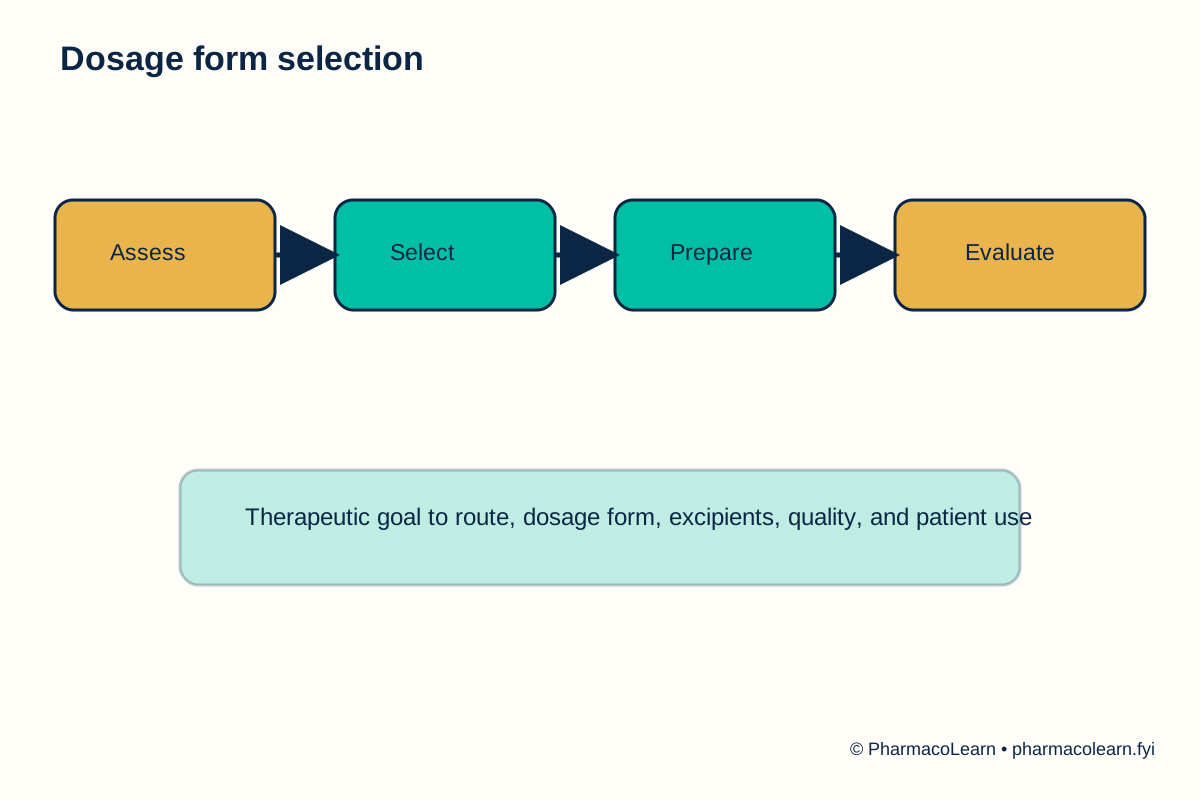
The formulation pathway is stepwise: identify the therapeutic objective, select a route, choose a dosage form, select excipients, define manufacturing controls, evaluate quality, and give instructions for storage and use. A pharmacist balances dose accuracy, patient acceptability, stability, bioavailability, and safety.
Prescription
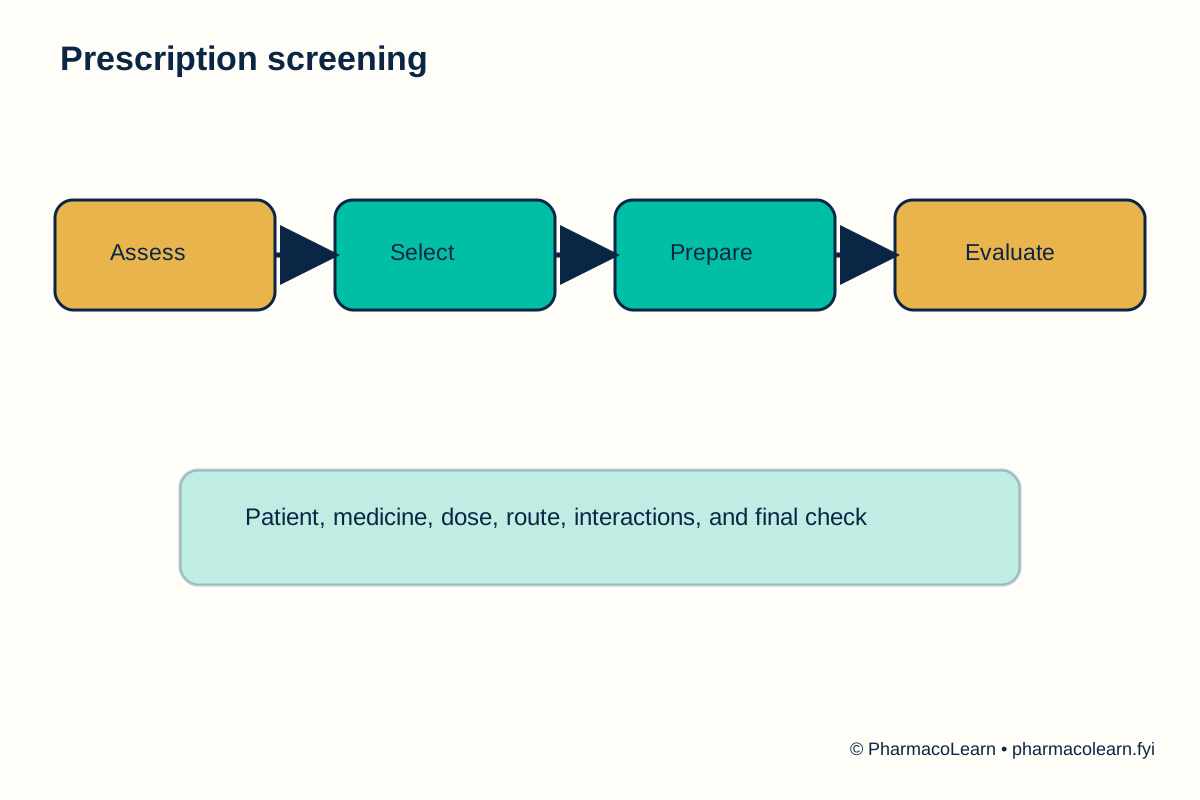
A prescription is an authorized written or electronic direction for supplying and using a medicine. Its components commonly include patient identifiers, date, superscription, inscription, subscription, signa, prescriber details, and authentication. The pharmacist checks legality, completeness, dose, route, frequency, duration, duplication, interactions, allergies, and clarity before dispensing.
Posology
Posology is the study of dose selection. Dose depends on age, body mass, body surface area, renal and hepatic function, route, disease severity, dosage form, tolerance, interactions, and therapeutic target. The safest calculation workflow is: identify the prescribed dose basis, convert units, determine the patient factor, calculate the quantity, then perform an independent check.
Worked example: Young's rule is an historical age-based estimate and should not replace a validated reference. If a reference specifically authorizes it, child dose = age divided by age plus 12, multiplied by adult dose. Always verify the method before use.
FAQs
Worked example
A patient who cannot swallow a tablet may need a suitable liquid, dispersible product, or another route. The pharmacist checks whether crushing is permitted before recommending an alternative.
FAQs
Why are dosage forms needed? They protect the ingredient, control delivery, and improve accurate use.
- Prescription screening is a clinical safety step.
- Posology requires patient factors and independent checking.
Takeaways
- Apply the unit mechanism and quality controls in the stated order.
- Check formulation, route, storage, measurement, and patient instructions before supply.
Integrated practice note
Use the unit content as a connected pharmacy workflow: identify the formulation or process, control the relevant quality attributes, document the decision, and communicate safe use to the patient and care team.
References
References: [1], [2], [3].
Mechanism and clinical reasoning
Dosage-form design links the active ingredient to patient use. The route determines the biological barrier, the dosage form determines how the dose is presented, excipients control manufacturability and release, packaging protects quality, and counselling determines whether the patient can use the product correctly. A formulation is successful only when these links work together.
Clinical example: a patient who cannot swallow a tablet may need a suitable liquid, dispersible product, or another route. The pharmacist checks whether crushing is permitted, because altering a modified-release or enteric-coated product can change exposure and cause harm.
Clinical correlation
Prescription screening connects the written order to the actual patient. Confirm the indication, allergy history, renal and hepatic function, formulation, dose, route, duration, and practical ability to use the product. Clarify ambiguous abbreviations or conflicting directions before supply.
Worked example
If an order requests a tablet to be crushed for a feeding tube, the pharmacist checks the release design, tube location, compatibility, and approved administration instructions before recommending an alternative. The safest answer is not based on tablet appearance alone.
Unit 2: History and Development of Pharmacy
Syllabus scope
This unit covers the syllabus topics named in the unit title and their formulation, dispensing, quality, and patient-safety implications.
Pharmacy developed from the preparation of medicines by healers, apothecaries, and dispensers into a science based on chemistry, biology, pharmaceutics, quality systems, and clinical care. The modern pharmacist contributes to formulation, manufacturing, dispensing, medicine information, pharmacovigilance, and patient counselling.
The pharmaceutical industry evolved through improved extraction, purification, synthetic chemistry, dosage-form engineering, microbiological control, packaging, and regulation. Industrial production requires reproducible processes rather than reliance on one operator. Step by step, an industrial product moves from development and preformulation to scale-up, validation, manufacture, testing, release, distribution, and post-market monitoring.
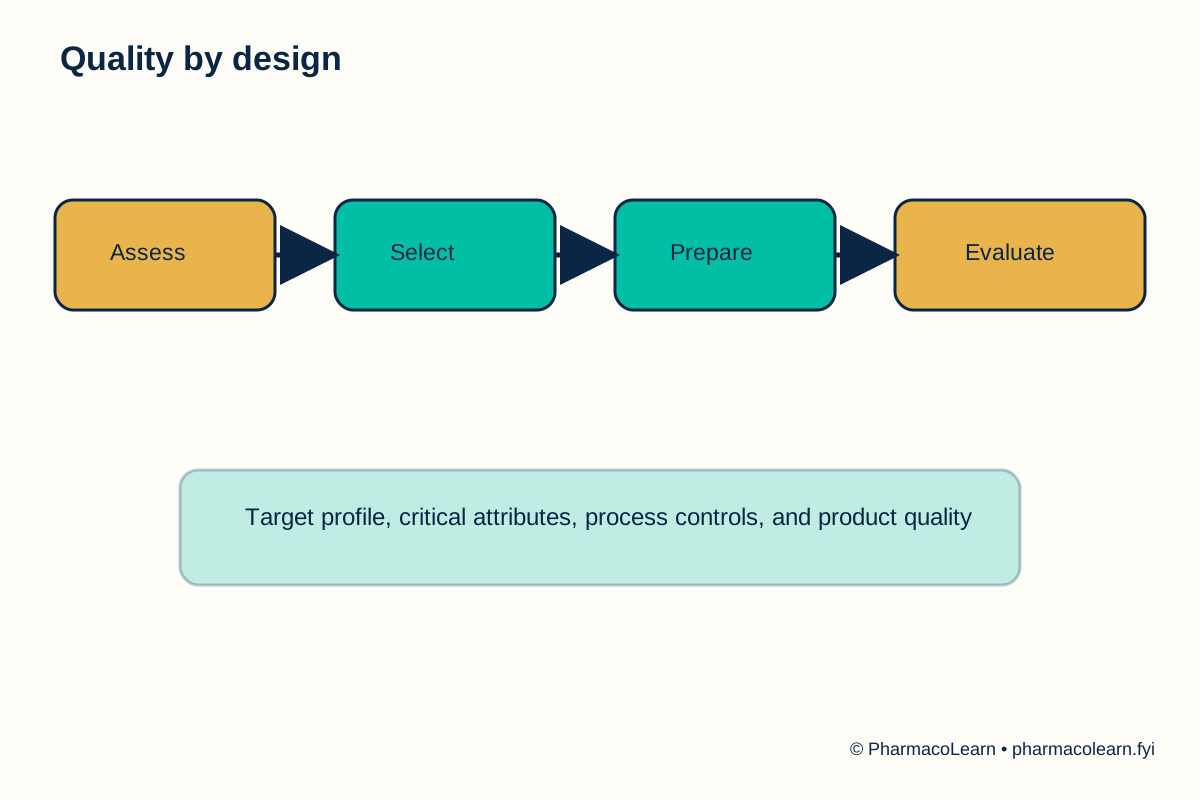
Quality is built into the process. Good manufacturing practice controls premises, equipment, personnel, documentation, materials, production, packaging, laboratory testing, complaints, and recalls. A deviation is investigated by identifying the event, assessing product impact, finding root cause, implementing corrective and preventive action, and checking effectiveness.
Clinical correlation: a formulation may be chemically correct but clinically unsafe if the strength, labelling, storage, delivery device, or patient instructions are wrong. Pharmacists connect industrial quality with safe patient use.
Worked example: a suspension that settles rapidly may still contain the correct drug, but poor redispersibility can produce an inaccurate dose. Product development therefore evaluates both assay and dose uniformity during use.
Clinical correlation
Pharmaceutics connects dosage-form design with route, stability, correct administration, patient understanding, and safe medicine use. The pharmacist checks the formulation and clinical context before supply.
FAQs
Worked example
A suspension that settles rapidly may still contain the correct drug, but poor redispersibility can produce an inaccurate dose. Product development therefore evaluates dose uniformity during use.
FAQs
Why did pharmacy become industrial? Demand for consistent, scalable, tested medicines required controlled production.
- Pharmacy combines product science and patient care.
- Quality failures can occur before, during, or after manufacture.
Takeaways
- Apply the unit mechanism and quality controls in the stated order.
- Check formulation, route, storage, measurement, and patient instructions before supply.
Integrated practice note
Use the unit content as a connected pharmacy workflow: identify the formulation or process, control the relevant quality attributes, document the decision, and communicate safe use to the patient and care team.
References
References: [1], [4], [5].
Unit 3: Pharmacopoeias and Formularies
Syllabus scope
This unit covers the syllabus topics named in the unit title and their formulation, dispensing, quality, and patient-safety implications.
The Indian Pharmacopoeia provides official standards for identity, purity, strength, tests, assays, storage, and labelling of substances and dosage forms recognized in India. The British Pharmacopoeia and United States Pharmacopeia provide standards within their own official frameworks. The European Pharmacopoeia serves participating European jurisdictions. An extra pharmacopoeia is a reference work rather than the same type of legally adopted compendium. The Indian National Formulary supports rational selection and use of medicines.
A monograph is interpreted step by step: confirm the substance name and scope, review definition and limits, inspect identification tests, check purity tests, follow assay requirements, note storage and labelling, and record the edition used. A general chapter may define a method applied across multiple monographs.
Pharmacopoeial standards are not simply recipes. They define minimum quality expectations. A batch can fail identity, impurities, assay, microbial quality, dissolution, or packaging requirements even if the appearance is acceptable.
Clinical correlation: the pharmacist uses official standards to evaluate whether a material or product is fit for use and to interpret certificates of analysis. The applicable legal standard depends on jurisdiction and product status.
FAQs
Worked example
If an assay result appears acceptable but the sample fails an identification test, the batch cannot be released on assay alone. Identity is a separate quality attribute.
FAQs
Are all pharmacopoeias interchangeable? No. They differ in legal status, monographs, methods, and acceptance limits.
- Use the current applicable edition.
- Read a monograph with its general chapters and stated conditions.
Takeaways
- Apply the unit mechanism and quality controls in the stated order.
- Check formulation, route, storage, measurement, and patient instructions before supply.
Integrated practice note
Use the unit content as a connected pharmacy workflow: identify the formulation or process, control the relevant quality attributes, document the decision, and communicate safe use to the patient and care team.
References
References: [1], [5], [6].
Mechanism and clinical reasoning
A pharmacopoeial monograph converts a quality requirement into observable tests. Identification asks whether the material is the stated substance, purity tests limit relevant contaminants, assay estimates amount of active material, and dosage-form tests examine performance such as dissolution or uniformity. The pharmacist interprets the result with the monograph conditions, reference standard, sample identity, and edition.
Worked example: if an assay result appears acceptable but the sample fails an identification test, the batch cannot be released on assay alone. Identity is a separate quality attribute and the discrepancy requires investigation.
Clinical correlation
Official standards protect patients from substitution, contamination, inaccurate strength, and poor performance. Certificates of analysis support review but do not replace appropriate receipt, sampling, storage, and supplier controls.
Unit 4: Weights, Measures, and Pharmaceutical Calculations
Syllabus scope
This unit covers the syllabus topics named in the unit title and their formulation, dispensing, quality, and patient-safety implications.
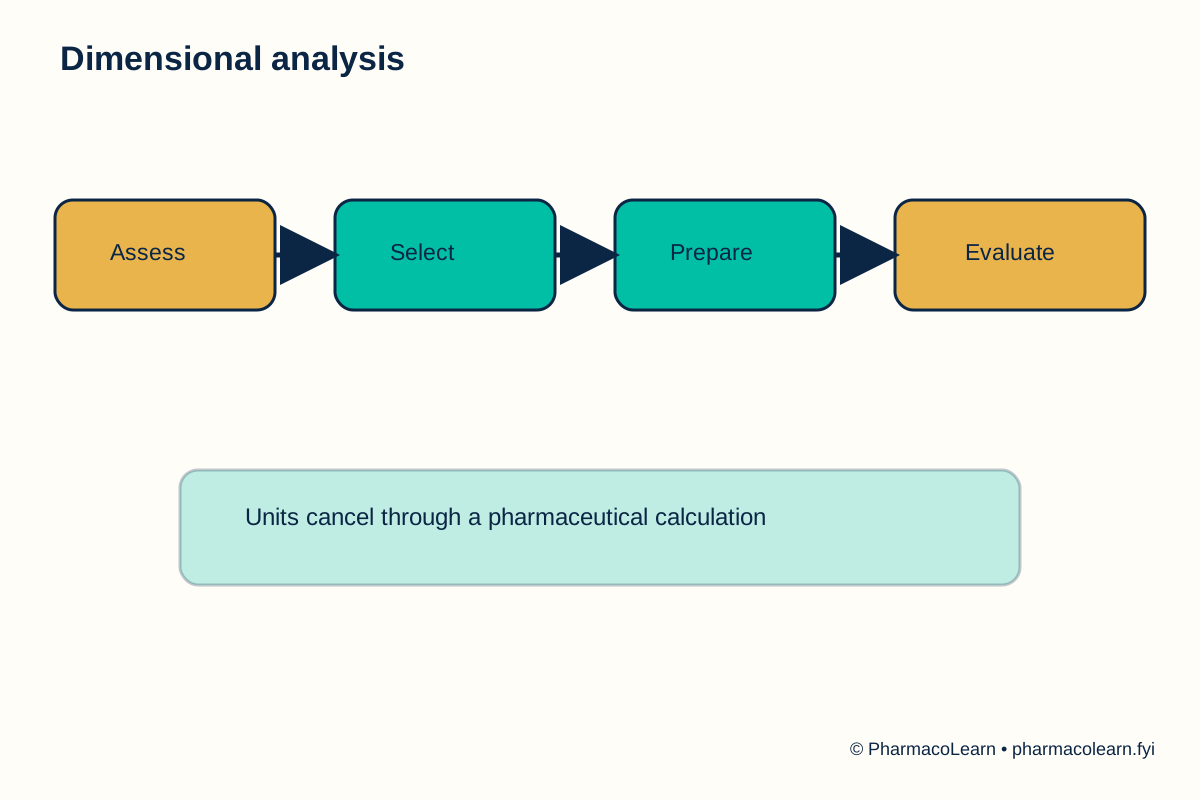
Pharmaceutical calculations require dimensional analysis. First write the desired unit, then multiply by conversion factors so unwanted units cancel. Common systems include metric mass, volume, and amount of substance. Use calibrated equipment and avoid confusing mass with volume.
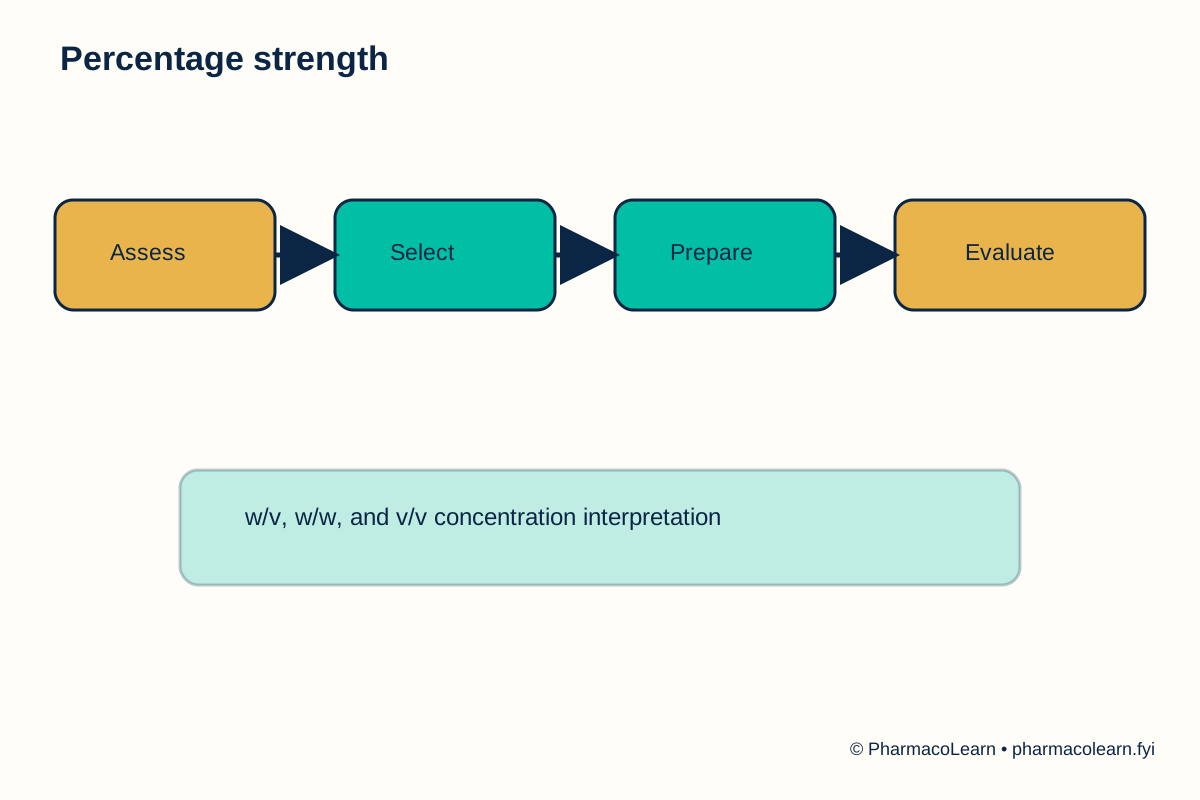
Percentage strength may be weight in weight, weight in volume, or volume in volume. A 5% w/v preparation contains 5 g of solute in a final volume of 100 mL. A 5% w/w preparation contains 5 g in a final mass of 100 g. The label must identify the basis when ambiguity is possible.
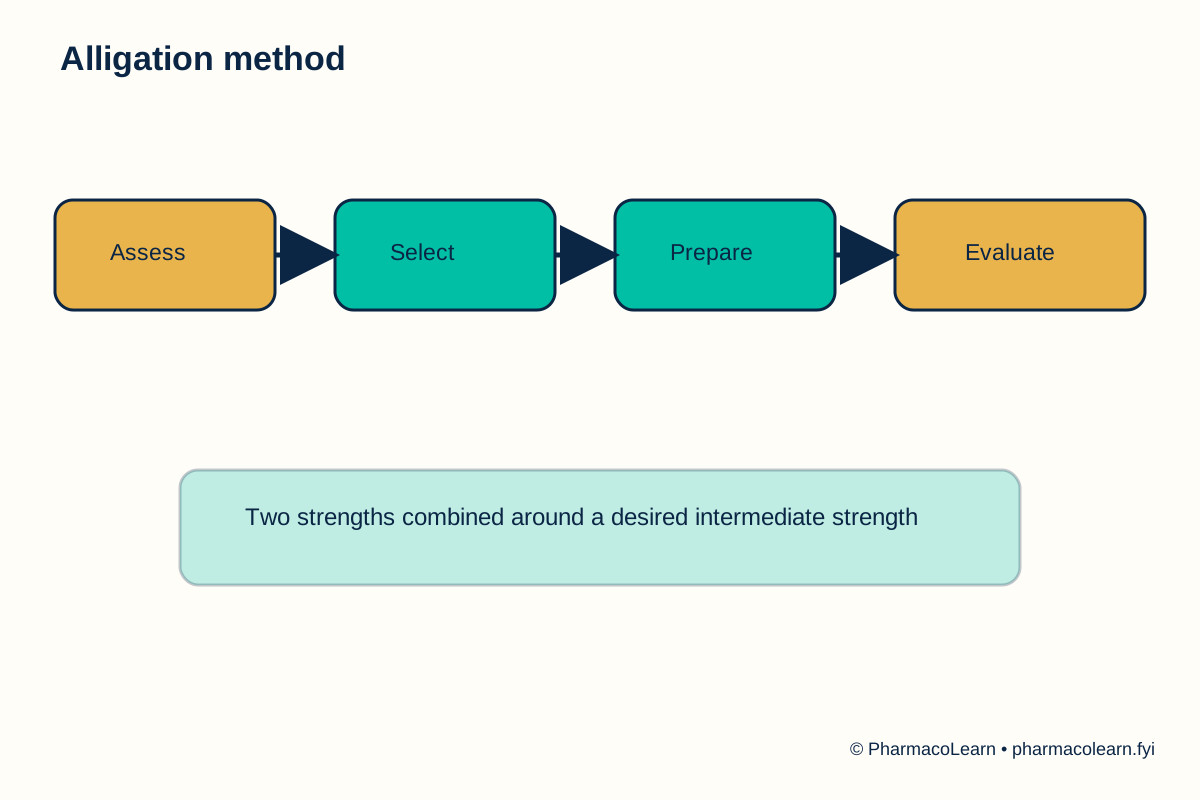
Alligation determines the proportions of two strengths needed to make an intermediate strength. The difference between the high strength and the desired strength gives parts of the low strength. The difference between the desired strength and the low strength gives parts of the high strength. Check the weighted average after calculation.
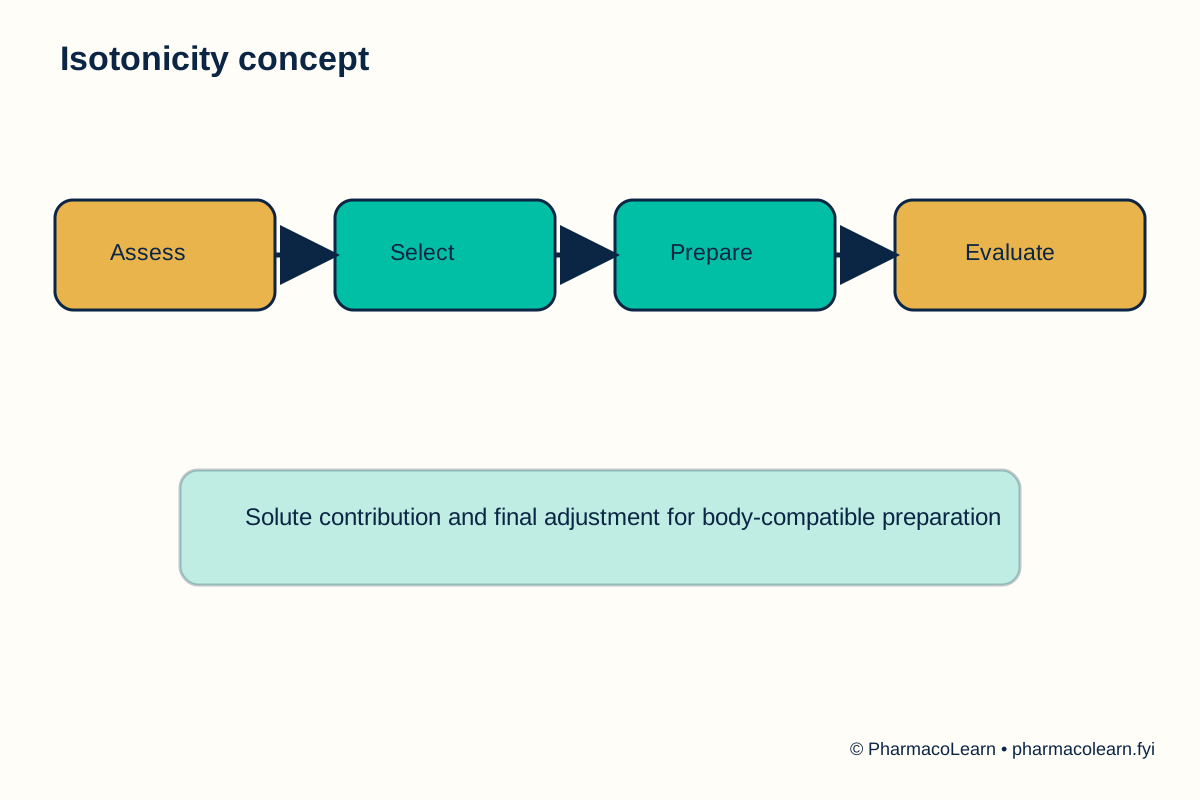
Isotonicity concerns osmotic pressure relative to body fluids. The final preparation must be suitable for its route. Sodium chloride equivalent methods estimate the amount of sodium chloride that would produce an equivalent osmotic effect. Exact calculations depend on validated constants and the official method.
Proof spirit is a historical alcohol-strength system. Conversion should use the specified standard and temperature. If a numerical proof-spirit factor is required, use the factor stated in the approved reference rather than importing a value from memory.
Worked example: to make 100 mL of 5% w/v solution, weigh 5 g, dissolve in a suitable portion of vehicle, and make up to a final volume of 100 mL. Do not add 5 g to 100 mL of solvent.
Takeaways
- State the concentration basis.
- Make the final volume or mass, not an uncorrected solvent volume.
- Verify constants and legal units before dispensing.
Integrated practice note
Use the unit content as a connected pharmacy workflow: identify the formulation or process, control the relevant quality attributes, document the decision, and communicate safe use to the patient and care team.
References
References: [1], [2], [7].
Mechanism and clinical reasoning
Dimensional analysis prevents a number from being separated from its unit. A percentage states both an amount and a basis, alligation balances the weighted strengths, and isotonicity estimates the osmotic effect relevant to the route. The calculation must therefore identify the final mass or volume, the concentration basis, the validated constant, and the permitted rounding rule.
Clinical correlation: a preparation labelled 5% w/v is not interchangeable with 5% w/w. Confusing the basis can produce an incorrect amount of solute and an unsafe dose.
Clinical correlation
Calculation errors can alter concentration, tonicity, dose, or final volume. The pharmacist checks the units, validated constants, route, and approved calculation policy before dispensing.
FAQs
Worked example
To make 100 mL of a 5% w/v solution, weigh 5 g, dissolve in a suitable portion of vehicle, and make up to a final volume of 100 mL.
FAQs
Why is the final volume important? Dissolving a solute changes the volume, so the stated concentration requires making the preparation up to the final volume.
- Write units at every step.
- State whether strength is w/w, w/v, or v/v.
Unit 5: Powders and Granules
Syllabus scope
This unit covers the syllabus topics named in the unit title and their formulation, dispensing, quality, and patient-safety implications.
Powders are dry, divided solid preparations. They may be simple, containing one ingredient, or compound, containing several. They may be bulk or divided, internal or external. Advantages include chemical stability and rapid dispersion. Limitations include poor taste, dust generation, segregation, hygroscopicity, and difficulty measuring very small doses.
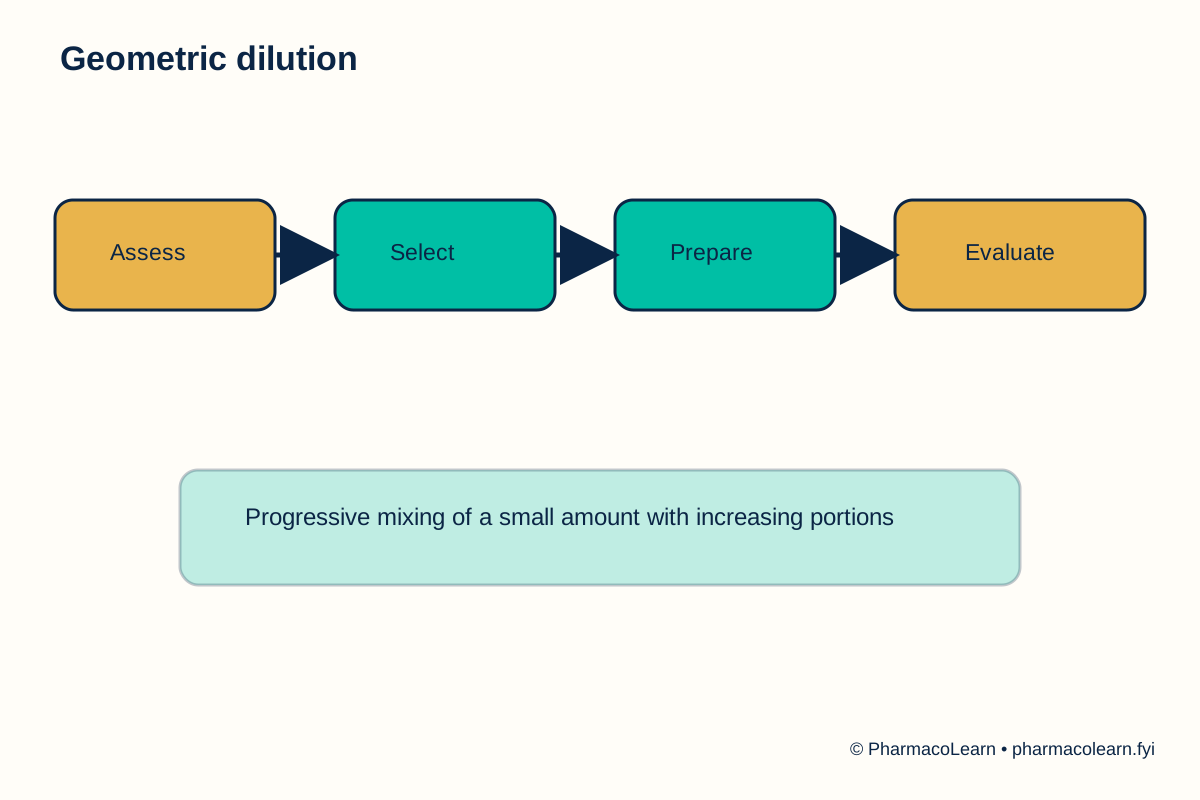
Preparation proceeds by drying if needed, size reduction, sieving, weighing, geometric dilution, blending, and packaging. Geometric dilution is essential when a small quantity of potent ingredient must be distributed through a larger carrier. Equal portions are mixed progressively so concentration becomes uniform.
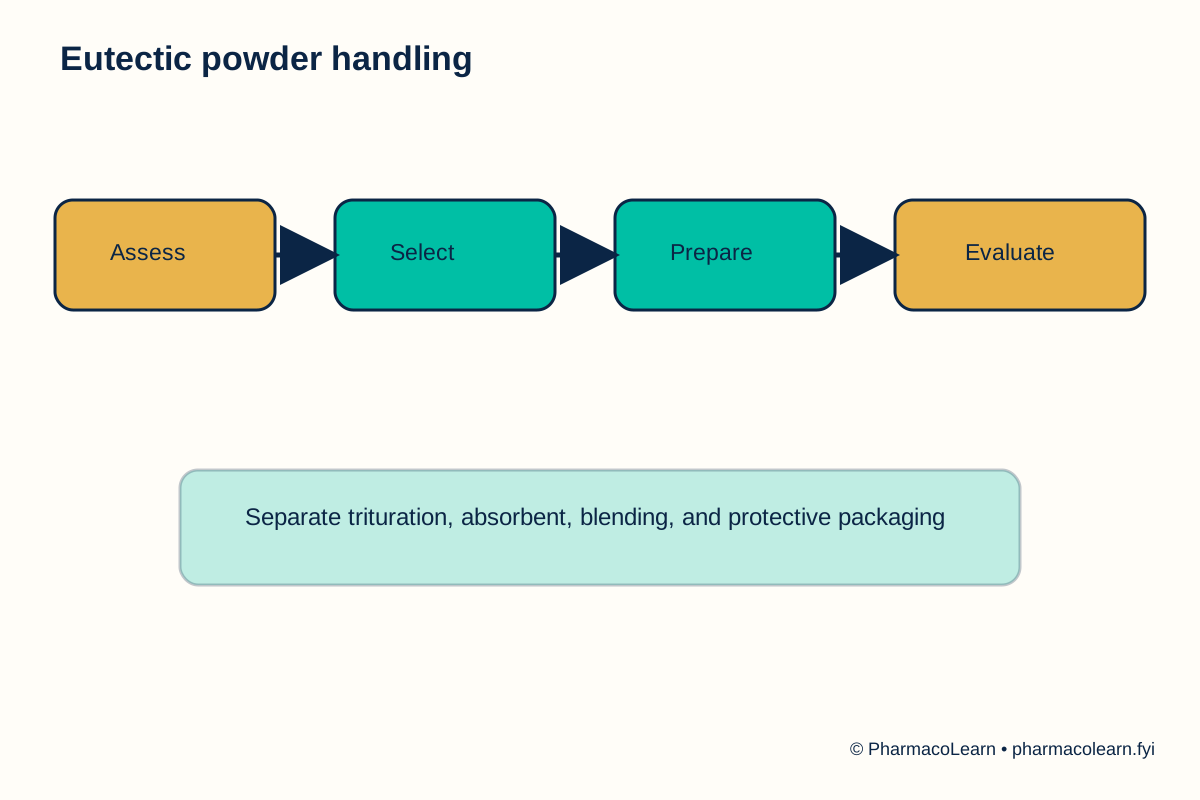
Eutectic powders contain components that liquefy when mixed because their combined melting point is lower. They are handled by separate trituration with an absorbent or by another validated method. Explosive powders are incompatible combinations that may react violently through friction, heat, or chemical interaction. They require avoidance rather than routine compounding.
Dusting powders must be fine, non-irritant, and suitable for external use. Insufflations are finely divided powders introduced into a body cavity with an appropriate device. Tooth powders must clean without excessive abrasion. Effervescent powders and granules release gas when acidic and alkaline components contact water; moisture control is critical.
Clinical correlation: powder segregation can produce dose variation. Pharmacists must consider particle size, density, flow, moisture, and packaging.
Clinical correlation
Pharmaceutics connects dosage-form design with route, stability, correct administration, patient understanding, and safe medicine use. The pharmacist checks the formulation and clinical context before supply.
FAQs
Worked example
When a small potent powder must be mixed with a large diluent, mix it with an approximately equal portion first, then add progressively larger portions.
FAQs
Why use geometric dilution? It reduces concentration gradients when blending a small amount with a large amount.
- Control moisture and particle size.
- Separate incompatible or eutectic ingredients when required.
Takeaways
- Apply the unit mechanism and quality controls in the stated order.
- Check formulation, route, storage, measurement, and patient instructions before supply.
Integrated practice note
Use the unit content as a connected pharmacy workflow: identify the formulation or process, control the relevant quality attributes, document the decision, and communicate safe use to the patient and care team.
References
References: [1], [2], [8].
Mechanism and clinical reasoning
Powder quality depends on particle size, surface area, density, moisture, flow, and mixing history. Geometric dilution reduces concentration gradients by repeatedly combining similar portions. Eutectic liquefaction occurs when components interact to lower the mixture melting point, while segregation occurs when particles separate during movement because their physical properties differ.
Worked example: when a small potent powder must be mixed with a large diluent, the pharmacist first mixes it with an approximately equal portion of diluent, then adds progressively larger portions. This is safer than adding the whole diluent at once.
Unit 6: Monophasic Liquid Dosage Forms
Syllabus scope
This unit covers the syllabus topics named in the unit title and their formulation, dispensing, quality, and patient-safety implications.
Monophasic liquids are homogeneous systems in which the solute is molecularly dispersed in a single phase. Formulation decisions include solubility, pH, buffer capacity, preservative compatibility, viscosity, taste, colour, container, and route.
Gargles and mouthwashes act in the oral cavity and are not automatically swallowed. Throat paints are viscous preparations applied locally. Ear drops require appropriate pH, sterility where required, and avoidance of use when the tympanic membrane status makes the product unsuitable. Nasal drops must be acceptable to nasal tissue. Liniments are rubbed onto skin, while lotions are generally applied without vigorous rubbing. Enemas deliver liquid rectally. Collodions form a film after solvent evaporation.
Stabilizers reduce chemical or physical change. Colours and flavours improve acceptability but may cause allergy or interact with the formulation. Preservatives require an effective concentration in the aqueous phase and must remain compatible with packaging and other excipients.
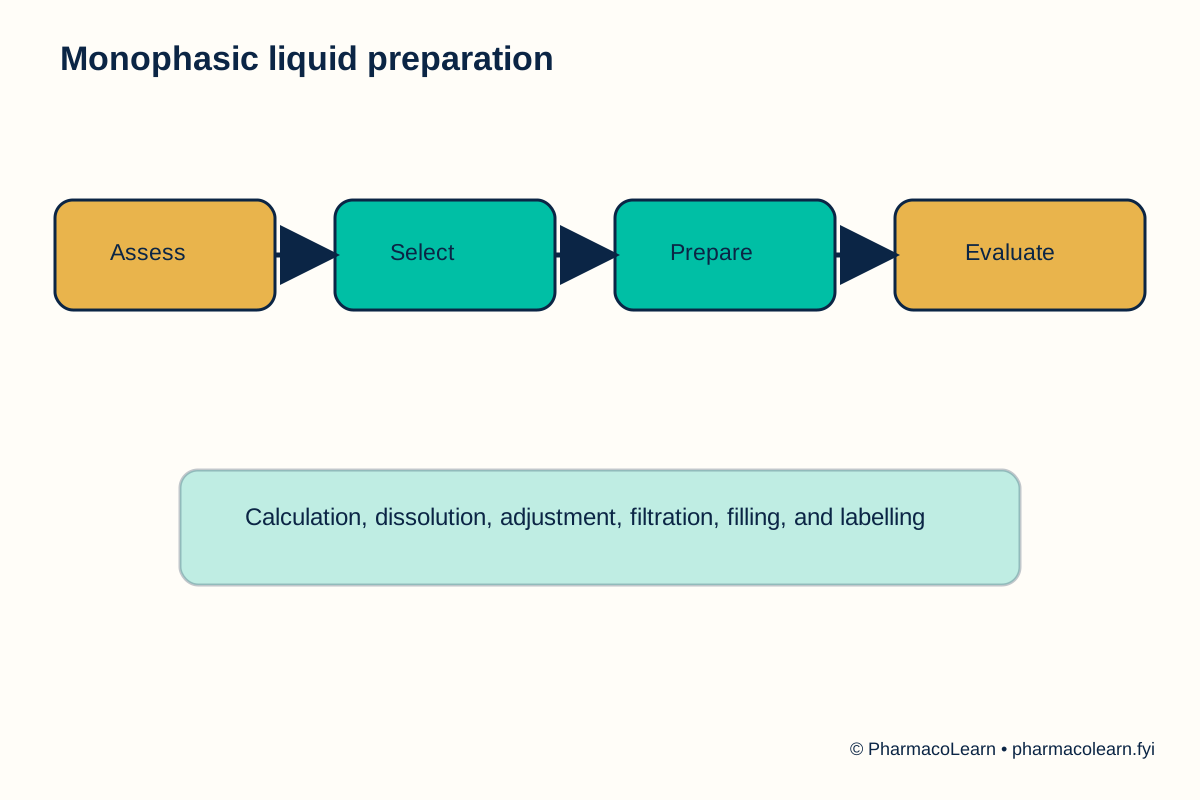
Step by step, a solution is prepared by calculating ingredients, dissolving the most soluble or difficult component in a suitable portion of vehicle, incorporating other ingredients, adjusting pH or volume, filtering if appropriate, filling, labelling, and evaluating clarity and stability.
Clinical correlation: wrong route labelling can cause injury. A pharmacist should distinguish external, oral, otic, nasal, and rectal use and give clear instructions.
Mechanism and clinical reasoning
A solution remains uniform because the solute is molecularly dispersed, but chemical stability can still fail through hydrolysis, oxidation, light exposure, pH change, or preservative loss. Preparation therefore proceeds from solubility and compatibility assessment to controlled dissolution, pH and volume adjustment, filtration when justified, suitable filling, and route-specific labelling.
Worked example: if an oral solution becomes cloudy after a pH adjustment, the pharmacist pauses release, checks precipitation and compatibility, confirms the formulation record, and investigates before dispensing. Appearance is an important signal but does not alone establish chemical quality.
Clinical correlation
Pharmaceutics connects dosage-form design with route, stability, correct administration, patient understanding, and safe medicine use. The pharmacist checks the formulation and clinical context before supply.
FAQs
Worked example
If an oral solution becomes cloudy after pH adjustment, pause release, check precipitation and compatibility, and investigate before dispensing.
FAQs
Why is a clear liquid not automatically stable? Degradation can occur without visible change, so formulation controls and appropriate storage are still required.
- Label the route and storage condition clearly.
- Check preservative and container compatibility.
Takeaways
- A monophasic liquid should be uniform throughout the container.
- Vehicle, pH, preservative, and packaging determine stability.
- Route-specific warnings are essential.
Integrated practice note
Use the unit content as a connected pharmacy workflow: identify the formulation or process, control the relevant quality attributes, document the decision, and communicate safe use to the patient and care team.
References
References: [1], [2], [9].
Unit 7: Suspensions and Emulsions
Syllabus scope
This unit covers the syllabus topics named in the unit title and their formulation, dispensing, quality, and patient-safety implications.
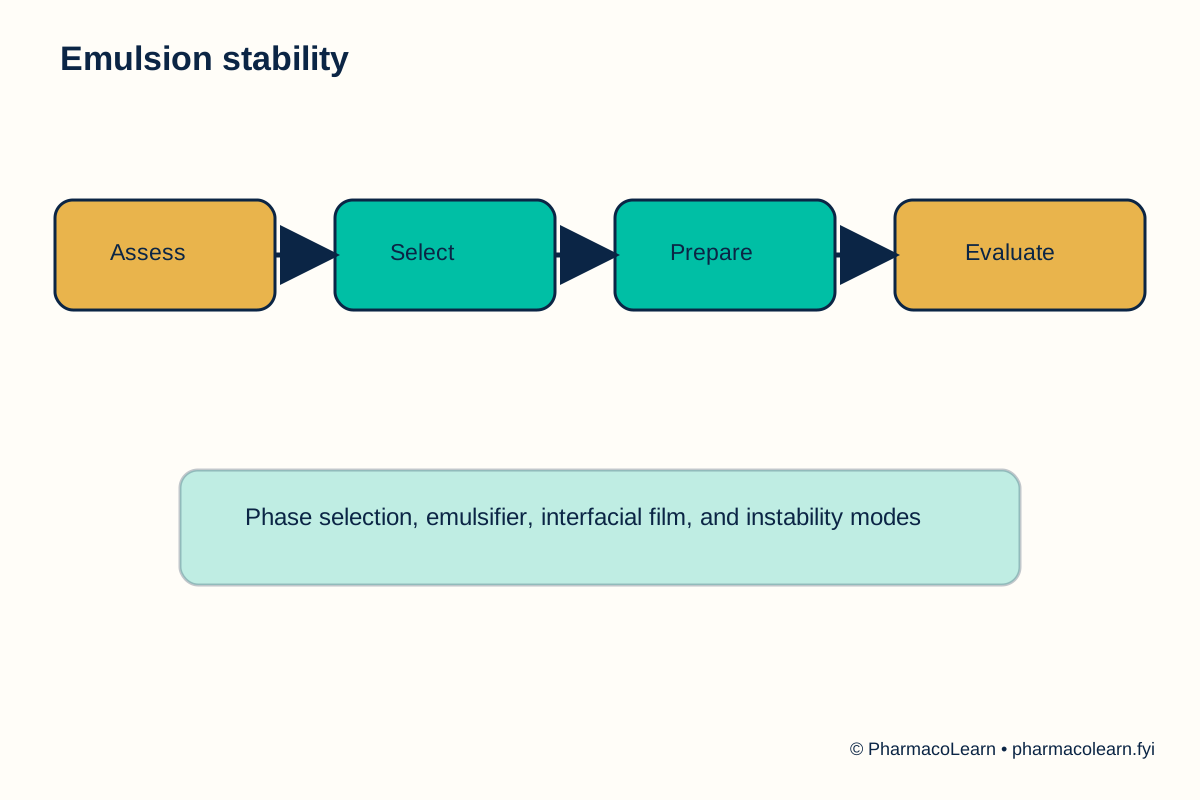
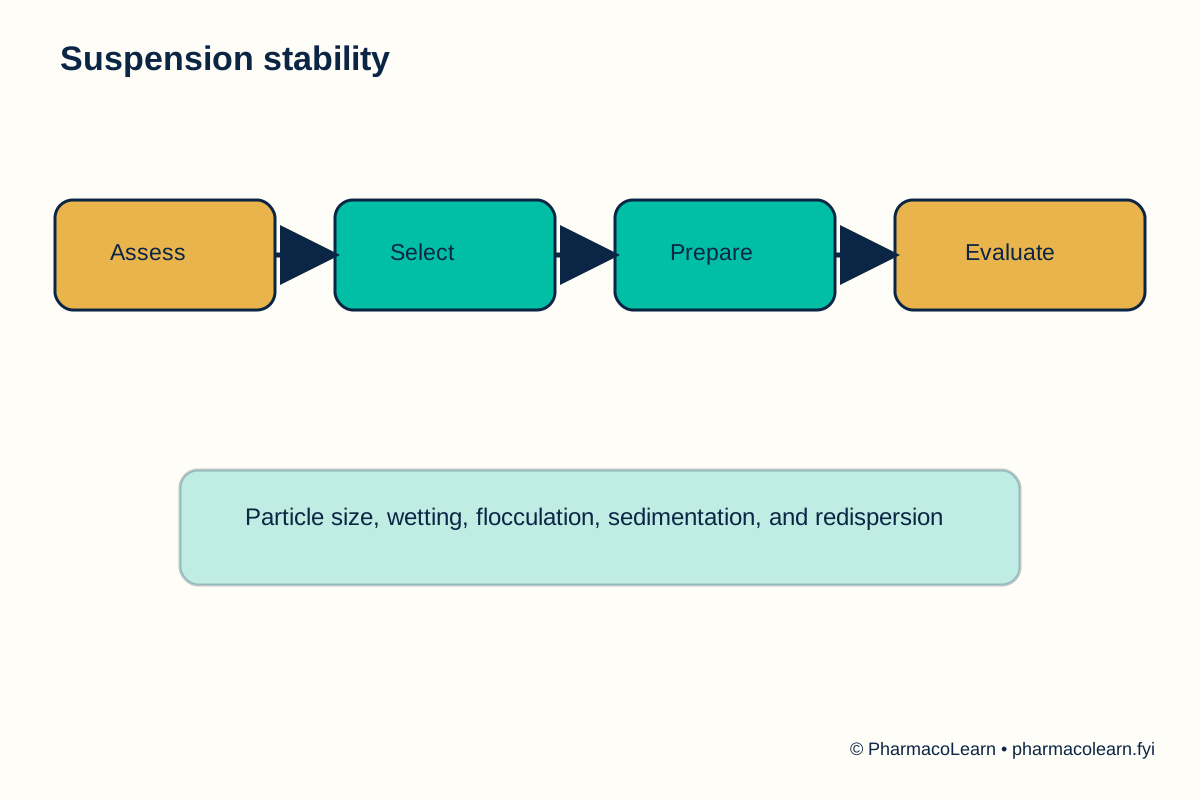
A suspension contains insoluble solid particles dispersed in a liquid. An emulsion contains one immiscible liquid dispersed in another, stabilized by an emulsifying agent. Suspensions may be flocculated or deflocculated. Flocculation produces loose aggregates that settle rapidly but redisperse readily. Deflocculated particles settle slowly but may form a compact cake.
Suspension formulation involves reducing particle size, wetting particles, selecting a structured vehicle, controlling sedimentation, and ensuring redispersibility. Stokes' law predicts that settling becomes slower when particle size decreases, vehicle viscosity increases, or density difference decreases. The law assumes conditions that may not hold perfectly in concentrated systems.
Emulsions are oil in water or water in oil. The type may be assessed by dilution, dye distribution, conductivity, or fluorescence, using validated interpretation. Formulation proceeds by selecting the phase ratio, emulsifier, method of incorporation, mixing energy, and preservative strategy. Instability may appear as creaming, flocculation, coalescence, cracking, or phase inversion.
Worked example: a suspension that forms a hard cake has poor redispersibility. Increasing structured-vehicle support or using controlled flocculation may improve use, but the final product must still pour and deliver an accurate dose.
Clinical correlation: inadequate shaking can cause underdose or overdose. Labels should state when to shake and how to measure the dose.
Clinical reasoning
The pharmacist evaluates whether the patient can redisperse the product reliably, whether the container allows accurate measurement, and whether storage changes viscosity or phase behaviour. A formulation that passes an initial appearance check can still fail during repeated use if the sediment cakes or the emulsion separates irreversibly.
Worked example: a bottle that forms a firm sediment after storage is investigated for particle size, vehicle structure, and flocculation. The product is not released merely because vigorous shaking temporarily restores its appearance.
Clinical correlation
Pharmaceutics connects dosage-form design with route, stability, correct administration, patient understanding, and safe medicine use. The pharmacist checks the formulation and clinical context before supply.
FAQs
Worked example
A bottle that forms a firm sediment after storage is investigated for particle size, vehicle structure, and flocculation. It is not released merely because vigorous shaking restores its appearance.
FAQs
What is the difference between a suspension and an emulsion? A suspension contains insoluble solid particles in a liquid, while an emulsion contains one immiscible liquid dispersed in another.
Why should a suspension be shaken? Inadequate shaking can cause underdose or overdose.
What is caking? It is the formation of a hard sediment with poor redispersibility.
Takeaways
- Sedimentation is not the same as irreversible caking.
- Emulsion stability depends on interfacial film and formulation process.
- Evaluation includes appearance, pH, viscosity, particle size, redispersibility, and dose uniformity.
Integrated practice note
Use the unit content as a connected pharmacy workflow: identify the formulation or process, control the relevant quality attributes, document the decision, and communicate safe use to the patient and care team.
References
References: [1], [2], [10].
Unit 8: Suppositories and Pessaries
Syllabus scope
This unit covers the syllabus topics named in the unit title and their formulation, dispensing, quality, and patient-safety implications.
Suppositories are solid or semisolid preparations inserted into the rectum, vagina, or urethra. Pessaries are vaginal preparations. They may provide local or systemic action and can help when oral administration is unsuitable.
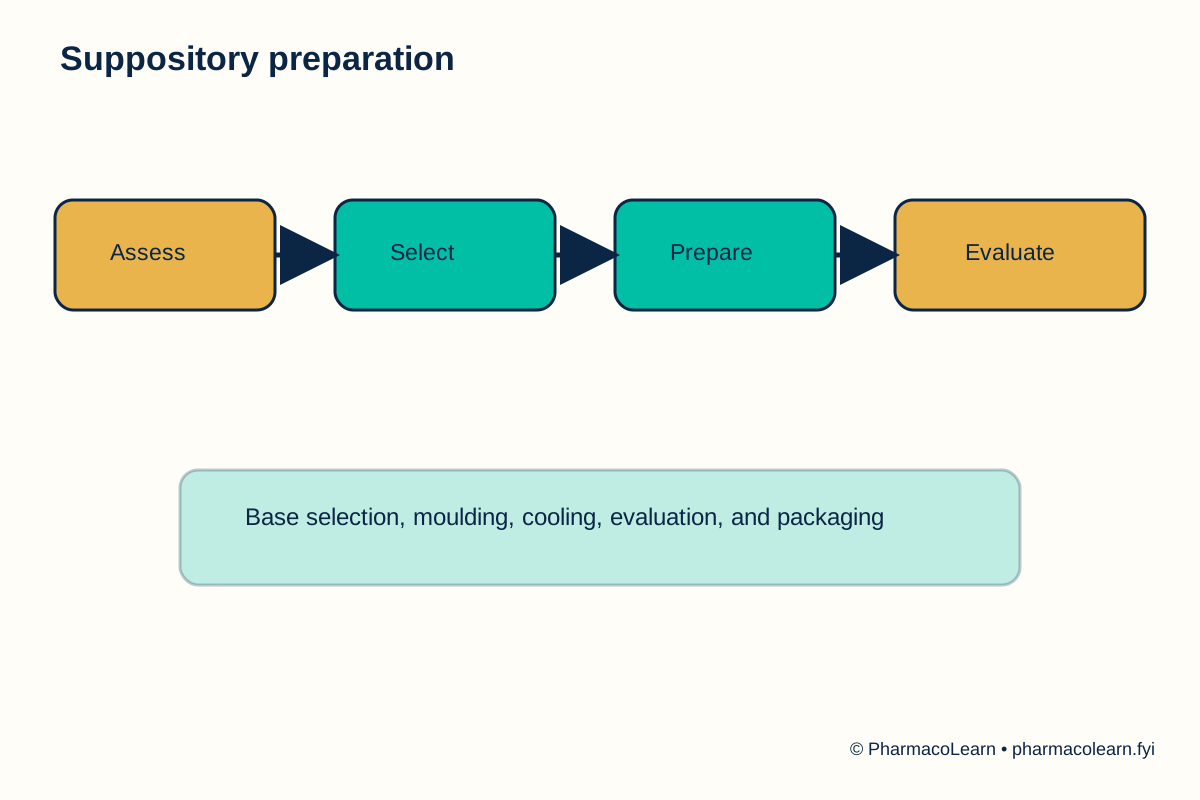
Bases include fatty bases, water-miscible bases, and water-soluble bases. A suitable base should melt, soften, or dissolve at the site, release the active ingredient, remain stable, and be non-irritant. Preparation methods include fusion and moulding, compression, or hand rolling where appropriate. The method is chosen according to base and formulation properties.
Displacement value expresses the amount of drug that displaces a given mass of base. The calculation is completed by determining the total mould capacity, subtracting the base displacement caused by the drug, and filling the remaining capacity with base. The exact convention must be stated because textbooks may express the value in reciprocal forms.
Evaluation includes appearance, uniformity of mass, content uniformity, melting or softening behaviour, liquefaction time, mechanical strength, and release. Packaging protects from heat, moisture, deformation, and contamination.
Clinical correlation: counselling should cover insertion technique, storage, leakage expectations, hygiene, and when to seek help for pain or bleeding.
Mechanism and clinical reasoning
A rectal or vaginal preparation must release the active ingredient from its base at the site of administration. A fatty base may melt, while a water-miscible base may dissolve or disperse. Drug partitioning, particle size, base composition, moisture, mechanical strength, and storage temperature influence release and handling. Displacement value protects dose accuracy by accounting for the space occupied by the drug in the mould.
Worked example: if adding drug reduces the amount of base required to fill a mould, the pharmacist calculates the drug displacement using the stated convention and documents the formula. A reciprocal convention must not be mixed with a direct convention.
Clinical correlation
Pharmaceutics connects dosage-form design with route, stability, correct administration, patient understanding, and safe medicine use. The pharmacist checks the formulation and clinical context before supply.
FAQs
Worked example
If adding drug reduces the amount of base required to fill a mould, calculate drug displacement using the stated convention and document the formula.
FAQs
Why does base selection matter? It determines softening or melting, drug release, stability, and patient comfort.
- Use the stated displacement-value convention.
- Protect preparations from heat, moisture, deformation, and contamination.
Takeaways
- Base selection controls release and patient acceptability.
- Displacement value prevents mass and dose errors.
- Route-specific counselling is part of formulation quality.
Integrated practice note
Use the unit content as a connected pharmacy workflow: identify the formulation or process, control the relevant quality attributes, document the decision, and communicate safe use to the patient and care team.
References
References: [1], [2], [11].
Unit 9: Galenicals and Extraction
Syllabus scope
This unit covers the syllabus topics named in the unit title and their formulation, dispensing, quality, and patient-safety implications.
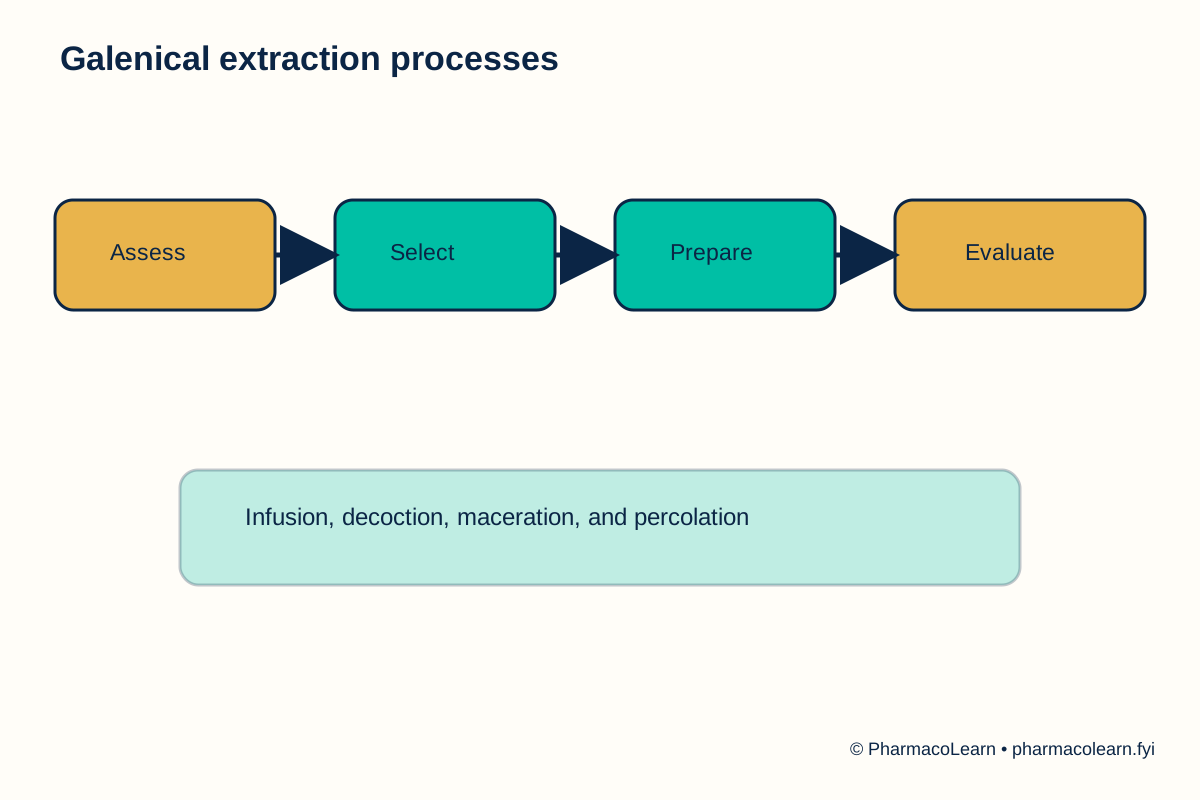
Galenicals are preparations made from crude plant or animal materials by processes such as infusion, decoction, maceration, and percolation. The result depends on identity, particle size, solvent, temperature, time, agitation, solvent-to-material ratio, and protection from degradation.
Infusion uses contact with a solvent, often at a moderate temperature, for materials that release constituents readily. Decoction uses boiling or near-boiling conditions for tougher materials, but heat-sensitive constituents may be damaged. Maceration involves soaking the material in solvent with occasional agitation and later pressing and filtration. Percolation passes solvent through a packed bed of comminuted material after suitable moistening and swelling.
Spirits are alcoholic or hydroalcoholic preparations of volatile substances. Tinctures are alcoholic or hydroalcoholic extracts or solutions. Extracts are concentrated preparations made by removing part or most of the solvent. Step by step, the pharmacist identifies the material, selects solvent, extracts, separates insoluble material, concentrates under suitable conditions, standardizes when required, and packages to limit light, oxygen, and moisture.
Clinical correlation: crude materials vary in identity and constituent concentration. Pharmacists should use authenticated material and approved standards rather than assume that a traditional name guarantees composition.
Mechanism and clinical reasoning
Extraction is mass transfer from a plant or animal matrix into a solvent. Solvent penetration, diffusion, agitation, temperature, time, particle size, and solvent polarity determine which constituents enter the liquid. Separation removes insoluble material, concentration increases the extract strength, and packaging reduces later degradation. Excess heat or prolonged exposure can destroy sensitive constituents or change the extract profile.
Worked example: a heat-sensitive constituent is not automatically treated by decoction. The pharmacist considers infusion, maceration, or another validated method, then checks identity, extraction conditions, concentration, and storage before use.
Clinical correlation
Pharmaceutics connects dosage-form design with route, stability, correct administration, patient understanding, and safe medicine use. The pharmacist checks the formulation and clinical context before supply.
FAQs
Worked example
A heat-sensitive constituent is not automatically treated by decoction. Consider infusion, maceration, or another validated method, then check identity and storage.
FAQs
Why does particle size affect extraction? Smaller particles provide greater surface area, but excessive comminution can complicate filtration and increase degradation.
- Match solvent and temperature to the constituents.
- Authenticate crude materials before extraction.
Takeaways
- Extraction is controlled mass transfer, not simply soaking.
- Heat, solvent polarity, and time change the extracted profile.
- Standardization and identification protect consistency.
Integrated practice note
Use the unit content as a connected pharmacy workflow: identify the formulation or process, control the relevant quality attributes, document the decision, and communicate safe use to the patient and care team.
References
References: [1], [2], [12].
Unit 10: Pharmaceutical Calculations
Syllabus scope
This unit covers the syllabus topics named in the unit title and their formulation, dispensing, quality, and patient-safety implications.
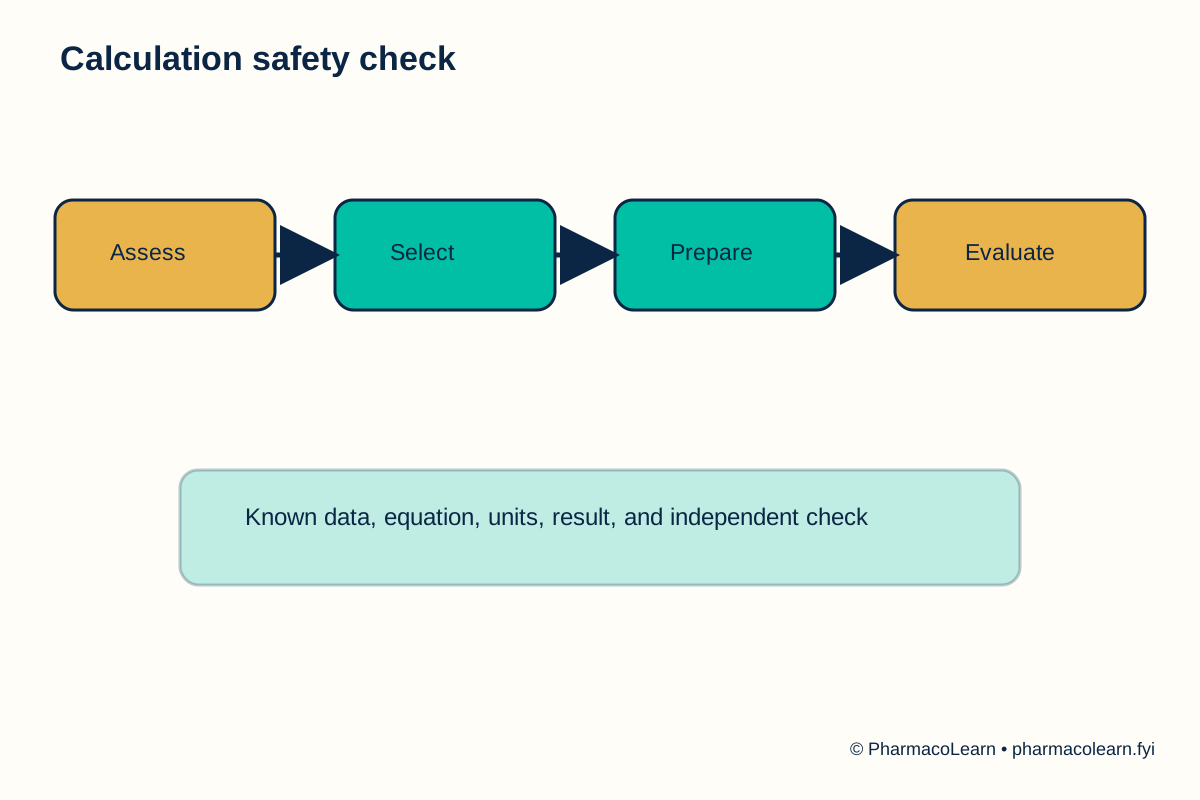
Pharmaceutical calculations include concentration, dilution, quantity, dose, density, specific gravity, flow, and formulation yield. The safest method is to write the known data with units, select the governing relationship, substitute values, calculate, and check whether the result is physically and clinically plausible.
Dilution uses C1V1 = C2V2 when the same solute is diluted and concentration units remain compatible. Alligation is useful for combining two strengths. Density equals mass divided by volume. Specific gravity compares the density of a substance with the density of water under the stated reference conditions.
Worked example: to prepare 250 mL of a 2% solution from a 10% stock using C1V1 = C2V2, V1 = 2 multiplied by 250 divided by 10 = 50 mL. Measure 50 mL stock and add vehicle to a final volume of 250 mL. The calculation does not mean adding 250 mL vehicle.
Dose calculations must distinguish prescribed dose, dose available, volume per dose, number of doses, and total quantity. For a liquid, volume per dose equals desired dose divided by concentration. Unit conversions should be performed before multiplication.
Exact formula sets and rounding rules may differ among institutional calculation policies. Use the locally approved policy for clinical dispensing.
Mechanism and clinical reasoning
Calculation safety comes from a visible chain: define the requested quantity, write the available concentration with units, choose the governing relationship, substitute values, calculate, round only at the permitted stage, and perform an independent plausibility check. This process catches errors that a calculator cannot detect, such as confusing final volume with solvent volume.
Clinical example: if a dose calculation produces a volume larger than the container or an implausible administration rate, stop and recheck the prescription, units, concentration, and formulation before preparation.
Clinical correlation
Calculation errors can produce the wrong strength, volume, dose interval, or infusion rate. The pharmacist documents the formula, units, source method, independent check, and any clarification with the prescriber. A correct arithmetic answer is not sufficient if the prescription, product concentration, or patient factor is wrong.
FAQs
Worked example
To prepare 250 mL of a 2% solution from a 10% stock, use C1V1 = C2V2 and measure 50 mL stock before making the final volume to 250 mL.
FAQs
Why should rounding be delayed? Early rounding can accumulate error across dilution, dose, and quantity calculations.
- Keep units visible until the final result.
- Independently check high-risk calculations before dispensing.
Takeaways
- Units are a safety check.
- Dilution calculations use final volume.
- Round only at the permitted stage and retain clinically meaningful precision.
Integrated practice note
Use the unit content as a connected pharmacy workflow: identify the formulation or process, control the relevant quality attributes, document the decision, and communicate safe use to the patient and care team.
References
References: [1], [2], [7].
Unit 11: Surgical Aids
Syllabus scope
This unit covers the syllabus topics named in the unit title and their formulation, dispensing, quality, and patient-safety implications.
Surgical dressings protect wounds, absorb exudate, maintain a suitable environment, and support healing. Selection depends on wound depth, moisture, infection status, tissue condition, frequency of change, and patient tolerance. A dressing should not adhere unnecessarily to a healing wound or conceal deterioration.
Absorbable gelatin sponge is a haemostatic aid that provides a matrix for clot formation and is absorbed over time when used appropriately. Its use is procedure-dependent and does not replace control of the bleeding source. Sutures approximate tissue edges. Ligatures tie vessels or structures. Materials may be absorbable or non-absorbable, monofilament or braided, and selected according to tissue, tensile support, infection risk, and desired healing time.
Medicated bandages combine a dressing or support material with an active substance. The formulation must provide uniform drug distribution, suitable adhesion, controlled release when intended, and safe removal. Packaging protects sterility or cleanliness where required and prevents loss of performance.
Clinical correlation: pharmacists should recognize that a surgical aid is a medical product with material, mechanical, sterility, and biocompatibility requirements. Advice must not substitute for surgical assessment when bleeding, infection, dehiscence, or necrosis is suspected.
Clinical correlation
Pharmaceutics connects dosage-form design with route, stability, correct administration, patient understanding, and safe medicine use. The pharmacist checks the formulation and clinical context before supply.
FAQs
Worked example
A surgical aid is selected according to wound depth, moisture, infection status, tissue condition, frequency of change, and patient tolerance.
FAQs
Why are sutures not interchangeable? Tissue type, healing time, tensile need, and infection risk differ.
- Match the aid to wound physiology.
- Haemostatic materials support, but do not replace, definitive bleeding control.
Takeaways
- Apply the unit mechanism and quality controls in the stated order.
- Check formulation, route, storage, measurement, and patient instructions before supply.
Integrated practice note
Use the unit content as a connected pharmacy workflow: identify the formulation or process, control the relevant quality attributes, document the decision, and communicate safe use to the patient and care team.
References
References: [1], [2], [13].
Unit 12: Incompatibilities
Syllabus scope
This unit covers the syllabus topics named in the unit title and their formulation, dispensing, quality, and patient-safety implications.
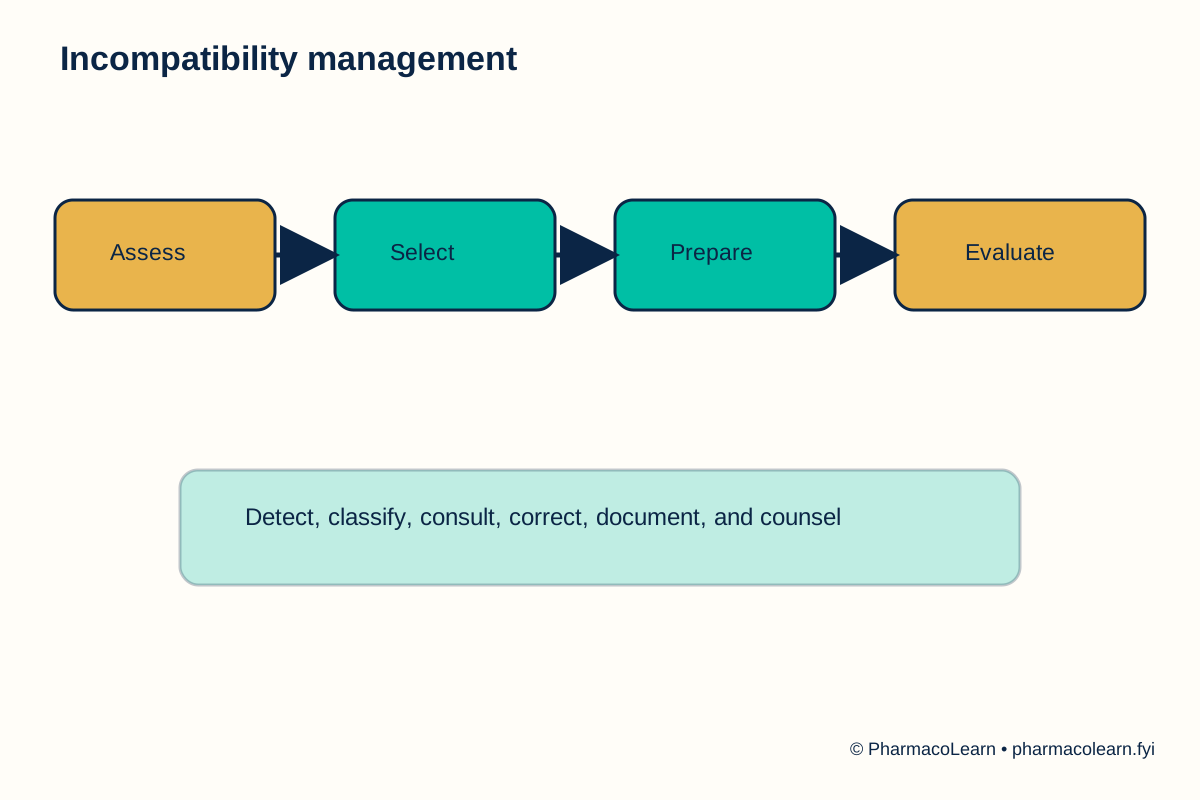
An incompatibility is an undesirable change caused by mixing ingredients, medicines, containers, or administration conditions. Physical incompatibility changes appearance, phase, solubility, viscosity, or uniformity. Chemical incompatibility changes molecular composition through hydrolysis, oxidation, reduction, complexation, or another reaction. Therapeutic incompatibility occurs when medicines or their effects conflict in the patient.
Recognition proceeds step by step: review the prescription and formulation, identify the ingredients and concentrations, check pH and solvent, inspect for precipitate, colour, gas, odour, heat, or phase separation, consult an authoritative reference, and decide whether to reformulate, separate administration, change the vehicle, adjust order, or refer to the prescriber.
Examples include precipitation after pH change, adsorption to a container, oxidation caused by oxygen or light, and antagonistic pharmacological effects. Prevention includes selecting compatible vehicles, controlling pH, using antioxidants or chelators where justified, protecting from light, separating incompatible ingredients, and labelling storage conditions.
Clinical correlation: a clear preparation may still be chemically degraded, while a visible precipitate may cause immediate dose nonuniformity. Therapeutic incompatibility can cause treatment failure or toxicity even when the product looks normal.
Clinical correlation
Pharmaceutics connects dosage-form design with route, stability, correct administration, patient understanding, and safe medicine use. The pharmacist checks the formulation and clinical context before supply.
FAQs
Worked example
When a suspected incompatibility appears, stop and investigate the ingredients, concentrations, pH, solvent, and authoritative compatibility information before deciding how to proceed.
FAQs
What is the first response to a suspected incompatibility? Stop and investigate using an authoritative compatibility reference. Do not guess.
- Separate physical, chemical, and therapeutic causes.
- Document the decision and communicate clinically relevant risk.
Takeaways
- Apply the unit mechanism and quality controls in the stated order.
- Check formulation, route, storage, measurement, and patient instructions before supply.
Integrated practice note
Use the unit content as a connected pharmacy workflow: identify the formulation or process, control the relevant quality attributes, document the decision, and communicate safe use to the patient and care team.
References
References: [1], [2], [14].
Diagrams
Other Year 1 subjects: Human Anatomy and Physiology · Pharmaceutics · Medicinal Biochemistry · Pharmaceutical Organic Chemistry · Pharmaceutical Inorganic Chemistry · Remedial Mathematics / Biology · Year 1 · Pharm D