
Pharmaceutical Organic Chemistry — Pharm D Year 1
Notes for Pharmaceutical Organic Chemistry, Pharm D Year 1, organised unit by unit following the PCI Pharm D syllabus. 16 units, 20 diagrams.
Syllabus: Pharm D Year 1 syllabus
Practicals: Pharmaceutical Organic Chemistry practicals
Units in this subject
- Unit 1: Structures and Physical Properties
- Unit 2: Nomenclature of Organic Compounds
- Unit 3: Free Radical Chain Reactions of Alkanes
- Unit 4: Alicyclic Compounds
- Unit 5: Nucleophilic Aliphatic Substitution
- Unit 6: Dehydrohalogenation and Elimination
- Unit 7: Electrophilic and Radical Addition
- Unit 8: Carbon-Carbon Double Bonds as Substituents
- Unit 9: Resonance and Conjugated Systems
- Unit 10: Electrophilic Aromatic Substitution
- Unit 11: Nucleophilic Addition and Acyl Substitution
- Unit 12: Condensation and Carbonyl Reactions
- Unit 13: Rearrangements, Amines and Phenols
- Unit 14: Nucleophilic Aromatic Substitution
- Unit 15: Oxidation and Reduction Reactions
- Unit 16: Official Organic Compounds
Unit 1: Structures and Physical Properties
Syllabus scope
This unit covers the syllabus topics named in the unit title and their organic-chemical mechanisms, pharmaceutical applications, and medicine-quality implications.
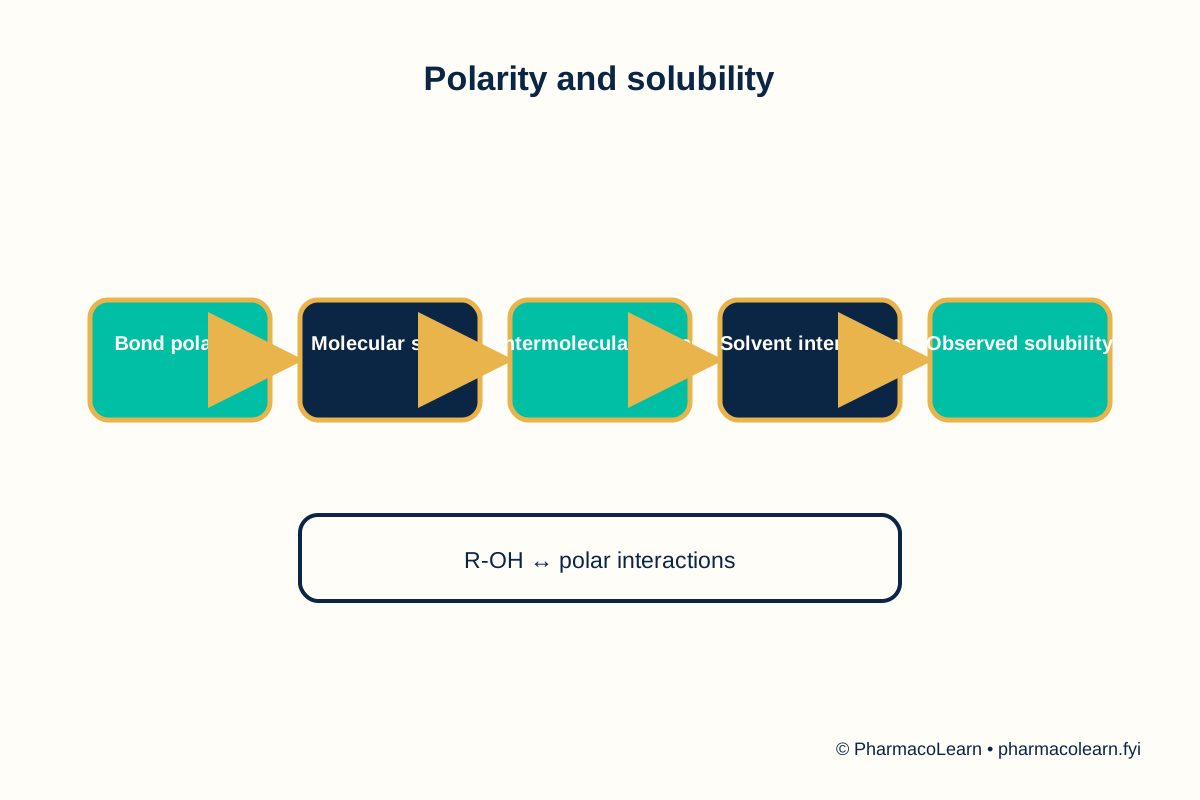
Organic structure determines polarity, intermolecular attraction, ionisation, solubility and reactivity. A polar bond results when atoms differ in electronegativity. Molecular polarity depends on both bond dipoles and molecular geometry. Hydrogen bonding, dipole interactions and dispersion forces influence melting point, boiling point and miscibility. Stronger intermolecular attraction usually raises boiling point, while symmetry can raise melting point by improving crystal packing.
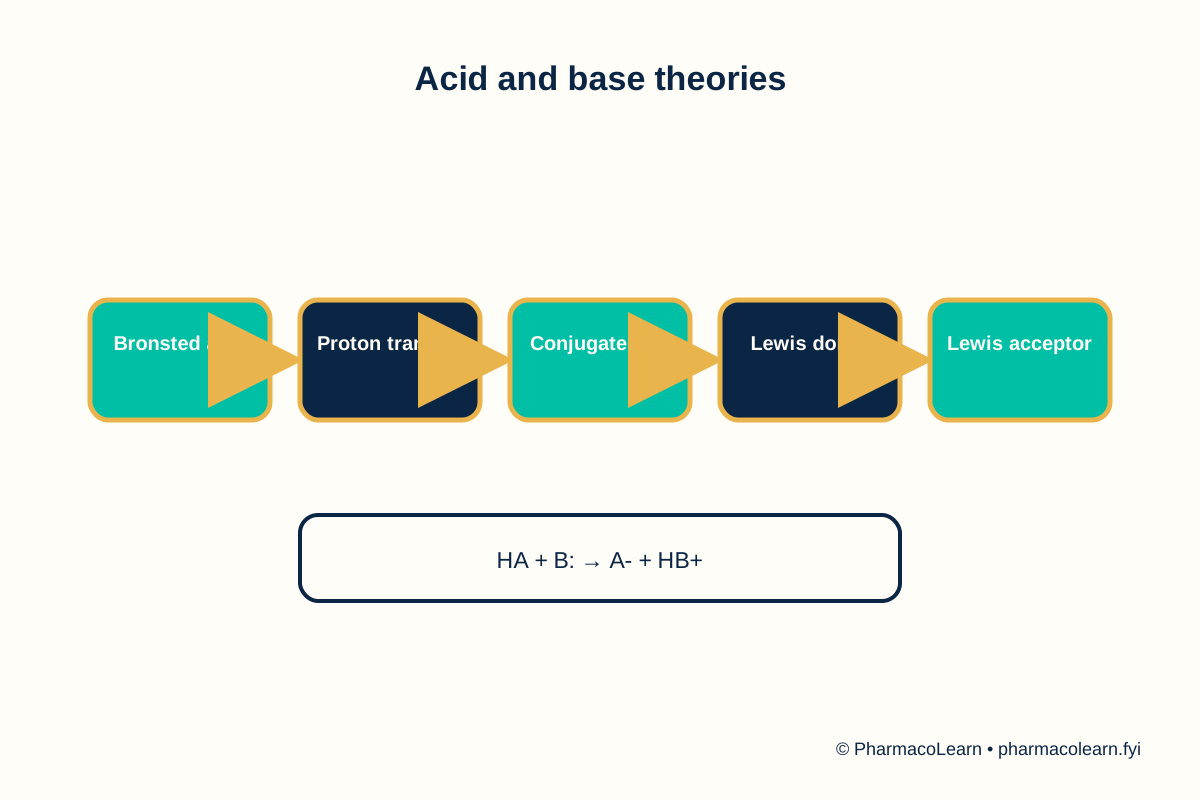
Bronsted-Lowry acids donate protons and bases accept protons. Lewis acids accept an electron pair and Lewis bases donate one. In a reaction, first identify the electron-pair donor, electron-pair acceptor and leaving group. Protic solvents can donate hydrogen bonds. Aprotic solvents cannot donate them but may solvate ions selectively. Ion pairs form when oppositely charged species remain associated, especially in media with limited dielectric separation.
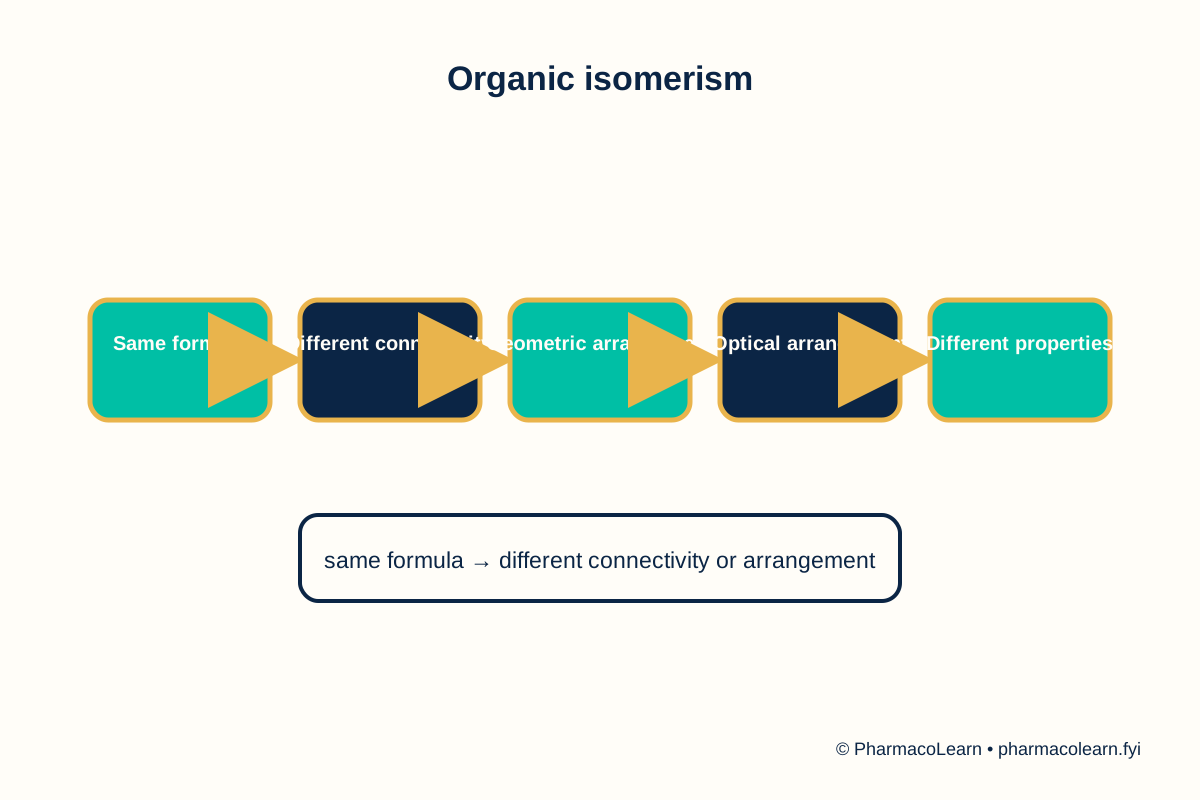
Isomerism includes constitutional isomerism and stereoisomerism. Constitutional isomers differ in connectivity. Stereoisomers have the same connectivity but differ in three-dimensional arrangement, including geometric and optical forms.
Clinical correlation
Ionisation changes membrane passage and aqueous solubility. A pharmacist must distinguish intrinsic solubility from pH-dependent apparent solubility.
Worked example
Ethanol mixes with water because its hydroxyl group hydrogen bonds with water, while its hydrocarbon group contributes weaker dispersion forces.
FAQs
Worked example
Ethanol mixes with water because its hydroxyl group hydrogen bonds with water, while its hydrocarbon group contributes weaker dispersion forces.
FAQs
- Why does salt dissolve in water? Ion-dipole interactions stabilize separated ions.
- Why can two isomers have different boiling points? Their shape and intermolecular forces differ.
References: PharmacoLearn, Pharm D Year 1 syllabus; Morrison and Boyd, Organic Chemistry; Clayden et al., Organic Chemistry; McMurry, Organic Chemistry.
Mechanism and pharmaceutical application
Polarity, hydrogen bonding, molecular size, and ionization influence melting point, boiling point, solubility, partitioning, and passage through biological barriers. A structural change can therefore alter formulation behaviour, absorption, distribution, metabolism, and elimination. The pharmacist uses these relationships to anticipate compatibility and exposure issues, while confirming the final decision with product-specific evidence.
Takeaways
- Identify the relevant structure, mechanism, stereochemical or electronic feature, and pharmaceutical implication.
- Apply the reaction pathway carefully and verify the product or quality decision against the stated conditions.
Integrated practice note
Organic chemistry connects structure and mechanism with solubility, stability, reactivity, metabolism, formulation, analysis, and patient safety. The pharmacist uses the mechanism to anticipate behaviour while checking the applicable product or monograph source.
References
PharmacoLearn, Pharm D Year 1 syllabus; Clayden et al., Organic Chemistry; Morrison and Boyd, Organic Chemistry.
Unit 2: Nomenclature of Organic Compounds
Syllabus scope
This unit covers the syllabus topics named in the unit title and their organic-chemical mechanisms, pharmaceutical applications, and medicine-quality implications.
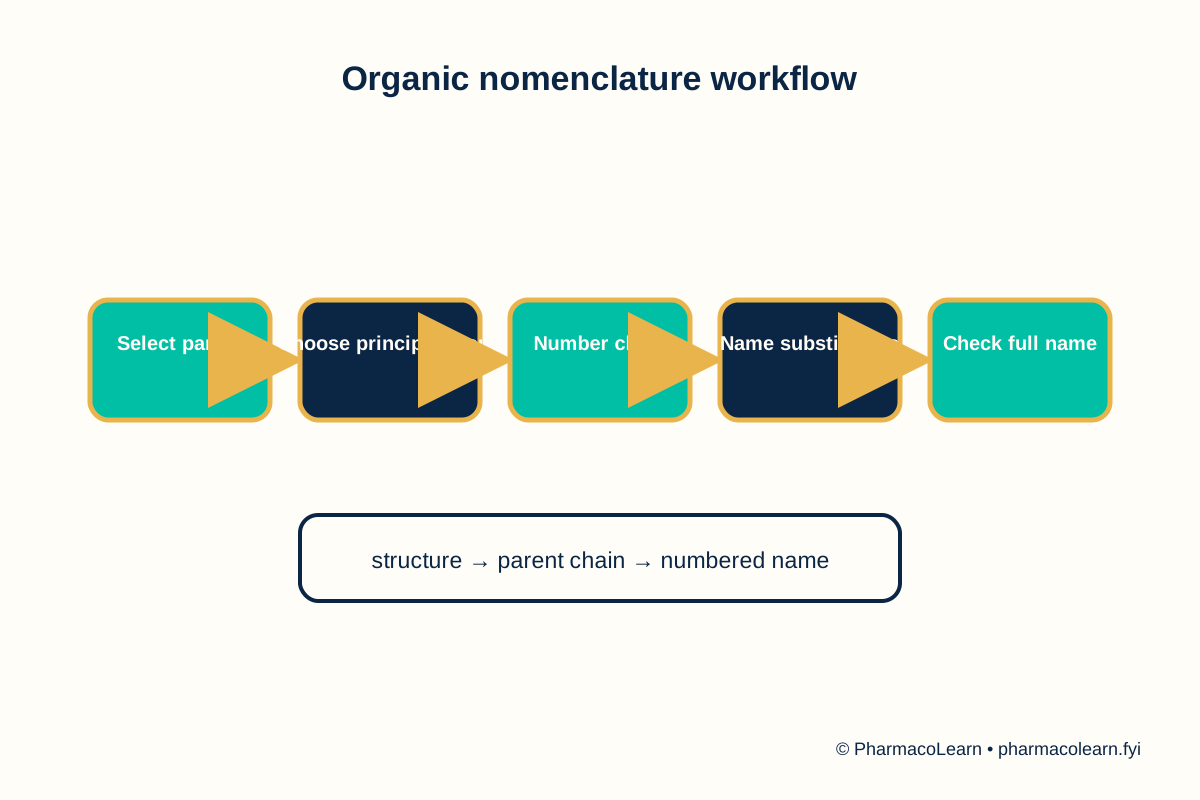
Systematic naming begins by selecting the parent structure, numbering it to give the principal functional group the lowest possible locant, identifying substituents, and arranging prefixes alphabetically. The syllabus classes are alkanes, alkenes, dienes, alkynes, alcohols, aldehydes, ketones, amides, amines, phenols, alkyl halides, carboxylic acids, esters, acid chlorides and cycloalkanes.
For alkanes use the longest carbon chain and the suffix -ane. Alkenes and alkynes use -ene and -yne, with numbering that prioritizes multiple bonds. Alcohols, aldehydes, ketones, amides and acids use characteristic suffixes. Esters are named as alkyl alkanoates. Acid chlorides use the acyl name followed by chloride. Cycloalkanes use cyclo- and are numbered to minimize substituent locants.
Worked example
A four-carbon chain with a terminal hydroxyl group is butan-1-ol. A three-carbon acid with a methyl ester group is methyl propanoate. The name is checked by reconstructing the parent chain, locating the principal group, then confirming each substituent.
Clinical correlation
Clear nomenclature prevents dispensing and compounding errors. Similar names can represent different functional groups and therefore different stability, solubility and toxicity.
FAQs
Worked example
A name is checked by identifying the parent structure, the principal functional group, substituents, numbering, and stereochemical descriptors before assigning the complete name.
FAQs
- What controls numbering? Principal functional group priority, then multiple bonds and substituents.
- Why learn common names? They remain present in official and medicinal literature, but systematic names reduce ambiguity.
References: PharmacoLearn, Pharm D Year 1 syllabus; IUPAC Nomenclature of Organic Chemistry; Morrison and Boyd, Organic Chemistry; Solomons, Organic Chemistry.
Takeaways
- Identify the relevant structure, mechanism, stereochemical or electronic feature, and pharmaceutical implication.
- Apply the reaction pathway carefully and verify the product or quality decision against the stated conditions.
Integrated practice note
Organic chemistry connects structure and mechanism with solubility, stability, reactivity, metabolism, formulation, analysis, and patient safety. The pharmacist uses the mechanism to anticipate behaviour while checking the applicable product or monograph source.
References
PharmacoLearn, Pharm D Year 1 syllabus; IUPAC Nomenclature of Organic Chemistry; Solomons, Organic Chemistry.
Unit 3: Free Radical Chain Reactions of Alkanes
Syllabus scope
This unit covers the syllabus topics named in the unit title and their organic-chemical mechanisms, pharmaceutical applications, and medicine-quality implications.
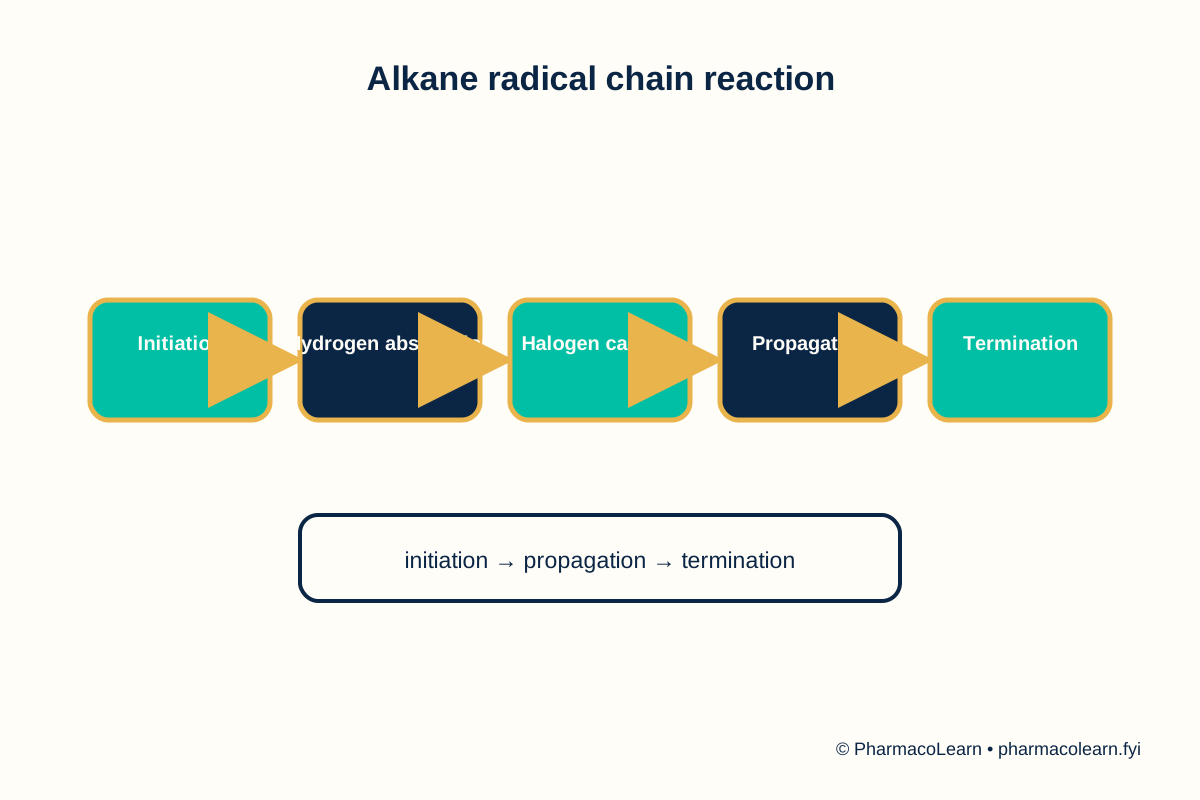
A free radical contains an unpaired electron. Alkane halogenation proceeds by initiation, propagation and termination. During initiation, light or heat breaks a halogen bond homolytically. In propagation, a halogen radical abstracts hydrogen from an alkane, producing hydrogen halide and an alkyl radical. The alkyl radical then reacts with halogen to form haloalkane and regenerate the halogen radical. Termination occurs when two radicals combine.
Relative reactivity reflects the stability of the radical formed and the selectivity of the halogenating reagent. Alkyl radicals are stabilized by hyperconjugation and electron donation from adjacent carbon groups. The order of approximate stability is tertiary, secondary, primary, then methyl. Radical stability is not the same as the safety or therapeutic suitability of a product.
Mechanism check
- Generate radicals.
- Abstract hydrogen.
- Form the carbon-halogen bond.
- Regenerate the radical.
- Stop the chain by radical combination or disproportionation.
Clinical correlation
Radical reactions can create reactive impurities during light or heat exposure. Pharmacists therefore consider packaging, antioxidants and storage conditions where the compound is susceptible to radical oxidation.
FAQs
Worked example
A radical chain reaction proceeds through initiation, propagation, and termination. Each propagation step consumes one radical and forms another, allowing the chain to continue.
FAQs
- Why is propagation called a chain process? A radical consumed in one step is regenerated in another.
- Why are mixtures formed? Different carbon-hydrogen positions can react.
References: PharmacoLearn, Pharm D Year 1 syllabus; Clayden et al., Organic Chemistry; March's Advanced Organic Chemistry; Carey and Sundberg, Advanced Organic Chemistry.
Takeaways
- Identify the relevant structure, mechanism, stereochemical or electronic feature, and pharmaceutical implication.
- Apply the reaction pathway carefully and verify the product or quality decision against the stated conditions.
Integrated practice note
Organic chemistry connects structure and mechanism with solubility, stability, reactivity, metabolism, formulation, analysis, and patient safety. The pharmacist uses the mechanism to anticipate behaviour while checking the applicable product or monograph source.
References
PharmacoLearn, Pharm D Year 1 syllabus; Clayden et al., Organic Chemistry; March's Advanced Organic Chemistry.
Unit 4: Alicyclic Compounds
Syllabus scope
This unit covers the syllabus topics named in the unit title and their organic-chemical mechanisms, pharmaceutical applications, and medicine-quality implications.
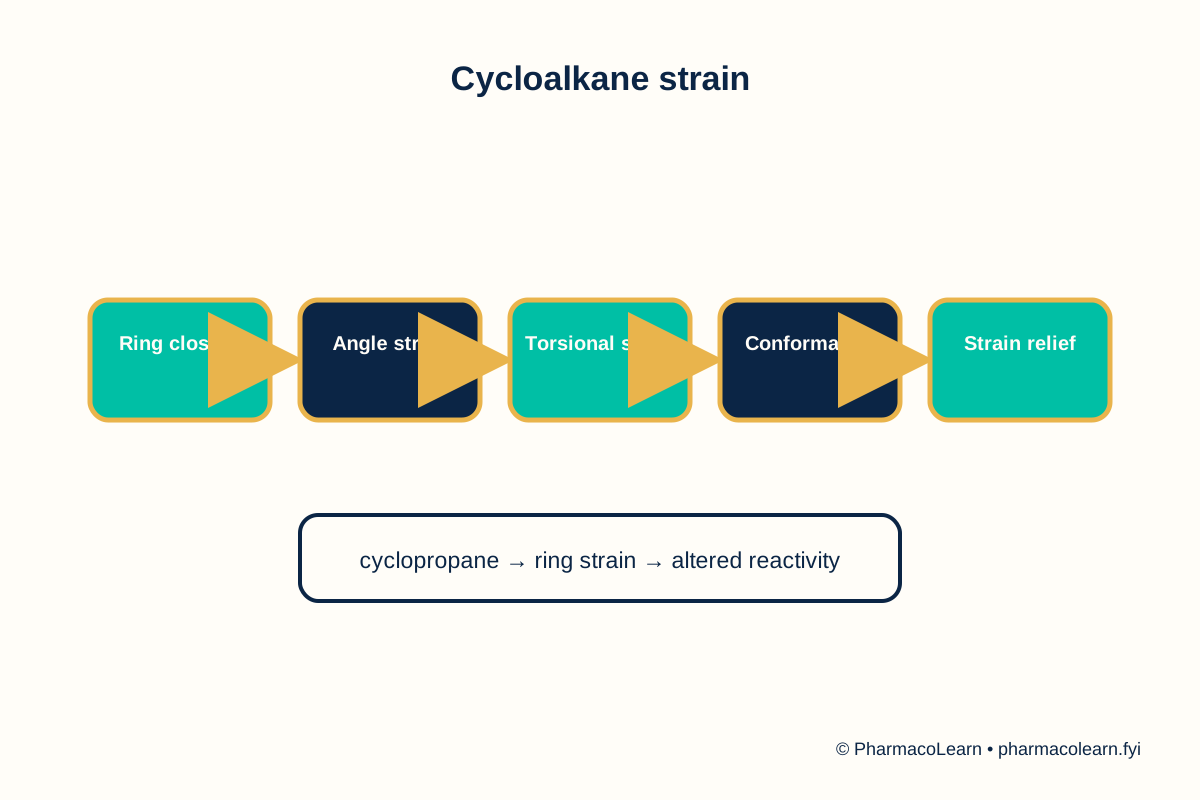
Alicyclic compounds are non-aromatic carbocyclic compounds. Cycloalkanes can be prepared by ring closure reactions or by hydrogenation of suitable unsaturated precursors. Their properties depend on ring size, conformational freedom and strain.
Baeyer strain theory treated rings as planar and predicted strain from deviation of bond angles from the tetrahedral angle. Its limitation is that larger rings pucker rather than remaining planar. The orbital picture explains angle strain as poor overlap when carbon-carbon bonds are forced away from their preferred geometry. Cyclopropane has substantial angle and torsional strain. Larger rings reduce some angle strain by adopting non-planar conformations, although medium rings can have additional transannular interactions.
Mechanism
- Identify the acyclic precursor or unsaturated ring precursor.
- Form the new carbon-carbon bond by intramolecular reaction.
- Examine ring geometry and conformational strain.
- Predict reactivity from ring opening tendency and substitution pattern.
Clinical correlation
Ring strain affects hydrolytic or metabolic stability and can influence the shape a bioactive molecule presents to a target.
FAQs
Worked example
Ring strain and stereochemistry influence the reactivity and conformation of an alicyclic compound. The pharmacist connects these properties with stability and molecular shape.
FAQs
- Why is Baeyer theory incomplete? It assumes planarity for rings that can pucker.
- Why are small rings reactive? Their angle and torsional strain provide a thermodynamic driving force for relief.
References: PharmacoLearn, Pharm D Year 1 syllabus; Clayden et al., Organic Chemistry; March's Advanced Organic Chemistry; Eliel and Wilen, Stereochemistry of Organic Compounds.
Takeaways
- Identify the relevant structure, mechanism, stereochemical or electronic feature, and pharmaceutical implication.
- Apply the reaction pathway carefully and verify the product or quality decision against the stated conditions.
Integrated practice note
Organic chemistry connects structure and mechanism with solubility, stability, reactivity, metabolism, formulation, analysis, and patient safety. The pharmacist uses the mechanism to anticipate behaviour while checking the applicable product or monograph source.
References
PharmacoLearn, Pharm D Year 1 syllabus; Clayden et al., Organic Chemistry; Eliel and Wilen, Stereochemistry of Organic Compounds.
Unit 5: Nucleophilic Aliphatic Substitution
Syllabus scope
This unit covers the syllabus topics named in the unit title and their organic-chemical mechanisms, pharmaceutical applications, and medicine-quality implications.
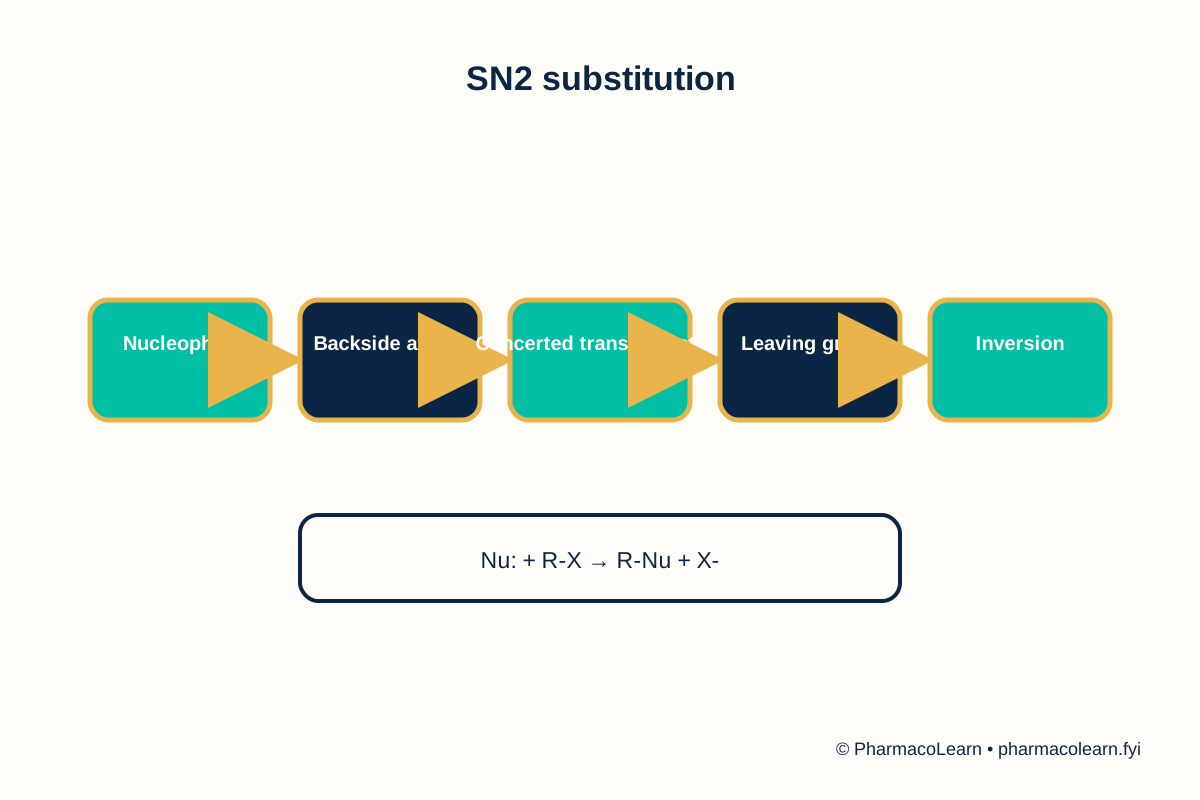
A nucleophile donates an electron pair to an electrophilic carbon. A leaving group departs with the bonding electron pair. In SN2 substitution, bond formation and bond breaking occur in one concerted step. The rate depends on both substrate and nucleophile. Backside attack causes inversion at a stereogenic carbon, and steric hindrance slows the reaction. Polar aprotic solvents often enhance anionic nucleophiles by reducing hydrogen bonding to them.
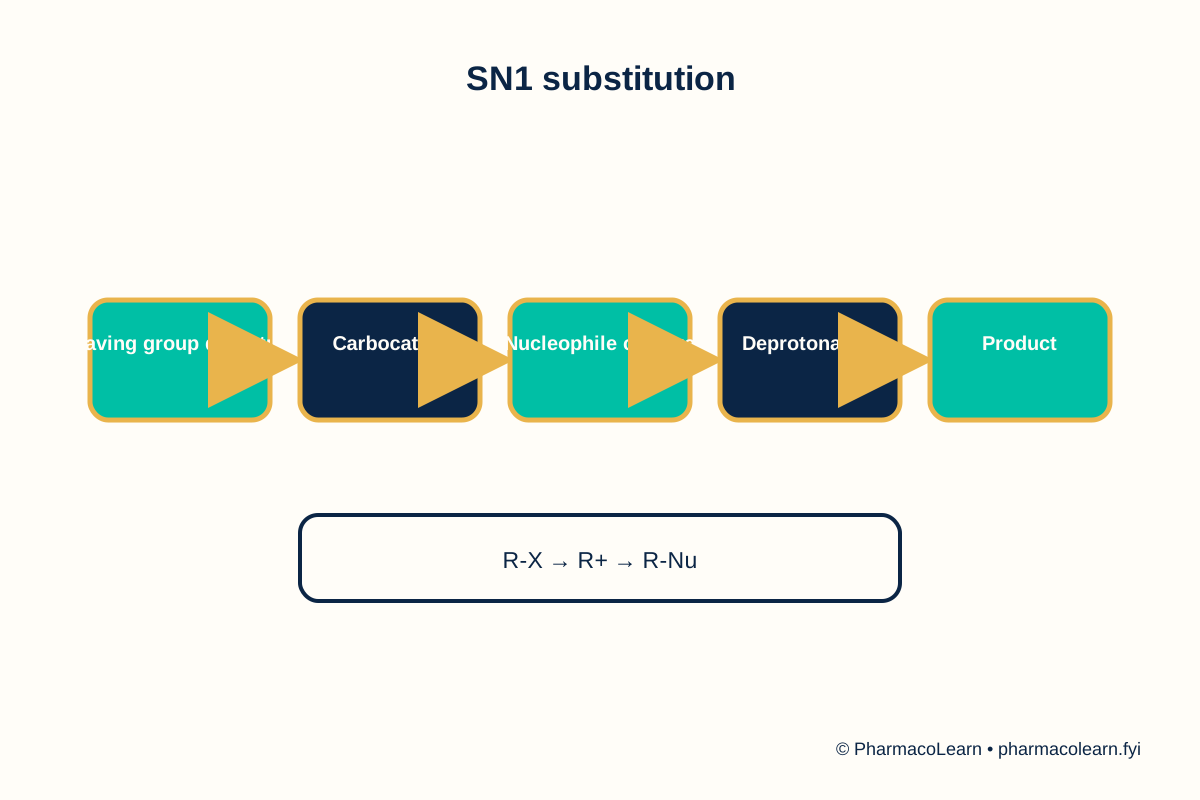
In SN1 substitution, the leaving group departs first to form a carbocation, followed by nucleophile capture. The rate depends mainly on substrate ionisation. Carbocation stability, solvent ionisation power and leaving-group ability matter. A planar carbocation can give partial racemisation. Rearrangements occur when a hydride or alkyl shift creates a more stable carbocation.
SN2 is favoured by less hindered substrates and strong nucleophiles. SN1 is favoured by substrates that form stable carbocations and by ionising solvents. Solvent nucleophilic assistance, ion-dipole interactions and phase-transfer catalysis can change observed reactivity.
Clinical correlation
Substitution pathways help explain hydrolysis, metabolism and stereochemical changes. A pharmacist uses these principles when considering stability in aqueous formulations.
FAQs
Worked example
In SN2 substitution, bond formation and bond breaking occur in one concerted step. Backside attack causes inversion at a stereogenic carbon.
FAQs
- What distinguishes SN1 and SN2? Stepwise ionisation versus one-step concerted displacement.
- Why does steric hindrance matter? It blocks the backside approach required for SN2.
References: PharmacoLearn, Pharm D Year 1 syllabus; Clayden et al., Organic Chemistry; March's Advanced Organic Chemistry; Ingold, Structure and Mechanism in Organic Chemistry.
Mechanism and pharmaceutical application
Substitution affects medicine stability because water, nucleophiles, enzymes, and formulation components can replace a leaving group. The observed pathway depends on substrate structure, solvent, concentration, temperature, and steric access. A reaction may alter potency, stereochemistry, impurity profile, or release behaviour, so the pharmacist considers both mechanism and storage conditions.
Takeaways
- Identify the relevant structure, mechanism, stereochemical or electronic feature, and pharmaceutical implication.
- Apply the reaction pathway carefully and verify the product or quality decision against the stated conditions.
Integrated practice note
Organic chemistry connects structure and mechanism with solubility, stability, reactivity, metabolism, formulation, analysis, and patient safety. The pharmacist uses the mechanism to anticipate behaviour while checking the applicable product or monograph source.
References
PharmacoLearn, Pharm D Year 1 syllabus; Clayden et al., Organic Chemistry; Ingold, Structure and Mechanism in Organic Chemistry.
Unit 6: Dehydrohalogenation and Elimination
Syllabus scope
This unit covers the syllabus topics named in the unit title and their organic-chemical mechanisms, pharmaceutical applications, and medicine-quality implications.
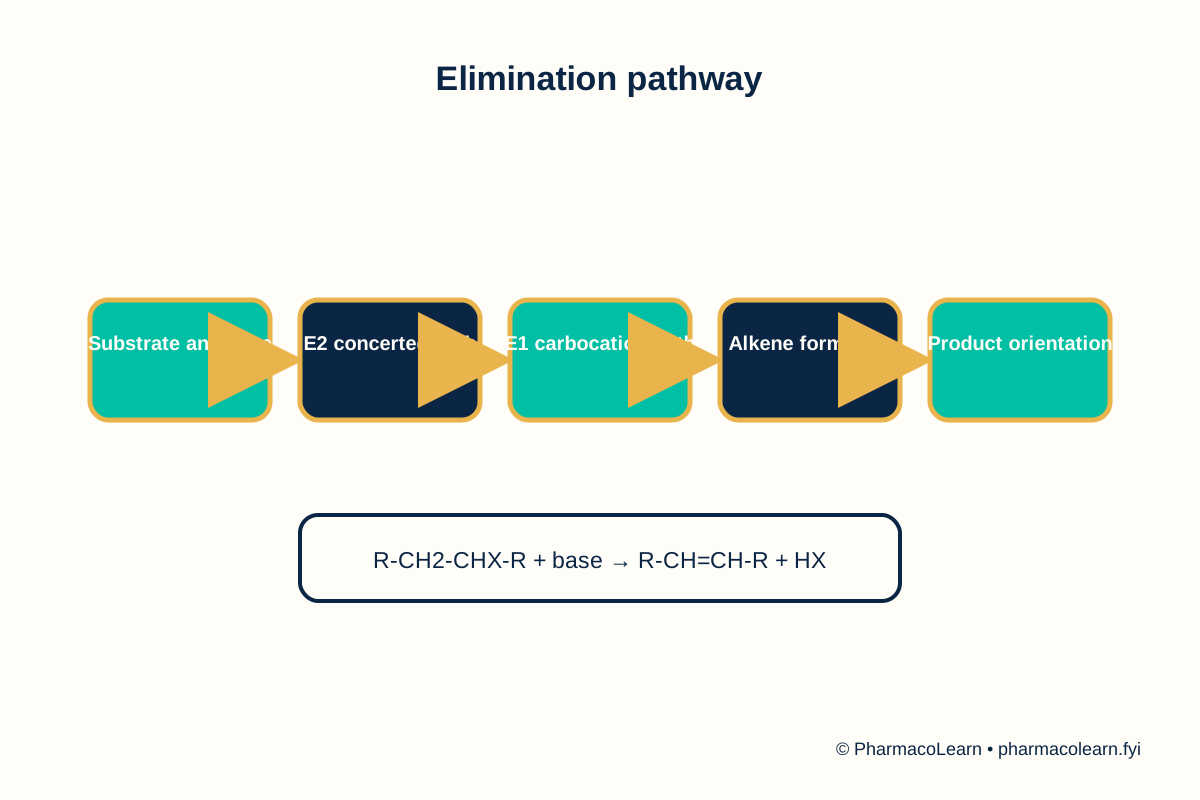
Dehydrohalogenation removes a leaving group and a beta hydrogen to form an alkene. In E2 elimination, base abstraction and leaving-group departure occur in one step. The rate depends on substrate and base. Antiperiplanar alignment is especially favorable because the breaking and forming bonds overlap as the alkene forms. In E1 elimination, the leaving group first forms a carbocation, then a base removes a beta proton. Rearrangement is possible in E1 but not in a strictly concerted E2 pathway.
Alcohol dehydration is acid catalysed. Protonation converts hydroxide into water, a better leaving group. Water leaves or elimination and departure occur together depending on the substrate, then deprotonation forms the alkene. The reaction can be reversible, so temperature, water removal and product stability affect the result. Orientation often follows the more substituted alkene rule, but bulky bases can favor the less substituted product.
Mechanism check
- Identify the leaving group.
- Locate beta hydrogens.
- Choose E2 or E1 from substrate, base and solvent.
- Check stereochemical alignment.
- Form the alkene and identify competing substitution.
Clinical correlation
Elimination can produce degradants or metabolites with changed activity. Formulation pH and heat can therefore alter product purity.
FAQs
Worked example
In an elimination reaction, a base removes a hydrogen while the leaving group departs and a carbon-carbon double bond forms. Substrate, base, solvent, and temperature influence the pathway.
FAQs
- Why can E1 rearrange? A carbocation intermediate exists.
- Why can elimination compete with substitution? Both use a leaving group and a base or nucleophile.
References: PharmacoLearn, Pharm D Year 1 syllabus; Clayden et al., Organic Chemistry; March's Advanced Organic Chemistry; Solomons, Organic Chemistry.
Takeaways
- Identify the relevant structure, mechanism, stereochemical or electronic feature, and pharmaceutical implication.
- Apply the reaction pathway carefully and verify the product or quality decision against the stated conditions.
Integrated practice note
Organic chemistry connects structure and mechanism with solubility, stability, reactivity, metabolism, formulation, analysis, and patient safety. The pharmacist uses the mechanism to anticipate behaviour while checking the applicable product or monograph source.
References
PharmacoLearn, Pharm D Year 1 syllabus; Clayden et al., Organic Chemistry; Solomons, Organic Chemistry.
Unit 7: Electrophilic and Radical Addition
Syllabus scope
This unit covers the syllabus topics named in the unit title and their organic-chemical mechanisms, pharmaceutical applications, and medicine-quality implications.
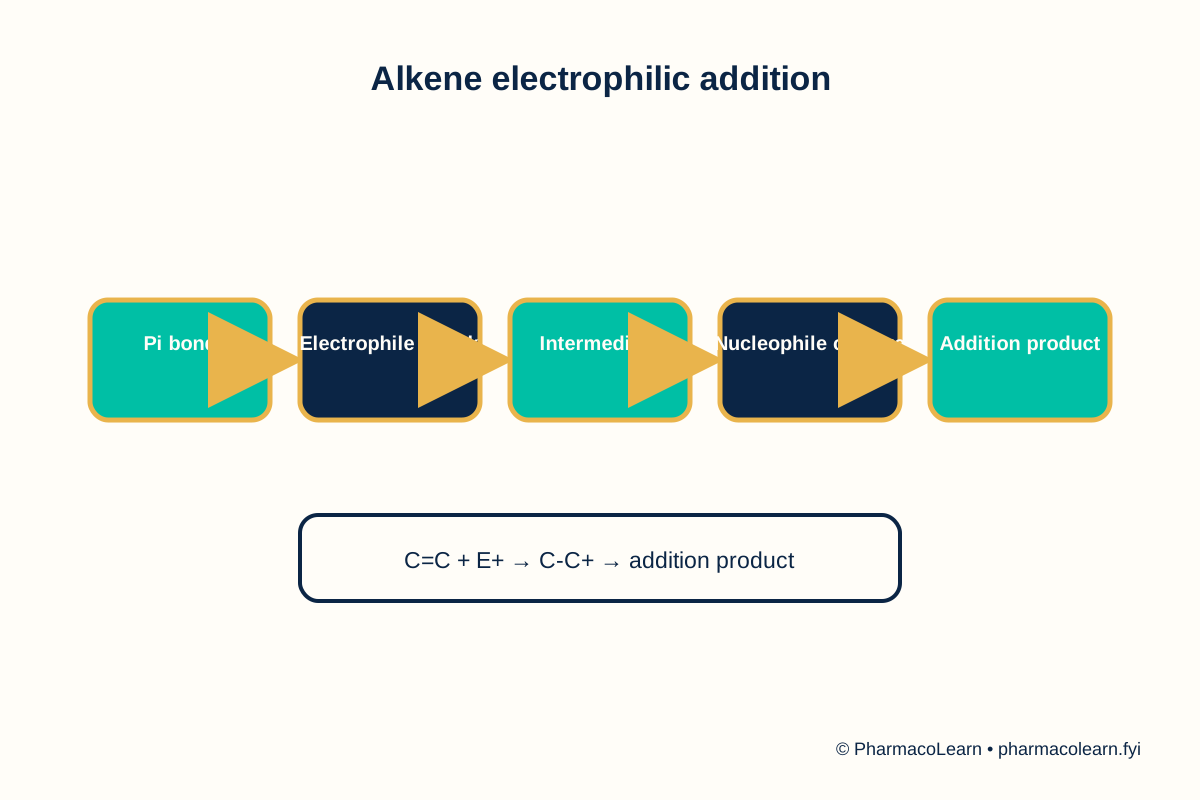
Alkenes contain a pi bond whose electrons can attack an electrophile. In electrophilic addition, the pi bond forms a new sigma bond while the other carbon develops positive character or a bridged intermediate. Protonation of an alkene can generate a carbocation, so rearrangement may occur. Markovnikov orientation commonly places hydrogen so the more stable carbocation is formed. Addition of halogens can proceed through a halonium ion, and water attack can produce a halohydrin.
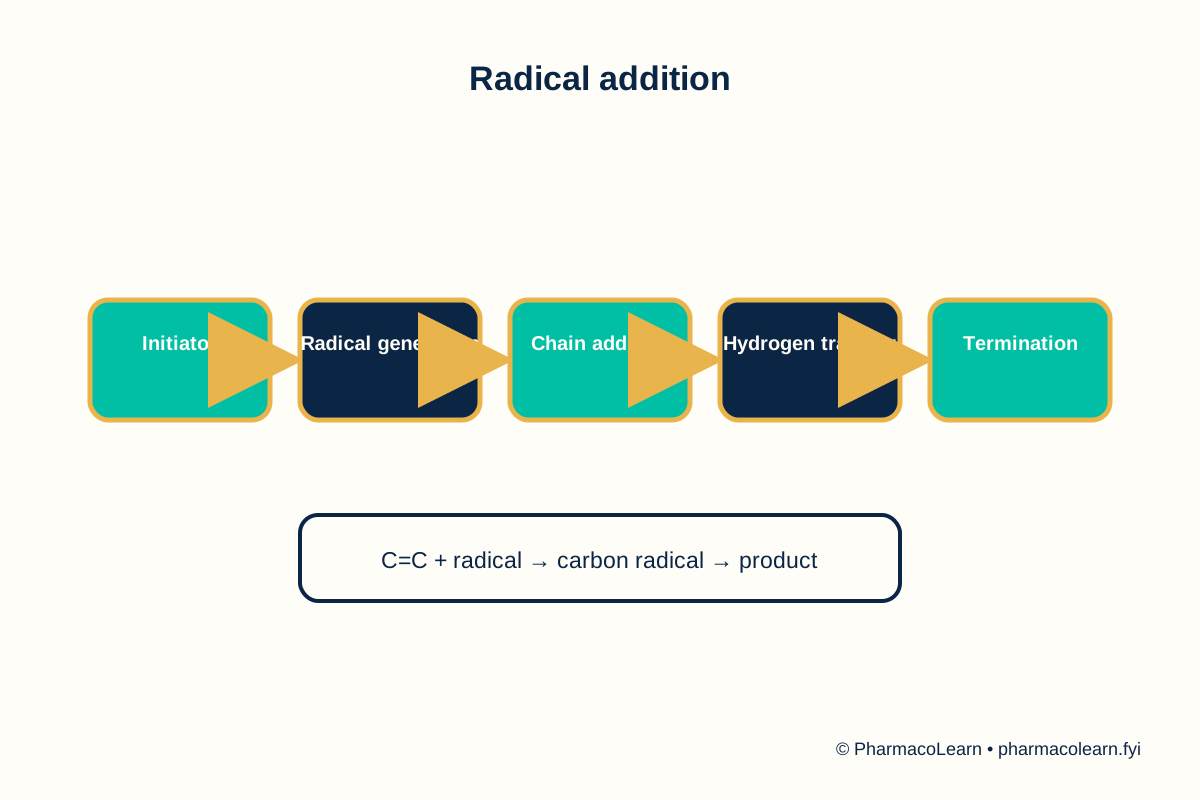
Hydrogen halide addition normally follows electrophilic orientation. Hydrogen bromide in the presence of peroxides follows a radical chain pathway and can show the peroxide effect. Hydrogenation releases heat, and the magnitude reflects alkene stability. Carbene addition can create cyclopropane rings. Cycloaddition is a concerted process in which pi systems reorganize together.
Mechanism check
- Polarize or homolyze the reagent.
- Attack the carbon-carbon pi bond.
- Form the most stable intermediate or transition state.
- Capture the intermediate.
- Check regioselectivity and stereoselectivity.
Clinical correlation
Unsaturated excipients and drug substances can undergo oxidation or addition-related degradation. Oxygen exclusion and suitable packaging can reduce risk.
FAQs
Worked example
Electrophilic addition begins when the double bond reacts with an electrophile, followed by formation of an intermediate and nucleophile capture. Radical addition follows a chain pathway.
FAQs
- What determines Markovnikov orientation? Relative stability of the developing positive charge and transition state.
- What changes in radical addition? The chain mechanism and intermediate stability determine orientation.
References: PharmacoLearn, Pharm D Year 1 syllabus; Clayden et al., Organic Chemistry; March's Advanced Organic Chemistry; Carey and Sundberg, Advanced Organic Chemistry.
Takeaways
- Identify the relevant structure, mechanism, stereochemical or electronic feature, and pharmaceutical implication.
- Apply the reaction pathway carefully and verify the product or quality decision against the stated conditions.
Integrated practice note
Organic chemistry connects structure and mechanism with solubility, stability, reactivity, metabolism, formulation, analysis, and patient safety. The pharmacist uses the mechanism to anticipate behaviour while checking the applicable product or monograph source.
References
PharmacoLearn, Pharm D Year 1 syllabus; Clayden et al., Organic Chemistry; Carey and Sundberg, Advanced Organic Chemistry.
Unit 8: Carbon-Carbon Double Bonds as Substituents
Syllabus scope
This unit covers the syllabus topics named in the unit title and their organic-chemical mechanisms, pharmaceutical applications, and medicine-quality implications.
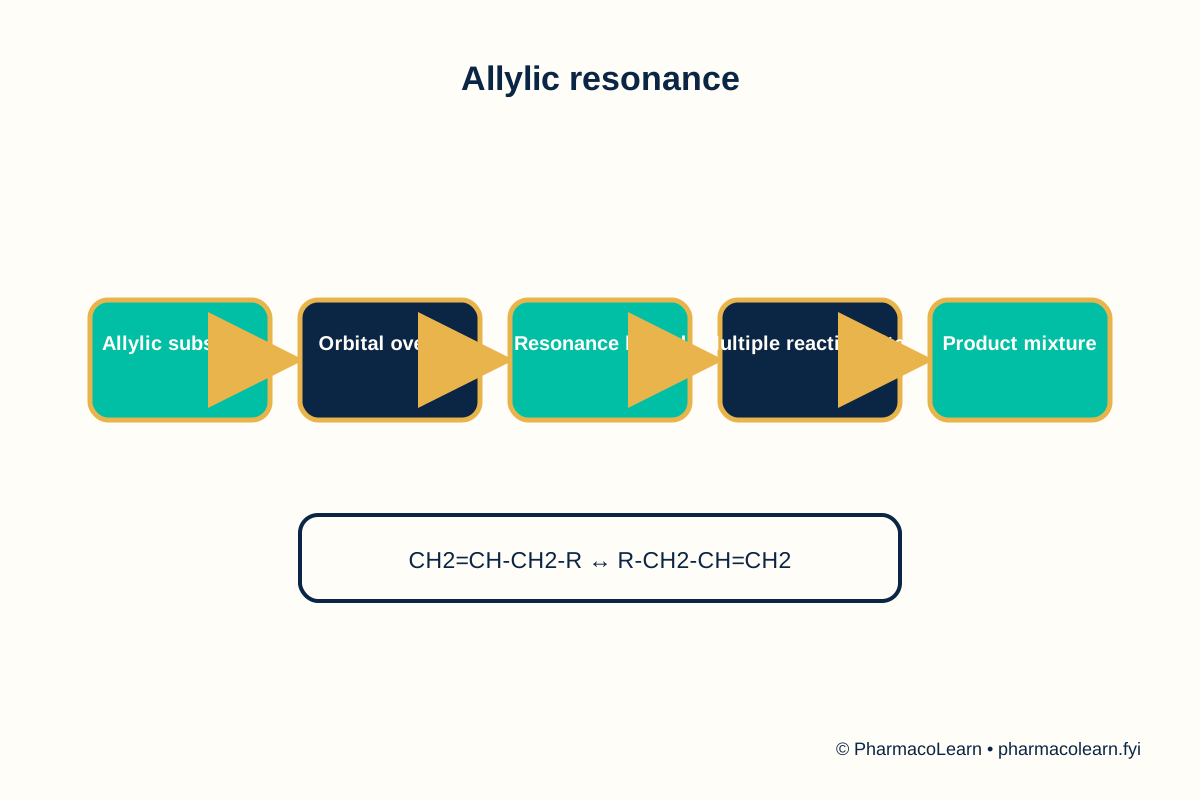
Alkenes can participate in radical halogenation, radical addition and allylic substitution. Allylic positions are activated because the resulting radical or cation can be resonance stabilized. A brominating radical may abstract an allylic hydrogen, then the allylic radical reacts with bromine. Resonance distributes the unpaired electron over more than one carbon, so products can arise from more than one position.
Radical substitution differs from radical addition in the bond being replaced or added. In substitution, a hydrogen or another group is replaced while the double bond remains. In addition, radical fragments add across the double bond. Orientation depends on the stability of the radical intermediate, steric effects and reagent selectivity. Allylic rearrangement occurs when a resonance-stabilized intermediate reacts at either end of the allylic system.
Mechanism check
- Identify allylic or vinylic positions.
- Generate the radical under suitable conditions.
- Draw all resonance contributors.
- Predict reaction at each reactive position.
- Compare substitution with addition.
Clinical correlation
Allylic oxidation is a common vulnerability in unsaturated lipids and drug molecules. Oxidized products may change odor, potency or tolerability.
FAQs
Worked example
A carbon-carbon double bond can act as a substituent whose geometry and reactivity affect the structure, naming, and behaviour of the larger molecule.
FAQs
- Why is allylic reactivity enhanced? Resonance stabilizes the intermediate.
- Why are vinylic positions different? A vinylic radical or cation is less favorably stabilized.
References: PharmacoLearn, Pharm D Year 1 syllabus; Clayden et al., Organic Chemistry; March's Advanced Organic Chemistry; Carey and Sundberg, Advanced Organic Chemistry.
Takeaways
- Identify the relevant structure, mechanism, stereochemical or electronic feature, and pharmaceutical implication.
- Apply the reaction pathway carefully and verify the product or quality decision against the stated conditions.
Integrated practice note
Organic chemistry connects structure and mechanism with solubility, stability, reactivity, metabolism, formulation, analysis, and patient safety. The pharmacist uses the mechanism to anticipate behaviour while checking the applicable product or monograph source.
References
PharmacoLearn, Pharm D Year 1 syllabus; Clayden et al., Organic Chemistry; Carey and Sundberg, Advanced Organic Chemistry.
Unit 9: Resonance and Conjugated Systems
Syllabus scope
This unit covers the syllabus topics named in the unit title and their organic-chemical mechanisms, pharmaceutical applications, and medicine-quality implications.
Resonance represents electron delocalisation using multiple contributors. The real molecule is a hybrid, not a rapidly switching set of structures. Allyl radicals and cations are stabilized because the p orbitals overlap across the system. Hyperconjugation also stabilizes charged and radical centers through donation from adjacent sigma bonds.
Allylic substrates can undergo SN1 or SN2 substitution. In SN1 reactions, a resonance-stabilized allylic cation improves ionisation. In SN2 reactions, attack can occur at either terminus when the transition state is delocalized. Vinylic substrates resist ordinary SN2 displacement because backside attack at an sp2 carbon is geometrically and electronically unfavorable.
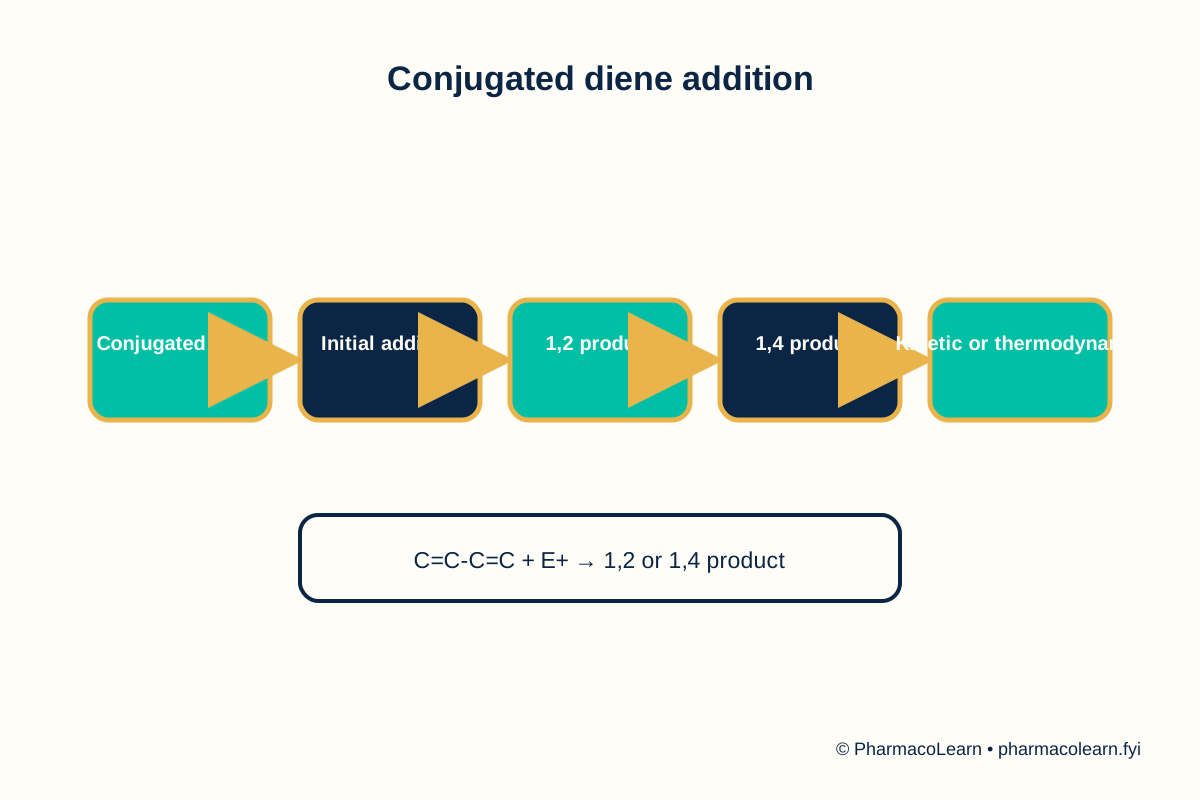
Conjugated dienes have alternating double and single bonds. Electrophilic addition can yield 1,2 and 1,4 products. Temperature and reaction time can shift the kinetic versus thermodynamic product ratio. Radical addition also depends on resonance stabilization and orientation.
Clinical correlation
Conjugation changes ultraviolet absorption, oxidation susceptibility and molecular shape. These properties affect analytical testing and storage.
FAQs
Worked example
Resonance contributors describe delocalisation, while the real molecule is a hybrid. Conjugation can change stability, ultraviolet absorption, and oxidation susceptibility.
FAQs
- What is the difference between resonance and tautomerism? Resonance changes electron placement without moving atoms; tautomerism changes proton position and bonding.
- Why can 1,4 addition become favored? It may produce the more stable alkene under equilibrating conditions.
References: PharmacoLearn, Pharm D Year 1 syllabus; Clayden et al., Organic Chemistry; March's Advanced Organic Chemistry; Solomons, Organic Chemistry.
Mechanism and pharmaceutical application
Delocalisation changes the energy and reactivity of a molecule. Resonance-stabilized intermediates may form more readily, while conjugated systems can absorb light and show greater oxidation sensitivity. This helps explain colour, analytical response, degradation pathways, and the need for light or oxygen protection in selected pharmaceutical materials.
Takeaways
- Identify the relevant structure, mechanism, stereochemical or electronic feature, and pharmaceutical implication.
- Apply the reaction pathway carefully and verify the product or quality decision against the stated conditions.
Integrated practice note
Organic chemistry connects structure and mechanism with solubility, stability, reactivity, metabolism, formulation, analysis, and patient safety. The pharmacist uses the mechanism to anticipate behaviour while checking the applicable product or monograph source.
References
PharmacoLearn, Pharm D Year 1 syllabus; Clayden et al., Organic Chemistry; Solomons, Organic Chemistry.
Unit 10: Electrophilic Aromatic Substitution
Syllabus scope
This unit covers the syllabus topics named in the unit title and their organic-chemical mechanisms, pharmaceutical applications, and medicine-quality implications.
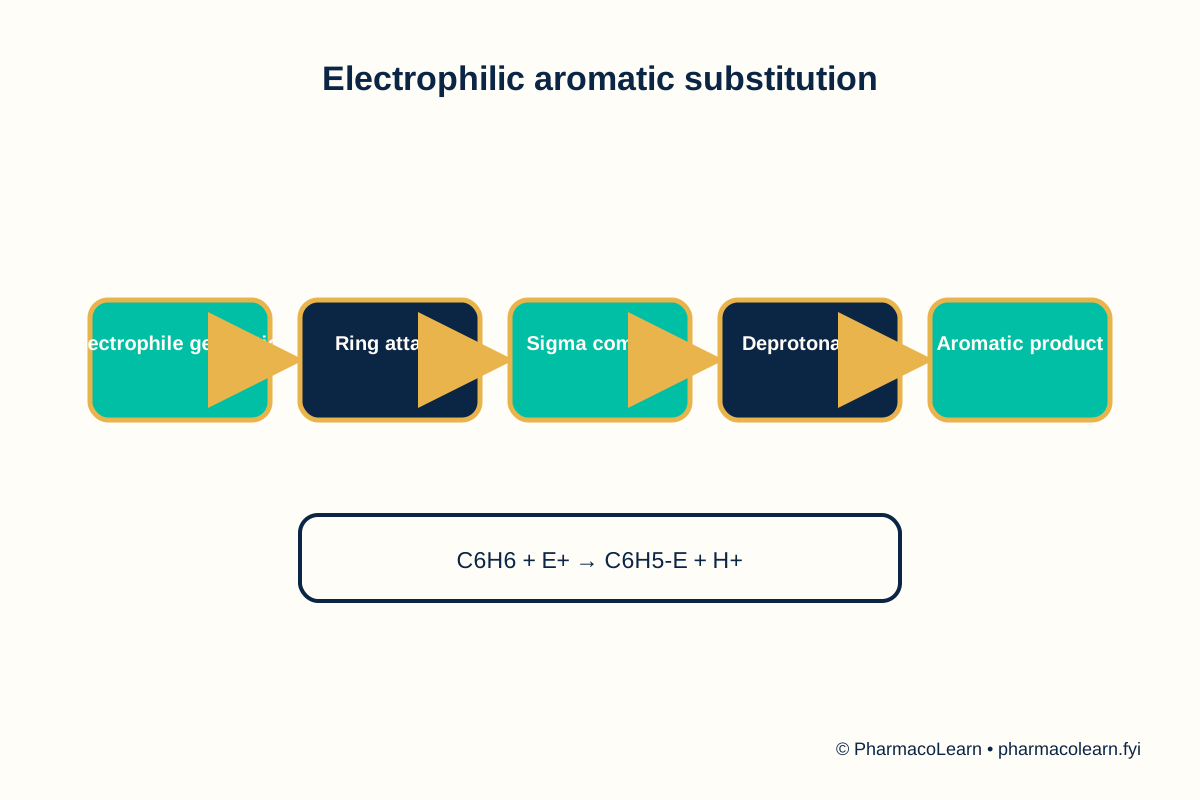
Aromatic substitution preserves the aromatic ring after a temporary loss of aromaticity. In nitration, the electrophile is generated in strongly acidic medium, the ring attacks it, and deprotonation restores aromaticity. Sulphonation, halogenation, Friedel-Crafts alkylation and Friedel-Crafts acylation use analogous electrophilic attack followed by proton loss.
Substituents influence rate and orientation. Electron-releasing groups generally activate the ring and direct incoming electrophiles to ortho and para positions. Strong electron-withdrawing groups generally deactivate and direct to meta. Halogens are deactivating by induction but can direct ortho and para by resonance. Friedel-Crafts reactions require a ring sufficiently nucleophilic and can be limited by rearrangement or multiple substitution.
Side-chain halogenation of alkylbenzene follows a radical pathway and differs from ring halogenation. The benzyl radical is resonance stabilized.
Mechanism check
- Generate the electrophile.
- Form the sigma complex.
- Compare resonance contributors for each orientation.
- Remove a proton.
- Restore aromaticity.
Clinical correlation
Aromatic substitution is used to understand metabolite formation and impurity profiles. Directing effects help predict which positional isomers may form.
FAQs
Worked example
Electrophilic aromatic substitution preserves aromaticity overall by replacing a ring hydrogen after electrophile addition and loss of a proton.
FAQs
- Why is aromaticity restored? Deprotonation returns the delocalized pi system.
- Why do substituents change orientation? They stabilize or destabilize the sigma complex.
References: PharmacoLearn, Pharm D Year 1 syllabus; Clayden et al., Organic Chemistry; March's Advanced Organic Chemistry; McMurry, Organic Chemistry.
Takeaways
- Identify the relevant structure, mechanism, stereochemical or electronic feature, and pharmaceutical implication.
- Apply the reaction pathway carefully and verify the product or quality decision against the stated conditions.
Integrated practice note
Organic chemistry connects structure and mechanism with solubility, stability, reactivity, metabolism, formulation, analysis, and patient safety. The pharmacist uses the mechanism to anticipate behaviour while checking the applicable product or monograph source.
References
PharmacoLearn, Pharm D Year 1 syllabus; Clayden et al., Organic Chemistry; March's Advanced Organic Chemistry.
Unit 11: Nucleophilic Addition and Acyl Substitution
Syllabus scope
This unit covers the syllabus topics named in the unit title and their organic-chemical mechanisms, pharmaceutical applications, and medicine-quality implications.
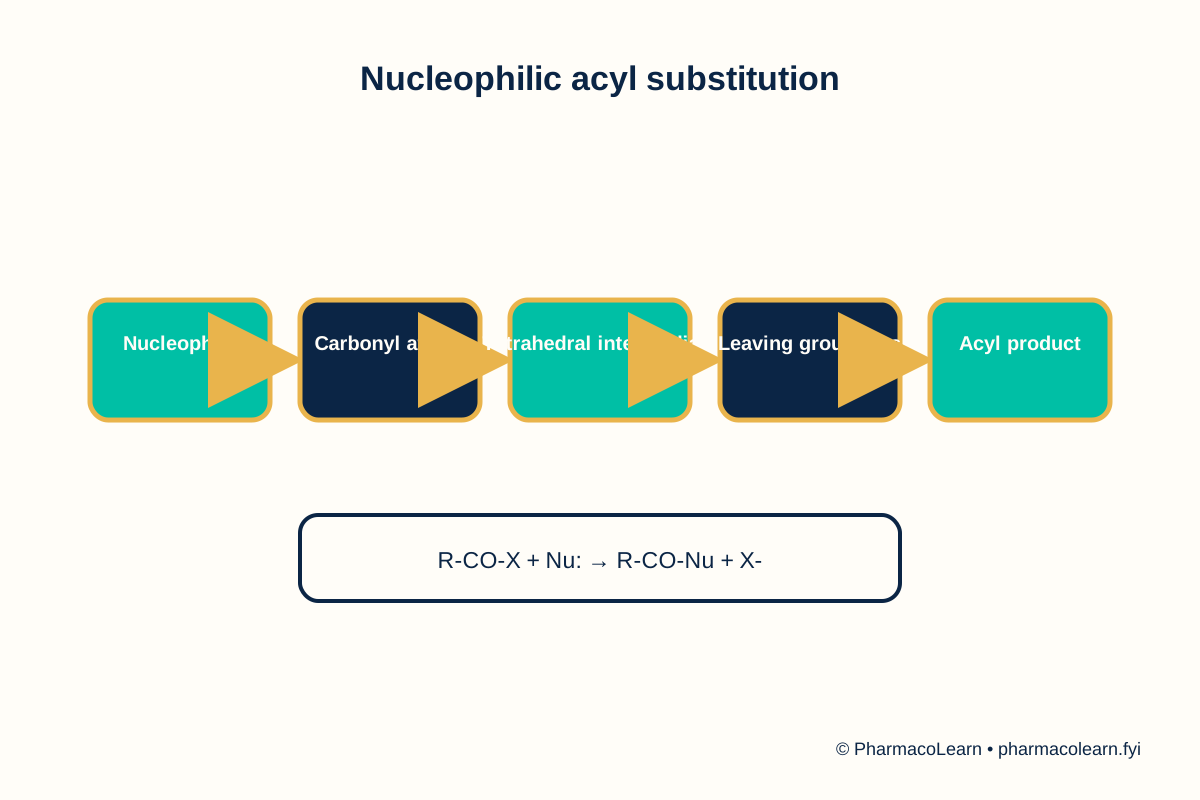
Carboxylic acids ionize because the carboxylate ion is resonance stabilized. Electron-withdrawing substituents increase acidity by stabilizing negative charge, while electron-releasing groups reduce it. In nucleophilic acyl substitution, a nucleophile attacks the carbonyl carbon, forming a tetrahedral intermediate. The intermediate then collapses, expelling a leaving group and reforming the carbonyl.
Acid chlorides are converted to esters, amides and anhydrides by nucleophilic acyl substitution. The leaving group ability and reaction conditions determine rate. Unlike simple alkyl substitution, the carbonyl group provides a clear addition and elimination sequence. The role of the carboxyl group is therefore to activate acyl carbon and stabilize intermediates through resonance.
Mechanism check
- Activate or protonate the carbonyl when required.
- Nucleophile attacks the acyl carbon.
- Form the tetrahedral intermediate.
- Transfer protons as needed.
- Eliminate the leaving group and restore the carbonyl.
Clinical correlation
Ester hydrolysis can change a compound's solubility, absorption and shelf life. Acyl substitution is central to understanding prodrugs and ester-containing excipients.
FAQs
Worked example
A nucleophile attacks an electrophilic carbonyl carbon, and the intermediate then undergoes proton transfer or substitution according to the functional group and leaving group.
FAQs
- Why are acid chlorides reactive? Chloride is a good leaving group and the carbonyl is strongly electrophilic.
- Why are amides less reactive? Resonance donation from nitrogen reduces carbonyl electrophilicity.
References: PharmacoLearn, Pharm D Year 1 syllabus; Clayden et al., Organic Chemistry; March's Advanced Organic Chemistry; Carey and Sundberg, Advanced Organic Chemistry.
Takeaways
- Identify the relevant structure, mechanism, stereochemical or electronic feature, and pharmaceutical implication.
- Apply the reaction pathway carefully and verify the product or quality decision against the stated conditions.
Integrated practice note
Organic chemistry connects structure and mechanism with solubility, stability, reactivity, metabolism, formulation, analysis, and patient safety. The pharmacist uses the mechanism to anticipate behaviour while checking the applicable product or monograph source.
References
PharmacoLearn, Pharm D Year 1 syllabus; Clayden et al., Organic Chemistry; Carey and Sundberg, Advanced Organic Chemistry.
Unit 12: Condensation and Carbonyl Reactions
Syllabus scope
This unit covers the syllabus topics named in the unit title and their organic-chemical mechanisms, pharmaceutical applications, and medicine-quality implications.
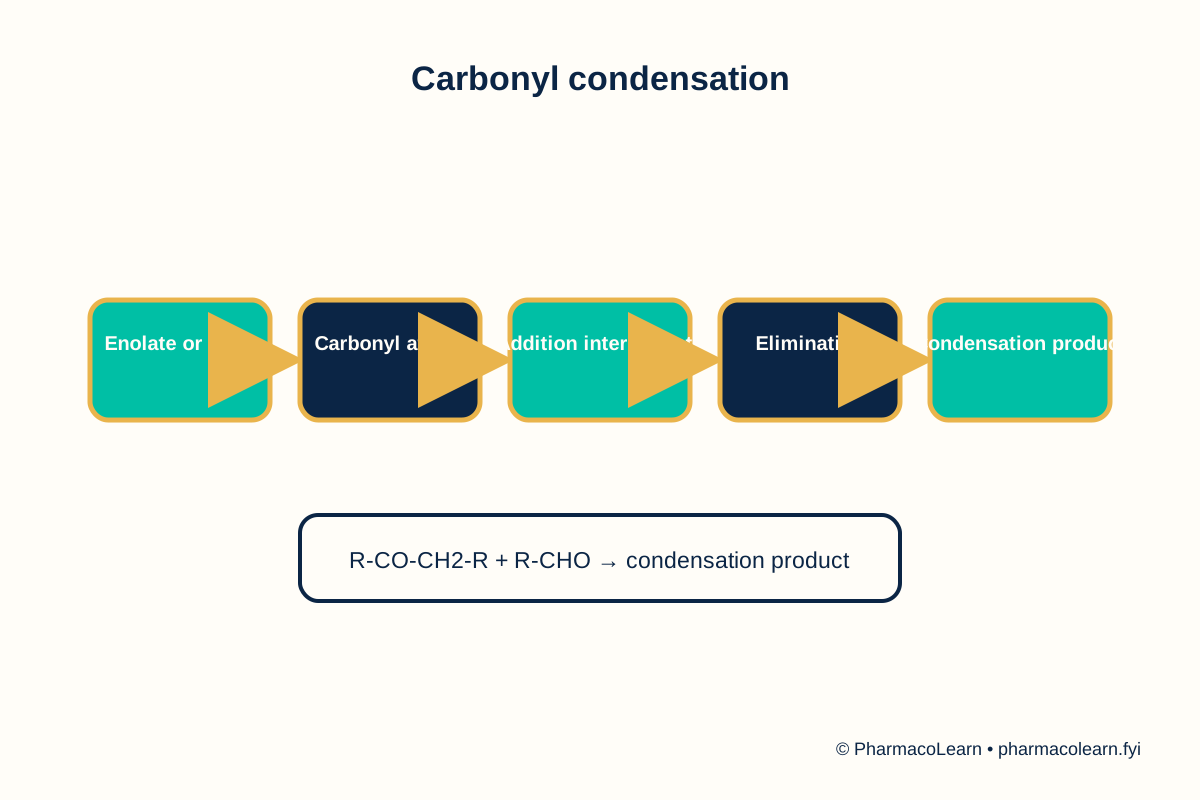
Aldol condensation begins when a base forms an enolate, which attacks another carbonyl. The beta-hydroxy product can dehydrate to an alpha,beta-unsaturated carbonyl. Claisen condensation uses an ester enolate to form a beta-keto ester. Cannizzaro reaction occurs with aldehydes lacking an alpha hydrogen and involves hydride transfer under strongly basic conditions.
Benzoin condensation joins aromatic aldehydes through polarity reversal catalysis. Perkin condensation forms an unsaturated aromatic acid derivative. Knoevenagel condensation uses an activated methylene compound. Reformatsky reaction uses an organozinc reagent to add to a carbonyl. Wittig reaction converts a carbonyl group into an alkene using a phosphorus ylide. Michael addition is conjugate addition to an alpha,beta-unsaturated carbonyl.
Mechanism check
- Identify the enolate, ylide or activated nucleophile.
- Attack the electrophilic carbonyl or beta carbon.
- Form the addition intermediate.
- Transfer protons and eliminate where applicable.
- Check whether the product is kinetic or thermodynamic.
Clinical correlation
Carbonyl reactions explain degradation and cross-linking of excipients, sugars and aldehyde-containing compounds. Control of pH, temperature and water can limit unwanted reaction.
FAQs
Worked example
A condensation reaction forms a new carbon-carbon or carbon-heteroatom bond while a small molecule is eliminated. The mechanism depends on the carbonyl compound and reaction conditions.
FAQs
- What makes aldol reactions possible? An alpha hydrogen can form an enolate.
- What is polarity reversal? A normally electrophilic carbon becomes nucleophilic through a special catalyst or reagent.
References: PharmacoLearn, Pharm D Year 1 syllabus; Clayden et al., Organic Chemistry; March's Advanced Organic Chemistry; Solomons, Organic Chemistry.
Takeaways
- Identify the relevant structure, mechanism, stereochemical or electronic feature, and pharmaceutical implication.
- Apply the reaction pathway carefully and verify the product or quality decision against the stated conditions.
Integrated practice note
Organic chemistry connects structure and mechanism with solubility, stability, reactivity, metabolism, formulation, analysis, and patient safety. The pharmacist uses the mechanism to anticipate behaviour while checking the applicable product or monograph source.
References
PharmacoLearn, Pharm D Year 1 syllabus; Clayden et al., Organic Chemistry; Solomons, Organic Chemistry.
Unit 13: Rearrangements, Amines and Phenols
Syllabus scope
This unit covers the syllabus topics named in the unit title and their organic-chemical mechanisms, pharmaceutical applications, and medicine-quality implications.
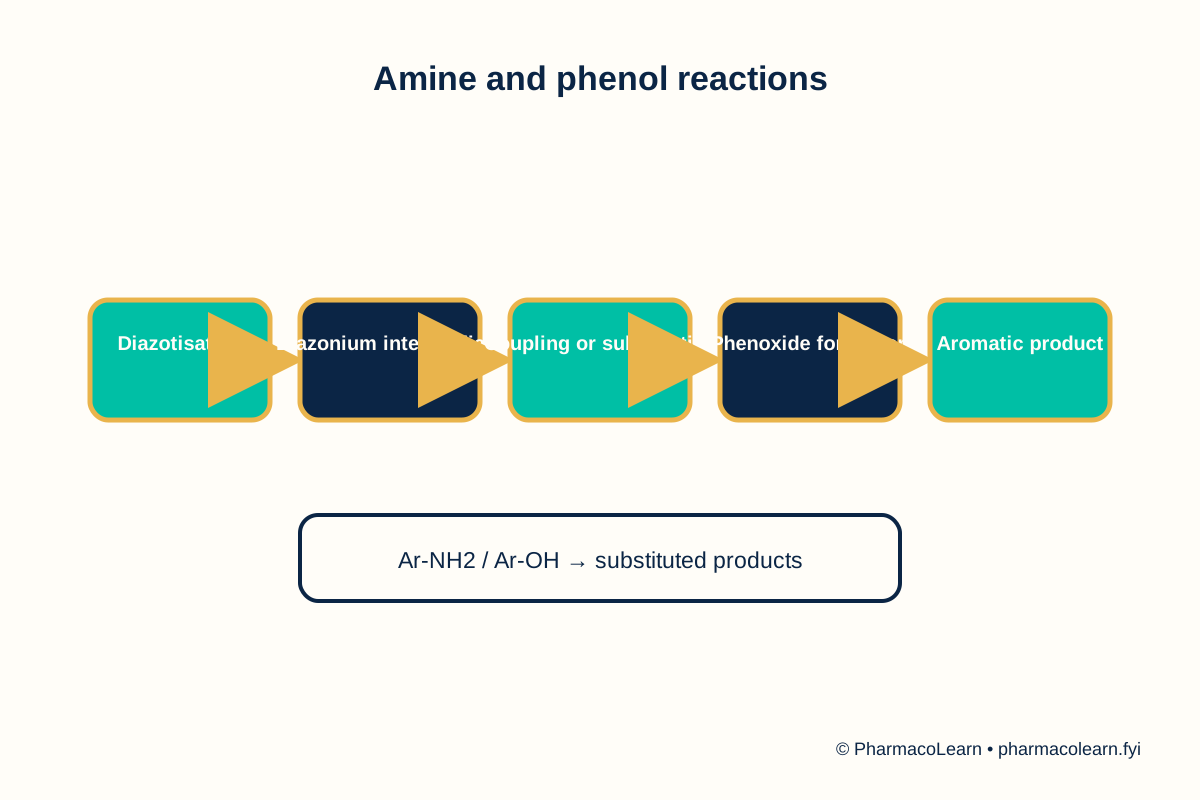
Hofmann rearrangement converts an amide into an amine with one fewer carbon through migration to electron-deficient nitrogen. Sandmeyer reactions replace a diazonium group using copper-mediated pathways. Diazotisation forms a diazonium salt from a primary aromatic amine under cold acidic conditions, and coupling produces azo compounds with activated aromatic partners.
Amines are basic because nitrogen can donate its lone pair, but resonance, inductive effects, solvation and aromaticity modify basicity. Phenols are more acidic than many aliphatic alcohols because the phenoxide ion is resonance stabilized. Williamson synthesis forms ethers by SN2 reaction of an alkoxide with a suitable alkyl halide. Fries rearrangement moves an acyl group from oxygen to the aromatic ring under Lewis-acid conditions. Kolbe reaction introduces a carboxyl group into a phenoxide-derived aromatic system. Reimer-Tiemann reaction introduces a formyl group into activated phenols.
Clinical correlation
Aromatic amines and phenols may undergo oxidation or conjugation in vivo. Their pKa and ionisation affect absorption and formulation.
FAQs
Worked example
A rearrangement changes the connectivity through a defined sequence, while amine and phenol reactions depend on nucleophilicity, basicity, resonance, and substitution pattern.
FAQs
- Why can diazonium salts be useful? The diazonium group can be replaced by several functional groups.
- Why does Williamson synthesis favor primary halides? Secondary and tertiary substrates more readily undergo elimination.
References: PharmacoLearn, Pharm D Year 1 syllabus; Clayden et al., Organic Chemistry; March's Advanced Organic Chemistry; Finar, Organic Chemistry.
Takeaways
- Identify the relevant structure, mechanism, stereochemical or electronic feature, and pharmaceutical implication.
- Apply the reaction pathway carefully and verify the product or quality decision against the stated conditions.
Integrated practice note
Organic chemistry connects structure and mechanism with solubility, stability, reactivity, metabolism, formulation, analysis, and patient safety. The pharmacist uses the mechanism to anticipate behaviour while checking the applicable product or monograph source.
References
PharmacoLearn, Pharm D Year 1 syllabus; Clayden et al., Organic Chemistry; Finar, Organic Chemistry.
Unit 14: Nucleophilic Aromatic Substitution
Syllabus scope
This unit covers the syllabus topics named in the unit title and their organic-chemical mechanisms, pharmaceutical applications, and medicine-quality implications.
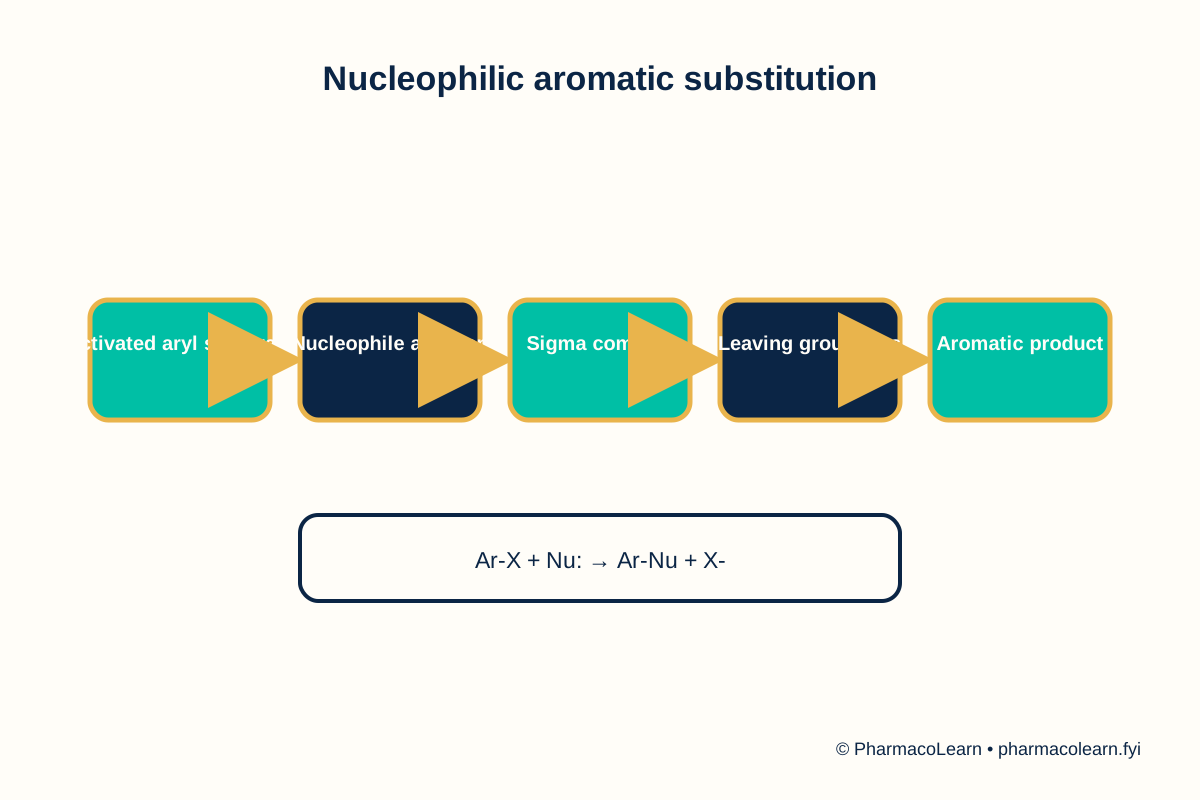
Nucleophilic aromatic substitution replaces a leaving group on an aromatic ring. In the addition-elimination pathway, a nucleophile adds to the carbon bearing the leaving group, forming a negatively charged sigma complex, then the leaving group departs and aromaticity returns. Electron-withdrawing groups positioned ortho or para can stabilize the intermediate and accelerate reaction.
A second pathway is the elimination-addition route through a benzyne intermediate under strongly basic conditions. This requires loss of a neighboring proton and leaving group, followed by nucleophile addition. Regioselectivity can be less predictable than in the addition-elimination pathway.
Aromatic substitution differs from aliphatic SN2 substitution because the aromatic pi system and ring substituents control the intermediate. Vinylic and aryl carbons do not normally support simple backside attack.
Mechanism check
- Locate the leaving group and activating substituents.
- Determine whether addition-elimination or benzyne chemistry is plausible.
- Form the intermediate.
- Expel the leaving group or capture benzyne.
- Restore or re-form the aromatic system.
Clinical correlation
Substituted aromatic systems are common in drug molecules. Their reaction pathways help predict impurity formation and metabolic transformation.
FAQs
Worked example
Nucleophilic aromatic substitution requires an activated aromatic system or an appropriate leaving-group environment. The pathway is checked against the substrate and nucleophile.
FAQs
- What activates addition-elimination? Electron-withdrawing groups stabilize negative charge in the sigma complex.
- Why is benzyne chemistry different? It proceeds through elimination followed by addition rather than direct displacement.
References: PharmacoLearn, Pharm D Year 1 syllabus; Clayden et al., Organic Chemistry; March's Advanced Organic Chemistry; Carey and Sundberg, Advanced Organic Chemistry.
Takeaways
- Identify the relevant structure, mechanism, stereochemical or electronic feature, and pharmaceutical implication.
- Apply the reaction pathway carefully and verify the product or quality decision against the stated conditions.
Integrated practice note
Organic chemistry connects structure and mechanism with solubility, stability, reactivity, metabolism, formulation, analysis, and patient safety. The pharmacist uses the mechanism to anticipate behaviour while checking the applicable product or monograph source.
References
PharmacoLearn, Pharm D Year 1 syllabus; Clayden et al., Organic Chemistry; Carey and Sundberg, Advanced Organic Chemistry.
Unit 15: Oxidation and Reduction Reactions
Syllabus scope
This unit covers the syllabus topics named in the unit title and their organic-chemical mechanisms, pharmaceutical applications, and medicine-quality implications.
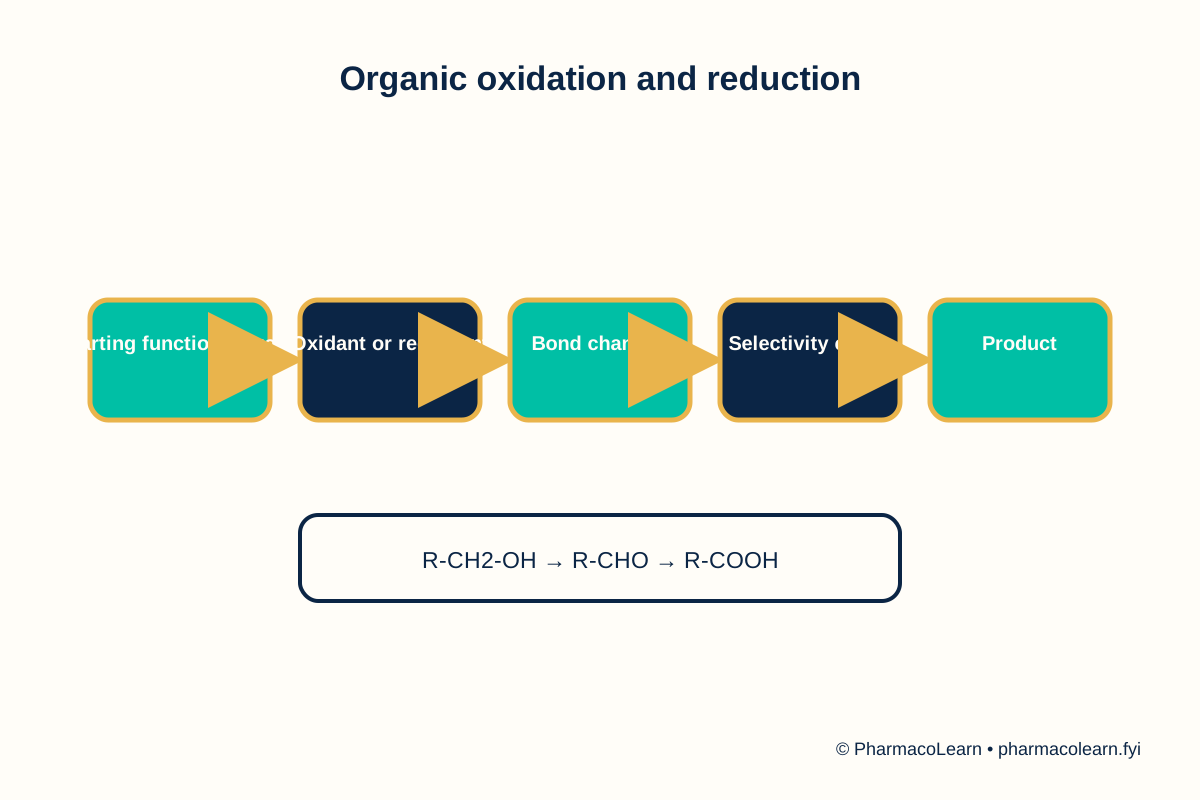
Oxidation in organic chemistry can mean increased bonding to oxygen or another electronegative atom, decreased hydrogen, or loss of electrons. Reduction commonly means increased hydrogen, decreased oxygen or electron gain. The actual reagent and substrate determine the pathway, so oxidation state alone should not be used to guess a product.
Primary alcohols can be oxidized first to aldehydes and then to carboxylic acids under stronger or aqueous conditions. Secondary alcohols can form ketones. Aldehydes are readily oxidized because they contain a hydrogen attached to the carbonyl carbon. Carbonyl compounds can be reduced to alcohols, and unsaturated bonds can be reduced by hydrogenation. Aromatic side chains can undergo benzylic oxidation when a suitable benzylic hydrogen is present.
Mechanism check
- Identify the functional group and its oxidation level.
- Identify the oxidant or reductant.
- Predict the bond changes.
- Check selectivity and overreaction.
- Confirm compatibility with other functional groups.
Clinical correlation
Oxidation and reduction are major metabolic routes. They can activate prodrugs, deactivate drugs or produce reactive metabolites. Light, oxygen, metals and pH can accelerate formulation degradation.
FAQs
Worked example
Oxidation and reduction are interpreted through changes in bonding, electron density, hydrogen, oxygen, or oxidation state. The reagent and substrate determine the outcome.
FAQs
- Why can aldehydes oxidize further? Their carbonyl carbon still bears hydrogen.
- Why is selectivity important? A reagent may affect more than one functional group.
References: PharmacoLearn, Pharm D Year 1 syllabus; Clayden et al., Organic Chemistry; March's Advanced Organic Chemistry; Finar, Organic Chemistry.
Takeaways
- Identify the relevant structure, mechanism, stereochemical or electronic feature, and pharmaceutical implication.
- Apply the reaction pathway carefully and verify the product or quality decision against the stated conditions.
Integrated practice note
Organic chemistry connects structure and mechanism with solubility, stability, reactivity, metabolism, formulation, analysis, and patient safety. The pharmacist uses the mechanism to anticipate behaviour while checking the applicable product or monograph source.
References
PharmacoLearn, Pharm D Year 1 syllabus; Clayden et al., Organic Chemistry; Finar, Organic Chemistry.
Unit 16: Official Organic Compounds
Syllabus scope
This unit covers the syllabus topics named in the unit title and their organic-chemical mechanisms, pharmaceutical applications, and medicine-quality implications.
The syllabus requires preparation, purity testing, assay principles and medicinal uses of chlorbutol, dimercaprol, glyceryl trinitrate, urea, ethylene diamine dihydrate, vanillin, paraldehyde, ethylene chloride, lactic acid, tartaric acid, citric acid, salicylic acid, aspirin, methyl salicylate, ethyl benzoate, benzyl benzoate, dimethyl phthalate, sodium lauryl sulphate, saccharin sodium and mephensin.
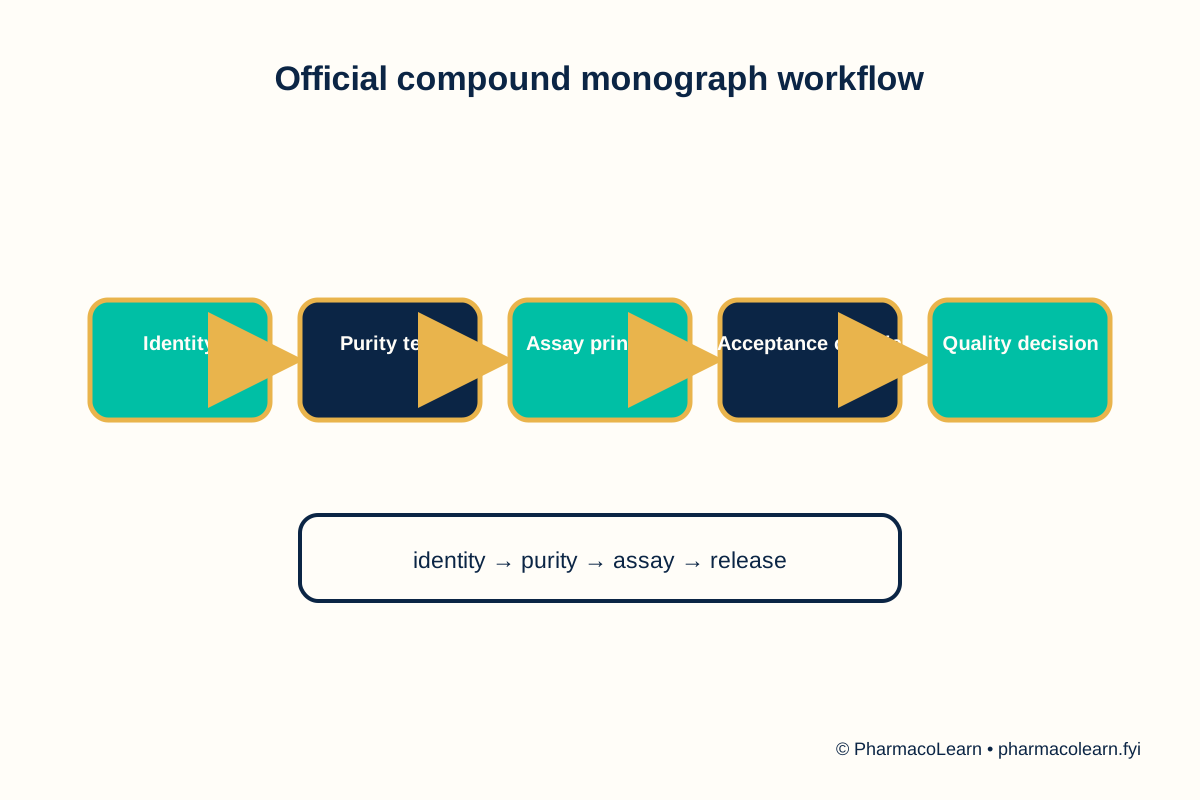
A monograph-based study proceeds in the same sequence: identify the official substance and structure, understand its functional groups and expected physical properties, review the stated identification and purity tests, understand the assay reaction or measurement principle, then relate the approved medicinal or pharmaceutical use to the substance's chemistry. Functional groups guide likely tests: acids can be neutralized, esters can be hydrolysed, aromatic compounds can show substitution behavior, and salts can be examined through their ions.
A pharmacist must not substitute a remembered assay detail for the current official monograph. Exact reagent concentrations, endpoint indicators, purity limits and medicinal indications are edition-dependent.
Clinical correlation
Impurities can change potency, stability or toxicity. Official monographs provide controlled acceptance criteria for quality decisions.
FAQs and takeaways
- Why are monographs essential? They define the current identity, quality and assay requirements.
- Why mark details for verification? Pharmacopoeial procedures and limits can change by edition.
Exact monograph procedures, assay conditions and acceptance limits must be checked against the applicable current pharmacopoeia before publication or release.
Mechanism and clinical reasoning
An official compound is controlled through identity, purity, strength, dosage-form performance, storage, and labelling. Organic structure explains properties such as ionization, solubility, stability, and reactivity, but the monograph determines the approved test conditions and acceptance decision. A pharmacist therefore connects chemical identity with the actual product and its intended use.
Worked application
If an official compound has a changed colour or unexpected assay result, the product is quarantined while identity, storage, sampling, method suitability, and documentation are reviewed. Appearance alone cannot establish failure, and an acceptable appearance cannot replace the specified monograph tests.
FAQs
Worked example
An official compound is reviewed through identity, purity, assay, storage, labelling, and the current applicable monograph before release or use.
FAQs
Why must the current monograph be used? Methods and limits may be revised, so an old procedure may no longer represent the applicable standard.
- Confirm edition, identity, method, and acceptance limit.
- Record the source used for the release or dispensing decision.
This preserves traceability and supports later investigation.
It also links the chemical test to patient safety and product quality.
when clinically required.
References: PharmacoLearn, Pharm D Year 1 syllabus; Indian Pharmacopoeia, applicable current edition; British Pharmacopoeia, applicable current edition; United States Pharmacopeia, applicable current edition; Finar, Organic Chemistry.
Takeaways
- Identify the relevant structure, mechanism, stereochemical or electronic feature, and pharmaceutical implication.
- Apply the reaction pathway carefully and verify the product or quality decision against the stated conditions.
Integrated practice note
Organic chemistry connects structure and mechanism with solubility, stability, reactivity, metabolism, formulation, analysis, and patient safety. The pharmacist uses the mechanism to anticipate behaviour while checking the applicable product or monograph source.
References
PharmacoLearn, Pharm D Year 1 syllabus; Indian Pharmacopoeia, applicable current edition; Finar, Organic Chemistry.
Diagrams
Other Year 1 subjects: Human Anatomy and Physiology · Pharmaceutics · Medicinal Biochemistry · Pharmaceutical Organic Chemistry · Pharmaceutical Inorganic Chemistry · Remedial Mathematics / Biology · Year 1 · Pharm D