
MRA204T — Regulatory Aspects of Food and Nutraceuticals
4 hrs/week, 4 credits, 60 hours, 100 marks. Notes follow the M.Pharm syllabus, unit by unit.
MRA204T Regulatory Aspects of Food and Nutraceuticals notes for M.Pharm Regulatory Affairs Semester 2: nutraceuticals, dietary supplements, functional and medical foods, WHO and NSF certification, FSSAI and the FSS Act 2006, FSMA and DSHEA claims, EFSA, novel foods and RDA. Free unit wise PDF downloads on PharmacoLearn.
Units in this subject
- Unit 1 — Nutraceuticals, Introduction
- Unit 2 — International and Global Aspects
- Unit 3 — India
- Unit 4 — USA
- Unit 5 — European Union
Download MRA204T PDF Notes
Free PDFs for this subject, one per unit:
Regulatory Aspects of Food and Nutraceuticals, subject code MRA204T, is the fourth and final core theory subject of M.Pharm Regulatory Affairs, Semester 2. It carries 4 credits and 60 hours of theory, taught at 4 hours per week, for 100 marks. The three subjects before it regulated medicines, biologics and devices. This subject regulates the products that sit on the border between food and medicine: the vitamin capsule, the fortified drink, the probiotic, the botanical extract and the formula feed. That border position is the whole difficulty of the field, and the whole interest of it. A nutraceutical is sold as a food, so it escapes the premarket proof of efficacy that a drug must supply; but it is bought for a health purpose, often in a capsule that looks exactly like a medicine, so it cannot be left to ordinary food law alone. Every system in this course is a different answer to the same question: how much drug style control should be applied to a product that is legally a food? This course is designed to impart fundamental knowledge on the regulatory requirements, registration and labelling regulations of nutraceuticals in India, USA and Europe, and to prepare students to learn in detail the regulatory aspects for nutraceuticals and food supplements.
The units move from the product family outward to the world and then through the three great jurisdictions. Unit 1 defines the family: the history of food and nutraceutical regulation, the meanings of nutraceuticals, dietary supplements, functional foods and medical foods, and the scope and opportunities of the market. Unit 2 takes the international layer: the WHO guidelines on nutrition, NSF International with its certification and its standards for food and dietary supplements, and good manufacturing practice for nutraceuticals. Unit 3 studies India: the Food Safety and Standards Act 2006, the Food Safety and Standards Authority of India (FSSAI), the regulations for import, manufacture and sale of nutraceutical products, and Recommended Dietary Allowances in India. Unit 4 studies the United States: the Food Safety Modernization Act and the Dietary Supplement Health and Education Act, the rules for manufacture and sale, labelling and label claims, and RDA in the US. Unit 5 studies the European Union: the European Food Safety Authority (EFSA), the directives and regulations for manufacture and sale, nutrition labelling, the novel foods regulation, RDA in Europe, and the regulation of functional foods. One discipline runs through the notes and should be stated at the start: these products are regulated as foods in all three systems, so no system in this course grants a marketing authorisation of the drug kind, and no claim in this course may promise to treat, cure or prevent a disease unless the product has crossed the border and become a drug. The regulatory professional's craft here is classification, ingredient permissibility, manufacturing quality, honest labelling and disciplined claims.
Unit 1: Nutraceuticals, Introduction
1.1 Introduction: products between food and medicine
Ordinary food law was built to answer two questions: is this food safe, and is it what its label says it is? Drug law was built to answer a harder question as well: does this product do what it claims to do, proved before sale? Nutraceuticals strain both frameworks because consumers buy them precisely for the third question. A fish oil capsule, a glucosamine tablet, a protein powder and a probiotic drink are foods in law, taken in food like forms or as measured supplements to the diet, but they are marketed on health territory that food law historically left alone and drug law would have demanded trials for. The regulatory settlement every jurisdiction reaches has the same broad shape, and the units of this course are its working out system by system. The product stays a food. Its ingredients are controlled by positive lists, safety assessments or notification duties. Its factory is held to good manufacturing practice closer to the pharmaceutical pattern than to the bakery pattern. Its label is tightly prescribed, because the label is where the health promise is made. And its claims are fenced: nutrition and health support language is permitted under conditions, disease treatment language is not. Learn that settlement once, and the Indian, American and European chapters of this course read as three dialects of one language.
1.2 History of food and nutraceutical regulations
Food regulation is old because food fraud is old: ancient market rules punished watered milk and weighted bread, and nineteenth century adulteration scandals produced the first modern food statutes, which defined adulteration and misbranding and created inspectorates to police them. The twentieth century added the safety disasters and the nutritional science that together built the modern framework. Toxic colourants, contaminated products and drug tragedies pushed legislatures toward premarket safety control of additives and, for drugs, of the products themselves, while the discovery of vitamins and deficiency diseases created a new, positive idea: that specific nutrients, identified and dosed, could prevent specific diseases. Fortification followed, with nutrients added to staple foods as public health policy, and with it the first regulatory question of the nutraceutical age, how a nutrient added on purpose differs in law from a drug. The supplement industry grew through the middle of the century in a legal grey zone, sold under food law, claimed in drug language, and periodically provoking attempts to regulate it as a drug. The modern settlement dates from the 1990s and 2000s, and its landmarks are the statutes of Units 3 to 5: in the United States the Dietary Supplement Health and Education Act of 1994 defined the dietary supplement category and its claim rules; in the European Union the Food Supplements Directive of 2002 harmonised the category across member states; and in India the Food Safety and Standards Act of 2006 consolidated a patchwork of older food laws into one statute and one authority, inside which the nutraceutical category was then expressly regulated. The word itself is younger than most of the law: the term nutraceutical, joining nutrition and pharmaceutical, was coined by Dr Stephen DeFelice in 1989 for foods and food components that provide medical or health benefits. The history lesson for the examination is the direction of travel: from punishing fraud, to assuring safety, to governing health benefit claims, with each step leaving the product legally a food.
1.3 Nutraceuticals: meaning and character
A nutraceutical is, in the widely used working sense, a food or a component of food that provides a physiological or health benefit beyond basic nutrition and helps in maintaining health. The category is defined by concentration and purpose. Its members include isolated nutrients (vitamins, minerals, amino acids), dietary ingredients of botanical origin (extracts, isolates and purified compounds from plants), probiotics and prebiotics, and substances such as fatty acids and enzymes, presented in measured forms: tablets, capsules, powders, granules and liquids that resemble medicines in presentation while remaining foods in law. Three limits define the category against its neighbours. A nutraceutical is not a drug: it is not intended to diagnose, treat, cure or prevent a disease, and the moment a product is presented with that intention it leaves this subject and enters the drug framework of MRA201T. A nutraceutical is not an ordinary food either: it is taken in a measured dose for a health purpose, which is why positive ingredient lists, dose discipline and claim control attach to it. And its benefit claim is a health maintenance claim, support of normal structure, function or general wellbeing, which must be truthful and substantiated but is not proved by the clinical trial programme of a medicine. In the Indian regulations the category is drawn in exactly this spirit, as foods consisting of extracts, isolates and purified chemical compounds having a physiological benefit and helping to maintain health, a definition Unit 3 returns to.
1.4 Dietary supplements
A dietary supplement, in the statutory sense the United States gave the term and the world has broadly followed, is a product intended to supplement the diet, containing one or more dietary ingredients: a vitamin, a mineral, an herb or other botanical, an amino acid, a dietary substance used to supplement the diet by increasing total dietary intake, or a concentrate, metabolite, constituent, extract or combination of any of these. It is taken by mouth, in a measured form such as a tablet, capsule, powder or liquid, and it is not represented for use as a conventional food or as the sole item of a meal or diet. The definition does three regulatory jobs. It fixes the ingredient universe: a supplement may only be built from dietary ingredients, and an ingredient that is neither a food component nor a permitted dietary ingredient takes the product out of the category. It fixes the form: measured, medicine like dosage forms are inside the category, while an ordinary food bar or drink making the same promise may fall under conventional food rules instead, a boundary companies test constantly. And it fixes the legal character: a supplement is a subcategory of food, not of drug, with all the consequences Unit 4 develops, no premarket approval, manufacturer responsibility for safety, and a claims regime of its own.
1.5 Functional foods
A functional food is a conventional food, eaten as part of the normal diet in normal food form, which has been shown or designed to provide a health benefit beyond the basic nutrition its nutrients would ordinarily supply. The contrast with the supplement is form and context: the functional food stays on the plate. Yoghurt carrying live probiotic cultures, oats whose beta glucan fibre is the point of the product, spreads fortified with plant sterols, and drinks fortified with vitamins are the standard examples. The category is scientifically natural and legally awkward, which is itself an examination point. Most systems have no separate statutory category called functional food: the product is regulated as an ordinary food, its added ingredients must be permitted, any fortification must follow the fortification rules, and any health benefit it advertises must pass through the general health claims regime of its jurisdiction. Europe, which the syllabus asks about expressly in Unit 5, handles the category in exactly that way, through ingredient, fortification and claims law rather than through a functional food licence. The professional habit follows: when a client says functional food, translate the phrase into the operative legal questions, what has been added, is it permitted, and what exactly will the label claim?
1.6 Medical foods
A medical food is the most drug adjacent member of the family, and the most tightly fenced. In the United States definition, which is the standard teaching form, it is a food formulated to be consumed or administered enterally under the supervision of a physician, and intended for the specific dietary management of a disease or condition for which distinctive nutritional requirements, based on recognised scientific principles, are established by medical evaluation. Enteral nutrition formulas for patients who cannot eat normally, and formulas designed for the dietary management of specific metabolic disorders, are the characteristic members. Every element of the definition is a gate. Under medical supervision separates it from self selected supplements. Distinctive nutritional requirements separates it from ordinary foods for special dietary use: the patient's disease must create nutritional needs that an ordinary diet cannot meet, not merely needs the product happens to suit. And dietary management, not treatment, keeps it a food: the product feeds the patient's condition specific nutritional requirement; it does not claim to cure the condition. Medical foods are therefore few, specialised and institutionally channelled, in contrast to the mass retail market of supplements, and systems that lack the category handle the same products under foods for special medical purposes, the European and Indian label for the same territory, which Unit 3 and Unit 5 meet.
1.7 The family compared
The four terms of this unit are used loosely in trade language and must be used precisely in regulatory language. The table states the working distinctions on the points an examiner will test: form, intention, user and legal treatment.
| Point | Nutraceutical | Dietary supplement | Functional food | Medical food |
|---|---|---|---|---|
| Basic idea | Food component with a physiological benefit, in measured form | Product that supplements the diet with dietary ingredients | Conventional food with a benefit beyond basic nutrition | Food for the dietary management of a specific disease or condition |
| Typical form | Capsule, tablet, powder, extract | Tablet, capsule, powder, liquid | Ordinary food form: yoghurt, cereal, spread, drink | Enteral formula, condition specific formula |
| Intended user | General consumer seeking health maintenance | General consumer filling a dietary gap | General consumer, as part of the normal diet | Patient, under medical supervision |
| Disease relationship | None permitted: no treatment claims | None permitted: structure and function support only | None permitted: authorised health claims only | Tied to a named condition, but manages its diet, does not treat it |
| Legal character | A regulated food category, expressly named in India | A defined subcategory of food, defined by statute in the US | Usually no separate category: food, fortification and claims law | A narrow defined category (US); foods for special medical purposes in the EU and India |
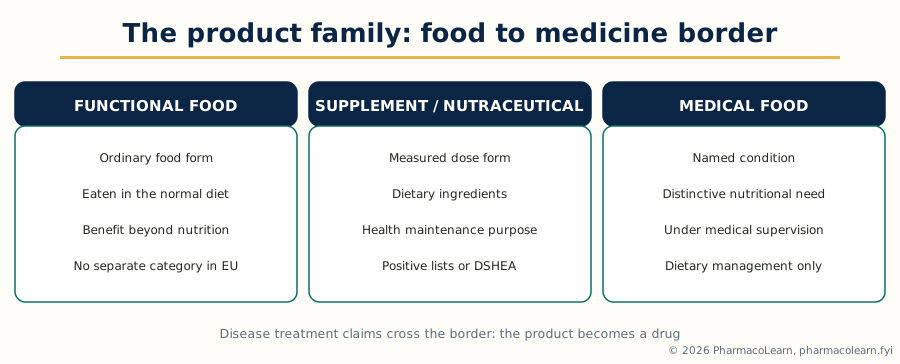 Figure: The four member family of sections 1.3 to 1.6 arranged by form and by closeness to medicine: the functional food in ordinary food form at the food end, the supplement and the nutraceutical in measured forms in the middle, and the medical food, tied to a named condition and used under supervision, nearest the drug border it must not cross (Unit 1, section 1.7).
1.8 Scope and opportunities in the nutraceutical market
The syllabus names scope and opportunities as a topic, and it is taught here qualitatively, because the drivers of the market are structural and durable while any figure quoted for its size would date and would differ by source. The demand side rests on four pillars. Preventive health behaviour: consumers increasingly spend on maintaining health rather than only on treating illness, and supplements and functional foods are the retail form of that intention. Lifestyle disease burden: the rise of conditions associated with diet and sedentary life creates a large population managing weight, blood lipids, blood sugar and joint and gut health through diet adjacent products, within the claim limits of section 1.3. Ageing populations: older consumers are the heaviest users of supplements for bone, eye, cognitive and general health support. And the sports, beauty and convenience segments: protein and performance products, beauty from within products, and fortified convenience foods extend the family well beyond the pharmacy shelf. The supply side offers its own opportunities: India's botanical heritage and its traditional medicine ingredient base give its industry a distinctive raw material position, contract manufacturing and private label work are substantial businesses, and exports are governed by exactly the three jurisdiction literacy this course teaches, since a product lawful in one system may need reformulation, relabelling or a notification in another. The regulatory opportunity inside the commercial one deserves emphasis: as claim control and ingredient positive lists tighten in all three systems, the firm whose regulatory work is sound, ingredients verified against the lists, claims inside the authorised language, GMP documented, holds a market advantage over the firm whose products are one inspection or one complaint away from withdrawal. That is the professional promise of this subject.
The border discipline of this subject
Is the article eaten as food, or presented in a measured
dose form for a health purpose?
        |
Ordinary form, no added health ingredient or claim
        -> conventional food law
        |
Measured form, dietary ingredients, health maintenance
        -> nutraceutical and supplement law (this subject)
        |
Named condition, distinctive nutritional requirement,
medical supervision
        -> medical food / food for special medical purposes
        |
Presented to diagnose, treat, cure or prevent disease
        -> a drug: leave this subject, drug law applies
Unit 2: International and Global Aspects
2.1 WHO guidelines on nutrition: the global reference point
The World Health Organization is the specialised agency of the United Nations for health, and its nutrition work is the global reference layer beneath every national system in this course. WHO does not license products and does not write binding food law for any country. What it issues is guidelines: systematically developed, evidence based recommendations, prepared through its guideline development process with expert review, on the intake of nutrients and on dietary patterns for populations and for specific groups. Their subject matter is the classical territory of nutrition science: the role of sugars, fats, sodium and potassium in the diet, fruit and vegetable intake, diet and the prevention of chronic disease, and the feeding of infants, children and other defined groups. For the regulatory student, three functions matter. First, WHO guidance is the scientific anchor national authorities cite when they set nutrient reference values, fortification policy and dietary guidance of their own, so the RDA sections of Units 3 to 5 all stand downstream of this layer. Second, WHO works jointly with the Food and Agriculture Organization in the Codex Alimentarius, the international food standards body whose standards on food labelling, food additives, contaminants and foods for special dietary uses are the reference texts national regulators adopt or align with, and the natural bridge between global guidance and enforceable national rules. Third, WHO's framing is public health, not product approval: it speaks of diets and populations, leaving products, factories and labels to national authorities, a division of labour the whole unit illustrates, since its second actor, NSF, is also not a government and also governs without a statute.
2.2 Reading WHO nutrition guidance as a regulatory document
A WHO guideline is read differently from a regulation, and the skill is worth a section. Its recommendations carry strength gradings, strong or conditional, which tell the adopting authority how firmly the evidence supports the recommendation and how much room local adaptation has. Its values are expressed for populations and life stage groups, not for products: a guideline on nutrient intake does not itself set the level a manufacturer may put in a capsule, which is the national authority's task, taken up for India by the Indian Council of Medical Research and its National Institute of Nutrition, for the United States by the National Academies' Food and Nutrition Board, and for Europe by EFSA, the three RDA authorities of this course. And its recommendations are revised on evidence cycles, which is why this subject teaches the architecture and the responsible bodies rather than memorised values: the values in force at any examination date are those of the current revision, in the current national table. The examination use of WHO material is therefore institutional: what WHO is, what a guideline is, how Codex relates to it, and how national systems convert its science into binding product rules.
2.3 NSF International: its role in the industry
NSF International, founded in the United States as the National Sanitation Foundation and now an independent, not for profit, non governmental organisation, is a standards developer, testing laboratory and certification body for public health products and for the food and supplement industries. Its role in the dietary supplement and nutraceutical industries rests on a gap in the statutory systems, and understanding the gap is understanding NSF. Under the American settlement of Unit 4, supplements reach the market without premarket approval: the FDA acts largely after marketing, against unsafe or misbranded products. Retailers, sports bodies and careful consumers therefore demanded an independent signal that a product contains what its label claims, in the amount claimed, without harmful contaminants, and was made under good manufacturing practice. NSF supplies that signal as third party certification: a private, voluntary attestation, by an accredited body independent of the manufacturer, that the product and its facility meet a published standard. Its wider supplement industry roles follow from the same position: developing the consensus standards the industry is certified against, auditing manufacturing facilities to GMP, testing finished products, certifying products for sport against prohibited substance concerns, and registering facilities. None of this is law, and all of it is commercially powerful, because a certification mark answers the trust question that a no premarket approval system deliberately leaves open.
How global guidance becomes a marketable product rule
WHO guideline: evidence based recommendation for populations
        |
Codex Alimentarius: international standard text
(WHO and FAO jointly)
        |
National authority: FSSAI, FDA, European Commission
with EFSA advice: binding rule, list, label or claim
        |
Manufacturer: formulation, GMP, label built to the rule
        |
Voluntary layer: NSF certification attests the product
and the factory against a published standard
2.4 NSF certification
NSF certification of a dietary supplement is a staged attestation, and the stages are the syllabus topic in their own right. The process, in its standard shape, runs as follows. The manufacturer applies and submits the product formulation and label for review: the ingredients are checked against the standard's requirements and the label against the certified claims. The product is tested in NSF's laboratories: the contents are verified against the label declaration, and the product is screened for contaminants, including heavy metals, microbial contamination, pesticides and, for sport certified products, prohibited substances. The manufacturing facility undergoes a GMP audit against the applicable GMP standard, because certification of a product made in an uncontrolled factory would certify nothing durable. Only when formulation, testing and audit all pass is certification granted, the product entered in NSF's listings and the certification mark licensed for use on the label. Certification is then maintained, not merely won: facilities are reaudited, products are subject to ongoing and unannounced testing and surveillance, and certification can be suspended or withdrawn when a product or facility falls out of conformity. Read the logic as an examiner does: certification transfers trust from a maker's promise to an independent body's continuing surveillance, which is why the mark, not the maker's own test report, is what retailers and sports authorities accept.
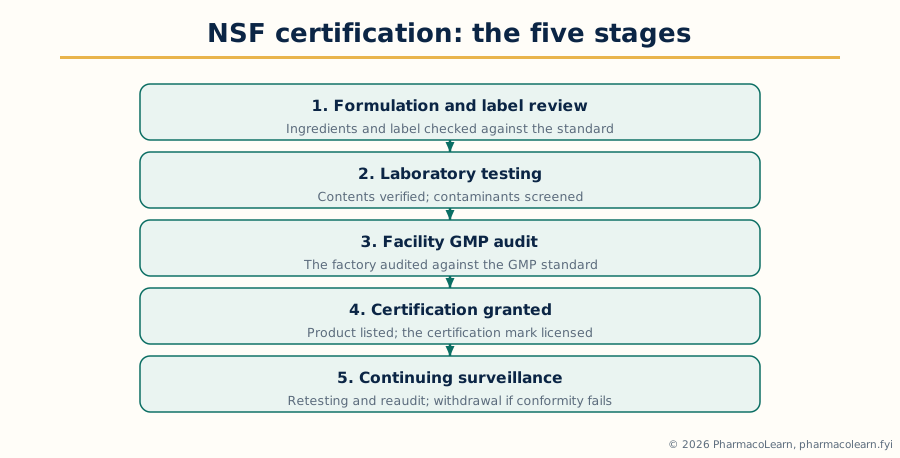 Figure: The NSF certification sequence of section 2.4: formulation and label review, laboratory testing for contents and contaminants, the facility GMP audit, grant of certification and the licensed mark, then continuing surveillance with retesting and reaudit (Unit 2, section 2.4).
2.5 NSF standards for food and dietary supplements
The standards are the documents that make certification possible, because a body can only certify against published, testable criteria. NSF's system works through joint and consensus standards developed with the American national standards process: the best known for this subject is the NSF/ANSI standard for dietary supplements, which sets the requirements for the identity, strength and composition of supplement contents, the limits for contaminants, and the basis on which label claims are verified. Beside the product standard sit the GMP standards and audit criteria for supplement and food facilities, against which the facility audits of section 2.4 are conducted, and NSF's food equipment and food safety standards family, which belongs to its older food industry work. Two distinctions carry the marks. A standard states the criteria; certification is the attestation that a named product or facility meets them, issued after testing and audit and kept under surveillance. And a private standard, however rigorous, does not replace the law: a certified product must still comply with the labelling, ingredient and claim rules of every market it is sold in, and certification is evidence of quality discipline, not a licence or an approval. The Indian and European systems of Units 3 and 5 make the converse arrangement, reaching much of the same assurance through statutory licensing and positive lists instead of voluntary certification, and the comparison is a favourite synthesis question.
2.6 Good Manufacturing Practices for nutraceuticals
Good Manufacturing Practice for nutraceuticals is the application to food supplement manufacture of the quality discipline this branch met for drugs in MRA101T, adjusted for products that are foods in law and medicines in presentation. Its elements are constant across the systems that impose it, the United States in its dietary supplement current GMP rule, India in the hygiene and manufacturing requirements of its food regulations, and the NSF audit criteria of this unit. Premises and equipment must be designed and maintained for hygienic manufacture, with contamination and cross contamination controlled. Specifications must exist for every component, for in process stages and for the finished product, covering identity, purity, strength and composition. Identity testing of incoming dietary ingredients is the characteristic nutraceutical duty: the manufacturer must verify that a botanical or nutrient raw material is what it claims to be, because the whole market failure pattern of this industry begins with substituted or diluted ingredients. Production and process controls, batch records, laboratory controls, packaging and labelling controls (including the reconciliation of labels, the classic source of supplement misbranding), holding and distribution controls, and a system for handling returned products and complaints complete the standard shape. Two ideas carry the examination weight. GMP is the substitute assurance of a no premarket approval system: where the state does not examine the product before sale, it examines and enforces the system that makes the product, which is why GMP violations are the commonest enforcement ground in this field. And GMP is documentary: a control that is not recorded is treated in audit as a control that did not happen, the same lesson MRA102T taught for drug documentation.
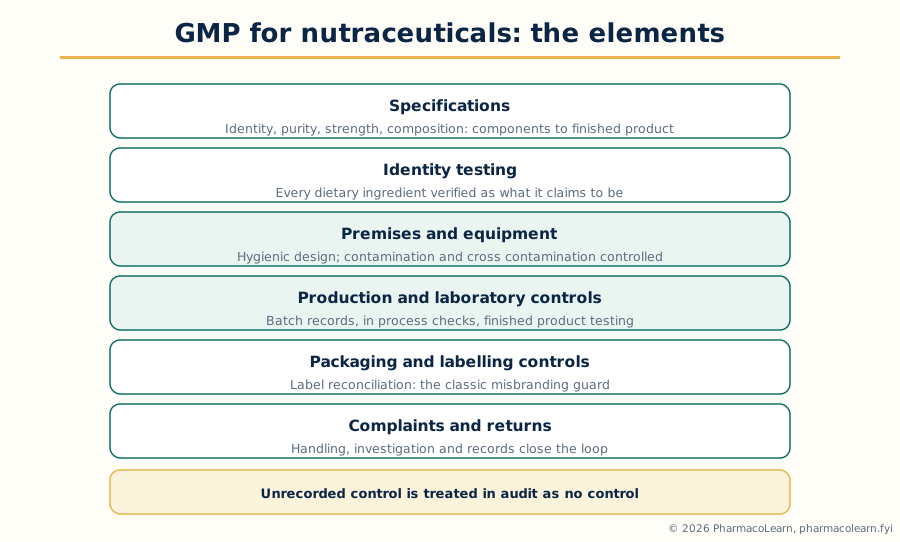 Figure: The GMP elements of section 2.6 in one view: specifications and identity testing of ingredients at the gate, premises, equipment and hygienic manufacture, production and laboratory controls with batch records, packaging and labelling controls, and complaint and return handling closing the loop (Unit 2, section 2.6).
Unit 3: India
3.1 The Food Safety and Standards Act 2006
The Food Safety and Standards Act, 2006 is the foundation statute of Indian food law and the first topic of this unit. Before it, Indian food regulation was a patchwork of separate laws and orders administered by different ministries, of which the Prevention of Food Adulteration Act 1954 was the best known. The 2006 Act consolidated that patchwork into a single statute and a single authority, shifted the system's centre of gravity from punishing adulteration after the event to science based standard setting and prevention, and brought manufacture, storage, distribution, sale and import of food under one framework administered through the Ministry of Health and Family Welfare. Its architecture is the standard Indian regulatory pattern. The Act establishes the Food Safety and Standards Authority of India and the state food safety machinery, empowers the making of regulations that carry the detailed standards, creates the licensing and registration system for food businesses, sets the offences and penalties, and provides for food recall and for the adjudication and tribunal machinery. For this subject its decisive feature is its breadth of the word food: the Act's framework reaches articles intended for human consumption including health supplements, nutraceuticals and foods for special dietary and medical purposes, which the detailed regulations then take up category by category in section 3.4. A product that is a food under this Act is regulated by FSSAI, and the same article presented as a medicine would fall to the drug authorities: classification at the border, once again, decides the regulator.
3.2 FSSAI: organization and functions
The Food Safety and Standards Authority of India (FSSAI) is the statutory authority the 2006 Act created, headquartered in New Delhi, working through its central office, regional and technical structures, and the state food safety commissioners and their licensing and enforcement officers. Its organisation follows the Act: a chairperson and members drawn from government, industry, science, consumer and farming interests, advised by a scientific committee and scientific panels of experts, because the Act intends standards to be set on scientific advice and not by administrative habit. Its functions are the syllabus list in substance: to frame regulations and lay down standards and guidelines for articles of food; to lay down the accreditation and certification machinery for food safety management systems and laboratories; to specify the licensing and registration system for food businesses; to collect and analyse data on food consumption, hazards and risks, and to run surveillance and risk communication; to promote food safety awareness and training; and to act as the national reference point for international food safety work, including Codex. The operational division of labour mirrors MRA104T's drug architecture: standards are central, set by FSSAI for the whole country, while licensing and enforcement run in two tiers, central licensing for the larger and specified categories of business and state licensing and registration below it, executed by state authorities. The regulatory professional deals with FSSAI as standard setter, licensor, and, through its food safety officers and adjudication machinery, enforcer.
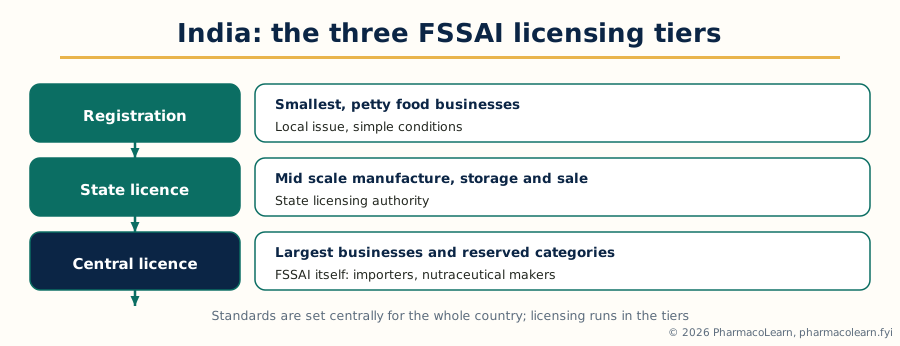 Figure: The three tier licensing structure of section 3.2: basic registration for the smallest food businesses, the state licence for mid scale businesses, and the central licence for the largest and for specified categories including importers and nutraceutical manufacturers, all under standards set centrally by FSSAI (Unit 3, section 3.2).
3.3 Licensing: registration, state licence and central licence
No food business in India may operate without the licence or registration the Act requires, and nutraceutical manufacture sits at the supervised end of the system. The structure is three tiered by scale and category. Registration covers the smallest, petty food businesses, issued locally on simple conditions. A state licence covers mid scale manufacture, storage and sale within the state system. A central licence, issued by FSSAI itself, is required for the largest businesses and for categories the regulations reserve to the centre, which include importers and the manufacture of the specialised product categories of this subject, health supplements and nutraceuticals among them. The licence is not a mere tax receipt: its conditions carry the hygiene and manufacturing requirements of the regulations, its grant follows scrutiny of the premises and the business, it must be renewed, and operating without it, or in breach of its conditions, is an offence under the Act. Beside the business licence stands product discipline: a nutraceutical may only be formulated from ingredients the regulations permit, in the forms and within the limits they set, which is the subject of the next section, so that the Indian system controls both the maker (by licence and GMP conditions) and the recipe (by positive lists), the two handed control the comparison with America in Unit 4 will throw into relief.
3.4 Regulations for import, manufacture and sale of nutraceutical products in India
The detailed Indian law of this subject lives in the regulations FSSAI has made under the Act, whose centrepiece for this unit is the dedicated regulations for health supplements, nutraceuticals, food for special dietary use, food for special medical purpose, prebiotic and probiotic food (first made in 2016 and revised since, the 2022 regulations being the current consolidated form students should name with its revision history in mind). Their method is the positive list: schedules list the permitted nutrients (vitamins, minerals, amino acids and other nutrients), the permitted plants and botanicals, and the permitted molecules, isolates and extracts, with prebiotics and probiotics dealt with in their own schedule. A product may be built only from what the schedules permit, in the dosage forms the regulations allow, and its nutrient levels are disciplined by reference to the RDA framework of section 3.5. Manufacture requires the central licence of section 3.3 and compliance with the good manufacturing and hygienic practices the regulations prescribe. Import runs through the food import clearance system: the importer must hold the central licence and import authorisation, consignments are cleared through FSSAI's import machinery with sampling and testing, and a product built on an ingredient India does not permit is not made lawful by being lawful abroad. Sale is governed by the labelling and claims discipline: the product must be labelled as its category requires, with the declarations the labelling regulations prescribe, and its claims are confined by the advertising and claims regulations to permitted nutrient and health language, with disease cure claims prohibited and the standing instruction that such products are not intended to diagnose, treat, cure or prevent any disease and are not a substitute for a varied diet, in the form the regulations require. Products that fall outside the permitted lists altogether require the prior approval route for non specified food and food ingredients, under which FSSAI examines the safety of the novel article before it may be marketed, India's functional equivalent of the European novel food gate of Unit 5.
Placing a nutraceutical on the Indian market
Are every ingredient and its level inside the schedules
of the nutraceutical regulations?
        |
No, and no prior approval  ->  do not launch; seek the
non specified food approval route first
        |
Yes
        |
Central licence held? Premises and GMP conditions met?
        |
Label and claims checked against the labelling and
claims regulations: category name, declarations,
no disease claims
        |
Manufacture or import under licence; import consignments
cleared with sampling and testing
        |
Sale with recall readiness and complaint handling
3.5 Recommended Dietary Allowances in India
Recommended Dietary Allowances are the reference values for the daily intake of energy and nutrients considered adequate for the maintenance of health in the population for which they are set. In India the values are set on the scientific work of the Indian Council of Medical Research through its National Institute of Nutrition (ICMR NIN), whose expert committees review the evidence, Indian dietary patterns, body weights and activity patterns, and publish the RDA tables by age, sex and physiological group, revising them as the evidence and the population change; the same scientific stable produces the complementary estimated average requirement concept, the average need figure from which the RDA, set safely above it, is derived. The syllabus asks for RDA in India as a regulatory topic, and its regulatory uses are three. Formulation discipline: the nutraceutical regulations of section 3.4 tie permitted nutrient levels in supplements to the RDA framework, so that a supplement is designed to fill the gap between dietary intake and the RDA rather than to deliver unbounded multiples of it. Labelling: nutrient declarations are read against the RDA, so the consumer and the examiner can both see what fraction of the day's requirement a serving supplies. And claims discipline: nutrient content claims are judged against thresholds expressed in relation to reference values. The values themselves are deliberately not recited in these notes: they are revised by expert committee, differ by nutrient and by life stage group, and the professional skill the syllabus tests is knowing whose values they are, what they are for, and where they bind the product, not memorising a table that a revision can supersede.
3.6 India in one view
The Indian settlement can now be stated in a paragraph, as the examinations will ask for it. One statute (2006), one authority (FSSAI), one licensing ladder with the specialised categories at its central tier, positive ingredient schedules that decide what may be sold, GMP and hygiene conditions on the maker, prescribed labels and a claims fence, an import gate with testing, and a prior approval route for anything the schedules do not cover. It is the most premarket of the three systems in this course: where America largely trusts the market and polices afterwards, India decides the recipe in advance. Hold that contrast for the synthesis at the end of Unit 5.
Unit 4: USA
4.1 Introduction: two statutes, two jobs
United States regulation of this product family rests on two statutes with different tempers, and the first task of the unit is to keep them apart. The Dietary Supplement Health and Education Act of 1994 (DSHEA) is the category statute: it defines the dietary supplement, decides what ingredients may be used, and builds the labelling and claims regime. The FDA Food Safety Modernization Act of 2011 (FSMA) is the food safety statute for the whole food supply: it reorients the Food and Drug Administration (FDA) from reacting to food safety failures toward preventing them, and its machinery reaches supplement facilities as food facilities. Around them stands the parent statute, the Federal Food, Drug, and Cosmetic Act, under which supplements are regulated as a subcategory of food. The governing fact of the American system, from which everything else in this unit follows, is negative: there is no premarket approval for dietary supplements. A supplement may be marketed without the FDA ever having examined it, provided its ingredients are lawful, its manufacture follows GMP, its label is compliant and its claims stay inside the fence. The state's power is exercised before marketing only at defined gates (the new dietary ingredient notification of section 4.4) and otherwise after marketing, against products that are adulterated or misbranded. NSF certification in Unit 2 exists because this gate is open; the Indian positive list system in Unit 3 exists because India chose to close it.
4.2 The Food Safety Modernization Act (FSMA), 2011
FSMA, signed in 2011, is described by the FDA itself as the most sweeping reform of United States food safety law in decades, and its philosophy is its first examinable point: prevention over reaction. Its pillars, as they touch this subject, are these. Preventive controls: food facilities must evaluate the hazards in their operation and implement and monitor preventive controls, with a written food safety plan, replacing reliance on end product inspection. Registration and inspection: food facilities, including supplement facilities, register with the FDA and face risk based inspection, foreign as well as domestic. Imported food safety: importers carry responsibility for verifying that their foreign suppliers meet United States standards, through the foreign supplier verification machinery, and foreign facilities face inspection and certification arrangements. Mandatory recall: FSMA gave the FDA, for the first time, the power to order the recall of food it reasonably believes is adulterated or misbranded in a way that threatens serious health consequences, where the responsible firm will not recall voluntarily. And traceability and records duties run through the scheme, so that when prevention fails the product can be found and removed quickly. For the supplement sector specifically, FSMA works alongside, and does not replace, the supplement specific GMP rule of section 4.4: the facility is a food facility for registration, preventive control and import purposes, and a supplement manufacturer for its product specific quality duties. The examination contrast is with the older reactive model: FSMA assumes contamination and failure will be attempted by circumstance, and requires the system that prevents, detects and corrects them to exist on paper and in practice before anything goes wrong.
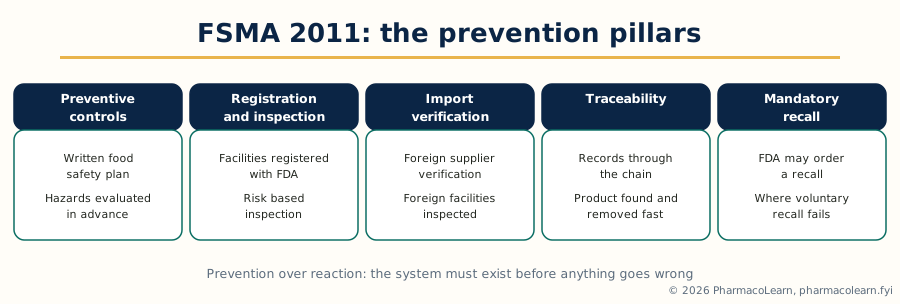 Figure: The FSMA pillars of section 4.2 as they reach a supplement facility: preventive controls under a written food safety plan, facility registration and risk based inspection, foreign supplier verification for imports, records and traceability, and the FDA mandatory recall power standing behind voluntary recall (Unit 4, section 4.2).
4.3 The Dietary Supplement Health and Education Act (DSHEA), 1994
DSHEA amended the Federal Food, Drug, and Cosmetic Act to settle, after years of conflict between the FDA and the supplement industry, what a dietary supplement is and how it is governed. Its definition is the one taught in section 1.4: a product intended to supplement the diet, bearing one or more dietary ingredients (vitamins, minerals, herbs or other botanicals, amino acids, dietary substances, and their concentrates, metabolites, constituents and extracts), for ingestion in measured form, and not represented as a conventional food or sole item of a meal or diet. Its safety settlement reverses the drug burden of proof: the manufacturer is responsible for ensuring its product is safe before marketing, but it need not prove safety to the FDA in advance; the FDA bears the burden of showing a marketed product is adulterated, for example because it presents a significant or unreasonable risk, before it can act against it on safety grounds. Its ingredient gate is the new dietary ingredient rule of the next section. Its claims settlement, the structure and function regime, is the subject of section 4.6. And its labelling settlement created the Supplement Facts panel of section 4.5. DSHEA also directed the good manufacturing practice authority under which the supplement GMP rule was later made. Read DSHEA whole and its character is plain: it is a statute of access with responsibility, deliberately keeping supplements out of the drug approval system while fixing the maker with the duties of safety, quality manufacture and truthful labelling, and the decades of argument about the American system are arguments about whether that balance was struck correctly.
4.4 US regulations for manufacture and sale of nutraceuticals and dietary supplements
The operative duties on an American supplement business assemble from DSHEA, FSMA and their rules into a coherent checklist, which is how the syllabus topic should be learned. Ingredients: a dietary ingredient marketed in the United States before DSHEA's 1994 enactment is treated as an existing ingredient; a new dietary ingredient (NDI), one not so marketed, may only be used where the manufacturer notifies the FDA before marketing, with information supporting the conclusion that the supplement will reasonably be expected to be safe, or where another lawful basis applies, such as the ingredient's presence in the food supply in a chemically unaltered form. The notification is a gate, not an approval: the FDA may object, and marketing a supplement with an unnotified NDI renders it adulterated in law. Manufacture: the current good manufacturing practice rule for dietary supplements (21 CFR Part 111) requires specifications for identity, purity, strength and composition, identity testing of dietary ingredients, production and process controls, batch records, laboratory and labelling controls, and complaint handling, the nutraceutical GMP of section 2.6 in its American statutory form. Facilities register under the food facility registration system FSMA strengthened. Sale: a supplement is adulterated if it presents a significant or unreasonable risk, contains a poisonous or deleterious substance in a harmful quantity, was made in breach of GMP, or contains an unlawful NDI; it is misbranded if its labelling is false or misleading or lacks what the labelling rules require. Serious adverse event reporting by the manufacturer to the FDA is a statutory duty, the vigilance limb of a system that, having no premarket gate, must watch the market it has allowed. Enforcement runs from warning letters through seizure, injunction and the FSMA mandatory recall, and border control over imports completes the scheme.
4.5 Labelling requirements for dietary supplements
The American supplement label is a prescribed document, and its centrepiece is the Supplement Facts panel, the supplement counterpart of the Nutrition Facts panel on conventional foods. It declares the serving size and servings per container, the amount per serving of each dietary ingredient, and the percentage of the Daily Value where a Daily Value exists (the label RDA machinery of section 4.7). Around the panel the label must carry the product's identity statement as a dietary supplement, the net quantity, the ingredient list in the required order and form, the name and address of the manufacturer, packer or distributor, and the directions and warnings the product needs, including the allergen and safety warnings particular products require. Two labelling duties carry special examination weight. The structure and function claim disclaimer of the next section must appear on the label where such a claim is made. And the label is the boundary of legality in the most literal sense: a statement that would be permissible in a textbook becomes, printed on this label, a claim the statute judges, and a disease claim on the label converts the product in law toward an unapproved drug. Label review is therefore a regulatory act, not a design act, in this industry.
4.6 Label claims for dietary supplements: the claims ladder
American supplement claims stand on a ladder of four rungs, and placing a proposed claim on the right rung is the core professional skill of this unit. At the top, authorised health claims describe a relationship between a substance and a disease or health related condition, and may be used only where the FDA has authorised the claim on the strength of significant scientific agreement, in the authorised wording or close to it. Below them, qualified health claims rest on evidence that is credible but does not meet that standard: the FDA exercises enforcement discretion for them only with qualifying language that accurately states the weakness of the evidence, so the consumer is not misled about certainty. The third rung is the DSHEA creation, structure and function claims: statements that describe the role of a nutrient or ingredient in affecting the normal structure or function of the body, or general wellbeing, such as language about supporting immune health or helping maintain joints. They need no FDA authorisation, but three conditions bind them: the manufacturer must have substantiation that the claim is truthful and not misleading, must notify the FDA of the claim after marketing within the period the rules prescribe, and must carry the disclaimer that the statement has not been evaluated by the FDA and that the product is not intended to diagnose, treat, cure or prevent any disease. Nutrient content claims, characterising the level of a nutrient in the product, run beside the ladder under their own defined terms and thresholds. Below the ladder altogether, forbidden, are disease claims: any statement that the product diagnoses, treats, cures, mitigates or prevents a disease, which makes the product an unapproved new drug whatever its ingredient list says. The ladder is a calibrated instrument: the stronger the medical meaning of the words, the stronger the evidence and authorisation the law demands before they may be printed.
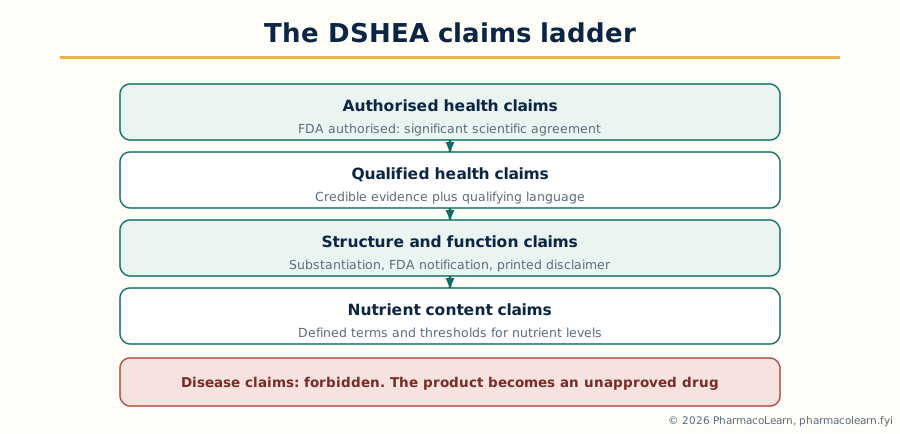 Figure: The American claims ladder of section 4.6: authorised health claims on significant scientific agreement, qualified health claims with their qualifying language, structure and function claims on manufacturer substantiation with notification and the FDA disclaimer, and disease claims below the line, forbidden to supplements entirely (Unit 4, section 4.6).
4.7 Recommended Dietary Allowances in the US
The American reference value system has two related instruments, and the syllabus topic is knowing both and which body owns each. The scientific instrument is the Dietary Reference Intakes (DRIs), the family of reference values developed by the Food and Nutrition Board of the National Academies of Sciences, Engineering, and Medicine, of which the Recommended Dietary Allowance (RDA) is the best known member: the average daily dietary intake level sufficient to meet the nutrient requirements of nearly all healthy individuals in a particular life stage and sex group, derived from the estimated average requirement with a margin for population variation. Beside the RDA the DRI family carries the estimated average requirement itself, the adequate intake used where evidence cannot support an RDA, and the tolerable upper intake level, the ceiling concept that disciplines high dose supplement formulation. The labelling instrument is the FDA's Daily Value: the reference figure printed on the Supplement Facts and Nutrition Facts panels, against which the percentage per serving is declared, set by the FDA by regulation for labelling purposes and updated by rulemaking rather than by each scientific revision. The professional distinctions follow. The RDA is a scientific recommendation for planning and assessing diets, set by an independent scientific board; the Daily Value is a legal labelling reference, set by the regulator; and neither is a product limit, though formulators use the DRI family, including the upper level, as the evidence frame for deciding what a supplement may sensibly contain.
Unit 5: European Union
5.1 The European Food Safety Authority (EFSA): organization and functions
The European Union separates the assessment of food risk from the management of it, and EFSA is the assessment side of that separation. Founded under the General Food Law of 2002, in the reform that followed the European food safety crises of the 1990s, EFSA is an independent European agency, based in Parma, Italy, funded by the Union and governed by a management board, an executive director, an advisory forum that links it to the member states' own food safety bodies, and a scientific committee and scientific panels of independent experts, of which the panel on nutrition, novel foods and food allergens is the one this subject deals with. Its functions are scientific: to provide independent scientific advice and opinions on food and feed safety, nutrition and related questions, at the request of the European Commission, the European Parliament, member states or on its own initiative; to collect and analyse data and monitor risks; and to communicate risks to the public. Its opinions are the mandatory scientific foundation for the decisions this unit studies: the authorisation of health claims, the safety assessment of novel foods, and the setting of dietary reference values. What EFSA does not do is equally definitional: it grants no authorisations, issues no licences and enforces nothing. Authorisation decisions are taken by the European Commission together with the member states (the risk managers), and enforcement belongs to the member states' own authorities. The division mirrors the WHO lesson of Unit 2 at regional scale: assessment advises, management decides, enforcement polices, and confusing the three is the standard examination trap in this unit.
5.2 EU directives and regulations for manufacture and sale of nutraceuticals and dietary supplements
Europe has no single nutraceutical statute; the category is governed by a family of instruments, and the syllabus topic is the family itself. The foundation is the General Food Law (Regulation (EC) No 178/2002), which lays down food safety principles, the rule that food business operators are responsible for the safety of what they place on the market, traceability, and the EFSA structure of section 5.1. The category instrument is the Food Supplements Directive (2002/46/EC), which defines food supplements as foodstuffs whose purpose is to supplement the normal diet, being concentrated sources of nutrients or other substances with a nutritional or physiological effect, marketed in dose form; it harmonises the field through positive lists of the vitamins and minerals, and their chemical forms, that may be used, leaving member states a continuing role on other ingredients such as botanicals, which is why the European supplement market is harmonised at its centre and national at its edges. Around these stand the addition of nutrients Regulation (Regulation (EC) No 1925/2006) for vitamins and minerals added to ordinary foods, the food hygiene and official controls framework under which manufacture and sale are policed by member states, the requirement that food businesses operate under hygiene rules and hazard analysis discipline, and the claims Regulation (Regulation (EC) No 1924/2006) of section 5.4's neighbour topic: no nutrition or health claim may be made in the Union unless it is authorised and entered in the Union list, on an EFSA opinion. Manufacture and sale therefore run on operator responsibility plus positive lists plus authorised claims, supervised nationally: a mid position between the Indian premarket recipe control of Unit 3 and the American market access model of Unit 4, and the comparison is the natural close of the course.
5.3 Nutrition labelling in the European Union
European nutrition labelling is governed by the Food Information to Consumers Regulation (Regulation (EU) No 1169/2011), which made a standard nutrition declaration mandatory on most prepacked foods and prescribes its content, order and expression. The declaration states energy value and the amounts of fat, saturates, carbohydrate, sugars, protein and salt, expressed per 100 grams or 100 millilitres and, additionally, per portion, with a defined set of voluntary additions; for food supplements the directive framework requires the amounts of the nutrients or substances with a nutritional or physiological effect to be declared per the recommended daily dose, expressed also as a percentage of the nutrient reference value, the Union's labelling reference (the European RDA instrument of section 5.6). The labelling rules also carry the supplement specific warnings discipline: the product is not a substitute for a varied diet, the stated recommended daily dose must not be exceeded, and products are to be kept out of the reach of children, in the form the directive prescribes. As in America, the label is a legal document: a claim printed on it must be an authorised claim, a value declared on it must follow the prescribed reference system, and the member state authorities enforce it as such.
5.4 The European regulation on novel foods and novel food ingredients
A novel food in Union law is a food that was not used for human consumption to a significant degree within the Union before the reference date the legislation fixes (15 May 1997, the date of the first novel food regulation), and which falls within the categories the current regulation lists, including foods with a new or modified molecular structure, foods made from microorganisms, fungi or algae, foods from cell or tissue culture, foods produced by new processes that significantly change them, and engineered nanomaterials, among others. The governing instrument is Regulation (EU) 2015/2283 on novel foods, which replaced the original 1997 regulation and centralised the system. Its logic is a premarket gate, the strictest in this course beside India's non specified food approval: a novel food may not be placed on the Union market unless it is authorised and entered in the Union list of authorised novel foods, with its conditions of use and labelling requirements. The route runs in stages: the applicant prepares a dossier demonstrating safety under the proposed conditions of use; the application goes to the European Commission, which requests a scientific opinion from EFSA, whose risk assessment examines composition, production process, proposed uses and use levels, nutritional character and toxicological evidence; on a favourable assessment the Commission brings forward the authorising act through the committee procedure with the member states, and the food is added to the Union list, sometimes with data protection for the applicant's proprietary evidence for a period. The regulation also provides a lighter notification route for traditional foods from third countries, with a history of safe use outside the Union, under which objections on safety grounds determine whether a full application is required. For this subject the novel food gate is where new nutraceutical territory is won or lost in Europe: a botanical extract, algal oil or fermented ingredient without a Union consumption history before the reference date is a novel food first and a supplement ingredient second, and no supplement directive argument can cure the defect.
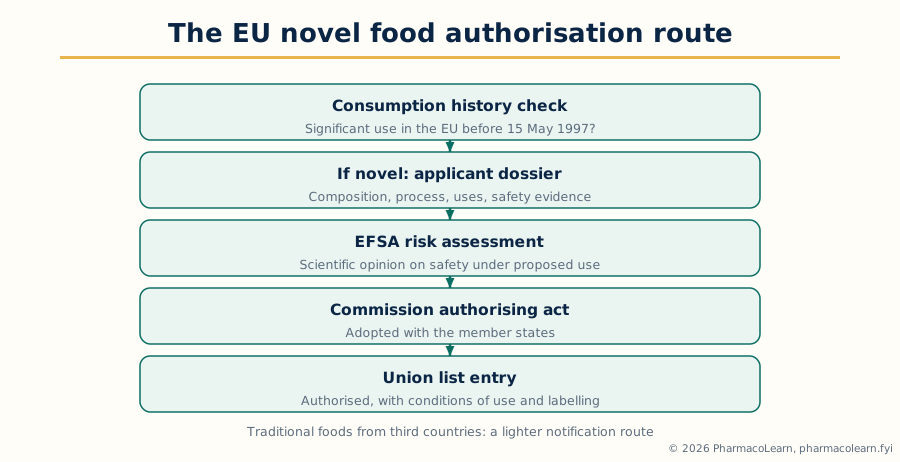 Figure: The novel food route of section 5.4 under Regulation (EU) 2015/2283: consumption history before the 1997 reference date decides novelty, the applicant dossier goes to the Commission, EFSA delivers the safety opinion, and authorisation enters the food in the Union list with its conditions of use (Unit 5, section 5.4).
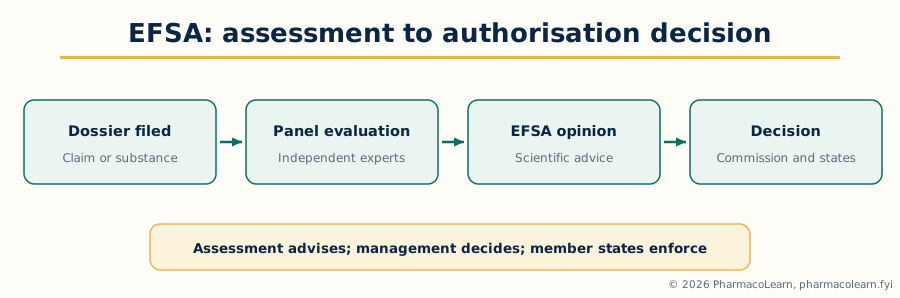 Figure: The EFSA assessment flow behind sections 5.1 and 5.2: a claim or substance dossier is validated, the competent scientific panel evaluates the evidence and adopts an opinion, and the Commission with the member states takes the authorisation decision that enters, or refuses, the Union list (Unit 5, section 5.1).
5.5 Regulation of functional foods in the European Union
Unit 1 established that the functional food is a scientific and marketing category in search of a legal one, and Europe is the proof. The Union has no functional food directive and no functional food authorisation: a yoghurt, spread or drink positioned on a health benefit is regulated by the ordinary instruments, each doing its own work. The product must be a lawful food under the General Food Law, made by a responsible operator under the hygiene framework. Anything added to give it its function must be permitted: added vitamins and minerals under the addition Regulation of section 5.2, and any ingredient without a Union consumption history must first clear the novel food gate of section 5.4. Its benefit may only be spoken in authorised language: the claims Regulation permits a health claim, including the reduction of disease risk claims it treats most strictly, only where EFSA has assessed the evidence and the claim stands in the Union list, in its authorised wording and conditions. And its label must carry the standard nutrition declaration of section 5.3. The European position is therefore best stated as a sentence: functional foods are fully regulated, but as foods with ingredients and claims, never as a class. The contrast the examiner wants is with a system that names the category, India, whose regulations expressly list functional territory inside their health supplement and nutraceutical framework, and with the United States, where the same product is a conventional food whose benefit language is judged under the health claim and structure and function rules of Unit 4.
5.6 Recommended Dietary Allowances in Europe
Europe's reference value system is set scientifically by EFSA, which publishes Dietary Reference Values (DRVs) for nutrients and energy for the Union: a family of values, including the average requirement, the population reference intake (the European counterpart in function to the RDA, the intake adequate for practically all healthy people in a group), adequate intakes where the evidence supports no population reference intake, and tolerable upper intake levels, set by age, sex and life stage group and revised on the evidence. The values are scientific opinions, not law in themselves: they serve the Commission and member states in setting policy, dietary guidance and labelling references, and the labelling expression of them is the nutrient reference value of section 5.3, the single set of reference figures the Food Information Regulation prescribes for percentage declarations on labels. The three RDA sections of this course now assemble into one comparison, which is the synthesis this subject has been building toward.
| Point | India | United States | European Union |
|---|---|---|---|
| Scientific body | ICMR through its National Institute of Nutrition | Food and Nutrition Board of the National Academies | EFSA, through its nutrition panel |
| Reference family name | Recommended Dietary Allowances (with estimated average requirements) | Dietary Reference Intakes, including the RDA | Dietary Reference Values, including the population reference intake |
| RDA counterpart | RDA itself | RDA itself | Population reference intake |
| Ceiling concept | Carried in the ICMR framework | Tolerable upper intake level in the DRI family | Tolerable upper intake level in the DRV family |
| Labelling expression | Declaration read against the RDA | Daily Value percentage on Supplement Facts | Nutrient reference value percentage |
| Regulatory use in this subject | Disciplines permitted nutrient levels in the nutraceutical regulations | Frames formulation and label percentages, no product limit in itself | Frames labelling percentages and policy; authorisation is separate |
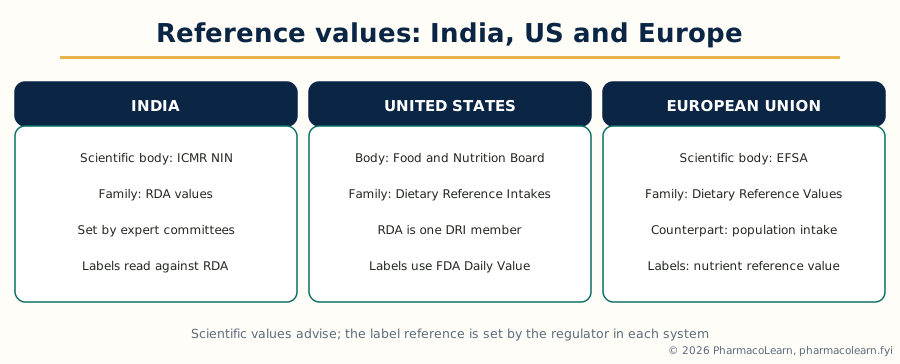 Figure: The three reference value systems of Units 3 to 5 side by side: ICMR NIN and the Indian RDA, the Food and Nutrition Board with the Dietary Reference Intakes and the FDA Daily Value for labels, and EFSA with the Dietary Reference Values and the nutrient reference value for labels (Unit 5, section 5.6).
5.7 The three systems compared: the close of the course
The course ends where a regulatory professional's judgment begins, in the comparison. India controls the recipe in advance: positive schedules decide what may be sold, the maker is centrally licensed for these categories, and anything outside the schedules needs prior approval. America controls the market in motion: no premarket approval, ingredient notification at one gate, GMP on the factory, a disciplined claims ladder on the label, and enforcement, adverse event reporting and recall against what fails. Europe controls by list and opinion: positive lists for vitamins and minerals, EFSA assessed authorisation for claims and for novel foods, operator responsibility under a general food law, and national enforcement. The same capsule can therefore be lawful in one system, reformulation work in a second, and an unauthorised novel food in the third, and none of the three is a failed version of the others: each is a coherent answer, weighted differently, to the border question of Unit 1. The habits this subject rewards follow directly. Classify the product first. Check the ingredient against the destination's list or gate. Build it under GMP and be able to prove it. Write the label from the destination's rulebook, not from the home market's. And never let the claim say in marketing language what the evidence and the authorisation do not say in regulatory language.
Frequently Asked Questions
Q: What is a nutraceutical, and how does it differ from a dietary supplement and a functional food? A nutraceutical is a food or food component, in measured form, that provides a physiological benefit beyond basic nutrition and helps maintain health. A dietary supplement is the statutory category of products intended to supplement the diet with dietary ingredients such as vitamins, minerals and botanicals. A functional food is a conventional food in ordinary food form with a benefit beyond basic nutrition. The nutraceutical is the broad trade and Indian regulatory term, the supplement the defined American category, and the functional food a category most systems regulate through ingredient, fortification and claims law rather than by a separate licence.
Q: Why are nutraceuticals regulated as foods and not as drugs? Because their intended purpose is health maintenance and dietary supplementation, not the diagnosis, treatment, cure or prevention of disease. All three systems in this course keep them inside food law, with drug style elements added where the risk sits: positive ingredient lists or notification gates, GMP manufacture, prescribed labels and fenced claims. A product presented with a disease purpose leaves the food framework and is judged as a drug.
Q: What does NSF certification attest, and is it a legal approval? NSF certification attests, after formulation and label review, laboratory testing for contents and contaminants, and a GMP audit of the facility, that a supplement meets a published NSF standard, with continuing surveillance and retesting to maintain it. It is a voluntary third party attestation, not a government approval or licence, and a certified product must still comply with the law of every market where it is sold.
Q: What did the Food Safety and Standards Act 2006 change in India? It consolidated a patchwork of older food laws and orders into a single statute, created the Food Safety and Standards Authority of India as the single national authority, moved the system toward science based standards and prevention, and brought manufacture, storage, distribution, sale and import of food, including nutraceuticals and health supplements, under one licensing and standards framework.
Q: How are nutraceuticals controlled in India before they reach the market? By positive list and licence. The FSSAI regulations for health supplements, nutraceuticals and related categories permit only scheduled nutrients, botanicals, molecules, isolates, extracts, prebiotics and probiotics, within the prescribed discipline; manufacture of these categories requires a central licence and GMP and hygiene compliance; imports pass through licensing and clearance with sampling and testing; and an article outside the schedules needs the prior approval route for non specified foods.
Q: What is the RDA, and who sets it in India, the US and Europe? The Recommended Dietary Allowance is the daily nutrient intake level considered adequate for nearly all healthy people in a defined group. In India the values come from the ICMR through its National Institute of Nutrition; in the United States the RDA sits inside the Dietary Reference Intakes of the Food and Nutrition Board of the National Academies, with the FDA Daily Value as the labelling expression; in Europe EFSA sets Dietary Reference Values, whose RDA counterpart is the population reference intake, with nutrient reference values used on labels.
Q: What is the difference between FSMA and DSHEA? DSHEA, 1994, is the category statute: it defines dietary supplements, fixes ingredient responsibility and the new dietary ingredient notification, and builds the labelling and claims regime, with no premarket approval. FSMA, 2011, is a food safety statute for the whole food supply: preventive controls, facility registration and risk based inspection, foreign supplier verification, traceability and mandatory recall authority. A supplement business in the US lives under both.
Q: What claims may a dietary supplement make in the United States? Authorised health claims where the FDA has authorised them on significant scientific agreement; qualified health claims with qualifying language about the evidence; nutrient content claims under their defined terms; and structure and function claims, which need manufacturer substantiation, notification to the FDA, and the disclaimer that the statement has not been evaluated by the FDA and the product is not intended to diagnose, treat, cure or prevent any disease. Disease treatment claims are forbidden and make the product an unapproved drug.
Q: What does EFSA do, and what does it not do? EFSA provides independent scientific risk assessment and communication for the European Union: opinions on claims, novel foods, substances and dietary reference values, through its scientific committee and panels. It does not authorise products, issue licences or enforce the law. Authorisation decisions are taken by the European Commission with the member states, and enforcement belongs to member state authorities.
Q: What is a novel food in the European Union, and how is it authorised? A novel food is a food without a history of human consumption to a significant degree in the Union before the 1997 reference date, within the categories listed in Regulation (EU) 2015/2283. It may be marketed only after authorisation and entry in the Union list: the applicant files a safety dossier, EFSA delivers the scientific risk assessment, and the Commission with the member states adopts the authorising act with conditions of use. A lighter notification route exists for traditional foods from third countries with a history of safe use.
Complete MRA204T notes, all 5 units in one PDF, free to keep.
Other M.Pharm subjects: MPH101T · MPC101T · MPL101T · MPH102T · MPH103T · MPH104T · MPL102T · MPL103T · MPL104T · MPC102T · MPC103T · MPC104T · MPH201T · MPH202T · MPH203T · MPH204T · MPC201T · MPC202T · MPC203T · MPC204T · MPL201T · MPL202T · MPL203T · MPL204T · MRA101T · MRA102T · MRA103T · MRA104T · MRM301T · MPG101T · MPG102T · MPG103T · MPG201T · MPG202T · MPG203T · MPG104T · MPG204T · MRA201T · MRA202T · MRA203T · MRA204T · M.Pharm