
MRA103T — Clinical Research Regulations
4 hrs/week, 4 credits, 60 hours, 100 marks. Notes follow the M.Pharm syllabus, unit by unit.
MRA103T Clinical Research Regulations notes for M.Pharm Sem 1 Regulatory Affairs: trial phases, ethics committees, informed consent, NDCT Rules 2019, ICH GCP, 21 CFR and EU guidance, with free unit wise PDF downloads on PharmacoLearn.
Units in this subject
- Unit 1 — Clinical Drug Development Process
- Unit 2 — Ethics in Clinical Research
- Unit 3 — Regulations Governing Clinical Trials
- Unit 4 — Clinical Research Related Guidelines
- Unit 5 — USA and EU Guidance
Download MRA103T PDF Notes
Free PDFs for this subject, one per unit:
Clinical Research Regulations, subject code MRA103T, is the third core subject of M.Pharm Regulatory Affairs, Semester 1. It carries 4 credits and 60 hours of theory, taught at 4 hours per week, for 100 marks. MRA101T taught the good practices of manufacture and the laboratory, and MRA102T the documents that carry a product to a regulator; this subject teaches the one experiment in pharmaceutical development that is performed on people. A clinical trial is at once a scientific study, an ethical undertaking and a regulated legal act, and it cannot begin, in any serious jurisdiction, until a regulator and an ethics committee have both said yes. This subject explains how that permission system is built: how a drug travels from first in human testing to post marketing surveillance, what history forced the rules into existence, who guards the rights of the participants, and which laws, rules and guidelines a regulatory affairs professional must command in India, the United States and the European Union.
The course is designed to impart fundamental knowledge on the clinical development process of drugs, pharmaceuticals and medical devices, the phases and conduct of clinical trials and research, and the regulations and guidance governing clinical research in India, the USA and the EU. Its objectives run in the order of the units: the history, origin and ethics of clinical and biomedical research and evaluation; the development process and the types and phases of trials; and the regulatory requirements and guidance for the conduct of clinical trials and research. Unit 1 walks the development process itself, phase by phase, ending with the special case of medical devices and IVDs. Unit 2 is the ethical foundation: the historical abuses that wrote the rules, the committees that guard participants, and the informed consent on which everything rests. Unit 3 states the governing regulations of the three regions, including India's New Drugs and Clinical Trials Rules 2019. Unit 4 collects the working guidelines, from ICH GCP to the ICH efficacy series. Unit 5 reads the two great foreign rulebooks in detail: the United States Code of Federal Regulations, part by part, and the European Union's directives, EudraLex volumes and device framework.
Unit 1: Clinical Drug Development Process
1.1 The clinical development process: a regulated experiment on people
A new drug reaches the clinic only after discovery and preclinical work (pharmacology, toxicology, formulation) have produced a candidate with enough evidence of possible benefit and acceptable risk to justify human exposure. From that moment the development is clinical: a planned sequence of studies in human participants, each designed to answer a defined question, each gated by regulatory permission and ethics approval, and each more expensive and less forgiving than the last. The regulatory affairs function exists inside this process because the gates are documentary: an application to test, a protocol to approve, reports to file, safety data to submit on fixed clocks. Three ideas organise the whole unit. The development is phased, because questions must be answered in order: is it safe enough, does it work at all, does it work well enough against the standard, and does it stay safe in real use. It is comparative, because from Phase II onward the drug is judged against a control, not against hope. And it is cumulative, because each phase's dossier becomes the evidence base the next phase's application stands on: the clinical trial application of Unit 3 is only ever as strong as the preclinical and earlier clinical data behind it.
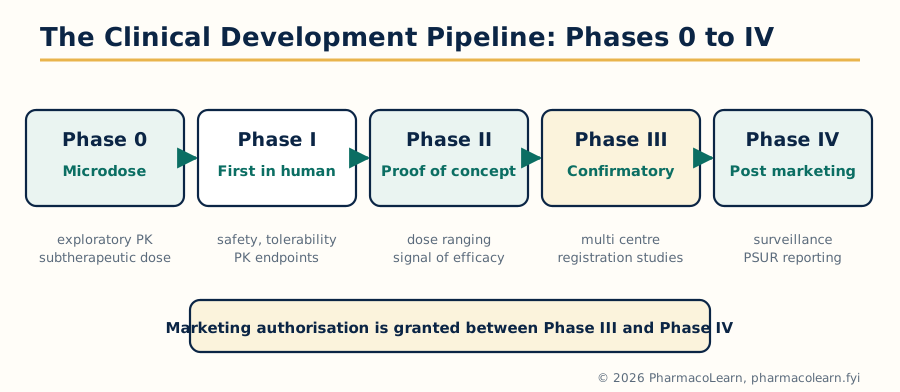 Figure: The clinical development pipeline: each phase answers one governing question, and marketing authorisation sits between the confirmatory and post marketing phases (Unit 1, section 1.1).
1.2 Types of clinical studies
The syllabus opens with the types, because the regulatory weight of a study depends on what kind it is. The first division is between interventional studies, in which the investigator assigns an intervention (a drug, a device, a procedure) by protocol, and observational studies, in which exposure happens in ordinary care and the investigator only records outcomes: cohort, case control and cross sectional designs, familiar from the biostatistics teaching, belong to the second family and generally need ethics approval and registration discipline but not a trial licence. Within interventional studies the working vocabulary of design is examinable in itself:
| Design feature | Principal forms | Regulatory significance |
|---|---|---|
| Allocation | Randomised, non randomised | Randomisation is the standard defence against selection bias; departures must be justified in the protocol |
| Control | Placebo, active comparator, dose comparison, historical, no treatment | The choice of control is an ethical and scientific decision governed by ICH E10 (Unit 4) |
| Blinding | Open label, single blind, double blind | Blinding protects endpoints from expectation; unblinding rules belong in the protocol |
| Structure | Parallel group, crossover, factorial | Crossover suits stable chronic conditions and small populations; carryover must be excluded |
| Purpose | Exploratory, confirmatory | Confirmatory trials carry the registration claim and are run to the strictest evidentiary standard |
A study is also classified by its relation to marketing: a pivotal or registration study is one designed to support an approval claim, and the same study run after approval changes regulatory character even where its science is identical. The type of study decides the type of permission: that sentence is the bridge from this unit to Unit 3.
1.3 The clinical trial protocol: the study's constitution
Every item in this subject returns to one document. The clinical trial protocol is the written plan that states what the study is, why it is justified, how it will be conducted, analysed and reported, and how participants will be protected. Its standard contents, set by ICH GCP (Unit 4), run: background and rationale; objectives; design; the participant population with inclusion and exclusion criteria; treatments and dosing; assessments and endpoints; safety reporting and stopping rules; statistical methods and sample size; data handling and quality management; ethics, consent and compensation arrangements; and the publication policy. The protocol is approved twice before a single participant is enrolled: by the ethics committee (Unit 2), which judges the ethics and the science that carries ethical weight, and, where the rules require it, by the regulatory authority, which judges the product and the plan together. Changes after approval travel as protocol amendments, classified and approved in the same order of importance, and departures in conduct are recorded as deviations and violations, because the approved protocol is the benchmark against which the whole study will one day be inspected. Beside the protocol stands the investigator's brochure, the compiled preclinical and clinical evidence about the product that lets investigators and committees judge risk; the protocol says what will be done, the brochure says what is already known.
1.4 Phase 0 studies: the exploratory first step
Phase 0 is the syllabus's most modern item: exploratory, first in human studies conducted before the traditional Phase I, under an exploratory investigational framework, with very limited human exposure and no therapeutic intent. The defining technique is microdosing: a subtherapeutic dose, conventionally not more than 100 micrograms and not more than one hundredth of the dose expected to produce a pharmacological effect, given to a small number of subjects so that sensitive analytical methods (accelerator mass spectrometry, positron emission tomography) can answer an early pharmacokinetic question: is the molecule absorbed, how is it distributed, which candidate of several deserves full development. Because exposure is so small, the preclinical package required is reduced, and the study cannot establish safety or tolerability in the ordinary sense and must never be sold to participants as treatment. Phase 0 is a development economics tool: it spends a little to avoid spending a fortune on the wrong molecule, and a regulator reading a microdose study reads it for exactly that limited purpose.
1.5 Phase I studies: safety, tolerability and pharmacokinetics
Phase I is the first systematic administration of the drug to humans, normally in healthy volunteers, and normally in small numbers at a single centre, with the exceptions a student must know: where the drug is expected to be too toxic for healthy people, classically cytotoxic anticancer agents, Phase I is run in patients. The objectives are safety and tolerability above all: the maximum tolerated dose or the highest safe exposure, the pattern of adverse effects, and the pharmacokinetic profile (absorption, distribution, metabolism, excretion) that every later phase will use. Phase I is not designed to show efficacy, and a Phase I report that claims efficacy misdescribes its own design. The phase is also the home of the special studies of the next section, which is why the syllabus lists Phase I together with its subtypes: the subtypes are not decorations, they are the standard building blocks from which a Phase I programme is assembled.
1.6 Phase I subtype studies
The subtypes each isolate one question:
- Single ascending dose (SAD) studies give one dose to successive cohorts, each cohort higher than the last, with sentinel dosing and predefined stopping rules, to map tolerability and pharmacokinetics across the dose range.
- Multiple ascending dose (MAD) studies give repeated doses over days to weeks, revealing accumulation, time dependent kinetics and tolerability at steady state.
- Dose escalation methods are the logic that orders the cohorts: the classical rule based schemes (the 3+3 design borrowed from oncology, the modified Fibonacci escalation of older practice) and model based approaches all answer the same ethical problem, how to climb toward an informative dose while exposing the fewest subjects to the highest risk, and the protocol must state the method and the criteria for stopping the climb.
- Food effect studies compare exposure fasted and after a standard high fat meal, because food can change bioavailability enough to dictate the dosing instruction on the label.
- Drug-drug interaction studies test the candidate against known inhibitors, inducers or substrates of the enzymes and transporters it uses, so that the label can state what must not be co-prescribed.
- PK end points are the measured quantities these studies exist to produce: maximum concentration (Cmax), time to that maximum (Tmax), area under the concentration time curve (AUC), half life, clearance and volume of distribution, the numbers that convert a molecule into a dosable medicine.
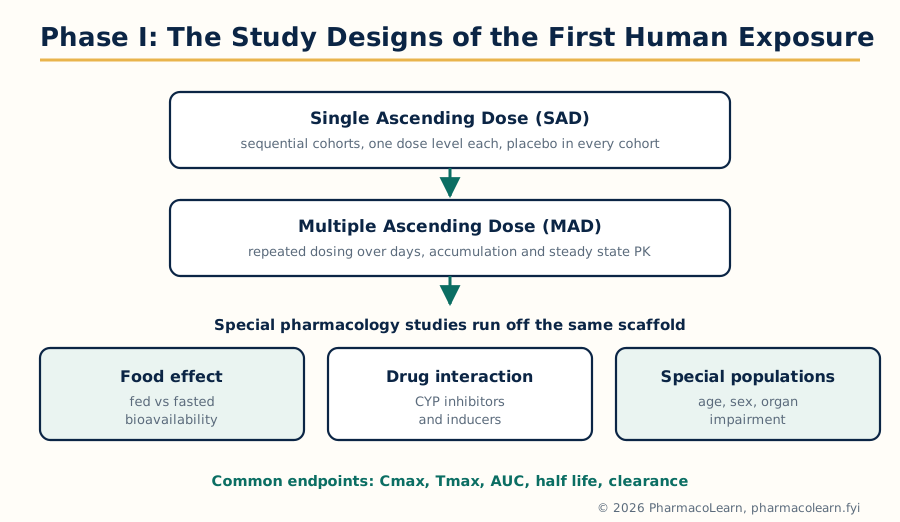 Figure: Phase I subtype studies: single and multiple ascending dose designs, with the food effect, drug interaction and special population studies that complete the first human characterisation (Unit 1, section 1.6).
1.7 Phase II studies: proof of concept
Phase II is the first administration to patients with the target condition, and its governing idea is the syllabus's own phrase, proof of concept: does the drug, at tolerable doses, move the biology or the clinical measure it was designed to move. Phase II work is typically divided in teaching into an early exploratory stage (signal finding, dose ranging across several doses, choice of endpoint) and a later stage in which the dose and population for Phase III are fixed. The outputs are decisions, not approvals: the dose range worth carrying forward, the endpoint that responds, the population that benefits, and the safety profile in patients rather than volunteers. A failed proof of concept ends most programmes, which is the point: Phase II is where money is deliberately risked in small studies so that the enormous Phase III spend is reserved for candidates that have already shown a pulse.
1.8 Phase III studies: the registration evidence
Phase III is the large, confirmatory, usually multicentre and randomised stage that produces the principal evidence of efficacy and the broader safety database on which a marketing application stands. Three of the syllabus's qualifiers each carry a lesson. Multi ethnicity: a programme intended for global registration must justify that its results travel across populations, because intrinsic factors (genetics, body size, metabolism) and extrinsic factors (diet, medical practice) can shift exposure and response; the bridging logic that handles foreign data returns in Unit 3. Global clinical trials, run simultaneously across countries (the multiregional trial), replace the old pattern of repeating studies country by country, and they place India inside world programmes rather than after them, with the regulatory consequences Unit 3 describes. Registration studies is the plainest name for what Phase III is for: these are the pivotal trials named in the application, designed with the regulator's expectations in view, adequately powered, and conducted to the full GCP standard, because their reports will be read line by line by assessors and can be inspected to source. Phase III is also where the safety database reaches the size at which uncommon adverse effects begin to appear, which is why Phase III safety data, not Phase I, dominates the risk sections of the eventual label.
1.9 Phase IV studies and the PSUR: after the licence
Approval does not end the clinical process; it changes its centre of gravity. Phase IV covers studies conducted after marketing authorisation, in ordinary practice populations far larger and more varied than any trial: post marketing surveillance studies, registries, studies of long term and rare adverse effects, of use in populations the trials excluded, and of new indications pursued after the first approval. Many are conditions of approval or commitments made during assessment, and their results can change the label, restrict use or, at the limit, end the product's life. The syllabus pairs Phase IV with the PSUR, the Periodic Safety Update Report, the scheduled document in which the marketing authorisation holder assembles worldwide safety data for a period, evaluates the benefit risk balance afresh, and proposes label changes: in current practice the PSUR's successor format is the Periodic Benefit Risk Evaluation Report (PBRER) of ICH E2C. Post marketing study and post marketing reporting are one activity seen from two sides: generating safety knowledge, and formally accounting for it.
The clinical development staircase
  Preclinical evidence (animal pharmacology, toxicology, formulation)
        -> Phase 0: microdose exploration, candidate selection (no therapy intended)
        -> Phase I: safety, tolerability, PK in humans (subtypes: SAD, MAD,
           food effect, interaction studies)
        -> Phase II: proof of concept in patients, dose finding
        -> Phase III: confirmatory registration studies, global and multi ethnic
        -> Marketing authorisation on the assembled dossier
        -> Phase IV: post marketing studies, PSUR cycle, label evolution
  Every arrow is crossed only with ethics approval and, where required,
  regulatory permission: the subject of Units 2 and 3
1.10 Clinical investigation and evaluation of medical devices and IVDs
Devices break the drug pattern, and the syllabus closes the unit by making the student handle the break. A medical device acts physically rather than pharmacologically, its performance depends on the operator, its design iterates during study, and blinding and placebo control are often impossible (a sham procedure is an ethical problem, not a design option). In vitro diagnostics (IVDs) differ again: the "participant" contributes a sample, and the study measures diagnostic performance, sensitivity, specificity and agreement with a reference, rather than therapeutic effect. The regulatory system answers with two distinct activities, which the syllabus names as the unit's closing pair and which Indian law (the Medical Devices Rules 2017 of Unit 3) and ISO 14155 (Unit 5) both organise: clinical evaluation, the assessment of clinical data about a device, much of it from literature and equivalent devices, and clinical investigation, the prospective study in human subjects that generates new clinical data where evaluation alone cannot carry the claim. Confusing the two is a standard examination trap: evaluation is the wider, continuing process; investigation is one source of evidence inside it.
1.11 Key concepts of medical device clinical evaluation
Clinical evaluation is a methodologically sound, ongoing process to collect, appraise and analyse clinical data about a device and to judge whether the evidence shows conformity with the essential principles of safety and performance when the device is used as intended. Its key concepts: it begins before marketing and continues across the product's life, fed by post market surveillance; it may rest on equivalence, a demonstrated sameness of clinical, technical and biological characteristics with a device whose data are already known, claimed rigorously and not by resemblance; it weighs the data for quality and relevance rather than merely counting papers; and it concludes in a clinical evaluation report that the regulator or notified body reads against the risk management file. Where the data are insufficient, the evaluation itself directs the remedy, a clinical investigation, which is the hinge to the final section.
1.12 Key concepts of clinical investigation
A clinical investigation is a systematic study in human subjects undertaken to assess the safety or performance of a device. Its key concepts adapt the drug trial machinery to the device world: a clinical investigation plan (the device counterpart of the protocol) stating objectives, design, endpoints and risk analysis; sponsor and investigator duties aligned to ISO 14155 rather than ICH GCP; ethics committee approval and regulatory notification or approval graded by the device's risk class and by whether the device already bears a mark; informed consent of the same ethical weight as in drug trials (Unit 2 governs both); and adverse event and device deficiency reporting that runs during and after the study. In India, clinical investigation of investigational medical devices requires the permission of the Central Licensing Authority under the Medical Devices Rules 2017, with ethics committee approval, and the investigation of an IVD is centred on performance evaluation against its intended use. With the process of both worlds now mapped, the subject turns to the question the process everywhere presupposes: what makes it permissible to experiment on a person at all.
Unit 2: Ethics in Clinical Research
2.1 Why the ethics is written down
No other science writes its conscience into law the way clinical research does, and the reason is the syllabus's opening list: the rules were each written over a documented failure. The pattern of this unit is therefore historical first and structural second. A code follows an atrocity or a disaster; the code hardens into committee review, consent doctrine and guideline; and the modern machinery of sections 2.11 to 2.15, the ethics committee, the safety board, the consent form, is the institutional form of memories the profession has sworn not to repeat. A regulatory affairs student should learn the history as law, not as colour: an assessor who knows why a rule exists applies it correctly to the case the rulebook did not foresee.
2.2 Historical perspectives I: the Nuremberg Code and the Nazi trials
The syllabus lists the Nazi trials and the Nuremberg Code side by side because the second is the direct product of the first. At the Nuremberg Doctors' Trial (1946 to 1947), physicians were tried for experiments conducted on concentration camp prisoners without consent: freezing, infection, mutilation and killing presented as research. The judgment of 1947 answered with the Nuremberg Code, ten points that remain the seed of all research ethics. Its first and governing point is that the voluntary consent of the human subject is absolutely essential: competent, informed, uncoerced. The remaining points require that the experiment yield fruitful results unprocurable by other means, rest on prior animal work, avoid unnecessary suffering, never proceed where death or disabling injury is expected, keep risk proportional to the humanitarian importance of the question, be conducted only by qualified persons, and stop at once if continuation threatens the subject, who must be free to withdraw at any time. Two limits of the Code explain the rest of this unit: it was a judgment, not a regulation, with no machinery to enforce it; and its absolute consent rule left unanswered the hard cases, research on those who cannot consent, that later instruments had to face.
2.3 Historical perspectives II: the thalidomide disaster
Thalidomide, marketed from 1957 as a sedative and taken for morning sickness, was withdrawn in 1961 after the recognition that it caused phocomelia, catastrophic limb malformation, in the children of women who took it in early pregnancy: some ten thousand affected children worldwide is the standard estimate. The regulatory lessons were permanent and are examinable as such. Safety testing before marketing had been inadequate to the exposure that followed, and in the United States the disaster was largely averted because a single FDA reviewer, Frances Kelsey, withheld approval for want of sufficient safety evidence. The legislative consequence in the United States was the Kefauver Harris Amendments of 1962, which added the requirement of substantial evidence of effectiveness from adequate and well controlled investigations to the pre existing requirement of safety, and tightened consent requirements for investigational drugs. Thalidomide also fixed two permanent features of the modern system: suspicion of any drug exposure in pregnancy, with the contraception and pregnancy testing regimes that follow from it, and the understanding that rare and delayed harms surface only in large exposed populations.
2.4 Historical perspectives III: the Tuskegee syphilis study
The Tuskegee syphilis study (1932 to 1972), run by the United States Public Health Service in Alabama, followed hundreds of poor African American men with syphilis, and a comparison group without it, for forty years, without informed consent, deceiving them about their diagnosis and about the "treatment" they were said to receive, and, the unforgivable core of it, continuing to withhold effective therapy after penicillin became the standard cure in the 1940s, actively keeping the men from obtaining it elsewhere. Exposed by the press in 1972, the study's consequences were structural: the National Research Act of 1974 created the commission whose work produced the Belmont Report (next section), and federal regulation of human research, institutional review boards and formal consent requirements, followed in the United States. Tuskegee is the standing proof of two propositions the whole subject rests on: that the investigators' scientific aim never licences deception or withheld treatment, and that the vulnerability of the population studied is itself an ethical fact, the seed of the special populations doctrine of section 2.10.
2.5 The Belmont Report: three principles
The Belmont Report (1979), issued by the United States National Commission for the Protection of Human Subjects, converted the history into principle. It drew the boundary between practice and research, and stated three principles that still organise every ethics discussion in this subject. Respect for persons: individuals are autonomous agents whose choices are to be honoured, operationalised as informed consent; and persons with diminished autonomy are entitled to protection, the principle behind the safeguards of section 2.10. Beneficence: the obligation to secure well being, to maximise possible benefits and minimise possible harms, operationalised as systematic risk benefit assessment. Justice: fairness in the distribution of the burdens and benefits of research, so that the populations who bear the risk are not chosen for their availability while others take the benefit, the principle Tuskegee violated in its purest form.
2.6 The Declaration of Helsinki
The Declaration of Helsinki, adopted by the World Medical Association in 1964 and revised repeatedly since (most recently in 2024), is the physician directed companion to Nuremberg: the ethical principles for medical research involving human participants, addressed to doctors and incorporated by reference into regulations and guidelines worldwide, including the consent and committee machinery of Indian law. Its working content, in the form examinations expect: research must rest on adequate laboratory and animal work and a careful assessment of risks against anticipated benefits; the protocol must be submitted to an independent research ethics committee before the study begins; the interests of the participant prevail over those of science and society; special protection is owed to vulnerable groups; informed consent, preferably written, is required, with defined arrangements for those unable to consent; the placebo position of section 2.9 is stated here; participants injured by research are entitled to treatment and compensation; and results, negative as well as positive, must be made publicly available, with authors and sponsors accountable for publication ethics. The Declaration is not a statute, and its force is a teaching point in itself: it binds because regulators, journals, committees and courts treat it as the standard of the profession.
2.7 The origin of ICH GCP
The modern guideline grew from convergence. By the 1980s the Declaration, national rules and drug law each governed part of the field, and industry faced three regional systems (the United States, Europe and Japan) with diverging expectations for trial conduct and data acceptability. The International Conference on Harmonisation, founded in 1990 by the regulators and industry associations of the three regions, took up good clinical practice as an efficacy topic, and the result, ICH E6, the Guideline for Good Clinical Practice, was finalised in 1996: one ethical and scientific quality standard for designing, conducting, recording and reporting trials, built so that data generated under it would be accepted across regions and so that the rights, safety and well being of participants and the credibility of data were protected by the same instrument. E6 codified what the history had taught, committee review, informed consent, qualified investigators, monitored conduct, auditable records, into an operating manual, and Unit 4 takes up its working content. Its revisions tell the same story in miniature: an integrated addendum, E6(R2), in 2016 added risk based quality management for the electronic age, and a third revision, E6(R3), adopted by ICH in 2025, re states the principles for decentralised and data rich trials.
| Year | Instrument or event | What it added |
|---|---|---|
| 1947 | Nuremberg Code | Voluntary consent as the first principle |
| 1961 to 1962 | Thalidomide disaster and Kefauver Harris Amendments | Effectiveness evidence and premarket safety rigour in the USA |
| 1964 | Declaration of Helsinki | The physician's research code; committee review of protocols |
| 1972 to 1979 | Tuskegee exposed; Belmont Report | Justice, beneficence, respect for persons as the organising principles |
| 1996 | ICH E6 GCP | One conduct standard accepted across the ICH regions |
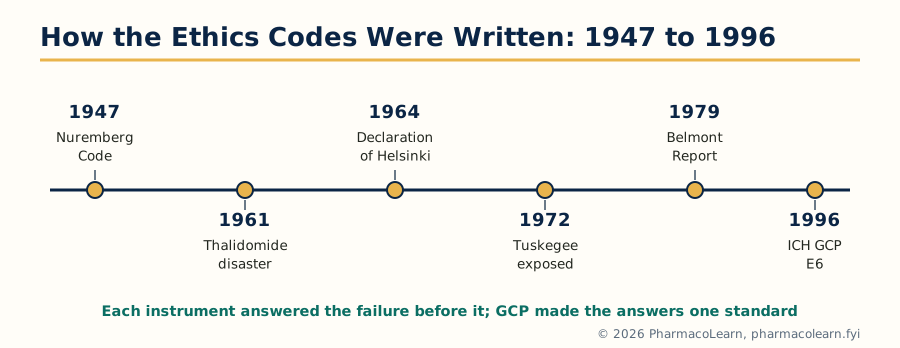 Figure: The ethics timeline: Nuremberg, thalidomide, Helsinki, Tuskegee, Belmont and the arrival of ICH GCP, the instruments of sections 2.2 to 2.7.
2.8 The ethics of randomized clinical trials
Randomisation is scientifically natural and morally in need of defence, and the defence has a name: equipoise, the state of genuine uncertainty within the expert community about which of the compared treatments is preferable. While equipoise holds, allocating participants by chance deprives no one of a known better treatment, and the trial is the honest response to shared ignorance. When credible evidence destroys equipoise, continuing to randomise becomes unethical, which is why interim monitoring (section 2.13) is an ethical duty and not a statistical luxury. The standard objections are answered in kind: the doctor's duty to the individual patient is real but cannot rest on a preference that evidence does not support, and consent (section 2.15) is what makes the participant a partner in the uncertainty rather than a subject of it. Randomisation also carries the justice principle inside it: allocation by lot is the fairest known way to distribute the burdens of an uncertain comparison.
2.9 The role of placebo
A placebo control, an inert treatment indistinguishable from the test product, is the cleanest instrument for isolating a drug's effect, and the sharpest ethical edge in trial design, because the placebo participant is denied active treatment by design. The settled position, stated in the Declaration of Helsinki and worked out in ICH E10 (Unit 4), is a graded one. Placebo is acceptable where no proven intervention exists for the condition. It can also be acceptable where a proven intervention exists, only for compelling and scientifically sound methodological reasons and where participants who receive placebo will not be exposed to additional risk of serious or irreversible harm: short periods, minor conditions, add on designs in which every participant receives standard therapy and the placebo replaces only the experimental addition, and rescue medication arrangements are the practical forms this takes. It is not acceptable where withholding treatment risks death or irreversible injury and the trial could have been designed otherwise. An examination answer on placebo states the two permitted cases and the harm limit; an answer that calls placebo always ethical, or never, has missed the doctrine.
2.10 Ethics of clinical research in special populations
The syllabus's phrase special populations names those whose consent is compromised, whose risk is asymmetric, or whose exploitation history demands structural protection: children, pregnant and nursing women, the elderly and frail, persons with mental illness or cognitive impairment, the unconscious, prisoners, students and employees in dependent relationships, and the poor and illiterate for whom payment can become coercion. The doctrine across all instruments is uniform in shape: inclusion must be scientifically necessary (the research cannot be answered in a less vulnerable group); risk is capped more strictly as capacity falls, for children, to minimal risk or a minor increase over it where there is no direct benefit; consent is layered, parental or legally authorised representative permission plus the child's own assent where the child can give it; and additional safeguards, independent monitors, community consultation, heightened committee scrutiny, are imposed by rule rather than left to goodwill. Exclusion is not the safe alternative it appears: populations excluded from research are later treated with drugs untested in them, which is why modern guidance presses for justified inclusion of women, the elderly (ICH E7) and children (ICH E11) rather than blanket protection by absence.
2.11 The ethics committee: IRB, IEC and Ethics Committee
Three names name one institution. Institutional Review Board is the American term of the federal regulations; Independent Ethics Committee is the ICH GCP term, emphasising independence from the institution conducting the trial; Ethics Committee is the term of Indian law. A regulatory writer must use the term of the document's jurisdiction and know they are the same safeguard: the independent, multidisciplinary body that reviews and approves the protocol, the consent documents and the site before the trial, and keeps the trial under review while it runs. Composition is prescribed because independence is structural, not attitudinal. Under the Indian NDCT Rules 2019 an ethics committee for clinical trials has at least seven members, drawn from medical, non medical, scientific and non scientific areas, and must include, in substance: a chairperson from outside the institution, a member secretary, a basic medical scientist (preferably a pharmacologist), a clinician, a legal expert, a social scientist or representative of a voluntary agency or philosopher or ethicist, and a lay person from the community, with adequate representation of age and gender and at least half of the members from outside the institution in the pattern ICMR guidance describes; a quorum, conventionally five members including specified categories, must be present for a decision. The United States federal regulations set their own floor of at least five members with scientific, non scientific and unaffiliated representation. Committees that will review clinical trials in India must be registered: ethics committees for clinical trials and bioavailability or bioequivalence studies with the Central Licensing Authority under the NDCT Rules, and ethics committees for other biomedical and health research with the designated authority in the Department of Health Research under the ICMR framework of Unit 4. An unregistered committee's approval is, for a regulated trial, no approval at all.
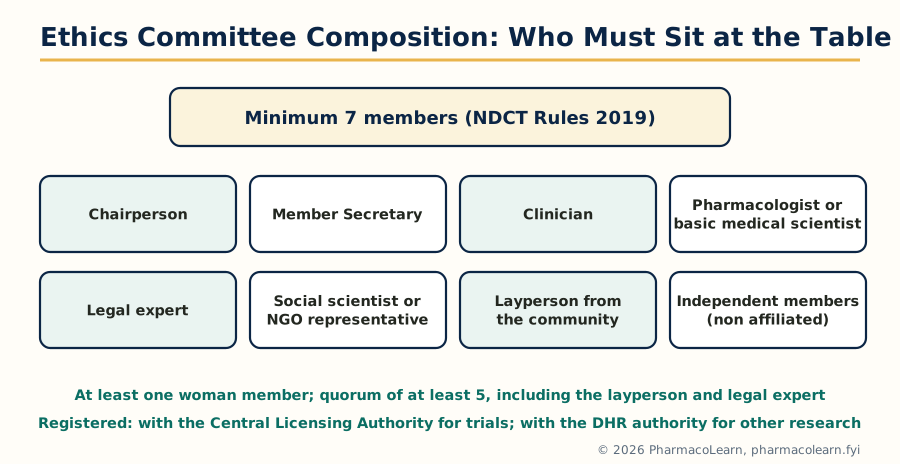 Figure: Ethics committee composition: the minimum seven members, the quorum rule and the two registration routes for trial and non trial research (Unit 2, section 2.11).
2.12 Committee work: review, approval and ongoing monitoring
The committee's product is decisions, in a defined order. Initial review examines the protocol for scientific validity (a badly designed study is unethical because it exposes participants to risk for no knowledge), for risk benefit balance, for fair participant selection, for the consent process and documents, for compensation and treatment arrangements for trial related injury, for the qualifications of the investigator and the site, and for the financial and insurance arrangements behind the trial. The outcomes are approval, approval after modification, or disapproval, recorded with reasons, with the committee's standard operating procedures governing voting, quorum, expedited review of minor changes and the handling of conflicts of interest among its own members. Approval is not the end of the committee's work: ongoing monitoring of safety data is the syllabus's own phrase for the continuing half of the mandate, comprising continuing review at defined intervals, review of amendments before implementation, prompt review of serious adverse events and of the sponsor's safety reports, review of protocol deviations, the power to require changes, to suspend or to terminate approval, and the site visits and audits some committees conduct. A committee that approves and sleeps has performed half its function, and inspection findings against sponsors and sites frequently begin exactly there.
2.13 Data safety monitoring boards
Some trials need a second, specialised guardian. A data safety monitoring board (DSMB), also called a data monitoring committee, is an independent group of clinical, statistical and sometimes ethical experts, appointed by the sponsor but firewalled from the trial team, which alone has access to unblinded interim results and reviews accumulating safety and efficacy data while the trial runs. Its charter, written before the trial starts, states its membership, meeting rhythm, the data it will see, the statistical guidelines it will judge by, and its advisory powers: continue unchanged, continue with modification, or recommend stopping, for benefit so clear that equipoise (section 2.8) has ended, for harm, or for futility where the trial can no longer answer its question. The board is standard in large, long, blinded, multicentre and mortality endpoint trials, and its independence is its entire value: the sponsor learns the board's recommendation, not its data, so commercial hope cannot argue with the interim numbers. Regulatory guidance treats the DSMB as part of the trial's safety architecture, and the committee of section 2.11 receives its outcome reports as part of ongoing monitoring.
2.14 Responsibilities of sponsor, CRO and investigator
Ethical conduct is distributed, and the syllabus assigns the shares. The sponsor, the company or institution that initiates and finances the trial, carries ultimate responsibility for the trial's ethical and scientific integrity: appointing qualified investigators, obtaining regulatory and committee approvals, supplying a quality investigational product, monitoring conduct, reporting safety information, compensating trial related injury as the rules require, and insuring the trial. A contract research organisation (CRO) performs duties the sponsor transfers to it in writing, trial management, monitoring, data handling, but the transfer moves the task, not the accountability: the sponsor remains responsible for the quality and integrity of the trial. The investigator, the physician at the site, holds the duties no contract can move: protecting the rights, safety and well being of the participants in their care, conducting the trial exactly as the approved protocol directs, obtaining informed consent properly, keeping accurate records, and reporting adverse events on the clocks the protocol and the rules prescribe.
How a study earns the right to enrol its first participant
  Protocol and investigator's brochure written and justified
        -> Sponsor applies: regulatory permission where required (Unit 3)
        -> Ethics committee: independent review, approval in writing
        -> Consent documents approved as part of the same review
        -> Site initiated only after both approvals are in hand
        -> During the trial: committee continues review, DSMB watches
           unblinded data where appointed, sponsor monitors the site
        -> Any serious breach or new risk: committee and regulator can
           suspend the study; the approvals are licences held on trust
2.15 Informed consent: principles, documents and process
Everything in this unit converges here. Informed consent is the process by which a competent person, given understandable information about a proposed study, freely decides whether to take part, and the signature is the evidence of the process, not the process itself. The governing principles descend from Nuremberg's first point through Belmont's respect for persons: consent must be informed (the information of the next paragraph, in language the participant actually understands), comprehended (checked, not presumed), voluntary (free of coercion and undue inducement, with the right to refuse or withdraw at any time without penalty or loss of entitled care), and documented. The two documents the syllabus names divide the labour. The Patient Information Sheet (participant information sheet) carries the information: the study's purpose and design, what participation involves visit by visit, the foreseeable risks and discomforts, the expected benefits and their uncertainty, the alternative treatments, the confidentiality arrangements and who may inspect records, the treatment and compensation available if injury occurs, the voluntary nature of participation, whom to contact, and the trial's registration identifier. The Informed Consent Form is the signed record that the information was given and the decision made, by the participant or, where the law permits and capacity is absent, by a legally authorised representative, with an impartial witness where the participant cannot read, and, in the Indian framework, with audio visual recording of the consent process in the circumstances the NDCT Rules prescribe. Three practical doctrines complete the section: consent is taken before any study procedure, including screening performed for the study; consent is renewed when new information emerges that could change the decision, through amended documents and re consent of those already enrolled; and the investigator who delegates the consent discussion remains responsible for its quality. A trial with defective consent is not a trial with a filing error: its data are ethically unusable, and regulators have refused applications on exactly that ground.
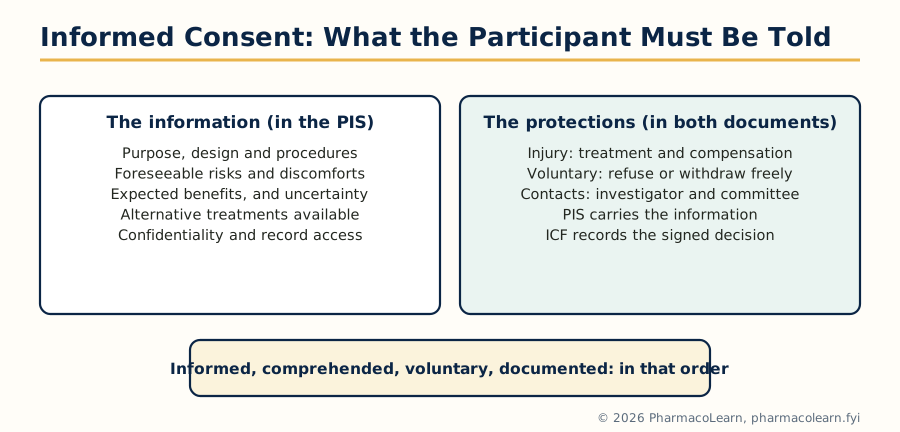 Figure: Informed consent: the information carried by the Patient Information Sheet and the protections the consent process guarantees (Unit 2, section 2.15).
Unit 3: Regulations Governing Clinical Trials
3.1 The Indian framework: from Schedule Y to the NDCT Rules 2019
India's clinical trial law grew inside the Drugs and Cosmetics Act 1940 and its Rules 1945, and the syllabus names its historical centre correctly: Schedule Y, the schedule to the Rules that for three decades prescribed the requirements and guidelines for permission to import or manufacture new drugs for sale and to conduct clinical trials. Schedule Y organised the application (the Form 44 era), the phases, the ethics committee approval, the informed consent expectations, the special population studies and the data to be submitted, and a generation of Indian regulatory practice was written in its vocabulary. Alongside it stood the CDSCO's medical device guidance of the pre 2017 period, when devices were regulated as drugs and only a notified subset attracted licensing. The position today, which this subject teaches alongside the syllabus text, is that the clinical trial provisions have been re founded: the New Drugs and Clinical Trials Rules 2019, made under the same Act and effective from March 2019, now govern clinical trials, bioavailability and bioequivalence studies, ethics committees and compensation in a single dedicated code, and the Medical Devices Rules 2017, effective from January 2018, do the same for devices. A regulatory professional must hold both layers at once: the syllabus's Schedule Y vocabulary, which older documents, examination papers and much industry speech still use, and the NDCT text, which is what a permission is actually granted under.
3.2 The NDCT Rules 2019: structure and substance
The syllabus itemises the Rules' coverage, and each item is a working territory. Clinical trials of new drugs and investigational new drugs require the prior permission of the Central Licensing Authority, the Drugs Controller General (India) at CDSCO (Unit 4), granted on an application with the protocol, investigator's brochure, ethics committee approval and the prescribed data, and the trial must be registered with the Clinical Trials Registry of India (CTRI) before the first participant is enrolled. Bioavailability and bioequivalence studies of new drugs and investigational new drugs are brought inside the same permission and ethics discipline, proportioned to their smaller scale. General principles and practices carry the GCP obligation, the responsibilities of sponsor and investigator, and the manufacture and labelling of the investigational product. The conduct of clinical trials chapters govern amendments, safety reporting of serious adverse events by investigator and sponsor on the Rules' clocks, the treatment and compensation of participants for trial related injury or death, which the Rules prescribe through a defined process of reporting, expert review and determination, and the grounds on which a permission may be suspended or cancelled. Post market assessment completes the arc of Unit 1's Phase IV: the authority may require post marketing surveillance and Phase IV studies as conditions, and act on their results. Two machinery points complete the picture: ethics committees for trials must be registered with the Central Licensing Authority (Unit 2), and the Rules build defined decision timelines and a deemed approval discipline into the permission chapters, an administrative reform whose periods differ by chapter and application type and are taught from the Rules' text rather than from any single number.
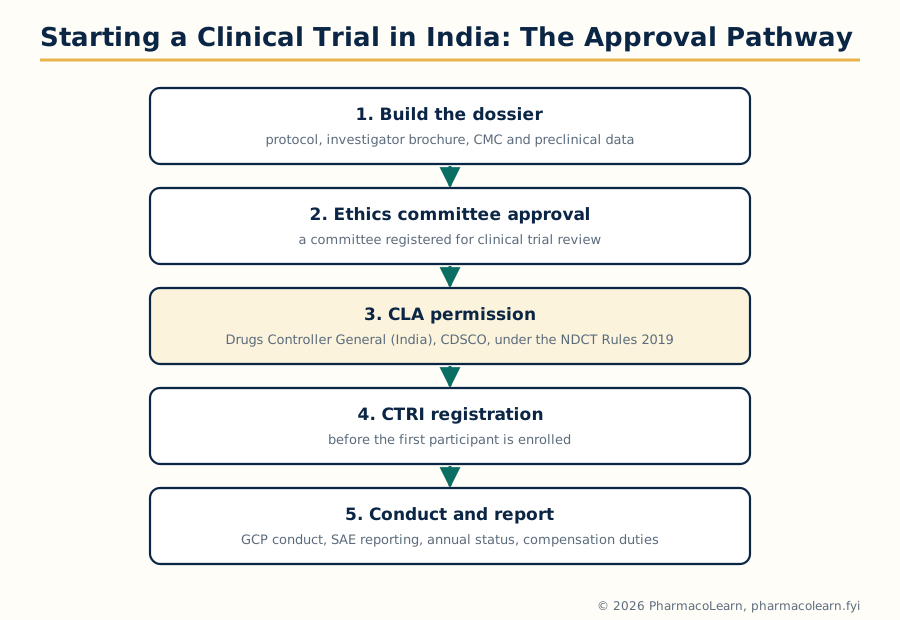 Figure: The Indian approval pathway: dossier, registered ethics committee approval, Central Licensing Authority permission and CTRI registration before enrolment (Unit 3, section 3.2).
3.3 The Medical Devices Rules 2017 and clinical investigation
For devices the parallel code is the Medical Devices Rules 2017, which created a risk based device regime (classes A to D, low to high risk) inside the same parent Act, with the Central Licensing Authority and State Licensing Authorities dividing licensing by class. On the clinical side the Rules require permission for the clinical investigation of an investigational medical device, supported by the clinical investigation plan, preclinical and risk data and ethics committee approval, conducted to good clinical practice expectations for devices (ISO 14155, Unit 5), with adverse events reported under the Rules' vigilance provisions; for IVDs the corresponding activity is performance evaluation at approved sites. The syllabus's pairing of the older "Medical Device guidance" with the 2017 Rules is the same two layer pattern as section 3.1: the guidance era explained the expectations, the Rules made them law.
3.4 The United States: FDA and the three statutory pathways
The American half of the unit opens with the agency and the statute. The Food and Drug Administration regulates trials through the investigational new drug framework of Unit 5; marketing approval flows from section 505 of the Federal Food, Drug, and Cosmetic Act, which provides the three application pathways the syllabus names verbatim, and a regulatory writer must never blur them:
| Pathway | Statutory basis | What the applicant must show | Typical use |
|---|---|---|---|
| NDA, full application | Section 505(b)(1) | Complete reports of safety and effectiveness investigations, all data generated or owned by the applicant | A new drug developed by the applicant |
| NDA, hybrid application | Section 505(b)(2) | A full application in form, relying in part on investigations not conducted by or for the applicant and for which the applicant has no right of reference, such as published literature or FDA's prior findings | New formulations, new indications, changes that still need clinical bridging |
| ANDA, abbreviated application | Section 505(j) | Sameness to a listed reference drug (active ingredient, dosage form, strength, route), plus bioequivalence; no independent clinical safety and efficacy trials | Generic drugs |
The distinctions are of evidence and of rights: 505(b)(1) stands on the applicant's own data, 505(b)(2) builds a scientific bridge to data the applicant does not own, with the patent and exclusivity certifications that bridge demands, and 505(j) replaces clinical proof with pharmaceutical equivalence plus bioequivalence, which is why the BA/BE rules of Unit 5 (21 CFR Part 320) sit inside a clinical research subject. For the conduct of the trials themselves, the pathway is downstream: what matters upstream is that trials intended to support any of the three are run to the standards FDA will accept, which is the next two sections.
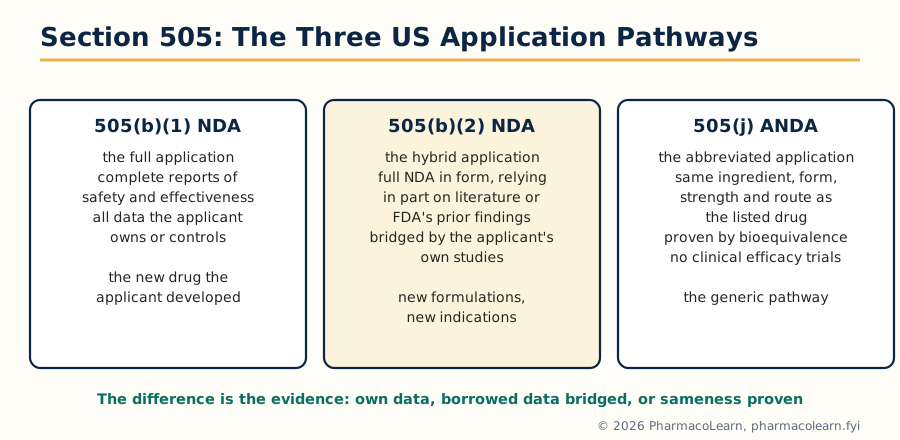 Figure: The three section 505 pathways compared: the evidence each applicant must supply (Unit 3, section 3.4).
3.5 FDA acceptance of foreign clinical studies
A global programme is worthless if its data stop at the border, so the conditions on which FDA accepts studies it did not oversee are core syllabus. For studies not conducted under an IND, FDA accepts a foreign clinical study in support of an IND or a marketing application when, in the terms of 21 CFR 312.120: the study was conducted in accordance with GCP, including review and approval by an independent ethics committee; the design and conduct allow FDA to validate the data, through on site inspection if necessary; and the study population and conditions are applicable to the United States population and medical practice, the bridging judgement of Unit 1's multi ethnicity discussion. For marketing applications the parallel rule (21 CFR 314.106) adds that foreign data alone must be sufficient in themselves and from investigators of recognised competence. The doctrinal point is that acceptability is earned by conduct, not by geography: a study run to E6 standards with committee approval is portable.
3.6 FDA clinical trials guidance on Good Clinical Practice
FDA's own GCP position completes the American picture. FDA has adopted ICH E6 as guidance (the agency's clinical trials guidance document on good clinical practice that the syllabus names), while the binding obligations sit in the agency's regulations, the CFR parts of Unit 5: protection of human subjects (Part 50), institutional review boards (Part 56), financial disclosure (Part 54) and the IND rules (Part 312). The teaching point is the two storey structure of American compliance: follow the regulations because they bind, and follow E6 because it is the standard they presuppose and the one the rest of the world shares.
3.7 The European Union: EMA and the clinical trials framework
The European system distributes the same work differently. Scientific standards and the centralised marketing authorisation sit with the European Medicines Agency (EMA), but the authorisation of a clinical trial itself is granted by the member states, each pairing its competent authority with its ethics committees. The syllabus era framework was the Clinical Trials Directive 2001/20/EC, which first harmonised trial authorisation, GCP and safety reporting across the Union; the current framework, which the draft states as the present position, is the Clinical Trials Regulation (EU) No 536/2014, fully applicable since January 2025 after its transition period, under which a sponsor files one application through the single EU portal, the Clinical Trials Information System (CTIS), and receives a coordinated assessment with one decision per member state concerned. Trial data are publicly registered in the EU system as a transparency obligation. For the regulatory writer the comparison with sections 3.2 and 3.4 is the examinable whole: three systems, one scientific standard, three different doors by which a trial is allowed to begin.
One trial, three doors (the Unit 3 map)
  India:  CLA (DCGI, CDSCO) permission under the NDCT Rules 2019,
          registered ethics committee approval, CTRI registration first
  USA:    IND in effect under 21 CFR Part 312 (filed with FDA, effective
          unless placed on clinical hold), IRB approval under Part 56
  EU:     single application through CTIS under Regulation 536/2014,
          coordinated assessment, one decision per member state concerned
  Common floor in all three: ICH E6 GCP, valid informed consent,
  safety reporting on prescribed clocks
Unit 4: Clinical Research Related Guidelines
4.1 Guidelines: the layer between law and practice
Unit 3 stated the laws; this unit teaches the instruments that tell professionals how the laws are satisfied. A guideline is not legislation, and the distinction matters in examinations and in practice: a rule binds, a guideline states the authority's current thinking or the profession's agreed standard, and departing from it is possible where the departure is justified, while departing from a rule is a violation. Yet the guidelines of this unit are the documents a regulatory affairs professional actually works from daily, because ICH GCP governs every protocol decision, ICMR's guidelines govern every Indian ethics file, and the ICH efficacy series answers the design questions that recur in every programme. The unit reads them in the syllabus's order: the GCP family first, then the device guidance, then the five efficacy guidelines, and it closes with the biostatistics principles that all of them presuppose.
4.2 ICH GCP E6: the working content
Unit 2 gave E6 its origin; here is what it contains. The guideline states thirteen principles of GCP, whose heads every student should be able to reproduce in substance: trials are conducted in accordance with the Declaration of Helsinki; foreseeable risks are weighed against anticipated benefits; the rights, safety and well being of participants prevail over science and society; the available information on the product must support the trial; the trial is described in a clear, detailed protocol; the protocol receives prior ethics committee approval; medical decisions rest with qualified physicians; everyone involved is qualified by education, training and experience; informed consent is freely given and documented; trial information is recorded, handled and stored so that it can be accurately reported, interpreted and verified; confidentiality of records is protected; the product is manufactured and handled under GMP; and systems with procedures assuring quality are implemented in every aspect. The balance of the guideline distributes the operational duties the principles imply: the ethics committee's composition and procedures (Unit 2), the investigator's responsibilities (protocol compliance, consent, records, safety reports), the sponsor's responsibilities (quality management, monitoring, auditing, data handling, safety information and its expedited reporting, trial master file discipline), and the essential documents that permit evaluation of the trial's conduct.
4.3 Indian GCP guidelines
India's own Good Clinical Practice Guidelines, issued by CDSCO under the Drugs and Cosmetics framework in 2001, adapt the same architecture to Indian conditions and remain the syllabus's named national counterpart to E6. Their emphases are the Indian specifics the international text cannot carry: ethics committees in Indian institutions, informed consent in the languages and literacy conditions of Indian participants, and the documentation the Indian regulator expects. The regulatory writer reads the Indian GCP with the NDCT Rules, not instead of them: where the Rules of 2019 now prescribe directly (ethics committee registration, compensation, reporting), the Rules prevail. This layering, statute, rules, national guideline, international guideline, recurs across the branch.
4.4 ICMR ethical guidelines for biomedical research
The Indian Council of Medical Research is the apex body for biomedical research in India, and its National Ethical Guidelines for Biomedical and Health Research Involving Human Participants (the current edition is the 2017 revision, successor to the ethical guidelines of 2000 and 2006 that the syllabus era text cites) are the ethics constitution for research that is not a drug trial: academic studies, epidemiology, public health research, research on stored samples and data, and the human research of every institution whether or not a licence is involved. Their content runs wider than GCP: general principles drawn from the same Belmont and Helsinki root; responsible conduct of research; ethical review procedures, including the registration of ethics committees for biomedical and health research with the designated authority in the Department of Health Research (the counterpart, for non trial research, of the CLA registration of Unit 2); informed consent including waiver conditions and community consent; vulnerability; biological materials and data governance; and the special fields, from genetic research to stem cell research (with the ICMR DBT stem cell guidelines that MRA104T meets again). A sponsor trial answers to NDCT and GCP; an investigator initiated study answers to ICMR; most institutions answer to both, and their ethics committees sit at the junction, which is why this subject teaches both codes.
4.5 CDSCO guidelines
The Central Drugs Standard Control Organization, headed by the Drugs Controller General (India), is the Central Licensing Authority of Units 2 and 3, and its published guidelines and guidance documents are the fourth layer of the Indian system: practical instructions on applications, dossiers, checklists and formats through which CDSCO tells applicants how it expects the Rules to be complied with, including guidance on clinical trial applications, bioavailability and bioequivalence studies and serious adverse event reporting. The skill this item teaches is hierarchical reading: an applicant follows the Act, then the Rules made under it, then CDSCO's guidance on the Rules, and treats a conflict between layers as a question to resolve upward, never as a freedom to choose.
4.6 GHTF Study Group 5: clinical evidence for devices
Devices take their guidance from a different family. The Global Harmonization Task Force, the pre 2012 harmonisation body for devices (succeeded by the International Medical Device Regulators Forum, IMDRF, whose guidance documents carry the work forward), organised its output in study groups, and Study Group 5 owned clinical evidence. Its guidance documents give the device world the definitions Unit 1 closed with: what counts as clinical data, how clinical evaluation is performed and reported across a device's life, and when and how a clinical investigation must be designed and conducted to fill the gaps evaluation finds. SG5's product is the device counterpart of this unit's drug guidelines, and its descendant documents, read with ISO 14155 (Unit 5), are the standards against which notified bodies and regulators judge device clinical evidence in Europe and in the Indian device framework alike.
4.7 ICH E4: dose response information
The five ICH efficacy guidelines the syllabus names are design instruments, and E4, Dose Response Information to Support Drug Registration (1994), is the one that governs the numbers on the label's first page. Its doctrine: dose response should be studied deliberately, not stumbled into; the dose ranging of Phase II (Unit 1) should characterise the dose response curves for both benefit and harm in the population, identify the starting dose, the ceiling beyond which benefit flattens or risk climbs, and the titration rules for individuals; and exposure response (concentration against effect) analysis may supplement dose response where pharmacokinetics vary. E4 is the guideline behind every assessor's question of the form: why this dose, in this population, on this schedule, and its absence is visible in applications whose doses appear chosen by habit.
4.8 ICH E7: studies in the geriatric population
E7, Studies in Support of Special Populations: Geriatrics, answers the special populations doctrine of Unit 2 for the group that consumes the most medicines. Its position: the elderly are to be included in drug development in meaningful numbers rather than protected by exclusion, because exclusion exports uncertainty into practice; geriatric evaluation should reflect the age distribution of the disease, attend to the very old, and examine the effects of age related renal and hepatic decline, of comorbidity and of the polypharmacy that defines real geriatric prescribing; and where a drug will mainly be used in the elderly, the database should be built accordingly. E7 is brief and its logic exemplary, which is why the syllabus pairs it with the population guidelines around it: the question is never whether a group is difficult to study, but what evidence the group is owed.
4.9 ICH E8: general considerations for clinical trials
E8, General Considerations for Clinical Trials, is the framework document of the efficacy series, the one that states the principles the others particularise: the development programme viewed whole, from exploratory to confirmatory; objectives stated before design; the taxonomy of study designs (Unit 1's vocabulary, harmonised); endpoints and their validity; bias and its controls, randomisation, blinding and the analysis choices that protect them; and the ethical and quality frame within which all of it sits. A revision, E8(R1), has modernised the text around critical to quality factors: the design features whose failure would invalidate the study should be identified prospectively and built into the protocol. E8 is the first of the five to read and the answer key to the others.
4.10 ICH E10: choice of control group
E10, Choice of Control Group and Related Issues in Clinical Trials, operationalises section 2.9. It classifies the controls (placebo, no treatment, dose response, active control, external or historical control, and combinations), states what inference each can support, and works through the two hard problems: the ethics of placebo and no treatment control, resolved by the harm graded position Unit 2 described; and the logic of active control non inferiority trials, whose conclusion depends on assay sensitivity, on the assumption that the control would have beaten placebo in this trial as it did in its own, an assumption the design must make defensible rather than merely assert. E10 is why control choice appears in every serious protocol review: the control is the instrument of inference, and a trial whose control cannot answer the question is a trial whose participants were exposed for nothing.
4.11 ICH E11: clinical investigation in the paediatric population
E11, Clinical Investigation of Medicinal Products in the Paediatric Population, with its later addendum on extrapolation, applies the special populations doctrine to children. Its structure: development in children should be considered early and planned, not appended after adult approval; studies proceed with age appropriate formulations, endpoints and consent arrangements (parental permission and the child's assent, section 2.10); age categories and the staged approach, usually from older to younger children, order the programme; pharmacokinetic study often carries more weight than in adults, because efficacy can sometimes be extrapolated from adult data where disease and response are sufficiently similar, the framework the addendum formalised; and long term safety follow up, growth and development included, outlasts the trial itself. E11 closes the syllabus's five with the population in whom the consent doctrine is most layered.
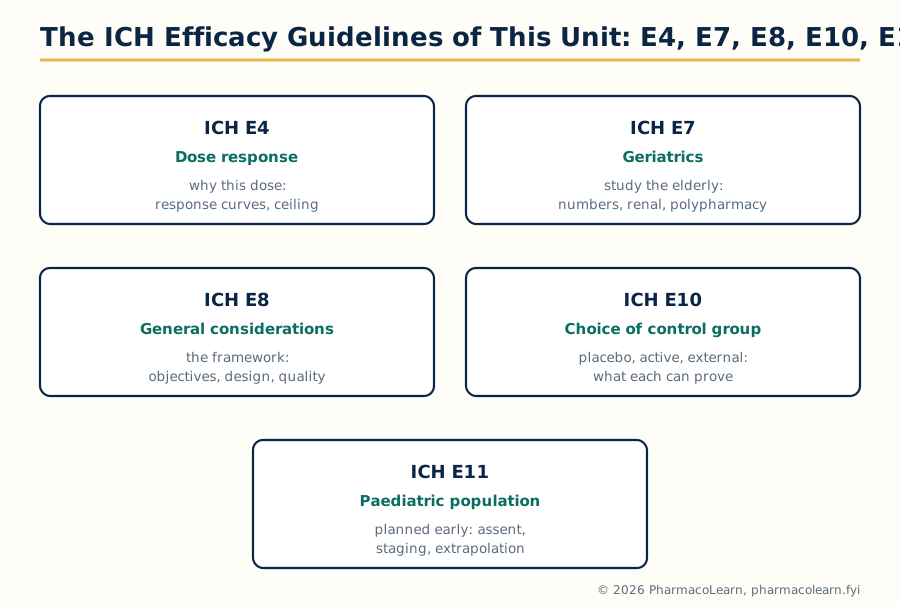 Figure: The five ICH efficacy guidelines of Unit 4 and the design question each one answers (Unit 4, sections 4.7 to 4.11).
4.12 General biostatistics principles applied in clinical research
The unit's last item names the discipline that makes trials evidentiary. The general principles, stated at the level this subject requires: Randomisation allocates by chance to remove selection bias, and blinding keeps participants, investigators and assessors from steering the result. Endpoints are defined before the trial: the primary endpoint carries the claim, secondary endpoints support it, and surrogate endpoints must be justified as predicting clinical benefit. Sample size is computed from the effect worth detecting, the variance, and the accepted error rates, and an underpowered trial is an ethical defect as well as a statistical one, because it spends participants without buying knowledge. Hypotheses and significance: a prespecified analysis plan fixes the test, the significance level and the handling of multiplicity before the data are seen. Analysis populations are declared in advance: the intention to treat set, all randomised participants analysed as randomised, preserving the protection randomisation bought; and the per protocol set, used in support, never as a quiet substitute. Interim analysis is permitted only under the discipline of the DSMB and the statistical penalty for looking. These principles are the criteria by which assessors read Module 5 of the dossier of MRA102T, and by which the FDA and EMA guidance of the next unit judges the data placed before it.
Unit 5: USA and EU Guidance
5.1 Reading the Code of Federal Regulations
The unit opens the American rulebook itself. Title 21 of the Code of Federal Regulations (CFR) collects the Food and Drug Administration's binding regulations, and the syllabus names the seven parts that govern clinical research and its downstream duties. The parts are read as a system: Parts 50 and 54 protect the participant and the integrity of the data at the level of the investigator; Part 312 governs the investigational stage; Part 314 the approval stage; Part 320 the equivalence evidence; and Parts 812 and 822 carry the same logic into devices and the postmarket period. A regulatory writer cites these parts the way a lawyer cites sections of an Act: the part number is the address of the duty.
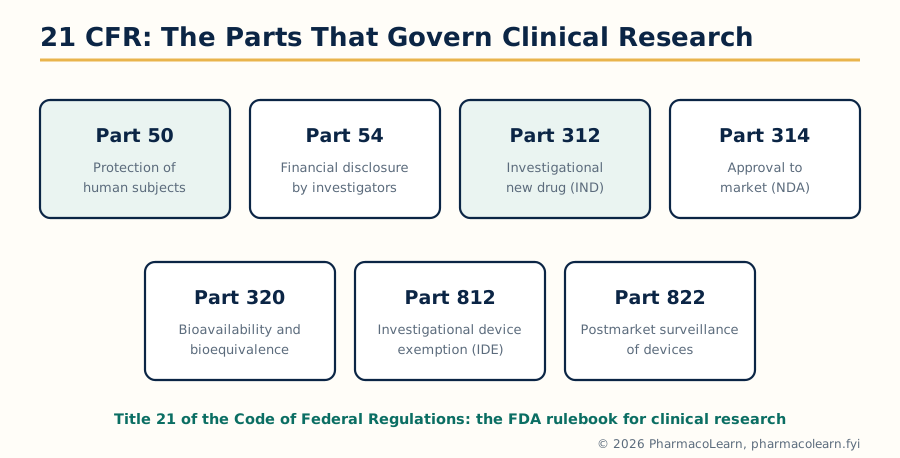 Figure: The 21 CFR map: the seven parts of the FDA rulebook that this unit reads in detail (Unit 5, section 5.1).
5.2 21 CFR Part 50: protection of human subjects
Part 50 is the American consent code. It requires that informed consent be obtained from the participant or a legally authorised representative under circumstances that give sufficient opportunity to consider participation and minimise coercion, and it lists the basic elements of consent every consent process must convey, in substance: that the study is research, its purpose, duration and procedures and which are experimental; the reasonably foreseeable risks; the benefits reasonably expected; the appropriate alternatives; the extent of confidentiality and who may inspect records, including FDA; the treatment and compensation position if injury occurs in research offering more than minimal risk; whom to contact about the research, about rights and about injury; and that participation is voluntary and may be discontinued without penalty. The part then governs consent in emergency research exceptions, the additional safeguards for children (Subpart D, parental permission and assent, echoing section 2.10), and the documentation of consent by a signed form, with short form and waiver provisions for defined cases. Part 50 is read with its institutional twin, Part 56 on IRBs, which this subject met in Unit 2: the form states the information, the board polices the process.
5.3 21 CFR Part 54: financial disclosure by clinical investigators
Part 54 attacks a quieter corruption. A clinical investigator with a financial interest in the outcome (equity in the sponsor, a proprietary interest in the product, significant payments beyond trial costs) has an incentive that can bias design, conduct and reporting, and the part requires the applicant to disclose the investigators' financial arrangements and interests, on the certification and disclosure forms the agency prescribes, covering the period of the study and one year after its completion, so that FDA can assess the data with the interest in view and require remedies, from disclosing the interest in the application to redesigning or repeating a study, where reliability is compromised. The part's lesson generalises: in clinical research, undisclosed interest is treated as a data integrity defect, not as a private matter.
5.4 21 CFR Part 312: the IND regulations
Part 312 is the operating system of American drug investigation. Its matter: when an IND is required and its content (the application form, the protocol, the chemistry, manufacturing and controls information, the pharmacology and toxicology, previous human experience and the investigator's brochure); the phases of investigation the part recognises (Unit 1's phases in regulatory dress); the sponsor's duties to select qualified investigators, keep them informed, monitor the investigation, control the product and records, and review safety information from all sources; the investigator's duties under the signed statement of investigator, Form FDA 1572; the grounds on which FDA may impose a clinical hold, suspending all or part of an investigation for unreasonable risk or defective design; the treatment use provisions for expanding access outside trials; and the IND safety reporting duty of section 5.9, which sits in this part at section 312.32. An IND is, in form, a notice that becomes effective by the passage of the review period unless the agency acts; in substance it is the licence under which every American drug trial runs.
5.5 21 CFR Part 314: applications for approval to market
Part 314 governs the destination document, the application for FDA approval to market a new drug, the NDA of Unit 3's pathways. Its clinical research content is the evidentiary standard the trials must satisfy: the application must contain full reports of the investigations, and approval requires substantial evidence of effectiveness from adequate and well controlled investigations (the statutory phrase of section 3.4, given regulatory flesh here, including the characteristics of a well controlled study), together with evidence of safety, and manufacturing and controls adequate to preserve the product's identity, strength, quality and purity. The part also houses the machinery trials feed after approval: postmarketing reporting of adverse drug experiences (section 314.80), annual reports, supplements for changes, and the withdrawal provisions. Part 314 is where Unit 1's staircase ends: every phase exists so that this part's questions can be answered yes.
5.6 21 CFR Part 320: bioavailability and bioequivalence requirements
Part 320 defines the evidence by which sameness is proved: the definitions of bioavailability (the rate and extent to which the active ingredient reaches the systemic circulation) and bioequivalence (the absence of a significant difference in that rate and extent between pharmaceutically equivalent products), the requirement of in vivo evidence for defined categories, the study designs acceptable (fasting and fed, replicate designs for highly variable drugs), the analytical and statistical standards, and the waivers of in vivo testing where the evidence permits them, notably for solutions and under the biopharmaceutics classification logic. The part is the rulebook behind the ANDA of section 505(j) and behind India's own BA/BE discipline under the NDCT Rules, and its requirements for the expedited reporting of adverse experiences from BA/BE studies are expressly named again in the syllabus's safety reporting item below.
5.7 21 CFR Part 812: investigational device exemptions
Part 812 is Part 312 translated for devices. An investigational device exemption permits a device that has not been cleared or approved to be shipped for clinical investigation. Its machinery mirrors the drug system with device differences: the sponsor's application and duties, the investigator's agreement and duties, the labelling of investigational devices, and above all the fork between significant risk investigations, which require FDA approval of the IDE plus IRB approval, and non significant risk investigations, which proceed under IRB approval through the abbreviated requirements unless FDA rules otherwise. The part gives content to Unit 1's device sections: the investigation plan, the risk classification and the committee approval are the three legs on which every lawful device study stands.
5.8 21 CFR Part 822: postmarket surveillance
Part 822 implements the agency's power (section 522 of the Act) to order postmarket surveillance of defined class II and class III devices: those whose failure would be reasonably likely to have serious adverse health consequences, devices intended for implantation for more than one year, and life sustaining or life supporting devices used outside a facility, among the statutory categories. The sponsor of such an order must submit a surveillance plan for approval within the period the order states, conduct the surveillance (for up to 36 months unless a longer period is agreed or ordered), and report interim and final results. The part closes the device lifecycle of this subject: premarket evidence under Parts 812 and the approval system, postmarket watchfulness under 822, the exact device parallel of the drug arc from Part 312 to Part 314's reporting duties.
5.9 FDA safety reporting for INDs and BA/BE studies
The syllabus singles out the reporting clocks, and the governing text is 21 CFR 312.32, the IND safety reporting rule, which the BA/BE framework applies to bioavailability and bioequivalence studies as the syllabus states. Its architecture: the sponsor must review all safety information and notify FDA and all participating investigators of potential serious risks; an expedited report is required for each adverse experience that is serious, unexpected and a suspected adverse reaction, in writing within 15 calendar days of the sponsor's initial determination, and, for an unexpected fatal or life threatening suspected adverse reaction, an initial notification as soon as possible and in no case later than 7 calendar days after the sponsor first learns of it, with the complete report following within the 15 day frame; follow up information travels on the same 15 day clock. Findings from animal, epidemiological, pooled or clinical sources that suggest a significant risk are reported in the same expedited manner. These figures are quoted here because they are printed in the regulation itself; the general discipline they teach is comparative, since the NDCT Rules run their own clocks for serious adverse events, and the competent professional states each jurisdiction's rule from its own text rather than by analogy.
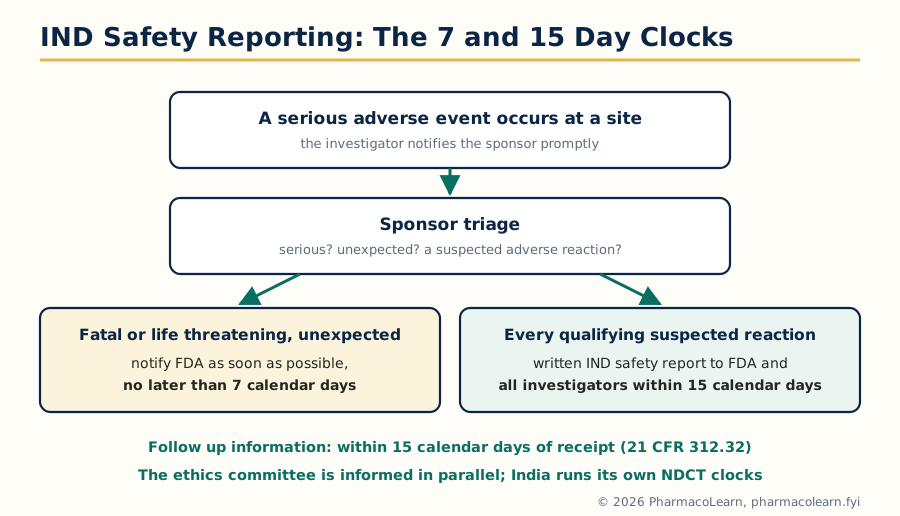 Figure: IND safety reporting under 21 CFR 312.32: from the site's first notice to the sponsor's 7 day and 15 day reports (Unit 5, section 5.9).
5.10 MedWatch and the pharmacovigilance guidance
MedWatch is FDA's safety information and adverse event reporting programme, the public face of the reporting system: healthcare professionals and consumers report voluntarily on the Form FDA 3500, manufacturers and other mandatory reporters file on Form FDA 3500A, and the programme returns the favour as a publisher, issuing safety alerts and labelling change notices by which the whole system learns. Beside it stands the guidance the syllabus names last among the American items, FDA's Guidance for Industry: Good Pharmacovigilance Practices and Pharmacoepidemiologic Assessment, which states the agency's thinking on pharmacovigilance planning and on the use of pharmacoepidemiologic methods, observational data pressed into the service of safety questions trials cannot answer.
5.11 The European Union: the 2001 directives
The syllabus's European half opens with EU directives 2001, the shorthand for the legislative settlement of that year on which the Union's medicines system still visibly rests. Two directives carry the clinical weight. Directive 2001/20/EC, the Clinical Trials Directive, first approximated the member states' laws on trials: authorisation by competent authority and ethics committee, GCP compliance, licensing of investigational product manufacture and import, and safety reporting to the EudraVigilance system; it is the instrument the Clinical Trials Regulation of Unit 3 has now replaced in operation, and it is taught here because the syllabus names it and because a generation of dossiers speaks its language. Directive 2001/83/EC, the Community code for medicinal products for human use, is the consolidated marketing and manufacturing code behind the authorisation procedures of MRA201T. Directives bind member states as to the result to be achieved and are implemented through national law, which is why the older system produced national variants of one design, and why the shift to a directly applicable Regulation for trials was the natural correction.
5.12 EudraLex Volume 3: scientific guidelines
EudraLex is the Union's compendium of pharmaceutical legislation and guidance, and its volumes divide the world exactly as a regulatory writer shelves it. Volume 3, Scientific guidelines for medicinal products for human use, collects the EMA and ICH derived scientific and technical guidelines, quality, nonclinical and clinical, by which dossiers are designed and judged: the guideline layer of Unit 4 in its European binding. Citing a Volume 3 guideline in a European submission shows the assessor that the programme was built to the published standard.
5.13 EudraLex Volume 9A: pharmacovigilance
Volume 9A, The Rules Governing Medicinal Products in the European Union: Guidelines on Pharmacovigilance for Medicinal Products for Human Use, was for years the single statement of European pharmacovigilance obligation: the responsibilities of marketing authorisation holders and competent authorities, adverse reaction reporting, the PSUR system of Unit 1 in its European form, and risk management. The current position is that the 2010 pharmacovigilance legislation replaced the volume's operative content with the Good Pharmacovigilance Practices (GVP) modules, the living texts by which the European system now runs. Volume 9A is taught as the syllabus prints it, as the ancestor whose structure the GVP modules inherit.
5.14 The EU Annual Safety Report
The EU Annual Safety Report is the syllabus's name for the periodic safety accounting owed during development, the document by which a sponsor reported once a year per investigational product the safety experience of its trials to the member states concerned, so that the ethics committees and authorities of Unit 3 received a single considered account. Its content and rhythm were absorbed into the ICH Development Safety Update Report (DSUR, ICH E2F), the harmonised annual safety report now used across the regions, tied to the product's development international birth date. The teaching holds both names, as the syllabus's literature does, and keeps the succession straight.
5.15 The EU Medical Device Regulation and ISO 14155
The unit closes where Unit 1 closed, with devices. With respect to clinical research, the Medical Device Regulation (EU) 2017/745, which replaced the Medical Devices Directive framework the older syllabus text names (see the verification record for the wording difference between the sources), imposes a clinical evaluation obligation across the device's life and requires clinical investigations for implantable and class III devices unless existing clinical data suffice, under member state authorisation, ethics review, a clinical investigation plan, and sponsor duties that parallel the drug system. The conduct standard for those investigations is ISO 14155, Clinical investigation of medical devices for human subjects: Good clinical practice, the device GCP: design, conduct, recording and reporting of investigations, the roles of sponsor, monitor, investigator and ethics committee, and the safety reporting of adverse events and device deficiencies. ISO 14155 stands to device research exactly as ICH E6 stands to drug research: one ethical root, two conduct standards, three regulatory doors, and a reporting duty that never sleeps.
The serious adverse event clock (United States, 21 CFR 312.32)
  Site learns of the event -> investigator notifies the sponsor promptly
        -> Sponsor assesses: serious? unexpected? a suspected reaction?
        -> Fatal or life threatening and unexpected:
           notify FDA as soon as possible, no later than 7 calendar days
        -> Every serious, unexpected, suspected reaction:
           written IND safety report to FDA and all investigators
           within 15 calendar days
        -> Follow up information: within 15 calendar days of receipt
  Parallel duties run to the ethics committee and, in India, under the
  NDCT Rules' own clocks: three systems, three texts, no borrowing
Frequently Asked Questions
Q: What is the difference between a 505(b)(2) application and an ANDA? Both rely on knowledge outside the applicant's own clinical programme, but at different depths. An ANDA under 505(j) claims sameness: the same active ingredient, dosage form, strength and route as a listed drug, proven by bioequivalence, with no new clinical efficacy trials. A 505(b)(2) application is a full NDA in form for a product that differs from the listed drug, a new formulation, indication or combination, which relies in part on published literature or FDA's earlier findings and bridges the difference with its own studies. See Unit 3, section 3.4.
Q: Does Schedule Y still govern clinical trials in India? Not as the operative code. Schedule Y of the Drugs and Cosmetics Rules was the governing text for three decades, and its vocabulary survives everywhere, but clinical trials, BA/BE studies, ethics committees and compensation are now governed by the New Drugs and Clinical Trials Rules 2019 under the same Act. Unit 3, sections 3.1 and 3.2 teach the syllabus's Schedule Y layer and the current NDCT position together.
Q: Why does Phase 0 use microdoses, and what can a Phase 0 study not show? A microdose, conventionally not more than 100 micrograms and a small fraction of the pharmacological dose, produces measurable pharmacokinetic information with negligible risk and a reduced preclinical package, letting a sponsor choose between candidate molecules cheaply. Because exposure is subtherapeutic and brief, the study cannot establish safety at real doses or any efficacy. See Unit 1, section 1.4.
Q: What is the difference between an IRB, an IEC and an Ethics Committee? Nothing of substance: they are the American (Institutional Review Board), ICH GCP (Independent Ethics Committee) and Indian (Ethics Committee) names for the same independent, multidisciplinary body that reviews, approves and continuously monitors a trial. The regulatory writer uses the term of the governing document's jurisdiction. Unit 2, section 2.11 covers composition and registration.
Q: When is a placebo control ethically acceptable? In the settled position of the Declaration of Helsinki and ICH E10: where no proven intervention exists, or where a proven intervention exists but compelling methodological reasons require placebo and participants face no additional risk of serious or irreversible harm. It is not acceptable where withholding treatment risks death or irreversible injury and another design could answer the question. Unit 2, section 2.9 and Unit 4, section 4.10.
Q: What must happen before a clinical trial can be registered and started in India? The sponsor needs the permission of the Central Licensing Authority (the DCGI at CDSCO) under the NDCT Rules 2019, the written approval of an ethics committee registered for the purpose, and registration of the trial with the Clinical Trials Registry of India before the first participant is enrolled. Unit 3, section 3.2.
Q: What does FDA require before it accepts a foreign clinical study it did not oversee? Under 21 CFR 312.120, in substance: the study was conducted to GCP including independent ethics committee review, the data can be validated by FDA including by on site inspection if necessary, and the population and conditions are applicable to United States patients and practice. Acceptability follows conduct, not geography. Unit 3, section 3.5 gives the full conditions.
Q: What is a data safety monitoring board, and why is it independent? A DSMB is a small expert group, appointed by the sponsor but firewalled from the trial team, that alone sees unblinded interim data and recommends whether a trial continues, changes or stops for benefit, harm or futility. Independence is the whole safeguard: the sponsor receives the recommendation, not the data, so commercial interest cannot argue with interim numbers. Unit 2, section 2.13.
Q: Which CFR part governs informed consent, and which governs the IND? Informed consent and the protection of human subjects sit in 21 CFR Part 50, with institutional review boards in Part 56 beside it; the investigational new drug framework, sponsor and investigator duties, clinical hold and IND safety reporting at section 312.32, sits in 21 CFR Part 312. Unit 5, sections 5.2 and 5.4.
Q: ISO 14155 or ICH E6: which standard governs a device investigation? ISO 14155, the good clinical practice standard written for clinical investigations of medical devices, governs device investigations, standing to them as ICH E6 stands to drug trials; in the EU it operates within the Medical Device Regulation 2017/745, and in India within the Medical Devices Rules 2017. Unit 1, sections 1.10 to 1.12 and Unit 5, section 5.15.
Complete MRA103T notes, all 5 units in one PDF, free to keep.
Other M.Pharm subjects: MPH101T · MPC101T · MPL101T · MPH102T · MPH103T · MPH104T · MPL102T · MPL103T · MPL104T · MPC102T · MPC103T · MPC104T · MPH201T · MPH202T · MPH203T · MPH204T · MPC201T · MPC202T · MPC203T · MPC204T · MPL201T · MPL202T · MPL203T · MPL204T · MRA101T · MRA102T · MRA103T · MRA104T · MRM301T · MPG101T · MPG102T · MPG103T · MPG201T · MPG202T · MPG203T · MPG104T · MPG204T · MRA201T · MRA202T · MRA203T · MRA204T · M.Pharm