
MRA104T — Regulations and Legislation for Drugs & Cosmetics, Medical Devices, Biologicals & Herbals, and Food & Nutraceuticals in India and Intellectual Property Rights
4 hrs/week, 4 credits, 60 hours, 100 marks. Notes follow the M.Pharm syllabus, unit by unit.
MRA104T Regulations and Legislation notes for M.Pharm Sem 1 Regulatory Affairs: the Drugs and Cosmetics Act and Rules, schedules, CDSCO and state licensing, devices, biologicals, herbals, FSSAI food law, BA and BE data and IPR, with free unit wise PDF downloads on PharmacoLearn.
Units in this subject
- Unit 1 — Acts and Rules
- Unit 2 — Regulatory Requirements and Approval Procedures
- Unit 3 — Standards
- Unit 4 — Bioavailability and Bioequivalence Data
- Unit 5 — Intellectual Property Rights
Download MRA104T PDF Notes
Free PDFs for this subject, one per unit:
Regulations and Legislation for Drugs & Cosmetics, Medical Devices, Biologicals & Herbals, and Food & Nutraceuticals in India and Intellectual Property Rights, subject code MRA104T, is the fourth core subject of M.Pharm Regulatory Affairs, Semester 1. It carries 4 credits and 60 hours of theory, taught at 4 hours per week, for 100 marks. The three subjects before it built the working skills of the branch: MRA101T taught the good practices, MRA102T the documents, and MRA103T the regulation of clinical research across India, the United States and the European Union. This subject turns homeward. It is the Indian statute book of the pharmaceutical world, taken in one sweep: the Acts and Rules under which every drug, cosmetic, medical device, biological, herbal product and food sold in India is licensed, the authorities that run that system, the standards against which quality is judged, the bioequivalence and ethics framework that supports approval, and, closing the semester, the intellectual property rights that decide who may make a product at all and for how long.
The course is designed to impart fundamental knowledge on regulations and legislation in India with respect to the five product families, and to prepare the student for the basic regulatory requirements of manufacture, import and registration, export, sale, marketing authorization, clinical trials and intellectual property rights. Its objectives are two: to know the different Acts and guidelines that regulate these industries in India, and to understand the approval process and regulatory requirements for each family. The units follow that design. Unit 1 reads the statute book itself, headed by the Drugs and Cosmetics Act 1940 and its Rules of 1945, with price control and the five companion Acts. Unit 2 walks the approval machinery: the Central Drugs Standard Control Organization and the State Licensing Authorities, and the procedure for each product family, ending with the dossier and with clinical investigations. Unit 3 is about standards, the Indian Pharmacopoeia, BIS and ISO. Unit 4 covers bioavailability and bioequivalence data, the BCS classification, stability, animal testing and its ethics, and the stem cell guidelines. Unit 5 is intellectual property: patent, trademark, copyright, industrial designs and geographical indications, the Indian patent scenario, and the working interface between IPR and regulatory affairs.
Unit 1: Acts and Rules
1.1 One statute book for five product families
Indian pharmaceutical law is not a single code but a shelf of statutes, most of them old, each written for the problem of its decade, and the regulatory affairs professional works across the whole shelf at once. One product can sit under several Acts simultaneously: a cough preparation containing alcohol and a psychotropic ingredient touches the Drugs and Cosmetics Act for its licence, the price control order for its ceiling price, the excise Act for its alcohol content and the narcotics Act for its controlled ingredient. The Drugs and Cosmetics Act 1940 is the spine of the shelf: it defines what a drug and a cosmetic are, sets the quality offences, creates the licensing system and names the standards a product must meet. Around it stand the companion statutes of this unit: the Drugs (Prices Control) Order and the National Pharmaceutical Pricing Authority for price, the Narcotic Drugs and Psychotropic Substances Act 1985 for controlled substances, the Drugs and Magic Remedies (Objectionable Advertisements) Act 1954 for advertising claims, the Medicinal and Toilet Preparations (Excise Duties) Act 1955 for alcohol bearing preparations, the Pharmacy Act 1948 for the profession itself, and the Prevention of Cruelty to Animals Act 1960 for the animals on whom products are first tested. Two reading rules apply to everything in this unit. First, the Acts state principles and create powers, while the Rules made under them carry the operative detail, so the pair must always be read together. Second, the framework is alive: the clinical trial provisions once carried in the Rules now sit in the New Drugs and Clinical Trials Rules 2019, medical devices have their own Medical Devices Rules 2017, and cosmetics their own Cosmetics Rules 2020, each noted where it belongs below.
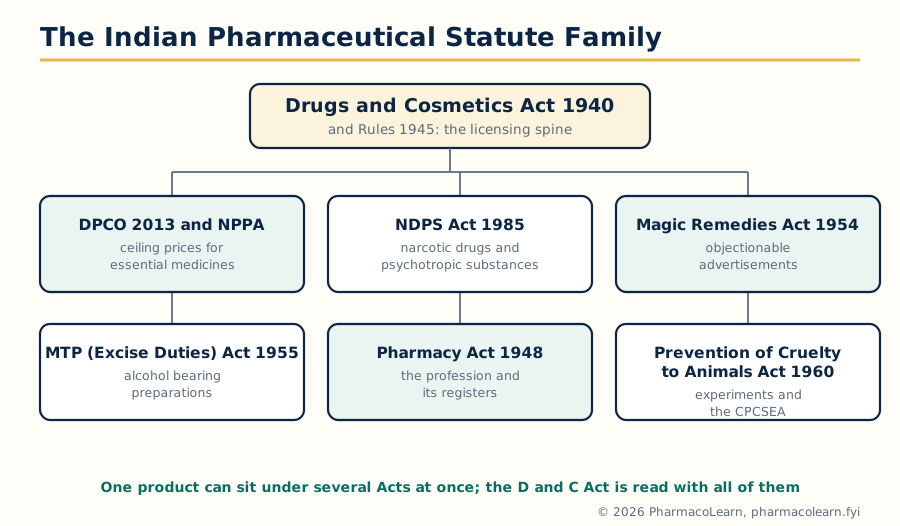 Figure: The statute family of Unit 1: the Drugs and Cosmetics Act 1940 at the centre, with the price, narcotics, advertising, excise, pharmacy and animal welfare statutes around it (Unit 1, section 1.1).
1.2 The Drugs and Cosmetics Act 1940: origin and architecture
The Act grew out of the Drugs Enquiry Committee of 1930-31, chaired by Colonel R. N. Chopra, which documented a market flooded with adulterated and substandard drugs, much of it imported, and recommended central legislation. The result was the Drugs Act 1940, initially concerned with imports; manufacture and sale were brought in by later amendment, and cosmetics were added to its reach and its title in 1962, giving the Drugs and Cosmetics Act in its modern form. Its architecture is simple and durable. The opening chapters define the territory and build the institutions: the Drugs Technical Advisory Board (DTAB), the expert body that advises the Central Government on technical matters; the Drugs Consultative Committee, through which the Centre and the States coordinate; the Central Drugs Laboratory; and the government analyst and drug inspector machinery through which quality is actually policed. The operative chapters then regulate, in turn, the import of drugs and cosmetics, their manufacture, and their sale, stocking, exhibition and distribution, with separate treatment for Ayurvedic, Siddha and Unani drugs (Chapter IVA, added in 1964) and a chapter of offences and penalties. Two features of the design matter for regulatory practice. The Act works through licensing: no one may import, manufacture or sell a drug or cosmetic except under a licence granted under the Rules, and the licence, not the product registration, is the basic permission for most established categories. And the Act creates the quality offences in a careful ladder of definitions, examined in section 1.4, so that the seriousness of a prosecution follows the seriousness of the defect.
1.3 The Drugs and Cosmetics Rules 1945: the schedules are the machinery
The Rules of 1945, framed under the Act, are where the system is actually operated, and their organising device is the schedule: lettered annexures that attach a special regime to a class of products, premises or activities. A regulatory professional reads the Rules by their schedules. Schedule M prescribes the good manufacturing practices and premises requirements with which a manufacturing licence must comply (its device and other parts extend the same approach beyond drugs). Schedule Y once carried the requirements and guidelines for permission to import or manufacture new drugs and to conduct clinical trials; its clinical trial substance has since been re-enacted in the New Drugs and Clinical Trials Rules 2019, as MRA103T describes, and the schedule is now read in that light. Schedules C and C1 list the biological and special products, sera, vaccines, insulin and their class, whose manufacture and import attract central oversight. Schedule F and its parts set standards for particular preparations. The prescription and caution schedules govern how medicines may be sold: Schedule G drugs must carry the caution that it is dangerous to take the preparation except under medical supervision; Schedule H drugs are prescription drugs, labelled with the Rx symbol and the prescription warning; Schedule H1, introduced in 2013 for specified antibiotics, anti-tuberculosis drugs and habit forming medicines, adds a separate record of sale, with name and address of the prescriber and patient, retained for three years, a direct legislative answer to antimicrobial resistance and self medication; Schedule X covers the narcotic and psychotropic substances that demand a special licence and duplicate prescriptions. Schedule J lists diseases and conditions for which no drug may claim a cure, the statutory backstop to the advertising Act of section 1.9, and Schedule T prescribes good manufacturing practices for Ayurvedic, Siddha and Unani drugs. The lesson of the schedules is procedural humility: in Indian drug law the answer to almost any working question (may I sell it, who may prescribe it, what must the label say, what records must exist) is found not in the Act's chapters but in a schedule and the licence conditions that point to it.
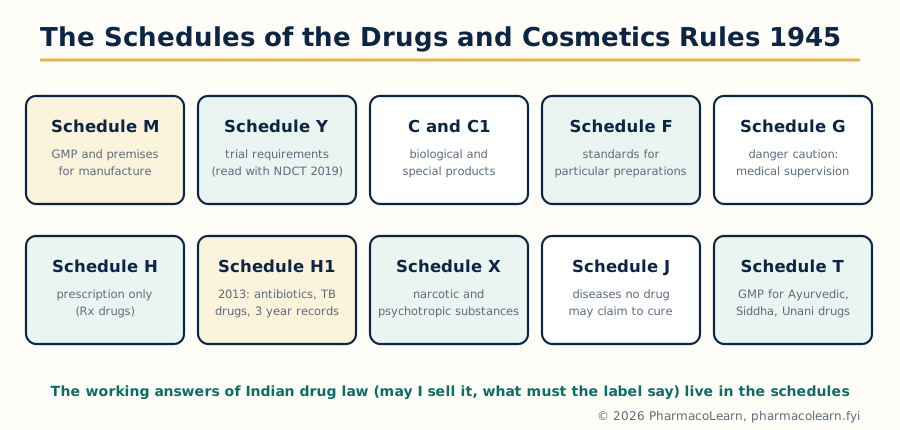 Figure: The schedules a regulatory professional reads first: quality and premises (M, C and C1), sale control (G, H, H1, X), trial requirements (Y, now read with the NDCT Rules 2019), claim limits (J) and ASU manufacture (T) (Unit 1, section 1.3).
1.4 Definitions that carry legal weight
Because prosecutions and licence refusals turn on them, the Act's quality definitions are worth learning as a graded set. A drug is misbranded if it is not labelled in the prescribed manner, if its label or accompanying claim is false or misleading, or, for a cosmetic and certain preparations, if it is coloured or presented in a way the definition captures: the defect is in the presentation. A drug is adulterated if it consists in whole or part of a filthy, putrid or decomposed substance, if it has been prepared or stored under insanitary conditions, if its container is poisonous or deleterious, if it carries a prohibited colour, or if its strength has been reduced or an admixture made injurious to health: the defect is in the substance or its keeping. A drug is spurious if it is manufactured under a name belonging to another drug, if it imitates or substitutes for another drug deceptively, or if it falsely claims to be the product of a manufacturer with whom it has no connection: the defect is in its identity, a counterfeit concept, and it carries the heaviest penalties. Standing slightly apart is the everyday quality verdict of not of standard quality (NSQ), applied when a sample fails the standards of the pharmacopoeia or of the Second Schedule to the Act; most government laboratory failures in India are NSQ findings rather than adulteration. The word drug itself is defined expansively, covering medicines for internal and external use, diagnostic and preventive substances, and articles intended to affect the structure or function of the body, and it is through this definition, by notification, that medical devices were progressively brought inside the Act, until in 2020 all medical devices were notified as drugs for regulatory purposes, as section 2.6 describes. Cosmetic is defined by its intended use on the human body for cleansing, beautifying, promoting attractiveness or altering appearance, a boundary that keeps generating classification disputes with borderline products, as happens in every jurisdiction.
1.5 Licensing under the Act and Rules
The licensing map follows the Act's structure. Import of drugs is licensed centrally, with registration of the foreign manufacturing site and the product for the categories that require it. Manufacture is licensed by the State Licensing Authority of the state where the factory sits, on the licence forms prescribed in the Rules, after inspection of the premises for Schedule M compliance; a defined set of sensitive categories, including vaccines and sera, whole human blood and blood products, large volume parenterals and in vitro diagnostic products, is approved at the centre by the Central Licence Approving Authority acting with the state. Loan licences and repacking licences serve manufacturers who use another's premises or repack bulk product. Sale, stock and distribution licences, wholesale and retail, are also state licences, and the retail licence carries the condition that dispensing is done by or under a registered pharmacist, which is where the Pharmacy Act of section 1.11 bites on the system. Around the main licences sit the test licence for small quantities imported or manufactured for examination, test or analysis, and the special regimes for Schedule C and C1 products and for narcotic and psychotropic items under Schedule X. The Central Government holds the emergency and standards powers, including the power under Section 26A to prohibit the manufacture and sale of a drug in the public interest, the provision behind the fixed dose combination bans of recent years. Every licence is time bound, renewable, inspectable and revocable, and the licence conditions, not merely the licence itself, are the compliance document a company actually lives under.
1.6 The living statute: successor rulebooks under the same Act
Three modern rulebooks now carry large parts of what was once inside the 1945 Rules, and the syllabus's phrase "with latest amendments" points at exactly this movement. The New Drugs and Clinical Trials Rules 2019 took over the approval of new drugs, clinical trials, bioavailability and bioequivalence studies and ethics committee registration from Schedule Y and the old appendices, under the Central Licensing Authority; MRA103T treats them in full. The Medical Devices Rules 2017, in force from 2018, created a complete risk based code for devices within the Act: classification, notified bodies, licensing by class and the materiovigilance programme, taken up at section 2.6. The Cosmetics Rules 2020 separated cosmetics into their own code, with central import registration and state manufacture licensing, at section 2.5. The pattern to note is that Parliament has not replaced the 1940 Act; successive governments have preferred to govern through fresh rules under it, so a professional cites the Act for power and the current rulebook for procedure, and checks which instrument governs the act in question before advising on any filing.
1.7 Price control: the DPCO and the NPPA
Drugs are the standing exception to market pricing in India, and the instrument is the Drugs (Prices Control) Order, issued not under the Drugs and Cosmetics Act but under the Essential Commodities Act 1955, which is why price work sits slightly apart in the statute family. A succession of price control orders runs from 1970 to the current Drugs (Prices Control) Order 2013. The 2013 Order controls the ceiling price of scheduled formulations: dosage forms and strengths of the medicines listed in the National List of Essential Medicines, which the Order adopts as its first schedule. For each scheduled formulation the ceiling price is calculated in a market based way, as the simple average price to retailer of the brands of that formulation holding at least one percent of market turnover, adjusted as the Order prescribes; manufacturers may price at or below the ceiling, and prices are revised with the wholesale price index on the Order's cycle. Formulations outside the schedule are not price fixed, but their maximum retail prices may not rise by more than ten percent in a year, and the authority watches the trade margin debate and exceptional cases, having used its public interest powers for items such as coronary stents and knee implants. The National Pharmaceutical Pricing Authority (NPPA), constituted in 1997 as an attached office of the Department of Pharmaceuticals, is the implementing body: it fixes and revises ceiling prices, monitors prices and availability, maintains the price database, enforces recovery of overcharged amounts with interest, and advises the government on the Order and on the national list. The regulatory lesson is that a marketing authorization is only half the commercial permission: the price label on the pack is itself a regulated statement, and a price filing error is a compliance breach in its own right.
1.8 The Narcotic Drugs and Psychotropic Substances Act 1985
The NDPS Act is India's consolidated law against narcotics, enacted to meet international convention obligations and to control the licit trade as firmly as the illicit. It prohibits the production, manufacture, possession, sale, transport and consumption of narcotic drugs and psychotropic substances except as licensed for medical and scientific purposes, and it builds a licensing lattice to keep the legitimate pharmaceutical trade inside the law: the Central Bureau of Narcotics administers the opium and alkaloid side and the international trade permits, state authorities license much of the domestic manufacture and possession, and the schedules of the NDPS Rules name the substances and the forms. For the pharmaceutical professional the Act intersects daily practice at three points. First, the psychotropic and narcotic ingredients of ordinary medicines pull those products into Schedule X of the Drugs and Cosmetics Rules and into duplicate prescription and record keeping discipline (section 1.3). Second, manufacture, export and import of controlled substances need the specific NDPS licences and quotas in addition to drug licences, so a controlled product carries two regulatory identities. Third, the Act's enforcement is penal and severe, with punishments graded by the quantity involved since the 2001 amendment, so documentation failures in this area are not clerical matters. The medical exception is written into the Act's own design: the object is control of abuse, not denial of therapy, and the recognised medical and scientific channel is the licence system itself.
1.9 The Drugs and Magic Remedies (Objectionable Advertisements) Act 1954
This short Act polices what may be claimed to the public. It prohibits advertisements of drugs that suggest use for the procurement of miscarriage or prevention of conception, for the correction of menstrual disorders, or for the diagnosis, cure, mitigation, treatment or prevention of the diseases and conditions listed in its Schedule; it prohibits advertisements of magic remedies, a defined term covering talismans, mantras, charms and similar articles claimed to possess miraculous powers; it prohibits taking part in the publication of such advertisements and controls the import and export of the offending material. Two connections make the Act examinable rather than antiquarian. Its Schedule of diseases overlaps with Schedule J of the Drugs and Cosmetics Rules (section 1.3), which forbids cure claims for the same class of conditions on labels and in promotion generally, so an advertisement can breach both instruments at once. And the Act is the ancestor of the modern Indian debate on drug promotion: direct to consumer advertising of prescription medicines remains outside lawful practice in India, and when advertisements for Ayurvedic and other products promise cures for scheduled diseases, it is still this 1954 Act that is invoked. One caution belongs in the record of this subject: some printed copies of the syllabus list this Act at 1955; the Act is of 1954, and those printings are in error (see the verification note for this package).
1.10 The Medicinal and Toilet Preparations (Excise Duties) Act 1955
A large class of medicines and toilet preparations (tinctures, extracts, syrups, hair oils, mouthwashes) is made with alcohol, and alcohol has always been a revenue and control subject in India. The Medicinal and Toilet Preparations (Excise Duties) Act 1955 imposes a duty of excise on medicinal and toilet preparations containing alcohol, opium, Indian hemp or other narcotic drugs, administered largely by the states, with licensed premises, bonded warehouses and the familiar machinery of duty paid and duty free (L-1 and kindred) licences for manufacture and for use of alcohol in manufacture. The Act matters to regulatory affairs for two reasons. It is a second licence system sitting on top of the drug licence for any alcohol bearing product, with its own inspections, registers and sampling. And it explains a permanent feature of Indian pharmaceutical geography: because alcohol duty and prohibition policy are state subjects in practice, the same preparation faces different fiscal conditions from state to state. The goods and services tax subsumed most excise duties from 2017, but alcoholic liquor for human consumption stayed outside the GST, so this excise framework continues to operate for the preparations within its charge.
1.11 The Pharmacy Act 1948
If the Drugs and Cosmetics Act regulates products and premises, the Pharmacy Act regulates people. It created the Pharmacy Council of India as the central council for pharmacy education and the profession, and the State Pharmacy Councils that maintain the registers of pharmacists. Its operative machinery is registration: a person whose name is entered in the state register, on the strength of an approved qualification (the Diploma in Pharmacy as the minimum for registration, with the Bachelor of Pharmacy above it), is the registered pharmacist whom the other statutes then rely upon. The Education Regulations framed under the Act set the minimum standards of the D.Pharm and B.Pharm courses, and council approval of institutions flows through those regulations. The Act connects to the rest of this subject at the dispensing point (section 1.5): retail sale of drugs must be effected by or under the personal supervision of a registered pharmacist, so the professional register is part of the drug control system, and the long Indian debate about enforcement of that requirement in community pharmacy is a debate about this Act.
1.12 The Prevention of Cruelty to Animals Act 1960
The last of the companion Acts looks away from the market to the laboratory. The Prevention of Cruelty to Animals Act 1960 is India's general animal welfare statute, and its Chapter IV, on experimentation on animals, provides that experiments may be performed only for the advancement of physiological knowledge or knowledge useful for saving or prolonging life or alleviating suffering, and creates the committee to control and supervise them: the Committee for the Purpose of Control and Supervision of Experiments on Animals (CPCSEA), a statutory body of the Government of India. CPCSEA registers establishments that breed animals for or perform experiments, and its guidelines govern facilities, housing, and the Institutional Animal Ethics Committees that approve protocols locally. Unit 4 returns to CPCSEA in its working detail; here the point is structural. Animal data are a legal precondition of drug approval, and this 1960 Act is the legal licence under which that precondition may be generated, which is why a welfare statute belongs in a regulatory affairs syllabus.
Unit 2: Regulatory Requirements and Approval Procedures
2.1 The two tier architecture of Indian drug regulation
India distributes drug regulation between the Union and the States, and almost every procedural question in this unit is answered by knowing which tier owns it. The Centre owns: standards and the pharmacopoeia; approval of new drugs and permission for clinical trials; import licensing and registration; the licensing of the sensitive biological and device categories described in Unit 1; bans and safety withdrawals; clinical trial ethics committee registration; and coordination of the state systems. The States own: licensing of manufacture for established drugs and of sale and distribution within their territory; inspection and enforcement on the ground; drug testing through state laboratories; and prosecution of offences. The Central Drugs Standard Control Organization (CDSCO) is the Centre's operating machinery, headed by the Drugs Controller General (India), and the State Licensing Authorities are the States' counterparts. A dossier may therefore need both tiers in sequence: central permission to test and to market a new drug, then a state manufacturing licence to make it. The figure sets the architecture out; the sections that follow take each authority and then each product family in turn.
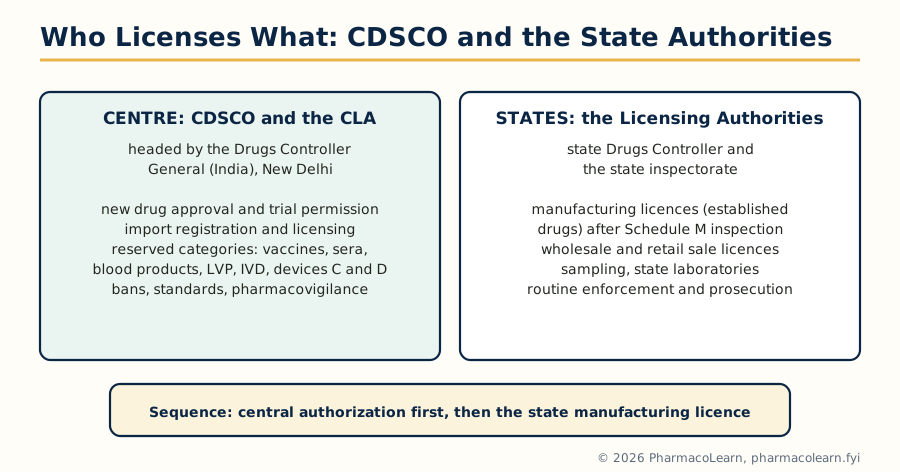 Figure: Who licenses what in India: the central tier (CDSCO and the Central Licensing Authority) and the state tier (State Licensing Authorities), with the standards and price bodies beside them (Unit 2, section 2.1).
2.2 CDSCO: organization and responsibilities
CDSCO is the national regulatory authority for pharmaceuticals and medical devices, functioning under the Directorate General of Health Services of the Ministry of Health and Family Welfare, with its headquarters in New Delhi. It is headed by the Drugs Controller General (India) (DCGI), who is also the Central Licensing Authority for the categories the Rules reserve to the centre. The organization reaches the field through zonal and sub zonal offices (the zonal offices at Mumbai, Kolkata, Chennai, Ghaziabad, Hyderabad and Ahmedabad among them), offices at ports of entry where imports are cleared, and the central drug testing laboratories, with the Central Drugs Laboratory at Kolkata serving as the statutory appellate laboratory whose report is conclusive in disputed analyses. Its responsibilities, read as a list, are the syllabus's own: laying down standards for drugs, cosmetics, diagnostics and devices; market authorization of new drugs and clinical trial oversight; import registration and licensing; approval of licences for the specified biologicals, devices and diagnostics; oversight of ethics committees and of bioavailability and bioequivalence centres; regulatory advice to and coordination with the state authorities, including joint inspections; safety surveillance with the Pharmacovigilance Programme of India; and the power, exercised through government, to prohibit drugs of unacceptable risk. Since 2013 most applications to CDSCO are filed online through the SUGAM portal, which MRA102T covers as a submission system; the filing formats beneath SUGAM are the subject of section 2.9.
2.3 The State Licensing Authorities: organization and responsibilities
Each state and union territory runs a drug control administration, typically a Food and Drug Administration or a Drugs Control Department, headed by a state Drugs Controller who acts as the State Licensing Authority. Its field force is the drug inspectorate, and its analytical arm the state drug testing laboratory. Its responsibilities are the mirror image of the centre's: grant and renewal of manufacturing licences for established drugs (after premises inspection against Schedule M or Schedule T), grant of wholesale and retail sale licences, inspection of factories, pharmacies and distributors, drawing of samples for test and analysis, investigation of complaints and of not of standard quality reports, and prosecution of offences under the Act before the courts. The state authority is also a joint actor in central categories: the licences for blood banks and for Schedule C and C1 products are issued with central approval, so a state file and a central file can both exist for one premises. The practical lesson for a regulatory professional is that timelines, inspection culture and documentation expectations are state specific for state licences, while the legal text is national; compliance is planned nationally and executed state by state.
| Question | Central tier (CDSCO / CLA) | State tier (SLA) |
|---|---|---|
| New drug approval | Yes, marketing authorization and trial permission | No |
| Clinical trial permission and EC registration | Yes | No (state ECs register centrally) |
| Import licence and site registration | Yes | No |
| Manufacturing licence, established drugs | Only for reserved categories (vaccines, sera, blood products, LVP, IVDs, higher device classes) | Yes, the general rule |
| Manufacturing licence, new drugs | Authorization first; licence then issued by the state | Yes, after central authorization |
| Sale and distribution licences | No | Yes |
| Standards and pharmacopoeia | Yes (with the Indian Pharmacopoeia Commission) | Adopts and enforces |
| Routine inspection and prosecution | Joint inspections; appellate laboratory | Yes, the primary enforcement |
2.4 Approval procedures for drugs
The approval of a new drug, as the New Drugs and Clinical Trials Rules 2019 define the term, covering a drug not previously approved in India, a new indication, dosage form, route or strength of an approved drug, and fixed dose combinations not previously approved, runs through the Central Licensing Authority in the following order: the preclinical and pharmaceutical data are assembled; permission is sought to conduct clinical trials in India, with the data of foreign trials considered under the Rules' bridging logic; trials proceed through their phases under registered ethics committees; and the application for marketing authorization is then reviewed, ordinarily with the advice of a Subject Expert Committee, before the licence to import or manufacture the new drug is granted. For a drug already approved and marketed, the work shifts to the state: the manufacturer obtains the state manufacturing licence and product permissions for the formulation. Import follows the registration and licence route for the site and product. The generic applicant's obligations are deliberately lighter on clinical data and heavier on pharmaceutical equivalence and bioequivalence (Unit 4), which is the balance the whole system strikes between access and evidence.
New drug approval in India (NDCT Rules 2019 route)
Discovery and preclinical data (Unit 4)
        |
        v
Application to CLA (CDSCO) in SUGAM, CTD format dossier (2.9)
        |
        v
Permission for clinical trials -> EC approval -> CTRI registration
        |
        v
Phase I to III data generated (MRA103T); SEC review
        |
        v
Marketing authorization by CLA
        |
        v
Manufacturing licence from the State Licensing Authority
        |
        v
Market, under DPCO pricing (1.7) and pharmacovigilance
2.5 Approval procedures for cosmetics
Cosmetics were separated into their own code by the Cosmetics Rules 2020, replacing the cosmetic provisions scattered through the 1945 Rules. Imported cosmetics must be registered with the Central Licensing Authority before import, with a licence to import following the registration; no imported cosmetic may be sold unregistered. Manufacture within India is licensed by the State Licensing Authority, with factory premises expected to meet the good manufacturing practice expectations the Rules prescribe. Registration and licensing both work through product categories and positive and negative lists: ingredients prohibited in cosmetics in India, and colourants and other ingredients permitted only within stated limits, are scheduled in the Rules and read with the standards of the Bureau of Indian Standards that the Rules adopt for finished products. Two Indian policy choices stand out. India has prohibited the import of cosmetics tested on animals abroad and the manufacture of cosmetics tested on animals at home, aligning the cosmetic code with the welfare statute of Unit 1. And misleading cosmetic claims are policed through the Drugs and Magic Remedies Act and the consumer protection framework together, so the label and the advertisement are reviewed as one communication.
2.6 Approval procedures for medical devices
Devices entered the Drugs and Cosmetics Act through the definition of drug, by notification; from 2020 the notification covers all medical devices, and the Medical Devices Rules 2017 supply the code. The Rules classify devices into four classes by risk: Class A (low risk, such as non sterile examination gloves and surgical dressings), Class B (low to moderate risk, such as sterile gloves, suction equipment and many in vitro diagnostic reagents), Class C (moderate to high risk, such as ventilators, bone fixation plates and dialysis equipment) and Class D (high risk, such as implantable defibrillators, heart valves and drug eluting stents). The licensing authority follows the class: the State Licensing Authority licenses manufacture of Class A and Class B (Class B being preceded by audit by a notified body registered with CDSCO), while the Central Licensing Authority licenses Class C and Class D manufacture and all imports. Every class carries a quality management system obligation keyed to the Rules' Schedule V; clinical investigation of devices in India follows the Rules' own provisions, conceptually parallel to the ISO 14155 standard for device trials; adverse events are reported into the Materiovigilance Programme of India; and registration of the manufacturer and product precedes the licence for imports. The device industry thus works under the drug statute but with a risk grammar of its own, which is exactly why the syllabus names it a separate family.
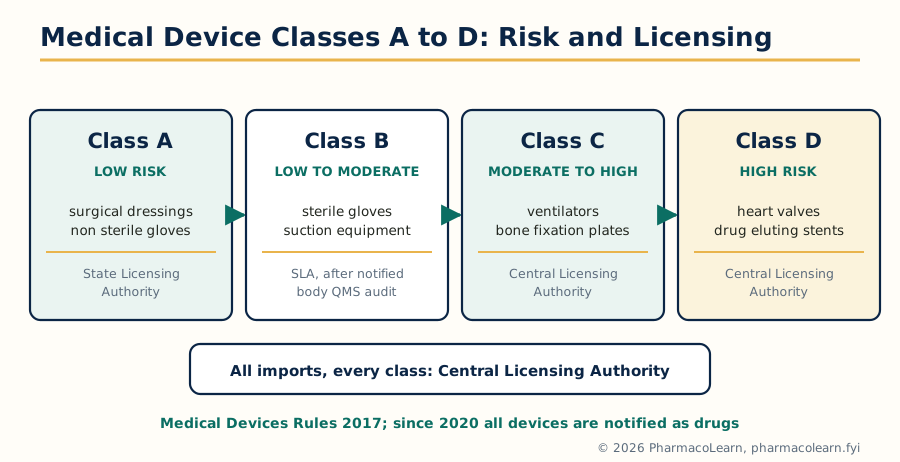 Figure: The four device classes under the Medical Devices Rules 2017, rising risk from A to D, with the licensing authority split between the State Licensing Authority (A, B) and the Central Licensing Authority (C, D and all imports) (Unit 2, section 2.6).
2.7 Approval procedures for biologicals and herbals
Biologicals occupy the Act's most supervised shelf. Vaccines, sera, blood and blood products, recombinant products and other Schedule C and C1 items require central approval of the licence, batch by batch diligence in manufacture, and characterisation data that chemical drugs do not generate: cell banks, viral safety, potency assays against reference standards (Unit 3). Whole human blood and its components are licensed as drugs with the blood bank as a licensed premises, a system built after the transfusion safety failures of the 1990s. Where genetic engineering is involved, an additional statutory layer precedes the drug licence: the Review Committee on Genetic Manipulation (RCGM) of the Department of Biotechnology oversees research and development of recombinant products under the Environment (Protection) Act machinery, before CDSCO's market authorization is sought. Herbals run on two tracks. The classical track is the Ayurvedic, Siddha and Unani (ASU) system of Chapter IVA of the Act: proprietary and classical ASU medicines are licensed by the state ASU licensing authority, with manufacture under Schedule T good manufacturing practices, and with a markedly lighter evidence regime for classical formulations, though safety and efficacy evidence is required for new proprietary claims. The modern track is the phytopharmaceutical category created by amendment in 2015: a purified and standardised fraction of a medicinal plant, presented with data on quality, safety and efficacy on the pattern of a new drug, regulated by CDSCO as a drug in the modern sense. The professional skill in this family is classification: the same plant can be a classical ASU medicine, a phytopharmaceutical drug, or a food ingredient, and the route chosen fixes the evidence, the licence and the claims.
2.8 Approval procedures for food and nutraceuticals
Food left the pharmacy statutes behind in 2006: the Food Safety and Standards Act 2006 consolidated the old food laws (including the Prevention of Food Adulteration Act) and created the Food Safety and Standards Authority of India (FSSAI), under the Ministry of Health and Family Welfare, as the standard setting and licensing authority, with State Commissioners of Food Safety as the enforcement tier. Every food business operator must hold an FSSAI licence or registration, in three tiers by scale: petty food businesses register; medium scale businesses take a state licence; and the largest businesses, importers, exporters and the categories the regulations reserve (which include manufacturers of nutraceuticals and health supplements) take a central licence. The product law for the syllabus's family is the Food Safety and Standards (Health Supplements, Nutraceuticals, Food for Special Dietary Use, Food for Special Medical Purpose, Functional Food and Novel Food) Regulations, first issued in 2016 and revised in 2022, which list the permitted ingredients, their forms and daily limits for the nutraceutical and supplement categories, and import a discipline of permitted claims: a supplement may carry the structure and function claims the regulations allow and must carry the statutory advisory that it is not for medicinal use, and no food may claim to cure or treat disease. The drug and food boundary is policed from both sides: a product that makes disease claims, or exceeds the vitamin and mineral limits the drug rules set for food style presentations, is treated as a drug and needs a drug licence. Regulatory affairs in this family is therefore boundary work: ingredients, dose, format and claim wording are checked against both statute books before a launch is advised.
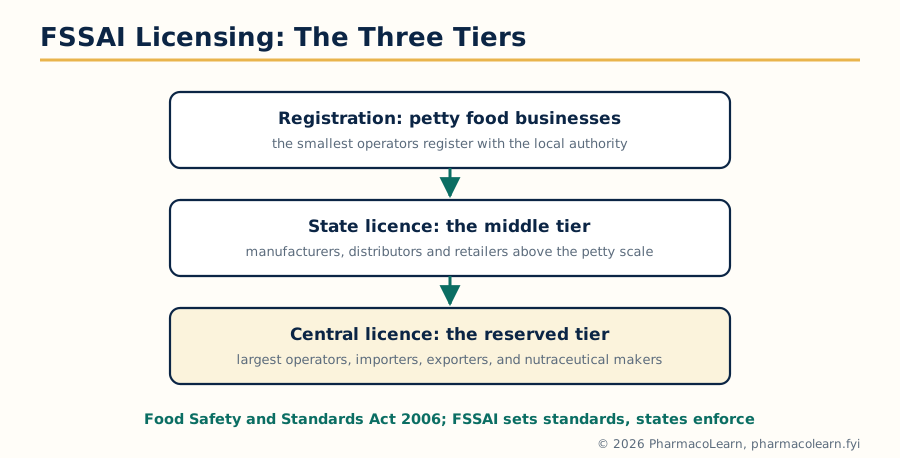 Figure: FSSAI licensing by scale: registration for petty food businesses, state licence for the middle tier, and central licence for the largest operators, importers and nutraceutical manufacturers (Unit 2, section 2.8).
2.9 Regulatory filing: format and contents of the dossier
The syllabus requires the format and contents of a regulatory dossier, and India asks for both a national layer and the international common format. The Common Technical Document (CTD) structure, the five module pyramid of ICH M4 that MRA101T introduces in its guidance survey, is the organising format CDSCO expects for new drug submissions: Module 1 carries the India specific administrative material (application forms, licences, labelling as proposed for India, and the certificates of the origin system), Module 2 the summaries and overviews, Module 3 the quality (chemical, pharmaceutical and biological) data, Module 4 the nonclinical reports and Module 5 the clinical study reports, with bioequivalence data of Unit 4 sitting in Module 5. Dossiers for other families adapt the same discipline to their codes: the device file follows the Rules' documentation and the quality system evidence; the cosmetic registration file the Rules' prescribed forms and ingredient declarations; the food licence and product approval files the FSSAI forms and standards. In every case the dossier is filed through the online systems (SUGAM for drugs and devices, the FSSAI licensing portal for food), and the regulatory professional's craft is completeness against the applicable checklist: a dossier is reviewed only as fast as it is complete, and deficiency letters are almost always listable in advance by the person who assembled the file.
2.10 Clinical trial and investigations under this framework
Unit 2's closing item returns to trials, now from the Indian approval side. A clinical trial of a new drug in India requires the permission of the Central Licensing Authority under the NDCT Rules 2019, the approval of a registered ethics committee, and registration in the Clinical Trials Registry of India before the first participant is enrolled; investigations of medical devices follow the Medical Devices Rules' own clinical investigation provisions, and bioavailability and bioequivalence studies run through their dedicated registered centres (Unit 4). The global conduct of trials, including the Indian conduct standards, the United States and the European Union, is the province of MRA103T; the Indian statutory skeleton it hangs on is this unit's. What the student should carry forward is the sequence: preclinical justification (Unit 4), central permission, ethics oversight, registry transparency, and inspection readiness, because every later unit's data are generated inside this frame.
Unit 3: Standards
3.1 Why standards are law in India
A licence promises that a product is what it claims to be; a standard is the public text against which that promise is tested. Indian drug law makes the connection explicit: the Drugs and Cosmetics Act names the standards with which drugs must comply, its Second Schedule designates the book whose monographs govern each class of drug, and a product that falls below its designated standard is not of standard quality (section 1.4), whatever its licence says. Three standards families do the work for this syllabus: the Indian Pharmacopoeia for medicines themselves, the standards of the Bureau of Indian Standards (BIS) for the materials, devices, packaging and finished product categories to which BIS standards apply, and the international system of ISO and kindred standards for management systems, device quality, laboratory competence and methods. The regulatory skill is designation: for any product, identify which standard governs which attribute, because a monograph, a BIS standard and an ISO certificate answer different questions and none substitutes for another.
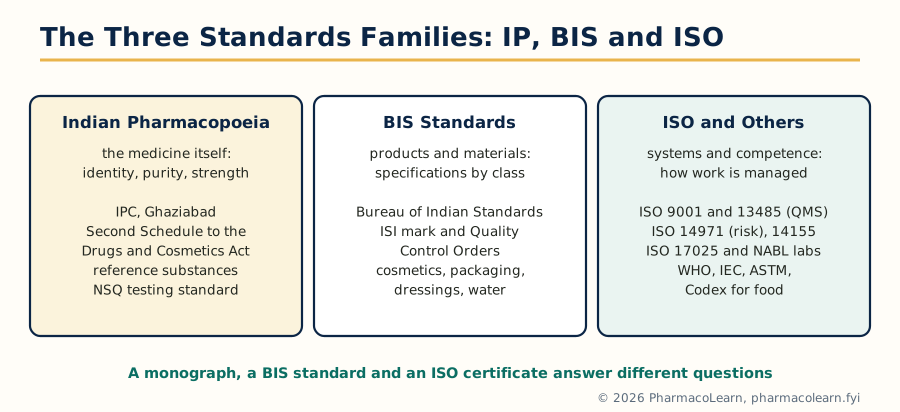 Figure: The standards families of Unit 3: the Indian Pharmacopoeia governs the medicine, BIS standards govern products and materials, and the ISO family governs systems and competence (Unit 3, section 3.1).
3.2 Indian Pharmacopoeial standards
The Indian Pharmacopoeia (IP) is the official book of standards for drugs in India, published by the Indian Pharmacopoeia Commission (IPC), an autonomous body of the Ministry of Health and Family Welfare at Ghaziabad, and designated in the Second Schedule to the Act as the standard for drugs manufactured, sold and distributed in India. Its authority was completed in stages: the first edition appeared in 1955, and the Commission now issues successive editions and addenda in a regular cycle, the current generation being the modern, multi volume editions. A monograph in the IP fixes identity, purity, strength and quality: the definition of the substance or preparation, its identification tests, assay and limits for impurities and related parameters, with general chapters supplying the methods. The IP's standards have statutory force: the government analyst tests against them, the courts read them, and where a drug is not in the IP, the Act looks to other designated pharmacopoeias. The Commission also prepares and supplies Indian Pharmacopoeia Reference Substances, the physical standards against which assays are run, and issues the pharmacopoeias for the ASU systems (the Ayurvedic, Siddha and Unani pharmacopoeias), so that the classical medicines of section 2.7 also have a statutory quality text. Related national compendia round out the picture: the National Formulary of India for prescribing information at the primary care level, and the Homoeopathic Pharmacopoeia for its system. For the student, the examination point is the chain: Act, Second Schedule, IP monograph, analyst's report, NSQ prosecution.
3.3 BIS standards
The Bureau of Indian Standards, the national standards body under the Ministry of Consumer Affairs, Food and Public Distribution, writes Indian Standards (IS numbers) across every sector of the economy, working under the BIS Act 2016, which strengthened its powers and its conformity assessment schemes. Its certification mark scheme (the familiar ISI mark) licenses manufacturers to mark products that conform to an Indian Standard, and the government can make BIS certification compulsory for notified products through Quality Control Orders. Pharmaceuticals meet BIS at four interfaces. Cosmetics: the Cosmetics Rules adopt BIS standards for finished cosmetic products, so a lipstick or a shampoo in India is tested to a BIS text as well as licensed under the drug statute. Devices and materials: standards for medical devices, surgical dressings, hospital equipment and sterilisation overlap with the Medical Devices Rules, which read BIS and international standards together. Packaging and inputs: containers, closures and water and sterilisation standards govern the plant's inputs. And food: FSSAI standards incorporate BIS style specifications for packaged drinking water and other categories, which must carry BIS certification as a condition of sale. The lesson mirrors section 3.1: BIS answers whether a product or material conforms to the national specification for its class, a different question from whether a medicine meets its pharmacopoeial monograph.
3.4 ISO and other relevant standards
The international layer is the International Organization for Standardization (ISO) and its sister bodies, whose standards India adopts, often as dual numbered IS/ISO texts. The set that a regulatory professional actually cites is short. ISO 9001 certifies a quality management system in general industry. ISO 13485 is the quality management standard written for medical devices, and device regulation in India and abroad reads it as the QMS grammar of section 2.6 (the Medical Devices Rules' Schedule V is built in its image). ISO 14971 governs risk management for medical devices; ISO 14155 the clinical investigation of devices in human subjects. ISO/IEC 17025 accredits testing and calibration laboratories, the competence basis on which India's National Accreditation Board for Testing and Calibration Laboratories (NABL) accredits the laboratories whose reports regulators accept, and ISO 15189 does the same for medical laboratories. Beyond ISO stand the other relevant families the syllabus gestures at: the WHO's standards and international pharmacopoeia for the global market; IEC standards for electro medical equipment; ASTM standards for materials and devices; and the Codex Alimentarius standards that frame food trade and feed into the FSS system of section 2.8. Certification to these standards is voluntary in form but structural in effect: procurement, exports, device licensing and laboratory recognition all price it in, so the syllabus studies them as part of the working law.
| Standard family | Custodian | What it standardises | Where it bites in this subject |
|---|---|---|---|
| Indian Pharmacopoeia | Indian Pharmacopoeia Commission | Identity, purity, strength and quality of medicines | Second Schedule standards; NSQ testing; reference substances |
| BIS Indian Standards | Bureau of Indian Standards | Products, materials, packaging, cosmetics, water, equipment | Cosmetics Rules; QCOs; ISI certification; FSS interfaces |
| ISO 9001 / 13485 | ISO | Quality management systems; the device QMS | Device licensing; supplier audits; plant certification |
| ISO 14971 / 14155 | ISO | Device risk management; device clinical investigation | Device files and investigations under the MDR |
| ISO/IEC 17025, ISO 15189 | ISO and IEC | Competence of testing, calibration and medical laboratories | NABL accreditation; regulator accepted test reports |
| WHO, IEC, ASTM, Codex | Respective bodies | Global health, electrical, materials and food standards | Exports; electro medical devices; food standards |
Unit 4: Bioavailability and Bioequivalence Data
4.1 BA and BE: what the data prove
A generic drug is approved on a bargain: it need not repeat the originator's trials, provided it can prove it delivers the same active substance to the body in the same way. Bioavailability (BA) measures the rate and extent to which the active ingredient is absorbed and becomes available at the site of action, captured in practice by the plasma concentration curve and its summaries, the area under the curve (AUC) for extent and the peak concentration (Cmax) and its timing (Tmax) for rate. Bioequivalence (BE) is the comparative claim: two products are bioequivalent if their bioavailabilities are so similar that their safety and efficacy can be presumed the same. The data are generated in a dedicated study, usually a randomised, single dose, two period crossover in healthy volunteers under fasting conditions, with a fed study where food affects the product or the label directs dosing with food, a washout between periods, and timed plasma sampling analysed by a validated bioanalytical method. In India such studies are regulated under the New Drugs and Clinical Trials Rules 2019, which provide for the registration of BA/BE study centres, ethics approval and the permission structure, and CDSCO guidance specifies when BE data are required: for new generics in the listed categories, for modified release forms, for fixed dose combinations relying on the components' data, and for changes that could alter delivery. MRA103T treats the trial rules; this unit treats the science the rules are protecting.
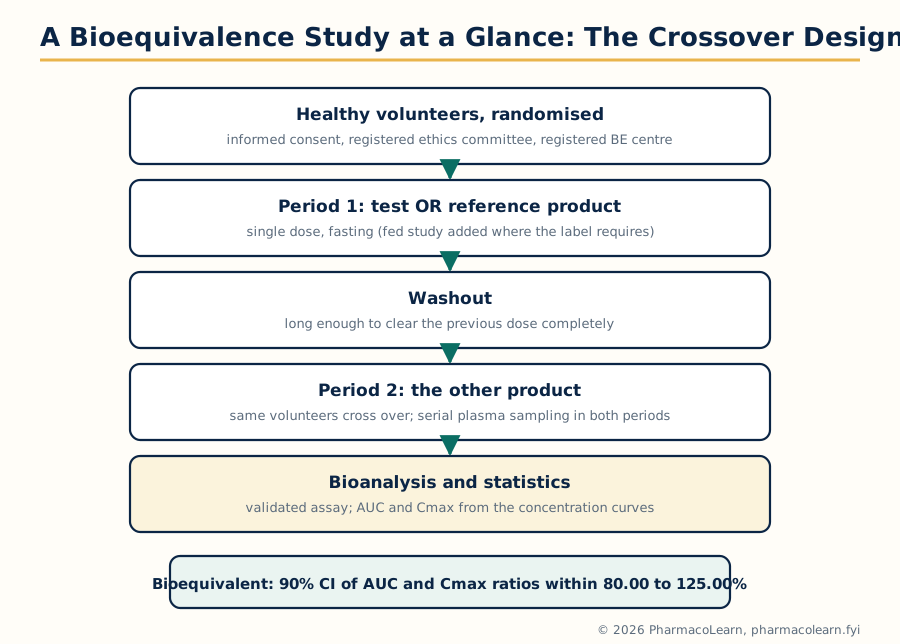 Figure: The standard crossover BE study: healthy volunteers, fasting single doses of test and reference in random order, a washout between periods, serial plasma sampling, and the 80.00 to 125.00 percent acceptance interval (Unit 4, section 4.1).
4.2 The BCS classification
The Biopharmaceutics Classification System (BCS), proposed by Amidon and co workers in 1995, sorts drug substances by the two properties that govern oral absorption: aqueous solubility (is the highest dose strength soluble in 250 millilitres of aqueous media across the physiological pH range) and intestinal permeability (is the extent of absorption in humans high, taken in the harmonised ICH criterion as 85 percent or more of the administered dose). The four classes follow, and each class predicts its absorption problem: Class I (high solubility, high permeability) absorbs readily and is the natural candidate for a waiver of in vivo BE; Class II (low solubility, high permeability) is dissolution limited, the classic difficult generic; Class III (high solubility, low permeability) is permeability and site limited, where excipients and transit matter; Class IV (low solubility, low permeability) is difficult on both counts. Regulators convert the classification into procedure through the biowaiver: for immediate release products of Class I substances, and under tighter conditions Class III, in vitro dissolution comparison can substitute for the in vivo study, a position harmonised in the ICH M9 guideline. In Indian practice the BCS is argued in the dossier wherever a waiver or a dissolution based justification is claimed, and the solubility and permeability evidence must be generated and documented to the standard the guidelines set out.
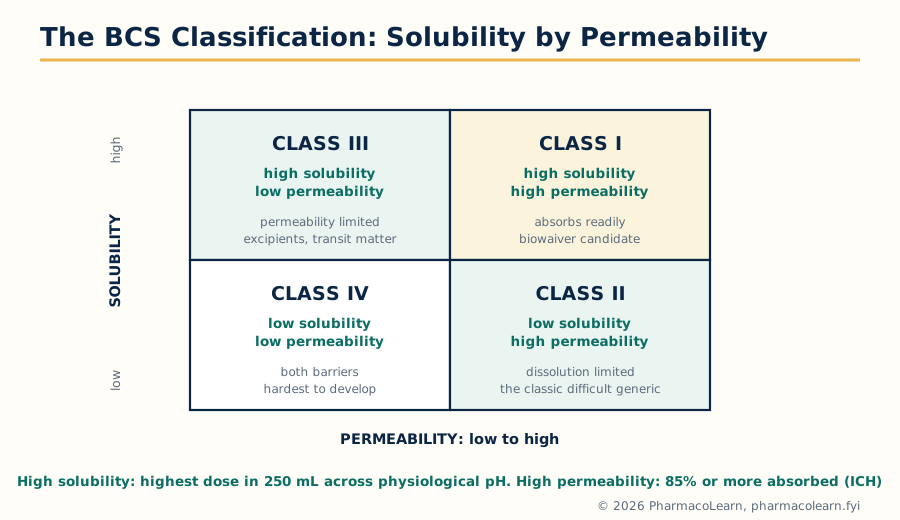 Figure: The four BCS classes on the solubility and permeability axes, with the absorption problem each class predicts (Unit 4, section 4.2).
4.3 Regulatory requirements for bioequivalence studies
The regulatory requirements assemble the earlier sections into a checklist a study must satisfy to be accepted. The design is the standard crossover unless the drug's half life or pharmacology requires a parallel or replicate design; long half life drugs may use a truncated AUC with justification. The statistics are the international constant: the 90 percent confidence interval for the ratio of geometric means of AUC and Cmax, log transformed, must fall within 80.00 to 125.00 percent for the claim of bioequivalence to be accepted; highly variable drugs may be handled by reference scaled approaches where the applicable guidance allows. The conduct requirements mirror clinical trial discipline at study scale: a protocol approved by a registered ethics committee, informed consent of the volunteers, a centre registered for BA/BE studies, validated assays with incurred sample reanalysis, and reporting that preserves the individual data. The decision logic an applicant actually follows runs:
Does the filing need in vivo BE data?
        |
        +-- New drug substance / novel delivery -> clinical route (Unit 2)
        |
        +-- Generic, BCS Class I immediate release
        |       -> argue biowaiver with dissolution data (ICH M9)
        |
        +-- Generic, other classes / modified release
        |       -> fasting BE study; add fed study if label or
        |          food effect requires it
        |
        +-- Post approval change affecting release or site
                -> BE study scaled to the change category
        |
        v
Acceptance: 90% CI of AUC and Cmax ratios within 80.00-125.00%
4.4 Stability requirements: ICH and WHO
Approval is a promise about the future, and stability data are its evidence: the dossier must show the product will remain within specification for its claimed shelf life under the conditions of the market it will sit in. The ICH stability programme (guideline Q1A(R2) and its family) supplies the grammar used in Indian filings: long term, intermediate and accelerated storage conditions, testing at defined intervals on batches of at least pilot scale, in the marketed pack, with the data evaluated to propose the retest period or shelf life. The world's markets are grouped into climatic zones, and India lies in the hot and humid territory for which the stringent long term condition of 30 degrees Celsius and 75 percent relative humidity (Zone IVb) is the working standard, a frequent point of failure when dossiers written for milder zones are filed unadapted. The WHO stability guidelines perform the same function for the wider world, keyed to the WHO climatic zone classification, and are the reference for products intended for WHO prequalification and export to markets that follow WHO guidance. CDSCO's own guidance on chemical and pharmaceutical information, including stability data required before approval of clinical trials and BE studies, connects the programme to the Indian filing calendar: stability commitments and ongoing studies continue after approval, and the shelf life on the Indian label is only ever as long as the data in the file.
4.5 ICH and WHO guidelines for drug testing in animals
Before any human study, the animal data must justify the risk, and the design of that justification is guideline work. The ICH multidisciplinary guideline M3(R2) sets the timing logic: which nonclinical studies must be complete before each phase of human trial, so that animal work gates human work and neither runs wastefully ahead of the other. Around it stands the ICH safety (S) series, each a study type the syllabus's preclinical heading contains: safety pharmacology (S7), genotoxicity (S2), carcinogenicity (S1), reproductive toxicology (S5), chronic toxicity (S4) and the biotechnological and anticancer carve outs (S6, S9). WHO publishes parallel guidance where its remit runs, notably for vaccines and biologicals, whose nonclinical evaluation follows WHO recommendations in much of the world. The Indian applicant reads these guidelines through the NDCT Rules' data requirements: the preclinical package in an Indian clinical trial application is an M3(R2) package in structure, whatever the local form's layout, and deficiencies in it are the commonest technical reason trial permissions are queried.
4.6 Animal testing: rationale for conducting studies
The syllabus asks for the rationale, and it deserves a reasoned answer rather than a shrug. Animal studies are conducted because the questions approval turns on cannot yet be answered otherwise: the whole organism integrates absorption, metabolism, target organ toxicity, reproductive effects and immune responses in ways no bench system reproduces, and first in human dosing (the starting dose, the escalation steps, the organs to monitor) is calculated from animal no effect levels and exposure margins. The rationale is therefore epistemic and protective at once: animal data are the evidence that human exposure is justified, and the stopping rules that protect the first volunteers are written from them. The discipline that keeps the rationale honest is the 3Rs, replacement of animals where a valid alternative exists, reduction of numbers to the statistical minimum the question needs, and refinement of procedures to minimise suffering: a study that uses more animals than its design needs, or a cruder endpoint than the science requires, fails its own rationale, which is the ethical bridge to the legal machinery of the next section.
4.7 CPCSEA guidelines
The Prevention of Cruelty to Animals Act 1960 (section 1.12) created the CPCSEA, and its guidelines are the operating law of the Indian animal facility. An establishment that breeds animals for experiments, or performs experiments, must be registered with CPCSEA; breeding and experimentation are separately registered activities. Within the establishment, the Institutional Animal Ethics Committee (IAEC) is the approving body, constituted with the establishment's scientists and veterinarian, a scientist from outside the institution, and CPCSEA's nominees including its main nominee, whose presence is required for the committee's decisions; no experiment may begin without IAEC approval of the protocol, and the committee inspects and monitors the facility's work. CPCSEA's guidelines for laboratory animal facilities standardise housing, husbandry, veterinary care, record keeping and the qualifications of personnel, and its norms govern imports of animals, their transport, and the conduct of studies to good laboratory practice expectations. The regulatory significance, and the reason the topic sits in this unit rather than only in a welfare discussion, is evidentiary: data from an unregistered establishment or an unapproved protocol are data the approval system cannot properly rely on, so the sponsor's vendor qualification for a contract laboratory in India begins with its CPCSEA registration and IAEC record. The common MRM301T page treats the facility guidelines in their research methodology frame; here the emphasis is the compliance chain into the dossier.
4.8 Ethical guidelines for human participants
The counterpart protection on the human side is the ICMR National Ethical Guidelines for Biomedical and Health Research Involving Human Participants (2017), issued by the Indian Council of Medical Research and binding in practice on every institution conducting such research in India. The guidelines state the general ethical principles (among them essentiality, voluntariness and informed consent, non exploitation, privacy and confidentiality, risk minimisation, professional competence, accountability and transparency, and the maximisation of public interest and distributive justice), classify research by risk, prescribe the composition and functioning of ethics committees (which the NDCT Rules then register and empower for trials), and treat consent, compensation for research related harm, stored samples, data and the special protections owed to vulnerable participants. MRA103T covers the trial facing parts of this framework; in this unit the point is the division of labour between the instruments: the NDCT Rules give the trial permission system its legal teeth, the ICMR guidelines give the ethics committees their working standard for all human research, drug trial or otherwise, and a dossier that satisfies the Rules but offends the guidelines will not pass a competent committee.
4.9 ICMR-DBT guidelines for stem cell research
Stem cell research concentrates every problem of this unit in one field: powerful biology, vulnerable patients, and a market eager to sell hope. The National Guidelines for Stem Cell Research (2017), issued jointly by the Indian Council of Medical Research and the Department of Biotechnology, govern it. The guidelines divide stem cell research into permissible, restrictive and prohibited areas: basic and in vitro work is permissible under institutional oversight; preclinical and clinical work is restrictive, requiring approval through the institutional committee for stem cell research and, at the national level, the National Apex Committee for Stem Cell Research and Therapy (NAC-SCRT), in addition to the ordinary ethics and drug trial machinery, since stem cell products intended for therapy are regulated as new drugs; and the prohibited area includes reproductive cloning and the clinical use of stem cells outside an approved clinical trial. The standing rule the guidelines enforce, and the sentence patients most need protected by, is that stem cell therapy is not an approved treatment for any condition outside the haematopoietic reconstitution for which blood stem cell transplantation is established practice; every other use is research and may be offered only inside a trial. For regulatory affairs the topic is a live file: institutes advertising stem cell cures are proceeded against under these guidelines read with the drug law, and any sponsor's stem cell dossier begins by locating itself in the guidelines' three categories.
Unit 5: Intellectual Property Rights
5.1 The IPR family: five instruments, five different monopolies
Intellectual property rights are the legal monopolies a state grants over creations of the mind, and the syllabus's five instruments protect five different things by five different logics. A patent protects an invention: a technical solution, granted for a fixed term in exchange for disclosure. A trademark protects a sign that distinguishes one trader's goods: it can last forever, but only while it is used and renewed. Copyright protects expression, the text, image or code itself, and arises automatically without registration. An industrial design protects the appearance of an article, its shape, configuration or pattern. A geographical indication protects a name that ties a product's qualities to its place of origin, and belongs to a community of producers rather than to one firm. A pharmaceutical product typically carries several of these at once: the molecule may be patented, the brand is a trademark, the pack artwork is copyright, the device shape may be a registered design, and a regional herbal product may trade on a geographical indication. Regulatory affairs lives inside this family because market exclusivity in practice is the sum of the patent position, the data position and the brand position, and the sections that follow take each instrument in the syllabus's order.
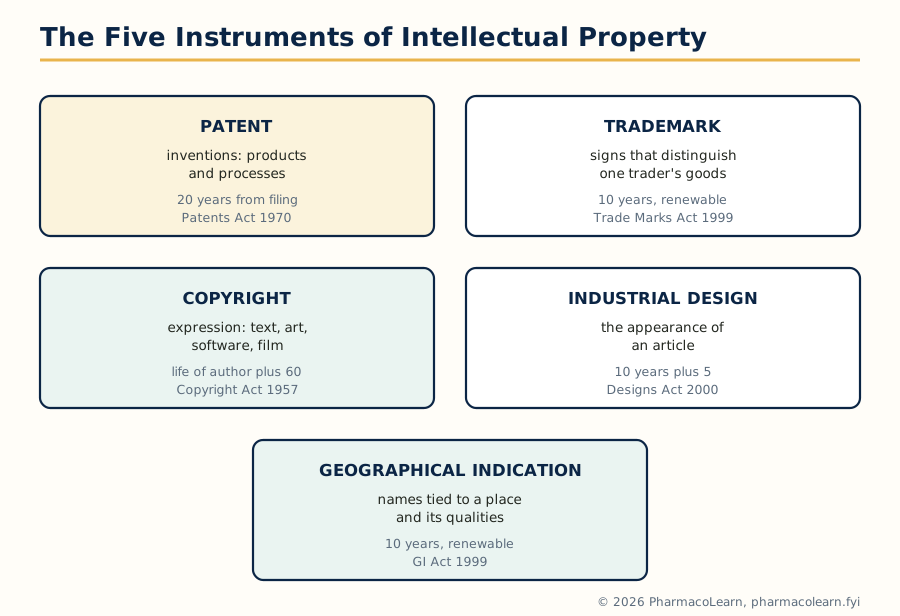 Figure: The five instruments of Unit 5: patent, trademark, copyright, industrial design and geographical indication, with the subject matter and term of each (Unit 5, section 5.1).
5.2 Patents: the Patents Act 1970 and the 2005 settlement
The governing statute is the Patents Act 1970, administered by the Indian Patent Office under the Controller General of Patents, Designs and Trade Marks, with offices at Kolkata (the head office), Delhi, Mumbai and Chennai. An invention is patentable if it is novel, involves an inventive step and is capable of industrial application, and is not excluded by the Act. The exclusions of Section 3 are the examinable heart of Indian patent law for this branch: methods of treatment and diagnostic methods are excluded; plants, animals and essentially biological processes are excluded; mere discoveries and new uses of known substances are excluded; and clause 3(d) excludes the mere discovery of a new form of a known substance which does not result in the enhancement of the known efficacy of that substance, with its explanation treating salts, polymorphs, isomers and other derivatives as the same substance unless they differ significantly in efficacy. The Supreme Court's 2013 judgment in the Novartis case, refusing a patent on the beta crystalline form of imatinib mesylate, made 3(d) the world's best known anti evergreening provision: a follow on form must show enhanced therapeutic efficacy to be an invention. The Act's modern shape is the work of the 2005 amendment, which completed India's TRIPS transition by restoring product patents for pharmaceuticals (suspended since 1970, when the original Act admitted only process patents for drugs, a design that built the Indian generics industry), closed the mailbox of applications filed during the transition, and strengthened the opposition system, with both pre grant and post grant opposition now available. The patent term is 20 years from the filing date, with maintenance by renewal fees; applications are published at 18 months and examined on request; and the state retains corrective powers, of which compulsory licensing, a licence granted to a third party against the patentee's will on grounds including public health need and unaffordable pricing (first exercised in 2012 for the anti cancer drug sorafenib), and government use, are the standard teaching examples.
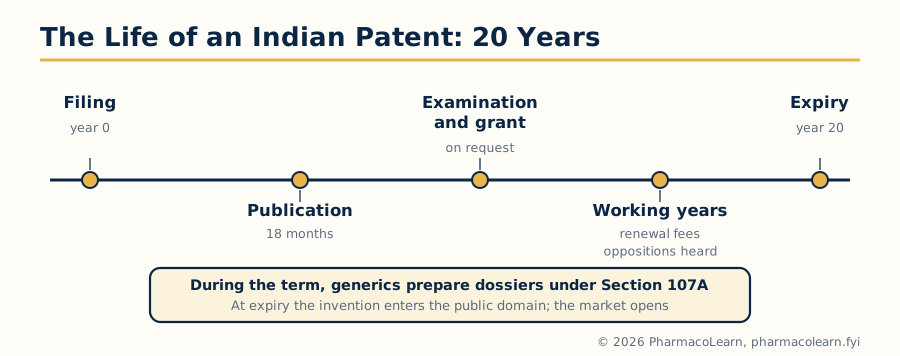 Figure: The life of an Indian patent: filing, publication at 18 months, examination and grant, working and renewal, expiry at 20 years and the opening of the market (Unit 5, section 5.2).
5.3 Trademarks
A trademark, governed by the Trade Marks Act 1999 and registered with the Trade Marks Registry, is a mark capable of graphical representation that distinguishes the goods of one undertaking from another's. Registration runs for 10 years and is renewable indefinitely in further 10 year periods, and the register is searched and opposed much as patents are. Pharmaceutical trademarks carry subject specific disciplines. The generic or international nonproprietary name (INN) of a drug cannot be monopolised, and a mark that appropriates an INN or its stem invites objection and rectification; brand names must also survive the licensing authority's scrutiny at the product permission stage, because two confusingly similar brand names for different medicines are a medication error hazard, and Indian courts and regulators alike have treated look alike and sound alike naming as a safety question, not merely a commercial one. After patent expiry the trademark is usually the originator asset that remains, which is why brand strategy, and the regulatory management of brand extensions and umbrella branding, belong to the regulatory timetable and not only to marketing.
5.4 Copyright
Copyright, under the Copyright Act 1957, protects original literary, dramatic, musical and artistic works, cinematograph films and sound recordings, and it subsists automatically on creation, registration being evidentiary only. Its term for literary works is the life of the author plus 60 years. In pharmaceutical practice copyright is the quiet instrument: it protects the text and artwork of packaging and patient information (never the information itself, for copyright guards expression, not facts or ideas), product literature and promotional material, clinical and regulatory documentation as text, photographs and illustrations, and computer software, which Indian law protects as a literary work and which therefore covers the submission and laboratory systems of MRA101T and MRA102T. Its regulatory relevance is mostly defensive: a generic entrant must write its own label text expression around the same mandatory content, a company's dossier templates and standard texts are its copyright assets, and plagiarism of an originator's distinctive artwork can found an action even where every patent has expired.
5.5 Industrial designs
The Designs Act 2000 protects the features of shape, configuration, pattern, ornament or composition of lines or colours applied to an article by an industrial process, judged solely by the eye; purely functional features and trademarks are outside it. Registration runs for 10 years from registration, extendable by a further 5 years. The pharmaceutical footprint is real but narrower than the other instruments: the shape and get up of inhalers, insulin pens and other drug delivery devices (a field where design, patent and trademark claims are routinely layered), distinctive tablet shapes and embossing where they are truly ornamental, blister and bottle forms, and packaging configurations. Design registration is fast and inexpensive compared with a patent, and in device and consumer health portfolios it is the standard first filing; its weakness is the subject matter limit, since a shape dictated by function cannot be kept from competitors by calling it a design.
5.6 Geographical indications
A geographical indication, under the Geographical Indications of Goods (Registration and Protection) Act 1999, identifies goods as originating in a territory, region or locality where a given quality, reputation or other characteristic is essentially attributable to that origin. Registration runs for 10 years, renewable, and the right belongs to an association of producers or an authority, not to a single proprietor: no individual may own Darjeeling tea. Pharmaceutical India meets GI at its herbal and traditional edge: origin named raw materials and regional products of the AYUSH and food sectors (the classic Indian registrations run from Darjeeling tea to regional spices, textiles and crafts) can trade on protected names, and a nutraceutical or Ayurvedic manufacturer sourcing a GI named ingredient takes both a marketing asset and a sourcing obligation. For examination purposes GI is the contrast case in the family: collective, renewable, tied to place, and incapable of assignment to an outsider in the way a patent or trademark can be sold.
| Instrument | Governing Act | Protects | Term | Registration needed |
|---|---|---|---|---|
| Patent | Patents Act 1970 | Inventions: products and processes | 20 years from filing | Yes |
| Trademark | Trade Marks Act 1999 | Signs distinguishing goods and services | 10 years, renewable indefinitely | Yes, for the statutory rights |
| Copyright | Copyright Act 1957 | Expression: text, art, software, film | Life of author plus 60 years (literary works) | No, subsists automatically |
| Industrial design | Designs Act 2000 | Appearance of an article | 10 years plus 5 on extension | Yes |
| Geographical indication | GI Act 1999 | Names tied to origin and quality | 10 years, renewable | Yes, by a producers' association |
5.7 The Indian patent scenario
The Indian patent scenario is the story of a system built twice. The 1970 Act, by admitting only process patents for drugs and shortening their term, deliberately made room for a domestic industry that learned to make every important medicine by an alternative route; by the 1990s that industry supplied a large share of the developing world's affordable medicines. TRIPS then required product patents, and the 2005 amendment delivered them with the safeguards this unit has met: Section 3(d) against evergreening, pre and post grant opposition, compulsory licensing, and a research and regulatory review exemption, so that India's settlement is accurately described as full TRIPS compliance engineered to preserve generic competition. The working indicators of the current scenario are qualitative but consistent: filings at the Indian Patent Office have grown year on year with a rising resident share, pharmaceutical and biotechnology applications form a significant and contested stream in which oppositions are a normal part of practice, Indian firms file aggressively abroad while challenging weak patents at home, and the Patent Rules have been repeatedly amended to compress timelines and digitise procedure. For the regulatory affairs student the scenario matters as market structure: the Indian launch question for any medicine is a joint question, what is its approval status under Units 1 to 4, and what is its patent status under this unit.
5.8 IPR versus Regulatory Affairs
The syllabus closes by setting the two disciplines against each other, and the working relationship has five fixed points. First, the approvals are independent: the drug regulator grants marketing authorization on quality, safety and efficacy and does not adjudicate patents; India operates no patent linkage, so a marketing approval can issue while a patent subsists, leaving enforcement to the patentee's civil action, and conversely a patent confers no right to market without approval. Second, data: India has no standalone data exclusivity statute; undisclosed test data receive the protection against unfair commercial use that TRIPS Article 39.3 requires, and the Indian system's answer in practice is the bioequivalence route, under which a generic proves sameness against the approved product rather than repeating its trials, which is why the BE machinery of Unit 4 is the hinge between the two disciplines. Third, the regulatory review exception: Section 107A of the Patents Act provides that acts of making, using or importing a patented invention solely for developing and submitting information required by a drug regulator, in India or abroad, are not infringement, the Bolar type provision that lets generics prepare their dossiers during the patent term and launch at expiry. Fourth, the expiry interface: launch planning runs off the patent calendar, oppositions and compulsory licence applications are regulatory events with commercial consequences, and the label, brand and pack (sections 5.3 and 5.4) are cleared as IP at the same table as they are approved as regulatory documents. Fifth, the public health overrides: compulsory licensing, government use and price control (section 1.7) are the state's standing reservations against both patent and market exclusivity. The professional conclusion is the semester's: regulatory affairs and IPR are two permissions for the same product, and a filing strategy that sequences only one of them will fail on the other.
The generic launch decision: two permissions, one calendar
Patent position (this unit)
   subsisting product patent? --yes--> wait, license, or challenge
        | no / expired / licensed                 (opposition, CL)
        v
Regulatory position (Units 1 to 4)
   approval route + BE data ready under s.107A shelter
        |
        v
Brand, label and pack cleared as IP (5.3, 5.4)
        |
        v
Launch at patent expiry with approval in hand
Frequently Asked Questions
Q: What is the difference between the Drugs and Cosmetics Act and the Drugs and Cosmetics Rules? The Act of 1940 states the law: definitions of drug and cosmetic, the quality offences of misbranded, adulterated and spurious drugs, the institutions and the licensing powers. The Rules of 1945 carry the operative detail made under the Act: licence forms and conditions, the schedules (M for GMP, G, H, H1 and X for sale control, C and C1 for biologicals) and the day to day procedures. The pair is always read together, and modern subjects such as clinical trials and medical devices now sit in newer rulebooks (NDCT Rules 2019, Medical Devices Rules 2017, Cosmetics Rules 2020) made under the same Act.
Q: Which authority approves a new drug in India, and who licenses its manufacture? Approval of a new drug, including permission for its clinical trials and its marketing authorization, is central, with the Central Licensing Authority in CDSCO, headed by the Drugs Controller General (India), under the New Drugs and Clinical Trials Rules 2019. Once the new drug is authorized, the manufacturing licence for the factory is issued by the State Licensing Authority of the state where the plant is located, after inspection against Schedule M. Sale and distribution licences are also state licences; import registration and licensing are central.
Q: What do Schedules G, H, H1 and X control? They control how medicines may be sold. Schedule G drugs must bear the caution that it is dangerous to take the preparation except under medical supervision. Schedule H drugs are prescription only, carrying the Rx symbol and the prescription warning. Schedule H1, added in 2013 for specified antibiotics, anti tuberculosis drugs and habit forming medicines, requires the retailer to maintain a separate record of the prescriber, patient and quantity, kept for three years. Schedule X covers narcotic and psychotropic substances, demanding a special licence and prescriptions in duplicate, and it works together with the NDPS Act 1985.
Q: How does price control work under the DPCO 2013? The Drugs (Prices Control) Order 2013, issued under the Essential Commodities Act 1955 and implemented by the National Pharmaceutical Pricing Authority (established 1997), fixes ceiling prices for scheduled formulations: the strengths and dosage forms of medicines in the National List of Essential Medicines. The ceiling is a market based figure, essentially the simple average price of brands holding at least one percent of the market, and no manufacturer may sell above it. Non scheduled formulations are not price fixed, but their prices may not rise by more than ten percent in a year.
Q: How are medical devices classified and licensed under the Medical Devices Rules 2017? Devices are classified by risk into Class A (low), Class B (low to moderate), Class C (moderate to high) and Class D (high). Since 2020 all medical devices are notified as drugs under the Drugs and Cosmetics Act and regulated under the 2017 Rules. The State Licensing Authority licenses manufacture of Class A and Class B devices (Class B after notified body audit of the quality system), while the Central Licensing Authority licenses Class C and Class D manufacture and all imports. Every obligation in the Rules, documentation, audit and clinical investigation, keys off the class.
Q: What is the difference between the drug route and the FSSAI route for a nutraceutical? The dividing line is the claim and the dose. A product presented to cure, treat or prevent disease is a drug and must be approved and licensed under the drug framework whatever it is called. A nutraceutical or health supplement is a food, licensed by FSSAI under the Food Safety and Standards Act 2006 and its health supplements and nutraceuticals regulations, may use only permitted ingredients within the prescribed limits, and may make only the claims those regulations allow. Nutraceutical manufacture requires a central FSSAI licence, and nutrients above the thresholds the drug rules specify are pulled into the drug framework.
Q: What is a BCS biowaiver? Under the Biopharmaceutics Classification System a drug substance is placed in one of four classes by solubility and permeability. For an immediate release generic of a Class I substance (high solubility, high permeability), and under tighter conditions Class III, regulators following the harmonised ICH M9 guideline accept in vitro dissolution comparison in place of an in vivo bioequivalence study: that substitution is the biowaiver. The statistical acceptance for an in vivo study that is run remains the 90 percent confidence interval for AUC and Cmax ratios lying within 80.00 to 125.00 percent.
Q: What is CPCSEA and what does its approval chain look like? CPCSEA is the Committee for the Purpose of Control and Supervision of Experiments on Animals, the statutory committee created under the Prevention of Cruelty to Animals Act 1960. An establishment that breeds experimental animals or performs experiments must register with CPCSEA, and within it the Institutional Animal Ethics Committee, which includes CPCSEA's nominees, must approve every protocol before the work begins and monitors the facility thereafter. The chain matters to drug approval because animal data generated outside it cannot properly support a regulatory filing.
Q: What does Section 3(d) of the Patents Act do? Section 3(d) excludes from patentability the mere discovery of a new form of a known substance that does not result in enhancement of the known efficacy of that substance, and its explanation treats salts, polymorphs, isomers, metabolites and other derivatives as the same substance unless they differ significantly in properties with regard to efficacy. In the Novartis judgment of 2013 the Supreme Court read efficacy for a medicine as therapeutic efficacy and refused the patent on the beta crystalline form of imatinib mesylate. The clause is India's statutory answer to evergreening: a new form must be a better medicine, not merely a newer filing.
Q: Is there patent linkage or data exclusivity in India? No to both, in the statutory sense. India operates no patent linkage: CDSCO and the state authorities grant approvals on quality, safety and efficacy and do not check or enforce patent status, leaving infringement to the civil courts. And India has no standalone data exclusivity law: undisclosed data are protected against unfair commercial use on the TRIPS Article 39.3 pattern, while generic applicants establish their case by bioequivalence against the approved product (Unit 4) and may prepare their dossiers during the patent term under the regulatory review exception in Section 107A of the Patents Act.
Complete MRA104T notes, all 5 units in one PDF, free to keep.
Other M.Pharm subjects: MPH101T · MPC101T · MPL101T · MPH102T · MPH103T · MPH104T · MPL102T · MPL103T · MPL104T · MPC102T · MPC103T · MPC104T · MPH201T · MPH202T · MPH203T · MPH204T · MPC201T · MPC202T · MPC203T · MPC204T · MPL201T · MPL202T · MPL203T · MPL204T · MRA101T · MRA102T · MRA103T · MRA104T · MRM301T · MPG101T · MPG102T · MPG103T · MPG201T · MPG202T · MPG203T · MPG104T · MPG204T · MRA201T · MRA202T · MRA203T · MRA204T · M.Pharm