
MRA102T — Documentation and Regulatory Writing
4 hrs/week, 4 credits, 60 hours, 100 marks. Notes follow the M.Pharm syllabus, unit by unit.
MRA102T Documentation and Regulatory Writing notes for M.Pharm Semester 1: industry documentation from EPDB and BMR to DMF, CTD and eCTD dossiers, ESG and SUGAM submissions, audits, inspections, CAPA and post approval changes. Free unit wise PDF downloads on PharmacoLearn.
Units in this subject
- Unit 1 — Documentation in Pharmaceutical Industry
- Unit 2 — Dossier Preparation and Submission
- Unit 3 — Audits
- Unit 4 — Inspections
- Unit 5 — Product Life Cycle Management
Download MRA102T PDF Notes
Free PDFs for this subject, one per unit:
Documentation and Regulatory Writing, subject code MRA102T, is the second core subject of M.Pharm Regulatory Affairs, Semester 1. It carries 4 credits and 60 hours of theory, taught at 4 hours per week, for 100 marks. Where MRA101T taught the good practices that govern the work, this subject teaches the paper the work leaves behind: the documents of the pharmaceutical industry, the dossier that carries them to a regulator, and the audits, inspections and lifecycle filings that test and maintain them for the whole life of a product.
The course is designed to impart fundamental knowledge on documentation and general principles involved in regulatory writing and submission to agencies. Its objectives run in the order of the units: to know the various documents pertaining to drugs in the pharmaceutical industry; to understand the basics of regulatory compilation; to create and assemble the submission as per the requirements of agencies; and to follow up the submissions and post approval document requirements. Unit 1 works through the industry's own documents, from the exploratory brief that opens a development project to the certificate that releases a batch. Unit 2 builds the dossier and sends it, in paper, in electronic CTD, in the regional variants and through India's SUGAM portal. Unit 3 turns to audits, the industry's own checking instrument, and Unit 4 to inspections, the regulator's. Unit 5 closes the loop with product life cycle management: the supplements and reports that keep an approval lawful as the product changes, and the enforcement that follows when the documents do not match the facts. A student who masters this subject can write, compile, audit and defend the written record of a medicine from first brief to final annual report.
Unit 1: Documentation in Pharmaceutical Industry
1.1 Documentation: the evidence system of the industry
Every other subject of this branch runs on documents, and Unit 1 is where the documents themselves are studied. A pharmaceutical document is not paperwork in the dismissive sense: it is the evidence that a medicine was designed, made, tested and released as the registration promised, and the industry's working rule, met already in MRA101T, is that if it is not recorded, it was not done. Documentation divides by function. Product development documents (the exploratory brief, plan and report of section 1.2) show why the product is what it is. Master documents (the master formula record of section 1.3) state how it must always be made. Execution records (batch records, sections 1.4 to 1.6) show how this batch actually was made. Output documents (the certificate of analysis, distribution records, sections 1.7 and 1.8) state what the batch proved to be and where it went. Standing reference documents (the site master file, section 1.9) describe the site itself, and confidential reference files (the drug master file, section 1.10) let a supplier place its secrets with the regulator and no one else.
Behind all of them sits good documentation practice: entries made at the time of the activity, legible, indelible, attributable to a named person, and corrected by single line strike through with initials and date so the original remains readable. The modern statement of these expectations is the ALCOA set (attributable, legible, contemporaneous, original, accurate), extended as ALCOA plus by completeness, consistency, endurance and availability. Regulatory writing, the second half of this subject's title, is the craft of producing such documents for a regulator's reading: precise about what was done and found, economical, consistent in terminology, and honest about limitations, because every sentence of a submission may one day be read back to its author in an inspection or a court.
1.2 The development chain: EPDB, PDP and PDR
Development begins with a brief, not a batch. The Exploratory Product Development Brief (EPDB) is the short document that opens a product development project, and the syllabus's first examinable point is that it is written twice, once for the drug substance and once for the drug product, because the two raise different questions. The drug substance EPDB sets out the molecule or active ingredient to be developed: its identity and source (synthetic route, fermentation or extraction), the target quality profile of the substance, known chemistry and stability risks, likely impurity and polymorph questions, scale and equipment needs, and the markets whose pharmacopoeias it must satisfy. The drug product EPDB sets out the medicine to be built around it: the proposed dosage form, strength and pack, the target product profile in clinical terms (indication, population, dosing), the intended markets and their format expectations, the competitive frame, and the development risks the project must retire first. An EPDB is a decision document: management reads it to give or refuse the go ahead, so it is short, factual and explicit about uncertainty, the first exercise in regulatory writing a student meets.
Given the go ahead, the Product Development Plan (PDP) converts the brief into a programme. Where the EPDB asks whether and why, the PDP states what, who, when and at what cost: the development tasks (preformulation, formulation development, analytical method development and validation, stability programme, scale up and technology transfer), their sequence and milestones, the responsible functions, the materials and equipment required, and the documentation each task must produce. The plan is a controlled document in its own right, revised as results arrive, and the timetable it sets is what later registration timelines are built on.
The Product Development Report (PDR) closes the chain by recording what was actually done and found. Written in the logic of ICH Q8 pharmaceutical development, it assembles the quality target product profile, the critical quality attributes of the product, the risk assessments that selected the formulation and process, the experiments (often designed statistically) that explored them, the design space if one is claimed, and the control strategy that manufacturing will inherit. The PDR is the ancestor of Module 3 of the dossier in Unit 2 and of the master formula record that follows here: development explains, in the PDR, exactly what production will be ordered to repeat, in the MFR.
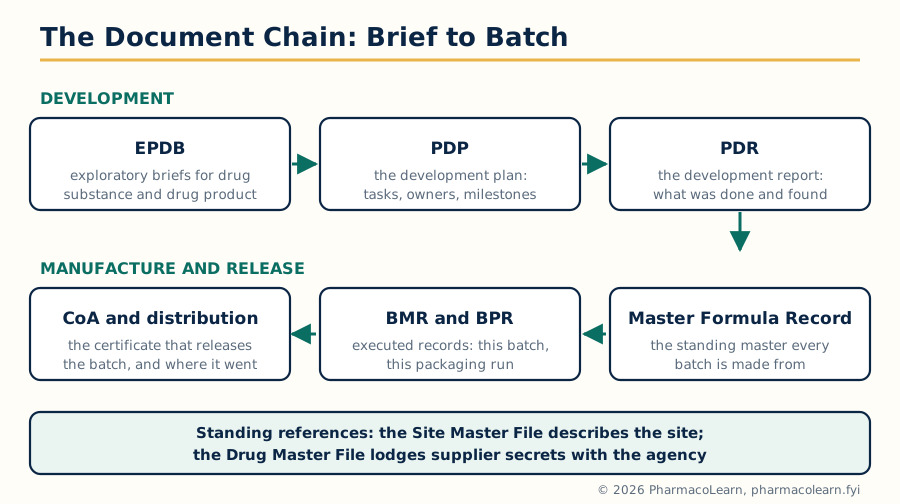 Figure: The document chain of Unit 1: the exploratory briefs open the project, the plan programmes it, the report records it, and the master record converts it into standing instructions that each batch record then executes and evidences.
How a number travels through the documentation system
  Development finding (PDR): this blend needs 30 minutes of mixing
        -> Standing instruction (MFR): mix for 30 minutes, record start and stop
        -> Execution evidence (BMR): mixed 10:05 to 10:35, operator signed
        -> Test evidence (CoA): blend uniformity within specification
        -> Release and shipment (distribution record): batch to named consignee
1.3 The Master Formula Record: the standing order
The Master Formula Record (MFR), called the master production record in the United States system (the master production and control records of 21 CFR 211 Subpart J, met in MRA101T), is the approved master document from which every batch of a product is made. It is written once, by development and production together, approved by quality, and changed only through change control. A complete MFR states: the product name, strength and dosage form; the master formula, the quantity of every ingredient for the standard batch size, including any calculated overages and their justification; the master process, step by step manufacturing and in-process control instructions with equipment, parameters and limits; the packaging instructions or a reference to them; the in-process and finished product specifications the batch must meet; and the yield limits within which the batch is expected to fall. Two disciplines make the MFR work. It describes exactly one batch size and one process, so that no operator ever scales or improvises on the floor; and every batch record issued for manufacture is a faithful copy of it, generated under control, so that a deviation can always be read as a departure from a known master. The MFR is the point where regulatory writing becomes manufacturing law inside the company.
1.4 The Batch Manufacturing Record and its calculations
The Batch Manufacturing Record (BMR), or batch production record, is the executed copy of the MFR for one batch. Issued by quality or production control with a unique batch number before manufacture begins, it travels with the batch, and every instruction in it is answered, contemporaneously, by an entry: the actual quantity weighed, the equipment actually used, the times actually started and stopped, the in-process results actually obtained, each entry signed by the operator who did the work and checked by a second named person for the critical steps. The completed BMR, reviewed and approved by quality, is the primary evidence on which the batch is released, and the document an inspector reads first when a batch is questioned years later.
The syllabus names the BMR's calculations expressly, and they are the record's arithmetic spine:
The three calculations every BMR carries
  1. Quantity adjustment for potency:
     quantity to weigh = (batch size x label claim x 100) / assay percent
     (so a substance assaying at 98.4 percent on as-is basis is weighed
     proportionally higher, and the arithmetic is shown, not buried)
  2. Percentage yield at each stage and at the end:
     percent yield = (actual quantity obtained / theoretical quantity) x 100
     worked example: theoretical 50.0 kg, obtained 48.6 kg, yield 97.2 percent
  3. Reconciliation of every controlled material (next section)
Each calculation is performed by one person and independently verified by a second, whose signature is part of the record; a BMR whose arithmetic is wrong is a defective record even when the batch is perfect, because the next reader cannot tell the two situations apart.
1.5 Batch reconciliation
Batch reconciliation is the accounting that closes a batch's material balance: for every controlled input, the quantity issued must equal the quantity used, plus the quantity returned, plus the quantity destroyed as waste or samples, within defined limits. It is applied most strictly to the items where a gap hurts: printed packaging materials and labels (section 1.6), where accountability approaches 100 percent and any unexplained difference must be investigated before release, because a stray label is a future mislabelled pack; and to the bulk product itself, where the reconciliation of tablets or litres filled against bulk manufactured exposes loss, diversion or mix up. The yield of section 1.4 and the reconciliation of this section are the same instinct at two scales: a batch whose numbers do not add up is not yet a releasable batch, whatever its test results say. Reconciliation failures are investigated and recorded in the batch record itself, and the investigation, not merely the outcome, is what auditors and inspectors read.
1.6 Batch Packaging Records and print pack specifications
Packaging has its own record because packaging errors, above all wrong labels, are the industry's classic recall trigger. The Batch Packaging Record (BPR) is issued with the batch like the BMR and executed step by step: line clearance before start (the formal check, recorded, that the line is empty of the previous product and its materials), the labels and printed materials issued, counted and coded (batch number, manufacturing and expiry dates printed or embossed), the quantities packed by format, the samples taken for retention and checking, the reconciliation of all printed materials, and the destruction of unused coded materials. Attached to it are the print pack specifications: the controlled specification of everything printed that reaches the pack, the label and carton text, pack leaflet, colours and their tolerances, barcode and pharmacode, Braille where a market requires it, and the approved artwork version. Printed matter is treated as a controlled component, issued against the specification, counted like a drug, and never left on a line overnight: the discipline of this section is the reason a patient in any country can trust that the name on the box is the medicine inside it.
1.7 Distribution records
The record system does not end at the factory gate. Distribution records capture, for each batch, what was shipped, in what quantity, on what date, and to which consignee, in enough detail that the manufacturer can identify and reach every first recipient of every batch within hours. Their purpose is singular and serious: they are the working tool of the recall of Unit 5, and the measure of a recall's competence is whether the distribution records can answer, completely and quickly, the question "where did every unit of this batch go?" Distribution records also evidence the chain of custody that good distribution practice (MRA101T, Unit 4) requires: a shipment that cannot be traced is a shipment whose storage and handling cannot be vouched for, and in falsified medicine investigations the distribution record is frequently the document that separates genuine product from intrusion.
1.8 The Certificate of Analysis: the batch's report card
The Certificate of Analysis (CoA) is the formal document that states a batch was tested and met its specification. Issued per batch of drug substance or drug product (and for materials supplied between companies, where the buyer's quality unit relies on it wholly or in part), a proper CoA carries: the product name and material code; the batch number and manufacturing and expiry dates; the name and address of the manufacturing site; the specification reference and version; each test performed with its limit and its actual result (results, not the bare word "complies", for the tests that carry numbers); the date of analysis; and the signature of the authorised quality person who certifies it. Two writing rules matter for examination answers. A CoA certifies a batch, not a product in general: a certificate borrowed across batches is a falsified document. And the certificate summarises the laboratory's records; it never replaces them, so a CoA that cannot be traced back to raw data in the issuing laboratory fails the data integrity standard of section 1.1. Between companies, the CoA is also a legal instrument: contracts and quality agreements state what it must contain, and regulators hold the receiving company responsible for verifying supplier certificates rather than merely filing them.
1.9 The Site Master File: the site describes itself
The Site Master File (SMF) is a document prepared by the manufacturer that describes the site itself: its organisation, activities and quality system, in a standard format an inspector can read before arrival. Its structure follows the PIC/S guide (PE 008) used internationally: general information on the site and its licensed activities; quality management system; personnel and their qualifications; premises and equipment; documentation; production; quality control; distribution, complaints and recalls; and self inspections, with appendices of products, licences and certificates. The SMF is deliberately factual rather than argumentative: it is the site's official self description, kept current, supplied to regulators on request and used during licensing and inspection planning. Its regulatory writing lesson is discipline: because the SMF is read against the physical site during inspection, every sentence in it must be literally true on the day it is read, which is why it is version controlled like a dossier document and updated when anything it describes changes.
1.10 Drug Master Files: secrets lodged with the regulator
The Drug Master File (DMF) solves a commercial dilemma: a drug substance or excipient maker must let the regulator read its confidential manufacturing detail, but cannot hand that detail to every customer who buys its material. The DMF is a file submitted by the holder directly to the agency, which the customer's application then references by number under a letter of authorization from the holder: the agency reads everything, the customer reads nothing confidential, and the approval of the customer's product rests on data its maker never saw. The United States system classifies DMFs by subject:
| DMF type | Subject |
|---|---|
| Type I | Manufacturing site, facilities, operating procedures and personnel |
| Type II | Drug substance, drug substance intermediate, and material used in their preparation, or drug product |
| Type III | Packaging material |
| Type IV | Excipient, colorant, flavor, essence, or material used in their preparation |
| Type V | FDA accepted reference information |
Type II is the workhorse, the file behind most generic applications. Two standard notes complete the picture honestly: FDA no longer accepts new Type I DMFs (that site information is expected in the application itself), and a DMF is never approved or disapproved on its own: it is reviewed only in the context of an application that references it, and deficiencies are communicated to the holder, who amends the file, while the customer's application waits. The European system reaches the same end by the Active Substance Master File (ASMF) procedure, which splits the file into an open part the applicant sees and a closed part it does not, and India relies principally on the dossier itself and, for substances covered by the European Pharmacopoeia, the Certificate of Suitability (CEP). The DMF family, in whatever regional costume, is documentation's most elegant idea: confidentiality preserved, review uncompromised.
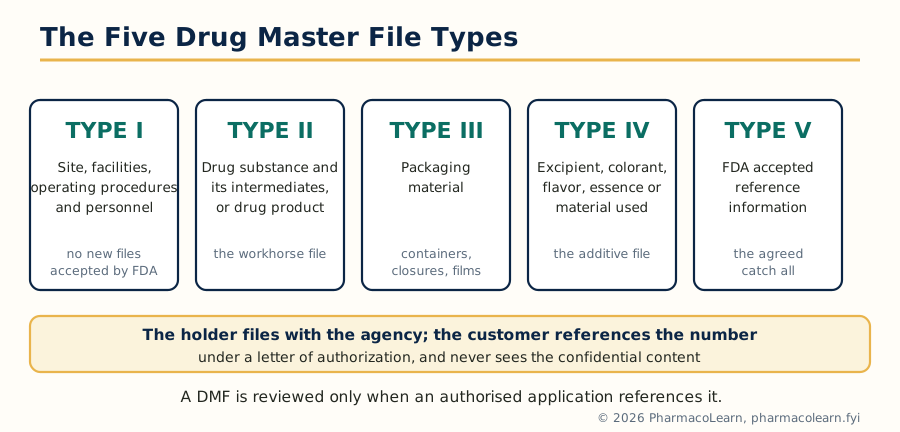 Figure: The five DMF types by subject matter. Type II, the drug substance file, supports the largest number of applications; the file is reviewed only when an authorised application references it.
Unit 2: Dossier Preparation and Submission
2.1 What a dossier is
A dossier is the assembled body of information a company submits to a regulatory authority to obtain and keep a permission: to test a drug in humans, to market it, to change it. Unit 1's documents are its raw material: the development report becomes the development sections, the master formula record stands behind the manufacturing description, the certificates and stability reports become the quality evidence. The dossier differs from the factory's document system in one way: it is written for an external reader with legal power, an assessor who will decide from the paper alone, who does not know the company, and who reads with structured scepticism. Everything in this unit, organisation, format, electronics, validation, serves that reader. The dossier's life also mirrors the product's: an investigational dossier opens development, a marketing dossier wins approval, and the supplements and reports of Unit 5 maintain it until withdrawal: the submission is a lifecycle, not an event, and regulatory writing is written for re-reading across decades.
2.2 Contents and organisation: binders and sections
Before format harmonisation, each authority prescribed its own dossier architecture, and the physical object was formidable: volumes of paper organised in binders, each binder a section of the application, tabbed, paginated and indexed by a master table of contents. Even today the intellectual structure the paper era imposed remains the skeleton of every format in this unit, and examinations still ask it plainly: a dossier is organised in sections by discipline, administrative information first (application forms, licences, certificates, labelling), then the summaries by which an assessor orients, then the three evidence bodies in their standard order, quality (chemistry, manufacturing and controls), nonclinical (pharmacology and toxicology), and clinical (the human studies), each section self contained, cross referenced rather than duplicated, and every claim in a summary traceable to data in a report. Compilation discipline, the order of volumes, the numbering of sections, the pagination and indexing, was the paper era's quality system for reviewability; the electronic formats of sections 2.5 onward automate exactly these virtues.
2.3 Compilation and review of the dossier
Compilation is the assembly of authored documents into a submission that satisfies a specific agency's format and content requirements for a specific application and market. Its working instruments are the submission outline (the target structure, module by module, with an owner and a status for every document), the gap analysis (what exists, what is missing, what is outdated, against the requirement list), and staged review: scientific review of the content by its authors and functions, regulatory review of format, consistency and cross referencing, and quality review of the finished assembly before it is released for transmission. The classic compilation failures are documentary, not scientific: a summary that quotes a study the report contradicts, a specification that differs between the quality summary and the method document, a study filed in the wrong module, a labelling text that does not match the approved wording. The review function exists because an agency's first deficiency letter is usually written out of exactly such inconsistencies, and each one costs the applicant a review cycle. Regulatory writing, in the compilation sense, is therefore an editorial discipline as much as a scientific one: one terminology, one set of numbers, one story, told identically in every module.
2.4 The Common Technical Document: overview and modules
The Common Technical Document (CTD) is the ICH harmonised format for a marketing application, defined by the ICH M4 guideline family, and it is the centre of gravity of modern regulatory writing. One set of technical content, in one organisation, is accepted in substance by the ICH regions and most of the world, so the company writes once and adapts the regional module, instead of rewriting the whole dossier per country. The CTD has five modules:
| Module | Content | Notes |
|---|---|---|
| Module 1 | Regional administrative information and prescribing information | Not harmonised: forms, fees, labelling, certificates; differs by region |
| Module 2 | Summaries and overviews | 2.3 Quality Overall Summary; 2.4 Nonclinical Overview; 2.5 Clinical Overview; 2.6 Nonclinical Summaries; 2.7 Clinical Summaries |
| Module 3 | Quality | 3.2.S drug substance; 3.2.P drug product; manufacture, characterisation, control, stability |
| Module 4 | Nonclinical study reports | 4.2 study reports: pharmacology, pharmacokinetics, toxicology |
| Module 5 | Clinical study reports | 5.3 study reports and their data, written and structured around ICH E3 clinical study reports |
Three reading rules reward memorisation. Modules 2 to 5 are the harmonised core; Module 1 is regional, the reason the same dossier still wears a different front cover in each market. Inside Module 2, the overviews (2.4, 2.5) are critical assessments written by experts, argument, not summary, while the summaries (2.6, 2.7) and the Quality Overall Summary (2.3) are factual compressions of Modules 4, 5 and 3 respectively. And the CTD is an organisation of content, not itself an electronic format: the same CTD content is what paper, eCTD, NeeS and ACTD all carry, each in its own mechanics, which is why this unit teaches the CTD before its electronic forms.
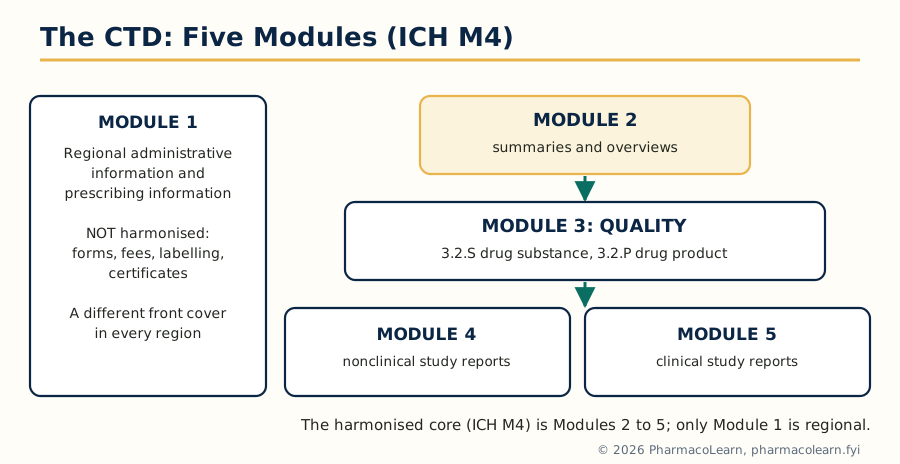 Figure: The CTD structure of ICH M4. Module 2, the summaries, sits above the three evidence modules like the apex of the classical CTD triangle; Module 1 stands apart as the regional administrative layer.
The CTD by the numbers (the structure an examiner expects)
  Module 1 : regional, not harmonised (forms, labelling, certificates)
  Module 2 : summaries - 2.3 quality, 2.4/2.6 nonclinical, 2.5/2.7 clinical
  Module 3 : quality - 3.2.S substance, 3.2.P product
  Module 4 : nonclinical reports - 4.2 by study type
  Module 5 : clinical reports - 5.3 by study, CSR built to ICH E3
2.5 Paper submissions
The paper submission, bound volumes shipped to the agency, is the original form of the dossier and is retained in this syllabus because parts of the world, and parts of India's system, still run on it or on scanned paper logic. Its rules are physical: prescribed copies, prescribed paper and binding, signed original forms, a covering letter identifying the application and its contents, and a master index against which the agency checks receipt. Paper teaches two transferable lessons. The first is that the submission is a manufactured object with its own quality control: collation, pagination and completeness checks are batch records for a dossier. The second is why electronics won: paper cannot be searched, cross referenced automatically, amended cleanly or shared between an agency's offices, and a lifecycle of paper supplements degrades into archaeology. Agencies have accordingly moved market by market to mandatory electronic submission, the subject of the next sections, but the paper discipline of order, indexing and check listing survives inside every electronic standard.
2.6 The electronic CTD: structure and lifecycle
The electronic CTD (eCTD) is the electronic form of the CTD, specified by the ICH M2 expert working group as the standard for transferring regulatory information from industry to agency. The content is the CTD's; the machinery is new. An eCTD submission is a sequence: a numbered transmission (0000, 0001, 0002 and onward) that carries, for one application, the documents added or changed since the last transmission, organised in the CTD folder structure. Its working parts are: files in prescribed formats (predominantly PDF for documents, with defined datasets for study data); a folder tree mirroring the modules; an XML backbone, the file index.xml, which lists every document in the sequence, its location, its checksum and its lifecycle operation; and checksums (the MD5 file) by which the receiving system proves nothing was corrupted in transit. The lifecycle operation is the eCTD's intellectual core: each document in a new sequence is marked new, append, replace or delete against the document it succeeds, so the agency's viewer can reconstruct the current, cumulative state of the whole application from the stack of sequences. Regulatory writing changes character here: granularity (how finely documents are split into files) follows the M4 granularity guidance, headings follow the backbone's fixed table of contents, and a misfiled document is no longer merely untidy but structurally wrong.
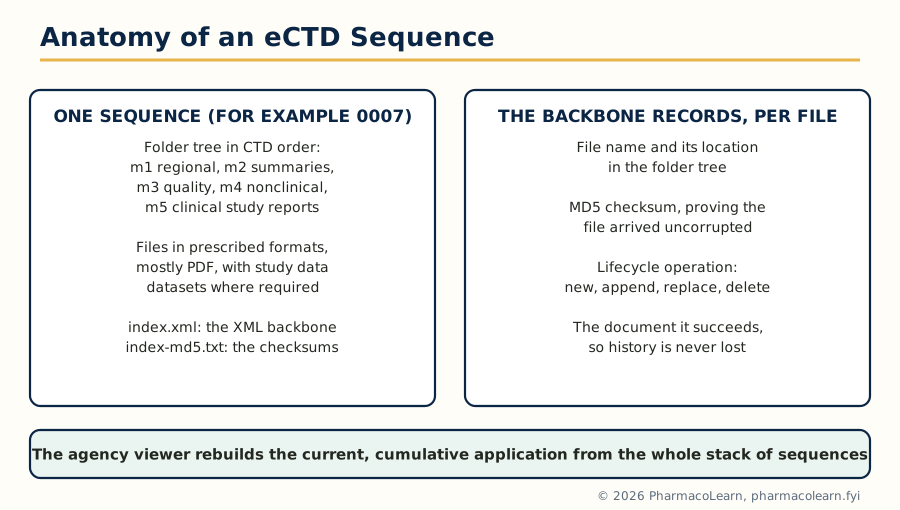 Figure: One eCTD sequence: a folder tree in CTD order, an XML backbone that indexes every file with its lifecycle operation, and checksums that prove the transmission intact.
2.7 Planning, requirements and the submission process
Because an eCTD is built by software, it is planned like a manufacturing process. Electronic submission planning begins with the publishing plan: which application, which sequence, which documents, authored to which templates and granularity, by whom and by when, and which regional requirements apply, for the module 1 content, file formats, and validation criteria differ by agency under the shared ICH standard (these agency specifications are the regulatory bindings the syllabus names: the regional rules that bind the harmonised format to a particular authority's systems). The tools and technologies are the publishing toolchain: document authoring and template systems, the eCTD publishing software that builds sequences and backbones, validators that test the build against the agency's technical criteria, and the transmission channel. The submission process then runs in a fixed rhythm: authoring and review of documents (section 2.3), publishing into a sequence, technical validation of the sequence (next section), transmission through the agency's gateway, receipt of the agency's acknowledgements, and archival of the exact transmitted package as the company's record of what the agency holds. Planning failures are as documentary as compilation failures: a sequence built against the wrong regional specification is a technically perfect submission to a door that cannot open.
2.8 Validation of the submission, and the Electronic Submissions Gateway
Validating the submission is the formal technical check that an electronic submission can be loaded, navigated and read by the agency's systems. It is done twice: by the applicant before transmission, with validator software applying the agency's published validation criteria (file formats and sizes, backbone integrity, checksum agreement, folder and naming rules, lifecycle references that resolve), and by the agency on receipt, where failure is a technical rejection: the submission is refused without scientific review, and the review clock never starts. The distinction examiners want is between technical validation (is the package well formed) and scientific assessment (is the product approvable): validation guards the door of the second. In the United States, transmission runs through the FDA Electronic Submissions Gateway (ESG), the agency's single receiving system for electronic regulatory submissions, for which companies hold registered accounts and digital certificates; the gateway issues a staged series of acknowledgements as the package is received by the gateway, delivered onward, and accepted by the reviewing centre, so the sender can prove, timestamp by timestamp, that the agency has its submission. Other regions run their own gateways and portals to the same design; the concept, one controlled door with receipts, is universal.
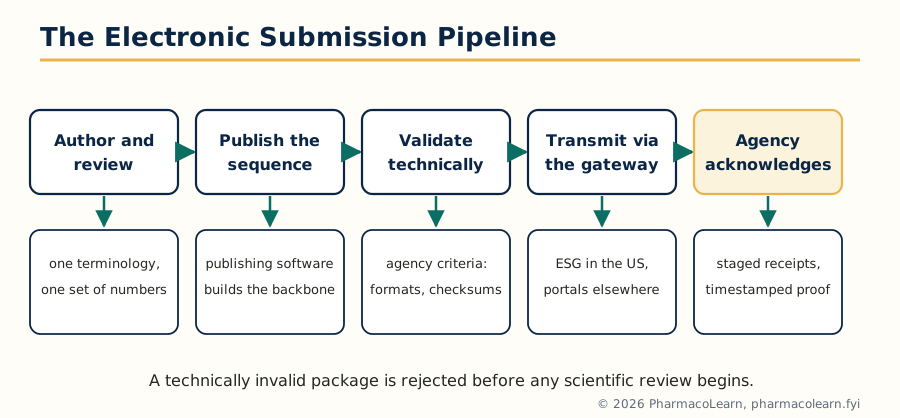 Figure: The submission pipeline of sections 2.3 to 2.8: authoring and review, publishing, technical validation, transmission through the gateway, and the agency's acknowledgements.
2.9 Non eCTD electronic submissions: NeeS
Between paper and eCTD stands NeeS, Non eCTD electronic Submissions: a dossier on electronic media (historically CD or DVD, now file transfer) in which the CTD folder structure and PDF documents are supplied without the XML backbone. Navigation is provided instead by hyperlinked tables of contents within the PDFs. NeeS was the European stepping stone format, accepted for national and some mutual recognition submissions while eCTD publishing capacity was scarce, and it survives where agencies permit it for smaller applications. Its teaching value is the contrast it sharpens: without a backbone there is no automated lifecycle management, no machine validation of structure, and no cumulative view across sequences, only a well organised set of documents; NeeS is the dossier as library, eCTD is the dossier as database. A regulatory writer must know which format a given market and procedure actually accepts today, for the same content, because filing NeeS where eCTD is mandatory is a technical rejection, and building eCTD where a simple format suffices is wasted effort.
2.10 The ASEAN CTD: ACTD
The ASEAN Common Technical Dossier (ACTD) is the regional format of the Association of Southeast Asian Nations, the format in which the ASEAN markets harmonised their applications on the CTD model with a structure of their own. The ACTD organises the same evidence in four parts: Part I, administrative data and product information (the regional front matter, like CTD Module 1); Part II, quality, carrying a quality overall summary with the quality documents; Part III, nonclinical, carrying the overview with the study reports; and Part IV, clinical, on the same pattern. The mapping onto the CTD modules is close enough that a company with a CTD core can republish into ACTD, which is precisely the regional design intent: harmonisation inside the bloc, convertibility outside it. For an Indian exporter, the ACTD matters practically, because the ASEAN markets are core destinations for Indian products, and the regulatory writer's craft includes knowing that the dossier family of this unit (CTD, eCTD, NeeS, ACTD, and India's own portal below) is one content in several bindings, and matching the binding to the market is a professional decision, not a clerical one.
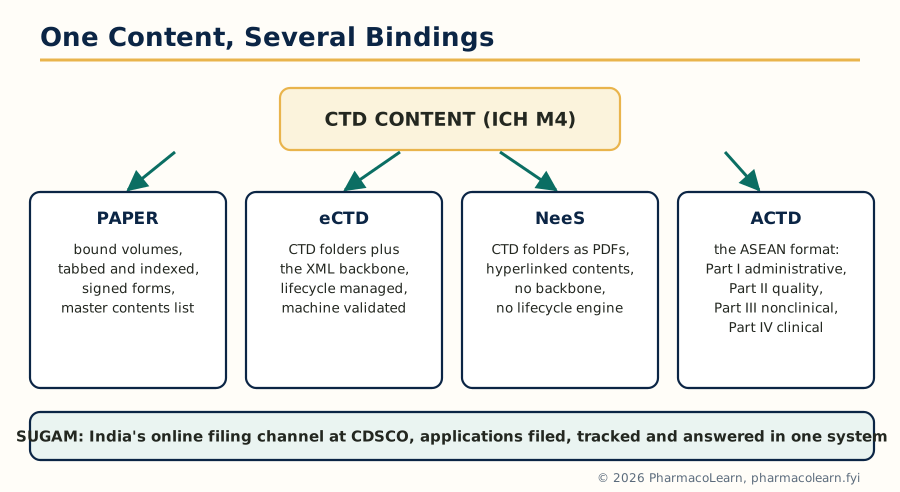 Figure: The format family of Unit 2. CTD content is carried in paper, in eCTD with its XML backbone, in NeeS without one, and in the ASEAN four part arrangement; SUGAM is India's online filing channel.
2.11 Submission in the SUGAM system of CDSCO
India's filing channel is SUGAM, the online portal of the Central Drugs Standard Control Organization (CDSCO), through which applications for licences, registrations, permissions and approvals within CDSCO's remit are filed, tracked and answered. In the portal's logic, the applicant registers the organisation and users, selects the application type (for example import registration and licences, manufacturing related central approvals, clinical trial and bioequivalence permissions, and the filings that accompany them), completes the structured online forms, uploads the dossier documents in the prescribed arrangement (India's submissions follow the CTD pattern, with the country's own administrative requirements in front), pays the fee electronically, and then follows the application through queries and approvals inside the same system, with the authority's questions and the applicant's responses recorded against the file. SUGAM's significance for this subject is that it makes the Indian dossier a tracked electronic lifecycle rather than a paper file in a registry: the regulatory writer in India works in SUGAM as the American writer works in the ESG, and the virtues are the same, completeness at filing, validation before transmission, and an auditable trail of everything submitted and everything asked.
Unit 3: Audits
3.1 What an audit is
An audit, in the standard definition of ISO 19011 adopted across the quality world, is a systematic, independent and documented process for obtaining objective evidence and evaluating it objectively, to determine the extent to which audit criteria are fulfilled. Every word in the definition carries weight in an examination answer. Systematic: planned against a programme and a checklist, not wandering. Independent: the auditor does not audit his or her own work. Documented: the audit leaves a report and records, and is itself a piece of documentation of the kind Unit 1 teaches. Objective evidence: verifiable facts, records, statements and observations, not impressions. Audit criteria: the standard against which evidence is judged, a law, a GMP guide, a registered dossier, an SOP, a contract. The audit's product is a set of findings, graded by seriousness, and its purpose is improvement and assurance, not blame: an audit that produces only comfort has failed, and one that produces only fear will be fed no evidence next time.
3.2 The parties of an audit: first, second and third
Audits are classified first by who stands on each side of the table, and the syllabus names each party in turn:
| Audit party | Who audits whom | Typical use |
|---|---|---|
| First party (internal audit) | An organisation audits itself, by its own or contracted auditors independent of the activity | Self inspection under GMP; the audit programme of section 3.4 |
| Second party | One organisation audits another it has a direct interest in, classically a customer auditing a supplier, or a company auditing its contract manufacturer or laboratory | Supplier qualification, contract giver audits under GMP contract rules |
| Third party (external) | An independent body with no commercial interest in the outcome audits for certification or regulatory purposes | Certification audits to ISO standards by accredited bodies; audits by or for authorities |
The internal audit (first party) is the GMP self inspection of MRA101T in its formal dress: required by the GMP texts themselves, it examines all parts of the quality system on a planned cycle. Second party audits externalise the same instrument along the supply chain: because GMP holds the contract giver responsible for the contract acceptor's work, supplier and contractor audits are a duty, not a courtesy, and their reports are documents a regulator will ask to see. External third party audits carry the certificate market: an accredited certification body's audit against a standard such as ISO 9001 or ISO 13485 (section 3.8), whose certificate other parties rely on. Beside the party classification stand classifications by object, system audits (the whole quality system), process audits (one process end to end) and product audits (conformance of a product and its file), and by notice, announced and unannounced; the mature programme mixes all of them deliberately.
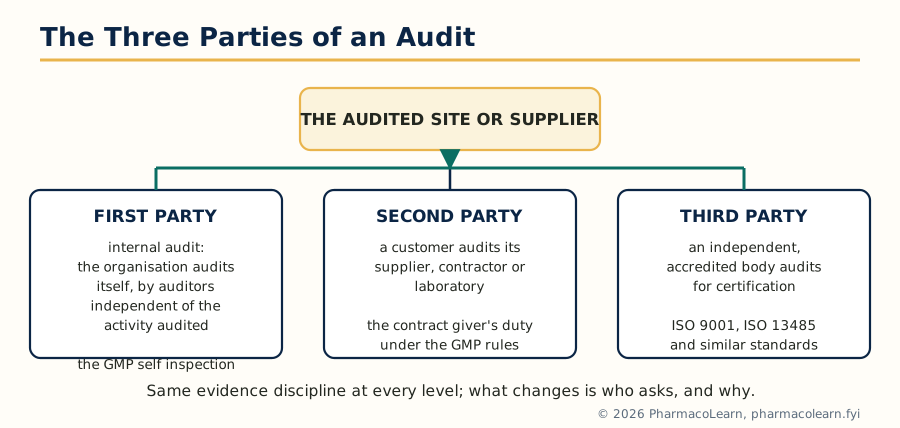 Figure: First party audits look inward, second party audits look along the supply chain, third party audits stand outside both, independent and accredited.
3.3 The GMP compliance audit
The GMP compliance audit is the audit aimed specifically at the GMP criteria: does this site, system or supplier actually operate as the GMP guide and its own registered commitments require? Its scope is the GMP map of MRA101T, organisation and personnel, premises and equipment, documentation, production, quality control, validation, distribution, complaints and self inspection, checked against the applicable GMP text (Parts 210 and 211, the EU Guide, WHO GMP or Schedule M, as the audit's purpose requires). Compliance auditing has a literature of its own, Ginsbury and Bismuth's Compliance Auditing for Pharmaceutical Manufacturers heads this subject's reference list, and its professional habit is worth naming: the compliance auditor tests the system against its claims, sampling records for the story they tell about everyday practice, because a site can be immaculate on the day and non compliant in its records, and the records, under Unit 1's rule, are the only admissible version of everyday practice.
3.4 Audit policy and the audit programme
Audits do not happen by enthusiasm; they run under an audit policy and a managed audit programme. The policy, set by senior management, states the organisation's commitment: what will be audited (all GMP areas, all sites, all critical suppliers), how often (a risk based cycle, commonly every area at least annually and critical suppliers on a defined rhythm), by whom (trained auditors independent of the audited activity), and what happens to findings (grading, response times, escalation, follow up). The programme is the policy made calendrical: the schedule of audits for the period, auditor assignments and competence records, notification rules, and the tracking of reports and closures. An inspector evaluating a company's self inspection almost always begins here, with policy and programme rather than with any single report, because a programme that quietly omits an awkward area or lets findings age unclosed condemns the system more efficiently than any individual deficiency.
3.5 Auditing strategy and the conduct of an audit
Auditing strategy is the choice of how evidence will be gathered efficiently: which areas and records to sample, in what depth, in which order, with what mix of document review, interview and direct observation, and how to follow the audit trail, the technique of taking one object (a batch, a complaint, a deviation) and chasing it through every system it touched. The conduct of an individual audit then follows the profession's fixed rhythm:
The rhythm of an audit (the sequence examinations expect)
  Preparation: scope, criteria, checklist, document request, plan
        -> Opening meeting: purpose, scope, method, timetable agreed
        -> Evidence gathering: records, interviews, observation, trails
        -> Findings: graded, evidenced, discussed as they arise
        -> Closing meeting: findings presented, no surprises left
        -> Report: written, distributed to defined recipients
        -> Response and follow up: CAPA agreed, verified, closed
Preparation deserves its own sentence: the auditor reviews the auditee's documents in advance (the site master file of Unit 1, previous reports, the deviation and change profile) and builds a checklist from the criteria, so the audit day is spent on evidence rather than orientation. During evidence gathering the craft is triangulation, claim, record and observation agreeing before a point is scored compliant, and findings are graded in the vocabulary of the system under audit: in regulatory inspection language critical, major and other deficiencies; in internal systems often critical, major and minor. Professional conduct is part of the method: auditors observe and record, do not consult or design corrections on the spot, and do not conceal a finding for later ambush.
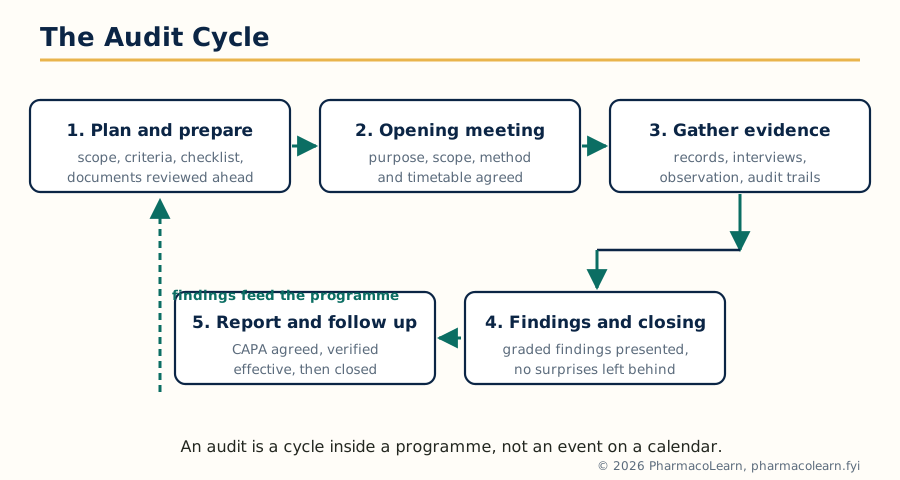 Figure: The audit cycle. Findings return to the programme as new risk information, which is why the audit programme is a cycle and not a diary.
3.6 Audit analysis, the audit report and follow up
After the closing meeting, the work of audit analysis converts notes into findings that can survive challenge: each finding written as criterion, evidence and conclusion (what the rule requires, what was objectively found, why the two diverge), graded, and stripped of opinion and excess. The audit report fixes this in the record: identification of the audit (scope, dates, auditors, criteria), the findings in full, the auditee's areas of strength where relevant, and the required response and its deadline. The report is a controlled document with defined distribution, because it may later be read by a regulator as evidence of the company's honesty with itself. Audit follow up closes the loop: the auditee's response with root cause and CAPA (Unit 4), the auditor's assessment of that response, verification that the promised actions were actually taken and effective (a follow up audit where the findings warrant), and formal closure recorded against each finding. The measure of an audit system is its closure discipline: findings that recur audit after audit announce that follow up, not auditing, is the broken step.
3.7 Audits and inspections of facilities by regulatory agencies, and timelines
Above the company's own audit system stands the regulatory inspection, which Unit 4 treats in full; this unit places it in the audit landscape and teaches its timelines, the calendar discipline both sides work to. The patterns worth stating are these. Inspections may be announced or unannounced: routine GMP surveillance inspections by many authorities are unannounced or short notice, while pre approval inspections (Unit 4) are scheduled against the application's review clock. The inspection itself occupies days, scaled to the site; its written outcomes run on defined clocks, most famously the expectation that a company responds to a US Form FDA 483 within 15 business days if the response is to inform the agency's decision on escalation (Unit 5), and the European practice under which a GMP certificate is issued following a satisfactory inspection and is generally valid for three years, with the inspection report and any deficiency letter answered within the period the inspectorate sets. Audit and inspection preparation inside companies, the mock audits and readiness programmes of industry, are built backwards from exactly these timelines: the professional skill is not knowing that an inspection will come, but knowing precisely what will be asked, and by when, at every step after it does.
3.8 GHTF Study Group 4 and ISO 13485: auditing in the device world
For medical devices, the audit framework was harmonised by GHTF Study Group 4, met in MRA101T for the GHTF family as a whole: SG4 wrote the guidance on regulatory auditing of quality management systems of medical device manufacturers, covering the audit process itself, the competence and training of regulatory auditors, and a graded nonconformity system that converts findings into a common scale so different auditing organisations reach comparable conclusions, work carried forward today under IMDRF and visible in the Medical Device Single Audit Program (MDSAP), in which one audit by a recognised auditing organisation serves several regulators at once. The criteria those audits test against are the device quality system of ISO 13485, the international standard specifying quality management system requirements for medical devices, design control, sterile manufacture, risk management linkage and regulatory reporting among them. For this subject the pairing is the point: SG4 standardised how device QMS audits are done, ISO 13485 states what they are done against, and a regulatory affairs professional meets both wherever devices enter a dossier, a supplier file or an audit programme.
Unit 4: Inspections
4.1 Inspection distinguished from audit
Units 3 and 4 are a deliberate pair, and the distinction between them opens this unit. An audit is performed by or for the organisation itself, or by a body it engages, and its force is contractual or systemic: findings oblige because the quality system says so. An inspection is performed by a regulatory authority exercising legal power: the inspector may enter, examine and copy records, take samples and require answers, by statute; the site may not decline, reschedule for convenience or limit the scope; and the outcomes are legal acts, licences granted, suspended or refused, certificates issued or withheld, enforcement under Unit 5. The technique on the floor looks similar, evidence, interviews, trails, because inspectors and auditors share a profession; the gravity differs entirely. Everything in this unit, the species of inspection, the inspectorate itself, its reports and certificates, and the root cause and CAPA machinery by which findings are answered, follows from that one distinction: this is the state reading the documents of Units 1 and 2.
4.2 Pre-approval inspections
The pre-approval inspection (PAI) is the inspection an authority performs before approving a marketing application, to verify that the facilities named in the dossier can actually do what the dossier says. In the FDA programme, which states the model most explicitly, a PAI pursues three objectives: readiness for commercial manufacturing (the facility, equipment, systems and people can make the product at commercial scale, with validation complete or credibly planned); conformance to the application (what will be done matches what was filed, in formulation, process, controls and site); and data integrity (the development, bioequivalence and stability data in the application are authentic, audited against raw records on the spot, the legacy of the generic drug scandals that created the programme). The European system reaches the same point by pre authorisation inspections ordered where the assessment raises questions, conducted by the supervisory authority of the member state where the site sits. A failed PAI does not merely embarrass: the application cannot be approved until the deficiencies are resolved, so the PAI converts the dossier's every claim into a hostage, which is why Unit 2's compilation discipline and Unit 3's self inspection are, in the long run, PAI preparation.
4.3 Inspection of pharmaceutical manufacturers
The routine inspection of pharmaceutical manufacturers is the surveillance engine of GMP: periodic, risk based in frequency, and systems in structure. The FDA's systems model, the template taught worldwide, inspects six systems: the quality system itself, then facilities and equipment, materials, production, packaging and labelling, and the laboratory control system, with the quality system always in scope and the others sampled by risk and rotation, so that over a cycle the whole factory is examined through the systems that govern it. The conduct follows the profession's rhythm from Unit 3 under legal colour: credentials presented, the site walked (the walkthrough, warehouse to production to laboratory to utilities, following the material and product flow), records requested and reviewed, personnel interviewed at their workplaces, and objectionable conditions recorded as they are found and discussed daily rather than sprung at the end. The inspector's working documents are the site's own: the site master file for orientation, batch records and validation files for evidence, and the self inspection reports of Unit 3, whose quality the inspector is silently grading throughout: a site whose internal audits found nothing, in a factory with visible problems, has failed twice.
4.4 Inspection of drug distribution channels
GMP's writ runs past the factory gate, and this unit's second inspection territory is the distribution channel: wholesalers, distributors, depots, transport operations and the pharmacies and institutions at the chain's end. These inspections test good distribution practice (MRA101T Unit 4) at each holder: licensing and authorisation of the premises and its responsible person, storage conditions and their monitoring records, the integrity of the cold chain in transit, segregation of returned, recalled and suspect stock, the documentation of receipts and supplies that makes traceability real, and the handling of suspected falsified medicines. The regulatory logic is the distribution record of Unit 1 read backwards: the manufacturer can account for every batch only if every link in the channel kept the records this inspection verifies, so distribution inspections are what make recalls possible and falsification difficult across a whole market rather than inside one factory.
4.5 Quality systems for national GMP inspectorates
Who inspects the inspectors? The syllabus's answer is examinable and elegant: a national GMP inspectorate must itself operate a quality system. The requirements, set out in WHO guidance on quality systems requirements for national good manufacturing practice inspectorates and embodied in the practice of the Pharmaceutical Inspection Co-operation Scheme (PIC/S), whose membership conditions audit the inspectorate itself, include: a legal basis and defined scope for inspections; documented procedures for planning, conducting, reporting and following up inspections; trained, qualified and conflict free inspectors, with continuing training; consistent classification of deficiencies and decisions, so two inspectors reach the same conclusion on the same facts; a system for handling appeals and complaints about inspections; and records sufficient for the inspectorate's own work to be audited, by peers in the PIC/S joint audit programme or in WHO's assessment of regulatory systems. Mutual recognition between countries, the acceptance of each other's GMP certificates that oils world trade in medicines, is extended only to inspectorates whose quality systems have themselves passed examination: the inspectorate quality system is the trust mechanism of the whole international structure.
4.6 The inspection report and the model certificate of GMP
An inspection crystallises into documents, and two are named in the syllabus. The inspection report is the formal record: the site and scope inspected, the systems and areas covered, the evidence examined, the deficiencies found, classified (in the European usage, critical, major and other), the site's responses and commitments, and the inspector's conclusion on the site's GMP compliance status. It is written to be read by strangers, other authorities under information exchange, licensing boards, courts, which is why the report, like the audit report of Unit 3, is written in criterion, evidence and conclusion form. The model certificate of good manufacturing practices is the certificate form of the WHO Certification Scheme on the quality of pharmaceutical products moving in international commerce: a standard certificate by which the competent authority of the exporting country attests that a manufacturing facility is in compliance with GMP and subject to its inspection regime, issued per site and product category and relied upon by importing authorities. Together, report and certificate are the exportable form of an inspection: the report carries the detail for those entitled to it, the certificate carries the conclusion for the world.
4.7 Root cause analysis
Every serious finding, deviation and complaint poses the same question: why did this happen, and root cause analysis (RCA) is the disciplined refusal to accept the first answer. Its logic is layered: the immediate cause (the balance was misread), the contributing causes (the display was ambiguous, the shift was rushed), and the root cause (the system allowed an ambiguous critical display and an unchecked transcription to reach a batch record), and only action at the root layer prevents recurrence, which is the entire point. The classical tools are few and examinable: the five whys, iterative questioning down the causal chain; the Ishikawa (fishbone) diagram, which organises candidate causes under heads such as manpower, machinery, materials, methods, measurement and milieu; and, for complex failures, fault tree and failure mode analyses borrowed from risk management. RCA has professional failure modes of its own, which the draft names because examiners do: stopping at human error (a description, not a cause; the question is why the system made that error likely and undetectable), and choosing the cause that is cheapest to fix rather than the one the evidence supports. The output of a good RCA is a small set of evidenced causes, each owned, which is exactly the input the next section requires.
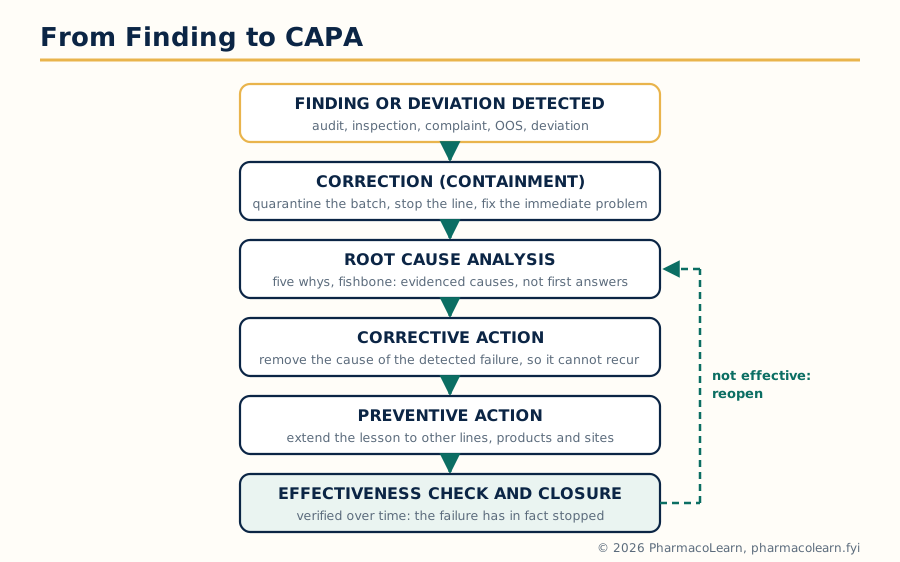 Figure: The CAPA flow of sections 4.7 and 4.8: containment first, then root cause, then actions aimed at the cause, then proof that they worked.
4.8 Corrective and preventive action: CAPA
CAPA is the system that converts findings into fixed systems, and its terms are defined with legal precision in the quality literature (expressly in the device rule, 21 CFR 820.100, and in ICH Q10 for pharmaceuticals). A correction is the immediate fix of the detected problem (the batch is quarantined, the label stock is destroyed). A corrective action eliminates the cause of a detected nonconformity so it does not recur (the display is replaced, transcription is removed by direct capture, the SOP and training are revised). A preventive action eliminates the cause of a potential nonconformity so it does not occur, classically by extending the lesson sideways to other lines, products and sites where the same cause is latent. A working CAPA system triages its inputs (deviations, audit and inspection findings, complaints, OOS results, recalls), assigns each an owner and a risk scaled deadline, tracks root cause and actions to verified effectiveness (the check, after a defined period or number of batches, that the failure has in fact stopped), and escalates what ages. CAPA is where the units of this subject meet: it answers the audit of Unit 3, defends the inspection of this unit, and supplies the credibility on which the post approval commitments of Unit 5 are accepted. An inspector's shortest summary of a quality system is often simply this: show me your CAPA file, and I will tell you your culture.
Unit 5: Product Life Cycle Management
5.1 Life cycle management: the approval is a beginning
An approval is a photograph of a product at one moment; manufacture then continues for decades, through new suppliers, bigger batches, better methods, new sites and tightening science. Product life cycle management, in the regulatory sense, is the discipline of keeping the registered product and the real product identical, by classifying every change, filing it by the correct route, and reporting what the law requires on schedule. ICH has given the discipline its modern frame in ICH Q12, which adds lifecycle instruments (established conditions, and post approval change management protocols that agree in advance how a change will be judged) to the older filing categories this unit teaches. The unit's geography is the United States system, whose category names the syllabus adopts, with the European variations system as the standing comparison: in the EU, changes are filed as Type IA (minor, do and tell, notified within twelve months or immediately for the IA immediate notification subclass), Type IB (minor, tell, wait and do, thirty days) and Type II (major, prior approval). The American ladder follows.
5.2 The United States reporting categories: PAS, CBE-30, CBE-0, annual report
United States law (21 CFR 314.70) sorts post approval changes to an approved application by their potential to affect the drug's identity, strength, quality, purity or potency, and the filing route follows the sort:
| Route | Name and rule | Timing |
|---|---|---|
| PAS | Prior Approval Supplement: a major change, substantial potential to affect the product | FDA approval before the changed product is distributed |
| CBE-30 | Changes Being Effected in 30 days: a moderate change | FDA must receive the supplement at least 30 days before distribution |
| CBE-0 | Changes Being Effected: a moderate change FDA has designated for immediate effect | FDA receives the supplement at the time distribution begins |
| Annual report | A minor change, minimal potential to affect the product | Described in the annual report, no supplement |
The classification is the examinable skill. Major changes (PAS) include a new manufacturing site for most products, a change in the drug substance synthesis, a formulation change outside accepted ranges, a new indication (filed as an efficacy supplement). Moderate changes of the CBE family include many specification, method and process adjustments within defined bounds. Minor changes, an editorial labelling correction, a like for like equipment replacement, ride in the annual report. Two disciplines surround the ladder: the change is first judged under SUPAC (next section) where a guidance applies, and the supplement or report is itself a piece of regulatory writing of Unit 2's kind, a mini dossier arguing, with data, that the changed product remains the approved product. Misclassification is a compliance failure in both directions: filing a major change as minor is a violation, and wasting prior approval on a minor change burns review resources the system cannot spare.
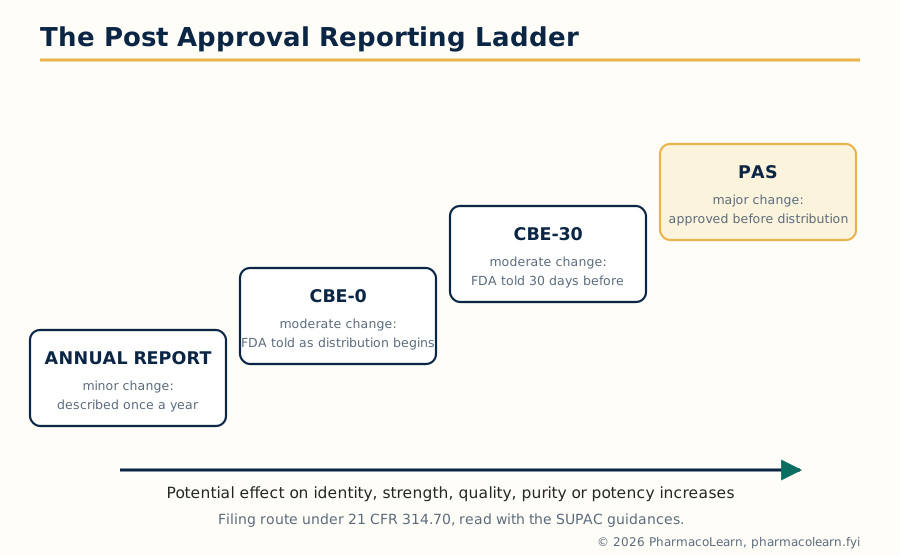 Figure: The United States reporting ladder of 21 CFR 314.70: the greater a change's potential effect on the product, the earlier the agency must be told, from annual record to prior approval.
5.3 SUPAC: the scale up and post approval changes guidances
SUPAC (Scale Up and Post Approval Changes) is the series of FDA guidances that operationalises section 5.2 for the commonest changes, giving each change type levels with the tests and filing route each level attracts. The family a student should be able to name: SUPAC-IR for immediate release solid oral dosage forms, SUPAC-MR for modified release solid orals, and SUPAC-SS for nonsterile semisolid dosage forms, with companion guidance for manufacturing equipment addenda and for changes to an approved NDA or ANDA in the chemistry, manufacturing and controls documentation. Within a SUPAC guidance, a change is sorted (for example Level 1, Level 2, Level 3 in SUPAC-IR) across the dimensions the guidance calls components and composition, site, batch size (scale), equipment and process; each level then prescribes the evidence (commonly comparative dissolution, sometimes stability, in the higher levels bioequivalence) and the filing (annual report, CBE, or PAS). SUPAC's teaching point is regulatory writing's deepest one: the agency has published, in advance, the questions it will ask about a change and the data it will accept as answers, so the competent regulatory professional reads the guidance before making the change, not after.
5.4 The annual report and post marketing reporting
Beside the supplements stands the periodic traffic of an approved application. The annual report (21 CFR 314.81), due within sixty days of the anniversary of the approval, reports the year's minor changes (section 5.2), the distribution data, the labelling in use, the status of post marketing commitments and studies, and a summary of significant new information bearing on the product's safety and efficacy. The wider post marketing reporting requirements run continuously, not annually: adverse experience reporting, periodic and expedited, under the pharmacovigilance rules; field alert reports, required within three working days when a distributed drug product shows significant problems (bacterial contamination, a labelling mix up, a failure to meet specifications) that could affect its safety or efficacy; and biological product deviation reports for licensed biologics on the parallel track. The common thread is that approval converts the company's knowledge duties into standing legal duties: from the day of approval, what the company learns about its product, it largely owes the agency, on a clock.
5.5 Post approval labeling changes
Labelling is part of the registered product, and changing it after approval follows its own graded logic, which this syllabus item isolates. Safety driven strengthening of labelling is deliberately made fast: a company that acquires new safety information may strengthen warnings, contraindications or adverse reaction statements by a changes being effected supplement and implement on filing, rather than waiting through prior approval while an out of date label circulates; the agency then reviews and may negotiate different wording. Other labelling changes sort by the ladder of section 5.2: editorial and minor changes in the annual report, substantive changes to indications, dosage or claims by prior approval supplement (an efficacy supplement, with the clinical dossier of Unit 2 behind it). The discipline connecting this section to Unit 1's print pack specifications is completeness: a labelling change is not made when the supplement is filed but when every printed component, leaflet, carton, label and electronic copy, has been converted to the new text and the old stock destroyed, and the batch records of Unit 1 are how that conversion is proven.
5.6 FDA inspection and enforcement: the 483, the EIR and the warning letter
Unit 4's surveillance inspection ends in documents with a legal afterlife, and this section teaches the sequence. On the spot, objectionable conditions are recorded on Form FDA 483, handed to management at the close of inspection: a list of observations, not yet the agency's final judgement, to which the company should respond in writing, with root cause and CAPA of Unit 4, within fifteen business days if the response is to be considered before the agency decides its next step. The inspection is then written up by the investigator in the Establishment Inspection Report (EIR), and the agency classifies the outcome: NAI, no action indicated; VAI, voluntary action indicated, objectionable conditions found but not warranting formal action; or OAI, official action indicated, where regulatory or administrative action will follow. The characteristic OAI instrument is the warning letter: a public letter identifying significant violations, requiring correction and a written response (customarily within fifteen working days) describing the corrective plan, and warning that failure may bring the harder remedies of the next section without further notice. Warning letters are published, and their commercial damage, in customer audits, tenders and investor reading, often exceeds their legal force: in the documents economy of this subject, they are the point where documentation failures become public facts.
5.7 Recalls, seizure and injunctions: the enforcement ladder's top
When product already distributed presents a risk, the instrument is the recall: the removal or correction of marketed product that violates the law, conducted by the firm, monitored and classified by the agency. FDA classifies recalls by health hazard, on the basis of a health hazard evaluation: Class I, a reasonable probability of serious adverse health consequences, including death; Class II, a probability of temporary or medically reversible consequences, or a remote probability of serious harm; Class III, exposure not likely to cause adverse health consequences. The recall's mechanics are documentation again: the strategy (depth of recall, to wholesale, retail or consumer level), the consignee notifications built from Unit 1's distribution records, the effectiveness checks that prove recipients acted, status reports, and termination when the agency is satisfied the product is recovered or corrected; a market withdrawal (a minor problem, no legal violation) and a stock recovery (product not yet distributed) are the neighbouring, lesser categories, and confusing them in an answer costs marks. Beyond recalls, the agency's statutory remedies escalate: seizure, a court action against the offending goods themselves (under section 304 of the Food, Drug, and Cosmetic Act), by which the product is condemned and removed; and injunction, a court order against the firm's conduct (under section 302), restraining further violation, in its developed form the consent decree under which major companies have operated for years under external oversight. The ladder as a whole, observation, report, warning, recall, seizure, injunction, is the enforcement grammar every earlier unit of this subject exists to keep a company off.
5.8 The ISO risk management standard
The unit closes with the standard its final phrase names. The ISO risk management standard is ISO 31000, Risk management: principles and guidelines, the generic international standard that frames risk management for any organisation: principles (risk management creates and protects value, is integrated, structured, customised, inclusive, dynamic and evidence based), a framework of leadership, integration, design, implementation, evaluation and improvement, and a process of communication and consultation, establishing context and criteria, risk assessment (identification, analysis, evaluation), risk treatment, monitoring and review, and recording and reporting. Beside the generic standard stands its pharmaceutical translations: ICH Q9, quality risk management, which applies the same cycle to product quality with tools from flowcharts to FMEA and HACCP, and ISO 14971, the sector standard for the application of risk management to medical devices, which Unit 3's ISO 13485 quality system expressly invokes. The closing lesson of the subject is that risk management is the grammar the whole course has been speaking: documentation that evidences control, audits and inspections that test it, changes classified by their risk to the product, and enforcement scaled to the risk that remains.
Frequently Asked Questions
Q: What is the difference between the Master Formula Record and the Batch Manufacturing Record? The Master Formula Record is the standing master: the approved formula and process for a product, written once, from which every batch is made. The Batch Manufacturing Record is its executed copy for one batch: issued with a batch number, filled in contemporaneously as manufacture proceeds, carrying the batch's actual quantities, times, results, calculations and signatures, and reviewed by quality before the batch is released. One is the law, the other is the evidence that the law was obeyed on a particular day.
Q: What does a Batch Manufacturing Record calculate, and why are the calculations checked twice? Three families of calculation: the quantity of each material to weigh, adjusted for its assay or potency; the percentage yield at each stage and for the batch, actual against theoretical; and the reconciliation of controlled materials, issued against used, returned and wasted. Each is performed by one person and independently verified by a second, because a wrongly calculated record cannot be distinguished afterwards from a wrongly made batch: the arithmetic is part of the evidence, so it is held to the same standard as the manufacture.
Q: What is a Drug Master File, and what are its five types? A Drug Master File is a confidential file a holder submits directly to the agency, so that an applicant can reference the holder's data in an application, under a letter of authorization, without ever seeing the confidential content. In the United States system the types are: Type I, manufacturing site, facilities, operating procedures and personnel (no longer accepted for new files); Type II, drug substance, its intermediates and materials, or drug product; Type III, packaging material; Type IV, excipient, colorant, flavor or similar material; and Type V, FDA accepted reference information. A DMF is never approved alone: it is reviewed only when an application references it.
Q: What is the difference between the CTD and the eCTD? The CTD (ICH M4) is an organisation of content: five modules, regional administrative information in Module 1, summaries in Module 2, and quality, nonclinical and clinical evidence in Modules 3, 4 and 5. The eCTD (ICH M2) is that same content in electronic form: a sequence of transmissions with a defined folder structure and an XML backbone that lists every document, its checksum and its lifecycle operation, so the current state of the application can be rebuilt from all its sequences. CTD says what goes where; eCTD says how it travels and changes.
Q: What is NeeS, and how does it differ from eCTD? NeeS, Non eCTD electronic Submissions, is a dossier supplied electronically in the CTD folder structure, as PDF documents navigated by hyperlinked tables of contents, but without the XML backbone. It therefore lacks the eCTD's automated lifecycle management and machine validation: it is a well organised set of documents rather than a database of them. It was Europe's transitional format and is still accepted for some procedures, while eCTD is mandatory for the major routes in the ICH regions.
Q: What is the SUGAM portal used for? SUGAM is the online portal of CDSCO, India's Central Drugs Standard Control Organization. Through it applicants register, file applications within CDSCO's remit (such as import registration and licences, clinical trial and bioequivalence permissions and related filings), upload the dossier documents, pay fees electronically, and then track the application, answering the authority's queries inside the same system. It gives the Indian dossier a tracked electronic lifecycle, as the Electronic Submissions Gateway does in the United States.
Q: What is the difference between an audit and an inspection? An audit is performed by or for the organisation (first party), by an interested partner such as a customer (second party), or by an independent certification body (third party); its force comes from the quality system or the contract. An inspection is performed by a regulatory authority using legal powers of entry, examination and copying; the site cannot decline it, and its outcomes are legal acts: licences, certificates, deficiency letters and enforcement. The floor technique is similar; the authority behind it is not.
Q: What is a pre-approval inspection, and what does it test? A pre-approval inspection is performed before a marketing application is approved, to verify that the facilities named in the dossier can do what the dossier promises. In the FDA model it tests three things: readiness for commercial manufacturing, conformance of actual practice to the application as filed, and the integrity of the data in the application, audited against raw records. A facility that fails cannot support an approval until the deficiencies are resolved, which is why compilation discipline and self inspection are, in effect, long term preparation for it.
Q: What is the difference between a correction, a corrective action and a preventive action in CAPA? A correction fixes the detected problem itself: the affected batch is quarantined, the wrong labels are destroyed. A corrective action removes the cause of a detected nonconformity so it cannot recur: the process, equipment, document or training that allowed it is changed. A preventive action removes the cause of a potential nonconformity, typically by extending the corrective lesson to other products, lines or sites where the same cause is present but has not yet produced a failure. CAPA closes only when the actions are verified to have been effective.
Q: What decides whether a post approval change is filed as a PAS, a CBE-30 or in the annual report? The change's potential to affect the drug product's identity, strength, quality, purity or potency, under 21 CFR 314.70 and the applicable SUPAC guidance. A major change with substantial potential effect is a Prior Approval Supplement, approved before distribution. A moderate change is a Changes Being Effected supplement, received by FDA at least thirty days before distribution (CBE-30), or at the time of distribution for designated changes (CBE-0). A minor change with minimal potential effect is simply described in the annual report. The classification is the skill: safety labelling, for example, is deliberately allowed the fast CBE route so that stronger warnings are not delayed.
Complete MRA102T notes, all 5 units in one PDF, free to keep.
Other M.Pharm subjects: MPH101T · MPC101T · MPL101T · MPH102T · MPH103T · MPH104T · MPL102T · MPL103T · MPL104T · MPC102T · MPC103T · MPC104T · MPH201T · MPH202T · MPH203T · MPH204T · MPC201T · MPC202T · MPC203T · MPC204T · MPL201T · MPL202T · MPL203T · MPL204T · MRA101T · MRA102T · MRA103T · MRA104T · MRM301T · MPG101T · MPG102T · MPG103T · MPG201T · MPG202T · MPG203T · MPG104T · MPG204T · MRA201T · MRA202T · MRA203T · MRA204T · M.Pharm