
MRA202T — Regulatory Aspects of Herbal & Biologicals
4 hrs/week, 4 credits, 60 hours, 100 marks. Notes follow the M.Pharm syllabus, unit by unit.
MRA202T Regulatory Aspects of Herbal and Biologicals notes for M.Pharm Regulatory Affairs Semester 2: similar biologics in India, FDA BLA and 351(k), EU biosimilars, plasma master file, vaccines, blood products and herbal regulation. Free unit wise PDF downloads on PharmacoLearn.
Units in this subject
- Unit 1 — India: Similar Biologics
- Unit 2 — USA: Biologics and Biosimilars
- Unit 3 — European Union: Biologics and Biosimilars
- Unit 4 — Vaccines and Blood Products
- Unit 5 — Herbal Products: India, USA and European Union
Download MRA202T PDF Notes
Free PDFs for this subject, one per unit:
Regulatory Aspects of Herbal and Biologicals, subject code MRA202T, is the second core subject of M.Pharm Regulatory Affairs, Semester 2. It carries 4 credits and 60 hours of theory, taught at 4 hours per week, for 100 marks. MRA201T taught how the world regulates the chemically defined drug: a molecule that can be fully characterised, copied exactly, and proved the same as its reference by analysis and a bioequivalence study. This subject is about the products for which none of that is straightforward. A biologic is made by a living system, is defined as much by its manufacturing process as by its structure, and can never be copied molecule for molecule; a herbal product begins as a variable plant material whose active constituents may not even be fully known. The regulator's answer in both cases is a distinctive body of law built on characterisation, comparability and vigilance rather than on identity, and this course is designed to impart fundamental knowledge on the regulatory requirements, licensing and registration, and the regulation of labelling of biologics in India, USA and Europe, covering in detail the regulatory requirements for biologics, vaccines and blood products.
The units follow the logic of the field. Unit 1 studies India, and within India the governing text is the CDSCO and DBT guideline on similar biologics: the principles of development, the preclinical, clinical trial and market authorisation data packages, and the post market duties of pharmacovigilance, GMP and GDP. Unit 2 studies the United States: what biologics, biologicals and biosimilars are, how they differ from generic drugs, the laws, regulations and guidance that govern them, and the development and approval machinery of the IND, BLA and the neighbouring routes, closing with preclinical and clinical considerations and the advertising, labelling and packing rules. Unit 3 studies the European Union, the system that invented the biosimilar concept: its directives and scientific guidelines, comparability and biosimilarity assessment, the plasma master file, TSE and BSE control, and approval of investigational products and biosimilars. Unit 4 takes the two oldest biological product families, vaccines and blood products, across India, the US and the EU, including batch release, ISBT labelling and haemovigilance. Unit 5 turns to herbal products and compares quality, safety and legislation in India, the USA and the European Union. One habit pays off throughout: keep asking what evidence stands in for the identity proof that these products cannot give. For a generic, sameness is shown. For a biosimilar, similarity is built stepwise. For a herbal medicine, long use and controlled quality are made to carry part of the weight that trials carry elsewhere. Every system in this subject is a variation on that substitution.
Unit 1: India: Similar Biologics
1.1 Introduction: why biologics needed their own Indian framework
India is one of the world's largest makers of biotechnology medicines, and its regulatory problem arrived early: recombinant products such as insulin, erythropoietin, interferons and monoclonal antibodies were being manufactured domestically long before there was a settled answer to the question of how a follow on version of such a product should be judged. A chemical generic is approved by showing it contains the same molecule and delivers it to the body at the same rate and extent. A biologic cannot meet that test. It is a large, complex protein produced in a living cell line, folded and glycosylated in ways that depend on the cell, the medium and the purification train, and two manufacturers using different processes will produce molecules that are highly similar but never identical. The Indian framework therefore regulates the follow on product as a similar biologic: a biological product that is similar in terms of quality, safety and efficacy to an already authorised reference biologic, with the similarity demonstrated through a comparability programme rather than assumed. This unit teaches the architecture CDSCO built for that judgment: the applicable statutes and guidelines, the principles of development, and the data packages at the preclinical, clinical and market authorisation stages, with the post market duties that follow.
1.2 Applicable regulations and guidelines, and who administers them
Similar biologics are drugs under the Drugs and Cosmetics Act 1940 and the Drugs and Cosmetics Rules 1945, and a similar biologic is a new drug requiring permission and registration like any other new drug; the clinical trial and approval machinery now sits in the New Drugs and Clinical Trials Rules 2019, which MRA103T teaches in full. Because the product is made by recombinant DNA technology, a second statutory layer applies: the Rules for the manufacture, use, import, export and storage of hazardous microorganisms and genetically engineered organisms or cells, 1989, made under the Environment (Protection) Act 1986, with the recombinant DNA safety guidelines administered by the Department of Biotechnology (DBT). The guideline that organises the whole field is the Guidelines on Similar Biologics: Regulatory Requirements for Marketing Authorization in India, first issued in 2012 by the Central Drugs Standard Control Organization (CDSCO) together with the DBT, and revised in 2016; the revision is the operative text, and it is the document from which this unit's data requirements are drawn. Around it sit the CDSCO guidance documents on clinical trial applications, on quality information for biotechnological and biological products, and on post approval changes to biological products. Administration is shared, and knowing which desk holds which decision is part of the subject. CDSCO, through the Central Licensing Authority, is the licensing authority for the clinical trial permission and the market authorisation. The Review Committee on Genetic Manipulation (RCGM) in the DBT oversees the development and preclinical evaluation of recombinant products, acting through the Institutional Biosafety Committees at each facility. The Genetic Engineering Appraisal Committee (GEAC) in the environment ministry is the apex body under the 1989 Rules for environmental release matters. Manufacture itself is licensed by the State Licensing Authority under CDSCO oversight for this class of products, and the good manufacturing practice benchmark is Schedule M of the Drugs and Cosmetics Rules, met again at section 1.9.
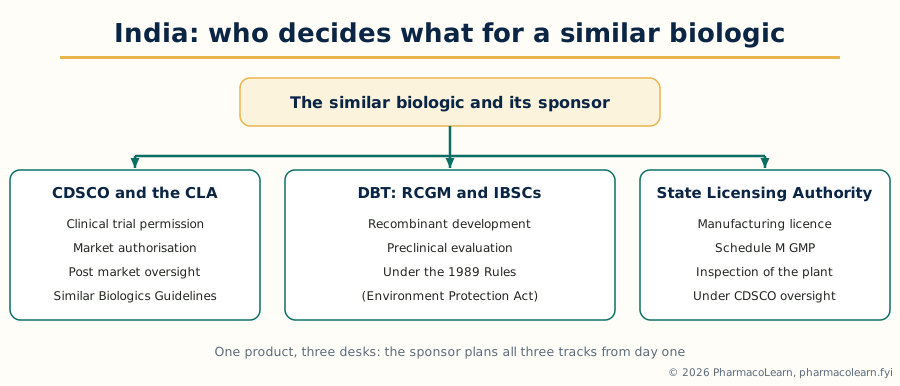 Figure: Who decides what for an Indian similar biologic: CDSCO and the Central Licensing Authority for trial permission and market authorisation, the RCGM and Institutional Biosafety Committees for recombinant development and preclinical oversight under the 1989 Rules, and the State Licensing Authority for the manufacturing licence (Unit 1, section 1.2).
1.3 Principles for development of similar biologics
The 2016 guideline rests on principles that the whole of this subject, in every jurisdiction, then repeats in local language. First, the reference biologic must be a product authorised in India on a complete data package, or, where the guideline permits, authorised in a jurisdiction whose standards India accepts, and it must be used consistently as the comparator throughout development; similarity to a moving target proves nothing. Second, development is stepwise: the programme begins with extensive physicochemical and biological characterisation of both products, and the amount of preclinical and clinical evidence then required is decided by what the analytical comparison leaves uncertain. A candidate that is analytically very close, with differences shown to be irrelevant, may need a reduced nonclinical and clinical package; a candidate with meaningful differences must earn its authorisation with more data, up to a full standalone package. Third, the standard is the totality of the evidence: no single study carries the application, and similarity is a conclusion drawn from the analytical, functional, preclinical and clinical layers together. Fourth, the similar biologic is developed against one reference product for one route of manufacture: the process used for the comparability batches must be the commercial process, because for a biologic the process defines the product, and a later process change reopens comparability. Fifth, extrapolation is possible but must be justified: if similarity is established rigorously in one studied indication, the product may be authorised for other indications of the reference biologic without a trial in each, provided the mechanism of action and the safety and immunogenicity profile support it. The stepwise logic is the single most examined idea in the unit, because it explains every data requirement that follows.
The stepwise development of a similar biologic (India)
Reference biologic fixed (authorised on a full data package)
        |
[1] Quality characterisation: structure, purity, biological activity
        |     (the widest, most sensitive comparison)
        v
[2] Preclinical comparison: pharmacodynamics, toxicology, immunogenicity
        |     (scaled to the residual uncertainty from step 1)
        v
[3] Clinical comparison: PK and PD, confirmatory efficacy and safety,
        |     immunogenicity (scaled to what steps 1 and 2 leave open)
        v
[4] Conclusion of similarity on the totality of the evidence
        |
        v
Market authorisation, with post market duties (Unit 1, sections 1.7 to 1.9)
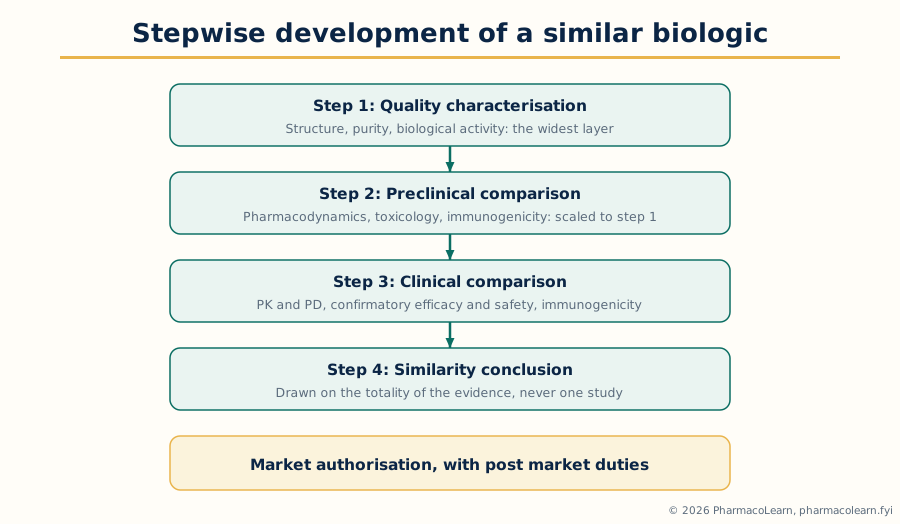 Figure: Stepwise development: characterisation first and widest, then preclinical and clinical layers scaled to the uncertainty each earlier step leaves, concluding in a judgment on the totality of the evidence (Unit 1, section 1.3).
1.4 Data requirements for preclinical studies
The preclinical package exists to detect, before human exposure, any difference between the similar biologic and its reference that the laboratory comparison could not settle. Its first layer is in vitro: pharmacodynamic studies using the functional assays of the product, receptor binding and cell based potency assays, run head to head against the reference biologic, because these assays are often more sensitive to real differences than animal work. The in vivo layer compares pharmacodynamics in a relevant animal model where one exists, and the guideline expects the choice of species to be justified by relevance to the pharmacology, not by convenience. Toxicology is comparative and deliberately proportionate: typically a repeat dose toxicity study in a relevant species with the similar biologic and the reference side by side, examining local tolerance and any difference in the toxicity profile, rather than the full standalone toxicology programme of a new molecule, which would waste animals answering a question the comparability design asks better. Immunogenicity in animals is read with care: animals commonly respond to human proteins in ways patients do not, so animal antibody data are used to understand the products' relative immunogenic behaviour, not as a direct prediction of the human response. Two administrative features distinguish this stage in India. The recombinant origin of the product brings the RCGM into the preclinical phase: the development and preclinical evaluation of recombinant DNA products are overseen through the RCGM and the Institutional Biosafety Committee machinery under the 1989 Rules, alongside the CDSCO track. And the whole package is read as a gate: its function is to decide the size and design of the clinical programme, so unexplained preclinical differences enlarge, and clean preclinical comparability can support reducing, the clinical work of the next section.
1.5 Data requirements for the clinical trial application
The clinical trial application to CDSCO assembles the quality dossier on the product made by the final process, the complete preclinical comparison of section 1.4, and the protocols of the proposed studies, and permission is sought under the NDCT Rules 2019 with ethics committee approval, as MRA103T teaches. The clinical programme the guideline expects has a recognisable shape. It opens with pharmacokinetic and pharmacodynamic comparison: a study, usually in healthy volunteers where ethically possible and in patients where the product's pharmacology requires it, showing that exposure and the PD response of the similar biologic match the reference within prespecified margins. It proceeds to a confirmatory clinical study in a sensitive indication and population, designed as an equivalence (or, where justified, non inferiority) comparison of efficacy against the reference biologic, with safety collected throughout. Immunogenicity is assessed across the programme with validated assays for anti drug antibodies and neutralising antibodies, because the immune response is the risk that analytical similarity can least guarantee away, and it is followed for a period proportionate to the risk, commonly through and beyond the treatment course. The guideline also leaves room, used carefully, for a reduced clinical package: where the analytical and preclinical comparability is comprehensive and a sensitive PD marker exists, the extent of efficacy testing may be reduced, which is the stepwise principle of section 1.3 operating at the clinical layer. What the Indian framework does not contemplate is approval on quality data alone for this class: some clinical comparison is the price of the word "similar".
1.6 Data requirements for the market authorization application
The market authorisation application converts the comparability programme into a licence. Its quality layer is the largest: full characterisation data, the head to head analytical comparison against the reference biologic presented as a structured comparability report, the description and validation of the manufacturing process, evidence of consistency across batches made by the final commercial process, specifications with their justification, and stability data supporting the claimed shelf life and storage conditions, which for a protein product almost always means a controlled cold chain. Its scientific layer carries the preclinical and clinical comparison of sections 1.4 and 1.5 with their integrated conclusions, an explicit justification for any extrapolation of indications sought beyond the studied one, and the proposed labelling, which follows the reference product's information as adapted to the similar biologic. Two features of the Indian decision deserve emphasis. The assessment is a similarity conclusion, not a re-proof of the reference product's benefit: CDSCO judges whether quality, safety and efficacy have been shown similar, and the authorisation is granted for the indications justified by that showing. And authorisation is accompanied by post marketing commitments, the subject of the next two sections: typically a Phase IV study or registry type follow up, periodic safety reporting, and product specific risk management measures, because a comparability judgment made on limited clinical exposure carries residual uncertainty that only wider use can close.
1.7 Post market data for similar biologics
Post market data in the Indian framework is not an afterthought; it is the fourth layer of the stepwise bargain. The guideline expects the marketing authorisation holder to generate data in real world use proportionate to the uncertainty left at approval, principally through Phase IV studies or structured observational follow up in the authorised indications, with attention to the endpoints the pre authorisation programme could not reach: uncommon adverse reactions, immunogenicity on repeated and long term exposure, and effectiveness in populations the trials excluded. These data feed periodic safety update reports submitted to CDSCO on the schedule the authorisation sets, and the findings can lead to label revision, additional studies or, in the limit, regulatory action. The professional point is continuity: the same comparability dossier that won the authorisation frames what must be watched after it, and a well built application names its own residual questions and proposes the post market work that answers them.
1.8 Pharmacovigilance
Pharmacovigilance for similar biologics runs through the Pharmacovigilance Programme of India (PvPI), coordinated by the Indian Pharmacopoeia Commission, with adverse drug reaction monitoring centres collecting reports from hospitals and practitioners, and through the authorisation holder's own obligations to collect, assess and report adverse reactions to CDSCO, including expedited reporting of serious and unexpected reactions. Two disciplines are specific to this class of products and are examined accordingly. The first is traceability: an adverse event report for a biologic is scientifically useful only if it identifies the exact product, by brand name and batch number, because several similar biologics of the same reference may be on the market and their immunogenicity can differ; prescribing and reporting by brand and batch is therefore a pharmacovigilance measure, not a commercial preference. The second is immunogenicity surveillance: loss of efficacy or hypersensitivity appearing in use may signal anti drug antibody formation, and the pharmacovigilance plan must be able to detect and investigate such signals, which is why the immunogenicity assays validated during development remain part of the product's post market life.
1.9 GMP and GDP for biologics
Manufacture of a biologic is licensed against Schedule M of the Drugs and Cosmetics Rules, and the biologics plant carries the general GMP discipline of MRA101T plus the controls this class demands: validated aseptic processing for products that cannot be terminally sterilised, control and monitoring of the cell banks and starting materials from which every batch descends, environmental monitoring of clean areas, and viral and microbial safety built into the process design rather than tested into the finished vial. Good distribution practice closes the unit because a biologic's quality is perishable in transit: the product's authorised shelf life assumes an unbroken cold chain, typically refrigerated storage and transport with continuous temperature records, and GDP for biologics is therefore centred on qualified storage, validated shipping systems, temperature excursion handling, and distribution records that can execute a batch recall to the last consignment, the GDP principles of MRA101T applied to a product that heat destroys silently.
Unit 2: USA: Biologics and Biosimilars
2.1 Introduction to biologics
American law draws the map of this unit in one definition. A biological product is defined in section 351(i) of the Public Health Service Act (PHSA) as a virus, therapeutic serum, toxin, antitoxin, vaccine, blood, blood component or derivative, allergenic product, protein, or analogous product, applicable to the prevention, treatment or cure of a disease or condition of human beings. The definition is a list because it predates the science: it gathers everything medicine makes from living sources, and its modern weight falls on the word protein, under which the recombinant and monoclonal antibody products of today are licensed. Administration is split between two FDA centres. The Center for Biologics Evaluation and Research (CBER) holds vaccines, blood and blood products, allergenics, cellular and gene therapies and related products. The Center for Drug Evaluation and Research (CDER) holds the therapeutic proteins, monoclonal antibodies and most follow on biologics of the modern market, a transfer made in 2003 that is why the biosimilar programme of section 2.6 is run largely from the drug centre. Either way, the licensing instrument is the same: a biologics licence under section 351 of the PHSA, granted only when the product is shown to be safe, pure and potent, and manufactured in a facility that meets the applicable standards, a statutory triad, safety, purity and potency, that is the American shorthand for the whole biologics philosophy.
2.2 Biologics, biologicals and biosimilars: the vocabulary
Three words circulate in the sources and the syllabus lists them because examinations test their boundaries. Biologics is the American regulatory term of art: the class licensed under the PHSA as just described. Biologicals is the wider, older term used by WHO and in European and Indian usage, covering the same family of products, vaccines, sera, blood products, biotherapeutics, without implying a particular statute; the two words overlap almost completely in substance and differ in legal address. A biosimilar is a comparative claim, not a product class: under section 351(k) of the PHSA, a biological product that is highly similar to an already licensed reference product notwithstanding minor differences in clinically inactive components, and that has no clinically meaningful differences from the reference product in terms of safety, purity and potency. The United States adds one further grade that no other system in this subject has: an interchangeable biosimilar, for which the applicant additionally shows that the product can be expected to produce the same clinical result in any given patient and that switching between the biosimilar and the reference product creates no greater risk than staying on the reference; interchangeability is the designation that permits a pharmacist to substitute the biosimilar for the prescribed reference product without consulting the prescriber, subject to state pharmacy law. India's similar biologic (Unit 1) corresponds to the biosimilar idea without the interchangeability tier, and the EU biosimilar (Unit 3) sits between the two in its treatment of switching, a comparison drawn together at section 3.3.
2.3 Different biological products
The class the definition gathers is best learned by its families, because each family's regulation later in this subject follows from what the product is. Preventive vaccines immunise healthy populations, which sets their safety expectations; blood and blood components are donated human material, regulated through the blood establishment system of Unit 4; allergenic products are standardised extracts for diagnosis and immunotherapy; cellular therapies and gene therapies carry living cells or genetic material as the active substance; therapeutic proteins, from replacement enzymes and growth factors to monoclonal antibodies, form the commercial centre of the class and nearly the whole of the biosimilar story; and a residue of products, toxins, antitoxins, sera and probiotics among them, descends from the original list. The recurring regulatory trait is that identity, purity and potency cannot be fixed by chemical specification alone: potency is measured by biological assay against reference standards, and batches are understood through the process that made them.
2.4 Difference between a generic drug and a biosimilar
This comparison is the conceptual centre of the unit, and it is stated precisely. A generic drug contains the same active ingredient as its reference, identical in structure, and is approved on pharmaceutical equivalence plus bioequivalence, the demonstration that it reaches the body at the same rate and extent; no clinical efficacy trial is needed because identity plus exposure is taken to settle the outcome. A biosimilar contains a highly similar, never identical, active substance, because no second living process reproduces a protein exactly; bioequivalence in the small molecule sense cannot settle the outcome, so approval rests on a comparability programme: extensive analytical and functional comparison, targeted animal and clinical work, and a dedicated immunogenicity assessment, scaled by the stepwise logic of Unit 1. The legal instruments differ accordingly, the ANDA under the FD&C Act against the 351(k) licence under the PHSA; the exclusivity landscape differs, Hatch-Waxman's patent and exclusivity settlement against the BPCI Act's 12 year reference product exclusivity; and substitution differs, the generic being rated therapeutically equivalent and freely substitutable, the biosimilar substitutable at pharmacy level only if separately designated interchangeable. A table fixes the contrasts.
| Point | Generic drug | Biosimilar |
|---|---|---|
| Statute and route | FD&C Act, ANDA under section 505(j) | PHSA, licence under section 351(k) |
| Active substance | Same molecule, identical structure | Highly similar protein, never identical |
| Basis of approval | Pharmaceutical equivalence and bioequivalence | Totality of evidence from a comparability programme |
| Clinical efficacy trial | Not required | Confirmatory comparison usually required |
| Immunogenicity | Not a routine issue | Central assessment in every programme |
| Substitution at pharmacy | Yes, on therapeutic equivalence rating | Only if designated interchangeable |
| Reference exclusivity faced | Hatch-Waxman patent and exclusivity scheme | 12 years of reference product exclusivity (BPCI Act) |
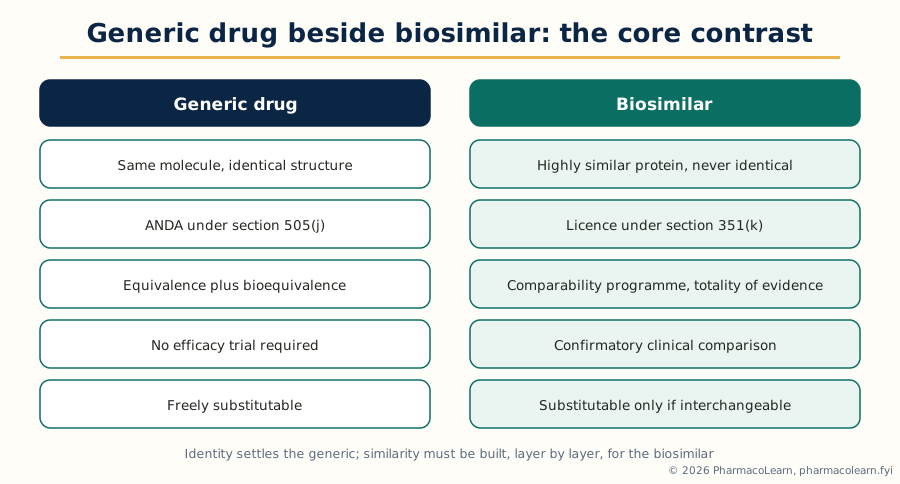 Figure: Same molecule and exposure proof on the generic side; highly similar protein and a totality of evidence comparability proof on the biosimilar side, with interchangeability as the extra American grade (Unit 2, section 2.4).
2.5 Laws, regulations and guidance on biologics and biosimilars
The statutory frame has three layers. The Federal Food, Drug, and Cosmetic Act supplies the general machinery, adulteration and misbranding, establishment registration, inspection, and the IND system under which biologics are clinically developed. The Public Health Service Act, section 351, supplies the licence: subsection (a) for the originator's full licence application, and subsection (k), added by the Biologics Price Competition and Innovation Act 2009 (the BPCI Act, enacted with the Affordable Care Act 2010), for the abbreviated biosimilar licence, with its 12 years of exclusivity for the reference product and a first interchangeable exclusivity for the first interchangeable biosimilar. The implementing regulations sit in Title 21 of the CFR: Part 600 and following for biological product standards and establishment licensing, Part 601 for licensing procedure, and Part 610 for the general biological product standards, including the lot release provisions met in Unit 4. Below statute and regulation sits the guidance layer, which for biosimilars does most of the technical work: FDA guidance on scientific considerations in demonstrating biosimilarity, on quality considerations, on clinical pharmacology data, on interchangeability considerations, and on the formal meetings between FDA and biosimilar sponsors at which the stepwise programme is agreed. The user fee system for this programme is the Biosimilar User Fee Act (BsUFA), under which FDA accepts performance goals for the review of biosimilar applications in return for industry fees, as PDUFA does for drugs. Purple Book literacy from MRA201T completes the picture: it is FDA's public list of licensed biological products with their biosimilars, interchangeables and exclusivity dates.
2.6 Development and approval: IND, BLA, and the routes the syllabus names
Development begins, as for drugs, under an Investigational New Drug application (21 CFR Part 312): the biologics IND assembles the manufacturing description of the investigational product, the preclinical pharmacology and toxicology, and the protocols, and the stepwise biosimilar programme is discussed with FDA through the biosimilar product development meeting series before and during the work. Approval for the originator is the Biologics License Application (BLA) under section 351(a), a full dossier proving safety, purity and potency from the applicant's own data, reviewed by CBER or CDER according to the product family of section 2.1, and granted together with the establishment licence judgment that the manufacturing facility meets its standards; approval carries post marketing duties, adverse event reporting under Part 600.80, and changes controlled through supplements graded by their effect on the product, in the PAS, CBE and annual report ladder of MRA102T. The biosimilar applicant files an abbreviated BLA under section 351(k), relying on the public knowledge that the reference product is licensed and on its own comparability programme rather than on a full independent proof of benefit. The syllabus names three further routes, and the student should place them exactly. The NDA appears because a defined set of protein products, insulin and human growth hormone among them, were historically approved as drugs under NDAs; in March 2020 those approvals were deemed to be biologics licences by operation of the BPCI Act transition provision, so the class now lives entirely inside the BLA system. The PMA (premarket approval) and 510(k) (premarket notification) are the device pathways of MRA203T, administered by CDRH; they enter a biologics syllabus because some products in the biological family, diagnostic blood grouping and infectious disease screening tests and certain combination products among them, are regulated through the device framework, and because the regulatory professional must be able to route any given product to its correct gate. The teaching point is routing discipline: drug, biologic or device is decided by the product's nature and primary mode of action, and the pathway follows the classification, not the sponsor's preference.
US approval routes named in this unit
Product under development
        |
        +-- Therapeutic biologic, originator ......... IND, then BLA 351(a)
        +-- Biosimilar ............................... IND, then BLA 351(k)
        |       (+ switching data for interchangeability)
        +-- Protein product licensed before 2020 ..... NDA, deemed a BLA
        |       under the BPCI transition (March 2020)
        +-- Biological product regulated as a device . 510(k) notification
                (diagnostics, screening tests)         or PMA approval
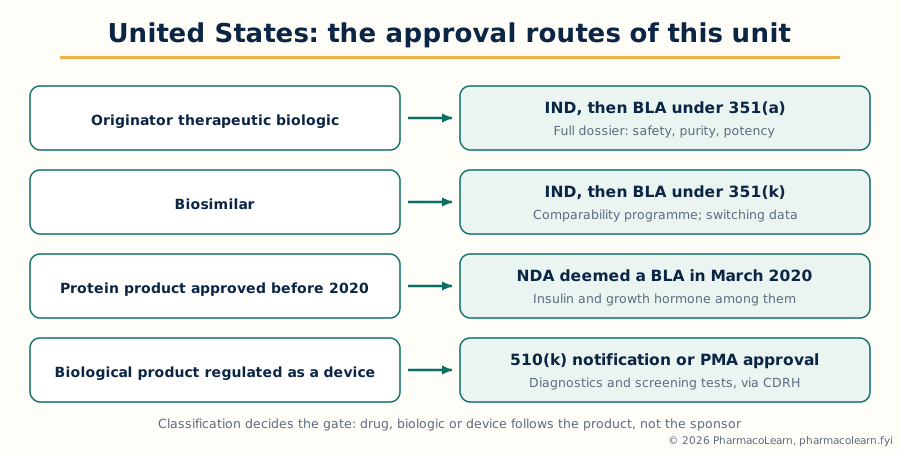 Figure: The routes of section 2.6: the full BLA and the abbreviated 351(k) licence at the centre, the historical NDA population deemed licensed in 2020, and the device gates, 510(k) and PMA, through which device regulated biological products pass (Unit 2, section 2.6).
2.7 Pre-clinical and clinical development considerations
American expectations for the evidence mirror the stepwise principles of Unit 1, with three emphases of their own. First, analytical similarity is the foundation and is expected to be extensive: multiple lots of the biosimilar and of the United States licensed reference product, compared across structure, purity, charge and glycan profile and biological function with methods sensitive enough to find differences, because every later reduction of animal or clinical work is argued from this base. Second, animal studies are used sparingly and purposefully, principally where they resolve a residual question of pharmacology or toxicity, reflecting both the comparability logic and the modern expectation that animal work must earn its place. Third, the clinical programme is built from a comparative pharmacokinetic and pharmacodynamic study where a PD marker exists, a confirmatory comparative clinical study in a population sensitive to differences, and an immunogenicity assessment with validated, drug tolerant assays, measuring anti drug and neutralising antibodies in both arms over a period adequate to the risk. For interchangeability, the additional evidence is a switching study: patients alternate between reference product and biosimilar, and the result must show no added risk and no diminished effect from the switching itself. Extrapolation to unstudied indications is permitted with scientific justification addressing mechanism and immunogenicity in each, as in India.
2.8 Advertising, labelling and packing of biologics
Naming is the first labelling rule and it is distinctive: FDA assigns each biological product a proper name consisting of a core name shared with related products and a distinguishing four letter suffix devoid of meaning for the originator and for biosimilars, so that adverse event reports and prescriptions can be traced to the exact product, the same traceability logic as India's brand and batch discipline at section 1.8; an interchangeable biosimilar shares the core name of the product it references. The label itself carries the US prescribing information in the standard format, with product specific warnings, and for REMS products the restricted distribution and communication elements FDA imposes. Advertising and promotion of biologics follow the prescription drug rules: promotional claims must be truthful, balanced and consistent with the approved labelling, a biosimilar may not claim superiority or difference the evidence does not support, and an interchangeable product's promotion must be consistent with its designation. Packing controls are the practical end of the same discipline: container closure integrity for a sterile protein, labelling that survives the cold chain, package level identification supporting recall and traceability, and the medication guide or patient labelling where the risk profile requires it.
Unit 3: European Union: Biologics and Biosimilars
3.1 Introduction to biologics in the European Union
The European Union was the first system to build a working biosimilar framework, issuing its overarching biosimilar guideline in 2005 and licensing the first biosimilar, a somatropin product, in 2006, years before the American pathway existed; Unit 3 therefore teaches the original design from which the concepts of Units 1 and 2 descend. The legal base is Directive 2001/83/EC, the Community code for human medicines, as amended for biologics, and Regulation (EC) No 726/2004, which makes the centralised procedure compulsory for medicines manufactured using specified biotechnological processes and for the advanced and innovative products EMA lists; in practice every biotechnology derived medicine and every biosimilar is authorised once, centrally, by the European Commission on the scientific opinion of the EMA's Committee for Medicinal Products for Human Use (CHMP), valid across the Union. The legal definition of a similar biological medicinal product lives in the Directive's data requirements: where a biological product does not meet the conditions of a generic, owing to differences in starting materials or manufacturing, the results of appropriate preclinical tests and clinical trials must be provided, which is the statutory sentence the entire biosimilar guideline structure elaborates.
3.2 Directives, scientific guidelines and guidance related to biologics in the EU
The framework is two layered. The directives and regulations set the gates: Directive 2001/83/EC for the dossier, authorisation and labelling of medicines; the variations and pharmacovigilance legislation met in MRA201T; the blood and tissues directives met in Unit 4; and the Clinical Trials Regulation for investigational products, at section 3.6. The scientific guidelines set the technical standard, and for biologics they form a deliberate architecture. At the top sits the overarching guideline on similar biological medicinal products, stating the principles: a stepwise comparability exercise, choice of reference product authorised in the EEA, and the possibility of extrapolation. Beneath it sit quality guidelines on the comparability of biotechnological products and on the quality data a biosimilar dossier must carry, and non clinical and clinical guidelines that translate the principles into study expectations. Beneath those sit product class specific guidelines, for insulins, erythropoietins, granulocyte colony stimulating factors, monoclonal antibodies, interferons and others, where the class experience is deep enough to prescribe the comparison in detail; the monoclonal antibody guideline, for the most complex class, is the natural capstone of the set. The professional reads the stack top down: principles first, then the class rule for the product in hand.
3.3 Comparability and biosimilarity evaluation
Two related exercises must be distinguished, because examinations confuse them. Comparability, codified in ICH Q5E, is the demonstration, after a change to a product's own manufacturing process, that the pre change and post change products are comparable in quality and that the change has no adverse impact on safety or efficacy; it is the originator's tool for living with process evolution, and it taught the biosimilar world its methods. Biosimilarity is the application of the same logic between two different manufacturers' products: an extensive head to head comparability exercise against the reference medicinal product across quality attributes, then non clinical comparison, then clinical comparison, in the stepwise order of Unit 1, with the extent of each later layer justified by the certainty of the layer before. The EU adds two operational features. The reference product must be one authorised in the EEA, and data from a non EEA comparator may support the programme only through a scientific bridging comparison. And on substitution, the EU legislates the science and leaves the practice to the member states: EMA and the Heads of Medicines Agencies have stated that biosimilars approved in the EU are interchangeable with their reference products from the scientific point of view, while the decision on pharmacy level substitution rests with each member state's own rules, which differ; the EU thus has interchangeability as a scientific conclusion without the American legal designation of section 2.2.
The EU comparability exercise for a biosimilar
[1] Quality comparison: physicochemical and biological characterisation
    against the EEA authorised reference product (widest layer)
        |
[2] Non clinical comparison: in vitro function, then in vivo work
    only where a residual question remains
        |
[3] Clinical comparison: PK and PD first; confirmatory efficacy,
    safety and immunogenicity in a sensitive population
        |
[4] Biosimilarity conclusion on the totality; extrapolation of
    indications justified mechanism by mechanism
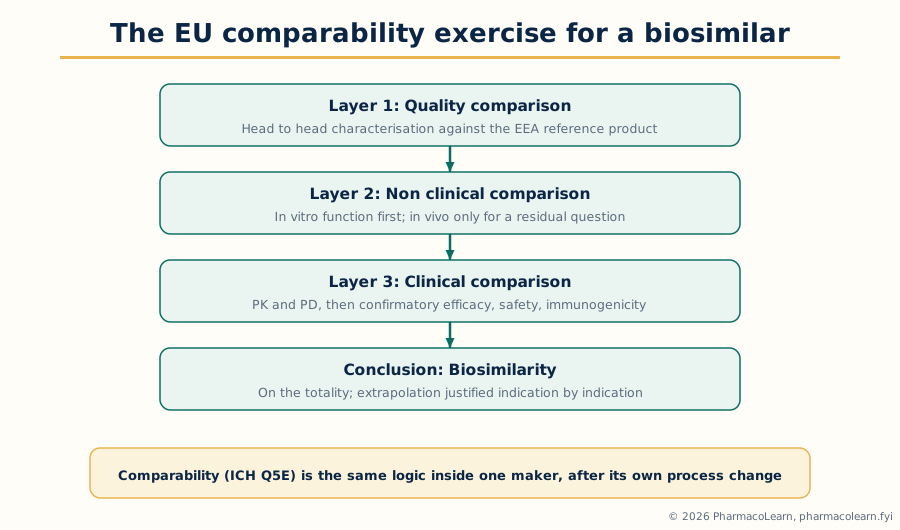 Figure: The staged comparability exercise: quality widest, non clinical targeted, clinical confirmatory, concluding on the totality with extrapolation justified separately (Unit 3, section 3.3).
3.4 The plasma master file
Plasma is the starting material of a whole family of biologics, albumin, immunoglobulins and clotting factors, and it is collected at many centres outside the marketing authorisation holder's own sites. The EU solves the resulting dossier problem with the Plasma Master File (PMF): a standalone dossier of the scientific and technical data on the collection, testing and pooling of human plasma, separate from any product's marketing authorisation dossier. A PMF holder submits the file to EMA for certification: the Agency evaluates the PMF and issues a certificate of compliance, which the marketing authorisation holders whose products use that plasma then cite in their own dossiers, so the plasma data are reviewed once and relied on many times. The certificate is maintained by annual recertification, in which the holder submits the updated epidemiological data on the donor populations and infectious markers, the year's changes to centres and tests, and the Agency re confirms compliance; product dossiers referencing the PMF are updated in step through the variations system. The PMF is the exact analogue, one level up the supply chain, of the ASMF of MRA201T: the master file device separates confidential, reusable source data from each product's own application.
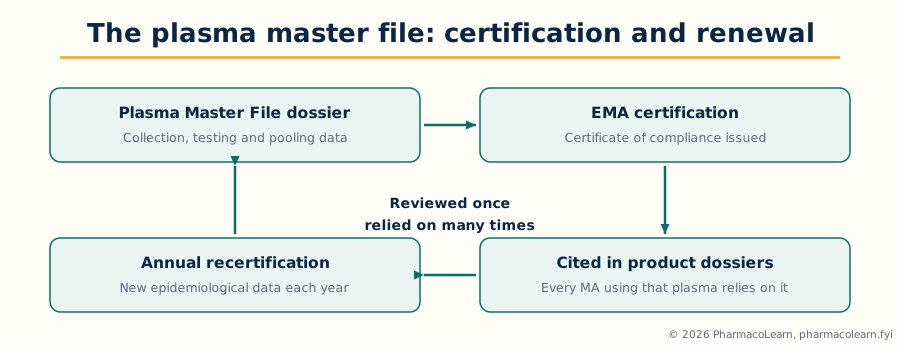 Figure: The PMF cycle: the plasma data dossier, EMA certification, citation by every marketing authorisation that uses the plasma, and annual recertification carrying the new epidemiological data (Unit 3, section 3.4).
3.5 TSE and BSE: evaluation and control
Transmissible spongiform encephalopathies, of which bovine spongiform encephalopathy (BSE) is the animal form and variant Creutzfeldt Jakob disease its human counterpart, are caused by prions that no routine inactivation or test can reliably remove from a biological starting material, so regulation works by risk minimisation at the source. The governing instrument is the EMA guideline on minimising the risk of transmitting animal spongiform encephalopathy agents via human and veterinary medicinal products, which classifies materials by the infectivity of the tissue (from specified high risk tissues down to materials with no detectable infectivity), by the species and the geographical BSE risk of the country of origin, and by the manufacturing process's capacity to reduce prion load, and combines them into the acceptability judgment for each animal derived material in a product, gelatine, lactose, bovine serum and tallow derivatives being the everyday examples. For specified materials, compliance is evidenced through the EDQM Certificate of Suitability for TSE risk, the TSE counterpart of the CEP of MRA201T, cited in the dossier in place of raw data. The evaluation is a living one: a change of sourcing country, species or tissue reopens the assessment, and the pharmacovigilance of section 3.8 stands behind it as the detector of last resort.
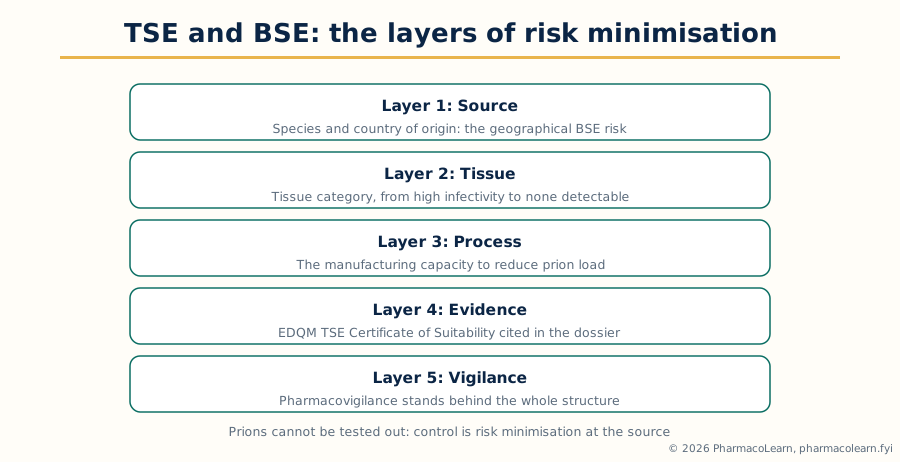 Figure: TSE and BSE control as layered risk minimisation: species and country risk, tissue category, process reduction, the EDQM TSE certificate as evidence, and vigilance behind the whole (Unit 3, section 3.5).
3.6 Development and regulatory approval: investigational products and biosimilars
A biologic enters European patients as an investigational medicinal product (IMP) under the Clinical Trials Regulation (EU) No 536/2014: one application through the EU portal, a coordinated assessment by the member states concerned with one state reporting, and the manufacturing of the IMP itself under GMP for investigational products with Qualified Person certification of each batch, the QP discipline of MRA201T carrying into the trial supply. The development programme is shaped in dialogue with EMA through scientific advice, the European habit of settling the comparability design with the regulator before the expensive studies run. Authorisation of the finished biologic is by the centralised procedure of section 3.1, applied for through a single dossier in CTD format in which the comparability exercise of section 3.3 is presented as an integrated, explicitly argued case: a quality module comparing the products attribute by attribute, the non clinical and clinical modules each prefaced by what the earlier layer left open, and the biosimilarity conclusion drawn across them. The CHMP opinion and Commission decision grant an authorisation for the indications the evidence supports, including extrapolated indications individually justified, and the product enters the post authorisation world of section 3.8 carrying a risk management plan as a condition of its licence.
3.7 Pre-clinical development considerations in the EU
European non clinical expectations for biosimilars state the stepwise principle in its most disciplined published form. The in vitro layer does the heavy lifting: a battery of functional assays reflecting every known mechanism of action of the product, run comparatively, because these assays are sensitive to differences that matter and spare animal use. In vivo animal studies are required only where an in vitro model cannot answer a remaining question, and where run, they are comparative, in a pharmacologically relevant species, designed for the question in hand: pharmacodynamics, a limited comparative toxicity assessment with toxicokinetics and antibody measurement, and local tolerance where the route demands it. Standalone safety pharmacology, genotoxicity and carcinogenicity programmes of the new molecule era are not expected for a biosimilar; the reference product's dossier has already settled those questions for the pharmacology in question. The design ethic is constant: every animal study must be able to change the decision, or it is not run.
3.8 Stability, safety and clinical evaluation
Stability of a biotechnological product is governed by ICH Q5C: because proteins degrade by pathways that accelerated conditions distort, the shelf life rests principally on real time, real condition data, with stress studies used to map degradation and prove the stability indicating power of the methods, and the cold chain conditions on the label are part of the stability claim itself. Safety and clinical evaluation post authorisation run through the EU pharmacovigilance system of MRA201T, with biologic specific sharpness: the risk management plan identifies immunogenicity and class risks as the standing concerns; periodic safety update reports follow the reference product's reporting cycle; and newly authorised biologics carry additional monitoring, marked by the black inverted triangle in the product information, inviting intensified adverse event reporting while experience accumulates. Traceability is a stated EU requirement for this class: brand name and batch number must be recorded in adverse reaction reports for biological medicines, the same discipline India teaches at section 1.8 and the US builds into its naming at section 2.8, because without product level identity a class level signal cannot be assigned to its source.
3.9 Advertising, labelling and packing of biologics in the EU
A European biologic is named by its INN with the company or brand name, in the invented name the centralised authorisation carries, and its identity in reporting and dispensing is anchored on that brand and batch, as section 3.8 sets out. The product information is the harmonised pair of the Summary of Product Characteristics for professionals and the package leaflet for patients, agreed centrally so that the same text serves every member state, with national additions confined to the blue box area of the pack. Advertising follows the medicines advertising rules of the Directive: prescription only biologics may not be advertised to the general public, professional promotion must accord with the SmPC, and no presentation of a biosimilar may claim a difference from its reference product that the authorisation does not establish. Packing carries the safety features of the falsified medicines framework, the unique identifier and anti tampering device by which each pack is verified at dispensing, together with the storage statement that keeps the cold chain promise of section 3.8 visible to every handler of the pack.
Unit 4: Vaccines and Blood Products
4.1 Vaccine regulations: the common frame in India, the US and the EU
Vaccines are the oldest biologics and the most intensively regulated per dose, because they are given to healthy people, very often children, in very large numbers. The three systems of this unit share one architecture, and this section teaches the architecture before Unit 4's remaining sections divide the detail. A vaccine is developed under the clinical trial machinery of its jurisdiction, tested in progressively larger populations with immunogenicity, the measured immune response, standing where possible as the readable endpoint in place of field efficacy. It is authorised on a dossier covering the antigen, the seed and cell substrate history, the manufacturing process and its consistency, and the clinical evidence. Uniquely in this class, authorisation is followed by official batch release: because no end product test fully characterises a vaccine, an official laboratory re examines and releases each batch, or a defined sample of batches, before sale. And because vaccination is a public programme, its safety is watched by dedicated surveillance of adverse events following immunisation, at section 4.3.
4.2 Clinical evaluation, licensing, quality assessment and additional requirements by jurisdiction
India. Vaccines are new drugs under the Drugs and Cosmetics framework, developed under the NDCT Rules 2019 and CDSCO oversight, with clinical trials designed around the vaccine's immunogenicity and safety in the Indian population, including bridging evaluation for vaccines developed abroad. Quality assessment and batch control rest substantially with the Central Drugs Laboratory, Kasauli, the national control laboratory for vaccines, which tests batches of vaccines for release in the Indian market; licensure of manufacture follows the Drugs and Cosmetics Rules with CDSCO as the central authority for this class. Additional requirements in the Indian setting are programmatic: vaccines destined for the Universal Immunization Programme must meet the programme's specifications and cold chain discipline, and export vaccines commonly carry WHO prequalification, below. United States. Vaccines are CBER products, developed under an IND and licensed by BLA, with the distinctive feature of lot release under 21 CFR 610.1: FDA may require submission of samples and protocols of each lot, and no lot subject to that requirement may be distributed until CBER releases it, a power applied lot by lot to vaccines and other designated biologics. Clinical evaluation follows the preventive vaccine pattern of large safety databases, immunogenicity endpoints and, where a disease endpoint trial is impracticable, immunological correlates accepted by agreement with the agency. European Union. Vaccines are centrally authorised like other biologics, and batch release is performed by the network of Official Medicines Control Laboratories under the Official Control Authority Batch Release (OCABR) system coordinated through EDQM: the manufacturer tests the batch, an official laboratory of one member state reviews the protocol and may test the batch, and the resulting certificate is recognised across the Union, so a batch is officially released once for all of Europe. Behind all three stands the WHO prequalification of vaccines, which assesses quality, safety and efficacy and the supplying programme's suitability, and on which United Nations agency procurement depends, making it a fourth, de facto licence for any vaccine aimed at the world's public programmes.
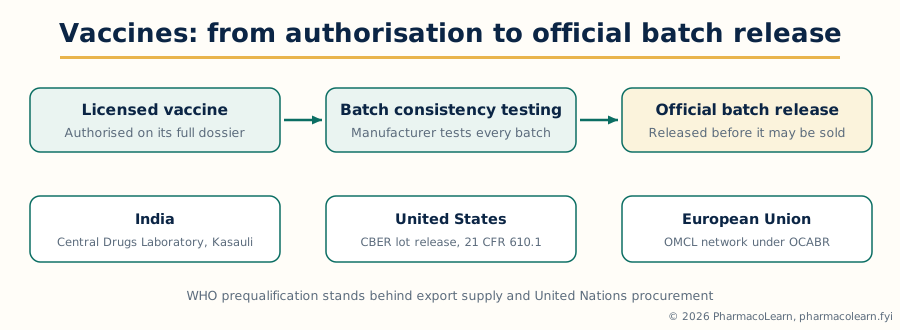 Figure: The vaccine route after authorisation: every batch passes consistency testing, and an official laboratory, the Central Drugs Laboratory in India, CBER lot release in the USA, an OMCL under OCABR in the EU, releases it before sale (Unit 4, sections 4.1 and 4.2).
4.3 Pharmacovigilance for vaccines and blood products
Vaccine safety surveillance has its own vocabulary because the events it watches occur against a background of coincidental illness in a recently vaccinated, usually healthy population, and must be separated from reactions the vaccine caused. India runs a dedicated Adverse Events Following Immunization (AEFI) surveillance system within the immunisation programme: events are reported upward from the vaccination site, investigated, and causality assessed by expert committees at district, state and national level, distinguishing vaccine product related and quality defect related reactions from immunisation error related events, anxiety related events and coincidence. The United States operates VAERS, the Vaccine Adverse Event Reporting System, jointly run by FDA and the Centers for Disease Control and Prevention, an open reporting system for events after licensed vaccines, read together with active follow up systems for signal confirmation. In the EU, vaccine reactions are reported into EudraVigilance under the general pharmacovigilance system, with the additional monitoring and risk management machinery of section 3.8. Blood products carry the parallel discipline of haemovigilance, treated at section 4.6: the surveillance of the whole transfusion chain, in which the event of interest may be a reaction in the recipient, an incident in processing, or a near miss in identification, and the system's value lies in tracing any unit of blood from donor to recipient and back.
4.4 Blood and blood products: regulatory requirements in India, the US and the EU
Blood regulation governs two different things that share a supply chain: components prepared from donations, whole blood separated into red cells, plasma, platelets and cryoprecipitate for transfusion; and plasma derived medicinal products, the fractionated albumin, immunoglobulins and clotting factors manufactured industrially from pooled plasma, which are licensed as medicines. India regulates blood banks under the Drugs and Cosmetics Rules: a blood bank requires a licence, granted for premises that meet the prescribed conditions of accommodation, equipment, staffing and testing, operates under the technical standards of the national blood policy framework with the National AIDS Control Organisation's standards for blood safety, and must test every donation for the prescribed transfusion transmitted infections, including HIV, hepatitis B and C, syphilis and malaria, with the component separation and storage conditions the Rules prescribe; the Central Drugs Laboratory and state laboratories stand behind the system for biological testing functions. United States. Blood establishments register with FDA and operate under the biologics regulations and the cGMP of Parts 606 and following of Title 21: donor eligibility is determined under Part 630, each donation is tested for the required infectious disease markers under Part 610.40, and components are labelled and released under a quality system whose errors and accidents must be reported to CBER; source plasma collection centres feed the fractionation industry under the same discipline. European Union. The Blood Directive 2002/98/EC sets the quality and safety standards for the collection and testing of human blood and components across the member states: designated competent authorities license and inspect blood establishments, every donation is tested for the Directive's marker panel, traceability from donor to recipient must be maintained for 30 years, and haemovigilance reporting of serious adverse reactions and events is mandatory, while the fractionated products themselves are authorised as medicines under the pharmaceutical legislation, with the plasma master file of section 3.4 carrying their starting material data.
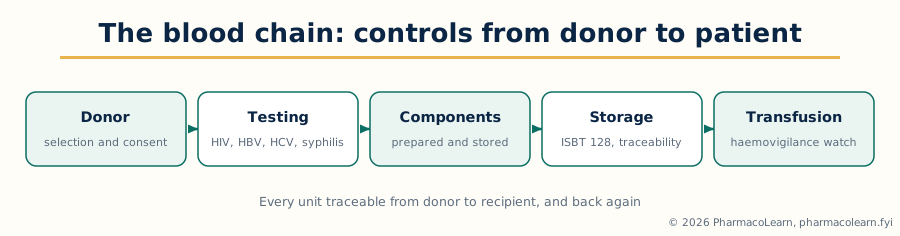 Figure: The chain every system in section 4.4 controls: donor selection, donation testing for transfusion transmitted infections, component preparation, labelled storage under traceability, and transfusion watched by haemovigilance (Unit 4, section 4.4).
4.5 Label requirements for blood and its components
A blood component label is an identification instrument before it is anything else: an error in matching unit to patient kills faster than any quality defect, so the label must state, unambiguously and durably, the identity of the component, its unique donation identification number, the blood group, the expiry date and time, the storage conditions, and the identity of the collecting and processing establishment. The three systems prescribe these contents through their blood regulations, and all require the label to connect the unit to its full record: donor, tests, processing and destination, the traceability chain of section 4.4. The modern carrier of this identity is the ISBT 128 standard of the next section, in which the label's information is encoded in barcodes and data structures read identically by blood services worldwide, so that a unit's group, product code and donation number survive every border it crosses.
4.6 ISBT labelling and the International Haemovigilance Network
The International Society of Blood Transfusion (ISBT) maintains ISBT 128, the global standard for the identification, labelling and information transfer of medical products of human origin, administered internationally by ICCBBA. Its donation identification number, built from a facility code, a year and a serial number, is unique worldwide and for all time; its product codes describe the component in standard terms; and its barcoded and electronic formats carry blood group, expiry and special attributes in a form any compliant system can read, which is why ISBT 128 labelling appears in the syllabus beside the label contents of section 4.5: it is how the content requirements are made machine true in practice. The International Haemovigilance Network (IHN) is the professional network of national haemovigilance systems: it harmonises the definitions of adverse reactions and events in donors and recipients, shares alerts and annual data between countries, and develops the standards by which a transfusion service learns from another's incident. India's own haemovigilance programme, the Haemovigilance Programme of India run under the National Institute of Biologicals with PvPI, applies the same logic domestically: transfusion reactions are reported on standard forms into a national database, so that the safety of the blood chain, like the safety of a vaccine programme, is a measured quantity rather than an assumption.
Unit 5: Herbal Products: India, USA and European Union
5.1 The herbal regulatory problem: quality, safety and the evidence of use
A herbal product reverses the usual regulatory order. For a synthetic drug, identity is easy and efficacy is hard; for a herbal medicine, efficacy claims rest on generations of use while identity itself is the problem: the starting material is a plant, variable by species, part, season, soil and processing, its chemistry is a mixture of many constituents, the therapeutically relevant ones may be incompletely known, and the finished product's consistency must be built by controlling botany, extraction and markers rather than by assaying a single molecule. The three systems of this unit answer the same three questions differently: how is quality assured for a material that cannot be fully specified; how is safety judged for products with long human exposure but little formal toxicology; and what legal route lets traditional use count as evidence, and for which claims. Read each system below as a distinct weighting of those three answers.
5.2 India: the ASU framework, Schedule T, and the phytopharmaceutical route
India regulates its traditional medicines inside the same statute as modern drugs, in a dedicated chapter: Chapter IVA of the Drugs and Cosmetics Act 1940 governs Ayurvedic, Siddha and Unani (ASU) drugs, with manufacture licensed by the state licensing authority for ASU drugs and the administrative oversight of the Ministry of AYUSH. The quality arm of the system is Schedule T of the Drugs and Cosmetics Rules, the good manufacturing practice schedule for ASU medicines, prescribing premises, equipment, record keeping and quality control requirements suited to classical manufacture; pharmacopoeial standards for identity, purity and strength are provided by the Ayurvedic Pharmacopoeia of India and the corresponding Siddha and Unani pharmacopoeias and formularies. The classification does the gatekeeping. Classical medicines prepared strictly according to the formulae of the authoritative texts listed in the First Schedule travel the lightest route; proprietary (patent or proprietary) ASU medicines, novel combinations and dosage forms, face additional scrutiny of their ingredients and claims; and a list of poisonous substances in Schedule E(1) conditions the use of the toxic classical ingredients. Safety evidence in the classical tradition rests on the documented history of use within the texts, with the licensing authority able to demand safety and effectiveness evidence for proprietary products. Beside this traditional framework, India created a scientific bridge: the phytopharmaceutical route, introduced through the Drugs and Cosmetics Rules for a purified and standardised fraction of a plant supported by a modern data package of quality, preclinical and clinical evidence, and carried forward in the NDCT framework, which brings a plant derived product through the new drug machinery on evidence standards closer to those of Unit 1 than to those of the classical texts. The two routes together are India's answer: tradition is honoured as evidence within its own system, and a herbal product that seeks modern drug claims can earn them by modern proof.
5.3 USA: dietary supplements under DSHEA and the botanical drug pathway
The United States places most herbal products in an entirely different legal house: under the Dietary Supplement Health and Education Act 1994 (DSHEA), botanicals sold as dietary supplements are regulated as a category of food, not as drugs. There is no premarket approval and no efficacy demonstration: the manufacturer is responsible for ensuring safety, FDA acts principally after marketing against adulterated or misbranded products, new dietary ingredients require a premarket safety notification, manufacture follows the supplement cGMP of 21 CFR Part 111, and labelling may carry structure and function claims, statements about the product's effect on the structure or function of the body, provided they are truthful, carry the prescribed disclaimer that the claim has not been evaluated by FDA, and are notified to the agency; disease treatment claims remain drug claims and are not permitted on a supplement. The same plant material can, however, choose the drug house: FDA's Botanical Drug Development guidance lays out how a complex botanical mixture can be developed under an IND and approved by NDA, with the agency accepting the mixture's inherent variability in exchange for rigorous botanical raw material control, chemical fingerprinting and clinically demonstrated effect; the small number of approved botanical drugs, a green tea extract ointment and a crofelemer product among them, show the route is real but demanding. The contrast is the teaching point of the section: in the USA the same herb is a supplement with structure function claims on a light regime, or a drug on proof, and the manufacturer's choice of claims decides which law it lives under.
5.4 European Union: traditional use registration and the HMPC
The EU built the route India and the USA gesture toward, a registration designed for tradition itself. Directive 2004/24/EC, amending the Community code, created the traditional use registration for herbal medicinal products: a simplified registration, without clinical efficacy trials, available where the product has been in medicinal use for at least 30 years, including at least 15 years within the European Union, has a specified strength and route, is intended for use without medical supervision for conditions suitable to that setting, and is shown safe in the conditions of use, with efficacy accepted as plausible on the basis of long standing use and experience. Quality is not simplified: the applicant must meet the full pharmaceutical quality standard, with the herbal substance and preparation defined, tested and controlled to the European Pharmacopoeia and the relevant guidelines. The scientific machinery is the Committee on Herbal Medicinal Products (HMPC) at EMA, which prepares Community herbal monographs, the agreed assessments of herbal substances setting out their well established or traditional uses, safety and conditions, and the Community list of herbal substances whose entries a registration may rely on; a product that follows a monograph's traditional use inherits its assessment, which is what makes the simplified route administrable at scale. Beside it stands the ordinary route: a herbal product with data of its own, or a recognised well established use supported by bibliographic evidence, may take a full or bibliographic marketing authorisation and carry therapeutic claims the traditional registration, limited to its traditional indication and a statement that the use is based exclusively on long standing use, cannot.
5.5 The three systems compared
Set side by side, the three systems divide the same plant three ways. India integrates herbals into its drug statute under a traditional chapter with its own pharmacopoeias and GMP schedule, letting classical textual authority carry the evidence within that system, and adds a phytopharmaceutical bridge to the modern new drug route. The USA defaults herbals to the food side of its law as dietary supplements, with no premarket efficacy judgment at all and claims confined to structure and function, reserving the drug route, guidance supported, for sponsors willing to prove a botanical drug. The EU keeps herbals inside medicines law but builds a registration in which documented tradition substitutes for trials, quality remains full standard, and the HMPC's monographs convert individual traditions into common assessments. For the regulatory professional the practical consequences travel with the product: the identical herbal preparation may be a licensed classical medicine in India, a supplement in the USA and a traditionally registered medicine in the EU, with three different labels, three different claim sets and three different evidence files, and a global herbal dossier is therefore written jurisdiction by jurisdiction, quality core shared, legal story retold each time.
| Point | India | USA | European Union |
|---|---|---|---|
| Legal home | Drugs and Cosmetics Act, Chapter IVA (ASU drugs); AYUSH oversight | DSHEA dietary supplements (food category); or drug route by choice of claims | Directive 2001/83/EC as amended by Directive 2004/24/EC |
| Main route | Licence to manufacture ASU drugs; classical and proprietary categories | No premarket approval for supplements; NDA for a botanical drug | Traditional use registration; full or bibliographic authorisation beside it |
| Evidence of efficacy | Classical textual authority; evidence demandable for proprietary products | None premarket for supplements; full proof for a botanical drug | Long standing use (30 years, 15 in the EU) makes efficacy plausible |
| Quality standard | Schedule T GMP; ASU pharmacopoeias and formularies | Supplement cGMP, 21 CFR Part 111 | Full pharmaceutical quality; European Pharmacopoeia standards |
| Claims | ASU indications as licensed | Structure and function claims with disclaimer; no disease claims | Traditional use indication, labelled as based on long standing use |
| Scientific machinery | AYUSH, pharmacopoeia commissions | FDA botanical drug guidance | HMPC, Community herbal monographs, Community list |
One herbal product, three legal answers
                    Herbal preparation
                          |
        +-----------------+-----------------+
        |                 |                 |
     INDIA              USA               EUROPEAN UNION
  Chapter IVA drug   Dietary supplement  Traditional use
  licence; Schedule  (DSHEA): notified   registration (2004/24/EC):
  T GMP; classical   claims, no premarket 30 years of use, 15 in
  texts as evidence  approval; or IND/NDA EU; HMPC monograph;
                     botanical drug      full quality standard
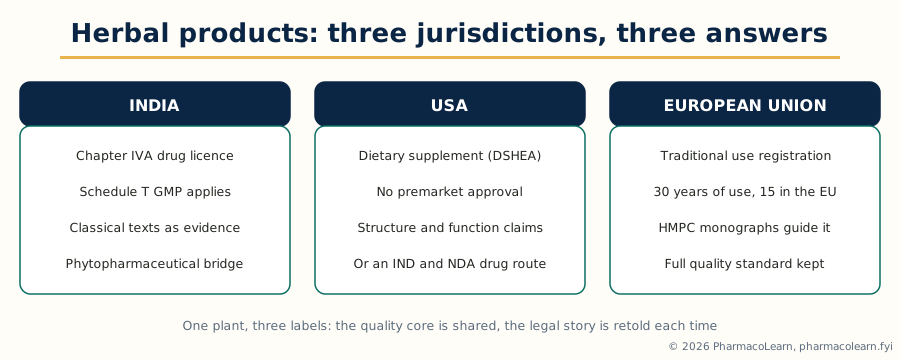 Figure: The three routes of section 5.5: India's traditional chapter inside the drug statute, America's supplement default with a drug route by choice, and Europe's registration built on documented tradition (Unit 5, section 5.5).
Frequently Asked Questions
Q: What is a similar biologic in the Indian framework? A similar biologic is a biological product shown to be similar in quality, safety and efficacy to an already authorised reference biologic, demonstrated through a stepwise comparability programme under the CDSCO and DBT Guidelines on Similar Biologics, revised 2016. It is not a generic: the molecules are highly similar, never identical.
Q: What does stepwise development mean for a biosimilar? It means the evidence is built in layers, and each layer's size depends on the layer before. Extensive analytical and functional characterisation comes first; the preclinical and clinical work that follows is scaled to the uncertainty the characterisation leaves, so a very close candidate may earn a reduced clinical package, and a doubtful one cannot.
Q: How does a biosimilar differ from a generic drug? A generic contains the same molecule as its reference and is approved on pharmaceutical equivalence and bioequivalence. A biosimilar contains a highly similar protein made by a different living process, and is approved on the totality of evidence from a comparability programme, including immunogenicity assessment; in the US it is substitutable at the pharmacy only if separately designated interchangeable.
Q: What is the plasma master file in the EU? The PMF is a standalone dossier of the data on collection, testing and pooling of human plasma, certified by EMA and cited by every marketing authorisation whose product uses that plasma, so the plasma data are reviewed once and relied on many times. It is maintained by annual recertification carrying the updated epidemiological data.
Q: Why do vaccines undergo official batch release when other medicines do not? Because no end product test can fully characterise a vaccine batch, the process consistency evidence must be re examined batch by batch. An official laboratory therefore releases each batch, or a defined sample of batches, before sale: the Central Drugs Laboratory in India, CBER lot release in the USA, and the OMCL network under OCABR in the EU.
Q: What is ISBT 128? ISBT 128 is the global standard, maintained by the International Society of Blood Transfusion and administered by ICCBBA, for identifying and labelling medical products of human origin. Its donation identification number is unique worldwide, and its barcoded data structures carry the product code, blood group and expiry of a blood component in a form any compliant system can read.
Q: How does the EU traditional use registration for herbal products work? Under Directive 2004/24/EC, a herbal medicinal product with at least 30 years of medicinal use, including 15 years in the EU, may be registered without efficacy trials, efficacy being accepted as plausible from long standing use. Quality must meet the full pharmaceutical standard, and the HMPC's Community herbal monographs supply the common scientific assessment the route relies on.
Q: What is Schedule T in the Indian herbal framework? Schedule T of the Drugs and Cosmetics Rules is the good manufacturing practice schedule for Ayurvedic, Siddha and Unani medicines, prescribing the premises, equipment, records and quality control expected of ASU manufacture, alongside the standards of the ASU pharmacopoeias and formularies.
Q: What role does immunogenicity play in biosimilar regulation? It is the risk that analytical similarity can least guarantee away: a highly similar protein may still provoke a different immune response. Every framework in this subject therefore requires validated anti drug antibody and neutralising antibody assessment across the clinical programme, traceability by brand and batch after marketing, and immunogenicity surveillance in pharmacovigilance.
Q: What are TSE and BSE controls for biological products? Because prions cannot be reliably removed or tested out of a biological starting material, control is by risk minimisation at the source: materials are classified by species, tissue infectivity and the geographical BSE risk of their origin, the process's ability to reduce prion load is assessed, and compliance for specified materials is evidenced by an EDQM TSE Certificate of Suitability.
Complete MRA202T notes, all 5 units in one PDF, free to keep.
Other M.Pharm subjects: MPH101T · MPC101T · MPL101T · MPH102T · MPH103T · MPH104T · MPL102T · MPL103T · MPL104T · MPC102T · MPC103T · MPC104T · MPH201T · MPH202T · MPH203T · MPH204T · MPC201T · MPC202T · MPC203T · MPC204T · MPL201T · MPL202T · MPL203T · MPL204T · MRA101T · MRA102T · MRA103T · MRA104T · MRM301T · MPG101T · MPG102T · MPG103T · MPG201T · MPG202T · MPG203T · MPG104T · MPG204T · MRA201T · MRA202T · MRA203T · MRA204T · M.Pharm