
MRA101T — Good Regulatory Practices
4 hrs/week, 4 credits, 60 hours, 100 marks. Notes follow the M.Pharm syllabus, unit by unit.
MRA101T Good Regulatory Practices notes for M.Pharm Semester 1: cGMP (21 CFR 210 and 211, EU and WHO GMP), GLP, GALP and 21 CFR Part 11, GDP, and quality management systems with validation and ICH. Free unit wise PDF downloads on PharmacoLearn.
Units in this subject
- Unit 1 — Current Good Manufacturing Practices
- Unit 2 — Good Laboratory Practices
- Unit 3 — Good Automated Laboratory Practices
- Unit 4 — Good Distribution Practices
- Unit 5 — Quality Management Systems
Download MRA101T PDF Notes
Free PDFs for this subject, one per unit:
Good Regulatory Practices, subject code MRA101T, is the opening core subject of M.Pharm Regulatory Affairs, Semester 1. It carries 4 credits and 60 hours of theory, taught at 4 hours per week, for 100 marks. Regulatory Affairs is the one specialisation whose Semester 1 does not include Modern Pharmaceutical Analytical Techniques; instead, its first subject is this tour of the "good practices", the codified ways of working that make pharmaceutical work trustworthy enough for a regulator to accept.
The subject studies four practices and the system that binds them. Unit 1 covers current Good Manufacturing Practices (cGMP), the rules under which medicines and medical devices are made, through the three great frameworks: the United States regulations in 21 CFR Parts 210 and 211, the European principles in Directive 91/356/EEC, and the WHO guidelines, with the GAMP 5 guide for computerized systems and the GHTF documents for medical devices alongside. Unit 2 covers Good Laboratory Practices (GLP), the rules under which nonclinical safety studies are run, through the US FDA regulations in 21 CFR Part 58, their documentation and audit machinery. Unit 3 covers Good Automated Laboratory Practices (GALP) and 21 CFR Part 11, the rules that keep electronic records and computerized systems honest. Unit 4 covers Good Distribution Practices (GDP), the rules that protect a finished medicine on its journey from factory to patient. Unit 5 gathers the whole into Quality Management Systems: quality concepts, total quality management, quality by design, Six Sigma, out of specification handling, change control, validation and qualification, the ICH process, ISO 13485 and CDSCO guidance. A student who masters this subject can read any later regulatory topic, dossier, audit or inspection, in its proper frame.
Unit 1: Current Good Manufacturing Practices
1.1 The good practices family: what this subject is about
Modern pharmaceutical regulation does not only judge products; it judges the way work is done. Over the second half of the twentieth century, each stage of a medicine's life acquired its own written code of good practice, and the codes together are nicknamed the GxP family, where x stands for the stage: GMP for manufacturing, GLP for nonclinical laboratory studies, GCP for clinical trials, GALP for automated laboratory systems, GDP for distribution, and their younger relatives such as GVP for pharmacovigilance. This subject teaches four of them in depth and the quality management system that sits above them all.
A good practice code has a recognisable anatomy wherever it appears. It states principles rather than recipes; it requires trained and named responsible people; it demands that procedures be written before they are performed (in standard operating procedures), that work be recorded as it happens, and that deviations be investigated rather than hidden; and it provides for independent checking, by a quality unit inside the organisation and by inspectors outside it. The practices differ in what they protect. GMP protects the patient from a badly made batch. GLP protects the regulator from safety data that cannot be trusted. GALP protects electronic records from silent corruption. GDP protects the medicine, after release, from heat, theft, mix-ups and falsification. Unit 5's quality management system is the management discipline that makes all of them run in one organisation rather than as four separate rulebooks.
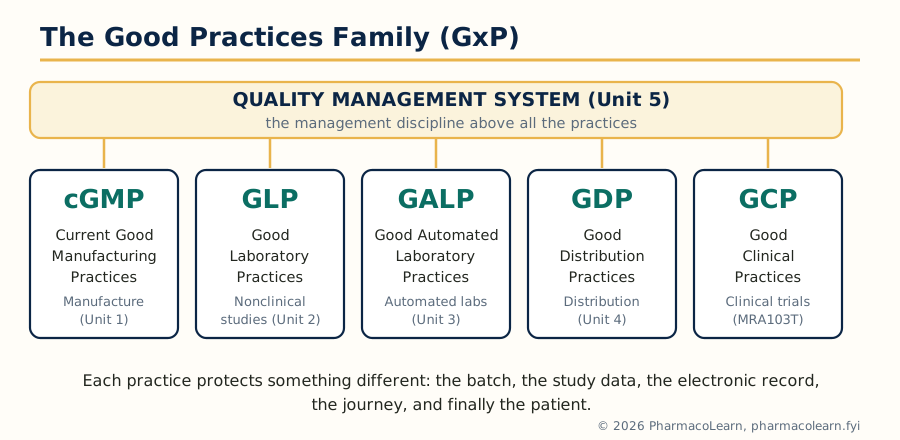 Figure: The GxP family mapped to the stages of a medicine's life that each practice governs, with the quality management system above them all.
1.2 cGMP: meaning, and why the word "current" is there
Current Good Manufacturing Practice (cGMP) is the body of regulation that requires manufacturers to control their operations so that every batch of a drug product has the identity, strength, quality and purity it claims. The FDA's classic summary is that cGMP provides systems assuring the proper design, monitoring and control of manufacturing processes and facilities: appropriate raw materials, robust operating procedures, reliable testing laboratories, and detection and investigation of quality defects.
The small letter c, for current, is the most examinable letter in the subject. It was added deliberately when the United States revised its GMP regulations in 1978, to record that GMP is not a frozen 1963 checklist: companies are expected to use current technology and current systems, so a practice that was acceptable a generation ago (handwritten records where validated electronic systems now exist, for example) can become a deficiency without any change in the regulation's text. History explains the shape of the rules. The sulfanilamide elixir disaster of 1937, in which a toxic solvent killed more than a hundred people, produced the US Federal Food, Drug, and Cosmetic Act of 1938; the first GMP regulations followed in 1963; the thalidomide disaster drove the 1962 efficacy amendments in the United States and, in time, licensing systems everywhere; and the 1978 revision produced the modern cGMP text of Parts 210 and 211 that Unit 1 now studies. Every GMP clause since has the same logic: a failure happened, was understood, and was converted into a standing control so it need not happen again.
1.3 The United States framework: 21 CFR Part 210 and Part 211
In the United States, drug cGMP lives in Title 21 of the Code of Federal Regulations in two companion parts. Part 210 states the current good manufacturing practice in manufacturing, processing, packing, or holding of drugs in general terms: it sets the status of the regulations (they have the force of law, and a drug made outside them is adulterated), defines key terms, and states how the rules apply when components or products are handled by more than one firm. Part 211 states the cGMP for finished pharmaceuticals, the operative detail, organised in subparts that a student should be able to recite as a map of a factory's obligations:
| Part 211 subpart | What it controls |
|---|---|
| A, General provisions | Scope and definitions |
| B, Organization and personnel | The quality control unit, responsibilities, personnel qualifications, training and hygiene |
| C, Buildings and facilities | Design, construction, lighting, ventilation, plumbing, sanitation, maintenance |
| D, Equipment | Design, size, location, cleaning, maintenance, calibration, computerised systems control |
| E, Control of components and drug product containers and closures | Receipt, identification, sampling, testing, approval or rejection, storage and retesting |
| F, Production and process controls | Written procedures, deviations, in-process controls, yield calculation, equipment identification, time limits |
| G, Packaging and labeling control | Material examination, label issuance and reconciliation, packaging operations, tamper evident packaging, expiration dating |
| H, Holding and distribution | Warehousing, distribution procedures, oldest stock used first |
| I, Laboratory controls | Testing and approval or rejection, specifications, sampling plans, stability testing, reserve samples, laboratory animals and records |
| J, Records and reports | The master production and control records, batch production and control records, distribution records, complaint files |
| K, Returned and salvaged drug products | Handling, testing and disposition of returns |
Three features of the American text repay attention. First, the quality control unit of Subpart B is given explicit authority and responsibility to approve or reject everything that bears on quality, and that authority may not be overridden by production interests: the seed of every later quality system idea is here. Second, the regulations are written as floors, not ceilings, minimum requirements in deliberately general language, which is why the FDA supplements them with guidance documents and why inspection findings cite the regulation while arguing from current practice. Third, the system is enforced by inspection: FDA investigators inspect facilities, record objectionable conditions on Form FDA 483, and the agency can escalate to warning letters, import alerts, seizure, injunction and consent decrees, the enforcement ladder that MRA102T meets again from the documentation side.
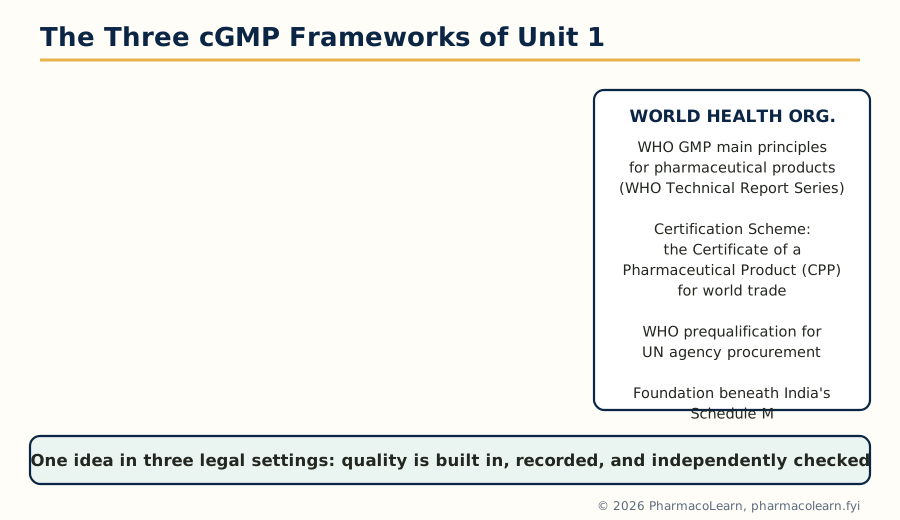 Figure: The United States Parts 210 and 211, the European GMP principles and the WHO guidelines: three statements of one idea, written for three different legal settings.
From hazard to standing control: how GMP rules are born
  A failure with harm (contamination, mix-up, wrong strength)
        -> Investigation finds the system gap, not only the error
        -> A control is written into regulation or guidance
        -> Inspectors verify the control in every later facility
        -> The failure mode becomes examinable, auditable, rare
1.4 The European framework: Directive 91/356/EEC and the GMP principles
The syllabus names the European statement of GMP as the principles and guidelines of good manufacturing practice laid down by Commission Directive 91/356/EEC of 13 June 1991, for medicinal products for human use, and directs attention to Articles 6 to 14, the operative articles in which the principles themselves are stated. Read in order, the articles build the same factory as Part 211, from the top down: a quality management requirement that the manufacturer operate a system of quality assurance incorporating GMP; personnel requirements (sufficient qualified staff, an organisational chart, training, hygiene); premises and equipment fit for their intended use and maintained to minimise contamination and error; documentation that is clear, controlled and retained; production conducted to clear instructions with in-process controls and validation; quality control independent of production, with sampling and testing to specifications; rules for work contracted out (contract manufacture and analysis) so responsibility cannot be outsourced away; a system for complaints and product recall; and self inspection, the manufacturer's duty to audit itself against the principles and correct what it finds. The directive has since been recast (Directive 2003/94/EC, and today the principles live for daily use in EudraLex Volume 4, the EU GMP Guide, whose Part I chapters mirror these article subjects), but the syllabus's choice of the 1991 text is deliberate: it is the cleanest short statement of the principles, and examiners ask for it by its article structure. A student should know both addresses: 91/356/EEC Articles 6 to 14 for the examination, EudraLex Volume 4 for the workplace.
1.5 The WHO framework: cGMP guidelines for the world
The World Health Organization writes GMP for the countries that have no large inspectorate of their own and for the products that move between all countries. The WHO GMP main principles for pharmaceutical products, published in the WHO Technical Report Series and revised over the years, state the same requirements in the same order (quality management, sanitation and hygiene, qualification and validation, complaints, recalls, contract production, self inspection, personnel, premises, equipment, materials, documentation, production and quality control), and they are supplemented by specific guidelines, for example for sterile products, biological products and water systems. WHO GMP matters commercially out of proportion to its length, for two reasons. First, the WHO Certification Scheme on the quality of pharmaceutical products moving in international commerce, under which a member state issues a Certificate of Pharmaceutical Product (CPP) for an exported medicine, rests on the exporting country's GMP being WHO aligned, so WHO GMP is the passport system of the world drug trade. Second, WHO prequalification of medicines, vaccines and diagnostics for UN agency procurement requires WHO GMP compliance at the manufacturing site. For India, whose industry exports to every regulatory tier, WHO GMP and the national Schedule M (Unit 5) are the twin foundations beneath the stricter US and EU systems.
1.6 GAMP 5: good practice for computerized systems in manufacturing
A modern plant runs on software: programmable logic controllers, manufacturing execution systems, laboratory information systems, electronic batch records. The syllabus therefore pairs the GMP texts with GAMP 5, the ISPE (International Society for Pharmaceutical Engineering) guide, "A Risk-Based Approach to Compliant GxP Computerized Systems". GAMP 5 is a guide, not a regulation, but regulators accept its method, and it supplies the working vocabulary of the whole subject's automation side: the life cycle of a computerized system from concept through operation to retirement; software categories (Category 1 infrastructure software, Category 3 non-configured products, Category 4 configured products, Category 5 custom applications) that scale the validation effort to the risk; specification and verification matched in a V shape (Unit 5 returns to this); and the principle that effort should follow patient safety, product quality and data integrity risk rather than paper volume. GAMP 5 is the bridge between this unit and Unit 3: GALP and Part 11 govern laboratory automation in the same spirit.
1.7 Medical devices and IVDs: the GHTF guidance documents
Medicines are not the only regulated products in this subject. For medical devices and in vitro diagnostic medical devices (IVDs), the harmonisation work was done by the Global Harmonization Task Force (GHTF), founded in 1992 by regulators and industry of the founding economies, and succeeded in 2011 by the International Medical Device Regulators Forum (IMDRF), which maintains and extends the GHTF document library. The GHTF wrote in five study groups, and their division of labour is the examinable map: SG1, regulatory systems, definitions, essential principles of safety and performance, and the summary technical documentation (STED); SG2, post-market surveillance and vigilance reporting; SG3, quality systems for device manufacturers (the direct ancestor of the device QMS requirements taught in Unit 5 through ISO 13485); SG4, auditing of device quality systems; SG5, clinical safety and performance. Device GMP thus differs from drug GMP in accent rather than in kind: design control and risk management move to the centre, because a device's quality is largely fixed at the design desk, and the quality system standard is ISO 13485 rather than a CFR part. MRA203T takes devices up in full; this unit's duty is to place the GHTF documents correctly, as the device world's GMP library.
Unit 2: Good Laboratory Practices
2.1 What GLP is, and what it is not
Good Laboratory Practice (GLP) is a quality system for the organisational process and conditions under which nonclinical health and environmental safety studies are planned, performed, monitored, recorded, archived and reported. Its territory is the safety study: the toxicity, mutagenicity and related experiments whose results a regulator reads when deciding whether a substance may proceed toward humans. GLP does not judge whether the science is clever; it guarantees that the study was done as described, by identifiable people, with calibrated equipment, under written procedures, leaving a complete record from which the work can be reconstructed years later by someone who was never in the building. Two distinctions examiners insist on: GLP is not GCP (which governs human trials), and GLP is not laboratory accreditation for routine analysis (which is the territory of ISO/IEC 17025, met in section 2.8); a clinical pathology result inside a GLP study follows GLP, a hospital laboratory follows its own systems, and confusing the three settings loses marks and, in industry, audits.
2.2 Why GLP exists: the IBT scandal and the 1978 rule
GLP was written in response to fraud, not error. In the 1970s, investigations of Industrial Bio-Test Laboratories (IBT), then the largest independent toxicology laboratory in the United States, found studies that had been fabricated, altered or so carelessly run that hundreds of safety studies supporting marketed products could not be relied on. The scandal's lesson was structural: a sponsor's data package could look perfect while the underlying work was worthless, because nothing required the raw work to be kept, checked or reconstructable. The FDA answered with the GLP final rule of 1978, codified at 21 CFR Part 58 and effective in 1979, imposing organisation, personnel, facility, documentation and quality assurance requirements on nonclinical laboratory studies. The OECD followed with its Principles of Good Laboratory Practice (1981), and built around them the system of Mutual Acceptance of Data (MAD): a study done under OECD GLP in one member country must be accepted for assessment in the others, ending duplicate animal testing across borders. India operates a national GLP compliance monitoring programme aligned to OECD (section 2.8). Every clause of Part 58 can be traced to an IBT era failure: animals replaced without record, dead animals written up as completing studies, raw data that did not exist.
2.3 The US FDA GLP regulations: Subparts A to K
The syllabus requires the regulations as a structure: 21 CFR Part 58, Subpart A to Subpart K. The map is:
| Subpart | Title and core content |
|---|---|
| A | General provisions: scope, definitions, applicability to studies supporting FDA applications |
| B | Organization and personnel: management duties, the study director, the quality assurance unit, personnel qualifications and training |
| C | Facilities: suitable size and construction, separation of functions, animal care, storage, handling areas |
| D | Equipment: design, maintenance, calibration, standard operating procedures for equipment, records |
| E | Testing facilities operation: standard operating procedures, reagent and solution labeling, animal care |
| F | Test, control, and reference substances: characterization, handling, storage, distribution, labeling and accountability |
| G | Protocol for and conduct of a nonclinical laboratory study: the written protocol, its required elements, conduct to protocol, changes recorded |
| H and I | Reserved |
| J | Records and reports: the final report, approval statements, storage and retrieval of records and specimens, retention periods, archives |
| K | Disqualification of testing facilities: grounds, notice, hearing, consequences and reinstatement |
Subparts B, G and J carry the system's heart. Subpart B creates the two people on whom everything hangs (section 2.4). Subpart G makes the protocol sovereign: a study is a written plan approved before work begins, and every departure from it is a recorded amendment or deviation, never a silent adjustment, so that the final report can be checked against the intention. Subpart J makes the study permanent: raw data, specimens and the signed final report are archived and retrievable for defined periods (in the FDA scheme, at least five years after submission of results in an application, or longer where the application is approved), because a safety study may be re-read a generation later when a harm appears.
2.4 The people of GLP: management, study director, quality assurance unit
GLP distributes responsibility in a triangle that examiners love. Testing facility management owns the organisation: it appoints the study director, provides the quality assurance unit, facilities, staff and resources, and is answerable for the facility's overall GLP compliance. The study director is the single point of control for one study: the individual responsible for its overall conduct and its final report, who approves the protocol, ensures procedures are followed and data recorded, judges deviations, and signs the report as a true account. One study, one named director: this rule exists because the IBT failures thrived where responsibility was everyone's and therefore no one's. The quality assurance unit (QAU) is the independent inspectorate inside the facility: a person or people, separate from study conduct, who inspect studies at critical phases, audit the final report against raw data, and maintain a signed quality assurance statement in the report listing what was inspected and when, and what was reported to management and the study director. A QAU that reports to the study director it inspects would fail the regulation; its independence is the system in miniature.
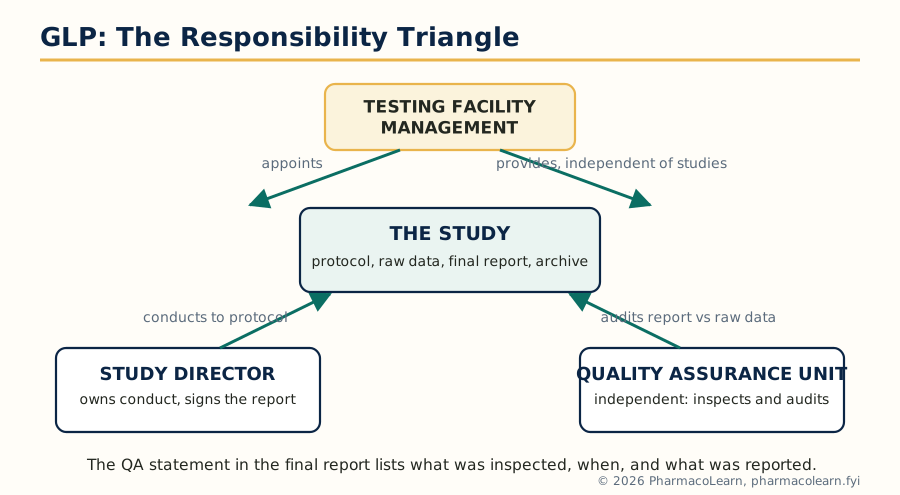 Figure: Management, the study director and the quality assurance unit: three corners of GLP responsibility, joined by the protocol and the archived record.
2.5 Documentation in GLP
Documentation is where GLP becomes visible. The system runs on standard operating procedures (SOPs) for every recurring operation, held controlled and available at the point of use, with deviations documented; on raw data, defined as the original records and certified copies from which results are computed, recorded promptly, legibly and indelibly, with corrections made by single line strike through, initialled and dated, never obliterated; and on the final report, which carries the study director's signed statement of compliance and the QAU statement, and must allow the study to be reconstructed. Around these sit the supporting records: training files, equipment calibration and maintenance logs, animal receipt and husbandry records, test item characterization and accountability, and the archives, secure, indexed, access controlled rooms or systems with a designated archivist, because a record that cannot be found is legally a record that does not exist. The objectives of this subject name good documentation practice as one of the practices to be mastered; in truth it is the common solvent of all four practices in this course, and Unit 3 shows what happens to it when the paper becomes electronic.
2.6 Controlling the GLP inspection process
A GLP facility will be inspected: by the FDA under its Bioresearch Monitoring (BIMO) programme, by the national GLP monitoring authority, and by sponsors placing studies. Controlling the inspection process means running the facility so that an inspection is a demonstration, not a discovery. Its elements are practical and examinable: a standing state of readiness (current SOP index, training records, calibration status, archive index, all retrievable within hours); an inspection host procedure naming who receives inspectors, escorts them, logs every request and provides copies under control; front room and back room discipline, in which requests are answered from a managed document room while subject experts are prepared before they meet inspectors; complete and honest answers, because inspectors forgive findings and do not forgive concealment; and a managed response afterward, in which observations (in the FDA system, recorded on Form FDA 483) receive a prompt written reply with corrective and preventive actions. Facilities fail inspections less often for bad science than for bad control: studies they cannot reconstruct, QA statements they cannot support, archives they cannot search. The inspection is the audit of the system of section 2.7 by an outsider, and the same rules win both.
2.7 Audit under GLP: goals of the laboratory quality audit, and audit tools
The laboratory quality audit is the QAU's own instrument, and its goals are worth listing as the syllabus frames them: to verify that studies comply with GLP, the protocol and SOPs; to verify that the final report accurately and completely reflects the raw data; to detect systemic weaknesses (a recurring deviation, an untrained operator, a drifting instrument) before a regulator does; and to give management an evidence based picture of the facility's compliance health. Audits divide by object: study based audits inspect a live study at critical phases; facility based audits examine the systems (archives, animal house, calibration programme) across studies; process based audits follow one procedure end to end; and the report audit, the line by line comparison of report against raw data, is the last internal gate before a report leaves. The audit tools are correspondingly concrete: approved checklists built from the regulation, protocol and SOPs; the master schedule of studies; sampling plans for records; interview technique; and the audit trail through documents, in which every number in a report is chased to its raw datum. Findings are classified, reported to the study director and management, answered with corrective action, and followed up: an audit without follow up is theatre, a point MRA102T develops for GMP audits.
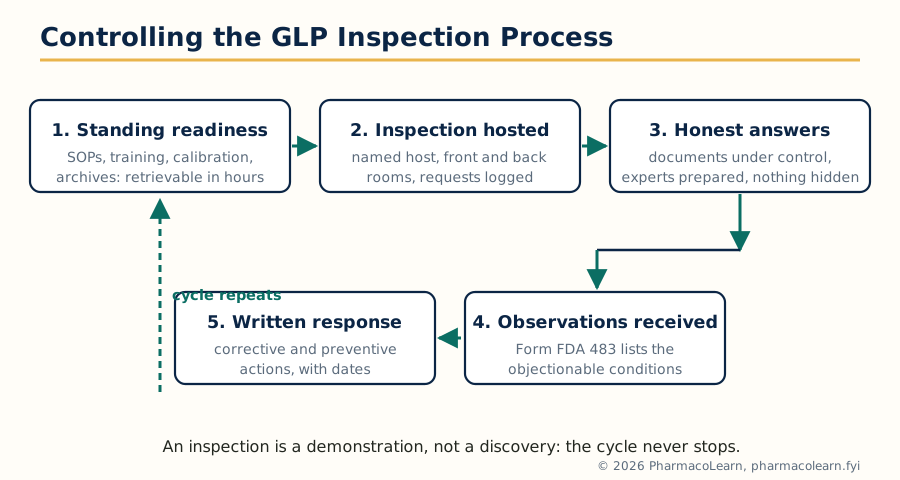 Figure: Inspection readiness as a continuous cycle: readiness, hosting, honest answers, written response, corrective action, and readiness again.
2.8 ISO and QCI: the Indian and international standards layer
Two standard systems border GLP and appear in the syllabus beside it. ISO/IEC 17025 sets general requirements for the competence of testing and calibration laboratories: management requirements and technical requirements (personnel, accommodation, methods and validation, equipment, traceability, sampling, handling of items, quality assurance of results, reporting). It accredits the competence of routine laboratories; it is not GLP, and a 17025 accredited laboratory is not thereby GLP compliant, but the two overlap in equipment, calibration and documentation discipline, and many facilities hold both. In India, accreditation and monitoring run through the Quality Council of India (QCI), the national accreditation body, whose board NABL (National Accreditation Board for Testing and Calibration Laboratories) accredits laboratories to ISO/IEC 17025, while India's National GLP Compliance Monitoring Authority (NGCMA), under the Department of Science and Technology, inspects and certifies GLP test facilities against the OECD principles and represents India in the OECD MAD system, which India joined as a full adherent in 2011. For the examination, the chain to remember is: OECD principles define GLP, NGCMA certifies Indian facilities against them, MAD makes their studies acceptable abroad, QCI and NABL run the parallel 17025 accreditation world.
2.9 The future of GLP regulations
GLP is a mature system changing at its edges, and the syllabus asks where it is going. Four directions are visible. Computerization is the deepest: electronic raw data, laboratory information systems and automated instruments have moved the old paper concepts (original record, certified copy, archive) into systems governed by Part 11 and its international equivalents, which is why Unit 3 exists. Multi site studies, in which one study is split across facilities and countries, have forced the roles of principal investigator and lead QA and OECD guidance on remote conduct. Data integrity has become the organising anxiety of all the good practices, expressed in principles such as ALCOA and its extensions (records attributable, legible, contemporaneous, original, accurate, and also complete, consistent, enduring and available). And scope pressure grows as new study types (in vitro methods, in silico toxicology, organ on chip systems) ask whether and how GLP should cover work that has no animal house at all. The principles have survived every technology change since 1978 unchanged in substance, because they were written about honesty and reconstruction rather than about paper; that is the sentence with which to close an examination answer on GLP's future.
Unit 3: Good Automated Laboratory Practices
3.1 Why automation needed a practice of its own
By the 1980s the analytical laboratory was filling with computers: chromatographs with integrators, balances printing to systems, laboratory information management systems (LIMS) holding results. Each removed a human transcription step and added an invisible one: data could be altered, reprocessed or deleted without the strike through and initials that paper GLP made visible. Good Automated Laboratory Practices (GALP) arose to extend GLP's guarantees into that world. The US Environmental Protection Agency, whose laboratories faced the problem first at scale, issued GALP guidance for its own automated laboratories, and the framework was taken up across regulated industry as the working statement of how a computerized laboratory system stays trustworthy: documented, validated, secure, and operated by trained people under SOPs. GALP is best understood as GLP translated for systems: wherever GLP says a record, GALP asks what the record is when it is a database entry; wherever GLP says a signature, GALP asks what proves identity on a screen.
3.2 Principles of GALP
The GALP principles can be stated as a short creed, and examiners accept them in this form. Data are the raw material and must be protected as such: electronic raw data are defined, backed up and archived with the same seriousness as paper notebooks. Systems are validated before use: a computerized system must be shown to do what it purports to do, consistently, before regulated work depends on it. Changes are controlled: hardware, software and configuration changes pass through documented change control with revalidation proportionate to the change. Access is personal and limited: users have unique identities, authority matched to role, and no shared accounts behind which an action could hide. Everything is attributable: audit trails record who did what, when, and what the value was before and after. People are trained and procedures are written: automation removes no responsibility; it relocates it to those who configure, operate and review the system. And the system is periodically reviewed: validation is a state to be maintained, not a certificate to be framed.
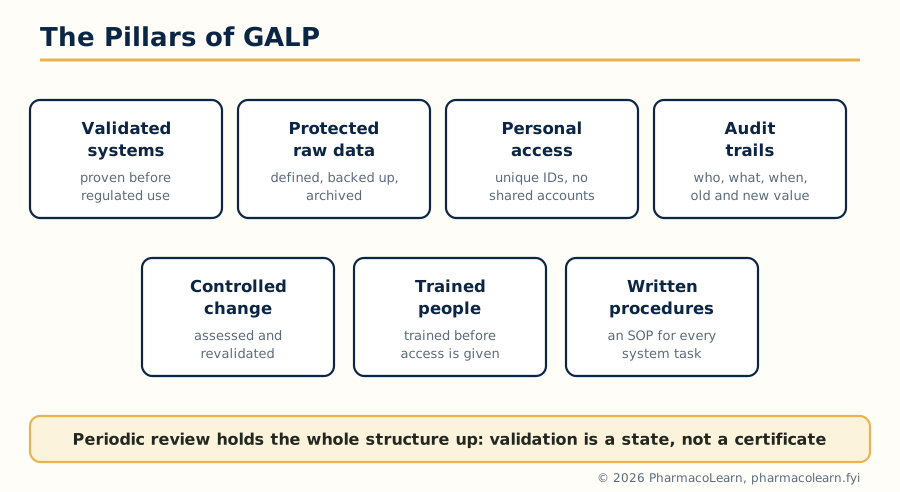 Figure: The GALP pillars: validated systems, protected raw data, personal access, audit trails, controlled change, trained people, written procedures.
The validation life cycle of a laboratory system
  User requirements written (what the lab needs the system to do)
        -> Vendor and software evaluation against the requirements
        -> Installation Qualification: installed as specified
        -> Operational Qualification: operates to specification
        -> Performance Qualification: performs in real laboratory use
        -> Release for regulated use, under change control
        -> Periodic review, revalidation after significant change
3.3 GALP requirements in practice
Translated into requirements, the principles produce the working list a laboratory is audited against. System documentation: an inventory of hardware and software with versions and configurations, network and interface maps, and the validation dossier for each regulated system. Security administration: user account management, password rules, role based permissions, and prompt removal of leavers' access. Data management: defined raw data for each system, backup schedules with tested restoration, time synchronization across systems so audit trails can be correlated, and archives from which electronic records remain readable for the full retention period, including after software upgrades. Operational discipline: SOPs for use, administration, incident handling and disaster recovery; a change log; and vendor management for hosted and cloud systems, in which the laboratory keeps responsibility for data even where a supplier keeps the servers. None of this is ornament: every item answers a failure that has actually been found in inspections, from shared logins to backups that had never once been restored.
3.4 SOPs of GALP, and training documentation
GALP requires its own SOP family, distinct from the analytical SOPs of the laboratory: SOPs for system use (per system), for user account and access management, for backup and restore, for change control of computerized systems, for audit trail review, for incident and problem management, for periodic review, and for archiving and retirement of systems. Behind them sits training documentation: a training matrix mapping each role to the systems and SOPs it requires, records showing each user was trained before being given access, and evidence of effectiveness where the task is critical. The audit question that exposes weak laboratories is simple: show me who may reprocess a chromatogram in this system, and show me where each of them was trained and authorised to do so. If the answer lives in a person's memory rather than in records, the GALP requirement is unmet however good the software is.
3.5 21 CFR Part 11: electronic records and electronic signatures
The regulation that gives GALP its legal teeth in the United States is 21 CFR Part 11, "Electronic Records; Electronic Signatures", issued by the FDA in 1997. Its premise is equivalence under conditions: electronic records and signatures are acceptable in place of paper records and handwritten signatures required by the predicate rules (such as Parts 58 and 211) when the systems holding them meet Part 11's controls. For electronic records the core controls are: system validation; the ability to generate accurate and complete copies for inspection; record protection throughout the retention period; computer generated, time stamped audit trails that record operator entries and actions creating, modifying or deleting records, with prior values never obscured; authority checks limiting system access to authorised individuals and functions; operational and device checks; and documentation control. For electronic signatures, Part 11 requires that a signature be unique to one individual, that identity be verified before an account is issued, that a signed record display the signer's name, the date and time, and the meaning of the signing (review, approval, authorship), and that signatures be linked to their records so they cannot be copied to another document. The FDA's 2003 guidance on the scope and application of Part 11 narrowed enforcement to these core elements while keeping the regulation itself in force, a distinction worth one line in any examination answer: the rule stands; the guidance sets enforcement priorities.
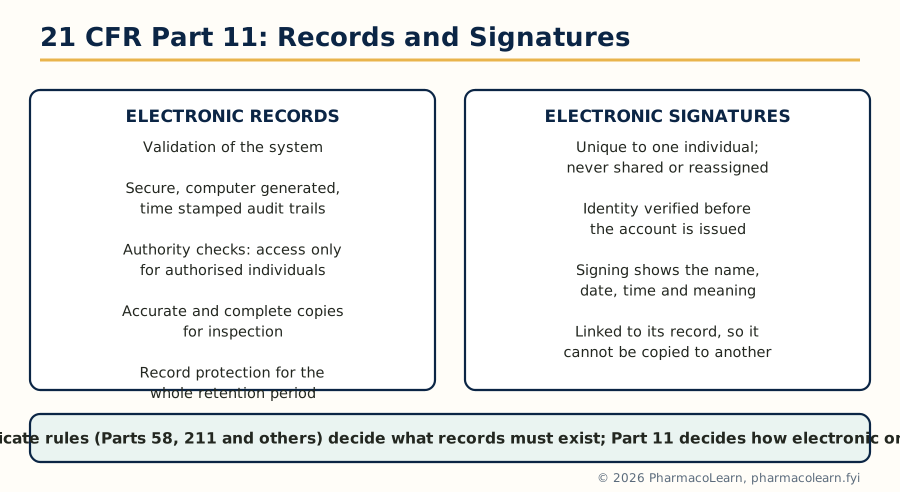 Figure: 21 CFR Part 11 in one view: the record controls on the left, the signature controls on the right, validation beneath both.
3.6 The general checklist of 21 CFR Part 11
The syllabus asks for the general checklist by which a system is judged Part 11 compliant, and it is best learned as questions an auditor asks, in order. Is the system validated, with documented evidence, for its intended regulated use? Are access controls enforced, with unique user IDs, password complexity and expiry, and automatic logoff or screen locking? Is a secure, computer generated audit trail active, recording creation, modification and deletion with user, date, time and old and new values, retained at least as long as the records, and protected from the users it watches? Are electronic signatures unique, identity verified, displayed with name, date, time and meaning, and cryptographically or logically linked to their records? Can the system produce accurate and complete copies of records, in human readable and electronic form, for inspection? Are records retrievable throughout their retention period, with backup and archive procedures proven by test restoration? Are operational sequence checks and device checks in place where the process needs them? Is there documentation control over system documentation itself, and training records for every user? A system for which any answer is "no, but" is a system carrying a Part 11 finding in waiting.
3.7 The software evaluation checklist
Before validation comes selection, and GALP formalises it in the software evaluation checklist used when a laboratory buys or builds a system. Its heads: functional fit (does the software perform the laboratory's required functions, tested against the written user requirements, not the vendor's brochure?); regulatory capability (audit trail design, access control model, electronic signature support, data export and archiving features, in short native Part 11 capability); vendor quality (the supplier's development and testing practices, established by questionnaire or audit, its installed base in regulated laboratories, its support and patch discipline); technical fit (platform, interfaces to instruments and other systems, performance, backup architecture); validation cost (the effort the product's design will demand: configurable products with vendor validation documentation cost less to validate than custom code, the GAMP 5 category logic of Unit 1); and life cycle terms (licensing, upgrade policy, data migration on retirement). The checklist's purpose is economic as much as scientific: the cheapest software to buy is often the dearest to make compliant, and the evaluation is where that truth is cheapest to learn.
3.8 ISO and QCI standards in the automated laboratory
The standards layer of Unit 2 returns here with an automation accent. ISO/IEC 17025 accreditation of a testing laboratory now examines its information management directly: the standard requires that laboratory information management systems be validated, protected from unauthorised access and tampering, and operated with data integrity safeguards, so an accredited laboratory cannot treat its LIMS as outside its quality system. ISO 9001 supplies the general management system frame (documented information, control of changes, corrective action) within which many laboratories house their system procedures. In India, NABL accreditation assessments under QCI test these points on site, and CDSCO and NGCMA inspections of GLP and GMP facilities apply the same expectations to the systems they find. The examination answer to hold is one of convergence: GALP stated the principles, Part 11 made them law for FDA regulated records, and the ISO family absorbed the same expectations into accreditation, so a laboratory that builds to GALP is rarely surprised by any of its judges.
Unit 4: Good Distribution Practices
4.1 Why distribution needs its own practice
A medicine can leave a perfect factory and arrive at the patient ruined or replaced. Between release and dispensing it passes through exporters, importers, distributors, wholesalers, transporters, warehouses and pharmacies, across climates and borders, in the hands of people the manufacturer does not employ. Good Distribution Practice (GDP) is the quality system for that journey: the set of requirements that keeps the product's quality and integrity intact through storage and transport, keeps its movement traceable, and keeps falsified products out of the legitimate chain. Its founding anxiety differs from GMP's. GMP fears the factory's own errors; GDP fears the world's: heat in a container on a dock, a broken cold chain, theft and re-entry of expired stock, a falsified consignment wearing a genuine product's name. Regulators elevated GDP from guidance to law after repeated falsified medicine incidents showed the distribution chain, not the factory, as the soft target.
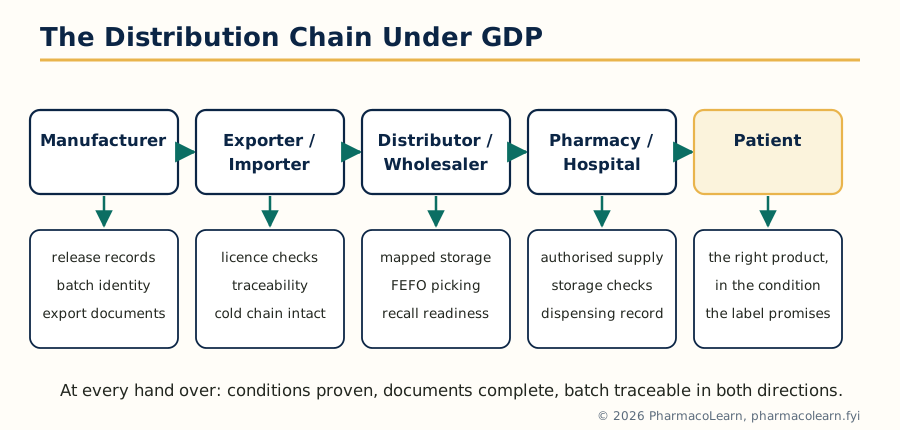 Figure: From manufacturer to patient: every hand over in the chain is a GDP control point for storage conditions, documentation and traceability.
4.2 Legal GDP requirements worldwide
The syllabus asks for the legal position across the world, and the honest summary is a patchwork with one design. In the European Union, GDP became a binding guideline in 2013 (the Guidelines on Good Distribution Practice of medicinal products for human use, 2013/C 343/01), given force through the amended Directive 2001/83/EC and the Falsified Medicines Directive 2011/62/EU: wholesale distribution requires authorisation, a responsible person, a quality system, and safety features (unique identifiers and anti tampering devices) on packs. WHO publishes GDP for pharmaceutical products (in its Technical Report Series, notably TRS 957, Annex 5, within the wider WHO good distribution and trade practices), which member states adopt or adapt; it is the reference text for most of the world. In the United States, distribution is governed state by state through wholesaler licensing under the Prescription Drug Marketing Act tradition, overlaid federally by the Drug Supply Chain Security Act (DSCSA) of 2013, which builds unit level traceability across the supply chain. India regulates distribution through the Drugs and Cosmetics Act licensing system for sale and distribution, CDSCO guidance and, for exports, the traceability and barcoding requirements imposed on exported medicines. The legal forms differ; the requirements converge on authorisation, responsible persons, premises and transport control, records, and recall capability.
4.3 Principles of GDP
GDP can be reduced to principles that any of the legal systems above would recognise. Quality is managed, not inspected, in distribution too: the distributor operates a quality system with defined responsibilities, risk management and change control proportionate to its activities. The product's identity and history are never lost: every movement is recorded, stock is traceable batch by batch, and the chain of custody can be walked in both directions, which is what makes recalls and falsified product investigations possible. Conditions are controlled and proven: storage and transport keep the labelled conditions, with monitoring records to prove it, not merely intentions. Only legitimate product moves: suppliers and customers are qualified and verified as authorised, suspicious offers and incidents are reported, and falsified products are quarantined and reported, never quietly returned to stock. Problems are handled in the open: complaints, returns, recalls and deviations are recorded, investigated and closed under procedure. Examiners reward the observation that GDP is GMP's philosophy (system, records, named responsibility, independent checking) re-expressed for warehouses and trucks.
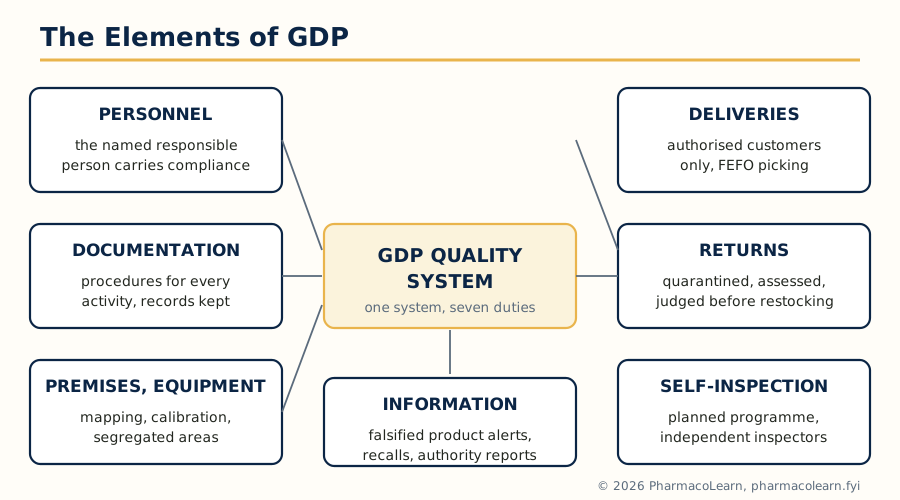 Figure: The GDP elements named in the syllabus: personnel, documentation, premises and equipment, deliveries, returns, self-inspection and information.
4.4 Personnel: the responsible person
GDP names its accountable human just as GLP names the study director. The responsible person (in EU terminology) is the named individual, suitably qualified and experienced, who carries personal responsibility for the distributor's GDP compliance: for the quality system, for the accuracy of records, for training, for the handling of recalls, complaints and returns, for approving suppliers and customers, and for ensuring self-inspections happen. Around this office the ordinary personnel requirements stand: an organisational structure with defined duties, enough staff for the volume of work, documented training in GDP and in each person's tasks, and hygiene and conduct rules for warehouse work. The regulatory point of a named responsible person is the same as in Unit 2: when something fails in a warehouse at midnight, the system must already know whose decision it was and whose it now is.
4.5 Documentation, premises and equipment
GDP documentation mirrors GMP's: written procedures for every activity that can affect quality (receipt, storage, order processing, transport, returns, recalls), records made at the time of each operation and kept for defined periods (in the EU scheme, at least five years, or one year beyond the product's expiry, whichever is longer), and delivery documentation that lets every consignment be traced. Premises must be designed or adapted to protect stock: clean, dry, within acceptable temperature limits, segregated areas for quarantined, rejected, returned and recalled goods under lock or electronic separation, security against unauthorised entry, and pest control. Equipment includes the monitoring estate itself: calibrated thermometers and data loggers, temperature mapping of storage areas in summer and winter to find hot and cold spots, alarms for excursions, and qualification of vehicles and shipping containers, including validated cold boxes for cold chain products, so that the labelled conditions are maintained in a truck as provably as in a warehouse. The recurring examination theme is proof: GDP does not ask whether the warehouse felt cool, it asks for the mapping study, the calibration certificates and the monitoring record.
4.6 Deliveries to customers, returns, self-inspection, and provision of information
The operational heart of the unit is four procedures. Deliveries to customers: orders are supplied only to authorised recipients (licensed pharmacies, hospitals, wholesalers), stock is picked by FEFO (first expiry, first out) so the earliest expiring batch moves first, transport conditions and packaging are matched to the product, and the transaction is recorded completely enough to execute a recall of that batch to that customer. Returns: goods returned from customers are not stock until judged; they are quarantined, assessed against defined criteria (unopened, in original packaging, within expiry, demonstrably stored correctly, returned within an agreed short period), and the decision to restock, destroy or return to the supplier is recorded with reasons, because the returned goods stream is a known door for falsified products. Self-inspection: the distributor audits itself against GDP at planned intervals under a written programme, by staff independent of the area inspected, recording findings and closing corrective actions, the GDP form of the self inspection principle met in Unit 1's European articles. Provision of information: the duty to tell regulators and partners what they need to know: notifying authorities of suspected falsified products, informing customers and authorities in a recall, and supplying the documentation that lets the next link in the chain meet its own duties.
4.7 Stability testing principles in distribution
GDP borrows one laboratory discipline and bends it: stability. A product's shelf life is earned in stability studies (the ICH stability framework of Unit 5's guidelines, run in climatic zones), and its labelled storage condition is a promise made on that data. Distribution is where the promise is kept or broken. The governing principles: excursions are data, not gossip: a recorded temperature excursion is assessed against the product's stability data and budget (the total time out of condition the data can support) by a competent person, and the decision is documented; mean kinetic temperature and excursion allowances exist precisely because perfect chains are impossible and assessed chains are acceptable. Cold chain products (typically 2 to 8 degrees Celsius) receive the strictest handling, with continuous monitoring and validated shippers, because freezing can damage a vaccine or biologic as surely as heat. And stability testing principles flow back upstream: distribution experience (recurrent excursions on a route, seasonal extremes) feeds the manufacturer's stability and packaging decisions, which is why GDP sits inside the quality system and not outside the factory gate.
4.8 WHO GDP, USP GDP and supply chain integrity; CDSCO guidance and ISO standards
Two reference texts close the syllabus's list. WHO GDP (the WHO good distribution practices for pharmaceutical products, with the companion WHO guidance on good trade and distribution practices) is the model most national systems copy: it covers the quality system, personnel, premises and equipment, shipment containers and labelling, dispatch, transportation, documentation, repackaging and relabelling, complaints, recalls, returned products, counterfeit products, importation, contract activities and self-inspection, a table of contents that doubles as a GDP syllabus in itself. The USP treatment appears in its general chapter on good distribution practices for drug products (USP <1079> and its family), which frames distribution as supply chain integrity: the discipline of keeping a product within its quality system from manufacturer to patient, managing the risks of adulteration, diversion, theft, temperature abuse and falsification as one connected problem rather than as separate accidents. In India, CDSCO guidance and the Drugs and Cosmetics Act licensing regime govern distributors, the Indian Pharmacopoeia Commission and industry bodies publish aligned guidance, and export consignments carry government mandated barcoding and traceability. The ISO standards that support GDP are the generalists: ISO 9001 for the quality management system itself (Unit 5), and supply chain security standards of the ISO 28000 family where a distributor formalises its integrity controls. The student should leave the unit able to say, for any GDP question, which text governs in which territory and what all of them agree on.
Unit 5: Quality Management Systems
5.1 The concept of quality
Every practice in this subject is a servant of one idea, and Unit 5 finally names it. Quality in the pharmaceutical sense is not luxury or excellence in the abstract; it is the fitness of a product for its intended use, expressed by the standard definition used across the ISO family: the degree to which a set of inherent characteristics fulfils requirements. For a medicine, the requirements are unforgiving and mostly invisible to the user: correct identity, strength, purity, and performance in the patient, batch after batch, for the whole shelf life, for every patient, most of whom will never know a batch number. Because the patient cannot test the tablet, quality cannot be inspected into the product at the end (a tested sample proves something about the sample and, statistically, the batch; it cannot repair the batch), and so the discipline's founding maxim follows: quality should be built into the product, and testing alone is not enough. That sentence, which appears in substance in ICH Q10, is the intellectual charter of this entire subject: GMP builds quality into manufacture, GLP into studies, GDP into distribution, and the quality management system is the organisation wide machinery for building rather than hoping.
5.2 Total Quality Management
Total Quality Management (TQM) is the management philosophy from which the modern pharmaceutical quality system descends. Its teachers (Deming, Juran, Crosby) gave it durable elements: customer focus, where the customer of each process step includes the next step and ultimately the patient; total involvement, quality as everyone's job rather than a department's; process thinking, managing the process that makes results rather than exhorting the people who inherit it; continual improvement in small verified cycles (the plan, do, check, act cycle); and management by fact, decisions from measured data rather than opinion. Deming's fourteen points and Juran's trilogy (quality planning, quality control, quality improvement) are the classic examination furniture. TQM's pharmaceutical descendant replaced its voluntary language with regulatory obligation: where TQM urges, ICH Q10 requires, but the genealogy is direct, and a student who presents Q10 as applied TQM under GMP law has understood both.
5.3 Quality by Design
Quality by Design (QbD) is TQM's process thinking made pharmaceutical and mathematical, defined in ICH Q8 as a systematic approach to development that begins with predefined objectives and emphasises product and process understanding and process control, based on sound science and quality risk management. Its working elements form a chain every student should be able to walk: the quality target product profile (QTPP) states what the product must be; critical quality attributes (CQAs) name the measurable properties that must be controlled for the patient; risk assessment links material attributes and process parameters to those attributes and identifies the critical process parameters (CPPs); designed experiments explore how parameters interact and establish a design space, the multidimensional region within which operation is assured to give quality (movement within an approved design space is not a change; movement out of it is); and a control strategy carries the knowledge into routine manufacture, with a life cycle of continual improvement under ICH Q10. QbD matters to a regulatory affairs student commercially as much as scientifically: a dossier written in QbD language, with design space and control strategy, is the modern form of the applications MRA102T and MRA201T handle, and regulators reward the understanding it demonstrates with flexibility an old style dossier cannot claim.
5.4 The Six Sigma concept
Six Sigma is quality management expressed as statistics. A process is described by its variation, measured in standard deviations (sigma) between its mean and its specification limits; the higher the sigma level, the rarer the defect, with the six sigma standard corresponding to about 3.4 defects per million opportunities under the method's conventional allowance for long term process drift. The improvement engine is DMAIC: Define the problem and its critical to quality measures; Measure the current performance honestly; Analyze the data for root causes; Improve the process and verify the gain; Control the improved process so the gain is kept. (For designing new processes, the companion is DMADV.) In pharmaceutical quality work Six Sigma supplies the mathematics behind deviation reduction, yield improvement and complaint reduction programmes, and its belt system (yellow, green, black, master black) supplies the trained people. Its honest limitation belongs in an examination answer too: a sigma level is a statement about a defined process and measured data, and the method degenerates into ceremony where the measurement system itself is weak, which is why this subject teaches method validation (section 5.8) in the same unit.
5.5 Out of Specifications: handling the result that fails
An Out of Specification (OOS) result is a laboratory result that falls outside the established specification for its material or product. The handling of OOS results is where quality systems are most severely tested, because the temptation to test a failing batch into compliance is the exact sin GLP and GMP were written against, and regulators have the case law to prove it (the United States court judgment in the Barr Laboratories case of 1993 shaped the modern rules, and the FDA's guidance on investigating OOS results, issued in 2006 and revised since, is the working text). The disciplined sequence: Phase I, the laboratory investigation: the analyst and supervisor examine the obvious causes within the laboratory (calculation, dilution, instrument, standard, sample preparation), under pre written rules; if a clear laboratory error is proven and documented, the result is invalidated and a retest follows the procedure; averaging away, or quietly retesting until a pass appears, is prohibited. Phase II, the full scale investigation: if no laboratory cause is found, the investigation widens to manufacturing, with additional testing of retained samples under an approved plan, and the batch's disposition decided on the totality of evidence by the quality unit. Two neighbours must be kept distinct: an out of trend (OOT) result is within specification but against the expected pattern, a warning handled by trend review rather than the OOS procedure; and an atypical result in stability or in process data has its own handling. The principles that survive every version: no result is discarded without documented scientific cause, the original result is never deleted, and the quality unit, not the laboratory or production, owns the conclusion.
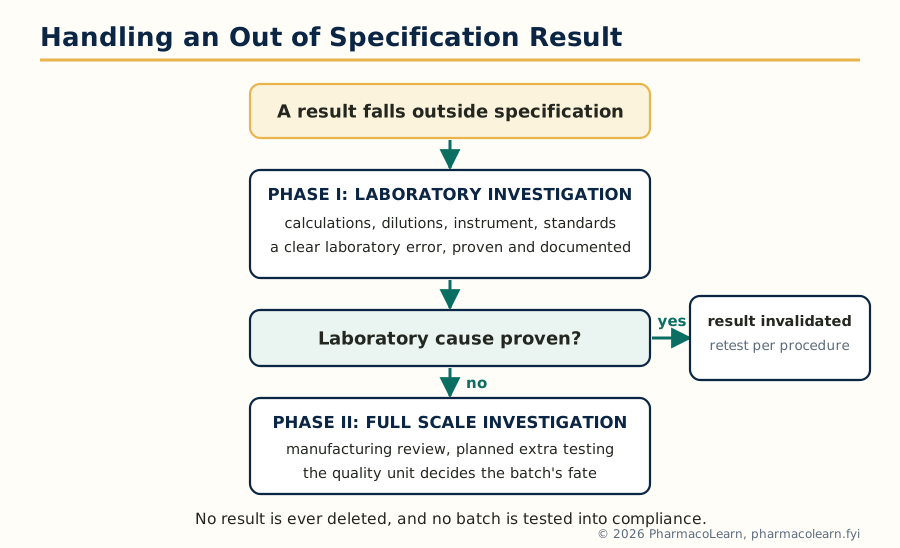 Figure: An out of specification result moves through a Phase I laboratory investigation and, if unexplained, a Phase II full scale investigation, with the quality unit deciding disposition.
Change control, step by step
  Change proposed and described, with reason
        -> Impact assessed: quality, safety, efficacy, validation, regulatory filing
        -> Approvals taken, including regulatory approval where the filing requires it
        -> Change implemented under plan, with training and document updates
        -> Effectiveness checked after implementation, and the change closed
5.6 Change control
Nothing in a validated, registered process may simply be altered: the product the regulator approved is the product of a described process, and an uncontrolled change silently makes a different product. Change control is the formal system that governs alteration: a documented proposal describing the change and its justification; an impact assessment across quality, safety, efficacy, validation status, documentation and regulatory commitments (the same change can be trivial in the plant and major in the dossier, requiring prior approval from one authority, notification to another, and only internal approval for a third, the classification logic MRA102T meets as PAS, SUPAC and CBE categories); approval by the quality unit and affected functions before implementation; implementation under a plan with updated SOPs, specifications and training; and a post implementation review confirming the change did what it promised and nothing it should not. Temporary changes are controlled with expiry dates, emergency changes with retrospective documentation under strict limits. Change control is the connective tissue of this whole subject: it is how GMP absorbs improvement without losing registration, how validated computer systems evolve under GALP, and how the Validation Master Plan of the next section stays true.
5.7 Validation and qualification: types, and the Validation Master Plan
Validation is documented evidence that a process, procedure or method, when operated within established parameters, will consistently produce a product or result meeting its predetermined specifications; qualification is the same idea applied to premises, equipment and utilities (proving the instrument is fit), and validation is built on qualification. The types of validation by timing are the classic trio: prospective validation, completed before routine production on the basis of protocol driven studies (the modern default); concurrent validation, performed during routine production in exceptional, justified circumstances; and retrospective validation, based on accumulated historical data for old stable processes, now little accepted for new claims. By object, the family includes process validation (in its modern life cycle form: process design, process qualification, continued process verification, per the FDA's 2011 process validation guidance), cleaning validation (section 5.8), analytical method validation (section 5.8), and computer system validation (Unit 3). All of it is planned in one document: the Validation Master Plan (VMP), the site's validation constitution, which lists what will be validated and qualified, the approach and acceptance criteria philosophy, responsibilities, documentation and scheduling, and the revalidation policy. An inspector who asks for the VMP is asking whether validation at this site is a system or a scrapbook.
5.8 Analytical method validation, utility validation and cleaning validation
Analytical method validation, governed by ICH Q2, proves a test method is fit for its purpose by measuring its performance characteristics: accuracy (closeness to the true value), precision (repeatability, intermediate precision and, where needed, reproducibility), specificity (the ability to measure the analyte undisturbed by everything else present), linearity and range (proportional response across the working interval), detection limit and quantitation limit (for impurity methods), and robustness (survival of small deliberate variations). Which characteristics are required depends on the method's job (identification, assay, impurity limit test, impurity quantitation), a matrix worth reproducing in an examination from Q2 itself.
The validation of utilities applies qualification to the invisible services: water systems (purified water and water for injection, qualified through design, commissioning and a phased sampling regime that proves chemical and microbiological control, then held under continuous monitoring, because water is the largest ingredient of most processes); steam (quality and dryness for sterilisation duty); compressed air (oil, water, particles and microbial quality at points of use); and HVAC (the heating, ventilation and air conditioning that delivers cleanroom air changes, pressure cascades, temperature and humidity, and is qualified with particle counts and recovery studies). Cleaning validation proves that cleaning procedures remove residues of the previous product, cleaning agents and microbial load to predetermined safe limits, classically derived from dose based criteria (a fraction, conventionally one thousandth, of the minimum therapeutic dose carried into the maximum daily dose of the next product) and the traditional 10 ppm and visually clean criteria, established on worst case products and hard to clean locations, with swab and rinse sampling. Together these three validation territories answer the inspector's deepest question: not whether today's batch passed, but whether the system can be trusted on the day nobody is watching.
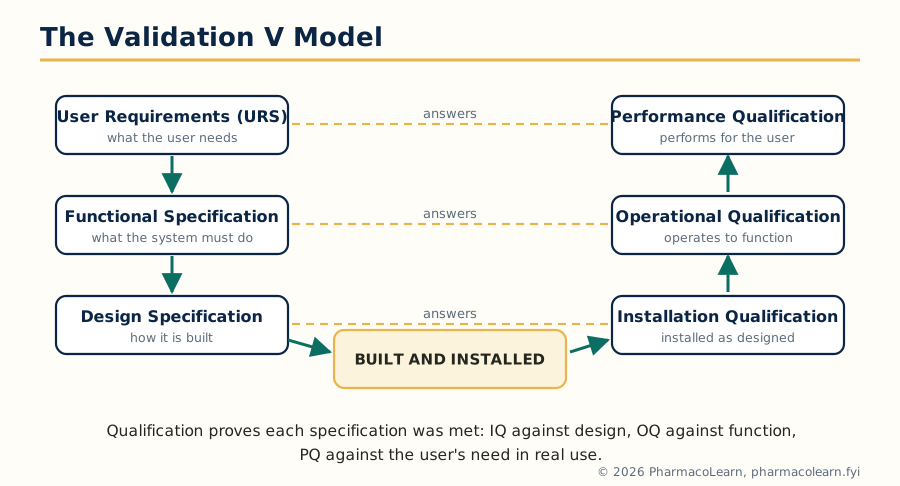 Figure: The V model of qualification: each specification level on the left is answered by a qualification level on the right, from user requirements down to design and back up.
5.9 The ICH process and the ICH guideline families
The International Council for Harmonisation (ICH), met in Unit 1's European and American frames and in MRA subjects throughout this branch, deserves its own section because Unit 5 names the ICH process itself. ICH was founded in 1990 (as the International Conference on Harmonisation, renamed when it became a legal association in 2015) by the regulators and industry associations of Europe, the United States and Japan, and has since widened to further regulators, including India's CDSCO as a member. Its method is deliberate: topics are chosen, an expert working group drafts a guideline through the five steps (consensus building, confirmation and adoption by the Assembly, regulatory consultation in each region, adoption of the harmonised guideline, and implementation in each region's law and guidance), and the result is one technical text that all member regulators accept. The guidelines are filed in four families: Q, quality (Q1 stability, Q2 analytical validation, Q3 impurities, Q6 specifications, Q7 GMP for active pharmaceutical ingredients, Q8 pharmaceutical development, Q9 quality risk management, Q10 pharmaceutical quality system, and their successors); S, safety (the nonclinical family, from carcinogenicity to genotoxicity); E, efficacy (the clinical family, including E6 good clinical practice); and M, multidisciplinary (M4, the Common Technical Document that MRA102T teaches, MedDRA, and electronic standards). The sentence that closes an examination answer on ICH: it establishes, in the syllabus's own words, the quality, safety and efficacy requirements of drug substances and products, so that a study, a validation or a dossier done once, to the harmonised text, can be read everywhere, which is the entire economic and ethical point of harmonisation: less duplication, faster access, no lower standard.
5.10 ISO 13485, Schedule M and CDSCO guidance: the closing frame
The unit closes where the subject began, with the device world and the home regulator. ISO 13485 is the international quality management system standard for medical devices: a QMS built on ISO 9001's skeleton, specialised for devices with requirements for design control, sterile manufacture, risk management linkage to ISO 14971, and regulatory reporting; certification to ISO 13485 is the normal evidence of a device maker's quality system worldwide and the descendant of the GHTF SG3 work of Unit 1. Beside it the syllabus places Schedule M of India's Drugs and Cosmetics Rules (printed in the syllabus in the compressed form "Sch M III"), the Indian GMP code: Schedule M states the good manufacturing practices for premises, plant and equipment for pharmaceutical products, and its recent revision aligns it more closely with WHO GMP; CDSCO administers it through the central and state inspectorates and publishes the guidance documents through which Indian manufacturers are judged, alongside the Medical Devices Rules 2017, which brought devices under a risk based Indian framework of their own. The regulatory affairs professional this subject is training will live between these frames for a career: international harmonised texts above, the Indian statute and CDSCO guidance at home, and ISO standards as the common technical language between them. Good Regulatory Practices is the foundation subject of the branch precisely because every later subject, documentation, clinical research regulations, Indian legislation, and the country by country regulatory aspects of Semester 2, is written in the vocabulary these five units have built.
Frequently Asked Questions
Q: What are the good regulatory practices, and which ones does MRA101T cover? They are the codified ways of working, the GxP family, that make pharmaceutical work acceptable to regulators: GMP for manufacturing, GLP for nonclinical laboratory studies, GCP for clinical trials, GALP for automated laboratory systems, GDP for distribution, and others such as GVP for pharmacovigilance. MRA101T teaches cGMP, GLP, GALP and GDP in depth, one unit each, and binds them together in Unit 5 with quality management systems, validation and the ICH process. GCP appears at the edges, since it belongs mainly to this branch's clinical research subjects.
Q: Why is the word "current" used in cGMP? To make the standard move with technology. When the United States revised its GMP regulations in 1978 it added "current" so that companies must use up to date technology and systems, not merely the practices that were acceptable when the text was written. A method that was good practice a generation ago, such as uncontrolled handwritten records where validated electronic systems now exist, can become a deficiency today without the regulation changing a word.
Q: What is the difference between 21 CFR Part 210 and Part 211? Part 210 states drug cGMP in general: the status and applicability of the regulations and the definitions, including the rule that a drug made outside cGMP is adulterated. Part 211 states the cGMP for finished pharmaceuticals in operational detail, in subparts covering organisation and personnel, buildings and facilities, equipment, control of components, production and process controls, packaging and labelling, holding and distribution, laboratory controls, records and reports, and returned and salvaged products. In short: 210 frames the law, 211 runs the factory.
Q: What do Articles 6 to 14 of Directive 91/356/EEC contain? They are the operative articles in which the European Commission's 1991 directive states the principles of GMP for human medicines: quality management, personnel, premises and equipment, documentation, production, quality control, contract manufacture and analysis, complaints and product recall, and self inspection. The directive has been recast since, and the principles are used today through EudraLex Volume 4, the EU GMP Guide, but the syllabus names the 1991 text because it states the principles in their cleanest short form.
Q: What is the role of the study director and the quality assurance unit in GLP? The study director is the single named individual responsible for the conduct of one nonclinical study and for its final report: approving the protocol, ensuring procedures are followed, judging deviations and signing the report as a true account. The quality assurance unit is independent of study conduct: it inspects studies at critical phases, audits the final report against the raw data, and places a signed QA statement in the report. The separation is the point: one person answers for doing the study, another for checking that it was done as reported.
Q: What is 21 CFR Part 11, and how does it relate to GALP? Part 11 is the FDA regulation of 1997 that accepts electronic records and electronic signatures in place of the paper records and handwritten signatures required by the predicate rules, when systems meet its controls: validation, audit trails, authority checks, record protection and signature controls. GALP is the broader good practice framework for automated laboratories, covering system documentation, security, training, change control and archiving. Part 11 gives GALP's principles legal force for FDA regulated records; GALP gives Part 11 its working context in the laboratory.
Q: Who is the responsible person in GDP, and what do they carry? The responsible person is the named, suitably qualified individual who carries personal responsibility for a distributor's good distribution practice compliance: the quality system, the accuracy and completeness of records, staff training, approval of suppliers and customers, the handling of complaints, returns and recalls, and the conduct of self-inspections. The office exists so that distribution failures have a named owner, exactly as the study director owns a GLP study.
Q: What is the difference between an OOS and an OOT result? An out of specification (OOS) result falls outside the established specification and triggers the formal investigation procedure: a Phase I laboratory investigation for assignable laboratory error, then, if unexplained, a Phase II full scale investigation extending into manufacturing, with the quality unit deciding the batch's disposition. An out of trend (OOT) result is inside specification but against the expected pattern of results; it is a warning handled through trend review and monitoring, not through the OOS procedure, though a pattern of OOT results can justify raising an investigation of its own.
Q: What are the types of validation, and what is a Validation Master Plan? By timing, validation is prospective (completed before routine production, the modern default), concurrent (during routine production, in justified exceptional cases) or retrospective (from accumulated historical data on old stable processes, little accepted now). By object it covers processes, cleaning, analytical methods and computerised systems, built on qualification of premises, equipment and utilities. The Validation Master Plan is the site document that plans all of it: the inventory of systems and processes to be validated, the approach, responsibilities, documentation and schedule, and the revalidation policy.
Q: What are the four ICH guideline families, and what does the Q family contain? ICH files its harmonised guidelines as Q (quality), S (safety, the nonclinical family), E (efficacy, the clinical family, including E6 on good clinical practice) and M (multidisciplinary, including M4, the Common Technical Document). The Q family carries the quality system of this subject: Q1 stability, Q2 analytical validation, Q3 impurities, Q6 specifications, Q7 GMP for active pharmaceutical ingredients, Q8 pharmaceutical development and quality by design, Q9 quality risk management and Q10 the pharmaceutical quality system.
Complete MRA101T notes, all 5 units in one PDF, free to keep.
Other M.Pharm subjects: MPH101T · MPC101T · MPL101T · MPH102T · MPH103T · MPH104T · MPL102T · MPL103T · MPL104T · MPC102T · MPC103T · MPC104T · MPH201T · MPH202T · MPH203T · MPH204T · MPC201T · MPC202T · MPC203T · MPC204T · MPL201T · MPL202T · MPL203T · MPL204T · MRA101T · MRA102T · MRA103T · MRA104T · MRM301T · MPG101T · MPG102T · MPG103T · MPG201T · MPG202T · MPG203T · MPG104T · MPG204T · MRA201T · MRA202T · MRA203T · MRA204T · M.Pharm