
MRA201T — Regulatory Aspects of Drugs & Cosmetics
4 hrs/week, 4 credits, 60 hours, 100 marks. Notes follow the M.Pharm syllabus, unit by unit.
MRA201T Regulatory Aspects of Drugs and Cosmetics notes for M.Pharm Regulatory Affairs Semester 2: FDA and EMA approval pathways, Japan PMDA, WHO prequalification, ASEAN and GCC registration, cosmetics law. Free unit wise PDF downloads on PharmacoLearn.
Units in this subject
- Unit 1 — USA and Canada
- Unit 2 — European Union and Australia
- Unit 3 — Japan
- Unit 4 — Emerging Markets and WHO
- Unit 5 — Asian Countries, CIS and GCC
Download MRA201T PDF Notes
Free PDFs for this subject, one per unit:
Regulatory Aspects of Drugs and Cosmetics, subject code MRA201T, is the first core subject of M.Pharm Regulatory Affairs, Semester 2. It carries 4 credits and 60 hours of theory, taught at 4 hours per week, for 100 marks. Semester 1 built the home ground: MRA101T taught the good practices, MRA102T the documents and submissions craft, MRA103T the regulation of clinical research, and MRA104T the Indian statute book and intellectual property rights. This subject turns outward. Its question is the one every Indian manufacturer who exports must answer: how do the other regulatory systems of the world decide what may be sold as a drug or a cosmetic, and what must a dossier prove to each of them? The course is designed to impart fundamental knowledge on the drug development process and the regulatory requirements for approval of new drugs, drug products and cosmetics in regulated and semi-regulated countries, and its objectives are to know the process of drug discovery, development and generic product development, the approval process and registration procedures for active substances and drug products in the United States and the European Union, the cosmetics regulations of regulated and semi-regulated countries, and to make a comparative study of India against the other global regulated markets.
The units are arranged as a journey outward from the most demanding markets to the widest world. Unit 1 studies the United States and Canada: the FDA, the Federal Food, Drug, and Cosmetic Act, the Hatch-Waxman settlement that created the modern generic industry, the application family of IND, NDA, ANDA and supplements, and cosmetics law in the USA and Canada including the MoCRA reform of 2022. Unit 2 studies the European Union and Australia: the networked EMA system, the four marketing authorization procedures, the ASMF and the Certificate of Suitability, variations and the Qualified Person, and the European cosmetics Regulation with its notification model, with Australia's ingredient based scheme beside it. Unit 3 studies Japan: the PMDA, the Pharmaceuticals and Medical Devices Act, the Master File system and Japan's distinctive post marketing re-examination machinery. Unit 4 steps back to the emerging markets and the World Health Organization: the regional harmonization committees, WHO GMP, the prequalification programme and the Certificate of Pharmaceutical Product. Unit 5 works through the Asian countries in detail, the ASEAN Common Technical Document, China and South Korea, the ASEAN five named in the syllabus, the CIS states and the GCC states, closing with cosmetics legislation across Brazil, ASEAN, CIS and GCC. Two habits pay off throughout. First, read every system as an answer to the same five questions: who authorizes, on what evidence, in what dossier, with what post approval duties, and how are cosmetics handled differently from drugs? Second, keep India in view: the comparisons the objectives demand are drawn at each stage, because the student who can set CDSCO beside FDA, EMA and PMDA understands all four better.
Unit 1: USA and Canada
1.1 Historical perspectives: how the American system was built by disaster and reform
United States drug regulation is the oldest of the modern systems and the most openly shaped by catastrophe. The Pure Food and Drugs Act 1906 created federal control over adulterated and misbranded products in interstate commerce, but it required the government to prove fraud and it said nothing about safety testing before sale. The gap was exposed in 1937, when a sulfanilamide preparation dissolved in diethylene glycol killed more than a hundred people, many of them children; because the elixir had never been tested for safety, no law had been broken by selling it. Congress answered with the Federal Food, Drug, and Cosmetic Act 1938, the statute that still governs: it required premarket notification of new drugs on safety grounds, created factory inspection powers and extended control to cosmetics and devices. A second disaster, thalidomide, which reached the United States only in investigational quantities because a single FDA reviewer, Frances Kelsey, held the application back, produced the Kefauver-Harris Amendments 1962, which added the requirement that a new drug be shown effective as well as safe, on the basis of adequate and well controlled investigations, and brought advertising and informed consent under federal discipline. The later landmarks are about money and speed rather than safety: the Drug Price Competition and Patent Term Restoration Act 1984, known universally as Hatch-Waxman, created the abbreviated generic pathway and the patent term restoration bargain examined at section 1.5; the Prescription Drug User Fee Act 1992 (PDUFA) let FDA charge sponsors for review and commit to performance goals in return, and it has been reauthorized roughly every five years since; the FDA Amendments Act 2007 added risk evaluation and mitigation strategies and mandatory post marketing powers; the Food and Drug Administration Safety and Innovation Act 2012 added the breakthrough therapy designation and the generic and biosimilar user fee programmes; and the 21st Century Cures Act 2016 adjusted evidence standards, including the place of real world evidence in defined settings. The pattern matters for the whole subject: American regulation is one statute, repeatedly amended after failure or political pressure, administered by an agency whose review the applicant industries largely fund through user fees.
1.2 Organization structure and functions of the FDA
The Food and Drug Administration is an agency of the Department of Health and Human Services, headed by a Commissioner appointed by the President. Its regulatory work is done through product centres. The Center for Drug Evaluation and Research (CDER) regulates prescription and over the counter human drugs and runs the IND, NDA and ANDA programmes of this unit. The Center for Biologics Evaluation and Research (CBER) regulates vaccines, blood products and most therapeutic biologics, which MRA202T treats in full. The Center for Devices and Radiological Health (CDRH) runs the device programmes of MRA203T. The Center for Food Safety and Applied Nutrition (CFSAN) is the home of cosmetics regulation, a placement that itself explains much about the American approach to cosmetics in section 1.16. Around the centres sit the inspection organisation, which conducts pre approval and surveillance inspections of domestic and foreign plants, and the advisory committee machinery through which outside experts publicly advise on difficult applications. Three functions define FDA for the regulatory professional. It is a premarket gatekeeper: no new drug may be sold until FDA approves its application. It is a standards setter: through regulations, guidance documents and the compendial system it writes the technical rules of manufacture and testing. And it is an enforcement body with its own administrative ladder, from inspection observations and warning letters to import alerts, seizure and injunction, the ladder MRA102T meets in the inspection units.
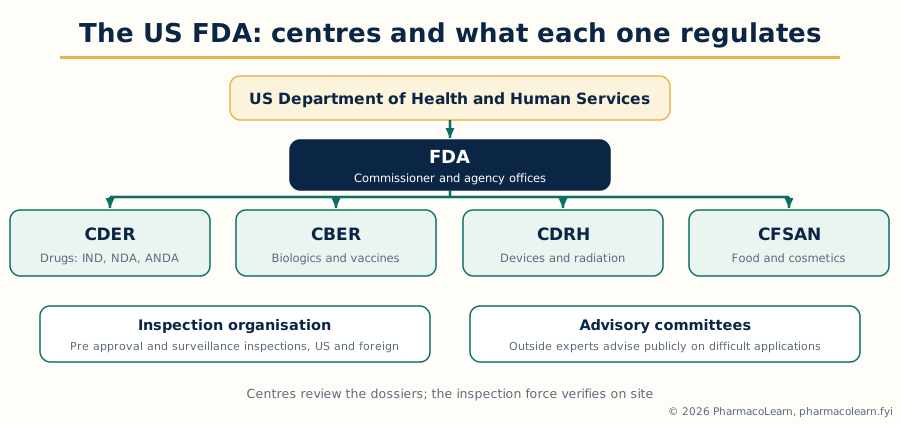 Figure: The FDA inside the Department of Health and Human Services: the Commissioner, the product centres that hold the drug, biologics, device and cosmetics programmes, and the inspection organisation (Unit 1, section 1.2).
1.3 The Federal Register and the Code of Federal Regulations
American regulatory law reaches the practitioner through two publications, and the syllabus names them because confusing them is a working error. The Federal Register is the daily journal of the federal government: where FDA publishes proposed rules for public comment, final rules, and notices including approval and withdrawal actions. It is chronological, a record of what the government did and when. The Code of Federal Regulations (CFR) is the codified, subject arranged body of the rules currently in force, revised annually; Title 21 is the food and drugs title. The working instruments of this branch live in Title 21: Part 210 and Part 211 (cGMP, from MRA101T), Part 201 (drug labeling), Part 312 (investigational new drugs), Part 314 (applications to market a new drug, including the ANDA provisions), Part 320 (bioavailability and bioequivalence) and Part 11 (electronic records and signatures). The discipline the pair teaches is chronological literacy: the CFR tells you what the law is today, while the Federal Register preamble tells you why FDA adopted it, what comments it rejected, and how it intends to enforce it, which is often what a regulatory argument turns on. Guidance documents bind neither party formally; they state the agency's current thinking, and the professional treats them as the safe route, not the only route.
1.4 The Federal Food, Drug, and Cosmetic Act: the operative ideas
Beneath the history of section 1.1, the Act works through a handful of operative ideas that every later topic in this unit uses. A new drug is defined functionally: a drug not generally recognised as safe and effective for its labelled conditions, and such a drug may not be introduced into interstate commerce unless an approved application is in effect for it; that single prohibition is the legal engine of the NDA system. The Act prohibits adulterated drugs, a concept that expressly includes failure to manufacture under current good manufacturing practice, so a GMP failure is not merely an inspection finding but a statutory offence against the product itself; and it prohibits misbranded drugs, whose labelling is false or misleading or lacks the required statements. The 1962 effectiveness standard is implemented through the substantial evidence test described above. Enforcement runs through the courts (seizure, injunction, criminal prosecution) and through administrative instruments the agency controls directly, above all refusal of admission of imports and import alerts, which is the power an Indian exporter feels most directly. Two structural features deserve note. The Act gives FDA no general premarket approval power over cosmetics, which is why section 1.16 is a story of exception and of the MoCRA reform. And the Act is the parent statute of the orphan, combination and generic regimes of this unit, each an amendment era grafted onto the 1938 frame.
1.5 The Hatch-Waxman settlement and the Orange Book
The Drug Price Competition and Patent Term Restoration Act 1984 was a negotiated settlement between two industries. The innovators received patent term restoration: up to five years of patent life lost during development and review may be restored, subject to caps, including the rule that the restored term cannot give more than 14 years of effective patent life after approval. The generic industry received the Abbreviated New Drug Application: a statutory route to approval on proof of sameness and bioequivalence to a listed drug, without repeating its clinical trials, sheltered in development by the regulatory review exemption that India copied as Section 107A (MRA104T). The settlement is administered through the Orange Book, formally the list of Approved Drug Products with Therapeutic Equivalence Evaluations, in which the innovator lists the patents it claims cover the approved drug. A generic applicant must certify against each listed patent, and the four certifications are the grammar of American generic litigation:
| Certification | Meaning | Consequence |
|---|---|---|
| Paragraph I | No patent information has been filed | Approval may proceed |
| Paragraph II | The patent has expired | Approval may proceed |
| Paragraph III | Approval is sought only from patent expiry | Approval effective at expiry |
| Paragraph IV | The patent is invalid, unenforceable or not infringed | Notice to the patent owner; suit within 45 days triggers an automatic stay of approval for up to 30 months; the first successful challenger earns 180 days of generic marketing exclusivity |
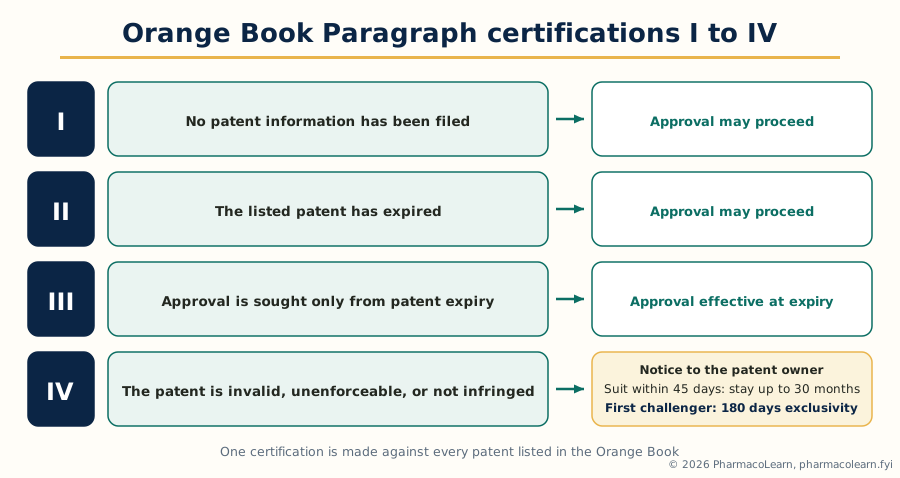 Figure: Paragraph I to IV: what the ANDA applicant asserts about each listed patent, and what each assertion sets in motion, including the 30 month stay and the 180 day exclusivity of the first Paragraph IV challenger (Unit 1, section 1.5).
The elegance of the scheme is that patent disputes are fought on a regulatory timetable: the stay holds approval while the court decides, and the 180 day prize pays the first challenger for clearing weak patents out of the way. Compare India (MRA104T): no linkage and no stay; the same conflict runs there as pure civil litigation after approval.
1.6 The Purple Book and the biologics settlement
Biologics arrived at the abbreviated pathway a generation later, through the Biologics Price Competition and Innovation Act 2009, enacted as part of the Affordable Care Act 2010. It created the 351(k) abbreviated licensure pathway for biosimilars and interchangeable products under the Public Health Service Act, with 12 years of reference product exclusivity. The Purple Book is the biologics counterpart of the Orange Book: the official lists of licensed biological products, including biosimilars and interchangeable products and their exclusivity information. The Purple Book is deliberately a list of licensure facts, not a patent register on the Orange Book model; patent disputes for biologics run through the statutory information exchange between biosimilar applicant and reference sponsor that practitioners call the patent dance, rather than through listed patent certifications.
1.7 The Drug Master File system in the United States
A Drug Master File is a confidential dossier lodged with FDA by the maker of an active substance, a component or a packaging material, which FDA reviews only in connection with an application that references it; the applicant who relies on it never sees its contents, and authorisation to reference it is given by a Letter of Authorization. The system protects the supplier's trade secrets while keeping one reviewed source of substance data on file. FDA recognises five types: Type I, manufacturing site, facilities and operating procedures; Type II, drug substance, its intermediates and the materials used in their preparation, the workhorse of the system; Type III, packaging material; Type IV, excipients, colourants, flavours and other additives; and Type V, FDA accepted reference information. One modern qualification, already met in MRA102T: FDA no longer accepts new Type I files, that facility information having moved into establishment registration and application level disclosure, though existing Type I files remain of record. A DMF is never approved or rejected on its own; it is reviewed when referenced, found adequate or deficient in that connection, and the deficiency is communicated to the holder, not to the applicant who referenced it. The CTD world files the same content in Module 3.2.S, and the European and Japanese counterparts of this section are the ASMF of section 2.4 and the Master File of section 3.4, compared in the table at section 2.4.
1.8 The IND: permission to test in humans
Clinical investigation in the United States runs under an Investigational New Drug application, Part 312. The IND is an exemption from the prohibition on shipping an unapproved drug: it assembles the preclinical pharmacology and toxicology, the chemistry and manufacturing information for the investigational product, and the protocol and investigator information, and the sponsor may begin the trial 30 days after FDA receives the IND unless FDA imposes a clinical hold. The hold, and its lifting, is the live regulatory instrument of the trial era, used where human subjects would be exposed to unreasonable risk or the information is inadequate. FDA interaction is continuous from there: pre IND meetings, end of phase meetings, annual reports, protocol amendments and the expedited safety reports of 21 CFR 312.32 (the 7 and 15 calendar day reports met in MRA103T). The IND is not an approval of anything; it is the supervised space in which the evidence for an NDA is generated. India's NDCT Rules permission and the EU clinical trial authorisation are the same institutional idea in other legal clothes.
1.9 The NDA: the full application, and the PDUFA clock
The New Drug Application, filed under section 505(b)(1) of the Act, is the complete dossier: full reports of the investigations of safety and effectiveness, the chemistry, manufacturing and controls, the proposed labelling, and the patent information for Orange Book listing. Review is done by CDER against the performance goals FDA accepts under PDUFA: the standard widely published goals are review within 10 months of the 60 day filing date for a standard application and within 6 months for a priority application, priority being granted where the drug would significantly improve the treatment of a serious condition. Expedited programmes sit around the standard route: fast track, breakthrough therapy designation, and accelerated approval on a surrogate endpoint reasonably likely to predict clinical benefit. The review ends in an approval letter or a complete response letter setting out the deficiencies that prevent approval; the complete response is a normal working outcome, and resubmission classes and their clocks govern the second round. Obligations do not end at approval: supplements (section 1.12), annual reports, adverse event reporting under Part 314.80 and, where imposed, a REMS carry the file through its commercial life.
1.10 The 505(b)(2) route: the deliberate hybrid
Section 505(b)(2) is the middle path the syllabus groups with the application family: an NDA that relies in part on data the applicant did not generate, published literature or FDA's previous finding of safety and effectiveness for an approved drug, bridged by the applicant's own studies. It serves the large class of rational product improvements that are neither new molecular entities nor copies: new dosage forms, new strengths, new combinations, new routes, changed active ingredients in defined ways, and switches from prescription to over the counter status. The applicant must still certify against Orange Book patents for the products it relies on, and may earn three years of exclusivity for new clinical investigations essential to approval. For the Indian formulator, 505(b)(2) is often the value added export strategy: the ANDA proves a copy, while the 505(b)(2) builds a differentiated product on an established safety base, at a fraction of a full NDA's cost.
1.11 The ANDA: approval by sameness
The Abbreviated New Drug Application, section 505(j), inverts the NDA: instead of proving safety and effectiveness, the applicant proves sameness to a Reference Listed Drug: the same active ingredient, dosage form, strength, route and conditions of use, with differences argued to be without effect; pharmaceutical equivalence; labelling the same, subject to carving out protected indications; manufacture under cGMP; and bioequivalence to the reference product, shown ordinarily in a crossover study whose 90 percent confidence interval for the ratios of AUC and Cmax must fall within 80.00 to 125.00 percent (MRA104T, Unit 4). FDA publishes product specific guidances that state, product by product, the study design it recommends, and the first cycle review goal under the generic user fee programme (GDUFA) is 10 months for a standard ANDA. The ANDA route is where Hatch-Waxman is executed: the paragraph certifications of section 1.5 are filed with the ANDA, and the 30 month stay and Paragraph IV litigation decide the launch date as surely as the review does.
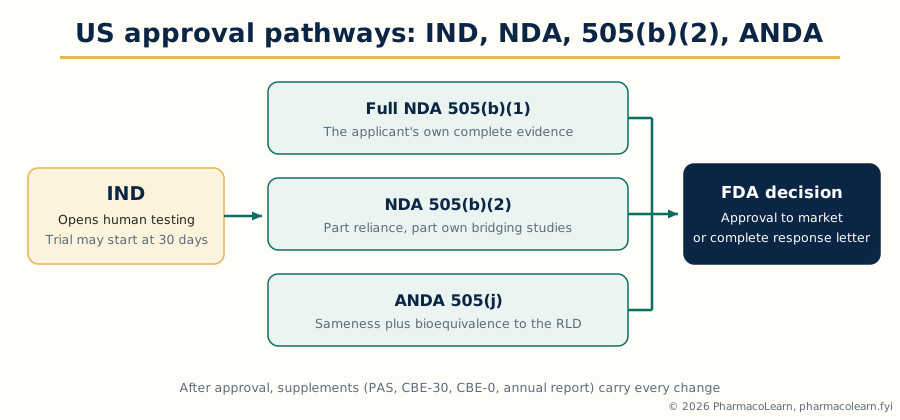 Figure: The American application family on one map: the IND opens human testing, the full NDA proves the new drug, the 505(b)(2) bridges to prior findings, and the ANDA proves sameness to the reference listed drug (Unit 1, section 1.11).
The ANDA journey (section 505(j))
Reference Listed Drug identified in the Orange Book
        |
        v
Development under the regulatory review exemption
        |
        v
Bioequivalence studies + CMC in CTD format
        |
        v
ANDA filed with Paragraph I to IV certifications
        |
        v
GDUFA review: completeness, BE, labelling, facility cGMP
        |
        v
Tentative approval if a patent or exclusivity blocks final approval
        |
        v
Final approval, Orange Book listing with equivalence code
1.12 Supplements: changes to an approved NDA or ANDA
Approval is a state, not an event, and the supplement system grades post approval change by its potential effect on the product, in the framework MRA102T Unit 5 teaches from the documents side. A Prior Approval Supplement (PAS) is required for a major change, one with substantial potential to affect identity, strength, quality, purity or potency; it must be approved before distribution. Changes Being Effected supplements cover moderate changes: the CBE-30 is distributed 30 days after FDA receipt if FDA has not objected, and CBE-0 covers a defined set of changes that may be implemented on filing. Minor changes ride in the Annual Report. The SUPAC guidances give the ladder technical content for defined product classes, stating the tests and filings each level of change attracts. ANDA holders file the same categories of supplement against their approvals. The professional habit this unit builds is classification discipline: every post approval change is first a question of which rung of this ladder it stands on.
1.13 Orphan drugs
The Orphan Drug Act 1983 addresses the market failure of rare diseases: where development costs cannot be recovered from a small patient population, the statute pays in regulatory currency instead. A sponsor may obtain orphan drug designation for a drug intended for a condition affecting fewer than 200,000 persons in the United States (or more, where there is no reasonable expectation of cost recovery), and designation carries tax credits for clinical testing, a waiver of the PDUFA application fee, protocol assistance, and, on approval, seven years of orphan exclusivity during which FDA will not approve the same drug for the same use, subject to exceptions such as clinical superiority. Designation is not approval: the designated drug must still win an NDA, ANDA style evidence or BLA on the merits. The EU runs a parallel scheme (prevalence not more than 5 in 10,000, ten years of market exclusivity) which Unit 2 mentions in the centralised context, where orphan medicines are mandatory centralised products.
1.14 Combination products
A combination product, defined in 21 CFR 3.2, combines drug, biologic and device constituents: physically or chemically combined (a prefilled syringe), packaged together (a kit), or separately supplied but labelled for use with each other. Regulation follows the primary mode of action: the constituent part providing the most important therapeutic action assigns the product to a lead centre, drug led to CDER, biologic led to CBER, device led to CDRH, with the Office of Combination Products as coordinator and the Request for Designation as the sponsor's formal remedy where assignment is disputed. One application ordinarily carries the whole product, and its manufacturing must satisfy a combined rule set: the drug cGMP of Parts 210 and 211 and the device quality system requirements, each applied to its constituents. For this branch the combination product is the boundary case that proves the centre map of section 1.2: the system is organised by product type only until a product refuses to be only one type.
1.15 Manufacturing, packaging and labeling considerations in the USA
Three standing disciplines apply to every approved product. Manufacture is under Parts 210 and 211 cGMP (MRA101T), policed by pre approval inspection for new applications and by surveillance inspection thereafter, with foreign establishments inside the same net and carrying facility fee obligations. Packaging is regulated as part of the product: container closure suitability is reviewed in the application, child resistant packaging is required under the Poison Prevention Packaging Act, tamper evident features apply to over the counter products, and the Drug Supply Chain Security Act 2013 adds unit level traceability. Labeling is reviewed and approved as part of the application: the structured prescribing information in the Physicians Labeling Rule format, carton and container labels under Part 201, Medication Guides and REMS materials where imposed, and for over the counter products the standardised Drug Facts panel. A label change is therefore a regulatory submission, supplement or annual report according to the ladder of section 1.12, and never a marketing decision alone.
1.16 Cosmetics in the United States: the exception, and MoCRA
American cosmetics law was, until very recently, the great exception among regulated products: the 1938 Act prohibited adulterated and misbranded cosmetics but gave FDA no premarket approval for cosmetics or their ingredients, the single exception being colour additives, which require premarket approval and, for many, batch certification. Voluntary registration of establishments and products through the Voluntary Cosmetic Registration Program was exactly that, voluntary. The Modernization of Cosmetics Regulation Act 2022 (MoCRA), the most significant expansion of FDA cosmetics authority since 1938, changed the architecture without abolishing its exception: cosmetic facilities must register with FDA, cosmetic products must be listed, responsible persons must keep safety substantiation and report serious adverse events to FDA within 15 business days, FDA gained mandatory recall authority over cosmetics, records access, and a rule making programme for good manufacturing practice for cosmetics and for fragrance allergen labelling. Premarket approval was deliberately not introduced: the American model remains a post market system with notification and substantiation duties, which is the precise contrast the EU section draws.
1.17 Cosmetics in Canada
Canada places cosmetics under its Food and Drugs Act and the Cosmetic Regulations, administered by Health Canada. The system is again notification based, without premarket approval: the manufacturer or importer must submit a Cosmetic Notification Form to Health Canada within 10 days of first sale, identifying the product, its ingredients and their concentrations; notification is not approval, and Health Canada may act against products that present a risk. Ingredients are controlled through the Cosmetic Ingredient Hotlist, an administrative list of prohibited and restricted substances that functions as the practical boundary of lawful formulation, and labelling must follow the Consumer Chemicals and Containers Regulations and the labelling rules of the Cosmetic Regulations, with ingredient names in the INCI nomenclature, in English and French. Read against sections 1.16 and 2.15, the family resemblance is the teaching point: North America notifies cosmetics and polices them in the market, while the European Union notifies too, but wraps the notification in a responsible person, a product information file and a pre market safety assessment.
| Application | Statute | What must be proved | Full clinical programme |
|---|---|---|---|
| IND | FD&C Act, 21 CFR 312 | Grounds for safe human testing | No: it opens testing |
| NDA 505(b)(1) | FD&C Act | Safety and effectiveness, full data | Yes, the applicant's own |
| NDA 505(b)(2) | FD&C Act | Safety and effectiveness, partly by reliance on literature or FDA's prior findings, bridged by own studies | Partial by design |
| ANDA 505(j) | FD&C Act | Sameness to the RLD plus bioequivalence | No, BE study instead |
| sNDA | FD&C Act, 21 CFR 314.70 | The defined post approval change | As the change requires |
Unit 2: European Union and Australia
2.1 The EMA and the European network model
The European system is a network, not an agency with branches, and understanding that single fact organises the whole unit. The European Medicines Agency (EMA), established in 1995 and seated in Amsterdam since 2019, coordinates the work of the national competent authorities of the member states; it does not itself employ most rapporteurs, who are experts drawn from the national agencies. Its scientific committees do the deciding: the Committee for Medicinal Products for Human Use (CHMP), whose opinion is the scientific verdict on a centralised application; the Pharmacovigilance Risk Assessment Committee (PRAC); the Committee for Orphan Medicinal Products (COMP); the Paediatric Committee (PDCO); the Committee for Advanced Therapies (CAT); and the Committee for Herbal Medicinal Products. The legal act of authorization belongs not to the EMA but to the European Commission, which converts a CHMP opinion into a decision binding in all member states. Beneath this sits the two layer legislation of the Union: Regulation (EC) No 726/2004, which lays down the centralised procedure and the EMA itself, and Directive 2001/83/EC, the Community code for human medicines, which governs national authorizations, mutual recognition, manufacturing, wholesale, labelling and pharmacovigilance, implemented in each member state's own law. The working style of the system is shared work and reliance: one state assesses, others recognise, the committees arbitrate, and the Commission decides.
2.2 EDQM and the European Pharmacopoeia
The European Directorate for the Quality of Medicines and HealthCare (EDQM) is a different body from the EMA in both law and home: it is a directorate of the Council of Europe, seated in Strasbourg, not an EU institution, and its pharmacopoeia binds well beyond the Union. The EDQM elaborates the European Pharmacopoeia, whose monographs and general chapters are legally binding quality standards in the signatory states; it runs the network of Official Medicines Control Laboratories; it manages the standard terms for dosage forms and routes; and it operates the certification of suitability procedure of section 2.10. Where EMA answers whether a medicine may be marketed, EDQM answers whether the substance in it meets the public standard: an application quotes pharmacopoeial monographs it does not re-prove, and a substance maker holding a certificate of suitability need not file its full data again in every dossier.
2.3 The legal base and general guidelines
A European dossier is written against three layers of texts. At the top sit the Regulation and the Directive (section 2.1), amended over time, notably by the 2010 pharmacovigilance legislation and the Falsified Medicines Directive 2011/62/EU with its safety features on packs. In the middle sits EudraLex, the collected library of EU pharmaceutical law and guidance treated in section 2.14. At working level sit the Notice to Applicants volumes, which state the procedural and format expectations for applications, and the CHMP and ICH guidelines on quality, safety and efficacy topics. Applications are filed in the CTD, electronically as eCTD, and the Notice to Applicants systematises the legal bases of the application: full, generic, hybrid (the EU counterpart of the 505(b)(2) idea), well established use on bibliographic evidence, fixed combination, and informed consent applications. Data and market protection rewards the full application: eight years of data protection and two further years of market protection, with a possible additional year for a significant new indication, the 8+2(+1) formula, against which generic and hybrid applications are timed exactly as ANDAs are timed against the Orange Book.
2.4 The ASMF system in the European Union
The Active Substance Master File is the EU counterpart of the US Drug Master File: the active substance manufacturer files its confidential know how once, in a document split by design into an Applicant's Part, shared with the applicant whose product uses the substance, and a Restricted Part, which the assessor sees and the applicant never does. The ASMF is not authorized on its own; it is assessed as part of each marketing authorization or variation that references it, under the responsibility of the applicant, who must have access to the open part and must declare that the product is made with the substance the file describes. The EU adds one refinement the US system lacks, the ASMF worksharing procedure, under which a single ASMF used in several procedures is assessed once and the outcome shared across the concerned authorities.
| Feature | US DMF | EU ASMF | Japan MF |
|---|---|---|---|
| Filed by | Substance or material maker | Active substance manufacturer | Substance or material maker |
| Confidential closed part | Whole file closed to applicants | Restricted Part, assessor only | Yes, in principle as US |
| Open part for applicant | None | Applicant's Part | Limited |
| Standalone approval | Never; reviewed when referenced | Never; assessed within each procedure | Registered with a certificate |
| Typical subject | Substances, excipients, packaging | Active substances | Substances, excipients, packaging |
| Reference mechanism | Letter of Authorization | ASMF reference and access letter | MF registration number |
2.5 The IMPD: content and approval process
Before a medicine is authorized it must be trialled in Europe too, and the trial dossier is the Investigational Medicinal Product Dossier: the quality, manufacture and control of the investigational product, the non clinical pharmacology and toxicology, previous clinical experience, and the overall risk and benefit assessment, filed with the protocol and investigator material. Since 31 January 2022 the authorisation of clinical trials is governed by the Clinical Trials Regulation (EU) No 536/2014, applied through the single Clinical Trials Information System (CTIS): one application, one portal, a coordinated assessment led by a reporting member state for the scientific part and a national part for each concerned state, replacing the patchwork of separate national filings under the old Directive. The IMPD itself survives the reform as the quality and evidence core of the application, in full or simplified form where the product is already authorized elsewhere in the system. MRA103T treats the ethics and conduct framework; the IMPD is its dossier face in Europe.
2.6 The four marketing authorization procedures: the map
Europe offers four roads to a marketing authorization, and choosing between them is a founding decision of a European regulatory strategy. The centralised procedure produces one authorization from the Commission, valid everywhere in the EU and the EEA states. The mutual recognition procedure converts an existing national authorization into authorizations in other member states. The decentralised procedure obtains first authorization in several member states at once, none holding it yet. The national procedure authorizes in one state only. Section 2.7 to 2.10 take each in turn; the comparison follows.
| Procedure | Who assesses | Where valid | Typical use |
|---|---|---|---|
| Centralised | CHMP (rapporteur and co-rapporteur) | All EU and EEA states | Biotechnology products, orphan medicines, advanced therapies and other mandatory scope; major innovation |
| Decentralised | Reference member state leads, concerned states join | The states named in the application | New products aimed at several states, none yet authorized |
| Mutual recognition | Reference member state (holder of the first authorization) leads | Further states recognising the first approval | Extending an existing national authorization |
| National | One national authority | One state | Local products, first step toward mutual recognition |
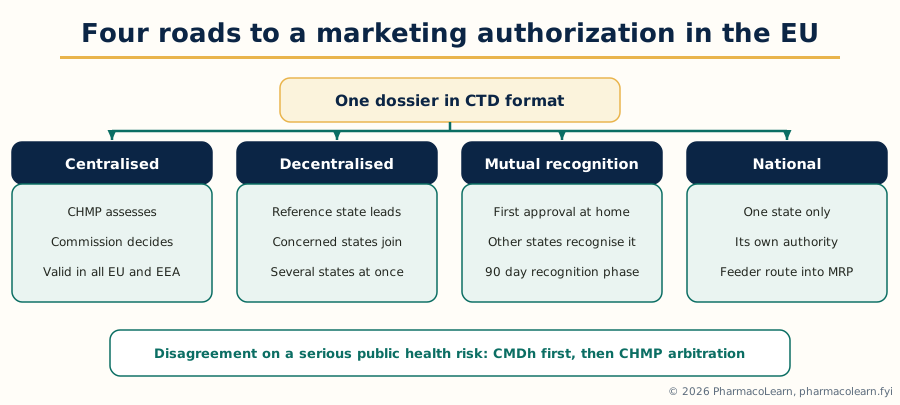 Figure: Four roads to a European authorization: the centralised procedure decides once for all states, the decentralised and mutual recognition procedures spread one assessment across chosen states, and the national procedure stays home (Unit 2, section 2.6).
2.7 The centralised procedure
The centralised procedure is mandatory for a defined scope: medicines derived from biotechnology processes, orphan medicines, advanced therapy medicinal products, and medicines for specified major disease areas; it is optional for other new active substances and significant innovations. The applicant files one dossier with the EMA; the CHMP appoints a rapporteur and co-rapporteur from member state agencies; and the assessment runs on a 210 day clock for the committee's opinion, not counting clock stops during which the applicant answers the consolidated list of questions, so the elapsed calendar time is longer than the active clock. PRAC reviews the risk management plan in parallel, the PDCO the paediatric position, and inspections may be requested of the manufacturing sites. The CHMP opinion passes to the European Commission, whose decision, with the agreed product information in all Union languages, creates the single authorization; the summary of product characteristics, labelling and package leaflet approved here are the texts every member state then uses. Renewal falls due after five years, the variations of section 2.11 carry the authorization through commercial life thereafter, and the centralised authorization is maintained in one place, which is the practical prize the procedure offers a global company.
2.8 Mutual recognition and the decentralised procedure
The mutual recognition procedure (MRP) starts from an authorization that already exists in one member state, the reference member state, whose assessment report other, concerned member states are asked to recognise, ordinarily within a 90 day recognition phase. A concerned state may refuse only on the narrow ground of a potential serious risk to public health, and unresolved disagreement escalates first to the coordination group (CMDh) and then, if needed, to a CHMP arbitration whose outcome binds all. The decentralised procedure (DCP) is the same machinery run before any authorization exists: the applicant chooses a reference member state, which prepares a draft assessment report and draft product information on the procedure's timetable, the concerned states comment, and the procedure closes with national authorizations issued in step in each participating state. The craft lies in choosing the reference state and in answering divergent national questions without fracturing the single text. Both procedures rest on mutual recognition with a public health escape, the compromise that built a single market in medicines without a single national regulator.
The centralised procedure
Eligibility check and intention to submit to the EMA
        |
        v
Rapporteur and co-rapporteur appointed by the CHMP
        |
        v
210 active days of assessment, clock stops for applicant answers
        |
        v
PRAC, PDCO and inspection inputs in parallel
        |
        v
CHMP opinion (positive or negative)
        |
        v
European Commission decision, valid in all EU and EEA states
2.9 National authorization, transfers and the life of the authorization
The national procedure authorizes in one member state under the Directive alone; it survives because some products are genuinely local, and as the feeder route into mutual recognition. Once granted, an authorization is an asset with its own conveyancing: a marketing authorization transfer moves it to a new holder, in the centralised system by a Commission decision on the transfer application, the dossier, manufacturing arrangements and pharmacovigilance system passing to the transferee, who steps into every duty from the transfer date. The authorization also has statutory lifelines to respect: it must be renewed after five years, after which it ordinarily remains valid indefinitely, and it lapses under the sunset clause if the product is not placed on the market within three years of authorization, or is absent for three consecutive years, subject to public health exemptions. Extensions of the authorization itself (a new strength, form or route that changes the terms fundamentally) are treated not as variations but as extensions, full applications in miniature (section 2.11).
2.10 The Certificate of Suitability: outsourcing substance proof to a monograph
Where the European Pharmacopoeia carries a monograph for an active substance, its manufacturer may prove compliance once, centrally, through the Certificate of Suitability (CEP), granted by the EDQM after assessment of the substance dossier submitted to Strasbourg. The certificate states that the monograph, suitably supplemented by the annexes and conditions recorded on it, adequately controls the substance's quality. A marketing authorization application then cites the CEP number instead of filing the full substance data, exactly as an ASMF is referenced, but with the assessment already done and portable across every procedure and state. The certificate is maintained like an authorization: revisions for changes, renewal on its five year cycle, and suspension or withdrawal where inspection or data show the monograph no longer controls the material. For Indian API exporters the CEP is a familiar commercial instrument: one EDQM assessment, backed by periodic EDQM inspections of the manufacturing site, against the alternative of defending the substance file separately in each customer's dossier.
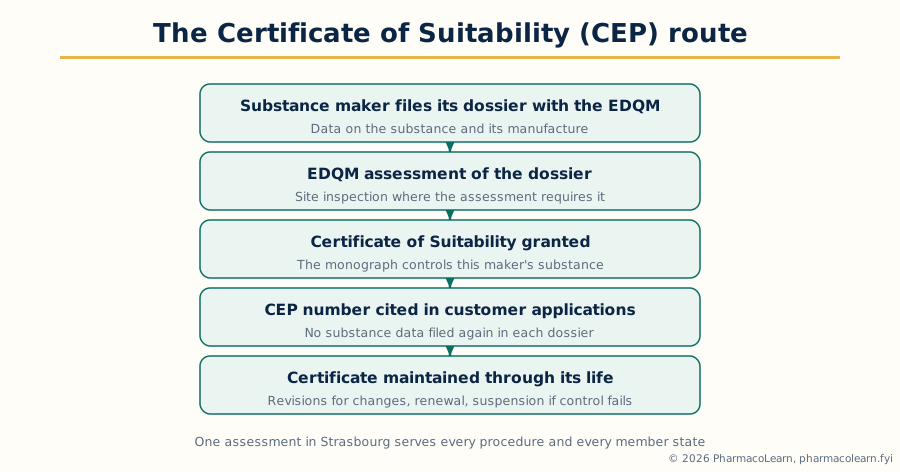 Figure: The CEP route: the substance maker applies to the EDQM, the dossier and, where needed, the site inspection support assessment, and the granted certificate is then cited in place of substance data in every customer's application (Unit 2, section 2.10).
2.11 Variations and extensions: grading change in the EU
Post approval change in the Union is governed by the Variations Regulation (EC) No 1234/2008, whose ladder mirrors the American one in spirit and differs in letters. Type IA variations are minor changes of no or minimal impact, handled on a do and tell basis: the holder implements and notifies within 12 months, with the Type IAIN subtype notified immediately after implementation where the regulation so requires (certain administrative and identity changes). Type IB variations are minor changes that are neither IA nor II: tell, wait and do, the authority having 30 days to object before the change may be implemented. Type II variations are major changes that may significantly affect quality, safety or efficacy: a full assessment, ordinarily 60 days of active review, ending in approval before implementation. Extensions, as noted, change the authorization's fundamental terms and are assessed as new applications under the variations regulation's annex. Related changes may be grouped in one application, and the same change across many authorizations may be filed as a single worksharing procedure with one lead authority. The classification guideline that accompanies the regulation lists, change by change, which rung applies and what evidence it demands; as in the US, the first professional act is classification.
| Class | Weight | Procedure | Implement when |
|---|---|---|---|
| Type IA | Minor, no or minimal impact | Do and tell, annual window (IAIN immediately) | Before notification |
| Type IB | Minor, not IA or II | Tell, wait 30 days, do | After the wait without objection |
| Type II | Major, may affect quality, safety or efficacy | Full assessment, ordinarily 60 days | Only after approval |
| Extension | Change of fundamental terms | Assessed as a new application | Only after approval |
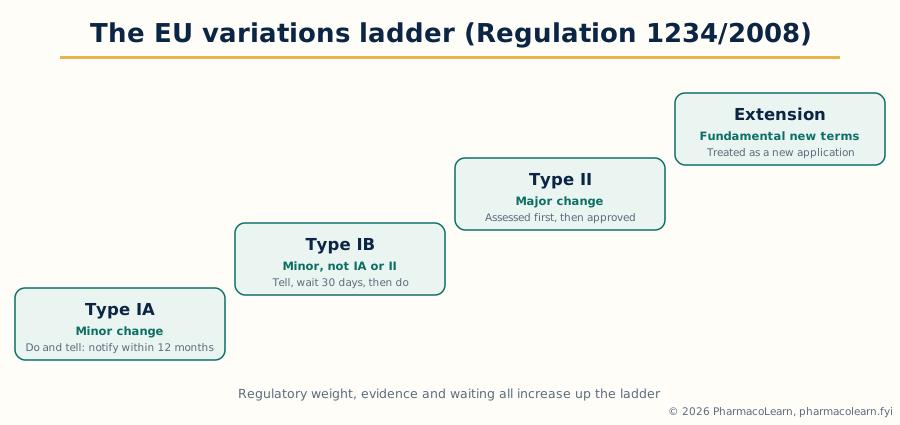 Figure: The ladder of the Variations Regulation: rising regulatory weight from the do and tell Type IA, through the tell wait do Type IB, to the assessed Type II and the extension treated as a new application (Unit 2, section 2.11).
2.12 The Qualified Person
The Qualified Person (QP) is the European system's signature institution: a named individual, meeting the Directive's qualification requirements in pharmacy, medicine, chemistry, biology or a cognate discipline plus defined practical experience, whom the manufacturing authorization holder names as personally responsible for certifying that each batch was manufactured and checked in compliance with the law, the GMP and the marketing authorization, before it may be released. Batch certification by the QP is the legal act of release in the EU; no quality unit, however senior, replaces the QP's personal certification, and the QP's duties, including defect handling and release of imported batches after the required tests, are detailed in GMP Annex 16. Set beside the American system, where release is a quality unit function under Part 211, the QP shows the EU's characteristic move: duties that other systems assign to organisations are pinned in Europe to an identified, qualified person, the same instinct that creates the cosmetics Responsible Person in section 2.15.
2.13 Manufacturing, packaging and labeling in the EU
Manufacture in the Union requires a manufacturing and importation authorization for the site, operation under the EU GMP of EudraLex Volume 4 (MRA101T), QP certification, and, for third country manufacture, importation by an authorized importer with testing in the EEA unless a mutual recognition agreement on GMP applies. Packaging and labelling run through the product information agreed in the authorization: the Summary of Product Characteristics as the professional reference text, the outer and immediate labelling of Title V of the Directive, and the package leaflet written in lay language and tested for readability with patient groups. Member state specific additions are confined to the blue box on the outer pack (local particulars such as price and reimbursement), the product name must also appear in Braille on the pack, and the Falsified Medicines safety features, a unique identifier in a two dimensional barcode plus an anti tampering device, must be carried by most prescription packs and verified through the European medicines verification system. As in the US, the pack and its texts are part of the authorization, not of the marketing plan.
2.14 EudraLex: the library of the system
EudraLex is the collected body of EU pharmaceutical law and guidance, arranged in ten volumes that the practitioner should be able to navigate by number: Volume 1, the pharmaceutical legislation for human medicines (the Directive and the governing regulations); Volume 2, the Notice to Applicants and regulatory guidance on applications; Volume 3, scientific guidelines; Volume 4, the GMP guidelines including the annexes this branch keeps citing; Volume 5 and Volumes 6 to 8, the veterinary legislation and its application and guidance counterparts; Volume 9, pharmacovigilance guidelines (the GVP modules of MRA101T and MRA103T); and Volume 10, clinical trials guidelines. EudraLex is not a single instrument: it is the shelf on which the instruments live, and citation by volume is the profession's shorthand for where a requirement sits in the legal order.
2.15 Cosmetics in the European Union: Regulation 1223/2009
European cosmetics law is a single directly applicable Regulation, (EC) No 1223/2009, and its model is notification wrapped in personal accountability. Every cosmetic product placed on the EU market must have a designated Responsible Person established in the Union who answers for its compliance. Before placement, the Responsible Person must ensure a cosmetic product safety report has been drawn up by a qualified safety assessor and hold a Product Information File (product description, the safety report, manufacturing method and GMP statement, proof of claimed effects, animal testing data) available to authorities at the address on the label. The product is then notified through the Cosmetic Products Notification Portal (CPNP): notification is not approval, but no lawful placement precedes it. Around this core the Regulation builds the substantive fences: annexes listing prohibited and restricted substances and the positive lists of permitted colourants, preservatives and UV filters; special rules for CMR substances and for nanomaterials, which require their own notification and labelling; claims discipline under the common criteria Regulation (EU) No 655/2013; manufacture under cosmetic GMP (ISO 22716 being the harmonised standard); and market surveillance by member states. Import into the EU makes the importer the Responsible Person unless it designates another, which is the practical point at which Indian cosmetic exporters meet the Regulation.
2.16 Cosmetics in Australia
Australia regulates cosmetics at the boundary of chemicals law and consumer law. Cosmetic ingredients are industrial chemicals under the Australian Industrial Chemicals Introduction Scheme (AICIS), which replaced NICNAS in 2020: ingredients must be authorized for introduction under AICIS categories based on risk, and many are controlled through the Poisons Standard scheduling system, which restricts or prohibits listed substances in cosmetic use. A finished cosmetic is not registered as a medicine would be, unless it crosses the therapeutic boundary: products making therapeutic claims, and primary sunscreens among them, fall to the Therapeutic Goods Administration as therapeutic goods, while ordinary cosmetics remain in the chemicals and consumer law world, where labelling standards and the Australian Consumer Law apply and ingredient names follow the INCI style. The comparison the syllabus intends is triangular: the EU notifies with a safety assessment and a responsible person, North America notifies with substantiation duties after MoCRA, and Australia controls the ingredient, largely leaving the finished product to chemicals and consumer law unless its claims make it a medicine.
Unit 3: Japan
3.1 The PMDA and the Japanese division of labour
Japan splits the two questions that the FDA answers together. The Ministry of Health, Labour and Welfare (MHLW) holds the legal authority: it grants the approvals and licenses, issues the ordinances, and takes the final decisions, advised by its council machinery, the Pharmaceutical Affairs and Food Sanitation Council. The Pharmaceuticals and Medical Devices Agency (PMDA), established in 2004 as an incorporated administrative agency, does the work: it conducts the scientific reviews of new drugs, devices and regenerative products, offers the consultations through which development programmes are agreed, runs the reliability and GCP inspections behind the reviews, operates the safety information and adverse event systems, and administers the relief services that compensate victims of adverse drug reactions and infections. The model is deliberate: PMDA reviews and recommends, MHLW approves, and the applicant's practical life is lived with PMDA, whose consultation system, much more formal and heavily used than its Western counterparts, is where Japanese development programmes are really shaped. Japanese language, formats and data expectations make Japan the advanced market most often entered with local regulatory counsel and, frequently, a Japanese partner.
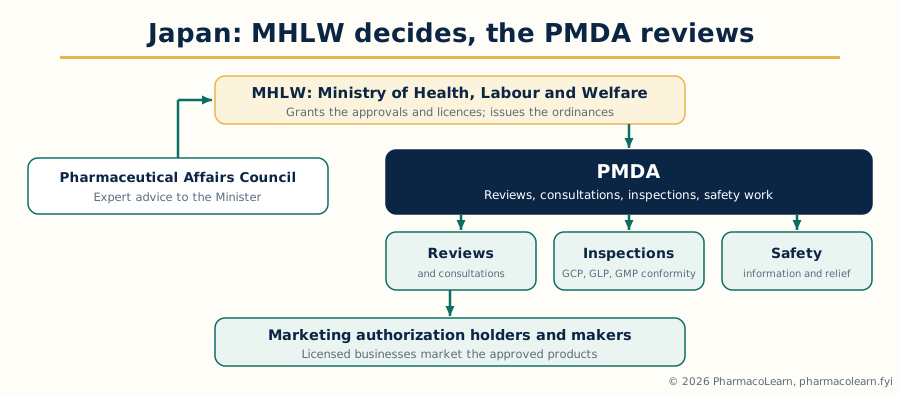 Figure: The division of labour: MHLW grants approvals and licenses on the advice of its council, while the PMDA conducts reviews, consultations, inspections and safety work, and manufacturers and marketing authorization holders operate under licence (Unit 3, section 3.1).
3.2 Pharmaceutical laws and regulations
The governing statute is the Act on Securing Quality, Efficacy and Safety of Products Including Pharmaceuticals and Medical Devices, universally shortened to the Pharmaceuticals and Medical Devices Act (PMD Act), the 2013 renaming, effective 2014, of the former Pharmaceutical Affairs Act, the renaming itself reflecting the statute's extension to the regenerative medicine products it now expressly governs. Below the Act sit the ministerial instruments that carry the working law: the ordinances on manufacturing control and quality control (the GQP ordinance), on post marketing safety control (the GVP ordinance), and on the conduct of post marketing studies (the GPSP ordinance), with GMP issued as a ministerial ordinance, and vigilance and quality duties thereby split between two named control systems, a quality system (GQP) and a vigilance system (GVP), each with its own responsible officers inside the marketing authorization holder. Licensing runs on two tracks, and the distinction matters: a marketing authorization holder licence (in three categories, by product class) authorises the business of marketing, while each product requires its own marketing approval and each manufacturing site its own manufacturing licence with GMP conformity inspection. Japan thus separates, more explicitly than the US or EU, the licence to be in the business, the approval of the product, and the conformity of the plant.
3.3 Types of registration applications
Applications for marketing approval are filed by category, the Japanese application being classified by what is new about the product, and the category fixes the data package and the consultation path. The principal classes are: drugs with new active ingredients; drugs with new combinations; drugs with new routes of administration; drugs with new indications; drugs with new dosage forms or new dosages; and generic drugs, filed by reference to the approved originator with bioequivalence at their centre. Around this classification the modern Japanese system has built its acceleration and access instruments: the SAKIGAKE designation (from 2015) for pioneering products intended for serious conditions, with priority consultation, pre evaluation and priority review and a concierge style PMDA shepherding; the conditional early approval system for drugs for serious diseases where confirmatory trials are impracticable, approved on early data with post marketing obligations; priority review and orphan drug designation (for conditions affecting fewer than 50,000 patients in Japan, with research support and a re-examination premium). As elsewhere, classification is the first professional act: the same product is a different application, with a different dossier, fee and clock, according to which class it honestly falls in.
3.4 The Master File system in Japan
Japan's counterpart of the DMF and ASMF is the Master File (MF) system for drug substances, intermediates, excipients and packaging materials, operated by the PMDA since 2005 under the amended statute. The maker registers the confidential manufacturing and quality information with PMDA and receives an MF registration certificate bearing the registration number; an approval applicant then cites that number in its application, and PMDA reviews the closed material in connection with the application without the applicant seeing it, the same triangular confidentiality as the US system. Two features are distinctively Japanese. Registration is a public administrative act: the register of files and their holders is maintained by PMDA, so the existence and ownership of a file is a matter of record even though its content is closed. And the system is paired with the accreditation of foreign manufacturers: a non Japanese site making a substance or product for the Japanese market must be accredited by MHLW, without which its material cannot feed an approval, accreditation and MF registration together forming the foreign supplier's entry paperwork.
3.5 The Japanese drug approval process
The approval process builds on consultation. Sponsors meet PMDA in formal consultations (on clinical trial design, on dossier strategy, and pre application) whose recorded conclusions are treated as commitments on both sides; the clinical trials run under Japanese GCP with the notification machinery MRA103T described. The application for marketing approval is filed with PMDA, which conducts the scientific review and the GCP, GLP and data reliability inspections, and may conduct GMP conformity inspection of the named sites. The review report passes to MHLW, where the expert committees of the Pharmaceutical Affairs and Food Sanitation Council deliberate, and the Minister grants the approval. Standard review is conventionally described at about 12 months of PMDA review for a new drug, with priority review products at about 9 months, excluding the applicant's answer time on inquiries, on the clock stop pattern familiar from the EU. National Health Insurance price listing follows approval, a step Japanese planning treats as part of one two stage launch.
3.6 Manufacturing, packaging and labeling in Japan
The manufacturing side of the Japanese system is the MAH system of section 3.2 at work: the marketing authorization holder answers for the product's quality and safety, operating the GQP quality system that controls its manufacturers, domestic and foreign, accredited and inspected for GMP conformity on the approval cycle and in periodic conformity inspections thereafter. Packaging and labeling show a characteristic Japanese form: the package insert, the approved professional text, moved to electronic provision as the default under the revised law, with the printed insert in transition; container and carton labelling carry the statutory statements in Japanese, including the MAH's name and address, the manufacturing number and the expiry, and patient facing information sheets are standard practice for prescription products.
3.7 Post marketing surveillance in Japan
Japan operates the most formalised post marketing evidence machinery of the three advanced systems, built on two instruments. The re-examination system attaches to new drugs at approval: a re-examination period is set (for a new active ingredient, in principle eight years), during which the holder must collect and analyse use results and safety data under the GPSP ordinance, and at its end the product is literally re-examined: MHLW and PMDA re-evaluate efficacy and safety on the accumulated record, and the approval stands confirmed, adjusted or, in principle, withdrawn. Running beside it is Early Post-marketing Phase Vigilance, an intensive first six months after launch in which the holder proactively works the hospital and pharmacy channel for safety information and reports findings on a tight schedule. Adverse reaction reporting, periodic safety reporting on the international pattern, and PMDA's medical information database network (MID-NET), giving access to real world electronic medical record and claims data for safety studies, complete the picture. Approval in Japan is provisional in a way it is not in Washington or Amsterdam, and the market itself is enrolled as the second, obligatory phase of the evidence programme.
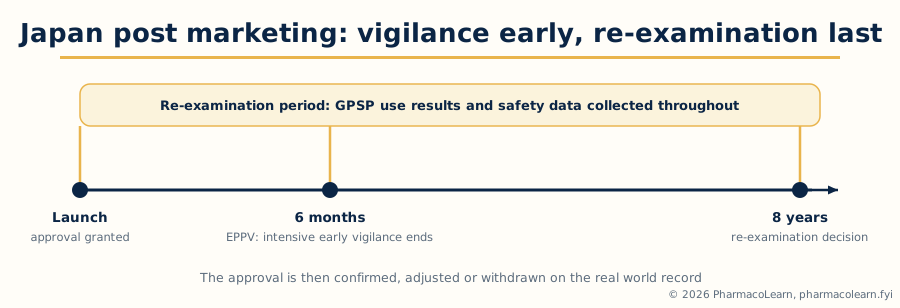 Figure: The two instruments: early post-marketing phase vigilance in the first six months, continuing surveillance through the period, and the formal re-examination, in principle at eight years for a new active ingredient, that closes the cycle (Unit 3, section 3.7).
Unit 4: Emerging Markets and the World Health Organization
4.1 Emerging markets: what the term means in regulatory work
In regulatory usage an emerging market is a market whose regulatory system is developing toward the stringent model: laws and agencies exist, dossiers are required, but assessment depth, inspection capacity and post marketing systems vary, and reliance on the decisions of stringent authorities and of WHO is a structural feature rather than an embarrassment. The regulated versus semi-regulated contrast of the subject's scope is best read as a spectrum. At one end stand the stringent regulatory authorities of Units 1 to 3, whose approvals others rely on. In the middle stand capable middle authorities, Brazil's ANVISA, India's CDSCO, China's NMPA and South Africa's SAHPRA among them, which conduct full assessments while also operating reliance routes. At the other end stand smaller authorities whose registration is expressly built on a reference approval plus a Certificate of Pharmaceutical Product, with national control exercised mainly at importation and in the market. The professional habits this spectrum demands are the unit's substance: map each market's reliance logic, keep one core dossier adaptable to each national format, and never assume a requirement met for one capital is met for the next.
4.2 Regional committees and harmonization bodies across the globe
The space between national systems is organised by regional bodies, and the syllabus names the six the practitioner meets most. ASEAN, the Association of Southeast Asian Nations, harmonises through its pharmaceutical product working group, producing the ASEAN Common Technical Document of Unit 5 and the cosmetics directive. APEC, Asia Pacific Economic Cooperation, works through its Regulatory Harmonization Steering Committee on convergence, training and reliance across the Pacific economies. The EAC, East African Community, runs a Medicines Regulatory Harmonization programme with joint assessments and a shared medicines register among its partner states. The GCC, the Gulf Cooperation Council, built centralised registration through its health council machinery alongside the strong national authorities of Unit 5. PANDRH, the Pan American Network for Drug Regulatory Harmonization, is the PAHO sponsored network through which the Americas converge. SADC, the Southern African Development Community, operates collaborative registration through the ZaZiBoNa initiative of joint assessments among participating states. None of these bodies grants a marketing authorization in its own name (the GCC's central registration historically came closest): their products are common documents, joint assessments, shared inspections and model laws, which national authorities then apply, harmonization by convergence rather than by the EU's transfer of sovereignty.
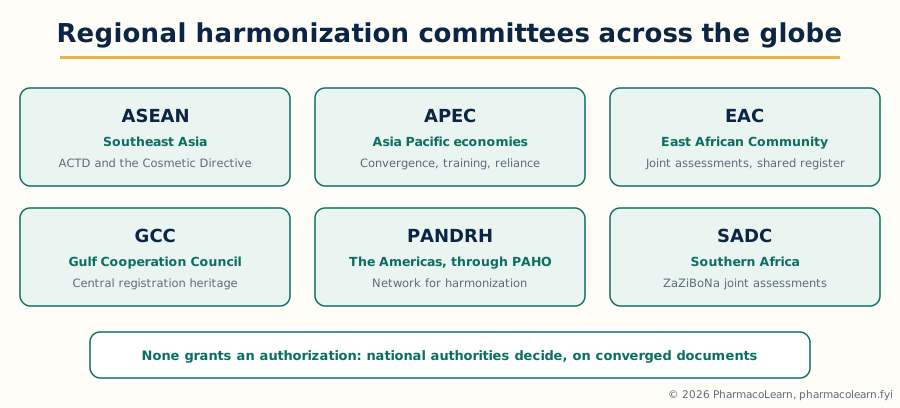 Figure: The six committees across the globe: ASEAN and APEC in Asia Pacific, EAC and SADC in Africa, the GCC in the Gulf, and PANDRH in the Americas, each converging national systems without replacing them (Unit 4, section 4.2).
4.3 WHO GMP
The World Health Organization's good manufacturing practice texts are the floor on which the emerging market world builds. The WHO GMP main principles for pharmaceutical products, published in the WHO Technical Report Series and revised over the decades, state the complete system: quality management, sanitation and hygiene, qualification and validation, complaints and recalls, contract production, self inspection and personnel, the same architecture as MRA101T's national texts, from which most national GMP codes in the developing world descend directly. Supplementary WHO GMP texts cover sterile manufacture, biological products, water systems and air conditioning, and the inspection guidelines used by the prequalification programme. Above the texts sits the WHO Certification Scheme on the Quality of Pharmaceutical Products Moving in International Commerce, the machinery of section 4.6: WHO GMP is what the Certificate of Pharmaceutical Product certifies compliance with, and the exporting state's authority attests, by issuing the certificate, that the plant is inspected against those standards. An Indian manufacturer therefore meets WHO GMP twice: as Schedule M's intellectual ancestor at home, and as the standard its export certificates assert abroad.
4.4 WHO prequalification: the programme and its purpose
The WHO Prequalification Programme, run by the Prequalification Team (PQT) within WHO's regulation department, was created so that the great purchasing agencies of global health, UNICEF, the Global Fund, UNITAID and their peers, could buy assured quality medicines, vaccines and diagnostics for diseases of the developing world without each running its own assessment industry. Prequalification is not a marketing authorization and confers no right to sell anywhere; it is a listing, on WHO's published lists, that a defined product from a defined site meets WHO's quality, safety and efficacy expectations, on which procurers and national regulators rely. Its scope follows the donor funded disease programmes: HIV, tuberculosis, malaria, hepatitis, reproductive health, and expanding areas. The pathway begins with a published invitation to submit an Expression of Interest for defined products; only products within an open invitation are assessed. For a generic, the dossier in CTD format, bioequivalence evidence to WHO's comparator standards, manufacturing data and samples support assessment; an innovator product already approved by a stringent authority takes an abridged course, and products assessed through collaborative registration with national regulators shorten the national registrations that follow.
4.5 The prequalification procedure and post approval requirements
The procedure has four working parts. Dossier assessment: WHO assessors, drawn from a global roster including stringent authority experts, evaluate the quality, bioequivalence and, where applicable, clinical data, in rounds of questions and responses. Site inspection: WHO inspectors, ordinarily with the national authority's inspectors invited, inspect the finished product and active substance sites against WHO GMP, and the bioequivalence facility against WHO GCP and GLP expectations. Laboratory testing: samples are tested in WHO contracted laboratories against the specifications. And listing: satisfactory completion places the product on the prequalified list with its site and specification identified. Listing brings standing obligations, the post approval requirements of the syllabus: variations to the prequalified product must be notified or approved by WHO on a grading pattern analogous to the US and EU ladders; complaints, quality defects and recalls are reported to WHO; the product and site are subject to reinspection on a risk based cycle; and failure to maintain the conditions leads to suspension or delisting, with procurers informed, a commercial sanction sharper than most fines. The programme thus behaves after listing exactly as a regulator behaves after approval, which is why national authorities are willing to rely on it.
The WHO prequalification route
Invitation to submit an Expression of Interest
        |
        v
Dossier (CTD) and bioequivalence evidence filed
        |
        v
Assessment rounds with WHO assessors
        |
        v
Site inspections (WHO GMP) and sample laboratory testing
        |
        v
Listing on the WHO prequalified products list
        |
        v
Post approval life: variation control, complaint reporting, reinspection
4.6 The Certificate of Pharmaceutical Product: the passport document
The Certificate of Pharmaceutical Product (CoPP, also CPP) is the single most travelled document in this subject. Under the WHO Certification Scheme, the competent authority of the exporting country issues, at the exporter's request and in the WHO recommended format, a certificate addressed to the importing country stating: whether the product is authorized for marketing in the exporting country, and if not, why not; whether the manufacturing site is subject to regular inspection and complies with WHO GMP; and the approved product information. The importing authority relies on it as independent, government to government assurance of status and standards, in place of repeating the exporter's own claims. India's CDSCO and state authorities issue CoPPs in this format for Indian exports, and India's own import registration asks foreign authorities for the mirror document. Two practical rules complete the standard picture: the certificate speaks as at its issue date and importing states set validity expectations, so fresh certificates are a routine export department task; and the certificate certifies the product and site as authorized and inspected in the exporting country, which is why a product made solely for export and not marketed at home attracts the explaining question the format expressly provides for.
4.7 Country specific notes: the syllabus's named CoPP markets
The syllabus names the markets whose CoPP and registration practice the student should hold concretely. South Africa: registration with the South African Health Products Regulatory Authority (SAHPRA), successor to the Medicines Control Council, a full assessment authority that works in CTD, uses the CoPP as supporting evidence of status, and participates in the ZaZiBoNa collaborative work of section 4.2. Egypt: registration with the Egyptian Drug Authority, with the CoPP and legalised documentation prominent in the file and pricing a formal part of registration. Algeria and Morocco: francophone systems of the Maghreb, strong reliance on the CoPP and on reference market approvals, with local agent and legalisation requirements typical of the region. Nigeria: registration with NAFDAC, the National Agency for Food and Drug Administration and Control, of fixed validity period, supported by the CoPP and by NAFDAC's own inspections of foreign sites. Kenya: registration with the Pharmacy and Poisons Board, CTD based and CoPP supported, within the EAC harmonization movement. Botswana: registration with the Botswana Medicines Regulatory Authority (BoMRA), a young authority expressly building reliance routes into its practice. The pattern across the seven is the unit in miniature: one core dossier, one passport document, seven national variations of evidence, agent, language and legalisation.
Unit 5: Asian Countries, CIS and GCC
5.1 Introduction to the ACTD
The ASEAN Common Technical Document (ACTD) is the regional application of the CTD idea that MRA102T teaches in its ICH form: a common organisation of the registration dossier across the ASEAN member states, so that one core dossier can be filed across the region with only the administrative part changing. The ACTD is organised in four parts. Part I carries the administrative data: application forms, labels, product information and country specific documents, the part that remains national. Part II is the quality part: drug substance and drug product data on the CTD Module 3 pattern. Part III is the non clinical part, and Part IV the clinical part, each with overviews and summaries styled on the ICH Modules 2, 4 and 5 but arranged in the ACTD's own order. Two practical consequences follow. Because the ACTD tracks the CTD rather than copying it section for section, a global dossier must be remapped into ACTD order for ASEAN filings, a documents exercise MRA102T's craft exists for; and because ASEAN registration remains national, the ACTD buys format convergence, not a single approval, each member state assessing and deciding for itself.
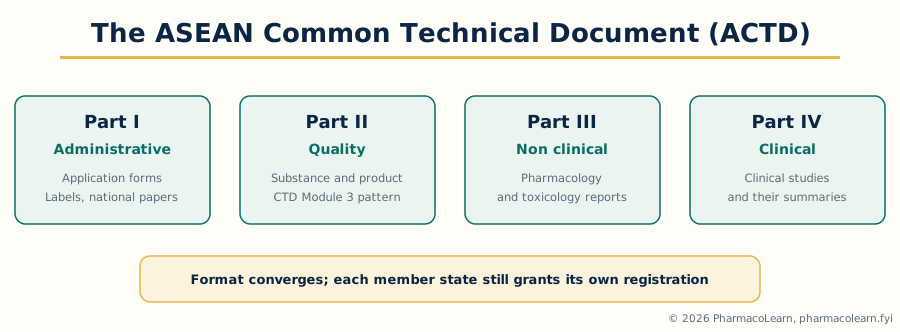 Figure: The ACTD: Part I administrative, the part that stays national, and Parts II, III and IV carrying quality, non clinical and clinical content on the CTD pattern, remapped to ASEAN order (Unit 5, section 5.1).
5.2 China
China's system has been rebuilt within a decade into a stringent style authority centred on the National Medical Products Administration (NMPA), with technical review by its Center for Drug Evaluation (CDE). The reforms that matter to this branch: the 2015 overhaul that cleared a backlog and raised data integrity expectations; acceptance of foreign clinical data on stated conditions and China's entry into ICH in 2017, after which the CTD and the ICH guidelines became the working grammar of Chinese filings; the marketing authorization holder system, made general by the revised Drug Administration Law 2019, separating the holder from the manufacturer on the Japanese pattern; the revised Drug Registration Regulation of 2020 with its four expedited channels (breakthrough therapy, conditional approval, priority review, special approval); and a registration classification reform sorting chemical drug applications into innovative, improved and generic classes. Human genetic resources administration adds a China specific gate on clinical data and sample movements. For Indian industry, China is now less an emerging market in the Unit 4 sense than a stringent market with its own language, timelines and local presence requirements.
5.3 South Korea
South Korea's authority is the Ministry of Food and Drug Safety (MFDS), renamed from the Korea FDA in 2013, with review supported by its National Institute of Food and Drug Safety Evaluation. Registration runs in CTD: new drug data packages are reviewed in full, with Korean bridging considerations where ethnic factors justify them, while generics proceed on bioequivalence against the Korean reference, within one of the world's most developed generic substitution cultures. Post approval, Korea operates re-examination periods for new drugs on the Japanese pattern and a risk based pharmacovigilance system with designated safety centres. Korea sits in this unit as ASEAN's northern comparator: an Asian stringent authority whose forms, language and local testing practices the regional filer must handle as distinctly as China's.
5.4 The ASEAN region: the five named countries
The syllabus names five ASEAN states, and the filer meets each through the ACTD dossier with national assessment. Singapore, through the Health Sciences Authority (HSA), is the region's reliance model: new drug applications are routed through full, abridged and verification routes according to whether and where the product is already approved by HSA's reference agencies, the verification route being among the fastest stringent grade assessments in the world, and generics assessed on the abridged pattern. Malaysia, through the National Pharmaceutical Regulatory Agency (NPRA) and the Drug Control Authority that registers, requires registration before import or sale, in ACTD, with five year registration validity and a local registration holder answerable in Malaysia. Thailand, through its Food and Drug Administration, registers on ASEAN harmonised requirements with Thai language labelling and a local licence holder. The Philippines, through its FDA (successor to the Bureau of Food and Drugs), registers under the FDA Act of 2009, with a certificate of product registration of defined validity and heavy practical reliance on certificates of pharmaceutical product from the country of origin, the Unit 4 passport at work. Vietnam, through the Drug Administration of Vietnam under its Pharmacy Law, registers with dossier requirements that have historically included clinical data expectations for defined categories and a local representative structure. The five together state the regional truth: one format, five sovereign decisions, speeds set by each state's reliance policy.
5.5 The CIS: Russia, Kazakhstan and Ukraine
The Commonwealth of Independent States markets are in a long transition from national Soviet successor systems to a regional one. The Eurasian Economic Union (EAEU) has built a common market for medicines with Union level rules: registration by the Union's mutual recognition and decentralised procedures, a single register of medicines, Union GMP, and expert organisations in each member state doing the assessment work. Russia, the Union's dominant market, moves registrations onto the EAEU track under its transition timetable, with the national law on circulation of medicines as the substrate, Russian language dossiers and labelling, and its own GMP inspection of foreign sites, an inspection Indian exporters know well. Kazakhstan participates in the same Union system through its national expert organisation, with national pricing and procurement layers over the Union registration. Ukraine stands outside the EAEU and has spent a decade converging on the EU instead: its system, administered by the Ministry of Health with the State Expert Center's assessment, works in CTD, recognises reliance on stringent approvals for defined categories, and has reformed repeatedly toward the European model. For the filer the CIS lesson is cartographic: know which of the two convergence projects, Eurasian or European, each market belongs to, because the dossier, language, inspection and register all follow that choice.
5.6 The GCC: Saudi Arabia and the UAE
The Gulf states combine strong national authorities with a regional inheritance. The Gulf Central Committee for Drug Registration, operating through the Gulf Health Council, historically ran a centralised registration whose certificates member states adopted; the centre of gravity has since moved to the national authorities, of which two dominate. Saudi Arabia's Food and Drug Authority (SFDA), established 2003, is the region's stringent authority: registration in eCTD, full assessment with defined review tracks including priority review, Saudi specific requirements on pricing (a formal price certificate and the region's reference pricing habits), Arabic labelling, and a pharmacovigilance centre of regional standing; SFDA approvals are themselves used as reference approvals across the region. The United Arab Emirates regulates federally through the Ministry of Health and Prevention, with CTD based dossiers, local agent requirements, federal pricing, and the emirate level health authorities layering facility and practice regulation over the federal product registration. The GCC prerequisites an applicant assembles are thus: a dossier in the common format, evidence of status and GMP of the CoPP kind, pricing documentation, Arabic compliant labelling, and a local establishment answerable in market. Stability expectations deserve a working note: the Gulf's climatic zone requirements for long term stability data are the standing technical trap for dossiers assembled to temperate market defaults.
5.7 Cosmetics in Brazil, ASEAN, CIS and GCC
The cosmetics closing item gathers four regional models. Brazil, under ANVISA, sorts cosmetics into Grade 1 products, whose basic properties need no detailed proof, handled by electronic notification with immediate effect, and Grade 2 products, with specific indications and claims requiring proof, subject to registration with ANVISA assessment; labelling in Portuguese and local responsible company requirements complete the system, and Brazil is accordingly the unit's one true approval model for higher claim cosmetics. ASEAN harmonised cosmetics through the ASEAN Cosmetic Directive, which transplants the EU model into the region: a responsible company places the product on the market after notification to each member state's authority, holding a product information file with safety assessment for inspection, with ingredient annexes modelled on the EU lists. The CIS and EAEU regulate cosmetics under the Eurasian technical regulation TR CU 009/2011 on the safety of perfumery and cosmetic products: conformity is declared or, for defined categories such as children's cosmetics, certified and state registered, with the EAC mark on the pack. The GCC applies the Gulf standard GSO 1943 for cosmetic safety through national notification and registration practice, with Arabic labelling and prohibited ingredient lists aligned to the European annexes. Read across Units 1, 2 and 5, the world's cosmetics settle into a spectrum the student can now state: notification with accountability in the EU and ASEAN manner at one end, registration by risk grade in the Brazilian manner at the other, and ingredient control in the Australian manner off to the side.
Frequently Asked Questions
Q: How does an ANDA differ from an NDA if both end in a marketing approval? An NDA proves safety and effectiveness on the applicant's own full evidence. An ANDA proves sameness: the same active ingredient, form, strength and route as a Reference Listed Drug, pharmaceutical equivalence, the same labelling, and bioequivalence within the 80.00 to 125.00 percent acceptance range. The ANDA contains no clinical efficacy programme, which is why Hatch-Waxman made generics cheap enough to transform the market.
Q: What exactly does a Paragraph IV certification do? It asserts that a patent listed in the Orange Book is invalid, unenforceable or not infringed by the generic product. The applicant must notify the patent owner and the NDA holder; if they sue within 45 days, FDA approval is automatically stayed for up to 30 months while the court decides. The first applicant to win or settle through a Paragraph IV challenge earns 180 days of generic marketing exclusivity.
Q: US DMF, EU ASMF and Japanese MF look alike. What is the practical difference? All three keep the substance maker's confidential data closed to the applicant while the authority reviews it in connection with an application. The EU ASMF is split into an Applicant's Part that the applicant does read and a Restricted Part it does not, and has an EU worksharing procedure. Japan registers the file and issues a registration certificate and number, and pairs the system with accreditation of the foreign manufacturer. The US DMF is closed in full and referenced by a Letter of Authorization.
Q: Which products must use the EU centralised procedure? Biotechnology derived medicines, orphan medicines, advanced therapy medicinal products and medicines for the specified major therapeutic areas must use it. Other new active substances and products representing significant innovation may choose it. The reward is a single Commission decision valid across the EU and EEA, on a CHMP opinion reached over 210 active assessment days plus clock stops.
Q: What is the difference between Type IB and Type II variations in the EU? A Type IB variation is a minor change that is neither Type IA nor Type II, worked on a tell, wait and do pattern: the holder notifies and may implement after 30 days if the authority does not object. A Type II variation is a major change that may significantly affect quality, safety or efficacy; it is fully assessed, ordinarily over 60 days, and may be implemented only after approval.
Q: Is notification of a cosmetic in the EU an approval? No. Under Regulation 1223/2009 the Responsible Person notifies the product on the Cosmetic Products Notification Portal before placing it on the market, but no authority approves it. Legality rests on the Responsible Person's duties: a safety assessment by a qualified assessor, a Product Information File held for the authorities, compliance with the ingredient annexes, and corrective action duties if the product proves unsafe.
Q: What did MoCRA change for cosmetics in the United States? The Modernization of Cosmetics Regulation Act 2022 kept the American rule of no premarket approval (colour additives excepted) but added the machinery around it: mandatory facility registration, product listing, safety substantiation, serious adverse event reporting within 15 business days, FDA records access, mandatory recall authority, and rule making for cosmetic GMP and fragrance allergen labelling.
Q: Japan has already approved a drug after full review. Why does it re-examine it years later? Because the Japanese system treats approval of a new drug as the start of a formal evidence period. The holder collects use results and safety data under the GPSP rules through the re-examination period, in principle eight years for a new active ingredient, intensified by early post-marketing phase vigilance in the first six months. At the end, PMDA and MHLW re-evaluate the product on the real world record and confirm, adjust or withdraw the approval.
Q: Does WHO prequalification allow a company to sell a medicine in a country? No. Prequalification is a listing relied on by purchasing agencies and national regulators; it confers no marketing right. Its power is reliance: a prequalified product from a prequalified site can be registered faster in many countries, including through collaborative registration procedures, and can be bought by UNICEF, the Global Fund and similar procurers.
Q: What is the difference between the ICH CTD and the ASEAN ACTD? The ACTD is ASEAN's regional adaptation of the CTD idea. Instead of the CTD's five modules it uses four parts: Part I administrative (the country specific part), Part II quality, Part III non clinical and Part IV clinical, arranged in ASEAN's own order. A global CTD dossier must be remapped into ACTD order for ASEAN filings, and the ACTD standardises format only; each ASEAN state still grants its own registration.
Complete MRA201T notes, all 5 units in one PDF, free to keep.
Other M.Pharm subjects: MPH101T · MPC101T · MPL101T · MPH102T · MPH103T · MPH104T · MPL102T · MPL103T · MPL104T · MPC102T · MPC103T · MPC104T · MPH201T · MPH202T · MPH203T · MPH204T · MPC201T · MPC202T · MPC203T · MPC204T · MPL201T · MPL202T · MPL203T · MPL204T · MRA101T · MRA102T · MRA103T · MRA104T · MRM301T · MPG101T · MPG102T · MPG103T · MPG201T · MPG202T · MPG203T · MPG104T · MPG204T · MRA201T · MRA202T · MRA203T · MRA204T · M.Pharm