
MRA203T — Regulatory Aspects of Medical Devices
4 hrs/week, 4 credits, 60 hours, 100 marks. Notes follow the M.Pharm syllabus, unit by unit.
MRA203T Regulatory Aspects of Medical Devices notes for M.Pharm Regulatory Affairs Semester 2: classification and essential principles, IMDRF and GHTF, STED, ISO 13485, ISO 14971, ISO 14155, US 510(k), PMA, IDE and UDI, EU directives and CE marking, ASEAN, China and Japan. Free unit wise PDF downloads on PharmacoLearn.
Units in this subject
- Unit 1 — Medical Devices, Introduction
- Unit 2 — Ethics and Quality
- Unit 3 — USA
- Unit 4 — European Union
- Unit 5 — ASEAN, China and Japan
Download MRA203T PDF Notes
Free PDFs for this subject, one per unit:
Regulatory Aspects of Medical Devices, subject code MRA203T, is the third core subject of M.Pharm Regulatory Affairs, Semester 2. It carries 4 credits and 60 hours of theory, taught at 4 hours per week, for 100 marks. The two subjects before it regulated products that are swallowed, injected or applied: drugs, whose identity is chemical, and biologics, whose identity is bound up with a living process. This subject regulates the third great family of medical products, the ones that act on the body without being metabolised by it: the instruments, machines, implants, software and laboratory tests of modern medicine. A medical device is regulated differently from a drug for a reason that runs through every unit of this course. Its performance is an engineering property, proved by design control, bench testing and standards conformity, with clinical evidence scaled to risk, rather than by the pharmacological trial programme of a medicine; its failures are mechanical, electrical and usability failures as much as biological ones; and its makers range from global engineering firms to a workshop with one lathe, so the law is built on classification by risk and on quality systems rather than on product by product proof of efficacy. This course is designed to impart fundamental knowledge on medical devices and in vitro diagnostics, the basis of classification and the product life cycle of medical devices, and the regulatory requirements for approval of medical devices in regulated countries like the US, EU and Asian countries along with WHO regulations, covering in detail the harmonization initiatives, and the quality and ethical considerations, for marketing devices and IVDs.
The units follow the architecture of the field. Unit 1 builds the global foundation: what a medical device is, the essential principles every device must meet, risk based classification, how devices, IVDs and combination products differ from pharmaceuticals, the history and the product life cycle, and the harmonisation machinery of the GHTF and its successor the IMDRF, with its two great tools, the STED dossier format and the GMDN nomenclature. Unit 2 takes the ethical and quality spine: clinical investigation of devices under ISO 14155, the ISO 13485 quality system, ISO 14971 risk management, design verification and validation, and adverse event reporting. Unit 3 studies the United States: classification into Classes I, II and III, the 510(k) notification, premarket approval, the investigational device exemption, the Quality System Regulation of 21 CFR Part 820, labelling under Part 801, post market surveillance and the Unique Device Identification system, closing with IVDs. Unit 4 studies the European Union through the directives the syllabus names, the Medical Device Directive, the Active Implantable Medical Device Directive and the In Vitro Diagnostic Directive, with the CE certification process and IVD classification; because those directives have since been replaced by the Medical Device Regulation 2017/745 and the IVD Regulation 2017/746, the unit teaches the directive framework in full and states the current position beside it, in the two layer manner used throughout this branch. Unit 5 studies ASEAN, China and Japan: registration procedures, quality system requirements and clinical evaluation and investigation, closing with the IMDRF study groups and guidance documents. One honest note belongs here at the start: the course objectives name India among the countries whose approval process the student shall know, but the printed units assign no unit to India. The Indian framework, the Medical Devices Rules 2017 with their classes A to D and the CDSCO licensing machinery, is taught in this branch in MRA104T, and Unit 1 of this subject places the Indian classes inside the global classification picture; this subject then follows its printed units. The habit that pays off throughout: classify first. Almost every regulatory question about a device, which dossier, which evidence, which authority, which vigilance duty, is answered by the class the device falls in and the jurisdiction it is sold in, and the two together.
Unit 1: Medical Devices, Introduction
1.1 Introduction: a third family of medical products
A medical device can be almost anything in a hospital that is not a drug or a pair of hands: a scalpel, a hip implant, an MRI scanner, a blood glucose test, a surgical glove, a pacemaker, a phone application that reads a heart rhythm. The family is defined not by what its members are made of but by how they achieve their purpose, through physical, mechanical, electrical or software action rather than through pharmacological, immunological or metabolic means. That single distinction drives the whole regulatory design of this subject. Because a device's action is engineered, its safety and performance can to a large extent be designed in, specified, tested on the bench and audited through the manufacturer's quality system; because devices iterate quickly and are used by operators whose skill varies, regulation must also govern design change, usability and the information supplied to the user. The regulatory professional's work in this field is therefore classification, standards, quality systems and vigilance, wrapped around clinical evidence proportionate to risk.
1.2 Definition of a medical device
Definitions decide jurisdiction, so they are drafted with care and examined accordingly. The harmonised definition, carried by the GHTF and echoed in law worldwide, runs in substance as follows: a medical device is any instrument, apparatus, implement, machine, appliance, implant, reagent for in vitro use, software, material or other similar or related article, intended by the manufacturer to be used, alone or in combination, for human beings, for one or more specific medical purposes: the diagnosis, prevention, monitoring, treatment or alleviation of disease; the diagnosis, monitoring, treatment, alleviation of or compensation for an injury; the investigation, replacement, modification or support of the anatomy or of a physiological process; supporting or sustaining life; the control of conception; the disinfection of medical devices; or providing information by means of in vitro examination of specimens derived from the human body, and which does not achieve its primary intended action in or on the human body by pharmacological, immunological or metabolic means, but which may be assisted in its intended function by such means. Three elements do the work. Intended purpose, as stated by the manufacturer in labelling, instructions and claims, decides whether an article is a device at all: the same software is a wellness product or a regulated device according to the medical purpose claimed for it. Mode of action separates devices from drugs at the border: a wound dressing that merely covers is a device, while one whose primary action is an antimicrobial drug effect crosses toward the drug side, the combination product problem of section 1.5. And the definition deliberately includes software and in vitro reagents, which is why the syllabus treats IVDs inside the device family throughout. An in vitro diagnostic medical device (IVD) is a device, whether used alone or in combination, intended by the manufacturer for the in vitro examination of specimens derived from the human body, solely or principally to provide information for diagnostic, monitoring or compatibility purposes: reagents, calibrators, control materials, specimen receptacles, instruments and test kits, from a pregnancy test to a blood bank screening assay.
1.3 Essential principles of safety and performance
Every regulatory system in this subject is, at bottom, a machine for demonstrating one short list of propositions about a device, and the GHTF codified that list as the Essential Principles of Safety and Performance. In substance they require that devices be designed and manufactured so that, when used as intended, they do not compromise the health or safety of patients, users and others; that the risks be acceptable when weighed against the benefits; that performance claimed by the manufacturer be achieved, over the device's lifetime, under normal conditions of use; that design take account of the state of the art, of the environment of use and of the knowledge and skill of the intended user; and that specific families of hazards be controlled: chemical, physical and biological properties, including material safety and contamination; infection and microbial contamination; manufacturing and environmental properties; devices with a measuring function, which must be accurate and stable; protection against radiation, where the device emits or uses it; and the information supplied with the device, labelling and instructions for use, which is itself treated as a safety feature. Conformity with recognised standards is the normal evidence: a device built and tested to the applicable harmonised or consensus standards is presumed to meet the corresponding essential principles, which is why standards literacy, met for quality in ISO 13485 and for risk in ISO 14971 in Unit 2, is a regulatory skill and not an engineering extra. The essential principles also explain the shape of the STED dossier of section 1.10: its device description, design verification and clinical evidence sections exist to demonstrate, principle by principle, that this device meets the list.
1.4 Risk based classification
Classification is the master key of device regulation because the class assigns the weight of every other control: the conformity route, the depth of clinical evidence, the audit intensity and the vigilance duties. The GHTF model, which most of the world now follows in shape, sorts devices into four classes, A, B, C and D, in ascending risk, assigned by rules applied to the device's characteristics rather than by case by case discretion. The rules weigh a consistent set of factors: the duration of contact with the body (transient, short term, long term); the invasiveness of the device and the body orifice or tissue it reaches, with surgically invasive and implantable devices weighted above surface devices; whether the device is active, depending on a source of energy, and what that energy does, administering or exchanging substances or radiation being weighted most heavily; the centrality of the body system touched, devices acting on the central circulatory or nervous system carrying the highest weight; and for IVDs, the consequence of a wrong result, for the individual and for public health, which is why a test for a transmissible agent in blood donations outranks a test whose error merely inconveniences. The regulatory logic is proportionality stated as a table.
| Class (GHTF model) | Risk level | Illustrative devices | Weight of control |
|---|---|---|---|
| A | Low | Examination gloves, tongue depressors, simple dressings | Manufacturer declaration, quality system basics, registration and listing |
| B | Low to moderate | Powered wheelchairs, infusion pumps of simple design, most diagnostic ultrasound | Notification or review of technical documentation by the authority or a designated body |
| C | Moderate to high | Ventilators, orthopaedic implants, blood glucose monitoring systems | Full technical review, clinical evidence examined, quality system audited |
| D | High | Implantable defibrillators, heart valves, tests for transfusion transmitted infection | The closest scrutiny: full review, clinical investigation evidence, batch and post market controls |
The named jurisdictions translate this model into their own labels, the subject of Unit 3, Unit 4 and section 1.8 below: the United States uses Classes I, II and III; the European directives used I, IIa, IIb and III; India, ASEAN, China and Japan follow the four letter A to D shape most closely.
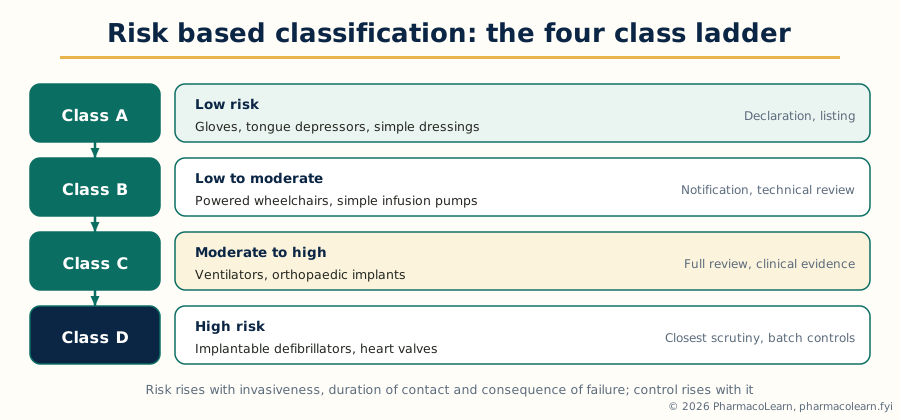 Figure: The GHTF four class ladder of section 1.4: risk rises with invasiveness, duration of contact and consequence of failure, and the weight of regulatory control rises with it, the model the working systems of section 1.8 translate into local labels (Unit 1, section 1.4).
1.5 Devices, IVDs and combination products, and the line against pharmaceuticals
Borderline judgment is a daily regulatory task, and the syllabus lists the differentiations explicitly. A pharmaceutical achieves its primary action by pharmacological, immunological or metabolic means and is regulated on chemical or biological identity plus clinical trial proof of efficacy. A medical device achieves its primary action by physical or mechanical means and is regulated on classification, design control and performance evidence. An IVD never touches the patient at all: it examines a specimen taken from the body, and its performance is measured in analytical and diagnostic accuracy, sensitivity and specificity, rather than in therapeutic effect, which is why a false result, not a toxic effect, is its characteristic harm. A combination product combines two or more of the families in one article: a drug eluting stent (device frame, drug action), a prefilled syringe (drug in a device), an antimicrobial catheter. Combination products are assigned by their primary mode of action: the component that achieves the principal intended purpose decides the lead regulatory framework, and the other component's requirements are then applied on top, so a drug eluting stent is led as a device with the drug constituent assessed to drug standards. In the United States a dedicated office assigns the lead centre, CDRH, CDER or CBER, by that test; in the EU a device incorporating a medicinal substance whose action is ancillary is regulated as a device with a medicines authority consulted on the substance. The examination point is the test itself: primary mode of action decides the lead, and both sets of rules then apply to their own parts.
| Point | Pharmaceutical | Medical device | IVD |
|---|---|---|---|
| Primary action | Pharmacological, immunological or metabolic | Physical, mechanical, electrical or software | None on the body: examination of a specimen |
| Proof of performance | Clinical trials of efficacy and safety | Design verification, bench and performance testing, clinical evidence by risk | Analytical and clinical performance: accuracy, sensitivity, specificity |
| Characteristic harm | Adverse drug reaction | Malfunction, mechanical or electrical failure, use error | A false result leading to a wrong decision |
| Regulatory key | Composition and trials | Classification and quality system | Classification by consequence of error |
| Change discipline | Variations to a marketing authorisation | Design control under the quality system | Change control of reagents, calibrators and software |
1.6 History of medical device regulation
Device law is younger than drug law, and its landmarks are reactions to harm, in the pattern MRA103T traced for clinical research ethics. Early twentieth century law treated devices, where it noticed them at all, as ordinary goods: the original US Food, Drug, and Cosmetic Act of 1938 gave the FDA authority over adulterated and misbranded devices but no power to require proof before marketing, and most countries had less. The gap showed in a series of failures, of which the Dalkon Shield intrauterine device in the 1970s, marketed without premarket testing and followed by pelvic infections, infertility and deaths, is the standard teaching case: it taught legislators that a device could injure at scale while no authority had ever examined it before sale. The American answer was the Medical Device Amendments of 1976, the foundation of the modern system: classification into three classes, general controls for all devices, premarket notification for the middle class and premarket approval for the highest, with investigational device exemptions for clinical study, the machinery Unit 3 teaches. Europe built later and differently: the directives of the 1990s (the Active Implantable Directive of 1990, the Medical Device Directive of 1993, the IVD Directive of 1998) created the CE marking system of Unit 4, delegating conformity assessment to notified bodies rather than a central agency. The harmonisation era followed: the Global Harmonization Task Force, founded in 1992 by the regulators and industry of the US, EU, Japan, Canada and Australia, wrote the shared grammar of the field, the essential principles, the classification rules, the STED; and when its work was judged ready to pass to regulators alone, the IMDRF succeeded it in 2011. The most recent turn is tightening after failure: the PIP breast implant scandal, in which a manufacturer fraudulently used industrial grade silicone while holding a CE mark, drove the EU from directives to the directly applicable, stricter MDR and IVDR of 2017, with notified bodies themselves more heavily supervised.
1.7 Product lifecycle of medical devices
A device's regulated life runs longer and changes faster than a drug's, and the syllabus names the product lifecycle as a topic because each stage carries its own regulatory instruments. It opens in conception and design: intended purpose is fixed, the classification is determined, the applicable standards and essential principles are mapped, and design control under the quality system begins, because in device regulation the design file is a legal document. Design verification and validation follow, bench, software, usability and where required animal and clinical work, governed for investigations by ISO 14155 (Unit 2). Regulatory submission and market authorisation convert the design dossier, in STED shape where accepted, into the right to sell, through the routes of Units 3 to 5. Manufacture and release run under the audited quality system, with the device history records that let every unit be traced to its materials and process. Distribution and use add labelling, installation, training and servicing duties, and for the higher classes the unique device identification that Unit 3 covers. Post market surveillance and vigilance then operate for the whole market life: complaint handling, adverse event reporting, field safety corrective actions and the periodic reassessment of the risk file, because a device's risk profile is learned in use and its design is expected to improve. Change and obsolescence close the loop: design changes are graded by their effect on safety and performance and may need fresh notification or approval, and end of life brings withdrawal, recall where required, and record retention. The contrast with the drug lifecycle of MRA102T is instructive: a medicine's identity is frozen at authorisation and defended by variations control, while a device is expected to evolve under design control, and its regulator therefore audits the system that controls change as much as the product that results.
The regulated lifecycle of a medical device
Conception: intended purpose fixed, classification determined
        |
Design and development under design control (ISO 13485)
        |
Verification and validation; clinical investigation where
the class requires it (ISO 14155)
        |
Submission (STED shaped dossier) and market authorisation
        |
Manufacture and release under the audited quality system
        |
Distribution and use: labelling, UDI, training, servicing
        |
Post market surveillance, vigilance, corrective action
        |
Change under design control, or obsolescence and withdrawal
        (and the loop returns to design)
1.8 Classification of medical devices: the working systems
Section 1.4 gave the model; this section gives the labels the market actually uses, which Units 3 to 5 then spend. The United States classifies into Class I (low risk, general controls, many exempt from premarket notification), Class II (moderate risk, general plus special controls, normally the 510(k) route) and Class III (high risk, normally premarket approval), assigned device type by device type in the classification regulations. The European directives classified by eighteen rules into Class I, IIa, IIb and III, the MDR keeping the four tiers and widening several rules so that some devices moved up a class. India's Medical Devices Rules 2017 follow the GHTF shape exactly: Class A low, B low to moderate, C moderate to high, D high risk, with the licensing split MRA104T teaches, State Licensing Authority for Classes A and B manufacture, Central Licensing Authority for C and D and for all imports. ASEAN under its Medical Device Directive, China under the NMPA (with its own Class I, II and III labels), and Japan under the PMD Act (general, controlled and specially controlled devices, aligned to the four GHTF classes) complete the Unit 5 picture. Two professional habits follow. Classification is rule based and intended purpose based, so the same physical article can change class with its claims; and classification must be settled before any other regulatory planning, because dossier, evidence, route and audit all hang from it.
1.9 IMDRF and GHTF: the harmonisation machinery
The Global Harmonization Task Force (GHTF) was founded in 1992 as a voluntary partnership of the regulatory authorities and the regulated industry of five jurisdictions, the United States, the European Union, Japan, Canada and Australia, to converge device regulation worldwide: one set of essential principles, one classification model, one dossier shape, so that a device assessed once could travel. It worked through five study groups, each owning a territory: Study Group 1, premarket evaluation, which wrote the essential principles and the STED; Study Group 2, post market surveillance and vigilance, which wrote the adverse event terminology and reporting guidance met in Unit 2; Study Group 3, quality systems; Study Group 4, auditing of quality systems; and Study Group 5, clinical safety and performance. In 2011 the regulators judged that convergence work should be led by regulators alone, wound the GHTF down, and founded the International Medical Device Regulators Forum (IMDRF) as its successor, a voluntary group of device regulators, chaired in rotation, working through working groups on the same convergence agenda, with a management committee of the member authorities and the WHO and harmonisation bodies such as the Asian Harmonization Working Party participating as observers. IMDRF's products are guidance documents (its adverse event terminology is the global coding standard of Unit 2, section 2.7), the regulated product submission table of contents that succeeds the STED, and frameworks such as the Medical Device Single Audit Program, under which one quality system audit serves several jurisdictions, used again in Unit 5. Neither body makes law: their power is that national systems, India's 2017 Rules and ASEAN's directive among them, adopt their models wholesale, so a student who knows the GHTF grammar can read most national device rules as dialects of it.
1.10 Summary Technical Documentation: the STED
The Summary Technical Documentation, universally shortened to STED, is Study Group 1's answer to the dossier problem: a standardised summary of the evidence that a device complies with the essential principles, organised so that any adopting regulator can review the same package. Its contents follow the lifecycle of the proof: a device description and features, including variants and accessories, and the intended purpose; the essential principles checklist, mapping each applicable principle to the standards applied and the evidence held; labelling and instructions for use; design and manufacturing information, at summary level; the verification and validation evidence, bench, software, biocompatibility, sterilisation and stability as applicable; the clinical evidence and its evaluation; and the risk analysis and management summary drawn from the ISO 14971 file. The crucial word is summary: the STED is the organised face of the technical documentation, not the whole of it, and the manufacturer must hold the underlying full data for audit or on request. Its regulatory significance is portability: a STED prepared for one STED adopting jurisdiction can be readdressed to another with the local administrative layer replaced, which is the practical cash value of harmonisation, and the MRA205P practical list of this branch accordingly sets a STED application for a Class III device as an exercise. The IMDRF's table of contents for regulated product submissions is the STED's designated successor, broader and chaptered for electronic submission, and Unit 5 closes with the guidance family to which both belong.
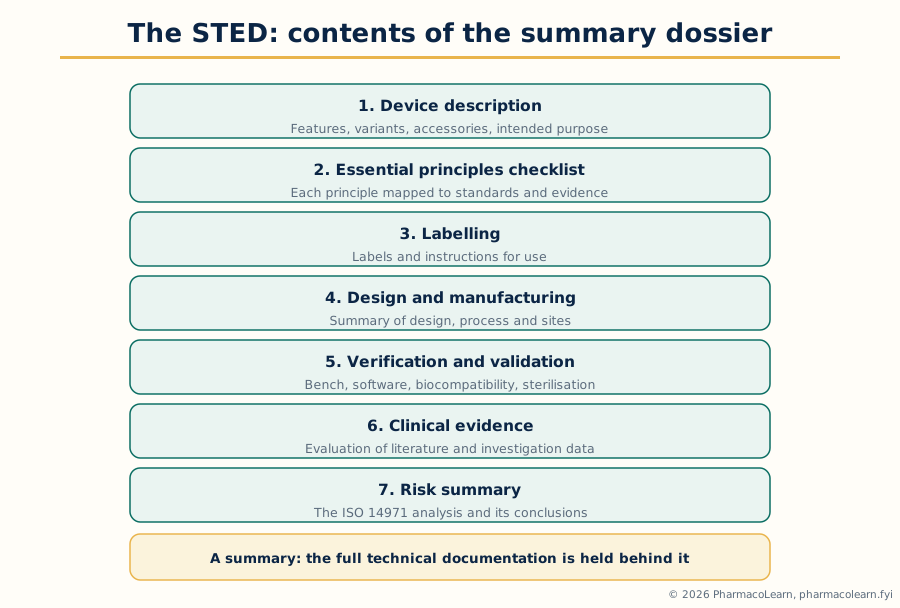 Figure: The STED chapters of section 1.10: device description and intended purpose, the essential principles checklist, labelling, design and manufacturing summary, verification and validation evidence, clinical evidence and the risk summary, the summary face of the full technical documentation held behind it (Unit 1, section 1.10).
1.11 Global Medical Device Nomenclature: the GMDN
Regulators cannot compare experience with devices they cannot name consistently, and the Global Medical Device Nomenclature (GMDN) is the naming system built for that purpose: a structured, coded vocabulary of generic device groups, maintained by the GMDN Agency, in which every device type is assigned a term and code describing what it generically is, a cardiac catheter, a hip prosthesis, a blood glucose analyser, regardless of brand or maker. Its regulatory uses are fundamental: classification rules are administered against generic groups; adverse event reports aggregate experience by GMDN term, so a problem appearing across brands of one generic type is visible at all; registration and listing systems file devices under it; and traceability systems, including the UDI device identifiers of Unit 3, draw their generic layer from it. The professional habit it embodies: in device regulation, precise generic naming is not housekeeping but the precondition of surveillance, since a signal that cannot be grouped cannot be counted.
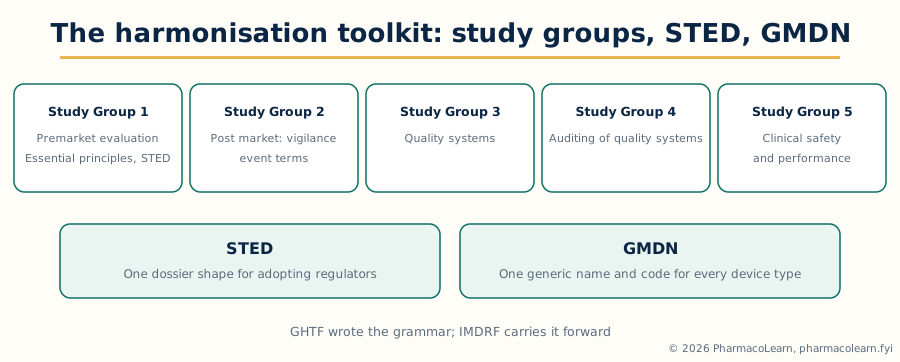 Figure: The GHTF and IMDRF toolkit of sections 1.9 to 1.11: essential principles and classification from Study Group 1, vigilance from Study Group 2, quality systems and auditing from Study Groups 3 and 4, clinical evidence from Study Group 5, carried by the two instruments every regulator reuses, the STED dossier and the GMDN nomenclature (Unit 1, sections 1.9 to 1.11).
Unit 2: Ethics and Quality
2.1 Clinical investigation of medical devices: why and when
Clinical investigation is the device world's clinical trial: a systematic study in human subjects undertaken to verify the safety and performance of a device used as intended. Not every device needs one, and knowing when it does is the first judgment of this unit. Where the essential principles can be demonstrated by bench testing, standards conformity and literature on equivalent devices, clinical evaluation may rest on that evidence, and most low class devices reach the market so. Investigation is required where the technology, the claim or the risk leaves a question only human use can answer: typically novel high risk implantables, devices whose performance claim is itself clinical, and cases where the existing literature does not cover the intended purpose. The ethical frame is the one MRA103T built: the Declaration of Helsinki and the ICH GCP tradition, adapted to devices by ISO 14155, because device investigations have features drug trials lack: the intervention may be a procedure as much as a product, blinding may be impossible where a surgeon must know the implant, the device may be permanently implanted so that withdrawal from the study does not withdraw the exposure, and the operator's learning curve is itself a variable. Ethics committee approval, informed consent and insurance and compensation arrangements are required before first enrolment, and the sponsor's duty to monitor safety runs through the investigation, with device deficiencies, the near misses of the device world, recorded alongside adverse events.
2.2 The clinical investigation plan
The clinical investigation plan (CIP) is the protocol of the device investigation, the document ISO 14155 requires to be written, approved and followed, and its contents mirror a drug protocol with device specific additions. It states the identification and description of the device, its intended purpose and the claims under test; the objectives and the design, endpoints, subject population and sample size with their justification; the risk analysis of the device and the justification for exposing subjects, drawn from the ISO 14971 file of section 2.5; the procedures, including any surgical technique, training of investigators and the handling of device deficiencies; monitoring, data management and statistical methods; the ethical apparatus, ethics committee approval, informed consent documents and provisions for vulnerable subjects; and the reporting machinery for adverse events and deviations, with the criteria for early termination. Two companions travel with it: the investigator's brochure, assembling everything known about the device, its bench and preclinical data and the experience to date, so the investigator can judge risk independently; and the clinical investigation report at the end, on which the clinical evaluation of the device is built. Read the CIP as the point where ethics, risk management and evidence meet: every element of it answers to one of the three.
2.3 ISO 14155: good clinical practice for device investigations
ISO 14155 is the good clinical practice standard for the clinical investigation of medical devices, the device counterpart of ICH E6 for drugs, and the syllabus cites its 2011 edition, the edition on which this teaching is based, noting that the current edition is ISO 14155:2020. Its principles restate the ethical core in device language: investigations are conducted in accordance with the Declaration of Helsinki; the rights, safety and well being of subjects prevail over science and society; the device information must justify the exposure; and the investigation follows the approved CIP under qualified investigators and medical oversight. Its operative content is the allocation of duties. The sponsor designs and funds the investigation, selects and trains investigators, monitors conduct and data, manages device accountability and safety reporting, and owns the quality system within which the study runs. The investigator obtains ethics approval and informed consent, follows the plan, records data and deficiencies, and reports adverse events promptly. The ethics committee reviews the plan, the consent materials and the investigator's suitability, and keeps the investigation under review. What distinguishes the standard from its drug counterpart is its device furniture: device deficiency reporting (malfunctions and use errors that could have led to harm, reported even when no harm occurred), requirements on device accountability and traceability to each subject, and provisions for the learning curve and for investigations where the device cannot be removed. A clinical investigation run to ISO 14155 generates the clinical evidence that Units 3 to 5 then file in their several systems, which is why this unit precedes them.
A device clinical investigation under ISO 14155
Bench, preclinical and risk file complete (ISO 14971)
        |
Clinical investigation plan written; investigator's brochure issued
        |
Ethics committee approval and regulatory notification or approval
        |
Informed consent of every subject before any procedure
        |
Conduct: monitoring, device accountability, deficiency and
adverse event reporting throughout
        |
Database lock and clinical investigation report
        |
Clinical evaluation: the evidence enters the device dossier
2.4 ISO 13485: the quality system regulation for devices
ISO 13485 is the quality management system standard written specifically for medical devices, the standard against which manufacturers worldwide are certified and the benchmark the quality items of this subject return to. It is built on the process architecture of ISO 9001 but diverges from it in the direction of regulation throughout: where ISO 9001 aims at customer satisfaction and continual improvement, ISO 13485 aims at regulatory compliance and consistent safety and performance, and it keeps requirements the general standard has relaxed, such as documented procedures, maintained records and controlled work environments wherever product quality demands them. Its clause map runs: the quality management system itself, with the quality manual and the control of documents and records; management responsibility, including the appointed management representative and management review; resource management, with competence, training and infrastructure; product realisation, the operative heart, covering planning, customer related processes, design and development with its inputs, outputs, review, verification, validation and transfer, purchasing and supplier control, production and service provision including cleanliness, installation and servicing, and the control of monitoring and measuring equipment; and measurement, analysis and improvement, covering monitoring of product and process, control of nonconforming product, complaint handling, reporting to regulatory authorities, internal audit and corrective and preventive action. Two ideas carry the examination weight. First, the standard is risk based: it calls up ISO 14971 risk management inside design and production, so the risk file of section 2.5 is a quality system document, not an annex. Second, in most jurisdictions certification to ISO 13485 by an accredited or designated body is the standing evidence that the quality limb of conformity is met, which makes the standard's audit, by a notified body in the EU scheme of Unit 4 or under the single audit programme of Unit 5, a market access event and not merely a quality exercise.
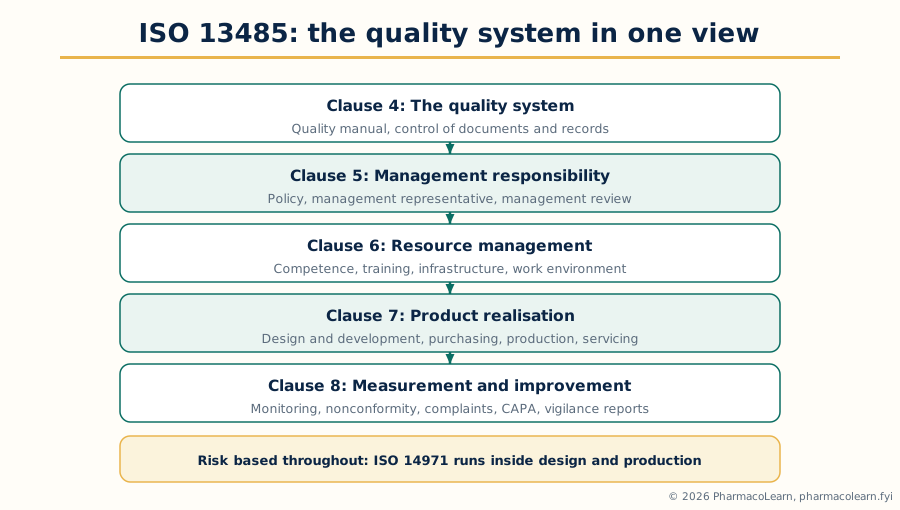 Figure: The ISO 13485 clause structure of section 2.4: management responsibility and resources around the product realisation core, design and development, purchasing, production and servicing, closed by measurement, complaint handling, vigilance reporting and CAPA (Unit 2, section 2.4).
2.5 ISO 14971: risk management for medical devices
ISO 14971 is the risk management standard for medical devices, and its process is the second language of this subject. The vocabulary first, because examinations test it precisely: a hazard is a potential source of harm; a hazardous situation is the circumstance in which people or property are exposed to the hazard; harm is the injury or damage that may result; and risk is the combination of the probability of the harm occurring and its severity. The process then runs as a disciplined cycle across the whole lifecycle. Risk analysis: the intended use and the characteristics related to safety are identified, hazards and foreseeable sequences of events are listed, and the risk of each hazardous situation is estimated. Risk evaluation: each estimated risk is judged against the acceptability criteria the manufacturer has set in advance in the risk management plan. Risk control: unacceptable risks are reduced, by the standard's ordered preference, first by inherent safety in design, then by protective measures in the device or its manufacture, and only last by information for safety, labelling and training; residual risks are weighed against benefit, and the overall residual risk is judged acceptable or not. Production and post production activity: the file stays open for the product's life, fed by complaints, vigilance and production data, and new hazards or changed estimates reopen the analysis. Everything is documented in the risk management file, which is the traceability spine from each hazard, through its controls, to the verification that the controls work. Risk management is not a department in this scheme: the clinical investigation plan of section 2.2 cites it, the design controls of ISO 13485 execute it, and the essential principles of Unit 1 are its acceptance test.
The ISO 14971 risk management cycle
Risk management plan: acceptability criteria set in advance
        |
Risk analysis: hazards, hazardous situations, risk estimated
        |
Risk evaluation: against the criteria
        |
Risk control: design out, protect, inform (in that order);
residual risk weighed against benefit
        |
Overall residual risk judged: acceptable or not
        |
Production and post production information: complaints,
vigilance, production data feed back into the analysis
        |
        +---- the file stays open for the whole product life ----+
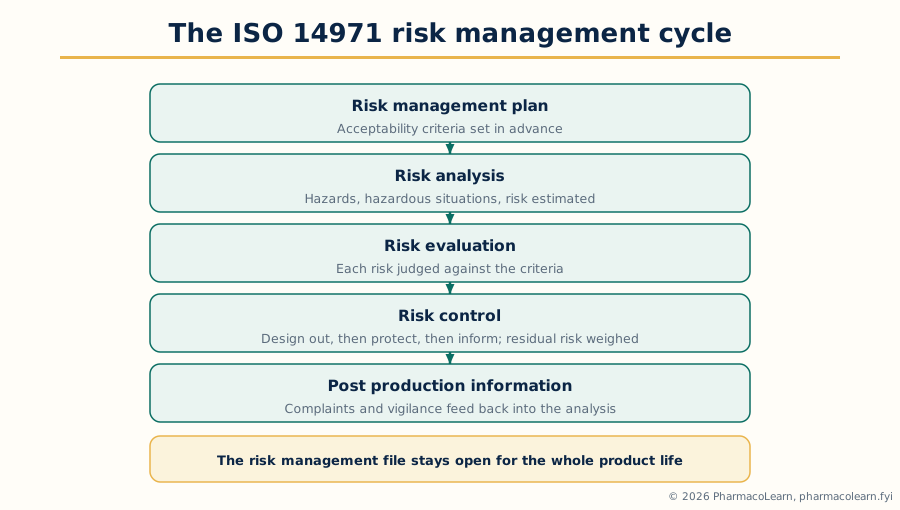 Figure: The risk management cycle of section 2.5 as a loop: analysis, evaluation against criteria set in advance, control by design, protection and information in that order, and post production information feeding back, all documented in the risk management file (Unit 2, section 2.5).
2.6 Verification and validation of medical devices
The pair is a single examination favourite because the words are easily swapped and must not be. Verification asks: did we build the device right? It confirms, by test, inspection, analysis or demonstration, that the design outputs meet the design inputs: the pump delivers the specified flow, the software responds within the specified time, the implant withstands the specified load, the sterilisation cycle achieves the specified sterility assurance. Validation asks: did we build the right device? It confirms that the finished device meets the user needs and the intended purpose in actual or simulated use: clinicians can operate it safely in the intended environment, the diagnostic result supports the intended decision, the implant performs in the body as claimed. Validation therefore reaches into usability engineering, the study of use error by the intended operator, and into clinical evaluation, where human evidence validates the clinical claims. Process validation stands beside the pair: where a process result cannot be fully verified by inspecting the product, sterilisation, moulding, aseptic sealing and software driven manufacture among them, the process itself must be validated, installed, operated and performance qualified, the qualification discipline met in MRA101T now applied to device lines. The three together are the engineering evidence on which the STED and every jurisdiction dossier of this subject rest, and design transfer, the controlled hand over from design to production, is where they are audited.
2.7 Adverse event reporting of medical devices
Vigilance for devices follows the pattern of pharmacovigilance with device specific reporting objects, and the IMDRF adverse event terminology supplies the shared codes. The reportable core is the incident: an event in which a device malfunctioned or deteriorated in performance, a device's labelling or instructions proved inadequate, or a use error occurred, and the event caused, or could have caused, death or serious deterioration in health. The molecule of the device world is the device deficiency, the inadequacy of a device with respect to its identity, quality, durability, reliability, usability, safety or performance, including malfunctions, use errors and inadequate labelling; deficiencies are counted whether or not anyone was harmed, because in aggregate they are the leading indicator of the incidents to come. The manufacturer's duties run in channels: report incidents to the competent authority of the market concerned within the timelines that market sets, graded by seriousness; investigate, with the risk file of section 2.5 reopened by the finding; and execute field safety corrective actions, up to and including recall, with field safety notices informing users. Users and facilities report in parallel, and the aggregated data feed the post market surveillance of Unit 3. The professional point mirrors MRA202T's traceability lesson: a device report is usable only if it identifies the exact device, model, lot or serial and its UDI where assigned, which is why the identification machinery of the next unit is vigilance machinery too.
Unit 3: USA
3.1 Introduction: the FDA and the device amendments
United States device regulation is administered by the FDA, principally through the Center for Devices and Radiological Health (CDRH), under the device provisions the Medical Device Amendments of 1976 built into the Federal Food, Drug, and Cosmetic Act. The architecture erected then still stands: every device is classified; every device, whatever its class, is subject to general controls, the baseline duties of establishment registration and device listing, labelling rules, the Quality System Regulation and adverse event reporting; higher classes attract special controls and premarket review in proportion to risk; and clinical study of a significant risk device runs under an investigational device exemption. Devices lawfully marketed before the 1976 amendments, preamendments devices, and devices found substantially equivalent to them form the reference population on which the 510(k) system of section 3.3 rests. Around the statute sit the user fee and modernisation acts, under which industry fees fund review performance goals, and the later statutory additions this unit meets: the De Novo pathway for novel low to moderate risk devices, the humanitarian device provisions for rare conditions, and the UDI rule.
3.2 Classification in the United States
FDA classification is by device type, set out in the classification regulations of 21 CFR Parts 862 to 892, organised by medical specialty panels, each type assigned to one of three classes according to the controls needed to assure safety and effectiveness. Class I devices present the lowest risk and are controlled by general controls alone; many are exempt from premarket notification, though not from registration, listing, labelling and the quality system (a small number are exempt even from parts of the quality system). Class II devices are those for which general controls alone are insufficient but for which special controls, performance standards, post market surveillance, patient registries or guidance, can provide the needed assurance; most reach the market through the 510(k) notification. Class III devices are those that support or sustain life, are implanted with significant risk, or present a potentially unreasonable risk of illness or injury, and for which the lesser controls cannot assure safety and effectiveness; they require premarket approval, the full evidentiary route of section 3.4. The class follows the generic type, not the individual brand, and a manufacturer who believes a device is misclassified, or whose device fits no existing type, uses the classification request and De Novo machinery of section 3.5. The examination contrast with Unit 1's model should be kept: the US three classes map onto the GHTF four by splitting the middle, Class II spanning what the model separates as B and C, which is why the 510(k) population is so wide.
| Point | 510(k) premarket notification | Premarket approval (PMA) |
|---|---|---|
| Legal basis | FD&C Act section 510(k) | FD&C Act section 515 |
| Typical class | Class II, some Class I and a residue of Class III | Class III |
| Question asked | Substantially equivalent to a predicate device | Reasonable assurance of safety and effectiveness |
| Evidence | Comparison to the predicate, bench and performance data, clinical data only where needed | Full valid scientific evidence, usually including clinical investigation |
| FDA act | Clearance: the device may be marketed | Approval: the application is approved |
| Change discipline | New 510(k) where a change could significantly affect safety or effectiveness | PMA supplements graded by the change, panel track to annual report |
3.3 Premarket notification: the 510(k)
The 510(k) is a notification, not an application, and its logic is comparative from first to last. The submitter must show that the device is substantially equivalent to a legally marketed predicate device, a preamendments device or a device itself cleared through the process: same intended use, and either the same technological characteristics or different characteristics that do not raise new questions of safety and effectiveness, with performance data demonstrating that the device is as safe and effective as the predicate. Intended use is the anchor: a new intended use defeats equivalence however similar the hardware. The submission assembles the device description, the predicate comparison, the labelling, the sterility, biocompatibility, software and electrical safety evidence as applicable, and the performance testing, with clinical data required only for the minority of cases where bench evidence cannot settle the comparison. FDA's decision is a clearance, expressed in an order finding substantial equivalence, after which the device may be marketed subject to general and any special controls; a finding of not substantially equivalent pushes the device toward De Novo classification or PMA. Variants exist for efficiency, the special 510(k) for a manufacturer's change to its own cleared device and the abbreviated 510(k) relying on standards and guidance, but the equivalence logic is constant. The professional caution is symmetrical to MRA202T's biosimilar lesson: equivalence is to a named predicate on a defined intended use, and marketing language that widens the use beyond the clearance is misbranding.
3.4 Premarket approval: the PMA
Premarket approval is the scientific review route for Class III devices, and it asks the drug style question in device language: whether there is reasonable assurance of safety and effectiveness for the device under the conditions of use in its labelling, judged on valid scientific evidence. The application is a full dossier: device description and principles of operation; the manufacturing section, audited by a preapproval inspection of the plant against the Quality System Regulation, so that a PMA can fail on manufacturing as well as on data; the nonclinical laboratory studies; the clinical investigations, conducted under an IDE; the labelling; and the benefit risk analysis that draws them together. Review is by CDRH with, for many original PMAs, an advisory panel meeting in public, and the outcomes are approval, an approvable letter identifying what remains, or a not approvable letter. Approval is then defended for the product's life by the PMA supplement ladder: panel track supplements for changes affecting safety or effectiveness, reviewed before implementation; prior notice and 30 day supplements for defined manufacturing changes; and annual reports for the changes that need only be recorded, the ladder MRA102T taught in the drug lifecycle now in its device form. Post approval studies may be imposed as conditions of approval, and the annual report carries the running account of changes, complaints and literature. The PMA population is small beside the 510(k) population, but it holds the devices whose failure is least forgivable, and its discipline is correspondingly the closest in this subject to the drug world's.
3.5 The De Novo route and humanitarian devices
Two smaller routes complete the approval map, both standard and both useful in examinations for placing a device that fits neither great gate. The De Novo classification request serves the novel device of low to moderate risk for which no predicate exists: without it, novelty would default the device to Class III and PMA however gentle its risk. The applicant asks FDA to classify the device into Class I or Class II on the strength of its risk profile and proposed special controls; a granted De Novo creates a new device type, authorises marketing, and, in the system's neat recursion, makes the device itself a predicate for later 510(k)s. The humanitarian device exemption serves devices intended for conditions affecting only a small population each year: it requires that the device be designated a humanitarian use device, and it then exempts the applicant from the PMA requirement to demonstrate effectiveness, while still requiring safety and a showing that no comparable device is available and that the probable benefit outweighs the risk, with institutional review board approval governing its clinical use. Both routes teach the same lesson as their existence: the American system's classes are the risk judgment, and the routes are engineered to keep the evidence demanded proportionate to that judgment.
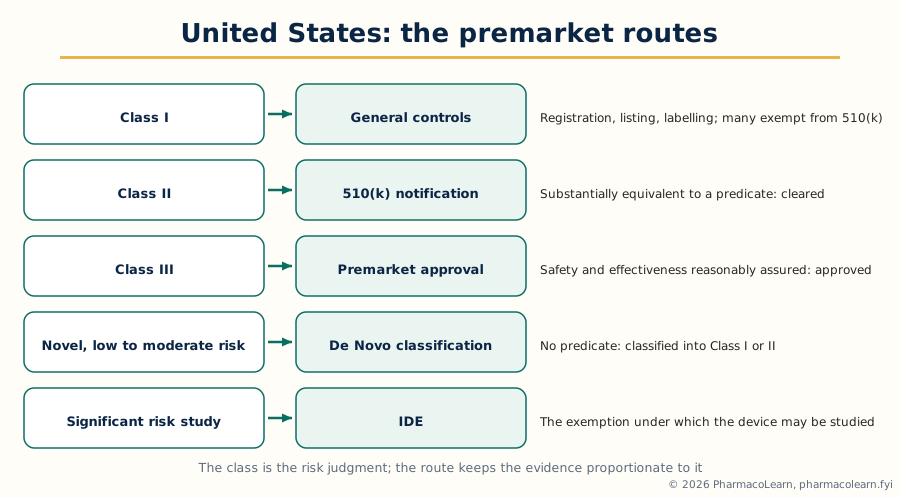 Figure: The American premarket map of sections 3.2 to 3.5: Class I under general controls, Class II to the 510(k) comparison against a predicate, Class III to the PMA's own proof of safety and effectiveness, the novel low to moderate risk device diverted to De Novo, and clinical study of the significant risk device held under the IDE until its route is run (Unit 3, section 3.5).
3.6 Investigational Device Exemption: the IDE
The Investigational Device Exemption, 21 CFR Part 812, is the permission under which an unapproved device may be shipped and studied clinically, the device counterpart of the drug IND of MRA103T. Its hinge is the distinction between significant risk and nonsignificant risk studies. A significant risk device is one that is implanted, life supporting or life sustaining, of substantial importance in diagnosis or treatment, or otherwise presenting a potential for serious risk to the subject; its study requires an FDA approved IDE application, assembling the device description, the prior investigations and bench data, the investigational plan and protocol, the risk analysis, the investigator agreements and the informed consent documents, with institutional review board approval at each site, and FDA may disapprove or condition the study. A nonsignificant risk study is treated as having an abbreviated IDE: the sponsor documents the risk judgment, and the study proceeds with IRB approval and the abbreviated duties of labelling, monitoring and record keeping, though FDA can overrule the judgment. Under either, the recurring duties are sponsor monitoring, investigator compliance, device accountability, adverse device effect reporting to FDA and the IRBs, and the prohibition of promotion or commercial distribution of the investigational device. The IDE is also the gatekeeper of evidence quality for the PMA: the clinical investigations a PMA relies on are expected to have been conducted under it, in compliance with the informed consent and IRB parts of the CFR.
3.7 Quality system requirements: 21 CFR Part 820
The Quality System Regulation, 21 CFR Part 820, is the American legal form of the device quality system, the counterpart in force of law to ISO 13485's standard, and FDA inspections test a plant against it directly. Its subparts run the familiar architecture with American accents: quality system and management responsibility, with the management review and quality audit duties; design controls, the QSR's most examined element, requiring design and development planning, design input and output, review, verification, validation, transfer and change control, all accumulated in the design history file; document and record controls, including the device master record, the complete recipe of specifications and procedures from which a device is made, and the device history record, the production history of each batch or unit, the device world's answer to the batch record family of MRA102T; purchasing controls over suppliers and components; production and process controls, with process validation where results cannot be fully verified; acceptance activities, labelling and packaging control, handling, storage, distribution and installation; and the closing subparts on nonconforming product, corrective and preventive action, complaints and servicing, with statistical techniques where appropriate. The comparison with ISO 13485 is a set question, and its answer is alignment with different instruments: the two systems cover substantially the same ground, the QSR as a regulation enforced by FDA inspection and the ISO standard as a certifiable standard, a convergence the single audit programme of Unit 5 exploits, and which FDA has moved to complete by harmonising Part 820 with ISO 13485. The student should state the position exactly: Part 820 as the syllabus prints it is the operative text for this course, with the harmonisation named as the direction of travel.
3.8 Labeling requirements: 21 CFR Part 801
21 CFR Part 801 governs device labelling, and in the American scheme labelling is a control, not a courtesy: a device whose labelling is false or misleading, or lacks required information, is misbranded and unlawful whatever its engineering merit. The general duties require the name and address of the manufacturer or distributor, an adequate statement of the intended use and directions for use sufficiently detailed for the intended user, prescription or over the counter as the case may be, and the warnings, precautions and contraindications that safe use requires, with prominence rules so that the safety matter is not buried. Prescription devices carry the federal prescription legend and are exempt from the adequate directions requirement only on conditions, including that they are labelled with the information a practitioner needs and confined to professional channels. Subparts address particular families, in vitro diagnostic products among them, whose labelling must state the intended use, the performance characteristics and the limitations of the test, since a diagnostic's labelling is where its truth is told. Two Unit 3 themes meet here: the intended use stated in labelling is the same intended use that anchors classification and 510(k) equivalence, so labelling discipline is market access discipline; and labelling is an IDE and UDI carrier, investigational devices bearing their caution legend, and marketed devices bearing the unique identifier of the next section.
3.9 Post marketing surveillance and Unique Device Identification
The American post market system has three instruments, and the syllabus names the third expressly. The first is medical device reporting, 21 CFR Part 803: manufacturers, importers and device user facilities must report device related deaths, serious injuries and reportable malfunctions to FDA, the reports populating the public database from which signals are read. The second is postmarket surveillance in its strict sense, the authority under section 522 of the Act for FDA to order prospective surveillance studies of specified Class II and Class III devices, life sustaining devices, implants and devices with significant paediatric use among them, so that questions visible only in wide use are answered by design rather than by accumulation of reports; corrections, removals and recalls, reported under Part 806, complete the enforcement side. The third is the Unique Device Identification system: the UDI rule requires most devices to bear a unique device identifier on their label and packaging, in human readable and machine readable form, composed of a device identifier, the fixed part naming the model and labeler, and a production identifier, the variable part carrying lot or batch, serial number, expiry and manufacture date as applicable, with the device's record lodged in FDA's public GUDID database. The UDI is what converts the reporting of section 2.7 from narrative to data: a malfunction report, a recall and an implant registry entry can all be tied to the exact device configuration, and traceability, the virtue MRA202T praised for biologics by brand and batch, is here built into every label by rule.
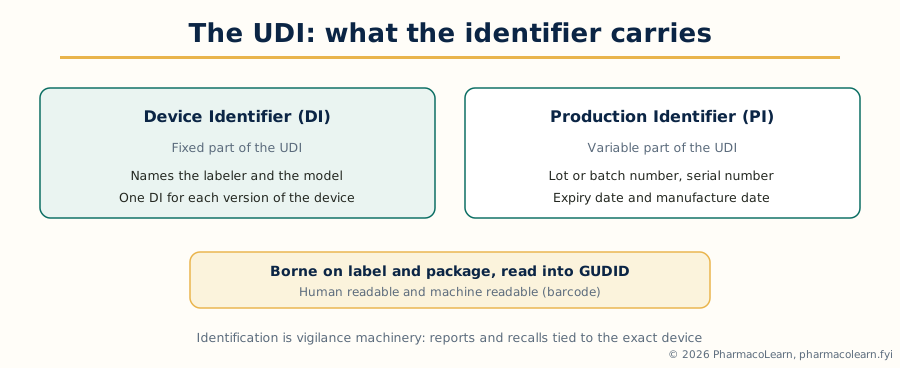 Figure: The two parts of the unique device identifier of section 3.9: the device identifier, fixed, naming labeler and model, and the production identifier, variable, carrying lot, serial number and dates, read together from the label into the GUDID record (Unit 3, section 3.9).
3.10 IVDs in the United States: basics, classification and approval
An American IVD is a device, classified like any other by risk into Classes I, II and III under the panels for chemistry, haematology, immunology, microbiology and the rest, and routed by the same gates of this unit: most routine assays reach the market by 510(k) clearance against a predicate assay, high risk tests, companion diagnostics and blood screening assays among them, by PMA, and novel moderate risk tests by De Novo. What distinguishes IVD review is the performance language: an assay is judged on analytical performance, accuracy, precision, analytical sensitivity and specificity, interfering substances and stability, and on clinical performance, the diagnostic sensitivity and specificity of its results against the true condition in the intended population, with its labelling under Part 801's IVD subpart stating intended use, performance characteristics and limitations. Two boundary topics are standard teaching. Laboratory developed tests, assays designed and used within a single clinical laboratory, lived for decades under enforcement discretion; the regulatory position on them has been contested and has shifted with rulemaking and litigation, and the careful statement for the student is that the area is in transition and the laboratory's own quality obligations under the clinical laboratory rules apply throughout. And the companion diagnostic, an IVD essential to the safe and effective use of a corresponding drug, is reviewed in coordination with the drug, so that test and therapy reach the market together with matched labelling.
Unit 4: European Union
4.1 Introduction: the European approach
The European system inverts the American architecture, and this unit cannot be understood without holding the inversion clearly. Where the United States puts a federal agency between the manufacturer and the market, Europe built a New Approach system: legislation states the essential requirements, harmonised standards supply the technical detail, and the assessment of conformity is performed by notified bodies, independent organisations designated and supervised by the member states, with the manufacturer's reward a CE mark that opens every member state market at once. The syllabus prints the framework in its directive form: the Medical Device Directive 93/42/EEC for general devices, the Active Implantable Medical Device Directive 90/385/EEC for powered implants, and the In Vitro Diagnostic Directive 98/79/EC for IVDs, and the sections that follow teach that framework exactly as printed. The current position is then stated where it belongs, in section 4.2 and carried through the unit: the two regulations of 2017, the MDR (Regulation (EU) 2017/745) for devices and active implantables together, and the IVDR (Regulation (EU) 2017/746) for IVDs, have replaced the directives, keeping the architecture, classification tiers and CE logic while tightening clinical evidence, notified body oversight, traceability and post market duties.
4.2 The three directives and their successors
The Medical Device Directive covered the general run of devices, from syringes to scanners, defining the medical device in the mode of action language of Unit 1, stating the essential requirements in its first annex, classifying devices by rules in its ninth annex, and setting the conformity assessment routes of section 4.4. The Active Implantable Medical Device Directive covered the small, highest risk family of powered implants, pacemakers and implantable defibrillators and drug pumps, imposing the fullest conformity route on all of them without class gradation, because a powered device inside the body that cannot be inspected concentrates risk. The In Vitro Diagnostic Directive covered IVDs with its own proportionate scheme of section 4.6, in which most tests were self declared and only the highest risk lists attracted notified bodies. The succession matters to practice and must be stated correctly: the directives are repealed, the MDR has applied since 2021 and the IVDR since 2022, each with staged transition for legacy devices holding directive certificates; the MDR absorbed the active implantables into the single device regulation; both regulations are directly applicable law in every member state rather than texts awaiting national transposition; and the classification rules, vigilance duties and UDI system of the regulations are materially stricter than the directives they replaced. The examination strategy follows the branch pattern of MRA103T: answer the printed syllabus in the directive framework, and show that you know the regulation now in force.
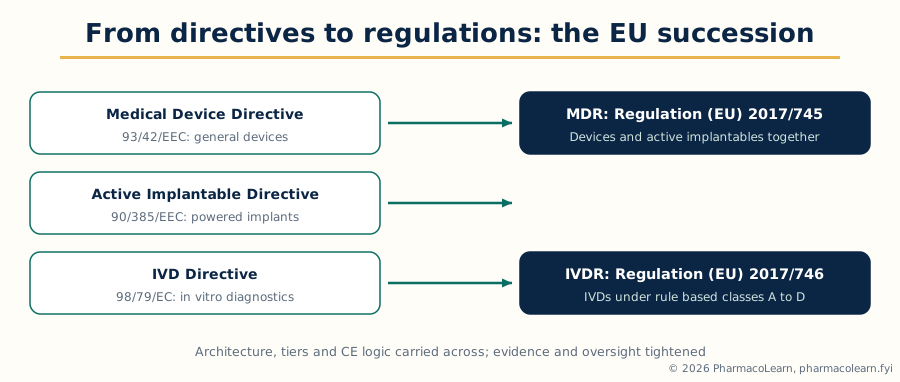 Figure: The succession of section 4.2: the Medical Device Directive and the Active Implantable Directive together replaced by the MDR 2017/745, and the IVD Directive replaced by the IVDR 2017/746, the architecture, tiers and CE logic carried across and the evidence, oversight and vigilance duties tightened (Unit 4, section 4.2).
4.3 Classification in the European system
European classification is performed by the manufacturer, applying the classification rules to the device's intended purpose, and defended to the notified body, a discipline opposite to the American assignment of classes by regulation to listed device types. The MDD rules, eighteen in number, sort devices by the logic of Unit 1: non invasive devices in the lowest classes unless they channel or store blood or modify composition; invasive devices graded by duration, transient, short term and long term, and by the sensitivity of the site, the teeth and lower orifices below the body interior, the central circulatory and nervous systems at the top; active devices graded by the energy they exchange, diagnostic energy below therapeutic energy, and the administration of medicines or radiation highest; with special rules for contraception, disinfection, recording of diagnostic images and devices incorporating a medicinal substance. The output is the four tier ladder: Class I low risk, Class IIa medium, Class IIb medium to high, Class III high, with Class I subdivided for sterile devices and devices with a measuring function, which alone in their class need a notified body, for the sterile or measuring aspect. The MDR keeps the four tiers and the rule machinery, extends it to twenty two rules, and moves several families upward, software and devices in contact with the central systems among them, so legacy classifications cannot simply be carried across. IVDs kept their own scheme under the IVDD, and the IVDR replaced it with a rule based A to D classification aligned with the GHTF model, the two states of the IVD scheme being compared in section 4.6.
4.4 Conformity assessment and notified bodies
Conformity assessment is the European route system: the manufacturer demonstrates conformity with the essential requirements by a route proportioned to the class, draws up a declaration of conformity, and affixes the CE mark. The routes combine two kinds of examination in different proportions: examination of the quality system, by audit of the manufacturer's ISO 13485 based system in its full or production limited forms (the directive annexes II, V and VI), and examination of the product, by type examination of a representative device (annex III) or by verification of each product or batch. Class I devices, sterile and measuring aspects aside, are self declared on the manufacturer's own responsibility. Class IIa devices engage a notified body on the quality system or the type. Classes IIb and III engage the notified body fully, with design dossier examination for Class III, in which the authority reviews the design documentation itself before certification. The notified body is the system's load bearing institution: a conformity assessment body designated by its member state against competence criteria, notified to the Commission and the other states, listed with the scope of device types it may certify, and itself audited and supervised, a supervision the MDR made markedly harder after the failures discussed in Unit 1. Its certificate, not a state approval, is the manufacturer's passport, and its withdrawal closes the European market to the device. Beside the bodies stand the competent authorities of the member states, who run vigilance, market surveillance and the safeguard clause by which a CE marked device can still be stopped where it endangers health.
The CE certification process
Classify the device by the rules (manufacturer, intended purpose)
        |
Select the conformity route for the class
        |
Compile the technical documentation: essential requirements
checklist, risk file, clinical evaluation
        |
Notified body audit of the quality system and, by class,
type or design examination
        |
Declaration of conformity drawn up by the manufacturer
        |
CE mark affixed: the whole European market opens
        |
Post market surveillance and vigilance under the member states
4.5 The CE certification process, step by step
Read as a workflow, the process of section 4.4 runs in eight movements, and the syllabus names the process itself, so it is set out in sequence. First, determine the framework: confirm the product is a medical device under the definition, and fix its intended purpose in writing, since purpose drives everything. Second, classify by the rules and record the reasoning. Third, identify the applicable requirements and standards: the essential requirements, and the harmonised standards whose application confers presumption of conformity. Fourth, compile the technical documentation: device description, design and manufacturing information, the essential requirements checklist, risk management file under ISO 14971, verification and validation evidence, and the clinical evaluation, the structured appraisal of the clinical literature and any investigation data that supports safety and performance, which every class owes in some depth. Fifth, run the quality system: the ISO 13485 system of Unit 2, under which design, production and vigilance operate. Sixth, submit to the notified body where the class requires one: application, documentation review, quality system audit, and for the higher classes design or type examination, answering its questions until certification. Seventh, declare and mark: the manufacturer draws up the declaration of conformity and affixes the CE mark, with the notified body's number beside it where a body took part. Eighth, register and watch: registration of the manufacturer and device with the competent authority, and the post market surveillance, vigilance reporting and periodic updating of the clinical evaluation for the product's life. The MDR adds the European database registration and the UDI assignment to the closing movements. What the student should see is that CE marking is a manufacturer declaration resting on audited systems and reviewed documents, a different species of market licence from FDA clearance or approval.
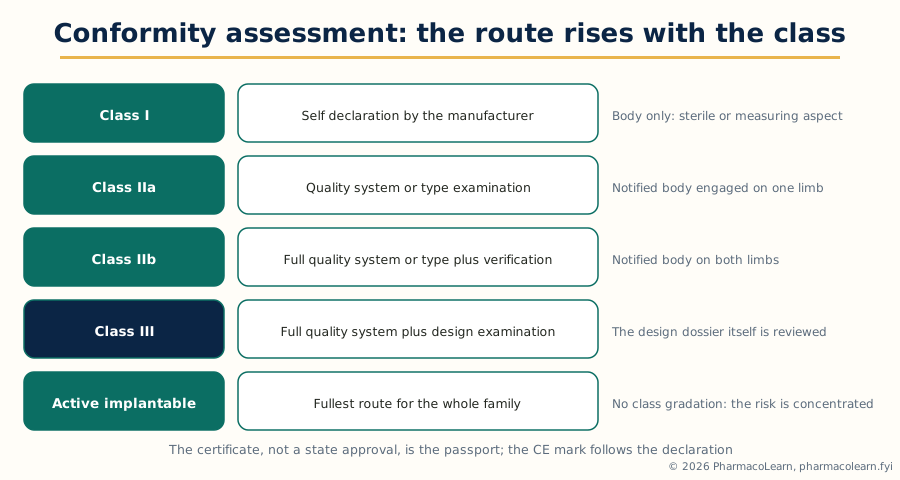 Figure: The conformity assessment ladder of section 4.4: self declaration for Class I, notified body engagement rising through IIa and IIb, and full quality system audit with design dossier examination for Class III, with the active implantable family held at the fullest route throughout (Unit 4, section 4.4).
4.6 IVDs in the European Union: basics, classification and approval
Under the IVD Directive, classification was by lists rather than rules, and its proportionality was extreme in the direction of trust: the great majority of IVDs, the general category, were placed on the market by the manufacturer's own declaration of conformity. Notified bodies entered only for the named high risk territories: List A, the highest, covering tests for blood grouping and for transfusion transmitted infection markers such as HIV and the hepatitis viruses, which required design examination and batch verification; List B, covering a further schedule of significant tests, among them certain infectious disease, tumour marker, genetic and blood grouping reagents, which required type examination or a full quality system; and self testing devices, designed for lay users, which required notified body examination of the design for usability by non professionals. Performance evaluation, the demonstration that the test achieves its analytical and diagnostic performance in the hands of intended users, was the IVD's clinical evidence, and common technical specifications set binding performance floors for the List A and B territories. The IVDR replaced the lists with the rule based, GHTF aligned classification the model of Unit 1 predicts: Class A low individual risk (general laboratory products, instruments and specimen receptacles), Class B moderate (most self assessed routine assays, for example many pregnancy and fertility and cholesterol tests falling here by rule), Class C high individual or moderate public health risk (tests whose error carries serious consequence, including many infectious disease and cancer related assays), and Class D the highest, tests for transfusion and transplantation safety and life threatening transmissible agents. The practical consequence is the largest single change in the IVDR: notified body involvement, once the exception, now covers the great majority of IVDs, and the transition has been staged by class precisely because the notified body capacity had to grow to meet it.
Unit 5: ASEAN, China and Japan
5.1 ASEAN: one directive, ten markets
The Association of Southeast Asian Nations harmonised its device regulation in the ASEAN Medical Device Directive, adopted by the member states and implemented into each national law at its own pace, which is the first thing to understand about it: the directive is a model, and the operative licence is still issued nationally, by the authorities of Singapore, Malaysia, Thailand, Vietnam, the Philippines, Indonesia and their fellow members. The model's contents are the GHTF inheritance entire: the essential principles, the four class A to D risk classification by rules closely following the GHTF set, a common classification and grouping practice that lets families of devices be registered together, and the Common Submission Dossier Template (CSDT), ASEAN's STED shaped dossier, whose chapters carry the device description, the essential principles checklist, the design verification summary, the clinical evidence and the labelling in a form every member state accepts. Registration routes are graded by class in the now familiar proportions, abridged and reliance routes recognising approvals from reference jurisdictions for the lower and middle classes in several member states, with Singapore's Health Sciences Authority operating the region's most developed evaluation routes and Malaysia's Medical Device Authority its registration under the national Medical Device Act. Quality system expectation is ISO 13485 conformity throughout the region, and post market duties follow the member state's vigilance system, with the directive's post market alert framework naming the shared vocabulary. For the regulatory professional the ASEAN lesson is the shape of modern regional harmonisation: one technical spine, national licensing hands, and a dossier written once in CSDT form and readdressed state by state.
5.2 China: the NMPA system
China regulates devices through the National Medical Products Administration (NMPA) under the State Council's Regulations for the Supervision and Administration of Medical Devices, with provincial authorities executing parts of the system. Classification runs in the Chinese three tier form: Class I low risk, managed by a filing with the local authority rather than an approval; Class II moderate risk, registered with the provincial authority for domestic products; Class III high risk, registered with the NMPA itself, with imported devices registered nationally at Classes II and III. Classification is administered against a published classification catalogue and classification rules in the GHTF spirit, with a formal classification determination available where a novel device fits no catalogue entry. Registration demands a dossier of product technical requirements, type testing by an accredited Chinese laboratory for most products, the risk analysis, clinical evaluation, by literature and equivalence comparison where the rules allow or by a clinical trial conducted for China where they do not, and the quality system evidence, China's device GMP being audited as part of registration for the higher classes. Two China specific disciplines carry examination weight: the clinical trial catalogue system, under which defined high risk devices must be trialled in certified Chinese institutions for registration purposes, which makes Chinese registration a programme of local evidence generation rather than a paper reliance exercise for the top of the market; and the post registration duties of adverse event monitoring and re registration on the cycle the regulations set. The direction of travel is convergence, through China's IMDRF membership and the adoption of international standards, from a position that remains distinctly its own.
5.3 Japan: the PMD Act system
Japan's framework, met for drugs in MRA201T, covers devices under the Pharmaceuticals and Medical Devices Act (PMD Act), administered by the Ministry of Health, Labour and Welfare (MHLW) with the review work of the Pharmaceuticals and Medical Devices Agency (PMDA). Classification follows the GHTF four classes, named in the Japanese manner: general medical devices (Class I), marketed on notification to the PMDA; controlled medical devices (Class II), requiring certification (ninsho) by a registered certification body against published certification standards where such standards exist; specially controlled medical devices (Classes III and IV), requiring ministerial approval (shonin) on PMDA review; with in vitro diagnostics distributed through the same structure by their own risk rules. The system's distinctive institution is the separation of the product approval from the licence to do business: a marketing authorisation holder licence, graded by class, under which the holder bears the legal duties for the product, including the quality and vigilance duties of the GQP and GVP ordinances, while manufacture itself, domestic or foreign, is separately licensed or accredited, the foreign manufacturer accreditation being the importer's gateway. The quality system ordinance, the QMS ordinance, is built on ISO 13485 and is audited against the device's approval, and PMDA consultations, the pre submission meetings of MRA201T's drug teaching, operate for devices as the standard way to settle classification, evidence and clinical questions before filing. Post market duties run through the re examination and re evaluation machinery and the GVP reporting duties, with the package insert, Japan's controlled labelling document, carrying the approved claims.
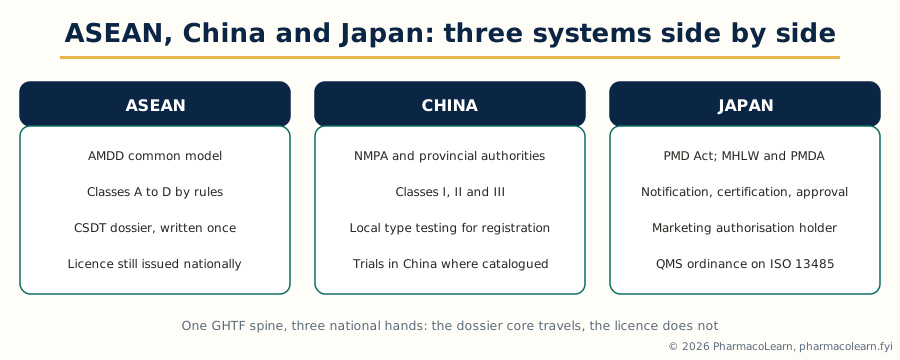 Figure: The three systems of Unit 5 compared: ASEAN's common directive and CSDT under national licensing, China's NMPA registration in three classes with local testing and trials, and Japan's PMD Act ladder of notification, certification and approval under the marketing authorisation holder (Unit 5, section 5.3).
5.4 Quality system requirements across ASEAN, China and Japan
The three systems of this unit converge on the point Unit 2 prepared: each demands an ISO 13485 shaped quality system, and differs in how conformity is evidenced and audited. In ASEAN member states the registration dossier carries the quality system evidence, an ISO 13485 certificate from an accredited body being the standard exhibit, and several states accept audits performed for other jurisdictions. China writes its device good manufacturing practice in national form and audits it domestically, with registration inspection of the quality system for the higher classes, accepting the ISO certificate as supporting rather than substitute evidence. Japan audits against its QMS ordinance, harmonised with ISO 13485 in structure, the audit tied to the product approval and conducted by the PMDA or a registered certification body according to class. Standing across all three, and across Units 3 and 4 as well, is the Medical Device Single Audit Program (MDSAP), the IMDRF era programme under which a single audit by a recognised auditing organisation, against ISO 13485 together with the participating jurisdictions' specific requirements, is accepted by its members, which include the United States, Canada, Brazil, Australia and Japan. MDSAP is the working proof of the harmonisation argument of Unit 1: one system, audited once, read by many regulators.
5.5 Clinical evaluation and investigation in ASEAN, China and Japan
Clinical evidence in the three systems follows the gradient of Unit 2, with local gates that the syllabus's single line unfolds into. Clinical evaluation, the appraisal of literature, equivalence data and experience, is the default evidence in all three: ASEAN's CSDT carries a clinical evidence chapter built on evaluation; China's rules permit evaluation by comparison with predicate devices on the market for defined categories; Japan accepts foreign clinical data and literature based evaluation for many approvals. Clinical investigation becomes compulsory at the points of genuine novelty and highest risk, and each system gates it in its own law: China through its device GCP and the catalogue of devices requiring trials, with trials conducted at certified Chinese institutions for registration purposes; Japan through its device GCP ordinance, the clinical trial notification to the PMDA for the higher classes, and ethics review at the institutions; ASEAN member states through their national clinical research rules and ethics committees, with ISO 14155 as the referenced standard of conduct. The professional discipline is identical in the three markets and is the unit's closing practical lesson: settle the evidence question, evaluation or investigation, in classification and consultation before the dossier is written, because it is the longest lead item in every one of these registration programmes.
5.6 IMDRF study groups and guidance documents
The syllabus closes this unit, and the subject, by returning to the IMDRF, and the return is structural: the three systems just taught are all, to different degrees, readers of IMDRF's output. The IMDRF works through working groups constituted for defined deliverables, the successors in spirit to the GHTF study groups of Unit 1, whose mapping the student should be able to draw: premarket and dossier work descending from Study Group 1, including the regulated product submission table of contents that succeeds the STED; vigilance and adverse event terminology from Study Group 2, whose IMDRF terms and codes are the reporting vocabulary of Unit 2; quality systems and the single audit programme from Study Groups 3 and 4; and clinical evidence from Study Group 5. Its further guidance families address the frontiers the original study groups never faced: software as a medical device, with its classification and clinical evaluation frameworks; personalised and patient matched devices; and good regulatory review practices. The guidance documents are not law in any member jurisdiction, and the subject has insisted on the point before: their force is adoption. A manufacturer who writes the dossier in the IMDRF shape, codes events in the IMDRF terminology, and runs the quality system to be auditable under the single audit programme has built one technical core saleable, with local layers, in the United States, Europe, Japan, China and ASEAN alike, which is the entire commercial argument of harmonisation and the note on which the subject properly ends.
Frequently Asked Questions
Q: What distinguishes a medical device from a pharmaceutical product? The primary mode of action. A pharmaceutical achieves its primary intended action by pharmacological, immunological or metabolic means; a medical device achieves its primary action by physical, mechanical, electrical or software means, though it may be assisted by drug action, and is then handled as a combination product led by its primary mode of action.
Q: What are the Essential Principles of safety and performance? They are the harmonised GHTF list of propositions every device must satisfy: safety and performance as intended across its lifetime, risks acceptable against benefits, control of chemical, physical, biological, infection, radiation and measuring hazards, and adequate labelling and information. Conformity with recognised standards is the normal evidence, and the STED dossier is organised to demonstrate them principle by principle.
Q: How does risk based classification work for medical devices? Devices are sorted by rules, weighing duration of body contact, invasiveness, whether the device is active and what its energy does, the body system it touches, and for IVDs the consequence of a wrong result. The GHTF model has four classes, A to D; the US uses Classes I to III, the EU I, IIa, IIb and III, and India and ASEAN the A to D shape, with controls rising with the class.
Q: What is the difference between verification and validation of a device? Verification confirms the design outputs meet the design inputs: the device was built right, shown by test, inspection, analysis or demonstration. Validation confirms the finished device meets the user needs and intended purpose in actual or simulated use: the right device was built, reaching into usability and clinical evidence.
Q: What does ISO 14155 require? ISO 14155 is the good clinical practice standard for clinical investigation of medical devices. It requires an approved clinical investigation plan, ethics committee review, informed consent, qualified investigators, sponsor monitoring, device accountability and the reporting of adverse events and device deficiencies, adapting the Helsinki and GCP tradition to devices, where blinding may be impossible and the device may not be removable.
Q: What is the difference between a 510(k) and a PMA? A 510(k) is a premarket notification showing the device is substantially equivalent to a legally marketed predicate, in intended use and technological characteristics; FDA's act is a clearance, and most Class II devices use it. A PMA is a premarket approval application for Class III devices, which must itself provide reasonable assurance of safety and effectiveness on valid scientific evidence; FDA's act is an approval.
Q: What is a unique device identifier (UDI)? The UDI is the identifier most devices in the US system must bear on label and packaging, in human and machine readable form. Its device identifier part is fixed and names the labeler and model; its production identifier part carries lot or batch, serial number and expiry or manufacture dates as applicable. The record sits in the GUDID database, and the UDI is what makes reports, recalls and registries traceable to the exact device.
Q: How does CE marking differ from FDA clearance or approval? CE marking is a manufacturer's declaration of conformity, resting on an audited quality system and, for the higher classes, on a notified body's examination of the technical documentation or design; it is not a state approval, and it opens every EU member state at once. FDA clearance and approval are acts of the federal agency itself, for the US market only.
Q: What replaced the EU medical device directives? Regulation (EU) 2017/745, the Medical Device Regulation, replaced the Medical Device Directive and the Active Implantable Directive, and Regulation (EU) 2017/746, the IVD Regulation, replaced the IVD Directive. They keep the classification tiers, notified bodies and CE logic while tightening clinical evidence, oversight of notified bodies, UDI and post market duties; the syllabus teaches the directives, and the regulations are the current law.
Q: What is the STED, and why does it matter beyond any one country? The Summary Technical Documentation is the GHTF's standardised summary of the evidence that a device meets the essential principles: description, principles checklist, labelling, design and manufacturing summary, verification and validation, clinical evidence and risk summary. Because adopting regulators accept the same shape, a STED prepared for one jurisdiction can be readdressed to another.
Complete MRA203T notes, all 5 units in one PDF, free to keep.
Other M.Pharm subjects: MPH101T · MPC101T · MPL101T · MPH102T · MPH103T · MPH104T · MPL102T · MPL103T · MPL104T · MPC102T · MPC103T · MPC104T · MPH201T · MPH202T · MPH203T · MPH204T · MPC201T · MPC202T · MPC203T · MPC204T · MPL201T · MPL202T · MPL203T · MPL204T · MRA101T · MRA102T · MRA103T · MRA104T · MRM301T · MPG101T · MPG102T · MPG103T · MPG201T · MPG202T · MPG203T · MPG104T · MPG204T · MRA201T · MRA202T · MRA203T · MRA204T · M.Pharm