
MPL204T — Clinical Research and Pharmacovigilance
4 hrs/week, 4 credits, 60 hours, 100 marks. Notes follow the M.Pharm syllabus, unit by unit.
MPL204T Clinical Research and Pharmacovigilance notes for M.Pharm Semester 2 Pharmacology: ICH-GCP, ethics committees, informed consent, trial designs, documentation, ADR assessment, PvPI, surveillance and safety databases, with free unit wise PDF downloads on PharmacoLearn.
Units in this subject
- Unit 1 — Regulatory Perspectives of Clinical Trials
- Unit 2 — Clinical Trials: Types and Design
- Unit 3 — Clinical Trial Documentation, Monitoring and Adverse Drug Reactions
- Unit 4 — Basic Aspects, Terminologies and Establishment of Pharmacovigilance
- Unit 5 — Methods, ADR Reporting and Tools Used in Pharmacovigilance
- Unit 6 — Pharmacoepidemiology, Pharmacoeconomics and Safety Pharmacology
Download MPL204T PDF Notes
Free PDFs for this subject, one per unit:
Unit 1 PDF Unit 2 PDF Unit 3 PDF Unit 4 PDF Unit 5 PDF Unit 6 PDF
Clinical Research and Pharmacovigilance, subject code MPL204T, is a core Semester 2 subject of M.Pharm Pharmacology. It carries 4 credits and 60 hours of theory, taught at 4 hours per week, for 100 marks.
This subject joins the two disciplines that guard a medicine at the two ends of its life in humans. Clinical research generates the evidence: a candidate drug is tested in people, under rules strict enough that the results can be believed and the participants protected while they are generated. Pharmacovigilance keeps the guard up afterwards: once a medicine is marketed to millions, rare and delayed harms that no trial could have caught must be detected, assessed and acted on for as long as the drug is used. Unit 1 sets out the regulatory and ethical frame of trials: the origin and principles of ICH Good Clinical Practice, ethics committees, the Schedule Y and ICMR framework in India, and the informed consent process. Unit 2 studies trial types and designs, experimental and observational, and the study team that runs them. Unit 3 works through trial documentation, monitoring and safety monitoring, and then the adverse drug reaction itself: its types, detection, reporting, assessment and management. Unit 4 turns to pharmacovigilance proper: its history, its terminologies, the WHO programme, medication safety evaluation, and how pharmacovigilance centres are established in hospitals, industry and national programmes. Unit 5 covers the working methods and tools: surveillance of every kind, spontaneous reporting, the safety databases Argus and Aris G, the reporting system VigiFlow, and the statistical evaluation of safety data. Unit 6 closes with the three population disciplines the syllabus names: pharmacoepidemiology, pharmacoeconomics and safety pharmacology.
Unit 1: Regulatory Perspectives of Clinical Trials
1.1 Why trials are regulated: the ethical history in brief
A clinical trial is an experiment performed on people, and its rules were written in response to experiments that shamed medicine. Three landmarks frame everything in this unit. The Nuremberg Code (1947), drawn from the trial of Nazi physicians, stated the first modern rule: the voluntary consent of the human subject is absolutely essential. The Declaration of Helsinki (1964), issued by the World Medical Association and revised repeatedly since, became the physician's ethical charter for research: independent committee review, informed consent, and the principle that the subject's welfare outranks the interests of science and society. The thalidomide disaster (1961), in which a sedative marketed as safe caused severe limb malformations in thousands of children, was a drug safety failure rather than a consent failure, and it drove the modern licensing state: in the United States the Kefauver Harris Amendments of 1962 required proof of efficacy as well as safety before marketing.
The regulatory system of this subject is the accumulated answer to those lessons. Ethics rules protect the person in the trial; good clinical practice rules protect the truth of the data; licensing and pharmacovigilance rules protect the patients who come after. A student who keeps those three protections separate in mind will find the rest of the subject organizes itself.
1.2 The origin of ICH and the idea of harmonization
By the 1980s a new drug faced three separate development programmes for the United States, Europe and Japan, with duplicated trials, different data formats and different technical demands, while the science underneath was the same. The International Conference on Harmonisation of Technical Requirements for Registration of Pharmaceuticals for Human Use, universally shortened to ICH, was founded in 1990 to end that duplication: regulators and industry associations of the three regions agreed to write one set of technical guidelines together, so that data generated once could support registration everywhere. ICH (renamed the International Council for Harmonisation when it reformed as a legal association in 2015) works through expert working groups whose guidelines are adopted region by region. Its guideline families are quality (Q), safety (S), efficacy (E) and multidisciplinary (M). Clinical research lives mainly in the E family, and its most consequential member is E6, the Guideline for Good Clinical Practice, adopted in 1996 and cited in the PCI reference list for this subject.
Harmonization matters to a pharmacology student for a practical reason: an Indian trial conducted to ICH-GCP can support a global dossier, and an Indian pharmacovigilance report written in ICH formats can enter the world safety system. The local rules of sections 1.6 and 1.7 are India's implementation of the same ideas, not a rival system.
1.3 ICH-GCP: what good clinical practice is
Good Clinical Practice (GCP) is an international ethical and scientific quality standard for designing, conducting, recording and reporting trials that involve human subjects. ICH E6 states its purpose in one sentence: compliance gives public assurance that the rights, safety and well being of trial subjects are protected, consistent with the Declaration of Helsinki, and that the clinical trial data are credible. Protection of people and credibility of data are the twin aims, and every GCP rule serves one or the other.
The guideline's heart is its thirteen principles. Grouped for learning, they are:
| Group | The principles it gathers |
|---|---|
| Ethics first | Trials are conducted in accordance with the ethical principles of the Declaration of Helsinki and consistent with GCP and regulatory requirements; before a trial begins, foreseeable risks are weighed against anticipated benefit, and the trial proceeds only if benefit justifies risk; the rights, safety and well being of subjects prevail over the interests of science and society |
| Independent review and consent | A trial is reviewed and given favourable opinion by an institutional review board or independent ethics committee before it starts; freely given informed consent is obtained from every subject before participation |
| Sound science and qualified people | Trials are scientifically sound and described in a clear, detailed protocol; medical care and decisions are the responsibility of a qualified physician; every individual involved is qualified by education, training and experience; the trial is conducted in compliance with the approved protocol |
| Product and data integrity | The investigational product is manufactured, handled and stored to applicable good manufacturing practice and used as the protocol directs; information is recorded, handled and stored so that accurate reporting, interpretation and verification are possible; records identifying subjects are kept confidential; systems with procedures assuring quality are implemented in every aspect of the trial |
Examiners ask for the principles themselves, so the grouping above is a memory aid, not a substitute: the thirteen are conventionally listed individually, and a good answer names them in order before explaining them in groups.
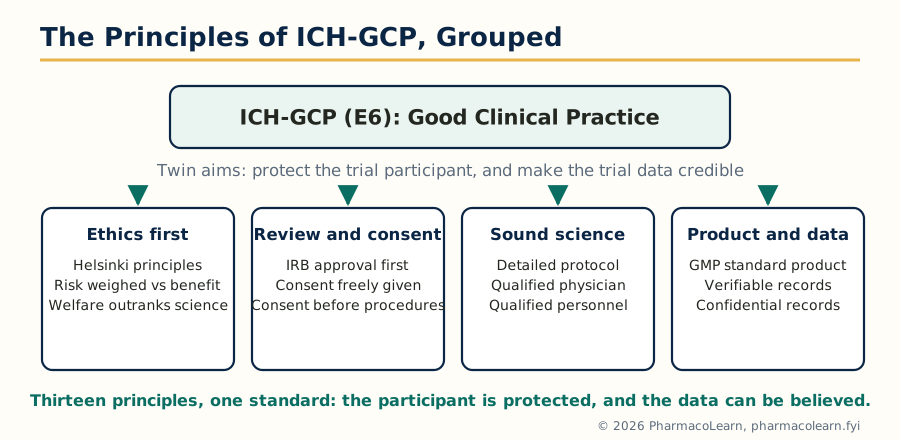 Figure: The principles of ICH-GCP (E6) grouped by what they protect: the participant, the review process, the science, and the product and its data.
1.4 GCP in India
India's own GCP guidelines, issued by the Central Drugs Standard Control Organization (CDSCO) in 2001 and named in this subject's reference list, adapt the same standard to Indian law and institutions: they restate the ICH principles, define the responsibilities of sponsor, investigator and ethics committee in the Indian setting, and require ethics committee review and informed consent for trials conducted in India. In daily practice an Indian trial runs under three layers at once: the international standard (ICH-GCP), the Indian GCP guidelines, and the statute law of section 1.6. Where they differ in detail, the law governs; where the law is silent, GCP is the working rule.
1.5 The ethics committee: institutional review board
No trial in this framework begins on a researcher's word alone. An ethics committee, called an Institutional Review Board (IRB) in the American terminology the syllabus uses and an Institutional Ethics Committee in Indian usage, is the independent body charged with protecting the rights, safety and well being of participants. It reviews the protocol, the investigator's qualifications and brochure, the consent documents and the plans for recruitment and compensation, and it must approve the trial before the first participant is enrolled; its oversight continues through the trial by review of amendments, progress reports and serious adverse events, and it can suspend or terminate approval.
A properly constituted committee is deliberately mixed: medical and non medical members, scientific and lay members, including a member from outside the institution and a person able to represent the participant's perspective, with a chairperson from outside the institution under the Indian rules, so that no single professional interest dominates. Its judgements are ethical, not merely technical: whether the risk benefit balance is acceptable, whether the consent form is honest and comprehensible in the local language, whether vulnerable participants are adequately protected, and whether the trial answers a question worth asking people to bear risk for. The committee's records, composition and procedures are themselves regulated, because an unaccountable committee would reproduce the problem it exists to solve.
1.6 Schedule Y and the Indian regulatory framework
Clinical trials in India are conducted under the Drugs and Cosmetics Act framework. Schedule Y of the Drugs and Cosmetics Rules was, for decades, the schedule that prescribed the requirements and guidelines for permission to import or manufacture new drugs for sale and to conduct clinical trials: the data to be submitted, the phases of study, the responsibilities of sponsor and investigator, and the format of reports. The clinical trial provisions of Schedule Y have since been replaced by a dedicated modern code, the New Drugs and Clinical Trials Rules, 2019, which now govern permission from the Central Licensing Authority (the Drugs Controller General of India, heading CDSCO), ethics committee registration, compensation for trial related injury, and timelines for decisions. The syllabus names Schedule Y because the subject's text predates the change; the student should know Schedule Y as the historical and still referenced framework and the 2019 Rules as the operative one. In both, the structure is the same: prior permission, registered ethics committee approval, informed consent, and safety reporting are legal duties, not courtesies.
1.7 The ICMR ethical guidelines
The Indian Council of Medical Research (ICMR) issues the ethical layer of the framework: the Ethical Guidelines for Biomedical Research on Human Subjects (2000, the edition in this subject's reference list; revised as the National Ethical Guidelines for Biomedical and Health Research Involving Human Participants, 2017). Where Schedule Y and its successor rules say what permission is needed, the ICMR guidelines say what is ethical: the principles of autonomy, beneficence, non maleficence and justice applied to Indian research realities, consent in languages participants actually speak, special protection for children, pregnant women, tribal and other vulnerable populations, and rules for research in emergencies, on stored samples and on genetic material. Ethics committees in India judge protocols against the ICMR guidelines; regulators judge applications against the rules; a compliant trial satisfies both.
1.8 The informed consent process: structure and content
Informed consent is a process, not a signature: a dialogue in which a prospective participant is told what the trial involves, has the chance to ask questions, and freely agrees or declines. The document that records it, the informed consent form with its participant information sheet, has a standard content fixed by GCP and the Indian rules. Its essential elements are:
- The trial's purpose, and that it is research, distinct from ordinary treatment
- What will be done: procedures, visits, tests, and how long participation lasts
- Randomization and placebo, explained plainly where they apply
- Foreseeable risks and discomforts, and anticipated benefits, including the possibility of no personal benefit
- The alternative treatments available outside the trial
- Compensation and medical management for trial related injury, and any payments or costs to the participant
- Confidentiality: who will see the records, and its limits
- That participation is voluntary, that refusal costs nothing in ordinary care, and that the participant may withdraw at any time without giving a reason
- Whom to contact about the trial, about rights, and in case of injury
Consent is taken in a language the participant understands, by a person able to answer questions, with time to decide; for participants who cannot read, an impartial witness is present through the process and signs to that effect, and for those who cannot consent, a legally acceptable representative consents in their place under stricter safeguards. In India, audio visual recording of the consent process is additionally required for specified categories of trials under the 2019 Rules. A consent taken badly is not a technical defect: it means the participant was never truly enrolled, ethically, at all.
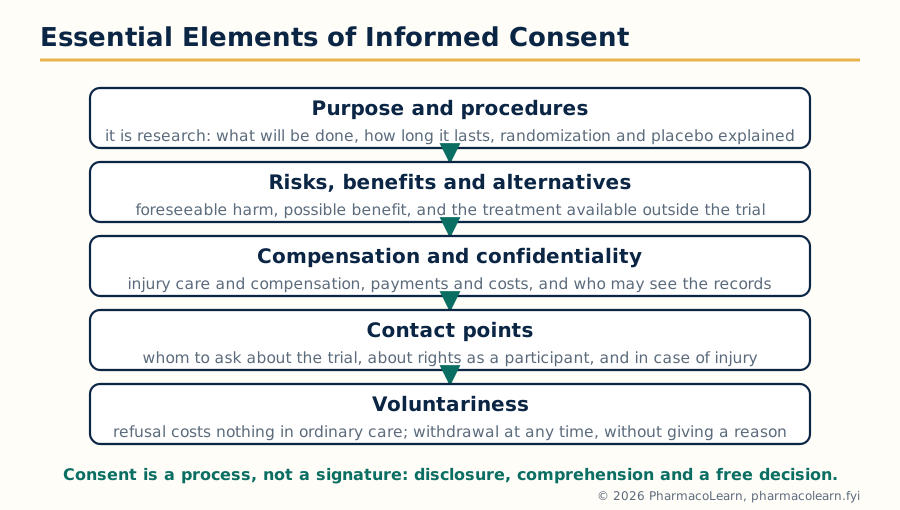 Figure: The essential elements of the informed consent process, from disclosure of purpose and procedures to the standing right to withdraw.
1.9 The ethical principles governing consent
Four principles govern the process and explain why its elements are what they are. Autonomy (respect for persons) is the root: a competent adult decides what is done to his or her own body, and consent is that decision made real. Disclosure follows: the decision is only the participant's if it rests on the material facts, which is why the element list of section 1.8 is mandatory rather than generous. Comprehension disciplines the telling: information dumped in medical language on a frightened patient is disclosed but not understood, so consent requires language, time and questions. Voluntariness excludes coercion and undue inducement: no threat to ordinary care, and no payment so large it blinds judgement. Together they convert the Nuremberg sentence, consent is absolutely essential, into a working method, and the same four principles reappear wherever this subject faces an ethical choice, from placebo use to research in vulnerable populations.
THE PATH OF A TRIAL BEFORE THE FIRST PARTICIPANT

  Sponsor drafts protocol and investigator brochure
      |
      v
  Ethics committee (IRB) review: science, risk and benefit,
  consent documents, investigator suitability
      |
      v
  Regulatory permission (in India, the Central Licensing
  Authority under the NDCT Rules 2019)
      |
      v
  Site initiation: trained team, product, forms, systems
      |
      v
  Informed consent of each participant, freely given,
  before any trial procedure
      |
      v
  The trial may begin
Unit 2: Clinical Trials: Types and Design
2.1 What a clinical trial is, and the phases in which trials run
A clinical trial is a systematic study of a drug in human subjects, conducted to discover or verify its clinical, pharmacological or pharmacodynamic effects, to identify its adverse reactions, or to study its absorption, distribution, metabolism and excretion, with the object of ascertaining safety and efficacy. Trial types are classified two ways in this subject: by the development phase they belong to, and, which is what the PCI unit examines, by study design.
The phases are the conventional frame. Phase I, first in humans, studies safety, tolerability and pharmacokinetics in a small number of healthy volunteers, or patients where the drug class demands it. Phase II studies efficacy signals and dose ranging in a few hundred patients with the target disease. Phase III is the large, usually randomized confirmatory stage in hundreds to thousands of patients, whose results support licensing. Phase IV covers studies after marketing, where the drug meets the general population and pharmacovigilance, the second half of this subject, takes over the watch. The design classification that follows cuts across the phases: a Phase III trial is typically an RCT, and a Phase IV commitment is typically observational.
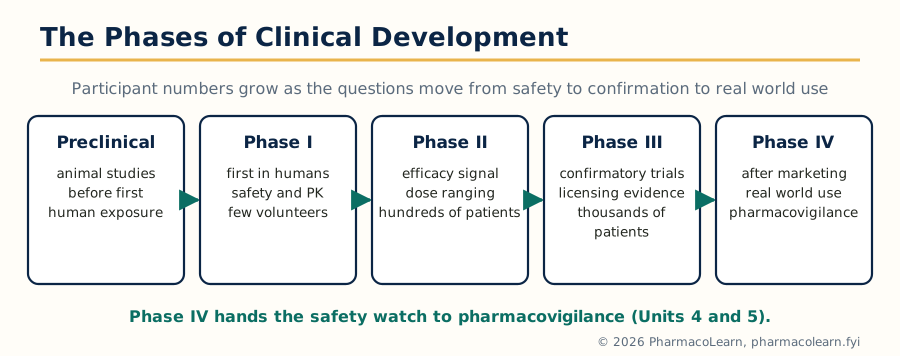 Figure: The phases of clinical development. Numbers grow and questions change stage by stage, and Phase IV hands the safety watch to pharmacovigilance.
2.2 Two families of design: experimental and observational
Designs divide by one question: does the investigator assign the exposure? In an experimental study the investigator allocates participants to interventions, test drug against control, and compares outcomes; the randomized controlled trial and its non randomized relatives live here. In an observational study the investigator assigns nothing: exposure has already happened, or happens by ordinary clinical choice, and the study watches, records and compares. Cohort, case control and cross sectional studies live here. Experimental designs can approach causal proof because allocation, properly randomized, breaks the link between exposure and every other characteristic; observational designs trade that strength for realism, size, speed and the ability to study exposures, rare harms and long latencies that no trial could ethically or practically assign. Unit 2 teaches the experimental family; the observational family returns in Unit 5, where it becomes the engine of pharmacovigilance.
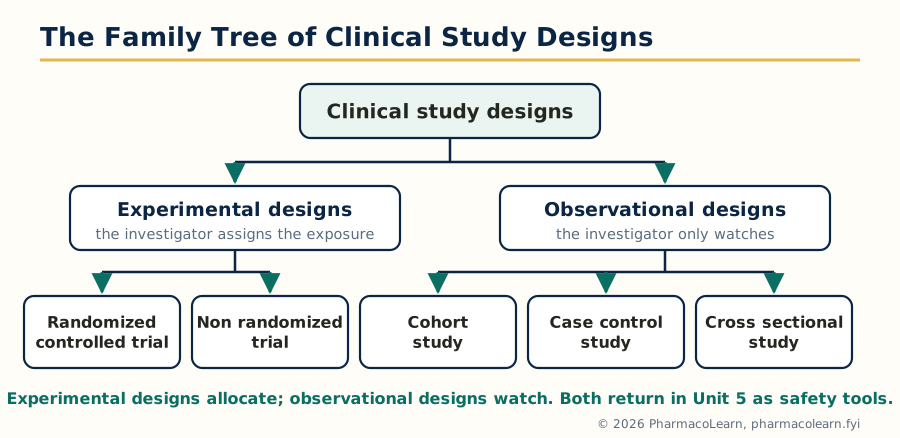 Figure: Study designs divide by whether the investigator assigns the exposure: experimental designs allocate, observational designs watch.
2.3 Randomized controlled trials
The randomized controlled trial (RCT) is the reference design of clinical research. Participants meeting the protocol's criteria are allocated at random to the test intervention or to a control, which may be placebo, standard treatment, or a different dose, and the groups are then treated and followed identically apart from the intervention. Randomization is the design's genius: done properly and in sufficient numbers, it distributes known and unknown confounders, age, severity, habits, genes, evenly between groups, so that a difference in outcome can be attributed to the intervention with a confidence no observational comparison can match.
Three supporting techniques protect that attribution. Blinding (masking) hides allocation: single blind from the participant, double blind from participant and investigator, so that expectations cannot bend care, reporting or assessment. Allocation concealment hides the upcoming assignment from the person enrolling, so selection cannot creep back in before randomization. Analysis by intention to treat keeps every randomized participant in the group to which chance assigned them, preserving the balance randomization bought even when participants stray. RCT variants the examiner expects named include parallel group and crossover layouts, and superiority, equivalence and non inferiority questions; each is a way of arranging the same machinery.
2.4 Non randomized experimental studies
Not every experimental question can or should be randomized. In a non randomized controlled trial the investigator still allocates the intervention, but by a non random rule: alternation, date of birth, centre, or patient choice, and the groups are compared with the standing warning that allocation bias and confounding may explain part of any difference. Uncontrolled studies, a single arm treated and described with no comparator, answer feasibility and safety questions, dominate early Phase I and II work, and can occasionally settle efficacy where the untreated course is uniform and catastrophic and the effect is dramatic. The design lesson is symmetrical: removing randomization does not make a study useless, it makes its conclusions graded, and the report must carry the grading honestly.
2.5 Cohort studies
A cohort study assembles groups by exposure and follows them forward to outcomes. A defined population is classified as exposed or unexposed to the drug or factor of interest, and both are followed over time while the incidence of the outcome is counted in each; the comparison is a relative risk, incidence in exposed divided by incidence in unexposed. Run forward in calendar time it is prospective; reconstructed from records of exposure and outcome that already exist, it is retrospective, and no less a cohort study for that. Cohort designs suit rare exposures and multiple outcomes of one exposure, give true incidence, and establish that exposure preceded outcome. Their costs are time, size, and blindness to rare outcomes: a harm occurring in one user in ten thousand needs a cohort of hundreds of thousands to be seen at all, which is why drug safety leans so heavily on the next design.
2.6 Case control studies
A case control study reverses the direction of inquiry: it assembles groups by outcome and looks backward to exposure. Cases, people who have suffered the outcome, classically a suspected adverse reaction, are compared with controls, similar people who have not, and the history of exposure to the suspect drug is traced in each group; the comparison is an odds ratio, the odds of exposure among cases divided by the odds among controls. Because the study starts from the outcome, it is the efficient design for rare outcomes and long latencies, quick and comparatively cheap, and it can examine several exposures for one outcome. Its weaknesses are the mirror image: it cannot give incidence, it studies one outcome at a time, and it lives or dies by the quality of exposure history and the fairness of the controls chosen. The thalidomide and phocomelia story of Unit 4 is, methodologically, a case control insight drawn from case reports.
2.7 Cross sectional studies
A cross sectional study measures exposure and outcome at one point in time, a snapshot of a defined population: how many people are taking the drug, how many have the condition, and how the two overlap. It yields prevalence, not incidence, and because snapshot association cannot show which came first, it cannot by itself establish causation. Its proper work is descriptive and administrative: drug utilization patterns, prevalence of prescribing problems, the burden a safety programme must handle. In the vocabulary of Unit 5 it is the design of drug utilization studies and prescription event monitoring snapshots, the map on which the analytic designs then operate.
2.8 The designs compared
| Feature | RCT | Non randomized experimental | Cohort | Case control | Cross sectional |
|---|---|---|---|---|---|
| Investigator assigns exposure | Yes, at random | Yes, by a non random rule | No | No | No |
| Direction of inquiry | Forward from intervention | Forward from intervention | Forward from exposure | Backward from outcome | Single point in time |
| Measure of comparison | Risk or outcome difference between arms | Risk or outcome difference, bias prone | Relative risk (incidence compared) | Odds ratio (exposure odds compared) | Prevalence |
| Strongest use | Efficacy and common safety outcomes | Feasibility, early phase questions | Rare exposures, incidence, multiple outcomes | Rare outcomes, long latency, several exposures | Prevalence, drug utilization |
| Chief weakness | Cost, size, artificial population | Allocation bias, confounding | Slow, huge for rare outcomes | No incidence, recall and selection bias | No time order, no causation |
2.9 The clinical trial study team
A trial is executed by a defined cast, and GCP assigns each member duties that cannot be silently delegated. The four roles the syllabus names are the investigator, who leads at the site; the study coordinator, who makes the site's work happen day to day; the sponsor, who owns the trial as a whole; and the contract research organization (CRO), to which the sponsor may transfer duties. Around them stand the ethics committee of Unit 1, the monitor of Unit 3, pharmacists, laboratory staff and data managers; the four named roles carry the examinable responsibilities, set out next.
2.10 The investigator
The investigator is the person responsible for the conduct of the trial at a site, and where a team works, its leader, the principal investigator. GCP's charge on the investigator is personal: to be qualified and experienced for the responsibility; to know the protocol and the investigator brochure thoroughly; to conduct the trial exactly as approved, documenting any deviation and its reason; to protect participants, obtaining informed consent properly, providing their medical care, and acting on adverse events; to control the investigational product at the site; to keep accurate source records and case report forms; to report serious adverse events to sponsor and ethics committee within the required timelines; and to communicate with the ethics committee throughout. The investigator's signature converts a protocol from paper into a promise.
2.11 The study coordinator
The study coordinator (clinical research coordinator) is the site's operating centre: scheduling and conducting study visits, preparing and maintaining documents and files, assisting with consent administration, completing case report forms from source data, coordinating laboratory samples and product accountability, and serving as the daily point of contact among investigator, monitor, sponsor and participants. The role is administrative in form and clinical in consequence: most protocol deviations and data queries in real trials are prevented or created at the coordinator's desk, which is why GCP training and delegation logs treat the coordinator as trial personnel under the investigator's supervision, with duties recorded in writing.
2.12 The sponsor
The sponsor is the individual, company, institution or organization that takes responsibility for the initiation, management and financing of the trial. Sponsorship is accountability, not merely funding. The sponsor designs the protocol with expert advice, selects qualified investigators and sites, supplies the investigational product and the investigator brochure, obtains regulatory and ethics approvals or ensures they are obtained, appoints monitors, arranges insurance and indemnity and compensation for trial related injury, manages safety information flowing in from all sites, and owns the final clinical study report. A sponsor may be the drug's manufacturer, or, in investigator initiated research, the institution or investigator, in which case sponsor and investigator duties unite in the sponsor investigator. What cannot happen under GCP is a trial with nobody answerable for it: that answerability is the sponsor's definition.
2.13 The contract research organization and its management
A contract research organization (CRO) is a company contracted by the sponsor to perform one or more of the sponsor's trial duties: protocol development, site selection and monitoring, data management, statistics, medical writing, safety processing, or the whole trial end to end. GCP's rule on transfer is precise: a sponsor may transfer duties to a CRO, in writing, but the ultimate responsibility for the quality and integrity of the trial data always resides with the sponsor, and any duty not specifically transferred is retained by the sponsor. Managing a CRO is therefore a sponsor competence, not an abdication: selection by capability and inspection of quality systems, a contract specifying duties, deliverables and quality standards, oversight through reports, audits and key performance indicators, and audit certificates documenting that the work was checked. The growth of the CRO industry is the economic fact behind this syllabus item: most large trials are now executed by this sponsor, CRO, site triangle, and the pharmacovigilance processing of Unit 5 is commonly housed in the same arrangement.
CHOOSING A DESIGN: THE WORKING LOGIC

  Can the exposure be assigned ethically and practically?
      |
      +-- Yes --> Can it be assigned at random?
      |              +-- Yes --> RANDOMIZED CONTROLLED TRIAL
      |              +-- No  --> NON RANDOMIZED EXPERIMENTAL STUDY
      |
      +-- No --> Is the outcome rare or long delayed?
                     +-- Yes --> CASE CONTROL STUDY
                     +-- No --> Is incidence over time the question?
                                    +-- Yes --> COHORT STUDY
                                    +-- No  --> CROSS SECTIONAL STUDY
Unit 3: Clinical Trial Documentation, Monitoring and Adverse Drug Reactions
3.1 Documentation: the essential documents
GCP's memory is paper, and its governing maxim is that if it was not documented, it was not done. The essential documents are those that individually and collectively permit evaluation of a trial's conduct and of the quality of the data produced: the protocol and its amendments, the investigator brochure, consent forms, ethics committee approvals and correspondence, regulatory permissions, investigator agreements and curricula vitae, product accountability records, case report forms and source documents, monitoring reports, safety reports, and the clinical study report, assembled in the trial master file. Preparation follows simple, examinable guidelines: documents are version controlled and dated, written in language their users understand, approved before use, and archived so that the trial can be reconstructed years later by an auditor or inspector who was never there.
3.2 The protocol
The protocol is the trial's constitution: the document that describes the objectives, design, methodology, statistical considerations and organization of the trial, fixed and approved before the trial begins. Its standard contents are:
| Part of the protocol | What it fixes |
|---|---|
| Background and rationale | Why the trial is needed and what is already known |
| Objectives and endpoints | The primary and secondary questions and how success is measured |
| Design | Type of trial, arms, randomization, blinding, duration |
| Participants | Inclusion and exclusion criteria, recruitment, withdrawal rules |
| Treatment | Product, dose, schedule, compliance, prohibited medication |
| Assessments | Visits, procedures and measurements, with their timing |
| Safety | Adverse event definitions, recording and reporting procedures |
| Statistics | Sample size reasoning, analysis populations and methods |
| Ethics and administration | Consent, confidentiality, data handling, quality control, publication |
Every later document answers to the protocol: the case report form collects exactly what it schedules, the monitor checks conduct against it, and the study report reports its questions. Deviations are therefore defined against the protocol, and amendments to it require the same ethics and regulatory approvals as the original before they take effect, urgent safety changes excepted.
3.3 The investigator brochure
The investigator brochure (IB) is the compilation of the clinical and nonclinical data on the investigational product that is relevant to its study in humans: the physical and pharmaceutical description, the animal pharmacology and toxicology, any human pharmacokinetic and earlier trial results, and a summary of known risks and anticipated benefits, ending in guidance to the investigator on recognizing and managing adverse effects and overdoses. The sponsor prepares and updates it, at least annually or whenever significant new information appears, because the investigator's judgement at the bedside rests on it. Where the protocol is the plan of this trial, the IB is the dossier of everything known about the drug before this trial adds to it.
3.4 Case report forms
The case report form (CRF) is the printed or electronic document designed to record all of the protocol required information on each participant: eligibility, dosing, visit measurements, laboratory results, adverse events and outcomes. Good CRF design is a discipline of its own: one datum in one place, questions that cannot be misunderstood, no data collected that the protocol does not need, and a design that matches the source records from which coordinators transcribe. The electronic CRF (eCRF) inside an electronic data capture system adds edit checks at entry, an audit trail of every change, and controlled access; the rules of correction, date, sign, never obscure the original entry, apply in both media, because the CRF is a legal record of the trial.
3.5 The clinical study report
The clinical study report (CSR) is the trial's final, integrated account: a full description of the trial's planning, conduct, participant disposition, efficacy and safety results, statistical analysis and conclusions, in the structured format of ICH E3, with protocols, sample forms, investigator lists and key tables appended. It is written after database lock and unblinding, is signed by the sponsor's responsible medical officer, and becomes the primary source from which publications, licensing submissions and labelling statements are drawn. A trial that is never reported has, scientifically, not been run; the CSR is where the subject's first half discharges its duty to the patients of the second half.
3.6 Clinical trial monitoring
Monitoring is the act of overseeing the progress of a trial to ensure it is conducted, recorded and reported in accordance with the protocol, standard operating procedures, GCP and regulatory requirements. It is performed by monitors (clinical research associates) appointed by the sponsor, who act as the line of communication between sponsor and investigator. The monitor's cycle through a site is standard:
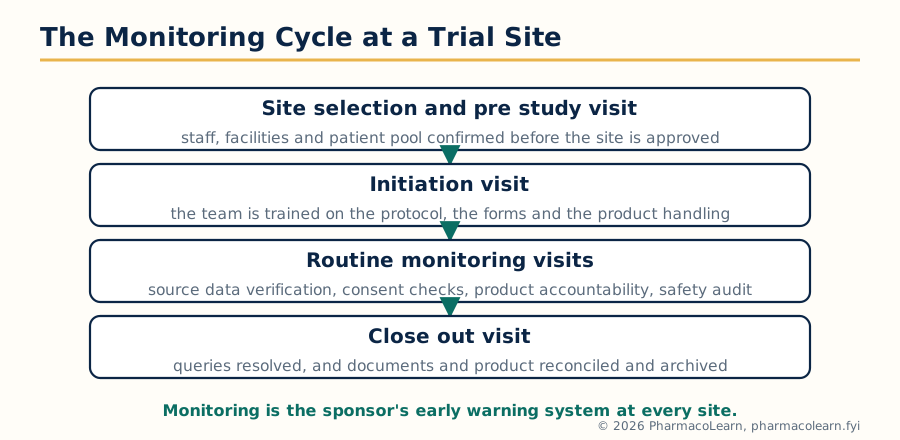 Figure: Monitoring follows a fixed cycle: qualify the site, initiate it, visit it regularly during the trial, and close it out.
At selection and pre study visits the monitor confirms the site's staff, facilities and patient pool. At the initiation visit the team is trained on protocol, forms and product handling before the first participant. At routine monitoring visits the monitor performs the craft's core act, source data verification: CRF entries are compared line by line with source documents, consent forms are checked for every participant, product accountability is reconciled, adverse event reporting is audited, and queries are raised for correction. At the close out visit outstanding data, documents and product are reconciled and archived. Monitoring reports after each contact document what was found; a monitor who finds a serious or persistent breach escalates it, because monitoring is the sponsor's early warning system, and Unit 3's next topic is its safety half.
3.7 Safety monitoring within the trial
Inside a trial, safety monitoring is the continuous collection, review and escalation of harm. Its vocabulary, fixed by ICH E2A, must be exact: an adverse event (AE) is any untoward medical occurrence in a participant administered a product, whether or not it is considered related to the product. Every AE is recorded; its relationship to the drug is assessed; and events meeting seriousness criteria or defying expectation follow the fast reporting path of section 3.9. For larger and longer trials, an independent data safety monitoring board (DSMB), also called a data monitoring committee, reviews accumulating, often unblinded, safety and efficacy data at intervals and recommends whether the trial should continue, change or stop, protecting participants from an emerging imbalance no single site could see. Safety monitoring inside trials and pharmacovigilance outside them are one discipline at two scales, which is why the syllabus teaches them in one subject.
3.8 Adverse drug reactions: definition and types
An adverse drug reaction (ADR) is narrower than an adverse event: in the WHO definition, a response to a drug which is noxious and unintended and which occurs at doses normally used in man for prophylaxis, diagnosis or therapy of disease, or for the modification of physiological function. Causality, at least a reasonable possibility, separates a reaction from an event. ADRs are classified by the Rawlins and Thompson scheme extended to six types:
| Type | Name and mechanism | Classic behaviour and example |
|---|---|---|
| A | Augmented: an exaggeration of the drug's known pharmacology | Dose related, predictable, common; bleeding on anticoagulants, hypoglycaemia on insulin |
| B | Bizarre: unrelated to known pharmacology, often immunological or idiosyncratic | Not dose related, unpredictable, uncommon but serious; penicillin anaphylaxis |
| C | Chronic: related to cumulative dose and duration | Appears with continued use; analgesic nephropathy, corticosteroid suppression of the adrenal axis |
| D | Delayed: appears long after exposure, sometimes in the next generation | Teratogenesis and carcinogenesis; thalidomide limb defects |
| E | End of use: withdrawal reactions on stopping | Rebound hypertension after abrupt clonidine withdrawal |
| F | Failure: unexpected failure of therapy | Contraceptive failure from enzyme inducing co medication |
Side effects are unintended effects at normal doses related to the drug's pharmacological properties, often tolerable and sometimes useful; a side effect becomes spoken of as an ADR when it is noxious. Precision here is examinable: adverse event is the wider, causality free term of trial reporting; ADR asserts a suspected causal link; side effect describes mechanism, not harm.
3.9 Detection and reporting of ADRs in the trial setting
Within trials, detection is systematic by design: participants are questioned, examined and tested at scheduled visits, and every untoward occurrence is captured on the CRF whether or not the investigator suspects the drug. Reporting then splits by gravity. The investigator reports serious adverse events to the sponsor immediately, conventionally within 24 hours of awareness, and to the ethics committee as required; the sponsor evaluates seriousness, causality and expectedness, and expedites to regulators the events that are serious, unexpected and suspected adverse reactions (SUSARs), fatal or life threatening ones fastest. Under the Indian rules, trial related injury, disability or death must additionally be reported within prescribed timelines to the licensing authority and ethics committee, with compensation determined for the participant or family. The structure to remember is a relay: bedside to investigator, investigator to sponsor and committee, sponsor to regulator, each leg with its own clock.
3.10 Severity and seriousness: two different assessments
Students lose marks by confusing these twins, so the syllabus names them side by side. Severity grades the intensity of an event: mild, moderate or severe, a clinical description of how bad it felt and how much it interfered with activity or required treatment; a severe headache is intensely unpleasant and entirely non serious. Seriousness is a regulatory category defined by outcome: an event is a serious adverse event (SAE) if it results in death, is life threatening, requires or prolongs hospitalisation, produces persistent or significant disability, is a congenital anomaly or birth defect, or is otherwise medically important. Seriousness, not severity, drives expedited reporting, insurance and regulatory attention. Severity is graded on scales, sometimes formal ones such as the Common Terminology Criteria for Adverse Events in oncology; seriousness is judged against the fixed outcome list.
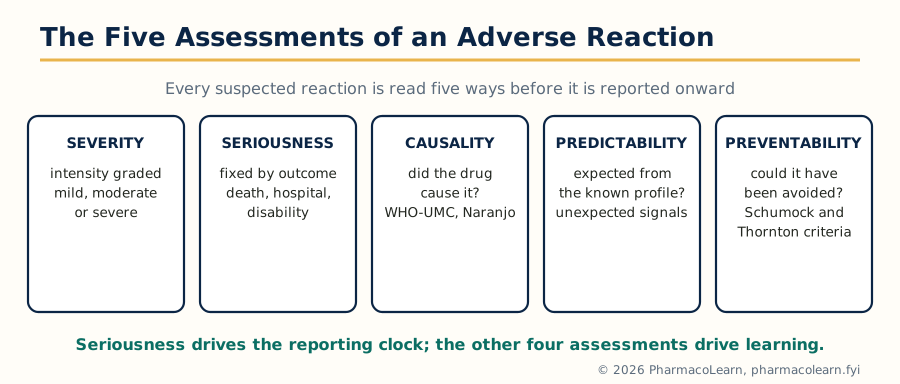 Figure: Every adverse drug reaction is read through five assessments: severity, seriousness, causality, predictability and preventability.
3.11 Predictability and preventability assessment
Predictability, also called expectedness, asks whether the reaction is consistent with the information already known about the drug, the investigator brochure in trials and the approved product information after marketing. An expected reaction is already described; an unexpected one, in nature, severity or outcome, carries the greater signal value and the heavier reporting duties, since it may be the first sighting of a new harm. Preventability asks the harder human question: could this reaction have been avoided? The standard Schumock and Thornton approach examines whether the drug was inappropriate for the patient's condition, whether dose, route or duration was wrong, whether monitoring or a needed interaction check was omitted, and whether a known allergy or prior reaction was ignored, classifying reactions as definitely preventable, probably preventable, or not preventable. Preventability assessment converts an ADR from a statistic into an audit, and it is the assessment that most directly reduces future harm.
3.12 Management of adverse drug reactions
Management follows a steady sequence. Recognize: suspect the drug in any new symptom, rash, or laboratory abnormality, and take a complete drug history including over the counter and traditional medicines. Act on the suspect drug: withdraw it where the reaction is serious or progressive, the commonest and most effective single step; reduce dose for dose related type A reactions; and never stop abruptly where withdrawal itself is dangerous. Treat the reaction: symptomatic and supportive care, specific antidotes where they exist, and specialist help for organ injury. Avoid re exposure: document the reaction prominently, inform the patient, and supply an alert the patient can show future prescribers; a deliberate rechallenge is justified only exceptionally, where the drug is irreplaceable and the reaction mild. Report: every suspected reaction, however managed, enters the reporting system of Units 4 and 5, because one clinician's case is the next patient's warning. Dechallenge, the improvement of a reaction after withdrawal, and rechallenge, its return on re exposure, are also the clinician's causality evidence, and link this section to the evaluation methods of Unit 4.
3.13 Terminologies of ADR
The safety vocabulary in one place, since the units that follow use it constantly:
| Term | Working meaning |
|---|---|
| Adverse event (AE) | Any untoward medical occurrence during treatment, causality not implied |
| Adverse drug reaction (ADR) | Noxious, unintended response at normal doses, causality at least reasonably possible |
| Serious adverse event or reaction | Defined by outcome: death, life threatening, hospitalisation, disability, congenital anomaly, medically important |
| Unexpected ADR | Inconsistent with the applicable product information in nature, severity or outcome |
| Side effect | Unintended pharmacological effect at normal dose, not necessarily noxious |
| Adverse drug event | Harm arising from medication use, including errors, used widely in hospital safety work |
| Signal | Information suggesting a new potentially causal association, or a new aspect of a known one, judged to require verification |
Unit 4: Basic Aspects, Terminologies and Establishment of Pharmacovigilance
4.1 What pharmacovigilance is
The WHO defines pharmacovigilance as the science and activities relating to the detection, assessment, understanding and prevention of adverse effects or any other medicine related problem. Each verb is a function: detection gathers reports of suspected harm; assessment weighs causality and importance; understanding characterizes who is at risk, by what mechanism and how often; prevention issues the warnings, labelling changes, restrictions and education that stop the next case. The discipline's product is not reports but decisions: a label amended, a dose revised, a population excluded, occasionally a drug withdrawn, and far more often, quiet reassurance that a medicine's balance remains favourable.
4.2 History and progress of pharmacovigilance
The modern discipline was born of one catastrophe and built by one system. In 1961 thalidomide, widely used in pregnancy, was linked by clinicians' case reports to an epidemic of limb reduction defects; the drug's withdrawal taught the permanent lesson that premarketing trials, small, short and conducted in selected patients, cannot exclude rare or delayed harm. Through the 1960s several countries built national reporting schemes, and in 1968 the WHO established its Programme for International Drug Monitoring, pooling national reports into one global database so that a rare reaction invisible in any single country could become visible across many. Professionalization followed: the Uppsala Monitoring Centre in Sweden became the WHO collaborating centre operating the programme; standardized terminologies and, later, computerized individual case safety report management and statistical signal detection professionalized the work through the 1990s and 2000s; and the Indian programme of section 4.4 grew from a late start into one of the largest national systems. The arc of the history is from individual vigilance, to national systems, to a networked global one; the method, the suspected case report, has remained the atom throughout.
4.3 The significance of safety monitoring
Why must marketed drugs be watched at all, when licensing follows thousands of trial patients? Because arithmetic and reality conspire. A trial of three thousand patients will reliably show reactions occurring in about one patient in a thousand or more often; a reaction striking one in fifty thousand will almost certainly be missed, yet at ten million users it harms two hundred people. Trials are also short against chronic use, narrow against the elderly, the pregnant, the very young and the multiply ill who fill real practice, and clean against the interacting co medications real patients take. Safety monitoring therefore continues for the product's entire life, its intensity highest early, when knowledge is thinnest, and its justification permanent: every marketed medicine is, in this precise sense, still being studied.
4.4 Pharmacovigilance in India and international aspects
India joined the WHO Programme for International Drug Monitoring in 1998, and after early national efforts the durable system arrived with the Pharmacovigilance Programme of India (PvPI), launched in 2010 by the Central Drugs Standard Control Organization and coordinated since 2011 by the Indian Pharmacopoeia Commission (IPC), Ghaziabad, as the National Coordination Centre. PvPI works through a network of ADR Monitoring Centres in medical colleges and hospitals across the country, which collect reports from healthcare professionals and, increasingly, directly from patients, process them in the international reporting format, and transmit them to the national database and onward to the WHO global database. The programme also issues drug safety alerts and recommends regulatory action to CDSCO. Internationally, the architecture rhymes: national centres collect, the Uppsala Monitoring Centre pools and analyses globally, and regulators, the FDA in the United States, the EMA in Europe, CDSCO in India, act within their jurisdictions on shared evidence.
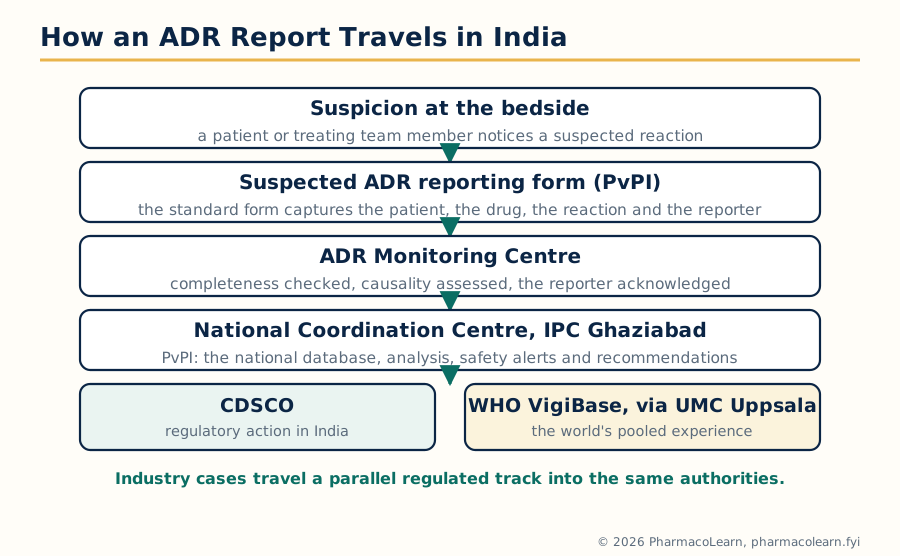 Figure: The journey of a suspected ADR report in India, from the reporter's form to the national programme and the WHO global database.
4.5 The WHO international drug monitoring programme
The WHO Programme for International Drug Monitoring, established in 1968, is the global collaboration of national pharmacovigilance centres, coordinated by WHO in Geneva with the Uppsala Monitoring Centre (UMC) as its operational arm. Member countries submit individual case safety reports in a common format; UMC maintains them in VigiBase, the global database holding tens of millions of reports, returns feedback and analyses to members, and supports the statistical signal detection of Unit 5. Membership obliges a country to run a national centre and a spontaneous reporting system; in return it receives the world's experience with its drugs, including signals first visible elsewhere. Most of the world's population is now covered by member programmes, and the programme's quiet achievement is standardization: one vocabulary, one report format, one database, so that a case reported in Ghaziabad can be analysed in Uppsala beside a case reported in Stockholm.
4.6 WHO and regulatory terminologies of ADR
Shared work requires shared words, and pharmacovigilance has built terminologies at three levels. Reaction terms: the WHO Adverse Reaction Terminology historically, and now MedDRA, the Medical Dictionary for Regulatory Activities, a hierarchical medical terminology (from system organ class down through high level group, high level and preferred terms to lowest level terms) into which every reported event is coded, so that a report written as "liver failure", "hepatic failure" or "liver function abnormal" in different places becomes one countable concept. Drug names: the WHO Drug Dictionary codes products to the international nonproprietary names of Unit 5, so brand variants collapse to one substance. Case definitions and seriousness criteria follow ICH E2A, and causality language the categories of section 4.7. Terminology work looks clerical and is in fact the discipline's infrastructure: signal detection can only count what coding has made identical.
4.7 Evaluation of medication safety: causality assessment
A report asserts that a patient took a drug and suffered an event; evaluation asks whether the drug caused it. Causality assessment weighs, case by case, the time relationship (did the event follow the drug plausibly?), dechallenge and rechallenge, alternative explanations in disease and other drugs, prior knowledge of the reaction, and dose relationship. Two standard instruments structure the judgement. The WHO-UMC system sorts cases into categories: certain, probable or likely, possible, unlikely, conditional or unclassified, and unassessable or unclassifiable, according to how completely those tests are satisfied. The Naranjo scale scores ten questions about the case, previous reports, timing, dechallenge, rechallenge, alternatives, placebo response, drug levels, dose response and prior similar exposure, into a total read as definite, probable, possible or doubtful. Neither instrument manufactures certainty from a single case, and that is not their purpose: they make thousands of individual judgements consistent enough that the aggregate, a cluster of "probable" cases of the same rare event, can constitute a signal. Causality at case level, severity, seriousness, predictability and preventability together are the complete evaluation of a medication safety report, after which it is fit for the statistical methods of Unit 5.
4.8 Establishing a pharmacovigilance centre in a hospital
A hospital pharmacovigilance centre, in India typically an ADR Monitoring Centre under PvPI, is established by assembling the same elements anywhere: sponsorship from the institution's leadership and a named coordinator, usually a pharmacologist or clinical pharmacist; a multidisciplinary ADR committee drawing in clinicians of the major departments, pharmacy and nursing; infrastructure: the standard suspected ADR reporting form (in India the PvPI form), access to the reporting software, and a defined route for reports to travel to the national centre; promotion, because reporting is voluntary and competes with workload: launch meetings, posters, pocket reminders, a simple answer to the reporter's question "what happens to my report"; feedback, the element most often omitted and most decisive: reporters who receive acknowledgement, causality outcomes and safety news keep reporting, and those who report into silence stop; and routine work: ward rounds that hunt reactions, review of reports for completeness, causality assessment by the committee, monthly transmission and analysis, and periodic hospital bulletins. A centre is judged by sustained reporting quality, not by inauguration.
4.9 Pharmacovigilance in industry
For a marketing authorization holder, pharmacovigilance is a legal system, not a service. An industry pharmacovigilance unit must collect every adverse event its company learns of, from trials, literature, sales representatives' field reports, patient support programmes and the web; process each case against the minimum validity criteria (an identifiable patient, an identifiable reporter, a suspect drug and an event); assess seriousness, expectedness and causality; expedite serious cases to regulators within the prescribed clocks; maintain the company safety database (the systems of Unit 5); write the periodic aggregate reports that review the product's whole safety experience at intervals; and detect and evaluate signals continuously, feeding labelling changes and risk minimization measures back to regulators. Oversight is by named accountable officers and by regulatory inspection. The company's commercial interest and its safety duty point in opposite directions often enough that the system's design, independent reporting lines, audit, inspection, assumes the tension and engineers around it.
4.10 National programmes related to pharmacovigilance
National programmes are the state run form of the same work. PvPI is India's, described in section 4.4; its cousins include the FDA's MedWatch reporting programme feeding the FAERS database in the United States, and the Yellow Card scheme of the MHRA in the United Kingdom, the oldest national scheme of all, founded in 1964 directly after thalidomide. National programmes set reporting rules for their jurisdictions, run public and professional awareness, publish safety communications, and carry the country's cases into the WHO programme. Around the core drug programme sit allied schemes the syllabus touches through Unit 5, notably vaccine safety surveillance under the immunization programme, and specialized vigilance for medical devices, blood products and other product classes, collectively the vigilances, each with its own reporting form and centre but one shared logic.
4.11 Roles and responsibilities in pharmacovigilance
The system's duties distribute by position. Healthcare professionals detect and report: their case reports are the raw material, and no database substitutes for the clinician who connects a rash to a prescription. Hospitals and their pharmacovigilance centres collect, complete, assess and forward reports, and feed learning back to prescribers. Industry processes its products' cases worldwide, maintains databases, detects signals and reports to regulators on fixed clocks. National centres and programmes validate and pool national data, analyse, communicate and represent the country internationally. Regulators evaluate the assembled evidence and act: label changes, restricted indications, Dear Healthcare Professional letters, suspension or withdrawal. The WHO programme and UMC pool the world, standardize the language and return global analyses. Patients and the public, the newest recognized reporters, contribute reports directly in many systems including PvPI, and are the audience every communication finally serves. Pharmacovigilance works when each role trusts the next with its reports; it fails, characteristically, by silence at the first step.
THE PHARMACOVIGILANCE CYCLE

  DETECT --> reports of suspected reactions are gathered
      |
      v
  ASSESS --> causality, seriousness, expectedness are judged
      |
      v
  UNDERSTAND --> patterns across cases: who, how often, why
      |
      v
  PREVENT --> warnings, labels, restrictions, education
      |
      +------> outcomes feed back into detection
Unit 5: Methods, ADR Reporting and Tools Used in Pharmacovigilance
5.1 International Classification of Diseases
Safety data must be sorted before it can be counted, and the world's sorting frame for diseases is the International Classification of Diseases (ICD), maintained by the WHO and now in its eleventh revision, ICD 11. Every disease, injury and cause of death carries an ICD code, so diagnoses written in any language and style resolve into standardized entries that statistics can aggregate across hospitals, regions and countries. In pharmacovigilance the ICD complements MedDRA: MedDRA codes the reaction as reported and coded for regulatory work, while ICD coding supports mortality and morbidity statistics, hospital records research and the pharmacoepidemiological studies of Unit 6, whose databases are built on ICD coded diagnoses. One vocabulary for the event, another for the disease burden: both exist so that comparisons are between like and like.
5.2 International Nonproprietary Names for drugs
Drugs need the same treatment as diseases. An International Nonproprietary Name (INN) is the WHO assigned generic name by which a pharmaceutical substance is known worldwide, one substance, one name, displacing the thicket of brand names and national variants: the substance sold under dozens of trade names is paracetamol in INN terms in most of the world, acetaminophen in the United States Pharmacopoeia tradition. INNs are built with stems, suffixes and prefixes that declare pharmacological family, so a name itself carries information: the stem "olol" announces a beta blocker, "pril" an ACE inhibitor. In pharmacovigilance the INN is the aggregation key of section 4.6: reports against every brand of a substance meet in the database under its INN, and a signal for the substance emerges that no single brand's reports could have shown.
5.3 Passive surveillance: the spontaneous reporting foundation
Passive surveillance is the system that waits for reports: healthcare professionals and patients who suspect a reaction complete a report, and the system receives whatever the field sends it. The spontaneous reporting system of section 5.8 is its machinery. Passive surveillance is cheap, covers every drug and every patient in the country, runs for the product's whole life, and is unmatched at generating hypotheses about rare and unexpected harm, since any observant clinician anywhere can contribute a case that no study would have been funded to find. Its limitations are structural and must be taught with it: under reporting, the celebrated weakness, only a small fraction of reactions, often estimated in the literature at well under one in ten, are ever reported, and reporting is uneven, rising after publicity and for new drugs, and falling for familiar and mild reactions; no denominator, the system counts reports, not users, so it cannot by itself give incidence; and variable quality, reports arrive with missing doses, dates and histories that assessment must chase. Passive surveillance finds signals; it cannot measure risks. Measurement belongs to the active and analytic methods that follow.
5.4 Active surveillance
Active surveillance goes out and looks. Instead of waiting for reports, the system solicits them: defined populations of drug users are identified and followed deliberately, through prescription event monitoring, in which prescribers are asked systematically about events in patients on a new drug; through registries that enrol every exposed patient; through sentinel hospital sites with staff tasked to hunt reactions on the wards; and through routine record linkage of the databases of Unit 6. Because ascertainment is systematic, active systems can approach true incidence and characterize the exposed population that passive reporting lacks. The costs are money, organization and time, so active surveillance is deployed selectively: new drugs of wide expected use, drugs with a suspected serious problem, and special populations such as pregnancy, where exposure registries are the standard instrument.
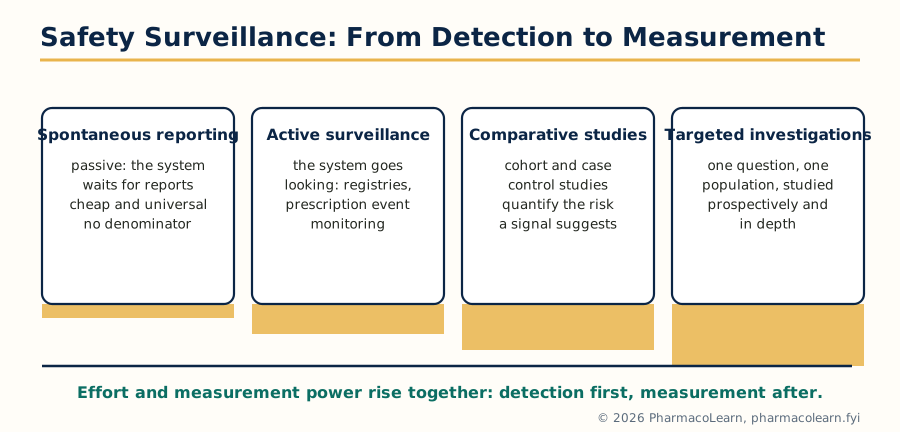 Figure: The methods of safety surveillance range from waiting for reports to following whole exposed populations, gaining measurement power as effort rises.
5.5 Comparative observational studies in safety evaluation
When a signal needs measuring, the observational designs of Unit 2 return as analytic instruments, now called comparative observational studies. Cohort studies compare incidence of the suspected harm in users and non users of the drug, or against users of an alternative drug for the same disease, the comparison that corrects for the disease itself causing the outcome. Case control studies test whether cases of a rare established harm were more often exposed, the design that confirmed several historic reactions in pregnancy and childhood. Their pharmacoepidemiological discipline, confounding control, bias analysis, and very large record databases, is Unit 6's subject; here they are placed in the toolkit as the methods that convert a spontaneous reporting suspicion into a quantified relative risk a regulator can act on.
5.6 Targeted clinical investigations
Between passive reporting and full epidemiology sits the targeted clinical investigation: a focused study, often small and quick, aimed at one defined safety question in one defined population. A cluster of reports suggesting liver injury leads to a study measuring liver enzymes prospectively in exposed patients; a question about a drug in renal impairment leads to a pharmacokinetic and tolerability study in that group; a suspected interaction leads to a formal interaction study. The investigation is targeted in question, population and measurement, and its place in the sequence is characteristic of good pharmacovigilance: signal from reports, quantification by observation, mechanism and boundaries by targeted study, then regulatory action proportioned to the assembled evidence.
5.7 Vaccine safety surveillance
Vaccines break several assumptions of drug pharmacovigilance: they are given to healthy people, often children, in mass campaigns; the public tolerance for harm is therefore near zero; and coincidental events, illnesses that would have occurred anyway in the days after vaccination, are guaranteed in large numbers. Vaccine safety surveillance is built for this terrain. Its core event category is the adverse event following immunization (AEFI): any untoward medical occurrence after immunization, not necessarily caused by it, classified by cause as vaccine product related, vaccine quality defect related, immunization error related, immunization anxiety related, or coincidental. India runs a dedicated AEFI surveillance system under its immunization programme, with district and state committees performing structured causality assessment of serious cases, because the cost of a mishandled scare is measured not only in individual harm but in collapsed vaccine coverage and returning disease. The lesson generalizes: causality communication is itself a safety intervention.
5.8 The spontaneous reporting system and reporting to regulatory authorities
The spontaneous reporting system is the organized machinery of passive surveillance: standard report forms distributed everywhere care is given; collection points in hospitals and pharmacovigilance centres; a national database; assessment; and feedback. A report qualifies as a valid individual case safety report when it carries the four minimum elements: an identifiable patient, an identifiable reporter, a suspect product, and an event. In India the reporter, professional or patient, completes the suspected ADR reporting form of PvPI; reports flow from ADR Monitoring Centres to the National Coordination Centre at IPC, where they are processed and transmitted to CDSCO for regulatory use and to VigiBase for the world's. Industry reports run on a parallel regulated track into the same authorities. Reporting guidelines, section 5.9, exist to raise the completeness and speed of this flow, because a spontaneous system's sensitivity is set less by its software than by the willingness of busy clinicians to spend three minutes on a form.
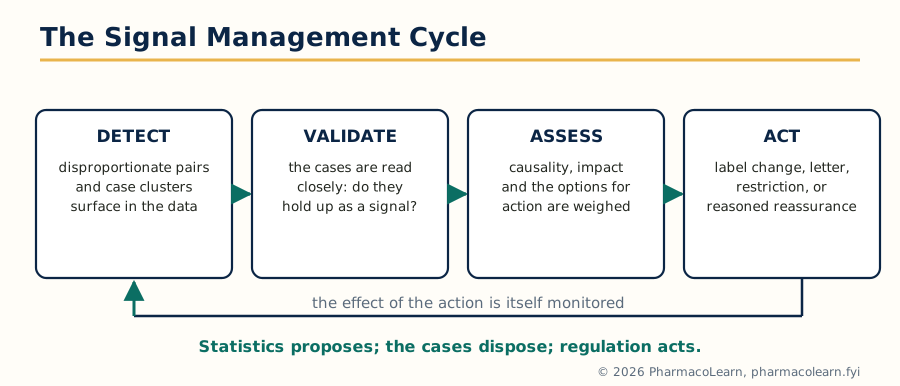 Figure: Signal management is a cycle: detection in accumulated data, validation against the cases, assessment of the evidence, and action whose effects are then monitored.
5.9 Guidelines for ADR reporting
Reporting guidelines answer the practitioner's four questions. What to report: any suspected adverse reaction, with emphasis on reactions that are serious, unexpected, or associated with new drugs, but without excluding the rest, since reporters cannot know in advance which case completes a pattern; in India all suspected reactions to all drugs, including those from traditional systems where the form allows, may be reported. Who reports: physicians, pharmacists, nurses, dentists and other healthcare professionals, and patients themselves, whose reports the Indian programme accepts directly. When and where: as soon as the suspicion forms, to the nearest ADR Monitoring Centre, hospital pharmacovigilance unit, or directly to the national programme, using the standard form or its electronic equivalents; suspicion, not proven causality, is the reporting threshold, and waiting for certainty is how signals are strangled. How completely: with patient particulars in anonymized form, full drug details including dose, dates and batch where known, the reaction's onset, course, investigations and outcome, dechallenge and rechallenge information, and concomitant medicines and diseases, because the value of a report is set by its assessability, and an unassessable report is a signal that failed to arrive.
5.10 Argus: the industry safety database
Case reports at industry scale number in the hundreds of thousands, and the discipline runs on specialized safety databases. Oracle Argus Safety, universally called Argus, is the most widely deployed of them in pharmaceutical companies: a validated software system for the intake, processing, medical review, coding in MedDRA, duplicate checking, and regulatory submission of individual case safety reports, with the audit trails and electronic records controls that regulated software requires. Argus automates the clocks of section 4.9, flagging expedited deadlines, generates submissions in the international electronic format (the ICH E2B standard) to regulators, and holds the case data from which aggregate reports and signal detection draw. Knowing what Argus is belongs to this subject because a large fraction of M.Pharm pharmacovigilance employment consists of working inside it or its rivals.
5.11 Aris G and the family of safety systems
Aris G (styled ArisG), the safety system of ArisGlobal, is the other classic name the syllabus pairs with Argus: a pharmacovigilance database for case intake, processing, coding, reporting and signal support, used by companies and some regulatory and contract research organizations. The two systems differ in vendor, architecture and interface, not in function: both exist to keep every case valid, coded, assessed, submitted on time and auditable, and skills transfer between them. Around them stands a small family of related tools the working professional meets: electronic data capture and submission gateways through which cases pass to authorities, literature screening tools, and the signal detection platforms of section 5.13.
5.12 VigiFlow: the national centre workhorse
VigiFlow is the web based case management system provided by the Uppsala Monitoring Centre to national pharmacovigilance centres: a secure online tool in which a centre enters, codes, assesses and manages its individual case safety reports, and from which reports pass electronically into VigiBase, the WHO global database. PvPI's ADR Monitoring Centre network works in this ecosystem, so a case entered at a medical college in India becomes, after national processing, part of the world's pooled experience with that drug. VigiFlow's significance for the student is architectural: national systems need not buy industry scale software, because the WHO programme supplies a shared platform, one more way the international system lowers the cost of joining it.
5.13 Statistical methods for evaluating medication safety data
Case by case assessment reaches its limit where counts grow large; statistics takes over, not by replacing judgement but by ranking where judgement should look first. The working family is disproportionality analysis, which asks whether a drug event pair is reported more often than the database's background would predict. The standard measures compare the pair's share of the drug's reports with its share among all other drugs: the proportional reporting ratio (PRR) and the reporting odds ratio (ROR) work on the two by two table of reports, while Bayesian methods, the information component used with VigiBase and the empirical Bayes measures used with the FDA database, shrink unstable small counts toward the background so that three reports do not outrank three thousand. A pair standing out disproportionately is a statistical signal of disproportionate reporting: an instruction to read the cases, not a verdict, since disproportionality is inflated by publicity, by newness and by the reporting biases of section 5.3. Around these sit the supporting crafts: duplicate detection, time to onset analysis, stratification by age, sex and region, and the review of observed to expected counts where exposure denominators exist. The craft's rule closes the unit and the subject's method: statistics proposes, cases dispose, epidemiology measures, and only then does regulation dispose finally.
FROM REPORT TO SIGNAL: THE EVALUATION LADDER

  Individual reports arrive (spontaneous, literature, studies)
      |
      v
  Case assessment: causality, seriousness, expectedness
      |
      v
  Disproportionality screening across the database
      |
      v
  Signal validation: do the cases, read closely, hold up?
      |
      v
  Analytic studies and targeted investigations quantify risk
      |
      v
  Regulatory action and communication, then continued
  monitoring of the action's effect
Unit 6: Pharmacoepidemiology, Pharmacoeconomics and Safety Pharmacology
6.1 Pharmacoepidemiology: definition and scope
Pharmacoepidemiology is the study of the use and effects of drugs in large numbers of people: the application of epidemiological methods and reasoning to pharmacology's questions. Clinical trials establish that a drug can work and is acceptably safe in selected patients over months; pharmacoepidemiology establishes what the drug actually does in the population that receives it: the elderly and the pregnant, patients with five diseases and ten medicines, users who take half the dose or twice it, over years. Its scope covers beneficial and adverse effects alike, patterns and determinants of drug use, the effectiveness of risk minimization measures, and the quantification of risks that trials could only suspect. In the architecture of this subject it is the measurement science that Units 4 and 5 presuppose: spontaneous reporting detects, pharmacoepidemiology counts.
6.2 Study designs and data sources in pharmacoepidemiology
The designs are those of Unit 2 deployed at population scale: cohort studies in databases of millions, case control studies for the rarest outcomes, cross sectional drug utilization studies, and self controlled designs in which each patient is his or her own control across exposed and unexposed periods, cancelling fixed personal characteristics by construction. The distinctive craft is the data. Pharmacoepidemiology runs on secondary data: health insurance and health system claims, electronic health records, prescription and dispensing databases, disease and product registries, and the spontaneous report databases of Unit 5 read analytically. Working in such data demands its characteristic cautions: exposure is inferred from prescribing or dispensing, not observed ingestion; diagnoses are coded for billing as much as for truth; and confounding by indication, the disease causing both the prescription and the outcome, haunts every comparison and is fought with comparator choice, statistical adjustment and design. The discipline's credibility rests on naming these weaknesses and engineering against them, not on the size of the database.
6.3 What pharmacoepidemiology adds
Four contributions justify the discipline's place in this subject. Rare and delayed effects: only population scale sees the one in fifty thousand reaction and the cancer that follows a decade of exposure. Real populations: effects in pregnancy, childhood, old age and multimorbidity, the patients trials exclude, are measurable here and nowhere else. Comparative safety: drugs for the same disease can be compared head to head in use, answering the prescriber's actual question, which of these is safest, which trials rarely ask directly. Drug utilization and policy: who receives what, in what dose, for how long, and at what cost, evidence on which formularies, guidelines and safety interventions are built, and against which their success is judged. A pharmacovigilance system without pharmacoepidemiology can worry precisely; with it, it can also know.
6.4 Pharmacoeconomics: definition and the costs and outcomes frame
Pharmacoeconomics evaluates the costs and the consequences of pharmaceutical products and services, and asks the question scarcity forces: given that resources spent on one drug are unavailable for everything else, which use of them buys the most health? Its frame is an equation with costs on one side, all of them, not only the drug's price but administration, monitoring, treating adverse effects and the costs of treatment failure, set against consequences on the other, measured in the units the next section distinguishes. The perspective of the analysis, patient, hospital, payer or society, decides which costs count, and must be declared before results mean anything. Pharmacoeconomics sits in this subject because safety is one of its inputs: an adverse reaction is simultaneously a clinical event, a pharmacovigilance case and an economic cost, and several historic withdrawals were, in effect, judgements that a drug's harm made its cost per unit of health unacceptable.
6.5 Types of pharmacoeconomic evaluation
| Type | Costs measured in | Outcomes measured in | The question it answers |
|---|---|---|---|
| Cost minimization analysis (CMA) | Money | Assumed or proven equivalent | Outcomes are equal; which option costs least? |
| Cost effectiveness analysis (CEA) | Money | Natural clinical units: life years gained, blood pressure reduced, cases prevented | What is the cost per unit of effect? |
| Cost benefit analysis (CBA) | Money | Money | Do the benefits, valued in money, exceed the costs? |
| Cost utility analysis (CUA) | Money | Utility: quality adjusted life years (QALYs) | What is the cost per QALY, allowing comparison across diseases? |
The four share one discipline: an incremental comparison, the extra cost of the newer option divided by its extra effect, since decisions are always between alternatives, never against nothing. Cost utility analysis, through the QALY, which weights years of life by the quality of health in which they are lived, supplies the common currency in which health technology assessment bodies compare a cancer drug with a vaccine programme, and its ratios inform, without mechanically deciding, reimbursement and formulary judgements. The examiner's expectation is the table's logic: identify what each type measures outcomes in, and the rest follows.
6.6 Safety pharmacology: definition and purpose
Safety pharmacology is the preclinical discipline that studies the undesirable pharmacodynamic effects of a substance on physiological functions, the functional safety counterpart to toxicology's structural focus. Where a toxicity study asks what a compound damages, a safety pharmacology study asks what it disturbs: does it prolong cardiac repolarization, depress respiration, alter behaviour or coordination, at exposures near the therapeutic one? Its regulatory frame is the ICH safety guidelines S7A, which organizes the field, and S7B, which addresses delayed ventricular repolarization, the QT interval, the mechanism behind the hERG channel story told across modern drug regulation, in which several marketed drugs were withdrawn for provoking a lethal arrhythmia. Safety pharmacology studies are performed before and alongside first human exposure precisely so that the functional hazards they detect can be designed out, monitored for in Phase I, or used to set stopping rules, linking this closing topic back to the trial safety monitoring of Unit 3.
6.7 The safety pharmacology core battery
ICH S7A defines a core battery of organ systems whose functions must be investigated, chosen because their acute disturbance can be life threatening:
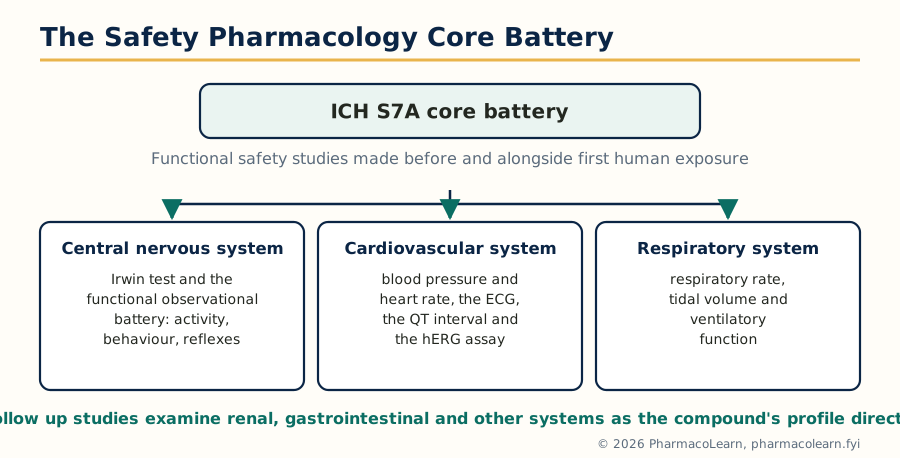 Figure: The ICH S7A core battery: central nervous, cardiovascular and respiratory function, the systems whose acute disturbance endangers life.
Central nervous system: motor activity, behaviour, coordination, reflexes and body temperature, screened by a functional observational battery or Irwin test in rodents. Cardiovascular system: blood pressure, heart rate and the electrocardiogram, with the QT interval and the in vitro hERG potassium channel assay at the battery's centre, since repolarization liability is the classic programme killing finding. Respiratory system: respiratory rate and measures of ventilatory function such as tidal volume. Beyond the core battery, follow up and supplemental studies examine systems as the compound's profile directs: renal and urinary function, gastrointestinal motility, autonomic and skeletal muscle endpoints, and deeper studies of any core system where a signal appeared. The closing symmetry of the subject is now visible: safety pharmacology watches function before the first volunteer is dosed, trial safety monitoring watches patients while evidence is built, and pharmacovigilance watches the world thereafter; one vigilance, three stations.
Frequently Asked Questions
Q: What is the difference between ICH-GCP and the Indian GCP guidelines? They are a standard and its national adaptation. ICH E6, adopted in 1996, is the international good clinical practice guideline written by the regulators and industry of the founding ICH regions, and it supplies the thirteen principles and the role definitions used worldwide. The CDSCO GCP guidelines of 2001 restate that standard for Indian law and institutions. An Indian trial satisfies both at once: the international guideline for scientific and ethical quality, the Indian documents and the governing statute for legal validity.
Q: An ethics committee approves a trial. Does the investigator still need regulatory permission? Yes, the two approvals answer different questions. The ethics committee judges the trial ethically: risk and benefit, consent, protection of participants. The regulator, in India the Central Licensing Authority under the New Drugs and Clinical Trials Rules 2019, grants legal permission to conduct the trial and import or manufacture the investigational product. Both must be in place before enrolment, along with the consent of each participant, which is a third, personal, approval.
Q: Severity and seriousness sound identical. How are they kept apart? By what each measures. Severity is intensity, graded mild, moderate or severe: how strong the event is. Seriousness is a regulatory category fixed by outcome: death, life threatening event, hospitalisation, disability, congenital anomaly, or other medical importance. A severe migraine is intense and non serious; a mild rash that requires hospitalisation for observation is serious. Reporting clocks, compensation and regulatory attention follow seriousness, so the distinction is operational, not pedantic.
Q: Why is the case control study the classic design for studying rare adverse reactions? Because it starts from the outcome. A rare reaction affecting one user in fifty thousand would need an impossibly large cohort or trial to accumulate cases going forward, but the cases already exist in hospitals and records. Assembling those cases and matched controls and comparing past exposure gives an odds ratio efficiently and quickly, which is why historic reactions, from thalidomide embryopathy onward, were established by case based reasoning, at the price of depending on the quality of exposure history.
Q: Spontaneous reporting has no denominator and massive under reporting. Why does every country still build its pharmacovigilance on it? Because nothing else sees everything. It covers all drugs, all patients, all durations, at low cost, for the product's whole life, and it is exquisitely sensitive to the rare, unexpected and bizarre, exactly the reactions trials miss. Its weaknesses mean it generates hypotheses rather than rates, which is a proper division of labour: spontaneous reports raise signals, and the observational and targeted studies of Units 5 and 6 measure them. A system is not weak because its first instrument is a detector rather than a scale.
Q: WHO-UMC categories and the Naranjo scale both assess causality. Why two instruments? They trade precision differently. The WHO-UMC system gives qualitative categories, certain down to unassessable, judged on timing, dechallenge, rechallenge and alternatives, and is the language of national centres and pooled databases because it is fast and robust across millions of cases. The Naranjo scale scores ten explicit questions into definite, probable, possible or doubtful, which makes individual judgements reproducible and teachable, and suits hospital committees and publication. Both impose the same underlying logic; they differ in granularity and setting, and mature centres use each where it fits.
Q: Argus, Aris G and VigiFlow are all safety software. Who uses which? Argus (Oracle) and Aris G (ArisGlobal) are commercial safety databases used mainly by pharmaceutical companies and contract research organizations to process their case reports, meet expedited reporting clocks and submit electronically to regulators. VigiFlow is the Uppsala Monitoring Centre's web based system provided to national pharmacovigilance centres, through which their cases are managed and passed into the WHO global database, VigiBase. Same craft, different seats: industry systems face regulators, the national system faces the world pool.
Q: What is a signal, and is a statistical signal the same thing? A signal is information from one or more sources suggesting a new potentially causal association between a drug and an event, or a new aspect of a known association, judged likely enough to justify verificatory action. A statistical signal of disproportionate reporting is narrower: one detection method's output, showing a drug event pair reported more than background expectation. It is evidence towards a signal, not the signal itself, because disproportionality can be manufactured by publicity and reporting habits; the signal is declared only after the underlying cases are read and hold up.
Q: What does the safety pharmacology core battery cover, and why those three systems? The ICH S7A core battery covers central nervous, cardiovascular and respiratory function. These systems are chosen because their acute pharmacological disturbance can kill quickly: a seizure or profound sedation, a QT prolongation degenerating into a fatal arrhythmia, respiratory depression. They are therefore studied functionally before first human exposure, with follow up studies on renal, gastrointestinal and other systems as the compound's profile requires, so that Phase I monitoring and stopping rules can be built around known liabilities.
Q: Pharmacoeconomics is about money. Why does it sit in a pharmacology subject about safety? Because value judgements decide which drugs populations actually receive, and safety is priced into them. Every adverse reaction carries costs, of treatment, hospitalisation and lost health, and cost utility analysis comparing cost per QALY will rank a safer drug above an equally effective but more toxic one. Formulary and reimbursement decisions made on pharmacoeconomic grounds are, in practice, safety decisions taken at population level, and a pharmacologist who cannot read them cannot follow where the subject's evidence finally acts.
Complete MPL204T notes, all 6 units in one PDF, free to keep.
Other M.Pharm subjects: MPH101T · MPC101T · MPL101T · MPH102T · MPH103T · MPH104T · MPL102T · MPL103T · MPL104T · MPC102T · MPC103T · MPC104T · MPH201T · MPH202T · MPH203T · MPH204T · MPC201T · MPC202T · MPC203T · MPC204T · MPL201T · MPL202T · MPL203T · MPL204T · MRA101T · MRA102T · MRA103T · MRA104T · MRM301T · MPG101T · MPG102T · MPG103T · MPG201T · MPG202T · MPG203T · MPG104T · MPG204T · MRA201T · MRA202T · MRA203T · MRA204T · M.Pharm