
MPH204T — Cosmetic and Cosmeceuticals
4 hrs/week, 4 credits, 60 hours, 100 marks (75 end semester + 25 sessional). Notes follow the M.Pharm syllabus, unit by unit.
MPH204T Cosmetic and Cosmeceuticals notes for M.Pharm Semester 2 Pharmaceutics: cosmetic regulation in India, skin, hair and oral biology, surfactants, emollients and preservatives, moisturizing, vanishing and cold creams, shampoo, toothpaste, sunscreens and herbal cosmetics, with free unit wise PDF downloads on PharmacoLearn.
Units in this subject
- Unit 1 — Cosmetics, Regulatory: definition of cosmetics as per Indian regulation, labelling, import provisions, misbranded and spurious cosmetics, manufacture licensing, loan license, offences and penalties
- Unit 2 — Cosmetics, Biological aspects: structure of skin and its problems (dry skin, acne, pigmentation, prickly heat, wrinkles, body odor), structure of hair and hair growth cycle, oral cavity problems, cleansing and care needs of body sites
- Unit 3 — Formulation Building blocks: surfactants, emollients, rheological additives, antimicrobial preservatives and factors affecting their efficacy, building blocks of moisturizing cream, vanishing cream, cold cream, shampoo and toothpaste, soaps and syndet bars, perfumes and EU allergens, controversial ingredients
- Unit 4 — Design of cosmeceutical products: sun protection, sunscreen classification and regulatory aspects, cosmeceutical formulations for dry skin, acne, pigmentation, prickly heat, wrinkles, body odor, dandruff, dental cavities, bleeding gums, mouth odor and sensitive teeth
- Unit 5 — Herbal Cosmetics: herbal ingredients for hair care, skin care and oral care, COSMOS guidelines for herbal cosmetics, challenges in formulating herbal cosmetics
Download MPH204T PDF Notes
Free PDFs for this subject, one per unit:
Cosmetic and Cosmeceuticals, subject code MPH204T, is a core Semester 2 subject of M.Pharm Pharmaceutics. It carries 4 credits and 60 hours of theory, taught at 4 hours per week, for 100 marks.
A cosmetic is the only pharmaceutical product class that a healthy person applies every day for years, so its science sits at the meeting point of law, biology and formulation. This subject follows that order. The first unit is regulatory: what a cosmetic legally is in India, what its label must say, and the licensing, import and offence provisions of the Drugs and Cosmetics framework that govern its manufacture and sale. The second unit is the biology the products act on: the structure of skin read through the problems it presents (dry skin, acne, pigmentation, prickly heat, wrinkles, body odor), the structure and growth cycle of hair, the common problems of the oral cavity, and the cleansing and care needs of each body site. The third unit is the formulator's toolbox: surfactants, emollients, rheology additives and antimicrobial preservatives, the building blocks of a moisturizing cream, a vanishing cream, a cold cream, a shampoo and a toothpaste, soaps and syndet bars, perfumes and their regulated allergens, and the controversial ingredients that every formulator must be able to discuss honestly. The fourth unit turns the toolbox onto the problems: sunscreen design and its regulation, then a cosmeceutical formulation strategy for each condition of Unit 2, extended to dandruff and the oral problems. The fifth unit covers herbal cosmetics: the herbal ingredients of hair, skin and oral care, the private standards such as COSMOS that govern natural claims, and the real challenges of formulating with plant materials.
Unit 1: Cosmetics, Regulatory
1.1 What a cosmetic is: the Indian legal definition
Every regulatory question in this unit starts from one definition. Under the Drugs and Cosmetics Act, 1940, a cosmetic is any article intended to be rubbed, poured, sprinkled or sprayed on, or introduced into, or otherwise applied to, the human body or any part of it, for cleansing, beautifying, promoting attractiveness or altering the appearance. Three features of this definition matter. First, it is defined by intended use and site of application, not by composition: the same cream base is a cosmetic if sold to beautify and a drug if sold to treat. Second, the list of purposes is cosmetic in the plain sense, cleansing and appearance, so a product that claims to cure, mitigate or prevent a disease steps outside the cosmetic definition and into the drug definition, with the much heavier drug licensing and evidence requirements that follow. Third, soaps are expressly included within the Indian cosmetic definition, unlike the position in the United States, which is why Unit 3 can treat soaps and syndet bars as cosmetics. The word cosmeceutical, used throughout this subject, has no legal status in India or in most jurisdictions: it is a professional term for a cosmetic positioned on the borderline, carrying an active ingredient with a biologically plausible benefit beyond appearance. A cosmeceutical is regulated as a cosmetic, and its claims must stay within what a cosmetic may claim, however active its formulation feels.
| Feature | Cosmetic (India) | Drug (India) |
|---|---|---|
| Legal basis | Drugs and Cosmetics Act 1940 definition of cosmetic | Drugs and Cosmetics Act 1940 definition of drug |
| Intended purpose | Cleansing, beautifying, promoting attractiveness, altering appearance | Diagnosis, treatment, mitigation or prevention of disease |
| Claims allowed | Appearance and hygiene claims | Therapeutic claims, with evidence |
| Examples | Face cream, shampoo, toothpaste for cleaning, lipstick | Antifungal cream, medicated anti dandruff preparation with drug claims, fluoride toothpaste positioned against caries as a disease claim in some markets |
1.2 The regulatory framework: Act, Rules and the administering authority
Cosmetics in India are regulated under the same statute as drugs, the Drugs and Cosmetics Act, 1940, and the rules made under it, principally the Drugs and Cosmetics Rules, 1945 for manufacture and sale, and the Cosmetics Rules, 2020, which separated out and modernised the provisions for import and registration of cosmetics. The Central Drugs Standard Control Organization (CDSCO), headed by the Drugs Controller General of India, is the central authority; manufacture licensing is administered through the state licensing authorities, and import registration is handled centrally. This split, central control of what enters the country and state licensing of what is made in it, explains the shape of the rest of this unit: import provisions are registration based and uniform, while manufacturing licences are granted by the state in which the factory sits. India also maintains a list approach through the Bureau of Indian Standards for certain specification matters and restricts or prohibits specific ingredients from time to time by notification, so a formulator's duty is to check the current position rather than memorise a frozen list. The framework's logic is consistent: cosmetics are lower risk than drugs but are applied widely, repeatedly and to children, so the law controls identity, labelling honesty, manufacturing hygiene and prohibited products rather than pre market proof of efficacy.
1.3 Labelling of cosmetics: Indian requirements
The label is the consumer's only contract with the product, and Indian rules prescribe what a cosmetic label must carry. The inner and outer labels together must state the name of the cosmetic, the name and address of the manufacturer (and, for imported products, of the importer), the net contents, the batch or lot number, the manufacturing licence number, the month and year of manufacture and the expiry or best before date, and the list of ingredients. Ingredients are declared in descending order of concentration by weight or volume at the time of manufacture, following the convention used internationally, so the first named ingredient is the largest component, usually water. Directions for safe use and any warnings or cautions the product requires must be printed where the product needs them, and special precautions apply to particular categories, for example hair dyes containing certain dye intermediates carry prescribed caution statements about skin sensitivity testing. Two principles run through the detail. The label must not make false or misleading claims, because a misleading label makes the product misbranded (section 1.5), and the particulars must be legible and indelible under normal conditions of storage and use. For the formulator, labelling is not an afterthought: the ingredient list is written in the INCI style naming used by the industry, and every claim on the pack must be supportable by the formulation as filed.
1.4 Regulatory provisions relating to import of cosmetics
Because a large share of cosmetics sold in India is imported, the import provisions are registration based. Under the Cosmetics Rules, 2020, a cosmetic may be imported only if it is registered with the central licensing authority and the importer holds the registration certificate for the product and its overseas manufacturing site; the application is made by the manufacturer or its authorised agent or importer in India. No cosmetic may be imported if it is prohibited in its country of origin for safety reasons, if it contains a prohibited ingredient, or if it is misbranded or spurious. Imported products must carry the registration number and the importer's particulars on the label in addition to the standard labelling. Consignments enter through notified ports and are liable to sampling and testing by the port officers, and the central authority may prohibit the import of any cosmetic whose quality or safety is in doubt. The practical effect for the industry is that market entry for a foreign brand is a dossier exercise: product composition, free sale status in the origin country, manufacturing site credentials and labelling artwork are examined before the first consignment ships, rather than the product being judged at the border alone.
1.5 Misbranded and spurious cosmetics
The Act grades defective cosmetics by the kind of deception involved, and the distinction matters in examinations and in enforcement. A cosmetic is misbranded if it is not labelled in the prescribed manner, if its label or container bears a statement, design or device that makes a false claim or is misleading, or if it is coloured or coated in a way that conceals damage or makes it appear of better or greater therapeutic value than it is. Misbranding is therefore about information: the product may be perfectly safe, yet it deceives the buyer. A cosmetic is spurious if it is manufactured under a name that belongs to another cosmetic, if it imitates or substitutes for another cosmetic in a manner likely to deceive, or if it falsely claims to be the product of a manufacturer of whom it is not truly a product. Spuriousness is about identity and origin: the product pretends to be something or someone else's. Adulteration, the drug side concept of a product rendered injurious or substandard, has its cosmetic analogue in products contaminated with harmful substances or made under insanitary conditions, which the manufacture and prohibition provisions of this unit address. Enforcement proceeds by sampling by drugs inspectors, testing in government laboratories, and prosecution or administrative action proportionate to the grade of offence.
| Defect | Core idea | Typical example |
|---|---|---|
| Misbranded | The information deceives | A cream labelled with a false claim of curing eczema; a label missing the manufacturer address |
| Spurious | The identity deceives | A counterfeit of a well known brand, packed to imitate it |
| Prohibited or substandard | The product itself is the problem | A cosmetic containing a prohibited ingredient, or made in insanitary premises |
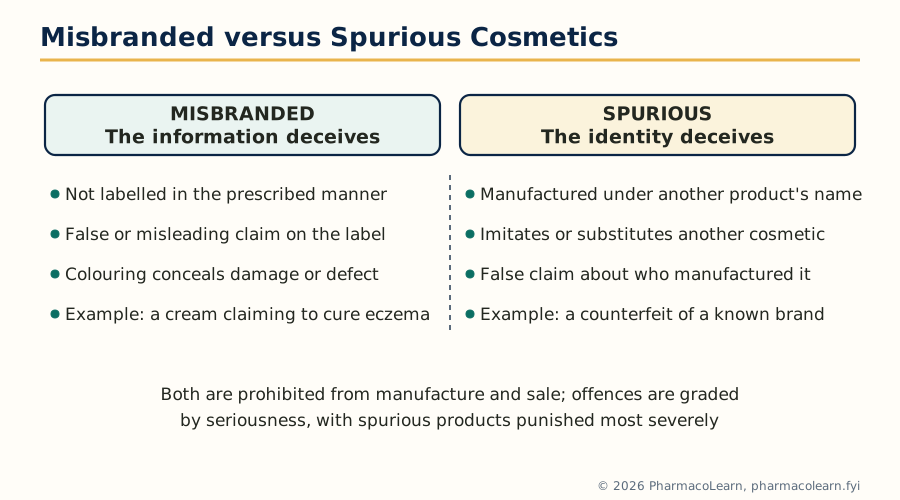 Figure: The two ways a cosmetic deceives. Misbranding corrupts the information; spuriousness corrupts the identity.
1.6 Manufacture of cosmetics: conditions for obtaining a licence
Manufacture of cosmetics for sale requires a licence from the state licensing authority, granted for specified premises and product categories. The conditions for obtaining the licence define the floor of cosmetic manufacturing practice. The applicant must provide premises that meet the factory requirements of the Rules: a clean, hygienic site with adequate space for manufacture, quality control and storage, with provision against contamination. Competent technical staff must supervise manufacture and testing, persons with prescribed qualifications in pharmacy, science or cosmetic technology as the Rules require. The manufacturer must maintain adequate facilities for quality control testing of raw materials and finished products, or have access to approved testing arrangements, and must keep records of manufacture and testing. The licence is granted for the categories applied for, so a unit licensed for creams cannot automatically make every other cosmetic class. Conditions continue after grant: the licensee must allow inspection, maintain the premises and staff standards, and manufacture according to good manufacturing practice expectations, with the licence liable to suspension or cancellation for breach. These conditions are the regulatory counterpart of the formulation work in Unit 3: the licence is what converts a bench formula into a product that may lawfully be sold.
From formula to market: the Indian cosmetic licence path
Bench formula and stability work (Unit 3)
   |
   v
Premises and competent technical staff in place
   |
   v
Application to the state licensing authority
   |
   v
Inspection of premises, staff and testing facilities
   |
   v
Manufacturing licence for the product categories
   |
   v
Manufacture under licence conditions, labelled as prescribed
   |
   v
Sale, with inspector sampling and testing in the market
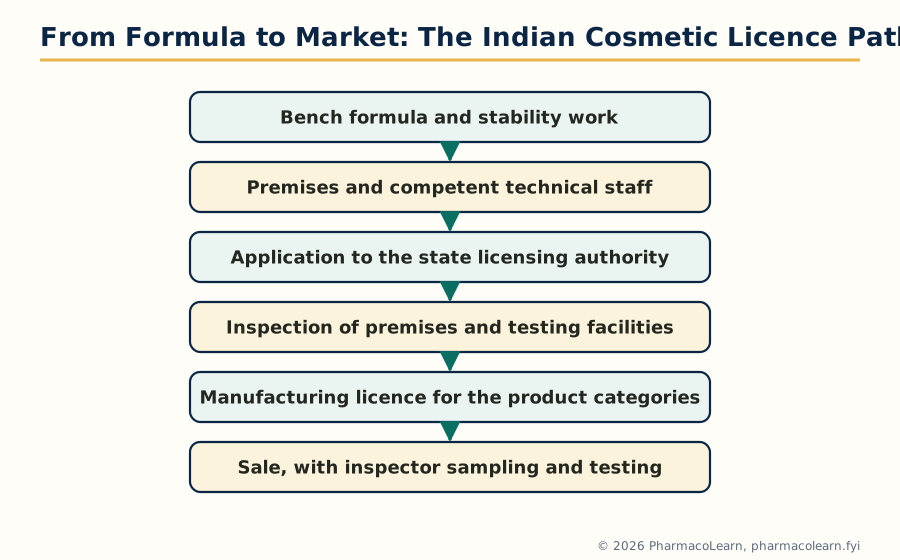 Figure: The licence path of an Indian cosmetic, from bench formula to a marketed product under inspector sampling.
1.7 Prohibition of manufacture and sale of certain cosmetics
The licence system is balanced by explicit prohibitions. Manufacture and sale are prohibited for cosmetics that are misbranded or spurious, that contain a prohibited ingredient, that are not of standard quality where standards apply, or that contain a prescribed colour or substance beyond its permitted conditions. No cosmetic may be manufactured or sold if it has been imported in violation of the import provisions, and the central and state governments may, by notification in the public interest, prohibit the manufacture, sale or distribution of a cosmetic that involves risk to human beings. Prohibition is the framework's emergency brake and its routine filter at once: routine, because inspectors sample and withdraw non complying products continuously; emergency, because a notification can remove a whole ingredient or product class from the market when evidence of harm accumulates. For formulators the lesson is to design against the prohibition logic from the start: avoid borderline ingredients with a known safety cloud (Unit 3's controversial ingredients), respect claim limits, and keep the dossier evidence that a product is what its label says.
1.8 Loan licence
A loan licence is a distinctive Indian provision that separates the right to manufacture from the ownership of the factory. Under it, an applicant who does not own manufacturing premises may be granted a licence to manufacture cosmetics using the premises and facilities of another manufacturer who already holds a licence for those premises. The loan licensee markets the product under its own name and licence number, while the actual manufacture happens at the approved site under the site licensee's systems. The provision exists to let brands and small companies bring products to market without building factories, while keeping every product tied to an inspected premises and an accountable licensee. It carries the same conditions as an ordinary licence in respect of the product: qualified technical supervision at the manufacturing site, quality control arrangements, and liability for the product's compliance rests with those the rules make responsible, so a loan licence is a regulated arrangement, not a shortcut around the licensing conditions of section 1.6. Examiners test the contrast: an ordinary licence authorises manufacture on the licensee's own premises; a loan licence authorises manufacture on another licensee's premises.
1.9 Offences and penalties
The Act enforces the cosmetics provisions through offences graded by seriousness. Manufacturing, selling, stocking or exhibiting for sale a spurious cosmetic, manufacturing without a licence, and obstructing an inspector are offences under the Act, and offences concerning cosmetics are punishable with imprisonment and fines as prescribed, with enhanced punishment for repeat offences. The grading reflects harm: offences involving spurious products and unlicensed manufacture attract the severest treatment because they remove the product from every safeguard at once, while labelling and record offences are treated more leniently. Two features deserve note. The Act provides for the liability of companies and the persons in charge of their business, so offences are not deflected onto junior staff, and it provides for confiscation of the offending stock. Penalties interact with the licence system as well: conviction and breach of licence conditions can each end a business, one through the courts and one through the licensing authority, and a manufacturer must satisfy both regimes at all times. Because the precise penalty amounts and imprisonment terms are amended from time to time, they are stated here in structure rather than figures; the examinable point is the grading logic, which offences exist, and that repeat offences are punished more severely.
Unit 2: Cosmetics, Biological Aspects
2.1 Structure of skin: the surface every cosmetic meets
Skin is the largest organ of the body and the substrate of almost every product in this subject. Its three layers are the epidermis, the dermis and the subcutaneous fat. The epidermis is a stratified squamous epithelium whose surface layer, the stratum corneum, is the working barrier: roughly 10 to 20 micrometres of flattened, dead corneocytes embedded in a lipid mortar of ceramides, cholesterol and free fatty acids, the classic bricks and mortar model. Corneocytes are continuously made at the basal layer and shed from the surface, a turnover of about four weeks in young skin. On the surface sits the acid mantle, a thin film of sweat, sebum and degraded corneocyte contents giving a surface pH around 4.5 to 5.5, and the natural moisturizing factor (NMF) inside corneocytes, a hygroscopic mixture of amino acids, urea, lactic acid and salts derived largely from the protein filaggrin, which holds water in the stratum corneum. The dermis beneath is connective tissue: collagen for tensile strength, elastin for recoil, and a gel of glycosaminoglycans such as hyaluronic acid holding water, with blood vessels, nerves, sweat glands and the pilosebaceous units (hair follicle plus sebaceous gland) passing through it. The subcutaneous layer insulates and cushions. Two barrier ideas run through the whole subject: water is lost through the barrier as transepidermal water loss (TEWL), the quantitative measure of barrier health, and almost nothing applied to intact skin penetrates far past the stratum corneum, which is why cosmetics act at the surface and why their claims are framed there.
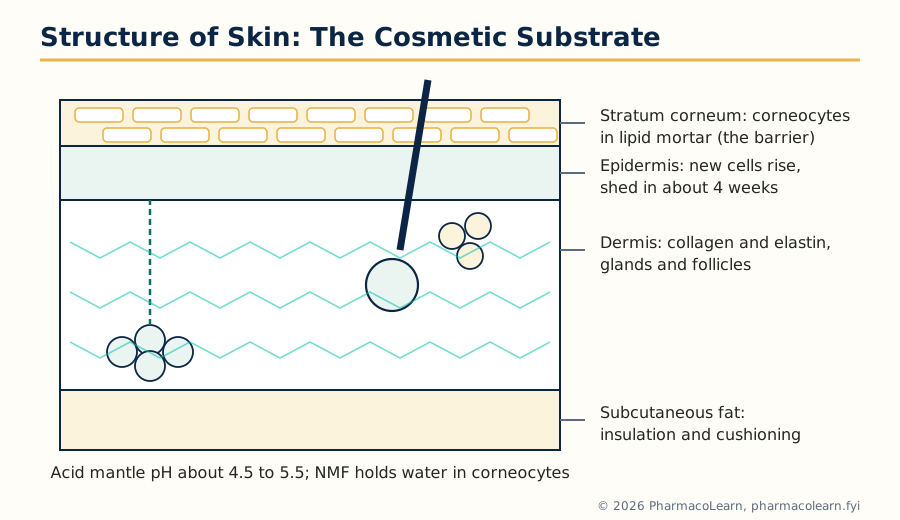 Figure: The layers of skin. Almost every cosmetic acts at or above the stratum corneum, the barrier layer at the top.
2.2 Dry skin: where the barrier leaks
Dry skin (xerosis) is a failure of stratum corneum water content, which normally stays above about 10 percent. The causes combine: reduced NMF from filaggrin deficiency or ageing, loss or disorganisation of the intercellular lipids that seal the corneocytes, low environmental humidity, and stripping of surface lipids and NMF by harsh surfactants and hot water. The result is a stiff, cracked surface film: corneocytes shrink and separate, fine scale appears, the barrier leaks so TEWL rises, and fissures admit irritants, producing tightness, itching and secondary inflammation. The biology dictates the three intervention classes that Unit 4 builds into moisturizers: occlusives that lay a water proof film over the surface and cut TEWL, humectants that bind water in the stratum corneum, and emollients that fill the gaps between corneocytes and restore flexibility. Dry skin is also the model for sensitive skin generally, because a defective barrier admits preservatives, fragrances and other small molecules that intact skin would exclude.
2.3 Acne: the pilosebaceous unit under pressure
Acne vulgaris is a disorder of the pilosebaceous unit, the hair follicle and its sebaceous gland, most active on the face, chest and back. Four factors combine. Sebaceous glands enlarge and secrete more sebum under androgen stimulation, typically at puberty. The follicle lining hyperkeratinizes, so shed cells stick together instead of flowing out, plugging the follicle outlet as a comedo (open, a blackhead, when the plug darkens at the surface; closed, a whitehead, when it does not). The anaerobic bacterium Cutibacterium acnes (formerly Propionibacterium acnes) proliferates in the sebum rich, oxygen poor plug and its enzymes and metabolites provoke inflammation, converting a comedo into papules, pustules and, in severe disease, nodules and cysts that scar. Cosmetic relevance is threefold: comedogenic ingredients can add to follicle plugging; cleansing and sebum control are legitimate cosmetic aims; and the boundary with medicine is close, because established inflammatory acne is a disease whose treatment (retinoids, benzoyl peroxide as a drug, antibiotics) sits on the drug side in most classifications, so a cosmetic product supports care and must not claim cure.
2.4 Pigmentation: melanin and its distribution
Skin colour and its disorders come from melanin, made by melanocytes in the basal epidermis. Each melanocyte supplies pigment to a fixed neighbourhood of keratinocytes (the epidermal melanin unit), synthesising melanin in organelles called melanosomes from tyrosine through the rate limiting enzyme tyrosinase: tyrosine is oxidised to dopaquinone, which proceeds to the brown black eumelanin or, with cysteine, the yellow red pheomelanin. Ultraviolet radiation stimulates melanogenesis, the tanning response, and hormones and inflammation modulate it. Hyperpigmentation disorders include melasma (symmetrical facial patches, driven by sun, hormones and visible light), post inflammatory hyperpigmentation after acne or injury, and solar lentigines (age spots) from chronic sun. Hypopigmentation, loss of pigment as in vitiligo, is a medical condition outside cosmetic claims. Cosmetically, pigmentation is addressed by limiting melanin production at tyrosinase, by interrupting melanosome transfer to keratinocytes, by accelerating shedding of pigmented surface cells, and above all by photoprotection, because every lightening strategy fails under continued ultraviolet exposure. Unit 4 develops each of these into formulations.
2.5 Prickly heat: a sweat duct problem
Prickly heat (miliaria) is a disorder of the eccrine sweat duct in hot, humid conditions. Sweat glands deliver sweat to the surface through a coiled duct; when the duct is blocked by swollen, hydrated stratum corneum, sweat is retained and leaks into the surrounding skin at the level of the block. Blockage within the stratum corneum gives tiny clear vesicles (miliaria crystallina); blockage deeper, in the epidermis, gives the itchy red papules of miliaria rubra, the familiar prickly heat rash, common in infants and in adults newly exposed to tropical heat. The cosmetic logic follows the mechanism: keep the skin cool and dry, avoid heavy occlusive products that hydrate and swell the surface further in hot weather, use light, absorbent preparations and powders that reduce surface wetness and friction, and include soothing agents for the itch. Prickly heat is also the reason heavy cold creams of Unit 3 are winter products in the Indian market and light lotions and powders dominate summer shelves.
2.6 Wrinkles: ageing written in the dermis
Wrinkles are the visible surface record of dermal change. Intrinsic ageing slowly thins the dermis: fibroblasts make less collagen and elastin, the collagen that remains is fragmented and disorganised, glycosaminoglycan water content falls, and the epidermis flattens at its junction with the dermis so the surface folds more easily. Photoageing, chronic ultraviolet exposure, accelerates and dominates the process on exposed sites: ultraviolet generates matrix metalloproteinases that degrade collagen, produces the tangled, dysfunctional elastin material of solar elastosis, and adds pigmentation irregularity. Expression lines form where repeated muscle movement folds the weakening sheet, and gravity and fat redistribution deepen folds with age. The cosmetic response is limited by anatomy: no cream rebuilds the dermis, but photoprotection prevents most photoageing, moisturization plumps the stratum corneum and smooths fine lines optically and physically, and retinoids and related actives used in cosmeceuticals can modestly improve photoaged skin over months. Honest claims say "reduces the appearance of fine lines", which is both the legal and the scientific truth, and examiners reward the distinction.
2.7 Body odor: sweat, skin bacteria and the axilla
Fresh sweat is nearly odourless. Body odor is manufactured by skin bacteria, chiefly in the axilla (under arm), where the apocrine glands open into hair follicles and produce a protein and lipid rich secretion on top of the watery eccrine sweat. Corynebacterium and Staphylococcus species on the warm, moist axillary skin metabolise apocrine secretions and sweat components into volatile odorants, including short chain fatty acids and steroid derivatives; the classic axillary odorant 3-methyl-2-hexenoic acid is released from an odourless precursor secreted by the glands. Foot odor follows the same logic inside occlusive footwear. Two distinct cosmetic strategies follow, and Unit 4 separates them: deodorants reduce odor, by antimicrobial action against the responsible bacteria, by absorbing or masking odorants, and by fragrance; antiperspirants reduce sweat itself, aluminium salts forming a temporary gel plug in the eccrine duct, which also starves the bacteria of moisture. The axilla's skin is thin and often shaved, so irritation and sensitization limits are part of deodorant formulation design.
2.8 Structure of hair and the hair growth cycle
A hair is a keratin filament produced by the hair follicle, an invagination of epidermis reaching into the dermis. The visible shaft has three concentric layers: the outer cuticle of overlapping flattened scales pointing towards the tip, the cortex of keratin fibres in a protein matrix, which gives the hair its strength, elasticity and its pigment granules, and in coarse hair a central medulla. Below the surface, the follicle bulb surrounds the dermal papilla, whose blood supply feeds the rapidly dividing matrix cells that build the shaft; the sebaceous gland opens into the follicle above the bulb, coating the emerging hair with sebum. Hair grows in cycles independent of its neighbours. In anagen, the growth phase lasting two to six years on the scalp, the shaft lengthens at roughly a centimetre a month and some 85 to 90 percent of scalp hairs are in this phase. In catagen, a brief two to three week transition, growth stops and the bulb shrinks. In telogen, a resting phase of about three months, the old hair is held loosely and then shed, normally 50 to 100 hairs a day, as a new anagen hair forms beneath it. The cycle explains both normal shedding and why hair fall products cannot act quickly: a follicle committed to telogen sheds its hair whatever is applied, and any genuine effect on growth appears over a full cycle. Chemical treatments act on the shaft's chemistry: the disulfide bonds of keratin, reduced and reformed in permanent waving and straightening, are what give hair treatments something permanent to change.
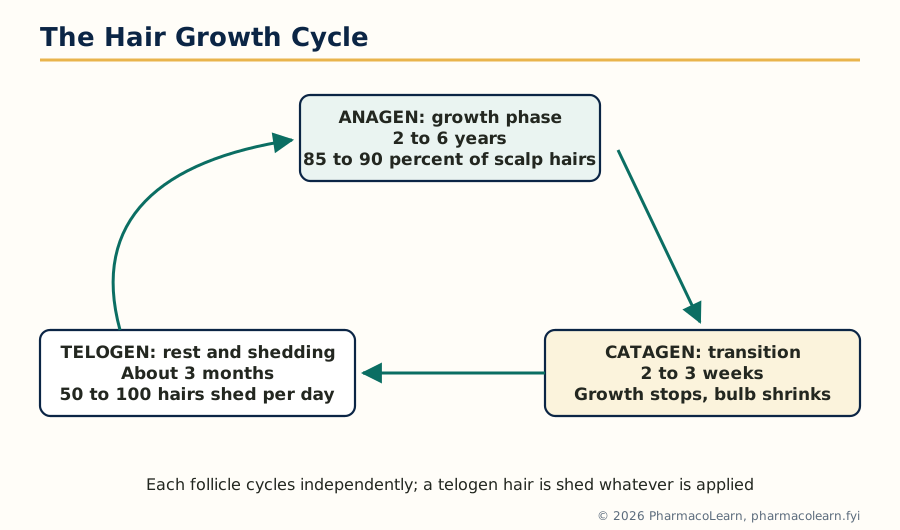 Figure: The hair growth cycle. A follicle in telogen sheds its hair on schedule, which is why hair products cannot show quick effects.
2.9 Common problems of the oral cavity
The mouth is a cosmetic territory with medical borders. Dental caries begins when plaque bacteria, principally Streptococcus mutans, ferment dietary sugars to acid, dropping plaque pH below the critical value (about 5.5 for enamel) at which enamel mineral dissolves; repeated acid attacks produce the cavity. Gingivitis, inflammation of the gums with bleeding on brushing, is the response to plaque accumulated at the gum margin, and untreated it can progress to periodontitis, destruction of the tooth's support, which is dental disease beyond cosmetics. Halitosis (mouth odor) comes mainly from anaerobic bacteria on the tongue coating and in periodontal pockets degrading proteins to volatile sulfur compounds such as hydrogen sulfide and methyl mercaptan. Dentin hypersensitivity (sensitive teeth) arises when gum recession or enamel wear exposes dentinal tubules; fluid movement in the tubules in response to cold, heat or touch triggers sharp pain. Add to these extrinsic tooth staining from tea, coffee and tobacco, and calculus, mineralised plaque that only professional scaling removes, and the oral care formulator's targets are complete. Unit 3 builds the toothpaste that addresses them and Unit 4 turns each problem into a cosmeceutical design.
2.10 Cleansing and care needs across body sites
One skin biology, many sites: the care programme differs because thickness, sebum output, exposure and function differ.
| Site | Distinguishing features | Cleansing and care needs |
|---|---|---|
| Face | Thin skin, high sebum in the T zone, fully exposed to sun and pollution | Gentle cleansing that does not strip, moisturization matched to skin type, daily photoprotection, eye area products kept mild |
| Eye lids | Thinnest skin of the body, no subcutaneous fat, products migrate towards the eye | Very mild, tear compatible cleansers and removers, no harsh surfactants or strong fragrance near the eye |
| Lips | No stratum corneum of normal thickness, no sebaceous or sweat glands, lose water rapidly | Occlusive and emollient lip salves, no detergent cleansing, sun protection for prolonged exposure |
| Hands | Palms thick and gland rich, backs thin and exposed; frequent washing at work | Syndet or superfatted cleansing, rich replenishing creams after washing, barrier creams for wet work |
| Feet | Thick plantar stratum corneum, occluded by footwear, high sweat output | Antifungal hygiene where needed, odor control, urea based softening of thick callus, drying between toes |
| Nails | Hard keratin plate over a sensitive bed, cuticle seals the base | Gentle removers, cuticle care without cutting injury, moisturization of the nail plate to prevent brittleness |
| Scalp | Dense follicles and sebaceous glands, dandruff prone, hair covered | Sebum and scale cleansing by shampoo, conditioning of the shaft, anti dandruff and soothing products where required |
| Neck | Thin, sun exposed, often neglected in product application | Same moisturization and photoprotection as the face |
| Body | Large area, variable thickness, friction zones | Soap or syndet cleansing matched to frequency, moisturization after bathing, talc or powders in folds in hot climates |
| Under arm | Thin, occluded, apocrine glands, frequently shaved | Mild cleansing, deodorant or antiperspirant care, irritation aware formulation |
The table is the practical summary of this unit: every product category of Units 3 and 4 exists because one of these sites has a need its biology creates.
Unit 3: Formulation Building Blocks
3.1 The building block idea
A cosmetic formulation is assembled from functional classes of ingredients, and this unit teaches the classes before the products. Every cream, shampoo or toothpaste in this unit is a short list of decisions: a surfactant system to cleanse or to emulsify, emollients to give the skin feel and barrier support, rheology additives to give the product its body and keep it suspended and stable, emulsifiers holding oil and water together, preservatives keeping it microbiologically safe through its shelf life and use, and the finishing classes, humectants, fragrance, colour, chelating agents, antioxidants and pH adjusters. Read the five named products of this unit (moisturizing cream, vanishing cream, cold cream, shampoo, toothpaste) as five arrangements of the same blocks; the differences between them are which blocks dominate. This block thinking is what the examination tests: given a product, name the blocks and the example ingredients; given a block, state its classes, examples and failure modes.
Assembling a cosmetic from building blocks
Water phase: water, humectants, water soluble actives
   +
Oil phase: emollients, emulsifiers, oil soluble actives
   |
   v
Emulsify and cool with mixing
   |
   v
Rheology adjustment to target body and stability
   |
   v
Preservative, fragrance, colour, pH adjustment
   |
   v
Fill, with microbiological and stability testing
3.2 Surfactants: classification by charge
Surfactants (surface active agents) are molecules with a water loving head and an oil loving tail, which is why they gather at interfaces, lower surface and interfacial tension, wet surfaces, solubilise oils into micelles, foam, and stabilise emulsions. They are classified by the charge of the head group in solution, and the classification predicts properties well enough to organise the whole field.
| Class | Head charge | Representative examples | Properties and cosmetic applications |
|---|---|---|---|
| Anionic | Negative | Sodium lauryl sulfate, sodium laureth sulfate, sodium cocoyl isethionate, soap (sodium stearate) | Strong cleansing and foaming, the primary detergents of shampoos, toothpastes and cleansers; the stronger members irritate skin and eyes |
| Cationic | Positive | Cetrimonium chloride, behentrimonium chloride, benzalkonium chloride | Substantive to negatively charged hair and skin, so the conditioning agents of hair conditioners and rinses; poor detergents; some are antimicrobial |
| Nonionic | Uncharged | Polysorbates, sorbitan esters, cetearyl alcohol ethoxylates, cocamide DEA, alkyl polyglucosides | Mild, stable across pH, low foam alone; the emulsifiers and solubilisers of creams and lotions, and foam boosters and thickeners with anionics |
| Amphoteric (zwitterionic) | Both, pH dependent | Cocamidopropyl betaine, coco amphoacetate | Mild co surfactants that reduce the irritation of anionics, boost and stabilise foam; standard in baby and facial products |
Two working concepts complete the picture. Above the critical micelle concentration, surfactant molecules aggregate into micelles with tails inward, and it is micellar solubilisation of sebum and oily soil that does most cleansing work. The hydrophile lipophile balance (HLB) scale grades emulsifiers by their water versus oil affinity, low HLB suiting water in oil emulsions and high HLB oil in water emulsions, and blends are chosen to match the required HLB of the oil phase.
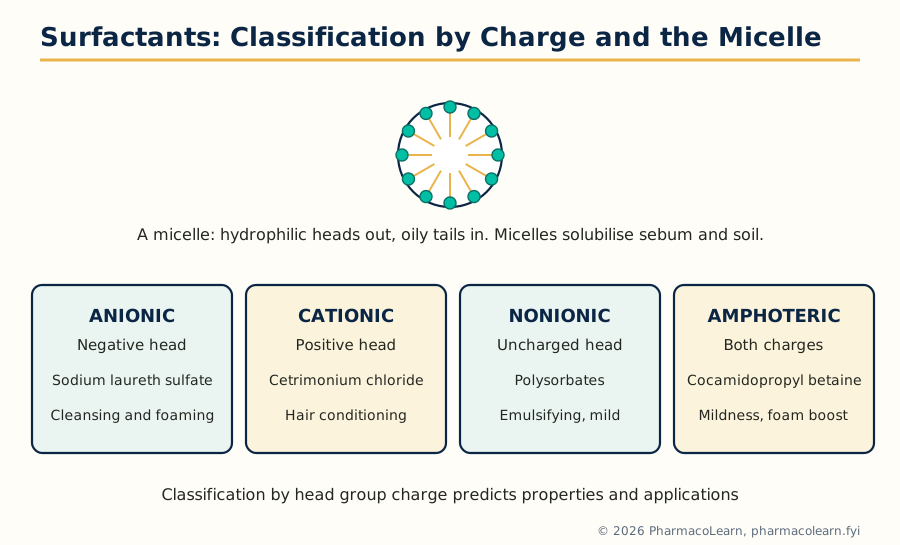 Figure: A micelle and the four surfactant classes. Head group charge predicts cleansing power, mildness and application.
3.3 Surfactants: applications in cosmetic products
Applications follow from the table. In shampoos, an anionic primary surfactant (commonly sodium laureth sulfate) does the cleaning, an amphoteric such as cocamidopropyl betaine cuts irritation and builds foam quality, and a nonionic or polymeric thickener sets viscosity. In skin cleansers and face washes the same architecture is diluted and softened, with milder anionics such as sodium cocoyl isethionate. In toothpaste, sodium lauryl sulfate provides foam and helps disperse the paste, at levels balanced against mucosal irritation. In creams and lotions, nonionic emulsifier pairs do the surfactant work of holding the emulsion together rather than cleansing. Cationic surfactants earn their place after washing, in conditioners, where their positive charge deposits them on the damaged, negatively charged sites of the hair shaft, reducing combing friction and static. The formulation skill is matching charge, mildness and secondary function to the product's site from Unit 2: what is an excellent shampoo anion is an unacceptable eyelid cleanser.
3.4 Emollients: classification and application
Emollients are the ingredients that soften and smooth skin and hair and give a product its sensory signature. Applied to skin they spread over the stratum corneum, fill the spaces between shedding corneocytes, reduce the scaly feel of dryness and partly occlude the surface, so they are both a feel ingredient and a mild barrier ingredient. They are classified by origin and chemistry, and graded in practice by spreadability and after feel, from dry, fast spreading esters to heavy, greasy butters.
| Class | Examples | Character and typical use |
|---|---|---|
| Hydrocarbons | Mineral oil, petrolatum (petroleum jelly), squalane | Inert, stable, strongly occlusive; petrolatum is the most effective single reducer of TEWL; bases of cold creams and ointment like products |
| Fatty esters | Isopropyl myristate, cetyl palmitate, caprylic/capric triglyceride | The great feel adjusters, light to medium spread, reduce the greasiness of hydrocarbon bases |
| Fatty alcohols and acids | Cetyl alcohol, stearyl alcohol, stearic acid | Body and structure in creams, co emulsifiers, the backbone of vanishing cream |
| Natural oils and butters | Coconut oil, almond oil, shea butter, cocoa butter | Traditional and herbal positioning (Unit 5), nourishing feel, variable oxidative stability |
| Silicones | Dimethicone, cyclomethicone | Exceptional spreading and a dry, silky after feel, volatile grades evaporate without residue; common in modern creams and hair serums |
| Lanolin and derivatives | Lanolin, lanolin alcohols | Wool wax resembling skin lipids, excellent emolliency and water absorption, occasional sensitization |
Emollient choice is product definition: the vanishing cream of section 3.9 feels dry because its emollient is largely stearic acid that crystallises on the skin, while the cold cream feels rich because it is built on mineral oil and wax.
3.5 Rheological additives: classification and application
Rheology additives control how a product flows, its viscosity, body, suspension stability and pickup. A shampoo must pour but not run off the hand; a cream must hold a peak in the jar yet spread to nothing; a toothpaste must stand on the brush and then break down in the mouth. The classes:
- Natural gums: xanthan gum, guar gum and its cationic derivative guar hydroxypropyltrimonium chloride (also a hair conditioner), cellulose gums such as carboxymethylcellulose and hydroxyethylcellulose. Water swelling polymers giving body at low use levels, broadly compatible, subject to microbial attack and so needing preservation.
- Clays and mineral thickeners: bentonite and hectorite, plate like minerals that build thixotropic gels, suspending powders in calamine type lotions and face packs; magnesium aluminium silicate is the cosmetic grade workhorse.
- Synthetic polymers: the carbomers, crosslinked acrylic acid polymers neutralised in use to give clear, high yield value gels at fractions of a percent, the standard thickener of gels and modern creams; acrylate copolymer emulsion thickeners for lotions.
- Waxes and fatty structuring agents: beeswax, carnauba and candelilla waxes and cetyl and stearyl alcohols, which thicken by building a crystal network in the oil phase, essential in sticks, balms and cold creams.
- Inorganic salts and surfactant structuring: sodium chloride thickens anionic shampoo systems by shrinking micelles into rods, the cheapest rheology control in the subject; alkanolamides historically did similar work.
The governing practical concepts are yield value (stress needed to start flow, which keeps particles and droplets suspended), thixotropy (viscosity falling under shear and recovering at rest, the behaviour of a good cream) and the danger of over thickening, which traps air, slows manufacture and ruins spreadability.
3.6 Antimicrobial preservatives: merits and demerits
Any water containing cosmetic is a nutrient medium, and a preservative system is a safety requirement, not an option: contamination of eye area and baby products with organisms such as Pseudomonas aeruginosa has caused serious infections, which is why preservation is regulated and challenge tested. The principal classes, with their honest merits and demerits:
| Class | Examples | Merits | Demerits |
|---|---|---|---|
| Parabens | Methylparaben, propylparaben | Broad spectrum, cheap, stable, effective at low levels over a wide pH range, decades of use data | Public controversy (section 3.13), restricted for some members and uses in the EU, weak against some fungi alone |
| Formaldehyde liberators | DMDM hydantoin, imidazolidinyl urea, quaternium-15 | Very effective, especially against bacteria including Pseudomonas | Release formaldehyde, a known sensitizer; controversial (section 3.13) |
| Isothiazolinones | Methylisothiazolinone, methylchloroisothiazolinone blend | Potent at very low levels, broad spectrum | Strong sensitizers; heavily restricted in the EU, leave on use largely prohibited there |
| Organic acids | Benzoic acid, sorbic acid, dehydroacetic acid | Food grade familiarity, good consumer acceptance | Active only in the undissociated form, so effective only at acid pH; weaker against bacteria |
| Alcohols and glycols | Phenoxyethanol, chlorphenesin, caprylyl glycol | Phenoxyethanol is the modern workhorse, broad, stable, good tolerance; glycols boost other preservatives | Phenoxyethanol weaker against fungi, used with boosters; high alcohol systems sting and dry |
| Others | Chlorhexidine, triclosan (historically), benzalkonium chloride | Specific niches: antiseptic and oral products, cationic preservation | Triclosan restricted over environmental and resistance concerns; cationics inactivated by anionics |
The professional answer to "which preservative" is always a system: a primary antimicrobial, a chelator such as disodium EDTA that weakens bacterial membranes, a glycol booster, hygienic manufacture, and packaging that limits recontamination, verified by a preservative efficacy (challenge) test in which the product is inoculated with standard organisms and must reduce their counts to the pharmacopoeial criteria over 28 days.
3.7 Factors affecting microbial preservative efficacy
Preservative efficacy is a property of the whole formulation, not of the preservative alone, and the factors are a standard examination list:
- pH: organic acids work only where they are undissociated (acid pH); parabens hydrolyse in strong alkali; every system has a pH window.
- Partitioning into the oil phase: preservative dissolved in oil droplets or solubilised inside surfactant micelles is absent from the water phase where microbes live; high oil loads and high surfactant levels can quietly strip a system.
- Inactivation by ingredients: nonionic surfactants and some polymers bind or solubilise preservatives; cationic preservatives are neutralised by anionic ingredients.
- Concentration and water activity: the free aqueous concentration does the work; high solids and humectant loads lower water activity and help.
- Container and closure: permeable or wide mouthed packs admit contamination and may absorb preservative into plastic or liner materials.
- Temperature and storage: hydrolysis and volatilisation deplete preservative over shelf life, so efficacy must survive to the expiry date, not just pass at release.
- Initial bioburden and manufacturing hygiene: a preservative system is designed to control incidental contamination, not to rescue a dirty batch.
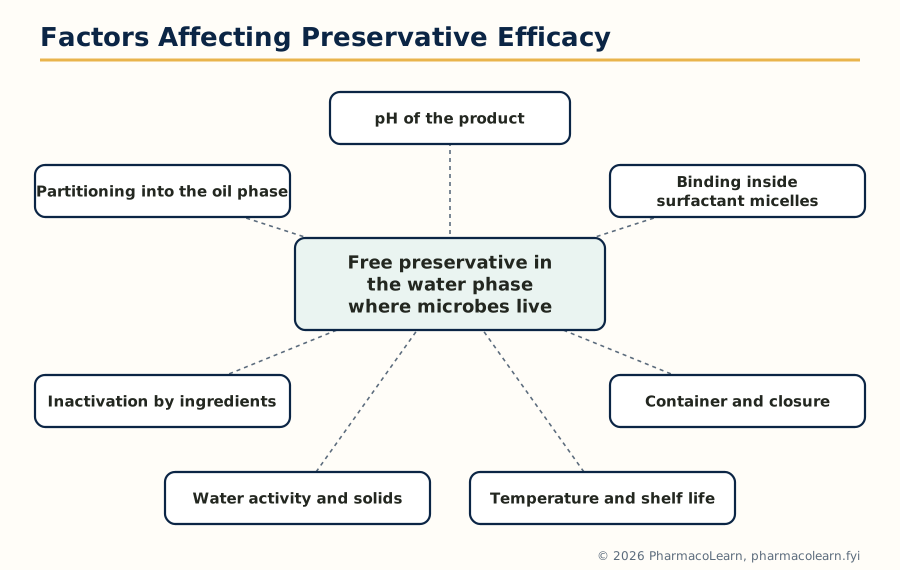 Figure: Preservative efficacy is decided by the whole formulation. Every factor shown moves preservative out of the water phase where microbes live.
3.8 Building blocks of a moisturizing cream
A moisturizing cream is an oil in water emulsion organised around the three dry skin mechanisms of Unit 2. Its blocks: an aqueous phase of water with humectants (glycerin is the standard, supported by propylene glycol, sorbitol, urea at cosmetic levels and hyaluronic acid in premium products) that bind water in the stratum corneum; an oil phase of emollients, including an occlusive component such as petrolatum or mineral oil that cuts TEWL; an emulsifier system, commonly a nonionic pair or a fatty alcohol and soap combination, holding the emulsion; rheology from cetyl and stearyl alcohols and a polymer for body; preservative system, chelator, antioxidant, fragrance and pH adjustment to about skin pH. Barrier repair variants add the stratum corneum's own lipids, ceramides, cholesterol and fatty acids, in the ratios the skin uses. The formula logic is additive to the biology: occlude, hydrate, smooth, and do not damage the barrier with harsh surfactants or excess fragrance.
3.9 Building blocks of a vanishing cream and a cold cream
These two classical creams are the cleanest illustration in the subject that emulsion type and emollient choice are the product.
| Feature | Vanishing cream | Cold cream |
|---|---|---|
| Emulsion type | Oil in water | Water in oil (classically) |
| Core building blocks | Stearic acid partly neutralised in situ with potassium hydroxide or triethanolamine to form a soap emulsifier, with glycerin as humectant and water as the bulk phase | Beeswax and borax, whose reaction forms a soap emulsifier in situ, with a large mineral oil phase and water dispersed within it |
| Behaviour on skin | Rubs in and seems to vanish, leaving a dry, matte, slightly powdery stearic acid film; a base for powders and make up | Feels cool as the dispersed water evaporates, leaves a rich occlusive film; a cleanser and night cream base |
| Feel and use | Light, non greasy, daytime | Heavy, greasy, for dry skin, massage and make up removal |
Both are made by the same in situ soap trick with opposite geometry: in the vanishing cream a small amount of oil phase (stearic acid) is emulsified into much water; in the cold cream a small amount of water is emulsified into much oil. Modern versions replace the soap systems with nonionic emulsifiers for stability and pH control, but the block diagrams examiners ask for are the classical ones above.
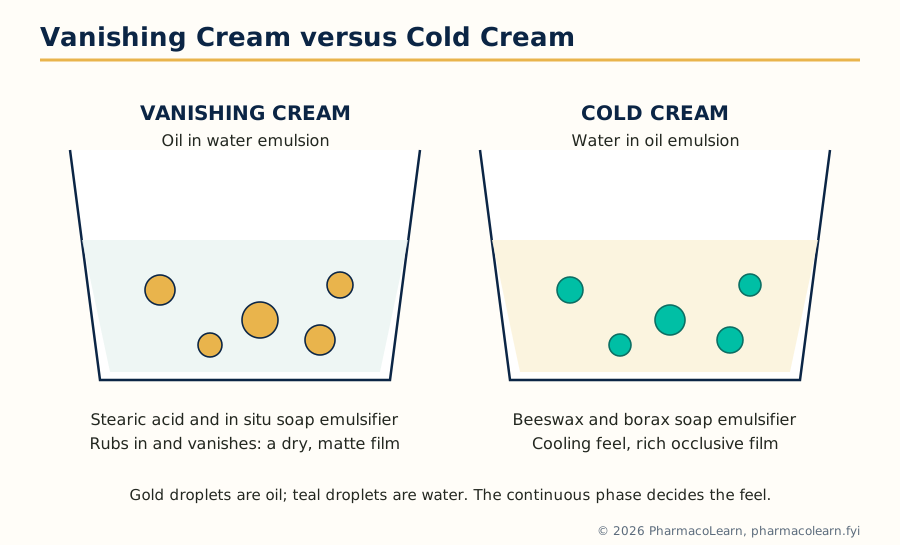 Figure: The same in situ soap trick in opposite geometry. Which phase is continuous decides whether the cream vanishes or coats.
3.10 Building blocks of a shampoo
A shampoo is a surfactant system built to clean hair and scalp without stripping either into damage. Blocks: a primary anionic surfactant for detergency and foam (sodium laureth sulfate is the industry standard; sodium lauryl sulfate the stronger, harsher alternative); a secondary amphoteric surfactant (cocamidopropyl betaine) to moderate irritation and stabilise foam; foam boosters and viscosity control (sodium chloride response of the micellar system, or polymeric thickeners); conditioning agents matched to the variant: cationic guar or polyquaternium polymers and silicones such as dimethicone in conditioning shampoos, deposited from the wash liquor onto damaged hair; an opacifier or pearlescer (glycol distearate) where a creamy appearance is wanted; preservative, chelator, fragrance, colour and pH adjustment to a mildly acidic pH that keeps the cuticle flat. Specialised variants are built by swapping one block: anti dandruff shampoos add the antifungal actives of Unit 4; baby shampoos rebuild the surfactant system around amphoterics and nonionics for mildness. The formulation tension is constant: cleaning power lives in the same surfactant aggressiveness that irritates scalp and strips hair, so shampoo design is the management of a compromise.
3.11 Building blocks of a toothpaste
A toothpaste is a structured aqueous gel carrying a high load of solid abrasive. Blocks: abrasives (hydrated silica is the modern standard; calcium carbonate and dicalcium phosphate the classical alternatives) at levels giving cleaning without excessive enamel and dentin wear; humectants (sorbitol solution, glycerin) keeping the paste from drying in the tube and giving body; water; a binder or rheology system (carboxymethylcellulose, xanthan or carrageenan, often with colloidal silica) suspending the abrasive and giving the ribbon its stand up; surfactant (sodium lauryl sulfate) for foam and dispersion; fluoride where the product is positioned for caries protection (sodium fluoride or sodium monofluorophosphate, the anticaries active, whose status as drug or cosmetic varies by market and claim); flavour (peppermint and menthol systems strong enough to mask raw materials and signal freshness); sweetener (saccharin), preservative, opacifier (titanium dioxide) and colour. The design constraints are pharmaceutical in character: abrasive and fluoride must stay uniformly dispersed for the tube's life, fluoride must remain bioavailable and not be bound by an incompatible abrasive, and the rheology must extrude as a clean ribbon yet break down instantly in brushing.
3.12 Soaps and syndet bars
A soap is the sodium or potassium salt of fatty acids, made by saponifying fats and oils with alkali; the fatty acid profile of the feedstock writes the bar's properties, hard saturated fats such as tallow and coconut giving hardness and lather, unsaturated oils giving mildness at the cost of softness and rancidity risk. Soap cleans by its surfactant action but carries two built in weaknesses: its solutions are alkaline, around pH 9 to 10, against the skin's acid mantle, and it forms insoluble lime soap scum in hard water. A syndet bar (synthetic detergent bar) replaces all or most of the soap with synthetic surfactants such as sodium cocoyl isethionate, allowing a skin neutral pH around 5.5, good performance in hard water, and a milder profile suited to facial and sensitive skin cleansing. Combination bars blend soap and syndet for cost and feel. The comparison is a guaranteed examination item:
| Feature | Soap bar | Syndet bar |
|---|---|---|
| Cleansing agent | Fatty acid salts from saponification | Synthetic surfactants, e.g. sodium cocoyl isethionate |
| pH in use | Alkaline, about 9 to 10 | Near skin pH, about 5.5 to 7 |
| Hard water behaviour | Forms scum, loses lather | Lathers normally |
| Mildness | Can strip lipids and raise skin pH for hours | Milder, preferred for face and sensitive skin |
| Cost and tradition | Cheapest, oldest cleanser | Dearer, modern positioning |
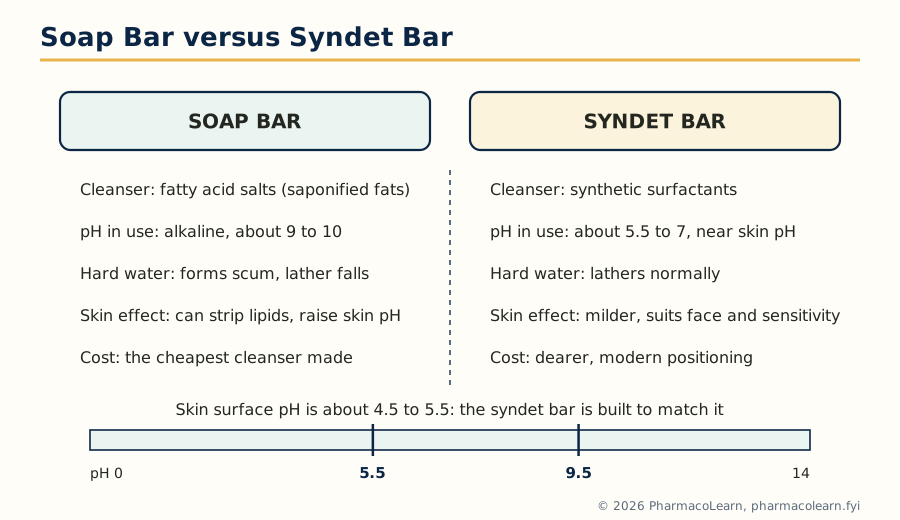 Figure: Soap and syndet bars compared. The pH strip shows the syndet bar's design target: the skin surface itself.
3.13 Perfumes: classification and the EU allergen rules
Perfume is a composition of fragrant materials in an alcoholic or oil base, and cosmetics borrow both its materials and its vocabulary. Classified by concentration of the fragrance compound, the traditional grades run: parfum (extrait), the strongest at roughly 15 to 30 percent compound; eau de parfum, about 10 to 20 percent; eau de toilette, about 5 to 15 percent; and eau de cologne, about 2 to 5 percent, percentages varying by house and source. Classified by odour family, perfumes group into floral, oriental (amber), woody, fougere, chypre and citrus or fresh families, and by structure every fine fragrance is described as top notes (volatile, first impression), heart or middle notes (the character), and base notes (the fixatives that persist). Within cosmetics, fragrance is dosed far lower, in the tenths of a percent in a cream to a few percent in a soap, and serves product identity and the masking of base odours as much as perfuming the user. Regulation meets perfume at allergens: the EU Cosmetics Regulation requires that 26 named fragrance allergens be declared individually on the label when present above 0.001 percent in leave on products or 0.01 percent in rinse off products. The classic members of that list include limonene, linalool, geraniol, citronellol, citral, eugenol, coumarin, benzyl alcohol, cinnamal and hydroxycitronellal. The labelling logic is the point the syllabus tests: these materials are not banned; they must be declared so that sensitised consumers can avoid them, and a formulator using natural essential oils inherits their allergens automatically, because the oils contain them.
3.14 Controversial ingredients: parabens, formaldehyde liberators and dioxane
Three ingredient groups carry a public controversy that a formulator must discuss with evidence rather than slogans, and the syllabus names them exactly.
Parabens. The paraben preservatives (section 3.6) were challenged after studies showed weak estrogenic activity in vitro and a widely reported 2004 paper found parabens in breast tumour tissue without establishing any causal link or comparison tissue. Regulatory reviews by the EU's scientific committees concluded that methyl and ethyl paraben remain safe at permitted levels, while propyl and butyl paraben were restricted to lower levels and a few longer chain parabens were removed for lack of data. The balanced position: parabens are among the best characterised and least sensitising preservatives known, and the controversy is a risk perception problem more than a demonstrated harm problem at cosmetic doses. "Paraben free" reformulation has often replaced them with less characterised or more sensitising alternatives, the isothiazolinone sensitization epidemic being the standing warning.
Formaldehyde liberators. Preservatives such as DMDM hydantoin and imidazolidinyl urea work by slowly releasing formaldehyde. Formaldehyde is an established contact allergen and, in industrial inhalation exposure, a carcinogen; the liberators therefore sit under permanent pressure. Their defence is dose and route: the free formaldehyde in a preserved rinse off product is very low, and patch test data put sensitization rates at low single digit percentages of dermatitis patients. The EU requires a "contains formaldehyde" warning above a threshold of free formaldehyde in the finished product. The honest summary is that the hazard is real, the exposure is small, and sensitive individuals are protected by labelling.
Dioxane. 1,4-Dioxane is not an ingredient at all: it is a trace byproduct formed during the ethoxylation that makes mild surfactants such as sodium laureth sulfate, and it appears on controversy lists because it is a possible carcinogen in animal studies at high doses. Control is by manufacturing: vacuum stripping of ethoxylated raw materials reduces residual dioxane to low parts per million, and regulators monitor it as an impurity limit rather than an ingredient decision. The three cases together teach the unit's lesson: distinguish hazard from risk, ingredient from impurity, and evidence from alarm, because the next controversial ingredient will arrive by the same route.
Unit 4: Design of Cosmeceutical Products
4.1 Sun protection: what the formulation is defending against
Ultraviolet radiation reaching the skin divides by wavelength and effect. UVB (290 to 320 nm) is largely absorbed in the epidermis; it produces sunburn (erythema) and drives direct DNA damage, and it is the band the SPF number measures protection against. UVA (320 to 400 nm, with UVA2 320 to 340 and UVA1 340 to 400) penetrates into the dermis, is present all day and through window glass, and drives photoageing (Unit 2) and much of pigmentation, besides contributing to skin cancer risk. Visible light, particularly in darker skin types, adds to melasma pigmentation. Sun protection therefore has two targets, not one: prevent erythema (UVB) and prevent the long wavelength damage (UVA), and a modern sunscreen is judged on both. The product design that follows is the combination of UV filters that absorb or scatter across both bands, a film forming vehicle that lays them evenly on an uneven skin surface, and the cosmetic elegance on which actual user compliance, and therefore real protection, depends.
4.2 Sunscreens: classification of UV filters
UV filters are classified by mechanism and by spectrum, and a formulation is a blend chosen from the table.
| Class | Examples | Mechanism and spectrum |
|---|---|---|
| Organic UVB absorbers | Octinoxate (ethylhexyl methoxycinnamate), octocrylene, ethylhexyl salicylate, homosalate | Absorb UVB (and short UVA for octocrylene), converting it to heat; the erythema protection workhorses |
| Organic UVA absorbers | Avobenzone (butyl methoxydibenzoylmethane), the standard UVA1 absorber; bemotrizinol and bisoctrizole, broad modern filters | Absorb UVA; avobenzone is notably photounstable and must be stabilised, classically by octocrylene or by modern filters |
| Broad spectrum modern organics | Bemotrizinol (Tinosorb S type), bisoctrizole (Tinosorb M type, which also scatters) | Single molecules covering UVB and UVA with high photostability; widely used in the EU and Asia, regulatory status varies by market |
| Inorganic (mineral) filters | Zinc oxide, titanium dioxide | Absorb and scatter across UVB and UVA (zinc oxide extends furthest into UVA); micronised or nano grades trade whitening on skin against transparency |
| Secondary protectors | Antioxidants such as vitamin E and vitamin C, anti inflammatory agents | Not filters; they quench the free radicals UV generates and are supporting actives in the formula |
Classification by product form completes the picture: creams and lotions (emulsions, the standard), gels (alcohol or aqueous, for oily skin and the scalp), sprays (convenient, film uniformity is a concern), sticks (small areas), and powders and compacts carrying mineral filters for reapplication over make up.
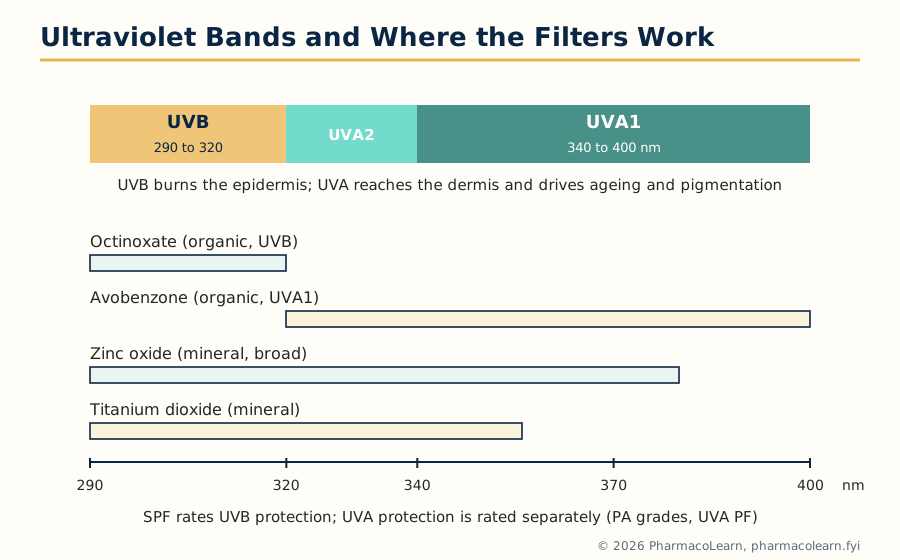 Figure: No single common filter covers the whole ultraviolet range, which is why sunscreens are blends.
4.3 SPF and protection measurement
The sun protection factor (SPF) is the ratio of the minimal erythemal dose of UV on sunscreen protected skin to that on unprotected skin, measured in vivo on human volunteers with the product applied at the standard density of 2 milligrams per square centimetre of skin. An SPF 30 product in the test therefore lets one thirtieth of the erythemally effective radiation through, blocking about 97 percent of UVB; SPF 50 blocks about 98 percent, which shows why SPF gains flatten: the number is a reciprocal, not a percentage. Three qualifications matter for design and for honest claims. The test density is roughly double what most users actually apply, so real world protection is substantially lower than the label, a behavioural fact that high SPF partly compensates. SPF says almost nothing about UVA, which is rated separately, by the persistent pigment darkening method expressed as PA grades (PA+ to PA++++) common in Asia, or by the in vitro UVA protection factor and critical wavelength methods used in the EU, where the recommendation is that UVA protection be at least one third of the labelled SPF. Water resistance is a separate tested claim, retention of SPF after standardised water immersion. In vitro methods using plates and spectrophotometry support development but in vivo testing remains the reference for the label.
4.4 Formulation design of a sunscreen
Building a sunscreen from Unit 3 blocks shows what is special about the category. The filter system is designed first, for spectrum, photostability and permitted levels in the target market: a UVB absorber base, a UVA absorber, stabilisation of any avobenzone, and mineral filters where a mineral claim or sensitive positioning is wanted. The vehicle must dissolve crystalline filters (oily emollients such as C12-15 alkyl benzoate serve as filter solvents), spread to a uniform film, and resist removal by sweat, water and sebum, for which film formers and water resistant polymers are added. Emulsion type trades protection against elegance: water in oil systems resist wash off but feel heavy, oil in water systems are the mainstream compromise. Sensory design is not decoration in this category, because a sunscreen worn thin or not at all protects nobody; the elegant product with a slightly lower SPF usually delivers more real protection than the disliked stronger one. Finally the product is tested as a system: filters interact, vehicles change filter distribution on skin, and the SPF on the label belongs to the finished formula, never to the filter list alone.
4.5 Regulatory aspects of sunscreens
Sunscreens sit on the drug cosmetic borderline more visibly than any other product in this subject. In India they are regulated as cosmetics under the framework of Unit 1, with labelling and ingredient restrictions applying as for other cosmetics. In the United States they are regulated as over the counter drugs, with monograph conditions for filters, levels and testing, which is why several modern European filters long remained unavailable there; the regulatory status of a filter is a market by market question and a formulator designs the filter system per destination. In the EU, UV filters are a positive list: only filters listed in the regulation's annex may be used, at or below their stated maxima, and the claim rules require that products not be labelled in ways implying total protection, so terms such as "sunblock" and "total protection" are prohibited in the EU, SPF labelling is capped (products testing above 50 are labelled 50+), and the UVA circle logo certifies the one third UVA rule of section 4.3. The common principles across markets: filters are the most tightly controlled cosmetic ingredients in existence, the label number must come from the prescribed test, and claims must not discourage sensible sun behaviour, because no sunscreen at real application thickness gives complete protection.
4.6 Addressing dry skin through cosmeceutical formulation
The moisturizer of section 3.8 is the base design; the cosmeceutical version adds a repair intent and an evidence discipline. Design: combine the three mechanisms with intent, an occlusive phase (petrolatum remains the benchmark, measurably cutting TEWL), a strong humectant system (glycerin at meaningful levels, with urea which is both humectant and, at higher levels, keratolytic for scaly conditions), and barrier lipid replacement (ceramides with cholesterol and free fatty acids). Supporting actives used with good evidence include niacinamide, which increases ceramide synthesis, and colloidal oatmeal in the North American tradition for itch and irritation. Design pitfalls are examinable: fragrance and strong preservatives in a product for barrier damaged skin invite the sensitization Unit 2 predicts; high alcohol "light" textures defeat the purpose; and pH should respect the acid mantle. The claim boundary is comfort and measurable moisturization (corneometry and TEWL are the standard instruments), not the treatment of eczema, which is a drug claim territory a cosmetic must not enter.
4.7 Addressing acne through cosmeceutical formulation
The acne design targets the four factors of Unit 2 within cosmetic limits. Sebum and shine are managed with light, oil free gel vehicles, oil absorbing powders (silica, starches) and mattifying films; the product must not add occlusive, comedogenic load to a follicle already plugging. Follicular hyperkeratinization is addressed with keratolytic actives that cosmetics legitimately use, salicylic acid being the standard (a beta hydroxy acid that is oil soluble and so enters the sebum filled follicle), with glycolic and other alpha hydroxy acids for surface renewal. Cutibacterium acnes and inflammation are moderated by niacinamide, widely used for its anti inflammatory and sebum moderating profile, and by zinc salts in some traditions; benzoyl peroxide and topical retinoids are drug actives in most classifications and are not smuggled into a cosmetic formula. Formulation discipline: non comedogenic testing or ingredient screening supports the positioning, pH and irritation are tightly controlled because acne skin is often also on irritating drug therapy, and claims are limited to care of oily and blemish prone skin. The honest design summary: a cosmetic cannot treat acne, and a well designed one still earns its place by cleansing gently, not adding plugs, delivering salicylic acid properly, and supporting the skin through drug treatment.
4.8 Addressing pigmentation through cosmeceutical formulation
Anti pigmentation design is a layered strategy against the melanin pathway of Unit 2. Tyrosinase inhibition is the classic route: arbutin (a glycoside that releases hydroquinone slowly), kojic acid, and in current practice niacinamide, which works differently, by reducing melanosome transfer from melanocyte to keratinocyte; vitamin C derivatives (ascorbyl glucoside, magnesium ascorbyl phosphate) act as antioxidants and mild inhibitors; newer designed molecules such as thiamidol represent the high end of inhibitor research. Exfoliation with alpha hydroxy acids speeds the shedding of already pigmented corneocytes. Photoprotection is the foundation, not an add on: a broad spectrum sunscreen, with iron oxide pigments for visible light protection in melasma prone darker skin, without which the other layers are wasted. Design cautions: hydroquinone itself is restricted or drug only in many markets (its cosmetic use has been prohibited in the EU) and is not a casual cosmetic ingredient; irritation from aggressive lighteners causes post inflammatory pigmentation, the exact condition being treated, which is why mildness testing dominates this category; and results are measured in months, a claims and counselling point. Even, supported language: "reduces the appearance of dark spots", with sunscreen in the same regimen.
4.9 Addressing prickly heat through cosmeceutical formulation
Section 2.5 set the mechanism: blocked sweat ducts in hot, humid conditions. The formulation response is subtractive rather than active led. Powders are the characteristic product: a talc or starch based dusting powder absorbs surface moisture, reduces skin to skin and skin to clothes friction, and keeps the surface dry so ducts stay open; antiseptic variants exist in the Indian market tradition. Light lotions, classically calamine type preparations (calamine with zinc oxide in an aqueous base), cool by evaporation, soothe itch and leave a dry protective film without occlusion. Design rules are the mirror of the moisturizer: avoid heavy oils, waxes and occlusive films in the hot season product; keep textures aqueous and fast drying; include mild soothing agents. Prevention counselling is part of the design brief: loose clothing, cooling, and drying after sweating do more than any ingredient, and a formulation that promises to cure miliaria overclaims; it relieves and helps prevent.
4.10 Addressing wrinkles through cosmeceutical formulation
Anti wrinkle design starts from the honesty of section 2.6: the changes are dermal, the product acts at the surface, and the formulation layers are therefore prevention, optical correction and modest biological support. Prevention is the sunscreen of sections 4.1 to 4.5, the single most effective anti wrinkle product ever tested. Optical and physical smoothing is immediate: moisturization swells the stratum corneum and softens fine lines, silicone elastomers and soft focus powders fill and blur lines, and film formers give a temporary tightening feel. Biological support actives with the best cosmetic evidence are the retinoids, retinol and retinal in cosmetic use (adapalene and tretinoin are drugs), which over months increase epidermal thickness and improve photoaged appearance, at the cost of irritation that the formulation must manage with dose, encapsulation and buffering emollients; vitamin C as an antioxidant and collagen synthesis cofactor, niacinamide, and peptide signal ingredients such as palmitoyl peptides complete the standard active shelf. Packaging is part of the design: retinoids and vitamin C degrade in air and light, so airless, opaque packs are functional, not decorative. Claims stay at appearance, and any product promising to reverse ageing is announcing that it is not a compliant cosmetic.
4.11 Addressing body odor: deodorants and antiperspirants
Unit 2 separated the two designs and this section formulates them. A deodorant reduces odor without much affecting sweat: antimicrobial agents (historically triclosan, now more commonly ethylhexylglycerin, farnesol or zinc ricinoleate, which traps odorants chemically) reduce the bacterial manufacture of odor; absorbent powders take up moisture and odorants; fragrance perfumes and masks. A deodorant antiperspirant adds aluminium salts (aluminium chlorohydrate is the standard, aluminium zirconium complexes the high efficacy grade) that dissolve in sweat at the duct opening and precipitate as a gel plug in the upper eccrine duct, reducing sweat flow to the surface for a day or more; less sweat also means less bacterial substrate, so antiperspirants deodorise secondarily. Formats use every block of Unit 3: sticks (wax structured anhydrous), roll ons (emulsions), aerosols (alcohol and propellant systems), creams and gels. Design constraints: aluminium salt solutions are acidic and irritating if misformulated; application to freshly shaved skin stings; white residue on clothes from salts and yellow staining from sweat and salt interaction are the classic consumer complaints the formulation must engineer down.
4.12 Addressing dandruff through cosmeceutical formulation
Dandruff is scalp scaling with itch, driven by the scalp's Malassezia yeasts metabolising sebum in a susceptible individual, with accelerated epidermal turnover shedding visible flakes. The anti dandruff shampoo is the designed answer, built on the shampoo chassis of section 3.10 with an antifungal active block: zinc pyrithione, the historical standard antifungal and cytostatic agent (its cosmetic use was prohibited in the EU in 2022 on reproductive toxicity classification, and markets diverge, so its status must be checked per destination); ketoconazole, a potent azole antifungal, drug classified in many markets; selenium sulfide, antifungal and cytostatic, with a characteristic odour and colour care needed; piroctone olamine, a modern cosmetic antifungal with a good tolerance profile; and salicylic acid and coal tar (restricted) as keratolytic partners that remove scale so the antifungal reaches the scalp. Delivery is the design problem: a rinse off product has minutes of contact, so actives are chosen and deposited with substantive carriers, and the instructions (leave the lather in contact, use regularly) are part of the product. Cosmetic positioning covers dandruff as a cosmetic condition; severe seborrhoeic dermatitis is medical.
4.13 Addressing dental cavities and bleeding gums through cosmeceutical formulation
Unit 3 built the toothpaste; this section aims its blocks at the oral problems of Unit 2. Against dental cavities, the active is fluoride: in the mouth, fluoride converts surface hydroxyapatite towards the more acid resistant fluorapatite, promotes remineralisation of early lesions and mildly inhibits bacterial acid production; the formulation duties are to keep fluoride bioavailable (abrasive compatibility, section 3.11), to dose it at the levels the market's rules prescribe (around 1000 to 1500 parts per million fluoride is the usual adult toothpaste range where permitted), and to design flavour and foaming so that users, especially children, brush long enough, with a pea sized amount and spitting rather than swallowing for the young. Against bleeding gums (gingivitis), the design combines mechanical plaque removal support (the abrasive and surfactant system) with antiplaque and antigingivitis agents used in oral cosmetics: stannous fluoride (simultaneously anticaries and antigingivitis, with flavour and stability challenges), zinc citrate against calculus and bacterial metabolism, cetylpyridinium chloride and essential oil systems against plaque bacteria, and triclosan historically. Herbal gum care actives follow in Unit 5. The claim line is exact: toothpaste helps prevent caries and gingivitis; established periodontitis needs a dentist, and bleeding that persists is a referral, not a bigger claim.
4.14 Addressing mouth odor and sensitive teeth through cosmeceutical formulation
Mouth odor design works on volatile sulfur compounds and their bacterial source (Unit 2.9): zinc salts are the core technology, because zinc ions bind sulfur compounds to non volatile products and inhibit the bacteria producing them; cetylpyridinium chloride and chlorhexidine (the latter a drug grade antiseptic with staining and taste side effects that limit cosmetic use) reduce the bacterial load; essential oil rinses combine antimicrobial action with flavour impact; and tongue cleaning is the mechanical half of the regimen, since most odor originates on the tongue coating. Mouthwashes are the delivery format, aqueous or hydroalcoholic solutions of the same blocks. Sensitive teeth design follows the hydrodynamic theory: either seal the open dentinal tubules or calm the nerve. Tubule occluding agents include stannous fluoride and arginine with calcium carbonate, which deposit mineral plugs in the tubule openings, and bioactive glass compositions that lay down a hydroxycarbonate apatite layer; nerve desensitising relies on potassium nitrate, whose potassium ions raise the firing threshold of the intradental nerves over weeks of use. Both mechanisms are slow and cumulative, so the honest product promise is reduced sensitivity with regular use, and the formulation must not sabotage them with an aggressive abrasive that reopens tubules faster than they seal.
Designing against a Unit 2 problem: the workflow of Unit 4
Problem biology (Unit 2)
   |
   v
Choose the mechanism of intervention
(block, inhibit, absorb, occlude, deposit)
   |
   v
Select actives with evidence at cosmetic doses
   |
   v
Build the vehicle from Unit 3 blocks
   |
   v
Check the claim stays a cosmetic claim
   |
   v
Stability, safety and efficacy testing of the finished product
Unit 5: Herbal Cosmetics
5.1 Why herbs: the herbal cosmetic premise
Herbal cosmetics use plant derived ingredients, extracts, fixed oils, essential oils and isolated phytochemicals, as the functional or the positioning core of the product. The premise is part pharmacology (plants genuinely supply emollients, antimicrobials, antioxidants, anti inflammatories and pigments), part consumer trust in natural materials, and part tradition, with Ayurveda giving the Indian market a classical formulary of its own. The formulator's discipline is to hold both truths at once: a plant extract is a complex chemical mixture, variable by season, soil and extraction method, and "natural" is not a synonym for safe, since plants also supply potent allergens, phototoxins and irritants. This unit works through the standard ingredient shelf for hair, skin and oral care, then the private standards that police natural claims, then the formulation challenges that make herbal products technically harder than their marketing suggests.
5.2 Herbal ingredients for hair care
| Ingredient | Source and key chemistry | Cosmetic role |
|---|---|---|
| Amla | Phyllanthus emblica fruit, tannins and ascorbic acid | Traditional hair tonic and colour support, antioxidant positioning |
| Bhringraj | Eclipta alba herb | Classic Ayurvedic hair oil ingredient for hair fall positioning |
| Brahmi | Bacopa monnieri and Centella asiatica (the name serves both) | Scalp soothing and strengthening claims in oils and shampoos |
| Henna | Lawsonia inermis leaves, lawsone dye | Natural hair colorant, binds keratin, orange red shades; also a conditioner |
| Shikakai | Acacia concinna pods, saponins | Natural surfactant cleanser, the original herbal shampoo |
| Reetha (soapnut) | Sapindus mukorossi fruit, saponins | Natural foaming cleanser for hair and delicate fabrics |
| Aloe vera | Aloe barbadensis leaf gel, polysaccharides | Soothing, moisturizing scalp and hair care base |
| Coconut and sesame oils | Fixed oils of Cocos nucifera and Sesamum indicum | The standard hair oil vehicles, emollient and pre wash protective; coconut oil is documented to reduce protein loss from hair |
| Neem | Azadirachta indica leaf and seed | Antimicrobial positioning, anti dandruff and scalp care |
| Hibiscus | Hibiscus rosa-sinensis flowers and leaves, mucilage | Conditioning and traditional colour care |
5.3 Herbal ingredients for skin care
| Ingredient | Source and key chemistry | Cosmetic role |
|---|---|---|
| Turmeric | Curcuma longa rhizome, curcumin | Anti inflammatory and complexion positioning; strong colour limits dose |
| Sandalwood | Santalum album wood and oil, santalols | Fragrance, soothing and traditional fairness positioning; sustainability limits supply |
| Aloe vera | Leaf gel polysaccharides | After sun, soothing and moisturizing products |
| Kumkumadi and saffron | Crocus sativus stigma, in classical oil formulations | Premium complexion care positioning |
| Liquorice | Glycyrrhiza glabra root, glabridin | Tyrosinase related pigmentation care (Unit 4.8) |
| Green tea | Camellia sinensis leaf, catechins such as EGCG | Antioxidant and photoprotection support |
| Neem | Leaf and seed extracts | Anti acne and antimicrobial positioning |
| Tulsi | Ocimum sanctum leaf | Antimicrobial and purifying positioning |
| Rose | Rosa damascena water and oil | Fragrance, toners, mild astringent care |
| Multani mitti | Fuller's earth clay | Oil absorbing face packs for oily skin |
| Walnut and apricot scrub particles | Ground shell and kernel | Mechanical exfoliants in scrubs |
| Shea and kokum butters | Plant seed fats | Emollient bases for creams and lip care |
5.4 Herbal ingredients for oral care
Herbal oral care draws on the chewing stick tradition, in which the active delivery system was the plant itself. Neem twigs and extracts supply antimicrobial positioning against plaque bacteria. Babool (Acacia arabica bark) is the classic astringent gum care ingredient. Clove provides eugenol, an established dental analgesic and antiseptic used in dentistry itself. Miswak (Salvadora persica) contains silica for cleaning, fluoride in small amounts and antimicrobial compounds, and chewing sticks of it are recognised in the dental literature as effective plaque control aids when used properly. Supporting members are liquorice (sweetness and soothing), tulsi, peppermint and other mint oils as flavours with mild antimicrobial action, and triphala in traditional gum care. The formulator's task in a herbal toothpaste is to carry these into the blocks of section 3.11 without losing the fluoride based caries protection that is the evidence core of the product, a point on which herbal positioning and dental evidence must be reconciled honestly rather than traded against each other.
5.5 Private standards for herbal cosmetics: the COSMOS review
Because "natural" and "organic" have no complete statutory definition for cosmetics in most markets, private certification bodies wrote the rules, and the syllabus requires a review of their guidelines with respect to the five formulation block classes. COSMOS (COSMetics Organic and natural Standard) is the harmonised standard of the European founders BDIH, Cosmebio, Ecocert, ICEA and the Soil Association, and it certifies products at two levels, COSMOS Organic and COSMOS Natural. Its approach is a positive and restrictive list system applied block by block:
| Building block class | COSMOS position in outline |
|---|---|
| Preservatives | Only a short list of permitted preservatives, mainly nature identical ones such as benzoic acid, sorbic acid, dehydroacetic acid and benzyl alcohol, within limits; the standard synthetic systems of Unit 3 are excluded, which is why preservation is the herbal formulator's hardest problem (section 5.6) |
| Emollients | Must be of natural origin and obtained by permitted physical or biotechnological processes; mineral oil and petrolatum are excluded, so the occlusive benchmark of Unit 4 is unavailable and plant oils and butters take its place |
| Foaming agents (surfactants) | Permitted surfactants are plant derived and readily biodegradable, such as alkyl polyglucosides and approved sulfates of natural origin; ethoxylated synthetics are excluded |
| Emulsifiers | Natural origin emulsifiers and their permitted derivatives; the synthetic nonionic pairs of Unit 3 are largely excluded |
| Rheology modifiers | Natural gums, starches and celluloses are permitted; carbomers and other synthetic acrylic thickeners are excluded |
The standard also governs percentages of organic and natural origin content, packaging and environmental management of manufacture. Other private and regional schemes exist alongside it, but the examinable point is the pattern: a private standard is a list discipline across every block, and certifying a product means reformulating it block by block, not adding a herb to a conventional base and labelling the result natural.
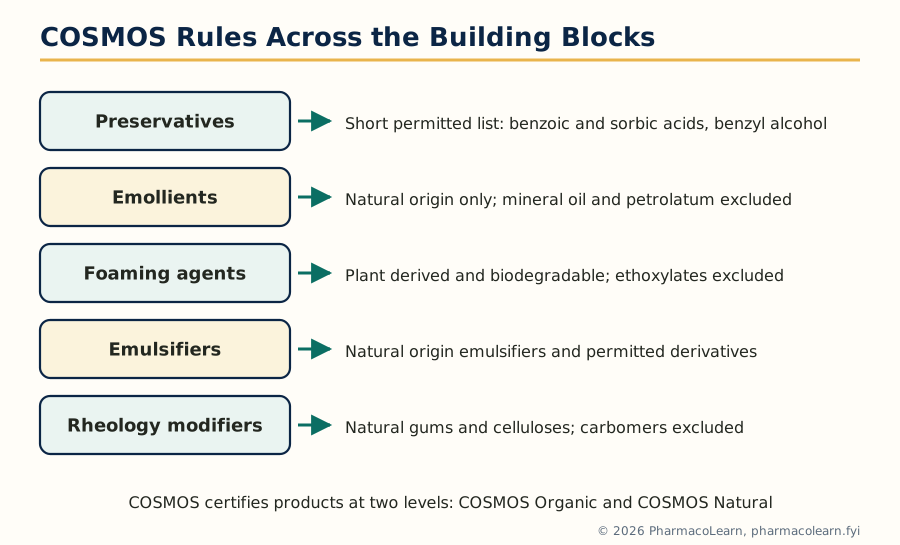 Figure: A private standard is a list discipline applied to every building block, not a herbal label on a conventional base.
5.6 Challenges in formulating herbal cosmetics
The challenges are technical, and they close the subject because they gather every earlier unit into one product:
- Standardisation: an extract varies with plant source, harvest and extraction; without marker compound specifications and fingerprint testing, batch to batch efficacy and colour drift, and the product cannot be reproducible in the sense Unit 1's licensing assumes.
- Stability: plant antioxidants oxidise, colours fade or darken (turmeric and henna chemistry), essential oils evaporate and resinify, and the formulator's antioxidant and packaging defences are weaker because several synthetic stabilisers are excluded by the standards of section 5.5.
- Preservation: water based herbal products are excellent microbial media, plant material arrives with a bioburden, and the permitted preservative list is short and comparatively weak; preservative efficacy testing (Unit 3.7) fails herbal products more often than any other category.
- Compatibility and physical form: polyphenols complex with proteins and metal ions, tannins precipitate and darken with iron contamination, natural gums vary in viscosity, and emulsions built only on natural emulsifiers are less robust to heat and electrolyte.
- Safety substantiation: natural allergens (the fragrance allergens of section 3.13 arrive automatically inside essential oils), phototoxic furanocoumarins in citrus oils, and adulteration of expensive oils all require the same safety testing as synthetics, with less published data to rely on.
- Claims and cost: the market wants drug like promises at cosmetic claim limits (the Unit 1 and Unit 4 boundary), genuine certified ingredients cost more, and sustainable sourcing of pressured species such as sandalwood is a supply problem as well as an ethical one.
The subject's conclusion is therefore a professional one: a herbal cosmetic is a cosmetic, held to the same law, built from the same blocks, aimed at the same biology and problems, with an ingredient palette that is older, more variable and more constrained. Formulating one well is not a lesser skill than formulating its synthetic counterpart; on the evidence of this unit, it is the harder one.
Frequently Asked Questions
Q: What is the legal definition of a cosmetic in India? A: Under the Drugs and Cosmetics Act 1940, a cosmetic is any article intended to be rubbed, poured, sprinkled or sprayed on, or introduced into, or otherwise applied to the human body for cleansing, beautifying, promoting attractiveness or altering the appearance, and soap is included in the definition.
Q: What is the difference between a misbranded and a spurious cosmetic? A: A misbranded cosmetic deceives through information: it is not labelled as prescribed or its label makes false or misleading claims. A spurious cosmetic deceives through identity: it imitates another product or falsely claims to be made by a manufacturer who did not make it.
Q: What is a loan licence for cosmetics? A: A loan licence allows a person who has no factory of their own to manufacture cosmetics on the premises of another manufacturer who already holds a licence for those premises, marketing the product under the loan licensee's own name and licence number.
Q: Why does dry skin lose water, and which ingredient classes repair it? A: Dry skin has a defective stratum corneum barrier, from loss of natural moisturizing factor and disorganisation of the intercellular lipids, so transepidermal water loss rises. Occlusives such as petrolatum cut the loss, humectants such as glycerin and urea bind water in the stratum corneum, emollients smooth the surface, and ceramide containing formulas replace barrier lipids.
Q: What are the four factors that combine to produce acne? A: Increased sebum secretion under androgen influence, abnormal keratinization plugging the follicle to form a comedo, proliferation of Cutibacterium acnes inside the plug, and inflammation, which turns comedones into papules, pustules and nodules.
Q: How are surfactants classified, and which class conditions hair? A: Surfactants are classified by head group charge into anionic (main detergents, e.g. sodium laureth sulfate), cationic, nonionic and amphoteric classes. Cationic surfactants such as cetrimonium chloride condition hair, because their positive charge makes them deposit on the negatively charged damaged sites of the hair shaft.
Q: What decides whether a preservative system actually works in a finished cosmetic? A: The free preservative concentration in the water phase, which pH, partitioning into the oil phase, binding by nonionic surfactants and micelles, the packaging and the initial bioburden all influence. That is why efficacy is proven by a preservative challenge test on the finished product rather than calculated from the formula.
Q: What is the difference between a vanishing cream and a cold cream? A: A vanishing cream is an oil in water emulsion based on stearic acid partly converted to a soap emulsifier, which rubs in and vanishes leaving a dry matte film. A cold cream is classically a water in oil emulsion of beeswax and borax with a large mineral oil phase, leaving a rich occlusive film and a cooling feel as its water evaporates.
Q: What does SPF measure, and why is the label value higher than real life protection? A: SPF is the ratio of the minimal erythemal UV dose on protected skin to that on unprotected skin, a mainly UVB measure. It is tested at an application of 2 mg per square centimetre, while most users apply about half that or less, so protection in real use is substantially below the labelled value.
Q: What makes herbal cosmetics harder to formulate than conventional cosmetics? A: Variable and unstandardised raw materials, weaker stability of plant actives and colours, a short permitted preservative list under standards such as COSMOS against a high microbial load in plant materials, exclusion of workhorse synthetic blocks such as mineral oil and carbomers, and natural allergens that arrive automatically inside essential oils.
Complete MPH204T notes, all 5 units in one PDF, free to keep.
Other M.Pharm subjects: MPH101T · MPC101T · MPL101T · MPH102T · MPH103T · MPH104T · MPL102T · MPL103T · MPL104T · MPC102T · MPC103T · MPC104T · MPH201T · MPH202T · MPH203T · MPH204T · MPC201T · MPC202T · MPC203T · MPC204T · M.Pharm