
MPH104T — Regulatory Affair
4 hrs/week, 4 credits, 60 hours, 100 marks. Notes follow the M.Pharm syllabus, unit by unit.
MPH104T Regulatory Affair notes for M.Pharm Semester 1 Pharmaceutics: documentation and DMF, Hatch-Waxman and ANDA, NDA approvals, CMC, CTD and eCTD, ICH guidelines, IND, IMPD, clinical trials and pharmacovigilance, with free unit wise PDF downloads on PharmacoLearn.
Units in this subject
- Unit 1 — Documentation in Pharmaceutical Industry and Generic Drug Product Development
- Unit 2 — Regulatory Requirements for Product Approval
- Unit 3 — CMC, Post Approval Regulatory Affairs, CTD and ICH Guidelines
- Unit 4 — Non Clinical Drug Development and Global Submissions
- Unit 5 — Clinical Trials
Download MPH104T PDF Notes
Free PDFs for this subject, one per unit:
Regulatory Affair, subject code MPH104T, is a core Semester 1 subject of M.Pharm Pharmaceutics. It carries 4 credits and 60 hours of theory, taught at 4 hours per week, for 100 marks.
Every medicine that reaches a patient has passed through a regulatory system: someone outside the company has examined the evidence for its quality, safety and efficacy and has given a legal permission to sell it. This subject teaches how that permission is obtained and kept. It begins with the documents a pharmaceutical company must maintain and with the development of generic drugs under the United States system built by the Hatch-Waxman Act, then moves to what approval demands for an API, a biologic and a novel therapy, and how a foreign manufacturer registers in the US. The third unit covers the chemistry, manufacturing and controls (CMC) story, post approval duties, the Common Technical Document, the ICH guidelines and the requirements of the EU, UK, Australia and the rest of the world. The last two units follow a new drug backwards into development: the non clinical work and the global dossiers (IND, IMPD, investigator brochure) that open the door to human testing, and finally the clinical trial itself, with its protocol, ethics committee, informed consent, privacy protection and safety monitoring. A student who completes this subject should be able to explain which application a product needs, what evidence each part of the dossier must carry, and what a company must keep doing after approval to stay on the market.
Unit 1: Documentation in Pharmaceutical Industry and Generic Drug Product Development
1.1 Documentation in the pharmaceutical industry
Documentation is the written memory of a pharmaceutical company, and in a regulated industry it is also legal evidence. Regulators work on a simple principle: if an activity is not documented, it is treated as not done. Batch records prove that a batch was made exactly as approved; specifications and test records prove it met its quality limits; distribution records prove where every pack went, which is what makes a recall possible.
Good documentation practice asks that records are:
- Attributable: every entry shows who did the work and who checked it, with signatures and dates.
- Legible and permanent: entries are made in ink or in a controlled electronic system, and corrections are made by a single line strike-through with initials and date, never by overwriting or correction fluid, so the original entry stays readable.
- Contemporaneous: records are written at the time the activity happens, not reconstructed later.
- Original and accurate: the record is the original observation or a certified copy, and it matches what actually happened.
- Controlled: documents carry a title, a unique number, a version or revision number and effective dates; obsolete versions are withdrawn so that only the current approved version can be used.
The main document families are specifications and test procedures, standard operating procedures (SOPs), the master formula record and the batch records made from it, validation documents, and the records of distribution, complaints and recalls. Three of these are named in the syllabus and are covered in the next sections: the master formula record, the Drug Master File and distribution records.
1.2 Master formula record and batch records
The master formula record (MFR), also called the master production record or master batch record, is the approved master document that states exactly how one batch of a product is to be made. It is prepared and approved by the production and quality functions before any batch is manufactured, and every batch of that product must follow it.
Contents of a master formula record:
- Name of the product, its dosage form and strength, and the batch size.
- The complete formula: every ingredient with its pharmacopoeial grade, quantity per unit and quantity per batch, including permitted overages and the reason for them.
- A step by step manufacturing procedure, in the order operations are performed, with equipment to be used and the in-process controls and limits at each stage (for example mixing time, drying temperature and loss on drying limit, blend uniformity).
- Theoretical yield and the permitted yield range, packaging instructions and packaging materials.
- Labelling requirements, storage conditions and the shelf life of the product.
- Safety precautions and the signatures of the persons who prepared, checked and approved the document.
For each actual batch, a batch manufacturing record (BMR) is issued as a controlled copy of the MFR. Operators record what was really done against each step: actual quantities weighed, actual times and temperatures, in-process results, deviations and their justification, and the actual yield. The completed BMR, together with the batch packaging record and the analytical reports, is reviewed by quality assurance before the batch is released. The MFR is the instruction; the BMR is the evidence that the instruction was followed for that batch. Confusing the two, or making batches from an uncontrolled copy of the formula, is a serious compliance failure because a wrong version can put a wrong formula into production.
1.3 Drug Master File (DMF)
A Drug Master File (DMF) is a submission to a regulatory authority, most fully developed in the US FDA system, that holds confidential, detailed information about a facility, a process or a material used in making a drug. The classic example is the API manufacturer: the maker of the active substance files its complete chemistry and manufacturing details in a DMF, so that each finished dose manufacturer who buys that API can refer to the DMF in its own application instead of receiving, and disclosing, the API maker's trade secrets.
Key features of the DMF system:
- A DMF is not approved or disapproved by itself. It is only reviewed when an application (IND, NDA or ANDA) refers to it, and it is reviewed as part of that application.
- The applicant asks the DMF holder for a letter of authorisation (LOA), which the applicant includes in its application. The LOA permits the agency to review the DMF in support of that application. Without an LOA the agency will not look at the DMF for that applicant.
- The DMF holder must keep the file current, reporting changes and filing an annual update listing, and must inform every authorised applicant of changes that could affect their products.
- Deficiencies found in the DMF during review are communicated to the DMF holder, not to the applicant, because the contents are confidential to the holder. The applicant is only told that the DMF is not adequate to support the application until the holder corrects it.
Types of DMF in the US system:
| Type | Subject of the file | Status |
|---|---|---|
| Type I | Manufacturing site, facilities and operating procedures | No longer accepted; replaced by site information in applications and establishment registration |
| Type II | Drug substance, drug substance intermediate, and material used in their preparation | The most commonly used type (the API DMF) |
| Type III | Packaging material | In use |
| Type IV | Excipient, colorant, flavour, essence or material used in their preparation | In use |
| Type V | FDA accepted reference information (for example certain facility or clinical study related information) | In use, only after the agency agrees to accept it |
In Europe the same need is met by the Active Substance Master File (ASMF) procedure, and a Certificate of Suitability (CEP) from the EDQM can be used instead where a pharmacopoeial monograph exists for the substance; these are the European counterparts students should be able to name alongside the US DMF.
How a DMF supports an application
API manufacturer prepares DMF  ->  files it with FDA, receives DMF number
Finished dose applicant         ->  obtains letter of authorisation from holder
Applicant submits ANDA or NDA   ->  refers to the DMF by number
FDA reviewers                    ->  review the DMF only for that application
Deficiency in the DMF           ->  told to the holder, holder corrects the DMF
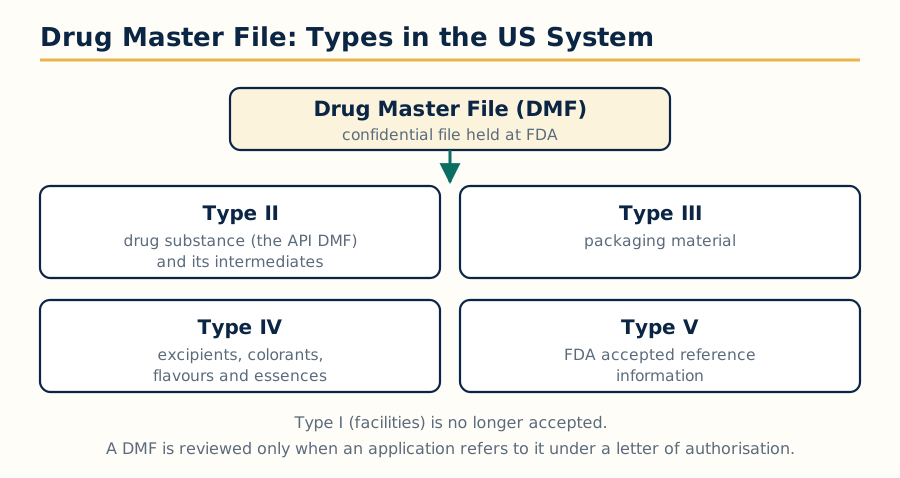 Figure: Drug Master File types in the US system: the file is held confidentially at FDA and is reviewed only when an application refers to it under a letter of authorisation.
1.4 Distribution records and recall readiness
Distribution records are the records that link finished batches to the customers who received them: the consignee name and address, the product, batch number, quantity and date of dispatch, and the transport details. Good manufacturing practice requires distribution records to be complete enough, and kept long enough, that the complete history of a batch can be traced forward to every customer and backward to its raw materials.
Their regulatory importance is practical rather than theoretical:
- Recalls: if a defect is discovered, distribution records decide how fast and how completely the affected batches can be recovered from the market. A recall exercise (mock recall) is used to test whether the records can trace 100 percent of a batch within the required time.
- Complaint investigation: a complaint about a pack can be traced to its batch, its BMR and its analytical results only through the distribution and batch numbering chain.
- Expiry and stock rotation control: distribution records support first expiry first out handling and the detection of expired or diverted stock in the chain.
1.5 Generic drugs: innovator products and generic products
A generic drug is a copy of an already marketed innovator (brand name, reference) product. It contains the same active substance, in the same strength and dosage form, for the same route of administration, and it must be shown to be bioequivalent to the reference product (Unit 1.9), meaning it delivers the active substance to the site of action at the same rate and to the same extent. Because safety and efficacy were already established for the innovator product, the generic applicant does not repeat the clinical development programme; the bridge to the innovator's data is bioequivalence.
| Feature | Innovator (brand) product | Generic product |
|---|---|---|
| Active substance | New, discovered and developed by the applicant | Same as the reference product |
| Development evidence | Full non clinical and clinical programme | Pharmaceutical quality data plus bioequivalence |
| US application | NDA (New Drug Application) | ANDA (Abbreviated New Drug Application) |
| Patent and data position | Protected by patents and regulatory exclusivity | Can be filed only as the Hatch-Waxman rules permit (Section 1.6) |
| Labelling | Sets the reference labelling | Must be essentially the same as the reference product labelling |
| Price position | Higher, recovers research cost during exclusivity | Lower, competes mainly on price after entry |
1.6 The Hatch-Waxman Act and its amendments
The Drug Price Competition and Patent Term Restoration Act of 1984, universally called the Hatch-Waxman Act after its sponsors, is the law that created the modern US generic industry. Before 1984 a generic maker effectively had to repeat clinical trials, so few generics were filed. The Act balanced two goals: reward innovation, and let safe generic copies compete as soon as legitimate protection ends.
Main provisions:
- The ANDA pathway: a generic can be approved through an Abbreviated New Drug Application under section 505(j) of the Food, Drug and Cosmetic Act, relying on the agency's earlier finding of safety and efficacy for the reference listed drug, with bioequivalence as the scientific bridge.
- Patent term restoration: to compensate for the time a patented drug spends in development and review, part of the patent term lost can be restored, up to a maximum of five years of extension, and so that the remaining effective patent life after approval does not exceed fourteen years.
- Regulatory exclusivities: a new chemical entity receives five years of exclusivity during which an ANDA generally cannot be submitted for the first four years and cannot be approved before five years; changes to an approved drug that needed new clinical investigations receive three years of exclusivity for the protected change; orphan drugs and paediatric studies carry their own exclusivity provisions.
- Patent listing and certification: innovators list their drug patents in the FDA Orange Book (the register of approved drug products with therapeutic equivalence evaluations). Every ANDA applicant must certify for each listed patent one of four positions, the paragraph certifications:
- Paragraph I: no patent information has been filed for the drug.
- Paragraph II: the patent has already expired.
- Paragraph III: the applicant will wait; approval is sought only after the patent expires.
- Paragraph IV: the patent is invalid, unenforceable, or will not be infringed by the generic product.
- Paragraph IV litigation and the 30 month stay: a Paragraph IV certification is legally treated as an act of infringement, so the patent owner can sue. If the owner sues within the prescribed window after notice, approval of the ANDA is stayed for up to 30 months while the case runs, unless the court decides sooner.
- 180 day first generic exclusivity: the first applicant to file a substantially complete ANDA with a Paragraph IV certification receives 180 days of generic marketing exclusivity, during which the agency generally cannot approve later ANDAs for the same drug. Later amendments (notably the Medicare Modernization Act of 2003) added forfeiture events so this exclusivity cannot be used to block the market indefinitely, and tightened the rules to one 30 month stay per ANDA.
Amendments and related later laws students should recognise by name include the 2003 Medicare Modernization Act changes to Hatch-Waxman, the generic drug user fee programme (GDUFA) that funds ANDA review through industry fees, and the biosimilar pathway created by the Biologics Price Competition and Innovation Act of 2009, which is the Hatch-Waxman style framework adapted to biologics (Unit 2).
1.7 The Code of Federal Regulations (CFR)
The Code of Federal Regulations (CFR) is the codification of the rules issued by US federal agencies. Drug regulation sits in Title 21, Food and Drugs. A regulation in the CFR has the force of law, unlike a guidance document, which states the agency's current thinking and is not binding. Knowing the important parts of Title 21 is basic regulatory literacy:
| Part of 21 CFR | Subject |
|---|---|
| Part 11 | Electronic records and electronic signatures |
| Parts 210 and 211 | Current good manufacturing practice for drug products |
| Part 312 | Investigational New Drug (IND) application |
| Part 314 | Applications for FDA approval to market a new drug (NDA and ANDA rules) |
| Part 320 | Bioavailability and bioequivalence requirements |
| Part 601 | Biologics licence applications |
The CFR matters in day to day work because application contents, GMP duties, labelling rules and post approval reporting duties are all specified there; an answer in an examination or in a regulatory job that cites the governing part of the CFR is a stronger answer than a general statement.
1.8 Drug product performance in vitro
In vitro performance is what the dosage form does in laboratory apparatus, above all in the dissolution test. For a generic product, dissolution testing has three regulatory jobs:
- Quality control: batch to batch consistency is shown by every batch meeting the dissolution specification.
- Development evidence: the generic formulation is compared with the reference product in comparative dissolution profiling, usually in media across the physiological pH range (typically pH 1.2, 4.5 and 6.8), and the profiles are compared, commonly with the similarity factor f2.
- Bioequivalence support and waivers: where the rules permit, strong in vitro data can support a biowaiver, approval without an in vivo study, the classic case being immediate release products of highly soluble, highly permeable drugs (BCS Class I) with rapid dissolution and similar profiles to the reference.
1.9 Bioavailability and bioequivalence assessment in vivo
Bioavailability (BA) is the rate and extent to which the active substance is absorbed and becomes available at the site of action; in practice it is measured from the blood concentration time curve. A bioequivalence (BE) study compares the test (generic) product with the reference product, most often in a single dose, two period, two sequence crossover study in healthy volunteers under fasting conditions, with a fed study added where food affects absorption or the reference labelling requires dosing with food.
The comparison is statistical. The key parameters are the area under the curve (AUC, extent) and the maximum concentration (Cmax, rate). The products are accepted as bioequivalent when the 90 percent confidence interval for the ratio of the test to reference geometric means of AUC and Cmax falls entirely within the acceptance range of 80.00 to 125.00 percent. Narrow therapeutic index drugs are handled with tightened or scaled approaches in several jurisdictions, because the ordinary range may allow clinically important differences.
A BA/BE study is a clinical study in regulatory terms: it needs ethics committee approval, informed consent, GCP compliance and analytical work in a validated bioanalytical laboratory, which is why companies often outsource it (Section 1.14).
1.10 The ANDA approval process
The ANDA route, step by step:
ANDA approval process (US)
Select reference listed drug from the Orange Book
  -> develop formulation, file or refer to the API DMF
  -> comparative dissolution and pilot BE work
  -> pivotal BE study against the reference product
  -> compile ANDA (CTD format: quality, BE, labelling modules)
  -> patent certification for every Orange Book patent
  -> FDA filing check, scientific review, facility inspection
  -> deficiency letters and applicant responses, cycle as needed
  -> approval letter; tentative approval if a patent or exclusivity
     still blocks marketing, final approval when it clears
Two outcomes students must distinguish: an approval letter allows marketing, while a tentative approval means the application is scientifically complete but cannot be finally approved yet because a patent or exclusivity period has not run out; the product cannot be sold until final approval. A complete response letter is the modern deficiency letter: it lists everything that prevents approval, and the clock restarts when the applicant resubmits.
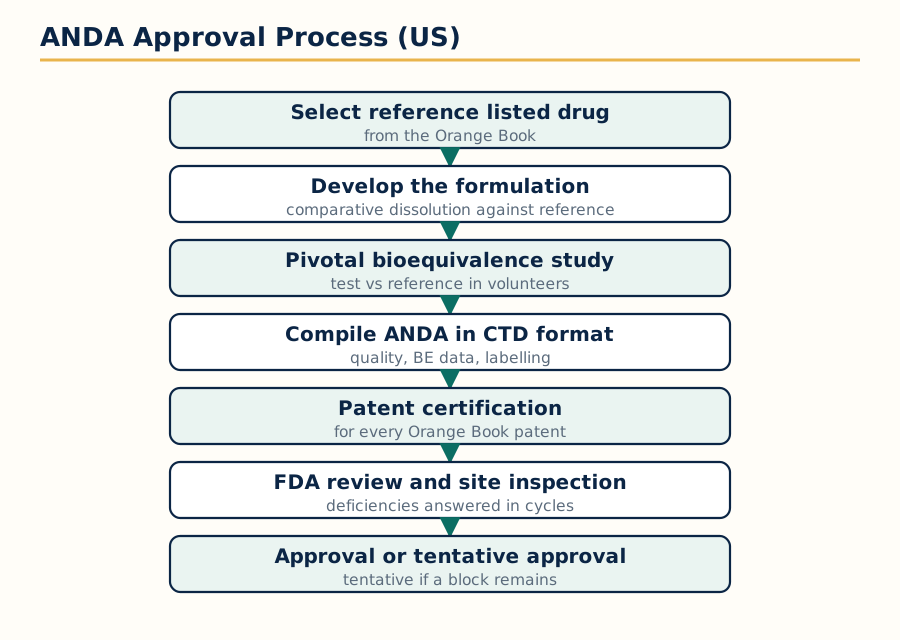 Figure: The ANDA approval process: bioequivalence and quality evidence in place of a new clinical programme, with the patent certification running alongside.
1.11 The NDA approval process
The New Drug Application (NDA) is the full application for a new drug. Unlike the ANDA, it stands on the applicant's own complete evidence: pharmaceutical quality (CMC), non clinical pharmacology and toxicology, and adequate and well controlled clinical trials proving safety and effectiveness for the claimed use. The agency reviews each discipline separately (chemistry, pharmacology and toxicology, clinical, statistics, and others), inspects the manufacturing sites and the key clinical and bioanalytical sites, and takes the work to an advisory committee for novel or difficult questions when needed. The result is approval, a complete response letter, or, rarely now, a refusal to file at the very first check if the application is too incomplete to review. The NDA is covered again from the applicant's side in Units 2 and 4; in this unit the point is the contrast: the ANDA borrows the innovator's evidence and adds bioequivalence; the NDA creates all of the evidence itself.
1.12 Scale up and post approval changes (SUPAC)
Between the BE batch and full commercial production the process is scaled up, and after approval the product keeps changing: sites move, suppliers change, equipment is replaced, batch sizes grow. Regulation handles this through change control graded by the size of the change. The FDA's SUPAC guidances (Scale Up and Post Approval Changes, issued by dosage form family) classify changes into levels:
- Level 1 changes: minor changes with no expected effect on quality or performance (for example a like for like equipment change within the same design). Handled in the annual report.
- Level 2 changes: moderate changes that could affect quality (for example a site change within the same campus, or a larger batch size increase within defined limits). Need a changes being effected supplement and supporting data such as comparative dissolution.
- Level 3 changes: major changes likely to affect performance (for example a change in the formulation's composition beyond set limits, or a move to a different manufacturing site). Need a prior approval supplement, often with fresh BE evidence.
The operating idea, which also appears in EU variation rules in Unit 3, is that the size of the regulatory filing follows the size of the risk; identical logic applies to the API process, equipment and packaging changes.
1.13 Post marketing surveillance
Approval is based on limited numbers of patients treated for limited times, so the safety picture of a drug is completed only after marketing. Post marketing surveillance is the organised collection and assessment of safety information on marketed products: spontaneous adverse event reports from health professionals and patients, periodic safety update reporting to the agency, signal detection from accumulated data, and regulatory actions that follow, from labelling changes and safety communications to restriction or withdrawal of the product. In the US, applicants must report serious and unexpected adverse events to FDA on an expedited basis and file periodic adverse experience reports; the details of clinical trial safety reporting are in Unit 5, and the two duties should not be confused: Unit 5 reporting protects trial subjects during development, post marketing surveillance protects patients after approval. Post marketing surveillance also includes the surveillance of product quality (defect reports, field alerts for batches that may fail specification), which links back to the distribution records of Section 1.4.
1.14 Outsourcing BA and BE studies to a CRO
A contract research organisation (CRO) performs work for a sponsor under contract. BA and BE studies are the most commonly outsourced regulatory studies in the generic industry because they need a clinical unit, healthy volunteer panels, a validated bioanalytical laboratory and statistical support, all used only for short periods.
Points that carry regulatory weight:
- The sponsor remains responsible for the study even when a CRO performs it. Outsourcing transfers tasks, never accountability; the sponsor must select and audit the CRO and monitor the work.
- The transfer of duties must be written: the contract and any regulatory transfer of obligations (in the US, the transfer of obligations under 21 CFR 312.52 for IND studies) define exactly which duties the CRO holds.
- Typical failure points found in inspections are bioanalytical data integrity, inadequate validation records and consent or ethics documentation gaps, so vendor qualification for a BE CRO concentrates on the bioanalytical laboratory and its data systems.
- In India, BA/BE studies are conducted at centres registered with the licensing authority and studies follow the New Drugs and Clinical Trials Rules, with ethics committee approval mandatory; the same sponsor responsibility principle applies.
Unit 2: Regulatory Requirements for Product Approval
2.1 The principle of premarket approval
Modern drug law rests on one idea: a new drug may not be marketed until the regulator has approved it as safe and effective for its labelled use, and made by a process that reliably gives the approved quality. Approval requirements therefore always fall into three evidence blocks, and every application in every country is built from them:
- Quality: identity, strength, purity and stability of the substance and product, and a controlled manufacturing process (the CMC block of Unit 3).
- Safety: non clinical toxicology and the clinical safety record (Units 4 and 5).
- Efficacy: substantial evidence from adequate and well controlled clinical investigations that the drug does what its labelling claims.
What changes between product types is how much of each block the applicant must generate itself. That is the subject of this unit: the API underneath the product, ordinary small molecule products through the NDA and ANDA, biologics, and novel therapies, then the practical question of how a product made outside the United States is registered there.
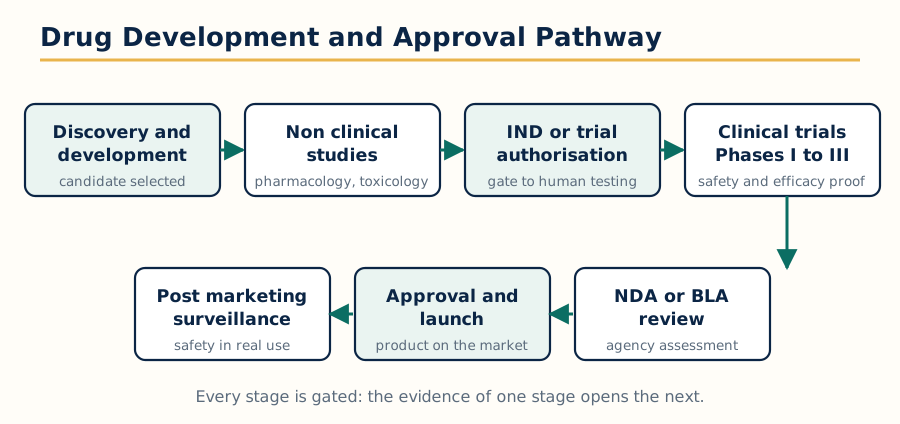 Figure: The development and approval pathway: each stage is gated by the evidence of the stage before it.
2.2 Approval requirements for the API
The active pharmaceutical ingredient (API) is not approved as a stand alone product in the US system; it is approved as part of each finished product application that uses it. Its regulatory requirements are therefore documentary and quality based:
- Full characterisation and specification: identity, assay, impurities (including mutagenic impurity assessment under ICH M7 principles), residual solvents (ICH Q3C), elemental impurities (ICH Q3D), polymorphic form and particle size where these affect the product.
- Manufacturing description and control: the synthetic route, starting materials and their controls, critical steps and intermediates, in process controls, and process validation expectations, all carried in the DMF or its regional equivalent (Unit 1.3) or in Module 3 of the application itself.
- Stability and retest: stability data under ICH Q1 conditions supporting a retest period or shelf life for the substance, with a defined container closure system.
- GMP compliance of the API site: the site is subject to inspection against GMP expectations for APIs (ICH Q7 is the reference standard), including for foreign sites supplying the US.
2.3 Approval requirements for biologics
Biologics are products made from living systems: monoclonal antibodies, recombinant proteins, vaccines, blood products and similar. In the US they are licensed through a Biologics Licence Application (BLA) under the Public Health Service Act rather than an ordinary NDA, and the reviewing centre is the biologics centre of FDA. Their special requirements follow from their nature:
- The product is defined by its process: a living production system cannot be copied exactly, so characterisation, comparability after process changes, and control of the cell substrate and adventitious agents (viral safety) carry far more weight than for a small molecule.
- Immunogenicity must be studied, because the patient's immune system can react to a biological product.
- A biosimilar is the biologic counterpart of a generic: it must be shown to be highly similar to a reference biologic, with no clinically meaningful differences in safety, purity and potency, through a stepwise programme of analytical comparison, animal work where needed, and clinical studies targeted at the remaining uncertainty. The abbreviated biosimilar pathway was created by the Biologics Price Competition and Innovation Act of 2009, and the further status of interchangeable biosimilar carries additional switching evidence expectations.
2.4 Approval requirements for novel therapies
Novel therapies include cell therapies, gene therapies, tissue engineered products and first in class products built on new platforms. Their regulatory handling extends the biologics model rather than replacing it:
- Products are reviewed by specialist offices (in FDA, the office responsible for therapeutic products including cell and gene therapy within the biologics centre), and early, frequent agency interaction is expected because standard templates fit poorly.
- Long term follow up of patients is a characteristic requirement for gene therapy products, because integrating vectors and genome edits can show effects only after years.
- Expedited programmes exist to speed development of products for serious conditions with unmet need (fast track, breakthrough therapy, regenerative medicine advanced therapy designation, priority review and accelerated approval in the US; PRIME and conditional marketing authorisation in the EU). These change the intensity and timing of review, not the underlying duty to show quality, safety and efficacy; accelerated or conditional approvals carry confirmatory study obligations after marketing.
- Orphan drug designation for rare diseases brings fee relief, protocol assistance and a period of market exclusivity, and is frequently the entry route for novel therapy developers.
2.5 Obtaining an NDA
An NDA is obtained by assembling the full evidence in CTD format (Unit 3) and carrying it through review:
Obtaining an NDA (US), outline
Complete non clinical programme (Unit 4)
  -> IND in force, clinical Phases I to III completed (Unit 5)
  -> pre-NDA meeting with FDA: agree contents and open issues
  -> compile and submit NDA in eCTD with user fee
  -> filing review: accepted for review or refuse to file
  -> discipline reviews, site inspections, advisory committee if needed
  -> action: approval letter or complete response letter
  -> labelling agreement and post marketing commitments
The applicant's practical burden is the evidence itself: three blocks of Unit 2.1, all generated by the sponsor, plus manufacturing sites ready for pre-approval inspection and labelling that matches the proven claims word for word.
2.6 Obtaining an ANDA for a generic drug
The ANDA applicant must show that its product is the pharmaceutical equivalent and bioequivalent of the reference listed drug:
- Same active ingredient, dosage form, route of administration and strength as the reference product.
- The same conditions of use and, with permitted exceptions, the same labelling.
- Bioequivalence demonstrated as in Unit 1.9, with comparative dissolution supporting the formulation.
- Quality data for its own product and process, with the API covered by a DMF reference or full data.
- A patent certification for every Orange Book patent and respect for any unexpired exclusivity (Unit 1.6).
Because the evidence pattern is fixed, generic development is an exercise in matching: match the reference product's form and performance, prove it with dissolution and one or two BE studies, and keep the quality block complete and inspection ready.
2.7 US registration for foreign drugs: ways and means
A drug made outside the United States enters the US system through the same product applications, plus a layer of establishment and import controls:
- Product approval first: the foreign product needs its own approved NDA or ANDA like any US product. Approval examines the foreign data on the same standards; foreign clinical studies not under an IND are acceptable when conducted to GCP and when the agency can validate the data, including by inspection.
- Establishment registration and drug listing: every foreign establishment that manufactures, processes, packs or labels a drug for the US market must register with FDA and list its products, and must renew the registration and listing as required. Registration is an administrative listing, not an approval.
- US agent: a foreign establishment must name a United States agent as its official contact point for FDA communications.
- Inspection: foreign sites are inspected by FDA on the same GMP expectations as domestic sites, increasingly on an unannounced or short notice basis; refusal of inspection is itself a ground to treat products as adulterated and block entry.
- Import controls: shipments can be sampled, examined and detained at the border; firms and products with a history of problems can be placed on import alert and detained without physical examination until compliance is shown.
- DMF and site files: the API and site information for foreign suppliers travels through DMFs (Unit 1.3), so the confidentiality and authorisation mechanics of the DMF system are part of the foreign registration route.
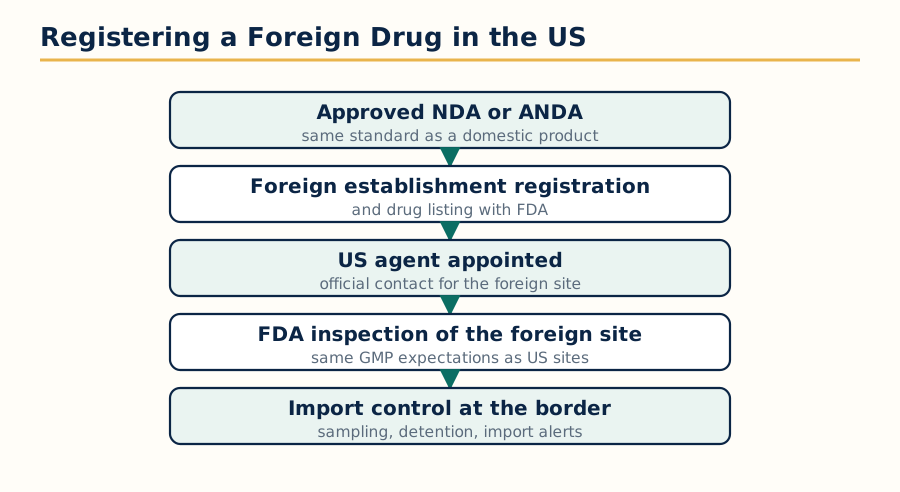 Figure: Registering a foreign drug in the US: the product application plus the establishment, agent, inspection and import control layers.
Unit 3: CMC, Post Approval Regulatory Affairs, CTD and ICH Guidelines
3.1 Chemistry, Manufacturing and Controls (CMC)
CMC is the quality third of every application: the evidence that the product is the substance it claims to be, made the same way every time, and stable for its shelf life. In CTD terms it is Module 3 (Section 3.5), and it is organised in two halves:
- Drug substance (3.2.S): manufacture and characterisation, control of materials, critical steps and intermediates, specifications and analytical procedures with their validation, reference standards, container closure, and stability with the proposed retest period.
- Drug product (3.2.P): composition and pharmaceutical development, manufacture and process controls, control of excipients, specifications and analytical validation, batch analyses, characterisation of impurities, container closure, and stability supporting the shelf life and storage statement.
CMC is described as the part of the dossier the company will live with longest: every later change to process, site, specification or pack must be filed against the approved CMC baseline, which is why post approval affairs (next section) is mostly applied CMC.
3.2 Post approval regulatory affairs
Approval freezes an authorised baseline of the product. Everything that moves away from that baseline afterwards is a post approval change, and regulatory affairs work after approval is the disciplined filing of those changes, plus the routine reporting that keeps the licence alive. In the US system for NDAs and ANDAs the filing routes are graded by risk under 21 CFR 314.70:
| Filing route | Kind of change | When the change may be implemented |
|---|---|---|
| Prior approval supplement (PAS) | Major change with substantial potential to affect identity, strength, quality, purity or potency (for example a new manufacturing site, a qualitative formulation change) | Only after FDA approval of the supplement |
| Changes being effected supplement (CBE, including CBE-30) | Moderate change (for example certain process or specification changes within guidance limits) | On submission, or 30 days after FDA receipt for CBE-30, as specified for the change |
| Annual report | Minor changes and the year's accumulated record (minor changes, stability data, labelling updates already permitted, complaint and adverse event summaries) | Reported once a year after implementation |
The SUPAC levels of Unit 1.12 are the development side of the same grading. In the EU the same work is done through the variations system: minor Type IA notifications, Type IB minor variations, and Type II major variations that need prior approval, with extensions for genuinely new products. Post approval affairs also includes periodic safety reporting, licence renewals where they apply, and responses to agency questions and inspections throughout the product's life.
3.3 Regulation of combination products
A combination product combines two or more regulated components, for example a drug with a device (a drug eluting stent, a prefilled syringe, an inhaler), a drug with a biologic, or a biologic with a device. Its regulation starts from the primary mode of action: the single mode of action that provides the most important therapeutic action of the combination. In the US, the primary mode of action decides which FDA centre leads the review (drugs, biologics or devices), with the Office of Combination Products assigning the lead and coordinating the other centres; the GMP rule for combination products lets a manufacturer comply through a streamlined combination of the drug GMP and device quality system requirements. In the EU, a medicinal product with an integral device part is regulated as a medicinal product, with a notified body opinion on the device part where the rules require it. The examination point is simple: a combination product is not regulated twice in full; it is regulated once, under the lead system, with the other system's requirements drawn in.
3.4 Regulation of medical devices
Medical devices are regulated on a risk ladder. In the US:
- Class I devices (low risk, for example simple dressings) are subject to general controls and most are exempt from premarket notification.
- Class II devices (moderate risk, for example powered infusion pumps) usually reach the market through the 510(k) premarket notification, which clears a device by showing substantial equivalence to a legally marketed predicate device.
- Class III devices (high risk, for example heart valves and implantable pacemakers) need premarket approval (PMA), a full evidence review of safety and effectiveness similar in spirit to an NDA.
In the EU, devices carry the CE mark under the Medical Devices Regulation, with conformity assessment by notified bodies graded by device class (I, IIa, IIb, III). For this subject the device block matters mainly where it meets the drug side: combination products (previous section) and devices supplied with drug delivery systems.
3.5 The Common Technical Document (CTD)
The Common Technical Document is the ICH agreed format for assembling an application so that the same core dossier can be submitted in the US, EU and Japan and widely beyond. It has five modules:
| Module | Title | Contents |
|---|---|---|
| Module 1 | Administrative information and prescribing information | Region specific: application forms, labelling, certificates; the only module that differs by region |
| Module 2 | Common technical document summaries | Quality overall summary, non clinical overview and summaries, clinical overview and summaries; the expert's written interpretation of Modules 3 to 5 |
| Module 3 | Quality | The full CMC documentation (Section 3.1) |
| Module 4 | Non clinical study reports | Pharmacology and toxicology reports (Unit 4) |
| Module 5 | Clinical study reports | Clinical protocols, reports and data (Unit 5) |
The logic to remember: Modules 2 to 5 are the common core, and Module 1 wraps them for each region. The dossier is usually drawn as a triangle or stacked layers with Module 1 at the regional edge and the evidence deepening through Module 2 summaries into the full reports of Modules 3, 4 and 5.
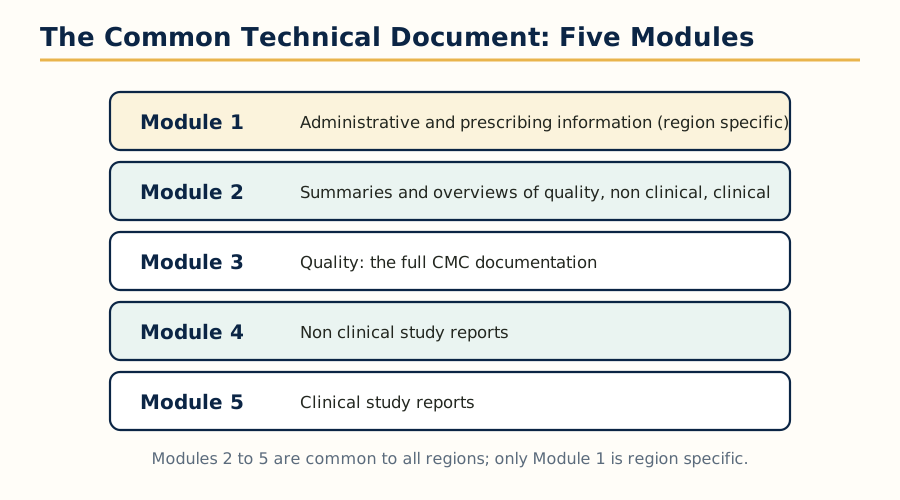 Figure: The five CTD modules: Modules 2 to 5 form the common evidence core and only Module 1 is region specific.
3.6 The eCTD
The electronic CTD (eCTD) is the electronic implementation of the CTD, the standard ICH M2 format in which applications are submitted to FDA and EMA and many other authorities. Instead of paper volumes, the applicant submits a structured electronic sequence: each document placed in the module folder structure, tied together by an XML backbone that acts as the table of contents, with hyperlinks and bookmarks inside documents and checksums that let the agency verify file integrity.
- Sequences and lifecycle: each submission (original application, supplement, amendment, annual report) is sent as a numbered sequence, and documents across sequences can replace, append or delete earlier documents, so the eCTD builds the complete current dossier over the product's life.
- Validation: submissions are checked against technical validation criteria before review; a technically invalid sequence can be refused, so publishing quality is a regulatory skill in itself.
- Benefits: one publishing standard serves several regions, reviewers can navigate the whole history of the product, and companies stop printing and shipping paper dossiers.
3.7 Industry and FDA liaison
Regulatory work is not done by dossier alone; it includes formal liaison between the company and the agency. Its main instruments:
- Formal meetings: the development calendar is punctuated by scheduled meetings with FDA: pre-IND meetings before first human studies, end of phase 2 meetings to agree the pivotal programme, pre-NDA or pre-BLA meetings to agree the application's contents, and mid cycle and late cycle review meetings during assessment (in the PDUFA programme). Meetings are requested in writing, supported by a briefing package sent in advance, and closed by official minutes, which are the record both sides work to.
- Written correspondence: information requests and discipline review letters from the agency during review, complete response letters at the end of a cycle, and the applicant's amendments in reply. Good liaison practice means every agency question gets a traceable, complete answer in the sequence it belongs to.
- Informal scientific advice: in the EU the same role is played by EMA and national scientific advice procedures; early advice is sought because a late disagreement about the evidence needed is far more expensive than an early one.
3.8 ICH and its guideline families
The International Council for Harmonisation (ICH) brings regulators and industry from the major regions together to write single technical guidelines accepted across regions, so that one development programme can support applications in all of them. Its guidelines are grouped in four families, and the syllabus names all four:
- Q, Quality: the pharmaceutical quality series. Includes stability testing (Q1), analytical validation (Q2), impurities (Q3), specifications (Q6), GMP for APIs (Q7), pharmaceutical development (Q8), quality risk management (Q9), pharmaceutical quality system (Q10), development and manufacture of drug substances (Q11) and lifecycle management (Q12).
- S, Safety: the non clinical series, covering carcinogenicity (S1), genotoxicity (S2), safety pharmacology (S7), immunotoxicity (S8), reproductive toxicology (S5), biotechnology product testing (S6) and similar topics that shape the Unit 4 programme.
- E, Efficacy: the clinical series, covering study design and reporting (E3, E8, E9), dose response (E4), ethnic factors (E5), good clinical practice (E6, the governing standard of Unit 5), and special populations such as geriatrics (E7) and paediatrics (E11).
- M, Multidisciplinary: topics that cross families: the CTD itself (M4), its electronic form the eCTD and electronic standards (M2), the MedDRA terminology (M1), evaluation of mutagenic impurities (M7) and electronic transmission standards such as E2B safety reporting under the E family implementations.
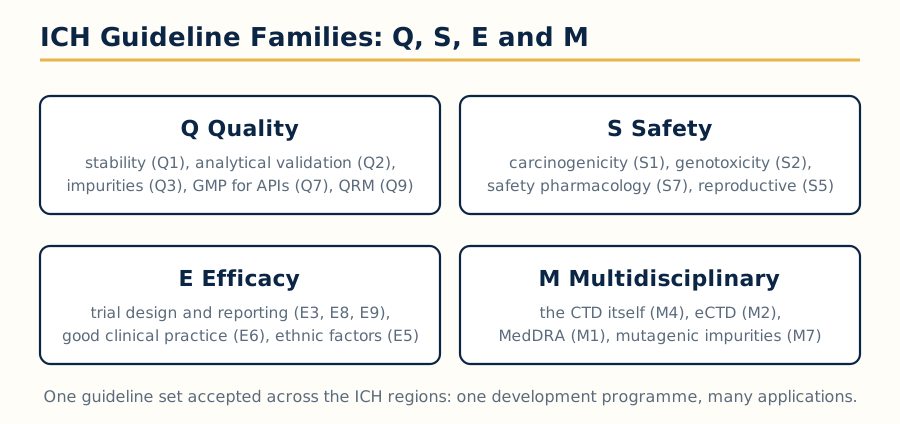 Figure: The four ICH guideline families, Q, S, E and M, with the guidelines students meet most often in each.
3.9 Regulatory requirements of the EU
The European system is a network: national authorities plus the European Medicines Agency (EMA) and the European Commission, which issues the legal decision for centralised products. Four routes lead to a marketing authorisation:
- Centralised procedure: one application to EMA, scientific assessment led by the Committee for Medicinal Products for Human Use (CHMP), and one Commission decision valid in all member states. Mandatory for biotechnology products, orphan medicines, and medicines for defined major disease areas, and available for other innovative products.
- Mutual recognition procedure: a product already authorised in one member state (the reference member state) seeks recognition of that authorisation by other member states, which rely on the reference state's assessment report.
- Decentralised procedure: for products not yet authorised anywhere in the EU, one reference member state assesses and the others accept the outcome, so several states authorise together.
- National procedure: authorisation for a single member state only.
The dossier is the same CTD, with an EU Module 1 (application form, product information in the common EU format, and local requirements). Conditional marketing authorisation and authorisation under exceptional circumstances exist for products where complete data cannot be provided at once, with specific obligations afterwards.
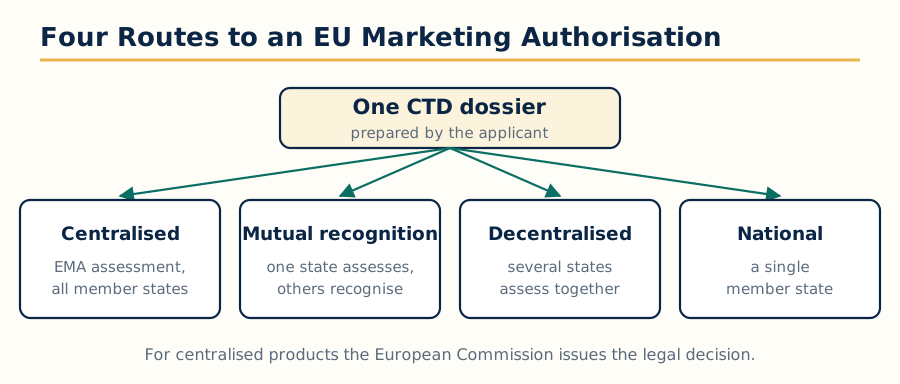 Figure: Four routes to an EU marketing authorisation from a single CTD dossier.
3.10 MHRA, TGA and the rest of the world (ROW)
- MHRA (United Kingdom): the Medicines and Healthcare products Regulatory Agency authorises medicines for the UK market. Since the UK left the EU it runs its own national licensing through its own assessment, and it also operates recognition style routes that can rely on the work of trusted partner regulators for suitable applications. The dossier remains CTD based, so a global dossier needs a UK Module 1 rather than a new evidence base.
- TGA (Australia): the Therapeutic Goods Administration registers medicines on the Australian Register of Therapeutic Goods (ARTG). Prescription medicines require full evaluation of quality, safety and efficacy data in CTD format, and TGA also uses comparable overseas regulator pathways that can rely on assessment reports from recognised regulators to shorten its own work.
- ROW countries: the rest of the world is not one system. Many countries accept the CTD dossier with a local Module 1, registration of the manufacturing site, local agent or subsidiary as the applicant, and legalised certificates such as the Certificate of Pharmaceutical Product (CPP) issued under the WHO certification scheme from the country of origin. Reliance and recognition of approvals by stringent regulators is a growing ROW pattern, and WHO prequalification serves products aimed at UN and donor procurement. The examination point is that the evidence core (Modules 2 to 5) travels globally; the administrative wrapper, site registration and labelling language are what change.
One dossier, many doors (the CTD idea)
Modules 2 to 5 written once  ->  quality, non clinical, clinical evidence
Module 1 prepared per region ->  forms, labelling, certificates, local agent
Same core submitted to        ->  FDA (US), EMA and national agencies (EU),
                                 MHRA (UK), TGA (Australia), CDSCO (India),
                                 and ROW authorities with local requirements
Unit 4: Non Clinical Drug Development and Global Submissions
4.1 Purpose of non clinical development
Non clinical development is the laboratory and animal work done before, and alongside, the first studies in humans. ("Non clinical" is the modern regulatory term; "preclinical" is the older synonym.) Its job is to answer three questions before a human receives the drug: what does the drug do (pharmacology), what harm can it do (toxicology), and what happens to it in the body (pharmacokinetics and metabolism). The results decide whether human testing may start, the safe starting dose and escalation plan for the first trial, and the monitoring the protocol must build in.
The work is done under Good Laboratory Practice (GLP) for the safety studies: a quality system covering organisation, facilities, written procedures, raw data and archiving, with an independent quality assurance unit, because regulators must be able to reconstruct and trust studies they did not witness. Pivotal toxicology studies that do not follow GLP are generally not accepted in support of human dosing.
4.2 The non clinical study programme
- Pharmacology: primary pharmacodynamics (the intended action and potency), secondary pharmacodynamics (other actions of the drug), and safety pharmacology, the core battery of studies on the cardiovascular, respiratory and central nervous systems (ICH S7), which looks for dangerous functional effects (for example effects on cardiac conduction, studied through the hERG channel and QT interval work) before human exposure.
- Pharmacokinetics and toxicokinetics: absorption, distribution, metabolism and excretion in animals, plasma protein binding, metabolite identification, and the measurement of drug exposure inside the toxicity studies (toxicokinetics), so that animal doses can be compared with human doses by exposure, not by dose alone.
- Toxicology: single dose (acute) studies, repeated dose studies of increasing duration matched to the intended length of human use (ICH M3 sets the matching), genotoxicity testing (ICH S2, the standard battery for mutation and chromosome damage), carcinogenicity studies for long term use products (ICH S1), reproductive and developmental toxicology (ICH S5) before populations that include women of childbearing potential are exposed, and local tolerance and immunotoxicity work where the product needs it.
The governing logic is proportionality and sequence: short animal studies open short human trials, and longer animal coverage is added as human exposure lengthens, so the non clinical programme and the clinical programme grow together.
4.3 The Investigational New Drug application (IND)
In the US, a drug that is not approved may not be shipped across state lines for human testing unless an exemption applies; the IND is that exemption. A sponsor files an IND with FDA containing:
- The general investigational plan and the protocol for the first clinical study (Unit 5).
- The investigator brochure (Section 4.6).
- The completed non clinical pharmacology and toxicology evidence, and any earlier human experience with the drug.
- The CMC information for the investigational product, enough to show it can be made consistently and safely for trial use.
- The commitment to conduct the trial under GCP, with IRB review and informed consent.
The IND goes into effect 30 days after FDA receipt unless the agency places a clinical hold (for example because the non clinical data show an unreasonable risk, or the protocol is too unsafe to proceed). The sponsor then maintains the IND with protocol amendments, safety reports and annual reports for the life of the development programme. Other regions run the same gate under other names: the clinical trial application (CTA) in the EU, built around the IMPD (next section), and the clinical trial permission route through CDSCO in India under the New Drugs and Clinical Trials Rules, 2019.
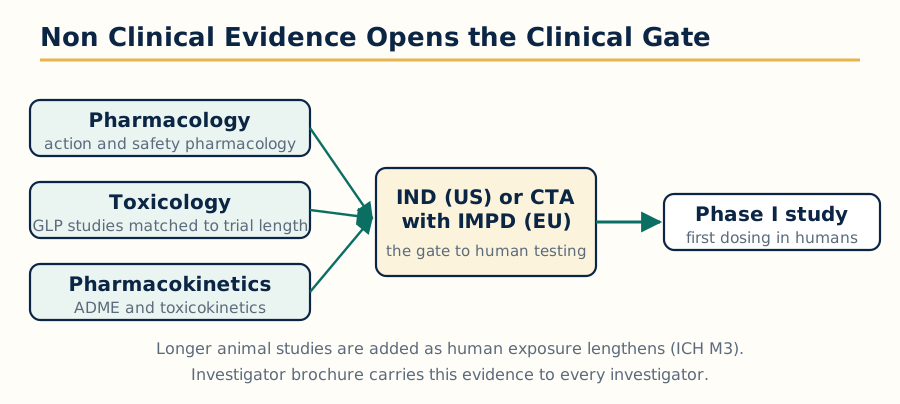 Figure: Non clinical evidence opens the clinical gate: the IND in the US, or the CTA supported by the IMPD in the EU.
4.4 Global submission of IND, NDA and ANDA
Unit 1 and Unit 2 described the US applications one at a time; this section puts the three together as a global filing pattern.
| Application | What it authorises | Evidence core | Typical filer |
|---|---|---|---|
| IND (US) / CTA with IMPD (EU) | Testing the drug in humans | Non clinical package, protocol, investigational product CMC | Innovator sponsor, occasionally academic or generic sponsors for BE work under local rules |
| NDA (US) / MAA (EU) | Marketing a new drug | Full quality, non clinical and clinical evidence owned by the applicant | Innovator company |
| ANDA (US) / generic MAA (EU) | Marketing a generic copy | Quality package, bioequivalence, reliance on the reference product's established safety and efficacy | Generic company |
The practical meaning of "global submission" is that the applicant writes the evidence core once, in CTD modules, and then runs the gates of each region in sequence: trial authorisation before trials, marketing application after pivotal trials, and generic applications only when the reference product's protections allow. The regional wrappers differ (Module 1, fees, local representatives), the evidence logic does not.
4.5 The Investigational Medicinal Product Dossier (IMPD)
The IMPD is the dossier that supports a clinical trial application in the EU; it is the trial-stage counterpart of the marketing dossier. Its contents mirror the CTD in miniature:
- Quality data on the investigational medicinal product and any comparator or placebo: manufacture, characterisation, specifications, stability for the trial period.
- Non clinical data: the pharmacology and toxicology summary and reports relevant to the proposed trial, drawn from the programme of Section 4.2.
- Clinical data: previous human experience with the product, if any.
- Risk and benefit assessment: an overall evaluation tying the non clinical and clinical evidence to the specific protocol, population and doses proposed.
A simplified IMPD can be used where the product is already authorised or has been assessed in an earlier application, because the authority can cross refer to what it already holds. The IMPD plus the protocol and the investigator brochure form the core of the CTA package.
4.6 The investigator brochure (IB)
The investigator brochure is the compiled briefing document given to every clinical investigator: the single place where the sponsor sets out everything known about the investigational product that matters for running the trial safely. Its contents, per GCP (ICH E6):
- Description of the product and its formulation.
- Summary of non clinical pharmacology, toxicology and pharmacokinetics, with the sponsor's interpretation of what they mean for humans.
- Effects in humans so far, including safety and efficacy findings and marketed experience if the product is sold elsewhere.
- Guidance for the investigator: expected risks and adverse reactions, precautions, dose modification and stopping guidance, and the management of overdose or special populations.
The IB is a living document: it is updated as new data arrive, at least annually in an active programme, and material new safety information in it is one of the triggers for protocol amendments and fresh consent information (Unit 5). Both the IND and the CTA rely on it, which is why the syllabus places the IMPD and the IB together: they are the two documents through which the non clinical work is presented for human testing.
Unit 5: Clinical Trials
5.1 Clinical trials and their phases
A clinical trial is a systematic study of a drug in human subjects to discover or verify its clinical, pharmacological or other effects, to identify adverse reactions, and to study its absorption, distribution, metabolism and excretion, with the object of ascertaining safety and efficacy. Trials are conventionally described in phases:
| Phase | Main question | Typical subjects | Notes |
|---|---|---|---|
| Phase I | Is it safe, and how does the body handle it? | Small number of healthy volunteers (patients when the drug is too toxic for volunteers, as in much oncology work) | First in human dosing guided by the non clinical data; single and multiple ascending doses, food effect, early ADME |
| Phase II | Does it work, and at what dose? | Patients with the target condition, tens to a few hundred | Proof of concept, dose ranging, selection of the dose and endpoints for Phase III |
| Phase III | Is it effective and acceptably safe at scale? | Large patient groups, hundreds to thousands, usually controlled (randomised, blinded comparisons) | The pivotal evidence for the marketing application |
| Phase IV | What else is learned after approval? | Patients in ordinary practice | Post marketing studies: rare adverse effects, long term outcomes, new populations and uses |
| Phase 0 (exploratory) | Early human signal at microdoses | Very small numbers | Optional exploratory work under reduced non clinical requirements |
The phases are a development logic, not a legal straitjacket: programmes overlap, and adaptive and seamless designs combine phases, but an examination answer should always be able to place a study question in its phase.
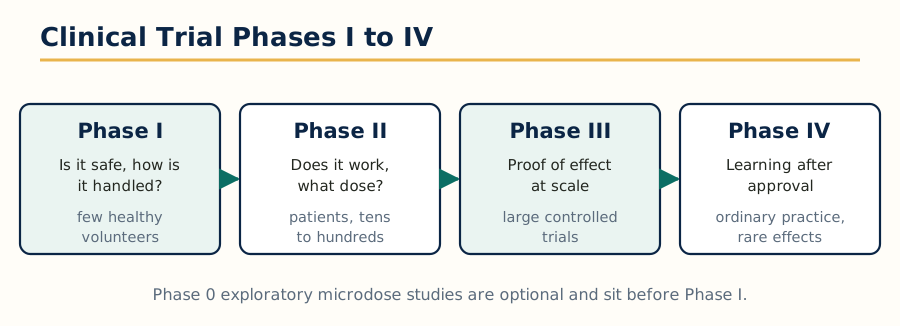 Figure: The four clinical trial phases and the question each phase answers.
5.2 Developing a clinical trial protocol
The protocol is the master plan of the trial, written before the trial starts and approved by the ethics committee and, where required, the regulator. A protocol contains:
- Title, objectives and the scientific background and rationale.
- Trial design: type of study (randomised, blinded, controlled), treatment arms, and the plan that keeps bias out (randomisation and blinding procedures).
- Subject selection: inclusion and exclusion criteria defining the study population.
- Treatment details: product, dose, route, duration, permitted and prohibited concomitant medication, and compliance checks.
- Assessments: efficacy and safety variables, the schedule of visits and procedures, and laboratory work.
- Statistics: sample size reasoning, analysis populations and methods, interim analyses.
- Ethics and administration: informed consent arrangements, safety reporting procedures, data handling and record keeping, monitoring and quality control, publication and finance arrangements.
Changes after approval of the protocol are made by protocol amendments, which themselves need ethics and regulatory handling proportionate to their effect on subject safety and the study's science. A trial run materially off its protocol produces data a regulator may refuse to use, however expensive the trial was.
5.3 Institutional review board and independent ethics committee
An Institutional Review Board (IRB) in US terminology, or Independent Ethics Committee (IEC) in ICH GCP terminology, is the independent body whose review and approval protect the rights, safety and well being of trial subjects. In India the same body is the ethics committee registered with the licensing authority under the New Drugs and Clinical Trials Rules.
- Composition: a multidisciplinary, plural group, conventionally at least five members, including medical and non medical members, at least one member whose primary interest is non scientific (a lay member), and members independent of the trial site and sponsor. GCP and the Indian rules both prescribe composition elements (chairperson from outside the institution, clinician, pharmacologist, legal expert, social scientist or community representative, lay person, member secretary).
- Formulation and working procedures: the committee works to written SOPs of its own: submission requirements and review timelines, quorum rules (decisions only at convened meetings with the prescribed minimum membership present), review of the protocol, consent documents, investigator qualifications, subject payment and compensation arrangements, and continuing review of the running trial, including protocol amendments, deviations, safety reports and the final report.
- Powers in practice: the committee can approve, require modifications before approval, disapprove, and suspend or terminate an approval it has given. No subject may be enrolled before written approval for that site, and the investigator must report serious adverse events and new risk information to the committee promptly (Section 5.7).
5.4 Informed consent: process and procedures
Informed consent is the process by which a subject voluntarily confirms willingness to participate, after being informed of every aspect of the trial relevant to the decision. It is a process, not only a signature: information, comprehension, voluntariness, and the right to withdraw at any time without penalty to the subject's care.
The information that must be explained, in a language and form the subject understands, includes: that the study is research, its purpose and expected duration, the treatments and the probability of random assignment, the procedures (and which are experimental), foreseeable risks and inconveniences, expected benefits (and that there may be none), alternative treatments, confidentiality and who may inspect the records, compensation and treatment arrangements for trial related injury, whom to contact about the trial and about injury, and the voluntary nature of participation and withdrawal.
Procedural points that examiners and inspectors both check:
- Consent is taken before any trial procedure, by a person qualified and authorised to do so, with time for the subject to consider and ask questions.
- Both subject and the person taking consent sign and date the consent form, and the subject receives a copy.
- Special protections apply to vulnerable subjects: legally acceptable representatives consent for those who cannot (children, incapacitated adults), with the subject's assent added where the subject can give it.
- New information that may affect willingness to continue is communicated and re-consent taken where required, for example after a material IB update (Unit 4.6).
- In India, audio visual recording of the consent process is required in defined situations under the New Drugs and Clinical Trials Rules, and compensation for trial related injury or death follows the formula and procedures given in those Rules.
5.5 HIPAA and the privacy of health information
The Health Insurance Portability and Accountability Act of 1996 (HIPAA) is the US law whose Privacy Rule governs how identifiable health information may be used and disclosed. Clinical trials run directly into it, because trial records are built from patients' health information and sponsors, monitors and auditors need access to it.
For research, the Privacy Rule works through authorisation: a subject's written authorisation, usually combined with the informed consent document in US trials, permits the covered health care provider to use and disclose the subject's protected health information for the trial. Without authorisation, use is possible only under limited routes such as a waiver granted by an IRB or privacy board for defined low risk situations. De-identified data fall outside the Rule, which is one reason sponsors work with coded subject identifiers in their databases and reports. The trial consequences are concrete: consent forms carry HIPAA language, monitors verify source data under the authorisation, and breaches of confidentiality are both a privacy violation and a GCP finding.
5.6 Requirements of the clinical study process
Beyond protocol, committee and consent, a lawful and credible trial needs the whole GCP system (ICH E6) in place:
- Approvals before start: ethics approval and the regulatory trial authorisation (an IND in effect in the US, a CTA approval in the EU, CDSCO permission in India) both precede enrolment.
- Qualified team and delegation: the investigator is medically qualified and trained in the protocol and GCP; every task is delegated in writing to named, trained staff.
- Investigational product control: the product is made to GMP for clinical supplies, labelled for trial use, stored correctly, dispensed against the randomisation system, and accounted for unit by unit.
- Data integrity and essential documents: case report forms, source documents, consent forms, approvals, monitoring reports and correspondence are filed as the trial master file, the inspection ready record that the trial was run as approved; data changes carry an audit trail.
- Monitoring and quality assurance: the sponsor monitors the trial (on site and increasingly risk based and centralised) and may audit it; regulators may inspect sites, sponsors and CROs, and inspection findings can lead to data rejection or enforcement action.
- Safety management: the reporting system of Section 5.7 runs for the entire study and into the development safety update reporting that accompanies the programme.
5.7 Pharmacovigilance and safety monitoring in clinical trials
Pharmacovigilance in a trial is the continuous collection, assessment and reporting of adverse events so that subjects are protected in real time and the product's safety profile is built honestly. The working vocabulary:
- Adverse event (AE): any untoward medical occurrence in a subject given the product, whether or not it is caused by the product.
- Adverse drug reaction (ADR): an AE for which a causal relationship to the product is at least a reasonable possibility.
- Serious adverse event (SAE): an event that results in death, is life threatening, requires or prolongs hospitalisation, causes persistent or significant disability, is a congenital anomaly, or is otherwise medically important.
- SUSAR: a serious unexpected suspected adverse reaction: serious, causally suspected, and not described in the reference safety information (the IB for an investigational product); SUSARs are the core of expedited reporting.
The reporting duties run on two levels:
- Investigator to sponsor and ethics committee: the investigator reports SAEs to the sponsor immediately (conventionally within 24 hours of awareness) and reports serious events to the ethics committee within the timelines of the applicable rules.
- Sponsor to regulators: the sponsor assesses seriousness, expectedness and causality and submits expedited reports of SUSARs to the regulators (in the US, IND safety reports; fatal or life threatening unexpected suspected reactions are reported fastest, others on the standard expedited clock, exact day counts following the governing rule of the region), notifies all investigators and ethics committees, and keeps the IB and consent information updated as the profile changes.
- Independent oversight: many trials appoint a Data Safety Monitoring Board (DSMB), an independent group that reviews accumulating, often unblinded, safety and efficacy data at intervals and can recommend continuing, modifying or stopping the trial; stopping rules for safety are defined in advance in the protocol or the DSMB charter.
Safety reporting inside a clinical trial
Subject has a serious adverse event
  -> investigator assesses, treats, reports to sponsor at once
  -> investigator also reports to the ethics committee
  -> sponsor assesses: serious? expected? causally suspected?
  -> if SUSAR: expedited report to regulators, inform all
     investigators and ethics committees
  -> DSMB reviews accumulating data and may advise stopping
  -> IB and consent updated if the risk picture has changed
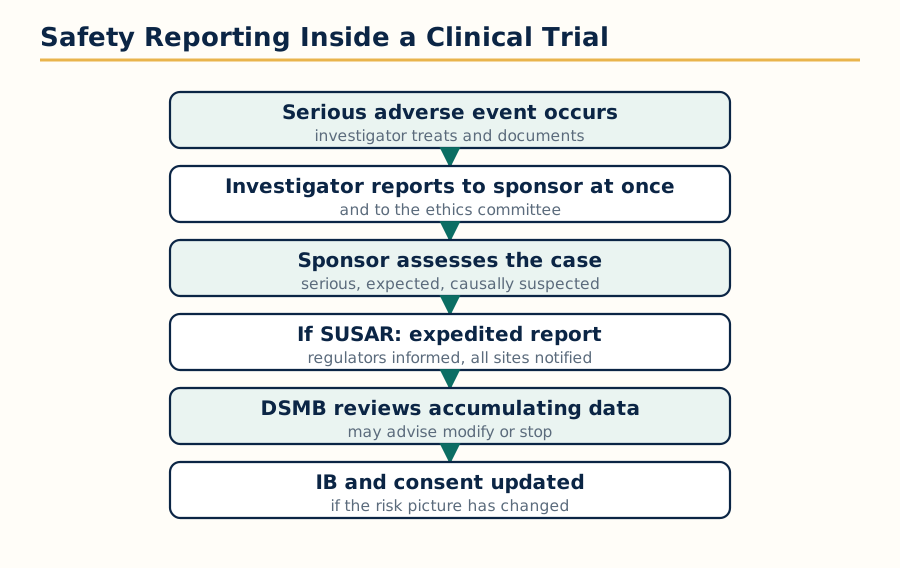 Figure: Safety reporting inside a trial: the event travels from bedside to sponsor to regulator, with independent DSMB oversight alongside.
Frequently Asked Questions
Q: What is a Drug Master File and is it ever approved by FDA? A DMF is a confidential file submitted to FDA holding detailed information about a facility, process or material, most often the API. It is never approved or disapproved on its own; it is reviewed only when an application such as an ANDA or NDA refers to it with a letter of authorisation from the DMF holder, and it stands or falls as part of that application's review.
Q: What did the Hatch-Waxman Act actually change? The Drug Price Competition and Patent Term Restoration Act of 1984 created the ANDA pathway, so a generic could be approved on quality data plus bioequivalence instead of repeating clinical trials. In exchange it gave innovators patent term restoration of up to five years, data exclusivities such as five years for a new chemical entity, the Orange Book patent listing and paragraph certification system, the 30 month litigation stay, and 180 days of exclusivity for the first Paragraph IV generic filer.
Q: What are the four paragraph certifications in an ANDA? Paragraph I states that no patent information is filed for the reference drug; Paragraph II that the patent has expired; Paragraph III that approval is sought only after patent expiry; Paragraph IV that the patent is invalid, unenforceable or not infringed. Only Paragraph IV invites immediate litigation and the chance of 180 day first filer exclusivity.
Q: How is bioequivalence decided statistically? The 90 percent confidence interval for the ratio of test to reference geometric means of AUC and Cmax from the BE study must lie entirely within 80.00 to 125.00 percent. AUC carries the extent of absorption and Cmax the rate, and both must pass.
Q: What is the difference between tentative approval and final approval of an ANDA? A tentative approval means the application is scientifically complete but a patent or exclusivity still blocks marketing, so the product cannot be sold. Final approval, granted when the block clears, is what allows the generic to enter the market.
Q: What are the five modules of the CTD? Module 1 is regional administrative information and labelling; Module 2 holds the summaries and overviews; Module 3 is Quality (the CMC evidence); Module 4 is the non clinical study reports; Module 5 is the clinical study reports. Only Module 1 changes between regions.
Q: How does the EU authorise a medicine, and how many routes are there? There are four routes to an EU marketing authorisation: the centralised procedure through EMA and the European Commission, the mutual recognition procedure based on an existing national authorisation, the decentralised procedure for simultaneous authorisation in several states, and the purely national procedure for one state.
Q: What is the difference between an IND, an IMPD and an investigator brochure? An IND is the US filing that exempts an unapproved drug from the ban on interstate shipment so it can be tested in humans. The IMPD is the EU trial dossier carrying the quality, non clinical and clinical data behind a clinical trial application. The investigator brochure is the sponsor's compiled briefing on the product given to investigators, and it forms part of the support for both routes.
Q: Who can sit on an ethics committee and what can it do? An IRB or IEC is a multidisciplinary independent body, conventionally at least five members, including medical and non medical members and at least one lay or non scientific member, working to its own written procedures. It can approve a trial, require changes, refuse approval, and suspend or terminate an approval, and no subject may be enrolled before its written approval.
Q: What is a SUSAR and who reports it to whom? A SUSAR is a serious unexpected suspected adverse reaction in a clinical trial: serious, not described in the reference safety information, and with at least a reasonable possibility of causality. The investigator reports serious events to the sponsor and the ethics committee at once; the sponsor then files expedited reports of SUSARs to the regulators and informs all investigators, with the fastest handling for fatal or life threatening cases.
Complete MPH104T notes, all 5 units in one PDF, free to keep.
Other M.Pharm subjects: MPH101T · MPC101T · MPL101T · MPH102T · MPH103T · MPH104T · M.Pharm