
MPG203T — Indian System of Medicine
4 hrs/week, 4 credits, 60 hours, 100 marks. Notes follow the M.Pharm syllabus, unit by unit.
MPG203T Indian System of Medicine notes for M.Pharm Pharmacognosy Semester 2: Ayurveda, Siddha, Unani and Homoeopathy concepts, Gunapadam and Suddhi, ISM formulation techniques, Schedule T GMP, TKDL and AYUSH research councils, with free unit wise PDF downloads on PharmacoLearn.
Units in this subject
- Unit 1 — Fundamental Concepts of the Indian Systems of Medicine
- Unit 2 — Naturopathy, Yoga and Aromatherapy Practices
- Unit 3 — Formulation Development of the Indian Systems
- Unit 4 — Schedule T and Quality Assurance in ISM Manufacture
- Unit 5 — Traditional Knowledge, Geographical Indications and the AYUSH Research Bodies
Download MPG203T PDF Notes
Free PDFs for this subject, one per unit:
Indian System of Medicine, subject code MPG203T, is the third core theory subject of M.Pharm Pharmacognosy, Semester 2. It carries 4 credits and 60 hours of theory, taught at 4 hours per week, for 100 marks, and its five units are of equal length at 12 hours each. Its scope, as the syllabus states it, is to make the students understand thoroughly the principles and preparations of medicines of the various Indian systems of medicine like Ayurveda, Siddha, Homeopathy and Unani, also focusing on clinical research of traditional medicines, quality assurance and the challenges in monitoring the safety of herbal medicines. The subject turns the student from the plant to the traditions that used the plant for centuries before pharmacognosy named it. Unit 1 lays the foundations: the fundamental concepts of Ayurveda, Siddha, Unani and Homoeopathy, the dosage forms in which those systems deliver their medicines, the Ayurvedic Pharmacopoeia and the analysis of formulations and crude drugs, and the Siddha pharmacology of Gunapadam with its raw drugs, its Dhatu and Jeevam classes and its purification process, Suddhi. Unit 2 covers the practice systems that stand beside the drug based ones: naturopathy, yoga and aromatherapy. Unit 3 follows the formulations into their making, the preparation techniques of the four pharmacopoeial traditions, and the standardization, shelf life and stability work an ISM formulation must now undergo. Unit 4 is the manufacturing law of the subject: Schedule T good manufacturing practice, quality assurance through GAP, GMP and GLP, documentation for new drug applications and export, and the challenges of monitoring the safety of herbal medicines. Unit 5 closes with the knowledge politics of traditional medicine: the Traditional Knowledge Digital Library, geographical indications, government action in AYUSH, and the four research councils, CCRAS, CCRS, CCRH and CCRU. One idea holds the subject together: these systems are complete medical traditions with their own physiology, pharmacology, pharmacy and literature, and the pharmacognosist's task is to understand each on its own terms first, and only then to test, standardise and manufacture its medicines by the quality discipline taught in the rest of this degree.
Unit 1: Fundamental Concepts of the Indian Systems of Medicine
1.1 The Indian systems as a group
Indian System of Medicine, in the usage of this syllabus and of the Government of India, names the systems of medicine of Indian origin, or that came to India from outside and were absorbed so deeply into Indian practice that they are now part of the Indian tradition. The principal systems are Ayurveda, Siddha, Unani and Homoeopathy, with Yoga and Naturopathy standing as the practice and lifestyle systems of the same family, taught in Unit 2 of this subject. Since 2014 these systems have had their own ministry, the Ministry of AYUSH, whose name is built from their initials: Ayurveda, Yoga and Naturopathy, Unani, Siddha and Homoeopathy, with Sowa-Rigpa, the Himalayan tradition, also recognised in the Indian fold. Each system is a complete medical tradition, not a list of remedies: each has its own account of the body and of health, its own principles for judging a drug, its own classical texts, its own pharmacy of formulations and dosage forms, and its own line of practitioners. What they share, and what makes them one subject, is their common ground: a heavy reliance on drugs of natural origin, plant above all, then mineral and animal; a holistic reading of the patient in which the constitution and the balance of the body's governing principles matter as much as the named disease; and a written classical literature, in Sanskrit, Tamil, Arabic and Persian, and later in European languages for Homoeopathy, which functions as the primary authority for what a medicine is and how it is made.
Three consequences of that shared ground organise the whole subject. First, the raw materials of these systems are the starting materials of pharmacognosy itself, so the identity, purity and quality discipline of MPG202T applies to them in full, and Unit 1 returns to it under the Ayurvedic Pharmacopoeia. Second, the systems' medicines are manufactured today in licensed factories under good manufacturing practice, Schedule T, Unit 4 of this subject, so the classical pharmacy is a regulated modern industry and not only a textual inheritance. Third, because the knowledge is old, textual and collectively held, it needs a defence against private appropriation that modern knowledge does not, and Unit 5 takes up that defence through the TKDL and geographical indications. The attitude this subject teaches throughout is to take each system's concepts seriously as its own framework, and to state plainly which of its claims rest on classical authority, which on long use, and which on modern testing, never confusing those three standings.
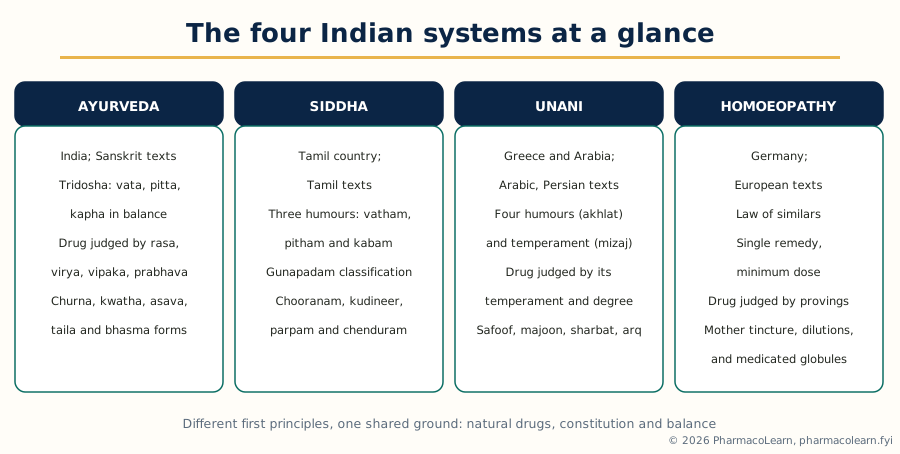 Figure: The four systems at a glance. Different languages, literatures and first principles, one shared ground of natural drugs and constitutional balance.
1.2 Fundamental concepts of Ayurveda
Ayurveda, the science of life, is the oldest and largest of the Indian systems, carried in the great compendia of Charaka (the Charaka Samhita, devoted to internal medicine), Sushruta (the Sushruta Samhita, devoted to surgery) and Vagbhata (the Ashtanga Sangraha and Ashtanga Hridayam), the Brihat Trayi or great trio, with a later trio of shorter texts, the Laghu Trayi, completing the classical shelf. Its physiology begins from the panchamahabhuta, the five great elements, akasha (space), vayu (air), agni or tejas (fire), jala (water) and prithvi (earth), of which everything in the body and in the drug is composed. In the body the elements work through the tridosha, the three doshas: vata, formed of space and air, governing movement; pitta, formed of fire and water, governing transformation, digestion and heat; and kapha, formed of water and earth, governing structure and cohesion. Health, in this framework, is the doshas in their proper balance for that person, and disease is their disturbance, so diagnosis reads the pattern of disturbance and treatment aims to restore the balance rather than only to silence a symptom.
Below the doshas the framework continues: the sapta dhatu, the seven tissues from rasa (nutrient fluid) through rakta, mamsa, meda, asthi and majja to shukra, nourished in sequence; the mala, the waste products whose proper elimination is part of health; agni, the digestive and metabolic fire on whose strength the whole nourishment depends; and the srotas, the channels that carry materials through the body. Each person also carries a prakriti, an individual constitution fixed by the proportion of the doshas, against which their balance and imbalance are judged. Ayurvedic pharmacology, the part of the framework a pharmacognosist must command, judges a drug by five properties: rasa, its taste, of which six are recognised; guna, its qualities; virya, its potency, classically read as heating or cooling; vipaka, its taste after digestion; and prabhava, its specific action that the other four cannot explain. A formulation, in this system, is a deliberate composition in which drugs are combined so that their rasa, virya and vipaka correct the disturbed dosha while the vehicle and processing direct them, which is why Ayurvedic pharmacy, taken up in Unit 3, works with compound formulations far more than with single drugs.
1.3 Fundamental concepts of Siddha
The Siddha system is the medical tradition of Tamil country, attributed to the Siddhars, the perfected masters of whom Agathiyar is named first, and written in Tamil texts that combine medicine with alchemy and spiritual discipline. Its account of the body begins, as Ayurveda's does, from five elements, the panchabhutam, and works through three humours, vatham, pitham and kabam, corresponding in function to movement, transformation and structure, whose balance is health and whose derangement is disease. The body is built of seven physical constituents, the udal thathukkal, and the whole doctrine is organised in the classical teaching as 96 thathuvams, the basic principles that make up the human being and its functions. Pulse reading, naadi, holds a particularly developed place in Siddha diagnosis, read together with examination of the body's other signs.
What distinguishes Siddha most sharply, and what the syllabus singles out through Gunapadam, is the weight of its mineral and metal pharmacy. Siddha uses plant drugs extensively, but its characteristic higher medicines are prepared from metals, minerals and salts, processed through elaborate purification and incineration into fine preparations such as parpam and chenduram, and it is this feature that makes the purification process of Suddhi, Section 1.11, a safety critical doctrine rather than a ritual. Siddha pharmacology classifies its raw drugs by origin into plant, mineral and animal classes, and judges them by properties such as taste (suvai), potency and post digestive effect, in a structure parallel to the Ayurvedic five properties but with its own texts, names and classifications. The student should register the pattern: the Indian systems repeatedly build the same architecture, elements, humours, drug properties, purification, compound pharmacy, from different regional and linguistic roots, which is why one subject can teach them together without merging them.
1.4 Fundamental concepts of Unani
The Unani system is the Greco-Arab tradition: founded in the Greek medicine of Hippocrates and Galen, developed by the Arab and Persian physicians, of whom Ibn Sina, Avicenna, and his Canon of Medicine are the standard names, and carried in India for centuries until it became one of the Indian systems in law and in practice. Its physiology rests on the four akhlat, the humours: dam (blood), balgham (phlegm), safra (yellow bile) and sauda (black bile), formed from the food in the liver and circulating as the body's nutritive fluids. Every person, organ and drug carries a mizaj, a temperament, described on the scales of hot and cold, wet and dry, and health is the humours in their proper quantity and quality for that temperament, maintained by tabiyat, the body's own governing power of self preservation and healing, which the physician assists rather than replaces.
The classical teaching organises the conditions of health as the Asbab-e-Sitta Zarooriya, the six essential prerequisites: ambient air, food and drink, physical movement and rest, mental movement and rest, sleep and wakefulness, and evacuation and retention. Disease arises when these, or the humours they govern, fall out of order. Unani therapy then proceeds by a graded logic that the examination expects in order: Ilaj bil Ghiza, treatment by diet; Ilaj bit Tadbeer, treatment by regimental measures such as exercise, massage, bathing and venesection in the classical practice; Ilaj bid Dawa, treatment by drugs, the largest part, drawn from plant, mineral and animal sources and judged by their temperament and degree; and Ilaj bil Yad, treatment by hand, that is surgery, as the last resort. The temperament of the drug must answer the temperament of the disease in the opposite direction, hot remedies for cold diseases and the reverse, which is the system's version of the balancing principle seen in Ayurveda and Siddha, arrived at through a different literature.
1.5 Fundamental concepts of Homoeopathy
Homoeopathy is the youngest system in this unit and the only one of European birth admitted to the Indian family. It was founded by Samuel Hahnemann, a German physician whose Organon of Medicine of 1810 states the system, and who arrived at its central law through experiment: a substance that produces a set of symptoms in a healthy person can, in a suitably prepared small dose, treat those same symptoms in a patient. This is the law of similars, similia similibus curentur, let likes be treated by likes, and it inverts the logic of the other systems in this unit, which treat by opposites or by balance. Because the law points to the individual substance and the individual symptom picture, Homoeopathy builds its materia medica by provings: the systematic recording of the symptoms a substance produces in healthy volunteers, from which the remedy pictures that guide prescribing are drawn.
Three further principles complete the framework. The single remedy: classical Homoeopathy prescribes one substance at a time, matched to the total symptom picture of the patient, so that its effect can be read clearly. The minimum dose: the dose is reduced to the least that will act, which connects with the system's characteristic pharmacy. Potentisation: remedies are prepared by serial dilution with vigorous shaking, succussion, for liquids, or by grinding with lactose, trituration, for solids, on the decimal or centesimal scales, and the system's doctrine holds that this process releases the dynamic medicinal power of the substance while removing its material toxicity. The student is not asked to adjudicate these doctrines here; the student is asked to state them accurately as the system's own framework, to prepare its medicines correctly in Unit 3, and to recognise that its pharmacopoeia and manufacturing rules follow from these principles exactly as the other systems' rules follow from theirs.
1.6 Dosage forms of the ISM
The dosage forms of the Indian systems are best learned as families, since every system delivers its drugs in a recurring set of physical forms, and the examination asks for the families and their characters rather than for recipes. The solid forms come first. Powders are universal: the Ayurvedic churna, the Siddha chooranam and the Unani safoof are all finely powdered drugs or drug mixtures, dosed by measure and taken with a vehicle such as water, milk or honey. Pills and tablets follow: the Ayurvedic vati and gutika, the Unani habb and qurs, moulded or compressed masses of powdered drug with a binding liquid. The Siddha solids reach further into the mineral pharmacy with parpam, the fine white calxes produced by incineration of metals and minerals, and chenduram, the red coloured preparations of the same family, forms that have no counterpart in ordinary herbal pharmacy and that depend entirely on the purification doctrine of Section 1.11 for their classical claim to safety.
The liquid and semi solid forms form the second family. Decoctions, the Ayurvedic kwatha and Siddha kudineer, extract drugs with boiling water and are used fresh. Fermented liquids, the Ayurvedic asava and arishta, are generated by fermenting decoctions or juices with jaggery or sugar until a self generated alcohol both preserves the preparation and extracts its constituents, the single most distinctive liquid technology of the Indian pharmacy. Distillates, the Ayurvedic and Unani arka or arq, carry the volatile fraction of aromatic drugs. Syrups and electuaries, the Unani sharbat, majoon, jawarish and khamira and the Ayurvedic avaleha or leha, deliver drugs in sugar or honey based semi solids that keep well and taste acceptable. The fatty forms, Ayurvedic taila (medicated oils) and ghrita (medicated ghees) and the Siddha ennai and nei, process drugs into oil or ghee for internal and external use, the lipid vehicle being itself part of the therapy in the classical account. Homoeopathy stands apart with its own forms: mother tinctures, the alcoholic extracts from which its remedies begin, their serial dilutions, and the medicated globules and pellets that carry a dilution to the patient. A comparison of the four systems is given here, and the preparation techniques behind the forms are Unit 3.
| Point of comparison | Ayurveda | Siddha | Unani | Homoeopathy |
|---|---|---|---|---|
| Origin and language | India, Sanskrit texts | Tamil country, Tamil texts | Greece and Arabia, Arabic and Persian texts | Germany, European texts |
| Governing principles | Tridosha: vata, pitta, kapha | Three humours: vatham, pitham, kabam | Four humours (akhlat) and temperament (mizaj) | Law of similars, single remedy, minimum dose |
| Drug judgement | Rasa, guna, virya, vipaka, prabhava | Taste, potency and allied properties | Temperament and degree of the drug | Proving picture on healthy persons |
| Characteristic forms | Churna, kwatha, asava and arishta, taila, bhasma | Chooranam, kudineer, parpam, chenduram | Safoof, majoon, sharbat, arq | Mother tincture, dilutions, globules |
| Signature pharmacy | Compound formulations, fermented liquids | Metal and mineral preparations | Diet and regimental therapy beside drugs | Potentisation by dilution and succussion |
1.7 The Ayurvedic Pharmacopoeia of India
A living classical system needs an official book of standards, and for Ayurveda that book is the Ayurvedic Pharmacopoeia of India (API), published under the Ministry of AYUSH by the Pharmacopoeia Commission for Indian Medicine and Homoeopathy. The API is organised in two parts. Part I carries the monographs of single drugs, the individual crude drugs of plant origin in the main, each monograph fixing the drug's identity and standards: its names and description, the part used, its macroscopic and microscopic characters, its foreign matter and physico-chemical constants such as ash values and extractive values, its assay or marker requirements where these are established, and its identity tests including chromatographic fingerprints. Part II carries monographs of compound formulations, the classical multi ingredient preparations, stating their composition from the authoritative texts and the standards each finished formulation must meet. Beside the pharmacopoeia stands the Ayurvedic Formulary of India (AFI), which collects the formulations themselves, their ingredients and methods of preparation, drawn from the classical texts recognised as authoritative, the books listed in the First Schedule of the Drugs and Cosmetics Act, 1940.
The legal force of these books is the point a pharmacist must not miss. Ayurvedic medicines manufactured for sale in India are licensed under the Drugs and Cosmetics Act and Rules, and the pharmacopoeial standards are the standards against which their quality is judged: a drug that fails its API monograph is, in law, not of standard quality. Parallel pharmacopoeias serve the other systems in the same way: the Siddha Pharmacopoeia of India and the Siddha Formulary, the National Formulary of Unani Medicine and the Unani Pharmacopoeia, and the Homoeopathic Pharmacopoeia of India for Homoeopathy. MPG104T has already taught the comparative study of these monographs; this subject uses them, and Unit 3 returns to them as the working references of formulation development.
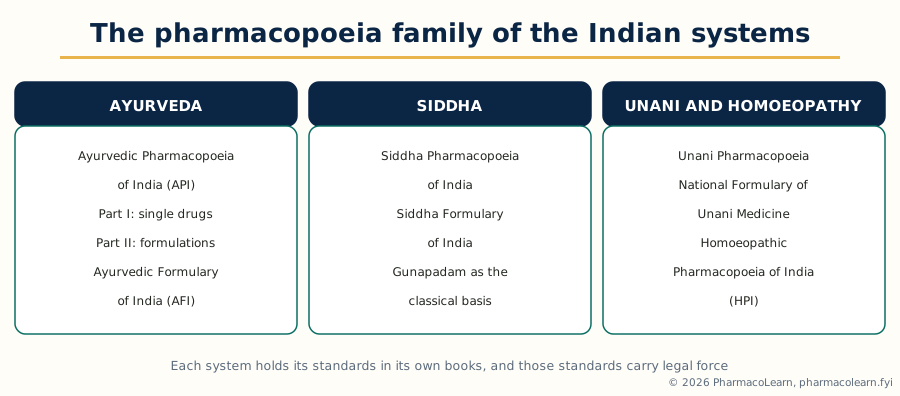 Figure: The pharmacopoeia family. Each system holds its standards in its own pharmacopoeia and formulary, and those standards carry legal force in manufacture and sale.
1.8 Analysis of formulations and crude drugs: identity, purity and quality
The syllabus fixes the analysis of ISM material under three heads, and they are the same three heads under which all pharmacognosy analysis is organised. Identity asks whether the material is what it claims to be: the correct species, the correct part, the genuine classical drug of that name. Identity is established by organoleptic characters, by macroscopy and microscopy against the pharmacopoeial description, by chemical identity tests, and, in modern practice, by chromatographic fingerprinting, HPTLC above all, in which the pattern of a genuine sample is matched band for band, the technique MPG103T built for exactly this service. Purity asks what else is present: foreign matter, substituted or exhausted material, microbial load, and the contaminant panel of heavy metals, pesticide residues and aflatoxins that MPG202T taught, applied here with special force to the mineral containing Siddha and Ayurvedic preparations, where arsenic, lead and mercury compounds are classical ingredients in some formulations and uncontrolled contaminants in others, and the laboratory must distinguish an ingredient declared and processed by the classical method from the same metal present as a failure of control. Quality asks whether the genuine, clean material is strong enough: its physico-chemical constants within pharmacopoeial limits, its marker or assay values at standard, its formulation performance, disintegration, uniformity and stability, as it should be.
For compound formulations the analysis hardens, because no single assay can certify a mixture of ten or twenty ingredients. The working method, as standardised in API Part II practice, is layered: the raw materials are each certified before manufacture, the process is controlled and recorded, and the finished formulation is judged by its own pharmacopoeial monograph, its fingerprint, selected marker assays for characteristic ingredients, and its physical standards. The conclusion transfers the lesson of MPG202T into the ISM setting unchanged: identity, purity and quality are three different questions, each answered by its own family of tests, and a formulation that has not faced all three has not been analysed, however classical its name.
1.9 Siddha pharmacology: Gunapadam
Gunapadam is the pharmacology of the Siddha system, the part of its literature that studies the drugs themselves: their sources, characters, properties and actions, and the methods by which they are purified and prepared into medicines. Its organisation by origin is the feature the syllabus examines. Gunapadam divides its materia medica into classes by kingdom and kind. The herbal class, Mooligai, covers the drugs of plant origin, the largest class and the one shared with the other systems. The mineral and metal class, Thadhu, covers the metals, minerals, salts and allied substances, gold, silver, copper, iron, zinc, mercury, sulphur, arsenic compounds and the rest of the classical mineral shelf, which in Siddha are not marginal ingredients but the basis of its most characteristic medicines. The animal class, Jeevam in the syllabus's spelling, covers drugs of animal origin. For each drug the classical Gunapadam account gives its names, its source and varieties, its organoleptic characters, its properties in the system's own terms of taste and potency, its actions and uses as the tradition records them, and, critically for the Thadhu class, its purification.
The pharmacist's reading of Gunapadam should be exact about what kind of text it is. It is a classical pharmacology: its drug judgements are the system's own framework, refined over centuries of practice, and its accounts of action are traditional knowledge, to be stated as such. Its permanent value is twofold: it is the authoritative record of what the Siddha tradition contains, without which no Siddha formulation can even be identified, and its classification and purification doctrines still govern how Siddha medicines are legally made, because the Siddha Formulary and Pharmacopoeia rest on it. Sections 1.10 and 1.11 take its two remaining syllabus heads in turn.
1.10 Raw drugs, Dhatu and Jeevam in the Siddha system
The raw drug teaching of Gunapadam begins from the three classes of Section 1.9 and follows the drug from its source to the factory door. A raw drug, in this literature, is specified not only by species or substance but by the part and condition: for plant drugs the part used and its proper collection and drying, for the mineral class the genuine form of the metal, mineral or salt and the marks by which inferior or substituted material is known. The Dhatu drugs, using the syllabus's term for the mineral and metal class of substances, are the distinctive burden of Siddha raw drug science, because a metal in its crude state is not the medicine: it is a toxic starting material that becomes a medicine, in the classical account, only after the purification and processing of the next section, and the raw drug monographs of the tradition therefore carry as much weight on recognition and rejection of bad material as any plant monograph. The Jeevam class, drugs of animal origin, is the smallest of the three and is taught on the same pattern: source, characters, purification where the texts prescribe it, and the classical account of its properties.
Two modern consequences follow, examined again in Unit 4. Raw drug quality is the single largest variable in ISM manufacture, because the classical formulations assume genuine material of the classical description, and Schedule T therefore opens its requirements with raw material authentication and storage. And the mineral class places Siddha and the allied Ayurvedic rasa preparations at the centre of the herbal safety debate, since their safety, in the classical claim, rests on a process, and a process can be verified, audited and tested, or skipped, and the difference is exactly what good manufacturing practice exists to police.
1.11 Suddhi: the purification process
Suddhi is the purification process of the Siddha system, with its counterpart Shodhana in Ayurveda: the series of operations by which a raw drug, above all a metal, mineral or poisonous plant drug, is treated before it is fit to enter a medicine. The classical operations are physical and pharmaceutical in character and are taught here as techniques, not recipes: washing and cleaning; boiling or steaming in specified liquid media such as decoctions, juices or milk; trituration and grinding with liquid media, the levigation called bhavana in the Ayurvedic parallel; quenching of heated material in liquids; and calcination, the controlled heating that converts the treated material toward its final form. Each operation is repeated as the text directs and is followed by the classical tests of the purified state, fineness, colour and behaviour, before the material passes to formulation. No quantities or schedules are given in this subject, because none are in the syllabus: what is examined is the doctrine and its purpose.
The purpose should be stated in both of the languages this subject speaks. In the system's own terms, Suddhi removes the dosha, the defect or toxicity, of the raw drug and makes it assimilable, converting a substance the body could not handle into one the tradition holds it can. In analytical terms, the operations do real pharmaceutical work that a laboratory can describe without endorsing any further claim: they wash away soluble impurities, oxidise and convert metals toward oxide and sulphide forms of lower solubility, reduce particle size to the very fine, and standardise the material from batch to batch when they are faithfully performed. Both statements are true on their own level, and the discipline of this subject is to keep them separate: the process is classical, its physical effects are demonstrable, and the safety of the finished medicine is a further question, answered by the analysis of Section 1.8 and the surveillance of Unit 4, not by the performance of the process alone. That separation, respect for the doctrine with honesty about what proves what, is the intellectual centre of this whole subject, and it returns in every unit that follows.
Suddhi, the purification sequence (doctrine level)
  Raw drug received and identified
        |
        v
  Cleaning and washing
        |
        v
  Treatment in liquid media (boiling, steaming)
        |
        v
  Trituration and levigation with liquids
        |
        v
  Calcination or conversion heating (for mineral drugs)
        |
        v
  Classical tests of the purified state
        |
        v
  Material passed to formulation
Unit 2: Naturopathy, Yoga and Aromatherapy Practices
2.1 Naturopathy: introduction and basic principles
Naturopathy is the drugless system of the AYUSH family: a system of healing that works through the elements and forces of nature, diet, water, earth, air, sunlight, fasting, exercise and rest, and that treats the patient's way of life, rather than a medicine, as the therapeutic instrument. Its basic principles, as the standard teaching states them, begin from the claim that the body possesses an inherent healing power, a vitality, which maintains health and repairs disease when its conditions are met, and that disease is principally the result of violating the laws of that nature: wrong diet, wrong habits, accumulated waste and morbid matter in the body, and the suppression of the body's own eliminative efforts. Treatment therefore aims to remove the cause and to assist elimination, not to introduce a foreign agent, and the naturopath's materia medica is the panchamahabhuta itself, the same five elements that open Unit 1, applied as therapies.
The contrast with the drug based systems of Unit 1 is instructive and is the point of placing naturopathy in a pharmacognosy degree. Naturopathy has almost no pharmacy: no pharmacopoeia, no formulation classes, no Schedule T factory, and its inclusion in this subject teaches the student the boundary of pharmaceutical science, the place where the medicine stops and the regimen begins. Its principles are stated here, as everywhere in this subject, as the system's own framework: the claims of the tradition are recorded accurately, and their standing is that of a practice tradition with a large following and a statutory place in the AYUSH fold, not that of trial proven pharmacotherapy.
2.2 Naturopathy: treatment modalities
The treatment modalities of naturopathy follow directly from its principles, each modality enlisting one natural agent. Diet therapy stands first in classical teaching, the regulation of food as the primary medicine: elimination diets and fasting to rest the digestive system and assist the removal of accumulated matter, then rebuilding diets of natural, unprocessed food. Fasting therapy is the system's signature measure, the supervised abstinence from food for a period, held in the tradition to switch the body from intake to elimination. Hydrotherapy uses water in its forms, baths, packs, compresses, douches and steam, at temperatures chosen for their effects on circulation. Mud therapy applies earth, as packs and baths, for its cooling and absorptive character as the tradition describes it. Sun and air therapy, chromotherapy in its classical colour based form, magnet therapy in some accounts, massage, and exercise and rest complete the standard list, with yoga, the next section, supplying the movement and breathing discipline that most naturopathy centres in practice build into the day.
Two observations keep the account professional. The modalities are regimens, administered over days and weeks, so their quality questions are questions of training, supervision and hygiene, not of product standards, and no part of the drug regulatory apparatus of Unit 4 applies to them as products. And several of the gentler modalities, dietary reform, exercise, hydrotherapeutic bathing, are continuous with ordinary health advice in every system, which is why naturopathy in India functions largely as a lifestyle and wellness practice beside the drug based systems rather than as a rival pharmacy.
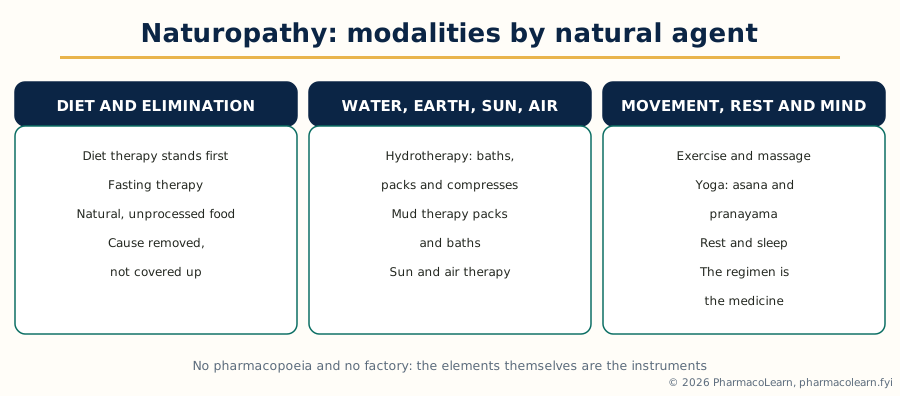 Figure: Naturopathy's modalities by agent. Diet, water, earth, sun and air, movement and rest: the elements themselves are the instruments of the drugless system.
2.3 Yoga: introduction and streams of yoga
Yoga is the discipline of body and mind that India gave to the whole family of systems, practised inside Ayurveda and naturopathy as regimen and standing in the AYUSH fold as a system in its own right. In its classical frame, codified in Patanjali's Yoga Sutras, yoga is the stilling of the fluctuations of the mind, pursued through the eight limbs of Ashtanga yoga: yama and niyama, the ethical restraints and observances; asana, posture; pranayama, breath regulation; pratyahara, withdrawal of the senses; and dharana, dhyana and samadhi, the deepening stages of concentration, meditation and absorption. The health teaching of this subject uses the middle limbs, posture, breath and meditation, which are the parts a pharmacy student will meet in practice and in the wellness industry.
The streams of yoga, the paths by which the discipline is approached, are taught as a standard set. Raja yoga is the royal path of meditation and mind control, the path of the Sutras themselves. Hatha yoga is the path of physical discipline, of asana and pranayama, from which nearly all modern posture practice descends. Karma yoga is the path of selfless action, Bhakti yoga the path of devotion, Jnana yoga the path of knowledge and enquiry, and Mantra yoga the path of sacred sound. The streams are temperamental routes to one discipline rather than rival techniques, and a complete practice combines them, with hatha supplying the body work that Sections 2.4 to 2.6 now open.
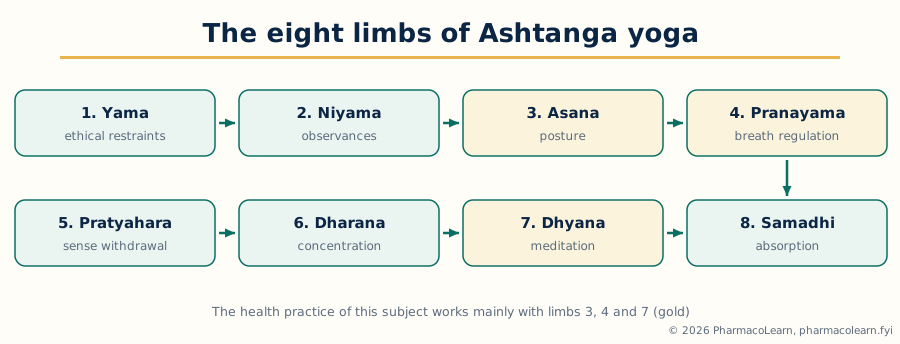 Figure: The eight limbs of Ashtanga yoga. The health practice of this subject works mainly with the middle limbs: posture, breath regulation and meditation.
2.4 Asanas
Asana, in the classical definition, is a steady and comfortable posture, and the asanas form the physical foundation of yoga practice: a large repertoire of standing, sitting, supine, prone, inverted and balancing postures, each with its prescribed method of entry, hold and release, and its traditional account of the parts and functions it engages. The teaching points for this subject are formal rather than athletic. Asanas are classified by position and by action, and are learned as named postures with correct alignment, breathing coordinated with movement, and contraindications respected, since several postures are classically and sensibly restricted in conditions such as pregnancy, hypertension and spinal disease. Their place in the systems of this unit is as regimen: in naturopathy and AYUSH practice they supply the exercise component of treatment plans, and in the wider world they are the most widely practised element of the Indian tradition, in wellness, rehabilitation support and general fitness settings.
The professional caution of this subject applies here too. The traditional accounts of what each posture does are recorded as the tradition states them; claims that a posture treats a named disease are claims, to be weighed on evidence like any drug claim, and instruction in practice rests with trained yoga teachers, whose discipline this is.
2.5 Pranayama
Pranayama is the regulation of the breath, the fourth limb of Ashtanga and the bridge in yoga practice between the body work of asana and the mind work of meditation. Its classical structure is threefold: puraka, inhalation; kumbhaka, retention; and rechaka, exhalation, performed in measured ratios and with attention fixed on the breath. The named practices of the standard teaching include nadi shodhana, alternate nostril breathing for balance, as the tradition describes it; bhramari, the humming breath; kapalabhati, the rapid cleansing breath; bhastrika, the bellows breath; and the cooling breaths sitali and sitkari, each with its method, its traditional indications and its cautions, among which the standard ones restrict forceful practices in hypertension, pregnancy and ear and eye disease. Instruction in pranayama, like instruction in asana, belongs to trained teachers, and this subject records the framework: what the practices are, how they are classified, and what the tradition holds them to do, stated as the tradition's account.
2.6 Meditation and relaxation techniques
Meditation, dhyana, is the seventh limb, the sustained, unbroken attention that the earlier limbs prepare, and in health practice the word covers a family of techniques: concentration on the breath, on a mantra, on an object or image, body scan and progressive relaxation, yoga nidra, the guided deep relaxation practised lying still, and the mindfulness methods adapted from these sources into modern wellness settings. Relaxation techniques, the practical end of the family, are taught in AYUSH and naturopathy practice as part of the regimen for stress dominated complaints. Their examination place is as the mind directed third of Unit 2's practice teaching, beside the body directed asana and the breath directed pranayama, and the same discipline of statement applies: the techniques are real, teachable and widely practised, their traditional accounts are recorded as such, and specific therapeutic claims for them are to be weighed as claims, on evidence, like any other in this degree.
2.7 Aromatherapy: introduction
Aromatherapy is the practice of using volatile aromatic oils, the essential oils of pharmacognosy, for their effects through smell and through the skin, and it enters this degree naturally, because its materials are the volatile oils of MPG103T and MPG202T and its products sit on the same shelves as the herbal cosmetics of MPG204T. In the framework of this unit it is a practice tradition of the AYUSH wellness fold rather than a classical Indian system with ancient texts: its modern form was assembled in twentieth century Europe from perfumery, massage practice and the chemistry of essential oils, and absorbed into Indian spa, wellness and naturopathy practice, which is where the syllabus meets it. Its working theory, as its practitioners state it, is that aromatic molecules act in two ways: through the olfactory pathway, where smell is held to influence mood and state directly, and through absorption in massage and bathing, where the oil is delivered in a carrier. The oils are used concentrated only in diffusion and inhalation; on the skin they are diluted, which is the subject of Section 2.9.
2.8 Aroma oils for common problems
The materia medica of aromatherapy is a shelf of standard essential oils, each with a recognised odour character and a traditional use pattern in the practice literature, and the examination expects the common ones known by name and association. Lavender oil is the practice's general oil, associated with relaxation and sleep preparations. Tea tree oil is associated with skin and scalp preparations of a cleansing character, and eucalyptus and peppermint oils with inhalation and chest rub preparations for their penetrating vapours. Citrus oils, lemon, orange and bergamot, are the uplifting oils of the practice's mood vocabulary, used in diffusion and bathing, with the standard caution that some citrus oils, bergamot classically, are phototoxic on skin exposed to sun. Rosemary and clary sage appear in hair and scalp preparations; sandalwood and frankincense in meditation and cosmetic blends. These associations are recorded as the practice tradition states them, which is the correct standing for this material: the oils are genuine pharmacognosy commodities with real chemistry and real hazards of irritation and sensitisation when misused, and their aromatherapeutic uses are practice claims of the wellness kind rather than drug claims of the pharmacopoeial kind.
2.9 Carrier oils
Carrier oils are the fixed vegetable oils in which essential oils are diluted for application to the skin, and they are the safety mechanism of aromatherapy practice: an essential oil neat on skin can irritate or sensitise, while the same oil at working dilution in a carrier can be massaged over a large area. The standard carriers are the familiar fixed oils of pharmacognosy: sweet almond oil, light and widely used; coconut oil, the base of much Indian practice; sesame oil, the classical base oil of Ayurvedic massage, which links this section back to the taila tradition of Unit 1; jojoba, a liquid wax of high stability; grapeseed and sunflower oils as light neutral carriers; and olive oil as the heavy traditional carrier. The carrier is not inert in the practice's own account: its texture, absorption and keeping quality decide the character of the preparation, and its own rancidity is the preparation's chief stability fault, which is why aromatherapy products live under the stability discipline taught in Unit 3. With carrier oils the unit closes where it began, at the boundary of pharmacy: drug class materials, handled with pharmaceutical judgement, in the service of a practice system.
Unit 3: Formulation Development of the Indian Systems
3.1 The pharmacopoeias and texts as the working sources
Formulation development in the Indian systems does not begin from a blank page; it begins from the books. Every classical formulation a manufacturer may sell traces to a text recognised in the First Schedule of the Drugs and Cosmetics Act, and its working recipe, in the modern statutory sense, is the one printed in the system's formulary: the Ayurvedic Formulary of India for Ayurveda, the Siddha Formulary of India for Siddha, the National Formulary of Unani Medicine for Unani, and the pharmacopoeial directions of the Homoeopathic Pharmacopoeia of India for Homoeopathy, with the pharmacopoeias of Section 1.7 supplying the standards for the ingredients and for those finished products they monograph. The salient feature of ISM formulation work follows directly: development here means faithful realisation of a textual formulation at manufacturing scale, with modern standardisation wrapped around it, and a genuinely new ISM product, a proprietary medicine, must declare its textual or reasoned basis and pass the licensing scrutiny that Unit 4 describes. The classes of formulation in the next four sections are therefore taught as the pharmacopoeias and texts present them: by class, by technique and by the purpose each technique serves, without quantities, which belong to the formulary texts themselves.
3.2 Ayurvedic formulation classes and their preparation techniques
The Ayurvedic classes arrange themselves by the operation that defines them. The aqueous classes come first in classical order: swarasa, the expressed juice of the fresh drug; kalka, the paste; kwatha, the decoction, in which coarse drug is boiled down in water and strained, the base liquid of the whole pharmacy; hima, the cold infusion; and phanta, the hot infusion. These are short lived preparations, and their industrial descendants are the extracts and liquid orals of the modern factory. The powder and pill classes follow: churna, fine sieved powders of one or more drugs, and vati, pills made by rolling a powdered mass with a liquid medium and drying, the class into which much of the mineral containing pharmacy also falls. The lipid classes, sneha kalpana, cook drugs into ghee or oil: the drug paste and decoction are processed into the fat until the classical end points of the cooking are reached, judged by the traditional signs of completion, and the resulting ghrita and taila carry the fat soluble and processed constituents in a stable, dosable form.
The remaining classes are the distinctive technologies. Sandhana kalpana, the fermented class of asava and arishta, sets a decoction or juice with sugar or jaggery and a fermenting flower, classically dhataki, in sealed vessels until fermentation generates its own alcohol, which then extracts and preserves; the manufacturer's art lies in controlling a living process to a consistent alcohol content and character. Rasaushadhi, the herbo mineral pharmacy, works the mineral class through shodhana, purification, the Ayurvedic parallel of Suddhi; bhavana, repeated levigation of the material with prescribed liquids; and puta, controlled incineration in sealed crucibles under measured fuel heat, repeated until the product, a bhasma, passes the classical tests of fineness and quality, tests such as floating on water and filling the lines of the fingertip, which are genuine physical checks of particle fineness whatever else is claimed for them. Parpati, made by pressing a molten mineral preparation between leaves into flakes, and kupipakwa preparations, sublimed in glass bottles under graded heat, complete the classical mineral repertoire. The examination asks for the salient features of these techniques: the operation, its product class and its purpose, at exactly the level given here.
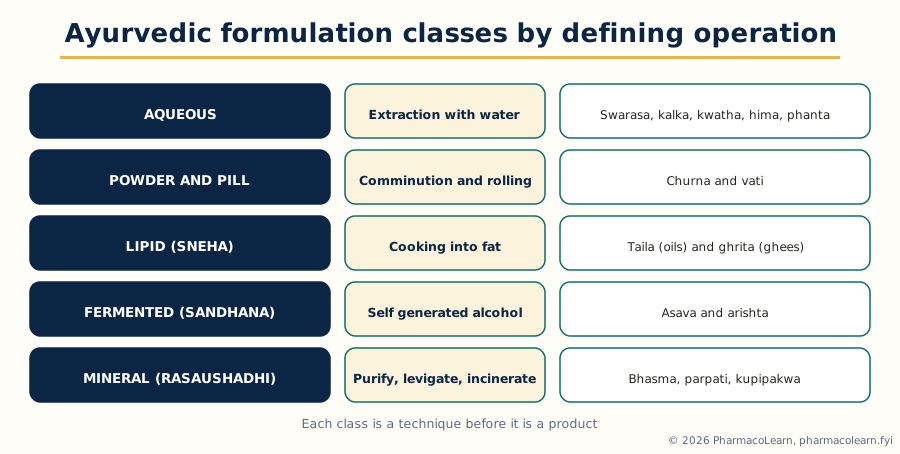 Figure: The Ayurvedic formulation classes by their defining operation. Each class is a technique before it is a product: extraction, powdering, lipid cooking, fermentation and the mineral operations.
3.3 Siddha formulation techniques
Siddha formulation technique rests on the Gunapadam classification of Unit 1 and divides by its three drug classes. The herbal preparations parallel the Ayurvedic ones in Tamil dress: chooranam, the powders; kudineer, the decoctions; nei, medicated ghees; and ennai, medicated oils, prepared by processing drugs into the fat as in the sneha method. The mineral pharmacy is where Siddha technique is most itself. Parpam, the white calxes, are produced by grinding the purified metal or mineral with herbal juices and subjecting the cakes to puta, calcination, in sealed earthen vessels, repeatedly, until a fine white powder results. Chenduram, the red preparations, carry the same operations to the red oxide and sulphide type products. Chunnam are the alkaline preparations, kalangu the pill like hardened preparations, and kattu the bound forms in which a processed material is held in a stable lump by treatment with specified juices, each class defined by its operation and end form. Mezhugu, the wax like preparations, complete the standard list. Across all of them the doctrine of Section 1.11 governs: no mineral enters these operations unpurified, and the classical tests of the finished calx, fineness above all, are the technique's own quality gate, which modern manufacture supplements with the instrumental analysis of Section 1.8.
3.4 Unani formulation techniques
Unani pharmacy, the saidala of the classical texts, works with techniques that partly parallel the Ayurvedic and partly reflect its own Greco-Arab inheritance. Its powder class is the safoof; its pill classes habb and qurs; its characteristic semi solids are the majoon, an electuary in which powdered drugs are worked into a honey or sugar base, with jawarish and khamira as its lighter and fermented relations; sharbat carries drugs in syrup; laooq is a linctus like preparation taken slowly; arq, the distillate, is made by distilling aromatic drugs with water, the direct counterpart of the Ayurvedic arka; roghan are the medicated oils; and marham the ointments and qairooti the wax based preparations for external use. The techniques are those of any classical pharmacy: comminution and sieving for the powders, incorporation into the sweet bases at controlled consistency for the electuaries, distillation for the arq, and expression and maceration for the oils. What the Unani Formulary adds is the same architecture as the other systems: named classical formulations with fixed ingredient lists, so that development means standard realisation, exactly as Section 3.1 stated.
3.5 Homoeopathic preparation techniques
Homoeopathic pharmacy is the most procedurally distinctive in this unit, because its preparations are defined by a process with no counterpart elsewhere: potentisation. Manufacture begins from the mother tincture, the starting solution prepared from the raw drug, for plant drugs by maceration or percolation with alcohol of pharmacopoeial strength, and standardised as the Homoeopathic Pharmacopoeia of India directs. From the mother tincture the dilutions are made in series: at each step one part of the previous strength is diluted in the prescribed proportion of vehicle, alcohol and water for liquids, on one of the two pharmacopoeial scales, the decimal scale of one to ten or the centesimal scale of one to a hundred, and the step is completed by succussion, a defined number of vigorous downward strokes of the vial, which the system's doctrine holds to be as essential as the dilution itself. Insoluble substances begin as triturations, ground in series with lactose in mortar by a timed procedure until a soluble strength is reached, from which liquid potencies continue. The finished potencies are delivered as the liquid dilution itself, or medicated onto globules and pellets of cane sugar, or in tablets and external forms such as ointments and liniments prepared from the tinctures. The manufacturer's discipline, examined here as technique, is one of serial accuracy, scrupulous cleaning between remedies, since the same vessels carry many, and exact labelling of name and potency, the two facts on which the whole system turns: a homoeopathic medicine whose substance or potency is wrong is not a weak medicine but the wrong one.
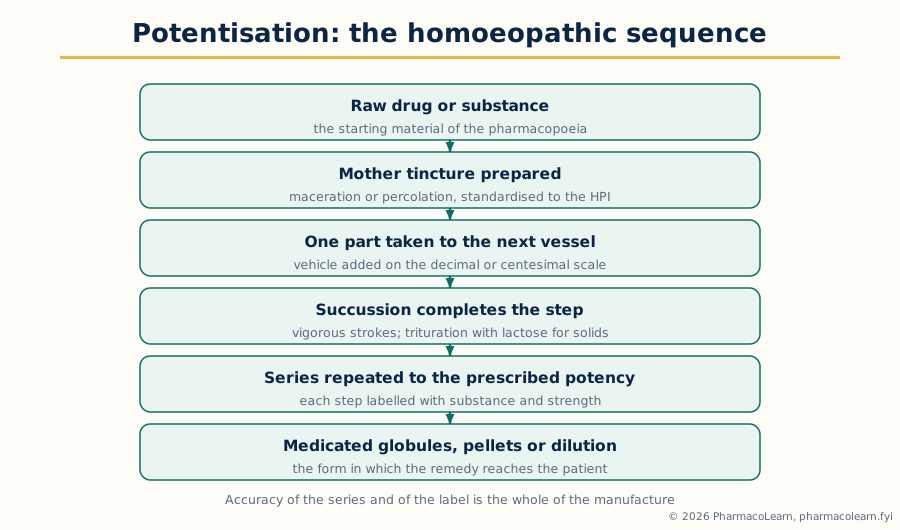 Figure: Potentisation as a manufacturing sequence. Each step is a defined dilution completed by succussion or trituration, and the label must carry substance and potency exactly.
3.6 Standardization of ISM formulations
Standardization is the process by which a classical formulation, defined by a text, is made reproducible in a factory and demonstrable in a laboratory, taught here as a chain of controls rather than as a single test. The chain begins with the raw materials, each certified against its pharmacopoeial monograph by the identity, purity and quality work of Section 1.8; a formulation made from uncertified drugs cannot be standardised afterwards, because no finished product test can recover information the batch never had. The second control is the process itself: the classical method translated into a written manufacturing procedure with defined quantities, times, temperatures and end point tests, so that the textual instruction becomes an auditable operation, the same conversion Schedule T demands in Unit 4. The third control is the finished product specification: organoleptic characters, physico-chemical constants, fingerprint against a reference batch, marker assays where characteristic ingredients carry established markers, and the microbial and contaminant limits of the pharmacopoeias. Where a classical formulation has no established marker, the standard practice is honest about it: fingerprint and process control carry the weight, and consistency with the reference profile, not an invented assay, is the claim.
Standardization of an ISM formulation
  Classical text and formulary entry identified
        |
        v
  Every raw material certified to its monograph
        |
        v
  Textual method written as a controlled procedure
        |
        v
  In process end points checked (classical and physical)
        |
        v
  Finished product: fingerprint, markers, constants, limits
        |
        v
  Batch released against the specification
3.7 Shelf life and stability studies of ISM formulations
A classical text may say that a preparation keeps, but a modern label must print an expiry, and the distance between those two statements is the shelf life and stability work of this section. Shelf life for ISM formulations is assigned from evidence of two kinds. The first is the classical and formulary record itself, which for many classes carries traditional keeping periods, long for the fermented and mineral preparations, short for the aqueous ones, and which the licensing framework respects as the starting position. The second is the modern stability study, adapted from the general pharmaceutical pattern: batches stored under defined conditions of temperature and humidity, long term and accelerated, and tested at intervals for the characters that can fail, appearance, odour and taste, moisture, physico-chemical constants, fingerprint and marker content, alcohol content in the fermented class, and microbial quality, until the point at which the product leaves its specification defines the supported shelf life. The failure modes differ by class and should be known: aqueous liquids spoil microbially; churnas cake, lose volatiles and take up moisture; tailas and ghritas turn rancid by oxidation; asavas continue to change slowly in the bottle; bhasmas, the most stable class, still demand protection from moisture. Packaging is part of the study, since the container that admits air and damp decides the result as surely as the formula. The conclusion is the standard one of this degree: shelf life is not a property a product has by tradition, it is a period demonstrated by a study and printed as a promise the manufacturer must keep.
Unit 4: Schedule T and Quality Assurance in ISM Manufacture
4.1 Why ISM manufacture has a GMP of its own
Ayurvedic, Siddha and Unani medicines are drugs in Indian law, manufactured for sale under licence, and a licensed drug industry needs a good manufacturing practice fitted to its materials and methods. The general drug industry works under Schedule M of the Drugs and Cosmetics Rules; the ISM industry works under Schedule T, the schedule of the same Rules that prescribes GMP for Ayurvedic, Siddha and Unani medicines, notified in 2000 and binding as a condition of the manufacturing licence. Its premise is exactly the premise of this subject: a classical formulation is only as good as the factory that realises it, because identity can be lost in a dirty store, strength in a wrong process and safety in a contaminated vessel, in a traditional factory as surely as in a synthetic one. Schedule T therefore translates the classical pharmacy into auditable requirements under the heads the syllabus prints: its objectives and components, infrastructure, working space, storage, machinery, standard operating procedures, health and hygiene, and documentation. This unit teaches it in that order, and the student should note what Schedule T is not: it is not a judgement on the classical systems themselves, and it changes no formulation by a single ingredient; it governs only how faithfully and cleanly the formulation is made.
4.2 Objectives and components of GMP under Schedule T
The objectives of Schedule T, in its own terms, are that the raw materials used are authentic, of prescribed quality and free from contamination; that the manufacturing process is the prescribed process, performed so as to maintain the standards; that adequate quality control measures are adopted; and that the finished drug released for sale is of acceptable quality. Those four objectives, authenticity, prescribed process, quality control and acceptable product, are the whole of GMP in one sentence, and every component that follows is machinery for making them true. The components, as the schedule organises them, fall into two parts. The first part states the general requirements that apply to every unit: factory premises and their situation and construction; the warehousing and storage arrangements; the machinery and equipment; the standard operating procedures; health and hygiene of personnel; documentation and records; and the quality control expectations. The second part works through the categories of Ayurvedic, Siddha and Unani dosage forms, the classes of Unit 1 and Unit 3 grouped for the purpose, and states the minimum working space and the machinery and equipment expected for each category, so that a unit licensed for fermented liquids must show the vessels and space that fermentation honestly needs, and a unit making mineral preparations must show the furnaces and grinding equipment of that pharmacy. Sections 4.3 to 4.8 open each component in turn.
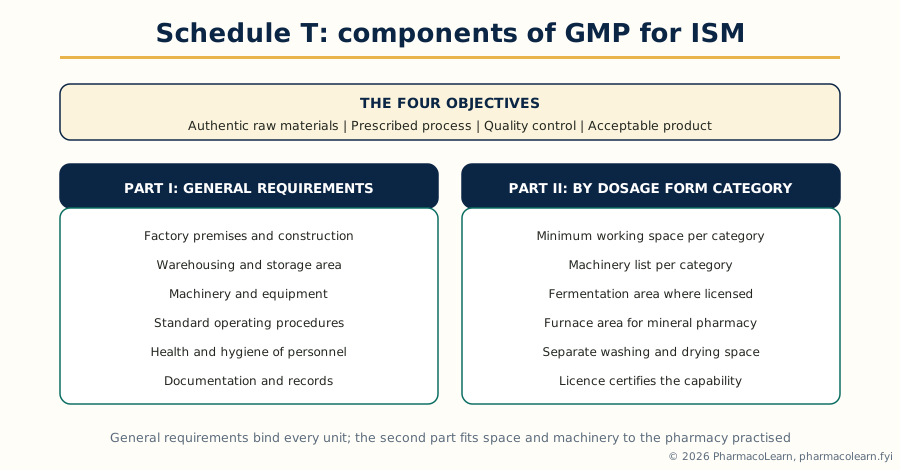 Figure: The components of Schedule T. General requirements bind every unit; the second part sets space and machinery category by category of dosage form.
4.3 Infrastructural requirements: location and building
The infrastructural requirements begin before any machine is installed. The factory premises must be located and constructed so that manufacture is protected from the surroundings and the surroundings from manufacture: sited away from open drains, public lavatories and sources of contamination, in a building designed for the work, with surfaces that can be cleaned and a layout that separates the dirty operations, raw drug washing and grinding, from the clean ones, filling and packing. The schedule expects the manufacturing area to be organised as a flow: raw material enters at one end through its store, passes through processing, and leaves as packed product, without crossing streams in which finished goods meet raw waste. Separate provision is expected for the operations whose character demands it: the furnace area for the mineral pharmacy, the fermentation area for asava and arishta, and space for the washing and drying of crude drugs, which in this industry is a major operation and not a corner of the yard. These are the requirements of any honest factory, restated for a pharmacy whose raw materials arrive as roots, barks and minerals rather than as drums of fine chemicals.
4.4 Working space and storage area
Working space under Schedule T is prescribed as a minimum, and prescribed by category: the schedule's second part assigns to each group of dosage forms the area in square feet that its manufacture requires, so that the licence itself certifies that the factory can physically perform the operations it claims. The principle beneath the numbers, which is what this subject examines, is that each operation must have room to be done properly and separately: grinding without dusting the packing line, fermentation without crowding the boiling vessels, and the mineral operations with their furnaces and repeated calcinations given their own territory. Storage receives equal weight, and in three divisions: the raw material store, where drugs are kept identified, off the floor, protected from moisture, pests and mix up, with the poisonous and mineral drugs under their own control; the in process and quarantine arrangements, by which material waits, labelled, for its quality verdict; and the finished goods store, from which alone released product may leave. In an industry whose materials are seasonal harvests bought in bulk, the store is where quality is first kept or first lost, and Schedule T's insistence on it is the factory echo of the raw drug doctrine of Section 1.10.
4.5 Machinery and equipment
The machinery component of Schedule T lists, by dosage form category, the equipment a unit must possess: the grinders, pulverisers and sieves of the powder pharmacy; the boilers, extraction vessels and strainers of the aqueous classes; the fermentation vessels of sandhana; the furnaces, crucibles and grinding machinery of the mineral classes; the distillation apparatus for arka; the filling, sealing and labelling equipment of the packing end; and the basic quality control instruments by which the factory checks its own work. Two features deserve notice. The list is a floor, not a ceiling: it names the minimum by which the licensed categories can honestly be made, in traditional or modern form, and a factory may exceed it freely. And the schedule admits the traditional implements of the classical pharmacy where they genuinely perform the operation, which is why the ISM factory is a regulated hybrid, classical in method and modern in discipline, exactly as Unit 3 described its formulations.
4.6 Standard operating procedures
Standard operating procedures are the written form of the factory's discipline: a procedure for every recurring operation, stating what is done, by whom, with what, and how it is recorded, covering the receipt and sampling of raw materials, their cleaning and processing, each manufacturing operation, the cleaning of equipment and premises between products, the maintenance of machinery, and the quality control checks at each stage. Their function in the ISM setting is the conversion named in Unit 3: the classical text says what the medicine is, the formulary says how it is classically made, and the SOP says how this factory, with these machines and these workers, makes it the same way every time. An inspector reading the SOPs can walk the factory in paper before walking it in fact, and a deviation discovered in a batch can be traced to the procedure that allowed it, which is what makes the SOP set, rather than any single machine, the real instrument of good manufacturing practice.
4.7 Health and hygiene
The health and hygiene component governs the people, on the standard GMP reasoning that the worker is the most mobile source of contamination in any factory. Schedule T expects the personnel engaged in manufacture to be medically fit and free from infectious disease, to observe personal hygiene, and to wear the protective clothing the work requires; it expects the premises to be kept clean, with arrangements for washing, for the exclusion of pests, and for the separation of the manufacturing areas from eating, drinking and other domestic use. In the ISM factory the component carries an extra weight, because so much of the pharmacy is open handling: drugs washed by hand, pastes ground and levigated, pills rolled, liquids strained and filled, and mineral powders, some of them preparations of toxic starting materials, weighed and ground in quantity. Hygiene here protects the worker as directly as the product, and the examination treats the component with that double sense.
4.8 Documentation and records
Documentation is the final general component and the one that makes all the others provable. The records Schedule T expects a unit to maintain cover the life of every batch: the raw material records, showing each drug received, its identification and quality verdict and its issue to manufacture; the batch manufacturing record, showing the formulation made, the quantities and batch numbers of every ingredient, the operations performed and their dates, the in process checks and the yield; the quality control record of the finished product against its specification; and the distribution record, by which every consignment sold can be traced to the batch it came from, so that a complaint or a recall can find its product. Records must be retained for the period the Rules prescribe beyond the product's shelf life. The principle is the GMP principle of every system in this degree: if it is not recorded, it did not happen, and a classical name on the label is not a record.
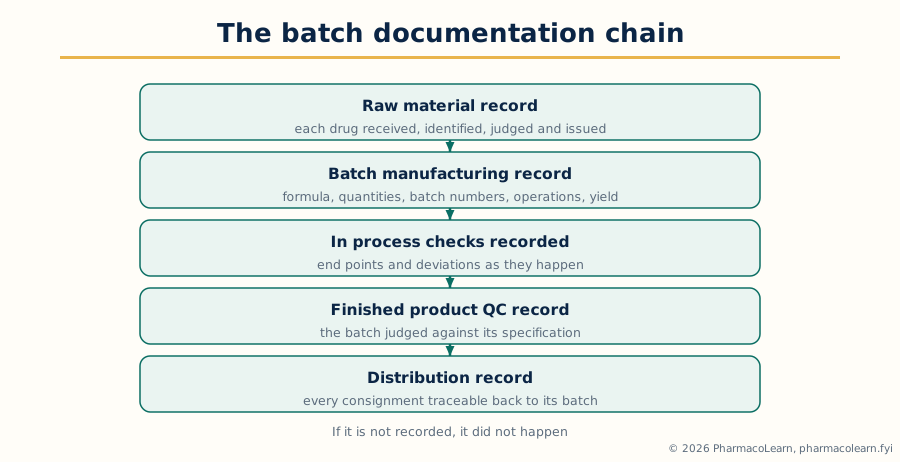 Figure: The documentation chain. Every batch carries its own paper life, from the raw material verdict to the consignment that can be traced back to it.
4.9 Quality assurance in the ISM industry: GAP, GMP and GLP
Quality assurance for an ISM product is a chain of three good practices, each guarding one stage of the product's life, and the syllabus names the chain explicitly. GAP, good agricultural practices, guards the field stage: the cultivation and collection of the medicinal plants themselves, the subject MPG102T taught as good agricultural and collection practice, by which the wild and farmed raw material arrives identified, uncontaminated and of the right part and season. GMP, good manufacturing practice, guards the factory stage, and for this industry it is Schedule T, the whole of Sections 4.1 to 4.8. GLP, good laboratory practice, guards the testing stage: the discipline of the laboratories, the manufacturer's own and the independent ones, in which the identity, purity, quality and safety studies on which release and licensing rest are performed under documented, auditable conditions. The chain's logic is the logic of the whole degree: quality cannot be inspected into a product at the end, it is built at the field, kept at the factory and proven at the laboratory, and a failure at any link reaches the patient through all the links below it.
The quality chain of an ISM product
  GAP: the field
  (identified, clean, correct raw material)
        |
        v
  GMP: the factory (Schedule T)
  (prescribed process, recorded batches)
        |
        v
  GLP: the laboratory
  (auditable testing and safety studies)
        |
        v
  A product whose quality can be shown
4.10 Documents for new drug application and export registration
An ISM manufacturer placing a new product on the market, or an existing product on a foreign market, must convert the factory's discipline into documents a regulator can judge. For a new drug application in the domestic framework, the dossier assembles the product's identity and basis: the classical textual reference or the rationale for a proprietary formulation, the complete composition, the manufacturing method and its controls, the raw material and finished product specifications with their test methods, the stability evidence supporting the shelf life of Section 3.7, the safety and, where the category demands it, clinical evidence standing behind the claims, and the draft label with its claims stated exactly as they will be sold. For export registration the same core is re-cut to the importing country's pattern, with the additions foreign regulators characteristically require: the manufacturing licence and the GMP certificate evidencing Schedule T compliance, the free sale certificate from the home authority, pharmacopoeial specifications for the product and its ingredients, and the importing country's own labelling and claim rules, which differ sharply between countries that register traditional medicines and countries that admit them only as supplements or not at all. The professional point is constant: the dossier is not paperwork added to the medicine, it is the medicine's evidence, organised for judgement, and a product whose documents cannot be assembled was never as ready as its factory believed.
4.11 Challenges in monitoring the safety of herbal medicines
The syllabus closes the unit with the safety problem, under its three printed heads: regulation, quality assurance and control, and national and regional pharmacopoeias. Under regulation, the challenge is structural: herbal and ISM products reach the market by routes, classical licensing, traditional use registration, supplement sale, that ask for less premarket safety proof than a new synthetic drug faces, so the safety system leans heavily on monitoring after sale, in populations who often do not tell their physicians they are taking the product, and who attribute harms to their disease; under reporting is therefore not an accident of the system but its predictable state. Under quality assurance and control, the challenge is the material itself: a variable natural product, open to species substitution, contamination and the adulteration of MPG202T, whose harms are quality failures before they are pharmacology, together with the mineral preparations of Units 1 and 3, whose declared ingredients include substances toxic in any other context and whose safety rests wholly on the processing and testing that only audit can verify. Under pharmacopoeias, the challenge is coverage and convergence: national and regional pharmacopoeias, the API and its sister volumes among them, together with the WHO monographs, do not yet cover every drug in commerce, do not always agree in their limits, and leave manufacturer and regulator to judge unlisted material by analogy. The response the subject builds toward is the one its units have assembled piece by piece: authenticate the material, manufacture under Schedule T, test against the pharmacopoeia, label honestly, and monitor after sale with the expectation of finding harm, since a monitoring system that expects nothing will find nothing until the harm is large.
Unit 5: Traditional Knowledge, Geographical Indications and the AYUSH Research Bodies
5.1 The Traditional Knowledge Digital Library
The Traditional Knowledge Digital Library, TKDL, is India's defensive answer to a legal problem that the 1990s made famous. Traditional knowledge like that of Units 1 and 3 is old, published in classical languages and collectively held, yet patent offices abroad, searching only modern databases in modern languages, repeatedly granted patents on it to private applicants: the turmeric wound healing patent granted in the United States, the neem fungicide patent granted in Europe and the basmati rice patent are the standard teaching cases, each eventually revoked or narrowed after India proved, from its own classical texts, that the claimed invention was already known. The TKDL, established in 2001 as a joint project of the Council of Scientific and Industrial Research and the government department responsible for the Indian systems, closes the gap at its source. It is a database in which the formulations and practices of the classical texts of Ayurveda, Unani, Siddha and Yoga have been transcribed, translated into the major international languages, English, German, French, Spanish and Japanese among them, and classified under a purpose built system, the Traditional Knowledge Resource Classification, designed to be retrievable by patent examiners in the form their searches take. The library is not public: access is given to patent offices under agreement, for use as prior art in examination, so that an application claiming a classical formulation meets the text that defeats it before the patent is granted, rather than in a revocation fight after.
How the TKDL defends a classical formulation
  Classical text (Sanskrit, Tamil, Arabic, Persian)
        |
        v
  Transcription and translation into examiner languages
        |
        v
  Classification under the TKRC headings
        |
        v
  Patent office searches the TKDL as prior art
        |
        v
  Application on known knowledge refused or withdrawn
The examination points are the mechanism and the limit. TKDL is defensive protection: it prevents others from patenting the tradition, it grants the tradition no rights of its own, and it works only where examiners can and do search it. It is, even so, the model the world cites for the documentation defence of traditional knowledge, and it is the natural completion of this subject's arc, because the same classical texts that Unit 1 read as pharmacy are read here as legal evidence.
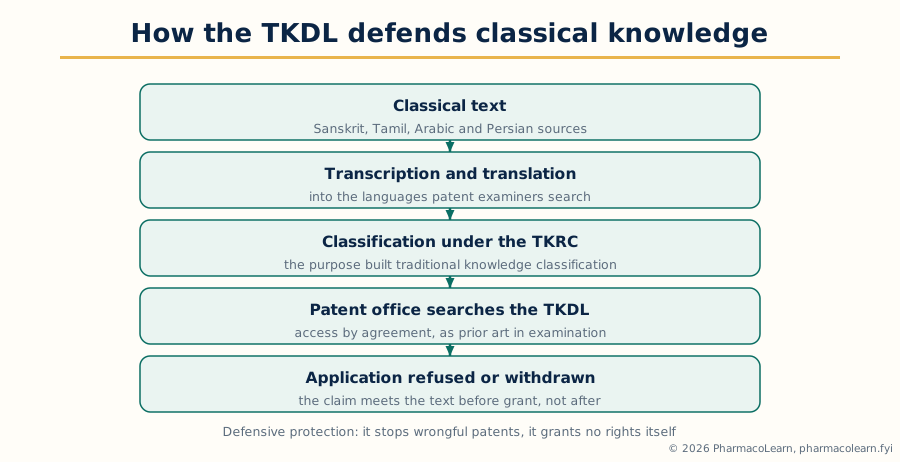 Figure: The TKDL defence. The classical text is made searchable in the examiner's own language and classification, so the patent is stopped at examination, not fought after grant.
5.2 Geographical indications
Where the TKDL defends knowledge, the geographical indication defends origin. A geographical indication is a sign that identifies a product as originating in a place whose geography, soil, climate or traditional skill gives the product its character, and in India it is protected under the Geographical Indications of Goods (Registration and Protection) Act, 1999, in force since 2003, notwithstanding the syllabus's printing of the head as the Geographical Indication Bill: registration is granted for ten years at a time and renewable, and the registered proprietor and authorised users may exclude others from selling goods under the indication that do not come from the place. Darjeeling tea, the first Indian registration, is the standard example of the mechanism. The relevance to this subject runs through the raw material trade of the ISM and herbal industries: a number of the produce on which traditional pharmacy depends, spices, aromatic and regional specialities among them, trades partly on a place name, and a GI protects the growers of the genuine origin against both foreign appropriation of the name and domestic passing off of material from elsewhere. The student's summary should hold the two instruments of this unit apart: a patent rewards a new invention and is defeated by TKDL prior art, a GI rewards a place and its accumulated practice and is defeated by goods that are not from the place; together they cover the two ways traditional pharmacy can be taken, its knowledge and its names.
5.3 Government action in AYUSH and ISM
The third head of the unit is governmental: the bills, measures and institutional building by which the Indian state has raised the systems of this subject from tolerated practice to administered sector. The landmarks the examination expects are structural. The Indian Medicine Central Council Act of 1970 put Ayurveda, Siddha and Unani education and practice under statutory councils, and its successor legislation of 2020 replaced it with the National Commission for Indian System of Medicine, modernising the regulatory frame; Homoeopathy followed the parallel path through its own central council legislation to its own national commission. The Department of Indian Systems of Medicine and Homoeopathy, later the Department of AYUSH, grew inside the health ministry until, in 2014, AYUSH became a ministry of its own, the institutional fact behind every other development in this subject: the pharmacopoeia commission, the research councils of the next sections and the Schedule T enforcement machinery all run through it. Government bills in AYUSH, in the syllabus's phrase, are therefore best understood as a continuing legislative programme: education and practice regulated, pharmacopoeias given legal force, research funded through statutory councils, and the sector's products brought progressively under the drug law of Unit 4. The direction of travel is one this subject has taught throughout: the systems keep their classical content, and the state steadily builds the modern apparatus of standards, licences and evidence around them.
5.4 CCRAS: research in Ayurvedic sciences
The Central Council for Research in Ayurvedic Sciences, CCRAS, is the apex research body for Ayurveda under the Ministry of AYUSH, the first of the four councils the syllabus names, and its pattern is the pattern of them all. The councils in their present separate form date from the reorganisation of the earlier combined research council for Indian medicine and Homoeopathy, and CCRAS today runs a network of research institutes across the country. Its mandate is the scientific investigation of the Ayurvedic tradition on the tradition's own material: literary research and publication of the classical texts, surveys and documentation of medicinal plants and of living practice, pharmacological and pharmaceutical studies of Ayurvedic drugs and formulations, and clinical research on Ayurvedic treatments, together with the standards and monographs that feed the pharmacopoeia work of Unit 1. The council is, in effect, the state's instrument for converting the claims of the classical literature into tested knowledge by the methods of this degree, and its published trials and drug research are the standard primary literature an M.Pharm student will cite.
5.5 The sister councils: CCRS, CCRH and CCRU
The remaining three councils repeat the CCRAS pattern for the other systems of Unit 1, and they are best learned as a set. CCRS, the Central Council for Research in Siddha, serves the Siddha system from its base in Tamil country; it is the youngest of the four in its separate form, the Siddha research units having been carried for many years inside the Ayurveda council's structure before the separate council was constituted, a history that mirrors the Gunapadam tradition's own position as a fully formed system long administered in Ayurveda's shadow. CCRH, the Central Council for Research in Homoeopathy, serves Homoeopathy, running its institutes and its clinical and drug proving and standardisation work, including the verification of the proving pictures on which its materia medica rests. CCRU, the Central Council for Research in Unani Medicine, serves the Unani system, with its institutes, its literary research on the Arabic and Persian corpus and its clinical and pharmacological studies of Unani drugs and regimens. Two further councils complete the AYUSH research family in practice, the council for Yoga and Naturopathy research and the council for Yoga's sister discipline, and the national institutes and pharmacopoeia laboratories stand beside the councils in the ministry's structure; but the syllabus names four, and the four share one description that the examination rewards: each is the apex body, under the Ministry of AYUSH, for the scientific validation, standardisation and propagation of its system, working through its own institute network, journals and research programmes.
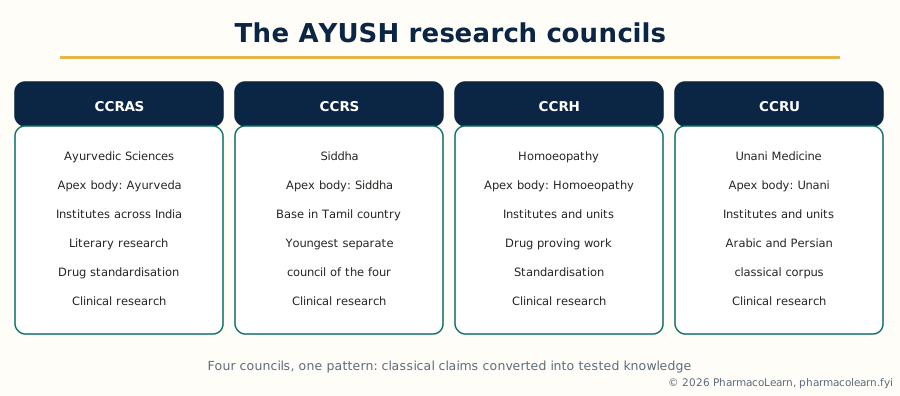 Figure: The four research councils named in the syllabus. Each council is its system's apex research body, and together they convert classical claims into tested knowledge.
5.6 How the pieces of the subject fit
The unit, and with it the subject, can now be closed by fitting its pieces together, because the five units were always one argument. The Indian systems are complete traditions, Unit 1, with their own accounts of body, drug and balance, and with practice systems of regimen beside them, Unit 2. Their medicines are classical formulations realised by defined techniques, Unit 3, and now standardised, shelf life tested and made in licensed factories under Schedule T and the GAP, GMP and GLP chain, Unit 4. Their knowledge and their names are defended by the TKDL and the geographical indication, and their claims are progressively examined by the research councils of their own ministry, Unit 5. What a pharmacognosist adds to this inheritance is the discipline of standing: to say of every statement in this field whether it is the classical text speaking, tradition speaking from long use, or evidence speaking from test, and to manufacture, analyse and label accordingly. A graduate who can do that can work anywhere in the ISM industry, the regulator's office or the research institute, without either credulity or contempt.
Frequently Asked Questions
Q: What are the fundamental concepts of Ayurveda that every pharmacognosy student must know? The panchamahabhuta or five elements, the tridosha of vata, pitta and kapha whose balance is health, the seven dhatus, agni the digestive fire, and the five properties by which a drug is judged: rasa, guna, virya, vipaka and prabhava. Unit 1, Sections 1.1 and 1.2 give the full account.
Q: What is Gunapadam in the Siddha system? Gunapadam is Siddha pharmacology, the classical study of its drugs: their sources, characters, properties and preparation. It classifies the materia medica by origin into the herbal class, the mineral and metal class called Thadhu or Dhatu drugs, and the animal class called Jeevam, and it prescribes the purification, Suddhi, on which the mineral pharmacy depends. See Sections 1.9 to 1.11.
Q: What is Suddhi and why does it matter? Suddhi is the purification process by which a raw drug, above all a metal, mineral or poisonous plant drug, is treated before use, through washing, treatment in liquid media, trituration and calcination, until it passes the classical tests of the purified state. It matters because the safety claim of the Siddha and Ayurvedic mineral medicines rests on this process, so it is the point where classical doctrine, manufacturing discipline and modern safety testing meet. See Section 1.11.
Q: What is the Ayurvedic Pharmacopoeia of India and what force does it carry? The API is the official book of standards for Ayurvedic drugs, Part I monographing single drugs and Part II compound formulations, published under the Ministry of AYUSH. Its standards are the legal standards for Ayurvedic medicines manufactured and sold under the Drugs and Cosmetics Act, so a product failing its monograph is not of standard quality in law. See Section 1.7.
Q: What are the main dosage form families of the Indian systems? The recurring families are powders (churna, chooranam, safoof), pills (vati, habb, qurs), decoctions (kwatha, kudineer), fermented liquids (asava and arishta), distillates (arka, arq), sweet semi solids (avaleha, majoon, sharbat), medicated fats (taila, ghrita, ennai, nei), the mineral calxes (bhasma, parpam, chenduram), and for Homoeopathy the mother tinctures, dilutions and globules. See Section 1.6 and Unit 3.
Q: What is potentisation in Homoeopathy? Potentisation is the preparation process of Homoeopathy: serial dilution of the mother tincture on the decimal or centesimal scale, each step completed by succussion, or serial trituration with lactose for insoluble solids. The system's doctrine holds that the process releases the dynamic power of the substance while removing its material toxicity, and exact labelling of substance and potency is the manufacturer's central duty. See Section 3.5.
Q: What is Schedule T and what does it require? Schedule T of the Drugs and Cosmetics Rules prescribes good manufacturing practice for Ayurvedic, Siddha and Unani medicines, and compliance is a condition of the manufacturing licence. It requires authentic raw materials, the prescribed manufacturing process, quality control and an acceptable finished product, through components covering premises, working space by dosage form category, storage, machinery, standard operating procedures, health and hygiene, and documentation and records. See Unit 4.
Q: What do GAP, GMP and GLP each guard in the ISM industry? GAP, good agricultural practices, guards the field stage of cultivation and collection; GMP, for this industry Schedule T, guards the factory stage; and GLP, good laboratory practice, guards the testing stage in which identity, quality and safety are proven. Together they form the quality chain from field to laboratory. See Section 4.9.
Q: What is the TKDL and how does it protect traditional knowledge? The Traditional Knowledge Digital Library is a database of the formulations of the Ayurvedic, Unani, Siddha and Yoga classical texts, translated into the major international languages and classified so that patent examiners can search it. Patent offices use it as prior art under access agreements, so applications claiming classical knowledge are stopped at examination. It is defensive protection: it prevents wrongful patents but grants no rights itself. See Section 5.1.
Q: What are CCRAS, CCRS, CCRH and CCRU? They are the Central Councils for Research in the AYUSH systems, for Ayurvedic Sciences, Siddha, Homoeopathy and Unani Medicine respectively, the apex research bodies of their systems under the Ministry of AYUSH. Each runs research institutes and programmes in literary research, drug standardisation, pharmacology and clinical research for its own system. See Sections 5.4 and 5.5.
Complete MPG203T notes, all 5 units in one PDF, free to keep.
Other M.Pharm subjects: MPH101T · MPC101T · MPL101T · MPH102T · MPH103T · MPH104T · MPL102T · MPL103T · MPL104T · MPC102T · MPC103T · MPC104T · MPH201T · MPH202T · MPH203T · MPH204T · MPC201T · MPC202T · MPC203T · MPC204T · MPL201T · MPL202T · MPL203T · MPL204T · MRA101T · MRA102T · MRA103T · MRA104T · MRM301T · MPG101T · MPG102T · MPG103T · MPG201T · MPG202T · MPG203T · MPG104T · MPG204T · MRA201T · MRA202T · MRA203T · MRA204T · M.Pharm