
MPG104T — Industrial Pharmacognostical Technology
4 hrs/week, 4 credits, 60 hours, 100 marks. Notes follow the M.Pharm syllabus, unit by unit.
MPG104T Industrial Pharmacognostical Technology notes for M.Pharm Pharmacognosy Semester 1: herbal drug industry and scale up, GMP, TQM, GLP and ISO 9000, pharmacopoeial monographs and WHO quality assessment, stability testing and patents, with free unit wise PDF downloads on PharmacoLearn.
Units in this subject
- Unit 1 — Herbal Drug Industry
- Unit 2 — Regulatory Requirements for Setting Up the Herbal Drug Industry
- Unit 3 — Monographs of Herbal Drugs
- Unit 4 — Testing of Natural Products and Drugs
- Unit 5 — Patents
Download MPG104T PDF Notes
Free PDFs for this subject, one per unit:
Industrial Pharmacognostical Technology, subject code MPG104T, is the fourth core theory subject of M.Pharm Pharmacognosy, Semester 1. It carries 4 credits and 60 hours of theory, taught at 4 hours per week, for 100 marks. Its scope, as the syllabus states it, is to understand the industrial and commercial potential of drugs of natural origin, to integrate traditional Indian systems of medicine with modern medicine, and to know the regulatory and quality policy for the trade of herbals and drugs of natural origin. Where the earlier subjects of the semester ask what a plant contains and how it is proved, this subject asks how a plant drug becomes an industry: what infrastructure turns raw herbs into standardised extracts and finished dosage forms, what rules govern setting up and marketing that industry, how pharmacopoeias and the WHO judge its products, how natural products are tested in the laboratory and for stability, and how the law of patents protects, or refuses to protect, herbal inventions. Five units answer in order. Unit 1 covers the herbal drug industry itself. Unit 2 covers the regulatory requirements for setting it up, from global marketing and trade policy to quality assurance, TQM, GMP, GLP and ISO 9000. Unit 3 covers monographs of herbal drugs across seven pharmacopoeias and the WHO guidelines. Unit 4 covers testing of natural products, clinical laboratory testing and stability testing. Unit 5 covers patents in full, from patentability to filing, opposition, revocation and the Controllers of Patents. One discipline runs through the notes: a herbal product earns its place in trade by being standardised, documented and legally defensible, not by tradition alone.
Unit 1: Herbal Drug Industry
1.1 The herbal drug industry: from field material to finished product
The herbal drug industry is the organised production of medicines and health products from drugs of natural origin: crude herbal drugs, standardised extracts, isolated phytopharmaceuticals and finished dosage forms built from them. It differs from the synthetic drug industry at its starting point. Its raw material is grown or collected, not synthesised, so its quality begins in the field, varies with season, soil, climate and handling, and must be controlled into consistency by sorting, testing, standardisation and blending. Everything in this unit, and much of Units 2 to 4, follows from that single fact: the industry is a chain that converts a variable natural material into a reproducible product, and every link in the chain exists to remove variability or to prove that it has been removed.
The chain has five broad stages. First, sourcing: cultivation under good agricultural and collection practice, or controlled collection, with botanical authentication of the species and plant part. Second, primary processing: cleaning, drying, garbling, cutting, milling and storage under conditions that protect the constituents. Third, extraction and concentration: the drug is extracted with a chosen solvent system, the extract is filtered, concentrated and dried to a powder or soft extract of defined drug extract ratio. Fourth, standardisation and testing: the extract is assayed for its marker or active constituents, checked for contaminants, and adjusted or blended so that every batch meets the same specification. Fifth, formulation and packing: the standardised extract is built into tablets, capsules, syrups, oils, ointments and other dosage forms, packed, labelled and released against finished product specifications. The production chain diagram below shows the stages.
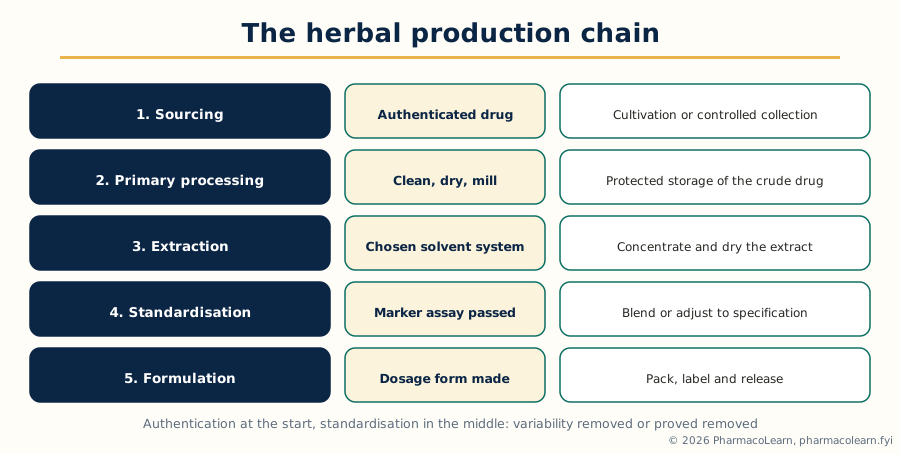 Figure: The herbal production chain. Authentication at the start and standardisation in the middle are the two points where a variable natural material is converted into a reproducible industrial product.
The industry works at several product levels, and an examination answer should be able to place a business on the ladder. At the base are traders and processors of crude drugs. Above them are extract manufacturers, who sell standardised extracts as industrial raw material to other companies. Above them are formulators, who buy extracts and make branded finished products. At the top are integrated companies that cultivate, extract, formulate, test and market under one control. The infrastructure, project planning and production management of the following sections apply at every level, with a scale and a regulatory burden that grow as the product moves closer to the patient.
1.2 Infrastructure of the herbal drug industry
Infrastructure means the complete working system the industry needs: land and buildings, plant and machinery, utilities, laboratories, stores, people and systems. The syllabus ties the infrastructure specifically to the production of standardised extracts and various dosage forms, so the account below follows the product.
For extracts, the core production infrastructure is a reception and raw material store with quarantine and approved areas, a cleaning and drying section, milling and sieving equipment, extraction vessels suited to the chosen process, filtration, evaporation and concentration equipment, drying equipment such as spray, vacuum or tray dryers, and blending and packing for the dried extract. For dosage forms, the infrastructure adds the formulation sections of Section 1.4: granulation, compression and coating for tablets; filling for capsules; preparation, filtration and filling lines for liquids; and melting, mixing and filling for semi solids. Around production sit the supporting areas every GMP plant needs: quality control laboratories, a quality assurance office, engineering and maintenance, purified water and steam utilities, effluent handling, warehouses for raw materials, packing materials and finished goods, and the offices that run documentation, purchase and dispatch.
Three infrastructure ideas carry examination weight. First, separation: dirty and clean operations, raw and finished goods, and different product families must be physically and procedurally separated so that cross contamination and mix ups cannot occur. Second, flow: materials should move in one direction, from receipt through quarantine, sampling, approval, processing and packing to dispatch, without backtracking through clean areas. Third, services decide quality as much as machines do: water quality, air handling, dust extraction and pest control are infrastructure, not decoration. A plant designed without them cannot be upgraded into compliance later without rebuilding, which is why plant design is a syllabus topic of its own in Section 1.10.
1.3 Standardised extracts: the industrial product at the centre of the unit
A standardised extract is an extract adjusted, within stated limits, to a defined content of constituents with known therapeutic activity, or, where the actives are not fully known, to a defined content of marker compounds, and produced by a controlled process from an authenticated drug of defined drug extract ratio. Each element of that definition does work. Authenticated drug fixes identity. Drug extract ratio fixes the relationship between the crude drug put in and the extract taken out, so strength can be compared between batches and suppliers. Defined marker content fixes the chemical target the assay of Unit 3 and Unit 4 measures. Controlled process fixes how the target is reached, so the whole extract profile, not only the marker, stays comparable.
Industrial standardisation is achieved by the methods of the trade, stated plainly. Batches of extract are blended so that a strong and a weak batch average to specification. Inert excipients of the permitted kind may be added to adjust a strong extract down to the declared strength. Extraction conditions, solvent strength, temperature, time and drug to solvent ratio, are held inside validated ranges so the process itself delivers consistency. What standardisation is not must also be said: it is not spiking an extract with isolated or synthetic marker to fake the assay, a practice that defeats the fingerprint logic of quality control and is treated as adulteration. The case studies of Section 1.12 return to these methods in worked form.
1.4 Dosage forms built from herbal extracts
The second half of the infrastructure phrase is various dosage forms. Herbal extracts enter the same dosage form families as any other active material, each with its own herbal difficulty. Tablets and capsules carry dry extracts, with the characteristic problems of hygroscopicity, poor flow and large dose bulk, handled by granulation, suitable diluents and moisture protective packing and coating. Liquid orals, syrups, linctuses and drops carry soft or liquid extracts and traditional preparations, with problems of precipitation, microbial growth and taste, handled by filtration, permitted preservatives, sweetening and flavouring and tight container closure. Topical forms, oils, ointments, creams and gels, carry extracts and fixed and volatile oils, with problems of rancidity, separation and skin compatibility. Traditional dosage forms of the Indian systems, churnas, kwathas, asavas and aristhas, tailas and ghritas, bhasmas and others, are manufactured in their own right under the Ayurvedic, Siddha and Unani licences and pharmacopoeias of Unit 3, and the modernisation challenge of Section 1.5 is largely about bringing such forms to documented, reproducible standards without destroying their classical character. In every family the industrial questions are the same three: can the form be made identically every batch, can its quality be tested against a written specification, and does it stay within that specification for its shelf life, the stability question of Unit 4.
1.5 Current challenges in upgrading and modernisation of herbal formulations
The syllabus asks for the current challenges in upgrading and modernisation, and the honest list begins with the raw material. Variability of plant material, species confusion and substitution, declining or unsustainable wild collection, and contamination with heavy metals, pesticides and microbes all enter before manufacture begins, and no factory process fully repairs a wrong or dirty drug. The second challenge is knowledge: for many traditional formulations the active constituents are incompletely known, so standardisation must work with markers and fingerprints rather than a single active assay, and classical processes described in texts must be translated into controlled parameters of temperature, time and proportion before they can be validated. The third challenge is evidence: modernisation increasingly demands safety and efficacy data of the kind Unit 4 describes, and generating clinical evidence for multi ingredient traditional products is slow and methodologically hard. The fourth is regulatory and commercial: different markets classify the same herbal product as a medicine, a supplement or a food, with different evidence and labelling demands, so upgrading a formulation for one market may not satisfy another, the problem behind Unit 2. The fifth is economic: modern plant, laboratories and documentation cost money that small traditional manufacturers struggle to raise, so upgrading proceeds unevenly across the industry. A good answer keeps the balance the syllabus implies: modernisation is necessary for safety, reproducibility and trade, and its challenge is to add control and evidence without discarding the traditional knowledge that made the formulations worth upgrading.
1.6 Entrepreneurship development
Entrepreneurship development is the building of the people and support system that turn technical knowledge into new herbal enterprises. In this subject it is taught as a process with recognisable stages. The prospective entrepreneur identifies an opportunity in the herbal sector, a local drug resource, an underserved product, a processing gap such as drying or extraction that cultivators cannot do themselves. The idea is then tested for feasibility: raw material availability across seasons, market demand, competition, regulatory route and cost. The enterprise is planned in the project report of Section 1.8, financed through the capital routes of Section 1.9, registered and licensed, set up, and then run through its early fragile period. Entrepreneurship development programmes, run by government agencies, industry departments, banks and training institutes, support this process with training in project preparation, finance, marketing and regulation, and with schemes of credit and subsidy directed at small industry. For pharmacy graduates the subject carries a direct message: pharmacognosy knowledge is itself an entrepreneurial asset, because the founder who can authenticate a drug, design an extraction and read a monograph can judge a herbal project from the inside, which most general investors cannot.
1.7 Project selection
Project selection is the disciplined choice of which herbal enterprise to undertake, and it is where most later success or failure is decided. The standard criteria, applied in order, form a screen that weak projects fail early. Raw material: is the drug available in the needed quantity and quality, across the year, at a workable price, from cultivation or sustainable collection, and can its identity be assured? Market: who buys the product, at what level of competition, through which channel, and is the demand durable or a passing fashion? Technology: is the process known and available, can the entrepreneur obtain the technical knowledge of Section 1.9, and does the needed machinery exist at the intended scale? Regulation: what licence and pharmacopoeial standards apply, and can the project meet GMP and testing requirements from the start? Finance: does the project size match the capital that can actually be raised, with working capital for the seasonal purchase of plant material honestly included? Location: does the site give access to raw material, labour, utilities, transport and market, without violating zoning and pollution rules? The selection flow below shows the screen as a sequence of gates.
Identify the herbal product or service opportunity
        |
Check raw material: quantity, quality, season, sustainability
        |
Check the market: buyers, competition, channel, durability
        |
Check technology and technical knowledge: process available?
        |
Check the regulatory route: licence, GMP, pharmacopoeia
        |
Check finance: project cost against capital that can be raised
        |
Check location and infrastructure
        |
All gates passed: proceed to the detailed project report
Any gate failed: modify the project or select another
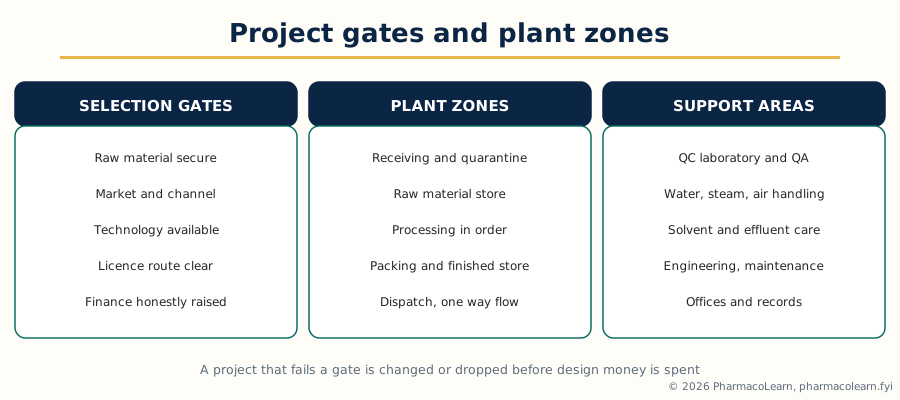 Figure: Project selection as a sequence of gates, and the plant zones those decisions produce. A project that fails a gate is modified or dropped before money is spent on design.
1.8 The project report
The project report is the written document that presents the selected project to banks, financial institutions, investors and licensing authorities, and on which the decision to finance is largely taken. Its standard contents should be known as a list. An introduction and the promoter profile, with qualifications and experience. The product description and its uses and market. The market survey: demand, supply, competition and marketing plan. The technical section: process of manufacture step by step, plant capacity in general terms, machinery list, raw material requirement, utilities and manpower. The location and site, building and layout plan. The financial section: project cost broken into land, building, machinery, preliminary expenses and working capital; the means of finance; cost of production; sales realisation; profitability estimates; break even analysis; and repayment schedule. Implementation schedule, licences and approvals needed, and supporting documents. Two qualities decide whether a report succeeds. It must be internally consistent, the capacity, raw material, cost and sales figures agreeing with each other, because lenders test exactly that. And it must be honest about assumptions, stating the prices, yields in general terms and demand basis used, since a report built on inflated assumptions produces a unit that cannot repay. In the herbal sector the technical section carries extra weight: authentication, standardisation and testing arrangements must be described, because they are what make the product lawful and saleable.
1.9 Technical knowledge and capital venture
Technical knowledge is the know how the project runs on: the process details, quality standards, machinery operation and troubleshooting skill that are not written on the product label. An entrepreneur obtains it by routes that should be listed: own professional training; employment experience in the industry; consultancy from experts and institutions; technology transfer and collaboration agreements; published pharmacopoeias, formularies and literature; and training programmes. The examination point is that technical knowledge is a project input as real as machinery: a plant bought without the knowledge to run and standardise its process produces unsaleable extract, and project appraisal therefore asks where the knowledge comes from and what it costs.
Capital venture, in the language of the syllabus, is the raising of the money the project needs, venture capital in the broad sense of risk capital committed to a new enterprise. The means of finance combine the promoter contribution, term loans from banks and financial institutions for fixed assets, working capital finance for the seasonal stock of plant material and finished goods, and, for suitable ventures, institutional venture capital and government scheme support for small and new enterprises. The herbal specifics matter. Working capital dominates, because crude drugs are bought in season and held, so cash is locked in stock for much of the year. Lenders appraise herbal projects with extra questions on raw material security and product standards, and the project report of Section 1.8 is the instrument that answers them. Capital structure must balance debt against the promoter stake so that repayment obligations do not exceed what the early, smaller sales can carry.
1.10 Plant design, layout and construction
Plant design converts the process into a building. Its principles follow directly from GMP, which Unit 2 treats as a system and which begins here as architecture. Layout starts from the flow of Section 1.2: receiving, quarantine store, sampling, approved raw material store, processing sections in process order, in process testing points, packing, finished goods store and dispatch, with personnel and material movement planned to avoid cross flow. Areas are classified by cleanliness and environmental control according to the operation performed in them, with air handling, dust control and drainage designed accordingly. Herbal specific design points deserve emphasis: generous raw material storage, because stock is bulky and seasonal; drying and milling areas with dust extraction, because plant dust is both a contamination and a safety hazard; extraction areas designed for solvent handling, with flameproof fittings and solvent recovery and storage where flammable solvents are used; and separation of strong smelling, coloured or potent drugs so they cannot contaminate others. Construction follows the design: floors, walls and surfaces that can be cleaned and do not harbour dust or microbes, adequate lighting and ventilation, water and effluent systems sized for the process, and provision for expansion, because a plant that cannot grow forces a second, disruptive rebuild. Design, layout and construction are licensed stages as well as engineering ones: factory, pollution, boiler, electrical and drug manufacturing approvals each look at the plant as built, so the design stage is where compliance is cheapest.
1.11 Pilot plant scale up techniques
Scale up is the translation of a process that works at laboratory or bench scale into one that works at production scale, and the pilot plant is the intermediate stage where that translation is proved. Direct jump from bench to factory fails for predictable reasons: mixing, heat transfer, extraction contact and drying behaviour all change with size, so a solvent ratio, time or temperature that exhausts a small batch may leave a large batch under extracted or overheated. Pilot plant scale up techniques proceed in the standard order. Define the critical process parameters at small scale: drug particle size, solvent strength and ratio, temperature, time, agitation, and the critical quality attributes of the extract, its marker content, extractive values and physical character. Run the process at pilot scale, intermediate between bench and production, holding the parameters that theory says should be held and adjusting those that scale changes, and compare the product against the small scale specification. Identify which parameters proved scale sensitive and fix their production ranges. Then confirm at production scale with validation batches manufactured and tested exactly as routine batches will be, the results documented as the evidence that the scaled process is under control. The scale up staircase below shows the logic.
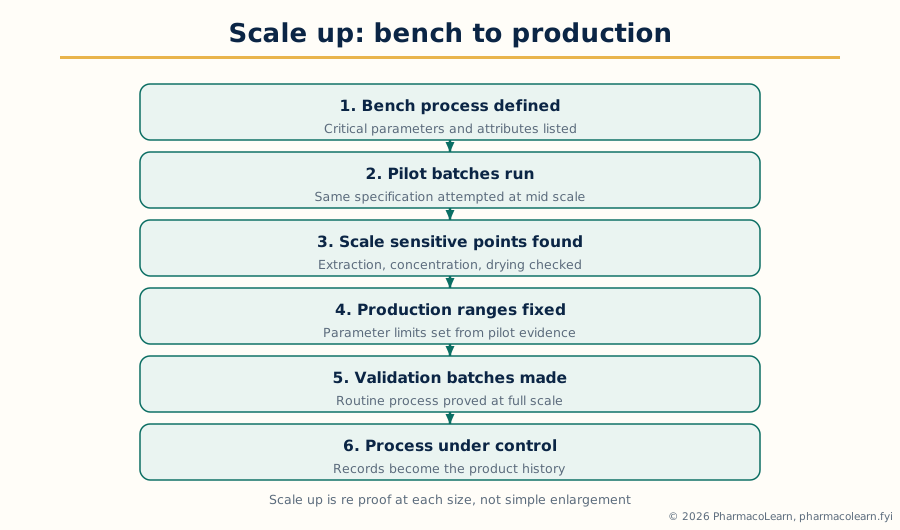 Figure: The scale up staircase. Each step proves the critical parameters at a larger size before money is committed to the next; the pilot stage is where scale sensitive parameters are found.
For herbal extracts, three scale sensitive points recur in case teaching. Extraction: percolation and maceration behaviour changes with bed depth and solvent flow, and continuous or staged extraction may replace batch soaking at scale. Concentration: long heating in large evaporators can damage heat sensitive constituents that a small rotary evaporator spared, favouring vacuum and falling film concentration. Drying: spray drying conditions that suit a pilot dryer need re establishment at production size to hold moisture and marker content together. Scale up is therefore not enlargement; it is re proof of the process at each size, and its records become part of the product history that quality assurance defends in Unit 2.
1.12 Case studies of herbal extracts
The syllabus directs case studies of herbal extracts, and their teaching value lies in a common pattern rather than in any single plant. A standardised extract case, read properly, walks through the same stations: the crude drug and its authentication; the part used and its marker or active constituents; the extraction solvent and process chosen, and why that solvent suits those constituents; concentration and drying; the specification set for the extract, identity, marker assay, limits for contaminants and physical constants; the standardisation method used to bring batches to specification, blending and adjustment of Section 1.3; the dosage forms the extract enters; and the stability behaviour that fixes its packing and shelf life. Cases commonly taught in the standard texts follow exactly this pattern for widely traded extracts such as senna standardised on its sennosides, liquorice on glycyrrhizin, and other marker led extracts of the pharmacopoeias. Read any case by asking the station questions in order: what proves identity, what is measured to prove strength, what process decisions protect the constituents, and what specification would catch a bad batch?
1.13 Formulation and production management of herbals
Production management is the running of the approved process, day after day, so that output, quality and cost stay together. Its instruments are standard in industry and take herbal colouring from the material. Production planning starts from the sales plan and the seasonal raw material position: extraction campaigns are scheduled when authenticated drug is available and approved, and batch sizes are set to the plant and the stock position. Batch manufacturing records document each batch from dispensing to release, with the in process checks, yields in process terms and deviations recorded as they happen, so any batch can be traced back to its drug lot and forward to its customers. Inventory management balances the cost of holding seasonal stock against the risk of stock out, with stores run on first expiry first out for materials and products with shelf lives. Personnel management provides trained operators for each operation, with training records, because most deviations trace back to an untrained hand or an unclear instruction. Maintenance and calibration keep machinery and instruments in their validated state. Cost management watches the few costs that dominate herbal manufacture: raw material, solvent and its recovery, energy for drying, and testing. Production management closes Unit 1 where it began: the industry exists to convert variable nature into reproducible product, and management is the discipline that performs that conversion on schedule, at cost and inside the rules that Unit 2 now sets out.
Unit 2: Regulatory Requirements for Setting Up the Herbal Drug Industry
2.1 Regulatory requirements: the licence to exist
No herbal drug unit may lawfully be set up by decision alone. It must be established under the legal framework that governs drugs in its market, and in India that framework is the Drugs and Cosmetics Act and its Rules, under which manufacturing licences are granted for defined premises, products and categories, with Ayurvedic, Siddha and Unani products licensed under their own provisions and Good Manufacturing Practice requirements, and modern herbal and phytopharmaceutical products handled under the applicable drug provisions. The regulatory requirements for setting up therefore run in a sequence the student should be able to narrate: constitution and registration of the enterprise; selection of premises meeting the factory and drug rules; application for the manufacturing licence with the layout, machinery, personnel and product details the authority examines; provision of the technical staff the rules require; establishment of quality control arrangements, in house or through approved laboratories where permitted; and the collateral licences and registrations, factory, trade, pollution control, tax and, for export, the registrations of Section 2.4. The continuing obligations matter as much as the grant: licences are renewed, premises and products are inspected, records are maintained, and changes of product, process or premises are notified or approved as the rules require. Regulation in this unit is not an obstacle placed in front of the industry; it is the industry operating system, and Units 3 and 4 supply its technical content.
2.2 Global marketing management
Global marketing management is the planning and control of selling herbal products across national markets, and its first lesson is that the world does not classify herbal products uniformly. The same standardised extract product may enter one market as a licensed herbal medicine with efficacy claims, another as a traditional use product with limited claims, another as a dietary or food supplement with no disease claims, and another not at all until locally registered. Marketing management therefore begins with regulatory market selection: which markets accept the product in a category the company can satisfy, with what evidence, labelling and pharmacopoeial standards, Unit 3 supplying the standards map. Product decisions follow: which dosage form, strength, pack and claims suit each market. Pricing and channel decisions must carry the costs of registration, testing, stability data for the destination climate and pharmacovigilance. Promotion is bounded by the claims the category permits. A disciplined global marketer of herbals sells compliance first and product second, because a consignment rejected on documentation, contaminants or labelling destroys more value than a slow registration. The management cycle below organises the topic for examination answers.
Select the market and its herbal product category
        |
Confirm the evidence, standards and labelling it demands
        |
Adapt product, pack and claims to that category
        |
Register the product and organise compliant supply
        |
Distribute through the chosen channel; monitor response
        |
Handle complaints, adverse reports and renewals
        |
Feed market learning back into product and market selection
2.3 Indian and international patent law as applicable to herbal drugs and natural products
Unit 2 names patent law in its regulatory survey; Unit 5 teaches it in full. The survey position is this. A patent is a time limited exclusive right granted for an invention, and for herbal drugs and natural products its decisive difficulty is that products of nature as found, and traditional knowledge as inherited, are generally not patentable inventions, while genuinely new processes, formulations, extraction methods, standardisation techniques and new uses developed by human ingenuity may be. Indian law states this boundary expressly through its exclusions, including the exclusion of traditional knowledge and of mere aggregation of known properties of traditionally known components, and the international framework of Section 2.5 leaves each country room to draw the line. The regulatory consequence for setting up the industry is practical: before a product is launched, its freedom to operate must be checked against existing patents, and the enterprise must decide what of its own development is worth protecting, by patent or by the other rights of Unit 5. The detail, filing procedure, criteria, cases, opposition and revocation, belongs to Unit 5 and is not duplicated here.
2.4 Export Import (EXIM) policy
The Export Import policy is the government policy framework governing foreign trade: what may be exported or imported, under what conditions, licences, quality requirements and incentives. For the herbal industry it operates on both sides of the factory gate. On the export side, crude drugs, extracts and finished herbal products are exported under the policy classification and conditions in force, with the documentation that importing countries and Indian authorities require: shipping and customs documents, certificates of origin and quality, pharmacopoeial compliance and, where demanded, certificates of free sale and analysis. Conservation enters trade policy directly: plant species threatened by over collection are restricted or prohibited in export in raw form under wildlife and biodiversity controls and international convention commitments, pushing trade toward cultivated material and value added extracts. On the import side, the policy governs import of crude drugs India does not produce, of machinery and of reference standards and instruments, with duties and conditions as notified. EXIM policy also carries the promotional machinery of foreign trade: export promotion councils and boards concerned with medicinal plants and AYUSH products, market development assistance and quality certification support. For examination purposes the policy should be presented as a framework that changes by notification, so principles and machinery are the durable content: classification, licensing and restriction, documentation, quality and conservation conditions, and promotion support.
2.5 TRIPS
TRIPS, the Agreement on Trade Related Aspects of Intellectual Property Rights, is the World Trade Organization agreement that sets minimum standards of intellectual property protection for member countries, including patents, copyright, trademarks and geographical indications, and requires members to make enforcement available. Its importance for this subject is threefold. First, it obliged member countries, India included, to provide product patent protection in pharmaceuticals, reshaping the legal environment in which herbal and natural product inventions are protected, the background to Unit 5. Second, its patentability standards, inventions that are new, involve an inventive step and are capable of industrial application, with limited permitted exclusions, supply the vocabulary of Unit 5: novelty and non obviousness are the TRIPS era terms. Third, TRIPS is the international forum of the traditional knowledge debate: the patenting abroad of uses long known in Indian traditional medicine, the cases of Unit 5, raised the questions of prior art documentation, benefit sharing and protection of traditional knowledge that India answered in part with its Traditional Knowledge Digital Library and its patent law exclusions. TRIPS does not itself grant patents; national offices grant them under national law built to TRIPS standards. That sentence prevents the commonest error in student answers on this topic.
2.6 Quality assurance in herbal and natural drug products
Quality assurance is the organised whole of arrangements that gives confidence that a product will meet its quality requirements: not testing alone, but the system of which testing is one part. In herbal and natural drug products QA carries extra weight because the starting material is variable, so assurance must extend further back, to supplier approval, authentication of crude drugs, and control of cultivation and collection sources, and further forward, to stability, complaints and recall. The QA functions should be listed as a system: approval of specifications and procedures; vendor qualification; review and release of batches on their complete records; handling of deviations, changes and corrective and preventive actions; validation of processes and methods; stability programme oversight with Unit 4; complaint and recall management; self inspection and audit; and documentation control, the issuing, revision and archiving of every controlled document. QA is independent of production in a sound organisation, with authority to reject material and stop release, because a QA that reports to the production it judges will eventually judge leniently. The three quality systems that follow, TQM, GMP and GLP, together with ISO 9000, are the named frameworks through which QA is implemented, and the comparison table in Section 2.10 fixes their territories.
2.7 TQM: Total Quality Management
Total Quality Management is a management philosophy in which quality is the responsibility of every person and every function, organised around customer satisfaction, continuous improvement and employee involvement. Its concepts, as the syllabus word concepts directs, are the examinable content. Customer focus: quality is defined by the needs of the customer, internal as well as external, each process serving the next. Total involvement: quality cannot be inspected in by a department at the end; it is built by all, which is why TQM trains and empowers operators to own their process quality. Continuous improvement: processes are improved in small, permanent steps, classically by the plan, do, check, act cycle, rather than by occasional campaigns. Process approach: work is managed as processes with inputs, controls and outputs that can be measured. Data based decisions: improvement is directed by measurement, using the basic statistical and problem solving tools, rather than by opinion. Its difference from GMP should be stated: GMP is a regulatory requirement with legal force for defined manufacturing operations; TQM is a voluntary management philosophy that can cover the whole business, and the two reinforce each other.
2.8 GMP: Good Manufacturing Practice
Good Manufacturing Practice is the part of quality assurance that ensures products are consistently produced and controlled to the quality standards appropriate to their intended use. Its elements form the standard list: premises and equipment designed, maintained and cleaned for their purpose; trained personnel with defined responsibilities and hygiene rules; approved, written procedures for every operation, actually followed and recorded; materials controlled from receipt, through quarantine and testing, to issue; production carried out under batch documentation with in process controls; finished products tested against specification and released by authorised quality personnel; storage and distribution that protect quality; and systems for complaints, recalls and self inspection. For Ayurvedic, Siddha and Unani manufacture in India, GMP is codified in Schedule T of the Drugs and Cosmetics Rules, which sets requirements for factory premises, warehousing, machinery, standard operating procedures, records and quality control for those systems, a point that links this unit to the ISM pharmacopoeias of Unit 3. The herbal emphasis inside GMP is constant: identity of the crude drug is the first GMP act, because all later control is worthless on a misidentified material; segregation and labelling prevent the mix ups that botanical materials, similar in appearance and stored in bulk, invite; and drying, storage and pest control protect constituents that synthetic actives do not lose in the warehouse. GMP checkpoints are drawn in the diagram of Section 2.10.
2.9 GLP: Good Laboratory Practice
Good Laboratory Practice is the quality system for non clinical laboratory studies, concerned with how studies are planned, performed, monitored, recorded, reported and archived, so that the resulting safety data can be trusted and reconstructed by regulators. Its core elements: a defined organisation with a study director responsible for each study; written standard operating procedures for laboratory operations; facilities and equipment suited and maintained for the work; test and reference materials characterised and controlled; a study plan approved before work begins; raw data recorded contemporaneously and traceably; a final report that faithfully reflects the raw data; and archives that preserve the whole for later inspection, with an independent quality assurance unit auditing the system. GLP must be distinguished from ordinary laboratory quality control: the QC laboratory of a factory tests batches for release under GMP, while GLP governs the conduct of safety studies whose data support regulatory decisions. A herbal company meets GLP when the toxicological and safety data on its products are generated for submission; the discipline of traceability it teaches, every result reconstructable to raw data, is the same discipline Unit 4 demands of all testing.
2.10 ISO 9000 and the quality systems compared
ISO 9000 is the family of international standards for quality management systems, published by the International Organization for Standardization, against which an organisation may be certified by an accredited body. The family states requirements for a documented quality management system covering leadership, planning, support, operation, performance evaluation and improvement, in the process and risk based form of the current standards. Certification is voluntary and commercial in motive: it assures customers that a management system exists and is audited, and it is often demanded in trade, which is why a syllabus on industrial technology includes it beside the legal systems. Its limits must be stated as clearly as its value: ISO certification attests the management system, not the quality of any individual product, and it does not replace GMP, which remains the legal condition of manufacture. The table and diagram below fix the four named systems of this unit against each other.
| System | What it is | Legal force | Territory | Judged by |
|---|---|---|---|---|
| TQM | Management philosophy of total involvement and continuous improvement | Voluntary | Whole organisation, customer outward | Results and culture, self driven |
| GMP | Rules for consistent manufacture and control of products | Mandatory for licensed manufacture | Premises, materials, production, release | Regulatory inspection and batch records |
| GLP | Rules for planning, conduct, recording and archiving of laboratory safety studies | Required for studies submitted to regulators | Non clinical laboratory studies | Inspection of study traceability and archives |
| ISO 9000 | International quality management system standards | Voluntary, certification by accredited bodies | Management system of the whole organisation | External certification audit |
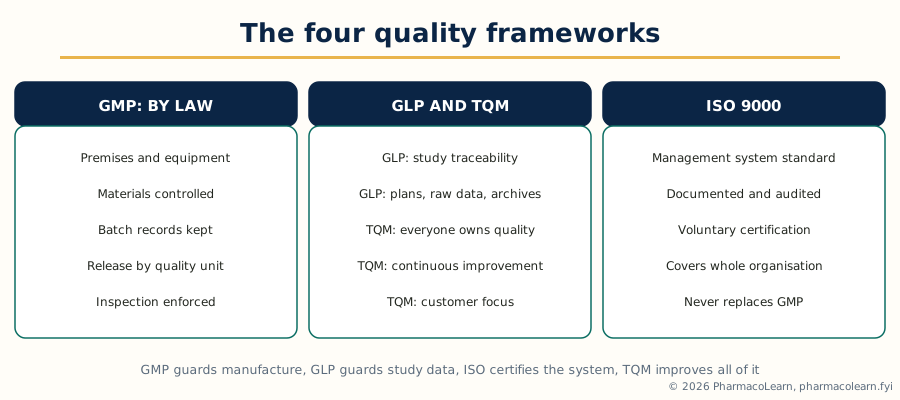 Figure: The four quality frameworks of Unit 2 placed on one plant. GMP guards manufacture by law, GLP guards study data, TQM improves everything voluntarily, and ISO 9000 certifies the management system that holds them.
Unit 3: Monographs of Herbal Drugs
3.1 General parameters of monographs of herbal drugs
A monograph is the authoritative written standard for a drug: the set of definitions, tests and limits by which a sample is judged to be that drug and to be of acceptable quality. A herbal drug monograph must do more work than a synthetic drug monograph, because its subject is a natural material of variable composition, and its general parameters form the core list of this unit. Title and definition: the official name, botanical name with family, the part used, and, for extracts, the solvent and drug extract ratio, fixing identity before any test. Description: macroscopic characters, colour, odour, taste, size and fracture, the first screen against substitution. Identification: microscopical characters of the whole and powdered drug, chemical identification reactions, and chromatographic identity, typically a TLC or HPTLC fingerprint against reference material. Purity tests: foreign matter, ash values, extractive values, moisture or loss on drying, and the contaminant limits, heavy metals, pesticide residues, microbial limits and aflatoxins where applicable. Assay: quantitative determination of the active or marker constituents by the stated method, with limits. Then the supporting parameters: standards for storage and labelling, and, in the fuller pharmacopoeial style, the reference standards and reagents the tests require. Two parameters carry special teaching weight. Fingerprint identity is the herbal monograph signature test: a whole chromatographic pattern compared, not a single spot, because the drug is a mixture. And the marker assay raises the question the examiner loves: the marker need not be the active, it is the measurable constituent chosen to represent the batch, and a monograph is honest about which it is using. The parameters are collected in the diagram of Section 3.8.
3.2 The Indian Pharmacopoeia (IP)
The Indian Pharmacopoeia is the official book of drug standards for India, published by the Indian Pharmacopoeia Commission under the Drugs and Cosmetics Act, whose monographs carry legal force for drugs manufactured and sold in India. Its herbal coverage has grown across editions from a small set of crude drug monographs to a substantial body of herbal drug, extract and formulation monographs, written in the IP house style: definition with botanical name and part, description, identification including chromatographic fingerprinting, tests for foreign matter, ash, extractives, loss on drying and contaminants, and assay of marker constituents, supported by general chapters on methods. In comparative answers, IP is the home standard for the Indian industry of Units 1 and 2, the book its licences and courts actually enforce, and its herbal monographs draw on Indian drugs and Indian analytical practice. Its relationship with the Ayurvedic Pharmacopoeia of Section 3.4 is complementary: IP governs herbal drugs in the modern drug framework, while the Ayurvedic Pharmacopoeia governs the classical ASU drugs in theirs.
3.3 The United States Pharmacopoeia (USP)
The United States Pharmacopoeia, published with the National Formulary by the United States Pharmacopeial Convention, sets the enforceable standards for drugs and, importantly for this subject, for dietary supplements in the United States. Its herbal monographs appear largely as botanical dietary supplement monographs, in the USP style of definition, identification by macroscopic, microscopic and chromatographic methods, composition or assay of characteristic constituents, and specific tests including limits for contaminants such as heavy metals, pesticides and microbes, backed by an extensive apparatus of general chapters and physical reference standards that laboratories can purchase and use. The comparative points are its legal setting, standards enforced through the food and drug law for products on the US market, including supplements; its strong reference standard system; and its detailed general chapters on topics such as heavy metals and pesticide residues in botanicals, which laboratories worldwide borrow even when working to other pharmacopoeias.
3.4 The Ayurvedic Pharmacopoeia of India
The Ayurvedic Pharmacopoeia of India, published by the Government of India for the Ayurvedic system, is the official standard book for Ayurvedic drugs: single drugs of plant, mineral and animal origin in its earlier parts and compound formulations in its later parts, with the Ayurvedic Formulary standing beside it as the book of classical formulations. Its monographs combine the classical identity of the drug, Sanskrit name, synonyms, and the properties assigned in the tradition, with modern laboratory parameters: macroscopic and microscopic description, foreign matter, ash and extractive values, chromatographic identification and, where established, assay, together with standards for the finished classical forms. Its legal territory is the ASU industry licensed under the Drugs and Cosmetics Act, and its GMP partner is Schedule T of Section 2.8. In comparison with IP, its monographs serve a system in which the formulation as a whole, prepared by the classical process, is the medicine, so pharmacopoeial control must standardise both the raw drugs and the classical processes, a harder problem than single drug standardisation and the reason its development is a continuing national programme.
3.5 The Siddha and Unani Pharmacopoeias
The Siddha Pharmacopoeia of India and the Unani Pharmacopoeia of India are the parallel official books for the other two codified Indian systems named in the syllabus, published by the Government of India in parts covering single drugs and formulations of each system. Their monograph pattern follows the Ayurvedic model because their regulatory position is the same: definition in the system own terms with botanical or other origin, classical properties and uses, then the laboratory parameters of identity, purity and strength that a modern inspector can test, macroscopy and microscopy, physicochemical constants, chromatographic identity and contaminant limits as developed. The comparative teaching point is unity inside diversity: three traditional systems, three pharmacopoeias, one regulatory Act, one GMP schedule, and one shared scientific apparatus of testing, because a heavy metal or a wrong species is a defect in any system language. Their coverage is younger and less complete than the Ayurvedic book, and monographs are added part by part as standards are developed and validated, which is itself a live example of the modernisation challenge of Unit 1.
3.6 The American Herbal Pharmacopoeia (AHP)
The American Herbal Pharmacopoeia is a non government, expert authored series of monographs on botanicals, produced in the United States, which is not a legally enforceable pharmacopoeia in the USP sense but a scholarly standard widely used by industry and regulators as a reference. Its monographs are distinctive in depth and structure: nomenclature and botany, cultivation and collection, history of use, identification including detailed microscopy and chromatography, constituents, analytical methods, therapeutics and safety information, and a review of the evidence, presented as a monograph and therapeutic compendium together. In comparative answers its position is the expert reference model: no legal force of its own, high scientific authority, monographs developed herb by herb to a depth the official books, covering many drugs at once, rarely match. It shows students what a monograph becomes when it is allowed to teach as well as to test.
3.7 The British Herbal Pharmacopoeia (BHP)
The British Herbal Pharmacopoeia, published by the British Herbal Medicine Association, is the United Kingdom counterpart in the comparison: a herbal profession pharmacopoeia providing monographs for herbal drugs used in British herbal practice, in a concise testing style, definition, macroscopic and microscopic identification, TLC identification, and physicochemical tests such as ash, extractive and moisture values, with assays where suitable. It sits in the British setting in which many herbal products are supplied under traditional herbal registration, whose quality standards refer to pharmacopoeial quality, the European and British Pharmacopoeias carrying the legally enforceable monographs for that market. The comparative point mirrors the American case with a difference: BHP is a practice pharmacopoeia of the herbal profession, valued for its selection and its fit to the drugs herbalists actually use, while legal enforceability in its home market flows through the official pharmacopoeias and the registration system.
3.8 The pharmacopoeias compared
Comparison is the syllabus verb for this unit, so the table collects the seven books on the points an examiner can ask. The diagram after it collects the monograph parameters of Section 3.1.
| Pharmacopoeia | Publisher and status | Main territory | Monograph character |
|---|---|---|---|
| Indian Pharmacopoeia (IP) | Indian Pharmacopoeia Commission; official, legally enforceable in India | Herbal drugs, extracts and formulations in the modern drug framework | Definition, description, identification with fingerprinting, purity tests, marker assay |
| USP | US Pharmacopeial Convention; enforceable in the United States | Drugs and botanical dietary supplements | Identification, composition and assay, contaminant limits, purchasable reference standards, extensive general chapters |
| Ayurvedic Pharmacopoeia of India | Government of India; official for Ayurvedic drugs | Single Ayurvedic drugs and classical compound formulations | Classical identity and properties with laboratory parameters of identity, purity and strength |
| Siddha Pharmacopoeia of India | Government of India; official for Siddha drugs | Single Siddha drugs and formulations | Ayurvedic model applied to the Siddha materia medica |
| Unani Pharmacopoeia of India | Government of India; official for Unani drugs | Single Unani drugs and formulations | Ayurvedic model applied to the Unani materia medica |
| American Herbal Pharmacopoeia | Expert non profit body; no direct legal force | Botanicals of American herbal practice and trade | Deep scholarly monographs: botany, analysis, therapeutics and safety together |
| British Herbal Pharmacopoeia | British Herbal Medicine Association; profession pharmacopoeia | Herbal drugs of British herbal practice | Concise testing monographs: identification, TLC, physicochemical tests |
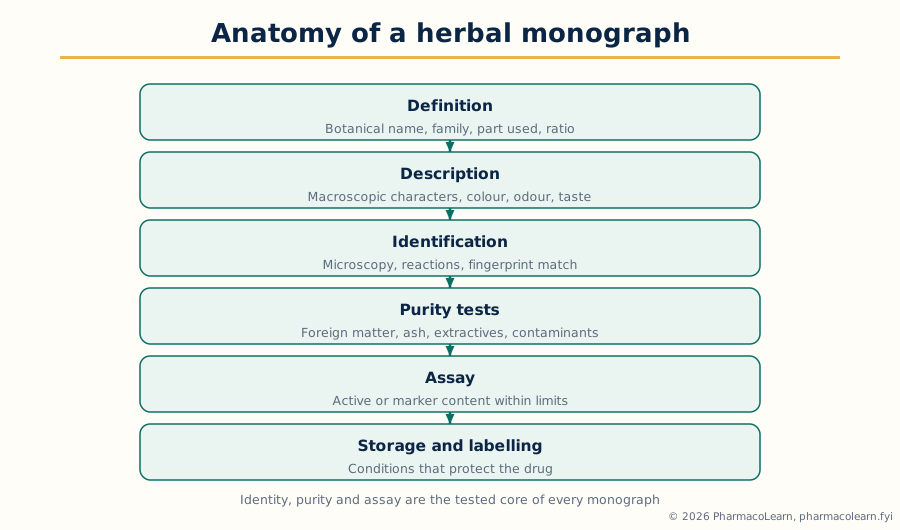 Figure: The general parameters of a herbal drug monograph. Identity, purity and assay are the tested core; definition, description and storage frame them.
Reading the table as an argument: official pharmacopoeias trade depth for enforceability and coverage, profession and expert books trade enforceability for depth and selection, and the Indian system books carry the extra task of standardising classical formulations and processes. A manufacturer selling in several markets works to several books at once and releases against the strictest applicable limit for each parameter, which is the practical end of the comparative study.
3.9 WHO guidelines in quality assessment of herbal drugs
The World Health Organization guidelines on quality assessment of herbal drugs, part of the WHO programme of guidance on herbal medicines, supply the international reference framework that the pharmacopoeias of this unit implement nationally. Their subject is the whole quality chain, and the guidelines should be presented in that chain order. Identity and quality of the starting material: correct botanical identification, control of cultivation and collection, and attention to the factors, geography, season and processing, that move composition. Quality control parameters for herbal materials and preparations: macroscopic and microscopic examination, foreign matter, ash and extractive values, moisture, chromatographic fingerprinting, assay of actives or markers, and the contaminant battery, heavy metals, pesticide residues, microbial contamination and aflatoxins, with the principle that limits and methods must suit a natural, variable material. Stability and shelf life, assessed by the methods of Unit 4. Good practices in the chain: good agricultural and collection practice at the source and GMP in manufacture, linking this unit back to Unit 2. And assessment in the round: quality cannot be separated from safety and efficacy assessment, so the guidelines sit inside the wider WHO guidance on research and evaluation of traditional medicine. The workflow below states the assessment as an industrial sequence.
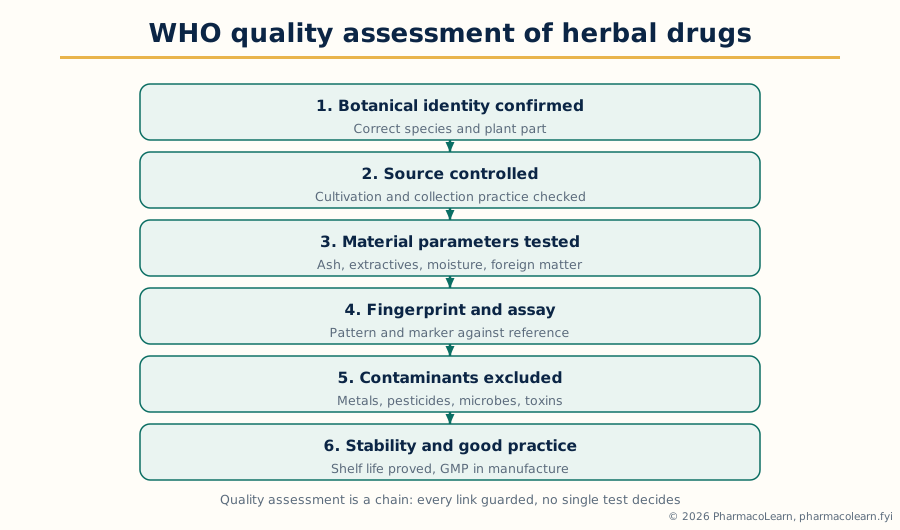 Figure: Quality assessment in the WHO sense is a chain, not a single test: identity, purity, fingerprint and assay, contaminants, stability and good practices each guard one link.
Unit 4: Testing of Natural Products and Drugs
4.1 Testing of natural products and drugs: what testing must prove
Testing is the laboratory half of quality: the application of defined methods to a sample, against defined limits, to support a decision to accept, reject or release. For natural products the testing programme must prove four things, and organising the unit by them prevents the common error of treating testing as a list of instruments. Identity: the material is the species, part and preparation it claims to be, proved by macroscopic, microscopic, chemical and fingerprint methods of Unit 3. Purity: it is free, within limits, of what should not be there, foreign matter, other species, heavy metals, pesticide residues, microbial load and toxins. Strength: it contains its actives or markers within the specified range, proved by assay. And performance over time: it stays within specification to the end of its shelf life, proved by the stability programme of Sections 4.3 and 4.4. Behind the four proofs stand the disciplines that make any single result believable: sampling that represents the batch, methods validated for the matrix, reference standards of known purity, instruments calibrated, analysts trained and records that allow the result to be reconstructed, the GLP discipline of Unit 2 applied in the QC laboratory. The quality control gate diagram collects the programme.
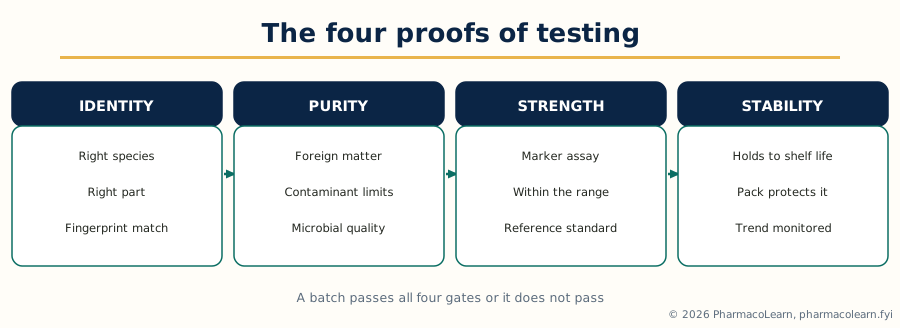 Figure: The four proofs of natural product testing. A batch passes all four gates or it does not pass; strength cannot compensate for failed identity or purity.
4.2 Herbal medicines: clinical laboratory testing
The syllabus places clinical laboratory testing inside the testing unit, and the phrase should be taught in its plain sense: the laboratory testing by which herbal medicines are examined in relation to their clinical use, the testing of the medicine and, where studies are done, of the patient receiving it. On the medicine side, clinical use raises the testing stakes: batches used in clinical evaluation must be fully characterised, authenticated, fingerprinted and assayed, with contaminants excluded, because a clinical result obtained with an uncharacterised product proves nothing and cannot be repeated; the tested, retained batch becomes the chemical definition of what was clinically studied. On the study side, clinical laboratory testing in herbal medicine trials and in safety monitoring covers the standard laboratory safety panel applied to participants, blood counts, liver and kidney function tests and other biochemistry, used to detect organ toxicity, interactions and adverse effects of the herbal product under study, together with testing for the product specific concerns of herbals, such as screening for adulteration with synthetic drugs in products where that abuse is known. The teaching point that unifies the section: herbal medicines are not exempt from laboratory evidence. The closer a product comes to clinical claims, the more completely it must be characterised chemically and monitored biologically, and the laboratory is where both are done.
4.3 Stability testing of natural products
Stability testing is the programme of studies that shows how the quality of a product varies with time under the influence of environmental factors, and from which shelf life, storage conditions and packing are set. Natural products need the programme in a sharpened form, because their constituents are chemically alive in ways a stable synthetic crystal is not: glycosides hydrolyse, volatile oils evaporate and oxidise, fixed oils turn rancid, enzymes in incompletely dried drugs keep working, pigments and markers fade and degrade in light and heat, and moisture invites microbial growth. The programme therefore tests the attributes that can change: description and physical character, moisture, marker or active assay, fingerprint comparison against the initial profile, degradation products where known, microbial quality, and, for dosage forms, the performance tests of the form such as disintegration and dissolution. The study designs are the standard pair. Long term studies store the product at the storage condition claimed, for the period of the proposed shelf life, testing at planned intervals. Accelerated studies store it under stressed temperature and humidity to reveal the degradation pattern quickly and to predict behaviour, with intermediate conditions used when accelerated results demand them. For herbal products the fingerprint is a stability instrument in its own right: a marker can hold while the wider profile drifts, and the chromatogram comparison catches the drift, which is why Unit 3 fingerprinting returns here as a testing tool.
4.4 Stability protocols
A stability protocol is the written plan that makes a stability study a piece of evidence rather than a set of stored samples. Its contents form a standard list that should be reproduced confidently. Objective and scope: the product, batches and market climate the study serves. Batches: normally production or pilot batches in the marketed pack, identified by number, size and manufacturing date. Storage conditions: the long term, intermediate and accelerated conditions chosen, with the climatic zone reasoning for the intended market stated. Time points: the planned testing intervals across the study. Tests and methods: the stability indicating attributes of Section 4.3, each with its method, and the requirement that assay methods be stability indicating, able to separate and measure the marker in the presence of its degradation products. Acceptance criteria: the specification the product must meet at every time point, shelf life specifications where they differ from release. Packing: the container closure system under test, since stability belongs to product in pack, not product in bulk. Evaluation and conclusions: how trends are assessed, how shelf life is estimated from the data, and what happens on an out of specification or out of trend result, including the effect on the marketed shelf life. The protocol flow below shows a study moving from plan to shelf life decision.
Write the protocol: batches, conditions, time points, tests, limits
        |
Manufacture and pack the study batches; record time zero results
        |
Store under long term and accelerated conditions as planned
        |
Withdraw samples at each time point; test against the protocol
        |
Compare fingerprint, assay and all attributes with time zero
        |
Trend the results: within limits and stable trend?
        |
Assign or confirm shelf life, storage statement and pack
        |
Continue long term study to confirm the assigned shelf life
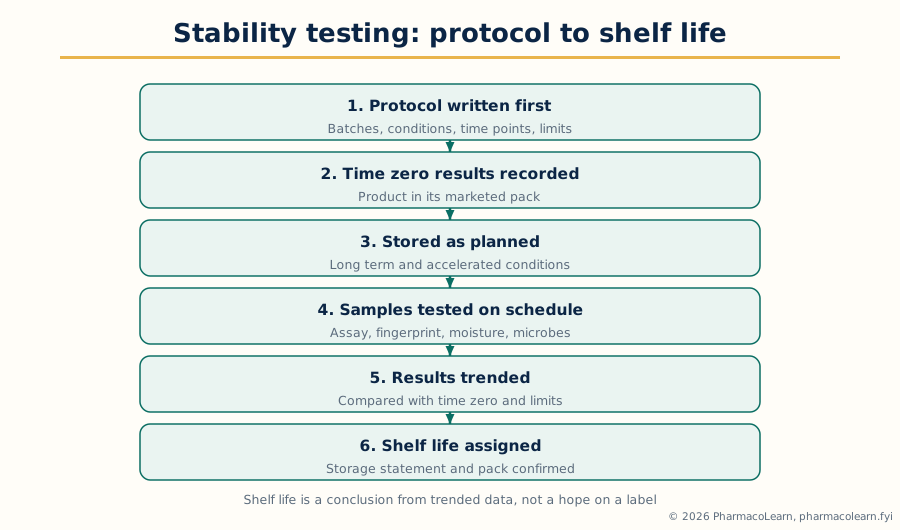 Figure: The stability workflow. The protocol is written before the first sample is stored; shelf life is a conclusion drawn from trended data, not a hope printed on a label.
4.5 Reading stability results for natural products
The unit closes with the judgement the data demand. Shelf life is assigned from the long term evidence, supported and sometimes shortened by accelerated behaviour; a product whose marker falls steadily is assigned the time at which it is projected to reach its limit, not the time at which it was last seen passing. Storage statements follow the failure mode: protect from light where photodegradation appears, protect from moisture where hydrolysis or microbial risk drives change, store in well closed containers where volatiles escape. Packing changes are a legitimate stability conclusion: a better barrier pack can rescue a product whose chemistry is sound but whose container leaks moisture or oxygen. Retest and expiry language must be used correctly: crude drugs and extracts may carry retest arrangements after which they are re examined before use, while finished products carry expiry dates beyond which they are not used. Stability is where Units 1 to 3 are cashed: the standardised extract, made under GMP to a pharmacopoeial monograph, either holds its specification in its pack for its shelf life or it does not, and the stability file is the proof.
Unit 5: Patents
5.1 Patents: Indian and international patent laws
A patent is an exclusive right granted by a state for an invention, in exchange for full public disclosure of the invention, for a limited term, in the standard modern form twenty years from the filing date under the TRIPS built framework of Unit 2. The Indian law is the Patents Act, 1970, as amended, notably by the amendments that introduced product patents for pharmaceuticals in the TRIPS transition, administered through the Indian Patent Office under the Controller General of Patents, Designs and Trade Marks. Internationally there is no single world patent: rights are territorial, granted country by country, but two systems organise the work, the Paris Convention, which gives a priority right allowing an applicant a period to file abroad on the strength of the first filing, and the Patent Cooperation Treaty, which provides a single international filing and search route that then enters national phases where each office decides grant. For herbal and natural products the laws apply with the special tension this unit exists to explain: the inventions of an industry built on traditional knowledge and natural materials must pass the same tests of patentability as any other, and much of what the industry knows best fails those tests, as Sections 5.5 and 5.10 show.
5.2 Proposed amendments as applicable to herbal and natural products and process
The syllabus directs attention to proposed amendments as they bear on herbal and natural products and processes, and the durable way to teach a moving target is by the questions the amendments debate rather than by memorising any single bill. The recurring amendment themes in the Indian debate are these. Disclosure of source: whether applicants must disclose the source and geographical origin of biological material used in an invention, and declare compliance with biodiversity law, a requirement India built into its patent law and which bites directly on plant based inventions. Traditional knowledge protection: how the law should prevent patents on what traditional communities already know, through exclusions, prior art documentation and databases. The patentability boundary for natural products: where discovery of a substance occurring in nature ends and invention begins, for isolates, extracts and processes. Compulsory licensing and access: the balance between patent exclusivity and public access to medicines, a live question for patented phytopharmaceuticals as for any drug. And process protection for traditional preparations: whether and how improved processes for classical products should be rewarded without enclosing the classical knowledge itself. An examination answer that names the theme, states the interest on each side, and connects it to a herbal example satisfies the syllabus phrase in any year, whatever the current bill.
5.3 Geographical indication
A geographical indication, GI, is an intellectual property right that identifies a product as originating in a territory, region or locality where a given quality, reputation or other characteristic is essentially attributable to its geographical origin. For natural products GI is often the right that fits where patent cannot: the value of a regional crude drug, spice or traditional product lies precisely in its origin and the accumulated practice of its place, which no single inventor created and no patent should enclose. India protects GI under its Geographical Indications of Goods Act, with registration, an authorised user system for producers of the region, and remedies against outsiders using the name. The examination distinctions are GI against trademark, a GI belongs to the producers of a region collectively and cannot be assigned away like a private mark, and GI against patent, GI protects the name and origin link, not any technical invention, and lasts while the link and registration are maintained rather than for a fixed invention term. For the herbal trade of Unit 2, GI is a marketing and protection instrument at once: it certifies origin to distant buyers and reserves the name to the region that built its reputation.
5.4 Copyright
Copyright is the right that protects original literary, artistic, musical and dramatic works and their modern statutory companions, arising automatically on creation and lasting, in the standard Indian provision, for the author life plus a statutory period for most works. Its place in a patents unit is as a neighbouring right with a different territory, and the distinctions are the marks. Copyright protects expression, not ideas, facts or inventions: the text of a monograph, a book on herbal industry, a database presentation, a label artwork and a company catalogue can be copyright works, while the process they describe is patent territory or no right at all. Facts and traditional knowledge as such are not owned by copyright, though an original compilation of them may be protected in its selection and arrangement. In the herbal enterprise copyright appears in publishing, documentation, software and branding materials, and its lesson for the student is negative and valuable: copyright cannot be used to monopolise a formulation or a traditional use, however original the book that describes it.
5.5 Patentable subject matters
Patentable subject matter is the class of things the law allows to be patented at all, before the tests of Section 5.6 are applied. The positive statement: a patent may be granted for a product or a process that is an invention, a new product or process involving an inventive step and capable of industrial application. The Indian Act then excludes whole categories in its Section 3, and the exclusions that govern herbal and natural products must be known individually. Discoveries of living things or substances occurring in nature are not inventions. Plants and animals and essentially biological processes are excluded, with the statutory treatment of microorganisms and plant varieties, the latter protected in India by the separate plant varieties legislation, standing apart. Methods of agriculture and horticulture are excluded. Methods of treatment are excluded. Inventions whose use would be contrary to public order or morality or cause serious prejudice to life or environment are excluded. And, decisive for this subject, an invention which in effect is traditional knowledge, or an aggregation or duplication of the known properties of traditionally known components, is not patentable. From these exclusions the positive herbal map follows: a new extraction process, a genuinely new formulation with demonstrated technical advance, a new standardisation or stabilisation technique, a novel isolated and characterised compound or a new use developed by inventive work may be patentable subject matter; the plant, its traditional use and the classical formulation as inherited are not. The patentability gates are drawn below.
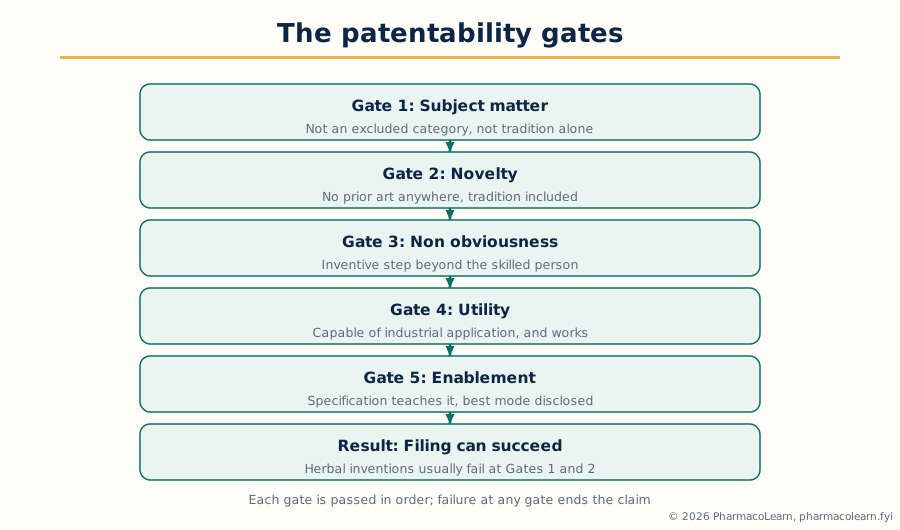 Figure: The patentability gates in order. Herbal inventions most often fail at the first gate, subject matter, or at novelty, because traditional knowledge is prior art.
5.6 Novelty, non obviousness and utility
Three criteria decide whether patentable subject matter is actually patented, and each has a precise meaning. Novelty: the invention must be new, not anticipated by prior art, the whole of what was published, used or otherwise made available to the public anywhere before the priority date. For herbals, prior art includes the classical texts and documented traditional practice, which is why the Traditional Knowledge Digital Library exists: to put that prior art in the search path of patent examiners worldwide. Non obviousness, the inventive step: the invention must not be obvious to a person skilled in the art from the prior art; a routine extraction solvent change or an expected combination of known herbs fails here even if the exact mixture was never written down. Utility, in Indian language capability of industrial application: the invention must work and be capable of being made or used in industry; a claimed use unsupported by the specification invites objection. The three criteria divide the failures instructively. Traditional knowledge cases fail novelty. Mere mixtures of known herbs for their known properties fail inventive step and the Section 3 exclusion together. Speculative natural product claims fail utility and the enablement requirement of the next section. A candidate who can assign a refused herbal application to its correct failing criterion has understood the unit.
5.7 Enablement and best mode
Enablement is the disclosure side of the patent bargain: the specification must describe the invention and the method of performing it fully and particularly, in terms clear enough that a person skilled in the art can carry it out without undue experiment. For a herbal process that means the drug, its part and preparation, the solvent system, conditions and the characterisation of the product must be disclosed to a working standard; a specification that hides the operative detail behind a plant name and a promise is not enabling. Best mode is the companion requirement in the Indian Act: the applicant must disclose the best method of performing the invention known to the applicant at filing. The pair protect the public side of the bargain: the state grants exclusivity only for knowledge actually handed over. Their herbal edge is sharp, because natural material varies: an enabling specification for an extract process should characterise starting material and product by the identity and assay standards of Unit 3, so that performance does not silently depend on one undisclosed batch of drug. Failure of enablement is a ground of opposition and revocation under Sections 5.11, which is where weak specifications are finally tested.
5.8 Procedure for Indian patent filing
The Indian filing procedure should be known as an ordered sequence. One, prepare the application: the prescribed form, the specification, provisional where the invention is not yet complete, giving an early priority date with the complete specification to follow within the statutory period, or complete at once; claims defining the protection sought; abstract; and, for plant based inventions, the declarations and permissions the law requires, including disclosure of source and geographical origin of biological material and, where applicable, approval of the National Biodiversity Authority. Two, file at the appropriate Patent Office, the office of territorial jurisdiction among the Indian patent offices, or electronically, receiving the application number and filing date that anchor priority. Three, publication: the application is published after the statutory period, earlier on request, entering the public record and the prior art. Four, request examination: substantive examination does not begin until requested within the statutory period; the examiner searches and issues a first examination report of objections, on patentability, clarity, enablement and formal grounds. Five, respond and be heard: the applicant answers objections, amends within the permitted limits and may be heard. Six, grant or refusal follows, the subject of Section 5.9. The filing staircase below compresses the sequence for revision.
Draft the specification and claims; check patentability and prior art
        |
File the application (provisional or complete) at the Patent Office
        |
Application published; request substantive examination
        |
Examination report issues: objections on the statutory grounds
        |
Respond, amend as permitted, attend hearing if called
        |
Grant and publication of the patent, or refusal
        |
Pay renewal fees; work the patent; defend or face opposition
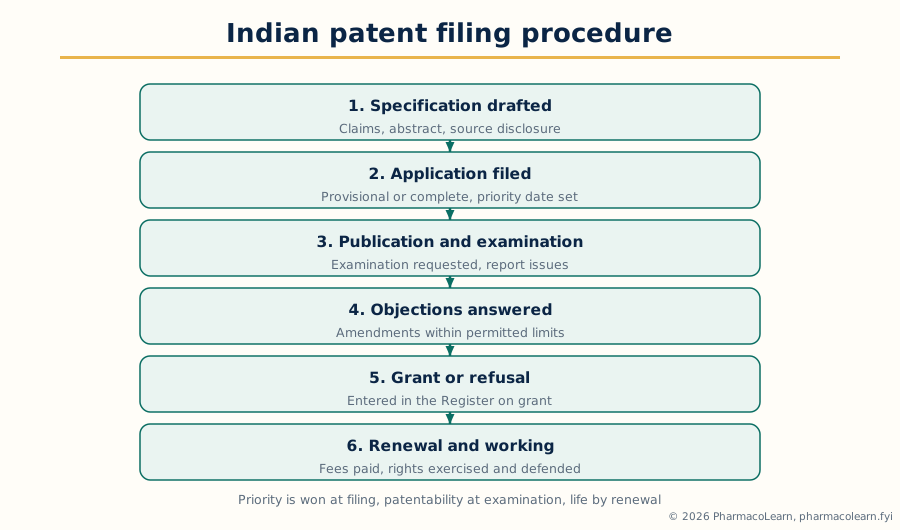 Figure: The Indian patent filing procedure. Priority is won at filing, patentability is won at examination, and the right is kept alive by renewal.
5.9 Patent processing, grant of patents and rights of patents
Patent processing is the administrative and substantive journey of Section 5.8 seen from the office side: formal checking, classification, publication, allocation to an examiner, search and examination report, consideration of the response, and the decision to grant or refuse, with the Controller deciding contested and discretionary matters. On grant, the patent is entered in the Register of Patents and published, and the patentee receives the rights of the patent: for a product patent, the right to exclude others from making, using, offering for sale, selling or importing the product in India; for a process patent, the corresponding rights over the process and over products obtained directly by it. Rights are territorial and time limited, maintained by renewal fees, assignable and licensable, and bounded by statutory exceptions and by the government use and compulsory licence provisions that keep the monopoly answerable to public interest. The patentee corresponding duties should travel with the rights in any full answer: work the invention, mark and renew, and expect the grant to be tested by the opposition and revocation routes of Section 5.11.
5.10 Cases of patents
The syllabus asks for cases of patents, and for herbal and natural products the canonical teaching cases are the traditional knowledge cases, taught qualitatively in every standard text. The turmeric case: a United States patent on the use of turmeric in wound healing was granted in the 1990s and then revoked on re examination after Indian authorities produced documentary prior art of the traditional use, the case that proved documentation defeats wrongful grant. The neem case: a European patent on a neem based antifungal preparation was opposed and ultimately revoked by the European Patent Office after evidence that the use was traditional knowledge in India, the leading case on opposition as a remedy, Section 5.11. The basmati case: a United States patent claiming basmati rice lines and grains was challenged by India, and its broad claims were withdrawn or cancelled on re examination, leaving a narrowed position and a permanent lesson in the defence of geographical and traditional assets, linking back to geographical indication in Section 5.3. Read together the three cases teach one doctrine from three angles: novelty is judged against all prior art including traditional knowledge; grant is not the end, because re examination, opposition and revocation can correct it; and a country that documents its traditional knowledge, as the Traditional Knowledge Digital Library does, converts an oral heritage into searchable legal evidence. No invented figures are needed for the doctrine to carry full marks.
5.11 Opposition and revocation of patents
Opposition is the procedure by which a grant is contested by others. Indian law provides pre grant opposition, by any person after publication and before grant, and post grant opposition, by a person interested, within the statutory period after grant, on the statutory grounds, which should be listed: wrongfully obtained invention; prior publication or prior use; obviousness and lack of inventive step; non patentable subject matter, including the traditional knowledge exclusion; insufficient and unclear disclosure, the enablement failure of Section 5.7; failure to disclose biological material source; and anticipation by knowledge, oral or otherwise, available within a local or indigenous community. The Controller hears the parties and may refuse, grant, or grant with amendment. Revocation is the stronger remedy, the removal of a granted patent, sought by petition to the higher forum the law provides, or by counterclaim in an infringement suit, on grounds that substantially mirror opposition, with the additional routes of revocation in the public interest by the government in the cases the Act specifies. For the herbal industry these procedures are working tools, not abstractions: they are how wrongly granted traditional knowledge patents were undone in Section 5.10, and how a company clears its freedom to operate when a blocking patent should never have been granted.
5.12 Patent search and literature
Patent search is the systematic searching of patent and non patent literature to answer a defined question, and the question decides the search. A novelty or patentability search asks whether an invention is new before money is spent filing it. A freedom to operate search asks whether making a product would infringe live claims in the markets of sale, a Unit 2 regulatory task. A validity search hunts prior art against a granted patent for opposition or revocation. A state of the art search maps who is doing what in a field, such as standardised extracts, for research and business planning. The literature searched is of two families: patent literature, the published applications and granted patents of the world offices, searchable through the Indian Patent Office search system and the international databases of the European and world offices, classified by the International Patent Classification and by keywords and applicants; and non patent literature, journals, books, pharmacopoeias and, for this industry above all, the traditional knowledge resources that record classical use. Search craft is examinable in outline: define the question, choose classes and keywords including synonyms and botanical names, search, read claims rather than titles for legal questions, and record the search so it can be repeated and defended. A search that is not recorded did not, for quality purposes, happen.
5.13 Controllers of Patents
The Controllers of Patents are the statutory officers who administer the patent system and decide the matters the Act reserves to them. At the head stands the Controller General of Patents, Designs and Trade Marks, who superintends the Patent Office and its branches and also administers the related intellectual property offices, with Controllers, Joint, Senior Joint, Deputy and Assistant Controllers exercising delegated powers in examination and proceedings. The Controller functions in the life of an application should be listed: receiving and processing applications, ordering examination, considering examination reports and applicant responses, hearing parties in applications, oppositions and rectification matters, deciding grant or refusal, extending and restoring in the cases the Act permits, deciding compulsory licence applications, maintaining the Register of Patents and publishing the official journal of applications, grants and proceedings. The Controller is a quasi judicial authority in these functions: decisions are reasoned, hearings are governed by natural justice, and appeals lie to the higher forum the law provides. For the student the office completes the unit map: Sections 5.8 and 5.9 describe a journey, and the Controller is the officer who decides its contested steps, the human address of the patent system. With that, the subject closes its circle: an industry built from authenticated plants, standardised extracts and pharmacopoeial standards, tested for quality and stability, and trading under a legal framework whose sharpest instrument, the patent, rewards genuine invention and, properly defended, refuses to enclose the traditional knowledge the industry inherited.
Frequently Asked Questions
Q: What is MPG104T in M.Pharm Pharmacognosy? MPG104T is Industrial Pharmacognostical Technology, the fourth theory subject of M.Pharm Pharmacognosy Semester 1 under the PCI syllabus. It carries 4 credits and 60 hours, taught at 4 hours per week for 100 marks, and covers the herbal drug industry, its regulation and quality systems, herbal drug monographs, testing and stability of natural products, and patents.
Q: What is a standardised extract? A standardised extract is an extract made by a controlled process from an authenticated drug of defined drug extract ratio and adjusted, within stated limits, to a defined content of active or marker constituents. Standardisation is achieved by controlled extraction and by blending or permitted adjustment of batches, never by spiking with isolated marker, which counts as adulteration.
Q: What are the main stages of pilot plant scale up for a herbal extract? First define the critical process parameters and quality attributes at small scale, then run the process at pilot scale and compare the product with the small scale specification, identify which parameters are scale sensitive and fix their production ranges, and finally confirm the process at production scale with validation batches documented as evidence of control.
Q: How do TQM, GMP, GLP and ISO 9000 differ? GMP is the mandatory legal system for consistent manufacture and control of products. GLP is the required system for the planning, conduct, recording and archiving of non clinical laboratory safety studies. TQM is a voluntary management philosophy of total involvement and continuous improvement across the whole organisation. ISO 9000 is a voluntary international quality management system standard, certified by external audit, which attests the management system and does not replace GMP.
Q: What are the general parameters of a herbal drug monograph? Definition with botanical name, family and part used, description of macroscopic characters, identification by microscopy, chemical tests and chromatographic fingerprinting, purity tests including foreign matter, ash and extractive values, moisture and contaminant limits, assay of active or marker constituents, and directions for storage and labelling.
Q: Which pharmacopoeias are compared in MPG104T Unit 3? The Indian Pharmacopoeia, the United States Pharmacopoeia, the Ayurvedic Pharmacopoeia of India, the Siddha Pharmacopoeia of India, the Unani Pharmacopoeia of India, the American Herbal Pharmacopoeia and the British Herbal Pharmacopoeia, together with the WHO guidelines on quality assessment of herbal drugs.
Q: What does stability testing of a natural product include? A written protocol fixes the batches, packs, storage conditions, long term and accelerated, time points, tests and acceptance criteria. Attributes followed include description, moisture, marker or active assay, fingerprint comparison with the initial profile, degradation behaviour and microbial quality. Shelf life, storage statements and packing are assigned from the trended results.
Q: Why is traditional knowledge generally not patentable in India? The Patents Act excludes from patentability an invention which in effect is traditional knowledge, or an aggregation or duplication of the known properties of traditionally known components. Traditional knowledge is also prior art, so claims covering it fail novelty. The turmeric, neem and basmati cases show such patents being revoked or narrowed when documented traditional use was produced.
Q: What are the criteria of patentability taught in MPG104T? The subject matter must be patentable and not fall in an excluded category, the invention must be novel against all prior art, it must involve an inventive step and not be obvious to a person skilled in the art, and it must be capable of industrial application. The specification must also enable the invention and disclose the best mode of performing it known to the applicant.
Q: Are the MPG104T unit wise PDFs free to download on PharmacoLearn? Yes. PharmacoLearn provides the MPG104T notes as free unit wise PDF downloads, one PDF for each of the five units, with the frequently asked questions appended to the Unit 5 PDF. The same page carries the complete notes for M.Pharm Pharmacognosy Semester 1 students.
Complete MPG104T notes, all 5 units in one PDF, free to keep.
Other M.Pharm subjects: MPH101T · MPC101T · MPL101T · MPH102T · MPH103T · MPH104T · MPL102T · MPL103T · MPL104T · MPC102T · MPC103T · MPC104T · MPH201T · MPH202T · MPH203T · MPH204T · MPC201T · MPC202T · MPC203T · MPC204T · MPL201T · MPL202T · MPL203T · MPL204T · MRA101T · MRA102T · MRA103T · MRA104T · MRM301T · MPG101T · MPG102T · MPG103T · MPG201T · MPG202T · MPG203T · MPG104T · MPG204T · MRA201T · MRA202T · MRA203T · MRA204T · M.Pharm