
MPG202T — Advanced Pharmacognosy-II
4 hrs/week, 4 credits, 60 hours, 100 marks. Notes follow the M.Pharm syllabus, unit by unit.
MPG202T Advanced Pharmacognosy-II notes for M.Pharm Pharmacognosy Semester 2: herbal remedies and validation, adulteration and DNA fingerprinting, ethnobotany and reverse pharmacology, analytical profiles and biological screening, with free unit wise PDF downloads on PharmacoLearn.
Units in this subject
- Unit 1 — Herbal Remedies, Toxicity and Regulations
- Unit 2 — Adulteration and Deterioration
- Unit 3 — Ethnobotany and Ethnopharmacology
- Unit 4 — Analytical Profiles of Herbal Drugs
- Unit 5 — Biological Screening of Herbal Drugs
Download MPG202T PDF Notes
Free PDFs for this subject, one per unit:
Advanced Pharmacognosy-II, subject code MPG202T, is the second core theory subject of M.Pharm Pharmacognosy, Semester 2. It carries 4 credits and 60 hours of theory, taught at 4 hours per week, for 100 marks, and its five units are of equal length at 12 hours each. Its scope, as the syllabus states it, is to know and understand the adulteration and deterioration that occurs in herbal and natural drugs and the methods of detection of the same, and to study herbal remedies and their validations, including methods of screening. Where Advanced Pharmacognosy-I taught how herbal drugs are cultivated, collected and turned into standardised products, this subject teaches the other half of professional judgement: how a herbal drug is doubted, tested and proven. Unit 1 sets the standard of proof, comparing herbals with conventional drugs and working through efficacy, validation of therapies, toxicity, regulation, and the pharmacodynamic and pharmacokinetic issues that make herbal products behave differently from single molecule medicines. Unit 2 is the quality unit: adulteration and deterioration, their types, causes and control, sampling and foreign matter, DNA fingerprinting for identity, and the detection of heavy metals, pesticide residues, phytotoxins and microbial contamination. Unit 3 follows knowledge back to its source, ethnobotany and ethnopharmacology, bioprospecting, and reverse pharmacology. Unit 4 applies the analytical discipline to six named drugs, Andrographis paniculata, Boswellia serrata, Coleus forskohlii, Curcuma longa, Emblica officinalis and Psoralea corylifolia, profiling each by its source, markers and methods. Unit 5 closes with biological screening: the in vitro and in vivo evaluation techniques by which a claim of activity is tested, and toxicity studies as per OECD guidelines. One idea holds the subject together: a herbal drug earns trust the same way a synthetic drug does, by identity established, quality measured, activity demonstrated and safety tested, and every unit is one of those four proofs examined closely.
Unit 1: Herbal Remedies, Toxicity and Regulations
1.1 Herbals versus conventional drugs
The comparison between herbal and conventional medicines is the frame of the whole unit, and it should be made precisely, because the differences are differences of material, not of dignity: both are medicines, but they arrive at the patient by very different routes. A conventional drug is, in the standard case, a single defined chemical entity of known structure, manufactured to a specification, dosed in exact milligrams, and characterised by a pharmacokinetic profile measured for that one molecule. A herbal drug is a whole plant part or an extract of it: a mixture of many constituents in proportions set by genetics, season, soil and processing, of which one or a few are named as markers, while the rest are incompletely characterised. From that single root fact the examinable contrasts grow, and the table states them fairly, giving herbals their genuine strengths as well as their problems.
| Point of comparison | Herbal drugs | Conventional drugs |
|---|---|---|
| Composition | Mixture of many constituents, markers named | Single defined chemical entity |
| Standardisation | By marker content and fingerprint | By assay of the active itself |
| Batch variation | Real, driven by plant and season | Small, controlled by manufacture |
| Dose precision | Approximate, extract strength varies | Exact, unit dose defined |
| Evidence base | Long traditional use, fewer trials | Clinical trial led development |
| Interaction knowledge | Often incomplete, discovered late | Studied before marketing |
| Cost and access | Usually low cost, widely available | Developed at high cost |
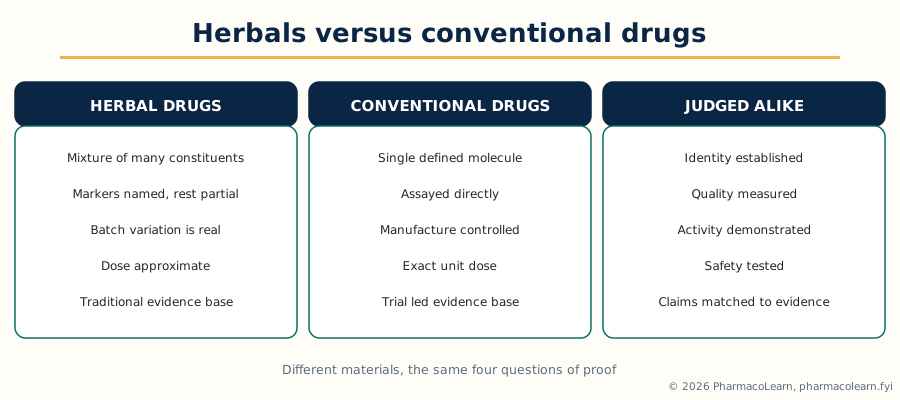 Figure: Herbals and conventional drugs differ as materials, in composition, variation and evidence base, and are judged alike by the four tests of identity, quality, activity and safety.
Two cautions belong with the table. First, the contrast is a spectrum, not a wall: some conventional drugs began as plant constituents isolated and purified, and some herbal products are standardised to a discipline approaching that of conventional manufacture. Second, the traditional use of a herbal is evidence of a kind, evidence of human exposure over long periods, but it is not the same kind of evidence as a controlled trial, and Section 1.3 takes up exactly what each kind of evidence can and cannot prove. The professional position this subject teaches is neither dismissal nor credulity: a herbal product is judged by the same four questions as any medicine, what is it, how strong is it, does it work, and is it safe, while recognising that the methods for answering them must be adapted to a mixture.
1.2 Efficacy of herbal medicine products
Efficacy, the capacity of a product to produce the claimed effect under controlled conditions, is harder to establish for herbal products than for conventional drugs, and the reasons should be listed rather than merely felt. The product tested must first be defined, yet an extract described only by plant name and solvent is not fully defined: plant part, extraction method, drug extract ratio and marker content all change what the material actually is, so two trials of the same named herb may have tested materially different products. The active principle may be unknown or may be a group of constituents acting together, so dose cannot be tied to a blood level of one molecule. Traditional indications are often broad and symptomatic, which makes trial endpoints harder to fix than the defined endpoints of conventional trials. Against these difficulties stand the genuine assets: a long record of human use that identifies plausible indications and obvious harms, and in the better developed herbal sectors, standardised extracts on which proper trials have in fact been run.
The examination answer should then state what an efficacy claim for a herbal product properly requires: an authenticated starting material, a defined and standardised extract, a stated marker content, a plausible indication drawn from traditional use or pharmacology, and controlled clinical evidence proportionate to the claim. Where such evidence exists, the claim stands on the same footing as any other. Where it does not, the honest label is traditional use, which several regulatory systems recognise as a claim category of its own, Section 1.5, rather than borrowing the authority of proof that has not been performed. Efficacy is therefore not a property of the plant in the field; it is a property of a defined product, made to a standard, tested for a stated purpose.
1.3 Validation of herbal therapies
Validation of a herbal therapy is the organised process of converting that traditional claim into tested knowledge, and it proceeds in a defensible order. The first step is to fix the material: botanical identity authenticated, part and preparation defined, quality established by the methods of Unit 2 and the profiles of Unit 4, because a therapy cannot be validated if the substance given to patients changes from batch to batch. The second step is the preclinical record: pharmacological screening of the kind taught in Unit 5, which tests whether the claimed activity appears in experimental systems at all, and toxicity testing that sets the first safety boundary. The third step is clinical evaluation in humans, in phases adapted to a product with a history of use: observational and experiential evidence from practice is collected and systematised, then controlled trials test defined outcomes in defined patients. The fourth step is continuing surveillance after marketing, pharmacovigilance of the kind introduced in Semester 1, because herbal harms are characteristically discovered late and reported rarely.
Two design problems deserve explicit mention, since examiners favour them. Blinding is difficult when a herbal preparation has a characteristic taste, smell or colour, so trial design must work harder to keep the comparison honest. Placebo response and the natural course of the mild, self limiting conditions for which herbals are often used can imitate efficacy, which is why uncontrolled observation, however long, cannot substitute for comparison. Validation is complete, in the sense this subject uses the word, when identity, quality, activity, clinical effect and monitored safety have each been addressed by the method appropriate to it; a therapy strong in one and silent in the others is partly validated, and the professional should be able to say which part is missing.
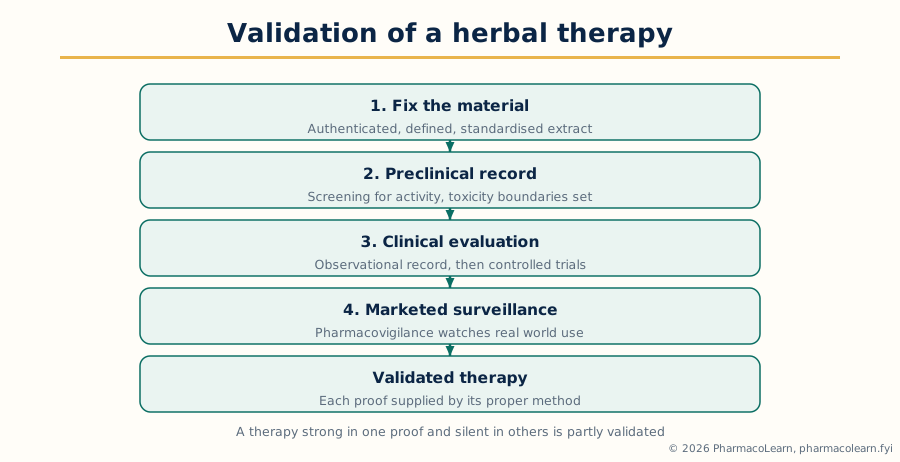 Figure: The validation path. The material is fixed first, the preclinical record and clinical evaluation follow, and surveillance continues after marketing; each proof is supplied by its proper method.
1.4 Toxicity of herbal remedies
The unit title carries toxicity, and the governing idea must be stated plainly: natural origin is not a safety certificate. A plant defends itself with chemistry, and many plant constituents are potent poisons in the wrong dose, the wrong preparation or the wrong patient. The standard teaching examples make the point concretely. Pyrrolizidine alkaloids, present in some traditional herbs and as contaminants from weeds harvested with the crop, injure the liver and can obstruct its veins. Aristolochic acids, from Aristolochia species substituted or mistaken for other drugs, cause a characteristic kidney failure and urinary tract cancers, one of the clearest lessons in why identity testing of Unit 2 is a safety procedure and not a formality. Ephedra type stimulant herbs act on the heart and blood pressure. Alongside intrinsic toxicity sit the acquired harms: heavy metals, pesticides and microbes carried from field and factory, treated as detection problems in Unit 2, and the deliberate adulteration of some commercial products with undeclared conventional drugs, which converts a quality offence into a poisoning.
Toxicity in herbals also hides better than in conventional medicine. Patients often do not report herbal use to their physicians, adverse events are attributed to the disease rather than the remedy, and under reporting is severe, so the absence of reports is weak evidence of absence of harm. Dose is the final complication: a traditional decoction and a concentrated modern extract of the same plant are exposures of different orders, so a safety record earned by the weak preparation does not automatically transfer to the strong one. The balanced conclusion is the one the subject sustains throughout: herbal toxicity is real, specific and testable, and the correct response is not alarm but the standard apparatus of identification, limits, labelling and surveillance.
1.5 Regulation of herbal medicines
Regulation is society's machinery for making Sections 1.2 to 1.4 compulsory, and the world's systems arrange themselves along one recognisable line: how much proof of efficacy is demanded before a claim may be made. At one end, herbal products are regulated as medicines in full, requiring quality, safety and efficacy dossiers like conventional drugs, the route taken for herbal products that seek therapeutic claims in stringent systems, and for the phytopharmaceutical category recognised in the Indian Drugs and Cosmetics Rules for purified and standardised plant derived fractions. In the middle stand traditional use registration systems, of which the European traditional herbal medicinal products framework is the standard example: quality and safety must be proven in full, while efficacy is accepted on the basis of long standing use, classically thirty years of medicinal use including fifteen within the European Union, and the permitted claims are limited accordingly. At the other end, some systems regulate most herbals as supplements or foods, the United States dietary supplement model being the standard case, where the product may be sold without premarket proof of efficacy, manufacturing quality is still regulated, and claims are confined to structure and function language with the burden of safety action falling largely after marketing.
In India, Ayurvedic, Siddha and Unani medicines are licensed under the Drugs and Cosmetics Act and Rules, manufactured under the good manufacturing practice requirements of Schedule T, and judged against the Ayurvedic and other pharmacopoeias; classical formulations and proprietary medicines follow related but distinct evidential expectations. The World Health Organization runs through all of these as the common reference: its guidelines on the assessment of herbal medicines and its monographs on selected medicinal plants supply the shared vocabulary of quality, safety and efficacy assessment that national systems adapt. For the examination, the systems matter less as lists than as one principle stated three ways: the strength of the claim permitted is matched, in every serious system, to the strength of the evidence supplied.
1.6 Pharmacodynamic issues
Pharmacodynamics, what the drug does to the body, presents three characteristic issues for herbal products. The first is multiplicity: an extract contains many constituents that may act on several targets at once, weakly each and jointly in ways that are difficult to predict from any single constituent, so the pharmacology of the extract is not simply the pharmacology of its marker. The marker itself may not even be the active: a constituent chosen because it is easy to measure may be a passenger while others do the work, which is why Unit 4 profiles name markers as analytical anchors and not automatically as actives. The second issue is direction of interaction between constituents, described as synergy where the mixture outperforms its parts and antagonism where it underperforms; both are real phenomena in mixture pharmacology, and both are routinely claimed and rarely proven, so the student should treat strong synergy claims as hypotheses requiring the same evidence as any other claim. The third issue is interaction with conventional drugs at the effect level: herbal products with sedative, hypoglycaemic, anticoagulant or stimulant actions add to or oppose prescribed medicines of the same classes, and the classic teaching examples are the bleeding risk when ginkgo, garlic or ginseng preparations meet anticoagulant and antiplatelet therapy, and the additive effect of hypoglycaemic herbs with antidiabetic drugs.
The professional consequences follow directly. A pharmacodynamic claim for a herbal product should be supported at the level of the product, not borrowed from an isolated constituent tested in a different system; dose response, where it exists, should be stated for the preparation actually sold; and interaction potential belongs on the label and in the prescriber's mind, not in the small print of post marketing experience. Unit 5 supplies the experimental methods by which these effect claims are first tested.
1.7 Pharmacokinetic issues
Pharmacokinetics, what the body does to the drug, is where the mixture nature of herbals bites hardest, because absorption, distribution, metabolism and excretion must now be followed for many constituents at once, most of them unmeasured. The characteristic issues should be known as a set. Bioavailability of many plant constituents is low and erratic, limited by poor solubility, degradation in the gut and first pass metabolism, and it varies with the preparation, so the decoction, the dry extract and the isolated constituent of the same plant can deliver very different exposures. Gut bacteria transform many constituents, hydrolysing glycosides to their absorbable aglycones, so the microbiome becomes an unlisted manufacturing step between dose and effect. Plant constituents also change the handling of other drugs: the standard example is St John's wort, whose hyperforin induces the metabolising enzyme CYP3A4 and the transporter P-glycoprotein, lowering blood levels of medicines such as ciclosporin, oral contraceptives and several antivirals, sometimes to the point of treatment failure. Other constituents inhibit metabolic enzymes in vitro, grapefruit type furanocoumarin inhibition being the famous food example of the mechanism, though the step from an in vitro signal to a clinical effect must always be verified in humans before it is taught as fact.
For standardisation the conclusion is practical: since full pharmacokinetic characterisation of a mixture is rarely achievable, control shifts to the input side, a defined extract, a fixed marker range and a consistent process, so that whatever the body does with the product, it does with the same product every time. That is the same discipline Unit 2 enforces analytically and Unit 4 illustrates drug by drug, and it is the realistic answer this subject gives to the pharmacokinetic problem: where exposure cannot be fully measured, manufacture must be fully controlled.
Unit 2: Adulteration and Deterioration
2.1 Introduction: adulteration and deterioration defined
Adulteration is the practice of substituting the original crude drug, partially or fully, with other similar looking substances that are either free from or inferior in chemical and therapeutic properties, or of adding material that debases the drug's quality. Deterioration is the separate, quieter failure: the genuine drug losing quality over time through moisture uptake, oxidation, light, heat, enzymatic change and attack by insects and microbes, until it no longer meets its standard although nobody has touched it dishonestly. The unit treats them together because the laboratory sees them together, as one question asked of every consignment: is this material what it claims to be, in the condition it should be in? The stakes are those of Unit 1 made concrete. An adulterated drug fails therapeutically at best, since the substituted material lacks the actives, and poisons at worst, when the adulterant is itself toxic or the substitution replaces a safe drug with a dangerous relative. Deteriorated material misleads differently, passing identity tests while its strength has drained away. Quality control of herbal drugs is therefore organised, in this unit's order, as knowledge of the fraud patterns, control of their causes, correct sampling, and then the specific determinations: foreign matter, DNA identity, and the contaminant panel of heavy metals, pesticides, phytotoxins and microbes.
2.2 Types of adulteration and substitution of herbal drugs
The standard classification should be learned as a working list, since each type has its own detection logic. Substitution with inferior commercial varieties replaces the drug with a cheaper, similar species or grade of lower activity, the classic case being dog senna and other inferior Cassia species passed with genuine senna. Substitution with superficially similar but unrelated drugs exploits appearance alone, where the substitute may be inert or actively harmful. Adulteration using artificially manufactured substances fabricates the drug's form, as with artificial invert sugar imitating honey or moulded and coloured materials imitating structured drugs. Adulteration using exhausted drugs returns to the market material from which the valuable constituent has already been removed, volatile oil distilled cloves and extracted ginger being the classical teaching examples: the shape is genuine, the strength is gone. Adulteration using vegetative parts of the same plant bulks the drug with stems, stalks and other parts of the correct plant that carry little of the active, clove stalks in cloves being the standard case. Adulteration of powders dilutes ground drugs, where morphology can no longer protect the buyer, with starch, dextrin, chalk, brick powder or exhausted powder of the same drug. Addition of toxic materials covers stones and soil added for weight and, in the gravest cases, toxic plant material or undeclared synthetic drugs worked into products. Against deliberate fraud stands unintentional substitution, through confusion of similar names, similar appearance, careless collection and mistaken identity in the field, which produces the same laboratory picture with no fraudster to blame.
One distinction organises the whole list for examination purposes. Some types attack identity, the drug is not the species claimed; some attack strength, the drug is genuine but empty or diluted; and some attack safety, adding what should not be there at all. Detection follows the attack: identity falls to microscopy and DNA, strength to assay and fingerprint, safety to the contaminant determinations of Sections 2.7 to 2.9.
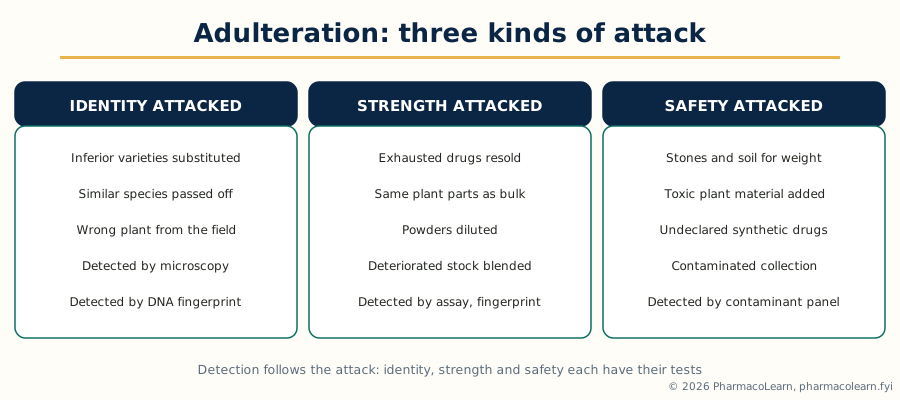 Figure: The types of adulteration grouped by what they attack. Identity frauds, strength frauds and safety frauds each meet a different family of tests.
2.3 Causes and measures of adulteration
The causes divide into the conditions that invite fraud and the failures that permit error. Scarcity is the first cause: a drug in short supply, from a slow growing, over collected or geographically narrow source, commands a price that makes substitution profitable and tempts collectors to stretch the genuine article. High price acts the same way even without scarcity, saffron standing as the permanent example of a drug whose value invites imitation. Seasonal and regional availability leaves gaps that substitutes fill. On the error side, confusion in vernacular names, where one name covers several species across regions, similar morphology between genuine drug and substitute, ignorance or negligence in collection, and faulty storage that deteriorates genuine stock until it is quietly replaced or blended, all feed adulteration without deliberate fraud. Deterioration has its own causes in the same section: excess moisture, heat, light, oxygen, insect infestation and microbial growth during careless storage and transport.
The measures answer the causes in order. Prevention begins in the field and the supply chain, with authenticated source material, good agricultural and collection practices of the kind taught in Semester 1, trained collectors, and purchase from traceable suppliers against specifications. Process control adds correct drying, protected storage and stock rotation, so genuine material is not lost to deterioration and replaced in desperation. Detection is the laboratory programme of the rest of this unit, applied at purchase, at manufacture and in market surveillance, with pharmacopoeial monographs supplying the standards against which material is judged. Enforcement closes the system: licensing of manufacture, inspection, sampling of marketed products and legal consequence for proven fraud, because a detection method without a consequence is merely information. The examination point is that adulteration is controlled as a system, of which the laboratory is one part, not the whole.
2.4 Sampling procedures
Every determination in this unit is performed not on the consignment but on a sample of it, so sampling is the step on which all later evidence stands or falls. The principles are constant across pharmacopoeias and the WHO guidance on quality control of herbal materials. The sample must represent the whole: material is drawn from a spread of containers selected according to the size of the consignment, and from different positions within containers, top, middle and bottom, because settling, moisture and admixture are never evenly distributed. The portions drawn are combined and then reduced by quartering, mixing the bulk, dividing it into quarters, rejecting opposite quarters and repeating until a working sample of manageable size remains, a method that reduces quantity without biasing composition. Samples for different purposes are kept distinct and labelled with full identity of batch and source: the analytical sample for the laboratory, and a retained reference sample held against future dispute. Sampling itself can contaminate, so clean tools, clean containers and protection from moisture and light during transit are part of the procedure, not courtesies.
Two examination points complete the section. First, sampling intensity responds to risk and history: a trusted supplier with a clean record and a new, unknown or previously failed source are not sampled with the same rigour, and visible heterogeneity of a consignment is itself a finding that widens the sampling. Second, identity work begins at sampling, not in the laboratory: the sampler records appearance, odour and condition of the bulk, because foreign matter, mould and insect damage, Section 2.5, are often visible at the warehouse in a way no extract in a vial will later show.
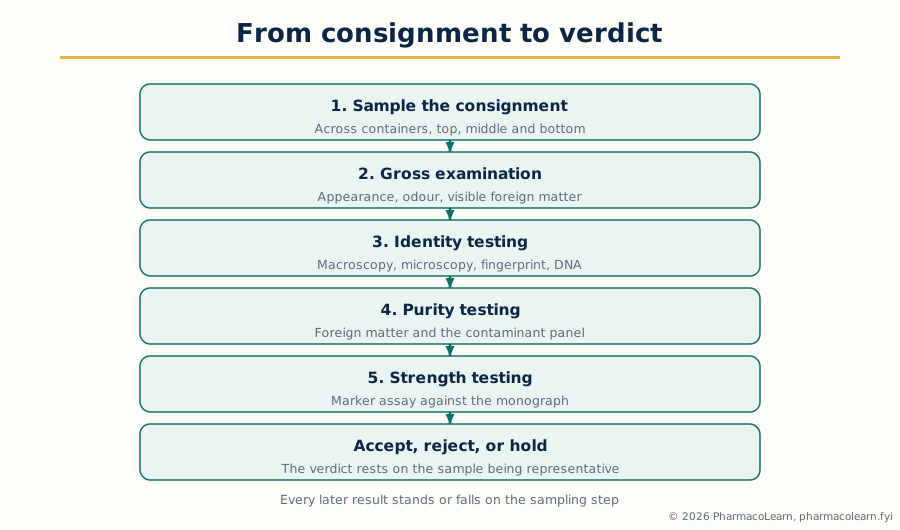 Figure: The detection workflow. Sampling, gross examination, identity, purity and strength determinations lead to the verdict, and every stage rests on the sampling being representative.
The detection workflow of the unit, from consignment to verdict, runs as follows.
Consignment received and documented
        |
Sample drawn across containers, positions noted
        |
Gross examination: appearance, odour, visible foreign matter
        |
Identity: macroscopy, microscopy, fingerprint, DNA where needed
        |
Purity: foreign matter, ash, extractives, contaminant panel
        |
Strength: marker assay against the monograph
        |
Verdict: accept, reject, or hold for referee testing
2.5 Determination of foreign matter
Foreign matter is everything in the sample that is not the drug as defined: parts of the plant other than the official part, other plants entirely, soil, stones, sand, animal contamination, mould and insect remains. Its determination is the oldest test in pharmacognosy and remains one of the most informative, because it measures the care taken at collection and cleaning in a single number. The procedure is direct: a weighed quantity of the sample, taken by the sampling discipline of Section 2.4, is spread and sorted, by eye and under magnification, separating everything foreign, and the separated material is weighed and expressed as a percentage of the sample. For drugs where sorting is impractical the pharmacopoeial methods adapt the principle, using sieving, sedimentation or microscopic estimation as the drug demands. Pharmacopoeias set a limit for foreign matter in each monograph, and material above the limit fails, however good its assay, because foreign matter is a direct index of the supply chain that produced the batch.
The section connects backward and forward. Backward, foreign matter is where the adulteration types of Section 2.2 first become visible: stalks in a leaf drug, exhausted material mixed with fresh, weed seeds carrying the pyrrolizidine risk of Unit 1. Forward, a high foreign matter result directs the contaminant panel, since material collected carelessly from the ground carries soil borne metals and microbes with it. A low result, conversely, is earned evidence of good practice that no later test can confer retrospectively.
2.6 DNA fingerprinting techniques in identification of drugs of natural origin
Morphology fails exactly where modern trade needs it most: in powders, extracts and fragments, where the structures microscopy reads have been ground away, and between closely related species whose chemistry overlaps. DNA fingerprinting answers by reading identity from the genome itself, which is present in every fragment, unchanged by season, age or growing conditions. The working methods should be known as a family with their logics distinguished. RAPD, random amplified polymorphic DNA, amplifies DNA with short arbitrary primers and compares the resulting band patterns; it is fast and needs no prior sequence knowledge, but its reproducibility between laboratories is weak. AFLP, amplified fragment length polymorphism, cuts the DNA with restriction enzymes and selectively amplifies fragments, giving many bands and high discrimination at the price of a longer protocol. ISSR amplifies the regions between microsatellite repeats, combining simplicity with good polymorphism. SSR markers target specific microsatellite loci and are highly reproducible once developed for a species. SCAR markers convert a distinctive fragment from a screening method into a single, robust, species specific test, the form in which fingerprinting becomes a routine identity assay. Alongside fingerprinting stands DNA barcoding, which sequences a standard short region, the plant core barcode loci rbcL and matK, with ITS2 widely used for medicinal plants, and matches the sequence against reference databases.
| Technique | Basis | Strength | Limitation |
|---|---|---|---|
| RAPD | Arbitrary primer PCR bands | Fast, no sequence data needed | Poor reproducibility |
| AFLP | Restriction plus selective PCR | Many markers, high discrimination | Long, demanding protocol |
| ISSR | PCR between microsatellites | Simple, polymorphic | Dominant markers |
| SCAR | One species specific PCR product | Robust routine identity test | Must be developed per drug |
| Barcoding | Standard locus sequenced | Database matched, portable | Needs intact DNA, close species may share |
The limits must travel with the method, in the examination as in practice. DNA methods prove species identity, not quality: they cannot measure marker content, detect exhaustion, or find chemical contamination, and DNA in highly processed extracts may be too degraded to amplify. DNA fingerprinting therefore takes its place inside the workflow of Section 2.4 as the identity instrument of last resort and highest authority, beside, never instead of, the chemical fingerprint and assay.
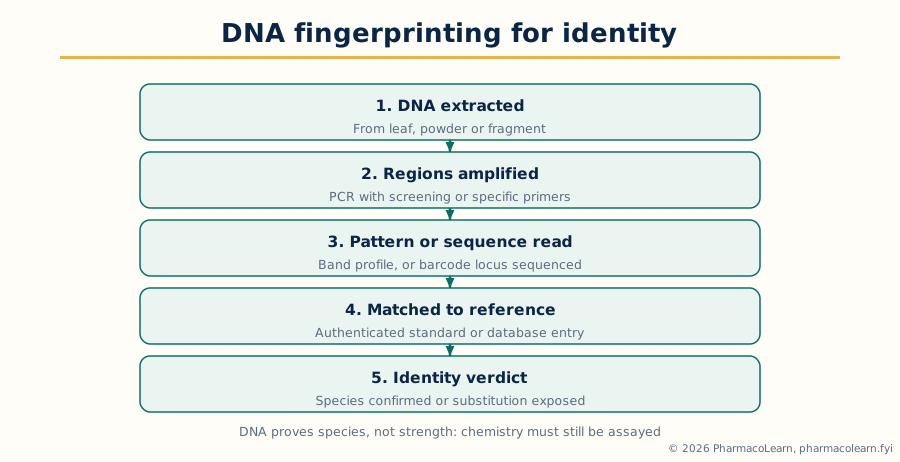 Figure: DNA fingerprinting for identity. DNA is extracted, amplified, read as a band pattern or barcode sequence, and matched against an authenticated reference.
2.7 Detection of heavy metals
Heavy metals reach herbal drugs from the ground up and the factory down: contaminated soil and irrigation water where the plant grew, atmospheric deposition near industry and roads, metal contact in processing equipment, and, in some traditional preparations, deliberate mineral ingredients whose control is a separate discipline. The metals of standard concern are lead, cadmium, arsenic and mercury, each with cumulative toxicity at low doses, which is why pharmacopoeias and WHO guidance set limits for them in herbal materials and finished products. Detection is instrumental and follows a fixed logic. The organic matrix is first destroyed, by dry ashing or acid digestion, since the metals must be freed into solution before they can be measured. Measurement is then by atomic spectrometry: flame and graphite furnace atomic absorption spectrometry for routine single metal work, inductively coupled plasma optical emission or mass spectrometry where many metals are measured together at very low levels, and cold vapour techniques for mercury, which is volatile enough to be measured as a vapour. The examination essentials are the sample preparation, the matching of method sensitivity to the limit being enforced, and the use of reference materials and recovery checks, because a digestion that loses the metal manufactures a false pass.
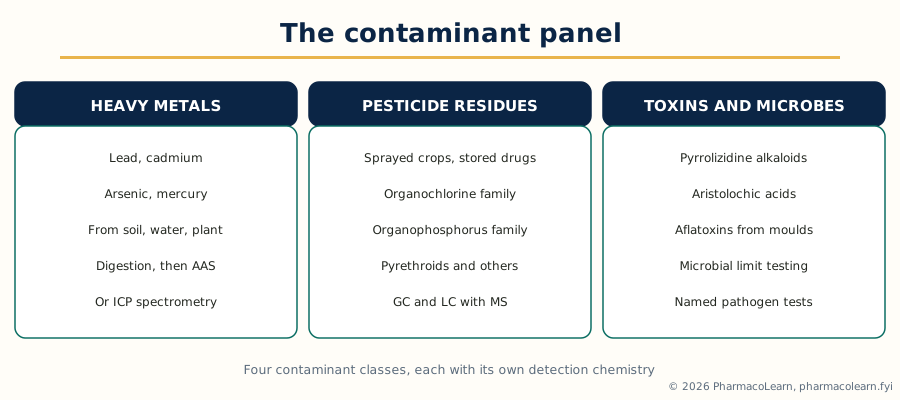 Figure: The contaminant panel of Sections 2.7 to 2.9. Each contaminant class, heavy metals, pesticide residues, phytotoxins and microbes, carries its own detection chemistry.
2.8 Detection of pesticide residues
Medicinal plants are crops, and crops are sprayed; in addition, stored crude drugs have historically been fumigated and protected against insects, so residues of the organochlorine, organophosphorus, carbamate and pyrethroid families can persist into the finished herbal product. Detection is a multi residue problem: dozens of possible compounds at very low levels in a complex plant matrix that interferes at every step. The standard workflow is extraction of the residues from the powdered drug into organic solvent, clean up to remove pigments, oils and other matrix material that would swamp the measurement, and then separation and detection matched to the chemistry of the targets: gas chromatography with selective detectors, and increasingly mass spectrometry, for the volatile and heat stable majority, and liquid chromatography with mass spectrometry for the polar and heat labile remainder. Results are judged against residue limits set for herbal materials in pharmacopoeial and regulatory lists. Two cautions belong in the answer: a result is only as wide as the panel screened, so the method reports which compounds were sought, and residues concentrate unevenly, which returns the examiner to Section 2.4, since no instrument can correct a sample that never represented the batch.
2.9 Detection of phytotoxins and microbial contamination in herbs and their formulations
The last two items of the contaminant panel concern poisons the plant kingdom and the microbial world contribute themselves. Phytotoxins are toxic constituents that arrive with the drug or its adulterants: pyrrolizidine alkaloids from weed contamination of harvested crops, aristolochic acids where Aristolochia species enter the supply, cyanogenic compounds in materials that carry them, and potent cardiac or neurotoxic constituents in substituted species. Their detection is chemical and specific, chromatographic separation with mass spectrometric confirmation being the standard approach, because these toxins act at low levels and cannot be found by general tests. Microbial contamination is assessed by the pharmacopoeial microbial limit framework: total aerobic microbial count and total yeast and mould count as the general load, and specified pathogen testing for organisms such as Escherichia coli, Salmonella and Staphylococcus aureus whose presence is unacceptable in oral products. Mycotoxins, above all the aflatoxins produced by Aspergillus moulds on badly stored material, are tested chemically in the same spirit as the phytotoxins, by chromatographic methods after clean up, because their harm is chronic and carcinogenic rather than infectious. Formulations inherit all of it: an extract concentrates whatever the raw material carried, and water based preparations support microbial growth, so the panel is applied to finished products as well as to crude drugs, with preservative and process controls in manufacture completing what testing begins.
Unit 3: Ethnobotany and Ethnopharmacology
3.1 Ethnobotany in herbal drug evaluation
Ethnobotany is the study of the relationship between people and plants: how communities name, select, prepare and use plants for medicine, food, ritual and material life. Its place in herbal drug evaluation is at the very start of the pipeline, because traditional use is the oldest screening programme in pharmacognosy, run over centuries on human subjects, and its records, properly read, tell the evaluator three things no laboratory can generate quickly: that a plant has been used by many people over long periods, for a recognisable set of complaints, prepared in a recognisable way. Evaluation uses ethnobotanical information as evidence to be weighed, not as proof to be quoted. A use report gains weight when independent communities use the same plant for the same purpose, when the traditional preparation resembles the product to be tested, and when the plant's known chemistry offers a plausible mechanism. It loses weight when reports are single, vague or gathered carelessly. The fieldwork discipline matters accordingly: plants are identified botanically and voucher specimens deposited in a herbarium, so that the species behind a use report can be verified forever after, uses are recorded with the healer's own detail of part, preparation and dose form, and the record distinguishes what was observed from what was inferred. An ethnobotanical claim without a voucher specimen is, for evaluation purposes, a rumour attached to a name.
Modern field method adds simple quantification to this discipline, and the evaluator should know its shape. Use reports are counted and compared: agreement among independent informants on a plant for a given complaint is treated as stronger evidence than a single report, and indices built on that agreement are used to rank species for laboratory follow up, turning a pile of interviews into a priority list. Preparation is recorded with the same care as identity, because the evaluator who ignores it ends up testing the wrong material: a drug taken traditionally as a fresh juice, a water decoction and a fermented preparation are three chemically different products wearing one name, and the screening of Unit 5 is only a test of the tradition when the tested extract corresponds to the recorded preparation. Evaluation, in short, begins in the field with the same habits it ends with in the laboratory: identify the material, record the method, and distrust any result whose specimen cannot be produced.
3.2 Impact of ethnobotany in traditional medicine
Within traditional medicine itself, ethnobotany works in both directions. It documents and thereby protects knowledge that lives in memory and practice and dies with its holders, converting fragile oral transmission into records that communities and researchers can return to. It feeds back into the systems it studies: identification of the correct species behind a classical drug name, resolution of the disputed source plants that classical texts leave behind, and quality standards for the raw drugs of Ayurveda, Siddha and Unani all draw on ethnobotanical fieldwork among the communities who collect and use the plants. It also disciplines traditional practice from inside, by detecting dangerous substitutions and toxic look alikes in local trade, the field end of the adulteration problem of Unit 2. The two classical success stories of the discipline show its reach when the loop closes into modern medicine: the antimalarial artemisinin, developed from the Chinese traditional use of Artemisia annua after the ancient preparation instructions were read with ethnobotanical care, and reserpine, isolated from Rauvolfia serpentina, a plant of the Ayurvedic tradition, which carried a traditional remedy for agitation and snakebite into the pharmacopoeias of the world. Neither drug would have been found by random screening on any realistic budget of time; both began as somebody's recorded knowledge of a plant.
3.3 New developments in herbals
The syllabus asks for new developments in herbals, and the honest survey is of directions rather than marvels. Standardisation has deepened from single marker assays toward fingerprint based control, in which the whole chromatographic pattern of an extract is matched, so that mixture products are defined by their profile and not by one convenient peak, the analytical philosophy behind Unit 4. Clinical evidence is slowly accumulating for the major traditional systems, with trial methods adapted to whole system practice and to standardised extracts, while pharmacovigilance systems for herbal medicines extend the safety net that Unit 1 found thin. Cultivation and biotechnology, the subjects of Semester 1 and of MPG201T, are being applied to endangered and variable species so that supply stops depending on wild collection, and conservation status now enters procurement decisions. Regulatory development continues along the line of Section 1.5, with traditional use frameworks spreading and pharmacopoeias expanding their herbal monographs. Finally, the information tools have changed the scale of the work: databases of traditional knowledge, of which India's Traditional Knowledge Digital Library is the landmark example, digitise classical formulations to defeat wrongful patents and to make the record searchable, and molecular identification, the DNA methods of Unit 2, has entered routine quality practice. The examination answer should present these as connected developments in one project, making herbal medicine documented, standardised, tested and traceable, rather than as a catalogue of novelties.
3.4 Bioprospecting tools for drug discovery
Bioprospecting is the systematic search of biological material for compounds and activities of commercial and medical value, and ethnobotany is its compass. The tools form a working kit. At the front end are collection strategies, ranging from random collection of diverse species, through phylogenetic collection of relatives of known producers, to ethnobotanically directed collection, which follows use reports and consistently yields the highest rate of active leads per sample in screening programmes. Field tools are documentation tools: voucher specimens, geographic and habitat records, and structured interviews recorded with the knowledge holders. Laboratory tools begin with extract libraries, in which prepared extracts of collected species are held ready for the screening methods of Unit 5, followed by bioassay guided fractionation, in which activity is tracked through separation until the responsible constituent is isolated, and dereplication, the early identification of known compounds by spectroscopic and database matching, which stops effort being wasted on rediscovering the familiar. The legal and ethical instruments are tools of the kit as surely as the chromatograph: access and benefit sharing under the Convention on Biological Diversity and its Nagoya Protocol, and in India the Biological Diversity Act, govern collection and use of traditional knowledge, requiring consent and fair return to the communities whose knowledge directed the search. A bioprospecting programme that ignores them is not merely unethical but legally fragile, a point examiners increasingly test.
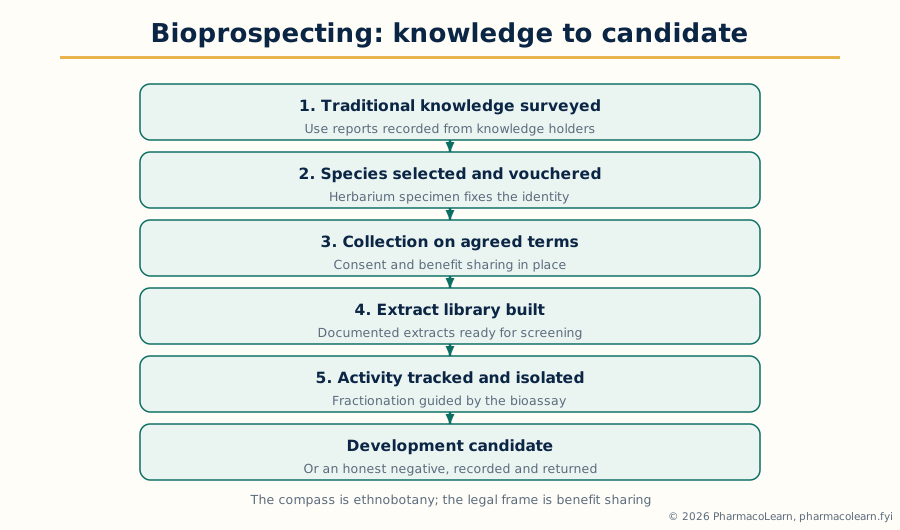 Figure: The bioprospecting flow. Traditional knowledge directs selection, the voucher specimen fixes identity, consent and benefit sharing frame collection, and screening with guided fractionation produces the candidate.
The discovery flow runs as follows.
Traditional knowledge and field survey
        |
Species selected, voucher specimen deposited
        |
Collection with consent and benefit sharing terms
        |
Extract library prepared and documented
        |
Screening for activity (Unit 5 methods)
        |
Bioassay guided fractionation, dereplication
        |
Active constituent isolated and characterised
        |
Development candidate, or return to source knowledge
3.5 Role of ethnopharmacology in drug evaluation
Ethnopharmacology is the interdisciplinary study of the biologically active agents used by peoples in traditional practice: it takes the ethnobotanical record as its starting hypothesis and submits it to pharmacological method. Its role in drug evaluation can be stated as four functions. It prioritises: from thousands of used plants it ranks candidates for the expensive business of screening and isolation, using strength and consistency of traditional use, and the fit between the traditional preparation and the test system, as ranking evidence. It designs better experiments: the traditional route of administration, preparation and combination tells the pharmacologist what to test, in what form, and against which endpoint, so that a plant used as a water decoction for stomach complaints is not absurdly tested as a hexane extract in a cancer screen and declared inactive. It interprets safety: long use at traditional doses is real, if uncontrolled, human exposure data, which ethnopharmacology reads carefully for the harms it does and does not rule out, remembering Unit 1's lesson that concentrated modern products outrun the traditional exposure. And it validates or retires claims: where experimental and clinical work confirms a use, the therapy graduates toward the validated status of Section 1.3; where careful work fails to find the claimed activity, ethnopharmacology records the negative honestly, which protects patients and purifies the tradition itself. In short, ethnobotany finds the claims and ethnopharmacology examines them, and this subject's Units 2 and 5 supply the examining instruments.
3.6 Reverse pharmacology
Reverse pharmacology is the discovery path that runs opposite to the conventional one, and it is fittingly an Indian contribution to drug discovery method, developed and named in the context of Ayurvedic research. Conventional discovery moves from molecule to man: a compound is found or designed, tested in cells and animals, and only at the end given to patients, with most candidates dying on the way. Reverse pharmacology begins where conventional discovery ends, with a documented clinical experience: a traditional formulation with a record of use and observed effects in patients. The path then runs backward through the laboratory, first systematising the clinical observation, in what its proponents describe as the experiential stage, then testing the formulation in exploratory studies for activity, dose behaviour and safety signals, and finally carrying it into experimental work to find mechanisms, active fractions and constituents, the stage at which it rejoins and can feed the conventional pipeline with a candidate already carrying human evidence. The direction is the whole point, and the comparison should be statable in one line each way: conventional pharmacology asks whether a molecule that works in the laboratory is safe and useful in man; reverse pharmacology asks how a remedy that appears to work in man does its work, and whether the effect survives controlled examination.
Documented traditional use and clinical observation
        |
Experiential stage: records systematised, outcomes defined
        |
Exploratory stage: activity, dose and safety studied
        |
Experimental stage: mechanism, fractions, constituents
        |
Validated therapy or development candidate
The method suits herbal drugs for the reason Unit 1 established: their evidence problem is inverted. A new synthetic molecule has laboratory data and no human record; a classical herbal formulation has a human record and thin laboratory data, and reverse pharmacology is the disciplined way of supplying the missing half without discarding the half that exists. Its disciplines are those of this whole subject: the formulation must be standardised before it is studied, the clinical observations must be recorded to research standard rather than anecdote, and failure at any stage is reported, else the method degenerates into a ceremony for confirming what was believed at the start. Properly run, it converts the ethnopharmacological hypothesis of Section 3.5 into a development programme, and it closes Unit 3 by joining the field knowledge of its first sections to the screening science of Unit 5.
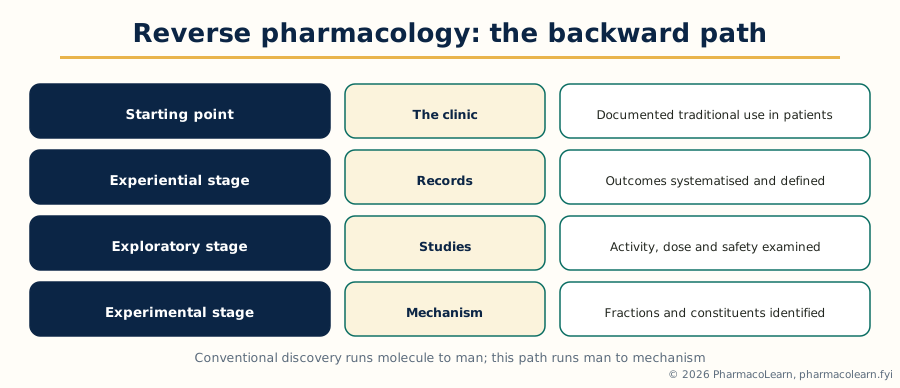 Figure: Reverse pharmacology. The path starts in the clinic with documented traditional use and runs backward through experiential, exploratory and experimental stages to mechanism, the reverse of the conventional molecule to man direction.
Unit 4: Analytical Profiles of Herbal Drugs
4.1 The analytical profile: what it contains
An analytical profile is the complete standard description of one herbal drug for quality purposes: its botanical identity and official part, the characters by which the genuine article is recognised, the constituents that serve as markers, the methods by which identity, purity and strength are measured, and the uses the standardised drug serves. This unit profiles the six drugs named in the syllabus in that order, and the pattern matters as much as the individual facts, because the same pattern is the student's template for profiling any drug in practice. Identity rests on macroscopy and microscopy supported by chemical fingerprint; strength rests on assay of the named marker; and the marker is chosen, in each case, because it is characteristic of the species and connected, directly or by association, with the drug's activity. The summary table fixes the six before the sections develop them.
Each profile below is anchored in the pharmacopoeial and standardisation framework around the drug: the Ayurvedic Pharmacopoeia of India and the Indian Pharmacopoeia carry monographs for several of these drugs, the WHO monographs on selected medicinal plants treat some of them, and commercial standardised extracts are traded against the marker specifications the profiles name. Where a drug's marker is also its principal active, as with forskolin and psoralen, the assay reads almost as a potency test; where the marker is a representative of a family, as with the amla tannins, it reads as an identity and consistency test, and the student should be able to say, for each of the six, which kind of marker they are handling and why it was chosen.
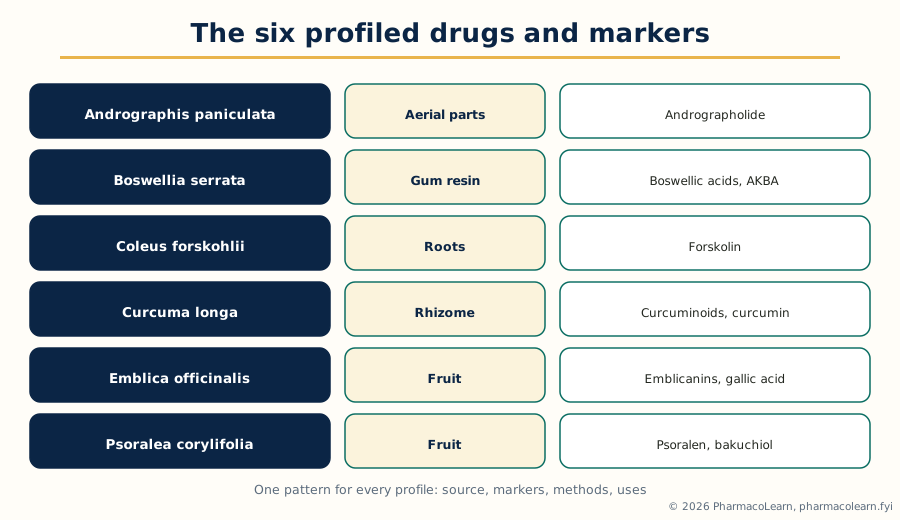 Figure: The six drugs of this unit with their official parts and principal markers. Every profile that follows is built on this one pattern: source, markers, methods and uses.
| Drug | Official part | Principal markers | Standard analytical approach |
|---|---|---|---|
| Andrographis paniculata | Aerial parts | Andrographolide and related diterpene lactones | HPTLC fingerprint, HPLC assay of andrographolide |
| Boswellia serrata | Gum resin | Boswellic acids, including AKBA | HPTLC and HPLC of boswellic acids |
| Coleus forskohlii | Roots | Forskolin | TLC and HPLC assay of forskolin |
| Curcuma longa | Rhizome | Curcuminoids, curcumin chief | Colour reactions, TLC, HPLC of curcuminoids |
| Emblica officinalis | Fruit | Emblicanins, gallic and ellagic acids | HPLC of phenolic markers, tannin assay |
| Psoralea corylifolia | Fruit | Psoralen, bakuchiol | TLC and HPLC of psoralen |
4.2 Andrographis paniculata: Kalmegh
Andrographis paniculata, family Acanthaceae, known in Indian practice as Kalmegh and in commerce as the king of bitters, is used as the dried aerial parts, the leaf and stem harvested at flowering. The profile opens with recognition: the plant is an erect annual herb with lanceolate leaves and a characteristically intense bitterness present in every part, a taste so reliable that it serves as a first field and bench test, since substitutes and exhausted material declare themselves by its absence or weakness. The chemistry is dominated by diterpenoid lactones of the labdane type, of which andrographolide is the principal bitter constituent and the universal marker, accompanied by neoandrographolide, dehydroandrographolide and related glycosides, with flavonoids in the roots and aerial parts as supporting constituents. Analysis follows the unit pattern: identity by macroscopy and microscopy of the leaf and stem, by the bitterness, and by thin layer and high performance thin layer chromatographic fingerprints in which andrographolide appears as the reference band; strength by HPLC assay of andrographolide in the drug and its extracts, against which commercial standardised extracts are specified. The drug's recorded uses, in Ayurvedic and other Asian traditional practice, are as a bitter tonic and febrifuge and in liver disorders, dyspepsia and respiratory infections, and modern investigation has concentrated on these same areas, which makes Andrographis a clean teaching example of Section 3.5: traditional claim, characteristic marker, standardised product, testable activity.
4.3 Boswellia serrata: Shallaki
Boswellia serrata, family Burseraceae, is an Indian frankincense: the drug is the gum resin, called Shallaki in Ayurvedic practice and salai guggul in trade, obtained by incising the bark of the tree and collecting the exudate that hardens on exposure. Its profile differs from the leaf drugs around it in kind, because a gum resin is a mixture of three fractions that the analyst separates before judging any of them: a resin fraction carrying the actives, a gum fraction of polysaccharides, and a volatile oil fraction. The markers sit in the resin: the boswellic acids, pentacyclic triterpene acids of which beta boswellic acid and its acetyl derivative are abundant, while 11-keto-beta-boswellic acid, abbreviated KBA, and its acetyl form AKBA are the constituents most studied for the drug's anti-inflammatory activity and therefore the markers quoted for enriched extracts. Identity rests on the appearance and behaviour of the tears of gum resin, their burning and solubility characters, and on the fingerprint; strength is measured by HPTLC and HPLC determination of the boswellic acids, reported for standardised products as total boswellic acids or as specified AKBA content. Adulteration pressure on this drug takes the Unit 2 forms: gum resins of other Boswellia species and cheaper resins enter the trade, and exhausted or low resin material dilutes strength, both of which the acid profile exposes. The traditional and investigated use is concentrated in inflammatory joint conditions, where the drug's long Ayurvedic record in arthritis made it a natural subject for the validation programme of Unit 1.
4.4 Coleus forskohlii
Coleus forskohlii, family Lamiaceae, also encountered under its later botanical name Plectranthus barbatus, is profiled on its roots: fleshy, tuberous roots of a perennial herb of the Indian hills, collected and dried as the commercial drug. This is the unit's single constituent drug, the profile of one molecule carried by one part. The marker and active is forskolin, also named coleonol, a labdane diterpene whose pharmacology is unusually precise for a plant constituent: it directly activates the enzyme adenylate cyclase, raising cyclic AMP in cells, and it is used worldwide as a laboratory tool for exactly that action. The root contains forskolin in modest proportion alongside related diterpenes, and because the molecule is the product, analysis is direct: identity by the root's macroscopy and microscopy and by thin layer chromatography of forskolin, strength by HPLC assay of forskolin, with standardised extracts specified by their forskolin content for the supplement and research trades. The profile teaches two cautions as well. First, a single marker drug is the exception that proves Unit 1's rule: most herbal drugs cannot be reduced to one constituent, and Coleus can be profiled this way only because its use follows its one famous molecule. Second, the plant is collected heavily from the wild and has been under pressure, so cultivation and the biotechnology of Semester 1 and MPG201T enter its modern story as supply answers. Traditional uses recorded for the plant in Indian practice are various, but its contemporary profile is written, unusually, in the laboratory language of its single diterpene.
4.5 Curcuma longa: Turmeric
Curcuma longa, family Zingiberaceae, supplies turmeric from its rhizomes, the primary central rhizomes and their lateral fingers boiled, dried and polished into the most familiar coloured drug of Indian commerce. Identity is the easiest in the unit and adulteration correspondingly bold: the rhizome's deep orange yellow interior, aromatic odour and colouring power are its characters, and the classical chemical tests belong to its chemistry, the colour reactions of curcumin with alkalis and with boric acid among them. The markers are the curcuminoids, the yellow diarylheptanoid pigments of which curcumin, diferuloylmethane, is the chief, accompanied by demethoxycurcumin and bisdemethoxycurcumin, together with a volatile oil fraction carrying turmerones that contribute the aroma. Analysis runs from the simple to the exact: colour and fluorescence behaviour for rapid identity, thin layer and HPTLC fingerprints showing the three curcuminoid bands, and spectrophotometric or HPLC determination of total curcuminoids and of curcumin itself for strength, against which oleoresins and standardised extracts are traded. The adulteration lesson of Unit 2 sits inside this profile, since turmeric powder has been a documented target for added colour, including toxic lead chromate in some supply chains, which converts a colour fraud into a heavy metal poisoning and is the standing justification for the metal testing of Section 2.7 on coloured drugs. The uses divide honestly: turmeric is at once a food colour and spice of daily life, a traditional drug for digestive complaints, wounds and skin, and a modern research subject in inflammation, and its profile must keep the colour value, the culinary identity and the medicinal claims analytically separate.
4.6 Emblica officinalis: Amla
Emblica officinalis, family Phyllanthaceae in modern classification and listed in older texts under Euphorbiaceae, now also named Phyllanthus emblica, gives the fruit drug Amla, one of the most esteemed rasayana drugs of Ayurveda and one of the three fruits of the Triphala combination. The fresh fruit is fleshy and richly astringent; the dried fruit, dark and wrinkled, is the usual article of analytical commerce. The chemistry is a tannin chemistry: the fruit carries hydrolysable tannins in quantity, of which emblicanin A and emblicanin B are named as the characteristic markers, breaking down toward gallic acid and ellagic acid, both of which serve as practical HPLC markers, together with a notable content of ascorbic acid, vitamin C, whose lability in drying and storage is itself an analytical lesson in deterioration from Unit 2. Identity rests on the fruit's macroscopy, its astringent taste and the iron and colour reactions of its tannins; strength is approached through total tannin determination and HPLC assay of gallic and ellagic acids as the stable, measurable representatives of a constituent group that changes as it is handled. The profile therefore teaches the general problem of drugs whose actives are a family rather than a molecule: the analyst standardises by representative markers and total content together, accepting that the fingerprint, Section 3.3's philosophy, describes such a drug more truthfully than any single peak. The recorded uses span the rasayana tradition of rejuvenation and the modern antioxidant interest that the same tannin chemistry predicts, with the fruit also serving as a food, a mordant and a hair care ingredient across Indian practice.
4.7 Psoralea corylifolia: Babchi
Psoralea corylifolia, family Fabaceae, now also classified as Cullen corylifolium, completes the unit with the fruit drug Babchi, the small, dark, kidney shaped fruits, commonly called seeds in trade, of an annual herb widespread in India. Its profile is the unit's safety profile, because this drug's famous constituent is powerful in a way that cuts both ways. The marker is psoralen, a furanocoumarin, present with its isomer isopsoralen in the fruit coat, accompanied by the meroterpene bakuchiol, now itself a cosmetic ingredient of interest, and by psoralidin and flavonoids as supporting constituents. Psoralen is photosensitising: on skin exposed to ultraviolet light it reacts to stimulate pigmentation, a mechanism that is the drug's traditional use in leucoderma and other depigmenting skin conditions, and the basis, in purified medicine, of psoralen plus ultraviolet A therapy. The same mechanism burns when dose and sunlight are uncontrolled, so the profile carries the unit's clearest statement that activity and toxicity are one property read at two doses, Unit 1's teaching in a single fruit. Analysis follows the pattern: identity by the fruit's distinctive appearance and odour and by thin layer chromatography of psoralen, strength by HPLC assay of psoralen, with attention to the proportion present in pericarp rich material. Adulteration takes the form of other seeds substituted in the small dark fruit trade, which microscopy and the psoralen fingerprint detect. The student should leave this profile able to state, for Babchi as for the other five, the four line summary this unit exists to teach: the plant and part, the markers and their chemical family, the methods that prove identity and strength, and the use, with its attendant caution, that the standardised drug serves.
Unit 5: Biological Screening of Herbal Drugs
5.1 Introduction and need for phytopharmacological screening
Biological screening is the systematic testing of plant materials in living or derived biological systems to discover whether they do anything, and if so, what. It is needed because of the arithmetic of the herbal world: there are far more plants, extracts and traditional claims than can ever be isolated, trialled or developed, so a rational order of testing must spend cheap, fast experiments first to decide where expensive, slow ones are deserved. Screening is that ordering system. It serves four purposes in pharmacognosy. It tests traditional claims at the first level, giving ethnopharmacology, Unit 3, its experimental verdicts. It guides chemistry, since bioassay guided fractionation follows activity through separation until the responsible constituents stand alone. It provides the first safety signals, because a screen that finds strong unwanted activity, above all cytotoxicity without selectivity, stops a line of work before animals or patients are exposed. And it standardises research materials biologically where chemistry is not yet able, an extract being describable by what it does as well as by what it contains. The rest of the unit teaches the standard instruments: in vitro techniques, which test effects in cells, microbes and chemical systems, and in vivo techniques, which test them in whole animals, ending with the toxicity studies by which safety is formally established.
5.2 New strategies for evaluating natural products
The classical strategy, grind, extract, test one extract in one model, isolate if active, wasted most of its effort on rediscovery and on activities that never survived contact with a whole organism. The newer strategies named in the syllabus correct those weaknesses and should be known as a set. Bioassay guided fractionation remains the backbone, now accelerated: activity is tracked at every separation step so effort concentrates only on active fractions. High throughput screening tests extract libraries, of the kind bioprospecting builds, Section 3.4, against molecular and cellular targets in automated miniature formats, converting screening from a craft into a statistics problem. Dereplication identifies known compounds in active extracts at the start, by liquid chromatography with mass spectrometry and database matching, so that known chemistry is recognised before it is reisolated at full cost. Metabolomic and fingerprint based approaches compare the whole chemical profile of many samples with their measured activities and let statistics nominate the peaks responsible, reversing the classical order by proposing candidates from data rather than from fractions. In silico screening tests constituents computationally against target structures before any bench work. Running through all of them is the strategic discipline of the cascade: cheap and predictive before dear and definitive, in vitro before in vivo, general screens before specific models, with the ethical and cost logic made explicit at the end of this unit.
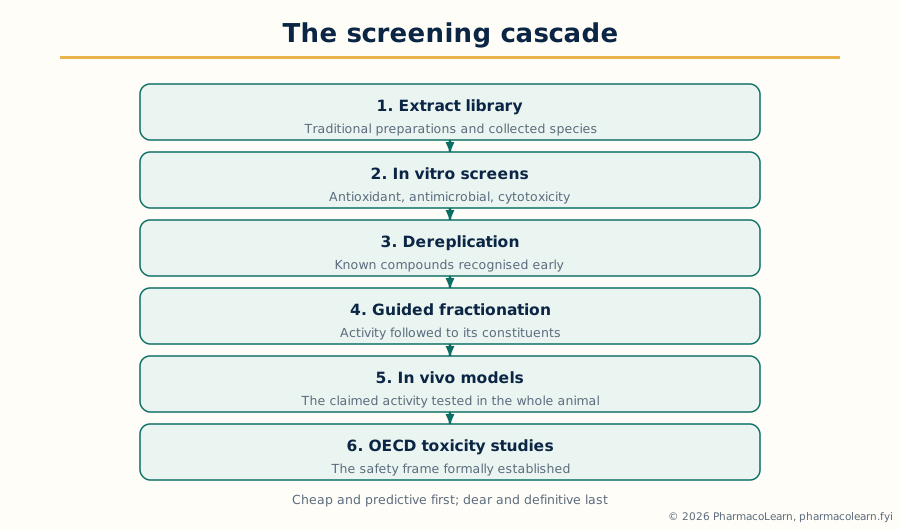 Figure: The screening cascade. Cheap and predictive tests come first, dereplication removes the known, fractionation follows activity, and in vivo models with OECD toxicity studies decide what may proceed.
The cascade in working order runs as follows.
Extract library or traditional preparation
        |
Primary in vitro screens: antioxidant, antimicrobial, cytotoxicity
        |
Active hits confirmed, dereplication applied
        |
Bioassay guided fractionation to active constituents
        |
Specific in vivo models for the claimed activity
        |
Safety pharmacology and OECD toxicity studies
        |
Candidate for validation and clinical study (Unit 1)
5.3 In vitro evaluation techniques for antioxidants
Antioxidant screening is the commonest first screen applied to herbal extracts, and its standard methods are chemical assays with biological meaning rather than biological systems in the strict sense. The DPPH assay measures the ability of an extract to quench a stable free radical, followed by the fading of the radical's colour; the ABTS assay applies the same logic to a different radical cation; the FRAP assay measures reducing power, the conversion of ferric to ferrous iron; and scavenging assays against superoxide, hydroxyl radical and hydrogen peroxide, with lipid peroxidation inhibition in membrane or oil systems, complete the usual panel. Results are expressed in comparison with standard antioxidants and as the concentration producing a stated degree of effect, and extracts are ranked rather than certified. The interpretation discipline is the examinable core: these assays measure electron and hydrogen donation in a test system, they do not prove that an extract protects a tissue in a body, where absorption, metabolism and distribution intervene, and many polyphenol rich extracts score highly in vitro while doing little in vivo. Antioxidant screening is therefore a legitimate first filter and a chemical characterisation, valuable for ranking and for the fingerprint work of Unit 4, and a claim of therapeutic antioxidant action requires the in vivo work of the later sections before it is made.
5.4 In vitro evaluation techniques for antimicrobial activity
Antimicrobial screening tests extracts against panels of bacteria and fungi under controlled conditions, and its standard methods descend from the clinical laboratory. Disc and well diffusion methods place the extract on or in inoculated agar and measure the zone in which growth is inhibited: fast, cheap and suitable for first screening, though diffusion through agar biases the result against large and poorly soluble molecules. Dilution methods, broth microdilution above all, determine the minimum inhibitory concentration, the lowest concentration preventing visible growth, and from it the minimum bactericidal or fungicidal concentration, converting the screen from a zone into a number that can be compared across extracts and against standard antibiotics run in parallel. Test panels are chosen to represent Gram positive and Gram negative bacteria and pathogenic fungi, with standard strains from culture collections so that results are reproducible between laboratories. The cautions parallel Section 5.3 and are regularly examined: plant extracts carry colour, precipitate in media, and contain tannins that inhibit microbes nonspecifically, so controls for solvent, colour and tannin effects are part of the method, and an in vitro minimum inhibitory concentration is a screening result, not a promise of clinical usefulness, which must survive the pharmacokinetic realities of Unit 1.
5.5 In vitro evaluation techniques for anticancer activity
Anticancer screening in vitro is cytotoxicity screening conducted with discipline: the question is not merely whether an extract kills cultured cells, which strong detergents also do, but whether it kills cancer cells preferentially, at concentrations that spare normal cells, through a mechanism worth pursuing. The standard viability assays measure living cell mass or metabolism after exposure: the MTT assay, in which living cells convert a tetrazolium dye to a coloured product; the sulforhodamine B assay, which stains cellular protein and is the assay of the well known national screening programmes; and dye exclusion and clonogenic methods in supporting roles. Panels of human cancer cell lines, representing different tissues of origin, are screened first, and an extract or compound earns progression by potency against the panel together with a selectivity margin against normal cells, the single most important interpretive rule of the section. Positive screening results then direct the fractionation of Section 5.2, and historically this screen has earned its keep: the vinca alkaloids and taxol reached medicine through plant screening programmes of exactly this architecture, the standing demonstration that a disciplined in vitro sieve, followed honestly, finds real drugs. Results are still screening results: potency in a dish must be rewon in the animal models of Section 5.7 before the word anticancer is used of a product.
5.6 In vivo evaluation techniques: anti-inflammatory and antiulcer
In vivo evaluation moves the question into the whole animal, where absorption, metabolism, distribution and integrated physiology decide whether the in vitro promise was real. The anti-inflammatory models are the most taught in pharmacognosy and should be known with their logic. Carrageenan induced paw oedema in the rat, in which an irritant injection produces a measurable, time phased swelling that test extracts are given against, is the standard acute inflammation screen, sensitive to the prostaglandin mediated phase of inflammation and therefore to the cyclooxygenase type activity of many plant constituents. The cotton pellet granuloma model, in which implanted pellets acquire a proliferative tissue mass over days, represents the chronic, proliferative side of inflammation that the acute model cannot reach. Antiulcer evaluation uses models that ulcerate by different mechanisms so that the mode of protection can be read from the pattern: pylorus ligation collects acid and pepsin against the mucosa and measures secretion and damage together; ethanol induced ulceration attacks the mucosal barrier directly and tests cytoprotection; and NSAID induced models imitate the commonest clinical cause. Endpoints are ulcer number and severity scored as an ulcer index, with gastric secretion parameters in the ligation model. The teaching point general to this unit applies here first: an in vivo model is an argument, not a verdict, and a herbal claim is strengthened when activity appears in mechanistically distinct models and weakens when it appears in only one.
5.7 In vivo evaluation techniques: anticancer and wound healing
Anticancer evaluation in vivo historically rests on transplantable tumour models in rodents, of which the ascites tumours are the pharmacognosy standards: Ehrlich ascites carcinoma and Dalton's lymphoma ascites, grown in the peritoneal cavity of mice, where a test extract is judged by increase in life span of treated animals, reduction in tumour cell count and volume, and restoration of haematological parameters disturbed by the tumour. Solid tumour versions of the same lines, and sarcoma models, test growth of a measurable mass rather than survival in ascites. The models are screens with known limits: they reward cytotoxicity reachable in the peritoneum and miss much human cancer biology, which is why Section 5.5's selectivity rule and honest interpretation govern their use. Wound healing evaluation divides by wound type, each model measuring a different repair property. The excision wound model, a standard area of skin removed, is followed by wound contraction and time to complete epithelialisation. The incision wound model measures the tensile, breaking strength of the healed wound, the mechanical truth of repair. The dead space wound model grows granulation tissue around implanted material, allowing its weight and its hydroxyproline content, the chemical index of collagen, to be measured. An extract claiming wound healing must show itself across these complementary measures, and the models connect directly to the traditional wound applications of drugs such as turmeric profiled in Unit 4.
5.8 In vivo evaluation techniques: antidiabetic and hepatoprotective
Antidiabetic screening is built on chemically induced diabetes in rodents: alloxan and streptozotocin each destroy pancreatic beta cells by related chemistry and produce a stable hyperglycaemia against which extracts are tested, in acute experiments for immediate glucose lowering and in repeated dosing studies for sustained control, with oral glucose tolerance tests in normal and diabetic animals distinguishing effects on absorption and tolerance from effects on established diabetes. Body weight, food and water intake and, in longer work, lipid and complication markers accompany the glucose readings. Interpretation carries the unit's usual discipline: many extracts lower glucose modestly in these models, and the claim matures only with dose response, comparison against a standard drug, and safety over the treatment period. Hepatoprotective evaluation induces a defined liver injury and measures its prevention or reversal: carbon tetrachloride produces a radical mediated centrilobular injury, paracetamol overdose produces the clinically familiar hepatocellular damage, and other agents model cholestatic and alcoholic patterns. Endpoints are the serum enzymes of hepatocellular injury, bilirubin, and histopathology of the liver as the confirming evidence, with silymarin, itself a plant product from milk thistle, standing as the conventional standard of comparison in these models, a neat closing of the circle in which a validated herbal becomes the yardstick for screening the next.
5.9 In vivo evaluation techniques: cardioprotective, diuretic and antifertility
The remaining in vivo techniques of the syllabus are grouped here as they are grouped in teaching. Cardioprotective evaluation centres on the isoproterenol induced myocardial injury model in rats, in which high doses of the catecholamine produce a reproducible necrosis resembling infarction; protection is read from cardiac marker enzymes in serum, lipid and antioxidant status, electrocardiographic changes and histology of the heart muscle. Diuretic evaluation follows the Lipschitz test design: rats are given a standard fluid load, urine is collected over a defined period in metabolic cages, and the volume and the sodium, potassium and chloride content of the urine of extract treated animals are compared with control and with a standard diuretic, distinguishing mere water excretion from the saluretic pattern of useful diuretics. Antifertility evaluation is a family of screens rather than one model: in females, anti implantation activity is tested by dosing in early pregnancy and counting implantation sites, and oestrogenic and anti oestrogenic activity by uterotrophic assays in immature or ovariectomised animals; in males, effects on sperm count, motility and reproductive organ weights are measured. These screens carry an obvious ethical and interpretive weight beyond their technique, since an antifertility finding in a crude drug taken for other purposes is a safety signal, while the same finding in a plant traditionally used for fertility control is a validation lead: the model is identical, and the reading of it depends on the claim under test, which is the last and most general lesson of the screening unit.
5.10 Toxicity studies as per OECD guidelines
Screening finds activity; formal toxicity studies establish the safety frame within which activity may be used, and for herbal drugs entering regulated development those studies follow the test guidelines of the Organisation for Economic Co-operation and Development, the OECD, whose protocols are the international common language of toxicology, run under good laboratory practice. The architecture should be known by tier. Acute toxicity studies estimate the effect of a single exposure: the acute oral toxicity guidelines, of which the acute toxic class method, Test Guideline 423, and the up and down procedure, Test Guideline 425, are the modern animal sparing forms, classify a substance by stepwise dosing in few animals with observation for mortality and signs, replacing the classical lethal dose determination in large groups. Repeated dose studies imitate real exposure: the 28 day oral study, Test Guideline 407, and the 90 day study, Test Guideline 408, dose animals daily and examine clinical signs, body weight, food intake, blood and clinical chemistry, organ weights and histopathology, together identifying target organs and the no observed adverse effect level from which safe human exposure is reasoned. Supporting families complete the frame: skin and eye irritation and sensitisation studies for topical products, genotoxicity testing, of which the bacterial reverse mutation, Ames, test, Test Guideline 471, is the first screen, and reproductive and developmental studies where exposure of the population requires them.
| Study purpose | OECD guideline family | What it establishes |
|---|---|---|
| Acute oral toxicity | TG 423, TG 425 | Hazard class from a single dose, few animals |
| Repeated dose, 28 days | TG 407 | Target organs, first no effect level |
| Repeated dose, 90 days | TG 408 | Subchronic safety for continued exposure |
| Genotoxicity, first screen | TG 471 (Ames) | Gene mutation potential in bacteria |
Two closing connections give the section its place in the subject. First, these studies are where Unit 1's toxicity discussion becomes numbers and organs: the pyrrolizidine type liver injury or the aristolochic acid kidney injury, found in a guideline study, is a development stopping fact, not a traditional footnote. Second, herbal status earns no exemption and asks no special pleading: a traditional record may justify the order and emphasis of testing, and may support traditional use registration without the full programme, Section 1.5, but a product seeking full drug claims submits to the same OECD frame as any synthetic candidate. That equality of standard, reached here at the end, is the thesis of Advanced Pharmacognosy-II: the herbal drug is honoured not by lowering the tests but by passing them.
Frequently Asked Questions
Q: What is MPG202T in M.Pharm Pharmacognosy? MPG202T is Advanced Pharmacognosy-II, the second theory subject of M.Pharm Pharmacognosy Semester 2 under the PCI syllabus. It carries 4 credits and 60 hours, taught at 4 hours per week for 100 marks, in five units of 12 hours each: herbal remedies, toxicity and regulations; adulteration and deterioration; ethnobotany and ethnopharmacology; analytical profiles of six named herbal drugs; and biological screening of herbal drugs.
Q: How do herbal drugs differ from conventional drugs? A conventional drug is normally a single defined chemical entity, dosed exactly and assayed directly. A herbal drug is a plant part or extract containing many constituents in proportions set by genetics, season and processing, standardised by marker content and fingerprint rather than by assay of one active. The questions asked of both are the same, what it is, how strong it is, whether it works and whether it is safe, but the methods are adapted to a mixture.
Q: What are the main types of adulteration of herbal drugs? The standard types are substitution with inferior commercial varieties, substitution with superficially similar drugs, artificially manufactured substitutes, exhausted drugs from which the active has been removed, vegetative parts of the same plant added as bulk, dilution of powders, and addition of toxic materials. Unintentional substitution through mistaken identity in collection produces the same defects without fraud.
Q: What is DNA fingerprinting used for in pharmacognosy? DNA fingerprinting identifies a drug at the level of its genome, using techniques such as RAPD, AFLP, ISSR and SCAR markers, together with DNA barcoding of standard loci such as rbcL, matK and ITS2. It works on powders and fragments where morphology and microscopy fail. It proves species identity only; it cannot measure strength or detect chemical contamination, so it stands beside chemical fingerprinting and assay, not instead of them.
Q: Which contaminants are tested in herbal drugs and how? The contaminant panel covers heavy metals such as lead, cadmium, arsenic and mercury, measured by atomic absorption and inductively coupled plasma spectrometry after digestion; pesticide residues, measured by gas and liquid chromatography with mass spectrometry after extraction and clean up; phytotoxins such as pyrrolizidine alkaloids and aristolochic acids, measured chromatographically; and microbial contamination, assessed by microbial limit testing with specified pathogen tests and mycotoxin analysis.
Q: What is reverse pharmacology? Reverse pharmacology is a drug discovery path that starts from documented clinical and traditional use and works backward into the laboratory, through experiential, exploratory and experimental stages, to find mechanism, active fractions and constituents. It reverses the conventional order, in which a molecule is developed in the laboratory first and tested in patients last. It suits herbal formulations because their human use record exists before their laboratory record does.
Q: Which markers are used for the six profiled drugs in Unit 4? Andrographis paniculata is standardised by andrographolide; Boswellia serrata by the boswellic acids, including KBA and AKBA; Coleus forskohlii by forskolin; Curcuma longa by the curcuminoids, chiefly curcumin; Emblica officinalis by its tannin markers emblicanin A and B with gallic and ellagic acids; and Psoralea corylifolia by psoralen, with bakuchiol as a supporting constituent.
Q: What is the difference between in vitro and in vivo screening? In vitro screening tests effects in chemical systems, microbes, enzymes and cultured cells: antioxidant, antimicrobial and cytotoxicity assays are the syllabus examples. In vivo screening tests effects in whole animals, where absorption, metabolism and integrated physiology operate: the syllabus models cover anti-inflammatory, antiulcer, anticancer, wound healing, antidiabetic, hepatoprotective, cardioprotective, diuretic and antifertility activities. In vitro results rank candidates; in vivo results test whether the promise survives the body.
Q: Which OECD guidelines are used for toxicity studies of herbal drugs? Acute oral toxicity is classified by the animal sparing stepwise guidelines TG 423 and TG 425. Repeated dose toxicity is studied over 28 days under TG 407 and 90 days under TG 408, identifying target organs and the no observed adverse effect level. Genotoxicity screening begins with the Ames bacterial reverse mutation test, TG 471. Herbal products seeking full drug claims follow the same OECD frame as synthetic drugs.
Q: Are the MPG202T unit wise PDFs free to download on PharmacoLearn? Yes. PharmacoLearn provides the MPG202T notes as free unit wise PDF downloads, one PDF for each of the five units, with the frequently asked questions appended to the Unit 5 PDF. The same page carries the complete notes for M.Pharm Pharmacognosy Semester 2 students.
Complete MPG202T notes, all 5 units in one PDF, free to keep.
Other M.Pharm subjects: MPH101T · MPC101T · MPL101T · MPH102T · MPH103T · MPH104T · MPL102T · MPL103T · MPL104T · MPC102T · MPC103T · MPC104T · MPH201T · MPH202T · MPH203T · MPH204T · MPC201T · MPC202T · MPC203T · MPC204T · MPL201T · MPL202T · MPL203T · MPL204T · MRA101T · MRA102T · MRA103T · MRA104T · MRM301T · MPG101T · MPG102T · MPG103T · MPG201T · MPG202T · MPG203T · MPG104T · MPG204T · MRA201T · MRA202T · MRA203T · MRA204T · MPP101T · MPP102T · MPP103T · MPP104T · MPP201T · MPP202T · M.Pharm