
MPG102T — Advanced Pharmacognosy-I
4 hrs/week, 4 credits, 60 hours, 100 marks. Notes follow the M.Pharm syllabus, unit by unit.
MPG102T Advanced Pharmacognosy-I notes for M.Pharm Pharmacognosy Semester 1: plant drug cultivation and good practices, marine natural products, nutraceuticals, phytopharmaceuticals and pharmacovigilance of natural drugs, with free unit wise PDF downloads on PharmacoLearn.
Units in this subject
- Unit 1 — Plant Drug Cultivation
- Unit 2 — Marine Natural Products
- Unit 3 — Nutraceuticals
- Unit 4 — Phytopharmaceuticals
- Unit 5 — Pharmacovigilance of Drugs of Natural Origin
Download MPG102T PDF Notes
Free PDFs for this subject, one per unit:
Advanced Pharmacognosy-I, subject code MPG102T, is the second core theory subject of M.Pharm Pharmacognosy, Semester 1. It carries 4 credits and 60 hours of theory, taught at 4 hours per week, for 100 marks. Where the first semester's analytical subject teaches how natural products are measured, this subject teaches where they come from and how they are controlled from the field and the sea to the finished product and the patient. Its scope, as the syllabus states it, is to learn and understand the advances in the field of cultivation and isolation of drugs of natural origin, the various phytopharmaceuticals, nutraceuticals and their medicinal use and health benefits. Five questions organise the whole course. How is a medicinal plant grown and collected so that its chemistry is right? What does the sea yield, and why is it so hard to work with? Which natural products are eaten as health products rather than prescribed as medicines, and how are they standardised? What are the named phytopharmaceuticals, compound by compound, and what is each one chemically? And how is the safety of all of these products watched after they reach the public, when most of them were never tested like drugs before sale?
The units follow that order. Unit 1 covers plant drug cultivation: the importance of pharmacognosy in the herbal drug industry, the Indian Council of Agricultural Research, Current Good Agricultural Practices, Current Good Cultivation Practices and Current Good Collection Practices, and the conservation of medicinal plants by in-situ and ex-situ methods. Unit 2 covers marine natural products: the general methods of isolation and purification, marine toxins, recent advances in marine drug research, and the problems of that research, taxonomical identification and chemical screening, with their solutions. Unit 3 covers nutraceuticals: current trends and future scope, the supplement categories from minerals and vitamins to dietary fibres and polyunsaturated fatty acids, herbs as functional foods, formulation and standardisation, regulatory aspects and FSSAI guidelines, and nine named products studied in detail: Spirulina, soya bean, ginseng, garlic, broccoli, green and herbal tea, flax seeds, black cohosh and turmeric. Unit 4 covers phytopharmaceuticals, group by group: carotenoids, limonoids, saponins, flavonoids, phenolic acids, vitamins, tocotrienols and tocopherols, and a closing set of named compounds including andrographolide, withanolides, vascine and taxol. Unit 5 covers the pharmacovigilance of drugs of natural origin: the WHO and AYUSH guidelines for safety monitoring of natural medicine, spontaneous reporting schemes for biodrug adverse reactions, and biodrug-drug and biodrug-food interactions with examples. One discipline runs through the notes: a natural origin is not a safety certificate and not a quality certificate. Every unit is, in its own way, about the controls that turn a variable natural material into a dependable product.
Unit 1: Plant Drug Cultivation
1.1 Pharmacognosy in the herbal drug industry: why cultivation is the first quality step
Pharmacognosy is the study of drugs of natural origin: their sources, their identification, their chemistry and their quality. In a synthetic drug factory, quality begins with a defined chemical starting material bought to a specification. In the herbal drug industry, quality begins much earlier, with a living plant. The active constituents of a medicinal plant are not fixed by its name. They vary with the species and the chemotype, with the soil and the climate, with the season and the age of the plant, with the part harvested, and with how that part is dried, stored and transported. A manufacturer who buys dried plant material on the open market inherits all of that variation and can only test for it after the event. A manufacturer who controls cultivation controls the variation at its source. That is why this unit, and this subject, begin in the field rather than in the factory.
Cultivation gives the herbal industry four things that wild collection alone cannot guarantee. The first is identity: a cultivated crop is planted from known seed or planting material of a named species and variety, so the starting identity is documented rather than argued over at the buying point. The second is uniformity: plants of one variety, grown in one place under one regime and harvested at one stage, are far more alike in constituent content than mixed wild collections gathered by many hands across many sites. The third is supply: an industry that must fill orders every month cannot depend on a wild resource that fluctuates with weather, access and over-collection, and cultivation turns an uncertain gather into a plannable crop. The fourth is sustainability: every tonne of plant material grown on a farm is a tonne not stripped from a wild population, and for species under pressure that difference decides whether the resource survives. Against these advantages stand real costs. Cultivation needs land, planting material, agronomic knowledge and time, and a slow growing species may tie up a field for years before the first harvest. The industry's settled position is therefore mixed: cultivate what can be cultivated economically, collect what must be collected under strict good collection practice, and conserve the wild resource either way.
1.2 The Indian Council of Agricultural Research (ICAR)
The Indian Council of Agricultural Research is the apex national body for agricultural research and education in India, working through a network of research institutes, national research centres and agricultural universities. Its relevance to pharmacognosy is direct: medicinal and aromatic plants are agricultural crops, and the scientific work that turns a wild medicinal plant into a farmable crop is agricultural research. That work includes the collection and evaluation of germplasm, the selection and release of improved varieties with higher yield or higher constituent content, the development of agro-techniques for each species (sowing time, spacing, nutrient and water needs, harvest stage), plant protection against pests and diseases, and post harvest handling suited to the drug part. For the pharmacognosy student, the point to hold is the division of labour. The herbal manufacturer sets the quality specification, the pharmacopoeial monograph states it, but the cultivated raw material that can meet it season after season exists because agricultural research did the variety and agronomy work first. When an examination answer discusses cultivation, naming the research backbone, ICAR and its institutes and the agricultural universities, shows that cultivation is an organised scientific system and not simply farming by habit.
1.3 Current Good Agricultural Practices
Good Agricultural Practice, in its current form usually written as Current Good Agricultural Practices, is the set of principles applied on the farm to produce a crop that is safe, traceable and of consistent quality while protecting the workers and the environment. Applied to medicinal plants, its core elements are these. The site is chosen and recorded: soil and water are assessed, and land with a history of contamination unsuitable for a medicinal crop is avoided. Inputs are controlled: seed and planting material are of known identity and quality, fertilisers and plant protection products are used responsibly and recorded, and anything that could leave an unwanted residue in the harvested drug is managed with the harvested product in mind. Hygiene is maintained in handling the crop, and workers are trained for the tasks they perform. Above all, records are kept: what was planted, where, when, what was applied, and when each lot was harvested. Those records are what make traceability possible, so that a finished herbal product can be traced back to a field and a season, and a problem lot can be found and withdrawn. Good Agricultural Practice is the farm level half of the quality chain; the next two sections take its two specialised forms for medicinal plants.
1.4 Current Good Cultivation Practices
Current Good Cultivation Practices are the good agricultural principles specialised to the growing of medicinal plants, where the crop's value lies in its chemistry and not only in its weight. The cultivation plan starts from the drug specification and works backwards. The species and, where it matters, the variety or chemotype are selected because their constituent profile matches the monograph. The growing conditions are set to favour that profile: the syllabus of factors is long, and the standard teaching groups it into the conditions of the place (climate, altitude, rainfall, soil type and fertility) and the management of the crop (sowing and planting method, spacing, irrigation, nutrition, weed and pest management, and the growth stage at which the drug part is harvested). Timing deserves its own emphasis. For many medicinal plants the constituent content rises and falls across the season and even across the day, and the part used may be leaf, flower, fruit, seed, root, rhizome or bark, each with its own correct harvest stage. Cultivation practice therefore fixes not only how the plant is grown but when the drug part is taken, because a chemically immature or over mature harvest is a failed drug however healthy the crop looked. Records link each harvest lot to its field, variety and dates, so that a constituent failure found in the laboratory can be traced to the cultivation decision that caused it.
1.5 From field to factory: the cultivation to collection pipeline
Cultivation and collection meet at the harvest, and the steps between a standing crop and a dried, graded raw drug are where much quality is won or lost. Drying stops enzymatic change and mould growth; grading removes foreign matter and the wrong plant parts; packing and storage protect the drug from moisture, light and pests until manufacture. The pipeline below is the standard sequence taught with this unit, and the figure that follows it shows the same chain as a diagram.
Verified seed or planting material of the named species and variety
        |
Field preparation, sowing or planting, crop management under GAP
        |
Harvest of the correct plant part at the correct growth stage
        |
Primary processing: cleaning, washing where suitable, sorting
        |
Drying under controlled conditions to the specified moisture level
        |
Grading, packing, labelling of the lot with field and harvest records
        |
Storage and transport to the manufacturer, identity and quality testing
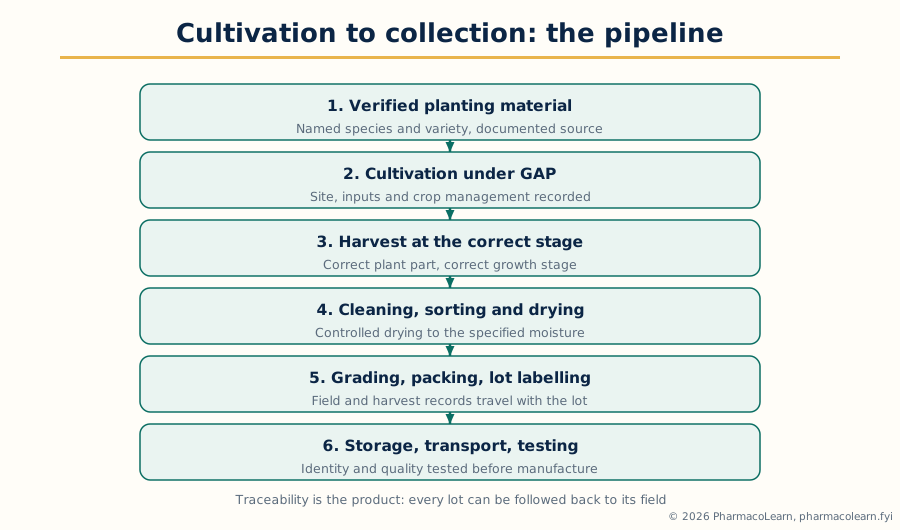 Figure: The cultivation to collection pipeline. Each stage carries the lot records forward, so the tested raw drug can be traced back to its field, variety and harvest date.
1.6 Current Good Collection Practices
Not every medicinal plant is cultivated. Many are still gathered from the wild, and some can only be collected, and for all of them Current Good Collection Practices supply the control that cultivation supplies for a crop. The first rule is identification at the point of collection: the collector must know the target species with certainty, because a wild stand mixes look alike species and a single wrong species in a lot can mean an ineffective drug or a toxic one. The second rule is correct part, correct stage, correct method: the specified part is taken at the stage of maximum suitability, by a method that does not destroy the plant where the plant is meant to survive, as when bark or roots are taken under rules that spare the population. The third rule is sustainability of the collection itself: collection is planned so that the population can regenerate, with limits on how much is taken and rotation of collection areas, and collection from protected or prohibited sources is excluded. The fourth rule is clean handling from the moment of collection: material is kept free of soil, foreign plants and contamination, protected from rain and ground contact, and moved promptly to drying. The fifth rule is documentation: where the material was collected, when, by whom, and in what quantity. Collection practice and cultivation practice are therefore the same discipline in two settings: known identity, correct part and stage, clean handling, sustainable taking, and records that make the lot traceable.
1.7 Conservation of medicinal plants: in-situ and ex-situ
Conservation enters this unit because the herbal industry's raw material base is a living resource under pressure. Demand growth, habitat loss and destructive collection have pushed many medicinal species towards scarcity, and a species lost in the wild takes its chemistry and its genetic variety with it. The syllabus names the two great conservation strategies, and the examination expects them compared cleanly. In-situ conservation protects the plant in its natural habitat: national parks, wildlife sanctuaries, biosphere reserves and other protected areas, together with legal protection of threatened species and regulation of collection and trade. Its strength is that the species keeps evolving in its real ecosystem, with its pollinators, its soil community and its full genetic range intact. Its weakness is that it depends on the habitat itself surviving. Ex-situ conservation protects the plant away from its natural habitat: botanical gardens, medicinal plant gardens, field gene banks, seed banks, and laboratory methods such as tissue culture collections and cryopreservation of seeds, tissues or cells. Its strength is security against habitat loss and ready access for research and reintroduction; its weakness is that a garden or a seed store holds only a sample of the species' genetic range, kept under artificial conditions. The two strategies are complements, not rivals: in-situ conservation keeps the living system whole, and ex-situ conservation keeps an insurance copy and a working collection. Cultivation itself is a conservation tool, since every cultivated supply reduces collection pressure on the wild stand.
| Point | In-situ conservation | Ex-situ conservation |
|---|---|---|
| Where | In the natural habitat | Away from the natural habitat |
| Typical forms | Protected areas, reserves, legal protection of species and habitat | Botanical gardens, field gene banks, seed banks, tissue culture and cryopreservation |
| Genetic range kept | The whole wild population and its variation | A sample of the species, as collected and stored |
| Ecosystem kept | Yes, with pollinators and associated species | No, the plant is kept out of its ecosystem |
| Main strength | The species continues to evolve naturally | Security against habitat loss; material available for research and reintroduction |
| Main weakness | Fails if the habitat is destroyed | Narrower genetic base; artificial conditions |
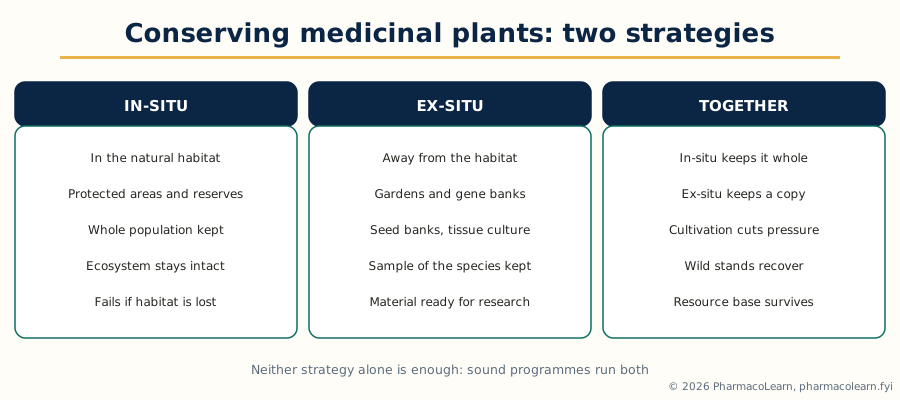 Figure: In-situ conservation keeps the species in its ecosystem; ex-situ conservation keeps a secured sample of it outside the habitat. Sound programmes use both.
1.8 Unit 1 in one view
Plant drug cultivation is the first quality step of the herbal drug industry, because the chemistry of a plant drug is set in the field. ICAR and the agricultural research system supply the varieties and agro-techniques. Current Good Agricultural Practices govern the farm, Current Good Cultivation Practices specialise them to the chemistry of a medicinal crop, and Current Good Collection Practices apply the same discipline to wild gathered material. Conservation, in-situ and ex-situ together, protects the resource base on which all of it depends.
Unit 2: Marine Natural Products
2.1 The sea as a source of drugs
The oceans cover most of the planet's surface and hold an enormous range of living organisms, many of them unlike anything on land. Marine organisms, sponges, corals, algae, molluscs, sea squirts (tunicates), bryozoans, echinoderms and marine microorganisms among them, produce chemistry that terrestrial plants rarely make. Two features of marine life explain much of that chemistry. Many marine animals are soft bodied, slow moving or fixed in place, and chemical defence is their defence: they make potent compounds to deter predators, to stop other organisms growing over them, and to fight infection in a microbe rich medium. And seawater chemistry, rich in bromide and chloride, lets marine organisms build halogenated compounds, especially brominated ones, that are uncommon on land. The result is a library of structurally unusual molecules, some of them extremely potent, which is why marine natural products have supplied drug leads and approved medicines as well as research tools. The same features make the field difficult, and the last section of this unit is devoted to those difficulties and their solutions.
2.2 General methods of isolation and purification
The isolation of a marine natural product follows the same logic as the isolation of any natural product, adapted to material that is often wet, salty, scarce and chemically fragile. The standard sequence is as follows. The organism is collected, identified by a taxonomist, and a voucher specimen is preserved, because without a verified identity the work cannot be repeated. The material is preserved promptly, commonly by freezing or in a solvent, to stop enzymatic and microbial change. Extraction follows, typically with organic solvents such as methanol or a methanol and dichloromethane mixture, chosen to draw out a wide range of metabolite polarities. The crude extract is then partitioned between immiscible solvents of increasing polarity, a liquid-liquid fractionation that sorts the mixture roughly by polarity and concentrates the activity. From there, separation proceeds by chromatography in its several forms: column chromatography and vacuum liquid chromatography for bulk fractionation, flash chromatography, preparative thin layer chromatography, and high performance liquid chromatography (HPLC) for the final purification of individual compounds, with techniques such as gel filtration used where size separates the compounds. Throughout, the work is guided by testing: in bioassay guided fractionation, each fraction is tested for the activity of interest and only the active fractions are carried forward, so effort is spent where the chemistry is doing something. Structure determination then rests on spectroscopy, mass spectrometry for the molecular formula and fragmentation, nuclear magnetic resonance for the carbon and hydrogen framework, and ultraviolet and infrared spectra as supporting evidence, with the final compound characterised by its physical and spectral data. The figure below summarises the sequence.
Verified organism, voucher specimen preserved
        |
Preservation (freezing or solvent) and extraction
        |
Solvent partitioning by polarity
        |
Chromatographic fractionation, bioassay guided
        |
HPLC purification of the active compound
        |
Structure elucidation: MS, NMR, UV, IR
        |
Characterised pure marine natural product
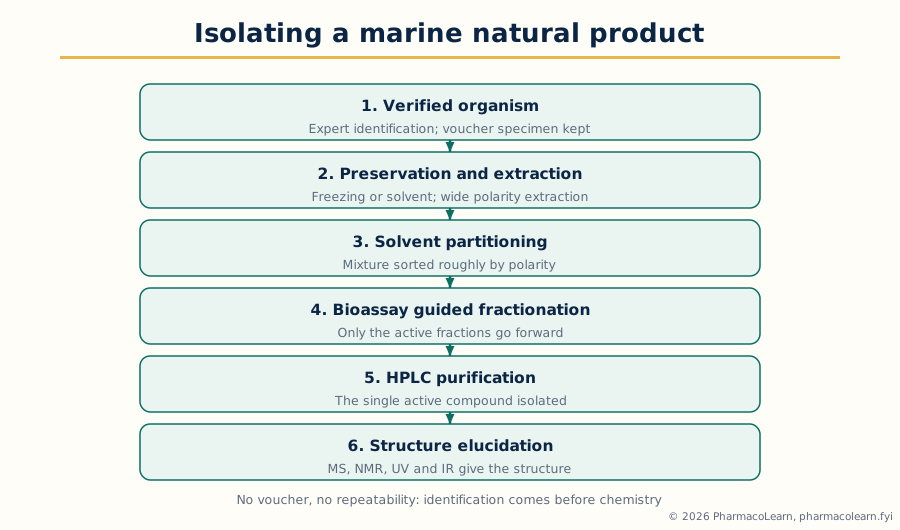 Figure: The general isolation and purification sequence for marine natural products. The voucher specimen and the bioassay guidance are the two steps students most often omit, and examiners notice both.
2.3 Marine toxins
Marine toxins are the poisonous compounds produced by marine organisms, and the syllabus asks for their study for two reasons: they are public health hazards in seafood, and they are some of the most precise pharmacological tools known, because a toxin that blocks one channel or one enzyme with great selectivity teaches physiology while it poisons. The standard named examples are these. Saxitoxin, produced by certain dinoflagellates and accumulated by shellfish, blocks voltage gated sodium channels and causes paralytic shellfish poisoning. Tetrodotoxin, found in puffer fish and some other marine animals and now understood to be associated with marine bacteria, also blocks voltage gated sodium channels and is a classic research tool for those channels. Ciguatoxins, from dinoflagellates and accumulated through reef food chains into large fish, act on sodium channels and cause ciguatera fish poisoning. Palytoxin, from zoanthid corals of the genus Palythoa, is among the most potent non protein toxins known and acts on the sodium potassium pump. Okadaic acid, a dinoflagellate polyether accumulated in shellfish, inhibits protein phosphatases and causes diarrhetic shellfish poisoning. Brevetoxins, from the dinoflagellate Karenia brevis of red tide fame, also act on sodium channels. The pattern to teach is mechanism: most of the famous marine toxins are ion channel or pump agents of extreme potency and selectivity, which is exactly why the laboratory values them and the clinic fears them.
2.4 Marine product families and drug leads
Marine research yields several kinds of product, and sorting them helps the student organise a large field. There are approved medicines whose origin is marine: cytarabine, the anticancer nucleoside whose design was inspired by nucleosides isolated from a Caribbean sponge, is the classic historical example, and the marine derived anticancer agent trabectedin, originally from a sea squirt, and the antibody drug conjugate component chemistry descended from the sea hare compound dolastatin 10 are standard modern examples. There are toxins used as research tools, covered in the previous section. There are compounds in development as analgesics and anticancer agents, of which the cone snail peptide ziconotide, a synthetic version of a Conus venom peptide used for severe chronic pain, is the best known approved peptide example. And there are the everyday marine products of the health market, such as fish oils rich in the polyunsaturated fatty acids of Unit 3 and algal products including Spirulina, which links this unit to the next. The figure below groups these families.
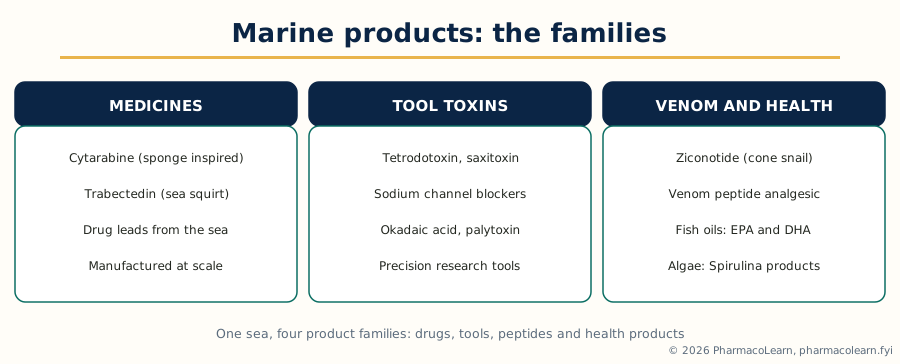 Figure: The families of marine products, from approved medicines and research tool toxins to venom peptide drugs and marine health products such as fish oils and algae.
2.5 Recent advances in research in marine drugs
Recent advances in marine drug research have come less from sailing further than from solving the field's standing problems with new methods, and the strongest examination answers name the method and the problem it answers together. Genome mining and metagenomics read the DNA of marine organisms and of their microbial communities, and can reveal the gene clusters for compounds produced in amounts too small to isolate, or not produced at all in the laboratory. That work has also settled a long standing question of origin: many compounds isolated from sponges and sea squirts are actually made by symbiotic microorganisms, and knowing the true producer opens the way to making the compound by fermentation. Aquaculture of the source organism and culture of the producing microbe are the accompanying supply side advances. In chemistry, total synthesis and simpler analogues have repeatedly converted an unobtainable compound into a manufacturable drug. In screening, high throughput methods, spectroscopy that works on very small amounts, and dereplication, the early identification of already known compounds so effort is not wasted rediscovering them, have made the work far faster. The direction is constant: from collecting tonnes of an organism for milligrams of a compound, towards identifying the producer, reading its genes, and making the compound, or a better analogue, by culture or synthesis.
2.6 Problems faced in research on marine drugs, and their solutions
The syllabus names two problems directly, taxonomical identification and chemical screening, and a complete answer sets them in the wider problem list. Taxonomical identification is hard at sea: many marine invertebrates are difficult to identify to species, similar looking organisms may be different species with different chemistry, the producing organism may really be a symbiont, and a misidentified source makes the whole study unrepeatable. The solutions are expert taxonomic examination with a preserved voucher specimen, photographic and collection records, and increasingly DNA barcoding, in which a standard gene sequence identifies the organism objectively. Chemical screening is hard because a crude marine extract is an extreme mixture, often salty, frequently containing very small amounts of very many compounds, with known nuisance compounds recurring again and again. The solutions are dereplication by LC-MS and NMR comparison against databases of known compounds, bioassay guided fractionation to follow activity rather than bulk, and prefractionation so that screens test simpler mixtures. Around these two named problems stand three more that the student should know. Supply: the active compound may be a trace fraction of an organism that cannot be collected again in quantity, answered by aquaculture, fermentation of the true microbial producer, total synthesis and analogue design. Structural complexity: marine compounds are often large and intricate, making synthesis and even structure determination slow, answered by modern high field NMR, mass spectrometry and computational assistance. And variability: chemistry varies with place, season and depth, answered by careful collection records and by moving production into controlled culture as soon as a lead is confirmed.
2.7 Unit 2 in one view
Marine natural products are the chemically distinctive products of sea organisms, often halogenated, often potent, and frequently made as chemical defence. Isolation follows verified collection, extraction, solvent partitioning, bioassay guided chromatography and spectroscopic structure determination. The toxins are chiefly selective ion channel and pump agents. The field's advances are genetic, cultural and synthetic answers to its standing problems of identification, screening and supply.
Unit 3: Nutraceuticals
3.1 Nutraceuticals: meaning, current trends and future scope
A nutraceutical is a product derived from food sources, or presented in a food derived form, that is taken for a health benefit beyond basic nutrition: the word joins nutrition and pharmaceutical, and the category lives, as Unit 1 of the wider subject keeps showing, on the border between food and medicine. Nutraceuticals are sold as foods and supplements, not as licensed medicines, so they carry no premarket proof of efficacy of the drug kind; what regulation controls is their composition, their manufacture, their labelling and the claims they may make. Current trends, stated qualitatively as this course teaches them, run in a clear direction. Demand is driven by preventive health thinking: consumers buy products for the maintenance of health and the support of normal function rather than waiting to treat disease. The market has moved from single vitamins towards formulated products, combinations aimed at a named purpose such as joint support, gut health or healthy ageing. Botanical and traditional ingredients have moved into the mainstream supplement market worldwide. Personalised and convenience formats, gummies, drinks, bars and powders alongside the classic tablet and capsule, continue to grow, and quality marks, testing and label transparency have become selling points as regulators tighten claim and composition rules. The future scope follows from the same forces: an ageing population, rising lifestyle related ill health, and growing scientific work on the gut microbiome, on botanical standardisation and on bioavailability all point to continued growth, accompanied by continued regulatory tightening, since a larger market with health claims invites closer control. The examination point is balance: scope is real, and so is the rule that a nutraceutical may support health but may not claim to treat, cure or prevent disease without becoming a drug.
3.2 The nutraceutical categories
The syllabus lists the nutraceutical categories one by one, and they are best learned as a single map before each is taken in turn. The categories are: inorganic mineral supplements; vitamin supplements; digestive enzymes; dietary fibres; cereals and grains; health drinks of natural origin; antioxidants; polyunsaturated fatty acids; and herbs as functional foods. The map below shows them together, and the sections that follow teach each in turn.
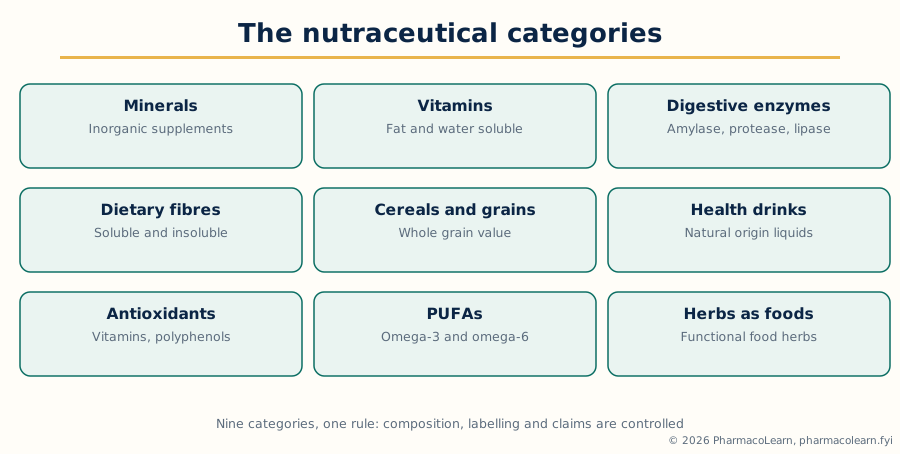 Figure: The nutraceutical categories of the syllabus on one map. Formulation and standardisation, regulatory aspects and the nine named products follow in this unit.
3.3 Inorganic mineral supplements
Minerals are the inorganic elements the body needs and cannot make, divided by the size of the daily need into macrominerals, needed in larger amounts, such as calcium, phosphorus, magnesium, sodium and potassium, and trace elements, needed in small amounts, such as iron, zinc, iodine, selenium, copper and manganese. As supplements they are supplied in chemical forms chosen for stability, tolerability and absorption: calcium as carbonate or citrate salts, iron as ferrous salts such as ferrous sulfate or fumarate, zinc as gluconate or sulfate, iodine commonly through iodised salt and supplements as iodides. The pharmacy points are three. First, the elemental amount is what matters, and labels state the salt and the elemental content, which differ. Second, minerals interact with each other and with medicines: calcium and iron compete in absorption, and divalent minerals can bind certain antibiotics in the gut and reduce their absorption, a food and supplement interaction of the kind Unit 5 studies formally. Third, more is not better: minerals have safe upper levels, and excess iron, selenium or vitamin A related mineral products can harm, which is why formulation and labelling discipline in this category is a safety matter and not only a quality one.
3.4 Vitamin supplements
Vitamins are organic compounds needed in small amounts for normal metabolism, grouped as fat soluble (A, D, E and K), which the body can store, and water soluble (the B complex and vitamin C), which it stores far less. Vitamin supplements supply a named vitamin, or a multivitamin combination, in a measured dose form, and their legitimate roles are the prevention and correction of deficiency and the meeting of increased needs, for example folic acid around conception and vitamin D where sunlight and diet do not supply enough. The characteristic features the student should hold are these. Chemical form matters: vitamin E is supplied as tocopherols and tocotrienols (Unit 4 returns to them as phytopharmaceuticals), and vitamin A as retinol compounds or as its provitamin beta carotene. Stability matters: vitamins degrade with heat, light, oxygen and moisture, so formulation protects them and shelf life is set by assay, not by hope. And the storage difference is a safety difference: the fat soluble vitamins can accumulate, so chronic excess of vitamins A and D is a real toxicity, while excess water soluble vitamins are largely excreted. A supplement label therefore states the amount per dose against the recommended dietary reference for the population, the framework Unit 3 returns to under regulatory aspects.
3.5 Digestive enzymes
Digestive enzyme products supply enzymes that assist the breakdown of food: amylases act on starch, proteases such as pepsin, trypsin and papain (from papaya) and bromelain (from pineapple) act on proteins, lipases act on fats, and lactase acts on lactose. Two settings must not be confused. As medicines, high strength pancreatic enzyme preparations are licensed drugs for pancreatic insufficiency. As nutraceuticals, lower strength products, often of plant or fungal origin, are sold as digestive support supplements. The pharmacognosy interest is the natural origin of enzymes such as papain and bromelain, and the formulation interest is protection: enzymes are proteins, sensitive to heat, moisture and gastric acid, so products are formulated and stored to preserve measured enzyme activity, the quantity a standardised product declares.
3.6 Dietary fibres
Dietary fibres are the carbohydrate polymers of plant foods that human digestive enzymes do not break down, passing to the large intestine where they act by their physical properties and as material for the gut microbiota. The working classification is by solubility and behaviour. Soluble fibres, such as the mucilage of ispaghula (psyllium husk), oat beta glucans and pectins, dissolve and form gels; they slow gastric emptying and nutrient absorption and are fermented by gut bacteria to short chain fatty acids. Insoluble fibres, such as wheat bran cellulose, add bulk and speed transit. As nutraceuticals, fibres are supplied as husk, powder, granules and formulated products, and their health associations in teaching are bowel regularity, support of normal cholesterol and glucose handling as part of the diet, and satiety. The formulation cautions are standard: fibre products must be taken with adequate fluid, they can bind medicines and reduce or delay their absorption if taken at the same time, and dose is increased gradually to limit gas and bloating. Ispaghula is the classic pharmacognosy example, a traditional crude drug that is also a modern fibre supplement.
3.7 Cereals and grains
Cereals and grains enter the nutraceutical unit as the staple foods whose whole grain forms carry fibre, B vitamins, minerals and phytochemicals, and whose fractions supply supplement ingredients. The teaching points are the contrast between refined grains, milled down to the starchy endosperm, and whole grains, which keep the bran and germ and therefore the fibre, vitamin E compounds, minerals and oils; named fractions such as oat beta glucan fibre, rice bran and its oryzanol fraction, and wheat germ; and the use of cereal materials as the base of formulated health foods and drinks. Cereals are the clearest example of the functional food idea: the health value is delivered by the food itself, in ordinary amounts, not by a concentrated dose form.
3.8 Health drinks of natural origin
Health drinks of natural origin are liquid products built on natural ingredients and marketed for refreshment with an added health association: herbal and botanical drinks, aloe and amla based drinks, fruit and vegetable drinks, fermented drinks and tea based drinks. Green tea is one of the nine named products of this unit, studied in detail below. The quality points for the category are the identity and strength of the natural ingredient in a matrix that is mostly water, control of added sugars, which can contradict the health positioning, the preservation and microbiological control any liquid food needs, and honest labelling of contents per serving.
3.9 Antioxidants
Antioxidants, in nutraceutical teaching, are substances that protect cells and food components against oxidative damage by free radicals, whether made in the body, eaten in foods or taken as supplements. The named teaching examples span the chemistry of this whole subject: vitamins C and E, the carotenoids including beta carotene and lycopene, the flavonoids and other polyphenols of tea, turmeric and coloured vegetables, selenium as a component of antioxidant enzymes, and compounds such as coenzyme Q10. The disciplined teaching position, and the one an examination answer should take, is that oxidative processes are genuinely involved in ageing and disease, antioxidant nutrients are genuinely required by the body, and deficiency is harmful; and at the same time high dose antioxidant supplementation is not thereby proved to prevent disease, some high dose supplements have disappointed or harmed in trials, and the products are regulated and labelled as supplements supporting normal function, not as disease prevention medicines.
3.10 Polyunsaturated fatty acids
Polyunsaturated fatty acids (PUFAs) are long chain fatty acids with more than one double bond, and the two families that matter in nutrition are the omega-3 family, whose parent is alpha linolenic acid from plant sources such as flax seed, and whose long chain members EPA (eicosapentaenoic acid) and DHA (docosahexaenoic acid) come chiefly from oily fish and fish oils and from algae, and the omega-6 family, whose parent is linoleic acid from seed oils. Neither parent fatty acid can be made by the body, so both are essential in the diet. As nutraceuticals, fish oil capsules and algal oil products are among the most established products in the whole category, used in teaching for the support of normal heart and brain function and as a source of EPA and DHA for people who eat little oily fish. The quality points are characteristic: the oils oxidise readily, so products are protected with antioxidants and encapsulation and are controlled for oxidation values, and the label states the EPA and DHA content per capsule, since it is those two compounds, not the gross oil weight, that carry the purpose.
3.11 Herbs as functional foods, formulation and standardisation of nutraceuticals
A functional food is an ordinary food, or a food like product, that delivers a health benefit beyond its basic nutrition, and herbs as functional foods are the botanical case: culinary and medicinal herbs and spices eaten in food amounts for their phytochemistry as well as their flavour, with turmeric in food, garlic in food and green tea as a drink as the unit's own examples. The line between a herb as a functional food and the same herb as a concentrated supplement or a herbal medicine is dose, presentation and claim, and the student should be able to place one plant in all three positions.
Formulation of nutraceuticals uses the dosage form skills of pharmaceutics on food grade materials: tablets, capsules, powders, granules, liquids, gummies and bars, with excipients permitted for foods and supplements. The formulation problems are practical ones: bulky actives that make large tablets, unpleasant tastes and odours (fish oils, garlic, botanicals), unstable actives (vitamins, oils, enzymes, probiotics), and combinations in which the ingredients must not react with each other. Standardisation is the quality answer, and it works by markers. A standardised nutraceutical is controlled by identity testing of each ingredient, assay of a named marker compound or nutrient content, limits for contaminants (heavy metals, pesticide residues, microbial load, and adulterants), stability testing to support the shelf life, and manufacture under good manufacturing practice with batch records. The marker idea is the bridge to the next section: for each named product the syllabus asks for the marker compound by name and chemical nature, because the marker is what the laboratory measures to say that this batch is the product it claims to be.
Ingredient identity verified (botanical or chemical identity tests)
        |
Raw material assayed against its specification
        |
Formulation: dose form built, interactions and stability checked
        |
Finished product assay: marker compound or nutrient content
        |
Contaminant limits checked: metals, pesticides, microbes
        |
Label verified against contents; batch released with records
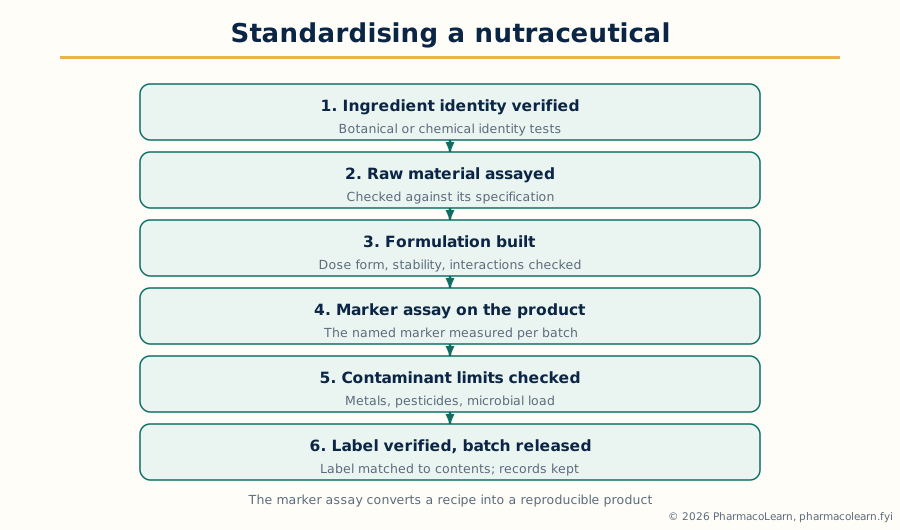 Figure: The standardisation chain for a nutraceutical. The marker assay is the step that converts a recipe into a reproducible product.
3.12 Regulatory aspects and FSSAI guidelines
In India, nutraceuticals are regulated as foods, under the Food Safety and Standards Act, 2006, administered by the Food Safety and Standards Authority of India (FSSAI). The FSSAI system licenses food businesses in tiers (registration for the smallest, state licences, and central licences for the largest and for reserved categories, nutraceutical manufacture among them), sets product standards and composition rules, controls labelling and advertising claims, and governs imports. For nutraceuticals specifically, the dedicated FSSAI regulations for health supplements, nutraceuticals and related special categories (first made in 2016 and issued in consolidated form in 2022) set which ingredients may be used, in which forms and within which ranges, tied to recommended dietary allowances, and which claims may be made. The regulatory character to teach is premarket control by composition and licence rather than by drug style marketing authorisation: a compliant product made of permitted ingredients, in a licensed premises, labelled within the claim rules, may be sold; a product with a non permitted ingredient, an out of range dose or a disease cure claim may not, whatever its quality. Products that cross into disease treatment claims or drug composition leave the food system and fall under drugs law. That border, and the FSSAI guidelines that police it, are the regulatory content of this unit.
3.13 The nine named nutraceuticals
The syllabus closes Unit 3 with nine named products, each to be known by source, marker compound and its chemical nature, medicinal uses and health benefits. The table states the markers and chemical nature; the paragraphs after it give the source, uses and benefits for each. No percentages or doses are stated, because the syllabus asks for the marker's name and nature, and standardisation values vary by product and pharmacopoeia.
| Product | Source | Marker compound(s) | Chemical nature of marker |
|---|---|---|---|
| Spirulina | Blue green alga Arthrospira (Spirulina) platensis, cultivated in open ponds or tanks | Phycocyanin; also valued for its protein content | Phycocyanin is a blue phycobiliprotein pigment protein |
| Soya bean | Seeds of Glycine max | Genistein and daidzein | Isoflavone flavonoids (isoflavonoids) |
| Ginseng | Roots of Panax ginseng (Asian ginseng) and Panax quinquefolius (American ginseng) | Ginsenosides | Triterpenoid saponin glycosides |
| Garlic | Bulbs of Allium sativum | Allicin, formed from alliin on crushing | Allicin is an organosulfur thiosulfinate compound |
| Broccoli | Florets of Brassica oleracea (broccoli) | Glucoraphanin, converted to sulforaphane | Glucoraphanin is a glucosinolate; sulforaphane is an isothiocyanate |
| Green and herbal tea | Leaves of Camellia sinensis for tea; various botanicals for herbal teas | Epigallocatechin gallate (EGCG) and other catechins | Catechins are flavan-3-ol flavonoids (polyphenols) |
| Flax seeds | Seeds of Linum usitatissimum | Alpha linolenic acid; lignans such as secoisolariciresinol diglucoside (SDG) | Alpha linolenic acid is an omega-3 polyunsaturated fatty acid; SDG is a lignan |
| Black cohosh | Roots and rhizomes of Actaea racemosa (syn. Cimicifuga racemosa) | Triterpene glycosides such as actein | Triterpene glycosides |
| Turmeric | Rhizomes of Curcuma longa | Curcumin, with demethoxycurcumin and bisdemethoxycurcumin | Curcuminoids are diarylheptanoid phenolic compounds |
Spirulina. A blue green alga grown commercially in alkaline ponds and sold dried as powder, tablets and capsules. It is valued as a concentrated food source, rich in protein and containing the pigment protein phycocyanin, carotenoids and B vitamins; its health positioning is nutritional support and antioxidant content. Quality control watches the identity of the alga and contamination, including other algae and heavy metals from the growing water.
Soya bean. The seed of Glycine max, eaten as a food worldwide and used as a nutraceutical for its protein and its isoflavones, genistein and daidzein. The isoflavones are phytoestrogens, plant compounds with a structure resembling oestrogen and weak activity at oestrogen receptors, which is the basis of soya's positioning for menopausal symptoms and bone health support, and also the reason soya products are discussed with care in hormone sensitive conditions.
Ginseng. The root of Panax species, a classic tonic drug of East Asian medicine, standardised on its ginsenosides, triterpenoid saponins. Its traditional and marketed uses are support against fatigue and for general vitality and cognitive support. Ginseng is also a Unit 5 citizen: it is one of the herbs reported to interact with medicines, including anticoagulants, which is why a complete answer on ginseng mentions both the marker and the interaction caution.
Garlic. The bulb of Allium sativum, a food and a traditional medicine. Its chemistry is sulfur chemistry: the intact bulb holds alliin, and crushing brings the enzyme allinase into contact with it to form allicin, the pungent compound on which garlic products are standardised, directly or as allicin potential. Garlic is positioned for cardiovascular support, including support of normal blood pressure and cholesterol as part of the diet. Its antiplatelet activity is the reason garlic supplements are a standard interaction example with anticoagulant and antiplatelet medicines.
Broccoli. A cruciferous vegetable whose marker glucoraphanin is converted, by the plant enzyme myrosinase and by gut bacteria, to sulforaphane, an isothiocyanate studied for its effects on the body's own protective enzyme systems. As a nutraceutical, broccoli and broccoli sprout extracts are standardised on glucoraphanin or sulforaphane potential and positioned for antioxidant and cellular health support.
Green and herbal tea. Green tea is the unfermented leaf of Camellia sinensis, standardised on its catechins, chiefly EGCG. It is taken as a drink and as concentrated extracts, positioned for antioxidant content and metabolic support. Concentrated green tea extracts carry a safety note that plain tea drinking does not: high intakes of catechin extracts have been associated with liver injury in susceptible people, a standard teaching example that form and dose change the safety of a familiar food. Herbal teas are infusions of other botanicals, such as chamomile or peppermint, valued as caffeine free drinks with their own traditional uses.
Flax seeds. The seed of Linum usitatissimum, a combined source of alpha linolenic acid, the plant omega-3, of lignans, and of mucilage fibre. Flax therefore sits in three of this unit's categories at once: a PUFA source, a fibre, and a functional food. Products are the whole or ground seed and flaxseed oil, and the teaching points are the protection of the oil from oxidation and the fibre cautions of Section 3.6.
Black cohosh. The root and rhizome of Actaea racemosa, a North American botanical standardised on its triterpene glycosides and used chiefly for menopausal symptoms such as hot flushes. It is included in examinations for its marker class and its use, and in safety teaching because rare reports of liver injury associated with black cohosh products have made it a pharmacovigilance example as well as a nutraceutical one.
Turmeric. The rhizome of Curcuma longa, the golden spice of Indian food and Ayurvedic medicine, standardised on the curcuminoids, chiefly curcumin. Turmeric and curcumin products are positioned for joint comfort and antioxidant and anti-inflammatory support, and curcumin's poor oral bioavailability is the standard formulation problem of the group, answered in products by combination and formulation strategies. Turmeric closes the named list where the course began, in an Indian cultivated rhizome, now standardised by its marker like every other product in this unit.
3.14 Unit 3 in one view
Nutraceuticals are food derived products taken for health benefit beyond basic nutrition, regulated as foods: in India by FSSAI under the Food Safety and Standards Act, 2006, with dedicated regulations controlling ingredients, ranges, licensing and claims. The categories run from minerals, vitamins and enzymes through fibres, cereals, health drinks, antioxidants and PUFAs to herbs as functional foods. Formulation builds the dose form; standardisation, by named markers with contaminant limits and GMP, makes the product reproducible; and the nine named products are each known by source, marker and chemical nature, uses and health benefits.
Unit 4: Phytopharmaceuticals
4.1 Phytopharmaceuticals: the pattern for every compound in this unit
A phytopharmaceutical, for the purpose of this unit, is a defined plant derived compound or compound group studied as a pharmaceutical substance in its own right: its occurrence, its isolation, and its characteristic features, meaning its chemical nature, its uses in pharmacy, and its medicinal and health benefits. The syllabus lists the compounds group by group, and each section below follows the same four part pattern, so that any compound can be revised and answered in the same shape. Occurrence: where in nature, and in which plant and part, the compound is found. Isolation: the general route by which it is obtained, in outline. Chemical nature: the class it belongs to and the structural feature that defines it. Uses and benefits: its established and marketed uses, stated with the discipline of this course, distinguishing a licensed drug use from a supplement use and from a traditional use. The development path figure below shows how a plant constituent travels from occurrence in the plant to a characterised phytopharmaceutical, which is the journey every section of this unit repeats.
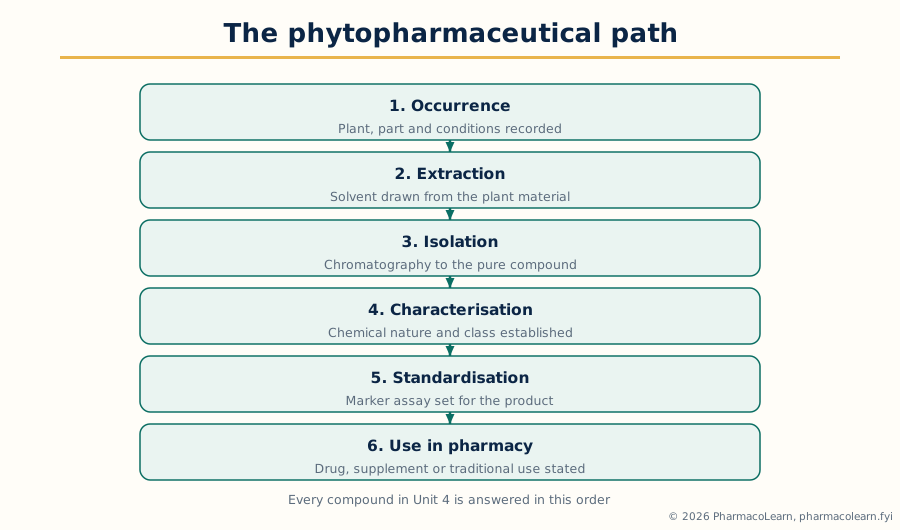 Figure: The phytopharmaceutical path: occurrence, extraction and isolation, characterisation of chemical nature, standardisation, and use in pharmacy.
4.2 Carotenoids: alpha and beta carotene, and xanthophyll (lutein)
Carotenoids are the yellow, orange and red pigments of plants, tetraterpenoid compounds built from eight isoprene units, forty carbons in the main chain, with a long system of conjugated double bonds that gives them their colour and their antioxidant behaviour. They divide into the carotenes, which are pure hydrocarbons, and the xanthophylls, which are their oxygen containing relatives.
Alpha and beta carotene. Beta carotene is the most widespread carotene of green leaves and the pigment of carrots, pumpkins, sweet potatoes and other orange vegetables and fruits; alpha carotene occurs alongside it in many of the same sources, in smaller amounts. Isolation is by extraction of the plant material with organic solvents and chromatographic separation, handled throughout with protection from light, heat and oxygen, since the conjugated system degrades readily. Chemically, both are hydrocarbon carotenes, and both are provitamins A: the body can cleave beta carotene centrally to give vitamin A (retinal and then retinol), which is the basis of their pharmacy use. Beta carotene is used as a vitamin A source in supplements, as a natural colouring agent for foods and pharmaceuticals, and as an antioxidant nutrient; it is also the standard teaching caution that high dose beta carotene supplements increased lung cancer risk in smokers in major trials, the classic proof that a food nutrient and a high dose supplement are not the same exposure.
Lutein. Lutein is a xanthophyll, the oxygenated carotenoid of green leafy vegetables and of marigold flowers, the commercial source. Chemically it carries hydroxyl groups on its end rings, which beta carotene lacks, and that difference decides its fate: lutein is not a vitamin A precursor. Instead it accumulates in the macula of the human eye, where it is, with its relative zeaxanthin, the macular pigment. Its pharmacy and health use follows from that occurrence in the eye: lutein is a standard ingredient of eye health supplements positioned for macular support, and a natural colour as well.
4.3 Limonoids: d-limonene and alpha terpineol
The syllabus places two monoterpene compounds under the limonoid heading: d-limonene and alpha terpineol. (In strict chemical classification, limonoids are the bitter tetranortriterpenoids of citrus seeds and neem; limonene and alpha terpineol are monoterpenes of citrus peel oil. The syllabus groups them with the citrus compounds, and this section teaches them as listed, with the classification stated honestly, as an examiner rewards.) d-Limonene is the major constituent of citrus peel oils, orange oil above all, a monocyclic monoterpene hydrocarbon with the characteristic orange odour. It is obtained as a by product of the citrus juice industry, by cold expression or distillation of the peel. In pharmacy it is used as a flavouring and fragrance material, as a solvent and penetration assisting ingredient in formulations, and it is sold as a supplement, chiefly positioned for digestive comfort. Alpha terpineol is a monoterpene alcohol, occurring in pine oil, petitgrain and other essential oils and formed from other terpenes; it carries a lilac like odour and is used in pharmacy and cosmetics as a fragrance ingredient and for the mild antiseptic character of the terpene alcohols, and it appears in cleaning and disinfectant type preparations. Both compounds teach the same point: volatile oil constituents are phytopharmaceuticals too, standardised by assay of the named terpene in the oil.
4.4 Saponins: shatavarins
Saponins are glycosides whose aglycone (sapogenin) is either a steroid or a triterpenoid, and whose combined sugar and aglycone structure makes them surface active: their aqueous solutions foam, the property that names them from soap. Shatavarins are the steroidal saponins of shatavari, the roots of Asparagus racemosus, a major Ayurvedic drug; shatavarin I is the most studied of the group. Occurrence is in the root, the official drug part. Isolation is by extraction of the roots, commonly with alcohol or aqueous alcohol, followed by fractionation and chromatographic purification of the saponin fraction. Chemically, shatavarins are sarsasapogenin type steroidal saponin glycosides. Shatavari's traditional and marketed uses are as a galactagogue (supporting milk production), a general female health tonic in Ayurvedic practice, and a soothing demulcent type drug for the gut. Shatavari is the bridge example of this unit: an Ayurvedic drug whose marker saponins let a traditional product be standardised by modern assay.
4.5 Flavonoids: resveratrol, rutin, hesperidin, naringin and quercetin
Flavonoids are the great polyphenol family of plants, built on a fifteen carbon C6-C3-C6 skeleton of two aromatic rings joined by a three carbon bridge, usually closed into an oxygen containing ring. They colour flowers and fruits, protect plants against ultraviolet light and oxidation, and dominate the antioxidant chemistry of the diet. The syllabus names five, and the family figure below sets them side by side before each is taken in turn.
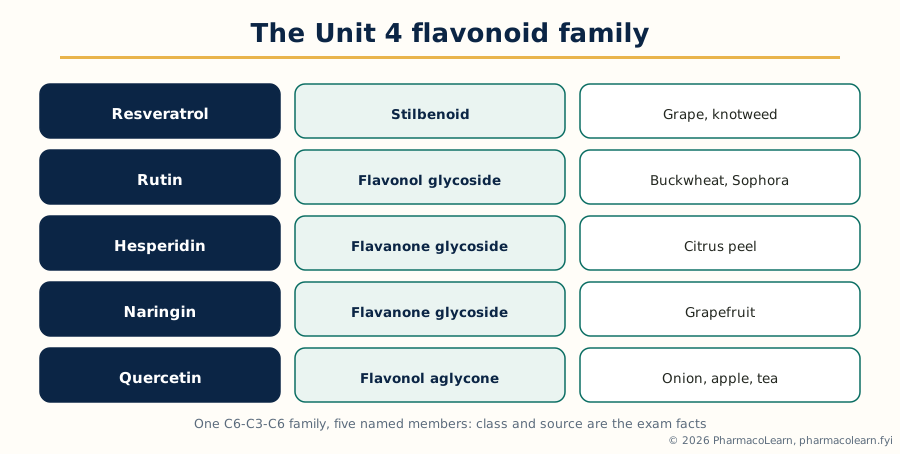 Figure: The five named flavonoid group compounds of Unit 4. Resveratrol is strictly a stilbenoid, grouped with the flavonoids in the syllabus list and taught here as listed, with its true class stated.
Resveratrol. A stilbenoid polyphenol (the syllabus groups it with the flavonoids; its true class is the stilbenes), produced by plants such as grape vine and Japanese knotweed, the commercial source, in response to fungal attack and stress: it is a phytoalexin, a defensive compound. It occurs in grape skins and therefore in red wine in small amounts. Isolated by extraction and chromatography from knotweed or grape sources, it is sold as a supplement positioned for antioxidant and healthy ageing support, and it is one of the most researched polyphenols in the literature, which an examination answer may say, without converting research interest into proven drug claims.
Rutin. A flavonol glycoside: the aglycone quercetin carrying the disaccharide rutinose. It occurs widely, in buckwheat, in citrus, and classically in rue and in Sophora flower buds, a commercial source. Rutin has a long pharmacy history under the vitamin P name given to the flavonoids once thought to govern capillary permeability, and it is used in preparations positioned for capillary and venous support, often with its semisynthetic relatives.
Hesperidin. A flavanone glycoside, the characteristic flavonoid of orange and other citrus peel, where it is a major component of the peel's flavonoid fraction. Chemically it is hesperetin (the aglycone) with rutinose attached, and its low water solubility is a known formulation feature. It is used in venous health preparations, in combination with diosmin in the micronised flavonoid fraction used for chronic venous insufficiency and haemorrhoids in many countries, the strongest established pharmacy use in this flavonoid list.
Naringin. The flavanone glycoside of grapefruit and pomelo, responsible with its aglycone naringenin for much of grapefruit's bitterness. It is taught for its occurrence and class, and for one interaction fact that also belongs to Unit 5: grapefruit constituents, the furanocoumarins above all, with naringin long studied alongside them, are associated with the inhibition of intestinal CYP3A4 and the raised blood levels of many medicines taken with grapefruit products, the textbook biodrug-food interaction.
Quercetin. The most widespread flavonol aglycone in the diet, occurring in onions, apples, berries and tea, mostly as glycosides such as rutin. Quercetin is the reference flavonol of the laboratory, used across antioxidant and enzyme studies, and a common supplement ingredient positioned for antioxidant and seasonal immune support. Its glycoside rutin and quercetin itself together teach the aglycone and glycoside relationship that runs through flavonoid chemistry.
| Compound | True class | Best known source | Signature point |
|---|---|---|---|
| Resveratrol | Stilbenoid polyphenol | Grape skins; Japanese knotweed | Phytoalexin, made by the plant under attack |
| Rutin | Flavonol glycoside | Buckwheat; Sophora buds | Quercetin plus rutinose; the old vitamin P |
| Hesperidin | Flavanone glycoside | Orange and citrus peel | Partner of diosmin in venous preparations |
| Naringin | Flavanone glycoside | Grapefruit and pomelo | Grapefruit bitterness; interaction teaching |
| Quercetin | Flavonol aglycone | Onions, apples, tea | The reference dietary flavonol |
4.6 Phenolic acids: ellagic acid
Phenolic acids are the simpler plant phenols, aromatic acids of the hydroxybenzoic and hydroxycinnamic families, widespread as free acids and as parts of larger tannins. Ellagic acid is the syllabus's named example. It occurs in pomegranate, raspberries, strawberries, walnuts and other fruits and nuts, and it is formed from the ellagitannins, the large hydrolysable tannins of those sources, which break down to release it. Chemically, ellagic acid is a fused, planar polyphenolic dilactone, poorly soluble in water, a property that shapes both its isolation, by extraction and hydrolysis of ellagitannin rich material, and its formulation. It is positioned in supplements and cosmetics for antioxidant content, and in the gut it is further converted by gut bacteria to the urolithins, the metabolites through which much of its biology is now studied.
4.7 Vitamins as phytopharmaceuticals
Vitamins appear in this unit in their listed position, as plant derived pharmaceutical substances, after their supplement treatment in Unit 3. The phytopharmaceutical angle is occurrence and isolation: vitamin C (ascorbic acid) from fruits such as amla, acerola and rose hips in natural source products; the vitamin E family of the next section, from vegetable oils; provitamin beta carotene of Section 4.2; and folates from green leaves. The characteristic feature to state is that a vitamin is the same molecule whether it is synthesised or isolated from a plant, so natural source vitamins are standardised by the same assays as synthetic ones, and the choice between them is one of source, formulation and labelling, not of a different active.
4.8 Tocotrienols and tocopherols
Tocopherols and tocotrienols together form the vitamin E family: eight compounds, alpha, beta, gamma and delta tocopherols and the corresponding four tocotrienols, all built on a chromanol head with a long side chain; the tocopherols carry a saturated chain and the tocotrienols an unsaturated chain with three double bonds, the structural difference that names and separates them. They occur in vegetable oils and seeds: tocopherols widely, in sunflower, wheat germ and many seed oils, and tocotrienols concentrated in palm oil, rice bran oil and annatto. Isolation is from the oils and their deodorisation fractions, by extraction and chromatographic methods. Alpha tocopherol is the form with the highest vitamin E activity and the reference form for requirements. In pharmacy the family is used as vitamin E supplements, as antioxidants protecting oils and formulations themselves from oxidation, and in skin preparations; tocotrienols are separately marketed and researched for their own profile, distinct from the common tocopherols precisely because of the unsaturated chain and its different distribution in tissues.
4.9 Andrographolide, glycolipids and guggulipids
Andrographolide is the bitter diterpene lactone of Andrographis paniculata, kalmegh, the intensely bitter Ayurvedic and traditional drug known as the king of bitters. It occurs in the leaves and aerial parts, is isolated by alcoholic extraction and crystallisation or chromatography, and is the marker on which andrographis products are standardised. Its traditional and marketed uses centre on the common cold and upper respiratory infections and on liver support in tradition, and it is one of the best studied Indian phytopharmaceuticals.
Glycolipids are lipids carrying one or more sugar units: membrane compounds of every living cell, in plants including the galactolipids of chloroplast membranes. They are taught as a class: occurrence in plant and food materials, isolation with the lipid fractions and separation by chromatography, and their amphiphilic character, part fat and part sugar, which gives them emulsifying and membrane related interest in pharmacy and food science.
Guggulipids are the standardised lipid fraction of guggul, the oleo gum resin of Commiphora wightii (syn. Commiphora mukul), the Ayurvedic drug guggulu. The active markers of the fraction are the guggulsterones, E and Z guggulsterone, steroid compounds of the resin. Guggulipid preparations were developed in India as a standardised phytopharmaceutical positioned for cholesterol support, and they remain the textbook Indian example of a traditional resin converted into a marker standardised product, with the conservation note that the source tree has been heavily tapped and is under pressure in the wild, linking this section back to Unit 1.
4.10 Withanolides, vascine and taxol
Withanolides are the steroidal lactones of ashwagandha, the roots of Withania somnifera, the most prominent adaptogen drug of Ayurveda. Chemically they are ergostane type steroids with a lactone side ring; withaferin A and withanolide A are the most studied members. They occur chiefly in the root, the official part, are isolated by alcoholic extraction and chromatography, and are the markers on which ashwagandha extracts are standardised. Ashwagandha products are positioned for stress, sleep and vitality support, and the plant is also this course's recurring example of a cultivated Indian drug developed through agricultural research.
Vascine (also spelled vasicine) is the quinazoline alkaloid of vasaka, the leaves of Adhatoda vasica (Justicia adhatoda), the classic Ayurvedic expectorant drug. It is isolated from the leaves by standard alkaloid extraction, acid base partitioning and purification. Vascine's pharmacy importance is doubled by its descendant: the synthetic expectorant and mucolytic drugs bromhexine and its active metabolite ambroxol were designed from the vascine structure, making vascine a clean example of a phytopharmaceutical serving as a drug design lead as well as a traditional drug constituent.
Taxol, the generic name paclitaxel, is the diterpenoid anticancer drug first isolated from the bark of the Pacific yew, Taxus brevifolia. Chemically it is a complex taxane diterpene with an unusual ring system and side chain, and its mechanism is distinctive: it stabilises microtubules and prevents their breakdown, freezing cell division, the opposite action to the vinca alkaloids. Its occurrence in bark in very small amounts created the classic supply crisis: bark collection killed a slow growing tree for a small yield. The solutions are now standard teaching and a model for Unit 2's supply problems: semisynthesis from baccatin III and related taxanes obtained from renewable yew needles and cultivated yew, and plant cell culture production. Paclitaxel is an approved anticancer medicine, the strongest proof in this unit that a phytopharmaceutical can become a front line drug.
4.11 Miscellaneous
The syllabus closes Unit 4 with the open head Miscellaneous, naming no further compounds. Taught honestly, it is the instruction to be able to extend the method of this unit to any further named phytopharmaceutical an examiner or a monograph presents: state the occurrence, outline the isolation, give the chemical nature and class, and state the uses and benefits with the same discipline, distinguishing drug, supplement and traditional uses and naming the marker where one exists. No list is invented under this head in these notes.
4.12 Unit 4 in one view
Phytopharmaceuticals are studied in one fixed pattern: occurrence, isolation, chemical nature, uses and benefits. Carotenoids colour and, for the carotenes, feed vitamin A; lutein serves the macula. The citrus terpenes serve pharmacy as flavours, solvents and supplements. Shatavarins standardise shatavari; the five flavonoid group compounds span stilbenoid to flavanone glycoside chemistry; ellagic acid represents the phenolic acids; the vitamin E family divides into tocopherols and tocotrienols by one side chain difference; and andrographolide, the guggulsterones of guggulipid, the withanolides, vascine and taxol close the unit with India's standardised phytopharmaceuticals and one world class anticancer drug.
Unit 5: Pharmacovigilance of Drugs of Natural Origin
5.1 Why natural products need safety monitoring
Pharmacovigilance is the science and the system of detecting, assessing, understanding and preventing adverse effects of medicines. Drugs of natural origin need it for reasons that are specific to them, and the first section of this unit states them plainly. Most herbal and natural products reach the public without the premarket clinical trial programme of a synthetic drug, so their safety knowledge must be built after marketing, from real world use. Their composition is variable, between species, batches and brands, so a safety signal may belong to one product or one contaminated batch and not to the herb in general. They are often self selected and self medicated, bought without a prescription and frequently not mentioned to the patient's doctor or pharmacist, so adverse events are under reported and interactions are missed at prescribing. They are used by exactly the patients most at risk from interactions: older people and people with long term conditions taking several conventional medicines. And the natural is safe assumption, held by many users, delays the recognition that a natural product can cause real harm: liver injury, kidney injury, allergy, bleeding and interactions are all documented for natural products. Pharmacovigilance of natural drugs is therefore not a suspicion of tradition; it is the ordinary safety discipline applied where the premarket evidence is thinnest.
5.2 WHO guidelines for safety monitoring of natural medicine
The World Health Organization addressed this gap directly in its guidelines on safety monitoring of herbal medicines in pharmacovigilance systems, published in 2004, which remain the WHO reference the syllabus points to. Their teaching content is as follows. Herbal medicines should be brought inside the national pharmacovigilance system rather than left in a separate traditional medicine channel, so that a herbal adverse reaction is reported, stored and assessed in the same system as any other adverse reaction. The existing spontaneous reporting forms and methods should be adapted, not replaced, with the special data a herbal report needs: the product's full name and brand, the botanical name of the plant and the part used where known, the manufacturer and batch, the source from which it was obtained, and any other medicines and products taken at the same time. The guidelines recognise the special difficulties of the field: naming chaos (one plant, many names; one name, many plants), variable products, self medication and under reporting, and contamination and adulteration as alternative explanations for an event. They direct national centres to work with the traditional medicine authorities, the manufacturers and the professional bodies, and to exchange reports internationally through the WHO global pharmacovigilance network and its database, so that a signal appearing in small numbers in many countries can be seen whole. The student's one line summary: WHO says monitor herbal medicines with the same system and the same seriousness as conventional medicines, adapted for the naming and identity problems that are unique to them.
5.3 AYUSH guidelines and safety monitoring in India
In India, the AYUSH systems (Ayurveda, Yoga and Naturopathy, Unani, Siddha and Homoeopathy) are administered by the Ministry of AYUSH, and the pharmacovigilance programme for Ayurveda, Siddha, Unani and Homoeopathy (ASU and H) drugs is the national structure the syllabus points to under AYUSH guidelines. Its design mirrors the WHO advice. It collects adverse event reports for ASU and H medicines through a network of peripheral, intermediary and a national pharmacovigilance centre, with reporting forms adapted to traditional medicines, and it works to build a culture of reporting among AYUSH practitioners, who historically did not report. It also addresses the quality side that runs beside event reporting: surveillance for misbranded, adulterated and spurious ASU and H products, and public awareness against misleading advertisements and the assumption that a traditional label guarantees safety. The reporting flow below shows how a single report travels in a spontaneous system of this kind, in India and generally.
Patient or practitioner notices a suspected adverse event
        |
Report completed: product, botanical name, batch, other medicines
        |
Peripheral or local centre receives and checks the report
        |
Intermediary and national centre: assessment and causality review
        |
National database; signals searched across many reports
        |
Action where needed: label change, advisory, product action
        |
Feedback to reporters and professionals; international sharing (WHO)
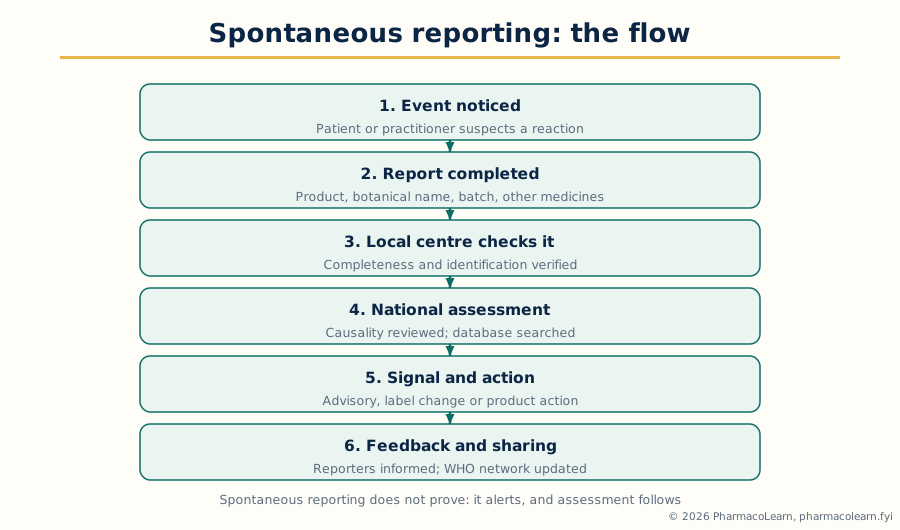 Figure: The spontaneous reporting flow for drugs of natural origin. The herbal specific fields, botanical name, plant part, brand and batch, are what make a herbal report assessable.
5.4 Spontaneous reporting schemes for biodrug adverse reactions
A spontaneous reporting scheme is a system in which health professionals, and in many systems patients themselves, report suspected adverse reactions voluntarily, as they notice them, to a central centre. The syllabus word biodrug means a drug of natural or biological origin, and a biodrug adverse reaction is a harmful, unintended response suspected to be caused by such a drug. Spontaneous reporting is the backbone of natural product pharmacovigilance because it is the one method that watches every product, in every patient, for as long as it is sold, at low cost. Its strengths are breadth and signal generation: rare and unexpected reactions, reactions in pregnancy, in children and in the elderly, and interaction reactions all surface first as spontaneous reports, and a cluster of similar reports is a signal that triggers formal assessment. Its weaknesses must be taught with it: under reporting is severe, and worse for herbal products, whose users often do not connect a symptom to a supplement or do not regard it as reportable; reports are incomplete, and for herbals often lack the botanical identity that assessment needs; and a report count alone cannot give a rate, since neither the true number of events nor the true number of users is known. Causality assessment, judging how likely the product is to have caused the event on timing, dechallenge (the event improving when the product stops), rechallenge where it exists, alternative explanations including the patient's diseases and other medicines, and previous knowledge, is what converts a pile of reports into evidence. The standard teaching verdict: spontaneous reporting does not prove, it alerts; proof is built by assessment and follow up study.
5.5 Biodrug-drug interactions
A biodrug-drug interaction occurs when a drug of natural origin changes the effect of a conventional medicine, or the medicine changes the natural product's effect, by a pharmacokinetic route (absorption, metabolism or excretion changed, most famously through liver and gut enzymes such as CYP3A4 and transporters such as P-glycoprotein) or a pharmacodynamic route (the effects add or oppose at the site of action). The watch points figure below collects the interaction types, and the standard examples follow it.
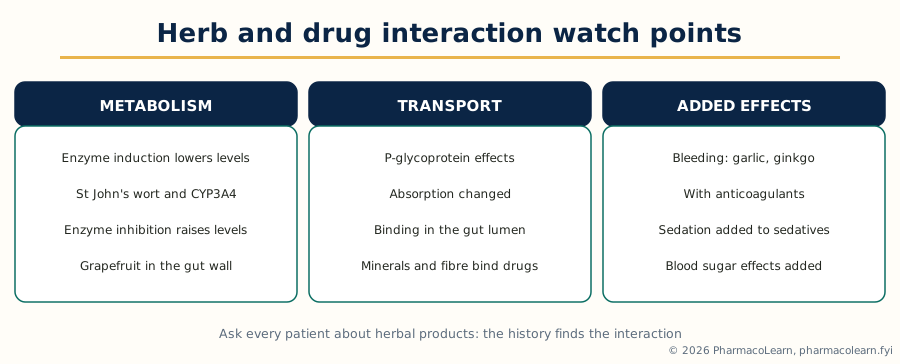 Figure: The interaction watch points for drugs of natural origin: metabolic induction, metabolic inhibition, transporter effects, and additive pharmacodynamic effects.
The classic examples, each standard in teaching, are these. St John's wort, the herbal antidepressant, induces CYP3A4 and P-glycoprotein and thereby lowers the blood levels and the effect of many medicines, including ciclosporin (with transplant rejection reported), oral contraceptives (with contraceptive failure reported), and several antivirals and anticancer drugs; it is the single most important herbal interaction example. Garlic and ginkgo, each with antiplatelet activity, can add to the bleeding risk of warfarin and other anticoagulant and antiplatelet medicines, and ginseng has also been reported to interact with warfarin. Liquorice, through its glycyrrhizin, causes potassium loss and sodium retention with continued heavy use, opposing antihypertensive treatment and increasing the risk from digoxin. Herbal products with sedative action add to prescribed sedatives. And any herbal product taken by a patient on antidiabetic medicines must be watched for additive blood sugar lowering where the herb itself has such an action. The clinical rule that closes the topic: the interaction is usually discovered by the history, so the history must ask about herbal and supplement use directly, because patients rarely volunteer it.
5.6 Biodrug-food interactions
A biodrug-food interaction runs in either direction across the same table: a food changes the effect of a drug of natural origin, or a natural product, itself often eaten as a food, changes the effect of a conventional medicine. The outstanding example of the second direction is grapefruit: grapefruit and its juice contain furanocoumarins that irreversibly inhibit intestinal CYP3A4, so medicines normally broken down in the gut wall reach the blood in higher amounts, with raised effect and raised toxicity; the affected list is long and includes several statins, calcium channel blockers and immunosuppressants, and the effect lasts beyond a day because the enzyme must be remade. Note the teaching loop this closes: the grapefruit flavonoid naringin was met in Unit 4, and grapefruit is where Unit 4's chemistry becomes Unit 5's safety lesson. Other standard food interaction teaching includes vitamin K rich green vegetables opposing warfarin's action when intake changes sharply; high fibre products and mineral supplements binding medicines in the gut and reducing their absorption when taken together (Sections 3.3 and 3.6); alcohol adding to sedative herbs and medicines; and tyramine rich foods interacting with monoamine oxidase inhibitor medicines, a drug-food interaction of the conventional side that completes the pattern. Timing advice, separating the medicine from the interacting food or supplement by an interval where the interaction is one of binding or absorption, and consistency advice, keeping vitamin K intake steady on warfarin, are the practical outputs of this section.
5.7 Assessment, signals and the professional's duties
The unit closes with the professional's working duties: ask what herbal products, supplements and traditional medicines the patient uses, and record the answer; recognise the high risk combinations, enzyme inducers and inhibitors, anticoagulant partners, and products in pregnancy, in children, in the elderly and in liver and kidney disease; report suspected adverse reactions with the full herbal identification the WHO guidelines require, and encourage patients to report; check identity and quality as safety work, since adulteration with undeclared synthetic drugs and contamination are recurring real world causes of supposed herbal adverse reactions; and teach the sentence that carries the whole unit: natural products are pharmacologically active, which is why they can help, and exactly why they can harm and interact.
5.8 Unit 5 in one view
Pharmacovigilance of drugs of natural origin applies the standard safety system, detection, assessment, understanding and prevention of adverse effects, to products whose premarket evidence is thin and whose use is often invisible to prescribers. WHO guidelines bring herbal medicines into the national spontaneous reporting system with herbal specific identification fields; the AYUSH pharmacovigilance programme does the same for ASU and H drugs in India. Spontaneous reporting generates signals, causality assessment tests them, and the interaction teaching, St John's wort induction, garlic and ginkgo with anticoagulants, liquorice with digoxin and blood pressure medicines, and grapefruit with CYP3A4 substrates, gives the pharmacist the watch list that prevents the commonest harms.
Frequently Asked Questions
Q: What are Current Good Cultivation Practices and Current Good Collection Practices, and how do they differ?
Both are quality systems for getting a plant drug from nature to the factory with its identity and chemistry intact. Cultivation practices govern a grown crop: species and variety selection, site and crop management, and harvest of the correct part at the correct stage, all recorded. Collection practices govern wild gathered material: certain identification at collection, correct part and sustainable method, clean handling and collection records. One controls a farm, the other controls a gathering; the discipline of identity, timing, cleanliness and traceability is the same.
Q: Compare in-situ and ex-situ conservation of medicinal plants.
In-situ conservation protects the species in its natural habitat, in protected areas and by law, keeping the whole population, its genetic range and its ecosystem, but failing if the habitat is destroyed. Ex-situ conservation protects it away from the habitat, in botanical gardens, field and seed gene banks and tissue culture or cryopreserved collections, giving security and material for research and reintroduction, but holding only a sample of the genetic range under artificial conditions. Sound conservation uses both.
Q: Outline the general method for isolating a marine natural product.
Collect and identify the organism with expert taxonomy and preserve a voucher specimen. Preserve the material promptly, extract with suitable organic solvents, and partition the crude extract between immiscible solvents by polarity. Fractionate by chromatography under bioassay guidance, following the active fractions, and purify the active compound by HPLC. Determine the structure by mass spectrometry, NMR and supporting UV and IR spectra, and characterise the pure compound fully.
Q: Name the major marine toxins and state how the best known of them act.
Saxitoxin and tetrodotoxin block voltage gated sodium channels; saxitoxin causes paralytic shellfish poisoning and tetrodotoxin is the puffer fish toxin. Ciguatoxins and brevetoxins also act on sodium channels. Palytoxin, from Palythoa zoanthids, acts on the sodium potassium pump and is among the most potent non protein toxins known. Okadaic acid inhibits protein phosphatases and causes diarrhetic shellfish poisoning. Their potency and selectivity make them both seafood hazards and valued research tools.
Q: What problems are faced in marine drug research, and what are their solutions?
The syllabus problems are taxonomical identification, answered by expert taxonomy, voucher specimens and DNA barcoding, and chemical screening of extreme, salty, dilute mixtures, answered by dereplication against known compound databases and bioassay guided fractionation. Around them stand supply, answered by aquaculture, fermentation of the true microbial producer, total synthesis and analogues; structural complexity, answered by modern NMR and mass spectrometry; and variability, answered by full collection records and controlled culture.
Q: What is a nutraceutical, and how are nutraceuticals regulated in India?
A nutraceutical is a food derived product taken for a health benefit beyond basic nutrition, sold as a food or supplement and not as a licensed medicine. In India it is regulated under the Food Safety and Standards Act, 2006 by FSSAI: licensing of the business in tiers, product standards, and dedicated regulations for health supplements and nutraceuticals controlling permitted ingredients, ranges and claims. Control is by composition, licence and labelling, not by drug style marketing authorisation, and disease cure claims take a product out of the food system.
Q: Give the marker compounds and their chemical nature for Spirulina, ginseng, garlic and turmeric.
Spirulina is standardised on phycocyanin, a blue phycobiliprotein pigment protein of the alga Arthrospira platensis. Ginseng is standardised on the ginsenosides, triterpenoid saponin glycosides of Panax roots. Garlic is standardised on allicin, the organosulfur thiosulfinate formed from alliin when the bulb of Allium sativum is crushed. Turmeric is standardised on the curcuminoids, chiefly curcumin, diarylheptanoid phenolic compounds of the Curcuma longa rhizome.
Q: Distinguish tocopherols from tocotrienols, and state where each is found.
Both are vitamin E compounds built on a chromanol head with a long side chain, in alpha, beta, gamma and delta forms. Tocopherols carry a saturated side chain and occur widely in seed and vegetable oils; alpha tocopherol is the reference form for vitamin E activity. Tocotrienols carry an unsaturated side chain with three double bonds, are concentrated in palm oil, rice bran oil and annatto, and are marketed and researched for their own distinct profile.
Q: What are withanolides, vascine and taxol, and why does each matter?
Withanolides are the steroidal lactone markers of ashwagandha root, Withania somnifera, on which its extracts are standardised. Vascine is the quinazoline alkaloid of vasaka leaves, Adhatoda vasica, a traditional expectorant constituent and the structural lead from which bromhexine and ambroxol were designed. Taxol (paclitaxel) is the taxane diterpene anticancer drug from yew, which stabilises microtubules; its supply was solved by semisynthesis from needle derived taxanes and plant cell culture after the original bark source proved unsustainable.
Q: State the WHO position on safety monitoring of herbal medicines, and give two major herb-drug interactions.
The WHO guidelines on safety monitoring of herbal medicines in pharmacovigilance systems direct that herbal medicines be monitored inside the national pharmacovigilance system, using the standard spontaneous reporting system adapted with herbal specific fields: botanical name, plant part, brand, manufacturer, batch and all other products taken. Two major interactions: St John's wort induces CYP3A4 and P-glycoprotein and lowers the levels of ciclosporin, oral contraceptives and many other medicines; and garlic or ginkgo adds antiplatelet effect to warfarin and related medicines, raising bleeding risk. Grapefruit inhibition of intestinal CYP3A4 is the standard biodrug-food example.
Complete MPG102T notes, all 5 units in one PDF, free to keep.
Other M.Pharm subjects: MPH101T · MPC101T · MPL101T · MPH102T · MPH103T · MPH104T · MPL102T · MPL103T · MPL104T · MPC102T · MPC103T · MPC104T · MPH201T · MPH202T · MPH203T · MPH204T · MPC201T · MPC202T · MPC203T · MPC204T · MPL201T · MPL202T · MPL203T · MPL204T · MRA101T · MRA102T · MRA103T · MRA104T · MRM301T · MPG101T · MPG102T · MPG103T · MPG201T · MPG202T · MPG203T · MPG104T · MPG204T · MRA201T · MRA202T · MRA203T · MRA204T · M.Pharm