
MPG204T — Herbal Cosmetics
4 hrs/week, 4 credits, 60 hours, 100 marks. Notes follow the M.Pharm syllabus, unit by unit.
MPG204T Herbal Cosmetics notes for M.Pharm Pharmacognosy Semester 2: classification and regulation, raw materials and formulation design, skin and hair physiology, product classes, cosmeceuticals, quality control and toxicity testing, with free unit wise PDF downloads on PharmacoLearn.
Units in this subject
- Unit 1 — Introduction and Regulation of Herbal Cosmetics
- Unit 2 — Raw Materials and the Design of Herbal Cosmetic Formulations
- Unit 3 — Herbal Cosmetics for Skin, Hair, Mouth and Nails
- Unit 4 — Cosmeceuticals of Herbal and Natural Origin
- Unit 5 — Analysis of Cosmetics, Toxicity Screening and Test Methods
Download MPG204T PDF Notes
Free PDFs for this subject, one per unit:
Herbal Cosmetics, subject code MPG204T, is the fourth core theory subject of M.Pharm Pharmacognosy, Semester 2. It carries 4 credits and 60 hours of theory, taught at 4 hours per week, for 100 marks, and its five units are of equal length at 12 hours each. Its scope, as the syllabus states it, is the study of preparation and standardization of herbal and natural cosmetics, with emphasis on the national and international standards prescribed regarding herbal cosmeceuticals. Unit 1 introduces herbal and natural cosmetics, their classification and economic aspects, and the regulatory provisions for their manufacture in India: licence, good manufacturing practice, offences and penalties, import and export, and the industries that produce them. Unit 2 studies the materials the formulator works with: raw materials, preservatives, surfactants, humectants, oils, colours and functional herbs, and then the preformulation, compatibility and interaction work by which those materials become a designed formulation. Unit 3 grounds the products in the body: the physiology and chemistry of skin and pigmentation, hair, scalp, lips and nail, and then the great product classes built on that physiology, cleansing creams, lotions, face powders, face packs, lipsticks, bath products, soaps and baby products, with the preparation and standardisation of tonics, bleaches, dentifrices, mouth washes, tooth pastes and cosmetics for nails. Unit 4 takes up cosmeceuticals of herbal and natural origin: hair growth formulations, shampoos, conditioners, colorants and hair oils, fairness formulations, vanishing and foundation creams, anti-sunburn preparations, moisturizing creams and deodorants. Unit 5 closes with control: the analysis of cosmetics, toxicity screening and test methods, and quality control and toxicity studies as per the Drugs and Cosmetics Act. One discipline runs through the whole subject and the student should hold it from the first page: a herbal cosmetic is still a cosmetic. The word herbal describes the origin of some of its ingredients; it does not exempt the product from the physiology of the skin it touches, the chemistry of the mixture it is, the licence under which it is made, or the tests by which its quality and safety are judged. These notes teach formulation at the level of class, function and principle throughout: no worked recipes, no percentage formulas, and no efficacy claims are stated, because none are in the syllabus and none belong in an examination answer.
Unit 1: Introduction and Regulation of Herbal Cosmetics
1.1 Herbal and natural cosmetics: what the terms mean
A cosmetic, in the working definition used in Indian law and in cosmetic science alike, is an article intended to be applied to the external surfaces of the human body, or to the teeth and the mucous membranes of the oral cavity, for cleansing, beautifying, promoting attractiveness or altering the appearance, without affecting the structure or functions of the body in the manner of a drug. That last clause is the boundary of the whole subject. A preparation that claims to treat disease, to change a body function, or to act through the body rather than on its surface has crossed into drug territory and is judged by drug rules. A cosmetic works on the surface: it cleanses the surface, deposits materials on the surface, changes how the surface looks, feels or smells, and is then in large part removed or worn away.
Within cosmetics, the syllabus works with two overlapping words. A herbal cosmetic is a cosmetic in which herbs, that is plant materials and their extracts, form a significant and declared part of the formulation, as the functional ingredient, the fragrance, the colour, or the identity of the product. A natural cosmetic is the wider term: its characteristic ingredients come from natural sources generally, plant, mineral or animal in origin, as against the fully synthetic ingredient shelf. Most products examined in this subject are both: a cream carrying a plant extract in a base that also uses mineral oil or a mineral pigment is herbal in its headline ingredient and mixed in its whole composition, The honest teaching point, repeated in Unit 5, is that natural origin is a fact about sourcing, not a proof of safety or of effect: plant materials include potent irritants and sensitisers, mineral materials include some of the most inert and safest cosmetic ingredients known, and every ingredient, of whatever origin, must pass the same quality and safety discipline.
Three consequences organise the subject. First, because the active surface is living tissue, the formulator must know that tissue: Unit 3 therefore teaches skin, hair, lips, nails and the mouth before it teaches the products used on them. Second, because a cosmetic is a manufactured mixture held stable for months on a shelf and hours on skin, its science is the science of mixtures: emulsions, suspensions, surfactant systems and preservation, which Unit 2 builds from the ingredient classes. Third, because cosmetics are made for sale to the public in very large numbers, they are a licensed, inspected and tested industry, and Unit 1 now turns to that regulation after classification and economics have set the scene.
1.2 Classification of cosmetics
Cosmetics are classified in several useful ways at once, and the examination expects the student to move between them. The first classification is by site of application, which is the classification the syllabus itself follows in Units 3 and 4: cosmetics for the skin (creams, lotions, powders, packs, foundations), cosmetics for the hair and scalp (shampoos, conditioners, oils, colorants), cosmetics for the face and lips in the decorative sense (lipsticks, face powders, foundations), cosmetics for the nails (lacquers, removers, creams), cosmetics for the mouth (dentifrices, tooth pastes, mouth washes), bath and cleansing preparations (soaps, bath products), and preparations for fragrance and odour control (deodorants and perfumes in the wider trade). The second classification is by function: cleansing, conditioning and protecting, moisturizing, colouring and decorating, fragrancing, and the borderline functional class the syllabus calls cosmeceuticals, taken up in Unit 4. The third classification is by physical form: emulsions (creams and lotions), suspensions and pastes (tooth pastes, face packs), powders (face powders, talc type products), sticks (lipsticks, deodorant sticks), solutions and lotions proper, gels, aerosols in the wider industry, and solid cakes (soaps). A single product sits in all three classifications at once: a lipstick is a lip product by site, a colouring product by function and a stick by form, and each classification predicts something different about it, its safety tests from its site, its performance tests from its function, and its manufacture from its form.
Herbal and natural cosmetics cut across the same grid. A herbal variant can exist in almost every cell of it: herbal soaps and herbal shampoos in the cleansing class, herbal creams and oils in the conditioning class, plant colours in the decorative class, and herbal dentifrices in the oral class. What makes the variant herbal is the ingredient story of Unit 2, not a separate physical science: a herbal cream is still an emulsion and fails in the same ways an emulsion fails. The classification table below gathers the scheme the rest of these notes use.
| Classification basis | Principal classes | What the class predicts |
|---|---|---|
| Site of application | Skin, hair and scalp, lips and face, nails, oral cavity, whole body bathing | The tissue involved, the safety tests, the regulatory care level |
| Function | Cleansing, conditioning, moisturizing, colouring, fragrancing, odour control | The performance the user judges, the claims that may honestly be made |
| Physical form | Emulsion, suspension, powder, stick, solution, gel, cake | The manufacturing process, the stability faults, the packaging |
| Ingredient character | Herbal, natural, mixed, synthetic | The sourcing, standardisation and interaction questions of Unit 2 |
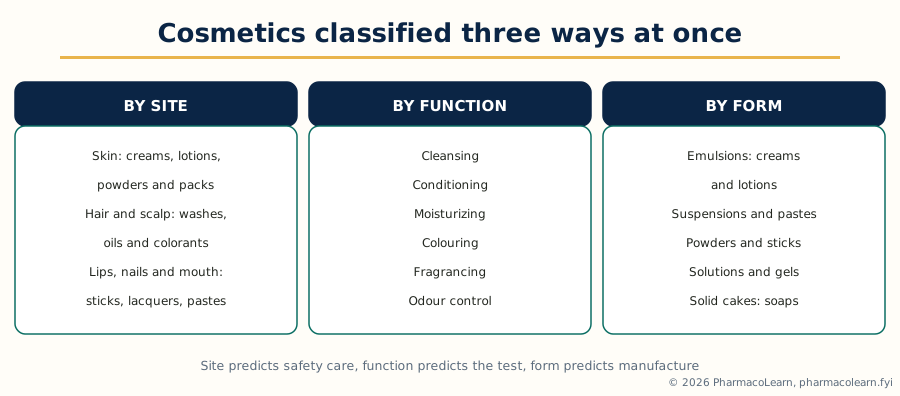 Figure: Three classifications at once. Site predicts the safety care, function predicts the performance test, and form predicts the manufacture and the stability faults.
1.3 Economic aspects and the industries involved
The syllabus joins classification to economic aspects in one breath, because the herbal cosmetics trade is a large industry and the pharmacognosist will work in it, regulate it or supply it. The economic facts to hold are structural rather than numerical, since market figures age quickly and none are printed in the syllabus. Cosmetics are high volume, repeat purchase consumer goods: the same household buys soap, tooth paste and shampoo continuously, so the industry rewards reliable quality at controlled cost far more than novelty. Herbal and natural products occupy a large and long established segment of the Indian market in particular, where plant based personal care connects with the Ayurvedic tradition taught in MPG203T, and where manufacturers range from very large national companies with full research and quality departments, through medium firms making a narrow range well, to small and cottage scale units making soaps, oils and powders for local sale. International trade runs in both directions: India exports herbal cosmetics and the raw materials and extracts behind them, and imports finished cosmetics, speciality ingredients and fragrances, which is why import and export control appears in this unit beside the manufacturing licence.
The industries involved, as the syllabus names them, form a chain rather than a single factory type. Growers and collectors supply the crude herbs; extractors and distillers convert them into the standardised extracts and volatile oils of commerce; ingredient manufacturers supply the surfactants, oils, waxes, colours and preservatives; cosmetic manufacturers formulate and pack the finished product; and packers, distributors and retailers carry it to the user. Loan licence and third party manufacture are established features of this chain in India: a marketing firm may have its product made in another firm's licensed premises, which is why the examination asks about loan licensing, and why Unit 5 insists that responsibility for quality follows the licence and the label, not the size of the firm.
1.4 Regulatory provisions: the legal frame
Cosmetics in India are regulated under the Drugs and Cosmetics Act, 1940 and the rules made under it, with the cosmetics provisions now carried in the Cosmetics Rules, 2020, administered through the Central Drugs Standard Control Organization at the centre and the state licensing authorities in the states. The frame has the same architecture as the drug frame the student already knows, fitted to the lower risk and higher volume of cosmetics: manufacture is licensed, premises and practice are controlled by good manufacturing practice requirements, products must meet the standards and labelling the rules prescribe, misbranded and spurious cosmetics are offences, imports are controlled at registration and the border, and samples may be taken and analysed by government analysts, with penalties on conviction. Herbal and natural cosmetics stand fully inside this frame. No separate, lighter licence exists for a product because it is herbal, and a product that makes drug claims may be treated as a drug, or as a misbranded cosmetic, according to the claim it makes. Ayurvedic cosmetics occupy a boundary the student should state carefully: a preparation manufactured as an Ayurvedic medicine under the Ayurvedic licensing provisions of the Act follows that route, while a preparation sold as a cosmetic follows the cosmetics route, and the route is decided by the product's intended use, claims and composition, not by the manufacturer's preference.
The cosmetics control frame in outline
  Drugs and Cosmetics Act, 1940 and Cosmetics Rules, 2020
        |
        v
  Manufacture only in licensed premises, under GMP
        |
        v
  Standards, labelling and prohibited claims applied
        |
        v
  Market sampling and analysis by government analysts
        |
        v
  Misbranded or spurious findings: offences and penalties
        |
        v
  Imports controlled in parallel: registration and border checks
1.5 The manufacturing licence
The licence is the permission to manufacture cosmetics for sale, granted by the state licensing authority for premises that satisfy the rules: suitable premises and plant, the required manufacturing and testing facilities or approved arrangements for testing, technically qualified supervision, and compliance with good manufacturing practice. The application states the categories of cosmetics to be made, because a licence for creams does not by itself authorise every other class, and the licence is premises specific and time bound, renewed on continued compliance and liable to suspension or cancellation when conditions fail. The own premises licence covers the manufacturer making products in its own factory, one of two licence forms that matter for the examination. The loan licence covers the firm that markets products made for it in another manufacturer's licensed premises: the actual manufacture happens under the host premises' licence and supervision, while the loan licensee carries the marketing responsibility the rules assign, and the label must tell the truth about who made the product and who markets it. The licensing flow diagram below shows the sequence every applicant follows in outline, whatever the category.
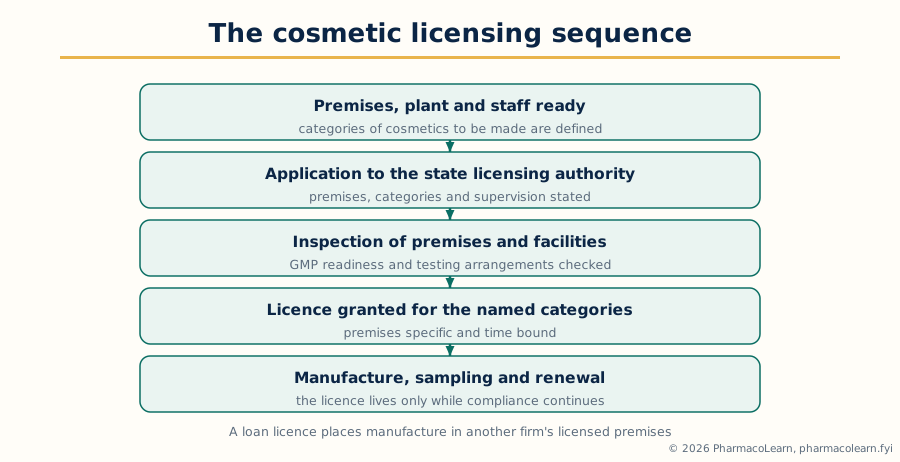 Figure: The licensing sequence in outline. The licence certifies premises, categories and supervision, and it stays alive only while inspection and sampling keep passing.
1.6 Good manufacturing practice for cosmetics
Good manufacturing practice, GMP, is the discipline that makes a licensed factory produce the same acceptable product on the hundredth batch as on the first, and the syllabus places it inside the regulatory unit because compliance is a licence condition, not a voluntary extra. Its components, stated at the level of principle the syllabus requires, are: premises designed and maintained so that operations do not contaminate each other, with washing, water and waste systems fit for cosmetic manufacture; equipment suited to the products, cleaned and maintained on a recorded schedule; raw materials received against specification, tested or certified, stored so that identity is never in doubt, and issued by recorded procedure; a defined manufacturing process for each product, written as a master formula and process record at the level of operations, followed batch by batch and signed as performed; in process and finished product quality control against the product specification, with retained samples; personnel who are trained, medically fit for the work and held to hygiene rules, since cosmetics are made for direct skin contact; documentation complete enough that any batch on the market can be traced to its materials, its process record and its test results; and a complaints and recall procedure that can find and withdraw a defective batch. None of this is peculiar to herbal products, but two points are: herbal raw materials vary as agricultural materials vary, so raw material control carries extra weight, and the natural image of the product tempts weak firms to treat GMP as optional, which is exactly the failure the licence system exists to catch.
1.7 Offences and penalties: misbranded and spurious cosmetics
The Act's enforcement vocabulary for cosmetics turns on two words the student must be able to distinguish. A cosmetic is misbranded when its label or presentation deceives: false or misleading claims, imitation of another product, missing or incorrect particulars such as the manufacturer, licence number, batch, ingredients where required, or directions and warnings the rules prescribe. A cosmetic is spurious when its very identity is false: it purports to be a product it is not, bears a name or mark it has no right to, or is manufactured or imported in a way that counterfeits a genuine article. Manufacture for sale, sale, stocking or import of misbranded or spurious cosmetics, and manufacture without a valid licence, are offences under the Act, punishable on conviction with the imprisonment and fine the Act prescribes for the class of offence, with enhanced consequences for repeat offences, and with forfeiture and licence action beside the prosecution. These notes state the structure of the liability and not penalty figures, because the syllabus names offences and penalties as a head and prints no figures, and an examination answer earns its marks by the distinctions, misbranded against spurious, unlicensed against licensed but non compliant, and cosmetic claim against drug claim, rather than by recited numbers.
1.8 Import and export of herbal and natural cosmetics
Imports are controlled so that a foreign cosmetic cannot enter the Indian market on weaker terms than a domestic one. In outline, cosmetics imported for sale require registration of the product and the manufacturer with the central authority under the Cosmetics Rules, import through permitted routes with the documents the rules require, compliance with the same standards, labelling and prohibited ingredient provisions as domestic products, and liability to sampling and refusal where a consignment fails. Prohibited and restricted ingredients, and cosmetics tested on animals in the manner the Indian rules prohibit, stand outside the permitted trade, and the student's answer should present import control as the border arm of the same system as the factory licence: one standard, two gates. Export runs the other way: the Indian manufacturer exporting herbal and natural cosmetics must meet the importing country's rules, which differ in their ingredient lists, labelling languages and claim rules, and must support the consignment with the certificates and documents the trade requires, commonly including evidence of lawful manufacture at home. The economic point of Section 1.3 completes itself here: India's strength in this trade rests on its plant wealth and its traditional formulations, and both are exportable only from licensed, documented, testable manufacture.
Unit 2: Raw Materials and the Design of Herbal Cosmetic Formulations
2.1 Commonly used herbal cosmetics and their raw materials in outline
Unit 2 opens with the commonly used herbal cosmetics, which are simply the product classes of Units 3 and 4 in their herbal form: herbal cleansing creams and lotions, herbal face packs and powders, herbal soaps and shampoos, herbal hair oils and colorants, herbal dentifrices and mouth washes, and herbal creams for moisturizing and complexion care. What makes them one unit is that they are all built from the same short shelf of raw material families, and a formulator who commands the families can read any product in the classes. The families are: the water and aqueous phase materials; the oils, fats and waxes that form the lipid phase and the skin feel; the surfactants that cleanse and emulsify; the humectants that hold water; the preservatives that keep the product safe in its container; the colours; the fragrances and volatile oils; the thickeners and structuring agents that give body; and the functional herbs and extracts that give the product its herbal identity and its intended surface action. The next six sections take the syllabus families in its own order, preservatives, surfactants, humectants, oils, colours and functional herbs, after one general rule: every raw material enters the formulation with a specification, identity, purity and quality in the sense of MPG202T, and a herbal extract is a raw material like any other, standardised by its marker or its fingerprint, never a handful of tradition added by weight of reputation.
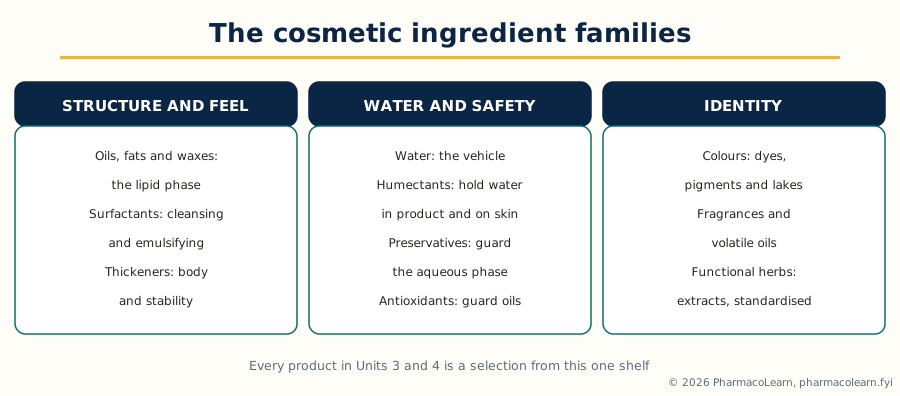 Figure: The ingredient families of Unit 2. Every product in Units 3 and 4 is a selection from this one shelf, proportioned to its tissue and its task.
2.2 Preservatives
A cosmetic that contains water and nutrients, which is to say nearly every cream, lotion, shampoo and pack in this subject, will grow micro-organisms unless it is preserved, and a contaminated cosmetic is both an efficacy failure and a safety hazard on skin that may be broken or shaved. Preservatives are the antimicrobial ingredients added to prevent that growth in the container during manufacture, storage and consumer use. The standard teaching classifies them by chemistry and by spectrum: antibacterial agents, antifungal agents, and the broad agents used against both, with antioxidants taught beside them as the second preservation system, since oils and fragrances fail by oxidation as surely as aqueous products fail by infection, and the two systems are often confused by students. An antioxidant protects the product from air; an antimicrobial preservative protects it from life; a rancid cream and a mouldy cream are different failures needing different guards.
Selection follows principles, not habits. The preservative must be effective against the organisms the product will actually meet, at the pH and in the phase system of that product, since many preservatives work only in the water phase and only within a pH range; it must survive the process and the shelf life without reacting with the other ingredients; it must be permitted for cosmetics in the governing rules and used within its permitted conditions; and it must be safe at the site of use, which is why the eye area, lips, baby products and leave on products draw stricter choices than rinse off products. Two herbal cautions belong here. Plant extracts can carry a heavy microbial load into the batch, so the herbal formulator preserves for the load actually present, not the load a clean synthetic base would carry. And no traditional antimicrobial reputation of an herb replaces the preservative efficacy test of Unit 5: the product is preserved when the test says so, not when the label names a famous plant.
2.3 Surfactants
Surfactants, surface active agents, are the working molecules of cosmetic science: each carries a water loving head and an oil loving tail, so the molecule sits at surfaces and interfaces and changes what happens there. From that one structure flow all their cosmetic jobs: wetting a surface so water spreads on it, emulsifying oil and water into the creams and lotions of this subject, dispersing solids, solubilising fragrances and oils into clear products, foaming, and above all cleansing, in which surfactant molecules surround oily soil and skin debris in micelles and lift them into the rinse water. The classification the examination expects is by the charge of the head group. Anionic surfactants, negatively charged, are the main cleansers of shampoos, soaps in the syndet sense and dentifrices, strong in detergency and foam. Cationic surfactants, positively charged, are poor cleansers but excellent conditioners, because the positive head is attracted to the negatively charged damaged hair surface, which is why they rule the conditioner class of Unit 4. Nonionic surfactants, uncharged, are mild, stable emulsifiers and solubilisers used across creams and lotions. Amphoteric surfactants, carrying both charges according to pH, are the mildness partners blended into shampoos and baby products to soften the anionics. Soap itself, the oldest surfactant, is treated fully in Unit 3.
Performance is judged on the properties the structure predicts: cleansing power, foam quantity and quality, mildness to skin and eye, behaviour in hard water, compatibility with the other ingredients, and stability across the product's pH and temperature range. The formulation lesson is that surfactants are chosen as systems: a primary cleanser for soil removal, secondary surfactants for foam and mildness, and emulsifying surfactants where the product is a cream rather than a wash, each decision following from the tissue and task of Unit 3.
| Surfactant class | Charge of head group | Typical cosmetic role | Character the formulator uses |
|---|---|---|---|
| Anionic | Negative | Primary cleansing in shampoos, washes, dentifrices | Strong detergency and foam, needs mildness partners |
| Cationic | Positive | Conditioning of hair, antistatic action | Substantive to damaged hair, poor cleanser |
| Nonionic | None | Emulsifying creams and lotions, solubilising | Mild, stable, low foam |
| Amphoteric | Both, pH dependent | Mildness partner in shampoos and baby products | Softens anionic systems, good skin feel |
2.4 Humectants
Humectants are the water holding ingredients: hygroscopic materials that attract water and hold it where they are placed. In a cosmetic they work in two theatres at once. Inside the container they keep the product itself from drying out, so creams do not crust and pastes do not harden. On the skin and hair they hold water in the surface layer, which is the whole physical basis of moisturizing as Unit 4 teaches it: the stratum corneum feels soft and looks smooth in proportion to the water it holds, and a humectant film slows the escape of that water to dry air. The standard members of the class are the polyols and allied materials of the cosmetic shelf, glycerol (glycerin) first among them, with propylene glycol, sorbitol and related polyhydric alcohols, and the natural moisturizing factor type materials in the wider teaching. Several are also useful solvents and sweeteners in oral products, which is why the humectant reappears in dentifrices in Unit 3, keeping the paste moist in its tube and pleasant in the mouth.
Judgement of a humectant is by water holding behaviour across humidity, by feel, since the class runs from clean to tacky as concentration rises, by compatibility, and by the product type: a leave on cream can carry the humectant load that a rinse off product would simply wash away. The interaction with preservation should be noted now and used in Unit 5: a sufficiently high humectant and polyol content lowers the available water of a product and so assists its microbial defence, one of the few places where two ingredient families pull in the same direction.
2.5 Oils, fats and waxes
The lipid shelf supplies the body, the skin feel and much of the stability of cosmetic products. Fixed oils, vegetable oils such as coconut, almond, sesame, olive and castor oils in the standard teaching, and mineral oil from the petroleum shelf, serve as emollients that spread on skin and hair, soften the surface, carry oil soluble ingredients, and form the internal or external phase of emulsions. Fats and butters of the shea and cocoa type give body and melting behaviour near skin temperature. Waxes, beeswax and the plant and mineral waxes, structure the product: they stiffen sticks such as lipsticks, thicken creams, and stabilise emulsions by building a solid network. Volatile oils, the essential oils of pharmacognosy, belong functionally to fragrance and to the functional herb shelf as much as to the oils, and are treated in Section 2.7.
Each lipid is judged by the properties the examination names for raw materials generally: its spreading and feel, its stability against rancidity, since an oxidised oil ruins odour, colour and skin tolerance together, its purity and constants in the pharmacognostic sense, and its compatibility with the emulsion system chosen. The herbal formulator's characteristic oils are the infused and expressed plant oils that carry the identity of the product, herbal hair oils being the type example of Unit 4, and their discipline is the same as any oil's, with the added duty of standardising what the plant has put into them.
2.6 Colours
Colour is a functional ingredient in cosmetics, not a decoration added at the end: it gives lipsticks and face powders their whole purpose, tints creams and soaps to their expected appearance, and signals identity and flavour in oral products. Cosmetic colours are classified by source and by behaviour. By source they divide into mineral and inorganic pigments, plant and natural colours, and synthetic colours permitted for cosmetics. By behaviour they divide into soluble dyes, which dissolve and colour transparently, and insoluble pigments and lakes, which disperse as fine particles, give opacity and covering power, and are therefore the colours of lipsticks, powders and foundations. The natural colour shelf of this subject includes the plant colours long used in Indian practice, among them turmeric for yellow, henna for its reddish brown staining of hair and skin, indigo in hair colouring, and the annatto, saffron, madder and beetroot type colours of the traditional list, each taught by source, colouring principle in general terms, and use, without invented technical claims.
Colour judgement is strict because colour faults are visible to every buyer: identity and purity of the colour material, its stability to light, heat and the product's pH, its even dispersion without streaking or bleeding, and above all its permission. Only colours permitted for cosmetics in the governing rules may be used, with stricter lists for products used near the eyes and on the lips, and a traditional history does not by itself place a colour on the permitted list: henna's long use coexists with the modern duty to control its purity and to exclude adulterated black henna type products that add undeclared chemicals. That sentence states the whole colour doctrine of the subject.
2.7 Functional herbs
Functional herbs are the plant materials included for the action the product is built around, as against herbs present only as fragrance or colour. The standard teaching meets them in families by cosmetic task: herbs used for skin cleansing and complexion care, herbs used for hair growth, conditioning and colouring in traditional practice, herbs with astringent and toning character used in tonics and packs, herbs used in oral care, and aromatic herbs and volatile oils used across all of these. Named examples recur through the Indian cosmetic tradition and the examination literature: aloe, turmeric, neem, amla, bhringraj, henna, shikakai and reetha type washing materials, sandalwood, liquorice, brahmi and hibiscus among them, each to be known by its part used, its traditional cosmetic role stated as traditional use, and its form in commerce, as powder, extract or oil. Two rules govern everything said about them in these notes. Their traditional roles are recorded as the tradition states them, which is their correct standing, and no efficacy claim is made for any product containing them. And as raw materials they face the full standardisation discipline of MPG202T and MPG103T: identity by the pharmacognostic characters, quality by marker or fingerprint where established, and control of the microbial, heavy metal and pesticide burden that a field grown material can carry into a cosmetic.
2.8 Preformulation studies
Preformulation is the study of a planned formulation's materials before the formulation is fixed, so that the design decisions of the next section rest on measurement rather than hope. For herbal cosmetics the studies follow the pattern the student knows from pharmaceutics, fitted to cosmetic materials. The herbal raw material is characterised: identity, organoleptic characters, solubility behaviour of the extract, its colour and odour contribution, its pH in solution, its stability to heat, light and air, and its marker content where a marker exists. The base materials are characterised in parallel: the emulsion or surfactant system the product will use, its pH range, its viscosity behaviour and its own stability. Then the two are brought together in trial mixtures at bench scale and watched: does the extract break the emulsion, shift the colour, thin the product, precipitate, or darken on standing? Preformulation answers these questions cheaply, in beakers, before they can be asked expensively, in filled jars. Its output is not a product but a set of decisions: which extract form to use, which base family tolerates it, which pH window the product must hold, and which risks the compatibility studies must now pursue formally.
2.9 Compatibility studies and chemical and herbal interactions
Compatibility studies test the chosen combination over time and under stress: the prototype product is stored at room and elevated temperatures, exposed to light where the pack allows it, cycled where transport demands it, and examined at intervals for the faults preformulation predicted, separation, colour and odour change, pH drift, viscosity change, loss of marker or preservative failure. Possible interactions between chemicals and herbs, the syllabus's own phrase, deserve a section of their own because they are the characteristic scientific risk of this subject. The interaction families are standard and should be listed in any examination answer. Physical interactions: a plant extract precipitates with an ingredient, salts out an emulsion, or adsorbs onto powders and clays so the product separates or loses its active distribution. Chemical interactions: acidic or alkaline herb constituents shift the product pH and so disable a pH dependent preservative or colour; tannin rich materials darken with iron and react with proteins and alkaloidal materials; oxidisable plant constituents consume the antioxidant and then discolour the product themselves. Functional interactions: a herb constituent binds inside surfactant micelles and is no longer available at the surface, or an ingredient inactivates the very constituent the product is sold for. And biological interactions in the safety sense: a combination produces irritation or sensitisation that neither part produced alone, which is why Unit 5 tests the finished product and not only its parts.
Design of a herbal cosmetic formulation
  Tissue and task defined (Unit 3 physiology)
        |
        v
  Product class and physical form chosen
        |
        v
  Ingredient families selected (Unit 2 shelf)
        |
        v
  Preformulation of herb and base materials
        |
        v
  Compatibility and interaction studies
        |
        v
  Prototype judged: appearance, stability, preservation
        |
        v
  Specification fixed, then manufacture under GMP
2.10 Design of herbal cosmetic formulation
Design is the disciplined assembly of the unit: the tissue and task come first, then the product class and physical form, then a selection from each ingredient family that the task requires and no family it does not, then preformulation, compatibility proof, prototype judgement and specification. The design questions, in the order a formulator answers them, are the real syllabus of this section. What surface, in what condition, for how long: leave on or rinse off decides half the ingredient choices at a stroke. What must the product visibly and measurably do: cleanse, condition, moisturize, colour or control odour, stated as testable performance. Which herbal material carries the product's identity, in which standardised form, and what does it bring with it in colour, odour, pH and load? Which base system carries it without interaction, at which pH, preserved how, packed in what, stable for how long under the stability discipline of Unit 5? A formulation that can answer those questions in writing is designed; a mixture that cannot is only assembled. With the shelf and the method in hand, the subject now turns to the tissues themselves.
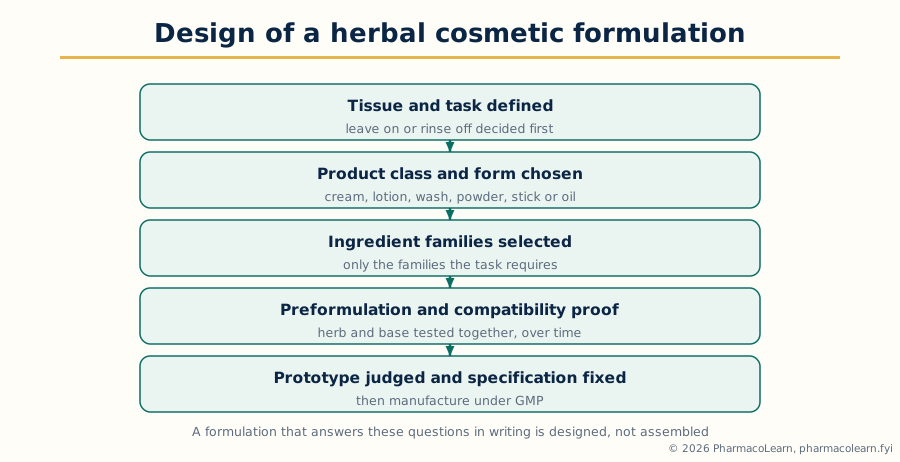 Figure: Formulation design as a sequence of answered questions. The specification at the end is only as good as the preformulation and compatibility work before it.
Unit 3: Herbal Cosmetics for Skin, Hair, Mouth and Nails
3.1 Physiology and chemistry of skin
The skin is the largest organ of the body and the surface every product in this subject except the oral and nail classes is made for, so its structure is examined in detail. In section from outside inward, the skin has three principal layers. The epidermis is the thin outer layer, itself layered, whose deepest basal layer continuously produces new cells that move outward, flatten, fill with the protein keratin and die, forming at the surface the stratum corneum: a wall of flattened corneocytes held in a mortar of skin lipids, ceramides, cholesterol and fatty acids. This brick and mortar wall is the skin barrier. It keeps water in and the world out, and nearly every cosmetic action in this subject happens in it, on it, or against its resistance. Beneath it the dermis carries the strength of the skin: the proteins collagen and elastin in a ground substance, with blood vessels, nerves, sweat glands, sebaceous glands and the hair follicles passing through it. Cosmetics in the legal sense do not act in the dermis; a product that did would be claiming drug action. Beneath the dermis the hypodermis, subcutaneous fat, insulates and cushions.
The chemistry teaching of the syllabus head follows from the structure. The skin surface carries a mixed film of sebum from the sebaceous glands and sweat, mildly acidic in health, the acid mantle of the textbooks, which is why product pH matters and why harsh alkaline cleansing disturbs the surface. Sebum output, sweat rate, surface lipid composition and the water content of the stratum corneum together define the working skin types of cosmetic practice, dry, oily, normal and combination, and the sensitive state in which barrier damage makes the skin react to materials it once tolerated. Appendages complete the picture: eccrine sweat glands for cooling, apocrine glands in limited sites whose secretions feed the body odour chemistry of Unit 4, sebaceous glands opening into hair follicles, and the nails and hair of the next sections. The cosmetic consequences should be drawn explicitly in an examination answer: cleansing removes surface soil and excess sebum and must stop there; moisturizing raises or protects stratum corneum water; colour sits on the surface film; and penetration beyond the barrier is, for a cosmetic, a safety question and not a selling point.
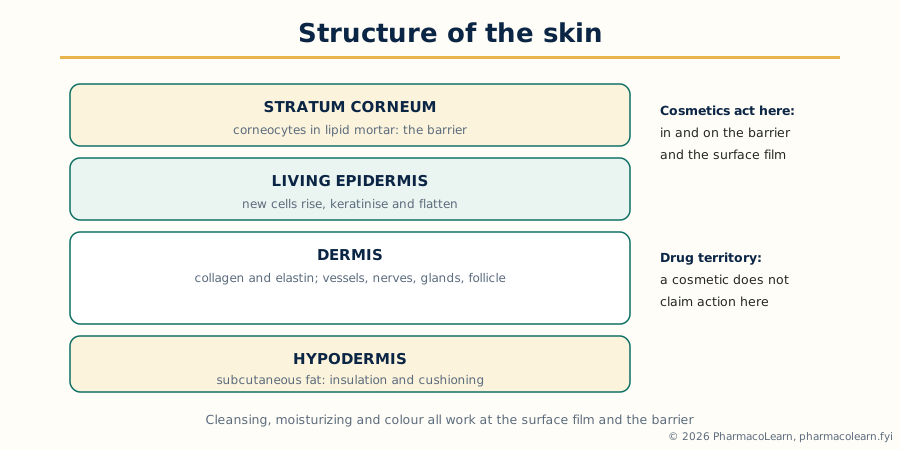 Figure: The skin in section. The stratum corneum barrier is where cosmetics act; the dermis below it is drug territory, not cosmetic territory.
3.2 Pigmentation
Skin colour is produced principally by melanin, the pigment made by melanocytes in the basal layer of the epidermis and transferred in melanosomes to the surrounding keratinocytes, where it absorbs ultraviolet radiation and gives the skin its tone. Two pigment families are distinguished in standard teaching: the brown black eumelanin and the red yellow pheomelanin, their proportion contributing to the range of human skin and hair colour, with haemoglobin in the dermal blood and carotene in the surface layers adding their tints. Melanin production responds to ultraviolet exposure, which is the physiology behind tanning, and its disorders give the pigmentation problems cosmetic practice meets: excess and uneven production in patches, loss of pigment in defined areas, and the post inflammatory darkening that follows skin injury or inflammation. For this subject the doctrine is narrow and firm. Cosmetics in the fairness class of Unit 4 work on the surface: they cleanse, moisturize, protect against sun exposure and even the appearance of tone by film and colour. The chemistry of melanin formation, a tyrosine derived pathway in the melanocyte, belongs to the student's knowledge of pigmentation, and products are described in these notes by their surface functions, with no depigmenting efficacy claims stated for any ingredient or product.
3.3 Hair and scalp: physiology and chemistry
Hair is a keratin fibre produced by the hair follicle, a pocket of epidermis sunk into the dermis with a bulb at its base where living cells divide, keratinise and die into the shaft. The shaft in section has three layers: the outer cuticle of overlapping scales that gives smoothness and shine when it lies flat and roughness when it is raised or damaged; the cortex beneath it, the bulk of the fibre, carrying the melanin that colours the hair and the protein structure that gives strength and elasticity; and the medulla, a central core present in coarse hairs. Chemically hair is keratin, a protein rich in the amino acid cystine, whose disulphide bonds cross link the structure and give hair its strength and its settable character: wetting and heat temporarily rearrange its hydrogen bonds, which is styling, while chemical breaking and remaking of disulphide bonds is the permanent waving and straightening chemistry of the wider trade. Hair grows in a cycle of growth, transition and rest phases, sheds continuously in small numbers, and is judged cosmetically by cleanliness, shine, manageability and colour, all properties of the dead shaft and its surface, since the shaft itself cannot be repaired, only conditioned, coated and protected.
The scalp is skin with a dense population of follicles and sebaceous glands, and its cosmetic problems are skin problems in a hairy site: excess sebum and loose surface scale in the condition called dandruff, dryness and itching, and the soiling of the hair itself by sebum, sweat, dust and applied products. Every hair product of Units 3 and 4 is aimed at one side of this pair: shampoos at the scalp and shaft soil, conditioners at the shaft surface, oils at scalp and shaft feel, colorants at the cortex pigment, and hair growth formulations at the follicle environment, stated in the careful terms of Section 4.2.
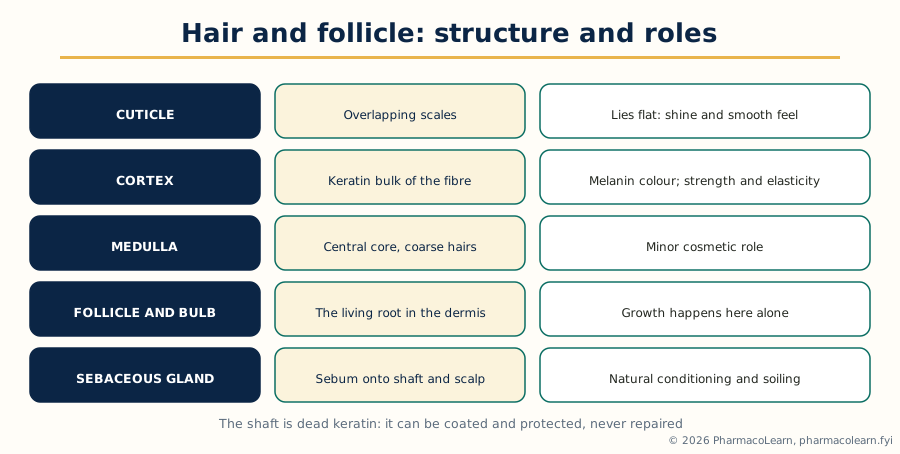 Figure: Hair in section. The cuticle decides shine and feel, the cortex carries colour and strength, and the living part of the system is the follicle bulb alone.
3.4 Lips and nails
The lips are a transition surface between skin and mucous membrane: their covering is thin, with a very thin stratum corneum, no sweat glands and few sebaceous glands, a rich blood supply close to the surface that gives the lips their colour, and a high rate of water loss that makes them dry and crack in a way ordinary skin does not. Cosmetically this predicts the whole lip product class: lipsticks and lip preparations must deposit colour in a fatty film that also protects against water loss, must be made of materials acceptable for a surface from which product is inevitably ingested in small amounts, and are therefore held to the strictest colour and ingredient discipline in the subject.
The nail is a plate of hard keratin produced by the nail matrix under the proximal nail fold, growing forward over the nail bed, with the cuticle sealing its base. Nail cosmetics work on a dead, dense, poorly permeable plate: lacquers deposit a coloured film that must adhere, flex and resist chipping; removers dissolve that film; and creams and oils condition the surrounding skin and the plate surface. Nail health teaching is simple and belongs in the answer: the plate is damaged by harsh solvents, by water and detergent exposure without protection, and by infection entering a broken cuticle seal, and cosmetic care is film, protection and hygiene.
3.5 The product classes of Unit 3 in outline
The remainder of this unit takes the product classes in the syllabus order. Each class is taught in the same pattern, and the student should be able to reproduce the pattern for any class in the examination: the tissue and task, the physical form and how it works on the surface, the ingredient families it draws from Unit 2, the herbal character of the class, and the preparation and standardisation points the syllabus names for the oral and nail classes and by extension the quality points for all of them. Preparation is taught throughout at the level of principle and operation, the emulsification, mixing, milling, moulding and filling operations of cosmetic manufacture in general terms, and never as a worked recipe.
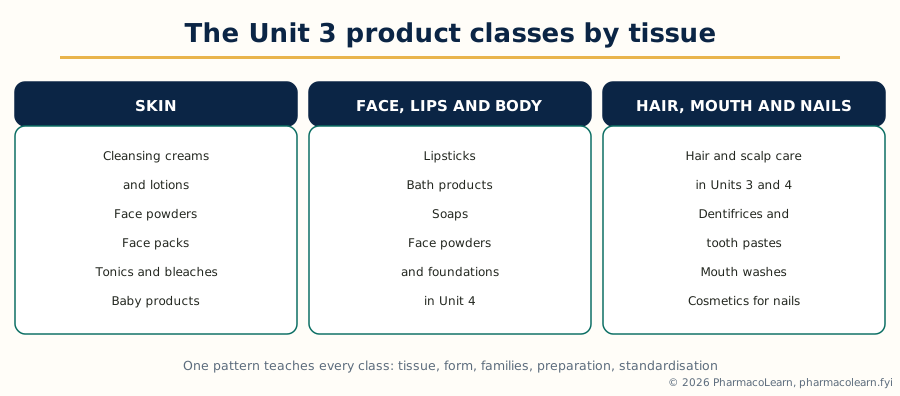 Figure: The Unit 3 classes by tissue. One pattern teaches them all: tissue and task, form, ingredient families, preparation in principle, standardisation.
3.6 Cleansing creams and lotions
Cleansing creams and lotions remove surface soil, sebum, sweat residue and applied colour cosmetics without the water and surfactant washing of a soap or shampoo. Their mechanism is solvent and emulsion action at the surface: the fatty phase of the cream dissolves oily soil and makeup, the product is spread, worked gently and wiped or rinsed away carrying the soil with it, and a thin conditioning film is left behind. In form they divide between the heavier cleansing creams, commonly water in oil in character, rich and thorough for dry skin and heavy makeup, and the lighter cleansing lotions and milks, commonly oil in water, fluid, quick to use and suited to lighter cleansing. The ingredient families are those of Unit 2 in cleansing proportion: lipid phase for soil dissolving, emulsifiers to hold the system and to help removal, humectants against tightness after cleansing, preservative for the aqueous phase, and fragrance and functional herbs for identity. Herbal cleansing products carry plant oils and extracts suited to the cleansing task in traditional use, and their standard is the class standard: the product must cleanse in use, remain a stable emulsion on the shelf, and leave the barrier undisturbed, claims that Unit 5 tests rather than labels assert.
3.7 Face powders and face packs
Face powders are finely divided solid preparations applied to the face to absorb surface oil and moisture shine, to even appearance, to give smoothness and a matte finish, and in their tinted forms to add colour. Their working materials are the powder shelf of cosmetic science: absorbent and covering powders, white pigments for opacity, clays and siliceous materials for oil absorption, talc type materials for slip and spread, small proportions of colours, binders in the pressed forms, and fragrance. Judgement is by fineness and uniformity of particle size, covering power without chalkiness, adhesion to the skin, absorbency, and freedom from grit and from microbial and heavy contamination, since a powder is inhaled in small amounts in use and its purity discipline follows from that. Loose and pressed or compact forms divide the class by manufacture: simple blending and sieving against compression into cakes with binder.
Face packs are the mask class: pastes or powders mixed to pastes, applied in a layer to the face, allowed to dry or set, and then removed, carrying surface oil, loose scale and soil away with them and leaving the surface feeling tightened and refreshed. Traditional Indian packs of plant powders, clays and grain flours are the herbal heart of this subject, and the class is taught by its mechanism: the wet layer hydrates the surface briefly, the drying layer absorbs and contracts, and removal exfoliates the loosest surface cells. Standard points are fineness, freedom from grit that would scratch, even drying, ease of removal, and the raw material purity of the plant and clay materials, which varies widely in commerce and is controlled exactly as MPG202T taught for any crude drug.
3.8 Lipsticks
The lipstick is a moulded stick of a coloured fatty base: waxes give the stick its structure and melting behaviour, oils and fats give spread and gloss, and pigments and lakes give the colour, dispersed through the mass by milling so the stick lays colour evenly. Manufacture in principle is melt, disperse the colour in the fatty phase, pour into moulds, cool, and finish, each operation controlled because the product's faults are all visible: streaking and sweating from a badly built base, graininess from undispersed pigment, breakage from a weak structure, and rancidity from an oxidised oil. Because the product is used on the lips and partly ingested, its colours must come from the permitted lip list, its fatty materials must be of cosmetic purity, and its standardisation covers colour match, melting and softening behaviour, breaking strength, and stability of colour and odour. Herbal lipsticks substitute plant colours and plant butters and waxes within the same structure, and inherit the same tests: the herbal origin of a colour does not relax its permission or its purity.
3.9 Bath products, soaps and baby products
Bath products cleanse and condition the whole body surface in water: bath salts and powders that soften or scent the water, bath oils that disperse to leave a conditioning film, foam baths built on surfactant systems, and shower preparations of the surfactant class. Their teaching points are solubility and dispersion in the bath, skin feel during and after, fragrance behaviour in warm water, and the mildness discipline that a whole body, prolonged contact product demands.
Soap is the oldest cleansing product and chemically the most definite: the alkali salt of fatty acids, made by saponification of fats and oils, cleansing because the soap molecule is itself a surfactant, lifting oily soil into micelles for rinsing. Its character follows from its chemistry and the student should state both the virtues and the faults: effective and inexpensive cleansing, an alkaline reaction in use that can disturb the acid mantle and dry the surface, and poor behaviour in hard water, where calcium and magnesium soaps precipitate as scum. Toilet soaps are the milled, perfumed, coloured descendants of the basic cake, with superfatting and added humectants softening the alkaline character, while herbal soaps carry plant oils in the fat charge and plant materials for identity and traditional roles, judged by the standard soap points: total fatty matter in the trade sense, moisture, lather, hardness and wear, and freedom from excess free alkali.
Baby products are not a chemistry of their own but a discipline applied to every class: cleansing, oiling, powdering and creaming products for infant skin, whose barrier is thinner, whose surface area to weight ratio is high, and whose user cannot report irritation. The discipline is mildness above all: gentle surfactant systems at controlled pH, minimal fragrance, conservative preservation proven by test, fine and non dusty powders used with care, and packaging and labelling that direct safe use. A herbal claim adds nothing to a baby product's safety; the standard is met by formulation restraint and by the testing of Unit 5.
3.10 Tonics and bleaches: preparation and standardisation
Tonics, in the cosmetic sense of this syllabus, are the liquid skin tonics and the hair and scalp tonics of traditional practice: aqueous or hydroalcoholic liquids applied to refresh, to remove the last traces of cleanser, to give an astringent and toned feel to skin, or to carry functional herbs to the scalp. Their preparation in principle is solution and extraction work: the vehicle is built, the herbal material is extracted into it or its standardised extract dissolved, astringent and humectant components are added by class, the product is clarified, preserved and packed. Standardisation is the syllabus word and should be answered directly: identity and strength of the herbal content by its marker or fingerprint where established, alcohol content where the vehicle carries it, pH, clarity and freedom from sediment beyond specification, microbial quality, and stability of colour and odour.
Bleaches in cosmetic use are preparations applied to lighten the appearance of facial hair and surface tone temporarily, of two families in standard teaching: the powder and cream bleaches based on oxidising action, and the milder herbal and pack type preparations sold for brightening. The teaching duty is candour: oxidising bleaches are chemically active products with real irritation and sensitisation potential, they are used strictly by their directions and patch test discipline, and their standardisation covers strength of the active system, pH, and stability in the pack. Herbal brightening preparations work at the surface by cleansing, pack action and film, and are described by those functions without lightening claims beyond appearance.
3.11 Dentifrices, tooth pastes and mouth washes
Dentifrices are the preparations for cleaning the teeth, in powder, paste and gel forms, and tooth paste is their dominant modern form. A tooth paste is a structured suspension: a mild abrasive system that polishes away surface film and stain without damaging enamel, humectants that keep the paste moist and give body, binders and thickeners that hold the structure and give the ribbon its stand up character, surfactant for foam and soil dispersion, flavour and sweetener for acceptance, water as vehicle, preservative, and in the medicated and herbal variants the functional materials of the product. Preparation in principle is controlled dispersion: the powders are wetted and dispersed without grit or air, the structure is built under vacuum mixing in modern manufacture, flavour and surfactant enter late, and the paste is filled while its consistency is in specification. Standardisation, expressly named in the syllabus, covers abrasiveness within safe limits, consistency and extrudability, pH, foam, flavour stability, fluoride content where a fluoride paste declares it, microbial quality, and stability without separation or drying in the tube. Herbal dentifrices carry plant materials of traditional oral use, including the chewing stick tradition materials of Indian practice, astringent barks and powders and aromatic oils, and they meet the same standardisation list: traditional use does not measure abrasiveness, the test does.
Mouth washes are the liquid companions: aqueous or hydroalcoholic solutions for rinsing the mouth, for freshness, cleansing of loose debris and delivery of aromatic and astringent materials to the oral surfaces. Their formulation families are vehicle, flavour and aromatic oils solubilised into the system, humectant and sweetener for feel, colour, and preservative, and their standards are clarity, alcohol content where present, pH, microbial quality and flavour stability. The boundary discipline of Section 1.1 applies with force in the mouth: a mouth wash is a cosmetic while it freshens and cleanses, and therapeutic claims for gum disease or infection move a product toward drug judgement.
3.12 Cosmetics for nails
The nail class completes the unit: nail lacquers or polishes, lacquer removers, and nail creams and oils. A lacquer is a film forming system: a film former of the nitrocellulose family in standard practice, resins for adhesion and gloss, plasticisers for flexibility, solvents that evaporate in the order that lets the film level and set, and pigments dispersed in the system for colour. Its standard points are viscosity and application, drying time, gloss, adhesion and chip resistance, colour uniformity, and stability without thickening or pigment settling beyond recovery. Removers are solvent systems matched to the film, judged by removal speed and by their harshness to plate and surrounding skin. Nail creams and oils are conditioning emulsions and oils for the cuticle and surrounding skin, judged as their parent classes are judged. Herbal nail products carry plant oils and colours within the same film and solvent logic, and the discipline of the class is unchanged: a coloured film on a keratin plate, made to a specification and tested against it.
Unit 4: Cosmeceuticals of Herbal and Natural Origin
4.1 Cosmeceuticals: the borderline class
Cosmeceutical is a trade and teaching word, not a legal category in Indian law, and the student should say so plainly before using it. It names cosmetics positioned at the border with therapy: products built around functional ingredients and presented for a defined surface condition, ageing appearance, dryness, sun exposure, hair fall in the cosmetic sense, or uneven tone in the cosmetic sense, while remaining cosmetics in law because they act on the surface and make appearance claims. The syllabus devotes a full unit to cosmeceuticals of herbal and natural origin because the herbal industry lives largely in this borderland, and the intellectual discipline of the unit is to keep both feet honest: to know the physiology of Unit 3 well enough to design a serious functional product, and to know the boundary of Section 1.1 well enough never to sell that product with drug claims. Each class below is therefore described by its surface function and its formulation logic, and no efficacy claim is stated for any of them.
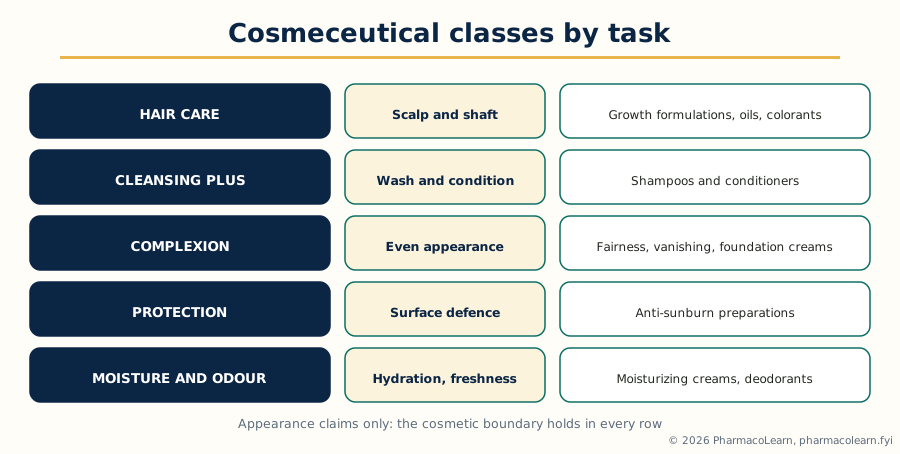 Figure: The cosmeceutical classes by task. Every class is a Unit 3 physiology applied with a functional ingredient, inside the cosmetic boundary of claims.
4.2 Hair growth formulations
Hair growth formulations are scalp preparations, lotions, tonics and oils, built around herbal materials of traditional use for the hair and scalp. Their cosmetic task, stated within the boundary, is care of the scalp environment and the existing hair: cleansing and conditioning the scalp surface, reducing breakage of the shaft by lubrication and conditioning so that hair is retained in appearance, and supporting the normal look and density of the hair. Their formulation logic follows Unit 3: a vehicle that spreads over the scalp and reaches the follicle openings, aqueous, hydroalcoholic or oily by product type; functional herbs of the traditional hair shelf, amla, bhringraj, brahmi and hibiscus among the standard names, in standardised extract or oil form; and supporting families, humectants, fragrance and preservative, chosen for a leave on scalp product. Standard points are those of the tonic class of Section 3.10 with scalp safety added: the preparation lives on skin for hours, so its irritation and sensitisation testing in Unit 5 is not optional. The examination answer that keeps this discipline, describing traditional use as traditional use and cosmetic function as cosmetic function, is the answer that earns full marks.
4.3 Shampoos
The shampoo is the defining hair cleanser: a surfactant system in water, built to remove sebum, surface scale, dust and product residue from hair and scalp, and to leave the hair clean, manageable and pleasant. Its architecture is the clearest example of the surfactant system teaching of Section 2.3: a primary anionic cleanser for detergency, secondary surfactants, amphoteric and nonionic, for foam quality and mildness, conditioning agents that deposit lightly on the damaged, negatively charged parts of the shaft, thickeners that give the product its pouring body, pearlising and opacifying agents where the product's look requires them, fragrance, colour, preservative, and sequestering agents against hard water dullness. Judgement is by cleansing in use, foam quantity and stability, pH in the mildly acidic to neutral working range of the class, viscosity, conditioning feel, and eye and scalp mildness. Herbal shampoos carry the traditional washing materials of Indian practice, the saponin bearing materials such as reetha and shikakai in extract or powder derived form, and herbal extracts for identity and conditioning roles, within the same surfactant architecture: a purely traditional wash and a modern herbal shampoo are cousins, and the modern product is standardised where the traditional wash is variable, which is the whole commercial argument of the subject in one sentence.
4.4 Conditioners
Conditioners are the complement of shampoos: where cleansing strips and leaves the shaft rough, static prone and tangle prone, conditioning restores surface order. Their active family is the cationic surfactants and fatty materials of Section 2.3: positively charged conditioning agents adsorb onto the damaged shaft, lay the cuticle scales flatter, reduce friction between fibres, reduce static, and so give softness, shine and combability. Forms divide into rinse off conditioners applied after shampooing and left briefly before rinsing, leave in preparations in lighter systems, and the cream and mask forms for intensive conditioning. Herbal conditioners add plant oils, butters and extracts to the same cationic base, and the class is judged by its measurable surface effects, wet and dry combing ease, feel and shine, never by claims to repair the shaft, which being dead keratin cannot be repaired, only coated, protected and kept.
4.5 Colorants and hair oils
Hair colorants divide by the depth of their chemistry, and the classification is the teaching. Temporary colours deposit pigment on the shaft surface and wash out. Semi permanent colours use small colour molecules that enter the cuticle region and leave over successive washes. Permanent colours work inside the cortex by oxidation dye chemistry, small precursors entering the shaft and coupling there into large coloured molecules that cannot wash out, the strongest chemistry in cosmetic practice and the class with the most serious sensitisation discipline, patch testing before use being its standing rule. The herbal colorants of this subject work by the older route: henna, whose colouring principle lawsone binds keratin and gives its characteristic red orange stain, and indigo, used with or after henna for brown to black shades, together with the plant materials used in traditional darkening preparations. Their teaching points are standardisation of the plant powder, purity against adulteration with synthetic dyes and metallic salts, which converts a simple herbal product into a hazard, evenness of colour, and honest description of the shade range plant colours can reach.
Hair oils are the simplest and oldest hair preparations: oils, plain or herb infused, applied to scalp and shaft for lubrication, shine, reduced friction and breakage in handling, and massage of the scalp. Coconut oil is the characteristic Indian base, with sesame and other fixed oils in regional practice, infused or processed with the traditional hair herbs to give the herbal hair oils of commerce. Their standards are those of any oil: purity and constants, freedom from rancidity, clarity and sediment, fragrance stability, and the standardisation of the herbal processing where the product claims it.
4.6 Fairness formulations
Fairness formulations are the complexion class of Indian cosmetic practice: creams and lotions presented for an even, bright appearance of the facial skin. Their honest cosmetic mechanisms, and the only ones stated in these notes, are surface mechanisms: cleansing and removal of surface dullness, moisturizing that makes the surface reflect light evenly, sun protection that limits further tanning unevenness where the product carries it, fine powder and film effects that even the appearance of tone, and exfoliating action in the pack and scrub relations that removes loose surface scale. Formulation follows the cream architecture of the next section with complexion herbs of traditional use, liquorice, turmeric, sandalwood and aloe among the standard names, in standardised form. The student's duty in this class is precision of language: appearance, evenness and brightness are cosmetic words; changing the skin's melanin biology is a drug claim, and Section 3.2 has already fixed the physiology that keeps the two apart.
4.7 Vanishing creams and foundation creams
The vanishing cream is the classical oil in water cream built on a stearic acid soap system: a light cream that spreads, sets to a dry, matte, non greasy film and seems to vanish into the skin, serving as a powder base and light day cream. Its character comes from its structure: a high proportion of stearic acid partly converted to its soap in manufacture, giving body and the characteristic pearly, matte finish, with humectant against drag and dryness. The foundation cream is its pigmented descendant: an emulsion carrying skin tone pigments, giving colour, coverage and a base for face powder and makeup, judged by shade match, even spreading without streaking, coverage without heaviness, wear through the day, and compatibility with the powders used over it. Both classes teach the same emulsion lesson from opposite ends: the vanishing cream shows how much character the fatty acid and soap structure alone can give, and the foundation shows the pigment dispersion discipline of Section 2.6 working inside an emulsion, so a foundation fails by streaking and shade drift exactly where a lipstick fails by grain and colour drift.
4.8 Anti-sunburn preparations, moisturizing creams and deodorants
Anti-sunburn preparations, the sunscreen class, protect the skin surface against sunburn from ultraviolet radiation by absorbing, scattering or reflecting the radiation before it acts. Their working materials divide into the organic ultraviolet filters that absorb defined wavebands and the inorganic materials, titanium dioxide and zinc oxide in standard practice, that scatter and reflect across the spectrum, held in an emulsion or lotion film that must spread evenly and stay in place, since protection fails wherever the film is thin or missing. These notes state no sun protection factor values and teach no rating claims: the class is taught by its mechanism, its film discipline, water resistance as a product property, and the standardisation duty that a protection product must be tested by the methods of Unit 5 rather than described by adjectives. Herbal anti-sunburn products carry plant materials with traditional sun care use inside the same film logic, and meet the same testing duty.
Moisturizing creams answer the dry skin physiology of Section 3.1 by three cooperating mechanisms, the standard teaching triad: humectants of Section 2.4 hold water in the stratum corneum; emollient oils of Section 2.5 smooth and fill the surface; and occlusive films slow water loss from the surface to the air. A moisturizing cream is an emulsion balanced among the three, light lotions humectant led for normal skin, richer creams oil and occlusion led for dry skin, judged by the measurable rise and retention of surface hydration, by feel, and by stability of the emulsion that carries the system.
Deodorants close the unit at the apocrine physiology of Section 3.1: body odour is produced when skin bacteria act on apocrine and sebaceous secretions, and a deodorant answers it by reducing the bacterial action, absorbing or masking odour, and carrying fragrance, in sprays, sticks, roll ons and creams. The class is distinguished from antiperspirants, which reduce sweat output itself by astringent salt action at the duct: many products combine both ideas, but the examination distinction is clean, deodorant against odour, antiperspirant against wetness. Herbal deodorants use aromatic and traditionally antibacterial plant materials and fragrance oils within the same mechanisms, and their safety testing follows the axillary site, warm, occluded and often shaved, which is among the more demanding sites in cosmetic safety work.
The cosmeceutical formulation pattern
  Surface condition named in cosmetic terms
        |
        v
  Physiology of the site recalled (Unit 3)
        |
        v
  Functional herb selected, standardised form
        |
        v
  Base class built (cream, lotion, oil, wash)
        |
        v
  Compatibility and stability proven (Unit 2)
        |
        v
  Quality and safety tested (Unit 5)
        |
        v
  Appearance claim only, never a drug claim
Unit 5: Analysis of Cosmetics, Toxicity Screening and Test Methods
5.1 Analysis of cosmetics: what control must prove
The final unit returns the subject to the discipline it began with: a cosmetic on the market must be provably what its label says, batch after batch, and provably safe for its intended use. Quality control of cosmetics, as the syllabus frames it under the Drugs and Cosmetics Act, works at three gates, and the student should structure every answer in this unit by them. Raw material control judges every incoming material against its specification before it can enter a batch. In process control watches the manufacture at the points where faults are born, emulsion formation, dispersion, filling. Finished product control judges the packed product against its product specification and releases or rejects the batch. Around the three gates stand the supporting systems: sampling plans, retained samples, stability studies that set and defend the shelf life, complaint and recall records, and the government sampling and analysis of Section 1.4, in which the state's analyst applies the same specification logic from outside the factory.
5.2 The quality control test families
The tests themselves fall into families that follow the nature of the product, and no single list fits all classes, which is itself an examination point. Physical and organoleptic tests judge appearance, colour against standard, odour, texture and feel, and the product's physical constants: pH, viscosity, specific gravity where relevant, melting and softening behaviour for sticks, fineness and particle character for powders, foam quantity and stability for shampoos and dentifrices, and extrudability and consistency for pastes. Chemical tests judge composition where composition is the promise: assay of declared functional materials and markers for herbal products by the chromatographic methods of MPG103T, fluoride where declared, limits of heavy metals and other contaminants in colours and finished products, free alkali in soaps, and the preservative content where the system depends on it. Performance tests judge the product doing its job under defined conditions: cleansing, conditioning and moisturizing measurements, emulsion stability under centrifugation and temperature stress in the laboratory sense, and pack compatibility, since a product that reacts with its container fails in the market however good it was in the tank. Microbiological tests, treated in the next section, judge the living burden. The specification is the document that gathers the applicable tests with their limits for one product, and standardisation, the word the syllabus uses for tonics, dentifrices and the rest, means exactly this: the product is made and judged against a written specification, every batch, without exception.
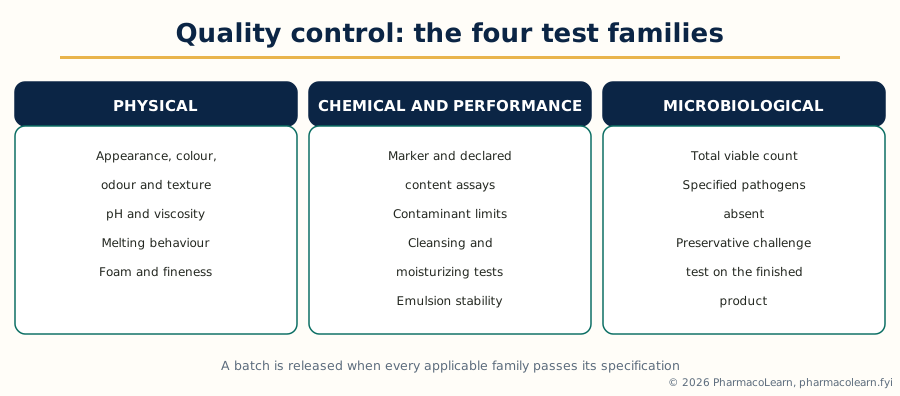 Figure: The four test families of cosmetic quality control. A batch is released when every applicable family passes against the written specification.
5.3 Microbiological quality and preservative efficacy
Cosmetics are applied to skin, eyes, lips and mouth, often by fingers, often kept in warm bathrooms, and their microbiological quality is therefore a first order safety matter and not a formality. Control judges the total viable count of the product, the absence of specified pathogens that must never be present in a cosmetic, and the special strictness owed to products for the eye area, for children and for use on damaged skin. The preservative efficacy or challenge test is the keystone method: the finished product is deliberately inoculated with test organisms in the laboratory and counted over time, and the preservative system passes only if the organisms fall as the method requires, proving that the product can defend itself against the contamination of real use. The herbal bearing is direct: plant materials arrive with a field and factory microbial history, water based herbal products are nutrient rich, and the natural image of a product has repeatedly tempted makers to under preserve. The test, not the image, decides, and this section should be read as the completion of Section 2.2.
5.4 Toxicity screening and test methods
Toxicity screening for cosmetics answers a different question from quality control: not is this batch correct, but is this product, correctly made, safe on the tissue it is made for, used as directed, for as long as users will use it. The standard test families, taught here as methods and purposes without protocols, are these. Skin irritation testing judges the immediate damaging action of the product or ingredient on skin. Skin sensitisation testing judges allergic potential, the delayed immune reaction that appears after repeated contact and that no single application predicts, the central long term hazard of colours, fragrances and hair dye systems. Eye irritation testing serves the products that reach the eye area or the face in use, shampoos and face products above all. Phototoxicity and photosensitisation testing serves products worn in sunlight, where an ingredient harmless in the dark may react under ultraviolet light, a risk with a real herbal history in plant materials containing light reactive constituents. Oral and mucosal tolerance serves the dentifrices, mouth washes and lip products. Systemic toxicity thinking stands behind the ingredient safety assessment itself: the permitted ingredient lists and restrictions of the rules embody it, so that the formulator's first toxicity control is to formulate only from permitted materials within their conditions.
The modern direction of the field is part of the examination picture and should be stated: animal testing of cosmetics is prohibited in India under the Cosmetics Rules framework, and the field works by validated alternative methods, reconstructed skin and eye models, in vitro sensitisation assays, and structured safety assessment of ingredients from existing data, performed or overseen by competent safety assessors. The student's answer should present toxicity testing as a layered assessment: ingredient data first, product tests by validated methods where the product type requires them, human compatibility and patch testing under ethical control for the final product where appropriate, and post market surveillance of complaints and reactions as the last and largest test of all.
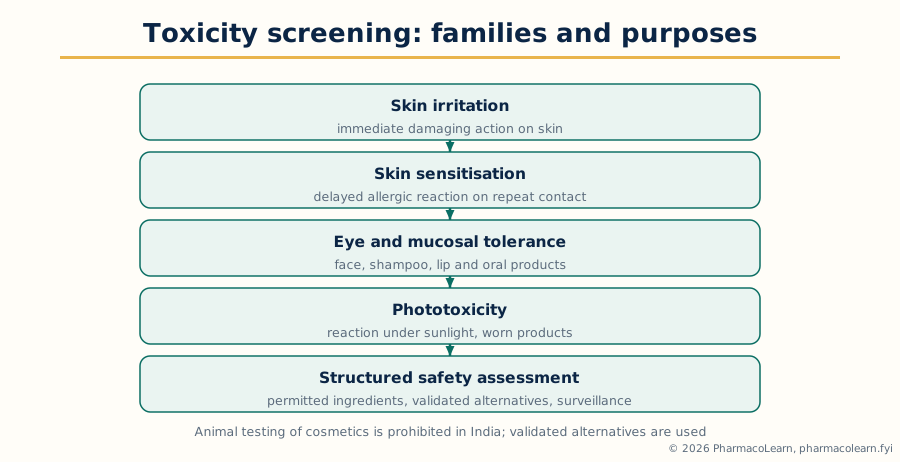 Figure: The toxicity test families. Each family answers for one tissue and one pattern of harm, and together they stand behind the safety of the finished product.
Safety and quality: the order of proof
  Permitted ingredients only, within their conditions
        |
        v
  Raw materials pass specification (gate 1)
        |
        v
  Manufacture controlled under GMP (gate 2)
        |
        v
  Finished product passes its specification (gate 3)
        |
        v
  Preservative challenge and toxicity families pass
        |
        v
  Stability defends the shelf life claimed
        |
        v
  Market surveillance: complaints, sampling, recall readiness
5.5 Stability studies
Stability work defends the time dimension of quality: the product must remain within specification, safe, effective in its cosmetic function and acceptable in appearance for the whole of its labelled life. The method follows the pattern of MPG203T and the wider degree: batches are stored under defined conditions of temperature and humidity, including accelerated conditions that predict ageing, and examined at intervals by the test families of Section 5.2, with the herbal products watched in particular for colour darkening, odour change from oxidising oils and extracts, emulsion separation, preservative failure over time, and pack interaction. The output is the shelf life and the storage instruction on the label, both earned by data. A herbal cosmetic with no stability record has an asserted shelf life, and the distinction between earned and asserted runs through this whole subject.
5.6 Quality control and toxicity studies as per the Drugs and Cosmetics Act
The unit closes by placing the laboratory work inside the legal frame of Unit 1, which is the syllabus's own closing phrase. Under the Drugs and Cosmetics Act and the Cosmetics Rules, the manufacturer's licence obliges the quality system these sections describe: manufacture under GMP, testing against standards, correct labelling, and records that prove all three. The state enforces from outside by inspection of premises, by sampling of products from manufacture and from the market, and by analysis in government laboratories, whose reports ground prosecution where a sample is found misbranded, spurious or not of standard quality. Imported cosmetics meet the same standards at the border gate. The student's closing synthesis is now available, and it is the synthesis of the whole subject: Unit 1 built the licence and the law, Unit 2 built the materials and the method of design, Unit 3 built the tissues and the product classes on them, Unit 4 carried the classes into functional cosmeceutical territory without crossing the claim boundary, and Unit 5 proves, batch by batch and test by test, that what the law licensed and the formulator designed is what the user actually receives. A graduate who can hold all five together can formulate, manufacture, regulate or examine herbal cosmetics anywhere in the Indian industry.
Frequently Asked Questions
Q: What is a herbal cosmetic, and how is it different from a natural cosmetic? A herbal cosmetic is a cosmetic in which herbs, plant materials and their extracts, form a significant and declared part of the formulation. Natural cosmetic is the wider term, covering characteristic ingredients from natural sources generally, plant, mineral or animal. Most herbal products are also mixed products in their whole composition, and both stand fully inside the Drugs and Cosmetics Act frame with no lighter licence for being herbal. See Sections 1.1 and 1.4.
Q: How are cosmetics classified in MPG204T? By site of application (skin, hair and scalp, lips and face, nails, oral cavity, bathing), by function (cleansing, conditioning, moisturizing, colouring, fragrancing, odour control), and by physical form (emulsion, suspension, powder, stick, solution, gel, cake). Each basis predicts something different: safety care, performance testing, and manufacture and stability respectively. See Section 1.2.
Q: What does the manufacturing licence for cosmetics require, and what is a loan licence? The licence, granted by the state licensing authority, requires suitable premises and plant, manufacturing and testing facilities or approved testing arrangements, technically qualified supervision, and GMP compliance, for the categories of cosmetics named. A loan licence covers a firm whose products are made for it in another manufacturer's licensed premises, with manufacture under the host licence and marketing responsibility on the loan licensee. See Sections 1.5 and 1.6.
Q: What is the difference between a misbranded and a spurious cosmetic? A misbranded cosmetic deceives by its label or presentation: false claims, imitation, or missing and incorrect particulars. A spurious cosmetic is false in its very identity: it purports to be a product it is not or bears a name and mark it has no right to. Both are offences under the Drugs and Cosmetics Act, as is manufacture without a valid licence. See Section 1.7.
Q: What are the main ingredient families in a herbal cosmetic formulation? The aqueous phase materials, oils, fats and waxes, surfactants, humectants, preservatives, colours, fragrances and volatile oils, thickeners and structuring agents, and the functional herbs and extracts that give the product its herbal identity. Every material enters against a specification, and a herbal extract is standardised like any other raw material. See Sections 2.1 to 2.7.
Q: How are surfactants classified, and what does each class do in cosmetics? By the charge of the head group. Anionic surfactants are the primary cleansers of shampoos, washes and dentifrices. Cationic surfactants condition hair by adsorbing to the damaged shaft. Nonionic surfactants emulsify and solubilise mildly across creams and lotions. Amphoteric surfactants soften anionic systems in shampoos and baby products. See Section 2.3.
Q: Why are preformulation and compatibility studies essential for herbal cosmetics? Because plant extracts bring colour, odour, pH, load and reactive constituents into a base system they can break, precipitate, discolour or inactivate. Preformulation characterises herb and base before they meet, compatibility studies prove the chosen combination over time and stress, and together they convert formulation from assembly into design. See Sections 2.8 to 2.10.
Q: Describe the structure of skin and say where cosmetics act. The epidermis produces keratinised cells that form the stratum corneum, corneocytes in a lipid mortar, which is the skin barrier; below it the dermis carries collagen, elastin, vessels, nerves, sweat and sebaceous glands and follicles; below that the hypodermis insulates. Cosmetics act in and on the stratum corneum and the surface film; action in the dermis would be drug action. See Section 3.1.
Q: What is a cosmeceutical, and what boundary must its claims respect? Cosmeceutical is a trade and teaching word, not an Indian legal category, for cosmetics built around functional ingredients and positioned for a defined surface condition. The product remains a cosmetic in law, acts on the surface, and may make appearance claims only; claims to treat disease or change body function cross into drug territory. See Section 4.1.
Q: What quality control and toxicity testing must a herbal cosmetic pass? Quality control works at raw material, in process and finished product gates against a written specification, across physical and organoleptic, chemical, performance and microbiological test families, including the preservative challenge test, defended over shelf life by stability studies. Toxicity screening covers irritation, sensitisation, eye and mucosal tolerance and phototoxicity by validated methods, within the Drugs and Cosmetics Act frame that also provides inspection, sampling and government analysis. See Sections 5.1 to 5.6.
Complete MPG204T notes, all 5 units in one PDF, free to keep.
Other M.Pharm subjects: MPH101T · MPC101T · MPL101T · MPH102T · MPH103T · MPH104T · MPL102T · MPL103T · MPL104T · MPC102T · MPC103T · MPC104T · MPH201T · MPH202T · MPH203T · MPH204T · MPC201T · MPC202T · MPC203T · MPC204T · MPL201T · MPL202T · MPL203T · MPL204T · MRA101T · MRA102T · MRA103T · MRA104T · MRM301T · MPG101T · MPG102T · MPG103T · MPG201T · MPG202T · MPG203T · MPG104T · MPG204T · MRA201T · MRA202T · MRA203T · MRA204T · M.Pharm