
MPC204T — Pharmaceutical Process Chemistry
4 hrs/week, 4 credits, 60 hours, 100 marks (75 end semester + 25 sessional). Notes follow the M.Pharm syllabus, unit by unit.
MPC204T Pharmaceutical Process Chemistry notes for M.Pharm Semester 2 Pharmaceutical Chemistry: scale up of APIs, unit operations, nitration, halogenation, oxidation, reduction, fermentation, reaction progress kinetic analysis and industrial safety, free unit wise PDF downloads on PharmacoLearn.
Units in this subject
- Unit 1 — Process Chemistry: introduction, synthetic strategy; stages of scale up process: bench, pilot and large scale process; in-process control and validation of large scale process; case studies of some scale up process of APIs; impurities in API, types and their sources including genotoxic impurities
- Unit 2 — Unit Operations: extraction (liquid equilibria, extraction with reflux, extraction with agitation, counter current extraction); filtration (theory of filtration, pressure and vacuum filtration, centrifugal filtration); distillation (azeotropic and steam distillation); evaporation (types of evaporators, factors affecting evaporation); crystallization (crystallization from aqueous and nonaqueous solutions, factors affecting crystallization, nucleation; principle and general methods of preparation of polymorphs, hydrates, solvates and amorphous APIs)
- Unit 3 — Unit Processes I: nitration (nitrating agents, aromatic nitration, kinetics and mechanism of aromatic nitration, process equipment for technical nitration, mixed acid for nitration); halogenation (kinetics of halogenations, types of halogenations, catalytic halogenations; case study on industrial halogenation process); oxidation (introduction, types of oxidative reactions, liquid phase oxidation with oxidizing agents; nonmetallic oxidizing agents such as H2O2, sodium hypochlorite, oxygen gas, ozonolysis)
- Unit 4 — Unit Processes II: reduction (catalytic hydrogenation, heterogeneous and homogeneous catalyst; hydrogen transfer reactions, metal hydrides; case study on industrial reduction process); fermentation (aerobic and anaerobic fermentation; production of antibiotics penicillin and streptomycin, vitamins B2 and B12, statins lovastatin and simvastatin); reaction progress kinetic analysis (streamlining reaction steps, route selection; characteristics of expedient routes, characteristics of cost-effective routes, reagent selection, families of reagents useful for scale-up)
- Unit 5 — Industrial Safety: MSDS (Material Safety Data Sheet), hazard labels of chemicals and Personal Protection Equipment (PPE); fire hazards, types of fire and fire extinguishers; Occupational Health and Safety Assessment Series 18001 (OHSAS 18001) and ISO 14001 (Environmental Management System), effluents and its management
Download MPC204T PDF Notes
Free PDFs for this subject, one per unit:
Pharmaceutical Process Chemistry, subject code MPC204T, is a core Semester 2 subject of M.Pharm Pharmaceutical Chemistry. It carries 4 credits and 60 hours of theory, taught at 4 hours per week, for 100 marks.
This subject is about what happens to a synthesis after it works in a flask. Process chemistry is often described as scale up: taking reactions from the small quantities created in the research laboratory to the larger quantities needed for further testing, and then to the still larger quantities required for commercial production. The goal of a process chemist is to develop synthetic routes that are safe, cost effective, environmentally friendly and efficient, and this course teaches how that is done for active pharmaceutical ingredients (APIs) and new chemical entities. Unit 1 covers process chemistry itself: synthetic strategy, the stages of scale up from bench to pilot to large scale, in process control and validation, case studies of API scale up, and impurities, including genotoxic impurities. Unit 2 covers the unit operations: extraction, filtration, distillation, evaporation and crystallization, finishing with polymorphs, hydrates, solvates and amorphous APIs. Units 3 and 4 cover the unit processes: nitration, halogenation and oxidation, then reduction, fermentation production of antibiotics, vitamins and statins, and reaction progress kinetic analysis with route selection and reagent families. Unit 5 is industrial safety: safety data sheets, hazard labels and protective equipment, fire, the OHSAS 18001 and ISO 14001 standards, and effluent management. A student who completes this subject should be able to explain why a reaction that is trivial at gram scale can be dangerous at tonne scale, and read a process the way a plant will run it.
Unit 1: Process Chemistry
1.1 What process chemistry is
A medicinal chemist and a process chemist look at the same molecule with different questions. The medicinal chemist asks: can it be made, and does it work? The process chemist asks: can it be made the same way, safely, batch after batch, at a cost the market can bear, in a plant that exists, with waste the law allows, and at a purity a regulator will accept? Process chemistry is the discipline that answers the second set of questions. Its raw material is a discovery route, usually designed to make many analogues quickly, with chromatography between steps and yields that were good enough for a pharmacology vial. Its product is a manufacturing process: a defined sequence of reactions and operations, with specified raw materials, quantities, temperatures, times, controls and acceptance criteria, that a production team can execute repeatedly.
Three features define the discipline. First, scale changes physics. A reaction that releases heat gently in a 100 millilitre flask releases the same heat per gram in a 4,000 litre reactor, but the reactor has far less surface area per unit volume to remove it through, so the same chemistry can run away at scale while behaving politely in the laboratory. Second, economics are unforgiving. A step that costs a few rupees of reagent per gram in research can decide whether a drug is commercially viable when the annual demand is measured in tonnes. Third, quality is built, not tested in. The API that reaches a patient must meet its specification for identity, purity and physical form every time, so the process, not the final analysis alone, is what guarantees quality. The syllabus scope states the goal plainly: routes that are safe, cost effective, environmentally friendly and efficient.
1.2 Synthetic strategy: choosing the route the plant will run
Synthetic strategy in process chemistry starts from the target and works backwards, as in retrosynthesis, but every disconnection is judged by manufacturing criteria as well as chemical ones.
- Step count and convergency. Every step costs time, solvent, labour and yield. A linear sequence of eight steps at 80 percent yield each delivers about 17 percent overall; a convergent route that builds two halves in parallel and joins them late loses far less material when one branch fails, and the longest linear sequence, not the total step count, sets the yield mathematics. Process chemists therefore favour convergent routes and fight to delete steps.
- Starting material strategy. A good process starts from cheap, commercially available materials with assured supply, ideally materials made at scale for other purposes. A route that begins from an obscure intermediate merely moves the problem upstream.
- Protecting group economy. Protecting groups add two steps each (on and off) and generate waste. Routes that exploit the molecule's own reactivity differences, or choose bond constructions that need no protection, are preferred.
- Telescoping. Several steps run in one vessel without isolating intermediates, using the output solution of one step as the input of the next. Telescoping saves time, solvent and handling losses, and is one of the clearest marks of a mature process.
- Robustness. The chosen chemistry must work within a forgiving range of temperature, charge quantity and raw material quality, because a plant cannot hold research laboratory tolerances. A route that only works in a narrow window is a route waiting to fail validation.
- Freedom to operate and supply. Patented steps, single source reagents and materials with hazardous transport classifications are all strategic risks that strategy must weigh.
1.3 The stages of scale up: bench, pilot and large scale
STAGES OF SCALE UP

Bench scale (laboratory)
  gram quantities; route scouting and optimisation;
  reaction calorimetry and hazard screening;
  analytical methods developed alongside
        |
        v
Pilot scale (pilot plant / kilo laboratory)
  kilogram quantities; the process, not just the chemistry;
  equipment trains rehearsed; engineering data collected;
  material made for toxicology and early clinical supply;
  safety and environmental behaviour measured at size
        |
        v
Large scale (commercial plant)
  hundreds of kilograms to tonnes; the validated process;
  fixed batch records, in process controls, defined ranges;
  material for the market, batch after batch
Bench scale is where the route is chosen and each step optimised, typically at gram scale in ordinary laboratory glassware. The work is chemical: yields, impurity profiles, solvent and reagent choice, and the first safety screens. Thermal hazard screening belongs here, because small scale calorimetry (differential scanning calorimetry of reactants and products, and reaction calorimetry of the process) tells the chemist how much heat a step releases, and how fast, before anyone runs it big.
Pilot scale translates chemistry into process. In a pilot plant or kilo laboratory, reactions run in jacketed vessels of tens to hundreds of litres, with plant style agitation, controlled additions and real work up operations: quenches, phase separations, distillations, filtrations and drying in equipment that behaves like the factory's. New phenomena appear that the bench hides: additions take minutes to hours instead of seconds, so local excesses and hot spots occur; mixing times lengthen; emulsions form in extractions; filter cakes wash slowly; and the addition controlled nature of exothermic steps reveals itself. Pilot campaigns also manufacture the kilogram quantities of API needed for toxicology studies and early clinical trials.
Large scale is commercial manufacture in vessels of thousands of litres. The process is fixed in master batch records: specified charges, temperatures, times, sampling points and acceptance ranges, executed by operators who did not develop it. The purpose of the earlier stages is to make this stage boring: every variable that matters has been identified, ranged and controlled before the first commercial batch.
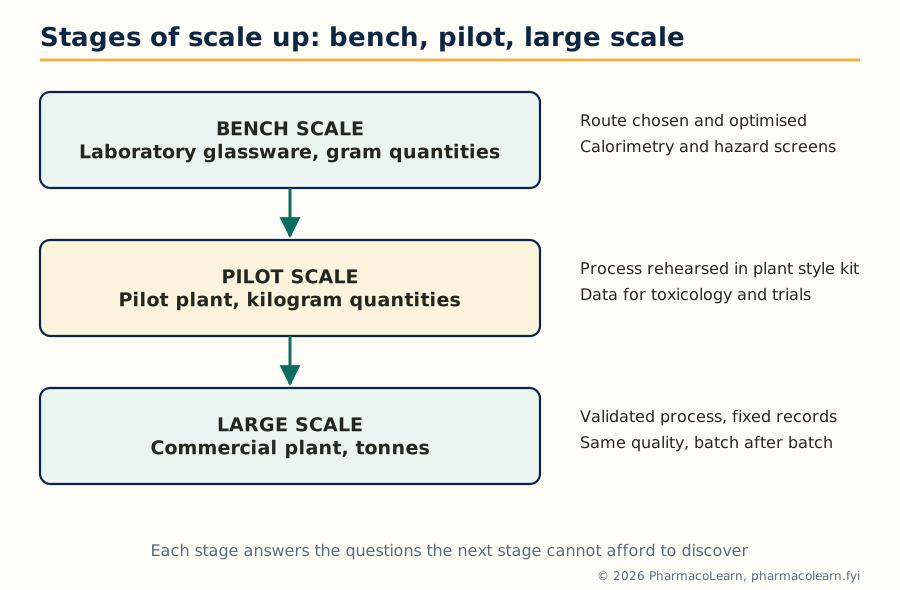 Figure: The three stages of scale up: each stage is larger, more formal and more expensive to be wrong in, so each must answer its questions before the next begins.
1.4 Why scale up is not just "more of the same"
The recurring examination theme of this unit is that scale changes behaviour, and four effects account for most of it.
- Heat transfer. Heat generation scales with volume; heat removal scales with surface area. Doubling vessel diameter multiplies volume by eight and surface area only by four, so a strongly exothermic step (nitration is the syllabus example, Unit 3) can outrun its cooling at scale. The defences are dose controlled addition, so the reaction only proceeds as fast as reagent is fed; adequate cooling capacity with margin; and knowing, from calorimetry, the maximum temperature the reaction mass could reach if cooling failed.
- Mixing and mass transfer. A magnetic stirrer homogenises a flask in seconds; a large vessel takes minutes, and during those minutes the composition is not uniform. Fast reactions in poorly mixed vessels give local over reaction, by products and, for gas liquid reactions such as hydrogenation, rates limited by gas transfer rather than by chemistry.
- Time. Charging, heating, cooling, filtering and drying all take longer at scale. An intermediate that is stable for the thirty minutes a bench work up takes may degrade during the six hours a plant filtration takes, so stability of process streams over realistic hold times must be established during development.
- Materials and safety inventory. A laboratory incident involves grams; a plant incident involves the full batch. Quantities of flammable solvent, toxic reagent and accumulated energetic intermediate are inherently larger, which is why hazard assessment deepens at every stage and why Unit 5 of this course exists.
1.5 In process control
In process control (IPC) is the system of checks performed during manufacture, as opposed to testing the finished API at the end. Its logic is that a process discovered to be off course early can be corrected; a finished batch discovered to be off specification can only be rejected. Typical IPC elements are:
- Reaction monitoring: samples withdrawn at defined times and checked by thin layer chromatography, HPLC or another suitable method for disappearance of starting material, appearance of product and growth of key impurities, with a defined end point criterion before work up is allowed.
- Physical checks: temperature, pressure, pH, addition completion, distillation end points (for example solvent exchange until a volume or composition limit is reached), water content by Karl Fischer titration where a dry stream is critical.
- Isolation checks: mother liquor losses (product measured in the filtrate), wash effectiveness, drying end point by loss on drying.
- Hold time and deviation control: defined maximum hold times for process streams, and a formal deviation record whenever the process departs from its instructions, with an assessment of impact on quality.
IPC results are recorded in the batch record as the batch proceeds, making the record a contemporaneous account rather than a reconstruction. In modern practice IPC is the shop floor expression of the quality by design idea: control the process at the points where quality is decided, not only at the gate.
1.6 Validation of the large scale process
Validation is the documented evidence that the process, run as written, consistently produces API meeting its specification. Development establishes what the process can do; validation proves it does so under routine conditions. The classical structure, taught across process chemistry and pharmaceutical quality courses, is:
- Define the process and its critical parameters. From development and pilot work, identify the critical process parameters (temperatures, charges, times, pH values, solvent qualities) whose variation affects critical quality attributes of the API (assay, impurity levels, polymorphic form, particle size, residual solvents).
- Demonstrate consistency at scale. The process is executed at commercial scale under the master batch record, conventionally over consecutive batches (the long standing industry convention is three consecutive successful batches), with full IPC and finished testing on each.
- Show the output meets specification every time. Assay, individual and total impurities, residual solvents, physical form and other specification tests must pass on every validation batch, with impurity profiles comparable to the development and clinical batches, so that the commercial material is the same material whose safety was established.
- Document and lock. Deviations during validation are investigated and explained; the validated state is then maintained by change control, so any later alteration to raw materials, equipment, parameters or site triggers an assessment of whether revalidation is needed.
Validation is why the pilot stage matters so much: a process that is merely possible cannot be validated, only a process that is robust, with proven acceptable ranges around each set point.
1.7 Case study: what scale up case studies teach, the ibuprofen routes
The syllabus asks for case studies of scale up processes of APIs without naming them; the example used across the process chemistry literature, and the one taught here, is ibuprofen, because its two industrial routes show exactly what process development is for. These are the standard teaching examples, not processes named in the syllabus.
The original Boots route (1960s) built ibuprofen in six steps from isobutylbenzene, beginning with a Friedel Crafts acylation and passing through a Darzens reaction and a hydrolysis, decarboxylation sequence. It worked, and supplied the drug for decades, but its atom economy was poor (about 40 percent of the reactant mass ended in the product on the commonly quoted calculation), it used stoichiometric aluminium chloride with its aqueous work up and waste, and six isolations meant six opportunities for loss.
The BHC route (Boots Hoechst Celanese, commercialised in the 1990s) reaches the same molecule in three steps: Friedel Crafts acylation of isobutylbenzene with acetic anhydride catalysed by hydrogen fluoride, which serves as both catalyst and solvent and is recovered and recycled; catalytic hydrogenation of the ketone to the alcohol; and palladium catalysed carbonylation of the alcohol to the acid. On the standard published comparison its atom economy is about 77 percent, rising toward 99 percent when the recovered acetic acid by product is counted, and it won a United States Presidential Green Chemistry Challenge Award in 1997. The teaching points are the syllabus points: fewer steps, catalysis in place of stoichiometric reagents, recovery designed in, and waste prevented rather than treated. A case study answer follows this pattern: what the research route was, what limited it at scale, and what the process route changed.
1.8 Impurities in APIs: types and sources
An impurity is any component of the API that is not the API itself. Controlling impurities is a central duty of process chemistry because the clinical safety of a drug is established on material of a particular purity; commercial material must match it. Sources and types organise as follows.
| Impurity type | Typical source in the process |
|---|---|
| Unreacted starting materials | Incomplete conversion; carried through when a step's end point is missed |
| Intermediates | Partial reaction, or an intermediate from an earlier step not purged at isolation |
| By products of the main reaction | Competing pathways: over reaction, under reaction, regioisomers, elimination and rearrangement products |
| Products of side reactions with reagents and solvents | Solvent or reagent adducts, for example ester formation between an acid API and an alcoholic solvent |
| Degradation products | Hydrolysis, oxidation, heat or light damage during processing, holding or storage |
| Reagent and catalyst residues | Metal catalysts (palladium, nickel), acids, bases and their salts incompletely removed at work up |
| Residual solvents | Solvents retained in the crystal or dried cake; controlled to ICH Q3C limits |
| Enantiomeric impurity | The unwanted enantiomer from a non selective step or partial racemisation |
| Inorganic impurities | Salts, filter aids, charcoal fines, water borne material |
Control is exercised at three levels. Prevention is process design: order of addition, temperature and stoichiometry chosen so the impurity forms minimally. Purging is the deliberate removal at crystallisation, washing, extraction or charcoal treatment steps, ideally demonstrated by spiking studies showing how much of an impurity each operation rejects. Specification is the final guard: the API specification sets limits, within the ICH Q3A framework, under which impurities are reported (above 0.05 percent for a maximum daily dose up to 2 grams), identified (above 0.10 percent or 1 milligram per day intake, whichever is lower) and qualified, meaning shown to be safe at that level (above 0.15 percent or 1 milligram per day, whichever is lower). The process chemist's aim is a process whose normal output sits comfortably below all three thresholds without heroics.
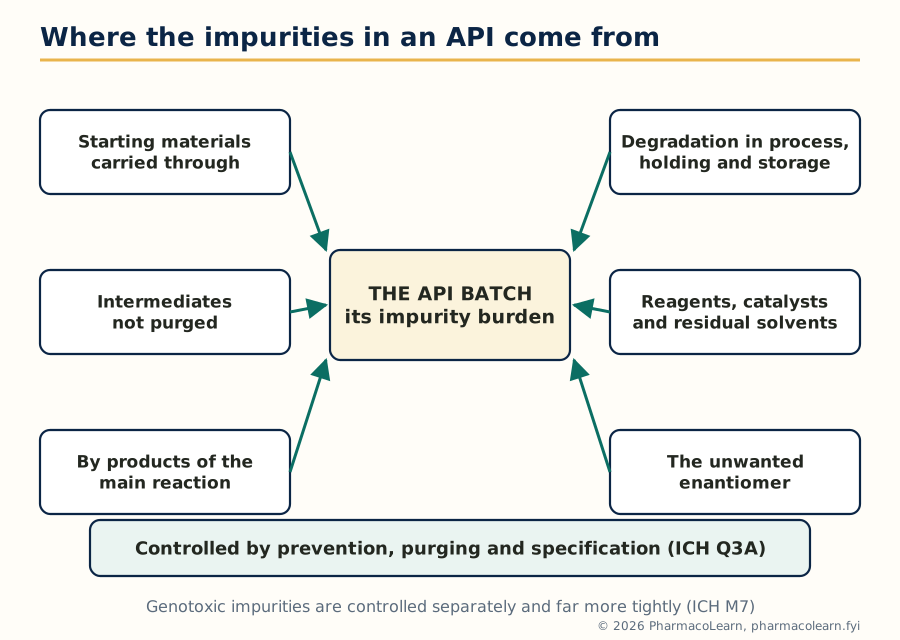 Figure: Every impurity in the API arrived from somewhere in the process; control is exercised by prevention, by purging at isolation steps, and finally by specification.
1.9 Genotoxic impurities
Genotoxic impurities are impurities that can damage DNA and are therefore controlled far more tightly than ordinary impurities, because for direct DNA reactive mutagens no safe threshold is assumed. The subject entered routine practice through cases in which sulfonate ester impurities, formed when sulfonic acids met alcoholic solvents, were found in marketed products, and it is now governed by ICH M7. Key ideas:
- Structural alerts. Certain chemical features flag a compound as potentially DNA reactive: alkyl halides, sulfonate esters, epoxides, hydrazines, aromatic amines and nitro compounds, and nitrosamines among others. An impurity carrying an alert is assessed, not automatically condemned: data, computation and, where needed, a bacterial mutagenicity (Ames) test decide its class.
- The threshold of toxicological concern (TTC). For a mutagenic impurity without compound specific data, the default acceptable intake under ICH M7 is 1.5 micrograms per day for lifetime exposure, with higher staged limits permitted for short treatment durations. Translating an intake in micrograms into a concentration limit in parts per million for a given daily dose is a routine calculation, and it routinely lands far below the ordinary 0.10 percent identification threshold, which is why genotoxic impurities need dedicated analytical methods and dedicated control strategies.
- Control by process design. The standard strategies are to avoid forming the impurity (choose a different reagent or solvent pairing, for example not holding a sulfonic acid in an alcohol), to introduce the alerting reagent early and demonstrate purge through later steps, to test at an intermediate stage rather than in the API, or to test the API with a suitably sensitive method. The nitrosamine findings in sartan medicines from 2018 onwards, in which nitrite and vulnerable amine chemistry combined in some processes, made the same lesson public: genotoxic impurity control begins at route selection, not at the specification page.
1.10 Unit 1 summary
| Question the unit answers | Core answer |
|---|---|
| What is process chemistry? | Developing syntheses into safe, economical, validated manufacturing processes for APIs |
| What changes with scale? | Heat removal per volume falls, mixing slows, operations lengthen, inventories grow |
| What does IPC do? | Detects drift during the batch, while correction is still possible |
| What does validation prove? | That the written process, run routinely, consistently meets specification |
| Where do impurities come from? | Starting materials, intermediates, by products, degradation, reagents, solvents |
| Why are genotoxic impurities special? | DNA reactive, no assumed safe threshold, TTC based limits in micrograms per day |
Unit 2 now looks at the physical operations that every process uses to move and purify its material.
Unit 2: Unit Operations
2.1 Unit operations and unit processes
Chemical engineering divides a manufacturing process into two kinds of step. A unit operation is a physical step that changes the state, composition or location of material without changing its chemical identity: extraction, filtration, distillation, evaporation, crystallization, drying, milling. A unit process is a chemical step in which bonds are made or broken: the nitration, halogenation, oxidation and reduction of Units 3 and 4. This unit teaches the five unit operations the PCI syllabus names, in the order a work up usually meets them: the reaction mixture is extracted to separate product from water soluble material, filtered to remove solids, distilled and evaporated to exchange and remove solvent, and crystallised to deliver the pure, correctly formed API.
2.2 Extraction: liquid equilibria
Liquid liquid extraction separates components by their unequal distribution between two immiscible liquid phases, most often an aqueous phase and a water immiscible organic solvent. The governing quantity is the distribution coefficient, the ratio of a solute's concentration in the organic phase to its concentration in the aqueous phase at equilibrium. A solute with a high coefficient is extracted in few contacts; one near unity needs many. Three practical consequences follow:
- pH is the process chemist's lever. For an acidic API, extraction into organic solvent is efficient when the aqueous phase is acidic enough to keep the acid unionised, and back extraction into water is efficient when the phase is made alkaline so the acid ionises and prefers water. Basic compounds are handled in mirror image. Much of API work up design is choosing the pH sequence that walks the product through the phases while leaving impurities behind.
- Several small extractions beat one large one. For the same total solvent volume, splitting the extraction into portions removes more solute, a direct consequence of the distribution law; plant practice balances this against time and emulsion risk.
- Liquid equilibria set the limits. Phase diagrams for the ternary system (solute plus two solvents) show the region in which two phases exist at all, and mutual solubility of the solvents caps recovery: solvent dissolved in the aqueous raffinate is solvent lost, and product dissolved in it is yield lost.
2.3 Extraction with reflux, with agitation, and counter current extraction
The syllabus names three ways of bringing the phases into effective contact.
Extraction with agitation is the batch standard: the two phases are stirred together in a vessel until equilibrium is approached, stirring is stopped, the phases are allowed to separate (settle), and the layers are split. Its industrial forms are the stirred extractor and the mixer settler. Agitation creates interfacial area; settling destroys it cleanly. The recurring failure mode is the emulsion, a stable dispersion that will not separate, provoked by over vigorous agitation, fines, surfactant like impurities or a small density difference between phases; remedies include longer settling, brine addition, filtration of the interface, temperature change or centrifugation.
Extraction with reflux applies when the extracting solvent is volatile and the material tolerates heat: solvent vapour condenses and percolates repeatedly through the material or solution, as in a Soxhlet type arrangement for solids, continually presenting fresh solvent without manual repetition. It suits exhaustive recovery of a solute from a solid matrix or from a solution in a higher boiling medium.
Counter current extraction is the efficient continuous arrangement. The two phases flow in opposite directions through a series of stages, so the freshest solvent meets the most depleted feed and the most loaded solvent meets the freshest feed; the concentration driving force is maintained along the whole cascade, and high recovery is achieved with far less solvent than cross current (repeated batch) extraction.
COUNTER CURRENT EXTRACTION, FOUR STAGES

Fresh solvent ---> [Stage 4] ---> [Stage 3] ---> [Stage 2] ---> [Stage 1] ---> Extract (loaded solvent out)
                      ^              ^              ^              ^
                      |              |              |              |
Feed solution  ------------------------------------------------> Raffinate (depleted feed out)
        (feed enters Stage 1; phases pass in opposite directions)
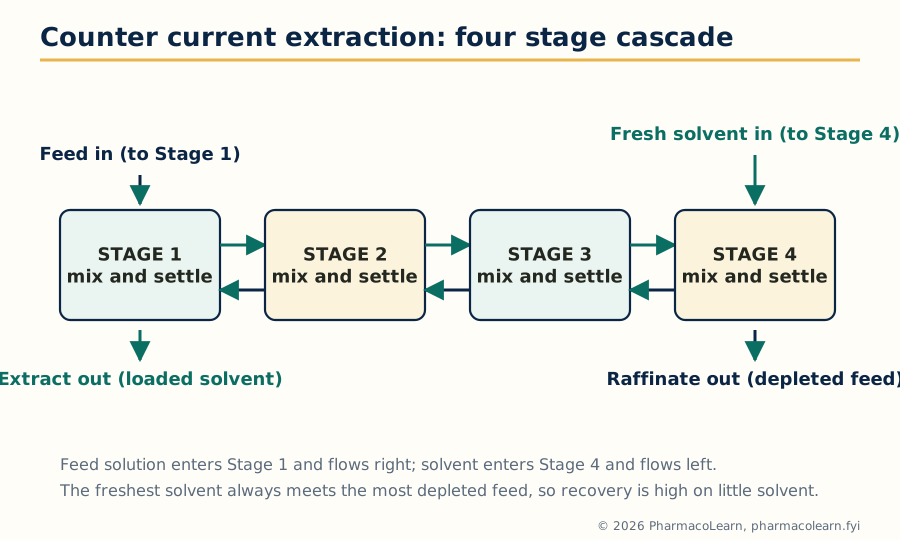 Figure: In counter current extraction the phases pass in opposite directions through the stages, keeping the concentration driving force alive along the whole cascade.
Industrial embodiments include cascades of mixer settlers, extraction columns (packed, pulsed or with rotating internals) and centrifugal extractors, which use centrifugal force to separate phases of similar density and give short contact times for unstable products. The penicillin recovery of Unit 4 is the classic pharmaceutical example: extraction of the antibiotic from broth into an organic solvent at low pH, and back into water at higher pH, performed rapidly and cold because the molecule is fragile.
2.4 Filtration: theory
Filtration separates suspended solids from liquid by passing the liquid through a porous medium that retains the solid as a cake. Its process roles are threefold: removing solids that are waste (catalyst, charcoal, salts), collecting solids that are product (the crystallised API), and clarifying solutions before a critical step (polish filtration). The theory of filtration, in the form examinations expect, rests on the idea that flow through the cake and the medium obeys a Darcy type law: the filtration rate is proportional to the driving pressure difference and inversely proportional to the liquid viscosity and the total resistance, that of the filter medium plus that of the growing cake. As filtration proceeds the cake thickens and the rate falls at constant pressure. The practical lessons are direct:
- Cake properties dominate. A crystalline, coarse, incompressible cake filters fast; a fine, gelatinous or compressible cake blinds the medium and slows to a crawl, and squeezing a compressible cake harder can reduce its permeability.
- Filter aids (diatomaceous earth, perlite, cellulose) build a porous cake structure and are used as a precoat or body feed when the solids filter badly.
- Washing the cake displaces mother liquor and its dissolved impurities; wash efficiency, not just wash volume, decides final purity, and cake cracking during washing short circuits the wash.
- Temperature and viscosity matter: hot solutions filter faster but may deposit crystals in the filter if they cool in transit.
2.5 Pressure, vacuum and centrifugal filtration
| Equipment | Driving force | Typical process use |
|---|---|---|
| Filter press | Pressure from a pump | Bulk solids removal, catalyst and charcoal filtration, filter aid cakes |
| Nutsche filter (including agitated Nutsche filter dryer, ANFD) | Pressure or vacuum, in a closed vessel | The pharmaceutical workhorse: crystallised API is filtered, washed, reslurried and dried in one contained unit |
| Vacuum leaf / rotary vacuum filter | Vacuum drawn through the medium | Continuous filtration of fast filtering slurries |
| Basket and peeler centrifuges | Centrifugal force | Rapid separation and washing of crystalline products; low residual moisture |
| Pressure leaf filter | Pressure in a closed vessel | Polish filtration of solutions, contained handling of solvent wet cakes |
Choice follows the cake and the hazard. A flammable solvent wet, toxic API demands closed, contained equipment (the ANFD earns its place because filtration, washing and vacuum drying happen behind one lid). A hard, coarse, fast crystal suits the centrifuge, which also delivers the driest cake and so shortens drying. Fine catalyst and charcoal are typically removed on a press or leaf filter with filter aid, and the filtrate polish filtered before the next step. Centrifugal filtration is a distinct principle in its own right: the driving force is the centrifugal field, many times gravity, so rates are high and cakes compact and dry, at the price of batch wise operation in most pharmaceutical designs.
2.6 Distillation: azeotropic and steam distillation
Ordinary fractional distillation separates volatile components by boiling point difference and underlies solvent recovery throughout the plant. The syllabus singles out the two special distillations a process chemist reaches for when simple distillation fails.
Azeotropic distillation addresses mixtures that form a constant boiling azeotrope, a composition that distils unchanged so that simple fractionation cannot cross it. The standard pharmaceutical applications are drying and solvent exchange. Water forms azeotropes with many process solvents (toluene carries water over as a low boiling azeotrope, the basis of Dean and Stark water determination and of azeotropic drying of a reaction mass), and ethanol water cannot be dried past its azeotrope by fractionation alone; adding an entrainer that forms a new, separable azeotrope, or switching to molecular sieves or membranes, completes the drying. In process work the commonest use is azeotropic removal of water to drive equilibria (esterifications and amidations are pushed by distilling water out as it forms) and to prepare the rigorously dry streams that water sensitive steps such as Grignard formation demand.
Steam distillation serves water immiscible, heat sensitive or high boiling organics. Passing steam through the mixture lets the organic component distil at a temperature below 100 degrees Celsius, because the total vapour pressure is the sum of the partial pressures of water and of the organic liquid, and boiling occurs when that sum reaches atmospheric pressure, far below the organic compound's own boiling point. It is used to recover volatile oils and intermediates, to strip residual high boiling solvents and odorous impurities from products, and to separate materials that would decompose at their normal boiling temperatures.
2.7 Evaporation: types of evaporators and factors affecting evaporation
Evaporation concentrates solutions by boiling off solvent, usually under reduced pressure so that heat sensitive APIs are not cooked. It differs from distillation in intent: the liquid concentrate (or the dry residue) is the product, and the vapour is normally condensed only for solvent recovery or disposal.
| Evaporator type | Character | Suited to |
|---|---|---|
| Open pan / jacketed vessel | Simple batch boiling, often under vacuum in pharma | Small batches, robust materials |
| Horizontal and vertical tube (calandria) evaporators | Heating tubes inside a body; natural or forced circulation | Large volumes of non fouling solutions |
| Falling film evaporator | Thin film flows down heated tubes; seconds of contact | Heat sensitive products, low hold up |
| Forced circulation evaporator | Pumped circulation through an external heater | Viscous liquors, crystallising concentrates, fouling duties |
| Agitated thin film (wiped film) evaporator | Rotor spreads a thin film on a heated wall | Very heat sensitive and viscous materials, stripping to near dryness |
Factors affecting evaporation: the temperature difference between heating medium and boiling liquid (the driving force, raised by vacuum lowering the boiling point but limited by product stability); the heat transfer coefficient, which falls as viscosity rises and as scale and fouling coat the surfaces; the boiling point elevation of concentrated solutions; hydrostatic head in tall liquid columns; foaming, which carries product into the condenser; and the vapour handling capacity of the condenser and vacuum system, which so often turns out to be the real bottleneck when a laboratory evaporation is scaled. Solvent exchanges in API processes, distilling out a reaction solvent while feeding the next one to hold volume constant, are evaporation and distillation doing process work together.
2.8 Crystallization: the purification that defines the product
Crystallization is the most important purification operation in API manufacture, because it is simultaneously a purification (the growing crystal lattice accepts the product and rejects most impurities), an isolation (a filterable solid from a solution) and a definition of the product's physical form (polymorph, particle size and shape, which govern filtration, drying, flow and even dissolution of the final drug). The syllabus structure is: crystallization from aqueous and nonaqueous solutions, the factors affecting crystallization, and nucleation.
A solution becomes capable of crystallising when it is supersaturated: it holds more dissolved solute than the equilibrium solubility at that temperature. Supersaturation is generated by cooling (for solutes whose solubility falls with temperature, the commonest case, and the basis of crystallisation from both aqueous and nonaqueous solutions), by evaporating solvent, by adding an antisolvent in which the product is poorly soluble (water into an alcoholic solution, or a hydrocarbon into a polar one), or by reaction (forming a salt in situ). Aqueous crystallization suits stable, water tolerant compounds and offers cheap, safe solvent and easy effluent handling; nonaqueous crystallization (alcohols, ethyl acetate, acetone, hydrocarbons and their mixtures) serves water sensitive or water insoluble APIs and gives access to solvates and anhydrous forms water cannot produce.
Factors affecting crystallization: the solvent (sets solubility, the supersaturation profile, which polymorph appears, and crystal habit); the rate at which supersaturation is generated (slow cooling gives growth on few nuclei, hence large pure crystals; crash cooling gives fines that trap mother liquor and filter badly); temperature profile and its control; seeding (see below); agitation (secondary nucleation and breakage versus uniformity); impurities, which can poison growth faces, change habit or be incorporated; and pH and ionic strength for ionisable compounds.
2.9 Nucleation, the metastable zone and seeding
Nucleation is the birth of crystal particles. In primary nucleation, new crystals appear spontaneously in a clear supersaturated solution; it needs high supersaturation and is hard to control. In secondary nucleation, existing crystals generate new ones by contact with the impeller, vessel walls and each other; it occurs at low supersaturation and is usually the practical source of crystal numbers in a seeded batch. Between the solubility curve and the supersaturation level at which primary nucleation erupts lies the metastable zone: a region where a solution will not nucleate on its own but will grow crystals that are introduced into it. The classical description is Miers supersaturation theory, which maps exactly these regions: unsaturated, metastable (growth only) and labile (spontaneous nucleation). Good process design lives in the metastable zone: the batch is brought into it, seeded with a small charge of correct form crystals of controlled size and quantity, and then cooled or dosed with antisolvent slowly enough that supersaturation is consumed by growth on the seeds rather than by new nucleation. Seeding is how a plant fixes crystal size distribution and polymorph batch after batch; an unseeded crash crystallisation is how it gets surprises.
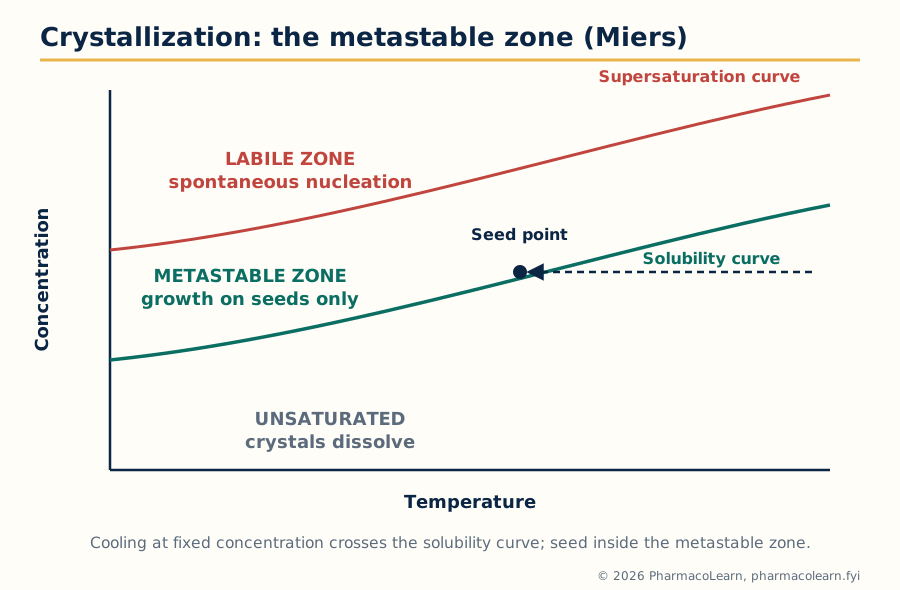 Figure: The Miers picture of crystallization: work in the metastable zone, between the solubility and supersaturation curves, where introduced seeds grow but new nuclei do not form.
2.10 Polymorphs, hydrates, solvates and amorphous APIs
The same molecule can pack into different solid forms, and the forms differ in solubility, stability, melting point, hygroscopicity and mechanical behaviour, all of which reach the patient through the performance of the dosage form.
- Polymorphs are different crystal structures of the same chemical composition. The thermodynamically stable form is the least soluble; metastable forms dissolve faster but risk converting to the stable form during processing or storage. The ritonavir episode is the standard cautionary tale taught with this topic: a more stable, less soluble polymorph appeared in the marketed product two years after launch, forced withdrawal and reformulation, and permanently changed how thoroughly industry screens for polymorphs.
- Hydrates incorporate water into the lattice, solvates incorporate solvent. They form when crystallising from water or the solvent concerned, may be more or less stable than the anhydrate depending on humidity and temperature, and must be controlled because drying can strip the lattice solvent and collapse or convert the form.
- Amorphous APIs lack a lattice entirely: they are higher in energy, dissolve faster (a strategy for poorly soluble drugs), and are correspondingly less stable, liable to crystallise on storage and often hygroscopic.
Principle and general methods of preparation, as the syllabus phrases it: polymorphs are prepared by crystallising under different conditions of solvent, temperature, supersaturation and cooling rate, and by techniques such as solvent evaporation, slurry conversion (stirring a form in a solvent until it converts to the form stable in that medium), melt crystallisation and grinding; hydrates and solvates by crystallising from water or the chosen solvent, or by exposing the solid to the vapour; amorphous material by removing the solvent or the melt state faster than crystals can organise, by spray drying, freeze drying, melt quenching or co precipitation with a stabilising polymer. The process point closes the unit: the form is not an analytical afterthought. It is decided at the crystallisation step, in this unit's core operation, and controlled by solvent, seeding and profile choices made there.
2.11 Unit 2 summary
| Operation | What it separates or achieves | The variable that decides success |
|---|---|---|
| Extraction | Product from aqueous or organic impurities | Distribution coefficient, pH, phase behaviour |
| Filtration | Solid from liquid | Cake permeability, medium, washing |
| Distillation | Volatile components; water removal | Azeotrope behaviour, partial pressures |
| Evaporation | Concentration, solvent removal | Heat transfer, vacuum, residence time |
| Crystallization | Purification plus physical form | Supersaturation profile, nucleation, seeding |
Unit 3: Unit Processes I
3.1 Unit processes: chemistry as an industrial operation
A unit process is a family of chemical conversions sharing a transformation and, crucially, a family resemblance in how they are run at scale: the reagents, equipment, hazards and controls repeat from product to product. Nitration always brings mixed acid, exotherm management and drowning out; hydrogenation always brings flammable gas, pressure and catalyst handling. This unit teaches the three oxidative and electrophilic workhorses the syllabus selects: nitration, halogenation and oxidation. Unit 4 completes the set with reduction, fermentation and the kinetic discipline that ties process chemistry together.
3.2 Nitration: nitrating agents and mixed acid
Nitration introduces the nitro group, NO2, into an organic molecule, most valuably onto aromatic rings, where it is both a functional group in its own right (nitro drugs such as chloramphenicol, nifedipine intermediates and the nitroimidazoles carry it) and the standard gateway to aromatic amines by reduction. The common nitrating agents are:
- Mixed acid: concentrated nitric acid with concentrated sulfuric acid, the industrial default for aromatic nitration.
- Concentrated or fuming nitric acid alone, for reactive substrates or where sulfuric acid would damage the molecule.
- Nitric acid in acetic acid or acetic anhydride (acetyl nitrate generated in situ), a milder system for sensitive or highly reactive rings.
- Alkali metal nitrates with sulfuric acid, generating nitric acid in situ.
- Nitronium salts such as nitronium tetrafluoroborate, laboratory reagents that deliver the electrophile directly.
- For O nitration (nitrate esters such as glyceryl trinitrate and isosorbide dinitrate) the same mixed acid esterifies hydroxyl groups rather than substituting on a ring, and for N nitration it produces nitramines; the three modes (C, O and N nitration) share equipment and hazard thinking but differ in chemistry.
Mixed acid works because sulfuric acid does three jobs: it protonates nitric acid and drives its conversion to the nitronium ion, NO2+, the true electrophile; it absorbs the water formed in the reaction, keeping the medium strongly acidic and the nitronium concentration high (spent acid strength is therefore a process variable, falling as nitration proceeds); and it provides a high boiling, heat absorbing medium that dissolves or suspends the aromatic substrate. Acid ratios are chosen for the substrate's reactivity: an activated ring nitrates in weaker acid, a deactivated ring needs stronger acid, higher nitronium concentration and often more forcing conditions, with the corresponding step up in hazard.
3.3 Mechanism of aromatic nitration
The mechanism is the standard electrophilic aromatic substitution, and its three steps are the examination core:
- Generation of the electrophile. Nitric acid is protonated by sulfuric acid and loses water to give the linear nitronium ion, NO2+. In shorthand: HNO3 + H2SO4 gives NO2+ plus HSO4 minus plus H2O (a second sulfuric acid molecule carries the proton balance in the full equation).
- Attack on the ring. The pi system of the aromatic ring attacks the nitronium ion, forming the resonance stabilised sigma complex (arenium ion or Wheland intermediate), in which aromaticity is temporarily lost and the positive charge is delocalised over the ortho and para positions relative to the site of attack. This step is normally rate determining.
- Loss of the proton. A base in the medium (bisulfate or water) removes the proton from the carbon bearing the nitro group, aromaticity is restored, and the nitroaromatic product leaves the sequence.
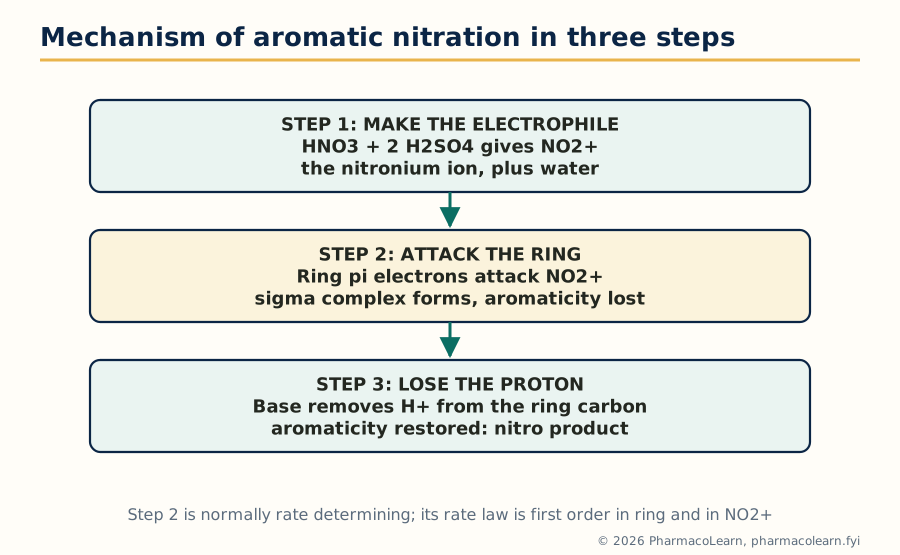 Figure: Aromatic nitration is electrophilic substitution: the nitronium ion is the electrophile, the sigma complex the intermediate, and step 2 is normally rate determining.
Orientation follows the standard rules of electrophilic substitution: existing substituents direct the incoming nitro group according to their activating or deactivating character, and the nitro group itself is strongly deactivating and meta directing, which is why controlled mononitration of a ring that already carries a nitro group needs planning, and why polynitration becomes progressively harder and more hazardous as it proceeds.
3.4 Kinetics of aromatic nitration
The kinetics are examinable because they change with the medium, and the change teaches mechanism. In concentrated sulfuric acid, where nitronium formation is essentially complete, the rate law is second order overall: rate equals k times [ArH] times [NO2+], first order in the aromatic and first order in the electrophile, consistent with the ring attack being rate determining. In media of lower acidity, or in organic solvents, the formation of the nitronium ion itself can become the slow step; the observed rate then becomes independent of the concentration and even the identity of the aromatic substrate (zero order in ArH), because every nitronium ion formed is captured at once. Between these limits, acidity of the medium is the master variable: rate profiles against sulfuric acid concentration pass through a maximum as rising acidity first generates more nitronium ion and then begins to protonate and deactivate the substrate itself. Process consequences are immediate. Because rate depends on nitronium concentration, which depends on acid strength, and acid strength falls as water forms, a batch nitration slows as it runs unless composition is controlled; because the reaction is strongly exothermic, dosing the substrate or the acid at a controlled rate and holding temperature are what keep the rate, and therefore the heat output, within the cooling capacity of the vessel.
3.5 Process equipment for technical nitration
Technical nitration equipment is designed around one fact: nitration is fast, strongly exothermic and capable of thermal runaway, and the charge contains both a strong oxidising acid and an oxidisable organic compound. The classical batch nitrator is a jacketed, corrosion resistant (now stainless steel or enamelled) vessel with cooling through jacket and often internal coils, powerful agitation to disperse the organic phase through the acid and prevent local hot spots, temperature alarms and trips, a charge system that doses substrate or mixed acid at a controlled rate with automatic cut off on cooling failure or over temperature, and an emergency drowning (quench) tank into which the entire contents can be dumped into water if control is lost. After reaction, the mixture passes to separators where spent acid and nitro product split by gravity; the product is washed (water, then dilute alkali to remove residual acid and phenolic by products) and the spent acid goes to recovery. Continuous nitrators (cascade or tubular designs) hold a far smaller inventory of reacting material and offer better heat removal, and modern practice increasingly moves nitration into continuous equipment for exactly that reason. The defences in depth are the examination points: small effective inventory, dose control, cooling with margin, agitation monitoring (a stalled stirrer lets unreacted layers accumulate and react at once on restart), and a rehearsed quench.
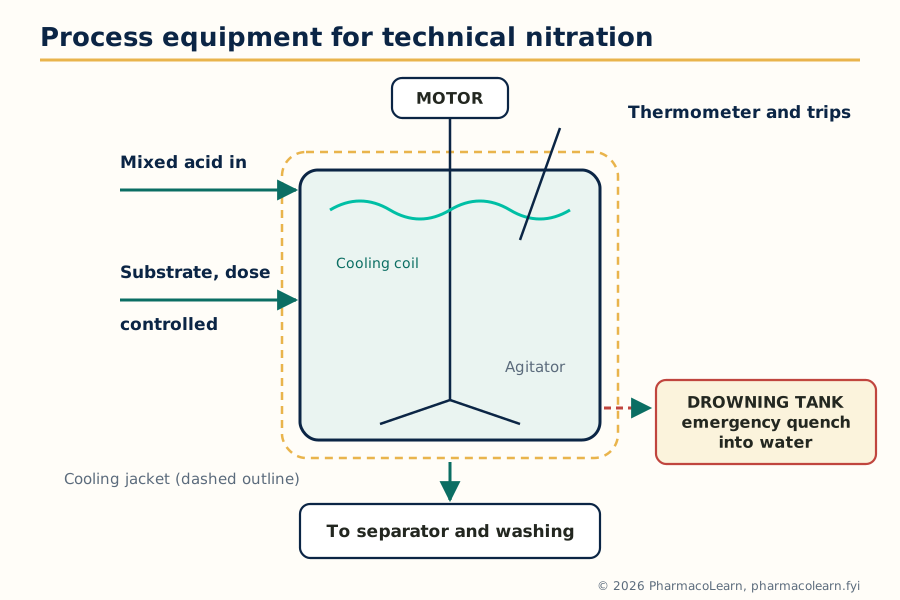 Figure: Equipment for technical nitration: dose control, cooling with margin, agitation and temperature trips, and a drowning tank if control is lost.
3.6 Halogenation: types and kinetics
Halogenation installs chlorine, bromine, iodine or fluorine. The syllabus asks for kinetics, types and catalytic halogenation, with an industrial case study.
Types of halogenation, organised by mechanism:
- Free radical substitution, typically side chain chlorination and bromination of alkyl aromatics and alkanes: initiated by light or heat or radical initiators, proceeding by a chain of initiation, propagation and termination steps. Benzylic chlorination of toluene to benzyl chloride is the textbook case.
- Electrophilic aromatic substitution: ring chlorination and bromination, requiring polarisation of the halogen, usually by a Lewis acid catalyst (ferric chloride, ferric bromide, aluminium chloride) which generates the effective electrophile; iodine, the least reactive, needs an oxidising co reagent to become electrophilic.
- Addition to multiple bonds: chlorine and bromine add across alkenes and alkynes (bromine addition is the classical unsaturation test); hydrogen halides add by ionic (Markovnikov) or radical (peroxide effect) pathways.
- Replacement reactions: hydroxyl replaced by halogen using thionyl chloride, phosphorus halides or hydrogen halides; diazonium replaced by halogen in the Sandmeyer and related reactions; halogen exchange (the Finkelstein reaction, and fluoride exchange processes) for iodides and fluorides.
- Fluorination stands apart: elemental fluorine is too violent for most substrates, so industry uses halogen exchange on chlorinated precursors, Balz Schiemann chemistry for aryl fluorides, and specialised reagents at fine chemical scale.
Kinetics of halogenations follow their mechanisms. Radical chain chlorination shows the signature of its class: an induction period while inhibitor (oxygen is a common one) is consumed, a rate governed by initiation rate and light intensity, long chain lengths (many product molecules per initiation event), and abrupt sensitivity to inhibitors and vessel surface. Electrophilic ring halogenation is typically first order in the aromatic and first order in halogen under catalysis, with the catalyst order and the rate determining step (formation of the sigma complex) following the same pattern as nitration; bromination is more selective than chlorination because bromine is the less reactive, more discriminating electrophile, a fact process chemists use when a single isomer is wanted.
3.7 Catalytic halogenation and the industrial case study
Catalytic halogenation names the processes in which a catalyst makes the halogen reactive enough, or selective enough, for manufacture: Lewis acids (FeCl3, AlCl3, FeBr3) for aromatic substitution; supported metal and metal chloride catalysts for vapour phase chlorinations; hydrogen chloride oxidation catalysis (the Deacon principle, oxidising HCl back to chlorine) where chlorine economy matters; and phase transfer or iodine catalysis in exchange reactions. The case study the syllabus asks for is taught with the standard example used across the literature, the chlorination of toluene, because one substrate demonstrates that conditions, not the reagent, choose the product. In the presence of a Lewis acid catalyst such as ferric chloride, in the dark and at moderate temperature, chlorine attacks the ring and gives ortho and para chlorotoluenes, intermediates for further elaboration. Under light, heat or radical initiation, with no Lewis acid, the same chlorine attacks the side chain and gives benzyl chloride, and with excess chlorine benzal chloride and benzotrichloride, the hydrolysis precursors of benzyl alcohol, benzaldehyde and benzoic acid respectively. The process lessons generalise: catalyst and condition selection are selectivity decisions; the reactor for a photochemical radical chain (illuminated, inhibitor free feed) is a different machine from the reactor for a catalysed ring substitution (dark, dry, corrosion resistant); and exotherm and hydrogen chloride handling dominate the engineering of both.
3.8 Oxidation: introduction and types of oxidative reactions
Oxidation at process scale converts alcohols to carbonyls and acids, oxidises side chains, introduces oxygen into rings and cleaves double bonds, and it does so under the shadow of a simple danger: the reagents that oxidise substrates can also oxidise everything else, including the solvent and the plant's inventory of intermediates, and over oxidation is a yield loss as well as a hazard. Types of oxidative reactions in the syllabus sense:
- Dehydrogenation: removal of hydrogen (alcohol to carbonyl is the borderline case, oxidation without oxygen insertion).
- Oxygen insertion and hydroxylation: adding oxygen atoms (side chain oxidation of alkyl aromatics to acids, the route by which toluene reaches benzoic acid; hydroxylation of phenols).
- Oxidative cleavage: breaking carbon carbon bonds (glycol cleavage, ozonolysis of alkenes, ring opening oxidations).
- Liquid phase oxidation with oxidising agents: the syllabus emphasis, in which the oxidant is delivered in the liquid phase: air or oxygen with metal catalysts (cobalt and manganese salts and bromide promotion in the industrial oxidation of alkyl aromatics), hydrogen peroxide systems, hypochlorite systems and permanganate or dichromate in classical processes, increasingly displaced on waste grounds.
The classical stoichiometric oxidants earned their place in textbooks and their retirement in plants: chromium and manganese reagents give excellent chemistry and stoichiometric heavy metal waste, and much of modern process oxidation is the search for catalytic, oxygen or peroxide based replacements that keep the selectivity and lose the waste.
3.9 Nonmetallic oxidising agents: hydrogen peroxide, sodium hypochlorite, oxygen and ozone
| Agent | Strengths at scale | Limitations and cautions |
|---|---|---|
| Hydrogen peroxide, H2O2 | Clean by product (water); high active oxygen per rupee; versatile with catalysts (tungstate, titanium silicalite, peracids formed in situ) | Decomposes with heat and metal contamination, releasing oxygen; storage and dosing discipline needed; dilute forms carry much water |
| Sodium hypochlorite, NaOCl | Cheap, aqueous, easy to dose; the standard reagent for TEMPO catalysed oxidation of alcohols to aldehydes and acids at fine chemical scale, and for oxidative work ups | Chlorinated by products possible; gas evolution (chlorine) if acidified; strength decays in storage |
| Oxygen gas (and air) | The cheapest and cleanest oxidant of all; the basis of large scale liquid phase oxidations with Co/Mn catalysis | Flammable vapour mixtures above the liquid demand rigorous control of oxygen concentration; mass transfer limited; needs pressure equipment |
| Ozone, O3 (ozonolysis) | Cleaves carbon carbon double bonds with a selectivity no other reagent matches; no stoichiometric waste beyond the work up | Generated on site (cannot be stored or shipped); intensely toxic and corrosive gas; ozonides are energetic intermediates needing controlled reductive or oxidative work up |
Ozonolysis deserves its mechanism note. Ozone adds across a double bond to give a primary ozonide, which rearranges to the more stable ozonide; the work up chooses the product: reductive work up (dimethyl sulfide, zinc in acetic acid, triphenylphosphine or catalytic hydrogenation) delivers aldehydes and ketones with aldehydes intact, while oxidative work up (hydrogen peroxide) carries aldehydes on to carboxylic acids. At scale the operation is run cold, in solution, with the ozone generated from oxygen on site and the excess destroyed at the vent, and it remains the industrial route of choice for cleaving double bonds where the carbonyl fragments are the product.
3.10 Unit 3 summary
| Process | Electrophile / active species | Signature hazard | Control that defines the process |
|---|---|---|---|
| Nitration | Nitronium ion from mixed acid | Thermal runaway of an oxidiser fuel mixture | Dose control, cooling, quench tank, agitation monitoring |
| Halogenation | Polarised halogen (Lewis acid) or halogen radical (light) | Runaway chains, HCl evolution, corrosive media | Condition selection for selectivity, feed purity, gas handling |
| Oxidation | O2, peroxide, hypochlorite, ozone | Over oxidation, flammable O2 mixtures, energetic intermediates | Oxidant dosing, oxygen concentration control, work up discipline |
Unit 4: Unit Processes II
4.1 Reduction: catalytic hydrogenation
Reduction is the mirror image of Unit 3's oxidation and the commonest final bond forming or functional group step in API synthesis: nitro groups to amines, double and triple bonds saturated, benzyl protecting groups removed, carbonyls reduced to alcohols. Its industrial form is catalytic hydrogenation, hydrogen gas activated on a metal surface. The elements a process chemist controls:
- The catalyst. Palladium on carbon is the general workhorse (alkene and alkyne reduction, hydrogenolysis of benzyl and Cbz protecting groups, nitro reduction). Platinum oxide (Adams catalyst) and platinum on carbon serve acidic media and aromatic ring reductions. Raney nickel, a porous nickel aluminium alloy leached with alkali, is the economical choice for nitrile and nitro reduction and desulfurisation, and is pyrophoric when dry, which dictates its slurry handling. Rhodium and ruthenium catalysts serve aromatic rings and demanding substrates. Lindlar catalyst (palladium poisoned with lead and quinoline) stops alkyne reduction at the cis alkene.
- The equipment. Hydrogenation needs pressure rated autoclaves with gas introduction designed for mass transfer (the reaction rate is commonly limited by how fast hydrogen dissolves and reaches the catalyst, so agitation design and gas dispersion are process parameters), hydrogen supply and venting engineered for a flammable gas, catalyst charging under inert conditions, and filtration of pyrophoric spent catalyst kept wet and handled as hazardous waste or sent for metal recovery.
- Selectivity and its enemies. Hydrogenation reduces in a rough hierarchy of ease, and chemoselectivity is won by catalyst choice, solvent, temperature, pressure and additives; catalyst poisons (sulfur compounds above all) destroy activity at trace level, so feed purity is a hydrogenation parameter. Partial reductions need poisons used deliberately, as in Lindlar chemistry, or transfer conditions (below).
4.2 Heterogeneous and homogeneous catalysts
| Feature | Heterogeneous catalysis | Homogeneous catalysis |
|---|---|---|
| Form | Metal on a support (Pd/C, Pt/C, Raney Ni) in a separate solid phase | A soluble metal complex in the same phase as the substrate, for example Wilkinson catalyst, RhCl(PPh3)3 |
| Separation | Filtration; straightforward, catalyst recoverable | Difficult: the metal leaves with the product stream and must be scavenged to meet metal residue limits |
| Selectivity | Broad, robust, sometimes blunt | Finely tunable by ligand design; the basis of asymmetric hydrogenation with chiral ligands |
| Operating style | Stirred autoclave, often high pressure | Milder conditions possible; sensitive to air and impurities |
| Cost driver | Metal loading and recovery from spent catalyst | Ligand cost and metal removal |
Homogeneous hydrogenation earns its place because of Wilkinson catalyst chemistry (selective reduction of less hindered double bonds under mild conditions) and because asymmetric hydrogenation, the industrial production of single enantiomers by chiral homogeneous catalysts, is a signature achievement of process chemistry. The heterogeneous default stands on economics and separation: a catalyst you can filter off is a catalyst you can afford.
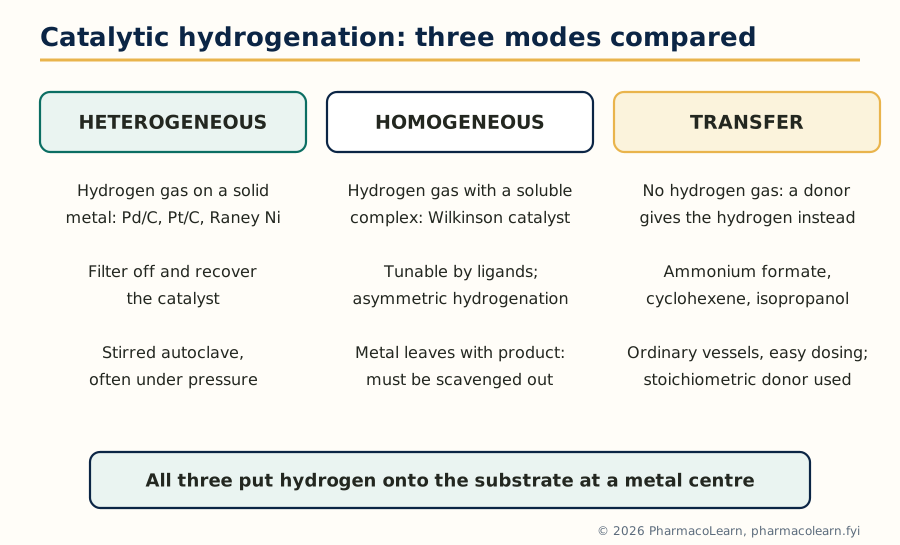 Figure: Three modes of catalytic hydrogenation: the heterogeneous default, the tunable homogeneous complexes, and transfer hydrogenation without hydrogen gas.
4.3 Hydrogen transfer reactions
Transfer hydrogenation avoids gaseous hydrogen altogether: a donor molecule gives up hydrogen to the substrate on a catalyst surface. Standard donors are cyclohexene and 1,4 cyclohexadiene (which aromatise to benzene as they donate), ammonium formate and formic acid (which decompose to carbon dioxide), isopropanol (which becomes acetone, the donor in Meerwein Ponndorf Verley type reductions and in many metal catalysed transfers), and hydrazine in specialised cases. The attractions are real: no hydrogen plant, no pressure autoclave, ordinary stirred vessels, easy dosing control, and some selectivities that are hard under hydrogen gas (palladium on carbon with ammonium formate is a standard method for debenzylation and nitro reduction). The costs are equally real: stoichiometric donor consumption, by product removal, and gas evolution from formate donors that must be vented by design. At commercial scale the balance usually returns to hydrogen gas; transfer hydrogenation dominates at development and smaller scales, which is precisely the judgement the syllabus is training.
4.4 Metal hydrides, and the industrial reduction case study
Metal hydride reagents reduce by delivering hydride to carbonyl and related groups, with a reactivity ladder the process chemist must know cold:
- Sodium borohydride, NaBH4: the mildest common hydride; reduces aldehydes and ketones in protic solvents including water and alcohols; leaves most esters, acids and nitro groups untouched under normal conditions. Cheap, safe to handle as a solid or alkaline solution, and the default first choice at scale.
- Lithium aluminium hydride, LiAlH4: the strongest common hydride; reduces esters, carboxylic acids, amides and nitriles as well as carbonyls. It reacts violently with water and protic solvents, is handled in ethers, and its work up generates voluminous aluminium hydroxide gels; at scale its cost, hazard and work up burden are arguments for redesign wherever possible.
- DIBAL H (diisobutylaluminium hydride): the precision instrument, reducing esters and nitriles to aldehydes at low temperature with one equivalent, in hydrocarbon or ether solution.
- Borane (BH3 complexes) and sodium triacetoxyborohydride fill specialised niches: hydroboration and carboxylic acid reduction for the former, reductive amination for the latter.
Case study on industrial reduction, as the syllabus requests, is taught with the standard example used across the literature: the reduction of nitrobenzene to aniline, historically and industrially the largest scale reduction in organic chemistry. The older Bechamp process (iron filings and dilute acid) worked but buried its product in iron oxide sludge; modern manufacture hydrogenates nitrobenzene over metal catalysts, in vapour phase over copper based catalysts or in liquid phase systems, with the exotherm harvested as process steam. The teaching points mirror Section 4.1: catalyst selection for a clean stop at aniline without ring reduction or coupling products, heat removal as the design problem, and waste prevented by choosing catalysis over stoichiometric metal. Every industrial nitro reduction in API synthesis is this case in miniature.
4.5 Fermentation: aerobic and anaerobic
Fermentation manufactures molecules that synthesis cannot reach economically, complex natural products built by enzymes in a living cell. The syllabus structure is: aerobic and anaerobic fermentation, then the production of named antibiotics, vitamins and statins.
The process elements are common to all of them. A production organism (bacterium or fungus, improved by decades of strain selection and mutation from the original isolate) is grown through a seed train of increasing volumes into a production fermenter: a stirred, jacketed, sterilisable vessel with sterile air sparging, agitation, foam control, pH and temperature control and aseptic sampling. Aerobic fermentation supplies oxygen continuously, and oxygen transfer is usually the rate limiting engineering problem, addressed by agitation power, sparger design and sometimes enriched air or pressure; penicillin, streptomycin, riboflavin, vitamin B12 and lovastatin production are aerobic. Anaerobic fermentation excludes oxygen, the pattern of solvent and acid fermentations and of the first stage of some vitamin B12 processes. Batch, fed batch and continuous modes describe feeding: antibiotic and statin processes are typically fed batch, the carbon source fed gradually to avoid catabolite repression and to steer the organism from growth (trophophase) into product formation (idiophase). Contamination control is the existential discipline: a single foreign organism growing faster than the producer ruins the batch, so sterilisation of medium and air and aseptic transfers are validated operations.
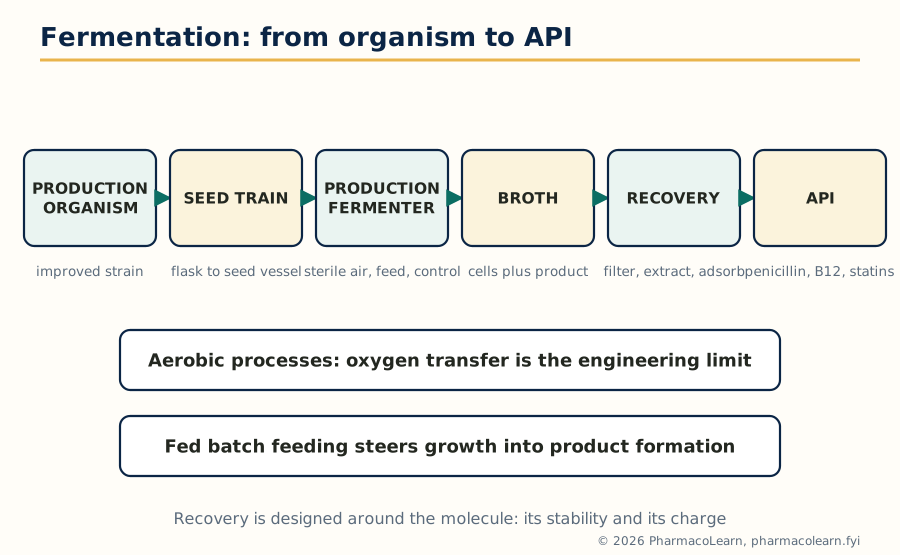 Figure: A fermentation process, from the improved production strain to the recovered API; the recovery train is designed around the product molecule.
4.6 Production of antibiotics: penicillin and streptomycin
Penicillin is the founding industrial fermentation and still the teaching model. The producer is the fungus Penicillium chrysogenum, in strains improved by many orders of magnitude over Fleming's isolate. The process is an aerobic fed batch fermentation lasting the better part of a week: a carbohydrate feed (historically lactose, because glucose represses production; modern processes feed glucose at controlled rates) sustains slow growth and then production, and the side chain precursor decides the product, phenylacetic acid feeding giving penicillin G and phenoxyacetic acid giving penicillin V. Temperature, pH and dissolved oxygen are held in narrow bands. Recovery is the unit operations of Unit 2 under time pressure: the broth is filtered to remove mycelium, and penicillin, an acid unstable in water at extremes of pH, is extracted rapidly and cold into a solvent such as butyl acetate at low pH and back extracted into aqueous buffer at near neutral pH, then crystallised as a salt or carried into 6 APA (6 aminopenicillanic acid) production, the platform intermediate for the semisynthetic penicillins.
Streptomycin is produced by the filamentous bacterium Streptomyces griseus, the actinomycete Waksman's group isolated in 1943, again in aerobic submerged fermentation, typically over several days, on media built from soybean meal and glucose with careful control of pH and aeration. Streptomycin is a basic, water soluble aminoglycoside and stays in the broth; recovery exploits its basicity, by adsorption onto cation exchange resins or activated carbon after broth clarification, elution, and purification to the sulfate salt. The paired examples teach a general rule of fermentation downstream processing: the recovery train is designed around the molecule's stability and charge, acid labile penicillin by fast solvent extraction, base stable streptomycin by ion exchange.
4.7 Production of vitamins B2 and B12
Vitamin B2 (riboflavin) is manufactured by aerobic fermentation, classically with the fungus Ashbya gossypii (and in modern industry also engineered Bacillus subtilis), which overproduces riboflavin so strongly that the vitamin crystallises in the broth as its protective response to iron limitation and oxidative stress, turning the culture yellow orange. Vegetable oil or glucose based media, several days of controlled aeration, and recovery by heat treatment to release and dissolve the vitamin followed by separation and crystallisation give feed and food grade product; the fermentation route displaced a multistep chemical synthesis on cost and waste, a clean example of Section 4.5's economic logic.
Vitamin B12 (cyanocobalamin) can only be made at scale by fermentation, because the molecule, a cobalt corrin complex, is far too complex for economical total synthesis. Industrial producers are bacteria such as Propionibacterium freudenreichii (run in two stages, an anaerobic phase in which the corrin intermediate accumulates and an aerobic phase in which the final assembly and the dimethylbenzimidazole ligand are completed) and Pseudomonas denitrificans (fully aerobic). Cobalt salts are fed because every molecule carries one cobalt atom, and the vitamin is largely inside the cells, so recovery begins with cell harvest and heat or acid treatment to release it, conversion to the stable cyano form with cyanide during work up (hence cyanocobalamin), adsorption purification and crystallisation. The yields are milligrams per litre rather than the grams of penicillin, which is why B12 is the textbook demonstration that fermentation wins not on throughput but on capability.
4.8 Production of statins: lovastatin and simvastatin
Lovastatin is a fungal secondary metabolite produced by aerobic fermentation of Aspergillus terreus, a polyketide assembled by the organism's enzyme machinery. The fermentation is run fed batch over more than a week with tight control of carbon feeding, pH and oxygen, because polyketide production is exquisitely sensitive to nutrient repression; lovastatin accumulates largely in and on the mycelium, and recovery extracts the broth and mycelium with organic solvent and purifies by crystallisation, with the lactone ring opened and closed deliberately during work up because lovastatin is administered as the lactone and acts as the hydroxy acid. Simvastatin is lovastatin's close analogue, differing by one methyl group on the ester side chain, and it is manufactured semisynthetically from lovastatin: the lovastatin side chain is hydrolysed to the diol intermediate (monacolin J), the lactone hydroxyl is protected, the required 2,2 dimethylbutyrate side chain is esterified on, and deprotection gives simvastatin; modern processes also achieve the key acylation with an engineered enzyme. The pair teach the industry's standard hybrid: fermentation builds the complex skeleton no synthesis can match, and a few chemical steps diversify it into a family of products.
4.9 Reaction progress kinetic analysis
Reaction progress kinetic analysis (RPKA), developed and popularised by Donna Blackmond, learns a reaction's kinetics from the progress of the reaction itself, using a handful of experiments rather than a factorial grid of initial rates. Its tools:
- Reaction progress curves: concentration against time for the whole course of the reaction, from calorimetry, in situ infrared or sampling. The full curve contains the rate law, catalyst behaviour and inhibition, if read correctly.
- Graphical rate analysis: rate plotted against concentration from the progress data; curves from runs at different starting concentrations that overlay share one rate law, and the concentration at which they diverge exposes what differs.
- Same excess and different excess experiments: two runs are compared in which the excess of one reagent over the other (for example [B] minus [A]) is the same but absolute concentrations differ; if the progress curves overlay when time adjusted, the catalyst is stable and product does not inhibit; if they separate, product inhibition or catalyst deactivation is diagnosed, and a run with product added at the start distinguishes the two.
- Orders without initial rates: running the reaction with different excesses maps the order in each reagent, so a kinetic model is assembled from perhaps three or four experiments.
For the process chemist, RPKA is how a step is understood before it is made big: it finds the true rate determining influences, exposes deactivation a pilot batch would otherwise discover expensively, and defines the addition rates and temperature profiles of Section 1.4 on evidence.
4.10 Streamlining reaction steps and route selection
Route selection applies RPKA style thinking to the whole synthesis. Streamlining means removing everything that does not build the molecule: telescoping steps so intermediates are not isolated, deleting protect and deprotect pairs by reordering bond formation, replacing a low yielding step rather than optimising around it, converging the route so expensive material enters late, and choosing the disconnection whose starting materials are commodities. The comparison the syllabus formalises is between the route that is quickest to first material and the route that is cheapest forever.
4.11 Expedient routes and cost effective routes
| Characteristic | Expedient route | Cost effective route |
|---|---|---|
| Purpose | Deliver material fast: for toxicology, trials, first launch supply | Deliver material cheaply and reliably for the product's lifetime |
| Step count | As found in discovery, modestly tidied | Ruthlessly minimised; convergent; telescoped |
| Reagents | Whatever works, including expensive or stoichiometric | Cheap, catalytic where possible, recoverable |
| Starting materials | Catalogue intermediates accepted | Commodity chemicals, dual sourced |
| Yield attitude | Each step good enough | Overall yield optimised, worst step re engineered |
| Waste attitude | Acceptable at small scale | E factor and solvent recovery engineered in; waste is cost |
| Development time | Weeks | Months to years, repaid over production life |
| Typical flaw | Cannot be validated economically at volume | Late and expensive to develop |
A real programme runs both in sequence: an expedient route supplies development while the cost effective route is built, and the switch between them is itself a project, because changing the route changes the impurity profile and therefore repeats parts of the safety and regulatory argument of Sections 1.8 and 1.9.
4.12 Reagent selection and families of reagents useful for scale up
Reagent selection at scale applies a filter that discovery chemistry never meets: safety (thermal stability, gas evolution, toxicity, peroxide formation), cost and availability at tonne scale, stoichiometry (catalytic beats stoichiometric beats excess), by product fate (a reagent whose by product distils out, washes out or can be recycled beats one whose by product must be chromatographed away, there being no chromatography at scale), and robustness (sensitivity to water, air and raw material grade). The syllabus phrase "families of reagents useful for scale up" refers to the standard short lists process chemists carry for each transformation, from which a member is chosen on the evidence:
| Transformation | Families carried on the scale up list |
|---|---|
| Bases | Triethylamine, diisopropylethylamine, pyridine; sodium and potassium carbonate and bicarbonate; sodium hydroxide; DBU for strong hindered cases |
| Acids (catalytic and work up) | Hydrochloric, sulfuric, acetic, p toluenesulfonic, methanesulfonic |
| Oxidants | Oxygen and air with metal catalysis, hydrogen peroxide systems, sodium hypochlorite (with TEMPO), peracetic systems; classical chromium and manganese reagents reserved and justified case by case |
| Reducing agents | Hydrogen with Pd, Pt, Ni or Ru catalysts; sodium borohydride; catalytic transfer systems; iron or zinc in acid where catalysis fails |
| Coupling and activating agents | Thionyl chloride and oxalyl chloride for acid chlorides; carbodiimides at small scale; mixed anhydride and acid chloride methods preferred at scale |
| Solvents as reagents' partners | Water, alcohols, ethyl acetate, toluene, acetonitrile, 2 methyltetrahydrofuran; dipolar aprotics used sparingly and recovered |
The habit being taught is substitution by family: when a step specifies a reagent that fails the filter (an expensive coupling reagent, a chromium oxidant, a hydride that gels the work up), the process chemist reaches first within the same family for the member the plant can live with.
4.13 Unit 4 summary
| Item | One line essence |
|---|---|
| Catalytic hydrogenation | Hydrogen on a metal surface; rate often set by gas transfer; feed purity is a parameter |
| Transfer hydrogenation | A donor replaces hydrogen gas; simple kit, stoichiometric donor |
| Metal hydrides | A selectivity ladder from NaBH4 to LiAlH4; chosen down, not up, where possible |
| Fermentation | Living synthesis for complex molecules; recovery designed around stability and charge |
| RPKA | Whole progress curves, same and different excess runs, few experiments, deep knowledge |
| Route selection | Expedient first, cost effective for life; reagent families chosen by the scale up filter |
Unit 5: Industrial Safety
5.1 Safety as a process parameter
Every earlier unit has carried a safety thread: nitration runaway, hydrogenation gas handling, ozonolysis intermediates. This unit gathers the formal systems under which a pharmaceutical plant keeps people, product and environment safe. The organising idea is the hierarchy of controls: hazards are controlled first by elimination and substitution (choose the route that does not use the dangerous reagent, the lesson of Unit 1), then by engineering controls (closed vessels, ventilation, inerting, relief systems), then by administrative controls (procedures, permits, training), and only lastly by personal protective equipment. The syllabus items follow that logic from information (the safety data sheet), through labels and PPE, to fire, to the management systems that hold the whole structure in place, and finally to the effluent that leaves the site.
5.2 The MSDS (material safety data sheet)
The material safety data sheet, in current practice the safety data sheet (SDS) under the Globally Harmonized System (GHS), is the standardised document that travels with every chemical and tells the user what the material is, what it can do to people and the environment, and how to handle, store, spill and dispose of it. A GHS SDS has sixteen fixed sections, and a process chemist reads certain of them professionally:
- Identification of the substance and of the supplier
- Hazards identification (hazard classes, signal word, hazard and precautionary statements)
- Composition and information on ingredients
- First aid measures
- Firefighting measures
- Accidental release measures
- Handling and storage
- Exposure controls and personal protection (including occupational exposure limits)
- Physical and chemical properties (flash point, boiling point, explosion limits: the numbers process design uses)
- Stability and reactivity (incompatibilities, conditions to avoid, hazardous decomposition: the numbers thermal hazard assessment uses)
- Toxicological information
- Ecological information
- Disposal considerations
- Transport information
- Regulatory information
- Other information
In the plant the SDS is not a filing exercise. It is the source document for the risk assessment of every operation, for the selection of PPE (Section 5.4), for storage segregation (oxidising acids away from organics, the mixed acid lesson of Unit 3), for the emergency plan, and for training. The rule taught with this item is simple: no material is charged to a vessel by anyone who has not read its sheet.
5.3 Hazard labels of chemicals
Labels translate the SDS onto the container in the hand. Under GHS the elements are: the product identifier; pictograms in red bordered diamonds, nine in the system, covering physical hazards (flame, flame over circle for oxidisers, exploding bomb, gas cylinder, corrosion), health hazards (skull and crossbones, exclamation mark, health hazard silhouette, corrosion) and the environmental hazard (dead tree and fish); a signal word, Danger for the more severe categories or Warning for the less; hazard statements (H statements, coded descriptions such as "flammable liquid and vapour" or "causes severe skin burns"); precautionary statements (P statements covering prevention, response, storage and disposal); and the supplier's identity. The older diamond systems survive alongside: the NFPA 704 diamond (health, flammability and reactivity quadrants with a special hazards field) on fixed installations and in transport practice, and the transport labels and UN numbers of the dangerous goods rules. For the process chemist the working skill is fluency: to read a drum label at a glance and know that this solvent store, this oxidant and this corrosive cannot share a bund, a pump or a waste stream.
5.4 Personal protective equipment (PPE)
PPE is the last line of the hierarchy, worn because the hazard remains after every better control has done its work. In an API plant the standard ensemble is:
- Eye and face protection: safety glasses for general areas, chemical goggles for splash risk operations (charging, sampling, line breaking), face shields over goggles for corrosive transfers.
- Hand protection: gloves matched to the chemical (nitrile for many organics, heavier laminates for aggressive solvents), changed on schedule and on damage, because a solvent soaked glove is an exposure device, not a protection device.
- Body protection: laboratory coats and plant coveralls, chemical resistant aprons and suits for corrosive charging, antistatic and flame retardant clothing where flammable atmospheres are handled.
- Foot protection: safety shoes with toe caps and chemical resistant soles; gumboots for washdown and effluent areas.
- Respiratory protection: dust masks and respirators with cartridges matched to the hazard for powder handling (potent API work uses powered air purifying or supplied air systems inside containment), and self contained breathing apparatus for emergency response only, by trained teams.
- Hearing protection in high noise areas such as compressor and utility halls.
The management content matters as much as the list: PPE is selected from the SDS and the risk assessment, issued personally, fitted (a respirator that does not seal does not protect), inspected, maintained, and its use trained and enforced: PPE is specified last in the hierarchy and audited hardest.
5.5 Fire hazards, types of fire and fire extinguishers
Fire needs fuel, oxygen and ignition together (the fire triangle; adding the self sustaining chain reaction gives the tetrahedron), and a pharmaceutical plant stores all three at scale: flammable solvents are the dominant fuel inventory, oxidising reagents and air supply the oxygen side, and ignition arrives by static discharge, electrical fault, hot work or runaway reaction. Prevention follows the triangle: inerting vessels with nitrogen, bonding and earthing against static, flameproof electrical equipment in classified areas, hot work permits, and solvent inventory discipline.
Types (classes) of fire, in the classification used in Indian practice:
| Class | Fuel | Extinguishers suited |
|---|---|---|
| A | Solid combustibles: wood, paper, packaging, many powders | Water, foam, dry powder |
| B | Flammable liquids: solvents, oils | Foam, dry powder, carbon dioxide; never a water jet, which spreads the burning liquid |
| C | Gases: hydrogen, LPG, solvent vapour leaks | Dry powder; first shut off the gas supply |
| D | Metals: sodium, magnesium, aluminium powder, metal hydrides | Special dry powder for metals; water is dangerous here |
| E | Electrical equipment (treated as a class in Indian practice) | Carbon dioxide, dry powder; non conducting agents only |
| F | Cooking and vegetable oils (kitchens and canteens) | Wet chemical extinguishers |
Extinguisher types map onto the classes by mechanism: water cools; foam cools and blankets the vapour; dry chemical powder interrupts the chain reaction and coats; carbon dioxide displaces oxygen and cools, leaving no residue, which suits electrical and instrument fires; wet chemical saponifies burning oils. The process plant additions are fixed systems: hydrant and hose reel networks, sprinklers, foam systems over solvent tank farms, gas detection with automatic isolation, and fire walls and bunding that keep a tank fire a tank fire. The syllabus point is selection under pressure: the wrong extinguisher (water on a solvent pool, water on a metal fire) converts an incident into a disaster, so class recognition is trained, not looked up.
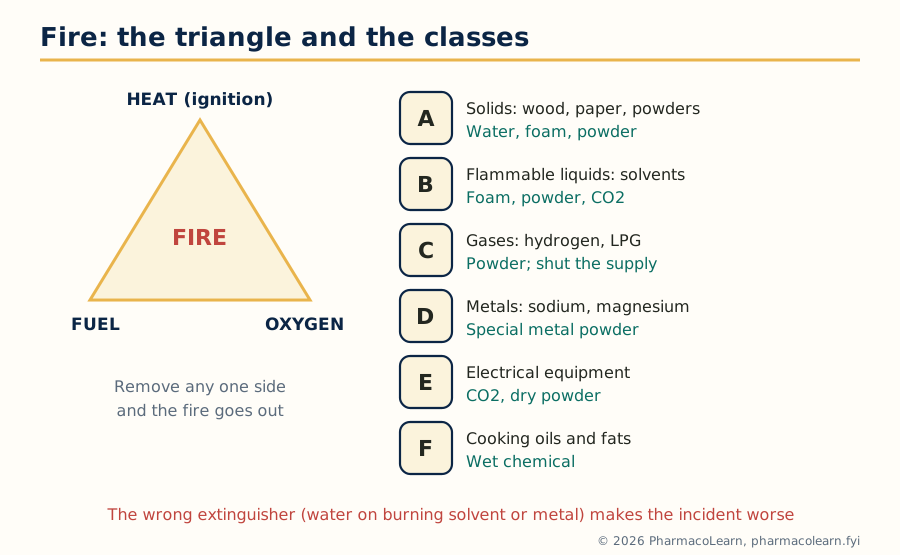 Figure: The fire triangle and the classes of fire used in Indian practice, each with the extinguishers that suit it and, by omission, those that must never be used.
5.6 OHSAS 18001 and ISO 14001: the management systems
Individual precautions become a system under the two standards the syllabus names. (The syllabus prints "OHSAS 1800"; the standard is OHSAS 18001, and for accuracy it should be recorded that OHSAS 18001 was withdrawn in 2018 and replaced by ISO 45001, whose structure it anticipated.)
OHSAS 18001 specified an occupational health and safety management system: the organisation sets a safety policy, identifies hazards and assesses risks for every activity (the plan), implements controls, training, communication and emergency preparedness (do), monitors performance, investigates incidents and audits the system (check), and reviews and improves it at management level (act). The plan do check act cycle is the standard's engine, and its product is the difference between safety as a poster and safety as an audited routine: permits to work, management of change, contractor control and incident investigation all live inside it.
ISO 14001 applies the same architecture to the environment: an environmental policy, identification of environmental aspects and impacts (emissions to air, effluent to water, waste to land, resource consumption), legal compliance obligations, objectives and programmes, operational control, monitoring and management review, again on the plan do check act cycle. In a pharmaceutical plant the two systems share most of their machinery: the same audit calendar, the same corrective action system, the same management review, and the same documentary discipline that GMP already imposes on the production side. Together they answer the regulator, the insurer, the neighbour and the workforce with one voice: hazards and impacts are known, controlled, measured and improving.
5.7 Effluents and their management
An API plant's liquid waste is chemically unlike any other industry's: mother liquors carrying product and by products, aqueous washes with solvent traces, scrubber liquors, fermentation broths of high biological oxygen demand, and utility water, in streams that vary batch by batch. Effluent management proceeds in layers:
- At source, the process layer: the cheapest effluent is the one never made. Solvent recovery by distillation (Unit 2) returns solvent to the process and removes it from the waste; segregating strong streams (mother liquors, first washes) from weak ones (later washes, cooling water) keeps the difficult fraction small, and high strength organic streams are commonly sent for incineration or cement kiln co processing rather than diluted into the treatment plant. The waste intensity of a process is summarised by Sheldon's E factor, kilograms of waste per kilogram of product, linking this section back to the route selection of Units 1 and 4.
- Primary treatment: screening, equalisation (blending the variable flow to a steady composition), neutralisation and oil and solids removal.
- Secondary (biological) treatment: activated sludge and related systems in which microbial communities consume the dissolved biodegradable load, measured as BOD (biochemical oxygen demand) and COD (chemical oxygen demand); fermentation and wash streams are treated here, and recalcitrant API residues are watched because some are biologically active at low concentration and can inhibit the biomass itself.
- Tertiary treatment: polishing by filtration, activated carbon, advanced oxidation or membrane processes to meet discharge standards for COD, total dissolved solids, colour and specific pollutants; in water stressed Indian industrial clusters, treated effluent is increasingly recycled to utilities, and zero liquid discharge configurations (evaporation and crystallisation of the final brine, closing the Unit 2 circle) are required of some pharmaceutical estates.
- Solid and hazardous residues run in parallel: distillation residues, spent catalyst (to metal recovery), contaminated filter aids and sludge go to authorised treatment, storage and disposal facilities with manifest tracking, under the hazardous waste rules.
The examination synthesis is that effluent management is process chemistry continued past the factory gate: what the route makes, the plant must treat, and the standards of Section 5.6 are the system that proves it does.
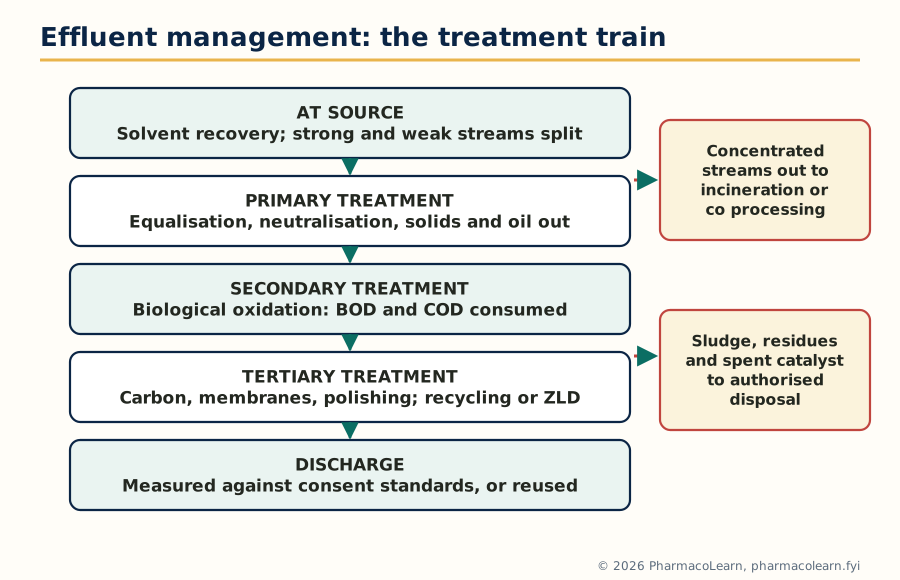 Figure: Effluent management as a train: reduce and segregate at source, then primary, biological and tertiary treatment, with concentrated streams and residues leaving by their own routes.
5.8 Unit 5 summary
| System | What it carries |
|---|---|
| SDS (16 GHS sections) | The hazard facts for every material, and the source of every risk assessment |
| GHS labels | Pictograms, signal word, H and P statements on the container in the hand |
| PPE | The last line of defence, selected from the SDS, fitted, trained and audited |
| Fire classes A to F | Fuel based classification that decides the extinguisher, and forbids the wrong one |
| OHSAS 18001 (now ISO 45001) | Occupational health and safety as an audited plan do check act system |
| ISO 14001 | Environmental management on the same architecture |
| Effluent management | Source reduction and segregation, primary, biological and tertiary treatment, hazardous residue control |
Frequently Asked Questions
Q: What is the difference between a unit operation and a unit process? A: A unit operation is a physical step that does not change chemical identity, such as extraction, filtration, distillation, evaporation and crystallization, while a unit process is a chemical transformation such as nitration, halogenation, oxidation or reduction.
Q: Why does a reaction that is safe in the laboratory become dangerous at plant scale? A: Heat generation scales with volume while heat removal scales with surface area, so the same exothermic chemistry can outrun its cooling in a large vessel; mixing also slows, operations take longer and the inventory of hazardous material is far greater.
Q: What are the three stages of scale up and what happens at each? A: Bench scale (gram quantities: route choice, optimisation, thermal hazard screening), pilot scale (kilogram quantities: the process rehearsed in plant style equipment, engineering data collected, material made for toxicology and trials), and large scale (hundreds of kilograms to tonnes: the validated process run to fixed batch records).
Q: What is a genotoxic impurity and how is it controlled? A: A genotoxic impurity is an impurity that can damage DNA, so no safe threshold is assumed; control follows ICH M7, using structural alert assessment and the threshold of toxicological concern (1.5 micrograms per day for lifetime exposure), achieved mainly by designing the impurity out at route selection and demonstrating purge through the process.
Q: Why are several small extractions better than one large extraction with the same total solvent? A: Because of the distribution law: each fresh portion of solvent removes a fraction of the solute remaining, so splitting the solvent into portions leaves progressively less solute behind than a single equilibration with the whole volume.
Q: What is the metastable zone in crystallization and why do processes work inside it? A: The metastable zone is the band of supersaturation between the solubility curve and the point of spontaneous nucleation, where a solution will grow existing crystals but will not nucleate new ones; seeding a batch inside this zone and generating supersaturation slowly gives controlled growth, consistent crystal size and the correct polymorph.
Q: What is mixed acid and why is sulfuric acid used in nitration? A: Mixed acid is concentrated nitric acid with concentrated sulfuric acid; the sulfuric acid generates the nitronium ion electrophile by protonating nitric acid and removing water, absorbs the water formed so the medium stays strongly acidic, and acts as a heat absorbing reaction medium.
Q: How can the same chlorine give ring chlorinated or side chain chlorinated toluene? A: Conditions choose the mechanism: a Lewis acid catalyst such as ferric chloride, in the dark, polarises chlorine for electrophilic attack on the ring, giving ortho and para chlorotoluenes, while light, heat or radical initiators give free radical attack on the side chain, giving benzyl chloride and its further chlorination products.
Q: Why is transfer hydrogenation used when hydrogen gas exists? A: Transfer hydrogenation replaces hydrogen gas with a donor such as ammonium formate, cyclohexene or isopropanol, so it needs no pressure autoclave or hydrogen supply and runs in ordinary vessels with easy dosing control, at the cost of a stoichiometric donor and its by product; it is favoured at development and smaller scales.
Q: What do OHSAS 18001 and ISO 14001 have in common? A: Both are management system standards built on the plan do check act cycle: policy, identification of hazards (OHSAS 18001, occupational health and safety, now succeeded by ISO 45001) or environmental aspects (ISO 14001), objectives, operational controls, monitoring, audit and management review, applied as one audited routine in a well run plant.
Complete MPC204T notes, all 5 units in one PDF, free to keep.
Other M.Pharm subjects: MPH101T · MPC101T · MPL101T · MPH102T · MPH103T · MPH104T · MPL102T · MPL103T · MPL104T · MPC102T · MPC103T · MPC104T · MPH201T · MPH202T · MPH203T · MPH204T · MPC201T · MPC202T · MPC203T · MPC204T · M.Pharm