
MPC102T — Advanced Organic Chemistry I
4 hrs/week, 4 credits, 60 hours, 100 marks. Notes follow the M.Pharm syllabus, unit by unit.
MPC102T Advanced Organic Chemistry I notes for M.Pharm Semester 1 Pharmaceutical Chemistry: carbocations, carbanions, radicals, carbenes, named reactions, synthetic reagents, protecting groups, heterocyclic synthesis and retrosynthesis, with free unit wise PDF downloads on PharmacoLearn.
Units in this subject
- Unit 1 — Basic Aspects of Organic Chemistry
- Unit 2 — Named Reactions: Mechanism and Synthetic Applications
- Unit 3 — Synthetic Reagents, Applications and Protecting Groups
- Unit 4 — Heterocyclic Chemistry
- Unit 5 — Synthon Approach and Retrosynthesis Applications
Download MPC102T PDF Notes
Free PDFs for this subject, one per unit:
Advanced Organic Chemistry I, subject code MPC102T, is a core Semester 1 subject of M.Pharm Pharmaceutical Chemistry. It carries 4 credits and 60 hours of theory, taught at 4 hours per week, for 100 marks.
This subject is the mechanistic foundation of drug synthesis. It begins with the short lived reactive intermediates, carbocations, carbanions, free radicals, carbenes and nitrenes, whose behaviour decides which products a reaction can give, and with the experimental methods by which mechanisms are proved rather than guessed. The same unit then works through the four great reaction families, substitution, addition, elimination and rearrangement, with their mechanisms, relative reactivity and orientation, and closes with the chemistry of enolates. Unit 2 studies the named reactions in depth, from the Mannich and Sandmeyer reactions to the Sharpless epoxidation and the Suzuki coupling, because these are the bond forming tools medicinal chemists actually use. Unit 3 covers the standard synthetic reagents, aluminium isopropoxide to the BOP coupling reagent, and the protecting group strategy that makes multi step synthesis possible. Unit 4 applies named ring forming reactions to the heterocyclic nuclei found in real drugs: imidazole antifungals, pyrazole analgesics, pyrimidine antibacterials, quinoline antimalarials, acridine anticancer agents, phenothiazine antipsychotics and purine drugs. Unit 5 reverses the whole way of thinking: the synthon approach and retrosynthesis, in which a target molecule is dissected backwards into purchasable starting materials. A student who completes this subject should be able to propose a mechanism for an unfamiliar reaction, choose reagents and protecting groups for a planned transformation, and dissect a small drug molecule into a workable synthetic route.
Unit 1: Basic Aspects of Organic Chemistry
1.1 Reactive intermediates: the idea behind the mechanisms
Most organic reactions do not jump from starting material to product in one step. Between the two there is at least one intermediate: a real chemical species, formed in one step and consumed in the next, sitting in an energy valley between two transition states. Intermediates are usually too reactive to isolate, but they can often be detected spectroscopically, trapped with a suitable reagent, or inferred from their products. Five families dominate organic mechanism: carbocations, carbanions, free radicals, carbenes and nitrenes. Each is defined by the electron count at one key atom, and that electron count decides its structure, its stability order and the reactions it will undergo. A sixth species, benzyne, is covered later in this unit with aromatic substitution, where it belongs mechanistically.
| Intermediate | Key atom and electrons | Geometry at the key atom | Typical character |
|---|---|---|---|
| Carbocation | Carbon with 6 electrons, positive charge, empty p orbital | Planar, sp2 | Electrophile, attacked by nucleophiles |
| Carbanion | Carbon with 8 electrons, negative charge, lone pair | Pyramidal, close to sp3 (planar when conjugated) | Nucleophile and strong base |
| Free radical | Carbon with 7 electrons, one unpaired electron | Planar or shallow pyramid, near sp2 | Adds to pi bonds, abstracts hydrogen atoms |
| Carbene | Neutral carbon with 6 electrons, two non-bonding electrons | Singlet: sp2 with lone pair; triplet: two singly occupied orbitals | Adds to alkenes, inserts into bonds |
| Nitrene | Neutral nitrogen with 6 electrons, nitrogen analogue of a carbene | Singlet or triplet, like carbenes | Inserts into C-H bonds, adds to alkenes |
The working rule of this unit is simple: whichever intermediate a reaction passes through, the conditions that stabilise that intermediate will speed the reaction up, and the products will be the ones that intermediate naturally gives. Nearly every selectivity question in Units 1 and 2 reduces to that rule.
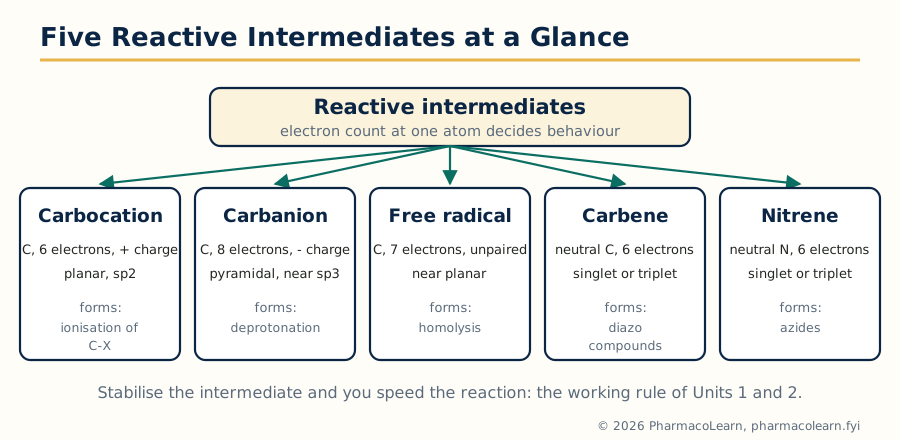 Figure: The five reactive intermediates. Electron count at the key atom decides structure, stability and reaction type.
1.2 Carbocations
A carbocation is a species with a positively charged carbon atom that has only six electrons in its valence shell and an empty p orbital. The charged carbon is sp2 hybridised and planar, which is why nucleophiles can attack it from either face and why SN1 reactions give racemisation.
Formation of carbocations:
- Ionisation of a C-X bond: an alkyl halide, alcohol (after protonation) or sulfonate ester breaks heterolytically in a polar solvent, the leaving group taking the electron pair. This is the slow step of SN1 and E1.
- Protonation of an alkene or alcohol: addition of a proton to a pi bond, or loss of water from a protonated alcohol, as in acid catalysed dehydration.
- From diazonium and diazo compounds: loss of nitrogen gas from an alkyldiazonium ion or protonation of a diazo compound.
- Electrophilic attack on an aromatic ring: the sigma complex (arenium ion) of electrophilic aromatic substitution is a carbocation delocalised around the ring.
Stability of carbocations. The charge is stabilised by anything that donates electrons towards the empty p orbital:
- Hyperconjugation and inductive effect: alkyl groups donate, so the order is tertiary > secondary > primary > methyl. A tert-butyl cation has nine alpha C-H bonds that can hyperconjugate; a methyl cation has none.
- Resonance: allyl and benzyl cations, in which the charge is shared over a pi system, are far more stable than simple primary cations. Triphenylmethyl (trityl) cations are stable enough to exist as isolable salts.
- Adjacent heteroatoms: a neighbouring oxygen or nitrogen lone pair stabilises strongly (oxocarbenium and iminium ions), which is why acetals hydrolyse through such cations.
Reactions of carbocations are the synthetic applications the syllabus asks for:
- Capture by a nucleophile: the SN1 substitution step, and the termination of Friedel-Crafts alkylation.
- Loss of a proton: gives an alkene, the E1 pathway.
- Rearrangement: a 1,2-hydride or 1,2-alkyl shift converts a less stable cation into a more stable one whenever the shift produces a more substituted or resonance stabilised cation. This Wagner-Meerwein type shift explains rearranged products in SN1 reactions and in pinacol type chemistry (section 1.13).
- Addition to pi bonds: a cation adds to an alkene to give a new, larger cation, the basis of cationic polymerisation and of many terpene cyclisations in nature.
The classical versus non-classical carbocation question (whether the 2-norbornyl cation is a pair of rapidly equilibrating classical ions or one bridged, delocalised ion) is the famous historical example of carbocation structure being settled by experiment; the bridged description is now accepted for that system.
1.3 Carbanions
A carbanion is a species with a negatively charged carbon carrying a lone pair: eight electrons at carbon. Simple alkyl carbanions are pyramidal and are among the strongest bases in common use. When the charge can be delocalised into an adjacent pi system, as in enolates and benzyl anions, the carbon flattens towards planar.
Formation of carbanions:
- Deprotonation of a C-H bond of measurable acidity: a base removes a proton alpha to a carbonyl, nitrile, sulfone or nitro group. The guide is the pKa of the conjugate acid: the weaker the acid (higher pKa of the C-H), the stronger the base needed.
- From organometallic compounds: Grignard reagents, organolithiums and acetylides behave as carbanion equivalents in most of their reactions.
- Decarboxylation: beta-keto acids and malonic acid derivatives lose carbon dioxide on heating through a cyclic transition state, leaving an enolate that is protonated on work up.
- Addition of a nucleophile to an activated alkene or reduction of certain pi systems with metals.
Stability of carbanions runs opposite to carbocations in one respect: electron withdrawing groups stabilise the charge.
- Resonance delocalisation: enolates of 1,3-dicarbonyl compounds (ethyl acetoacetate, malonic ester) are the most useful stabilised carbanions; their conjugate acids have pKa values near 9 to 13, so even alkoxide bases generate them fully.
- Inductive withdrawal: groups such as nitro, cyano and sulfonyl stabilise strongly; the nitro group makes nitromethane (pKa about 10) a practical carbon acid.
- s Character of the orbital holding the pair: acidity runs terminal alkyne (sp, pKa about 25) > alkene (sp2, about 44) > alkane (sp3, about 50), because more s character holds the pair closer to the nucleus.
- Alkyl groups destabilise simple carbanions, so the order methyl > primary > secondary > tertiary holds for unstabilised anions, the reverse of the carbocation order.
Synthetic applications: carbanions and their equivalents are carbon nucleophiles, so they build carbon skeletons. Enolate alkylation and acylation, the aldol and Claisen condensations, the Michael addition (Unit 2), acetylide additions to carbonyl compounds and the reactions of Grignard and organolithium reagents all run through carbanion character at carbon. Section 1.14 treats enolates, the most important family, in detail.
1.4 Free radicals
A free radical is a species with an unpaired electron. Carbon radicals have seven electrons at the radical centre and are close to planar. They are electrically neutral, which makes their chemistry different from ionic chemistry: radicals react well in non-polar media, are barely affected by solvent polarity, and react in chains.
Formation of free radicals:
- Homolysis of weak bonds: peroxides, azo compounds and N-bromosuccinimide break on heating or irradiation to give radicals that start chains. Bond weakness is the guide: the O-O bond of a peroxide breaks far more easily than a C-C bond.
- Photolysis: light cleaves halogens and ketones (the Norrish reactions) into radical pairs.
- Single electron transfer: metals such as sodium, iron(II) and samarium(II) iodide donate one electron to a substrate, giving radical anions or radicals.
- Hydrogen atom abstraction: a reactive radical removes a hydrogen atom from a substrate, leaving a new radical at that carbon.
Stability of radicals follows the same broad order as carbocations, because both are electron deficient: tertiary > secondary > primary > methyl, and resonance stabilised allyl and benzyl radicals are especially stable. The bond dissociation energy of the C-H bond broken is the quantitative guide: the weaker the bond, the more stable the radical left behind. Allylic and benzylic C-H bonds are weak precisely because the radicals are delocalised.
Reactions and synthetic applications:
- Chain halogenation of alkanes: initiation, propagation (abstraction, then halogen capture) and termination steps. Selectivity follows radical stability, and bromine is far more selective than chlorine because its abstraction step is endothermic and has a later, more product like transition state.
- Allylic and benzylic bromination with NBS (Unit 3), which keeps the bromine concentration low so that substitution at the activated position beats addition to the double bond.
- Addition to alkenes: the peroxide effect in HBr addition (anti-Markovnikov product) works because a bromine radical adds first to give the more stable carbon radical.
- Radical cyclisations and reductions: tributyltin hydride chemistry, now increasingly replaced by less toxic alternatives, closes rings by radical addition and reduces halides by hydrogen atom transfer.
- Polymerisation: most commodity plastics are made by radical chain growth.
Radical inhibitors such as hydroquinone and hindered phenols (BHT) break chains by donating a hydrogen atom to give a radical too stable to continue the chain, which is why they are added to monomers and to formulations as antioxidants.
1.5 Carbenes
A carbene is a neutral species with a divalent carbon carrying two non-bonding electrons: R2C:. The two electrons can be paired in one orbital (singlet carbene, bent, sp2 like, with an empty p orbital, so it behaves as electrophile and nucleophile at once) or unpaired in two orbitals (triplet carbene, which behaves like a diradical and reacts stepwise).
Formation of carbenes:
- From diazo compounds: diazomethane and ethyl diazoacetate lose nitrogen on heating, irradiation or metal catalysis (copper, rhodium) to give carbenes or metal carbenoids.
- Alpha elimination: chloroform with strong base loses HCl to give dichlorocarbene, the classic example.
- From diazirines and tosylhydrazone salts (the Bamford-Stevens route to diazo compounds).
Reactions and synthetic applications:
- Cyclopropanation: singlet carbenes add to alkenes in one concerted step, so the alkene geometry is preserved in the cyclopropane (stereospecific syn addition); triplet carbenes add stepwise and the stereochemistry is scrambled. This difference is a standard experimental test for carbene spin state. The Simmons-Smith reagent (ICH2ZnI) transfers a methylene equivalent without free carbene and is the practical laboratory method.
- Insertion into C-H and X-H bonds: metal carbenoids insert into C-H bonds, a reaction now used for late stage functionalisation.
- The Reimer-Tiemann reaction: dichlorocarbene adds to a phenoxide ring and hydrolysis of the dichloromethyl product gives an ortho formyl phenol (salicylaldehyde from phenol).
- Rearrangement: the Wolff rearrangement of alpha-diazoketones passes through a carbene like intermediate (Unit 1, section 1.13).
Cyclopropane rings appear in real drugs (ciprofloxacin carries one), which is why carbene transfer chemistry matters to pharmaceutical chemists.
1.6 Nitrenes
A nitrene is the nitrogen analogue of a carbene: a neutral, monovalent nitrogen species R-N: with six electrons at nitrogen, existing in singlet and triplet states. Nitrenes are generated and consumed in situ; they are never bottled.
Formation of nitrenes:
- From azides: alkyl and acyl azides lose nitrogen on heating or irradiation. Acyl azides are the key intermediate of the Curtius rearrangement (section 1.13).
- From N-halo compounds and hydroxylamine derivatives under basic or metal catalysed conditions.
Reactions and synthetic applications:
- Insertion into C-H bonds: singlet nitrenes insert concertedly; triplet nitrenes abstract hydrogen and recombine, like radicals.
- Addition to alkenes: gives aziridines, the nitrogen analogues of cyclopropanes, which are themselves reactive intermediates and occur in mitomycin class antibiotics.
- Rearrangement: acyl nitrenes rearrange to isocyanates (Curtius), and the closely related Hofmann rearrangement of amides passes through an electron deficient nitrogen of the same family. Both convert a carboxylic acid derivative into an amine with one carbon fewer, a standard move in drug synthesis.
1.7 Benzyne (aryne)
Benzyne is a benzene ring containing a formal triple bond: 1,2-didehydrobenzene. The extra pi bond lies in the plane of the ring, made from sp2 orbitals that overlap poorly, so benzyne is extraordinarily reactive and exists only as a fleeting intermediate. It is generated by removing two ortho substituents from a benzene ring: classically, a strong base such as sodium amide removes the proton ortho to a halogen and the halide then leaves (the elimination half of the elimination-addition mechanism), or an ortho silyl triflate is treated with fluoride, the modern clean method.
The evidence for benzyne is a model of mechanism proof (section 1.8): when chlorobenzene labelled with carbon-14 at the carbon bearing chlorine is treated with potassium amide, the aniline product has the amino group split almost equally between the labelled carbon and its neighbour, which is only possible if a symmetrical intermediate, benzyne, is attacked at either end. Benzyne is trapped by dienes in Diels-Alder reactions and is attacked by nucleophiles, and this addition chemistry is its main synthetic use: it installs substituents at positions that ordinary aromatic substitution cannot reach, including the ipso and cine substitution patterns seen when an amino group ends up adjacent to where the leaving group was.
1.8 Types of mechanisms and how mechanisms are determined
A mechanism is a step by step account of bond breaking and bond making, written with curly arrows: a full headed arrow moves an electron pair (ionic steps), a single headed fishhook arrow moves one electron (radical steps). Mechanisms are classified by what happens overall (substitution, addition, elimination, rearrangement), by the intermediate involved, and by molecularity (unimolecular or bimolecular rate determining step). A mechanism is a hypothesis, and the syllabus expects the experimental methods used to test one:
- Product analysis: the products, including minor ones and their ratios, must all fit the proposed steps. Rearranged products point to carbocations; scrambled stereochemistry points to planar intermediates.
- Kinetics: the rate law gives the composition of the rate determining transition state. First order in substrate alone supports SN1; first order in both substrate and nucleophile supports SN2.
- Isolation and detection of intermediates: stable examples are isolated (trityl salts), reactive ones are seen spectroscopically at low temperature, and carbocations have been observed directly in superacid media by NMR.
- Trapping: a reagent that reacts characteristically with the suspected intermediate diverts the reaction: dienes trap benzyne and carbenes, TEMPO captures radicals, azide ion captures carbocations.
- Crossover experiments: if a rearrangement run on a mixture of two differently labelled substrates gives no mixed label products, the migrating group never leaves the molecule: the reaction is intramolecular.
- Kinetic isotope effect: replacing a hydrogen broken in the rate determining step with deuterium slows the reaction several fold (kH/kD commonly 2 to 7). A large primary isotope effect proves C-H cleavage is rate determining, as in E2; its absence excludes it, as in E1.
- Stereochemical evidence: inversion proves backside attack (SN2); racemisation proves a planar intermediate (SN1); syn versus anti addition distinguishes concerted from stepwise carbene addition.
- Isotopic labelling: labelled atoms are followed into the products, as in the carbon-14 benzyne experiment of section 1.7 and oxygen-18 studies of ester hydrolysis that show which bond breaks.
- Substituent effects: the Hammett equation relates rate or equilibrium to substituent constants; the sign and size of rho show how much charge builds up in the transition state and where.
The energy profile ties these methods together. Each step has a transition state at an energy maximum and any intermediate sits in the valley between two maxima. The highest transition state relative to the starting material is rate determining, and by the Hammond postulate its structure resembles whichever stable species, reactant, intermediate or product, is closer to it in energy.
How evidence is matched to a mechanism question

Question: is an intermediate involved, and which one?
  -> trap it, detect it spectroscopically, or find its rearranged products
Question: which step is rate determining?
  -> measure the rate law and the kinetic isotope effect
Question: does a group migrate within the molecule or between molecules?
  -> run a crossover experiment with two labelled substrates
Question: what happens at the reacting carbon?
  -> follow the stereochemistry of a single enantiomer substrate
Question: how much charge develops in the transition state?
  -> measure rates for ring substituted substrates, apply the Hammett equation
1.9 Nucleophilic substitution at saturated carbon: SN1, SN2 and SNi
SN2 (substitution, nucleophilic, bimolecular). The nucleophile attacks carbon from the side opposite the leaving group as the C-X bond breaks: one step, no intermediate, rate = k[RX][Nu]. The carbon passes through a planar pentacoordinate transition state and the configuration inverts (Walden inversion). Methyl and primary substrates react fastest; tertiary substrates essentially never react this way because the backside is blocked. Strong, compact nucleophiles, polar aprotic solvents (DMSO, DMF, acetone) that leave the nucleophile unsolvated, and good leaving groups (iodide, tosylate) accelerate SN2.
SN1 (substitution, nucleophilic, unimolecular). The C-X bond ionises first, slowly, to a planar carbocation; the nucleophile then attacks either face, giving racemisation (often with some net inversion, because the leaving group shields one face as an ion pair). Rate = k[RX] only. Tertiary, benzylic and allylic substrates, polar protic solvents that stabilise ions, and weak nucleophiles favour SN1. Rearranged products are diagnostic.
SNi (substitution, nucleophilic, internal). In a few reactions the leaving group itself delivers the nucleophile from the same face: classically, an alcohol with thionyl chloride without base forms a chlorosulfite that collapses internally, giving retention of configuration. Adding pyridine flips the outcome to inversion, because free chloride then attacks from the back in an ordinary SN2 step: a neat proof that mechanism, not the reagent name, decides stereochemistry.
| Feature | SN1 | SN2 |
|---|---|---|
| Steps | Two, via a carbocation | One, concerted |
| Rate law | k[RX] | k[RX][Nu] |
| Substrate order | Tertiary > secondary > primary | Methyl > primary > secondary |
| Stereochemistry | Racemisation, some inversion | Complete inversion |
| Rearrangements | Common | Absent |
| Solvent that helps | Polar protic | Polar aprotic |
| Nucleophile strength | Matters little | Matters greatly |
Secondary substrates sit on the borderline and can react by either pathway, which is why they are the standard examination battleground: the winner is decided by nucleophile strength, solvent and temperature (higher temperature and a good leaving group also open the competing E1 door).
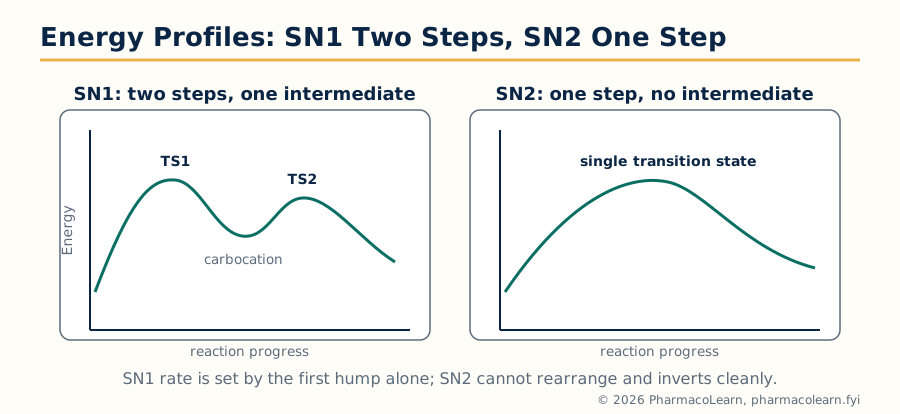 Figure: Energy profiles for SN1 and SN2. Only SN1 has an intermediate, so only SN1 can rearrange or racemise.
1.10 Nucleophilic aromatic substitution and electrophilic aromatic substitution
SNAr (addition-elimination). A nucleophile can displace a leaving group from an aromatic ring only if the ring carries strong electron withdrawing groups (nitro groups above all) ortho or para to the leaving group. The nucleophile adds first, giving an anionic sigma complex (a Meisenheimer complex) whose charge is delocalised onto the nitro groups; the leaving group then departs and aromaticity returns. Because bond formation, not bond breaking, is rate determining, the leaving group order is unusual: fluoride is the best leaving group, F > Cl > Br > I, the reverse of aliphatic substitution. The 2,4-dinitrochlorobenzene reaction with amines is the standard example, and the Smiles rearrangement (Unit 4) is an intramolecular version. Where no activating group exists, strong base can still force substitution through the benzyne mechanism of section 1.7, and the label ends up at two positions: cine substitution.
Electrophilic aromatic substitution and orientation. The syllabus requires relative reactivity and orientation across the reaction families, and aromatic substitution is where orientation is most examined. An electrophile adds to the ring to give a sigma complex; loss of the ring proton restores aromaticity. Substituents already on the ring decide both speed and position:
- Activating, ortho/para directing groups (OH, OR, NH2, alkyl) donate electrons and stabilise the sigma complex for ortho and para attack.
- Deactivating, meta directing groups (NO2, CN, carbonyl, SO3H) withdraw electrons; meta attack avoids placing positive charge next to the withdrawing group.
- Halogens are the exception: deactivating by induction yet ortho/para directing by resonance donation of a lone pair.
The same directing logic controls polysubstituted rings in drug intermediates, where the order in which groups are introduced is planned around it: nitrate first while the ring is still reactive, and never attempt a Friedel-Crafts step on a strongly deactivated ring.
1.11 Elimination reactions: E1, E2 and E1cB
Elimination removes two groups from adjacent carbons and forms a double bond. Three mechanisms cover the spectrum:
E2 (bimolecular). A base removes a beta hydrogen at the same moment as the leaving group departs: one step, rate = k[RX][base]. The breaking C-H and C-X bonds must lie in the same plane, and the anti-periplanar arrangement (dihedral angle 180 degrees) is strongly preferred because the orbitals align best; in cyclohexane rings this means both groups must be axial, which can force the less substituted alkene. E2 is the default mechanism with strong bases.
E1 (unimolecular). Ionisation gives the carbocation of the SN1 reaction, and a weak base or solvent then removes a beta proton. E1 therefore competes with SN1 under the same conditions and shares its rearrangements and solvent preferences; substitution usually dominates unless heat favours elimination.
E1cB (unimolecular, conjugate base). The base removes the proton first, giving a carbanion (the conjugate base of the substrate), which then expels the leaving group. This pathway needs an acidic beta hydrogen (flanked by a carbonyl, nitro or similar group) and a poor leaving group such as hydroxide or fluoride that will not leave from the neutral molecule: the aldol dehydration and the behaviour of 2-halo carboxylates are examples. A primary kinetic isotope effect is small or absent for the second step, and hydrogen exchange into recovered starting material is the classic test.
Saytzeff and Hofmann orientation. When two different beta carbons carry hydrogens, two alkenes can form. With small bases the more substituted, more stable alkene dominates (Saytzeff product), because the transition state shares the stability of the alkene being formed. With bulky bases (potassium tert-butoxide), with charged substrates such as quaternary ammonium hydroxides in the Hofmann elimination, or where a conjugated or statistically favoured product intervenes, the less substituted alkene dominates (Hofmann product) because the least hindered proton is removed fastest. Examination answers should state the rule and then the reason: alkene stability in the transition state against steric access to the proton.
| Feature | E1 | E2 | E1cB |
|---|---|---|---|
| Intermediate | Carbocation | None | Carbanion |
| Rate law | k[RX] | k[RX][base] | k[RX][base], with prior equilibrium |
| Needs | Ionising solvent, weak base | Strong base | Acidic beta H, poor leaving group |
| Stereochemistry | Not specific | Anti-periplanar preferred | Not specific |
| Rearrangements | Possible | No | No |
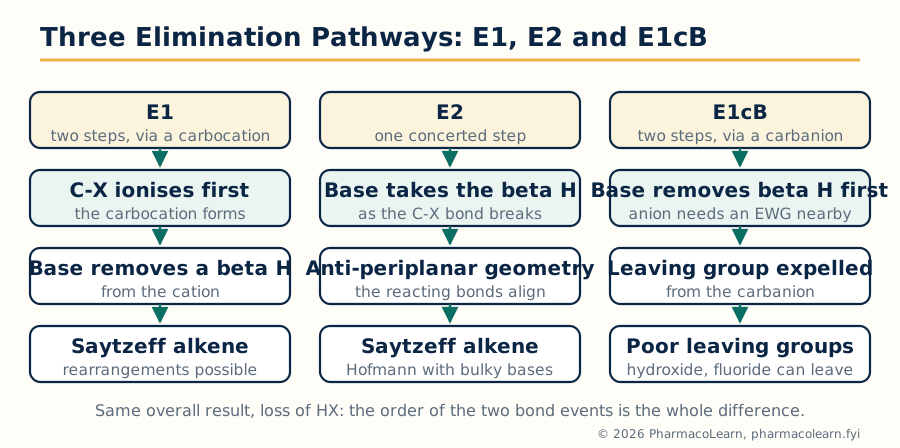 Figure: E1, E2 and E1cB compared. The three mechanisms differ only in the order in which the two bonds break.
1.12 Addition reactions in outline
Electrophilic addition to alkenes. A proton or other electrophile adds to give the more stable carbocation, and the nucleophile captures it: the Markovnikov rule (the electrophile adds to the carbon that leaves the more stable cation). HBr with peroxides reverses the orientation by switching to a radical chain in which bromine adds first. Acid catalysed hydration gives Markovnikov alcohols; hydroboration-oxidation gives the anti-Markovnikov alcohol by a concerted, sterically controlled addition.
Addition to alkynes follows the same cation logic through vinyl cations; hydration gives enols that tautomerise to carbonyl compounds.
Nucleophilic addition to carbonyl compounds is driven by the polarised C=O bond: the nucleophile attacks carbon, the pi electrons move to oxygen, and protonation gives the product. Cyanide, Grignard reagents, hydride donors, water, alcohols and amines all follow this pattern, and its reversibility with weak nucleophiles is what makes acetal chemistry and protecting groups (Unit 3) work. Conjugate (Michael) addition is the special case treated in Unit 2.
Orientation across these additions is always read the same way: identify the intermediate of the first step and put the first bond where it leaves the most stable intermediate.
1.13 Rearrangement reactions
A rearrangement moves a group or a bond within a molecule to give a skeletal isomer. The syllabus grouping is by the atom to which the key group migrates.
Carbon to carbon migrations:
- Wagner-Meerwein rearrangement: a 1,2-alkyl shift to an adjacent carbocation. The migrating group moves with its bonding electron pair into the empty p orbital, which must align with the C-C bond. It rationalises ring expansions and contractions in terpene chemistry and the behaviour of bicyclic systems such as camphene and isoborneol.
- Pinacol rearrangement: a vicinal diol in acid loses water from one carbon and the group on the neighbouring carbon shifts as the carbonyl forms. The group that migrates is the one best able to support positive charge in the transition state (aryl migrates well), and the carbon that loses water is the one giving the more stable cation. Pinacol itself gives pinacolone.
- Wolff rearrangement: an alpha-diazoketone loses nitrogen on heating, irradiation or silver oxide catalysis and the alkyl group shifts to the electron deficient carbon, giving a ketene, which water, alcohols or amines capture as the one carbon homologated acid, ester or amide. This is the last step of the Arndt-Eistert homologation (with diazomethane, Unit 3).
Carbon to nitrogen migrations (through electron deficient nitrogen):
- Hofmann rearrangement: a primary amide with bromine and alkali gives an amine with one carbon fewer. The N-bromoamide anion rearranges as the alkyl group migrates to nitrogen and bromide leaves, giving an isocyanate, which hydrolyses to the amine. Migration occurs with retention at the migrating carbon, and crossover experiments show it is intramolecular.
- Curtius rearrangement: an acyl azide on heating loses nitrogen and rearranges to the isocyanate through an acyl nitrene like transition state (section 1.6). Because the acid is converted to the azide through its chloride, the sequence acid to amine with loss of the carbonyl carbon is a standard, mild route to amino drug intermediates. The Lossen rearrangement of hydroxamic acids and the Schmidt reaction of acids with hydrazoic acid are the same family.
Carbon to oxygen migration:
- Baeyer-Villiger oxidation: a peracid converts a ketone into an ester by inserting oxygen beside the carbonyl; the group that migrates to oxygen is the one better able to bear partial positive charge (tertiary > secondary > aryl > primary > methyl). It is treated in full in Unit 2.
- Dakin oxidation: the phenolic variant, in which an ortho or para hydroxy aryl ketone is converted by alkaline peroxide into a catechol or quinol derivative, showing the same migration to oxygen.
Rearrangements are proved intramolecular by crossover experiments (section 1.8) and their synthetic value is that they rebuild skeletons that direct bond formation cannot reach: ring expansions, contracted amines and homologated acids.
1.14 Chemistry of enolates
An enolate is the conjugate base of a carbonyl compound formed by removing an alpha proton: the negative charge is shared between the alpha carbon and the carbonyl oxygen, and the two resonance forms explain why enolates can react at carbon or at oxygen. Carbon attack is the synthetically important mode with most electrophiles.
Formation. The alpha protons of simple ketones and esters have pKa values around 20 to 25, so a base must be chosen with care:
- Strong, hindered bases such as lithium diisopropylamide (LDA) in THF at low temperature remove the proton completely and irreversibly, giving the kinetic enolate: deprotonation at the less substituted alpha carbon, because that proton is removed fastest.
- Weaker bases or protic conditions give only a small equilibrium concentration of enolate, but that is enough when the enolate is trapped productively, as in the aldol reaction; equilibration then favours the more substituted, thermodynamic enolate.
- 1,3-Dicarbonyl compounds (pKa about 9 to 13) form enolates fully with alkoxides, which is why ethyl acetoacetate and diethyl malonate are the classic alkylating nucleophiles of the acetoacetic ester and malonic ester syntheses, closed by hydrolysis and decarboxylation.
Regio and stereochemistry. Unsymmetrical ketones can give two enolates; low temperature and LDA give the kinetic (less substituted) enolate, while conditions allowing equilibration give the thermodynamic (more substituted) one. Enolate geometry (E or Z, set by the base, solvent and metal) carries through into aldol diastereoselectivity, the basis of boron enolate methodology.
Reactions of enolates:
- Alkylation: SN2 attack on methyl, primary and allylic halides. Limitations: secondary halides invite elimination, and O-alkylation can intrude with very reactive electrophiles.
- Acylation and the Claisen condensation: an ester enolate attacks another ester carbonyl; the Dieckmann variant is intramolecular (Unit 2).
- Aldol addition and condensation: an enolate attacks an aldehyde or ketone carbonyl, giving beta-hydroxy carbonyl compounds that dehydrate to enones.
- Michael addition: enolates add conjugately to alpha,beta-unsaturated carbonyl compounds (Unit 2).
- Halogenation: enols and enolates react with halogens at the alpha position; under basic conditions polyhalogenation follows, ending in the haloform reaction for methyl ketones.
Enolates are the thread joining this subject: they are the nucleophile in the Mannich, Dieckmann and Michael reactions of Unit 2, they are protected and unmasked in Unit 3 strategies, and in Unit 5 the disconnection of a 1,3-difunctional compound is read directly as an enolate bond construction.
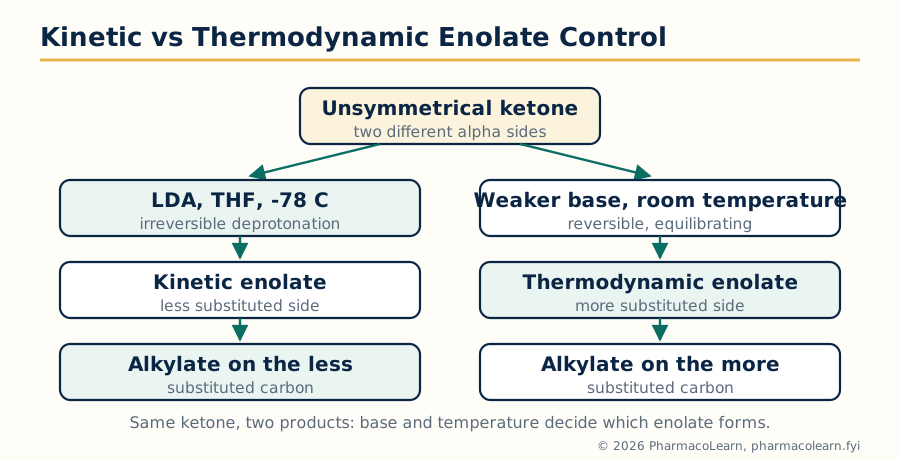 Figure: Kinetic versus thermodynamic enolate control. Base strength and temperature choose the enolate, and the enolate chooses the product.
Unit 2: Named Reactions: Mechanism and Synthetic Applications
2.1 How to study a named reaction
Every named reaction in this unit is examined in the same four parts: what bond is made or broken, the reagents and conditions, the mechanism in words, and where the reaction earns its keep in synthesis, especially of drugs. A reaction that forms a carbon-carbon or carbon-heteroatom bond under mild, predictable conditions survives in textbooks because process chemists can trust it at scale.
2.2 Ugi reaction
The Ugi reaction is a four component condensation: a carboxylic acid, an aldehyde (or ketone), an amine and an isocyanide combine in one pot to give a dipeptide like product, an alpha-(acylamino)amide, with water as the only byproduct.
Mechanism in words: the amine and aldehyde first condense to an imine. The carboxylic acid protonates the imine, and the isocyanide carbon, which is both nucleophilic and electrophilic, adds to the iminium carbon, giving a nitrilium ion. The carboxylate traps the nitrilium ion, and the resulting imidate undergoes the key irreversible step, the Mumm rearrangement, an acyl transfer from oxygen to the neighbouring nitrogen, which fixes the final amide skeleton.
Scope and applications: all four components can be varied independently, so one reaction generates a whole library of products, which made the Ugi reaction a foundation of combinatorial and medicinal chemistry. It builds peptidomimetic scaffolds and heterocycle precursors, and Ugi products can be cyclised in second steps to imidazoles, benzodiazepines and other drug nuclei met in Unit 4. Limitations: the need for an isocyanide (unpleasant, sometimes unstable) and modest stereocontrol at the new centre.
Ugi four component reaction, step by step

amine + aldehyde  ->  imine + water
imine + carboxylic acid  ->  iminium carboxylate pair
isocyanide carbon adds to the iminium carbon  ->  nitrilium ion
carboxylate traps the nitrilium ion  ->  imidate intermediate
Mumm rearrangement (O to N acyl transfer)  ->  dipeptide like product
2.3 Brook rearrangement
The Brook rearrangement is the migration of a silyl group from carbon to an adjacent oxygen: an alpha-silyl alkoxide rearranges so that silicon ends on oxygen and the negative charge ends on carbon. The driving force is the great strength of the silicon-oxygen bond compared with the silicon-carbon bond. The migration is intramolecular, passes through a three membered cyclic transition state, and usually proceeds with retention of configuration at silicon and at carbon.
The retro-Brook rearrangement runs the other way when a carbanion is better stabilised than the alkoxide. Synthetically, the Brook rearrangement converts an acylsilane addition product into a protected cyanohydrin equivalent: addition of a nucleophile to an acylsilane, Brook rearrangement and alkylation turns the carbonyl carbon into a nucleophile, an umpolung (polarity inversion) device that reappears in the retrosynthesis logic of Unit 5.
2.4 Ullmann coupling reactions
The classical Ullmann reaction couples two aryl halides with copper metal at high temperature to give a biaryl. In its modern, far more useful form, copper catalysis couples an aryl halide with a nucleophile: phenols give diaryl ethers (Ullmann ether synthesis), amines and amides give N-aryl products (the Goldberg coupling), and thiols give diaryl sulfides.
Conditions and mechanism: copper(I) salts or copper metal with a ligand (diamines, amino acids and phenanthrolines are common) in a polar solvent with a base such as potassium carbonate or cesium carbonate, typically at 80 to 110 degrees C in the modern version. The mechanism is discussed in terms of oxidative addition of the aryl halide to copper(I), coordination of the nucleophile, and reductive elimination from a copper(III) intermediate, though radical pathways operate in some systems; for examination purposes the copper(I)/copper(III) cycle is the expected account.
Scope and applications: aryl chlorides are sluggish unless activated; bromides and iodides are standard. Diaryl ether and N-aryl units appear throughout drug chemistry (the diaryl ether of thyroid hormones and of several kinase inhibitors, N-aryl amides and sulfonamides), and Ullmann conditions are often cheaper than palladium catalysis at process scale, which keeps the reaction industrially important.
2.5 Dieckmann reaction
The Dieckmann reaction (Dieckmann condensation) is the intramolecular Claisen condensation of a diester: a base removes an alpha proton from one ester group, the enolate attacks the other ester carbonyl inside the same molecule, and a cyclic beta-keto ester results after work up.
Key points: it works best for five and six membered rings, giving 2-carbalkoxycyclopentanones and cyclohexanones from adipate and pimelate esters; a full equivalent of base is needed because the product beta-keto ester (pKa about 11) is deprotonated and pulls the equilibrium forward, and the alkoxide base should match the ester alkoxy group to avoid transesterification. One ester group must carry an alpha hydrogen. Hydrolysis and decarboxylation then deliver the cyclic ketone itself, making Dieckmann a standard ring closing step (see also Unit 5). Crossed Dieckmann reactions are useful only when one partner has no alpha hydrogen or geometry strongly favours one pairing.
2.6 Doebner-Miller reaction
The Doebner-Miller reaction synthesises quinolines from an aniline and two molecules of an alpha,beta-unsaturated carbonyl compound (or a mixture of aldehydes that forms one in situ), under acidic, oxidising conditions.
Mechanism in words: the aniline first adds conjugately (Michael addition) to the enal or enone; the resulting secondary amine condenses with a second molecule of the carbonyl compound to an imine; acid catalysed cyclisation onto the aromatic ring closes the second ring, and oxidation (by nitrobenzene, arsenic acid or the excess carbonyl compound in classical conditions) aromatises the dihydroquinoline to the quinoline. It belongs to the same family as the Skraup synthesis (aniline, glycerol, oxidant) and is compared with the Combes synthesis in Unit 4: Doebner-Miller builds the ring from an enone side chain, Combes from a 1,3-diketone.
Applications: 2-methyl and 2,4-disubstituted quinolines and, by varying the aniline, ring substituted quinolines, the nucleus of antimalarial and antibacterial drugs (Unit 4).
2.7 Sandmeyer reaction
The Sandmeyer reaction replaces the diazonium group of an arenediazonium salt with chlorine, bromine or cyanide using copper(I) salts (CuCl, CuBr, CuCN) as catalysts.
Mechanism in words: the reaction is radical, not ionic. Copper(I) transfers one electron to the diazonium ion, nitrogen is lost and an aryl radical forms; the radical then takes the halogen or cyano ligand from the copper(II) species formed in the first step, giving the product and regenerating copper(I). This explains why Sandmeyer conditions succeed where direct ionic substitution on the ring would fail.
Scope and applications: arenediazonium salts are made from anilines with sodium nitrite and acid at 0 to 5 degrees C, so the Sandmeyer reaction converts the amino group, itself installed by nitration and reduction, into Cl, Br or CN at a defined position. The nitrile product hydrolyses to benzoic acids, so the sequence NH2 to N2+ to CN to COOH is a standard way to put a carboxyl group where direct methods cannot. Related replacements need no copper: water gives phenols, ethanol or hypophosphorous acid removes the group entirely (deamination), and potassium iodide alone gives aryl iodides. Fluoride is installed by the Balz-Schiemann reaction (diazonium tetrafluoroborate, heat). Aryl halides and nitriles made this way feed cross coupling chemistry such as the Suzuki reaction below.
2.8 Mitsunobu reaction
The Mitsunobu reaction converts an alcohol into an ester, ether, amine or other substitution product with inversion of configuration, under remarkably mild and nearly neutral conditions. The reagent pair is triphenylphosphine and diethyl azodicarboxylate (DEAD, Unit 3), with the incoming nucleophile present as a weak acid (pronucleophile of pKa below about 13: carboxylic acids, phenols, phthalimide, hydrazoic acid, sulfonamides).
Mechanism in words: triphenylphosphine adds to DEAD to give a betaine, which deprotonates the pronucleophile. The alcohol then displaces on phosphorus, forming an alkoxyphosphonium ion: the poor leaving group OH has been converted into an excellent one, triphenylphosphine oxide in waiting. The nucleophile anion attacks the carbon from the back in a clean SN2 step, so the configuration inverts, and triphenylphosphine oxide precipitates as the thermodynamic sink of the whole process.
Scope and applications: primary and secondary alcohols react; tertiary alcohols fail because the SN2 step is blocked. Its great synthetic value is stereochemical: a secondary alcohol of the wrong configuration for a target is inverted while being functionalised, a standard correction in carbohydrate, nucleoside and macrolide synthesis and in medicinal chemistry routes to chiral ethers and amines (phthalimide product, then hydrolysis, gives the inverted amine by the Gabriel logic). The drawbacks are stoichiometric triphenylphosphine oxide and hydrazine byproducts, which complicate purification and process scale use.
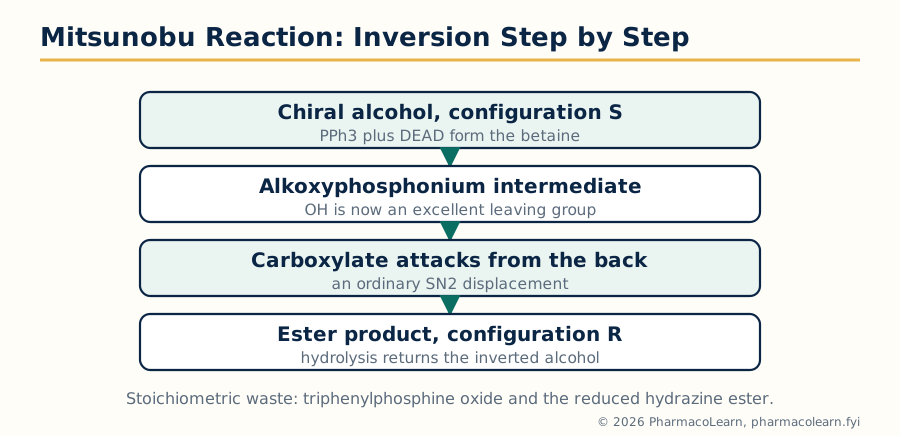 Figure: The Mitsunobu sequence. The key step is an ordinary SN2 displacement, which is why the configuration inverts.
2.9 Mannich reaction
The Mannich reaction joins three components: a compound with an acidic alpha hydrogen (usually a ketone), formaldehyde and ammonia or a primary or secondary amine, to give a beta-amino carbonyl compound, a Mannich base.
Mechanism in words: formaldehyde and the amine condense to an iminium ion (with dimethylamine, the preformed Eschenmoser salt is the same species bottled). The enol or enolate form of the carbonyl compound attacks the iminium carbon as a nucleophile, exactly as in an aldol reaction but with C=N in place of C=O. Acidic or basic conditions both work, matching the enol or enolate pathway.
Applications: Mannich bases are versatile intermediates: quaternisation and Hofmann elimination of the amino group reveals an alpha,beta-unsaturated carbonyl, making the Mannich reaction a controlled equivalent of direct alpha-methylenation. The classic target example is Robinson's tropinone synthesis, in which a double Mannich reaction builds the bicyclic alkaloid skeleton in one step, and Mannich bases themselves occur in drug structures and as intermediates toward analgesics and other amines. Phenols undergo ortho aminomethylation by the same reaction.
2.10 Vilsmeyer-Haack reaction
The Vilsmeyer-Haack reaction formylates electron rich aromatic and heteroaromatic rings. The reagent is made from dimethylformamide and phosphorus oxychloride (or oxalyl chloride): DMF attacks the chlorinating agent and chloride displaces to give the chloroiminium salt, the Vilsmeyer reagent, [Cl-CH=N+(CH3)2] Cl-, a compact electrophile.
Mechanism in words: the aromatic ring attacks the iminium carbon in an ordinary electrophilic aromatic substitution; the sigma complex loses its proton to give an aryl iminium salt, and aqueous work up hydrolyses the iminium to the aldehyde. Formylation therefore appears at the most electron rich free position, para to a dialkylamino group on benzene rings, and at the alpha position of pyrroles and indoles.
Scope and applications: the ring must be activated: dialkyl anilines, phenol ethers and, above all, heteroaromatics such as pyrrole, indole, furan and thiophene react well; plain benzene and deactivated rings do not. Indole-3-carbaldehydes and pyrrole-2-carbaldehydes made this way are standard building blocks for drug synthesis, and the reaction also converts ketones to beta-chloroacraldehydes (the Vilsmeyer-Haack-Arnold variant used for pyridine and quinoline ring construction).
2.11 Sharpless asymmetric epoxidation
The Sharpless asymmetric epoxidation converts an allylic alcohol into an epoxy alcohol with high enantioselectivity, using tert-butyl hydroperoxide (TBHP) as oxidant, titanium tetraisopropoxide as catalyst and a diethyl tartrate (DET) ester as the chiral ligand.
Mechanism in words: titanium binds the tartrate, the hydroperoxide and the allylic alcohol in one chiral complex; the alcohol group is essential because it anchors the substrate to the metal. Oxygen is delivered from the bound peroxide to one face of the double bond, selected by the tartrate. The mnemonic: draw the allylic alcohol with the CH2OH group at the lower right and the double bond horizontal; (+)-diethyl tartrate delivers oxygen from below the plane and (-)-diethyl tartrate from above. The drawing rule and the reagent must always be quoted together.
Scope and applications: only allylic alcohols react, but predictably, and the epoxy alcohol products open regioselectively to diols, amino alcohols and other three carbon units. The reaction is a landmark of asymmetric synthesis, used for intermediates toward beta blockers, statins and many chiral building blocks; with a racemic allylic alcohol, one enantiomer is epoxidised much faster, giving a kinetic resolution.
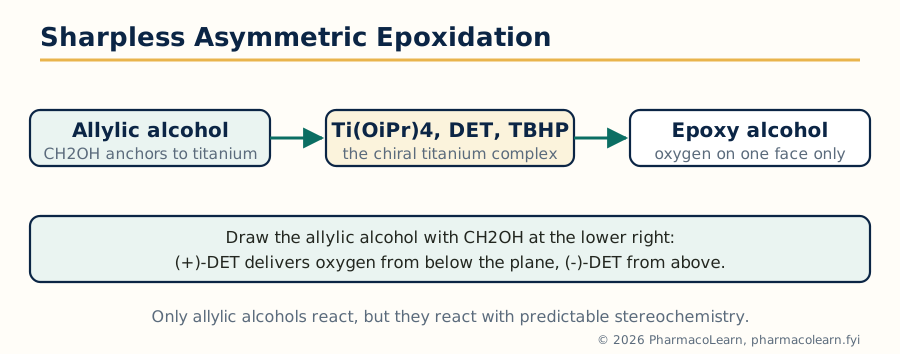 Figure: Sharpless epoxidation and its mnemonic. The tartrate enantiomer selects the face that receives the oxygen.
2.12 Baeyer-Villiger oxidation
The Baeyer-Villiger oxidation converts a ketone into an ester, or a cyclic ketone into a lactone, by inserting one oxygen atom next to the carbonyl. The oxidant is a peracid (m-chloroperbenzoic acid, MCPBA, is standard; peracetic acid, trifluoroperacetic acid and hydrogen peroxide systems are also used).
Mechanism in words: the peracid adds to the carbonyl carbon, giving the tetrahedral Criegee intermediate. In the slow step, the group anti-periplanar to the O-O bond migrates from carbon to the outer oxygen as the weak O-O bond breaks and the carboxylate leaves; the migrating group keeps its configuration because it moves with its bonding pair and never becomes free. Migration aptitude follows the ability to support partial positive charge: tertiary alkyl > secondary alkyl and phenyl > primary alkyl > methyl, and electron rich aryl groups migrate faster than electron poor ones.
Applications: ring expansion of cyclic ketones to lactones (cyclohexanone to epsilon-caprolactone, the monomer of a biodegradable polyester), synthesis of esters from aryl methyl ketones where the aryl group migrates, and the Dakin oxidation of hydroxy aryl ketones noted in Unit 1. In medicinal chemistry it is a clean way to place an ester oxygen inside a carbon skeleton and a standard step in steroid and macrolide intermediate synthesis.
2.13 Shapiro reaction
The Shapiro reaction converts a ketone into an alkene by way of its tosylhydrazone. Treatment of the tosylhydrazone with two equivalents of an alkyllithium (usually butyllithium) gives a vinyl lithium, which is protonated on work up to the alkene or trapped with other electrophiles.
Mechanism in words: the first equivalent of base removes the sulfonamide N-H proton; the second removes a proton from the carbon alpha to the C=N bond, on the less hindered side where possible. The resulting dianion expels the sulfinate group and nitrogen to leave a vinyl anion equivalent, the vinyl lithium, with the double bond between the carbonyl carbon and the deprotonated alpha carbon. The regiochemistry is therefore set by which alpha proton is removed, and the less substituted alkene is typically formed, a useful contrast with acid catalysed dehydration, which favours the more substituted alkene through the E1 pathway.
Comparison and applications: the Bamford-Stevens reaction (tosylhydrazone with base and heat) passes through a diazo compound and a carbene, giving more rearrangement; the Shapiro conditions are colder, anionic and cleaner. The great value of the Shapiro reaction is the vinyl lithium itself: quenching with carbon dioxide gives alpha,beta-unsaturated acids, with aldehydes gives allylic alcohols, and with other electrophiles gives substituted alkenes of defined geometry, making it a carbonyl to vinyl anion umpolung used in complex molecule synthesis.
2.14 Suzuki reaction
The Suzuki reaction (Suzuki-Miyaura coupling) joins an aryl or vinyl halide (or triflate) to an organoboron partner, an aryl or vinyl boronic acid or ester, under palladium catalysis with a base, forming a new carbon-carbon bond. It is the most widely used cross coupling in medicinal chemistry.
The catalytic cycle in words: palladium(0) oxidatively adds into the carbon-halogen bond, giving a palladium(II) complex and raising the metal oxidation state by two. The base activates the boronic acid to a boronate, which transmetalates: the organic group moves from boron to palladium, displacing the halide. The two organic groups on palladium then reductively eliminate, forming the C-C bond and returning palladium(0) to the cycle. The geometry at a vinyl partner is retained, so defined alkene geometry survives the coupling.
Suzuki catalytic cycle

Pd(0) catalyst
  -> oxidative addition of Ar-X        : Ar-Pd(II)-X
  -> base activates Ar'-B(OH)2         : boronate formed
  -> transmetalation                    : Ar-Pd(II)-Ar'
  -> reductive elimination              : Ar-Ar' product + Pd(0) again
Scope and applications: the reaction tolerates most functional groups, the boronic acids are stable, storable and low in toxicity, and conditions are mild (aqueous base, 60 to 100 degrees C). Biaryl products are everywhere in drug chemistry: the biphenyl unit of losartan and the other sartans, and countless kinase inhibitor and agrochemical intermediates, are assembled by Suzuki coupling. Limitations to note: protodeboronation of electron poor or heteroaryl boronic acids, homocoupling of either partner as a side reaction, and the need to remove residual palladium from pharmaceutical products to strict limits.
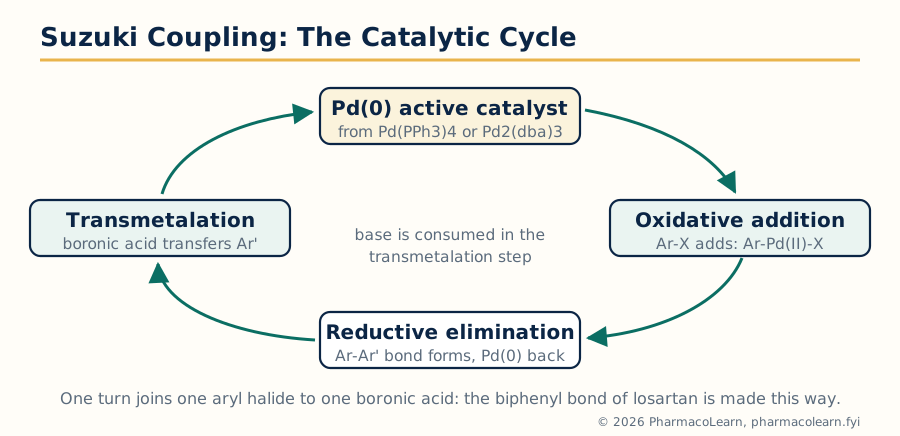 Figure: The Suzuki catalytic cycle. Three steps repeat until the aryl halide is consumed.
2.15 Ozonolysis
Ozonolysis cleaves carbon-carbon double bonds with ozone. Ozone adds across the alkene to give a primary ozonide (molozonide), which rearranges to the more stable ozonide; work up then converts the ozonide into carbonyl products.
Work up decides the products: a reductive work up (zinc and water, dimethyl sulfide or triphenylphosphine) gives aldehydes and ketones, preserving aldehydes as aldehydes; an oxidative work up (hydrogen peroxide) carries aldehydes on to carboxylic acids. Alkynes cleave to carboxylic acids.
Applications: the classical use is structural determination: locating a double bond in an unknown alkene by identifying the two carbonyl fragments, a method that belongs to the era before routine spectroscopy and is still examined for that logic. Synthetically, ozonolysis converts cyclic alkenes into dicarbonyl compounds (cyclohexene gives hexanedial) for ring opening strategies in retrosynthesis (Unit 5), and converts terminal alkenes into one carbon shorter aldehydes. Ozonides are explosive and are not isolated in process work; modern practice uses flow reactors or in situ quenching, a safety point worth stating in any examination answer.
2.16 Michael addition reaction
The Michael addition is the conjugate (1,4) addition of a nucleophile, the Michael donor, to an alpha,beta-unsaturated carbonyl or similar activated alkene, the Michael acceptor. Donors are stabilised carbanions: malonic and acetoacetic esters, nitro compounds, thiols, amines and enolates generally. Acceptors carry electron withdrawing groups: enones, enals, acrylates, acrylonitrile and nitroalkenes.
Mechanism in words: the nucleophile attacks the beta carbon, not the carbonyl carbon, because the resulting negative charge lands on oxygen as an enolate, the most stable anion available. Protonation of the enolate at carbon completes the addition and the carbonyl survives intact. The competition with direct 1,2 addition is decided by the nucleophile: soft, stabilised nucleophiles and cuprates favour 1,4 addition; hard organolithiums and Grignard reagents favour 1,2 addition to the carbonyl.
Applications: the Michael addition is the reliable way to build a 1,5-dicarbonyl pattern and therefore sits inside the Robinson annulation (Michael addition of a ketone enolate to methyl vinyl ketone, then intramolecular aldol) that constructs steroid and terpene ring systems. Thiol Michael additions are used to attach linker units in antibody-drug conjugate chemistry, and aza-Michael additions of amines appear in many alkaloid and drug routes. In retrosynthesis (Unit 5) a 1,5-difunctional relationship is the signal to disconnect by a Michael reaction.
2.17 Fischer indole synthesis
The Fischer indole synthesis (present in the KBH syllabus copy of this unit) converts a phenylhydrazone of an aldehyde or ketone into an indole on heating with an acid catalyst such as zinc chloride, polyphosphoric acid or a Lewis acid.
Mechanism in words: the phenylhydrazone tautomerises to its ene-hydrazine form; this undergoes a [3,3]-sigmatropic rearrangement that sets two new bonds on the ring; the resulting diamine cyclises onto the imine carbon, and ammonia is lost to aromatise the five membered ring. With an unsymmetrical ketone, two regioisomeric indoles can form; the more substituted side usually dominates under thermodynamic acid conditions.
Applications: indole is one of the most common nuclei in drugs (the triptans, indomethacin and many alkaloids), and the Fischer synthesis remains a first choice route because phenylhydrazines and carbonyl compounds are cheap and varied.
2.18 Multi-component reactions in outline
The KBH syllabus copy groups several named condensations as multi-component synthesis, in which three or more reactants assemble in one pot with most atoms retained in the product. The Ugi reaction of section 2.2 is the four component member. The others named there, in outline:
- Biginelli reaction: an aldehyde, urea and a beta-keto ester condense under acid catalysis to a dihydropyrimidinone (DHPM), a calcium channel and mitotic spindle (monastrol) pharmacophore, through an iminium ion, enol addition and cyclodehydration.
- Hantzsch reaction: two molecules of a beta-keto ester, an aldehyde and ammonia give a dihydropyridine, the synthesis of the nifedipine family of calcium channel blockers, whose dihydropyridine ring is the drug itself.
- Passerini reaction: a carboxylic acid, an aldehyde and an isocyanide give an alpha-(acyloxy)amide in one step, the three component relative of the Ugi reaction.
- Strecker synthesis: an aldehyde, ammonia and hydrogen cyanide give an alpha-aminonitrile, hydrolysed to an alpha-amino acid; the first amino acid synthesis.
- Bucherer-Bergs reaction: a ketone with potassium cyanide and ammonium carbonate gives a hydantoin; the classical synthesis of the phenytoin ring system.
Their shared medicinal chemistry value is speed of diversity: many analogues from one reaction by varying each input, which is why they anchor screening library synthesis.
Unit 3: Synthetic Reagents, Applications and Protecting Groups
3.1 Aluminium isopropoxide: Meerwein-Ponndorf-Verley reduction and Oppenauer oxidation
Aluminium isopropoxide, Al(OCH(CH3)2)3, is the reagent of the Meerwein-Ponndorf-Verley (MPV) reduction: in isopropanol solution it reduces aldehydes and ketones to alcohols while leaving carbon-carbon double bonds, nitro groups, halides and other reducible functions untouched. The mechanism is a hydride transfer inside a six membered cyclic transition state in which the carbonyl and an isopropoxide ligand are both bound to aluminium; acetone is formed, and distilling it out drives the equilibrium to product.
Run backwards, the same system is the Oppenauer oxidation: a ketone (classically cyclohexanone or acetone) in excess accepts the hydride and an alcohol is oxidised to its carbonyl compound, again with complete selectivity against double bonds. This pair of reactions matters in steroid chemistry, where a single secondary alcohol must be oxidised or a single ketone reduced in a molecule full of other functionality, and the mild, neutral conditions explain their survival in the reagent canon.
3.2 N-Bromosuccinimide (NBS)
N-Bromosuccinimide is the reagent for radical bromination at allylic and benzylic positions (the Wohl-Ziegler bromination). With a radical initiator (light, peroxide or AIBN) in carbon tetrachloride or a substitute solvent, NBS maintains a very low concentration of bromine: the chain carrier bromine radical abstracts the weak allylic or benzylic hydrogen, and the resulting resonance stabilised radical takes bromine from Br2 as fast as it forms. Keeping Br2 scarce is the whole trick, because free bromine at high concentration would add across the double bond instead. HBr produced in the chain regenerates Br2 from NBS, so the cycle sustains itself.
Further uses of NBS: bromination of arenes under ionic conditions in polar solvents, alpha bromination of ketones through their enols, and as a source of electrophilic bromine for bromohydrin formation with water as co-solvent. Allylic bromides from NBS are standard intermediates for introducing amines, ethers and carbon chains at allylic positions in terpene and steroid work.
3.3 Diazomethane
Diazomethane, CH2N2, is a yellow gas used in ether solution, a reagent of unmatched convenience and matched hazard: it is toxic, carcinogenic in concern and explosive, and is generated and used in situ behind screens with ground glass free apparatus.
Reactions:
- Methylation of carboxylic acids: instant, quantitative conversion into methyl esters with nitrogen as the only byproduct, because the acid protonates diazomethane to a methyldiazonium ion that the carboxylate displaces in an SN2 step. Phenols and enols are methylated more slowly in the same way. Analytical chemists use it (or the safer trimethylsilyldiazomethane substitute) to make methyl esters for gas chromatography.
- Arndt-Eistert homologation: an acid chloride reacts with diazomethane to a diazoketone, which undergoes the Wolff rearrangement (Unit 1) to the one carbon longer acid.
- Cyclopropanation and homologation of ketones: addition to alkenes with metal catalysis (carbene chemistry, Unit 1), and ring expansion of cyclic ketones.
- 1,3-Dipolar cycloadditions with alkynes and activated alkenes.
3.4 Diazopropane
Diazopropane (1-diazopropane and 2-diazopropane) is the higher homologue of diazomethane, prepared similarly and handled with the same precautions. It ethylates rather than methylates: carboxylic acids give ethyl esters and phenols give ethyl ethers, and it enters the same cyclopropanation and cycloaddition chemistry with an ethyl group in place of methyl. It is examined mainly as the homologue example and is used far less often, because diazomethane covers most needs at lower risk.
3.5 Dicyclohexylcarbodiimide (DCC)
Dicyclohexylcarbodiimide (DCC) is a dehydrating coupling reagent: it consumes the water of a condensation and is itself converted into dicyclohexylurea (DCU), which precipitates and is filtered off.
Mechanism in words, for esterification: the carboxylic acid adds to the C=N bond of DCC to give an O-acylisourea, which is an activated ester equivalent; the alcohol attacks it to give the ester and DCU. With a catalytic amount of 4-(dimethylamino)pyridine (the Steglich esterification), even hindered alcohols esterify at room temperature because the acyl group is relayed through a highly reactive acylpyridinium species.
Applications: amide and peptide bond formation (DCC or its more soluble relative DIC with hydroxybenzotriazole additives to suppress racemisation), esterification of sensitive acids, and the Pfitzner-Moffatt oxidation in which DCC with DMSO and acid oxidises alcohols. The drawbacks are the allergenic reagent and the DCU byproduct, which is why modern peptide coupling often uses the reagents of section 3.12 instead.
3.6 Wilkinson's catalyst
Wilkinson's catalyst, chlorotris(triphenylphosphine)rhodium(I), RhCl(PPh3)3, is the classic homogeneous hydrogenation catalyst. In solution it loses one phosphine ligand, oxidatively adds hydrogen to give a rhodium(III) dihydride, binds the alkene, transfers both hydrogens across the double bond in sequence (migratory insertion, then reductive elimination) and releases the alkane.
Because the catalyst is a bulky soluble complex, steric hindrance controls selectivity: less hindered double bonds are hydrogenated fastest, while carbonyls, halides, nitro groups and benzyl ethers survive, so an exposed double bond in a crowded steroid or terpene can be reduced while a buried one is left. It is the standard contrast with heterogeneous catalysts such as palladium on carbon, which are less discriminating, and chiral phosphine versions perform asymmetric hydrogenation, the industrial logic behind L-DOPA manufacture.
3.7 Wittig reagent
The Wittig reagent is an alkylidene phosphorane (ylide), Ph3P=CHR, made in two steps: triphenylphosphine displaces halide from an alkyl halide in an SN2 step to give a phosphonium salt, and a strong base (butyllithium, sodium hydride or an alkoxide for stabilised cases) removes the alpha proton.
Mechanism in words: the ylide carbon, a stabilised carbanion equivalent, adds to an aldehyde or ketone carbonyl; the betaine closes to a four membered oxaphosphetane, which collapses, breaking C-P and C-O bonds to give the alkene and triphenylphosphine oxide. Formation of the very strong P=O bond drives the whole reaction.
Stereochemistry and scope: non-stabilised ylides (simple alkyl groups) give mainly Z alkenes under salt free conditions; stabilised ylides (bearing an ester or similar group) give mainly E alkenes. The Horner-Wadsworth-Emmons variant, using a phosphonate carbanion, gives E alkenes reliably and a water soluble phosphate byproduct, and is preferred at scale. The Wittig reaction converts a carbonyl into a double bond with the new bond exactly where the carbonyl was, including methylenation (C=O to C=CH2), which few other methods do as cleanly; it is used for exocyclic methylene units and diene construction in vitamin and prostaglandin synthesis. Ketones react more slowly than aldehydes and very hindered ketones may fail.
3.8 Osmium tetroxide
Osmium tetroxide, OsO4, is the reagent for syn dihydroxylation of alkenes: it adds across the double bond in a concerted cycloaddition to give a cyclic osmate ester, and hydrolysis releases the cis vicinal diol and osmium in a lower oxidation state.
In practice OsO4 is expensive and highly toxic (it attacks the eyes and lungs), so it is used catalytically with a co-oxidant that reoxidises the osmium: N-methylmorpholine N-oxide (NMO) in the Upjohn conditions, or potassium ferricyanide in the Sharpless asymmetric dihydroxylation, where cinchona alkaloid ligands on osmium deliver the oxygens to one face and give chiral diols from prochiral alkenes. Alkenes react in the order of their electron richness and accessibility; conjugated and strained systems are fast. The product is always the syn diol, the exact complement of the anti diol obtained by epoxidation followed by acid hydrolysis, a comparison examiners love.
3.9 Titanium chlorides
Two titanium chlorides earn their place in the list:
- Titanium tetrachloride, TiCl4, is a powerful Lewis acid, stronger and more oxophilic than aluminium chloride in many settings. It promotes Mukaiyama aldol reactions of silyl enol ethers with aldehydes, activates carbonyls toward allylation, and catalyses Diels-Alder reactions at low temperature.
- Titanium trichloride, TiCl3, and low valent titanium generated from TiCl4 with zinc, perform the McMurry coupling: two carbonyl compounds are reductively joined to an alkene through a pinacolate bound to titanium, which is deoxygenated on heating. The reaction makes hindered and strained alkenes that the Wittig reaction cannot reach, and intramolecularly it closes large rings in natural product synthesis. Titanium reagents also underlie the Kulinkovich cyclopropanol synthesis and the Tebbe methylenation reagent, Cp2Ti(Cl)CH2AlMe2, used when a basic Wittig ylide would destroy the substrate.
3.10 Diethyl azodicarboxylate (DEAD)
Diethyl azodicarboxylate is the orange azo ester that partners triphenylphosphine in the Mitsunobu reaction (Unit 2): it accepts the elements of hydrogen as it is reduced to the hydrazine dicarboxylate, the stoichiometric waste of that process. The same oxidising appetite makes DEAD a dehydrogenation reagent in its own right (converting 1,4-dihydropyridines to pyridines, for example) and the aza component in alpha amination of enolates. It is shock sensitive and toxic; diisopropyl azodicarboxylate (DIAD) is the common safer substitute.
3.11 Triphenylphosphine
Triphenylphosphine, PPh3, is the phosphorus workhorse behind three Unit 2 reactions: it is the backbone of the Wittig reagent, the activator of alcohols in the Mitsunobu reaction, and hydrogen acceptor chemistry elsewhere. Its recurring role is explained by one fact: phosphorus forms an exceptionally strong bond to oxygen, so any process ending in triphenylphosphine oxide has a built in driving force.
Other standard uses: the Appel conditions (PPh3 with carbon tetrachloride or tetrabromide) convert alcohols into alkyl chlorides or bromides with inversion, through the same alkoxyphosphonium intermediate as the Mitsunobu reaction; the Staudinger reaction reduces azides to amines through an iminophosphorane hydrolysed by water, a mild alternative to catalytic hydrogenation that preserves other reducible groups; and PPh3 is the standard ligand in the palladium and rhodium catalysis of Units 2 and 3 (Suzuki, Wilkinson).
3.12 BOP reagent
BOP, benzotriazol-1-yloxytris(dimethylamino)phosphonium hexafluorophosphate, is a peptide coupling reagent. The carboxylate attacks phosphorus and displaces benzotriazolyloxide (the OBt anion), giving an active benzotriazolyl ester in situ; the amine partner then aminolyses it to the amide. Because the active ester forms quickly and the OBt group suppresses racemisation at the activated residue, BOP made solid phase peptide synthesis of long sequences practical and remains a standard coupling reagent for amide bond formation generally, including the amide bonds of drug candidates in medicinal chemistry.
Two practical points are examinable: BOP produces hexamethylphosphoramide (HMPA) as byproduct, a suspect carcinogen, which led to the safer analogue PyBOP in which pyrrolidine replaces dimethylamine; and coupling reagents of this family (BOP, PyBOP, HBTU, HATU) all work by the same logic of converting a poor leaving group, OH, into a good one under conditions mild enough for amino acid stereochemistry to survive.
3.13 Grignard reagent
The KBH syllabus copy adds the Grignard reagent, RMgX, formed by inserting magnesium into a carbon-halogen bond in dry ether or THF. Its carbon-magnesium bond is polarised towards carbon, so the reagent is a carbanion equivalent and a strong base at once. It adds to carbonyl compounds (aldehydes to secondary alcohols, ketones to tertiary alcohols, esters twice to tertiary alcohols), opens epoxides, and adds to carbon dioxide to give carboxylic acids after work up. The same basicity is its limitation: any acidic proton (water, alcohols, terminal alkynes, amines) destroys the reagent, and substrates carrying both a halogen and an acidic or carbonyl function usually cannot form Grignards directly, which is one of the problems protecting groups exist to solve.
3.14 Protecting groups: the role of protection in synthesis
A protecting group is a temporary disguise put on a functional group so that it survives reactions aimed elsewhere in the molecule, and removed when its turn comes. Protection costs two steps, so it is used only when chemoselectivity cannot be achieved directly: the classic situation is a molecule with two groups of similar reactivity, such as an amino alcohol to be acylated on nitrogen only.
A good protecting group must: go on in high yield under mild conditions; be stable to every reagent used while it is in place; come off in high yield under conditions that damage nothing else; and ideally make the intermediate easy to purify. The strategic idea of orthogonality completes the concept: two protecting groups are orthogonal if each can be removed in the presence of the other (for example a benzyl ether, removed by hydrogenolysis, beside a silyl ether, removed by fluoride), allowing several groups to be unveiled one at a time in a long synthesis.
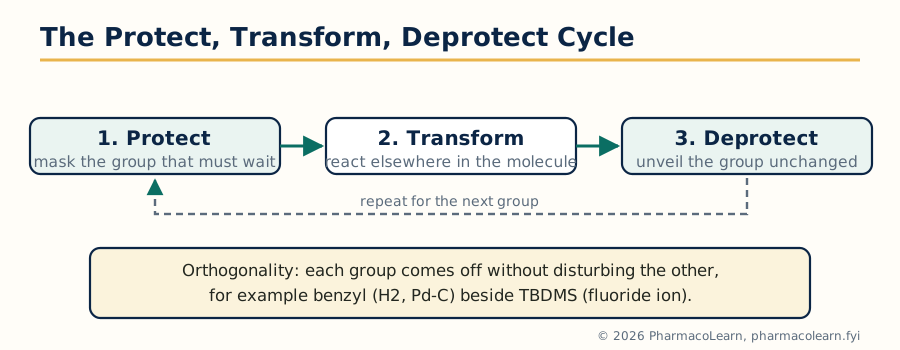 Figure: Protect, transform, deprotect. Orthogonal groups let several masks be removed one at a time.
3.15 Protection of the hydroxyl group and of diols
- Ethers: the benzyl ether (from benzyl chloride and base) is stable to acid, base and organometallics and is removed by catalytic hydrogenolysis. The methoxymethyl (MOM) and tetrahydropyranyl (THP) ethers are acetals in disguise: acid labile, base stable. Silyl ethers, above all tert-butyldimethylsilyl (TBDMS, from TBDMSCl and imidazole), are bulky, robust and removed uniquely by fluoride ion (tetrabutylammonium fluoride), the orthogonality exploited throughout polyol synthesis.
- Esters: acetyl and benzoyl groups protect alcohols as acetates and benzoates; they are base labile and removed by mild hydrolysis or transesterification (K2CO3 in methanol), pairing orthogonally with acid labile groups.
- Carbonates: benzyl and tert-butyl carbonates protect hydroxyls in some sequences and are more often met on nitrogen (section 3.18).
- Cyclic acetals and ketals for 1,2- and 1,3-diols: a vicinal or 1,3-diol reacts with acetone under acid catalysis to give a cyclic acetonide (a five membered 1,3-dioxolane from a 1,2-diol, a six membered 1,3-dioxane from a 1,3-diol), with benzylidene acetals from benzaldehyde as the alternative. This protects both oxygens at once while leaving other hydroxyls free, the standard manoeuvre in carbohydrate chemistry.
3.16 Protection of the carbonyl group
Aldehydes and ketones are protected as acetals and ketals: treatment with an alcohol and acid catalyst, with water removed, converts C=O into C(OR)2. Ethylene glycol gives cyclic 1,3-dioxolanes, preferred because ring formation is favourable and the ring hydrolyses cleanly. The acetal is stable to base, hydride reducing agents, Grignard reagents and organolithiums, everything that would attack a carbonyl, and is removed by dilute aqueous acid. The standard demonstration: to reduce an ester in a molecule that also contains a ketone, protect the ketone as its ketal, reduce the ester with lithium aluminium hydride, then hydrolyse the ketal back. The related 1,3-dithiane protects the carbonyl and inverts its polarity (umpolung): the dithiane proton is acidic, so the masked aldehyde becomes a nucleophilic acyl anion equivalent, hydrolysed back with mercury(II) salts.
3.17 Protection of the carboxyl group
A carboxylic acid is usually protected as an ester: methyl and ethyl esters for simple masking (removed by hydrolysis, which may be too harsh for sensitive molecules), benzyl esters removed by hydrogenolysis under neutral conditions, and tert-butyl esters removed by acid (trifluoroacetic acid). The syllabus also names amides and hydrazides as carboxyl protection: converting the acid into a robust amide (for example a Weinreb amide, which additionally controls Grignard addition to stop at the ketone) or a hydrazide masks the acidic proton and the carbonyl electrophilicity during steps elsewhere, with hydrolysis restoring the acid. Choice among these follows the usual logic: pick the mask whose removal conditions the rest of the molecule can survive.
3.18 Protection of the amino group and amino acids
- Carbamates: the Boc group (tert-butyloxycarbonyl, from di-tert-butyl dicarbonate) is stable to base, hydrogenolysis and nucleophiles and is removed by acid (TFA or HCl), releasing isobutene and carbon dioxide. The Cbz group (benzyloxycarbonyl, from benzyl chloroformate) is removed by catalytic hydrogenolysis and survives acid that would remove Boc, so Boc and Cbz are mutually orthogonal. Fmoc (9-fluorenylmethoxycarbonyl) is removed by mild base (piperidine) through an E1cB mechanism and is the standard N-protection of solid phase peptide synthesis.
- Amides: simple acylation (acetyl, benzoyl) protects an amine as an amide, strongly deactivating it (the acetanilide of aniline chemistry), and the phthalimide of the Gabriel synthesis protects nitrogen through alkylations until hydrazine releases the primary amine.
- Amino acid strategy: peptide synthesis combines these: the amino group of one residue is masked (Boc or Fmoc), the carboxyl of the other as an ester, side chain groups carry their own orthogonal masks, the coupling reagent (DCC or BOP, sections 3.5 and 3.12) forms the bond, and the terminal mask is removed for the next cycle. Orthogonality is not a refinement here; it is the entire technology.
| Group protected | Protecting group | Put on with | Taken off by |
|---|---|---|---|
| Hydroxyl | Benzyl ether | Benzyl chloride, base | H2, Pd-C hydrogenolysis |
| Hydroxyl | TBDMS silyl ether | TBDMSCl, imidazole | Fluoride (TBAF) |
| Hydroxyl | Acetate ester | Acetic anhydride, pyridine | K2CO3, methanol |
| 1,2- or 1,3-Diol | Acetonide (cyclic ketal) | Acetone, acid catalyst | Dilute aqueous acid |
| Carbonyl | Cyclic acetal or ketal | Ethylene glycol, acid | Dilute aqueous acid |
| Carboxyl | Benzyl ester | Benzyl alcohol coupling, or BnBr on the salt | H2, Pd-C |
| Carboxyl | tert-Butyl ester | Isobutene, acid | Trifluoroacetic acid |
| Amino | Boc carbamate | Boc anhydride | Acid (TFA) |
| Amino | Cbz carbamate | Benzyl chloroformate | H2, Pd-C |
| Amino | Fmoc carbamate | Fmoc chloride or Fmoc-OSu | Piperidine (base) |
Unit 4: Heterocyclic Chemistry
4.1 Why heterocycles dominate drug structures
Most drug molecules contain at least one heterocyclic ring: a ring carrying nitrogen, oxygen or sulfur in place of one or more carbons. Heteroatoms give a ring hydrogen bond donors and acceptors, tunable basicity, and dipole moments that fit enzyme and receptor pockets, all inside a rigid, defined shape. This unit takes the named syntheses of the five membered, six membered and fused systems of the syllabus and follows each into the drugs built on that nucleus, because in the examination the reaction and the drug list are asked together.
4.2 Debus-Radziszewski imidazole synthesis
The reaction: a 1,2-diketone, an aldehyde and excess ammonia (usually as ammonium acetate in acetic acid) condense to give a 2,4,5-trisubstituted imidazole.
Mechanism in words: ammonia condenses with the aldehyde and with one carbonyl of the diketone to give imine and alpha-imino ketone intermediates; these join so that the two nitrogen atoms and the three carbon fragments assemble into the five membered ring skeleton, and loss of two molecules of water aromatises it to the imidazole. The aldehyde carbon becomes C-2 of the ring (the carbon between the two nitrogens), the diketone supplies C-4 and C-5. The classical example is benzil, benzaldehyde and ammonia giving 2,4,5-triphenylimidazole (lophine).
Drug connection: the imidazole ring is the antifungal nucleus of the azole drugs. In ketoconazole, miconazole, clotrimazole and terconazole an imidazole nitrogen coordinates the haem iron of the fungal enzyme lanosterol 14 alpha-demethylase, blocking ergosterol synthesis; commercial routes build the substituted imidazole ring early and attach side chains by N-alkylation. Metronidazole is a nitroimidazole: 2-methyl-5-nitroimidazole, made by nitration of 2-methylimidazole, is N-hydroxyethylated with ethylene oxide or 2-chloroethanol; its nitro group is reduced inside anaerobic organisms to cytotoxic intermediates.
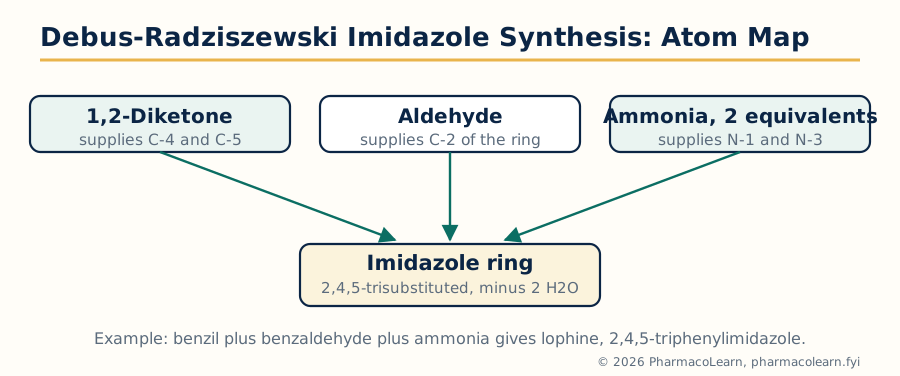 Figure: Where every imidazole atom comes from in the Debus-Radziszewski synthesis.
4.3 Knorr pyrazole synthesis
The reaction: a 1,3-dicarbonyl compound condenses with hydrazine or a substituted hydrazine to give a pyrazole. One nitrogen of hydrazine attacks the more reactive carbonyl, the second nitrogen closes onto the other carbonyl, and two dehydrations aromatise the ring; the two nitrogens end adjacent, which is the defining feature of pyrazole against imidazole.
Drug connection: with phenylhydrazine and ethyl acetoacetate the product is the pyrazolone antipyrine (phenazone) after N-methylation, and further elaboration gives metamizole sodium (dipyrone), the water soluble sulfonated analogue; both are classical analgesic antipyretics. The anti-inflammatory celecoxib carries a 1,5-diaryl pyrazole built by condensing a trifluoromethyl 1,3-diketone equivalent with a sulfonamide bearing phenylhydrazine, so the Knorr regiochemistry, which aryl group lands at C-3 and which at C-5, is a real industrial question in that drug.
4.4 Knorr pyrrole synthesis
The KBH copy adds the Knorr pyrrole synthesis: an alpha-amino ketone or alpha-amino beta-keto ester (made by nitrosation of a beta-keto ester and reduction) condenses with a second active methylene compound; the amine attacks the partner's carbonyl, cyclisation and dehydration give a polysubstituted pyrrole. It is the standard route to heavily substituted pyrroles and contrasts with the Paal-Knorr synthesis (1,4-diketone plus ammonia) that students often confuse with it: Knorr joins two fragments, Paal-Knorr closes one.
4.5 Pinner pyrimidine synthesis
The reaction: an amidine condenses with a 1,3-dicarbonyl compound (or its enol ether equivalent) under basic conditions to give a pyrimidine. The two amidine nitrogens become N-1 and N-3 of the ring and the amidine carbon becomes C-2; the dicarbonyl supplies C-4, C-5 and C-6. Regiochemistry with unsymmetrical partners is controlled by using enol ethers or enaminones with one defined electrophilic end.
Drug connection: the pyrimidine ring of the antibacterial sulfamerazine is 2-amino-4,6-dimethylpyrimidine, built by Pinner logic from amidine chemistry and then coupled as its amino group with N-acetylsulfanilyl chloride, hydrolysis freeing the sulfanilamide NH. Trimethoprim is a 2,4-diaminopyrimidine: its ring is closed by cyclisation with guanidine (the amidine partner) onto a three carbon unit derived from 3,4,5-trimethoxybenzaldehyde, giving the benzyl substituted diaminopyrimidine that inhibits bacterial dihydrofolate reductase. Triamterene is a pteridine, a pyrimidine fused to a pyrazine, and belongs to the same diaminopyrimidine family in its binding logic.
4.6 Combes quinoline synthesis
The reaction: an aniline condenses with a 1,3-diketone to give an enaminone (a beta-anilino enone); strong acid (concentrated sulfuric acid classically) then cyclises it by electrophilic attack of the protonated carbonyl carbon onto the ortho position of the aniline ring, and dehydration gives a 2,4-disubstituted quinoline.
Comparison within the family: Skraup builds quinoline from glycerol as the three carbon unit under harsh oxidising conditions and gives the unsubstituted ring; Doebner-Miller (Unit 2) uses an alpha,beta-unsaturated carbonyl partner and gives 2-substituted quinolines; Combes gives the 2,4-pattern directly and predictably, which is why it is the textbook choice for substituted quinolines, with the limitation that meta substituted anilines can cyclise to either ortho position and give mixtures.
Drug connection: the quinoline nucleus carries the antimalarials. Chloroquine and hydroxychloroquine are 4-aminoquinolines: the industrial route makes 4,7-dichloroquinoline (by a Gould-Jacobs type cyclisation) and displaces the reactive 4-chloro group with the dialkylamino side chain amine; hydroxychloroquine differs only in carrying a hydroxyethyl group on the side chain nitrogen. Quinine, the original antimalarial, is a quinoline methanol alkaloid from cinchona bark, obtained by extraction rather than total synthesis in commerce, but its quinoline half is the same nucleus this section builds.
4.7 Bernthsen acridine synthesis
The reaction: a diarylamine is heated with a carboxylic acid (or anhydride) and zinc chloride at high temperature; the acid carbon becomes C-9 of the acridine, inserted between the two rings by double electrophilic substitution, giving a 9-substituted acridine.
Drug connection: acridines are flat, DNA intercalating tricyclics. Quinacrine (mepacrine) is a 9-aminoacridine antimalarial whose side chain is attached at C-9 through the amino group, a descendant of the Bernthsen construction; amsacrine is a 9-anilinoacridine anticancer agent, a topoisomerase II poison. The phenothiazine antipsychotics belong to the neighbouring sulfur bridged family: promazine, chlorpromazine and prochlorperazine are built on phenothiazine, made by heating diphenylamine with sulfur (Bernthsen's thionation), chlorination at C-2 for the chlorinated members, and N-alkylation of the ring nitrogen with the appropriate aminoalkyl chloride side chain, the side chain being the main structural variable among the three drugs.
4.8 Smiles rearrangement
The Smiles rearrangement is an intramolecular nucleophilic aromatic substitution: in a system such as a 2-hydroxy or 2-amino diaryl sulfone, base generates the internal nucleophile, which attacks the other ring at the carbon bearing the sulfone, through a spiro Meisenheimer intermediate; the carbon-sulfur bond then breaks, completing a net migration of the aryl group from sulfur to oxygen or nitrogen.
It is examined as the elegant proof that SNAr (Unit 1) can be made intramolecular, and its synthetic use is to build diaryl ethers and hydroxy sulfones with substitution patterns that direct coupling gives poorly. The Truce-Smiles variant extends the same idea to carbon nucleophiles, where a carbanion displaces a sulfone.
4.9 Traube purine synthesis
The reaction: a 4,5-diaminopyrimidine (carrying the substituents wanted at the future 2 and 6 positions) is heated with formic acid or a formamide equivalent; the 5-amino group is formylated and then cyclises onto the 4-amino group, closing the fused imidazole ring and giving the purine. Where a substituent other than hydrogen is wanted at C-8, the corresponding carboxylic acid or derivative replaces formic acid.
Drug connection: purine is the nucleus of the xanthines and the antimetabolites. Theophylline is 1,3-dimethylxanthine (a purine-2,6-dione), classically built by the Traube route from dimethylurea and a malonic unit through the diaminouracil, nitrosation, reduction and formic acid closure sequence. Mercaptopurine (6-mercaptopurine) is made from hypoxanthine by replacing the 6-oxygen with sulfur (phosphorus pentasulfide thiation), and thioguanine is its 2-amino analogue; both are cytotoxic antimetabolites whose action depends on the purine ring being accepted by the salvage pathway enzymes.
4.10 The fused and remaining drug nuclei in outline
Two named drug groups of the syllabus sit on fused systems not covered by a single named reaction above, and the examination expects their nuclei recognised:
- Alprazolam is a triazolobenzodiazepine: a benzene ring fused to a seven membered diazepine that is itself fused to a triazole. Its synthesis builds the benzodiazepinone framework (from 2-amino-5-chlorobenzophenone chemistry) and annelates the triazole ring at the end, illustrating that fused systems are usually built one ring at a time onto a preformed ring, the strategy generalised in Unit 5.
- The phenothiazines (section 4.7) complete the fused list: five membered, six membered and fused nuclei, each reached by a named ring closure from simple precursors, which is the single pattern this whole unit teaches.
Unit 5: Synthon Approach and Retrosynthesis Applications
5.1 The disconnection approach: language and first principles
Retrosynthesis plans a synthesis backwards. Instead of asking what a starting material can be turned into, it asks what the target molecule (TM) could be made from, and repeats the question until the answer is a purchasable starting material. The backward step is a disconnection: an imaginary breaking of one bond of the target, corresponding to a real reaction run forwards. Disconnection is written with the retrosynthetic arrow (a double line open arrow, shown here as =>) and gives synthons: the idealised fragments the disconnection implies, charged or radical fragments that may not exist as such. Each synthon is then matched to a synthetic equivalent, the real reagent that behaves as that synthon: the acyl cation synthon R-C+=O is matched by the acid chloride R-COCl, and the carbanion synthon R- by the Grignard reagent RMgX.
Two auxiliary operations complete the language. Functional group interconversion (FGI) changes one functional group into another without touching the skeleton, moving the molecule to a form where a good disconnection exists (oxidise an alcohol to a ketone so that a carbonyl disconnection can be used). Functional group addition (FGA) deliberately adds a group, often a carboxyl or an activating group, to make a disconnection possible or regioselective, the group being removed later. Umpolung names the polarity inversions that supply unusual synthons, such as the dithiane anion as an acyl anion equivalent (Unit 3).
The advantages the syllabus lists are real: working backwards guarantees every step is chosen because the target needs it; it exposes several routes for comparison before any laboratory time is spent; and it concentrates attention on the skeleton forming steps, which decide whether a route is short or long.
5.2 Guidelines for the dissection of molecules
- Disconnect bonds made by reliable reactions first: amide, ester and ether bonds, and C-C bonds formed by the named reactions of Unit 2, because the forward reactions are trusted.
- Disconnect at branch points and near the middle: two similar sized fragments shorten the longest linear sequence, and convergent routes (fragments made in parallel, joined late) beat long linear ones for overall yield.
- Use symmetry: if the target has a plane of symmetry, one disconnection can create both halves from a single fragment.
- Let functional groups guide the cut: the C-C bond beside an alcohol is a Grignard disconnection; beside a carbonyl, an enolate disconnection.
- Prefer disconnections that give stable synthons and cheap equivalents, and avoid synthons with no real equivalent.
- Simplify before disconnecting: FGI the target into the form with the most obvious disconnection, and disconnect the simplified form.
- Count the cost of protecting groups: a disconnection demanding extensive protection (Unit 3) is usually inferior to one that avoids the clash.
5.3 C-X disconnections
Heteroatom bonds are the easiest disconnections because the forward reactions are substitutions and acylations of predictable polarity: the heteroatom partner is the nucleophile and the carbon partner is the electrophile (or acyl electrophile).
- Ethers: disconnect the C-O bond on either side; choose the side that puts the SN2 displacement on the less hindered carbon, the logic of the Williamson ether synthesis. Aryl alkyl ethers disconnect to phenol plus alkyl halide, never the reverse.
- Esters and amides: disconnect at the acyl bond to carboxylic acid (or chloride) plus alcohol or amine. These are one group C-X disconnections: one functional group in the target, one disconnection.
- Amines: disconnect a C-N bond to amine plus alkyl halide for simple alkyl groups, but remember overalkylation: for precise work the amine is often better reached by FGI from an amide, a nitrile, an imine reduction (reductive amination) or a Gabriel synthesis, so the apparent C-N disconnection is replaced by a carbonyl level precursor.
- Sulfides and thiols follow the same nucleophile-electrophile matching as ethers.
5.4 C-C disconnections: alcohols and carbonyl compounds
Alcohols. The C-C bond next to a carbinol carbon is disconnected so that the carbon bearing OH becomes a carbonyl carbon synthon and the other fragment becomes a carbon nucleophile synthon:
Alcohol disconnection, the 1,1-pattern

R2CH-OH target
  => disconnect the C-C bond beside the OH carbon
  => synthon 1: a carbonyl carbon (equivalent: an aldehyde or ketone)
  => synthon 2: a carbanion at the other fragment (equivalent: a Grignard
     reagent or organolithium)
Forward: RMgX adds to the carbonyl, work up gives the alcohol.
The choice of which group comes from the carbonyl partner and which from
the Grignard partner is made on cost, availability and symmetry.
Carbonyl compounds. Ketones and aldehydes disconnect in the same place but with different matched methods: an acyl synthon plus an alkyl synthon (forward: organometallic addition to an acid chloride derivative, a Weinreb amide, or a nitrile), or, for alpha functionalised carbonyls, an enolate synthon plus an electrophile synthon (forward: enolate alkylation and acylation, Unit 1). Carboxylic acids disconnect to the one carbon shorter nucleophile synthon plus carbon dioxide (Grignard carboxylation) or to a nitrile that is hydrolysed. Alpha,beta-unsaturated carbonyls disconnect across the double bond to an enolate donor and an aldehyde, the aldol logic, or are recognised as Michael products.
5.5 Difunctionalised compounds: the 1,n patterns
When two functional groups share a skeleton, the distance between them names the pattern and points to the reaction that makes both relationships at once:
| Pattern | Typical target | Disconnection logic | Forward reaction |
|---|---|---|---|
| 1,2-Difunctional | Alpha-hydroxy carbonyls, vicinal diols, epoxides | Break the C-C bond between the two functionalised carbons, or simplify by FGI to an alkene | Cyanohydrin and acyloin type couplings; diols by alkene dihydroxylation (OsO4, Unit 3) after FGI |
| 1,3-Difunctional | Beta-hydroxy carbonyls, 1,3-dicarbonyls | Disconnect the C-C bond beside one carbonyl: enolate plus carbonyl | Aldol reaction; Claisen and Dieckmann condensations |
| 1,4-Difunctional | Gamma-keto esters and acids | Needs one synthon of reversed polarity (umpolung): an acyl anion equivalent or a homoenolate equivalent | Dithiane alkylation then hydrolysis; Stetter reaction |
| 1,5-Difunctional | Delta-keto carbonyls, 1,5-dicarbonyls | Disconnect the bond between the alpha and beta carbons of the enone pattern | Michael addition (Unit 2) |
| 1,6-Difunctional | Hexanedioic (adipic) type chains | Disconnect the central bond and recognise a ring: simplify by FGI to a cyclohexene | Ozonolysis or oxidative cleavage of the ring double bond (Unit 2) |
The table is the working core of this unit. The 1,3 and 1,5 patterns arise from ordinary enolate polarity and are easy; the 1,4 pattern is deliberately listed to teach umpolung, because normal polarity cannot join two electrophilic carbons; the 1,6 pattern teaches that a ring can be a synthetic equivalent of a chain.
5.6 Strategies for the synthesis of rings
- Three membered rings: carbene and carbenoid addition to alkenes (cyclopropanes, Unit 1), and intramolecular SN2 closures to epoxides and aziridines; in retrosynthesis a cyclopropane disconnects back across one bond to the alkene.
- Four membered rings: the hardest common size, because of ring strain and slow cyclisation. Photochemical [2+2] cycloaddition and ketene [2+2] cycloaddition are the reliable entries; a cyclobutanone is read back to a ketene plus an alkene.
- Five membered rings: cyclisation is fast and favourable. Dieckmann condensation for carbocycles, Paal-Knorr and Knorr condensations (Unit 4) for pyrroles, furans and thiophenes, 1,3-dipolar cycloadditions for five membered heterocycles, and radical or anionic 5-exo cyclisations.
- Six membered rings: the Diels-Alder reaction is the first disconnection to try for a cyclohexene ring (disconnect two bonds back to diene plus dienophile); Robinson annulation builds the ring by Michael addition and aldol closure; Dieckmann and intramolecular aldol reactions close saturated rings; the named quinoline, pyrimidine and purine syntheses of Unit 4 are the heterocyclic equivalents, joining a dinucleophile fragment to a dielectrophile fragment.
- Heterocyclic rings generally: read the ring as nucleophile fragment plus electrophile fragment: count the atoms each partner contributes (the 3 plus 2 and 2 plus 3 patterns), place the heteroatom bonds as C-X disconnections (section 5.3) and the remaining C-C bond as the enolate or condensation disconnection.
5.7 Sequence of events in a disconnection analysis
The KBH copy names the working order explicitly, and it is the order used in the worked examples of any textbook treatment:
- Analyse: identify every functional group in the target, the ring systems, the stereocentres and any symmetry.
- Simplify: apply FGI on paper to reach the form of the target with the most powerful disconnection available.
- Disconnect: break one strategic bond, write the synthons, and immediately write the real synthetic equivalents under them; a disconnection without known equivalents is a guess, not a plan.
- Repeat: treat each fragment as a new target until every fragment is a known or purchasable compound.
- Write the forward synthesis: reverse every arrow, order the steps so that reactive groups are made late or protected (Unit 3), check each step against a named, trusted reaction, and check that no step destroys functionality installed earlier.
- Compare routes where more than one analysis succeeded: shortest longest sequence, cheapest starting materials, fewest protections and safest reagents win.
Worked illustration, ibuprofen. The target is 2-(4-isobutylphenyl)propanoic acid: a carboxylic acid one carbon from a benzylic centre, on a para substituted ring. Disconnect the bond between ring and side chain first (a Friedel-Crafts disconnection): the synthons are isobutylbenzene plus a two carbon propanoate electrophile equivalent. Forward, the industrial Boots route acylates isobutylbenzene, then builds the acid through a Darzens glycidic ester sequence, hydrolysis and decarboxylation; the later BHC green route keeps the same acylation disconnection but executes it in three steps (HF catalysed acylation, hydrogenation of the ketone, carbonylation). One good disconnection can support more than one forward execution, and the greener execution wins commercially.
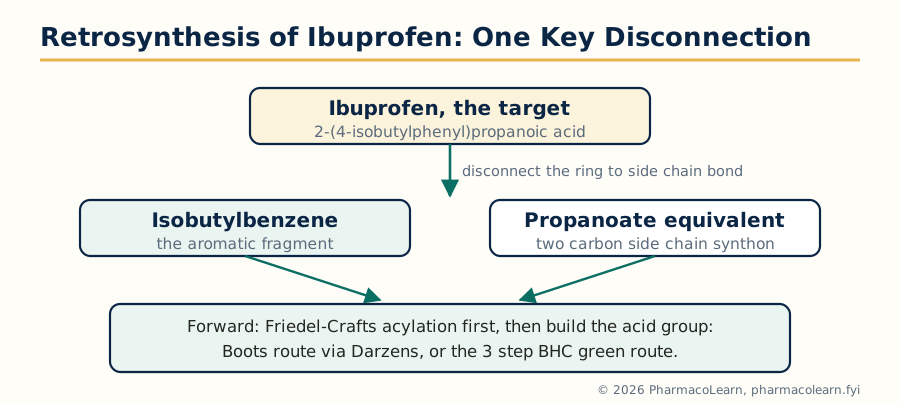 Figure: Ibuprofen dissected. One Friedel-Crafts disconnection supports both the Boots and the BHC forward routes.
Frequently Asked Questions
Q: How does the stability order of carbocations differ from that of carbanions, and why?
Carbocations are stabilised by electron donation, so the order is tertiary > secondary > primary > methyl, with allyl and benzyl cations higher still because the charge is delocalised. Carbanions are stabilised by electron withdrawal and delocalisation of the lone pair, so simple alkyl anions follow the reverse order, and the useful carbanions are resonance stabilised ones such as enolates and the anions of 1,3-dicarbonyl compounds. The same substituent, an alkyl group, stabilises one and destabilises the other because the two species have opposite electron demand.
Q: Which experiments would you use to prove that a reaction goes through a carbocation?
Look for the cation's fingerprints: rearranged products from hydride or alkyl shifts, racemisation at the reacting carbon, a rate law that depends only on the substrate, strong acceleration by ionising solvents, and common ion rate depression. Where direct evidence is wanted, carbocations can be generated in superacid media and observed by NMR, or trapped with azide ion to give alkyl azides among the products.
Q: What is the difference between the Saytzeff and Hofmann products of an elimination?
The Saytzeff product is the more substituted alkene, favoured with small bases because the transition state borrows the stability of the more stable alkene. The Hofmann product is the less substituted alkene, favoured with bulky bases that can only reach the least hindered proton, and in the Hofmann elimination of quaternary ammonium hydroxides where the charged leaving group and statistical proton counts reinforce the same result. Naming the product is not enough in an answer; the reason, alkene stability against steric access, is what earns marks.
Q: Why is fluoride the best leaving group in SNAr when it is the worst in SN1 and SN2?
In SNAr the rate determining step is addition of the nucleophile to the ring, not breaking of the carbon-halogen bond. Fluorine's powerful electron withdrawal makes the ring carbon more electrophilic and stabilises the Meisenheimer complex, so fluoride substrates react fastest even though the C-F bond is the strongest. In aliphatic substitution the bond must break in or before the rate determining step, so the order reverses and iodide, with the weakest bond, leaves best.
Q: What makes the Mitsunobu reaction give inversion, and when does it fail?
The alcohol oxygen is converted into an alkoxyphosphonium group, turning hydroxide into a leaving group as good as triphenylphosphine oxide, and the nucleophile then performs an ordinary backside SN2 displacement, which inverts the centre. It fails for tertiary alcohols because the SN2 step is sterically blocked, and for pronucleophiles too weakly acidic (pKa above roughly 13) because the DEAD-phosphine betaine cannot deprotonate them.
Q: How do you remember which face the Sharpless epoxidation oxidises?
Draw the allylic alcohol in the standard orientation, double bond horizontal with the CH2OH group at the lower right. Natural (+)-diethyl tartrate in the titanium complex then delivers oxygen to the bottom face of the double bond and (-)-diethyl tartrate delivers it to the top face. The mnemonic only works quoted with its drawing convention, and the allylic alcohol group is essential because it binds the substrate to the titanium-tartrate catalyst.
Q: What are the three steps of the Suzuki catalytic cycle and what does each do?
Oxidative addition: palladium(0) inserts into the aryl or vinyl halide bond, giving a palladium(II) complex. Transmetalation: the base activated boronate transfers its organic group from boron to palladium. Reductive elimination: the two organic groups on palladium join to form the new C-C bond and palladium(0) is regenerated. Each step has a distinct job, bond breaking at the halide, group transfer, and bond making, and the cycle explains both the need for base and the retention of alkene geometry.
Q: What decides which group migrates in the Baeyer-Villiger oxidation?
Geometry first: the migrating group must be anti-periplanar to the O-O bond of the Criegee intermediate. Within that constraint, aptitude follows the ability to carry partial positive charge in the migration transition state, giving the order tertiary alkyl > secondary alkyl and phenyl > primary alkyl > methyl, with electron rich aryl groups migrating faster than electron poor ones. The migrating group retains its configuration because it never detaches from the molecule.
Q: What makes a protecting group orthogonal to another one?
Two protecting groups are orthogonal when each can be removed under conditions that leave the other completely untouched: a benzyl ether (removed by hydrogenolysis) beside a TBDMS ether (removed by fluoride), or a Boc group (acid labile) beside a Cbz group (hydrogenolysis labile). Orthogonality lets a synthesis unmask one functional group at a time, which is the basis of peptide synthesis strategy, where Boc or Fmoc on nitrogen, an ester on the carboxyl and separate side chain masks are all removed in a planned order.
Q: How do you choose a disconnection for a molecule with two functional groups?
First measure the distance between the groups and name the pattern. A 1,3 relationship disconnects to an enolate plus a carbonyl compound (aldol or Claisen logic), a 1,5 relationship to a Michael addition, a 1,2 relationship is handled by FGI to an alkene or by umpolung couplings, a 1,4 relationship demands one reversed polarity synthon such as a dithiane anion, and a 1,6 relationship is simplified back to a ring alkene that is cleaved oxidatively. The pattern, not the individual groups, makes the choice.
Complete MPC102T notes, all 5 units in one PDF, free to keep.
Other M.Pharm subjects: MPH101T · MPC101T · MPL101T · MPH102T · MPH103T · MPH104T · MPL102T · MPL103T · MPL104T · MPC102T · MPC103T · MPC104T · MPH201T · MPH202T · MPH203T · MPH204T · MPC201T · MPC202T · MPC203T · MPC204T · M.Pharm