
MPC202T — Advanced Organic Chemistry II
4 hrs/week, 4 credits, 60 hours, 100 marks (75 end semester + 25 sessional). Notes follow the M.Pharm syllabus, unit by unit.
MPC202T Advanced Organic Chemistry II notes for M.Pharm Semester 2 Pharmaceutical Chemistry: green chemistry, microwave, ultrasound and flow synthesis, peptide and solid phase synthesis, pericyclic reactions, catalysis, asymmetric synthesis, free unit wise PDF downloads on PharmacoLearn.
Units in this subject
- Unit 1 — Green Chemistry: introduction and principles of green chemistry; microwave assisted reactions (merits and demerits, increased reaction rates, mechanism, superheating effects, solvent effects, process optimization, applications in organic reactions and heterocycle synthesis); ultrasound assisted reactions (homogeneous, heterogeneous liquid-liquid and liquid-solid, synthetic applications); continuous flow reactors (working principle, advantages and synthetic applications)
- Unit 2 — Chemistry of peptides: coupling reactions in peptide synthesis; principles of solid phase peptide synthesis, t-Boc and Fmoc protocols, solid supports and linkers, activation, peptide bond formation, deprotection and cleavage from resin, low and high HF cleavage, free peptides and peptide amides, purification and case studies, site-specific chemical modifications of peptides; segment and sequential strategies for solution phase peptide synthesis with two case studies; side reactions in peptide synthesis (deletion peptides, proton abstraction, protonation, overactivation, individual amino acids)
- Unit 3 — Photochemical reactions: basic principles of photochemical reactions, photo-oxidation, photo-addition and photo-fragmentation; pericyclic reactions: mechanism and types, cycloaddition, electrocyclic reactions and sigmatropic rearrangement reactions with examples
- Unit 4 — Catalysis: types of catalysis, heterogeneous and homogeneous, advantages and disadvantages; heterogeneous catalysis (preparation, characterization, kinetics, supported catalysts, deactivation and regeneration, examples in synthesis of drugs); homogeneous catalysis (hydrogenation, hydroformylation, hydrocyanation, Wilkinson catalysts, chiral ligands and chiral induction, Ziegler-Natta catalysts, examples in synthesis of drugs); transition-metal and organo-catalysis; biocatalysis (enzymes and immobilized enzymes/cells in organic synthesis); phase transfer catalysis, theory and applications
- Unit 5 — Stereochemistry and asymmetric synthesis: optical activity, specific rotation, racemates and resolution of racemates, Cahn-Ingold-Prelog sequence rules, meso compounds, pseudoasymmetric centres, axes of symmetry, Fischer D and L notation, cis-trans isomerism, E and Z notation; methods of asymmetric synthesis using chiral pool, chiral auxiliaries and catalytic asymmetric synthesis, enantiopure separation and stereoselective synthesis with examples
Download MPC202T PDF Notes
Free PDFs for this subject, one per unit:
Advanced Organic Chemistry II, subject code MPC202T, is a core Semester 2 subject of M.Pharm Pharmaceutical Chemistry. It carries 4 credits and 60 hours of theory, taught at 4 hours per week, for 100 marks.
Where Advanced Organic Chemistry I (MPC102T) taught how reactions work, this subject teaches how modern synthesis is actually practised. Unit 1 covers green chemistry and the three enabling technologies that have changed how reactions are heated, mixed and scaled: microwave irradiation, ultrasound and continuous flow reactors. Unit 2 is the chemistry of peptides, from coupling reagents and the racemisation problem through Merrifield solid phase synthesis in its Boc and Fmoc forms to solution phase strategies and side reactions. Unit 3 treats reactions driven by light and reactions governed by orbital symmetry: photo-oxidation, photo-addition and photo-fragmentation, then the pericyclic family of cycloadditions, electrocyclic reactions and sigmatropic rearrangements. Unit 4 is catalysis in all its forms: heterogeneous, homogeneous, transition metal, organo, bio and phase transfer catalysis, each with the examples drug synthesis actually uses. Unit 5 returns to stereochemistry at full depth: optical activity, the CIP rules, meso and pseudoasymmetric centres, D and L notation, E and Z notation, resolution of racemates, and the three great strategies of asymmetric synthesis, chiral pool, chiral auxiliaries and chiral catalysts. A student who completes this subject should be able to choose a greener way to run a reaction, plan a peptide synthesis and predict its side products, assign the stereochemical course of a pericyclic reaction, pick a catalyst class for a transformation, and design a route to a single enantiomer.
Unit 1: Green Chemistry: Microwave, Ultrasound and Continuous Flow Synthesis
1.1 Why synthesis needed a greener logic
Classical organic synthesis was judged by one number: yield. The waste a process generated, the solvents it consumed and the hazard it carried were someone else's problem. The pharmaceutical industry made this impossible to ignore, because drug molecules are complex, their syntheses are long, and the waste per kilogram of product is the highest in the chemical industry. Roger Sheldon quantified this with the E factor, the kilograms of waste produced per kilogram of product. His classic comparison puts oil refining near 0.1, bulk chemicals at about 1 to 5, fine chemicals at 5 to 50 and pharmaceuticals at 25 to 100 or more. Solvents are the largest single part of that waste, typically 80 to 90 percent of the mass of a pharmaceutical process. Green chemistry, formalised by Paul Anastas and John Warner in 1998, is the design discipline that attacks the problem at source: a process that never makes waste does not have to treat it.
1.2 The twelve principles of green chemistry
The twelve principles are the syllabus in miniature; almost every topic in this unit is one of them in action.
- Prevention: it is better to prevent waste than to treat or clean it up after it is formed.
- Atom economy: synthetic methods should maximise the incorporation of all materials used into the final product.
- Less hazardous chemical syntheses: methods should use and generate substances with little or no toxicity.
- Designing safer chemicals: products should achieve their function while minimising toxicity.
- Safer solvents and auxiliaries: auxiliary substances (solvents, separation agents) should be unnecessary where possible and innocuous where used.
- Design for energy efficiency: energy requirements should be minimised; reactions should run at ambient temperature and pressure where possible.
- Use of renewable feedstocks: a raw material should be renewable rather than depleting where technically and economically practicable.
- Reduce derivatives: unnecessary derivatisation (blocking groups, protection and deprotection, temporary modification) should be minimised or avoided, because it consumes reagents and creates waste.
- Catalysis: catalytic reagents, as selective as possible, are superior to stoichiometric reagents.
- Design for degradation: chemical products should break down at the end of their function into innocuous substances.
- Real time analysis for pollution prevention: analytical methods should allow in-process monitoring and control before hazardous substances form.
- Inherently safer chemistry for accident prevention: substances and processes should be chosen to minimise the potential for explosions, fires and releases.
Unit 4 of this subject is principle 9 expanded; the microwave, ultrasound and flow methods below are principles 5 and 6 in hardware form; and the protecting group discipline of Unit 2 exists partly because principle 8 says every protection step that can be avoided should be.
1.3 Measuring greenness: atom economy and the E factor
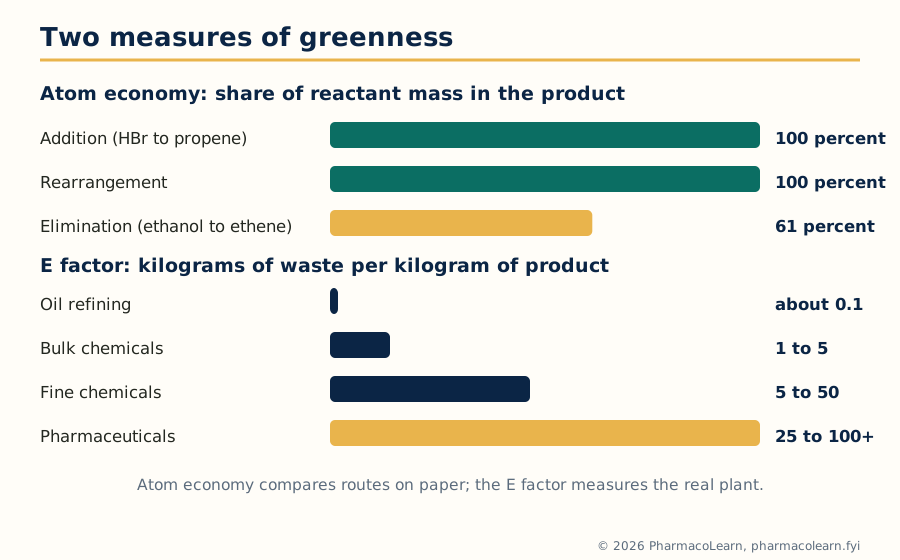
Figure: Atom economy rewards additions and rearrangements; the E factor shows why pharmaceutical processes, with E factors of 25 to 100 or more, are the prime target for greener design.
Atom economy (Trost) is calculated before a reaction is ever run: atom economy = (molecular weight of the desired product divided by the sum of the molecular weights of all reactants) multiplied by 100. Addition and rearrangement reactions score 100 percent in principle, because every reactant atom appears in the product. Substitution and elimination reactions necessarily lose atoms as leaving groups or small molecules. A quick example: dehydration of ethanol to ethene gives 28 divided by 46, an atom economy of about 61 percent, the rest leaving as water; addition of HBr to propene gives 100 percent, because the only product is the bromoalkane. Atom economy ignores yield, excess reagents and solvents, which is where the E factor and its relative, process mass intensity (total mass in per mass of product), take over. A wise process chemist quotes both: atom economy to compare routes on paper, E factor to compare plants in practice.
1.4 Microwave assisted reactions: how the heating works
A domestic or laboratory microwave field oscillates at 2.45 GHz, and it heats by dielectric heating through two mechanisms. In dipolar polarisation, molecules with a permanent dipole (water, alcohols, DMF) try to follow the oscillating field; their rotation lags the field, and the friction of that lag is dissipated as heat throughout the whole volume at once. In ionic conduction, dissolved ions are dragged back and forth through the solution and collide with solvent molecules, again generating heat. The efficiency of a solvent is summarised by its loss tangent, tan delta: ethanol (about 0.94), DMSO (about 0.83) and methanol are strong absorbers; water (about 0.12) is moderate; acetonitrile is weak; toluene (about 0.04) and hexane are almost transparent. Unlike an oil bath, which heats the vessel wall and relies on conduction and convection, microwave energy is deposited directly in the reaction mixture, so the contents can be hotter than the walls: the temperature gradient is inverted.
1.5 Why microwave reactions are fast: rates, superheating and solvent effects
Three effects combine to give the rate increases, often hours compressed into minutes, that the syllabus asks about.
- Rapid, uniform core heating: the mixture reaches the set temperature in seconds, so none of the reaction time is wasted climbing a slow thermal ramp.
- Superheating: in a sealed vessel the solvent can be held far above its normal boiling point, since pressure rises instead of boiling occurring; a reaction in ethanol at 180 degrees Celsius in a sealed microwave vessel is routine, and by the Arrhenius equation each 10 degree rise roughly doubles the rate, so the rate gains are large and entirely thermal in origin. Claims of mysterious non-thermal "specific microwave effects" have largely been traced to exactly these thermal and wall effects when temperature is measured properly with internal probes.
- Solvent effects: the solvent is the heating element. Polar solvents and ionic reagents couple strongly and heat fast; non-polar solvents heat poorly unless a susceptor is added (a strongly absorbing material such as silicon carbide or graphite, or a passive heating element in the vessel). Ionic liquids, being entirely ionic, absorb extremely well. Reactions can also be run neat or on solid supports (alumina, silica, clays), where adsorbed polar reactants absorb the field selectively, combining microwave heating with the solvent-free ideal of principle 5.
Merits: dramatic time savings, frequently higher yields and cleaner product profiles (less time at temperature means fewer decomposition products), energy efficiency, reproducibility in dedicated single-mode reactors, and rapid optimisation because dozens of conditions can be screened in an afternoon. Demerits: the field penetrates only a few centimetres into an absorbing mixture, so batch scale-up is limited and large-scale work moves to flow or multimode systems; sealed vessels carry pressure hazards; equipment is costly; and temperature measurement is less direct than sticking a thermometer in a flask. Microwave technology earns its place in process optimisation precisely as a discovery and screening engine: find the fast, clean, high-temperature conditions in the microwave, then transfer them to a flow reactor (section 1.9) for production.
1.6 Microwave synthesis in practice
Microwave conditions have been applied across the standard reaction repertoire: condensations, cycloadditions, metal catalysed cross couplings that complete in minutes, and alkylations under phase transfer conditions. The showcase applications are in heterocycle synthesis, where the cyclisation step is often slow and high temperature: the Biginelli dihydropyrimidinone synthesis, Hantzsch pyridine and dihydropyridine syntheses, imidazole, thiazole and pyrazole ring closures, and quinoline syntheses all run in minutes under microwave irradiation, frequently in water or ethanol rather than in high-boiling toxic solvents. This matters to the pharmaceutical chemist because most drug scaffolds are heterocyclic (Unit 4 of MPC102T): the microwave has become the default tool for building analogue libraries of heterocycles during drug discovery.
1.7 Ultrasound assisted reactions: acoustic cavitation
Ultrasound in synthesis means sound at frequencies above human hearing, usually 20 to 100 kHz from a cleaning bath or an immersion probe. Its chemistry comes not from the sound wave itself but from acoustic cavitation: in the low-pressure half-cycle of the wave, microscopic bubbles form and grow in the liquid; in the compression half-cycle they collapse violently. The collapse concentrates the energy of the wave into tiny hot spots estimated at roughly 5000 K and pressures of the order of 1000 atmospheres, lasting microseconds, with extreme heating and cooling rates. Near a solid surface the collapse is asymmetric and launches a microjet of liquid at the surface, which cleans, pits and activates it. Two consequences follow: in homogeneous solution, cavitation can generate radicals and switch reaction pathways (sonochemical switching); in heterogeneous systems, the dominant effects are mechanical, surface activation, particle size reduction and intense local mixing, sometimes called false sonochemistry because the chemistry itself is ordinary.
1.8 Types of sonochemical reactions
The syllabus divides sonochemical reactions by phase behaviour:
- Homogeneous liquid phase reactions: cavitation inside a single liquid phase produces radicals and excited species; the classic examples are the decomposition of volatile organometallics and aqueous sonolysis, in which water is split into hydrogen atoms and hydroxyl radicals that can drive oxidations. True sonochemistry, radical in character.
- Heterogeneous liquid-liquid reactions: two immiscible liquids, where ultrasound emulsifies the mixture into a fine dispersion, multiplying the interfacial area so that reactions normally needing a phase transfer catalyst can proceed faster, or with less catalyst; examples include ester hydrolyses and the generation of dichlorocarbene from chloroform and aqueous alkali.
- Heterogeneous liquid-solid reactions: a solid reactant or catalyst in a liquid, where microjets strip passivating layers and expose fresh surface. This is the most synthetically valuable class: formation of organometallic reagents that are sluggish conventionally, such as the Barbier reaction (carbonyl plus alkyl halide plus metal in one pot) and the Reformatsky reaction (zinc and an alpha-bromo ester), both dramatically improved by sonication; also lithium and magnesium activation, and hydrogenations over catalysts whose surfaces stay clean.
1.9 Continuous flow reactors: working principle
In a flow reactor the reagents are pumped continuously through a channel, coil or packed bed of small internal volume, reacted for a defined residence time (reactor volume divided by total flow rate: a 10 mL coil at 1 mL per minute gives every molecule a 10 minute reaction), and the product stream exits to be collected or fed into the next step. Small channels have a very high surface area to volume ratio, so heat transfer and mixing are excellent; a back pressure regulator lets solvents be superheated safely, like a microwave vessel but continuously; and at any instant only a few millilitres of reaction mixture exist, so hazardous intermediates (azides, diazo compounds, nitration mixtures, ozonolysis) are generated and consumed in small, controlled amounts, the concept Yoshida calls flash chemistry when residence times are seconds and reactive organolithium species are used before they can decompose.
1.10 Flow reactors: advantages and synthetic applications
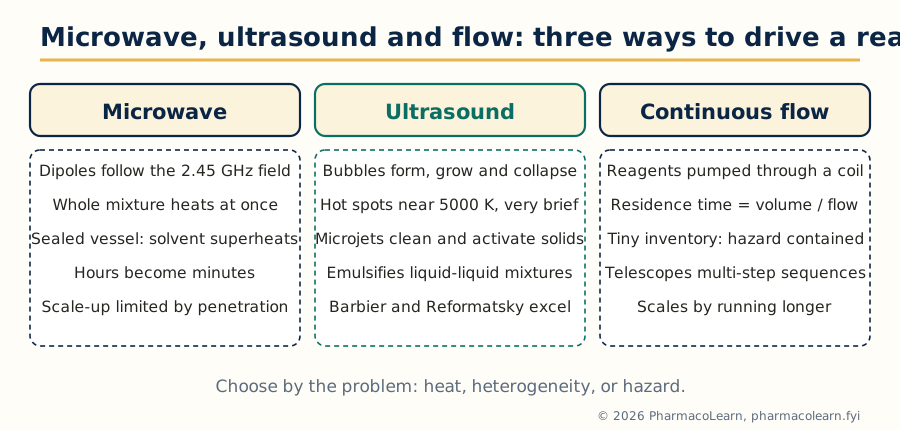
Figure: Three physical ways to drive reactions: microwave heats dielectrically, ultrasound works through cavitation, and flow reactors work through controlled residence time.
Advantages: safety at small inventory; precise control of temperature, mixing and reaction time, hence reproducibility; easy automation and in-line analysis (principle 11); scale-up by running longer or numbering up parallel channels rather than redesigning a vessel; and the ability to telescope several steps into one continuous sequence with no isolation of intermediates. Applications: continuous nitration and hydrogenation at production scale, photochemical steps in transparent flow coils (section 3.2), exothermic organometallic chemistry, and complete multi-step API syntheses in a single flowing stream: literature demonstrations include continuous routes to ibuprofen and to artemisinin. Flow is where microwave discovery conditions most often end up when a process group adopts them, so the two technologies of this unit are partners, not rivals.
| Feature | Microwave batch | Ultrasound | Continuous flow |
|---|---|---|---|
| Energy input | Dielectric heating of the whole mixture | Acoustic cavitation, local hot spots and jets | Conductive heating of a small flowing volume |
| Best at | Fast screening, heterocycle synthesis, superheated solvents | Heterogeneous mixtures, metal activation, emulsions | Scale-up, hazardous steps, multi-step sequences |
| Scale limit | Penetration depth of the field, vessel size | Bath and probe are bench scale | Run longer or number up, production proven |
| Main hazard | Pressure in sealed vessels | Probe erosion, noise, radical pathways | Blockages, pressure control |
| Green principle served | Energy efficiency (6) | Safer solvents, catalysis (5, 9) | Inherent safety, real time analysis (11, 12) |
Choosing an enabling technology for a difficult step

Is the step slow mainly because it needs high temperature?
  -> microwave for screening; transfer the conditions to flow for scale
Is the mixture heterogeneous, with a passivated metal or two liquid phases?
  -> ultrasound, for surface activation and emulsification
Is the step hazardous, very exothermic, or one of several steps in a row?
  -> continuous flow, small inventory and telescoping
Is the problem simply a poor solvent?
  -> change the solvent first; technology cannot fix a bad solvent choice
Unit 2: Chemistry of Peptides: Coupling Reactions, Solid Phase and Solution Phase Synthesis
2.1 Peptides as drugs and the problem of making them
A peptide is a chain of amino acids joined by amide (peptide) bonds. The bond has partial double bond character, is planar, and almost always trans. Peptide drugs range from oxytocin (9 residues) and insulin (51 residues in two chains) to modern blockbusters, and peptide synthesis is therefore a manufacturing discipline, not an academic curiosity. The synthetic problem has three layers: twenty or so different side chains must survive the synthesis untouched, so they are protected; each new peptide bond must be formed between a carboxyl group of one amino acid and the amino group of the next without scrambling either stereocentre; and a chain of n residues needs n minus 1 successful couplings, so even 99 percent per step gives only about 60 percent of correct full-length molecules at 50 steps. Every method in this unit is an answer to those three layers.
2.2 Protecting the building blocks
The alpha-amino group is protected with a group that can be removed under conditions that leave everything else intact. The three classical choices define the strategies of this unit:
- Boc (tert-butyloxycarbonyl): removed by moderate acid (trifluoroacetic acid). Acid-labile, the heart of the Boc strategy.
- Fmoc (9-fluorenylmethoxycarbonyl): removed by base (piperidine), through beta-elimination. Base-labile, the heart of the Fmoc strategy.
- Cbz or Z (benzyloxycarbonyl): removed by catalytic hydrogenolysis; the older solution phase standard.
Side chains carry protection matched to the strategy: in Boc chemistry, benzyl-based groups (benzyl ethers and esters, tosyl on arginine) that withstand repeated TFA treatment and are removed only by strong acid (HF) at the end; in Fmoc chemistry, tert-butyl-based groups (tert-butyl ethers and esters, Boc on lysine, trityl on cysteine and histidine, the sulfonyl group Pbf on arginine) that fall off in the final trifluoroacetic acid cleavage. A protection scheme in which each class of group is removed by a different mechanism is called orthogonal, and orthogonality is what makes controlled, stepwise synthesis possible at all.
2.3 Coupling reactions: forming the peptide bond
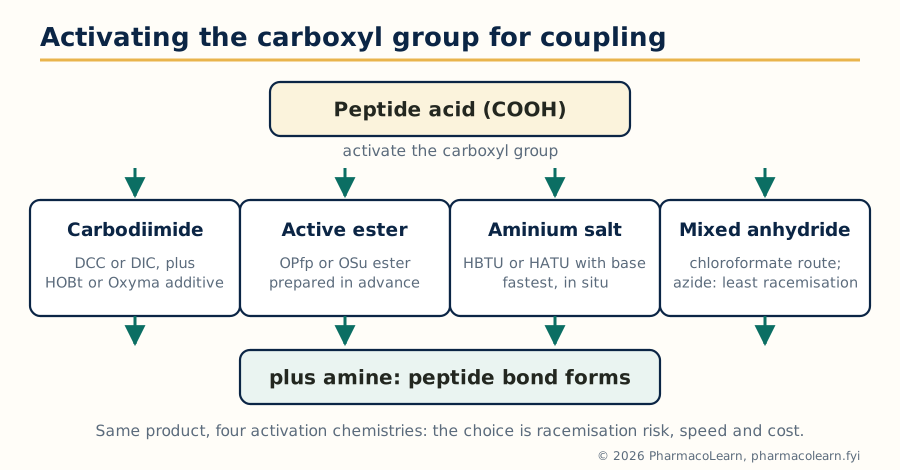
Figure: Every coupling reagent solves the same problem, activating the carboxyl group, but they differ in racemisation risk, speed, by-products and cost.
A free carboxylic acid and a free amine do not form an amide at a useful rate; the acid must be activated so that its carbonyl carbon becomes electrophilic enough for the amine to attack. The activation must also be gentle, because the activated species is exactly the species that racemises (section 2.4). The standard methods:
- Carbodiimide method (Sheehan, 1955): dicyclohexylcarbodiimide (DCC) reacts with the carboxylic acid to form an O-acylisourea, a powerful activated ester equivalent; the amine attacks and the urea (dicyclohexylurea, DCU) falls out. DCU is insoluble and contaminates products, which is why diisopropylcarbodiimide (DIC), whose urea stays soluble, is preferred on solid phase, and why the water-soluble EDC is used in solution work.
- Additives: 1-hydroxybenzotriazole (HOBt), its aza analogue HOAt, and the modern replacement Oxyma intercept the O-acylisourea to give an active ester that couples efficiently but racemises far less. Carbodiimide plus additive is the workhorse combination.
- Preformed active esters: pentafluorophenyl (OPfp) and N-hydroxysuccinimidyl (OSu) esters are stable, isolable activated forms, coupled with only mild base present.
- Mixed anhydride method: the acid is converted with isobutyl chloroformate and a tertiary base into a mixed carbonic anhydride, which the amine attacks at the correct carbonyl.
- Azide method: the peptide ester is converted to a hydrazide and diazotised to an acyl azide, which couples with exceptionally low racemisation; older, slower, but still the referee method for fragment condensations.
- Aminium and phosphonium salts: HBTU, HATU and PyBOP generate the active ester in situ from the acid and a tertiary base; HATU (built on HOAt) is the fastest and most racemisation-resistant of the family and is the default for difficult couplings on automated synthesizers. (The BOP reagent of MPC102T belongs to this family; its by-product issues led to PyBOP.)
2.4 Racemisation: the enemy inside the activation step
When an N-acyl amino acid or peptide acid is activated, the carbonyl oxygen of the preceding amide can attack the activated carbonyl and close a five-membered oxazolone (azlactone) ring. The oxazolone's alpha proton is acidic; a base removes it to give an achiral, planar intermediate, and reprotonation returns both configurations. Ring opening by the amine then installs a mixture of the correct residue and its epimer. Urethane protection (Boc, Fmoc, Cbz) suppresses oxazolone formation because the carbamate carbonyl is less nucleophilic, which is why single protected amino acids couple almost cleanly, while segment condensations, where the activated component is itself a peptide with an ordinary amide behind the alpha centre, are the dangerous operations, and are planned at glycine or proline junctions where racemisation is impossible or slow. Low temperature, minimal base, and HOBt, HOAt or Oxyma additives complete the defence.
2.5 Principles of solid phase peptide synthesis
In 1963 Robert Bruce Merrifield inverted the logic of synthesis: instead of purifying the product after every step, anchor the growing peptide to an insoluble polymer bead. The C-terminal amino acid is attached to the resin through a linker; each cycle then adds one residue using a large excess of reagents to force the coupling to completion, and every excess reagent, by-product and failure is removed by simply washing the beads, operations that a machine can repeat unattended. Purification happens once, at the end. The price of the method is that chemistry must be nearly quantitative at every step (section 2.1) and that the final product mixture contains truncated and deletion sequences rather than the intermediates of classical synthesis. Capping, acetylating any amino groups that failed to couple, keeps those failures short and easy to separate later.
2.6 Solid supports and linkers
The original support is polystyrene cross-linked with 1 to 2 percent divinylbenzene, which swells in dichloromethane and DMF so reagents can reach the chains inside the bead. Polyethylene glycol containing resins (such as PEG-polystyrene grafts) swell in a wider range of solvents and behave more like solution chemistry. The linker is the molecule between bead and peptide: it decides what the C-terminus becomes on cleavage and under what conditions it is released.
- Merrifield resin: chloromethylated polystyrene; the first amino acid is attached as a benzyl ester; cleavage needs HF; gives peptide acids.
- PAM resin: a more acid stable linker for Boc chemistry, reducing losses during repeated TFA cycles.
- Wang resin: a p-alkoxybenzyl alcohol linker; standard for Fmoc synthesis of peptide acids, cleaved by TFA.
- Rink amide resin: cleaved by TFA to give a C-terminal peptide amide, essential for the many peptide hormones (including oxytocin) whose natural form is amidated.
- MBHA resin: the corresponding amide-producing support for Boc chemistry, needing HF cleavage.
2.7 The Boc protocol
Each cycle runs: remove the Boc group with about 50 percent trifluoroacetic acid in dichloromethane; wash; neutralise the resulting ammonium salt with a tertiary base such as diisopropylethylamine; couple the next Boc amino acid (with DCC and HOBt, or HBTU). Side chains wear benzyl-type protection throughout. At the end, the peptide is cut from the resin and all side chain protection is removed in one strong acid step with liquid HF, using scavengers such as anisole and p-cresol to trap the benzyl cations released. Because HF is exceptionally hazardous, the low-high HF protocol (Tam) was developed: a first treatment with HF diluted in dimethyl sulfide and p-cresol removes most protecting groups by a gentler, more SN2-like pathway with fewer side reactions, and a second, concentrated HF step completes the cleavage. Boc chemistry survives today where Fmoc struggles, notably for long, aggregation-prone sequences, because the repeated acid treatments keep the growing chain protonated and better solvated.
2.8 The Fmoc protocol
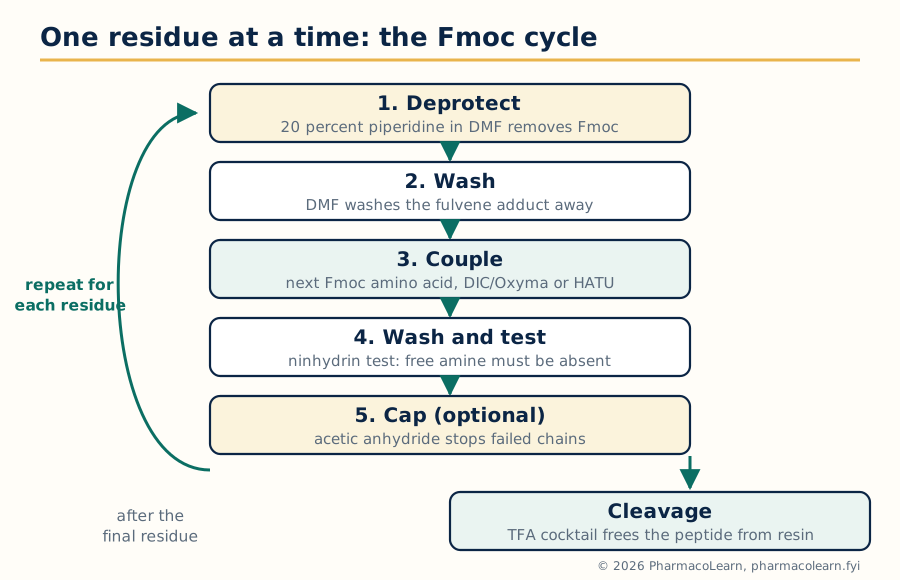
Figure: The Fmoc cycle: deprotect, wash, couple, wash and test, cap if needed, and repeat until the chain is finished, then cleave with TFA.
Each cycle runs: remove the Fmoc group with 20 percent piperidine in DMF, which also traps the dibenzofulvene released as a stable adduct whose ultraviolet absorbance lets the machine monitor deprotection; wash; couple the next Fmoc amino acid (with DIC and Oxyma, or HATU and base). Side chains wear tert-butyl-type protection. At the end, one treatment with a trifluoroacetic acid cocktail (classically TFA with water and triisopropylsilane as scavengers) cleaves the peptide from a Wang or Rink linker and strips every side chain group in the same operation. The product is precipitated in cold ether, collected and freeze dried. Fmoc chemistry is the modern default: no HF, milder conditions throughout, and continuous spectrophotometric monitoring of each deprotection.
One Fmoc solid phase cycle

resin bound peptide, N-terminal Fmoc group on
  -> 20 percent piperidine in DMF: Fmoc group off, fulvene adduct washed away
  -> wash: DMF several times, bead ready
  -> Fmoc amino acid + DIC/Oxyma (or HATU/base): coupling, 30 to 60 minutes
  -> wash: DMF several times
  -> optional capping with acetic anhydride: failed chains stopped here
  -> repeat for the next residue
after the last residue: TFA cocktail cleaves peptide from resin
  -> precipitate in cold ether, purify by preparative HPLC
2.9 Cleavage, free peptides and peptide amides
Cleavage is a chemical step in its own right, not just unhooking. The cocktail must supply acid strong enough to break the linker and the side chain groups, plus scavengers (water, triisopropylsilane, anisole, p-cresol, ethanedithiol in HF work) to absorb the reactive carbocations before they alkylate tryptophan, tyrosine or methionine in the product. The choice of linker made at the start fixes the output: acid linkers give free peptides ending in a carboxylic acid; amide linkers (Rink, MBHA) give peptide amides ending in CONH2, a difference that decides biological activity for many hormones. After cleavage the crude peptide is precipitated, dissolved and taken to purification.
2.10 Purification and case studies
Crude solid phase products are purified by preparative reversed phase HPLC, exploiting the large polarity differences between the target and its deletion sequences, and characterised by mass spectrometry and analytical HPLC. Two case studies from the history of the method belong in every account:
- Bradykinin: Merrifield's solid phase synthesis of this nonapeptide in 1964 demonstrated the speed of the approach, days instead of the months a solution synthesis of the same molecule had required, and converted a sceptical field.
- Enfuvirtide (T-20): the 36 residue HIV fusion inhibitor was manufactured commercially by a hybrid strategy, solid phase preparation of protected fragments followed by solution phase fragment condensation, showing that SPPS scales to tonne quantities of a complex peptide drug when the economics demand it. (The total synthesis of the enzyme ribonuclease A, 124 residues, by Gutte and Merrifield in 1969 remains the landmark proof that even a protein-sized chain can be assembled this way.)
2.11 Site-specific chemical modifications of peptides
Peptides are frequently modified at defined positions to improve stability or add function:
- Terminal modifications: N-terminal acetylation and C-terminal amidation, which block exopeptidases and often mimic the natural hormone.
- Cyclisation: disulfide bridges between cysteines, head-to-tail lactams, and side chain to side chain lactam or hydrocarbon staples that lock a helix in place and resist proteolysis.
- Lipidation: a fatty acid chain attached through a spacer to a lysine side chain makes the peptide bind albumin and last for hours or days instead of minutes; the GLP-1 drugs liraglutide and semaglutide are built this way.
- PEGylation: attachment of polyethylene glycol chains, increasing hydrodynamic size, solubility and circulation time.
- Labels and payloads: biotin, fluorescent dyes, chelators for radioisotopes, and cytotoxic payloads in peptide-drug conjugates, all installed at one chosen residue using an orthogonally protected building block (for example a lysine whose side chain carries an acid-labile group removable while the chain is still on resin).
2.12 Solution phase strategies: segment and sequential
Solution synthesis never died; it remains the method of choice for short peptides at very large scale and for fragment condensations. Two organisational strategies are named in the syllabus:
- Sequential (stepwise) strategy: residues are added one at a time from one end, as in solid phase work but with isolation and purification at every step. The industrial synthesis of the sweetener aspartame (L-aspartyl-L-phenylalanine methyl ester) illustrates it at its simplest: protected aspartic acid is coupled to phenylalanine methyl ester, then deprotected.
- Segment (fragment) strategy: the chain is built as several protected fragments in parallel and the fragments are condensed together, convergently, so the longest linear sequence of steps is short and each fragment can be purified rigorously before the risky fragment couplings. Racemisation control dictates that fragments end in glycine or proline where possible.
Case study 1, oxytocin: du Vigneaud's 1953 synthesis of the nonapeptide hormone oxytocin, the first synthesis of a peptide hormone, used solution chemistry throughout: a protected C-terminal fragment and a protected N-terminal fragment were prepared separately and joined by fragment condensation, the disulfide bridge was closed by oxidation at the end, and C-terminal amidation was built into the design. It earned the Nobel Prize in 1955.
Case study 2, insulin: insulin's two chains (A, 21 residues; B, 30 residues) joined by two interchain disulfide bridges make a formidable target. The classical solution approach synthesised each chain separately with all cysteines protected, then combined them: deprotection and air oxidation form the bridges, with the correct pairing obtained in modest yield alongside scrambled isomers, a problem that shaped decades of work. Modern manufacture sidesteps it biologically (recombinant proinsulin in bacteria or yeast, folded as one chain, then enzymatically trimmed), but the chemical insulin syntheses remain the definitive teaching example of the segment strategy and its disulfide problem.
2.13 Side reactions in peptide synthesis
The syllabus organises side reactions by their initiating event:
- Deletion peptides: any coupling or deprotection that stops short of completion leaves chains missing one residue; these are the hardest impurities to remove because they differ from the product by a single internal unit. Prevention is excess reagent, double coupling of difficult residues, monitoring (ninhydrin or chloranil tests for free amine), and capping, which converts deletions into truncated chains that separate more easily.
- Initiated by proton abstraction (base): aspartimide formation, in which the backbone nitrogen following an aspartate attacks its side chain ester under piperidine treatment, giving a succinimide that reopens to a mixture of the normal alpha peptide and the isomeric beta (isoaspartyl) peptide, partly racemised; and diketopiperazine formation, in which a resin bound dipeptide ester cyclises onto itself and falls off the resin, a notorious chain-terminating event in sequences containing proline or glycine at the second position.
- Initiated by protonation (acid): cleavage cocktails generate tert-butyl and benzyl cations that alkylate electron-rich side chains (tryptophan, tyrosine, methionine, cysteine) unless scavengers intercept them; acid can also cleave sensitive bonds such as Asp-Pro.
- Initiated by overactivation: the O-acylisourea of the carbodiimide method rearranges to an inert N-acylurea if the amine is slow to arrive (sterically hindered couplings), losing the activated acid entirely; and aminium coupling reagents such as HBTU and HATU react directly with a free N-terminal amine when no carboxylate is available, capping it as a tetramethylguanidinium group, a chain terminating side reaction prevented by correct reagent stoichiometry.
- Side reactions of individual amino acids: cysteine racemises readily, oxidises and undergoes disulfide exchange; methionine oxidises to the sulfoxide and is alkylated during HF cleavage; tryptophan is oxidised and alkylated by carbocations; histidine is among the most racemisation-prone residues; asparagine and glutamine dehydrate to nitriles under carbodiimide conditions; arginine can cyclise to a lactam when activated and its side chain protection (Pbf, Pmc) is among the slowest to remove; serine and threonine can be O-acylated under forcing conditions.
| Feature | Boc strategy | Fmoc strategy |
|---|---|---|
| Alpha-amino protection | Boc | Fmoc |
| Removed by | TFA (acid), every cycle | Piperidine (base), every cycle |
| Side chain protection | Benzyl type | tert-Butyl type |
| Final cleavage | HF (low-high protocol), or TFMSA | TFA cocktail with scavengers |
| Monitoring | After the fact tests | Continuous, fulvene adduct by UV |
| Characteristic strengths | Aggregation-prone and long sequences | Mild conditions, no HF, automation friendly |
| Characteristic hazards | HF handling | Aspartimide and diketopiperazine formation |
Unit 3: Photochemical Reactions and Pericyclic Reactions
3.1 Basic principles of photochemical reactions
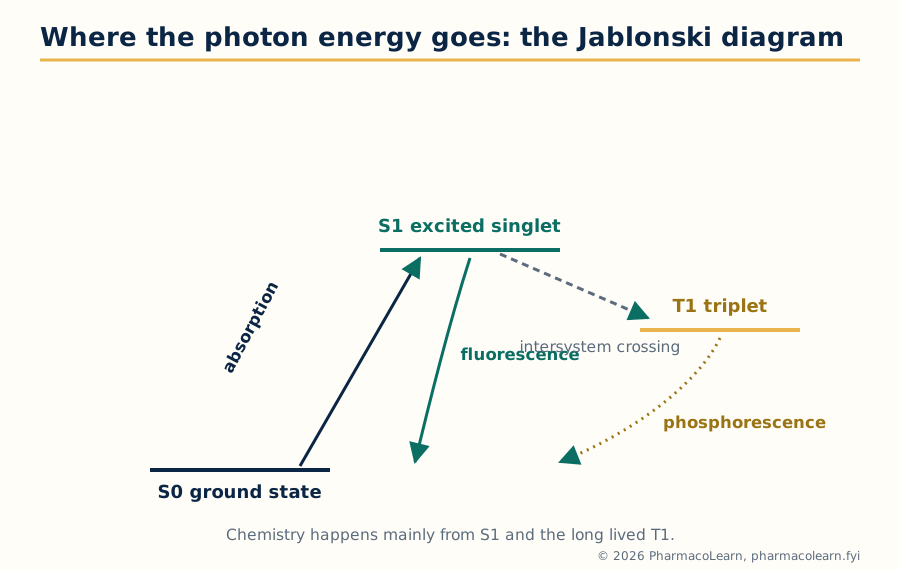
Figure: The Jablonski diagram: absorption reaches S1; fluorescence returns directly, while intersystem crossing reaches the long lived triplet T1, home of much photochemistry.
A photochemical reaction is driven by the energy of an absorbed photon rather than by heat. Two classical laws frame the subject. The Grotthuss-Draper law states that only light actually absorbed by a molecule can cause it to react; transmitted or scattered light does nothing. The Stark-Einstein law states that each absorbed photon activates one molecule in the primary step. The energy carried by one mole of photons is large by chemical standards: at 300 nm it is about 400 kJ per mole, comparable to the strength of the bonds being broken, which is why photochemistry reaches reactive states (excited singlets and triplets, radicals, carbenes) that thermal chemistry cannot. The efficiency of the overall change is the quantum yield, molecules reacted per photon absorbed; it can be far below one (most excitation is wasted as heat or light) or far above one (a radical chain reaction, where one photon starts a chain that consumes many molecules).
What happens after absorption is mapped on a Jablonski diagram. A molecule in its ground singlet state (S0) absorbs a photon and reaches an excited singlet (S1, S2), with the spin of the promoted electron unchanged. It can fall back by emitting fluorescence, lose energy internally as heat (internal conversion), or undergo intersystem crossing to the triplet state (T1), in which the promoted electron's spin has flipped. The triplet lives much longer (it returns to S0 only slowly, sometimes emitting phosphorescence), so most bimolecular photochemistry, and nearly all synthetic photochemistry, happens from triplets, often reached indirectly by sensitisation: a sensitizer such as benzophenone absorbs the light and transfers its triplet energy to the substrate. The practical consequence is that light gives the chemist a reagent of precise energy, switched on and off instantly, leaving no residue, which is why photochemical steps have become attractive in green process chemistry and in flow reactors, where thin channels let light penetrate the whole reaction volume.
3.2 Photo-oxidation
Photo-oxidation chemistry is dominated by singlet oxygen, an excited state of oxygen (written 1O2) generated when a triplet sensitizer (rose bengal, methylene blue, tetraphenylporphyrin) transfers its energy to ordinary ground state triplet oxygen. Singlet oxygen is a selective, electrophilic oxidant with three characteristic reactions:
- The ene reaction: an alkene with an allylic hydrogen gives an allylic hydroperoxide with the double bond shifted. The industrial oxidation of citronellol to a hydroperoxide on the way to rose oxide, and the key step of the artemisinin semi-synthesis (the ene reaction of dihydroartemisinic acid with singlet oxygen, followed by acid-catalysed Hock cleavage and cyclisation) are the textbook examples.
- [2+2] cycloaddition: electron-rich alkenes such as enol ethers give 1,2-dioxetanes, unstable four-membered peroxides that cleave to two carbonyl fragments, sometimes with emission of light (chemiluminescence).
- [4+2] cycloaddition: conjugated dienes give endoperoxides; the classic case is alpha-terpinene to ascaridole, one of the oldest known photochemical syntheses.
Photo-oxidation by electron transfer rather than by singlet oxygen also exists, particularly with strongly oxidising excited photocatalysts, and aerobic photoredox oxidation has become a modern extension of the same idea.
3.3 Photo-addition
In photo-addition, an excited molecule adds across a pi system in a way that the ground state forbids. The flagship reaction is the [2+2] photocycloaddition of two alkenes to a cyclobutane: thermally forbidden (section 3.6), photochemically routine. Enones are the most used partners, adding to alkenes through their triplet state; run intramolecularly, the reaction builds strained polycyclic skeletons rapidly, a strategy used in classic syntheses of cage and cyclobutane-containing natural products. The Paterno-Buchi reaction is the carbonyl analogue: an excited aldehyde or ketone adds to an alkene to give an oxetane, a four-membered oxygen ring that is itself a valuable intermediate and a motif in medicinal chemistry. Alkenes also add to excited benzene rings (the meta photocycloaddition), a reaction Wender used to build the tricyclic core of the sesquiterpene alpha-cuparenone in a single step. Photo-addition illustrates the general principle of this unit: photochemistry does not merely accelerate thermal reactions, it runs reactions whose orbital symmetry makes them impossible in the ground state.
3.4 Photo-fragmentation
Excited carbonyl compounds also break apart, in two patterns named for Ronald Norrish:
- Norrish Type I reaction: the bond between the carbonyl carbon and an alpha carbon cleaves (alpha cleavage) to give an acyl radical and an alkyl radical. The radicals can recombine, lose carbon monoxide (decarbonylation), or abstract hydrogen; in cyclic ketones the cleavage opens the ring to a biradical that closes to an aldehyde or ketene product.
- Norrish Type II reaction: the excited carbonyl oxygen abstracts a hydrogen from the gamma carbon through a six-membered transition state (possible because the excited oxygen behaves like an alkoxy radical), giving a 1,4-biradical. The biradical either cleaves between the alpha and beta carbons, producing an alkene and an enol that tautomerises to a ketone, or cyclises to a cyclobutanol (the Yang cyclisation).
The Barton reaction is a designed fragmentation of the same family: photolysis of a nitrite ester breaks the weak O-N bond to an alkoxy radical, which performs a precise 1,5-hydrogen abstraction from a delta carbon; capture of the resulting carbon radical by nitric oxide and hydrolysis installs a hydroxyl-derived oxime at an otherwise unreachable, unactivated position. Barton used it to functionalise the angular methyl group in the synthesis of aldosterone, a demonstration that photochemistry could do surgery on a steroid skeleton where no conventional reagent could reach. Photolysis more generally is the standard route to carbenes and nitrenes from diazo compounds and azides (compare MPC102T, Unit 1) and to radicals from peroxides and halogen compounds.
3.5 Pericyclic reactions: the family and its rules
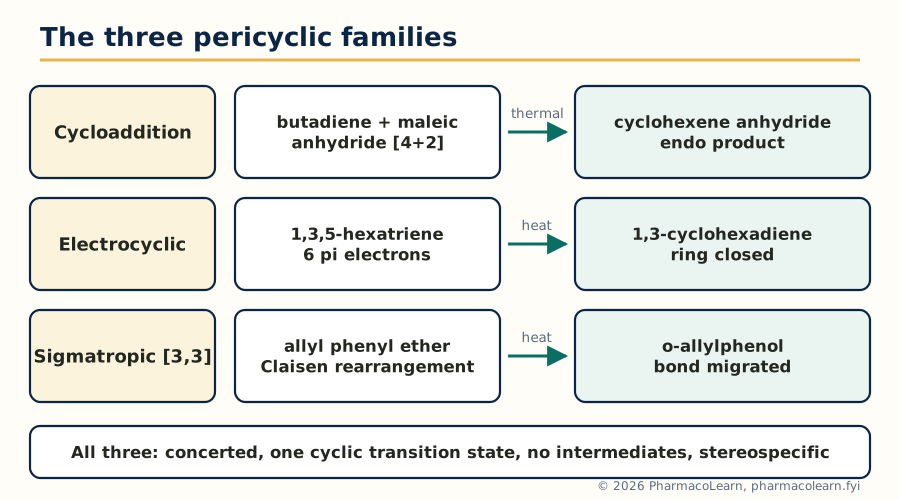
Figure: Cycloaddition, electrocyclic and sigmatropic reactions: three families, one shared pericyclic mechanism through a cyclic transition state.
A pericyclic reaction is a concerted reaction in which the bonds break and form simultaneously through a single cyclic transition state, the electrons moving in a closed loop. There are no intermediates, ionic or radical, and the reactions are characteristically stereospecific: the stereochemistry of the reactants maps predictably onto the products. Whether a pericyclic reaction can proceed thermally is decided by orbital symmetry, summarised in the Woodward-Hoffmann rules: a thermal pericyclic reaction is allowed when the number of suprafacial (4q plus 2) electron components and antarafacial (4r) electron components in the transition state totals an odd number. In practice the student applies three memorised selection rules, one per family, set out in the sections below and the closing table. The three syllabus families are cycloadditions, electrocyclic reactions and sigmatropic rearrangements; two relatives, the ene reaction and cheletropic reactions (such as the extrusion of sulfur dioxide from a sulfone), complete the family picture.
3.6 Cycloaddition reactions
In a cycloaddition, two (or more) pi systems combine to form a ring, two new sigma bonds appearing at the expense of two pi bonds. The notation counts the pi electrons of each partner: the Diels-Alder reaction is a [4+2] cycloaddition. The Diels-Alder reaction between a conjugated diene and a dienophile (an alkene, made more reactive by electron withdrawing groups in the normal electron demand version) is governed by rules a drug chemist uses constantly:
- The diene must adopt the s-cis conformation; locked s-cis dienes such as cyclopentadiene are exceptionally reactive.
- The reaction is stereospecific: substituents cis on the dienophile stay cis in the product (the cis principle), and the diene geometry is likewise preserved.
- The endo rule: the preferred transition state places the dienophile's substituents under the diene's pi system, giving the endo product, although the exo product is usually more stable; the preference is attributed to secondary orbital interactions and disappears when the reaction is run long enough to become reversible.
- Regiochemistry follows matching of the largest frontier orbital coefficients: electron donating groups on the diene and electron withdrawing groups on the dienophile reinforce so that the substituents emerge ortho or para to each other.
- The retro-Diels-Alder reaction, run on heating, unmasks dienes (cyclopentadiene is cracked from its dimer before use) and serves as a thermal protecting strategy for double bonds.
1,3-Dipolar cycloadditions are the other great family: a 1,3-dipole (azide, nitrile oxide, diazo compound, ozone) adds across a multiple bond to give a five-membered ring. The azide-alkyne cycloaddition to a triazole, made perfectly regioselective by copper catalysis (click chemistry), is now a standard bond construction in drug discovery; the first step of ozonolysis (MPC102T) is a 1,3-dipolar cycloaddition of ozone to an alkene.
3.7 Electrocyclic reactions
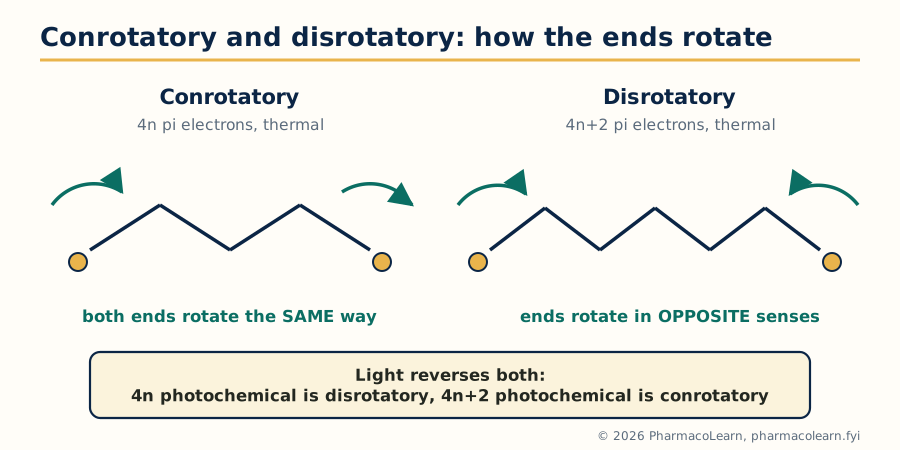
Figure: In conrotatory closure both termini rotate the same way; in disrotatory closure they rotate in opposite senses. The Woodward-Hoffmann rules choose between them.
An electrocyclic reaction interconverts a conjugated polyene and a cyclic isomer with one fewer double bond: one pi bond is traded for a sigma bond and a ring (opening runs the same road backwards). The stereochemical signature is the way the terminal carbons rotate as the sigma bond forms: conrotatory (both termini rotate in the same sense) or disrotatory (opposite senses). The selection rule turns on the number of pi electrons:
- Systems with 4n pi electrons (butadiene, 4): thermal reactions are conrotatory, photochemical reactions disrotatory.
- Systems with 4n plus 2 pi electrons (hexatriene, 6): thermal reactions are disrotatory, photochemical reactions conrotatory.
The consequences are exact: thermal conrotatory closure of (2E,4Z)-hexa-2,4-diene gives cis-3,4-dimethylcyclobutene, while the (2E,4E) isomer gives the trans cyclobutene, and no change of conditions can swap these outcomes, because the forbidden mode would require the molecule to break the orbital symmetry rule. Nature and medicine use the 6 pi version: the photochemical disrotatory ring opening of 7-dehydrocholesterol in skin gives previtamin D, the first step of vitamin D synthesis, a pericyclic reaction every student has personally performed.
3.8 Sigmatropic rearrangements
A sigmatropic rearrangement migrates a sigma bond across a pi framework: the bond breaks at one position and forms at another, with the pi bonds reorganising around it, all in one concerted step. Reactions are labelled [i,j] by counting the atoms on each side of the migrating bond. The rules of allowedness mirror the electrocyclic ones; thermally, [1,5] hydrogen shifts are allowed suprafacially and are fast and common (cyclopentadiene scrambles its hydrogen this way, which is why all its ring positions become equivalent), while [1,3] hydrogen shifts are effectively forbidden because the required geometry cannot be reached.
The workhorse examples are the [3,3] rearrangements:
- Cope rearrangement: a 1,5-diene rearranges to its isomeric 1,5-diene through a chair-like transition state; substituent effects and ring strain can drive it completely to one side. The oxy-Cope variant (a hydroxyl group at the 3 position) is faster, and its anionic version, with the alkoxide formed by strong base, is faster by many orders of magnitude and ends in an enolate that is protonated to a carbonyl compound.
- Claisen rearrangement: an allyl vinyl ether, or in its aromatic form an allyl phenyl ether, rearranges to a gamma,delta-unsaturated carbonyl compound or an ortho-allyl phenol respectively; the aromatic Claisen (Claisen, 1912) is the standard way to install an ortho allyl group on a phenol, and further cyclisation of the product builds the benzopyran ring systems of many natural products. The Ireland-Claisen variant rearranges silyl ketene acetals of allyl esters and sets two stereocentres predictably through its chair transition state.
- [2,3]-Wittig rearrangement: an allylic ether deprotonated beside oxygen migrates so that the bond from oxygen shifts from the 1 to the 3 position of the allyl system, giving a homoallylic alcohol with useful stereocontrol.
Biochemistry runs the same reactions: the conversion of chorismate to prephenate on the shikimate pathway (used by bacteria and plants to make aromatic amino acids, and absent in humans, which is why the pathway is an antimicrobial target) is an enzymatic Claisen rearrangement.
| Pericyclic family | What changes | Thermal rule | Photochemical rule | Classic example |
|---|---|---|---|---|
| Cycloaddition [4+2] | Two pi systems form a ring | Allowed suprafacial-suprafacial (4n plus 2 total pi electrons) | Generally requires one component excited; [2+2] becomes allowed | Diels-Alder; [2+2] photoaddition |
| Electrocyclic, 4n pi electrons | Polyene to ring | Conrotatory | Disrotatory | Butadiene to cyclobutene |
| Electrocyclic, 4n plus 2 pi electrons | Polyene to ring | Disrotatory | Conrotatory | Hexatriene to cyclohexadiene; vitamin D ring opening |
| Sigmatropic [1,5]-H | Sigma bond migrates | Allowed suprafacial | Not normally used | Cyclopentadiene hydrogen scrambling |
| Sigmatropic [3,3] | Sigma bond migrates across two allyl units | Allowed, chair-like transition state | Not normally used | Cope and Claisen rearrangements |
Identifying a pericyclic reaction and predicting its mode

Does a sigma bond migrate across a pi system with no ring size change?
  -> sigmatropic: count the atoms each side for the [i,j] label
Do two pi components join into a ring (or a ring break into two)?
  -> cycloaddition: add the pi electrons; 6 electron [4+2] is thermal,
     4 electron [2+2] needs light
Does one chain cyclise (or a ring open) with one pi bond traded for sigma?
  -> electrocyclic: count pi electrons; 4n thermal conrotatory,
     4n plus 2 thermal disrotatory, and light reverses both
Unit 4: Catalysis: Heterogeneous, Homogeneous, Transition Metal, Organo, Bio and Phase Transfer Catalysis
4.1 What a catalyst does, and the two great families
A catalyst provides an alternative reaction pathway of lower activation energy. It emerges unchanged at the end, it does not alter the thermodynamics (the equilibrium position is untouched; both directions are accelerated equally), and it is judged by its activity (turnover frequency, molecules converted per active site per unit time), its selectivity (for one product among possible products) and its lifetime. Catalysis is green principle 9: a catalyst replaces stoichiometric reagents and their stoichiometric waste. The syllabus divides the field by phase. A homogeneous catalyst is in the same phase as the reactants, usually dissolved in the reaction solvent: every molecule of catalyst is accessible, conditions are mild, the mechanism can be studied and the ligands tuned, but separating the catalyst from the product is difficult and expensive, a serious matter when the catalyst is a precious metal that must not contaminate a drug. A heterogeneous catalyst is in a different phase, usually a solid acting on liquid or gas reactants: separation is as simple as filtration, the catalyst is robust and recyclable, and industry loves it, but only surface atoms work, active sites are less uniform, conditions are often harsher, and heat and mass transfer can control the rate.
4.2 Heterogeneous catalysis: preparation and characterisation
A working heterogeneous catalyst is mostly engineering. Preparation decides its texture: in impregnation, a support (alumina, silica, activated carbon, a zeolite) is soaked with a solution of the metal salt, dried and then calcined and reduced to the active metal or oxide; in co-precipitation, catalyst and support components are precipitated together for bulk catalysts; ion exchange loads metals into zeolite cages; sol-gel methods build mixed oxides with high surface area. The catalyst that results is described by characterisation: the BET method measures total surface area from nitrogen adsorption; chemisorption of hydrogen or carbon monoxide counts exposed metal atoms (metal dispersion and particle size); X-ray diffraction identifies crystalline phases; electron microscopy images the particles; temperature programmed methods probe acidity and reducibility. A supported catalyst is exactly what its name says: small active particles spread over a large area of cheap, strong, porous carrier, so that grams of support carry milligrams of precious metal.
4.3 Heterogeneous catalysis: kinetics, deactivation and regeneration
The kinetic sequence has seven steps: diffusion of reactants through the fluid film to the surface, diffusion into pores, adsorption on active sites, the surface reaction itself, desorption of products, and diffusion back out. The Langmuir-Hinshelwood model, in which both reactants adsorb before reacting, describes many systems and explains their characteristic saturation behaviour: the rate first rises with concentration, then levels off when the surface is full. If diffusion is slow, the observed kinetics describe transport rather than chemistry, and the measured activation energy falls misleadingly, so catalyst testing must prove the surface reaction is rate limiting. Catalysts die by defined mechanisms: poisoning, the strong chemisorption of an impurity (sulfur compounds on nickel and platinum are the classic case; lead poisons are why leaded petrol destroyed exhaust catalysts); fouling or coking, carbonaceous deposits blocking pores and sites; sintering, the thermal migration and coalescence of metal particles into larger, less active ones; and leaching of the active phase into solution. Regeneration reverses what is reversible: coke is burned off in controlled air, poisons are sometimes washed or steamed away, and oxidised metals are re-reduced with hydrogen; sintering is largely irreversible, which is why operating temperature discipline matters.
4.4 Heterogeneous catalysis in the synthesis of drugs
Examples the syllabus asks for are the daily bread of process chemistry:
- Palladium on carbon hydrogenation reduces alkenes, alkynes, nitro groups and imines, and cleaves benzyl protecting groups by hydrogenolysis; it appears in the great majority of API routes that contain a reduction step.
- Raney nickel performs hydrogenations and desulfurisations (removal of sulfur protecting and directing groups as in the Mozingo reduction) and hydrogenates glucose to sorbitol industrially.
- Lindlar catalyst (palladium on calcium carbonate, poisoned with lead acetate and quinoline) stops alkyne hydrogenation at the cis-alkene, a selectivity used in vitamin A and E intermediate manufacture.
- Adams catalyst (platinum oxide) reduces under acidic conditions where palladium fails, and platinum and rhodium on supports hydrogenate aromatic rings, as in routes to saturated heterocyclic drugs.
- Zeolites and solid acids catalyse alkylations and isomerisations in bulk intermediates manufacture, replacing corrosive liquid acids (green principle 3).
4.5 Homogeneous catalysis and Wilkinson's catalyst
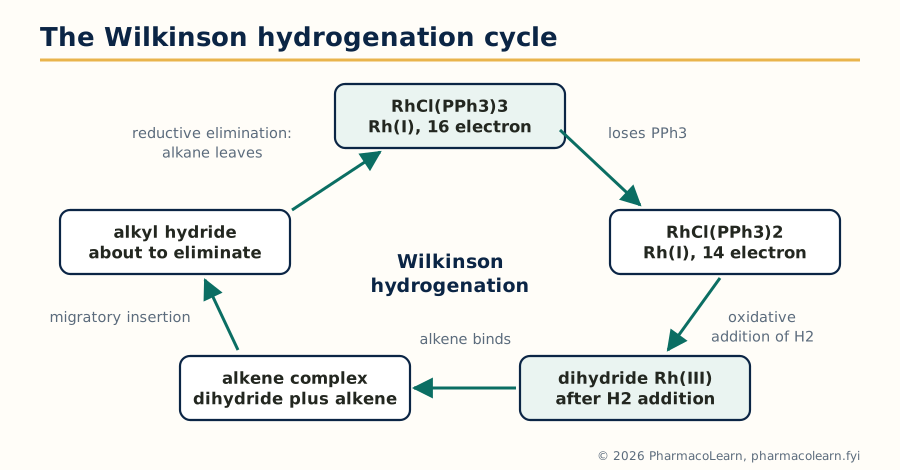
Figure: The Wilkinson cycle: ligand loss, oxidative addition of hydrogen, alkene coordination, migratory insertion and reductive elimination regenerate the catalyst.
Wilkinson's catalyst, chloridotris(triphenylphosphine)rhodium(I), RhCl(PPh3)3, is the teaching model of homogeneous hydrogenation, and its cycle contains every elementary step of the field:
- The square planar 16 electron complex loses a triphenylphosphine ligand, giving a reactive 14 electron species.
- Oxidative addition of hydrogen gives a rhodium(III) dihydride, the metal rising in oxidation state by two.
- An alkene coordinates to the vacant site.
- Migratory insertion moves one hydride onto the alkene, forming a rhodium alkyl.
- Reductive elimination joins the alkyl and the remaining hydride and releases the alkane, regenerating the catalyst.
The catalyst's selectivity follows from the mechanism: it hydrogenates the least hindered double bond fastest (terminal before internal, strained double bonds very fast), works at ambient temperature and pressure, and leaves carbonyls, nitro groups, nitriles and benzyl ethers untouched, selectivity no heterogeneous catalyst of its era could match. Its lesson generalises: in homogeneous catalysis the ligand sphere is the design space, and changing the ligands changes the catalyst.
4.6 Hydroformylation and hydrocyanation
Hydroformylation (the oxo process) adds carbon monoxide and hydrogen across an alkene to give an aldehyde one carbon longer. The original cobalt catalyst (HCo(CO)4, formed in situ) required high temperatures and pressures; modern rhodium catalysts with phosphine ligands run far more mildly and give high selectivity for the linear aldehyde, whose alcohol derivatives supply the plasticiser and detergent industries at millions of tonnes per year. Regiochemistry (linear versus branched aldehyde) is controlled by the ligand bite angle and electronics, the clearest large-scale proof that ligands govern outcomes. Hydrocyanation adds HCN across a double bond using nickel(0) phosphite catalysts; the DuPont process converts butadiene with two equivalents of HCN into adiponitrile, the nylon-6,6 intermediate, through oxidative addition of HCN, alkene insertion and reductive elimination steps, with Lewis acid promoters steering the second addition to the linear nitrile. Both processes show homogeneous catalysis at its industrial best and its characteristic risk: the metal is dissolved in the product stream and must be recovered completely.
4.7 Chiral ligands and chiral induction
Replace the achiral ligands of a hydrogenation catalyst with a single-enantiomer chiral ligand and the metal complex itself becomes chiral; the two faces of a prochiral substrate now pass through diastereomeric transition states of different energies, and one enantiomer of product forms faster. This is chiral induction, and its industrial debut is one of the famous stories of the field: Knowles at Monsanto replaced the triphenylphosphine of Wilkinson's catalyst with a chiral phosphine (DIPAMP) and hydrogenated a dehydro amino acid to L-DOPA, the Parkinson's drug, in high enantiomeric excess, the first large-scale asymmetric catalysis. Noyori's Ru-BINAP catalysts hydrogenate beta-keto esters and isomerise allylamines; Takasago uses an Rh-BINAP isomerisation of diethylgeranylamine as the key step of its menthol process. Knowles and Noyori shared the 2001 Nobel Prize with Sharpless for this work. The economic logic is decisive: a few grams of chiral catalyst can manufacture tonnes of single-enantiomer product, which is why catalytic asymmetric synthesis is the third strategy of Unit 5.
4.8 Ziegler-Natta catalysts
The Ziegler-Natta catalyst, classically titanium tetrachloride (or TiCl3) activated by triethylaluminium, polymerises ethene and propene at low pressure to linear, high density polymers, and, uniquely in its era, polymerises propene to the isotactic form in which every methyl group lies on the same side, giving a crystalline, strong plastic where earlier methods gave a useless sticky atactic gum. The Cossee-Arlman mechanism has the alkene coordinate to a vacant site on titanium and insert into the growing titanium-carbon bond, the surface geometry enforcing the same facial choice at every step. Modern single site metallocene catalysts (such as zirconocenes activated by methylaluminoxane) sharpen the same idea: every active site identical, polymer molecular weight and tacticity precisely controlled. The relevance to this syllabus is twofold: polymer manufacture is the largest-scale catalysis on earth, and isotacticity is stereochemistry written at the scale of thousands of stereocentres per molecule.
4.9 Transition metal and organocatalysis in modern synthesis
Transition metal catalysis beyond hydrogenation is built on the same elementary steps as Wilkinson's cycle: oxidative addition, transmetalation, migratory insertion and reductive elimination. The palladium cross couplings of MPC102T (Suzuki above all) are its flagship, joined by Heck, Sonogashira, Buchwald-Hartwig amination and olefin metathesis (Grubbs catalysts), the reactions with which modern medicinal chemistry assembles drug scaffolds. Organocatalysis uses small organic molecules instead of metals: the amino acid (S)-proline catalyses intramolecular aldol reactions through an enamine intermediate (the Hajos-Parrish reaction, known since the 1970s and the spark of the modern field); chiral imidazolidinone catalysts developed by MacMillan activate aldehydes as iminium ions and control Diels-Alder and other cycloadditions; hydrogen bond donor catalysts such as thioureas activate electrophiles by binding. Organocatalysts are robust, non-toxic, metal free (so no metal residue problem in the API) and often derived from the chiral pool; their price is higher loadings, typically 5 to 30 mole percent. List and MacMillan received the 2021 Nobel Prize for asymmetric organocatalysis.
4.10 Biocatalysis: enzymes as catalysts
Enzymes are the most selective catalysts known: operating in water at ambient temperature and near neutral pH, they routinely distinguish enantiomers, regioisomeric positions and similar functional groups in one step. The working classes in synthesis are hydrolases (lipases and esterases for kinetic resolutions and amide formation; penicillin G acylase, which produces 6-APA, the nucleus of the semisynthetic penicillins, industrially), oxidoreductases (ketoreductases making chiral alcohols, transaminases converting ketones to chiral amines), and lyases such as nitrile hydratases. Two examples mark the state of the art: the enzymatic kinetic resolution of racemates with lipases, a standard route to single-enantiomer alcohols and amines, and the sitagliptin process, in which an engineered transaminase, evolved in the laboratory to accept a bulky ketone it would never naturally meet, replaced a rhodium-catalysed hydrogenation, raising yield, removing the precious metal and cutting waste in one move. The limitations are real (narrow substrate ranges, product inhibition, enzyme cost, dilute aqueous streams), and protein engineering exists to remove them.
Immobilised enzymes and cells answer the recovery problem the way heterogeneous supports answer it for metals: enzymes are adsorbed on carriers, entrapped in gels such as calcium alginate, covalently bound to supports, or cross-linked into insoluble aggregates (CLEAs); whole cells are immobilised when a multi-enzyme pathway or cofactor recycling is needed. Immobilisation allows packed bed continuous reactors, repeated reuse over many batches, easier product isolation and often better stability to heat, pH and organic solvents.
4.11 Phase transfer catalysis
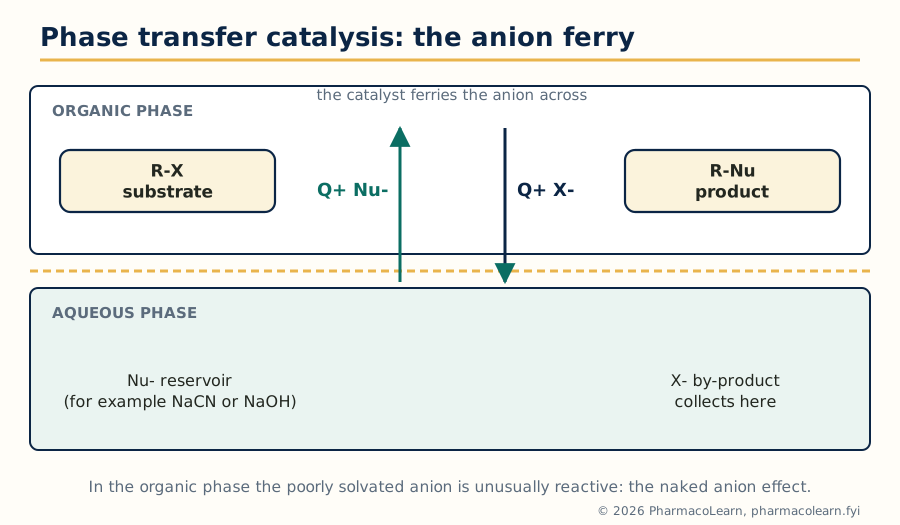
Figure: The quaternary ammonium cation ferries the nucleophile into the organic phase as Q+ Nu- and returns with the leaving anion as Q+ X-.
Many reactions pair a reagent that lives in water (hydroxide, cyanide, permanganate) with a substrate that lives in an organic solvent, and the two never meet. A phase transfer catalyst ferries the anion across the boundary. In the Starks extraction picture, a lipophilic quaternary ammonium cation (tetrabutylammonium, or Aliquat 336) exchanges its counterion for the reactant anion in the aqueous phase, carries the ion pair into the organic phase, where the anion, poorly solvated and therefore unusually reactive (a "naked" anion), reacts with the substrate; the catalyst returns with the leaving anion and cycles. Makosza's interfacial picture places the key deprotonation or exchange at the interface itself, important when the catalyst is less lipophilic. Crown ethers do the same job for metal cations (18-crown-6 wraps potassium, making potassium permanganate dissolve in benzene as "purple benzene"), and polyethylene glycols are the budget catalysts. Applications fill the classical repertoire: alkylations of phenols, malonates and nitriles with aqueous alkali and no dry solvents; cyanide and azide displacements; dichlorocarbene generation from chloroform and concentrated sodium hydroxide (Makosza conditions) for dichlorocyclopropanation; the Darzens glycidic ester synthesis; and oxidations by permanganate or hypochlorite in organic media. Phase transfer catalysis is green chemistry in practice: water as a co-solvent, no anhydrous conditions, cheap inorganic bases, and easy work-up.
| Property | Homogeneous | Heterogeneous |
|---|---|---|
| Active sites | Every molecule, uniform and tunable | Surface atoms only, varied sites |
| Conditions | Mild, low temperature | Often hotter, more forcing |
| Selectivity | High, ligand designable | Lower precision, but shape selectivity in zeolites |
| Separation | Difficult, metal contamination risk in APIs | Filtration, recyclable, suited to continuous flow |
| Deactivation | Ligand oxidation, metal plating out | Poisoning, coking, sintering |
| Typical examples | Wilkinson hydrogenation, hydroformylation, cross couplings | Pd/C hydrogenations, Ziegler-Natta polymerisation |
Unit 5: Stereochemistry and Asymmetric Synthesis
5.1 Why stereochemistry decides what a drug does
Enantiomers have identical melting points, spectra (in achiral environments) and reactivity towards achiral reagents, but a living body is built from chiral molecules, so to a receptor, an enzyme or a transporter the two enantiomers are different substances. One enantiomer of carvone smells of spearmint, the other of caraway, a harmless illustration of a serious rule. In medicines the rule decides efficacy and safety together: only one enantiomer of ethambutol carries the antitubercular activity while the other is associated with the ocular toxicity; levodopa is the drug and its enantiomer is not. The thalidomide disaster is the standard caution: the (R) enantiomer is the sedative and the (S) enantiomer is teratogenic, but because the two interconvert in the body, administering the pure enantiomer would not by itself have prevented the tragedy, the deeper lesson being that stereochemistry must be understood, not merely separated. Diastereomers, by contrast, differ in every physical property and behave as ordinary different compounds, which is precisely what makes resolution (section 5.9) possible.
5.2 Optical activity and specific rotation
Enantiomers rotate the plane of plane-polarised light by equal amounts in opposite directions. The measured rotation, alpha, depends on path length, concentration, solvent, temperature and wavelength, so the comparable quantity is the specific rotation, defined as the observed rotation divided by the product of path length in decimetres and concentration in grams per millilitre, conventionally measured at the sodium D line (589 nm) and quoted with its temperature: [alpha]D. A pure enantiomer has a characteristic value; the ratio of a sample's rotation to that of the pure enantiomer gives its optical purity, numerically equal to the enantiomeric excess, ee = (majority enantiomer minus minority enantiomer) divided by the total, times 100. A 50:50 mixture, a racemate, rotates nothing at all and has ee zero. Modern practice measures ee directly by chiral chromatography, but polarimetry remains the pharmacopoeial identity test for chiral drugs and the definition from which the whole language of this unit hangs.
5.3 The CIP sequence rules and R/S assignment
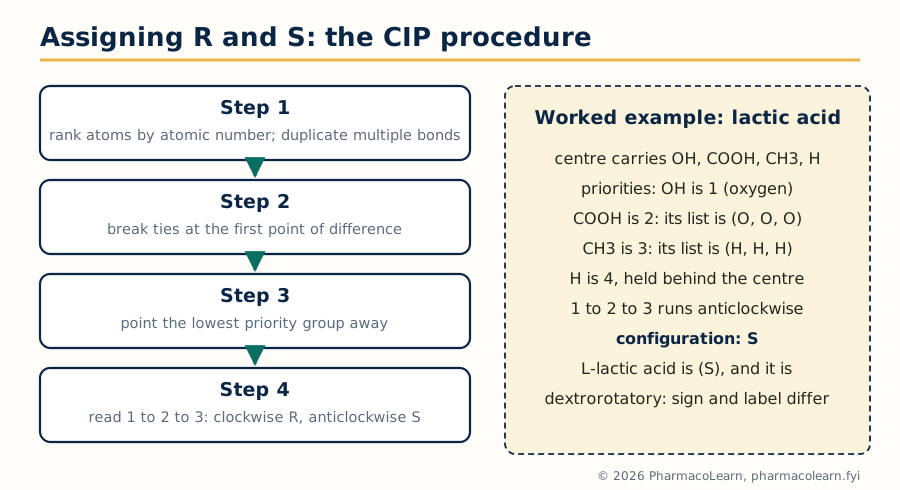
Figure: The CIP procedure in four steps, worked through for lactic acid: the natural L form is (S) yet dextrorotatory, a standing warning that sign and configuration are different things.
Absolute configuration is assigned by the Cahn-Ingold-Prelog rules. At a stereocentre, the four attached atoms are ranked by atomic number. Ties are broken by listing the atoms attached to each tied atom in decreasing order and comparing the lists at the first point of difference. Multiple bonds are expanded by the duplicate atom convention: a doubly bonded atom is treated as duplicated, so a carbonyl carbon counts as bonded to (O, O, and the third substituent), which is why a carboxyl group outranks a hydroxymethyl group. Isotopes rank by mass, deuterium above hydrogen. With priorities 1 to 4 assigned, the molecule is viewed with priority 4 pointing away; if the sequence 1 to 2 to 3 runs clockwise the centre is R (rectus), if anticlockwise, S (sinister).
Worked example, lactic acid. The stereocentre carries OH, COOH, CH3 and H. Oxygen (atomic number 8) is priority 1. Both remaining carbons are tied at the first atom; comparing their substituent lists, the carboxyl carbon counts as bonded to (O, O, O) once its double-bonded oxygen is duplicated, against the methyl carbon's (H, H, H), so COOH is priority 2 and CH3 priority 3, H priority 4. Natural L-lactic acid, the acid of muscle and of fermented milk, has these priorities running anticlockwise with H behind, and is therefore (S)-lactic acid; it is also dextrorotatory, a permanent reminder that the sign of rotation cannot be predicted from the R/S label.
Assigning R or S at a stereocentre

1. Rank the four atoms attached by atomic number.
2. Break ties with the substituent lists, first point of difference;
   expand double and triple bonds into duplicated atoms.
3. Put the lowest priority group pointing away from you.
   (If it points towards you, assign, then reverse the answer.)
4. Read 1 to 2 to 3: clockwise is R, anticlockwise is S.
5.4 Meso compounds and pseudoasymmetric centres
Tartaric acid has two identical stereocentres and three stereoisomers, not four: (2R,3R), which is dextrorotatory; its mirror image (2S,3S); and the (2R,3S) form, which is superposable on its own mirror image because it contains a plane of symmetry through its middle. This internally compensated, achiral form is a meso compound: it has stereocentres and yet is optically inactive, and its physical properties differ from the chiral pair. A subtler case is the pseudoasymmetric centre: a tetrahedral atom attached to two constitutionally identical groups that differ only in their own configuration (one R, one S), plus two different groups. The centre of 2,3,4-trihydroxyglutaric acid, when the outer centres are (2R,4S), is such a case: swapping its H and OH produces a stereoisomer, so the centre is stereogenic, yet the molecule as a whole is achiral. CIP gives these centres the lowercase descriptors r and s. Meso and pseudoasymmetric cases are the standing proof that "has stereocentres" and "is chiral" are not the same statement.
5.5 Symmetry, axes and chirality without a stereocentre
A molecule is achiral if it possesses an improper axis of symmetry (Sn), of which the commonest examples are a mirror plane (a plane of symmetry, S1) and a centre of inversion (S2). Proper rotation axes (C2, C3 and so on) are compatible with chirality and are common in chiral molecules; (R)-BINAP of Unit 4 is chiral and has a C2 axis. Chirality also exists without any tetrahedral stereocentre: axial chirality appears in allenes with different substituents at each end (the two pi systems are perpendicular, so the molecule is a twisted, non-superposable mirror pair), in hindered biphenyls whose rings cannot rotate past each other (atropisomerism; the basis of BINAP and of vancomycin's rigid shape), and in spiranes. Helicenes and suitably substituted cyclophanes extend the list. The general definition survives all cases: a molecule is chiral when it is not superposable on its mirror image, and every assignment system in this unit is bookkeeping for that single fact.
5.6 Fischer projections and D and L notation
The Fischer projection compresses a stereocentre into a cross: horizontal bonds project towards the viewer, vertical bonds away. It follows strict rules: rotating a Fischer projection by 180 degrees in the plane leaves the configuration unchanged; rotating by 90 degrees, or lifting it out of the plane, inverts it; exchanging any two groups inverts the centre, so two exchanges restore it. Fischer assigned the hydroxyl of glyceraldehyde: on the right in a projection with the aldehyde at the top defined the D series, on the left the L series, an arbitrary choice later proved lucky, since D-(+)-glyceraldehyde is indeed (R). The notation survives where families are compared: sugars are D or L by the configuration at the highest numbered stereocentre (most natural sugars are D), and alpha amino acids are L when the amino group sits on the left with the carboxyl group at the top (nearly all natural amino acids are L, and, because of the priority of the CH2SH group, cysteine is the famous case where an L amino acid is (R) rather than (S)).
5.7 cis-trans isomerism and E and Z notation
For alkenes, the older cis-trans language works only when each double bond carbon carries one substituent that can be matched with the other (the two hydrogens of 2-butene: cis-2-butene has both methyls on the same side, trans-2-butene opposite). When all four substituents differ, cis and trans become meaningless and the E/Z system takes over: apply CIP ranking at each end of the double bond independently; if the two higher priority groups are on the same side the alkene is Z (zusammen, together), if opposite, E (entgegen). Thus cis-2-butene is (Z)-2-butene and trans-2-butene is (E)-2-butene, but for many substituted alkenes the two languages disagree, and only E/Z is unambiguous. The physical consequences of geometry are large: maleic acid (cis-butenedioic acid, Z) melts near 130 degrees Celsius and readily forms a cyclic anhydride because its carboxyl groups are neighbours, while fumaric acid (the E isomer) melts near 287 degrees, is far less soluble, and cannot form the same anhydride; the body exploits the difference, since fumarate is a metabolic intermediate and maleate is not.
5.8 Resolution of racemates and enantiopure separation
A racemate from an achiral synthesis must be resolved when only one enantiomer is wanted. Racemates come in three physical types, and the type decides the method: conglomerates (mechanical mixtures of enantiomer crystals, a small minority) can in principle be separated directly; racemic compounds (both enantiomers in one crystal lattice, the great majority) cannot; solid solutions are worst of all. The methods:
- Direct crystallisation: Pasteur's 1848 manual separation of the hemihedral crystals of sodium ammonium tartrate, a conglomerate below about 27 degrees Celsius, founded stereochemistry; preferential crystallisation with seeding scales the same idea for conglomerates.
- Diastereomeric salt formation, the industrial workhorse: the racemic acid is treated with a single-enantiomer base (or the racemic base with a chiral acid such as tartaric or mandelic acid, or resolving bases such as 1-phenylethylamine and the cinchona alkaloids). The two products are diastereomers, differ in solubility, and separate by crystallisation; acid-base work-up then liberates the resolved enantiomer and the resolving agent is recycled. Classical resolution of racemic naproxen by this method supplied the (S) drug for years.
- Kinetic resolution: a chiral reagent, catalyst or enzyme reacts with one enantiomer faster, ideally leaving the other untouched at 50 percent conversion; the Sharpless epoxidation of a racemic secondary allylic alcohol and lipase-catalysed acylations are the standard examples, and dynamic kinetic resolution, racemising the slow enantiomer in situ, lifts the 50 percent ceiling.
- Chromatographic separation: chiral stationary phases (polysaccharide derivatives above all) separate enantiomers analytically for ee measurement and preparatively; simulated moving bed chromatography runs the separation continuously at production scale. This is the modern meaning of enantiopure separation when resolution by crystallisation fails.
5.9 Asymmetric synthesis, strategy one: the chiral pool
The chiral pool strategy buys chirality from nature: begin with an enantiopure natural product (a sugar, amino acid, hydroxy acid or terpene) whose stereocentres are already correct, and build the target around them, never creating the key stereocentres from scratch. The pool's most used building blocks include the protein amino acids, tartaric and lactic acids, D-mannitol (converted to a protected glyceraldehyde, a three-carbon chiral unit) and L-serine (converted to Garner's aldehyde, a protected alpha-amino aldehyde that feeds countless heterocycle and sphingolipid syntheses). The strategy is unbeatable when the target maps onto a pool member (many beta-lactam, statin side chain and nucleoside syntheses are pool-based) and useless when it does not; the stereocentres you are given are the ones you must use.
5.10 Asymmetric synthesis, strategy two: chiral auxiliaries
A chiral auxiliary is an enantiopure controller attached to the substrate for one stereochemistry-setting step and removed afterwards. It works by making the two faces of a planar reactive centre diastereotopic: the auxiliary blocks one face, the reaction happens on the other, and cleavage releases the product with the new stereocentre set. The canonical example is the Evans aldol reaction: an N-propionyl oxazolidinone (the auxiliary derived from a chiral amino alcohol) is converted with dibutylboron triflate to its (Z)-boron enolate, which adds to an aldehyde through a chair-like Zimmerman-Traxler transition state to give the syn aldol product with very high diastereoselectivity; hydrolysis then removes the auxiliary, which is recovered and reused, and leaves an enantiopure beta-hydroxy carbonyl fragment of the kind polyketide drugs are made from. Oppolzer's camphorsultam and Myers' pseudoephedrine amides run the same logic for alkylations. Auxiliaries cost two extra steps (attach, remove) and are stoichiometric, but they are predictable, general and deliver diastereomers, which can be purified by ordinary crystallisation before the auxiliary comes off: reliability is their virtue.
5.11 Asymmetric synthesis, strategy three: chiral catalysts, and stereoselective synthesis with examples
Catalytic asymmetric synthesis (Unit 4, sections 4.7 and 4.9) replaces the stoichiometric controller with a substoichiometric chiral catalyst: Sharpless asymmetric epoxidation sets two stereocentres of an allylic alcohol with titanium tartrate; Knowles and Noyori hydrogenations make amino acid and alcohol products at industrial scale; the Corey-Bakshi-Shibata oxazaborolidine reduces ketones predictably with borane. This is the most atom-economical strategy (principle 9 again) and the first choice when a catalyst exists for the transformation.
Two distinctions close the unit. A stereospecific reaction converts each stereoisomer of reactant into a defined stereoisomer of product by mechanistic necessity: anti bromination turns (E)-2-butene into meso-2,3-dibromobutane and (Z)-2-butene into the racemic pair, with no crossover. A stereoselective reaction merely prefers one stereoisomeric product from a single reactant: the Zimmerman-Traxler control of enolate geometry in aldol reactions ((Z)-enolates give syn products, (E)-enolates anti) makes aldol chemistry diastereoselective, and every method of this unit, pool, auxiliary or catalyst, is a device for making some bond-forming step stereoselective. In practice routes are judged by the combination of diastereomeric ratio, enantiomeric excess, and whether the unwanted isomer can be recycled.
| Strategy | Source of stereocontrol | Controller amount | Extra steps | Best suited to |
|---|---|---|---|---|
| Chiral pool | A natural enantiopure starting material | It is the starting material | None for the borrowed centres | Targets whose skeleton maps onto a sugar, amino acid or terpene |
| Chiral auxiliary | A recoverable group attached to the substrate | Stoichiometric, but recycled | Attach and remove | Predictable, crystalline intermediates; aldol and alkylation chemistry |
| Chiral catalyst | A chiral ligand, enzyme or organocatalyst | Substoichiometric, sometimes ppm levels | None | Scale manufacture; hydrogenation, epoxidation, reduction |
Frequently Asked Questions
Q: Why is a microwave reaction finished in ten minutes when the same mixture needs six hours in an oil bath? Because the microwave heats the mixture itself, not the vessel wall, and sealed vessels let the solvent run far above its boiling point. The rate increase is thermal: rapid heating plus superheating, each 10 degrees roughly doubling the rate by the Arrhenius equation.
Q: What is the difference between atom economy and the E factor? Atom economy is a paper calculation: the fraction of the reactants' mass that can appear in the product, ignoring yield and solvents. The E factor is measured on the real process: kilograms of everything wasted per kilogram of product, solvents and work-up included. A route can have perfect atom economy and a dreadful E factor.
Q: Boc or Fmoc: why has Fmoc become the default solid phase strategy? Fmoc deprotection uses piperidine instead of repeated strong acid, and the final cleavage uses trifluoroacetic acid instead of liquid HF, so the method is safer, easier to automate and continuously monitored by the ultraviolet absorbance of the fulvene by-product. Boc chemistry survives for long, aggregation-prone sequences where its acidic cycles keep the chain dissolved.
Q: Why is racemisation such a central problem in peptide synthesis? Because the activated carboxyl component can cyclise to an oxazolone whose alpha proton is easily lost, erasing the stereocentre before the amine attacks. Urethane protecting groups, racemisation-suppressing additives such as HOBt and Oxyma, and planning fragment couplings at glycine or proline junctions are the standard defences.
Q: How do I predict whether an electrocyclic reaction is conrotatory or disrotatory? Count the pi electrons. A 4n system closes thermally in the conrotatory sense and photochemically in the disrotatory sense; a 4n plus 2 system does the exact opposite, thermal disrotatory and photochemical conrotatory.
Q: Why does the Diels-Alder reaction usually give the endo product when the exo product is more stable? The endo transition state is stabilised by secondary orbital interactions between the dienophile's substituents and the diene's pi system, so the endo product forms faster. It is a kinetic product: give the reaction time and heat to become reversible, as in furan cycloadditions, and the exo product accumulates.
Q: If homogeneous catalysts are more selective, why does industry prefer heterogeneous catalysts so often? Because separation and lifetime dominate plant economics. A heterogeneous catalyst is filtered off or stays in its reactor, is recycled for months and cannot contaminate the product with dissolved precious metal, an especially strict requirement in drug manufacture. Homogeneous catalysis wins where its selectivity or mild conditions are decisive and recovery is engineered in.
Q: What does Wilkinson's catalyst not reduce, and why does that matter? Under its usual mild conditions it hydrogenates carbon-carbon double bonds, the least hindered fastest, while leaving carbonyls, nitro groups, nitriles and benzyl ethers intact. That chemoselectivity lets a chemist reduce one double bond in a polyfunctional drug intermediate without protecting everything else.
Q: How does a phase transfer catalyst move hydroxide into an organic phase? It does not move hydroxide alone: a lipophilic quaternary ammonium cation pairs with the anion in the aqueous phase and carries the pair into the organic solvent, where the anion is weakly solvated and therefore highly reactive. The cation returns with the leaving group anion and repeats the shuttle thousands of times.
Q: A compound has two stereocentres but is optically inactive. How? It is a meso compound: the two centres have opposite configurations and the molecule contains a symmetry element (a plane through its middle in meso tartaric acid), so it is superposable on its mirror image and its two halves cancel each other's rotation internally. Chirality is a property of the whole molecule, not a count of stereocentres.
Complete MPC202T notes, all 5 units in one PDF, free to keep.
Other M.Pharm subjects: MPH101T · MPC101T · MPL101T · MPH102T · MPH103T · MPH104T · MPL102T · MPL103T · MPL104T · MPC102T · MPC103T · MPC104T · MPH201T · MPH202T · MPH203T · MPH204T · MPC201T · MPC202T · MPC203T · MPC204T · M.Pharm