
← Pharmaceutical Microbiology Practicals
Determination of RWC
1. Aim
To calculate the syllabus-listed RWC from an instructor-verified disinfectant comparison record. RWC means Rideal-Walker coefficient in this disinfectant-comparison context. Follow the college lab manual and instructor's method sheet for the prescribed historical method.
2. Requirements
Instructor-supplied historical assay table, labelled disinfectant and phenol dilution series, viability readouts, method document, calculation sheet, and safety review. RWC means Rideal-Walker coefficient. Follow the approved historical method for test organism, endpoint times, dilution notation, and validity criteria.
3. Theory
RWC is the Rideal-Walker coefficient, a historical phenol-coefficient comparison of a disinfectant with phenol. The name and ratio are described in the historical Rideal-Walker literature; the local test protocol must follow the course guide. The underlying ratio compares matched effective dilutions under a specified assay endpoint. Dilution notation must be unambiguous: a more dilute effective preparation has a larger denominator in a 1:n notation. The coefficient describes relative laboratory activity under the test conditions and is not a general real-world disinfection guarantee.
4. Procedure
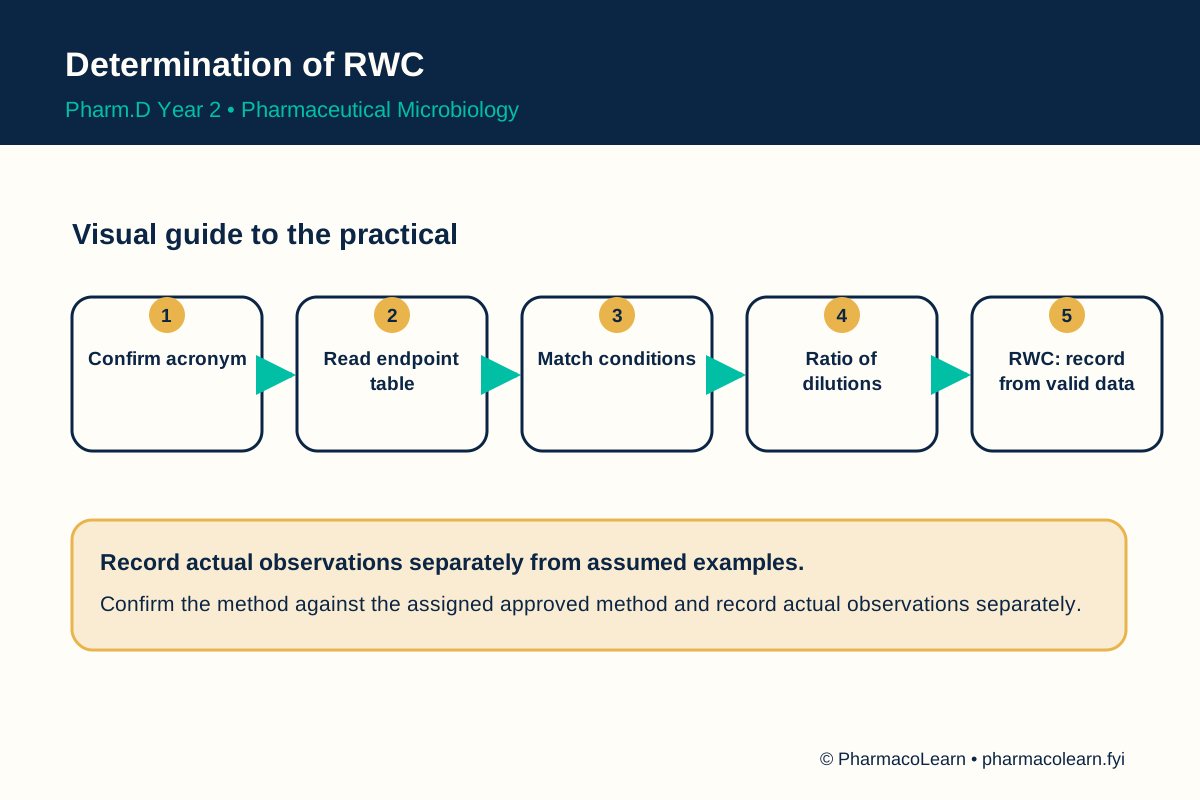
- Confirm the authorized Rideal-Walker method before using the exercise.
- Read the supplied phenol and test-disinfectant tables without conducting a live pathogen challenge.
- For each material, locate the method-defined matched effective endpoint and record its 1:n dilution.
- Check that endpoint timing, organism, controls, and validity requirements match across the comparison.
- Calculate the Rideal-Walker coefficient only from a matched, valid instructor-supplied endpoint record; otherwise leave the coefficient blank in the student record.
5. Observation and calculation
| Student record field | Entry |
|---|---|
| Case or product | Record here |
| Method | Record here |
| Observation | Record here |
| Inference | Record here |
| Supervisor check | Record here |
| Outcome | Record here |
Assumed values for practice only: assume a method-matched effective phenol dilution of 1:100 and an assumed disinfectant dilution of 1:400. The illustrative ratio is assumed 400 / assumed 100 = assumed 4. This is not a real test, a use dilution, or a product claim. Endpoint conditions must follow the approved historical method.
6. Output or final result
Give the coefficient only after the method is confirmed and controls are valid. Record the supervised outcome here.
Teaching-lab safety: Use historical or simulated records only. Do not culture a pathogen or test a disinfectant for operational use from this teaching page.
This page is a supervised-activity guide; it does not report a completed case.
7. Sources
- PharmacoLearn Pharm.D Year 2 syllabus
- PCI Pharm.D Regulations and Syllabus
- PharmacoLearn, Pharm.D Year 2 Syllabus
- Historical Rideal-Walker coefficient description
- ASM Guidelines for Biosafety in Teaching Laboratories
Back to Pharmaceutical Microbiology Practicals · All Pharm D Practicals · Pharm D
Theory notes: Pharmaceutical Microbiology