
← Pharmaceutical Microbiology Practicals
Diagnostic Tests for Common Diseases: Widal and Malarial Parasite
1. Aim
To interpret de-identified teaching records for Widal serology and malaria parasite microscopy while recognizing their different diagnostic value. Use a de-identified teaching record. This page makes no patient diagnosis; clinical diagnosis requires qualified review.
2. Requirements
Instructor-approved de-identified Widal report, labelled thick and thin malaria-film images, control or quality records, microscope image key, current diagnostic guidance, results sheet. Specimen collection, stain, kit, cutoffs, and reporting protocol are specified in your college lab manual and instructor's method sheet and are not performed here.
3. Theory
Widal records agglutinating antibodies, not direct detection of the typhoid organism. CDC cautions that Widal serology is unreliable and blood culture is preferred for typhoid diagnosis. Malaria microscopy detects parasites in stained blood films; WHO recommends examination of both thick and thin films, with trained reading and quality control. A classroom image can demonstrate morphology but cannot establish a patient diagnosis without specimen, clinical context, and qualified laboratory review. These two examples should therefore be reported separately.
4. Procedure
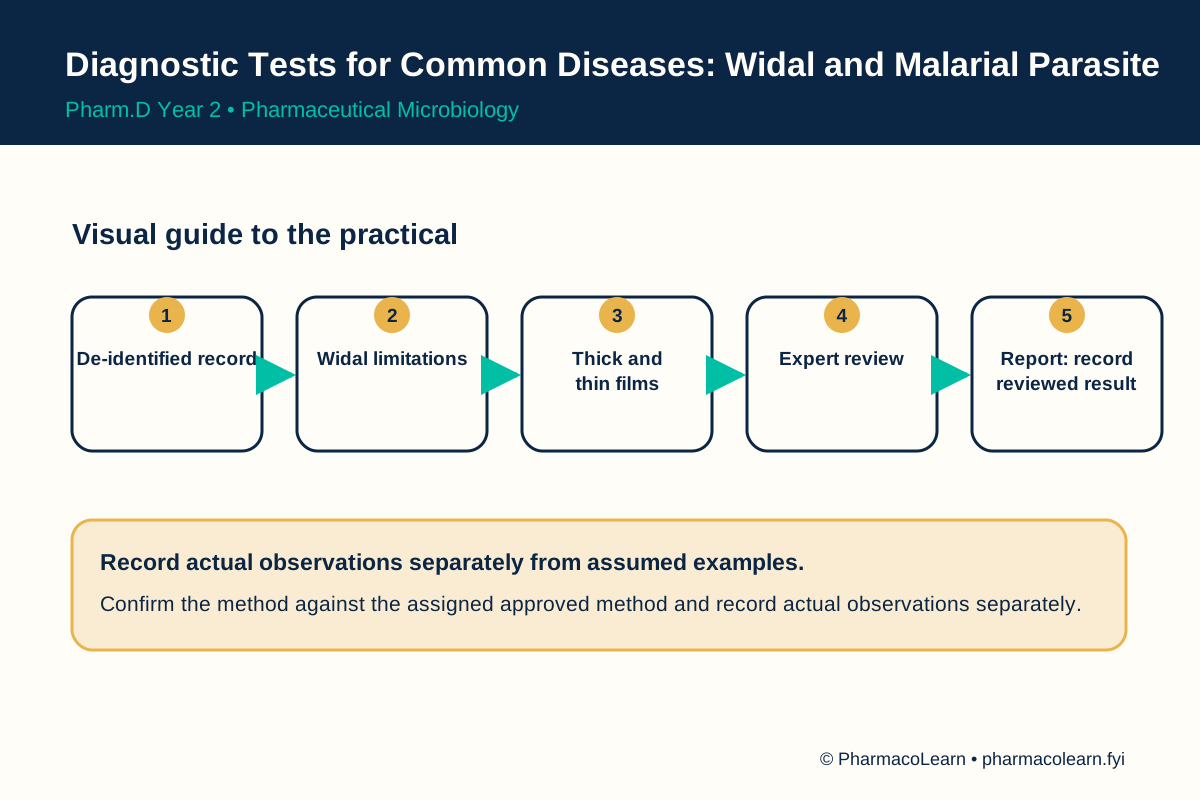
- Confirm that all records and images are de-identified and approved for teaching.
- For the Widal sheet, record antigen labels, reported titres, controls, and any missing interpretive context.
- For malaria images, record whether each is thick or thin film, image quality, and candidate parasite features using a verified atlas.
- Compare the student observations with the supplied expert interpretation and note disagreements or uncertainty.
- State the limitations of each test and refer any actual clinical decision to a qualified diagnostic service.
5. Observation and calculation
| Student record field | Entry |
|---|---|
| Case or product | Record here |
| Method | Record here |
| Observation | Record here |
| Inference | Record here |
| Supervisor check | Record here |
| Outcome | Record here |
Assumed observations for practice only: an assumed Widal record reports agglutination and an assumed film image contains a candidate ring-like feature. These invented observations do not diagnose typhoid or malaria. Enter observed case findings in the de-identified student record. This page makes no patient diagnosis; clinical diagnosis requires qualified review.
6. Output or final result
Provide two separate teaching interpretations with uncertainty and quality notes. No patient diagnosis is issued. Record the supervised outcome here.
Teaching-lab safety: Use only anonymized records and prepared digital images. No student venepuncture, patient sample handling, or pathogen culture is included.
This page is a supervised-activity guide; it does not report a completed case.
7. Sources
- PharmacoLearn Pharm.D Year 2 syllabus
- PCI Pharm.D Regulations and Syllabus
- CDC Clinical Guidance for Typhoid Fever
- WHO Malaria Microscopy Guidance
- ASM Guidelines for Biosafety in Teaching Laboratories
Back to Pharmaceutical Microbiology Practicals · All Pharm D Practicals · Pharm D
Theory notes: Pharmaceutical Microbiology