
← Pharmaceutical Microbiology Practicals
Cultural Sensitivity Testing for Some Microorganisms
1. Aim
To interpret a standardized antimicrobial disk diffusion record from an instructor-approved teaching organism. Record the assigned organism and agents from the supervised dataset. Clinical interpretation requires qualified review; this page does not interpret patient findings.
2. Requirements
De-identified plate photographs or approved low-risk culture, disk labels, ruler or caliper, quality-control record, current CLSI M02 method and M100 interpretation table, protective equipment. The approved inoculum, medium, incubation conditions, and organism-specific breakpoints are specified in your college lab manual and instructor's method sheet.
3. Theory
Disk diffusion tests how far an antimicrobial inhibits visible growth around a disk under standardized conditions. The measured inhibition-zone diameter is a raw observation. Susceptible, intermediate, or resistant categories require the correct current breakpoint for the organism and agent, together with acceptable quality controls. A large zone is not automatically a clinically effective medicine. This page uses the syllabus term cultural sensitivity but reports the method as disk diffusion susceptibility testing. Work with clinical isolates requires a separate authorized laboratory pathway.
4. Procedure
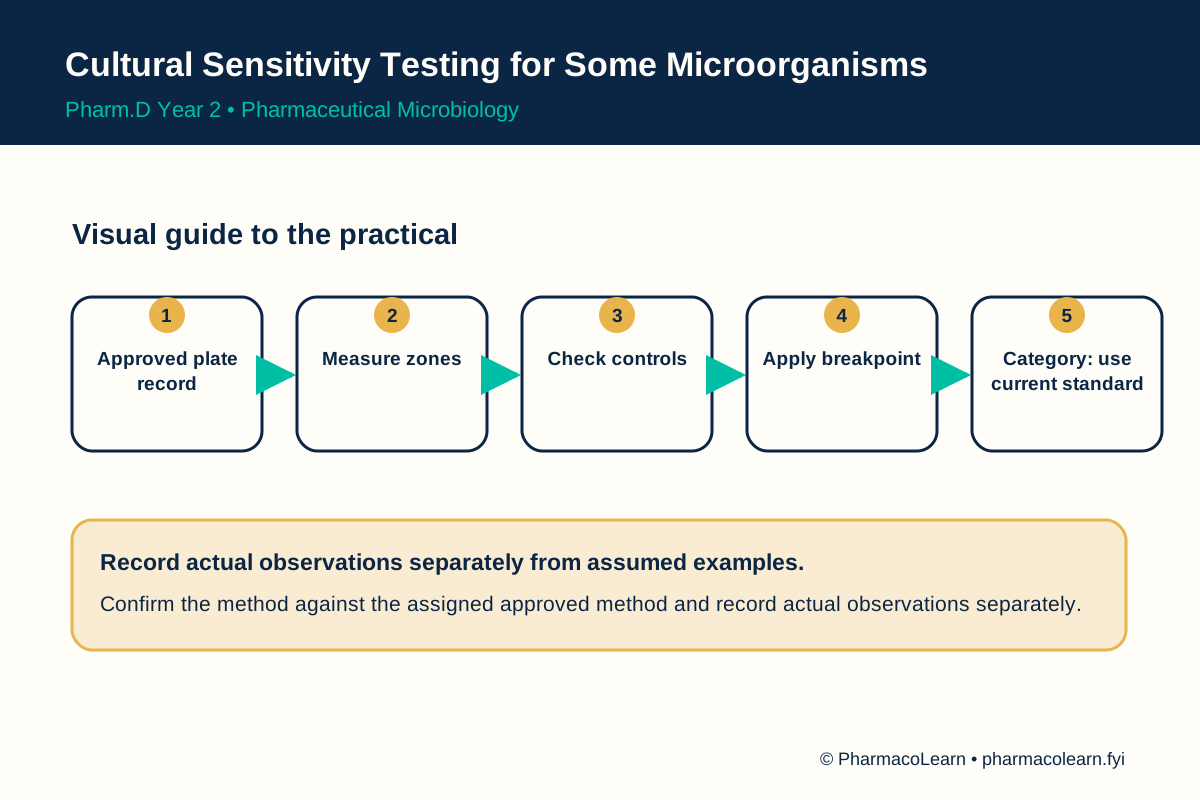
- Confirm the organism and risk assessment, method, disk identities, and control record with the instructor.
- Examine the supplied labelled plate image or observe a supervised run using only an approved teaching strain.
- Check whether growth is even and whether each disk and control can be read. Record unreadable zones as such.
- Measure the full diameter of each clear inhibition zone in millimetres, following the verified CLSI reading rule.
- Compare each valid measurement with the current organism and agent-specific breakpoint; flag missing criteria in the student record.
5. Observation and calculation
| Student record field | Entry |
|---|---|
| Case or product | Record here |
| Method | Record here |
| Observation | Record here |
| Inference | Record here |
| Supervisor check | Record here |
| Outcome | Record here |
Assumed values for practice only: an assumed plate image has an assumed zone diameter of 22 mm for an assumed disk A. This number is invented to show how to record a measurement. Disk A, its potency, organism, current breakpoint, and final category are specified in your college lab manual and instructor's method sheet. Do not infer susceptibility from 22 mm alone.
6. Output or final result
Report measured zone diameters and only those categories supported by a valid method, controls, and current breakpoints. Record the supervised outcome here.
Teaching-lab safety: Teaching-lab supervision is required. Use approved low-risk strains or image records; do not test unknown clinical samples in a student class.
This page is a supervised-activity guide; it does not report a completed case.
7. Sources
- PharmacoLearn Pharm.D Year 2 syllabus
- PCI Pharm.D Regulations and Syllabus
- CLSI M02, Performance Standards for Antimicrobial Disk Susceptibility Tests
- ASM Guidelines for Biosafety in Teaching Laboratories
Back to Pharmaceutical Microbiology Practicals · All Pharm D Practicals · Pharm D
Theory notes: Pharmaceutical Microbiology