
← Pharmaceutical Microbiology Practicals
Sterility Testing for Powders and Liquids
1. Aim
To interpret a sterility-test record for representative powder and liquid samples under a validated compendial method. Actual sample identity and acceptance decision are to be recorded from the assigned current monograph or approved college method in the student record.
2. Requirements
Approved simulated sample records, sample labels, method-suitability data, growth-promotion and negative-control records, suitable culture media records, USP <71>, protective equipment. Sample quantity, medium, transfer or membrane-filtration choice, incubation conditions, and observation period are specified in your college lab manual and instructor's method sheet from the applicable monograph and validated method.
3. Theory
A sterility test asks whether viable contaminating organisms can be detected under the stated conditions. USP <71> describes compendial approaches including membrane filtration and direct inoculation. Choice depends on the sample and its inhibitory properties. Method suitability is necessary because a preservative or antimicrobial substance could suppress growth and make a contaminated sample appear clear. A negative result is valid only with satisfactory controls and a conforming method. Students should not label a product sterile from one unvalidated observation.
4. Procedure
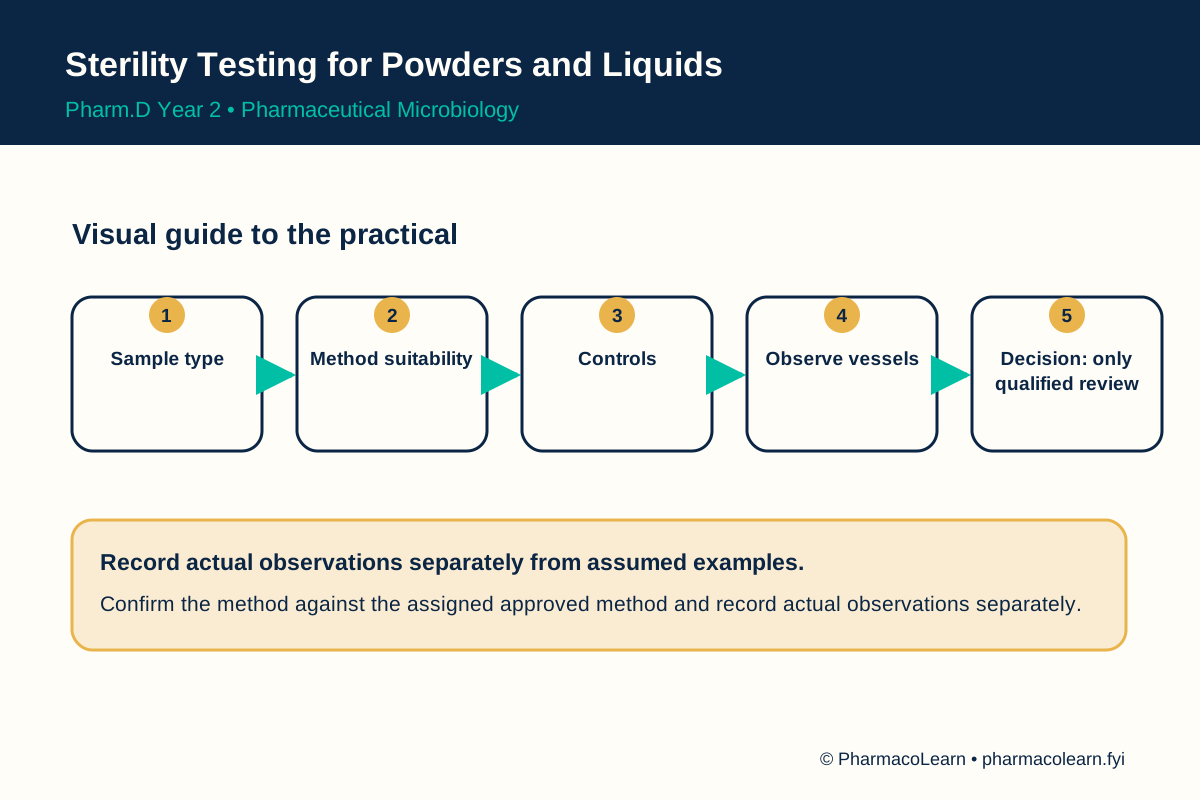
- Identify the powder and liquid records, their lot codes, and the applicable USP method.
- Check method-suitability, medium growth-promotion, and negative-control evidence before examining test vessels.
- Trace the validated sampling and transfer route for each formulation on the supplied batch record.
- Record every scheduled visual observation as growth seen, no growth seen, or unreadable, using the validated time points.
- Apply the compendial interpretation and investigation rules with instructor review; record any unresolved condition as Record here.
5. Observation and calculation
| Student record field | Entry |
|---|---|
| Case or product | Record here |
| Method | Record here |
| Observation | Record here |
| Inference | Record here |
| Supervisor check | Record here |
| Outcome | Record here |
Assumed observations for practice only: an assumed powder vessel is clear and an assumed liquid vessel shows turbidity. These are invented teaching observations. Neither is a release decision. Record sample identity, method suitability, controls, scheduled observations, and any investigation from the supervised laboratory record.
6. Output or final result
Present a separate validity assessment and conclusion for each sample. Actual sterility-test outcome: Record here.
Teaching-lab safety: Use supplied records or supervised institution-approved materials. Sterility testing for product release belongs in a qualified laboratory; unexpected growth is handled under its biosafety procedure.
This page is a supervised-activity guide; it does not report a completed case.
7. Sources
- PharmacoLearn Pharm.D Year 2 syllabus
- PCI Pharm.D Regulations and Syllabus
- USP <71>, Sterility Tests
- ASM Guidelines for Biosafety in Teaching Laboratories
Back to Pharmaceutical Microbiology Practicals · All Pharm D Practicals · Pharm D
Theory notes: Pharmaceutical Microbiology