
MPP201T — Principles of Quality Use of Medicines
4 hrs/week, 4 credits, 60 hours, 100 marks. Notes follow the M.Pharm syllabus, unit by unit.
MPP201T Principles of Quality Use of Medicines notes for M.Pharm Pharmacy Practice Semester 2: QUM principles, evidence based medicine, essential medicines, rational drug use, QUM in all settings and special populations, regulation, medication errors and pharmacovigilance, with free unit wise PDF downloads on PharmacoLearn.
Units in this subject
- Unit 1 — Introduction to Quality Use of Medicines
- Unit 2 — Concepts in QUM: Evidence Based Medicine, Essential Drugs and Rational Drug Use
- Unit 3 — QUM in Various Settings and in Special Populations
- Unit 4 — Regulatory Aspects of QUM in India
- Unit 5 — Medication Errors and Pharmacovigilance
Download MPP201T PDF Notes
Free PDFs for this subject, one per unit:
Principles of Quality Use of Medicines, subject code MPP201T, is the first core theory subject of M.Pharm Pharmacy Practice, Semester 2. It carries 4 credits and 60 hours of theory, taught at 4 hours per week, for 100 marks, and its five units are of equal length at 12 hours each in the PCI scheme. Its scope, as the syllabus states it, is to impart the basic knowledge and skills required to practice quality use of medicines in different healthcare settings and to promote quality use of medicines in clinical practice through an evidence based medicine approach. One wording note belongs at the start: Unit 1 of the syllabus prints the abbreviations QMC inside two item names, building blocks in QMC and evaluation process in QMC, in a unit otherwise entirely about QUM. The draft teaches those two items as the building blocks and the evaluation process of quality use of medicines, which is the only reading the surrounding text supports, and the verified record flags the printed form openly. No prevalence statistics, policy figures, guideline specifics or drug doses are stated anywhere in these notes, because the syllabus prints none and each of those belongs to a current guideline, list or label that a working pharmacist checks at the time of use.
Unit 1: Introduction to Quality Use of Medicines
1.1 What quality use of medicines means: the definition
Quality use of medicines, shortened to QUM, means that medicines are used wisely, safely and effectively, so that the people who need a medicine get the greatest benefit it can give with the least harm and waste it can involve. The definition has three tests built into it. Wise use means the decision to use a medicine at all, and the choice of which medicine, is made judiciously, on evidence and on the needs of this patient, with a non drug option considered where one exists. Safe use means the medicine is used in a way that minimises harm, with its risks known, watched for and managed. Effective use, sometimes stated as appropriate use, means the right medicine reaches the right patient in the right form for long enough to do its work, and its effect is checked. QUM is therefore not a property of a medicine. A good medicine used for the wrong indication, in the wrong patient, without explanation or without review, fails QUM, and an ordinary medicine chosen well, explained well and reviewed honestly passes it. That is why the subject is about decisions and systems, not about products.
1.2 The principles of QUM
The principles of QUM are the working form of the definition, and textbook teaching states them as a small set of linked commitments. First, primacy of the person: the patient, not the prescription, is the centre, and the patient's informed choice, circumstances and experience of treatment are part of quality, not an extra. Second, partnership: quality is produced jointly by prescribers, pharmacists, nurses, other health professionals, patients and carers, and no single partner can deliver it alone. Third, consultative and collaborative practice: partners share information, respect what each discipline knows, and resolve medicine problems together rather than in sequence and in silence. Fourth, support for consumer and professional education: people use medicines well when they understand them, and professionals prescribe and dispense well when their learning is current. Fifth, evidence informed decision making: choices rest on the best available evidence, read critically, applied to the individual. Sixth, monitoring and accountability: use is observed, problems are detected, outcomes are evaluated and practice changes on what is learned. An examination answer should state the principles and then show one operating in a named activity, for example partnership operating in a medication review, or monitoring operating in an adverse reaction report that changes a local guideline.
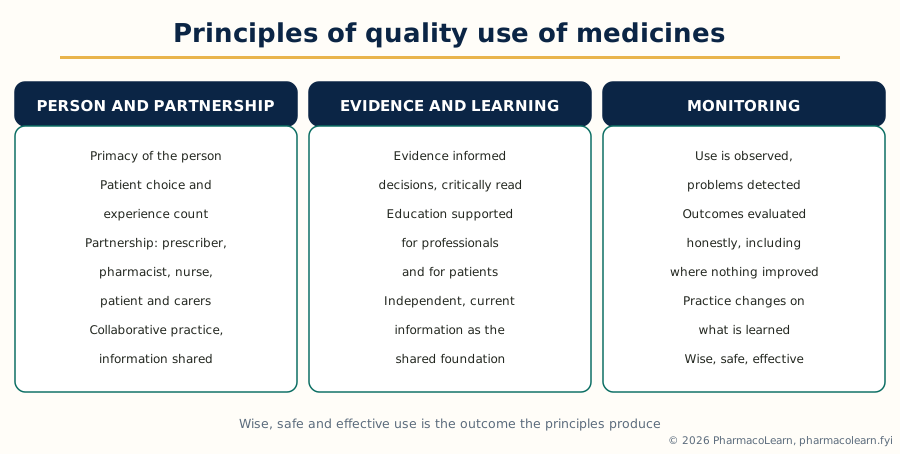 Figure: The principles of QUM. Wise, safe and effective use is the outcome; the six principles are how a service produces it.
1.3 Why QUM matters: benefit, harm and waste held together
Every medicine carries benefit and risk in the same package, and the syllabus objectives name both in one line: know the benefits and risks associated with the use of medicines. Used well, medicines relieve symptoms, cure infection, control long term disease and prevent events that have not yet happened. Used poorly, the same medicines harm through adverse reactions and interactions, fail through wrong choice or poor use by the patient, and waste scarce money in households and in health systems alike. QUM matters because all three failures are, in large part, preventable by better decisions rather than by better molecules: a clearer indication, a better matched choice, a warning given and understood, a review that stops a medicine whose work is done. For the Pharmacy Practice student the point is professional: the pharmacist is the partner whose daily work sits exactly at those decision points, at prescribing support, at dispensing, at counselling and at review, which is why this subject opens the second semester.
1.4 Key partners in QUM and their responsibilities in overview
The key partners of the syllabus are everyone whose decisions touch a medicine between its selection and its effect. Government and policy makers set the conditions: which medicines are registered and available, how they are priced, subsidised and listed, and what national policy says about their use. Regulatory authorities guard the quality, safety and efficacy of what reaches the market and act on safety information after marketing. Prescribers choose, for this patient, whether and what to prescribe, and remain responsible for review. Pharmacists assure the medicine supplied, check the prescription against the patient, counsel on use, detect medicine related problems and feed learning back to prescribers. Nurses and other health professionals administer medicines in institutional care, observe effects at the bedside and are often the first to see a problem. The pharmaceutical industry develops, manufactures, labels and promotes medicines, and its information shapes prescribing for better or worse. Patients and carers are partners, not recipients: they decide whether and how a medicine is actually taken, and their report of effect and harm is evidence no record can replace. Community and consumer organisations carry the public voice into policy and education.
1.5 Responsibilities of the partners, partner by partner
Responsibility in QUM is specific, and a strong answer assigns each duty to the partner who can actually perform it. The prescriber's responsibility is a defensible choice: a clear indication, a medicine selected on evidence and on this patient's other medicines, conditions and preferences, directions the patient can follow, and a plan for review, including when to stop. The pharmacist's responsibility runs across the supply: verifying the prescription for legality, appropriateness and interaction, supplying a quality product with correct labelling, counselling so the patient leaves knowing what the medicine is for, how to take it, what to expect and what to report, and documenting and communicating any problem found. The patient's responsibility, supported and never blamed, is to use the medicine as agreed, to keep and share an accurate list of all medicines including non prescription and complementary products, and to report benefit and harm honestly. The health organisation's responsibility is the system around them all: formularies, guidelines, prescribing and dispensing systems that make the right choice the easy choice, incident reporting without blame, and education time. Industry responsibility is taken up in full in Unit 4: honest information, quality manufacture and no promotion that outruns the evidence.
1.6 The building blocks of QUM
The building blocks are the foundations on which quality use rests, and they are best taught as the infrastructure a country and a service need before individual good practice can be expected. The first block is sound policy: a national medicines policy of the kind Unit 2 meets through the essential medicines list, stating how medicines will be selected, supplied, financed and used. The second is reliable information: independent, current, evidence based information for professionals and plain language information for patients, because decisions are only as good as the information inside them. The third is education: undergraduate, continuing and patient education that keeps knowledge and skill current. The fourth is a quality assured supply system: registration, good manufacturing and distribution practice, and access to the medicines the policy selects. The fifth is monitoring and evaluation, the subject of the next section: systems that watch how medicines are actually used and what they actually do. Remove any one block and the others strain: guidelines without supply produce frustration, supply without information produces waste, and everything without monitoring produces confidence without knowledge.
1.7 The evaluation process in QUM
Evaluation is the process by which QUM work finds out whether it worked, and it follows the same cycle whatever the scale, from a single ward intervention to a national programme. It begins by defining the problem and the question precisely: which medicine use, in which patients, measured how. Baseline information is then gathered before any change, because without a before picture no after picture proves anything. Indicators, the measurable signs chosen in advance, carry the evaluation: prescribing indicators, dispensing and administration observations, patient knowledge and reported outcomes, and safety reports, each chosen because it reflects the quality the intervention claims to improve. The intervention is implemented as planned and the same indicators are measured again in the same way. Results are compared honestly, including where nothing improved, and the findings are fed back to the partners whose practice is involved, in a form they can act on. The cycle then repeats or moves to the next problem. Evaluation so described is not research decoration: it is the accountability principle of Section 1.2 with its sleeves rolled up, and the pharmacist who can run a small, honest evaluation of a medicine use problem holds a core Pharmacy Practice skill.
The QUM evaluation cycle, step by step
  Define the medicine use problem and the question
        |
        v
  Measure the baseline with indicators chosen in advance
        |
        v
  Plan and implement the intervention with the partners
        |
        v
  Measure again in the same way, compare honestly
        |
        v
  Feed findings back, change practice, choose the
  next problem and begin the cycle again
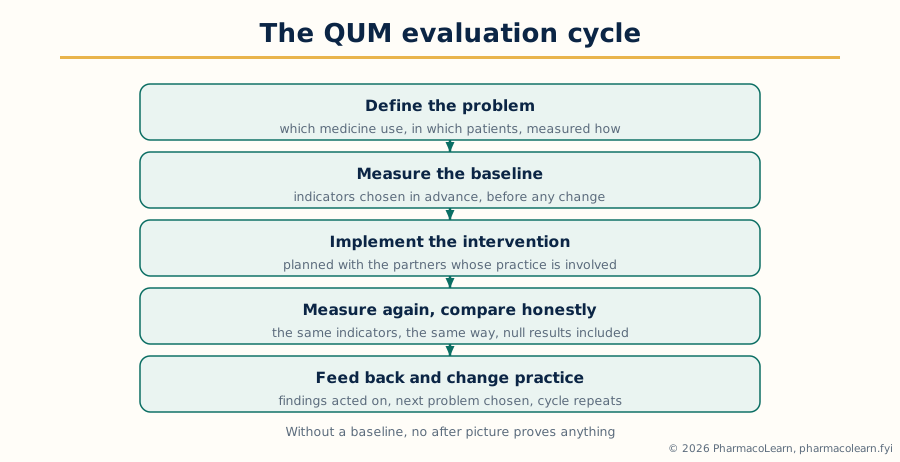 Figure: Evaluation as a cycle, not an event. The baseline is what makes the result believable.
1.8 Communication in QUM
Communication is named as its own syllabus item because most medicine failures are, at the point of failure, communication failures: an instruction misunderstood, a warning never passed on, a change of therapy that reached the ward and not the discharge summary, a patient who never said the tablets made her dizzy because no one asked in a way she could answer. Communication in QUM runs in three directions. Between professionals it means complete, accurate and timely transfer of medicine information at every handover, in writing where the record must carry it, with the reason for a choice stated and not only the choice itself. Between professional and patient it means counselling in plain language, checking understanding by asking the patient to say the plan back, providing written information to support the spoken word, and inviting questions and reports of problems as part of treatment rather than as complaints. Within the public sphere it means honest, balanced information about benefits and harms, from campaigns and consumer information, that neither oversells a medicine nor frightens people away from one they need. The pharmacist appears in all three directions, which is why the syllabus gives communication a full item and why Unit 3 returns to it inside multidisciplinary care.
1.9 Cost effective prescribing
Cost effective prescribing is the discipline of achieving the treatment goal at the lowest cost consistent with safety and effectiveness, where cost means the whole cost of the therapy and not only the price on the box. Its logic is sequential. First, is a medicine needed at all, or will a non drug measure, watchful waiting or stopping an existing medicine serve the patient better at no drug cost and no drug risk. Second, where a medicine is needed, is there a choice of equal effectiveness and safety for this patient at lower cost, the question the essential medicines concept of Unit 2 answers at policy level and the prescriber answers again at the bedside. Third, is the form, duration and quantity right, with no automatic continuation past the point of benefit and no waste through quantities the patient will not use. Fourth, are the hidden costs counted: monitoring the therapy requires, managing its adverse effects, and the far larger cost of a cheap therapy that fails and is replaced by hospital care. Cost effective prescribing is not cheap prescribing. A more costly medicine that prevents a serious outcome the cheaper one cannot prevent may be the cost effective choice, and the examination point is always the reasoning, outcome per unit of total cost, never price alone.
| Decision question | Cost effective answer looks like | Wasteful answer looks like |
|---|---|---|
| Is a medicine needed? | Non drug care or review first where evidence supports it | A prescription written because it is expected |
| Which medicine? | Equal benefit and safety at lower total cost | A costlier choice with no added benefit for this patient |
| How long and how much? | Duration and quantity matched to the goal, with a review date | Open ended continuation with no review |
| What follows the prescription? | Monitoring and adverse effect costs counted in the choice | Price compared alone, consequences ignored |
Unit 2: Concepts in QUM: Evidence Based Medicine, Essential Drugs and Rational Drug Use
2.1 The concepts of this unit, seen together
Unit 2 names the three concepts on which quality use stands. Evidence based medicine decides how a choice is justified: by the best available evidence, critically read. The essential medicines concept decides how a health system chooses its working set: a limited list, selected on need, efficacy, safety and value, kept supplied. Rational drug use decides how the individual prescription behaves: the right medicine, for the right patient, at the right cost to patient and community. The three operate at three levels, knowledge, system and prescription, and the pharmacist works at all three in a single day.
2.2 Evidence based medicine: definition
Evidence based medicine, shortened to EBM, is the conscientious, explicit and judicious use of current best evidence in making decisions about the care of individual patients, integrating that evidence with individual clinical expertise and with the patient's values and preferences. Every phrase in the standard definition carries weight. Conscientious and judicious exclude both careless copying and rigid obedience: evidence informs the decision, it does not replace it. Current best evidence means the most trustworthy research available now, appraised for quality, not the most recent headline or the most convenient study. Integration means the three elements meet in one decision: what the research shows, what the clinician's experience judges about this patient, and what this patient, informed, actually wants. A choice made from evidence alone, ignoring a patient's circumstances, is not evidence based practice; neither is a choice made from habit alone while calling it experience.
2.3 The concept of evidence based medicine: why it arose and what it corrects
EBM arose because unaided clinical experience, however sincere, is systematically misled: memorable cases outweigh typical ones, treatments appear to work because disease naturally fluctuates and because patients and doctors both expect benefit, and new information reaches practice unevenly and late. The concept answers with a discipline: questions are stated precisely, evidence is searched for rather than remembered, studies are appraised for bias and for whether their results matter and apply, and practice is audited against what the evidence supports. Around the individual decision sits an evidence ecosystem the pharmacist uses daily: systematic reviews that gather and appraise all the studies of a question, evidence based guidelines that translate syntheses into recommendations for defined situations, and primary studies of the kinds the next section ranks. EBM is therefore a habit of justification. When a prescriber or pharmacist is asked why this medicine, the evidence based answer cites the evidence, its strength and its fit to the patient, and says honestly where evidence runs out and judgement begins.
2.4 The hierarchy of evidence, taught qualitatively
Evidence is ranked because study designs differ in how well they protect a result from bias, and the syllabus expects the ranking understood qualitatively, as a ladder of trust for questions about whether a treatment works. At the top stand systematic reviews and meta analyses of well conducted trials, because they gather the whole evidence on a question and appraise it together. Below them stand individual randomised controlled trials, in which allocation by chance balances known and unknown differences between groups. Below trials stand observational designs, cohort and case control studies, which observe treatment as it occurs in practice and must argue their way around confounding. Below them stand case series and case reports, uncontrolled observations that can signal a question and, for rare harms, may be the first and only warning. At the base stand mechanism based reasoning and expert opinion, necessary, ubiquitous and the most easily misled. Two cautions complete the lesson. The ladder ranks designs for therapy questions; for questions of harm, prognosis or patient experience, other designs may be the best available. And a well conducted study of a lower design can deserve more trust than a badly conducted study of a higher one: the hierarchy guides appraisal, it does not replace it.
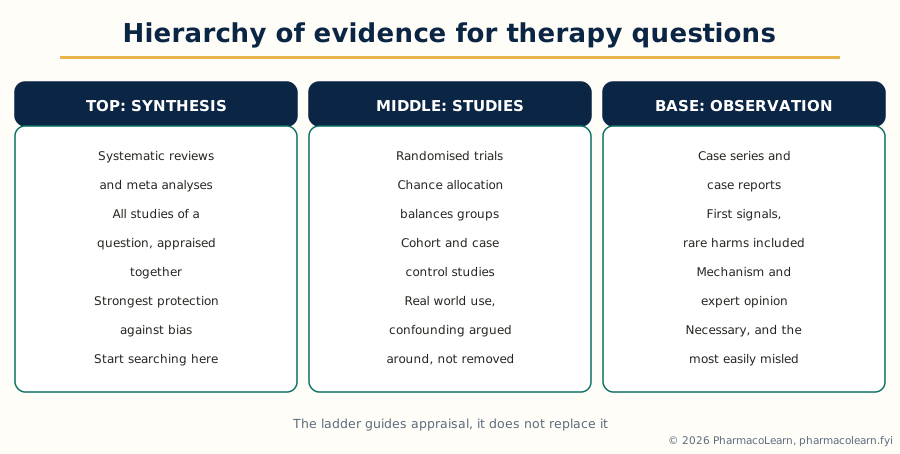 Figure: The evidence pyramid. Higher designs protect a therapy answer better against bias; appraisal still decides what any single study deserves.
2.5 Approach to evidence based medicine: the five steps
The approach to EBM is taught as five steps, and they should be learned as one continuous movement. Step one, ask: convert the clinical need into an answerable question, naming the patient or problem, the intervention, the comparison where there is one, and the outcome that matters. Step two, acquire: search efficiently for the best evidence that answers it, beginning where synthesis already exists, in guidelines and systematic reviews, before descending to primary studies. Step three, appraise: judge the evidence for validity, for the size and precision of its effect, and for its applicability to the patient in front of you. Step four, apply: integrate the appraised evidence with clinical expertise and the patient's values and make and explain the decision. Step five, assess: audit the outcome and the process, and let what happened refine the next question. In busy practice the steps compress: a pharmacist answering a ward question may run all five in minutes, using a guideline found quickly and appraised on known criteria. The compression is legitimate precisely because the steps are known well enough not to be skipped silently.
The five steps of evidence based practice
  Ask: state the answerable clinical question
        |
        v
  Acquire: search for the best available evidence
        |
        v
  Appraise: validity, size of effect, applicability
        |
        v
  Apply: evidence, expertise and patient values together
        |
        v
  Assess: audit the outcome and refine the next question
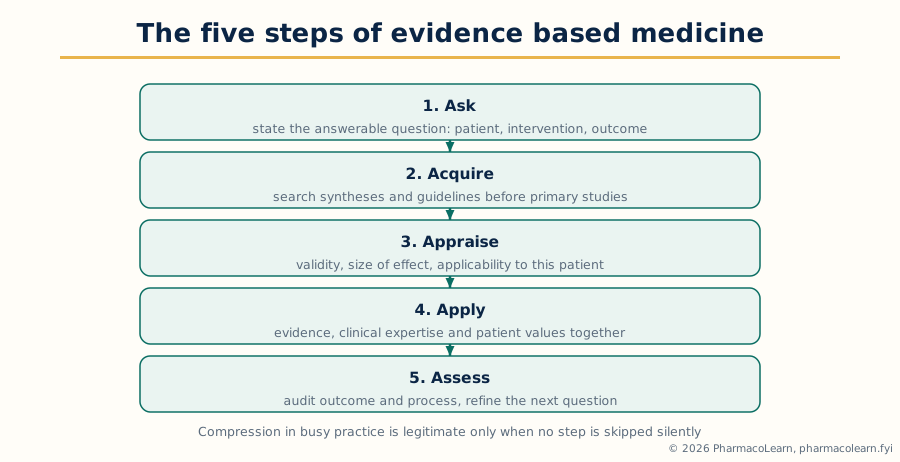 Figure: Ask, acquire, appraise, apply, assess. The fifth step is what turns one good decision into a better service.
2.6 Practice of evidence based medicine in clinical settings
In clinical settings EBM is practised through instruments, not only through individual searching. Clinical guidelines and local protocols carry appraised evidence to the point of decision and are the everyday form in which most evidence reaches most prescriptions; the professional skill is to use them knowingly, understanding what population and outcome they were built from and where the individual patient departs from them. Formularies restrict the working choice to medicines a committee has judged on evidence and value, which is EBM applied at system level before the prescription is written. Drug information services and medicines information pharmacists appraise evidence for questions too specific or too urgent for a guideline. Ward rounds, case presentations and journal clubs keep the appraisal habit social and current. The barriers deserve examination honesty: time pressure, information overload, guidelines that conflict, evidence that does not cover the elderly, the pregnant or the multiply ill patients who fill real wards, and commercial information that arrives faster and glossier than independent information. Naming a barrier and its countermeasure, protected appraisal time, independent sources, explicit documentation where practice departs from a guideline and why, is the mature answer.
2.7 Essential drugs: definition and need
Essential drugs, in current usage essential medicines, are those medicines that satisfy the priority healthcare needs of the population. The World Health Organization concept, in its standard form, selects them with due regard to disease prevalence and public health relevance, to evidence of efficacy and safety, and to comparative cost effectiveness, and intends them to be available at all times, in adequate amounts, in appropriate dosage forms, with assured quality and adequate information, and at a price the individual and the community can afford. The need for the concept is scarcity honestly faced. No system can stock, finance, quality assure and teach the safe use of every marketed product, and an unselected flood of products, many duplicating each other, dilutes all four: procurement budgets, quality control, prescriber knowledge and patient understanding. A limited, carefully chosen list concentrates each of them. Fewer medicines, better known, reliably supplied and affordably priced, treat the great majority of the conditions a population actually presents with, which is the empirical heart of the concept.
2.8 The concept of the essential drug: selection, lists and use
The concept works through selection and through disciplined use of the resulting list. Selection is by committee, on stated criteria, principally the pattern of disease, the treatment facilities and trained personnel available, genetic, demographic and environmental factors, and, medicine by medicine, efficacy and safety on the evidence, quality including stability in local conditions, cost and cost effectiveness, and a preference, other things equal, for single compounds with well known properties. The product of selection is a list, organised by therapeutic category, and the list then does work in the system: it guides procurement and supply, concentrates training and information, anchors the formulary of institutions, informs prescribing guidance and reimbursement, and gives the public a visible standard of what the system undertakes to provide. Lists are revised periodically because evidence, resistance patterns, prices and disease patterns change. The list is a floor for access, deliberately: it guarantees the medicines of greatest need; it does not claim that no other medicine should ever exist, and arrangements for exceptional need sit beside it in a well run system.
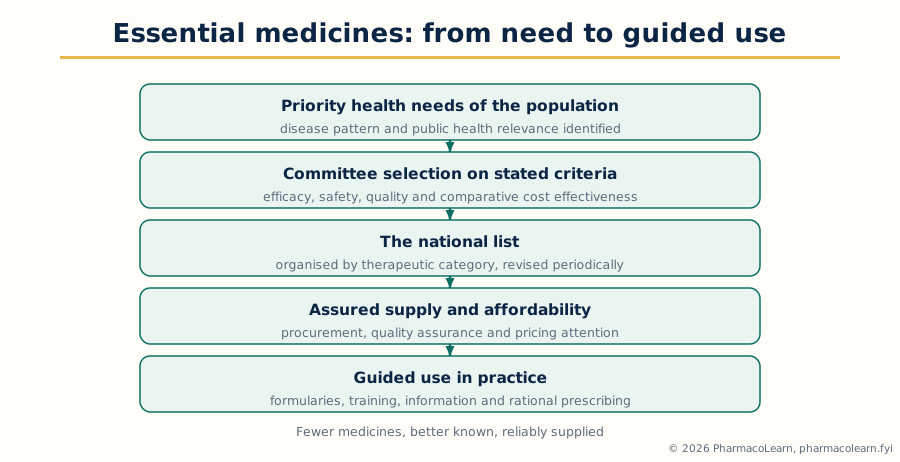 Figure: From population need to a working list. Selection is the concept; supply and guided use are where it succeeds or fails.
2.9 National essential drug policy and list
A national essential drug policy is the medicines component of national health policy: the government's stated commitment to selection, availability, affordability, quality and rational use, expressed through the national list and the systems that stand behind it. In India the corresponding instrument in current usage is the National List of Essential Medicines, prepared and revised through an expert committee process under the health ministry, which states which medicines the Indian system treats as essential for its priority needs. The policy and the list work together: the policy supplies the principles, procurement and pricing attention, quality assurance and promotion of rational use, and the list supplies the concrete content those principles act on. These notes state no edition, count or contents of any list, deliberately: lists are revised, and the professional habit taught here is to work from the current list itself, checking a medicine's presence, form and conditions at the time of the decision. For the examination, the answer structure is definition, selection criteria, functions of the list in supply, training and prescribing, and periodic revision.
2.10 Rational drug use: definition, concept and need
Rational drug use, in the classic World Health Organization formulation adopted at the Nairobi conference of experts, requires that patients receive medications appropriate to their clinical needs, in doses that meet their own individual requirements, for an adequate period of time, and at the lowest cost to them and their community, with dose here taught qualitatively as individual requirement and never as figures in these notes. The concept is the prescription level twin of QUM: QUM names the whole quality endeavour, rational use names what a single course of therapy must satisfy to belong to it. The need arises from the observed opposite, irrational use in its recognised forms: too many medicines per encounter, a medicine where none is indicated, an antimicrobial where the condition does not call for one or chosen without regard to guidance, injections where an oral form would serve, prescribing that departs from guidelines without reason, and self medication with prescription medicines or in unsafe ways. Each form wastes money, adds avoidable risk, and, for antimicrobials, spends a shared resource, continued effectiveness, that no individual prescription can restore. Rational use is thus simultaneously a clinical, an economic and, for antimicrobials, a community duty.
2.11 Rational drug prescribing: the prescriber's process
Rational drug prescribing is the process that produces a rational prescription, and it is taught as an ordered discipline. The prescriber first establishes the patient's problem and states the therapeutic objective: what this treatment must achieve, in terms the outcome can later be judged against. The choice of treatment follows, verifying, for the chosen medicine, its suitability for this patient: effectiveness on the evidence and in guidance, safety against this patient's conditions, other medicines, allergies and physiology, and cost the patient and system can sustain. Prescribing is then executed precisely: the right product and form, clear directions, duration and quantity matched to the objective, and warnings stated. The patient is informed, in the counselling sense of Unit 1, because a prescription the patient misunderstands is irrational in effect however rational on paper. Finally the result is monitored: benefit judged against the objective, harms watched for, and the medicine continued, adjusted or stopped on that judgement, with stopping recognised as a prescribing act of equal standing. The familiar shorthand for the whole process, right drug, right patient, right dose in the qualitative sense, right route, right time and right documentation, is a memory aid for this process, not a substitute for it.
The rational prescribing process
  Define the problem, state the therapeutic objective
        |
        v
  Choose the treatment: verify effectiveness, safety
  and cost for this individual patient
        |
        v
  Prescribe precisely and inform the patient fully
        |
        v
  Monitor benefit and harm against the objective
        |
        v
  Continue, adjust or stop, and record the decision
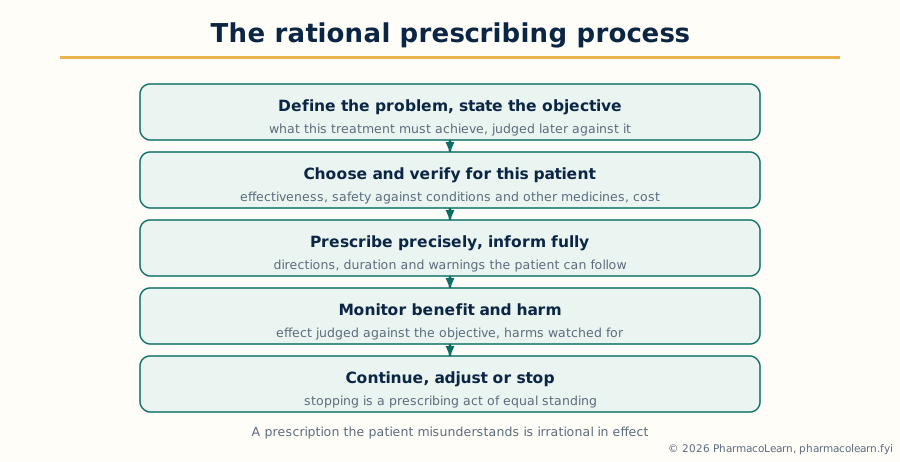 Figure: Rational prescribing is a cycle with a stop decision inside it, not a single act of writing.
2.12 Role of the pharmacist in rational drug use
The pharmacist promotes rational use at every point where a prescription can still be improved. At prescription review, before supply, the pharmacist checks indication against medicine, the choice against formulary and guidance, interactions and duplication across the whole list, and suitability in the special populations of Unit 3, and intervenes with the prescriber on what is found, constructively and with evidence. At dispensing, accuracy and labelling protect the written intention from execution error. At counselling, the pharmacist converts the prescription into the patient's own practice, which decides its real effectiveness. Beyond the individual prescription, pharmacists build the system that makes rational use normal: formulary and drug information work, prescribing feedback and evaluation of the Unit 1 kind, antimicrobial guidance work inside the hospital team at the general principle level of this syllabus, education of prescribers and patients, and pharmacovigilance of Unit 5, whose reports are rational use learning in its sharpest form. The role is therefore both checkpoint and architect: intercepting the irrational prescription today while helping design the service in which fewer are written.
| Concept | Level it works at | Core question it answers | Pharmacist's main instrument |
|---|---|---|---|
| Evidence based medicine | The decision | Is this choice justified by the best evidence, read critically? | Appraisal, guidelines, drug information |
| Essential medicines | The health system | Which medicines must always be available and affordable? | Formulary and list based supply and guidance |
| Rational drug use | The individual prescription | Does this patient get the appropriate medicine, suitably, for long enough, at lowest fair cost? | Prescription review, counselling, monitoring |
Unit 3: QUM in Various Settings and in Special Populations
3.1 QUM follows the patient across settings
Medicines travel with the patient between hospital, clinic, home and residential care, and quality failures cluster at the borders: the medicine changed in hospital and never reconciled at discharge, the clinic letter that never reached the community pharmacist, the residential facility working from an outdated list. Unit 3 therefore teaches QUM setting by setting, and then population by population, because the principles of Unit 1 are constant and their machinery differs. The constant discipline at every border is medication reconciliation in its general sense: one accurate, current list of medicines, checked at each transfer, with every change and its reason recorded and communicated.
3.2 QUM in hospital settings
In hospital, QUM is organised through committees and clinical pharmacy practice. The pharmacy and therapeutics or drug and therapeutics committee owns the hospital formulary, evaluates new medicines for local adoption, approves guidelines and reviews medicine use and safety learning, so that individual prescribing operates inside a judged framework. Restricted and guidance led use applies where evidence, cost or resistance risk demands it, most visibly for antimicrobials at the level of principle. Clinical pharmacists work on wards: taking medication histories on admission, reviewing charts daily for indication, choice, interaction, duplication and monitoring, intervening with prescribers, counselling patients on changed therapies and reconciling medicines at discharge. Prescribing systems, whether paper charts with disciplined design or electronic prescribing with decision support, shape error rates by their design, which Unit 5 examines. The hospital advantages are concentration and observation: many professionals, full records and daily review. Its characteristic risks are the mirror image: complex patients on many medicines, rapid changes, handovers between teams, and transitions at admission and discharge where information is most easily lost.
3.3 QUM in ambulatory care
Ambulatory care, the clinic, outpatient and community world in which most medicines are actually used, has the opposite profile: brief encounters, long intervals between reviews, and execution of therapy by the patient alone at home. QUM here rests on the quality of the individual encounter and of the record that connects encounters. The prescriber's tasks are a precise problem list, a maintained medicine list reviewed at each visit, avoidance of indefinite continuation without review, and explicit instructions for what to do when symptoms change. The community pharmacist is the most frequently seen professional in this setting and carries much of its QUM: checking new prescriptions against the patient's profile, noticing duplication between prescribers, counselling, supplying compliance supporting information in plain terms, identifying the patient whose collection pattern suggests a therapy has been abandoned or is being overused, and referring back to the prescriber with a specific, evidenced concern. Continuity is the scarce resource, and every shared record, shared list and referral letter is QUM infrastructure.
3.4 QUM in residential care
In residential care, older and frailer people live with staff support, medicines are commonly administered by care staff from supplied packs or charts, and the prescriber visits rather than resides. The QUM risks are characteristic: many medicines accumulated over years and prescribers, psychotropic and other high risk medicines continued without structured review, administration rounds under time pressure, and residents least able to report a problem clearly. Quality machinery therefore emphasises periodic, structured medication review involving prescriber, pharmacist and care team together, clear administration records, careful use of when required medicines with recorded indication and effect, staff training in administration and observation, and incident reporting that treats an administration error as system learning. The pharmacist's review role, often as a visiting or contracted service, is the single most characteristic QUM intervention of this setting, and its method is the rational prescribing process of Unit 2 run retrospectively over a whole list: for each medicine, is the indication still present, the benefit still plausible, the harm still acceptable, and the combination still coherent.
3.5 Role of health care professionals in promoting QUM
Each profession promotes QUM through the part of the medicine's journey it owns, and the syllabus expects the roles distinguished and then joined. Doctors and other prescribers own choice and review. Pharmacists own supply, verification, information and much of the system's evaluation and safety machinery. Nurses own administration in institutional settings and the closest continuous observation of effect and harm, and in many services own medicines reconciliation tasks and patient education at the bedside. Dentists, and other authorised prescribers within their scopes, carry the same duties inside those scopes. Allied health professionals contribute the non drug therapies that QUM counts as real alternatives and observe functional outcomes medicines claim to improve. Managers and administrators, easily forgotten in a clinical syllabus, control formularies, staffing, systems and time, without which professional intentions cannot become routine practice. Joined, the roles form the partnership principle of Unit 1 with job titles attached; unjoined, each profession optimises its own step while the patient's whole therapy quietly fails between them.
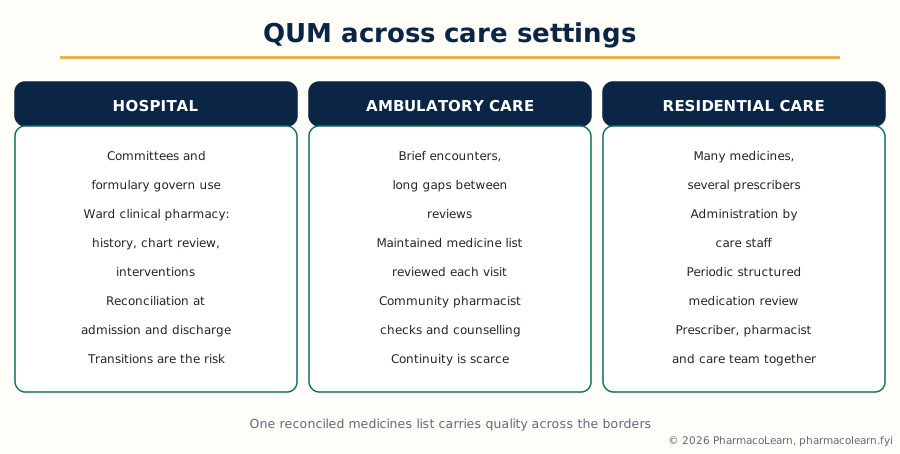 Figure: Three settings, three machineries, one patient. The reconciled list is what carries quality across the borders.
3.6 Strategies to promote QUM
Strategies to promote QUM are classified usefully by their target. Educational strategies change knowledge and habit: academic detailing, in which a trained pharmacist or peer visits prescribers with concise, independent evidence on a chosen topic; guideline dissemination with local discussion rather than by post alone; audit and feedback, in which prescribers see their own practice measured against a standard and against peers; and patient education campaigns and materials. Managerial strategies change the choice environment: formularies and preferred lists, prescribing indicators monitored by services, structured medication review programmes, and prescribing support at the point of decision. Regulatory strategies, Unit 4 in full, change what the law permits: scheduling, labelling and advertising controls and professional standards. Financial strategies change incentives, for good or ill, and must be examined for the prescribing behaviour they actually reward. The evidence informed lesson across strategies is that single, passive measures, a circular, a lecture, a poster, rarely move practice for long; combined, active strategies, education joined to feedback, system redesign and follow up evaluation, are what a QUM plan proposes, with the evaluation cycle of Unit 1 built in from the start.
3.7 Impact of QUM on E health
By E health the syllabus means the electronic systems through which modern medicine use is recorded, ordered and shared: electronic health records, electronic prescribing and dispensing systems, shared medicines lists, decision support and telehealth services. QUM shapes what these systems must do well, and is in turn reshaped by them. Well designed, they carry one reconciled list across settings, check interactions and allergies at the moment of prescribing, make guidelines available inside the workflow, create the data from which prescribing evaluation and pharmacovigilance signals are drawn, and let a pharmacist review a chart without standing beside it. Badly designed, they manufacture new error types, which Unit 5 counts honestly: wrong selection from look alike lists, alerts so frequent they are reflexively overridden, copy forward records that preserve yesterday's medicines as today's, and automation bias, the assumption that the system has checked what it has not. The QUM position is neither celebration nor rejection: specify systems against medicine safety requirements, train users, monitor the errors the system itself creates, and keep the professional check, especially the pharmacist's independent review, visibly alive inside the electronic workflow.
3.8 Integrative medicine and multidisciplinary care
Integrative medicine, in the sense relevant here, is the coordinated use of conventional treatment with complementary approaches a patient is using or wishes to use, inside one care plan, openly discussed and safety checked, rather than two parallel treatments invisible to each other. Its QUM significance is practical. Patients use complementary medicines widely and disclose them incompletely unless asked without judgement; those products can interact with prescribed therapy, vary in quality, and substitute for effective treatment where evidence does not support substitution. The multidisciplinary team is the structure that handles this well: prescriber, pharmacist, nurse, dietitian, physiotherapist and others planning together, with the pharmacist specifically screening the full product list, prescribed, purchased and complementary, for interaction, duplication and quality concerns, and the team agreeing what continues, what stops and what is monitored. Multidisciplinary care is also the general answer of this unit: complex patients exceed any one profession's view, and the team meeting, the shared plan and the shared record are QUM machinery in their own right, for integrative questions and for everything else.
3.9 QUM in special populations: the general principle
Special populations are groups in whom the standard adult assumptions behind most prescribing, about body size and composition, organ function, physiology and risk, do not hold, so that a choice ordinary in a healthy adult may be unsuitable, unsafe or ineffective in them. The syllabus names four: children, older people, pregnancy and lactation, and people who are immune compromised or living with organ failure. The shared discipline is individualisation with evidence and humility: establish how this population changes the medicine's handling and effects, prefer medicines with experience and guidance in the group, involve the specialist sources and teams who hold that experience, monitor more deliberately, and record the reasoning. No doses are stated in these notes for any population; dosing in special populations belongs to current references and specialist guidance checked at the time of prescribing.
3.10 Pediatric prescribing
In pediatric prescribing the child is not a small adult. Absorption, distribution, metabolism and excretion all change with age, most rapidly in the youngest children, so handling of medicines matures over childhood and the same medicine behaves differently at different ages. Body weight and developmental stage therefore govern prescribing in a way adult practice does not rehearse, formulations must exist that a child can actually take accurately, and measurement and administration at home, by parents using household measures or confused instructions, is a recognised error source that counselling and proper measuring devices answer. Evidence is thinner because children are less studied, which raises the prescriber's duty to follow pediatric guidance and formularies, to be explicit where use is outside a product's licensed terms and why it is nonetheless justified, and to watch and report outcomes, including adverse reactions, with the pharmacovigilance care of Unit 5. The pharmacist's pediatric roles are verification against age and weight based references, formulation and supply advice, and parent counselling that checks the caregiver can state the plan back accurately.
3.11 Geriatric prescribing
In geriatric prescribing the changes run the other way: kidney and liver function decline, body composition shifts, homeostatic responses blunt, and, above all, medicines accumulate, because older people live with several long term conditions and several prescribers. The characteristic QUM problems are polypharmacy in its harmful form, prescribing cascades in which an adverse effect is misread as a new disease and treated with a further medicine, medicines whose harms outweigh shrinking benefit as frailty and goals change, and adherence defeated by complexity, cost, vision, dexterity or cognition rather than by intention. Quality practice answers with regular whole list review and deprescribing, the planned, supervised stopping of medicines whose harm now outweighs benefit or whose indication has passed; with explicit caution lists and guidance on medicines risky in older people, used as prompts for review rather than as absolute bans; with simplification of regimens; and with goals set by what the patient values, function, comfort, independence, rather than by disease targets alone. The pharmacist led medication review is the flagship intervention, here as in residential care, which is largely geriatric care by another address.
3.12 Prescribing in pregnancy and lactation, in immune compromise and in organ failure
Prescribing in pregnancy must hold two patients in one decision: benefit and risk to the mother, whose untreated illness is itself a fetal risk, and direct and developmental risk to the fetus, which varies by stage of pregnancy and is greatest while organs are forming. The discipline is to prefer medicines with accumulated pregnancy experience, to use reliable specialist information sources rather than memory or fear, to avoid both unsafe prescribing and the equally harmful reflex of stopping necessary treatment, and to document counselling and shared decision making. In lactation the parallel questions are how much of the medicine reaches milk, what the infant's age and health make of that exposure, and how feeding and treatment can both be protected, again from specialist sources. In immune compromised patients the governing facts are vulnerability to infection, interaction between anti infective, immunosuppressant and other therapies, and the need for prophylaxis, vaccination judgement and close monitoring to be planned with the specialist team. In organ failure, principally kidney and liver, clearance falls or activation and protein binding change, active metabolites may accumulate, and the organ failure itself may be worsened by the wrong choice; prescribing leans on organ function based guidance and therapeutic monitoring where the sister subjects teach it. Across all four groups the pharmacist's contribution is the same shape: specialist reference checking, interaction and accumulation screening, monitoring plans and counselling that the patient and family can act on.
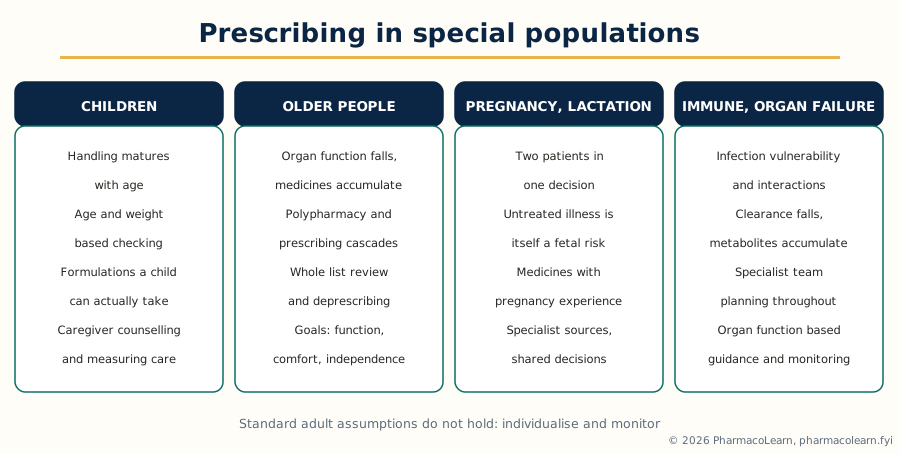 Figure: Four populations, one discipline: standard assumptions do not hold, so individualise, use specialist guidance and monitor deliberately.
Unit 4: Regulatory Aspects of QUM in India
4.1 Regulation as a QUM building block
Regulation is the legal machinery that sets the floor under quality use: which medicines may be sold at all, of what quality, by whom, to whom, on whose authority, with what information and what promotion. It cannot by itself create excellent prescribing, which is why Units 1 to 3 are about practice, but its absence reliably permits the worst use: unregistered and substandard products, unrestricted sale of medicines that need supervision, misleading promotion and no accountable professional at the point of supply. The Indian framework is taught here at the level the syllabus sets, the areas of regulation and their QUM purpose, naming governing instruments only in their standard textbook form. Specific schedule contents, licensing conditions and penalties are set by the current law and rules and are checked there, not memorised from notes.
4.2 Regulation including scheduling
The core statute is the Drugs and Cosmetics Act and its Rules, under which medicines are licensed for manufacture, import, sale and distribution, quality is policed through standards, sampling and laboratories, and misbranded, adulterated and spurious medicines are offences. Scheduling is the Rules' device for grading control to risk: medicines are placed in schedules that prescribe the conditions of their sale and supply, prominently including schedules whose medicines may be supplied only on the prescription of a registered medical practitioner, schedules adding record keeping and warning requirements for medicines with dependence or misuse potential, and provisions governing labels, warnings and the particulars a lawful supply must carry. The QUM logic of scheduling is proportionality: the greater the risk in unsupervised use, the tighter the gate, prescription only supply, records, warnings, restricted advertising, and the pharmacist at the counter is where the schedule becomes real, by insisting on the prescription the law requires and keeping the records it prescribes. The central and state division of labour, central authority over standards, imports and new medicines, state authorities over much manufacture and sale licensing and inspection, explains why enforcement experience varies and why professional standards must not.
| Regulatory area | What it controls | QUM purpose |
|---|---|---|
| Licensing and quality control | Manufacture, import, sale, standards and testing | Only quality assured medicines enter use |
| Scheduling | Conditions of sale, prescription only status, records and warnings | Supervision graded to the risk of unsupervised use |
| Complementary medicines regulation | Licensing, quality and claims of traditional and complementary products | The same honesty and safety floor for every product used as a medicine |
| OTC regulation | Which medicines may be self selected, labelling and advertising | Safe self care inside stated limits |
| Professional regulation | Registration, conduct and accountability of the pharmacist | An accountable professional at the point of supply |
4.3 Regulation of complementary medicines
Complementary medicines in India span the recognised traditional systems, principally Ayurveda, Yoga and Naturopathy, Unani, Siddha and Homoeopathy, together with a wide market of supplements and herbal products, and they are regulated through their own statutory channels: the traditional systems under the ministry and regulatory structures for those systems, with their own pharmacopoeias, licensing and good manufacturing requirements, and homoeopathy under its own council and pharmacopoeial tradition, beside the Drugs and Cosmetics framework where its provisions apply. The QUM questions are the same as for any medicine, and regulation exists to make them answerable: is the product what its label claims, made to a quality standard, free of undeclared potent ingredients and contamination, labelled with honest claims that do not promise cure where evidence does not, and used with its interactions and limits in view. The pharmacist's duty at the counter is integration in the Unit 3 sense: ask, record, screen for interaction and duplication, and never treat a product as harmless merely because it is traditional or natural.
4.4 Regulation of OTC medicines
Over the counter medicines are those the regulatory system permits a person to obtain without a prescription, for self recognised, minor and self limiting conditions, inside the limits their labelling states. India has historically operated this area principally by exclusion, medicines not placed in prescription only schedules being in practice available without prescription, with labelling, advertising and pharmacy sale provisions supplying the safeguards, rather than through a single published OTC list of the kind some other systems maintain; the student should present that position carefully, as a framework description, and check the current rules and any current list or amendment at the time of practice, because this is an actively reformed area. The QUM stakes are high because self medication is the largest volume of medicine use there is. Its benefits are real, timely treatment of minor illness, professional time saved, patient autonomy, and its risks are the syllabus risks of rational use in the home: masking a serious condition, wrong product for the condition, duplication of an ingredient across products, unsafe use in pregnancy, childhood and chronic disease, and interaction with prescribed therapy. The pharmacist is the safety net of the OTC system: structured questioning about the symptom, the person and their other medicines, advice with clear limits and referral triggers, and refusal to supply where supply would be unsafe are professional acts, not retail courtesies.
4.5 Professional responsibility of the pharmacist
Professional responsibility is where regulation becomes personal. The pharmacist in India practises under registration with the pharmacy council system established by the Pharmacy Act, is bound by the pharmacy practice regulations and the professional code they express, and answers, professionally and in law, for the medicines supplied under their supervision. In QUM terms the responsibilities are concrete: to supply only quality, lawfully sourced medicines and store them properly; to dispense against a valid prescription where one is required and never to treat that requirement as optional; to check prescriptions and intervene on error and irrationality, because silent supply of a prescription known to be wrong is a professional failure, not neutrality; to counsel patients and protect their confidentiality; to keep the records the law and good practice require; to refuse participation in misleading promotion or sale driven practice; and to keep competence current through continuing learning. Responsibility also runs upward: reporting quality defects and adverse reactions through the systems of Unit 5 is a professional duty, and a pharmacist who sees a system producing errors owes the service the report and the improvement proposal, not only private concern.
4.6 Role of industry in QUM in medicine development
Industry enters QUM first as the developer and manufacturer of the medicines themselves, and its development duties are quality duties: evidence generated honestly across the trial programme of the sister subject MPP104T, a product dossier that states benefit and risk as the data show them, manufacture to good manufacturing practice so that the medicine supplied is the medicine studied, labelling and product information that state indications, warnings and use accurately, and post marketing safety work, collecting, evaluating and reporting adverse reactions and acting on signals with the regulator. A medicine developed and labelled well arrives in practice with quality built in; a medicine oversold at launch, with marginal benefit presented as breakthrough and risks minimised, loads the prescriber and pharmacist with repair work for its whole life. Industry is therefore a named QUM partner in Unit 1 and a regulated actor in Unit 4 at once, and both framings are true.
4.7 Industry, information and promotion: the QUM boundary
The second industry interface is promotion: representatives, sponsored education, advertising where permitted, samples and digital marketing, all of which demonstrably shape prescribing and none of which is independent education, however useful individual items may be. The regulatory and ethical boundary, expressed in India through drug advertising controls, prescription medicine promotion restrictions and the industry's uniform code for pharmaceutical marketing practices in its current form, together with institutional and professional codes, draws a consistent line: promotion must be accurate, balanced and consistent with the approved product information; prescription medicines are promoted to professionals, not advertised to the public; inducements that purchase prescribing are prohibited in principle; and hospitality and sponsorship carry disclosure and restraint obligations. The pharmacist's and prescriber's QUM defence is critical appraisal applied to commercial information with the same rigour as to a paper: what is the comparator, what outcome, in which patients, and what does the independent source say. A service that teaches that defence has done more for prescribing quality than one that merely complains about promotion.
Unit 5: Medication Errors and Pharmacovigilance
5.1 Medication errors: definition
A medication error is any preventable event that may cause or lead to inappropriate medication use or patient harm while the medication is in the control of the healthcare professional, the patient or the consumer, in the standard textbook definition associated with the error literature the syllabus cites. Three words do the work. Preventable distinguishes the error from the adverse reaction of Section 5.8, which can occur with flawless practice; an error is by definition something the system could have prevented. Event includes near misses, errors caught before they reached the patient and errors that reached the patient without harm, because all three teach the same lesson and only chance separates them. Inappropriate use or harm states the outcome range honestly: most errors harm no one, some harm seriously, and a safety system studies the whole distribution rather than waiting for its worst member. Errors may occur at any stage the next sections trace: prescribing, transcribing and documenting, dispensing, administering and monitoring.
5.2 Categorization of medication errors
Errors are categorised in several complementary ways, and an examination answer gains by naming the scheme it is using. By stage, errors are prescribing errors, wrong medicine, wrong patient, unsuitable choice, illegible or incomplete order, interaction or allergy missed; transcription and documentation errors, the order changed, omitted or misread as it is copied or entered; dispensing errors, wrong product, strength, form, label or patient at supply; administration errors, wrong patient, medicine, route, time or omission at the point of giving; and monitoring errors, the effect or harm that should have been checked and was not. By outcome, systems grade errors from circumstances with the capacity to cause error, through errors that did not reach the patient, errors that reached the patient without harm, errors requiring monitoring or intervention, to errors contributing to temporary or permanent harm or death, the severity ladder associated with the standard error index teaching. By type of failure, wrong dose in the qualitative sense, wrong medicine and wrong patient remain the classic triad. Categorisation is not bureaucracy: the category decides the countermeasure, because an illegibility problem, a look alike product problem and a knowledge problem have nothing in common except the word error.
| Category by stage | Typical failure | First line countermeasure |
|---|---|---|
| Prescribing | Unsuitable choice, interaction or allergy missed, incomplete order | Decision support, pharmacist chart review, prescribing guidance |
| Transcribing and documentation | Order misread, omitted or changed in copying or entry | Direct electronic entry, read back, reconciliation at transfer |
| Dispensing | Wrong product, form or label, look alike selection | Independent check, separated storage, labelling discipline |
| Administration | Wrong patient or medicine, omission, wrong timing | Patient identification checks, administration record discipline |
| Monitoring | Effect or harm not checked, result not acted on | Planned monitoring, result ownership, pharmacist review |
5.3 Causes of medication errors
Causes are taught at two levels, the active failure at the sharp end and the latent conditions behind it, because prevention that punishes the last person and changes nothing else guarantees a repetition with a different person. Active failures include slips and lapses, the right intention executed wrongly, a look alike packet picked, a decimal misread, a step omitted under interruption; mistakes, the wrong intention itself, from incomplete knowledge of the medicine, the patient or the interaction; and, rarely, deliberate violations of safe procedure. Latent conditions are the system's contribution: look alike and sound alike names and packaging, poor prescription and system design, excessive workload, fatigue and interruption, inadequate staffing and training, missing information at the moment of decision, patients transferred without reconciled lists, and technology that introduces its own failure modes as Unit 3 described. Human factors teaching summarises the insight in the image of defensive layers with gaps: harm reaches a patient when the gaps in several layers, design, checking, supervision, happen to align. The pharmacist reading an error report therefore asks two questions in order: what happened, and what in our system made it likely.
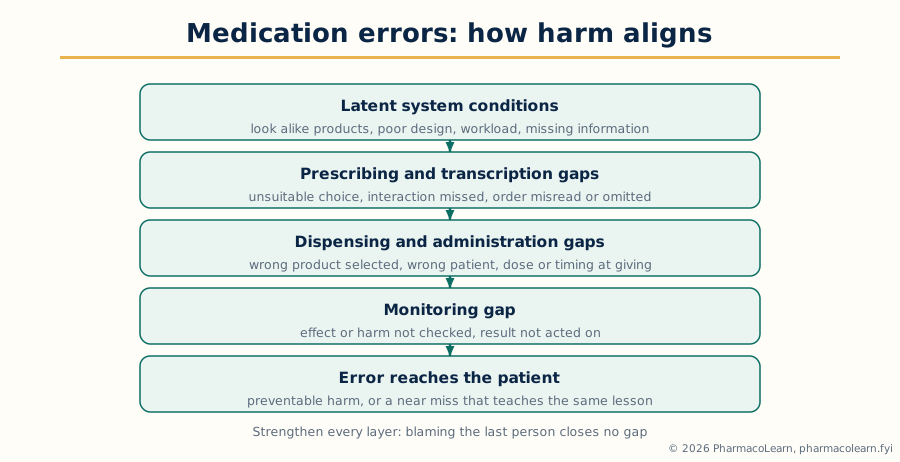 Figure: Harm reaches the patient when gaps align. Strengthen layers and close gaps; blaming the last layer changes neither.
5.4 Detection of medication errors
Detection runs through every checking layer a service builds, and then through the patient's own report. Prescription and chart review by the pharmacist before supply or administration is the highest yield detection point in institutional practice, catching prescribing errors while they are still ink. Double checks at dispensing and administration, independent where the risk justifies them, catch execution errors. Clinical review during therapy catches the error that only declares itself in the patient: the unexpected effect, the missing expected effect, the laboratory result that does not fit. Incident and near miss reporting systems detect what no check caught and, read in aggregate, reveal patterns no single event shows: the ward, the hour, the product pair, the system step where errors concentrate. Trigger based record review, searching records for signals such as antidote use in the generic sense, abrupt stopping or rescue treatment, finds errors and harms that were never reported as such. Patients and carers detect errors too, the tablet that looks different, the instruction that contradicts last month's, and a service that invites those questions respectfully owns a detection layer no technology replaces.
5.5 Prevention of medication errors
Prevention follows from causes, and its measures are strongest when they redesign the system rather than exhort the person. Standardisation removes variation that breeds error: standard order formats and concentrations in the generic sense, standard administration times, formularies that limit look alike duplication. Design and forcing functions make the wrong act difficult: separated storage of look alike products, distinctive labelling, systems that require the allergy field before the order completes, removal of dangerously ambiguous abbreviations from accepted use. Information at the point of decision, interaction and allergy checking inside electronic systems, guidelines inside the workflow, puts knowledge where memory fails. Independent checks are reserved and protected for high risk steps, because a check performed as ritual catches nothing. Education and competency assessment address the knowledge based mistakes, and staffing, workload and interruption management address the conditions in which slips multiply. Finally, the reporting and learning loop of the previous section is itself prevention, because the service that studies its near misses redesigns before the aligned gap produces harm. The pharmacist appears in nearly every measure, as checker, designer, educator and analyst, which prepares the role section below.
5.6 Role of the pharmacist in monitoring and management of medication errors
The pharmacist's role divides into the individual event and the system. For the individual event the duties are immediate and ordered: ensure the patient is safe and the prescriber informed at once where an error has reached a patient, with monitoring and management as the clinical team directs; establish exactly what happened, which medicine, which patient, what was actually given against what was intended, factually and without speculation; document and report through the institution's system fully and promptly; and participate honestly in the review that follows. Concealment is the one unforgivable response, clinically, ethically and in law, because it denies the patient care and the system its lesson. For the system the role is continuing: reviewing error and near miss reports for pattern, leading or serving the medication safety committee work, proposing and evaluating redesigns with the Unit 1 evaluation cycle, educating staff on the error types the data actually show, and feeding serious lessons into formulary, guideline and system decisions. Monitoring in the syllabus phrase therefore means both senses: watching the individual patient's therapy for error, and watching the institution's error pattern over time.
When an error is found: the pharmacist's sequence
  Make the patient safe, inform the prescriber at once
        |
        v
  Establish the facts: intended against actual, exactly
        |
        v
  Document and report fully through the safety system
        |
        v
  Review without blame: what in the system allowed it
        |
        v
  Redesign, educate, and check the fix worked
5.7 Pharmacovigilance: definition, aims and need
Pharmacovigilance is the science and activities relating to the detection, assessment, understanding and prevention of adverse effects or any other medicine related problem, in the standard World Health Organization definition. Its aims follow: to detect adverse drug reactions early, especially those not seen before approval; to assess their nature, seriousness and cause in careful relation to the medicine; to understand the factors that predispose to them and the mechanisms by which they occur; and to prevent harm by acting on what is learned, in product information, guidance, restriction or withdrawal, and in professional and patient education. The need is structural and permanent. Before approval a medicine has been studied in limited numbers, for limited durations, in selected patients who are usually younger, less ill and on fewer other medicines than the patients who will receive it in practice, a limitation the clinical research subject teaches from the trial side. Whole classes of harm are therefore invisible at launch by arithmetic and by selection: rare reactions, long latency reactions, reactions in pregnancy, childhood, old age and organ failure, and interactions with the real world's full medicine lists. Only systematic watching of real use can find them, which is why pharmacovigilance is not suspicion of medicines but the second half of their evidence.
5.8 Adverse drug reactions: types
An adverse drug reaction, shortened to ADR, is a response to a medicine which is noxious and unintended and which occurs at doses normally used in human beings for prophylaxis, diagnosis or therapy, in the classic definition, with dose again understood as the normal therapeutic range and never as figures here. The standard teaching classification divides reactions first by predictability and mechanism. Type A reactions are augmented: extensions of the known pharmacology, predictable in kind, related to the medicine's action and to individual exposure and susceptibility, and they account for the large familiar territory of side effects. Type B reactions are bizarre: not predictable from the known pharmacology, not clearly exposure related, often immunological or idiosyncratic, rarer and frequently more serious. Extended teaching adds further letters in common use: chronic reactions with continued use, delayed reactions appearing after time or after stopping, reactions of withdrawal on ending treatment, and failure of therapy as a reportable outcome where resistance, interaction or quality is in question. A second classification, by seriousness, separates the serious reaction, one that is fatal, life threatening, hospitalising, disabling or otherwise medically important, from the non serious, because seriousness drives the speed and route of reporting and action.
5.9 Predisposing factors and mechanisms of ADRs
Predisposing factors explain why the same medicine harms one patient and serves another. Patient factors include age at both extremes, sex, pregnancy, genetic differences in metabolism and immune response, allergic history, and the disease state itself, especially kidney and liver impairment changing exposure and injured organs tolerating insult poorly. Medicine factors include the drug's inherent toxicity and therapeutic width, its route and duration, and above all its company: polypharmacy multiplies interaction possibilities, and interactions, one medicine altering another's absorption, metabolism, excretion or effect, are among the most preventable of all ADR causes and the pharmacist's daily screening ground. Mechanisms, stated at framework level, divide into pharmacodynamic mechanisms, the medicine acting too much, too long or on an unintended target or tissue; pharmacokinetic mechanisms, exposure raised or lowered by interaction, organ failure or genetics until effect becomes harm; immunological mechanisms, the allergy family, in which the immune system treats the medicine or its product as foreign, with presentations from rash to anaphylaxis; and idiosyncratic mechanisms, rare, genetically or metabolically rooted susceptibilities whose lesson so far is humility and reporting. Predisposition is not blame: its use is prospective, to choose, monitor and counsel better for the next patient.
5.10 Detection, reporting and monitoring of ADRs
Detection begins at the bedside and the counter with a habit of suspicion: any new symptom, sign or laboratory change in a medicated patient is a possible ADR until considered, its timing against starting, changing or stopping medicines examined, and other causes weighed without assuming the medicine innocent or guilty in advance. Reporting converts private suspicion into public knowledge. The core system is spontaneous reporting: a health professional, and in modern systems the patient also, submits a report of a suspected reaction with the essential elements, an identifiable patient in protected form, the suspect medicine, the reaction and its course, and the reporter, to the national pharmacovigilance programme, in India the Pharmacovigilance Programme of India coordinated through the Indian Pharmacopoeia Commission channel in its standard textbook description, with reports flowing onward into international monitoring. Monitoring completes the work at three levels: the individual patient, watched and followed to outcome; the institution, where ADR committees review reports, feed learning into guidelines and education and close the loop with reporters; and the population, where aggregated reports are examined for signals, patterns of harm not visible in any single report, which regulators assess and act on. Underreporting is the system's known weakness, answered by making reporting easy, thanked and visibly used, and by teaching that a suspicion honestly reported is a contribution, not an accusation to be proved first.
The pharmacovigilance cycle, suspicion to prevention
  Suspicion: a change in a medicated patient is noticed
        |
        v
  Assessment: timing, other causes, dechallenge course
        |
        v
  Report: suspect medicine, reaction, patient, reporter
        |
        v
  Aggregation and signal review at programme level
        |
        v
  Action and feedback: information, guidance, education
  change practice, and suspicion sharpens for next time
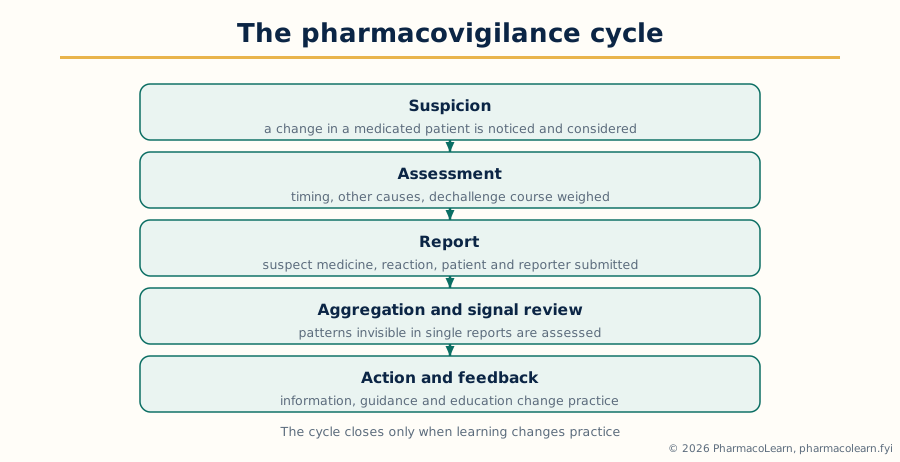 Figure: Reporting is the middle of pharmacovigilance, not the end. The cycle closes only when learning changes practice.
5.11 Causality assessment of ADRs
Causality assessment is the structured judgement of how likely it is that the suspect medicine caused the observed reaction, made because temporal association alone, the reaction followed the medicine, does not establish cause. The assessment weighs a standard set of considerations: the temporal relationship, whether the timing fits the known behaviour of such reactions; previous knowledge, whether the reaction is already recognised for this medicine or its class; dechallenge, what happened when the medicine was stopped, allowing for reactions that resolve slowly or not at all; rechallenge, whether the reaction recurred on re exposure, powerful evidence that is only ever weighed from history and never deliberately sought where the reaction was serious; alternative causes, the disease, other medicines and other exposures that could explain the event; and the patient's predisposing factors of the previous section. Formal instruments organise this judgement into categories running from certain through probable and possible to unlikely, the World Health Organization Uppsala Monitoring Centre categories in their standard form, and algorithmic scales such as the Naranjo scale in its textbook form score the same considerations into a probability band. The examination point is the reasoning, not the label: a good assessment shows the evidence for each consideration and lands on a category the reasoning supports.
5.12 Management of ADRs
Management begins with the patient, in seriousness order. The immediate duties are to recognise severity, stop or withhold the suspect medicine where the reaction and the clinical situation require it and the prescriber so directs, remembering that some medicines need planned withdrawal rather than abrupt stopping, and to give the supportive and specific treatment the reaction demands under medical direction, with emergency treatment first where the reaction threatens life. The continuing duties are documentation and protection of the future: the reaction, its suspect medicine, its course and its outcome recorded prominently in the record; allergy and intolerance entries made accurately, distinguishing true allergy from intolerance so future choices are guided and not needlessly narrowed; the patient and carers informed in plain language what happened, which medicine is suspected and what to avoid and to declare at every future consultation; and the report of Section 5.10 filed, because an unreported reaction protects no one else. Where the medicine remains necessary and no alternative serves, specialist led decisions, graded re exposure or desensitisation in the settings equipped for them, belong to specialist practice and are named here only to mark their existence and their boundary. Review of the whole event by the institutional committee converts management into prevention, closing the subject where it began, with evaluation.
5.13 Role of the pharmacist in pharmacovigilance
The pharmacist is placed, by position and by knowledge, at the centre of pharmacovigilance practice. At detection, pharmacists review charts and dispensing patterns with ADR suspicion as a standing question, are accessible to patients at the counter where reactions are first mentioned in ordinary language, and pick up the interaction and predisposition patterns other reviewers miss. At reporting, the pharmacist completes, quality checks and submits reports, helps other professionals report by making the process easy and the forms complete, and follows reports to outcome so the record is whole. At assessment, medicine information pharmacists work up causality and literature for the institutional committee. At prevention, the pharmacist turns learning into formulary conditions, alerts and counselling points, allergy documentation standards and education, and counsels the patient who has experienced a reaction so that fear is answered with a plan and future prescribers inherit knowledge rather than rumour. In the national programme the profession staffs and leads much of the monitoring centre work itself. The syllabus phrase role of pharmacist in pharmacovigilance therefore earns a full answer: detector, reporter, assessor, educator and system builder, the same fivefold shape as the medication error role, because the two halves of this unit are one safety profession seen from two sides.
Frequently Asked Questions
Q: What is quality use of medicines? A: Quality use of medicines means medicines are used wisely, safely and effectively: the decision to use a medicine and the choice of medicine are judicious and evidence informed, risks are known and managed, and the medicine reaches the right patient in a usable form for long enough to work, with its effect reviewed. It is a property of decisions and systems, not of products.
Q: What are the principles of QUM? A: The principles are primacy of the person, partnership among all who share responsibility for a medicine, consultative and collaborative practice, support for consumer and professional education, evidence informed decision making, and monitoring with accountability. A strong answer illustrates one principle in a named activity, such as partnership operating in a multidisciplinary medication review.
Q: What is evidence based medicine and what are its five steps? A: Evidence based medicine is the conscientious, explicit and judicious use of current best evidence in decisions about individual patients, integrated with clinical expertise and the patient's values. Its five steps are ask an answerable question, acquire the best evidence, appraise it for validity, effect size and applicability, apply it with expertise and patient values, and assess the outcome.
Q: What are essential medicines and why does a country need a list? A: Essential medicines are those that satisfy the priority healthcare needs of the population, selected on disease pattern, evidence of efficacy and safety, quality and comparative cost effectiveness. A limited list concentrates procurement, quality assurance, training and information on the medicines of greatest need, keeps them available and affordable, and anchors formularies and prescribing guidance. In India the instrument is the National List of Essential Medicines in its current revision.
Q: What is rational drug use? A: Rational drug use requires that patients receive medications appropriate to their clinical needs, in doses meeting their individual requirements, for an adequate period of time, and at the lowest cost to them and their community, in the classic World Health Organization formulation. Its opposites include prescribing where no medicine is indicated, too many medicines per encounter, guideline departure without reason and unsafe self medication.
Q: How does QUM differ between hospital, ambulatory and residential care? A: In hospital, QUM runs through committees, formularies and ward based clinical pharmacy, with transitions at admission and discharge as its weak points. In ambulatory care it rests on brief encounters, maintained medicine lists, periodic review and the community pharmacist's checks and counselling. In residential care its centre is structured periodic medication review by prescriber, pharmacist and care team, because residents take many medicines, are administered them by staff and report problems least easily.
Q: What changes in prescribing for children, older people, pregnancy and organ failure? A: Standard adult assumptions about handling and risk do not hold. Children change rapidly in absorption, distribution, metabolism and excretion and need age and weight based checking, suitable formulations and caregiver counselling. Older people accumulate medicines and declining organ function, so whole list review and deprescribing dominate. Pregnancy requires holding maternal benefit and fetal risk together using specialist information sources. Organ failure changes clearance and accumulation, so organ function based guidance and deliberate monitoring govern choices.
Q: What does drug scheduling do for quality use of medicines in India? A: Scheduling under the Drugs and Cosmetics Rules grades the conditions of sale to the risk of unsupervised use: prescription only supply for medicines needing medical supervision, added records and warnings for medicines with dependence or misuse potential, and labelling requirements across supply. The pharmacist at the counter is where scheduling becomes real, by insisting on required prescriptions and keeping required records.
Q: What is a medication error and how is it different from an adverse drug reaction? A: A medication error is any preventable event that may cause or lead to inappropriate medication use or patient harm while the medication is in the control of a professional, patient or consumer, at prescribing, transcribing, dispensing, administering or monitoring. An adverse drug reaction is a noxious, unintended response at normally used doses and can occur with completely correct practice. Preventability is the dividing line.
Q: What is pharmacovigilance and how is causality of an ADR assessed? A: Pharmacovigilance is the science and activities relating to the detection, assessment, understanding and prevention of adverse effects and other medicine related problems, needed because pre approval studies are too small, short and selected to reveal rare, delayed and population specific harm. Causality assessment weighs timing, previous knowledge of the reaction, dechallenge, any history of rechallenge, alternative causes and predisposing factors, and expresses the judgement in categories from certain to unlikely, as in the World Health Organization Uppsala categories.
Complete MPP201T notes, all 5 units in one PDF, free to keep.
Other M.Pharm subjects: MPH101T · MPC101T · MPL101T · MPH102T · MPH103T · MPH104T · MPL102T · MPL103T · MPL104T · MPC102T · MPC103T · MPC104T · MPH201T · MPH202T · MPH203T · MPH204T · MPC201T · MPC202T · MPC203T · MPC204T · MPL201T · MPL202T · MPL203T · MPL204T · MRA101T · MRA102T · MRA103T · MRA104T · MRM301T · MPG101T · MPG102T · MPG103T · MPG201T · MPG202T · MPG203T · MPG104T · MPG204T · MRA201T · MRA202T · MRA203T · MRA204T · MPP101T · MPP102T · MPP103T · MPP104T · MPP201T · MPP202T · M.Pharm