
MPP101T — Clinical Pharmacy Practice
4 hrs/week, 4 credits, 60 hours, 100 marks. Notes follow the M.Pharm syllabus, unit by unit.
MPP101T Clinical Pharmacy Practice notes for M.Pharm Pharmacy Practice Semester 1: pharmaceutical care, ward rounds, drug therapy review, medication history, counselling, pharmacovigilance, lab interpretation and drug and poison information, with free unit wise PDF downloads on PharmacoLearn.
Units in this subject
- Unit 1 — Introduction to Clinical Pharmacy and the First Clinical Pharmacy Services
- Unit 2 — Clinical Pharmacy Services
- Unit 3 — Patient Data Analysis and Laboratory Data Interpretation I
- Unit 4 — Laboratory Data Interpretation II
- Unit 5 — Medicines and Poison Information Services
Download MPP101T PDF Notes
Free PDFs for this subject, one per unit:
Clinical Pharmacy Practice, subject code MPP101T, is the first core theory subject of M.Pharm Pharmacy Practice, Semester 1. It carries 4 credits and 60 hours of theory, taught at 4 hours per week, for 100 marks, and its five units are of equal length at 12 hours each. Pharmacy Practice has no Modern Pharmaceutical Analytical Techniques subject in Semester 1; this branch begins directly with its clinical subjects, and MPP101T is the foundation on which the pharmacotherapeutics, hospital pharmacy and clinical research subjects are built. Its scope, as the syllabus states it, is to impart the basic knowledge and skills required to practice pharmacy, including the provision of pharmaceutical care services, to both healthcare professionals and patients in clinical settings. Its objectives follow: to understand the elements of pharmaceutical care and provide comprehensive patient care services, to provide integrated and critically analysed medicine and poison information that enables healthcare professionals in efficient patient management, and to interpret laboratory results to aid the clinical diagnosis of various disorders. Unit 1 defines clinical pharmacy, traces its evolution and scope, sets the international and national scenario, introduces pharmaceutical care, and opens the services with ward round participation and drug therapy review. Unit 2 continues the services: the medication history interview, the basic concepts of medicine and poison information services and of pharmacovigilance with haemovigilance, materiovigilance and adverse events following immunisation, patient medication counselling, drug utilisation evaluation, documentation, and quality assurance. Unit 3 turns to patient data analysis: the case history, medical abbreviations and terminologies, communication skills, and the first laboratory group, haematological, renal function and liver function tests. Unit 4 completes the laboratory teaching with cardiac tests, pulmonary function tests, thyroid function tests, fluid and electrolyte balance, and microbiological culture and sensitivity tests. Unit 5 gives the information services their full treatment: the medicine information service, its resources, the systematic approach to queries, verbal and written responses, the drug information centre, and the poison information service and centre. One discipline runs through the whole subject: clinical pharmacy is practised on evidence about an individual patient. Every service takes patient specific information in, applies pharmaceutical knowledge to it systematically, and produces a documented professional judgement out. These notes teach services, roles, methods and documentation at professional practice level: no drug doses are stated, laboratory tests are described by what they measure and what a change means in general terms without printed reference ranges, and no hospital statistics or named institutional protocols are claimed, because none are in the syllabus.
Unit 1: Introduction to Clinical Pharmacy and the First Clinical Pharmacy Services
1.1 Definition of clinical pharmacy
Clinical pharmacy is the branch of pharmacy practice in which the pharmacist works directly with patients and with the healthcare team to ensure that medicines are used safely, effectively and appropriately for the individual patient. The standard textbook definitions converge on the same core: clinical pharmacy is a health science discipline in which pharmacists provide patient care that optimises medication therapy and promotes health, wellness and disease prevention. In the formulation used in Indian teaching, it is the area of practice concerned with the rational use of medicines in patients, in which the pharmacist's knowledge of drugs, diseases and the individual patient is applied at the bedside rather than only at the dispensing counter. Three elements must be drawn out in an examination answer, because each separates clinical pharmacy from the older product centred practice. First, the object of the work is the patient and the patient's drug therapy, not the medicine as a product: the clinical pharmacist asks whether this medicine, in this dose form and schedule, for this patient, is the right therapy, rather than only whether the correct product was supplied. Second, the setting is direct patient care: the pharmacist takes a medication history, reviews the treatment chart, joins the ward round, counsels the patient and follows the response to therapy. Third, the responsibility is shared and prospective: the pharmacist contributes to decisions before and while medicines are given, and intervenes to prevent harm, instead of only detecting errors after supply. The contrast the syllabus expects is therefore between traditional practice, organised around procurement, compounding, dispensing and distribution, and clinical practice, organised around the patient and the outcome of therapy.
1.2 Evolution of clinical pharmacy
The evolution of clinical pharmacy is taught as a movement of the pharmacist's attention from the product, to the process of supply, to the patient. In the earliest phase the pharmacist was primarily a compounder, preparing medicines extemporaneously, and professional standing rested on pharmaceutical skill. As industrial manufacture took over the making of medicines in the twentieth century, the compounding role shrank and practice settled into dispensing ready made products, a phase in which clinical knowledge was underused and the profession questioned its future role. The clinical movement began as a response to that gap and to a documented problem: medicines had become numerous and potent, medication errors and adverse reactions were recognised as a significant cause of harm, and no team member was systematically reviewing the whole of a patient's drug therapy. In the United States in the 1960s, hospital pharmacists began moving onto the wards, maintaining medication profiles, checking orders against the patient's condition and advising prescribers at the point of decision; satellite pharmacies and unit dose distribution carried pharmacists closer to patients, and drug information services grew in the same period. Through the 1970s and 1980s the role formalised: clinical services were defined, drug therapy monitoring appeared, pharmacists joined ward rounds routinely in teaching hospitals, and education responded with clinically oriented degrees, most notably the Doctor of Pharmacy (PharmD) model, which trains pharmacists primarily for direct patient care. The United Kingdom developed the same movement as ward and clinical pharmacy within the National Health Service, and Australia and Canada built comparable services, with professional bodies publishing the practice standards the syllabus cites. The conceptual completion came with pharmaceutical care, treated in Section 1.6: once the pharmacist accepted responsibility for the outcomes of drug therapy and not only for its supply, the modern definition was complete.
1.3 Scope of clinical pharmacy
The scope of clinical pharmacy is the range of settings and activities over which this patient centred practice extends. In setting, its home is the hospital, where inpatients receive complex, rapidly changing drug therapy and where the full service set of this subject is delivered. It extends to ambulatory and outpatient clinics, where chronic therapy is monitored over long periods; to community pharmacy, where the same review, counselling and referral skills are applied at first contact with the public, a development the companion subject MPP103T teaches in full; and to specialised environments such as intensive care, paediatrics, geriatrics, oncology and renal services, where drug therapy is at its most individual and most hazardous. In activity, the scope is the service list Units 1 and 2 teach in sequence: medication history taking, drug therapy review, ward round participation, detection and resolution of drug related problems, adverse drug reaction monitoring within pharmacovigilance, medicine and poison information, patient counselling, drug utilisation evaluation, therapeutic monitoring support, and participation in formulary and drug policy work. In population, the scope gives particular attention to patients in whom drug therapy most often fails or harms: patients on many medicines at once, older patients, patients with impaired renal or hepatic function, pregnant patients, children, and patients moving between care settings, where errors cluster at admission, transfer and discharge. The boundary should also be stated, since examinations reward it: the clinical pharmacist does not diagnose disease or prescribe independently in the Indian hospital model this syllabus describes; the pharmacist's authority is the medicine itself, exercised in collaboration with the prescriber, who remains responsible for the prescription.
1.4 International scenario of clinical pharmacy practice
The international scenario, as the syllabus frames it, describes how far the clinical model has been established in the health systems where it began, stated structurally rather than by statistics. In the United States, clinical pharmacy is an established hospital discipline: pharmacists are integrated into ward teams, residency training after the PharmD prepares pharmacists for specialist clinical roles, and services such as medication reconciliation, monitoring clinics and antimicrobial stewardship support are recognised parts of hospital care, with board certification providing a credentialing structure for advanced practice. In the United Kingdom, hospital pharmacists progress through clinical roles of increasing independence, ward based clinical pharmacy is a standard service, and suitably qualified pharmacists may gain prescribing rights under the supplementary and independent prescribing frameworks, the furthest formal extension of the clinical role in any major system. In Australia, the professional standards published by the Society of Hospital Pharmacists of Australia, cited in this syllabus's own reference list, define clinical pharmacy services for hospitals, and accredited pharmacists conduct medication reviews in community and residential care under national programmes. Canada and several European countries show the same pattern in their own forms. Two lessons are drawn from the international picture in standard teaching. First, everywhere the model advanced on the same evidence: pharmacist review detects drug related problems other team members miss, and pharmacist presence at prescribing changes outcomes toward safer, more effective and more economical therapy. Second, education led practice: systems that created a clinical degree and supervised clinical training produced clinical pharmacists, and systems that did not, waited.
1.5 National scenario: clinical pharmacy in India
In India, clinical pharmacy developed later and is still developing, and the honest examination answer describes both the delay and the direction of travel. Historically, Indian pharmacy practice was product centred: the pharmacist worked in manufacturing, quality control, sales and dispensing, hospital pharmacy departments were small and supply oriented, and the clinical subjects had little place in the undergraduate curriculum. The turning points in standard accounts are educational and institutional. The introduction of the Master of Pharmacy in Pharmacy Practice, the very programme this subject belongs to, and later of the Doctor of Pharmacy (PharmD) programme under the Pharmacy Council of India, created graduates trained specifically for ward based patient care, with clerkship and internship in hospitals. Teaching hospitals, first in the south of India and then more widely, established clinical pharmacy services of the kind this subject teaches: ward round participation, drug information centres, adverse drug reaction monitoring linked to the national pharmacovigilance programme, patient counselling and medication history services, staffed substantially by Pharmacy Practice and PharmD graduates and faculty. Recognition has followed practice: pharmacovigilance in India formally receives reports from pharmacists, hospital accreditation standards expect medication management systems in which pharmacist review has a place, and antimicrobial stewardship programmes in larger hospitals routinely include clinical pharmacists. The limitations must be stated with equal clarity. Clinical pharmacist posts remain uneven across the country, many hospitals still run pharmacy services organised around supply alone, the ratio of clinical pharmacists to beds is low outside teaching and corporate hospitals, and the legal framework defines the pharmacist's role in supply more clearly than in clinical decision support. The direction, however, is settled: the curriculum, the accreditation environment and the medication safety agenda all move toward the patient facing pharmacist, and the M.Pharm Pharmacy Practice graduate is trained to build the services of Units 1, 2 and 5 in institutions that may not yet have them.
1.6 Pharmaceutical care
Pharmaceutical care is the philosophy of practice that the clinical services of this subject exist to deliver. In the classic formulation of Hepler and Strand, pharmaceutical care is the responsible provision of drug therapy for the purpose of achieving definite outcomes that improve a patient's quality of life. Each phrase carries weight. Responsible provision means the pharmacist accepts accountability for drug therapy outcomes, jointly with prescriber and patient. Drug therapy, not dispensing, is what is provided: assessment, care plan, monitoring and follow up, of which supply is one component. Definite outcomes means the goals of therapy are stated in advance and checked: the outcomes named in the classic definition are cure of a disease, elimination or reduction of symptoms, arresting or slowing of a disease process, and prevention of disease or symptoms. The working method, as standard textbooks present it, is a cycle repeated for every patient: assess drug related needs from history, prescription and clinical data; identify actual and potential drug related problems; develop a care plan resolving and preventing those problems in agreement with patient and team; and evaluate outcomes at follow up, revising the plan as the response appears. Drug related problems are classified into the families the care plan must check: an untreated indication, an improper drug selection, a subtherapeutic or supratherapeutic dosage, an adverse drug reaction, a drug interaction, failure to receive the drug as intended, and drug use without a valid indication. The distinction examinations probe is between clinical pharmacy and pharmaceutical care: clinical pharmacy names the discipline and its services, pharmaceutical care names the philosophy and outcome responsibility those services serve. A department can perform clinical pharmacy activities mechanically; pharmaceutical care is present when each activity is tied to an assessed need, a plan and a checked outcome for an individual patient.
The pharmaceutical care cycle
  Assess: history, prescription, clinical and laboratory data
        |
        v
  Identify actual and potential drug related problems
        |
        v
  Care plan agreed with patient and prescriber
        |
        v
  Implement: supply, counselling, monitoring arranged
        |
        v
  Evaluate outcomes and revise the plan
        |
        +---- back to Assess at every change of therapy
1.7 Clinical pharmacy services: the service set in outline
A clinical pharmacy service is a defined, repeatable patient care activity, delivered by pharmacists to an agreed standard, documented, and capable of being counted and audited. The syllabus distributes the service set across Units 1, 2 and 5, and this section maps it whole so the parts can be placed. Unit 1 carries ward round participation and drug therapy review, the two services that put the pharmacist inside the daily decision cycle of the ward. Unit 2 carries the medication history interview, the basic concepts of the medicine and poison information services and of the vigilance family (pharmacovigilance, haemovigilance, materiovigilance and adverse events following immunisation), patient medication counselling, drug utilisation evaluation, and the two services that make all the others accountable, documentation and quality assurance. Unit 5 carries the medicine information service and the poison information service in full operational detail. Around these named services sit supporting activities the same pharmacists commonly provide, including medication reconciliation at transitions of care, discharge medication planning, and education of patients and staff on medicines use; the student should treat these as applications of the named services rather than as separate syllabus heads. A service, to be real and not aspirational, needs the same anatomy wherever it is delivered: a defined patient group, a defined activity with a method, a place in the ward routine, a record, and a measure by which its quality is assured.
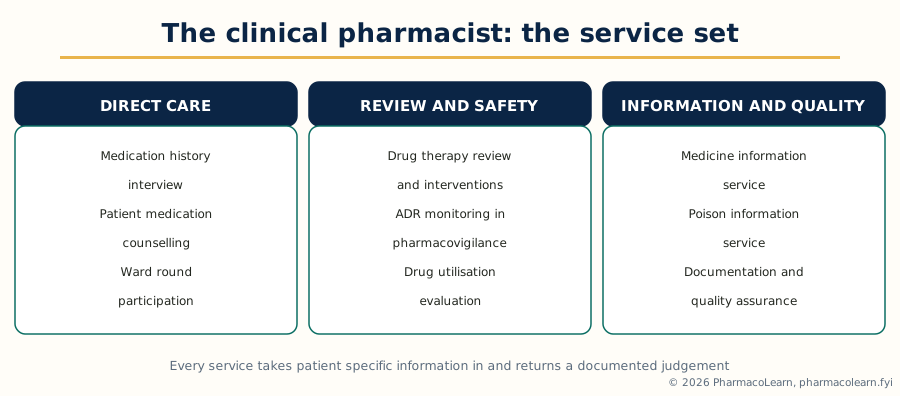 Figure: The clinical pharmacist's service set in outline. Every service takes patient specific information in and returns a documented professional judgement.
1.8 Ward round participation
A ward round is the scheduled visit of the treating team to its inpatients, at which each patient's progress is reviewed, investigations are considered and the treatment plan, including drug therapy, is confirmed or changed. Ward round participation is the clinical pharmacist's attendance on that round as a working member of the team, contributing pharmaceutical judgement at the moment decisions are made. The pharmacist prepares before the round, and preparation is half the service: charts and case records are reviewed in advance, therapy is checked against the data of Unit 3, likely problems are noted and prioritised, and concise proposals are formed. On the round itself the pharmacist listens first, answers drug questions as they arise, and raises interventions briefly, with the reason and the alternative stated, in the manner Section 1.12 describes. After the round the pharmacist follows up: agreed changes are checked into the orders, outstanding questions are answered through the method of Unit 5, patients needing counselling are identified, and the day's interventions are documented. Rounds differ in form, consultant led, unit and teaching rounds among them, but the preparation, contribution and follow up structure is constant.
Ward round participation: preparation, contribution, follow up
  Before: review charts and case data, prioritise problems,
          prepare concise proposals
        |
        v
  During: listen, answer drug questions, raise interventions
          briefly with reason and alternative
        |
        v
  After: verify agreed changes in the orders, answer
          outstanding queries, list patients for counselling
        |
        v
  Document interventions and outcomes the same day
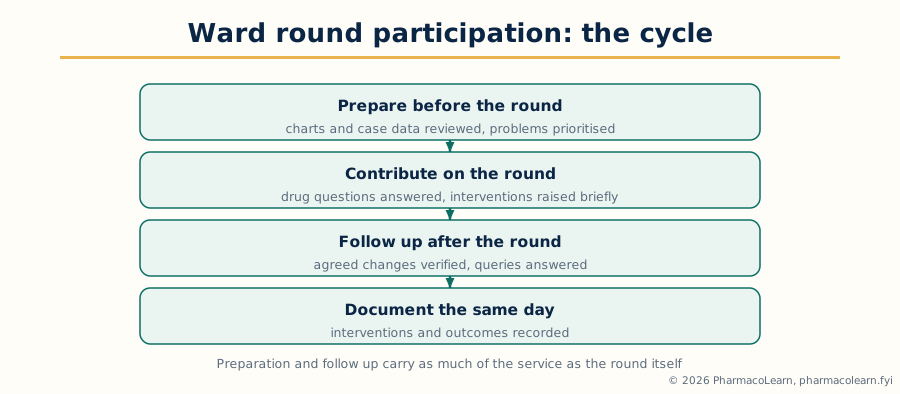 Figure: The ward round cycle. Preparation before and follow up after the round carry as much of the service as the contribution made on the round itself.
1.9 Drug therapy review: drug therapy monitoring in outline
Drug therapy review, which the syllabus equates with drug therapy monitoring, is the systematic examination of a patient's whole drug therapy against that patient's clinical condition, to confirm that every medicine is indicated, effective, safe and correctly used, and to identify drug related problems for resolution. It is the central analytical service of clinical pharmacy, the activity from which ward round interventions, counselling priorities and much documentation flow. For each medicine the reviewer asks whether there is a current indication; whether the drug, dose form, route, frequency and intended duration suit this patient, including age, weight, renal and hepatic function, pregnancy status where relevant, and allergy history; whether the medicine is achieving its goal, judged by symptoms, signs and the laboratory data of Units 3 and 4; whether harm is present or likely, as adverse effects, interactions, duplication, or medicines aggravating coexisting conditions; and whether the patient is actually receiving and able to use the medicine as intended. The syllabus divides the review into three working components, which the next three sections take in order: medication order review, the check of the order itself; chart endorsement, the pharmacist's recorded confirmation on the treatment chart; and clinical review, the deeper assessment of therapy against clinical data and progress, from which pharmacist interventions arise. Where a medicine is one whose blood levels are monitored in practice, the reviewer also checks that monitoring has been ordered, sampled at the right time in relation to the dose, and acted upon; the full science of that monitoring is a Semester 2 subject, handled here qualitatively as one input to the review.
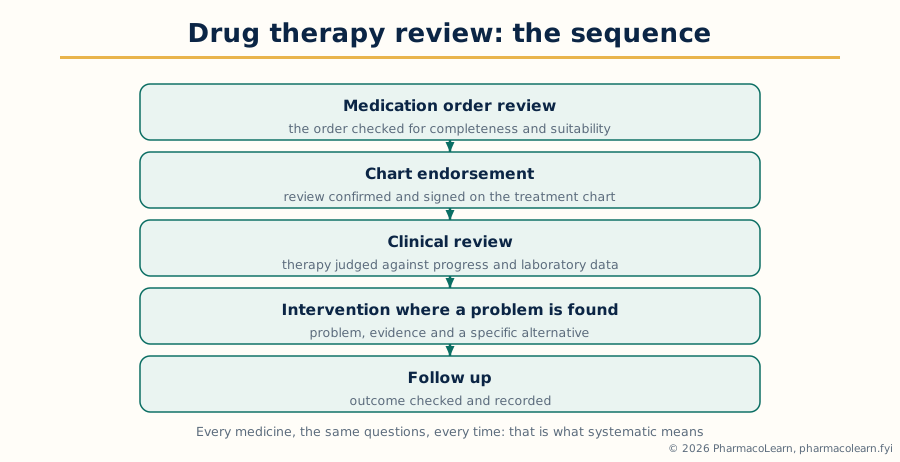 Figure: Drug therapy review as a sequence. The order is checked first, then therapy against the patient, and every problem found ends in an intervention and a follow up.
1.10 Medication order review and chart endorsement
Medication order review is the pharmacist's check of each medicine order, ideally before the first dose is administered. The order is read for completeness and legality first: the patient's identity, the drug name stated unambiguously, dose form, route, strength or dose, frequency, duration or review point, and the prescriber's authorisation; incomplete, ambiguous or illegible orders are clarified with the prescriber rather than interpreted by guesswork, a rule that prevents a whole class of medication errors at its source. The order is then read clinically, as the first pass of Section 1.9: indication, suitability, allergy, duplication, interaction and formulary status are checked, and any problem is resolved with the prescriber before supply or administration proceeds. Chart endorsement is the visible record of that check on the treatment chart itself: the pharmacist signs or initials and dates the chart to show that the orders have been reviewed, with queries and their resolution noted where the system provides for it. Endorsement matters beyond tidiness, and the examination answer should say why. It tells the nurse administering medicines that a pharmacist has reviewed the order; it creates accountability, recording who checked what and when; it gives the team a written place to find the pharmacist's queries; and it provides the raw material of the documentation and quality assurance services of Unit 2, since endorsed charts can be audited for review coverage and for the problems review detects. The limits should be noted as carefully: endorsement certifies that review took place to the department's standard, it does not transfer prescribing responsibility, and an order judged unsafe is not endorsed into acceptance but escalated to the prescriber and, if unresolved, through the hospital's clinical governance route.
1.11 Clinical review
Clinical review is the component of drug therapy review in which the pharmacist assesses therapy against the patient's clinical progress, and it is therefore the component that most depends on the data skills of Unit 3. Where medication order review asks whether the order is right as written, clinical review asks whether the therapy is working and remains right for this patient today. The reviewer assembles the picture from the case history and progress notes, the observation charts, the laboratory results of Units 3 and 4, the medication history of Unit 2, and the patient's own account of symptoms and of how the medicines are being taken and tolerated. Against that picture each medicine is judged on the pharmaceutical care questions: is the therapeutic goal being met, and if not, is the reason pharmacological, a wrong drug, an inadequate regimen, an interaction, or non pharmacological, including non adherence; is harm emerging, as a new symptom or laboratory change that fits an adverse effect; have the conditions changed, a new diagnosis or a changed renal function, so that a once correct regimen is correct no longer; and can therapy now be simplified, stepped down, converted from intravenous to oral form where criteria are met, or stopped, since review that only adds medicines has done only half its work. Clinical review runs on a rhythm matched to the patient's state, daily or near daily for inpatients whose therapy is changing, and at defined intervals for stable long term therapy, and its output is a set of proposals to the team, which is where the next section begins.
1.12 Pharmacist interventions
A pharmacist intervention is a recommendation or action by the pharmacist, arising from review, that changes or proposes to change a patient's drug therapy or its monitoring in order to resolve or prevent a drug related problem. Interventions are classified in standard teaching by the problem they address, and the classification doubles as a checklist of what review looks for: prescribing interventions, on drug choice, dose, dose form, route, frequency, duration and untreated indications; safety interventions, stopping or replacing a medicine causing or risking harm, resolving interactions and duplications, and correcting therapy in allergy or organ impairment; monitoring interventions, proposing the test, observation or review point that therapy needs; and use interventions, on administration technique, timing and the patient's own handling of the medicine, which connect review to the counselling service of Unit 2. The pharmacist intervenes with the prescriber, privately and courteously where the matter allows, states the patient specific problem first, the evidence and the risk second, and a specific workable alternative third, and is ready to be questioned and occasionally overruled on clinical grounds the prescriber holds; the outcome, accepted, modified or not accepted, is recorded either way.
Unit 2: Clinical Pharmacy Services
2.1 Patient medication history interview
The medication history interview is the pharmacist's structured conversation with the patient, or with the patient's carer where the patient cannot be interviewed, to establish exactly what medicines the patient has been taking, and how, at entry to the present episode of care. Its standing is foundational: drug therapy review judges therapy against the patient, and the history supplies the allergies, the self medication and the adherence behaviour that charts alone rarely record. The components of a complete history are standard and should be listed in full: currently prescribed medicines, with dose form, frequency, duration and the indication as the patient understands it; over the counter medicines; herbal, traditional and complementary products, which patients often do not volunteer because they do not count them as medicines, and which the interviewer must ask for by name; medicines taken intermittently or as required, including inhalers, injections, eye preparations, topical products and contraceptives, all commonly omitted from an unprompted account; recent changes, and by whom; allergy and previous adverse reaction history, with the reaction described and not merely the drug named, since intolerance and true allergy carry different consequences; adherence, how medicines are actually taken against how they were prescribed, and the reasons for any difference; and practical context, including who administers medicines at home and any difficulty with swallowing, containers, labels or cost.
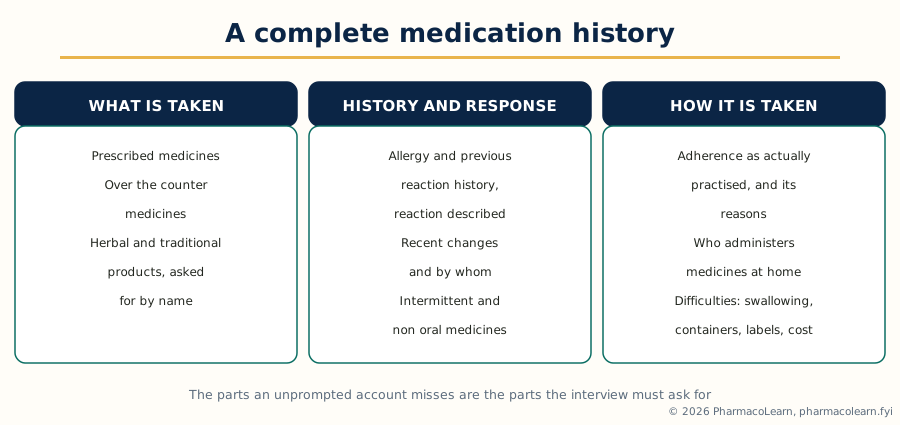 Figure: The components of a complete medication history. The products the patient does not count as medicines, and the way medicines are actually taken, are the parts an unprompted account most often misses.
2.2 Medicine and poison information services: the basic concept
Unit 2 asks for the basic concept of the medicine and poison information services, and Unit 5 gives both their full treatment; this section fixes the concept and the reason the two are taught together. Both exist because medicines and poisons generate urgent, specific questions that general knowledge cannot answer safely: whether a medicine may be used in pregnancy, what to do after an extra dose, whether two products interact, what an ingestion is likely to do and how it is managed. Both answer from evaluated sources, by a systematic method, with the answer matched to the enquirer and the urgency, and both keep records that make the service auditable. They differ in enquirer and tempo. The medicine information service, also called the drug information service, serves mainly healthcare professionals, and patients through them, with questions about medicines in therapeutic use, and its work is largely planned, researched and answered in writing or by considered verbal response. The poison information service serves professionals and the public in the emergency of an actual or suspected poisoning, where the first answer is immediate and verbal, and support continues while the patient is treated. A hospital commonly houses the two together, sharing sources, trained staff and documentation habits, which is why one subject teaches them as a pair.
2.3 Pharmacovigilance: the basic concept, and adverse drug reaction monitoring
Pharmacovigilance is the science and the activities concerned with the detection, assessment, understanding and prevention of adverse effects and other drug related problems. The basic concept begins with the reason the activity exists: medicines reach the market on trials in limited numbers of selected patients for limited durations, so effects that are rare, delayed, or confined to groups the trials excluded, including older patients, pregnant patients and patients with several diseases, can only be learned after marketing, from use in the whole treated population. An adverse drug reaction, in the standard definition, is a response to a drug which is noxious and unintended and which occurs at doses normally used in man for prophylaxis, diagnosis or therapy of disease or for modification of physiological function; it is distinguished from an adverse event, any untoward occurrence during treatment whether or not the drug caused it, the distinction on which causality assessment works. The clinical pharmacist's part, the adverse drug reaction monitoring of ward practice, runs in a chain: suspect, from a symptom, sign or laboratory change that fits a medicine the patient is receiving, the newest medicine and the medicine whose effects match the event being the first candidates; document the event, the medicines with start dates, the time course and the outcome; assess causality in the structured way the standard methods require, considering temporal relationship, whether the event is a known effect, whether it improved when the drug was stopped and recurred if given again, and whether the disease or another medicine explains it better; act, with the prescriber, to stop or replace the medicine where the risk requires it, and to treat the reaction; and report, through the hospital's system into the national pharmacovigilance programme, because a reaction protects other patients only when it enters the pooled record from which signals are detected.
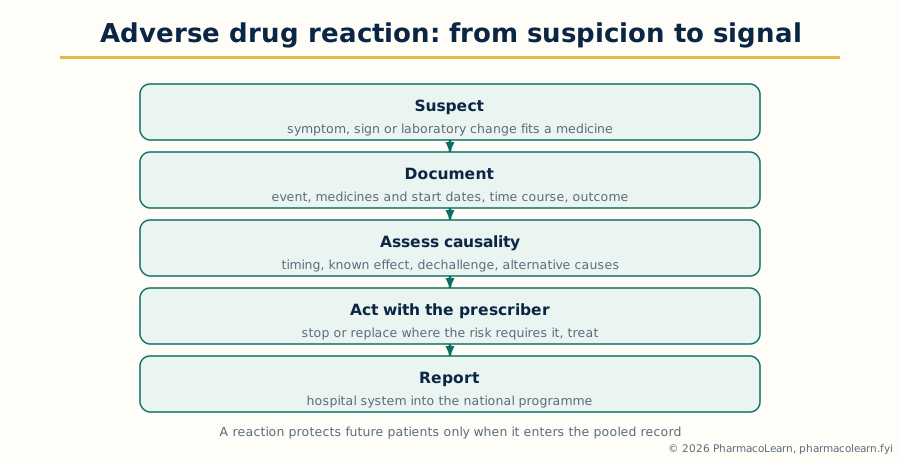 Figure: From suspicion to signal. A reaction helps future patients only when the bedside chain ends in a report that enters the pooled national record.
2.4 Haemovigilance, materiovigilance and AEFI
The syllabus names three companion vigilance activities beside pharmacovigilance, and the student should be able to place each precisely, because together they show that vigilance in modern Indian practice is a family of systems matched to the product involved. Haemovigilance is the system for blood and blood components: surveillance procedures covering the whole transfusion chain, from collection from donors through processing, storage and issue to transfusion and follow up of recipients and donors, concerned with adverse reactions, incidents, errors and near misses. Its clinical point is traceability: every unit must be traceable from donor to recipient and back, so a reaction or later discovered risk can be followed to every patient it touches, and the pharmacist meets it in transfusion committees and in the investigation of transfusion reactions. Materiovigilance is the system for medical devices: monitoring of adverse events and problems associated with devices in use, from implants and instruments to in vitro diagnostics, reported and analysed so that defective or unsafe devices can be corrected, recalled or withdrawn. Its characteristic events are device failures and use errors rather than pharmacological effects, and the pharmacist encounters it wherever devices and medicines meet, as in delivery devices and infusion equipment. AEFI, adverse events following immunisation, is the vigilance activity of the immunisation programme: an AEFI is any untoward medical occurrence which follows immunisation and does not necessarily have a causal relationship with the vaccine, and such events are reported, investigated and causality assessed through the programme's own system, which must separate events caused by the vaccine product, by an immunisation error, or by anxiety, from coincidental events, a separation on which public confidence in immunisation depends.
| System | Product covered | Characteristic events |
|---|---|---|
| Pharmacovigilance | Medicines | Adverse drug reactions and other drug related problems |
| Haemovigilance | Blood and blood components | Transfusion reactions, incidents, errors and near misses |
| Materiovigilance | Medical devices | Device failures, malfunctions and use errors |
| AEFI surveillance | Vaccines | Any untoward occurrence following immunisation, causal or not |
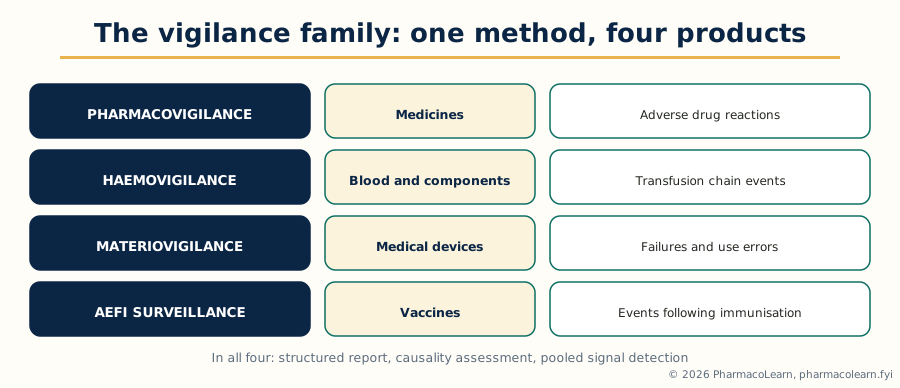 Figure: The vigilance family. One method, event, report, causality assessment and signal, matched to four kinds of product.
2.5 Patient medication counselling
Patient medication counselling is the pharmacist's oral, and where useful written, communication with the patient or carer that ensures the patient understands the medicines and can use them correctly and safely after the consultation ends. It is a clinical service and not a courtesy conversation, because therapy reviewed perfectly in hospital fails at home if the patient takes the wrong dose, at the wrong time, by the wrong technique, or stops at the first side effect no one warned about. Its content, for each medicine, is standard: the name of the medicine and what it is for, in the patient's own terms; how and when to take it, frequency, timing in relation to food and other medicines, and what to do if a dose is missed; how long to continue, rather than stopping when symptoms ease; technique where the medicine demands it, inhalers, injections, eye preparations and topical applications being the cases in which the method is half the therapy; expected effects and their time course; the important adverse effects, which are minor and transient and which require prompt medical advice; storage and safe keeping away from children; and precautions specific to the medicine and the patient, including alcohol, over the counter and herbal products the patient must now report rather than add silently. Counselling is prioritised where its absence is most dangerous: at discharge, when medicines are new or changed, for high risk medicines and complex regimens, for techniques, and for patients whose history showed adherence difficulty.
Patient medication counselling sequence
  Assess what the patient knows and believes
        |
        v
  Explain: name, purpose, dose, timing, duration
        |
        v
  Demonstrate technique where the medicine demands it
        |
        v
  Warn: expected effects, adverse effects, precautions
        |
        v
  Check understanding: the patient explains the regimen back
        |
        v
  Support with written information and document the session
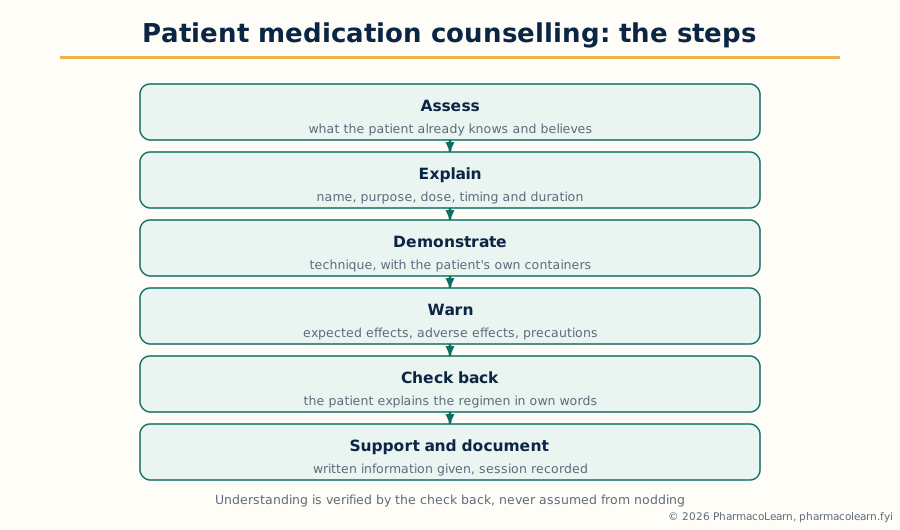 Figure: Counselling as a sequence with a check at its end. Understanding is verified by the patient explaining the regimen back, not assumed from nodding.
2.6 Drug utilisation evaluation
Drug utilisation evaluation, also taught as drug use evaluation, is the structured, criteria based review of how a medicine or a class of medicines is actually used in an institution, conducted to improve the quality and economy of prescribing. Where drug therapy review examines one patient's therapy, drug utilisation evaluation examines a pattern across patients. The method follows a fixed cycle the student should be able to reproduce. A medicine or problem is selected for study, usually because it is high risk, high cost, high volume, or suspected of misuse, and the selection is approved through the hospital's pharmacy and therapeutics structure. Criteria are written in advance, drawn from accepted evidence and guidelines, stating what counts as appropriate use: indications, patient selection, dose form, route and duration standards, the monitoring expected, and the outcomes to be counted. Data are then collected, prospectively or retrospectively from records, on a defined sample, and compared against the criteria, so the result is a measured gap between actual use and agreed standards rather than an impression. The findings are reported to prescribers and the committee with proposals for action, which may be educational, may revise the formulary or a guideline, or may restrict how the medicine is initiated; and after the action, the evaluation is repeated to confirm that use has moved toward the criteria. The pharmacist's role is central at every step: proposing topics, drafting criteria, designing data collection, analysing results and presenting them in a form prescribers can act on.
2.7 Documentation of clinical pharmacy services
Documentation is the written record of clinical pharmacy work, and the syllabus gives it the standing of a service in its own right because undocumented clinical work cannot be verified, handed over or improved. What is documented follows the service set: the medication history; the chart endorsement and review notes of Unit 1; each intervention, with the problem, the recommendation, the prescriber's response and the outcome; counselling given, with the aids supplied; adverse drug reactions suspected, assessed and reported; drug information queries and the answers given, by the records of Unit 5; and the department's activity record, the counts and summaries from which reports to hospital management are built. The standards are those of any clinical record: contemporaneous, written at the time of the activity and not reconstructed later; accurate and specific, naming the medicine, the problem and the action in terms another professional can act on; attributable, signed and dated by the pharmacist who did the work; held in the record systems the hospital uses; and confidential, under the same duties as every other part of the clinical record.
2.8 Quality assurance of clinical pharmacy services
Quality assurance of clinical pharmacy services is the systematic activity by which a department confirms that its services are delivered to the standard it claims, finds where they fall short, and improves them. It closes Unit 2 because it closes the loop on every other service in the unit: histories, counselling, review, vigilance and information work are each auditable, and quality assurance is the auditing habit organised. Its instruments are standard. Standards and procedures are written first, the department's service descriptions and standard operating procedures, against which performance can be measured at all. Indicators are chosen that reflect real risks and value: the proportion of charts reviewed and endorsed, the number and acceptance pattern of interventions, counselling coverage at discharge, the completeness and timeliness of adverse reaction reporting, the turnaround and quality of drug information answers, and the outcomes of drug utilisation evaluations. Performance is measured by audit, by peer review of records and answers, and by the feedback of prescribers, nurses and patients; gaps are analysed for their cause, which may be staffing, training, a defective form or a defective process, and the remedy is matched to the cause rather than to the person nearest the gap. Changes are then made and the indicator measured again, which is the audit cycle, quality assurance being a cycle and not an inspection event. Measurement must serve care and not replace it: a department that maximises counted activities while their quality thins has inverted the purpose, which is why peer review of content accompanies the counting of records. And quality assurance is prospective as well as retrospective: training, supervision of new staff, double checking of high risk work and current drug information sources prevent defects that audit would otherwise only count.
Unit 3: Patient Data Analysis and Laboratory Data Interpretation I
3.1 The patient case history: structure
Patient data analysis begins with the patient's case history, the organised record of who the patient is, why the patient has come to care, and what has happened before and during the present illness. Its structure is standard across clinical practice, and the clinical pharmacist must be able to read it fluently and find quickly the parts on which drug therapy decisions turn. The history opens with identification and demographic data: name, age, sex, weight and, where recorded, height, which together already condition drug selection and dosing assessment. The chief complaints follow, the symptoms that brought the patient to care, in the patient's own terms. The history of the present illness expands those complaints into a narrative: onset, course, character and severity of each symptom, aggravating and relieving factors, associated symptoms, and the treatment already received for this episode and its effect. The past medical and surgical history records previous diseases, operations, hospitalisations and injuries, with dates, because yesterday's disease is frequently today's contraindication, interaction or dosing limit. The medication history, the pharmacist's own contribution described in Section 2.1, sits within the case history and is read with it. The allergy history records agents that have caused reactions, with the reaction described. The family history records diseases of close relatives where they bear on the patient's risks. The social and personal history covers occupation, habits of direct pharmacological importance such as tobacco and alcohol use, diet where relevant, and the home circumstances into which discharge therapy must fit. The review of systems, a systematic enquiry across the body's systems, catches symptoms the narrative missed. The record then continues into physical examination findings, the provisional and working diagnoses, the investigation results of Sections 3.7 to 3.9 and Unit 4, the treatment chart, and the daily progress notes in which response to therapy is written.
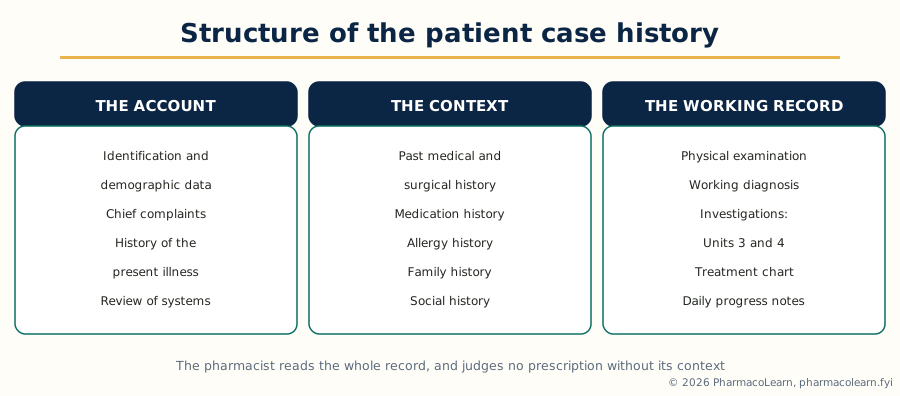 Figure: The structure of the case history. The pharmacist reads the whole record, and finds the drug therapy decisions in the medication, allergy, investigation and progress sections.
3.2 Significance of the case history in drug therapy management
The syllabus joins the structure of the case history to its significance in drug therapy management, best taught as the list of judgements that cannot be made without it. The diagnosis and its severity decide whether each medicine on the chart has an indication at all, the first question of drug therapy review. The past medical history decides safety: a medicine safe in isolation may be contraindicated by earlier disease, may aggravate a coexisting condition, or may duplicate therapy the patient already receives for it. Organ function history, with its laboratory confirmation in Sections 3.8 and 3.9, conditions every dose assessment, since the medicines most likely to accumulate are prescribed to the patients least able to clear them. The allergy and reaction history is the standing defence against repeating a harmful exposure, and its quality, drug named, reaction described, date and severity noted, decides how much protection it gives. The medication history reveals the therapy already failing or succeeding before admission, the adherence pattern that explains an apparently drug resistant condition, and the over the counter and traditional products that interact invisibly unless the history captured them. The social history decides whether the planned regimen is deliverable at all: a schedule the patient cannot follow, a dose form the patient cannot handle, or a cost the patient cannot sustain will fail however correct it is pharmacologically.
3.3 Common medical abbreviations and terminologies
Clinical records are written in a compressed professional language of abbreviations and terminologies, and fluency in it is a safety skill and not a scholarly ornament, because a misread abbreviation becomes a medication error with no further help from anyone. The families the student must command are these. Frequency and timing terms for medicine administration, the Latin derived set in universal ward use, including once daily, twice daily, three times daily and at bedtime forms, and timing instructions in relation to meals and other medicines. Route abbreviations for the oral, intravenous, intramuscular, subcutaneous and other routes. Dose form and unit abbreviations for tablets, capsules, injections and the standard weights and volumes. Clinical observation and investigation shorthand, for blood pressure, pulse, temperature, respiratory rate, blood glucose and the common laboratory panels of this unit and Unit 4. And general ward terminology for states and events of care, admission, discharge, nil by mouth, as required, and the standard terms for diagnoses and procedures. Terminology proper, the precise naming of conditions, symptoms and findings, matters beside the abbreviations: the pharmacist who knows the standard terms, dyspnoea, oedema, pyrexia, oliguria and the rest of the working vocabulary, reads the progress notes as they were meant and counsels in accurate plain language. Ambiguous abbreviations, those with two current meanings or those on the error prone lists medication safety teaching maintains, are clarified with the writer and never resolved by guessing, and in the pharmacist's own writing the full term is preferred wherever an abbreviation could be misread.
3.4 Communication skills: verbal communication
Communication is the medium in which every service of Units 1 and 2 reaches the patient and the team, and the syllabus therefore teaches it as a clinical skill with a structure. Verbal communication is communication in words, spoken and written, and its quality is judged by four tests: accuracy, the message states the facts correctly; clarity, it is understood as intended, in the language and at the level the receiver commands; completeness, nothing the decision depends on is left out; and confirmation, the sender checks that the message received is the message sent. The spoken skills follow from those tests. Questioning technique is the foundation: open questions that invite the patient's account, closed questions that settle specific facts, and probing questions that follow an answer into needed detail, used in the order the medication history interview models. Listening is a skill and not a pause: the pharmacist attends to the whole answer, does not interrupt prematurely, notes the exact words used for symptoms and reactions, and summarises back what was heard, correcting misunderstanding while it is still cheap. Explanation is adapted to the listener: plain language for patients, with technical terms translated and checked, and precise professional language for the team, with problem, evidence and proposal stated in the manner of Section 1.12. Written communication, the record entries, endorsements and drug information responses of this subject, obeys the same four tests with the added duty of permanence, since the written word is read later, by others, without its author present. Barriers should be named in the answer: language difference, jargon, the patient's anxiety, pain or confusion, hearing or speech difficulty, time pressure, and assumptions about what the other side already knows; each barrier has its counter, interpreters and family involvement with consent, teach back checking, written support, and the deliberate slowing of important conversations.
3.5 Non verbal communication and applications in patient care services
Non verbal communication is everything communicated without words, and in patient care it is read by patients continuously and believed preferentially when it conflicts with what is said. Its channels are standard: facial expression, eye contact and gaze, posture and orientation, gesture, proximity and touch, appearance, and the paralinguistic features of speech itself, tone, pace, volume and silence, which carry the emotional meaning of the words. The pharmacist's discipline follows from the uses patients put it to. Congruence comes first: a pharmacist who says a matter is important while visibly hurrying teaches the hurry, so attention is given fully for the time the interaction lasts, at the patient's physical level where possible, seated for a counselling conversation rather than standing over a bed. Observation is the second use, with direct clinical yield: the patient's non verbal behaviour is data, the wince that locates pain the patient minimises in words, the hesitation that marks the unasked question, the medicines left untouched, the nod that signals politeness rather than understanding, which is why Section 2.5 verifies comprehension by teach back and not by expression. Sensitivity to cultural and personal variation is the third discipline: eye contact, proximity and touch carry different meanings for different patients, and the pharmacist adjusts to the individual rather than applying one manner to all. The applications summarise the unit so far: in the history interview, non verbal attention earns the disclosures about adherence and traditional products that questions alone do not; in counselling, demonstration communicates what description cannot; on the ward round, presence, preparation and brevity communicate professional standing; and in recognising distress or deterioration at the bedside, observation is one more safety net under the patient.
3.6 Laboratory data interpretation: general principles
The second half of Unit 3 and the whole of Unit 4 teach laboratory data interpretation, and this section states the principles by which every panel in both units is read. A laboratory result is a measurement, not a verdict, and it is interpreted in a fixed order. First, against the reference interval the laboratory itself reports, intervals varying with method, population, age and sex, which is why these notes describe direction and significance of change rather than printing universal numbers. Second, as a pattern and a trend: panels are interpreted together, since single values mislead, and today's value is read against yesterday's, because direction and rate of change often matter more than position. Third, against the patient: symptoms, examination, diagnosis and the whole clinical picture of Section 3.1, laboratory medicine aiding clinical diagnosis in the syllabus's own phrase, and never replacing it. Fourth, and most distinctively for this subject, against the drug therapy: medicines cause laboratory change as intended effect and as adverse effect, they interfere with assays, and a laboratory abnormality in a treated patient is a drug related problem until the timing and the known effects of the medicines have been considered, which connects this unit to the vigilance work of Unit 2. Fifth, pre analytical cautions are held in mind: the wrong sample, wrong timing in relation to a dose or a meal, haemolysis and delay can manufacture abnormalities no patient has. The pharmacist's role is interpretive and advisory: to flag results that change the safety or efficacy of current therapy, to propose the monitoring a therapy requires, to detect drug induced changes early, and to put the laboratory picture before the prescriber in usable form.
| Panel | Principal question it answers |
|---|---|
| Haematological tests | Is the blood count and character normal, and is marrow or bleeding affected? |
| Renal function tests | How well do the kidneys filter, and is drug clearance safe? |
| Liver function tests | Is there liver injury, cholestasis, or loss of liver function? |
| Cardiac tests | Is there heart muscle injury, heart failure, or cardiac risk? |
| Pulmonary, thyroid and fluid panels | How is ventilation, thyroid axis control, and water and ion balance? |
| Culture and sensitivity | Which organism is present, and which antimicrobials remain effective? |
3.7 Haematological tests
Haematological tests examine the blood and its cellular components, and the panel is built around the complete blood count and its companions. Haemoglobin and the red cell measures, including red cell count, haematocrit and the red cell indices, describe the red cell mass and its character: a reduced haemoglobin defines anaemia, and the indices direct interpretation toward its family, small pale cells suggesting iron deficiency, large cells suggesting vitamin B12 or folate deficiency, with history and further tests separating the causes; a raised red cell mass raises the opposite questions of concentration and of true increase. The total and differential white cell counts describe the leucocytes: a raised total count with a shift toward neutrophils is the classic pattern of acute bacterial infection and inflammation, a raised lymphocyte pattern points differently, eosinophil increase raises allergy, parasitic disease and drug reaction among its causes, and a low white count raises marrow suppression, in which drug causes stand high on the pharmacist's list. The platelet count governs bleeding risk in one direction and thrombotic questions in the other, and a falling platelet count in a treated patient is a recognised drug effect pattern the reviewer must catch. The erythrocyte sedimentation rate and related inflammatory markers are non specific measures of inflammation, useful for trend and corroboration rather than for naming a disease. The coagulation tests, prothrombin time and its standardised international normalised ratio, and the activated partial thromboplastin time, describe the clotting system and are the monitoring instruments of anticoagulant therapy, read for efficacy direction and bleeding risk. Peripheral blood smear examination adds morphology, the shapes and inclusions counts cannot give.
3.8 Renal function tests
Renal function tests assess the kidney's work of filtration, excretion and regulation, and they hold a special place in this subject because renal function is the single most common patient variable that changes drug therapy. Serum creatinine is the routine filtration marker: produced by muscle at a fairly steady rate and cleared by filtration, a rising value signals falling filtration, with the cautions that it reflects muscle mass as well as kidney function, that it lags behind acute change, and that in older and smaller patients a modest value may conceal considerably reduced function, which is why estimated glomerular filtration rate and estimated creatinine clearance are calculated from it with age, sex and weight for drug dosing purposes. Blood urea rises with falling filtration but also with dehydration, high protein load and gastrointestinal bleeding, so it is read with creatinine and the clinical state. Urinalysis contributes what blood tests cannot: concentrating ability, protein and blood, casts and cells that localise disease within the kidney and urinary tract. Electrolyte measurement belongs partly here and is completed in Section 4.4. Measured clearances quantify filtration where estimation is unreliable, and imaging describes structure where function tests describe performance. The course patterns should be distinguished: acute kidney injury declares itself by rising creatinine and falling urine output over hours to days, commonly precipitated by illness, dehydration and nephrotoxic medicines acting together, in which review of every nephrotoxic and renally cleared medicine is an immediate intervention; chronic kidney disease is the slow, staged decline of filtration, in which the pharmacist's standing work is dose appropriateness and avoidance of accumulating medicines.
3.9 Liver function tests
Liver function tests are, in strictness, a panel of liver related measurements rather than tests of function alone, and the student interprets them by families, since the pattern across families localises the problem. The transaminases, alanine aminotransferase and aspartate aminotransferase, are enzymes released when hepatocytes are injured, so their elevation marks hepatocellular injury, the pattern of hepatitis, ischaemic injury and drug induced liver injury; in a treated patient a new transaminase rise is a drug causality question of the Unit 2 kind before it is anything else. Alkaline phosphatase and gamma glutamyl transferase belong to the cholestatic family: their elevation, especially together, points to impaired bile flow and biliary disease, with gamma glutamyl transferase helping to confirm that an alkaline phosphatase rise is hepatic rather than bony in origin. Bilirubin, reported total and in its fractions, measures the liver's handling of bile pigment: its rise produces jaundice and its pattern, unconjugated against conjugated, separates overproduction and uptake defects from hepatocellular and obstructive causes, read always with the enzyme families. Albumin and the prothrombin time are the true function tests: albumin is synthesised by the liver and falls in chronic liver disease, though also in malnutrition and protein loss, and the prothrombin time prolongs when synthesis of clotting factors fails, together measuring how much working liver remains, which is the information prognosis and drug dosing in liver disease both depend on. The pharmacist's reading discipline mirrors the renal one: liver tests condition the safety of hepatically metabolised and potentially hepatotoxic medicines, and drug induced liver injury is detected by holding the panel against the medication timeline, since its patterns imitate every natural liver disease and only the timeline and the response to withdrawal separate them.
Unit 4: Laboratory Data Interpretation II
4.1 Tests associated with cardiac disorders
The cardiac panel supports the diagnosis of heart muscle injury, the assessment of heart failure and the monitoring of cardiac risk and therapy, and its modern centre is the cardiac troponin measurement. Troponins are proteins of the heart muscle contractile apparatus released into the blood when myocardial cells are injured, and a rising and falling pattern of troponin, with at least one value above the laboratory's decision limit, in a patient with symptoms or signs of ischaemia, is the laboratory core of the diagnosis of myocardial infarction; the same measurement rises in other myocardial injury, including myocarditis and severe cardiac strain, so troponin is read against the clinical picture and its trend over serial samples. The older cardiac enzymes, creatine kinase and its MB fraction and the historical enzyme panels, are taught for the record, with troponin understood as the more cardiac specific and sensitive successor. The natriuretic peptides, brain natriuretic peptide and its N terminal fragment, are released by the stretched heart wall and are used in the assessment of heart failure: a low value in a breathless patient argues strongly against heart failure as the cause, a high value supports it and carries prognostic weight, and the trend follows the response to therapy, with renal impairment and age among the cautions. The lipid profile, total cholesterol with its lipoprotein fractions and triglycerides, belongs to cardiac risk assessment and to the monitoring of lipid lowering therapy rather than to acute diagnosis. Cardiac monitoring data complete the picture beside the laboratory panel: the electrocardiogram for rhythm, ischaemia and the conduction effects of medicines, and blood pressure and heart rate trends.
4.2 Pulmonary function tests
Pulmonary function tests measure how the lungs move air and, in the fuller laboratory, how they exchange gas, and the pharmacist interprets them chiefly to classify ventilatory defects and to follow respiratory disease and its therapy. Spirometry is the core test: the recorded volumes and flows include the forced vital capacity, the total volume forcibly exhaled after a full inspiration, and the forced expiratory volume in one second, the volume expelled in the first second of that manoeuvre, with their ratio as the interpretive key. The standard patterns should be stated plainly. In obstructive disease, of which asthma and chronic obstructive pulmonary disease are the teaching examples, air leaves slowly, the one second volume falls disproportionately and the ratio falls. In restrictive disease, where the lungs or chest wall cannot expand, volumes fall together and the ratio is preserved or raised. Reversibility testing, repeating spirometry after an inhaled bronchodilator, separates the reversible obstruction of asthma from the largely fixed obstruction of chronic disease and measures response to the very class of medicines the pharmacist counsels on. Peak expiratory flow measurement is the simpler portable form, used for asthma monitoring by patients themselves, read as personal best comparisons and diurnal variation rather than as a single number. Lung volumes, gas transfer measurements and arterial blood gas analysis for oxygen, carbon dioxide and acid base state complete the panel: blood gases decide the severity of respiratory failure and the safety of oxygen therapy, and connect this section to Section 4.4.
4.3 Thyroid function tests
Thyroid function tests interpret the pituitary thyroid axis as a system, and the panel is the clearest example in this subject of a result that cannot be read one analyte at a time. The thyroid gland secretes principally thyroxine, with the more active triiodothyronine, under the drive of pituitary thyroid stimulating hormone, and the axis is governed by negative feedback: when circulating thyroid hormone falls, the pituitary hormone rises to drive the gland, and when hormone rises, the pituitary signal is suppressed. The standard panel is therefore the thyroid stimulating hormone together with free thyroxine, with free triiodothyronine and thyroid antibodies in defined situations. The patterns follow the feedback logic. A raised thyroid stimulating hormone with a low free thyroxine is primary hypothyroidism, the gland failing and the pituitary calling louder. A suppressed hormone with raised free thyroxine, with or without raised triiodothyronine, is primary hyperthyroidism, the gland overproducing and the pituitary silenced. A raised pituitary hormone with a normal free thyroxine is subclinical hypothyroidism, and the mirror image is subclinical hyperthyroidism, both being monitoring categories as much as treatment categories. Antibodies assist in establishing autoimmune causes of failure and overactivity.
4.4 Fluid and electrolyte balance
Fluid and electrolyte balance is the physiology that keeps the body's water compartments and its dissolved ions within the narrow ranges cell function requires, and its disturbances are among the commonest ward laboratory problems and among the most frequently drug related. The accounting frame is standard: water is distributed between the intracellular and the extracellular compartments, the extracellular including the plasma, and balance means intake, from drink, food and metabolism, matches output, through urine, gut, skin and breathing, under control in which the kidney, antidiuretic hormone and the renin angiotensin aldosterone system do most of the adjusting. The electrolytes are interpreted individually and together. Sodium is the principal extracellular ion and its concentration reports water balance relative to sodium rather than total body sodium: a low sodium directs attention to water excess, sodium loss and the medicines, diuretics prominent among them, that produce both, while a high sodium reports water deficit, and both extremes disturb brain function first. Potassium is the principal intracellular ion, and its plasma concentration governs cardiac and muscle excitability: low potassium, classically from diuretic therapy, vomiting and diarrhoea, raises the toxicity of several cardiac medicines and disturbs rhythm, and high potassium, from renal failure, tissue breakdown and potassium retaining medicines, is among the most urgent abnormalities in laboratory medicine. Calcium, magnesium and phosphate complete the taught panel: calcium, disturbed by parathyroid, vitamin D, bone and renal disorders and by medicines; magnesium, frequently low alongside potassium and sharing its causes; and phosphate, bound up with renal function and bone. Acid base balance is read with the electrolytes: pH with bicarbonate and carbon dioxide separates metabolic from respiratory disturbance, and the anion gap sorts the metabolic acidoses by their likely family of cause.
4.5 Microbiological culture and sensitivity tests
Microbiological culture and sensitivity testing is the laboratory system that identifies the organism causing an infection and measures which antimicrobial agents inhibit or kill it, and it is the evidential basis on which rational antimicrobial therapy, and its review by the pharmacist, stands. The process runs in defined stages. A specimen is collected from the site of infection, blood, urine, sputum, wound material, cerebrospinal fluid or another site, before antimicrobial therapy where possible, in the correct container and transported promptly, because a badly taken specimen grows the flora of the skin or the delay rather than the cause of the disease. In the laboratory the specimen is examined directly, by microscopy including the Gram stain, which gives an early broad classification, and is cultured on media from which colonies of the infecting organism are isolated and identified. Sensitivity testing then exposes the organism to a panel of agents, by disc diffusion, in which zones of inhibited growth around agent containing discs are measured and interpreted, or by dilution methods that determine the minimum inhibitory concentration, the lowest concentration that inhibits growth. Results are reported in standard categories: susceptible, where the agent at achievable concentrations is expected to succeed; intermediate, where success is uncertain or depends on concentration at the site; and resistant, where a mechanism defeats the agent at safe concentrations. The pharmacist's interpretive work is a defined clinical skill: matching the report to the therapy, so empirical treatment started before results is narrowed to the effective agent the report supports and changed where resistance is shown; reading sensitivity with the site of infection, since an agent must reach the site as well as inhibit the organism; distinguishing contamination and colonisation from true infection, with the clinical team, before a report triggers treatment the patient does not need; and using the institution's accumulated sensitivity patterns to inform empirical choices and formulary decisions.
Unit 5: Medicines and Poison Information Services
5.1 Medicine information service: definition and need
The medicine information service, called in many institutions the drug information service, is the organised service that provides evaluated, patient or situation specific information about medicines to healthcare professionals, and through them and directly to patients, in answer to specific enquiries. Its definition has three working parts: it answers questions, it does not merely supply data, so the answer is selected, evaluated and applied to the enquirer's actual case; it is independent, its answers resting on critical appraisal of sources and not on promotion or habit; and it is documented, every enquiry and answer entering the service record of Section 5.4. The need for the service is the information problem of modern therapeutics, and it should be argued as the syllabus expects. The number of medicines, formulations and published studies exceeds what any prescriber can hold or read unaided, and it grows continuously. New evidence and safety information appear faster than textbooks and habits change, so practice left to memory alone drifts behind the evidence. Medicines are used in patients the trials did not study, in pregnancy, in organ failure, in combination, off label, and each such use generates a question that only a searched and appraised answer can settle responsibly. And errors follow ignorance predictably: a large share of drug related problems are information problems at root, a dose not adjusted, an interaction not known, a formulation property not appreciated. The drug information pharmacist, trained in searching, appraisal and communication, exists to close that gap at the speed clinical decisions require. The service's users are prescribers first, then nurses, fellow pharmacists, other professionals, and patients and the public, commonly through the professionals caring for them.
5.2 Medicine information resources
The drug information pharmacist works from a hierarchy of resources, and knowing the hierarchy, and when each level is the right place to stop, is the examined skill of this section. Primary resources are the original literature: published trials, observational studies, case reports and official regulatory documents. They are the most current and detailed source and the least digested, so they answer the questions the digested sources cannot, at the cost of the searcher's own appraisal, since a single study is evidence to be weighed and not a conclusion to be copied. Secondary resources are the indexing and abstracting services and bibliographic databases by which the primary literature is found: the searcher who cannot retrieve cannot appraise, and competence in constructing a search and following citations is a core service skill. Tertiary resources are the digested references in which evaluated knowledge is compiled for direct use: standard textbooks, drug compendia, national and hospital formularies, product information issued for each medicine, therapeutic guidelines from professional and national bodies, and the specialist references devoted to the recurring question families, medicines in pregnancy and lactation, in renal and hepatic impairment, interactions, compatibility of injections, and poisoning. Two disciplines complete the section: currency, since the centre maintains its references updated and knows the date of every source it relies on, and scepticism toward the unrefereed and the promotional, including much internet material, which is used, if at all, as a lead to evaluated sources and never as the answer's authority.
5.3 Systematic approach in answering medicine information queries
The systematic approach is the service's method, taught as a sequence of steps in the standard texts, and it is the single most examinable process in this unit. First, secure the enquirer's details and the true question: who is asking, in what role, for what patient or situation, and what decision the answer will inform, since the question as first phrased is often different from the question that needs answering, and background questions about the patient, the medicines already tried and the urgency are part of this step. Second, classify the enquiry, by subject family, dose, interaction, adverse effect, pregnancy, identification, compatibility and the rest, and by urgency, which sets the promised response time. Third, conduct a systematic search, beginning in the tertiary resources and proceeding through the secondary to the primary literature as the question requires, by the hierarchy of Section 5.2. Fourth, evaluate the information found: the quality of the studies, their relevance to this patient, their agreement with each other, and the strength of what can honestly be concluded, including the conclusion that the evidence is thin, which is itself an answer the enquirer needs stated plainly. Fifth, formulate the response, applying the evaluated evidence to the enquirer's case, recommendation first where a decision is waiting, reasoning and evidence after it, with cautions and monitoring. Sixth, communicate the response in the form the urgency requires, verbal, written or both, by Section 5.4. Seventh, follow up and document: confirm the answer was received and understood, learn what was decided, and file the enquiry, sources and answer in the service record.
The systematic approach to a medicine information query
  Secure the enquirer, the patient and the true question
        |
        v
  Classify the enquiry and set the response time
        |
        v
  Search: tertiary, then secondary, then primary sources
        |
        v
  Evaluate the evidence for quality and relevance
        |
        v
  Formulate the answer for this enquirer's decision
        |
        v
  Communicate verbally, in writing, or both
        |
        v
  Follow up and document in the service record
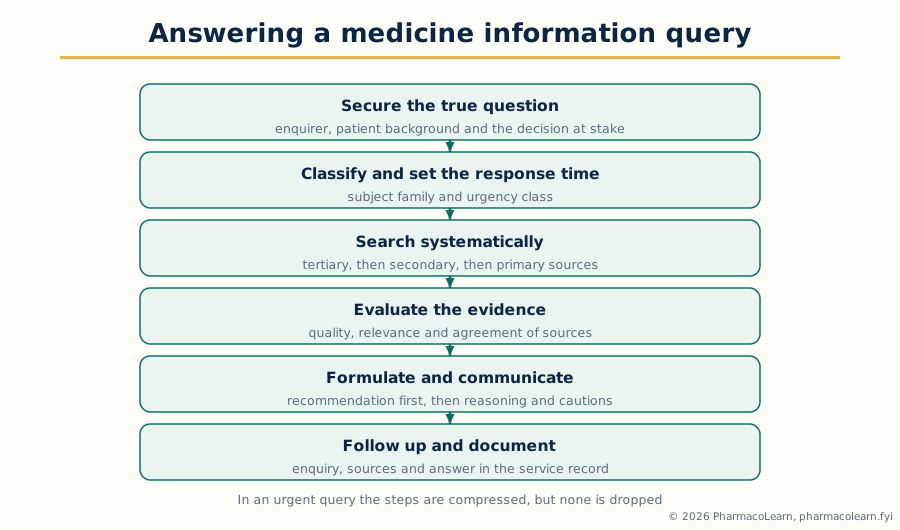 Figure: The systematic approach as a flow. Clarification comes before searching, and documentation closes every query, urgent or routine.
5.4 Preparation of verbal and written response
The response is the service's product, and its preparation follows rules that differ by form while its content standard is one. The verbal response is used where the decision is urgent, where the enquirer is present or on the telephone, and as the first instalment of a fuller written answer; it is delivered in a structure the listener can act on, recommendation first, key reasons and evidence in brief, cautions and monitoring, and the offer of written confirmation, spoken at the listener's pace with understanding checked, since a verbal answer cannot be reread. The written response is the considered form, used for complex, non urgent and formally referred questions, and it is built to a standard anatomy: the question as understood and the background on which the answer rests; the answer itself, stated early and unambiguously; the evidence and reasoning, with sources named and their quality characterised; the application to the enquirer's patient or situation, including alternatives where the first answer cannot be used; and the reservations, what is not known and what would change the answer, with the responder's name, date and references completing the document. Style is a professional matter in both forms: plain precise language, no promotional phrasing, quantities and names checked twice, and the distinction between established fact, inference and the responder's recommendation kept visible, because enquirers act on these documents and patients carry the consequences.
5.5 Establishing a drug information centre
Establishing a drug information centre is the organisational task that converts the method of the last three sections into a permanent service, and the syllabus examines it as a plan with defined components. The case for the centre is made first, to the institution's management and pharmacy and therapeutics structure: the need argued from the questions already reaching pharmacists informally, the medication safety the service supports, and the measurable outputs it will report. Place and staffing follow: the centre is housed within or beside the hospital pharmacy, in a quiet workspace suited to searching and uninterrupted telephone work, staffed by pharmacists trained in drug information method, with defined cover for its advertised hours and a clear route for urgent queries outside them. Its resources are assembled by the hierarchy of Section 5.2, core tertiary references and formulary material first, database and journal access as the budget allows, with the standard enquiry forms, response formats and record system that make the systematic approach the path of least resistance. Its procedures are written before it opens: how enquiries are received and logged, response time standards by urgency class, response formats, the documentation rule, and the quality assurance by which a sample of answers is peer reviewed and activity and user satisfaction are reported. Its launch is an act of communication as much as organisation: prescribers and nurses are told what the service answers, how to reach it and what background to supply with a query, and early users are followed up so the first answers advertise the service by their quality.
5.6 Poison information service: definition and need
The poison information service is the organised service that provides immediate, expert advice on the management of poisoning, to healthcare professionals treating a poisoned patient and, in many systems, directly to the public at the moment of exposure. Poisoning here covers the whole field the service answers for: medicines taken in overdose or in error, household and industrial chemicals, pesticides, venomous bites and stings, poisonous plants and substances of abuse, in adults and in children, accidental and deliberate. The need is argued from the character of poisoning itself. Poisoning is common, and its first management decisions are time critical: whether to decontaminate, whether and which antidote to give, whether the patient can be observed safely or must be transferred to intensive care, all turn on identifying the agent, the amount and the time since exposure, information the treating team at a general hospital cannot be expert in across thousands of possible agents.
5.7 Poison information centre: organization and functions
A poison information centre is the unit that delivers the poison information service, and its organisation follows from the tempo of its work. It operates continuously or to the fullest hours its system can sustain, since poisoning keeps no office hours, and it is reachable by a widely publicised telephone route, staffed by specialists in poison information, pharmacists prominent among them in the Indian centres as internationally, working to medical toxicology direction and with immediate access to the centre's information resources. Those resources are its defining equipment: evaluated databases and references on the toxicity and management of medicines, chemicals and natural toxins, product information by which a named household or industrial product is resolved into its actual ingredients, and the centre's own case records, in which previous exposures and outcomes accumulate into local knowledge no book contains. Its functions, which the examination answer should list as functions, are these. It provides immediate risk assessment and management advice by telephone, agent, amount, time and patient being established by structured questioning and the advice matched to the caller's setting, hospital or home. It supports the treating hospital through significant poisonings, advising on investigations, antidotes and their availability, monitoring and the expected course, and helping locate scarce antidotes through its network. It documents every call contemporaneously, building the surveillance record. It analyses that record and reports patterns to public health authorities, regulators and manufacturers, where a product or a local practice is generating poisonings. And it educates: training healthcare staff in the first management of common poisonings, and informing the public about prevention, safe storage and the centre's own number.
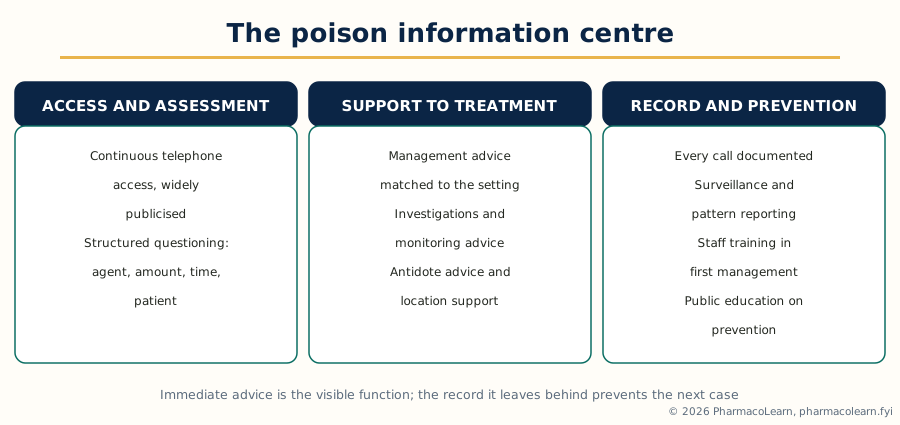 Figure: The poison information centre and its functions. Immediate advice is the visible function; documentation, surveillance and education are what the advice leaves behind.
Frequently Asked Questions
Q: What is clinical pharmacy, and how does it differ from traditional pharmacy practice? Clinical pharmacy is the branch of practice in which the pharmacist works directly with patients and the healthcare team to ensure medicines are used safely, effectively and appropriately for the individual patient. Traditional practice is organised around the product: procurement, compounding, dispensing and distribution. Clinical pharmacy is organised around the patient and the outcome of therapy, and adds review, monitoring, information and counselling to supply. See Sections 1.1 and 1.3.
Q: What is pharmaceutical care, and how is it different from clinical pharmacy? Pharmaceutical care is the responsible provision of drug therapy for the purpose of achieving definite outcomes that improve a patient's quality of life, in the classic Hepler and Strand formulation. Clinical pharmacy names the discipline and its services; pharmaceutical care names the philosophy and outcome responsibility those services serve, worked as a cycle of assessment, problem identification, care plan and evaluation. See Section 1.6.
Q: What does the pharmacist do on a ward round, and how is the work organised? The pharmacist prepares by reviewing charts and case data and prioritising drug related problems, contributes on the round by answering drug questions and raising interventions briefly with the problem, the evidence and a specific alternative, and follows up by verifying agreed changes, answering outstanding queries and documenting interventions the same day. See Section 1.8.
Q: What is drug therapy review, and what are its components? Drug therapy review, or drug therapy monitoring, is the systematic examination of a patient's whole drug therapy against the patient's clinical condition, checking every medicine for indication, suitability, effectiveness, safety and actual use. Its components are medication order review, chart endorsement, the pharmacist's recorded confirmation on the treatment chart, and clinical review, the deeper assessment of therapy against clinical progress, from which interventions arise. See Sections 1.9 to 1.12.
Q: What should a complete medication history contain? Currently prescribed medicines with dose form, frequency, duration and understood indication; over the counter medicines; herbal and traditional products, asked for by name; intermittent and non oral medicines such as inhalers and topical products; recent changes; allergy and previous reaction history with the reaction described; adherence as actually practised and its reasons; and the practical context of who administers medicines and any difficulty in using them. See Section 2.1.
Q: What is pharmacovigilance, and what is the pharmacist's chain of work when a reaction is suspected? Pharmacovigilance is the detection, assessment, understanding and prevention of adverse effects and other drug related problems, necessary because trials cannot reveal rare, delayed or group specific effects before marketing. The bedside chain is: suspect from the symptom or result and the medication timeline, document fully, assess causality in a structured way, act with the prescriber to stop or replace the medicine where required, and report through the hospital into the national programme. See Section 2.3.
Q: How do haemovigilance, materiovigilance and AEFI differ from pharmacovigilance? They are the matched vigilance systems for other products. Haemovigilance covers blood and blood components across the transfusion chain, built on donor to recipient traceability. Materiovigilance covers medical devices, whose characteristic events are failures and use errors. AEFI surveillance covers adverse events following immunisation, which need not be caused by the vaccine and are investigated to separate product, error, anxiety and coincidental causes. All four share structured reporting, causality assessment and signal detection. See Section 2.4.
Q: What are the stages of drug utilisation evaluation? Selection of a medicine or problem, usually for high risk, high cost, high volume or suspected misuse; criteria for appropriate use written in advance from accepted evidence; data collection on a defined sample; comparison of actual use against the criteria; report to prescribers and the pharmacy and therapeutics structure with proposals for action; and repetition after the action to confirm improvement. The exercise addresses the system of use, not blame. See Section 2.6.
Q: How are laboratory results interpreted in clinical pharmacy practice? In a fixed order: against the reporting laboratory's own reference interval; as a pattern across the panel and as a trend over time; against the patient's symptoms, examination and diagnosis; against the drug therapy, since medicines cause laboratory change as effect and as adverse effect and can interfere with assays; and with pre analytical cautions in mind. The pharmacist flags results that change the safety or efficacy of current therapy. See Section 3.6.
Q: What is the systematic approach to answering a medicine information query? Secure the enquirer, the patient and the true question; classify the enquiry and set the response time; search systematically, tertiary sources first, then secondary, then primary literature as required; evaluate the evidence for quality and relevance; formulate the answer for the enquirer's decision; communicate it verbally, in writing or both; and follow up and document the enquiry, sources and answer in the service record. In urgent queries the steps are compressed but none is dropped. See Section 5.3.
Complete MPP101T notes, all 5 units in one PDF, free to keep.
Other M.Pharm subjects: MPH101T · MPC101T · MPL101T · MPH102T · MPH103T · MPH104T · MPL102T · MPL103T · MPL104T · MPC102T · MPC103T · MPC104T · MPH201T · MPH202T · MPH203T · MPH204T · MPC201T · MPC202T · MPC203T · MPC204T · MPL201T · MPL202T · MPL203T · MPL204T · MRA101T · MRA102T · MRA103T · MRA104T · MRM301T · MPG101T · MPG102T · MPG103T · MPG201T · MPG202T · MPG203T · MPG104T · MPG204T · MRA201T · MRA202T · MRA203T · MRA204T · MPP101T · MPP102T · MPP103T · MPP104T · MPP201T · MPP202T · M.Pharm