
MPP104T — Clinical Research
4 hrs/week, 4 credits, 60 hours, 100 marks. Notes follow the M.Pharm syllabus, unit by unit.
MPP104T Clinical Research notes for M.Pharm Pharmacy Practice Semester 1: drug development and the IND, trial phases, designs and randomization, protocol and consent, ethics committees and GCP, trial documents, start up, monitoring, close out, audits and data management, with free unit wise PDF downloads on PharmacoLearn.
Units in this subject
- Unit 1 — Drug Development Process and Ethics in Biomedical Research
- Unit 2 — Types and Designs Used in Clinical Research and the Trial Team
- Unit 3 — Clinical Trial Documents and Start Up Activities
- Unit 4 — Investigational Product, Filing, Monitoring and Close Out
- Unit 5 — Quality Assurance, Quality Control and Clinical Data Management
Download MPP104T PDF Notes
Free PDFs for this subject, one per unit:
Clinical Research, subject code MPP104T, is the fourth core theory subject of M.Pharm Pharmacy Practice, Semester 1. It carries 4 credits and 60 hours of theory, taught at 4 hours per week, for 100 marks, and its five units are of equal length at 12 hours each in the PCI scheme. Its scope, as the syllabus states it, is to give students the opportunity to learn the drug development process, especially the phases of clinical trials and the ethical issues involved in the conduct of clinical research,. In India, clinical trials and bioavailability and bioequivalence studies of new drugs and investigational new drugs now run under the New Drugs and Clinical Trials Rules, 2019. No approval timelines, compensation formulas, sample size figures or institutional procedures are stated, because they are set by rule, amendment and institution and the syllabus prints none.
Unit 1: Drug Development Process and Ethics in Biomedical Research
1.1 Introduction: what clinical research is and why medicines need it
Clinical research is the systematic study of health and disease in human beings, carried out to produce knowledge that can be generalised: whether a treatment works, how safe it is, how it behaves in the body, and how its benefits and harms compare with the alternatives. Only structured human study can do that. Clinical research is therefore not a regulatory hurdle placed after the real science: it is the stage at which a candidate medicine becomes, or fails to become, a medicine at all, and every later unit of this subject exists to protect the two things that make its results believable: the rights and safety of the participants, and the credibility of the data.
1.2 The drug development process: the whole road in outline
The drug development process carries an idea for a treatment to an approved product and beyond. It begins in discovery, where a disease process is understood well enough to choose a target and compounds are found or made that act on it, and continues in preclinical development, where candidates are tested in laboratory systems and animals for activity, for how the body handles them, and for toxicity, and where the formulation a trial can use is worked out. Most candidates end here, and they are meant to: each early stage exists to stop weak candidates cheaply and safely before any human being is exposed. The survivors cross into clinical development through the investigational application of Section 1.5 and are studied in the phases of Unit 2, then a successful programme is assembled into a marketing application and reviewed on the total evidence of quality, safety and efficacy. Approval is not the end of learning: post marketing study and surveillance, the Phase IV world of Unit 2, continue the safety picture for as long as the product is used.
The drug development road, stage by stage
  Discovery: target chosen, compounds found or made,
  activity shown in laboratory systems
        |
        v
  Preclinical development: pharmacology, how the body
  handles the compound, toxicity, formulation for trials
        |
        v
  Investigational application: the evidence assembled
  and permission sought to test in humans
        |
        v
  Clinical phases: safety and handling, dose and early
  effect, proof at scale, learning after approval
        |
        v
  Marketing review, approval, and continuing
  post marketing study and safety surveillance
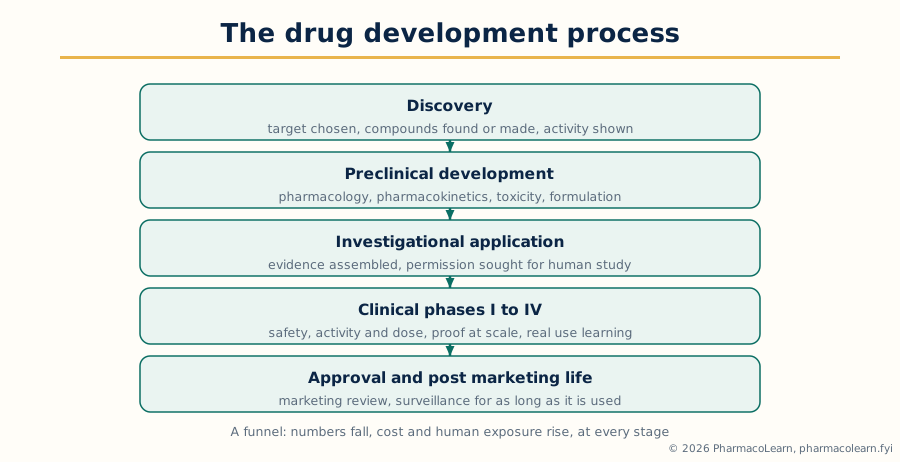 Figure: The development funnel. Each stage exists to stop weak candidates before the next, more costly and more human, stage begins.
1.3 Various approaches to drug discovery
The syllabus names various approaches to drug discovery, and an examination answer should present them as complementary routes to the same starting point: a compound, or a small set of compounds, with a credible action on a chosen target and a profile worth developing. The classical pharmacological approach screens substances for a desired effect in test systems and animal models, observing the effect first; the rational, target based approach selects and validates a molecular target and designs or screens compounds against it, at modern scale in automated high throughput systems; chemical approaches modify a known active structure to improve potency, selectivity, handling or safety, the lead optimization of medicinal chemistry. Biological approaches produce the medicine as a biological product, antibodies and other proteins made in living systems. However a lead is found, the same questions decide whether it proceeds: does it act potently and selectively on the intended target, can it reach that target in the body, does it survive long enough to act, and does its early safety profile leave room for a usable dose.
1.4 Preclinical development: the bridge to human study
Between discovery and the first human dose stands preclinical development. Its pharmacology establishes what the compound does: its primary action on the target, its wider actions on other systems, studied as safety pharmacology, and the relationship between exposure and effect. Its pharmacokinetic work establishes absorption, distribution, metabolism and excretion, predicting whether a human dose can achieve the exposures that worked in the test systems. Its toxicology establishes the harms to watch for: single and repeated dose toxicity, effects on reproduction and development where relevant, genetic toxicity, and the margin between the exposure producing the wanted effect and the exposure producing harm, because that margin shapes the starting dose and the escalation plan of the first human study.
1.5 The investigational new drug application
The investigational new drug application, universally shortened to IND, is the application by which a sponsor asks the regulatory authority for permission to begin testing an unapproved drug in humans, and, in the United States system from which the term comes, to ship the investigational product for that testing. The application assembles the preclinical story in three parts: the chemistry, manufacturing and controls information establishing what the product is; the pharmacology and toxicology evidence, with its margins and target organs; and the plan for the first studies, the protocol and investigator brochure of Unit 3. In India, the corresponding permission to conduct a clinical trial of a new drug or an investigational new drug is given under the New Drugs and Clinical Trials Rules, 2019, by the Central Licensing Authority, on an application with the data and documents those Rules prescribe, and the ethics committee approval of Section 1.8 stands beside the regulatory permission as a separate, equally necessary gate. Two gates, two different questions: the regulator asks whether the national requirements for this trial are met, and the ethics committee asks whether this trial, at this site, with these participants, should be done at all.
1.6 Ethics in biomedical research: why ethics is structural, not decorative
Ethics in biomedical research is the discipline that governs research involving human participants, and the syllabus places it inside Unit 1, beside drug development, because it is a design input to every trial and not a clearance obtained at the end. The historical failures behind the safeguards, research on people who could not consent, risks concealed, vulnerable groups used because they were available, are assumed here from the neighbouring subjects. Each modern safeguard answers one of those failures, which is why the safeguards are not negotiable courtesies. For the Pharmacy Practice student, the practical translation is this: every operational topic in Units 3 to 5, the consent form, the ethics submission, the safety report, the monitoring visit, the audit, is an ethical safeguard wearing working clothes.
1.7 Principles of ethics in biomedical research
The principles are respect for persons, beneficence with non maleficence, and justice. Respect for persons means participants decide freely on full information, may withdraw without penalty, and receive added protection where autonomy is reduced. Beneficence and non maleficence mean risks are identified, minimised, monitored and justified by the expected knowledge. Justice means participants are selected for scientific reasons, with burdens and benefits shared fairly. Around them stand scientific validity, independent review, informed consent, confidentiality, accountability and transparency, and the continuing duty of care. An examination answer should name the principles and then show each one operating in a named trial activity: consent, review, monitoring, reporting.
1.8 The ethics committee: constitution
The ethical committee of the syllabus, called the ethics committee in Indian usage and the institutional review board in the American term the syllabus prints beside it, is the independent body that reviews and approves research involving human participants before it begins and monitors it while it runs. Its constitution is prescribed because its independence and its competence both depend on who sits on it. In composition, the standard pattern across these frameworks is a chairperson drawn from outside the institution; a member secretary who organises its work; clinician and basic medical science members who can judge the science and the risks; a legal expert; a social scientist, ethicist or community representative who speaks for the participant and public perspective; and a lay person from the community, whose presence tests whether the documents and explanations make sense to a non professional.
1.9 Functions of the ethics committee and the review process
The functions of the ethics committee follow from its purpose, to protect the rights, safety and wellbeing of trial participants, across the whole life of a trial. Before the trial, it reviews the submission of Section 3.10: the protocol, for scientific soundness and the balance of risk and expected benefit; the investigator brochure, for whether known risks are honestly stated; the consent form and participant information, for completeness and plain language; recruitment and payments, for fairness and freedom from inducement; the arrangements for privacy, confidentiality, and care and compensation for research related injury under the applicable rules; and the investigator's qualifications and the site's facilities. Its decisions are to approve, to approve with modifications, to require changes and resubmission, or to disapprove, with reasons in writing; no participant may be enrolled before approval for that site exists. During the trial it reviews amendments before implementation, receives safety information and progress reports, conducts continuing review at intervals suited to the trial's risk, and can require changes, suspend or terminate its approval if the balance changes. After the trial it receives the completion report. Review is therefore a continuing oversight relationship, and the team's prompt, complete EC communications, which the monitor checks in Unit 4, are what make it real.
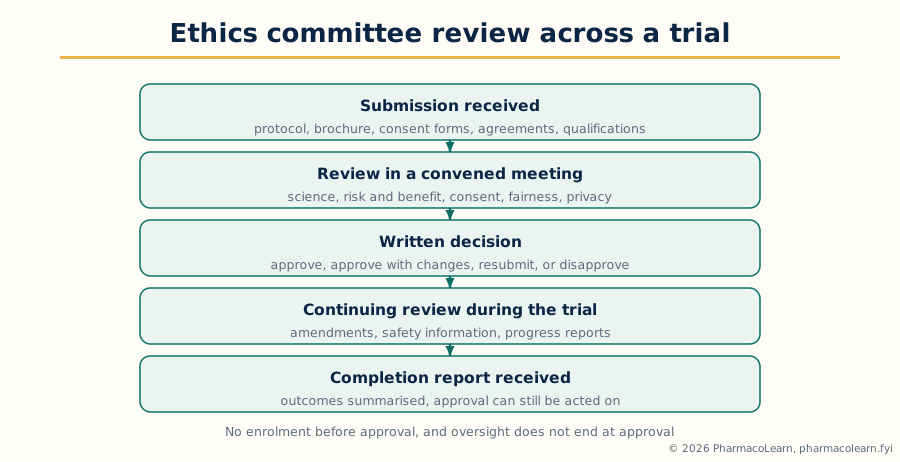 Figure: Ethics review across the life of a trial. Approval opens the gate, continuing review keeps it honest, and every decision is written.
1.10 Challenges in implementation of ethical guidelines
The challenges in implementation of ethical guidelines are the known failure points between the written standard and the working trial. The first is the consent gap: forms in technical language, translated poorly, or signed as a formality, so the signature exists and the understanding does not; the countermeasures are plain language documents, translation and back translation, time to decide, and staff trained to explain rather than to obtain signatures. The second is committee capacity: committees reviewing complex protocols without enough members, time, training or support produce delay or superficial review; the countermeasures are the constitution and quorum disciplines of Section 1.8 and honest workload planning. The third is vulnerability and inducement: participants who are poor, ill, dependent on the treating doctor, or unfamiliar with research may agree for reasons that are not free choice. The fourth is the dual role of the treating clinician who is also the investigator, where trust in the doctor can blur the line between treatment and experiment; clear separation of the conversations is the standard protection.
1.11 ICH GCP guidelines in the conduct of clinical trials
The ICH GCP guidelines, the Good Clinical Practice guideline of the International Council for Harmonisation, reference E6, are the international standard for designing, conducting, recording and reporting trials involving human participants. GCP gives public assurance that the rights, safety and wellbeing of participants are protected, consistent with the principles of the Declaration of Helsinki, and that the trial data are credible. Its principles, at framework level, are these: trials follow the ethical principles originating in the Declaration of Helsinki, GCP and the applicable regulatory requirements; foreseeable risks are weighed against anticipated benefit before a trial begins, and it continues only while that balance remains favourable; the rights, safety and wellbeing of participants prevail over the interests of science and society; the available nonclinical and clinical information adequately supports the trial; trials are scientifically sound and described in a clear, detailed protocol; a trial complies with the protocol that received prior ethics committee approval; medical care and decisions rest with a qualified physician; everyone involved is qualified by education, training and experience; freely given informed consent is obtained before participation; trial information is recorded, handled and stored so it can be accurately reported, interpreted and verified; participant confidentiality is protected; investigational products are manufactured, handled and stored to good manufacturing practice and used as the protocol directs; and systems assuring the quality of every aspect of the trial are implemented. The current revision of E6 modernises the same framework for electronic systems and risk proportionate quality management; the principles above are its stable core.
1.12 ICMR guidelines in the conduct of clinical trials
The ICMR guidelines, the National Ethical Guidelines for Biomedical and Health Research Involving Human Participants issued by the Indian Council of Medical Research, are the national ethical framework within which Indian trials, and Indian biomedical research generally, are designed and reviewed. Their practical chapters govern what an Indian committee actually decides: committee constitution and working, the consent process, research in vulnerable populations with named added protections, biological materials and data, and institutional responsibilities for oversight infrastructure. For a trial in India the frameworks meet in a triangle: the New Drugs and Clinical Trials Rules, 2019 supply the regulatory permission and committee registration requirements, ICH GCP is the working standard, and the ICMR principles are the ethical framework. A student who can place each document in that triangle understands the Indian system.
1.13 Drug safety reporting: the duty stated in outline
Drug safety reporting appears in Unit 1 of the syllabus because it is an ethical duty before it is a procedure. An adverse event is any untoward medical occurrence in a participant administered a product, whether or not it is considered related to that product; seriousness is a separate judgement on the outcome for the participant, and it drives the speed of reporting. When a participant is harmed, or new risk information emerges, the bodies charged with protecting participants must learn of it promptly and in a form they can act on. The investigator records events in the source documents and the case report form, assesses seriousness and, as the protocol requires, causality, treats the participant, and reports serious events to the sponsor and, as the applicable rules and the committee require, to the ethics committee within the timelines those instruments prescribe. The sponsor evaluates safety information across the whole programme, since a pattern invisible at one site may be unmistakable across many, reports expedited cases to the authority and to investigators and committees as the rules require, and updates the brochure and, where needed, the consent documents when the risk picture changes. In India these duties sit inside the New Drugs and Clinical Trials Rules, 2019 framework. No timelines are reproduced here, deliberately: they are prescribed figures a working trial takes from the current rules and its protocol, and an examination answer is marked on the chain of duties, investigator to sponsor to authority and committee.
Unit 2: Types and Designs Used in Clinical Research and the Trial Team
2.1 Planning and execution of clinical trials
Planning and execution are the two halves of trial conduct, and the syllabus names them together because a trial is won or lost in the planning. Planning begins with the research question, in which population, which intervention, compared with what, changing which outcome, and fixes the design, eligibility, endpoints and statistical approach in advance in the protocol, with the operation built around the science: sites, product supply, data systems, monitoring and the regulatory and ethical approvals. A planning error cannot be repaired by excellent execution, because the data faithfully record the wrong experiment. Execution is the disciplined running of that plan: site activation, recruitment and consent, treatment and follow up exactly as the protocol prescribes, data captured as events happen, safety watched continuously, and deviations recognised, recorded and corrected rather than hidden.
2.2 Phases of clinical trials: the map
The phases of clinical trials are the conventional stages of human study, numbered I to IV, through which a new medicine passes as knowledge and confidence grow. The table below states the comparison qualitatively, without invented participant numbers.
| Phase | Governing question | Typical participants | What is principally learned | What it decides |
|---|---|---|---|---|
| Phase I | Is it tolerable, and how does the body handle it? | Small number of healthy volunteers, or patients where the product class requires it | Safety and tolerability, pharmacokinetics, dose range for study | Whether human study continues, and at what doses |
| Phase II | Does it show activity, and at what dose? | Patients with the target condition | Early efficacy signals, dose response, further safety | Whether proof is worth seeking, and in which dose and population |
| Phase III | Does it truly benefit patients? | Larger patient groups, often many centres and countries | Confirmatory efficacy against a comparator, fuller safety profile | Whether the evidence supports marketing approval |
| Phase IV | What happens in real use? | Patients in ordinary practice after approval | Longer term and rarer effects, use in wider populations, effectiveness in practice | Labelling refinement, risk management, place in therapy |
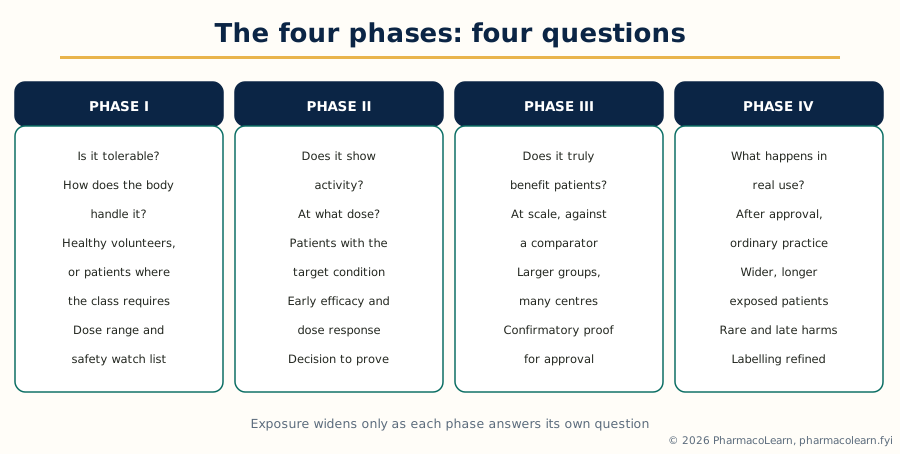 Figure: The four phases as four questions. Each phase earns the right to the next by answering its own question honestly.
2.3 Phase I: first study in humans
Phase I is the first administration of the investigational product to human beings, and its governing concerns are safety, tolerability and pharmacokinetics, not proof of benefit. Participants are usually healthy volunteers, because the object is to learn how a human body handles the product without the confusion of disease; where the product is expected to be markedly toxic, as with many anticancer agents, the first studies are done in patients instead. The design features all serve caution: a conservative starting dose from the preclinical margins of Section 1.4, single doses before repeated doses, small groups dosed in sequence with review before the next begins, gradual escalation under predefined stopping rules, and intensive monitoring in a setting equipped for emergencies.
2.4 Phase II: activity, dose and the decision to prove
Phase II moves the product into patients with the target condition and asks the first therapeutic questions: is there evidence of the intended activity, what dose and schedule produce it, and does the safety profile in patients, who are ill and usually taking other medicines, still leave a usable margin. Early Phase II work is commonly exploratory, comparing doses and refining the population and the endpoints. Later Phase II work firms those choices into the design Phase III will test. Small, short studies can show an effect is plausible and worth proving, or that a programme should stop, but they cannot establish benefit: chance, selection and the natural course of disease all imitate treatment effects at this scale.
2.5 Phase III and Phase IV: proof at scale, and learning after approval
Phase III is the confirmatory stage: large, controlled trials, commonly randomized against the standard treatment or another accepted comparator, in the population for which approval will be sought, measuring endpoints that represent real clinical benefit, over periods long enough for that benefit and the common harms to declare themselves. Its scale is set by statistics, the need to detect a difference of the size claimed with acceptable certainty, and its conduct is commonly multicentre and multinational, which is why the full machinery of this subject, monitoring, data management, central systems, exists at its most developed here. Phase IV is study after approval, in wider, older and more medicated populations than any trial enrolled, through further trials, observational studies and registries, and continuing safety surveillance, detecting the rare and long latency harms no pre approval programme can exclude and feeding labelling and risk management.
2.6 Bioavailability and bioequivalence studies
Bioavailability is the rate and extent to which the active substance is absorbed from a product and becomes available at the site of action, measured in practice by the concentration time profile in the blood: how much in total, and how fast it peaks. A bioavailability study characterises that profile for a product, absolutely against an intravenous reference or relatively against another product, and answers the formulation and handling questions behind it. Bioequivalence is the comparative judgement built on that measurement: two products are bioequivalent when their bioavailabilities are so similar, in rate and extent, that their effects can be expected to be essentially the same, so that one may be substituted for the other on the strength of the comparison rather than a fresh clinical programme. The characteristic bioequivalence design follows from the precision the judgement needs: a crossover study in healthy volunteers, in which each participant receives both products in randomly assigned order separated by a washout period, so that every person serves as their own control and the comparison is made within, not between, individuals; concentrations are measured through the profile; and the products are compared on the standard summary measures of extent and rate under the acceptance framework the applicable rules prescribe. In India these studies sit inside the New Drugs and Clinical Trials Rules, 2019, with their own approval, ethics and conduct requirements.
2.7 Randomization: why allocation must be left to chance
Randomization is the allocation of participants to the treatment groups of a trial by a chance process, and it is the single most important design device in the confirmatory trial. Random allocation, honestly executed and concealed until the moment of assignment, distributes known and unknown prognostic factors between the groups by chance alone, so that systematic bias has no route in, and remaining differences can be quantified by the statistics of chance. Three disciplines make randomization real rather than nominal: the sequence is generated before the trial and held independently of enrolling staff; allocation is concealed, so the enroller cannot foresee the next assignment; and allocation is implemented exactly as generated, with the record preserved for audit.
2.8 Randomization techniques: simple, restricted, blocking and stratification
The syllabus names the randomization techniques in a family that runs from the simplest to the more controlled. Simple randomization allocates each participant independently by the chance process, like the toss of a coin for two groups. It is pure and unpredictable, and its weakness appears in small and moderate trials: chance alone can leave the groups uneven in number and, occasionally, uneven on an important prognostic factor. Restricted randomization is the family of methods that keep the purity of chance while restraining that imbalance, and its two named members are the standard examination pair. Blocking, in permuted block randomization, generates the sequence in small blocks within which the groups are exactly balanced, the order inside each block being random, so that at every stage of recruitment, and at any early stopping point, the numbers per group are close; block sizes are varied and kept undisclosed, because a fixed known block size would let an observant enroller predict the last assignment of each block and break allocation concealment. Stratification generates separate randomization sequences within strata defined by a strong prognostic factor, such as centre, disease severity or age band, so that balance is guaranteed not only overall but within each level of that factor.
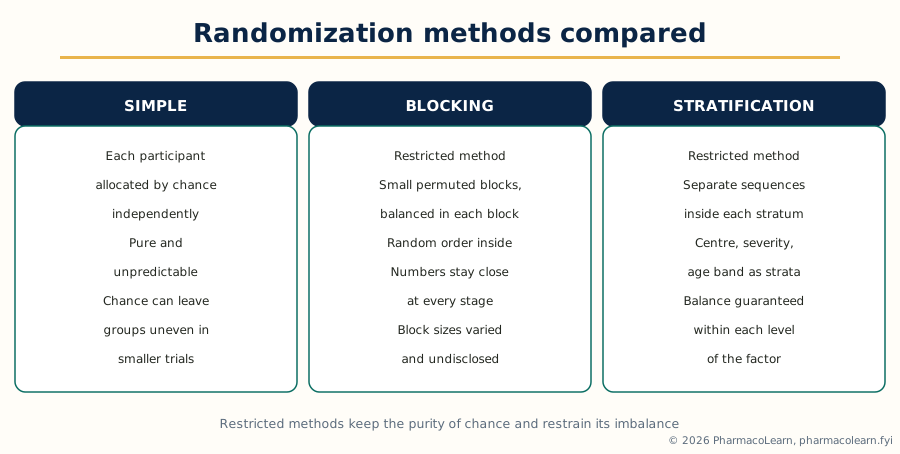 Figure: Three ways to let chance decide. The methods differ in how much imbalance they permit chance to leave behind.
2.9 Designs by controlling method: experimental, quasi experimental and observational
The syllabus classifies research designs first by the controlling method, by how much control the investigator exercises over the exposure being studied. In experimental designs, the investigator assigns the intervention: the clinical trial is the type case, with its protocol, its eligibility criteria, its assigned treatments and, at its strongest, randomization and blinding. Control is maximal, and with it the ability to attribute an observed difference to the intervention, which is why experimental evidence stands highest for questions of treatment effect. In quasi experimental designs, an intervention is delivered and its effects measured, but a defining element of the true experiment is missing, commonly random assignment: before and after studies, studies with a non randomized comparison group, and interrupted time series in which an outcome is tracked across the introduction of a policy or treatment. In observational designs, the investigator assigns nothing: exposure and outcome are observed as they occur in ordinary life and care, and the design families of Section 2.10, cohort, case control and cross sectional, are its members. Observational work studies what trials cannot, rare harms, long latencies, real world use, exposures that cannot be assigned, at the price of confounding, the entanglement of the exposure with the characteristics of the people who receive it, which the analysis must measure and adjust for and can never wholly remove.
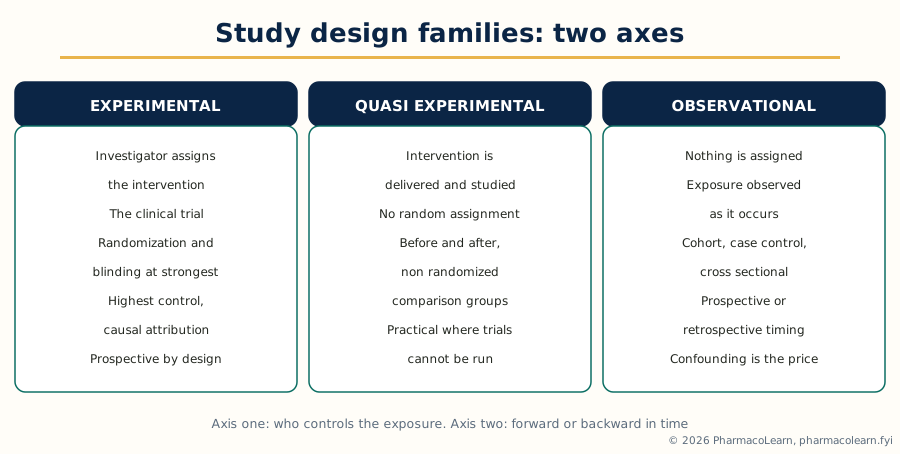 Figure: Two axes classify every design: who controls the exposure, and whether the study looks forward or back from it.
2.10 Designs by time sequence, and sampling designs: cohort, case control and cross sectional
The second classification of the syllabus is by time sequence. A prospective study looks forward: participants are identified by their present characteristics or exposure, and followed into the future for the outcomes to occur, as in a trial or a cohort study; its data are collected for the research question, at the price of time. The syllabus then names its three sampling designs, the observational families. A retrospective study, by contrast, looks backward from outcomes that have already occurred, reconstructing exposure from records and history. A cohort study assembles groups defined by exposure, exposed and unexposed, and follows them forward to compare the incidence of the outcome in each. A case control study assembles participants by outcome, cases with the condition and controls without it, and looks back to compare the frequency of past exposure in each, answering: given this outcome, how much more common was the exposure; it is the efficient design for rare diseases and long latencies, since the investigator starts from the cases rather than waiting for them. A cross sectional study measures exposure and outcome at one point in time in a defined population, a snapshot that yields prevalence and association but cannot by itself establish which came first.
2.11 Health outcome measures: clinical and physiological, humanistic and economic
A trial is its outcome measures: the endpoints chosen decide what the study can claim, and the syllabus classifies health outcome measures in three families. Clinical and physiological outcomes are the measures of disease and body function: the events a patient fears, death, relapse, major complications, and the clinical signs and laboratory and physiological measurements that track the disease. Humanistic outcomes measure the person's experience of health: symptoms as the patient reports them, functioning in daily life, and health related quality of life, captured by validated patient reported instruments. Economic outcomes measure the resources the treatment consumes and saves: the costs of the product, its administration and monitoring, and the hospital and community care it uses or averts, set against its effects in the economic evaluations that the sister subject MPP204T teaches in full. A well designed trial names one primary outcome, a small set of secondary outcomes, and safety outcomes watched throughout, and fixes all of them in the protocol before enrolment begins, because outcomes chosen after the data are seen can always be found to favour somebody.
2.12 The clinical trial study team: roles in overview
A clinical trial is conducted by a team whose roles the syllabus names individually. The sponsor owns the trial as a whole: its design, its quality, its regulatory standing and its data. The investigator owns the conduct at one site: the participants enrolled there, the protocol as actually followed, and the records made. Between and around them, the study coordinator makes the site's work happen day by day, the monitor verifies on the sponsor's behalf that the site's work is what the records claim, and the Contract Research Organization performs, under contract, whatever sponsor duties have been formally transferred to it.
2.13 Investigator and study coordinator
The investigator is the qualified person responsible for the conduct of the trial at a site, and, where a team works under them, the leader answerable for the team's trial work. Their GCP duties are to hold the approvals before enrolling anyone, follow the approved protocol and document deviations, obtain informed consent properly, ensure protocol compliant product handling and complete source data, make records available to monitors, auditors and inspectors, report adverse events as required, give participants proper medical care for trial related events, and report progress and completion to sponsor and ethics committee. The study coordinator, often a nurse or a pharmacist by training, is the operational centre of the site: scheduling visits, maintaining files and logs, tracking documents and samples, entering and correcting data, and coordinating between investigator, participants, pharmacy, laboratory and sponsor. The coordinator's work is delegated task by task by the investigator and recorded on the delegation log; the investigator's accountability for the site is not delegated with the tasks.
2.14 Sponsor, monitor and Contract Research Organization
The sponsor is the individual, company, institution or organisation that takes responsibility for the initiation, management and financing of the trial. Its duties include the trial's quality systems, selection of qualified investigators and sites, provision of the product made and labelled for trial use, the protocol, brochure and agreements, safety evaluation across the programme, monitoring and audit, and management of the data and the final report. The monitor, appointed by the sponsor, verifies that the site follows the protocol and GCP, that consent was properly obtained, that reported data agree with source records and that the product is accounted for; the monitor verifies and reports, and does not conduct the site's trial for it. The Contract Research Organization, or CRO, is an organisation contracted by the sponsor to perform one or more of the sponsor's trial duties, commonly monitoring, data management, statistics, pharmacovigilance or full trial management. The transfer is valid only as far as it is specified in writing: the sponsor retains ultimate responsibility for the quality and integrity of the trial and its data however much work the CRO performs. That sentence, sponsor accountability survives outsourcing, is the examination heart of the CRO topic.
Unit 3: Clinical Trial Documents and Start Up Activities
3.1 Clinical trial documents: the set seen as a system
The clinical trial documents of this unit are one system, not six separate writing tasks: each document has a distinct reader and job, and the documents must agree with each other because monitors, auditors and inspectors will read them against each other. The protocol tells everyone what will be done and why. The investigator brochure tells the investigator what is known about the product, including its risks. The informed consent form tells the prospective participant, in plain language, what participation involves. The case report form captures, for each participant, exactly the data the protocol promises to analyse. The contracts and agreements bind the parties, their duties and their money in writing.
3.2 The protocol: guidelines for preparation
The protocol is the master document of the trial, and the guidelines for its preparation are the questions the document must answer. Its opening sections give the background and rationale and the trial's identification and version. Its objectives are the primary and secondary outcomes of Section 2.11, and its design section specifies the design family, the treatments, randomization and blinding, and the measures that keep bias out. The participant sections define eligibility, consent, the visit schedule, withdrawal and stopping rules and product accountability; the safety sections define adverse event collection and reporting; and the statistics sections state the basis of the trial's size, the analysis populations and methods, following the framework principles of ICH E9. The closing sections govern ethics, data handling and record retention, monitoring and audit access, and publication policy.
3.3 The Investigator Brochure
The Investigator Brochure is the compilation of the clinical and nonclinical data on the investigational product relevant to its study in humans, provided by the sponsor to every investigator, so that the people conducting the trial understand the product's rationale, its expected effects and, above all, its risks, independently of the sponsor's enthusiasm. Its contents follow that purpose: a summary placing the evidence in reach of a busy reader; the product's identity and pharmaceutical properties and formulation; the nonclinical pharmacology, pharmacokinetics and toxicology of Section 1.4, with margins and target organs stated plainly; any effects in humans from earlier trials, including adverse reactions and the populations in whom experience exists or is absent; and a closing guidance section for the investigator, the anticipated risks to watch for, the precautions and monitoring the protocol expects, and the populations requiring special care.
3.4 The informed consent form and the consent process
The informed consent form, with the participant information that accompanies it, is the written record of the consent process: a conversation, in a language and at a level the person understands, with time and opportunity to ask questions and to consult family, conducted by a person qualified to explain the trial, free of coercion, and completed before any trial procedure begins. The document records that process, and its required content is what a reasonable person needs for the decision: that the study is research and its purpose; what will be done, visit by visit, and how it differs from ordinary care; the foreseeable risks and discomforts and the possible benefits, stated without promise; the alternatives, including ordinary treatment without participation; the voluntary nature of participation and the right to withdraw without loss of entitled care; confidentiality and who may see the records, including monitors, auditors, the ethics committee and regulators; the arrangements for care and for compensation for research related injury under the applicable rules; whom to contact about the trial, about rights, and in an emergency; and, where relevant, payments, costs, and what happens to samples and data. The exact version in use is ethics approved, signed and dated by the participant or legally authorised representative and by the person conducting the discussion, with witness arrangements where the guidelines require them, and a copy is given to the participant. Consent is also continuing: new risk information and amendments reopen it, and re consent uses the same discipline as the first consent.
The consent process, step by step
  Participant identified and approached without pressure
        |
        v
  Information given in plain language: purpose,
  procedures, risks, benefits, alternatives, rights
        |
        v
  Questions answered, time to decide and to consult
  family, understanding checked by the discussion
        |
        v
  Free decision: agreement signed and dated, or
  declined and ordinary care continues unaffected
        |
        v
  Copy given to the participant, consent lives on:
  new information shared, re consent where required
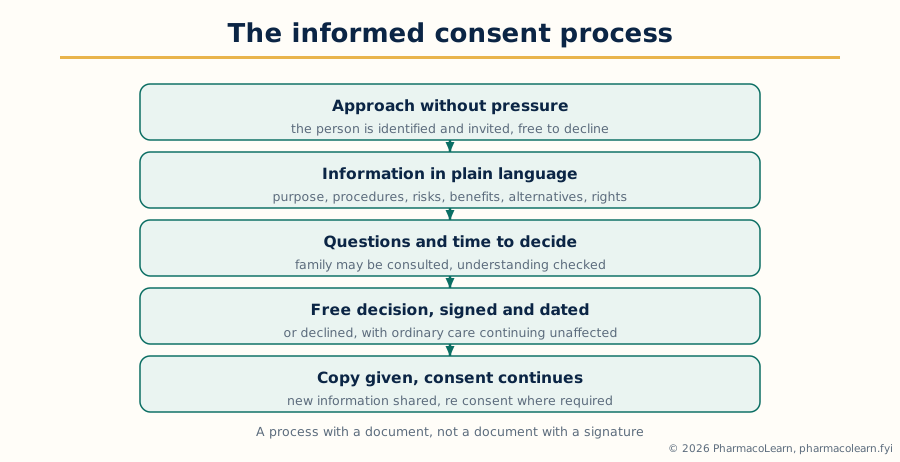 Figure: Consent is a process with a document, not a document with a signature. The conversation is the safeguard; the form is its record.
3.5 Case report forms
The case report form, or CRF, is the document, paper or electronic, designed to record all of the information on each participant that the protocol requires to be reported to the sponsor. Its preparation follows from the protocol by strict derivation: every data item exists because a protocol section demands it, an endpoint, an eligibility criterion, a safety assessment, a product administration, and every protocol requirement finds its field on the form, because data the form does not capture will not exist at analysis, however faithfully the visits were conducted. The form identifies the trial, the site and the participant by code, never by name on documents that travel. Questions are unambiguous, one item one meaning, with units, formats and allowable values printed where the answer is written, so ten sites record the same thing the same way. Corrections preserve the original entry and identify who changed what, when and why, and the investigator signs the completed form.
3.6 Contracts and agreements, and diary cards
Contracts and agreements are the legal skeleton of the trial, and their preparation guideline is that everything the parties expect of each other must be in them before the work begins. The clinical trial agreement between sponsor, institution and investigator records the scope of the work and the protocol it follows; the duties of each party, including GCP compliance, monitoring, audit and inspection access, record retention and reporting; the financial arrangements, payments and their schedule, stated transparently because undisclosed financial terms are an ethical as well as a legal defect; product supply, storage and accountability; confidentiality, data ownership and publication rights; indemnity and insurance arrangements for trial related harm; and the conditions of termination and its consequences for participants under care. The diary card, printed "Dairy Cards" in one syllabus copy and taught here in its correct form, is the only document in the set the participant writes: a card or booklet recording, at home and in real time, the doses taken, the symptoms experienced and the times of events the trial needs, returned and reviewed at each visit. Its rules are those of any participant facing document: plain instructions, space proportioned to what is asked, no more asked than the protocol will use, and review of the returned card with the participant.
3.7 Start up activities: the road from selection to activation
Clinical trial start up activities are the sequence that converts an approved protocol into a site ready to enrol its first participant, and the syllabus lists them as one connected block because their order matters. Feasibility establishes that the site can do the trial. Selection chooses sites and investigators on that evidence. The pre-study visit verifies the choice in person. The investigator meeting aligns every site on one reading of the protocol. The clinical trial agreement binds the arrangement legally and financially. The ethics submission wins the independent approval without which enrolment is forbidden. A site is activated, given formal permission by the sponsor to begin screening and enrolment, only when every gate stands open: contract executed, ethics approval in hand, regulatory requirements met, product on site and correctly stored, staff trained and delegated, systems live.
Start up: from protocol to an activated site
  Feasibility: can this site do this trial, honestly
  answered by site and sponsor together
        |
        v
  Selection and pre-study visit: investigators and
  facilities chosen and verified in person
        |
        v
  Agreement executed and ethics submission approved:
  the legal gate and the ethical gate both open
        |
        v
  Investigator meeting and site training: one reading
  of the protocol across every site and role
        |
        v
  Product, systems and files ready, initiation visit
  held: sponsor activates the site for enrolment
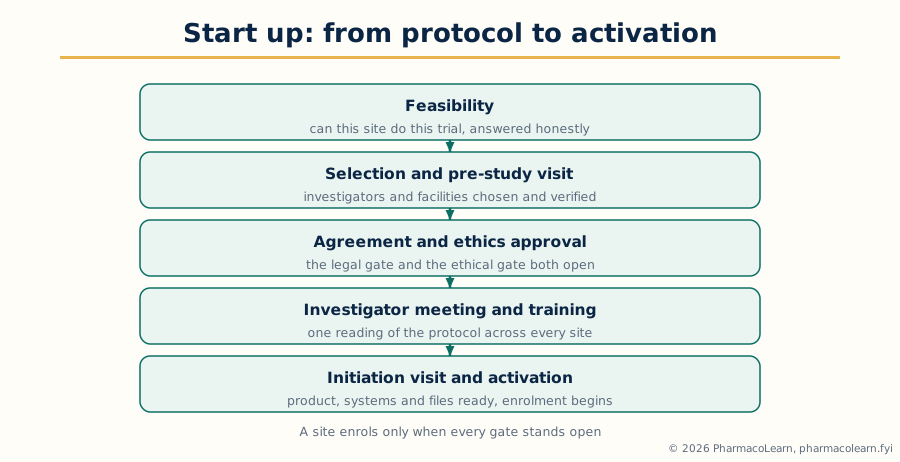 Figure: Start up as a row of gates. A site enrols only when every gate, legal, ethical and practical, stands open.
3.8 Site feasibility, selection and the pre-study visit
A site feasibility study is the structured assessment, before selection, of whether a particular site can conduct this particular trial to the required standard and timeline. On the participant side it tests whether the site's population contains the protocol's population in sufficient number, competing trials for the same patients, and the retention conditions that decide whether participants can complete the schedule. On the capability side: the investigator's experience and available time, coordinator and support staffing, the facilities and equipment the assessments require, pharmacy capacity for the product handling of Unit 4, laboratory support, ethics committee arrangements, contracting requirements, and the site's record in earlier trials, recruitment delivered against recruitment promised being the most predictive figure in the whole enquiry. Site and investigator selection then converts this evidence into the sponsor's choice: the investigator qualified, experienced, able to devote real time, and free of compromising conflicts; the site offering the population and infrastructure the feasibility study tested. The pre-study visit, also called the site selection visit, verifies all of this in person before the site is approved: facilities walked, equipment and storage seen rather than described, investigator and key staff met, source documents inspected, and its report records the evidence, the gaps, and the outcome, selection, selection with conditions to close before initiation, or non selection.
3.9 The investigator meeting and clinical trial agreement execution
The investigator meeting is the sponsor's gathering of the investigators and key site staff, held before or during start up, at which the trial is taught as one enterprise: the rationale and design, the product and its handling including pharmacy and blinding arrangements, eligibility and visit procedures, safety reporting duties, data capture and monitoring arrangements, and the GCP duties of each role, with questions answered on the record and clarifications issued to all sites alike. Attendance is documented, and the meeting's materials and clarifications become part of the trial's record. Clinical trial agreement execution, the signing of the contract of Section 3.6, runs in parallel with the meeting and the ethics submission, and it is a gate, not a formality: institutions review liability, indemnity, payment and publication terms with their own advisers.
3.10 Ethics committee document preparation and submission
Ethics committee document preparation and submission assembles the site's case for independent ethical approval, and its craft is completeness at the first attempt, because committees meet on a rhythm and an incomplete submission costs a whole cycle. The package mirrors the committee's review duties of Section 1.9: the protocol and amendments in current versions; the investigator brochure; the informed consent form and participant information in English and in the local languages of the population, with the translations the committee requires; the case report form; recruitment materials and participant payment information, exactly as participants will see them; the investigator's qualifications and GCP training evidence and the site's facilities information; the clinical trial agreement or its financial terms as the committee's rules require, since undisclosed payments are an ethical question; insurance and indemnity documents; and the regulatory status of the trial.
Unit 4: Investigational Product, Filing, Monitoring and Close Out
4.1 The investigational product: procurement and supply
The investigational product is the pharmaceutical form of the active substance, or the placebo, being tested or used as a reference in the trial, and mishandled product silently invalidates science: a degraded, mislabelled or wrongly dispensed product means the trial no longer knows what its participants received. The product is manufactured under good manufacturing practice for clinical use, packaged and labelled for the trial, with labelling that identifies it as an investigational product for trial use, the trial, the sponsor, the storage conditions, the expiry or retest date and the participant or kit identification the blinding system requires, and shipped to sites under the conditions its stability demands, with temperature control and monitoring where the product needs it. Receipt at the site is a documented act: identity, quantity, condition and temperature record are checked against the shipment advice before the stock is accepted. In most institutions the trial pharmacy is the receiving, storing and dispensing point, because the disciplines of this unit, custody, conditions, records, reconciliation, are the pharmacist's ordinary professional disciplines applied to an unlicensed product.
4.2 Storage, dispensing, accountability and reconciliation
Storage at the site applies pharmacy standards of custody with trial additions. The product is held in a secure area with access limited to authorised, delegated staff, under the labelled conditions, with temperature monitored and recorded and excursions reported to the sponsor and assessed before the affected stock is used. Stock is segregated by trial and, where the design requires it, by treatment code, with blinded stock handled so routine handling cannot reveal assignments. Dispensing follows the protocol and the randomisation system exactly: the right kit, for the right participant, at the right visit, recorded at the moment of dispensing with participant code, date, quantity and the dispenser's identity. Accountability is the continuous ledger binding these acts: quantities received, dispensed, returned and held, reconciled against each other so every unit is accounted for at every moment, discrepancies investigated and explained in writing at once and not at close out.
4.3 Essential documents and filing procedures
Essential documents are the documents which individually and collectively permit evaluation of the conduct of the trial and the quality of the data produced, in the definition of ICH GCP, and the filing procedures of this unit keep them complete, current and retrievable. The set spans the trial's life: before it, the brochure, signed protocol, approved consent forms, approvals, agreements, investigator qualifications, laboratory references and product and shipping records; during it, revised versions with their approvals, correspondence, signed consent forms and source documents, accountability records, monitoring reports and safety reports; after it, destruction records, final reports and the clinical study report.
4.4 The Trial Master File: preparation and maintenance
The Trial Master File, or TMF, is the sponsor side collection of the essential documents for the whole trial, the master record from which the trial's conduct across all its sites can be evaluated. Its preparation begins at start up, before the first document exists to file: a file structure is established, in modern practice following a recognised reference model, with sections for trial management, regulatory, ethics, site, product, data, safety and statistical documentation. Maintenance is the continuing duty: documents filed as they arise, completeness checked against the structure at intervals, increasingly by electronic TMF systems that flag what is missing. The TMF is the sponsor's whole trial file; the files of the next section are its site level counterparts, and the same document commonly exists in both, the approval letter in the site file where it authorises the work and in the TMF where the sponsor proves it held it.
4.5 The Investigator Site File and the Pharmacy File
The Investigator Site File, or ISF, is the site level counterpart of the TMF: the essential documents held at the site, by the investigator, from which that site's conduct can be evaluated: the current brochure and protocol with their approvals, approved consent forms in every language in use, agreements, staff qualifications, delegation and training logs, laboratory references, product information, site correspondence, monitoring reports, safety reports, and the screening, enrolment, visit and deviation logs of daily conduct. The Pharmacy File is the specialised file of the trial pharmacy: product receipt and shipment records, storage temperature records, dispensing and accountability logs, randomisation and unblinding procedures and records where the pharmacy holds them, preparation records where the pharmacy prepares doses, return and destruction documentation, and pharmacy delegation and training records. The comparison is the examination content of this section.
| File | Held by | Scope | Question it answers |
|---|---|---|---|
| Trial Master File | Sponsor | The whole trial, all sites | Was this trial conducted and documented properly overall? |
| Investigator Site File | Investigator at the site | One site, complete conduct | Was this site's conduct proper, approved and evidenced? |
| Pharmacy File | Trial pharmacy at the site | The product at one site | Can every unit of product at this site be accounted for? |
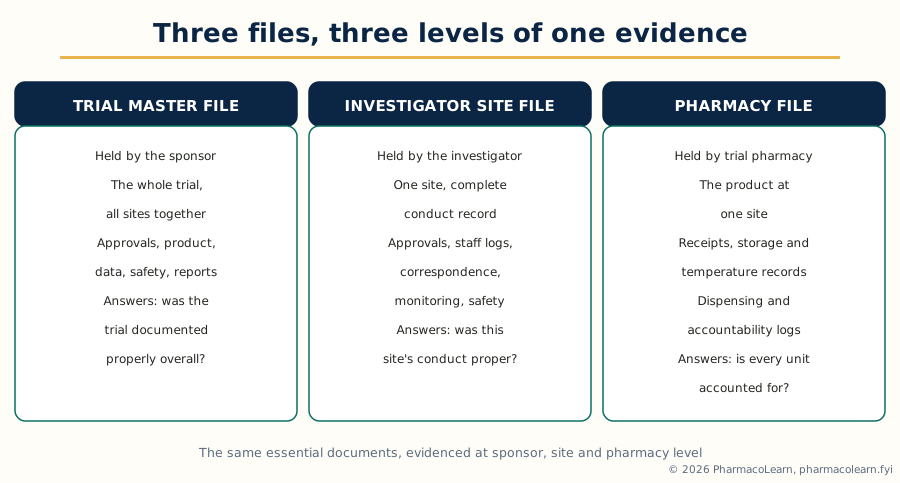 Figure: Three files, three levels of one evidence. An inspector reads down the levels; a good site keeps them in agreement.
4.6 The site initiation visit, and conduct, reporting and follow up
The site initiation visit is the sponsor's visit, conducted by the monitor, that completes start up at the site: documents, facilities and product arrangements are verified together, and the assembled site team is trained on the protocol, consent, product handling, safety reporting and data entry as they will actually be lived. Its preconditions are the open gates of Section 3.7. The visit report lists attendees, topics, documents verified and conditions outstanding, and only after it, and the sponsor's written activation, may the site screen and enrol. Conduct, in the syllabus's filing sequence, is the trial as lived between initiation and close out, under one rule: the records must allow a stranger to reconstruct, for every participant, what was planned, what was done, what differed and why. Reporting flows outward during conduct, progress to the sponsor, safety reports on their faster track, deviations as required, and the continuing ethics submissions of Section 1.9; follow up covers the participant after treatment ends, safety follow up until events resolve or stabilise, and the site's open items, queries answered and findings corrected.
4.7 Clinical trial monitoring: purpose and the monitoring visit
Clinical trial monitoring is the act of overseeing the progress of a trial to ensure that it is conducted, recorded and reported in accordance with the protocol, standard operating procedures, GCP and the applicable regulatory requirements, in the guideline's definition, and it is the sponsor's principal instrument of quality during conduct. Its purposes divide into protection, of participants, consent verified, eligibility checked, safety reporting watched, and verification, that reported data are accurate and verifiable from source, product accountability holds, and the approved protocol is the protocol conducted. The preparation and conduct of the monitoring visit follows a working pattern. Preparation: the monitor reviews the site's status, data entered, queries outstanding, safety reports and previous findings, and agrees the visit's focus and access with the site. Conduct on site: review of consent forms, source document verification against the CRF, product and pharmacy review, facilities and file review, and staff discussion and retraining where gaps appear, in the detail of Section 4.8. Findings are discussed with the investigator before the visit ends, because a problem the site understands and owns is a problem already half corrected.
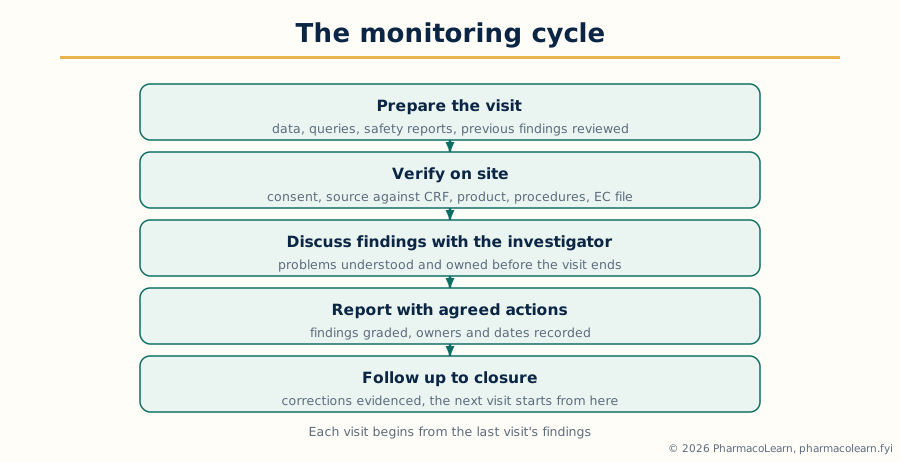 Figure: Monitoring as a cycle, not an event. Each visit begins from the last visit's findings and ends by creating the next visit's agenda.
4.8 What the monitor reviews: source, CRF, consent, product, procedures, communications and safety
The syllabus enumerates the monitoring review, and each item is a distinct verification with its own evidence. Source documents, the original records, hospital charts, laboratory reports, the diary cards of Section 3.6, are compared against the CRF and the data system, the discipline called source data verification: reported data must exist in source, agree with source, and source must contain nothing reportable that was not reported. The consent review checks every enrolled participant for the approved version, signature and date before the first procedure, and re consent where amendments required it. Product review checks storage, temperature records, accountability arithmetic, dispensing against randomisation and blinding. Procedure review checks eligibility evidence, visit timing, delegated staff and documented deviations. EC communications are checked for current approvals and acknowledged reports, and safety reporting is checked against the site's own source records, hunting the event recorded in the chart that never became a report. Together the six reviews answer the monitoring question in full: is this site protecting its participants and producing data that can be believed.
4.9 Monitoring visit reporting and follow up
The monitoring visit is completed by its report, a controlled document with its own discipline. It is written promptly after the visit, in the sponsor's format, and records the visit's facts: date, attendees, documents and data reviewed and the extent of source verification, product and facility checks, and then its findings, stated specifically enough to be acted on, the participant codes, documents and discrepancies involved, classified by seriousness, with the discussion held with the investigator and the actions agreed, their owners and their dates. The report file sits in the TMF and the ISF among the essential documents.
4.10 The close out visit, archival, reconciliation and destruction
The close out visit is the sponsor's final monitoring visit to a site, held when the site's trial work is complete, the last participant's involvement ended, and the data entered and queried to resolution, and its purpose is to convert a working site into a closed, archived and fully evidenced one. Its conduct works the syllabus's list. Study related documents are collected or confirmed: the sponsor retrieves the documents and copies it requires, verifies that the site file is complete for archive, and leaves the site its complete record. Investigational product is reconciled completely, every unit received, dispensed, returned, held or destroyed accounted for in the final arithmetic of Section 4.2. Archival follows the standard: essential documents retained by sponsor and investigator for the periods the applicable rules and agreements prescribe, in storage protecting them from loss, damage and unauthorised access, retrievable for the whole period; premature destruction of trial records is a serious breach. Residual product is returned to the sponsor or destroyed as the sponsor's instruction and the applicable rules direct, and destruction at site is authorised, witnessed where required, and documented with product, quantities, method and date, never performed as housekeeping on a site's own initiative. The close out visit report gathers all of it: documents collected and archived, product reconciled and its disposition, open items and their disposition, and the monitor's confirmation that the site is closed.
Unit 5: Quality Assurance, Quality Control and Clinical Data Management
5.1 Quality assurance and quality control in clinical trials: the distinction
Quality control, QC, is the operational techniques and activities undertaken within the quality assurance system to verify that the requirements for quality have been fulfilled: the checks performed on the work itself, monitoring in its verification aspect, data checks and edit checks, document completeness checks. Quality assurance, QA, is the wider, independent system: all the planned and systematic actions, established in advance, that give confidence the trial will be performed and the data generated in compliance with GCP and the applicable requirements, standard operating procedures, training systems, audits, vendor qualification.
| Aspect | Quality control | Quality assurance |
|---|---|---|
| Nature | Checks on the work as it is done | The planned system that makes good work likely |
| Performed by | The operational team and its verifiers | A function independent of the operations assured |
| Typical instruments | Monitoring verification, edit checks, completeness checks | SOPs, training systems, audits, vendor qualification |
| Timing | In real time, inside the process | Before, during and after, across processes |
| Failure it prevents | The individual error reaching the record | The same error recurring at every site |
5.2 Types of audits
An audit is a systematic and independent examination of trial related activities and documents to determine whether the evaluated activities were conducted, and the data recorded, analysed and accurately reported, according to the protocol, the sponsor's procedures, GCP and the applicable regulatory requirements. The types classify on two axes. By timing and trigger: routine or system audits, planned on a schedule against the audit programme, examining a site, a vendor, a system or the TMF; for cause audits, triggered by a signal, repeated monitoring findings, data anomalies, a complaint; and pre inspection audits, which rehearse an announced regulatory inspection while findings can still be corrected. By object: site audits; sponsor and CRO system audits; vendor audits, of laboratories, data and product suppliers; document and report audits, of the TMF, the database or the clinical study report against their sources; and database audits within data management, the subject of Section 5.15.
5.3 Audit criteria, the audit process and stakeholder responsibilities
Audit criteria are the standards against which the audited activity is judged, fixed before the audit begins. For a clinical trial the set is stable: the protocol and its amendments; ICH GCP; the applicable regulatory requirements, in India the New Drugs and Clinical Trials Rules, 2019 and the related framework; the sponsor's and CRO's standard operating procedures; the trial's own plans; and the agreements governing the work. The audit process runs its recognised course: planning, with scope, objectives, criteria and auditors set in an audit plan and the auditee notified as the plan requires; preparation, studying the trial's documents, monitoring reports and data signals; conduct, with an opening meeting, interviews, facility and product inspection, and above all tracing of documents and data, consent against source, CRF against source, file against the essential documents list, following each thread until it holds or breaks, findings recorded as objective evidence; and closing, reporting and follow up in Section 5.4. Responsibilities divide accordingly. The sponsor maintains an independent audit programme, appoints qualified auditors, receives reports without interference in their findings, and acts on them. The auditee provides access to premises, documents, systems and staff, answers factually, and owns the corrective work that follows.
5.4 Audit follow up, documentation, resolution and audit certificates
An audit is completed after the visit, in its follow up. The audit report is issued promptly, recording scope, criteria, method, the evidence examined and each finding with its grading and its requirement, and is distributed as the audit procedure prescribes, with the report and its working papers retained in the quality records, the audit documentation, under the confidentiality the material demands. Follow up begins with the auditee's response: for each finding, a root cause analysis that goes past the immediate error to the process that allowed it, and a corrective and preventive action plan, the correction of the instance, the correction of the cause, and the prevention of recurrence elsewhere, with owners and dates proportioned to the grading. Resolution is the state in which every finding stands corrected, prevented or formally accepted at the proper level of management with its risk understood, and the audit is closed. Where the procedures provide for it, an audit certificate, a brief statement that an audit of the named trial was conducted on the stated dates by the sponsor's QA, accompanies the essential documents in the TMF, while the report itself remains within the quality system.
5.5 Preparing for regulatory inspections, including FDA inspections
A regulatory inspection differs from an audit in authority and consequence: it is conducted by the regulator's inspectors, in India the officers acting under the Drugs and Cosmetics framework, in the United States the Food and Drug Administration, whose inspections the syllabus names, and its findings can affect approvals, licences and the acceptability of the trial's data itself. The permanent layer is inspection readiness as a state, not an event: essential documents complete and retrievable, the TMF current, staff who can explain their own work and produce its records, deviations and their handling honestly documented, because inspectors are most persuaded by a system that plainly runs the same way when no inspection is coming. The event layer begins on announcement: a host and presenting roles are named, requested records are produced promptly and logged with copies kept, testimony is checked for consistency with the documents, and staff answer the question asked, from knowledge and documents, without speculation and never with concealment. After the inspection, its report and any observations are answered in writing with corrections and commitments, tracked like the audit follow up of Section 5.4.
5.6 Fraud and misconduct management
Fraud and misconduct management is the quality system's gravest topic, and audits and inspections are where it is most often surfaced. Misconduct covers deliberate wrongdoing and serious negligence in proposing, performing, recording or reporting research: fabrication, inventing data or results; falsification, manipulating materials, processes or records so the research is misrepresented; and the serious breaches that accompany them, consent obtained by deception, eligibility invented, safety events suppressed. Honest error and genuine scientific disagreement are not misconduct. Management follows a disciplined course. Detection comes from the instruments of this subject: source verification that does not reconcile, data and statistical signals, impossible values and improbable uniformity, audit findings, and reports by staff. Assessment is conducted independently and on evidence, the original records secured before they can be altered, the scope established, and participant safety answered first, because participants exposed under fabricated eligibility or concealed risk may need clinical review before any institutional question is settled. Action is proportionate and documented: notification of senior quality and legal functions, the ethics committee and, as the rules and seriousness require, the regulatory authority; suspension of the site's enrolment or of the implicated work while facts are established; correction of the record and exclusion of unreliable data, with the decision and its basis documented for the analysis and the report.
5.7 Data management: infrastructure and system requirements
Clinical data management, CDM, is the discipline that converts the observations of a trial into an analysable database whose every value can be traced to its source. It begins with infrastructure and system requirements, because data quality is largely decided by the systems chosen before the first datum arrives: the validated systems on which the data live, the access controls, individual accounts, role based permissions and audit trails that make every change attributable, tested backup and recovery arrangements, and the supporting coding, laboratory and safety systems. System requirements are specified before selection: the functions the trial needs, capacity for its size and complexity, compliance with the electronic records requirements applicable to regulated trials, validation status and documentation, vendor support and the vendor's own quality standing. In a regulated trial an unvalidated system is a liability, because data whose system cannot prove who entered, changed or saw them cannot carry the trial's conclusions.
5.8 Electronic data capture systems
Electronic data capture, EDC, is the system family in which trial data are entered directly into electronic case report forms at the site, replacing the paper CRF's journey to a central data entry office with entry at the point of care and checking at the moment of entry. The eCRF screens mirror the CRF design of Section 3.5 and enforce it: fields accept only their defined formats and ranges, edit checks fire at entry, an out of range value, a date out of sequence, a required field empty, so many errors are corrected by the person who made them while the source is in their hand. Queries, the system's questions to the site about unclear, inconsistent or missing data, are raised, answered and closed inside the system with a full audit trail. Access is by individual account and role, investigator, coordinator, monitor, data manager each seeing and doing what their role permits, and the investigator's electronic signature attests the data as the paper signature did.
5.9 Selection and implementation of new systems, validation and test procedures
The selection and implementation of new systems for data management follows the regulated software lifecycle. Selection begins from documented user requirements and proceeds by structured evaluation: candidate systems and vendors assessed against the requirements, the vendor's quality system and support examined, demonstrations tested against realistic trial scenarios, and the total cost, licences, validation, training, migration and support. System validation is the regulated heart of the topic: documented evidence that the system does what it purports to do and continues to do so, built on a validation plan, requirements traced to tests, installation, operational and performance qualification as the organisation's procedures define them, and test procedures that are the executable form of that evidence: written test scripts with expected results, executed on the configured system, outcomes recorded, deviations resolved and retested, the whole retained as the validation documentation.
5.10 Coding dictionaries, data migration and archival
Coding dictionaries are the standard terminologies into which free medical language is converted so data can be counted: adverse events and medical history are coded in MedDRA, the medical dictionary in standard use, whose hierarchy runs from the verbatim term the investigator wrote, through preferred terms, to the system organ classes under which events are tabulated; and medications are coded against the drug dictionary in standard use, which classifies products by their ingredients and therapeutic classes. Data migration is the movement of trial data between systems, at system replacement, at a CRO transfer, or at the end of a study platform, performed as a validated process in its own right: the mapping of every field and code specified, the migration executed in a test environment and verified, record counts, checksums and sampled value comparisons evidencing that nothing was lost or altered in meaning, and the production migration repeated under the proven procedure. Data archival closes the lifecycle: the trial database and its supporting records, audit trails, coding decisions and validation documents, are archived at study end in a form that preserves readability and integrity for the retention period, with the migration path for ageing formats planned.
5.11 Clinical trial data management: SOPs and the data management plan
The working half of data management is governed by two instruments. Standard operating procedures, SOPs, are the organisation's standing written instructions for every recurring data management activity: study set up, CRF design, database build and validation, data entry and receipt, query management, coding, external data handling and database lock, written, trained and followed so the work does not depend on who performs it. The data management plan, DMP, is the study specific document that applies those SOPs to one trial: written before or alongside database build, approved by the responsible functions, and describing how this study's data will be handled from CRF design to database lock, the systems and versions in use, the data flow, the entry, checking, coding and reconciliation procedures, the external data, laboratory and safety, and how each will be received and reconciled, the query process and its timelines, the quality control steps, and the lock and transfer procedures.
5.12 CRF and database design, study set up and data entry
Study set up is the construction phase of data management, in which the protocol is converted into a working database. CRF and database design considerations start from Section 3.5's derivation: the database is designed behind the CRF, variables defined with formats, ranges and code lists, visits and forms structured as the protocol schedules them, and consistency designed in. The built database is then tested as a system, with test data entered against the specifications, checks fired and verified, and user acceptance testing performed and documented, before release to production and the issue of user accounts by role. Data entry follows the trial's model: in paper trials, entry at the data centre from the received CRF, commonly with independent double entry whose comparison catches keying error; in EDC trials, entry at the site by the trial team, with the system's checks at the point of entry.
5.13 CRF tracking, corrections and data cleaning
Data cleaning is the iterative process that brings the entered data to the state in which analysis is defensible. CRF tracking and corrections, in paper operation, log every CRF page received against the pages expected for every participant and visit, chase the missing, and control corrections: a site corrects its CRF under the correction discipline, original entry preserved and legible, change initialled, dated and explained as required, and the corrected data verified in the database. In EDC operation the same duties live in the system: form status tracking replaces the page log, and corrections are the site's data changes under full audit trail. Data cleaning proper runs on the accumulating database in cycles: programmed edit checks and data listings are run; discrepancies are identified, values failing ranges, dates breaking sequence, results inconsistent across forms; data queries are raised to the sites, each query specific, answerable and tracked; sites respond from source, correcting the data or explaining why the value stands; responses are reviewed, queries closed or reissued; and the cycle repeats as data accrue.
The data cleaning cycle, repeated until lock
  Data entered and edit checks run: ranges, dates,
  cross form consistency, missing items flagged
        |
        v
  Discrepancies reviewed by data management:
  genuine errors separated from true unusual values
        |
        v
  Queries raised to the site, answered from source
  documents, data corrected or value explained
        |
        v
  Responses reviewed, queries closed or reissued,
  coding and reconciliations brought up to date
        |
        v
  Cycle repeats on new data until the database is
  clean, complete and ready for the lock checklist
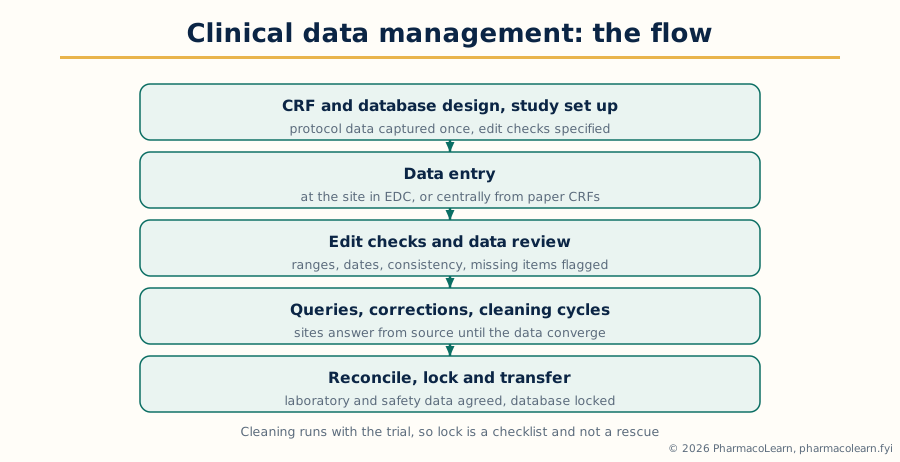 Figure: Data management as a converging cycle. Cleaning runs with the trial, so lock is a short checklist and not a rescue.
5.14 Managing laboratory and ADR data, data transfer and database lock
Laboratory data commonly arrive as external data, transferred electronically from central or local laboratories in agreed formats on an agreed schedule, and are managed by reconciliation: the records received are matched against the participants, visits and samples the trial expected, mismatches queried with the laboratory and the site until the transfer is fully accounted, and the values integrated with their reference ranges and flags so shifts and abnormalities can be reviewed. Adverse drug reaction data live in two systems at once: the clinical database, where events are CRF data coded in MedDRA under Section 5.10, and the sponsor's safety database, where serious events are processed for expedited reporting; the two must agree, and reconciliation between them, event by event for serious cases, is a defined pre lock activity. Data transfer is the controlled movement of the cleaned data to its next custodian, to the statisticians for analysis, between CRO and sponsor, or to an archive, performed under an agreed specification, with transfer verification confirming the data received are the data sent. Database lock is the formal act that ends cleaning: a lock checklist completed, all data received and entered, queries closed, coding finished, reconciliations signed off, protocol deviations reviewed and classified, the analysis populations and any data exclusions decided and documented, access frozen, and the lock authorised in writing by the responsible functions. After lock the database is read only; unlocking, where an error of consequence is found, is itself a documented, authorised and rare event.
5.15 Quality control and quality assurance in CDM, data mining and warehousing
Quality control in CDM is the checking built into the work: independent review of CRF design and edit check specifications, test evidence for the database build, double entry or its electronic equivalents, query quality review, coding consistency checks, and pre lock QC of the database against the lock checklist, performed inside the data management function as its own verification. Quality assurance in CDM stands outside it, as Section 5.1 defined: the SOP system audited, data management processes and vendors audited, database audits tracing sampled values from source through CRF to database and analysis set, and the metrics of the function, query rates, cycle times, error rates at lock. Data mining is the exploratory analysis of accumulated trial and health data for patterns not specified in advance: safety signals across a programme, subgroup patterns, associations that generate hypotheses; its discipline is the one Section 2.9 taught, that patterns found by searching are hypotheses until a designed study tests them. Data warehousing is the organised, long term repository in which data from many trials are held in common structures, with coding harmonised and provenance preserved, so programme level questions can be answered from data rather than from memory.
Frequently Asked Questions
Q: What is an investigational new drug application and what does it contain? A: It is the application by which a sponsor seeks permission to begin testing an unapproved drug in humans. It assembles the chemistry, manufacturing and controls information, the pharmacology and toxicology evidence with its safety margins, any previous human experience, and the plan for the first studies, the protocol and investigator brochure.
Q: What are the principles of ethics in biomedical research? A: Respect for persons, meaning free and informed agreement with added protection where autonomy is reduced; beneficence with non maleficence, meaning risks identified, minimised, monitored and justified by the expected knowledge; and justice, meaning participants chosen for scientific reasons with burdens and benefits shared fairly.
Q: How is an ethics committee constituted and what does it do? A: It is a multidisciplinary registered body: a chairperson from outside the institution, a member secretary, clinician and basic science members, a legal expert, a social scientist, ethicist or community representative, and a lay person. It reviews the protocol, brochure, consent documents, recruitment and payments, and investigator and site qualifications, approves or requires changes in writing, and continues review of amendments, safety information and progress for the life of the trial.
Q: What are the phases of clinical trials? A: Phase I asks whether the product is tolerable and how the human body handles it, usually in a small number of healthy volunteers, or in patients where the product class requires it. Phase II asks whether it shows activity in patients with the condition, and at what dose. Phase III asks, in larger controlled trials against a comparator, whether it truly benefits patients enough to support approval.
Q: What is the difference between simple randomization, blocking and stratification? A: Simple randomization allocates each participant independently by chance; it is pure but can leave groups uneven in smaller trials. Blocking generates the sequence in small blocks balanced within each block, with random order inside and undisclosed, varied block sizes, so group numbers stay close at every stage. Stratification generates separate sequences within strata of a strong prognostic factor, such as centre or severity, guaranteeing balance within each level of that factor.
Q: How do cohort, case control and cross sectional studies differ? A: A cohort study defines groups by exposure and follows them forward to compare the incidence of the outcome. A case control study defines participants by outcome, cases and controls, and looks back to compare past exposure; it is efficient for rare diseases and long latencies. A cross sectional study measures exposure and outcome at one point in time and yields prevalence and association, but cannot by itself establish which came first.
Q: What documents make up the core clinical trial document set? A: The protocol states what will be done and why. The investigator brochure states what is known about the product, including its risks. The informed consent form records what participation involves, in plain language. The case report form captures exactly the data the protocol promises to analyse. Contracts and agreements bind duties, finances, indemnity and publication rights in writing. Diary cards carry the participant's own record of doses and symptoms between visits.
Q: What happens at a monitoring visit? A: The monitor prepares from the site's data, safety reports and previous findings, then reviews the consent forms for every enrolled participant, verifies reported data against source documents, reviews product storage, accountability and dispensing, checks that procedures followed the protocol, confirms ethics committee communications are current, and looks for safety events recorded in source that were never reported. Findings are recorded in a monitoring report with agreed actions and dates, and followed up until closed.
Q: What is the difference between the Trial Master File, the Investigator Site File and the Pharmacy File? A: The Trial Master File is the sponsor's essential documents for the whole trial across all sites. The Investigator Site File is the site level counterpart held by the investigator, covering that one site's approvals, staff, correspondence, monitoring and conduct records. The Pharmacy File is the trial pharmacy's file for the product at that site: receipts, storage and temperature records, dispensing and accountability logs, and return and destruction documentation.
Q: What is database lock in clinical data management? A: Database lock is the formal act that ends data cleaning and freezes the trial database for analysis. It happens only when a lock checklist is complete: all data received and entered, queries closed, coding finished, laboratory and safety data reconciled, deviations reviewed and classified, and analysis populations and exclusions decided and documented. Access is then frozen to read only and the lock is authorised in writing.
Complete MPP104T notes, all 5 units in one PDF, free to keep.
Other M.Pharm subjects: MPH101T · MPC101T · MPL101T · MPH102T · MPH103T · MPH104T · MPL102T · MPL103T · MPL104T · MPC102T · MPC103T · MPC104T · MPH201T · MPH202T · MPH203T · MPH204T · MPC201T · MPC202T · MPC203T · MPC204T · MPL201T · MPL202T · MPL203T · MPL204T · MRA101T · MRA102T · MRA103T · MRA104T · MRM301T · MPG101T · MPG102T · MPG103T · MPG201T · MPG202T · MPG203T · MPG104T · MPG204T · MRA201T · MRA202T · MRA203T · MRA204T · MPP101T · MPP102T · MPP103T · MPP104T · MPP201T · MPP202T · M.Pharm