
MPP103T — Hospital and Community Pharmacy
4 hrs/week, 4 credits, 60 hours, 100 marks. Notes follow the M.Pharm syllabus, unit by unit.
MPP103T Hospital and Community Pharmacy notes for M.Pharm Pharmacy Practice Semester 1: hospital pharmacy, committees, formulary, inventory, distribution, IV admixtures, community pharmacy, prescriptions, OTC medicines, counselling and health promotion, with free unit wise PDF downloads on PharmacoLearn.
Units in this subject
- Unit 1 — Introduction to Hospitals, Hospital Pharmacy and Hospital Drug Policy
- Unit 2 — Hospital Formulary, Procurement, Inventory, Distribution, IV Admixtures and Waste
- Unit 3 — Education and Training, and Community Pharmacy Practice and Management
- Unit 4 — Prescription, Minor Ailments, OTC Medicines, Counselling, Adherence and ADR Monitoring
- Unit 5 — Health Promotion, National Health Programs, Home Medicines Review and Research
Download MPP103T PDF Notes
Free PDFs for this subject, one per unit:
Hospital and Community Pharmacy, subject code MPP103T, is the third core theory subject of M.Pharm Pharmacy Practice, Semester 1. It carries 4 credits and 60 hours of theory, taught at 4 hours per week, for 100 marks, and its five units are of equal length at 12 hours each in the PCI scheme. Its scope, as the syllabus states it, is to impart the basic knowledge and skills required to practice pharmacy in both hospital and community settings. Its objectives follow: to understand the organizational structure of hospital pharmacy, to understand drug policy and drug committees, to know about procurement and drug distribution practices, to know about admixture services, to understand community pharmacy management, and to know about the value added services in community pharmacies. The first two units build the hospital side: what a hospital is, how its pharmacy is organised, governed, financed and supplied, how medicines are selected through a formulary, procured, stored, controlled and distributed, and how intravenous admixtures and waste are handled. Unit 3 covers education and training inside the hospital and then crosses to the community side: what a community pharmacy is, how it is set up legally, laid out, stocked, accounted for and run to good dispensing practice. Unit 4 is the professional work at the community counter: the prescription, minor ailments, over the counter medicines, counselling, adherence, referral and adverse drug reaction monitoring. Unit 5 is the public health role: health promotion, screening, first aid, prevention, the national programs for malaria and tuberculosis, Home Medicines Review and research in community practice. One discipline runs through the whole subject: these notes describe systems, committees, procedures and professional roles at standard textbook level. No hospital statistics, budget figures or staffing ratios are invented, no named institutional protocol is presented as universal, and medicines are mentioned at class level only, without doses.
Unit 1: Introduction to Hospitals, Hospital Pharmacy and Hospital Drug Policy
1.1 Introduction to hospitals: definition and classification
A hospital is an institution that provides medical, surgical and nursing care for sick and injured people, organised so that diagnosis, treatment, rehabilitation and, in larger institutions, teaching and research happen under one roof and under one system of accountability. The definition matters for pharmacy because the hospital is a closed and highly regulated practice setting: nearly every medicine used inside it passes through one pharmacy department, is prescribed by an authorised prescriber, is recorded in institutional documents, and is subject to institutional policy in a way that community practice is not. Hospitals are classified on several independent axes, and an examination answer should keep the axes separate. By ownership and control, hospitals are government or public hospitals, private hospitals owned by individuals, companies or trusts, and voluntary or charitable hospitals run by non profit bodies. By system of medicine, they are allopathic hospitals or hospitals of the Indian systems of medicine and other recognised systems.
1.2 Organisational structure of the hospital
The organisational structure of a hospital is the formal arrangement of its authority, departments and reporting lines. At the head stands the governing body, a board, trust or government authority, which owns the institution, sets its mission and is ultimately accountable for it. Below the governing body, administration is led by a chief executive or medical superintendent, who coordinates the two great arms of the hospital: the medical and clinical services, organised into departments such as medicine, surgery, paediatrics, obstetrics and gynaecology, orthopaedics, radiology, pathology and anaesthesia, and the support and administrative services, which include nursing services, pharmacy, finance, human resources, medical records, housekeeping, dietary, laundry, engineering and security. Nursing services form their own hierarchy under a nursing superintendent, because nurses deliver most of the bedside care and administer most of the medicines. Committees cut across the departmental structure wherever a decision needs several professions at once: the pharmacy and therapeutics committee, the infection control committee and the research and ethics committee of this unit are the standard examples, and quality, safety and credentialing committees work in the same way. The pharmacist reads this chart practically.
1.3 Hospital pharmacy: definition and place in the hospital
Hospital pharmacy is the department of the hospital responsible for the procurement, storage, compounding, dispensing and distribution of medicines, and for the professional services that surround their use, so that every patient receives the right medicine, of the right quality, at the right time, with the information needed to use it safely. The older picture of the hospital pharmacy as a store that issues stock has been replaced in modern practice by a combined supply and clinical service: the department still runs the hospital's medicines supply chain, and it also advises on selection, prepares specialised products such as intravenous admixtures, monitors therapy, educates staff and patients, and carries the institution's medication safety work. Its functions are conventionally grouped as follows. Administrative functions: planning, budgeting, staffing, policy making and record keeping for the department. Supply functions: selection support, procurement, storage and inventory control, covered in Unit 2. Dispensing and distribution functions: filling prescriptions and medication orders and operating the distribution systems of Unit 2. Production and preparation functions: compounding, repacking, and sterile preparation including intravenous admixtures. Clinical and advisory functions: drug information, participation in committees, therapeutic guideline work, patient counselling and therapy monitoring, working alongside the clinical pharmacy services of MPP101T.
1.4 Relationship of the hospital pharmacy with other departments
The hospital pharmacy works through its relationships, and the syllabus names this as a topic in its own right. With the medical departments, the relationship is advisory and collaborative: prescribers choose therapy, and the pharmacy supports that choice with formulary information, availability, therapeutic alternatives where a prescribed item is unavailable or unsuitable, and alerts on interactions, duplications and allergies; the tone is professional, evidence based and patient centred, never obstructive. With nursing services, the relationship is operational and continuous: nurses administer the medicines the pharmacy supplies, so distribution timing, labelling clarity, ward stock arrangements, controlled drug records and the return of unused medicines are agreed jointly and reviewed when errors occur. With administration and finance, the relationship is one of budgets, procurement approvals, audits and staffing: the pharmacy justifies its budget, follows purchase rules and accounts for its stock. With the stores and purchase department, where these are separate, the pharmacy supplies the technical specification and quality judgement while purchase handles the commercial process. With pathology, radiology and other diagnostic departments, the relationship is one of shared supplies and shared information, including reagents and contrast media where the pharmacy handles them, and laboratory results that condition drug therapy.
1.5 Organisational structure of the hospital pharmacy department
Inside the department, structure follows function. The chief pharmacist, also called the head of pharmacy or pharmacy superintendent in different institutions, leads the department, represents it to administration and the committees, and carries legal and professional accountability for its work. Below the head, senior pharmacists take charge of the main sections, and pharmacists, pharmacy technicians and support staff are assigned to them. The standard sections of a medium or large hospital pharmacy are: the main pharmacy and dispensing section, which fills outpatient and discharge prescriptions and medication orders; the stores section, which receives, stores and issues stock and keeps inventory records; the inpatient distribution section or satellite pharmacies, which serve wards and specialised areas such as intensive care, operation theatres and emergency; the sterile preparation or intravenous admixture section, which works under the controlled conditions of Unit 2; the manufacturing or compounding and repacking section, where it exists; the drug information and clinical pharmacy section; and the administrative office, which holds records, accounts and correspondence. Small hospitals combine sections under fewer staff, and very large hospitals add specialised units, but the functional divisions remain recognisable at every scale. Two design rules govern any version of this chart.
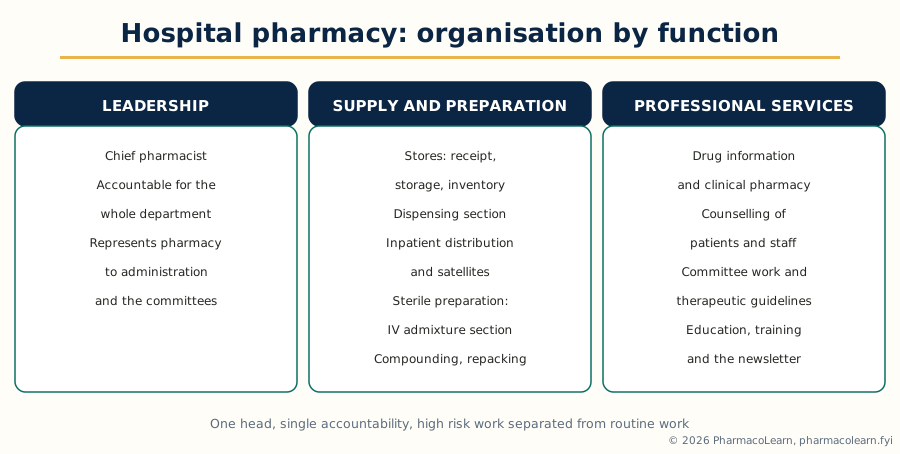 Figure: The hospital pharmacy department organised by function. Every section answers to one head, and high risk work is separated from routine work.
1.6 Legal requirements, workload statistics and infrastructural requirements
A hospital pharmacy operates under the same legal framework as other pharmacy practice in India, applied to an institutional setting. The Pharmacy Act governs who may practise as a pharmacist, and registration with the State Pharmacy Council is the foundation qualification for the staff who compound and dispense. The Drugs and Cosmetics Act and its Rules govern the licences under which medicines are stocked, sold and dispensed, the conditions of storage, the records for specified schedules of medicines, and the requirement that dispensing be done by or under the supervision of a registered pharmacist; the Narcotic Drugs and Psychotropic Substances framework adds its own licences, registers and custody rules for controlled medicines. Institutional requirements add a second layer: hospital registration and clinical establishment rules, biomedical waste rules for the department's own waste, and the standards of accreditation bodies where the hospital seeks accreditation. Workload statistics are the department's own measurement of itself: the numbers of prescriptions and medication orders dispensed, items issued, admixtures prepared, patients counselled and interventions made, counted over defined periods and compared with staffing and with previous periods.
1.7 The hospital pharmacy budget
The hospital pharmacy budget is the financial plan of the department for a defined period, usually one financial year, setting out what the department expects to spend and, where the hospital charges for medicines or services, what it expects to recover. A budget is prepared by the chief pharmacist with the sections, defended before administration, approved through the hospital's own process, and then used as the control document for the year: actual spending is compared with the budget head by head, and variances are explained and acted on. The standard heads of a pharmacy budget are: medicines and surgical consumables handled by the pharmacy, which form the largest head in most departments; staff salaries and related costs; equipment purchase and maintenance; materials for compounding and sterile preparation; books, software and drug information resources; training and continuing education; and contingencies for price rises and emergency purchases. Two budget disciplines deserve examination emphasis. The first is estimation from evidence: the medicines head is built from previous consumption, formulary changes, expected patient load and known price movements, adjusted for wastage and expiry, not from a single global figure carried forward.
1.8 Hospital pharmacy management
Hospital pharmacy management is the application of the general functions of management, planning, organising, staffing, directing, coordinating and controlling, to the pharmacy department, with the profession's own standards added. Planning sets the department's objectives and service plans: which services will be offered, to what standard, with what staff, and how success will be measured, using the workload statistics of Section 1.6. Organising builds the structure of Section 1.5, writes the job descriptions and standard operating procedures that make the structure real, and arranges duty rosters so that qualified cover matches the hospital's working pattern, including emergency cover outside routine hours where the hospital provides it. Staffing covers recruitment support, induction, training, appraisal and discipline, and the professional duty to keep every pharmacist's registration and competence current. Directing and leadership keep a mixed team of pharmacists, technicians and support staff working to one standard: clear communication, supervision proportionate to risk, and a culture in which reporting an error is safer than hiding it. Coordinating links the department outward, through the relationships of Section 1.4 and the committees of this unit, and inward, so that stores, dispensing and clinical sections do not optimise themselves at each other's expense.
1.9 Hospital drug policy and the Pharmacy and Therapeutics Committee
A hospital drug policy is the institution's agreed framework for how medicines are selected, procured, prescribed, dispensed, administered and monitored, so that therapy across the hospital is rational, safe and affordable rather than a sum of individual habits. The policy covers the formulary system of Unit 2, prescribing and generic name policies, antimicrobial policy, controlled medicine custody, medication error reporting, and the rules for non formulary and emergency medicines. Its engine is the Pharmacy and Therapeutics Committee, usually shortened to PTC. The PTC is a standing advisory committee of the medical staff and administration, composed of senior physicians from the major specialities, the chief pharmacist, who commonly serves as its member secretary, nursing leadership, and representatives of administration and other relevant departments, with specialists co opted for particular questions.
How a medicine earns its place on the hospital formulary
  Clinical need identified, or a new medicine proposed
        |
        v
  Pharmacy prepares the evidence summary: efficacy,
  safety, comparisons, cost and likely use
        |
        v
  PTC deliberates and decides: include, include with
  restrictions, defer or decline, with reasons recorded
        |
        v
  Decision communicated to all prescribers, stock and
  distribution arranged, guideline updated
        |
        v
  Use is monitored: utilisation, adverse reactions and
  outcomes reviewed, formulary status revisited
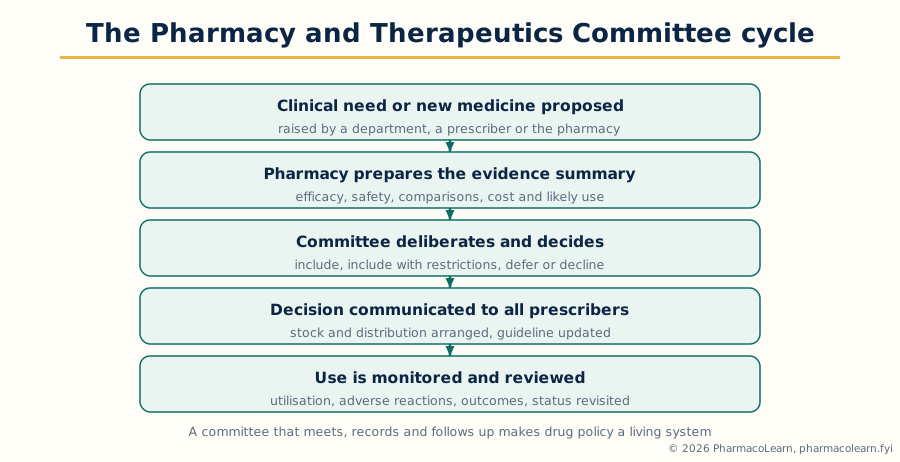 Figure: The PTC cycle. Selection is a decision, communication makes it real, and monitoring decides whether it stands.
1.10 The Infection Control Committee and the Research and Ethics Committee
Two further committees complete the drug policy structure named in this unit. The Infection Control Committee is the multidisciplinary body responsible for preventing and controlling healthcare associated infections: it frames the infection control policies of the hospital, including hand hygiene, isolation, sterilisation and disinfection practice and waste management, oversees surveillance of infections and resistant organisms, and directs outbreak investigation. Its connection with pharmacy is direct and continuous. Antimicrobial use is both a treatment and a driver of resistance, so the committee and the pharmacy together run the antimicrobial stewardship work of the hospital: an antimicrobial policy that guides empirical and targeted therapy, restriction and review arrangements for reserve antimicrobials, consumption monitoring, and feedback of resistance patterns from the microbiology laboratory to prescribers, in cooperation with the PTC, which owns the formulary side of the same decisions. The Research and Ethics Committee, also called the institutional ethics committee, is the independent body that reviews and approves research involving human participants before it begins, and monitors it while it runs.
1.11 Management of medicines as per NABH
The National Accreditation Board for Hospitals and Healthcare Providers, NABH, sets the accreditation standards against which Indian hospitals are assessed, and its standards include a dedicated chapter on the management of medication. Studying medicines management as per NABH means studying the hospital's medicines system as an auditable chain of defined processes, each with a written policy, a responsible person, records that prove the process happened, and indicators that show whether it is working. The chain, in the order an assessor walks it, runs: selection and procurement of medicines under policy, with quality checked at receipt; storage under the conditions each medicine requires, with temperature monitoring, segregation of look alike and sound alike medicines, and special custody for controlled and high alert medicines; prescription and transcription, with complete, legible and authorised orders and defined rules for verbal orders; dispensing and distribution against the verified order, labelled for the patient; administration by authorised staff with patient identification and the checks that precede giving a medicine; and monitoring after administration, including adverse drug reaction reporting, medication error reporting and review, and recall procedures when a product is found defective.
Unit 2: Hospital Formulary, Procurement, Inventory, Distribution, IV Admixtures and Waste
2.1 The hospital formulary: concept and guidelines
The hospital formulary is the continuously revised list of medicines approved for use in the hospital by its medical staff through the Pharmacy and Therapeutics Committee, together with the information needed to use them well. The formulary system is the method behind the list: a standing process by which medicines are evaluated, selected, monitored and reviewed, so that the hospital stocks a deliberately chosen range rather than everything any prescriber might ask for. The reasons for a formulary are practical and clinical at once. No hospital can stock every brand and strength of every medicine; an unselected stock multiplies cost, expiry and error, especially where look alike products crowd the shelves. A selected formulary concentrates purchasing into fewer items bought in larger quantity, keeps prescribers working with medicines they know well, makes therapeutic guidelines possible, and lets the pharmacy guarantee availability and quality for the items that matter most.
2.2 Development of the formulary
Developing a formulary is a project with a recognisable sequence. It begins with the decision to establish or revise the formulary and the constitution or reactivation of the PTC as the deciding body, with pharmacy given the working responsibility for the drafting. The pharmacy then assembles the raw material: the medicines currently stocked and prescribed, consumption and cost data, the range of conditions the hospital actually treats, and the essential medicines lists and standard treatment guidelines that frame rational selection at national level. Draft selection follows therapeutic category by therapeutic category: for each condition, the medicines that the evidence and the hospital's practice support are listed, duplicates within a class are compared on efficacy, safety, familiarity, dosage form and cost, and a preferred selection is proposed, keeping alternatives where patients genuinely differ, for example by route, age group or organ function. The draft passes through consultation with the clinical departments, whose comments are recorded and answered, and then through PTC approval, section by section.
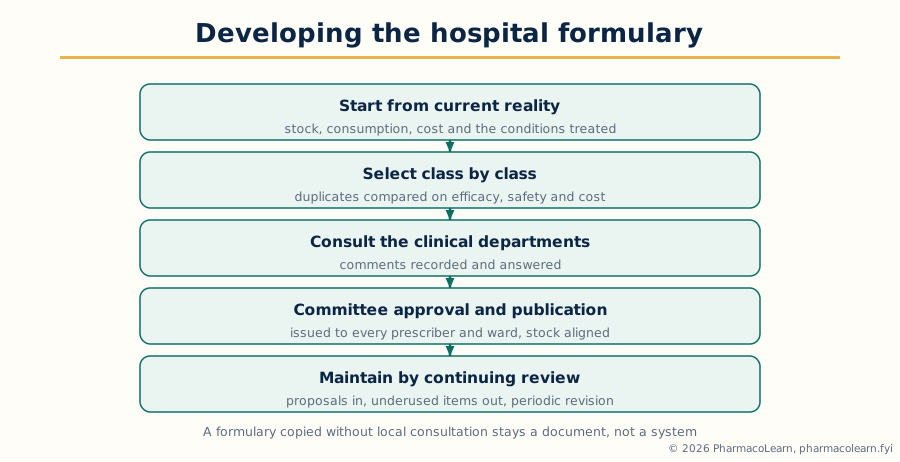 Figure: Building a formulary. Local data and consultation turn a stock list into the medical staff's own agreed selection.
2.3 Developing therapeutic guidelines
Therapeutic guidelines are the hospital's agreed statements of how defined conditions are to be treated, including the medicines to be used, in what order, by what route, and what monitoring and referral each stage requires. Where the formulary answers the question which medicines the hospital stocks, guidelines answer the question how those medicines are to be used for this condition in this hospital, and the two documents are developed together, usually under the same committee. Guideline development follows a disciplined method. A topic is chosen where variation in practice is wide, risk is high, cost is significant or evidence has recently changed. A small working group, clinicians of the relevant speciality with a pharmacist and, where needed, microbiology, nursing and other input, reviews the evidence and the recognised national and international guidelines, and adapts them to local reality: the local formulary, local resistance patterns for antimicrobials, the investigations actually available, and the skills and equipment of the hospital. Adaptation, not copying, is the professional step, because a guideline that assumes unavailable medicines or tests will be ignored.
2.4 The drug procurement process
Procurement is the process by which the hospital obtains its medicines and related supplies at the required quality, in the required quantity, at the right time and at a justified price. Its stages form a chain in which an error at any link reaches the patient or the budget. The chain begins with selection, already decided by the formulary, and quantification: how much of each item the hospital will need in the coming period, estimated from past consumption, morbidity and service plans, expected losses and the stock already in hand. Specification follows: each item is defined precisely by generic name, strength, dosage form, pack and quality standard, so that offers can be compared on the same goods. The purchasing method is then chosen under the institution's rules: open or limited tender, rate contract, quotation based purchase, or direct purchase for emergencies and proprietary items, each with its own approval level. Vendor selection weighs quality standing and reliability beside price: licences, manufacturing and distribution authorisations, past supply performance and recall history are pharmacy concerns, not clerical detail, because the cheapest offer for a substandard medicine is the most expensive purchase a hospital can make.
The drug procurement chain in a hospital
  Formulary selection and quantification of need
        |
        v
  Specification: generic name, strength, form, pack,
  quality standard stated for every item
        |
        v
  Purchasing method and vendor selection: quality
  standing and reliability weighed beside price
        |
        v
  Purchase order placed, delivery received and
  inspected: identity, batch, expiry, condition
        |
        v
  Accepted stock to stores, payment and records,
  supplier performance reviewed for the next cycle
2.5 Methods of inventory control
Inventory control is the set of methods by which the pharmacy keeps stock sufficient for uninterrupted care without locking money and shelf life into excess. Its core records state, for every item, the stock in hand, the rate of consumption, the lead time between ordering and delivery, and the levels that trigger action: the reorder level at which a fresh order is placed, the buffer or safety stock held against delay and sudden demand, and the maximum level beyond which stock is not allowed to grow. Around these levels, the named methods of the syllabus operate. ABC analysis classifies items by annual consumption value: a small proportion of items, class A, accounts for most of the value and receives tight control, frequent review and careful ordering; class B receives moderate control; the many low value items of class C are controlled simply, in bulk and with less frequent review. VED analysis classifies by criticality: vital items, whose absence endangers life or stops a service, essential items, whose absence degrades care, and desirable items, whose absence is an inconvenience.
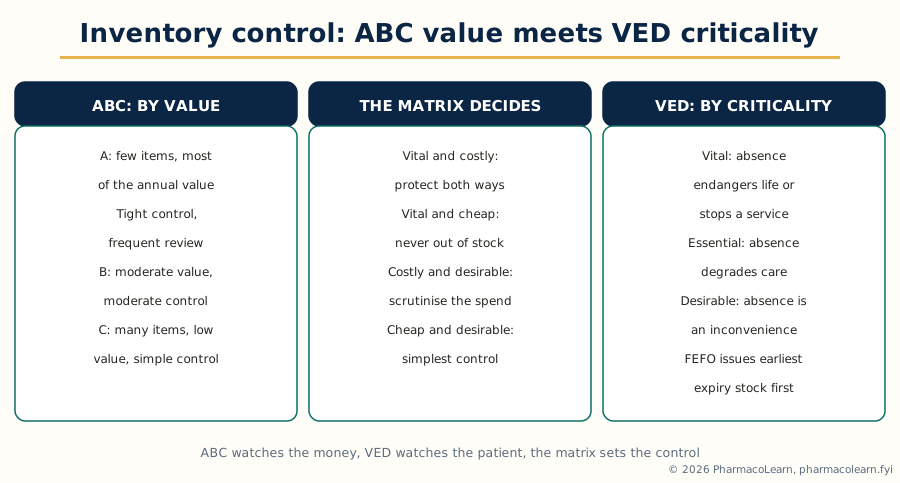 Figure: Two lenses on one stock. ABC watches the money, VED watches the patient, and the matrix decides the control each item gets.
2.6 Storage and stores management in the hospital pharmacy
The stores function is where procurement becomes availability. Received and accepted stock enters a storage system organised so that every item is identifiable, protected and retrievable: medicines are shelved by a consistent logic, commonly therapeutic class or alphabetical order within sections, with labelling that survives handling. Storage conditions are controlled and monitored: room temperature ranges observed, refrigerators and freezers for cold chain items with recorded temperatures and alarm or escalation arrangements when readings stray, protection from light and moisture where products require it, and separation, physical and visual, of look alike and sound alike medicines, of internal and external preparations, and of returned, expired and recalled stock, which is quarantined and never allowed to drift back into usable shelves. Controlled medicines are held in secure custody with their own registers and balance checks. Stores records, manual or electronic, carry receipts, issues, balances, batch and expiry details, and support the inventory methods of Section 2.5: an issue is recorded as it happens, so that the record balance is a fact and not a reconstruction.
2.7 Methods of drug distribution
Drug distribution is the system by which medicines travel from the pharmacy to the patient inside the hospital, and the syllabus expects the standard systems to be known comparatively. The individual prescription system, the traditional method, dispenses medicines for a named patient against that patient's prescription or medication order, labelled for that patient for a short period. It gives the pharmacy full sight of every order and the strongest check before issue, at the cost of pharmacy workload and some delay. The floor stock or ward stock system places a stock of commonly used medicines on the ward, from which nurses administer doses as prescribed, replenished by the pharmacy against usage. It is fast and convenient, and weakest in control: the pharmacist may never see the individual order, stock can expire or be borrowed between patients, and records are thin. The unit dose system dispenses each dose for each patient separately packaged and labelled, ready to administer, supplied for a defined period, commonly a day, against the pharmacist verified order.
| System | What reaches the ward | Pharmacist check of the individual order | Main strength | Main weakness |
|---|---|---|---|---|
| Individual prescription | Medicines labelled for the named patient | Yes, before issue | Strong checking and records | Workload and delay |
| Floor stock | A ward stock of common medicines | No, order not seen per dose | Speed and convenience | Weak control, expiry and borrowing |
| Unit dose | Each dose packaged and labelled per patient | Yes, before preparation | Checking, traceability, least waste | Highest preparation workload |
| Combination | Unit dose or individual supply plus limited floor stock | Yes, for pharmacy supplied items | Balance of safety and practicality | Needs clear rules for which items sit where |
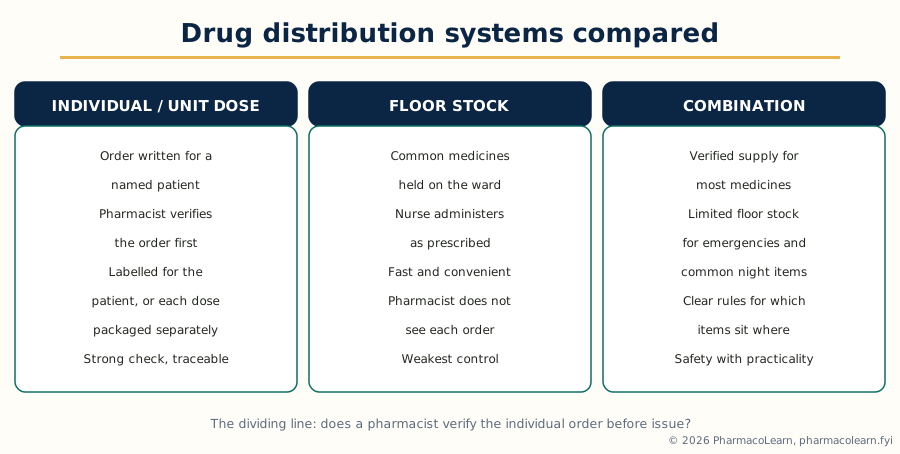 Figure: Four ways medicines reach the ward. The systems differ chiefly in whether a pharmacist verifies the individual order before issue.
2.8 Intravenous admixtures
An intravenous admixture is a sterile preparation made by adding one or more medicines to an intravenous fluid, prepared ready for administration. Centralising this work in the pharmacy, as an intravenous admixture service, is one of the clearest safety advances in hospital pharmacy: preparations are made by trained staff, in a controlled clean environment, against a pharmacist verified order, with standardised calculations, labelling and records, instead of being improvised on wards under interruption and variable technique. The service rests on defined elements. The environment and equipment: a clean area with a laminar airflow workstation or equivalent containment appropriate to the preparation, maintained, cleaned and monitored under written procedures, with staff gowned and trained in aseptic technique, because the patient receiving an intravenous product has no defence against a contaminated one. The order and its verification: the prescriber's order is checked for the medicine, the diluent and volume, compatibility, stability, concentration and the patient's particulars before preparation begins. Preparation: components are assembled and checked, the admixture is made by aseptic manipulation, and in process and final checks confirm identity, appearance and label.
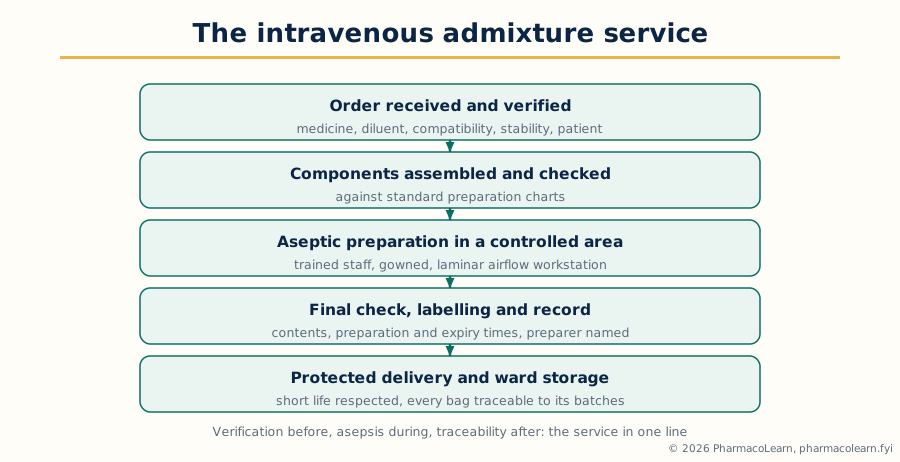 Figure: The admixture service. Verification before preparation, asepsis during it, and a label and record that make every bag traceable.
2.9 Total parenteral nutrition as part of the admixture service
Total parenteral nutrition, the intravenous feeding of a patient who cannot use the gastrointestinal route, is prepared within the admixture service and is its most complex routine product, which is why it is taught with this unit. A parenteral nutrition preparation combines the patient's fluid, energy, amino acid, electrolyte, vitamin and trace element requirements in one sterile system, compounded to an individual prescription that changes as the patient's condition and laboratory results change. The pharmacist's role spans the whole process: checking the prescription for completeness and internal consistency, including the compatibility and stability limits of a mixture in which calcium and phosphate and many other components must coexist without precipitating; planning the compounding sequence and method, manual or automated, that keeps the mixture stable and sterile; applying the filtration, labelling and storage rules appropriate to the formulation; and monitoring with the clinical team, since the nutrition prescription is reviewed against the patient's progress, fluid balance and biochemistry at regular intervals.
2.10 Hospital waste management
Hospital waste management is the system by which the waste a hospital generates is segregated, collected, transported, treated and disposed of without harming patients, staff, the public or the environment, under the biomedical waste management rules in force. The pharmacy meets this system in two directions: as a generator of waste itself, and as the department accountable for pharmaceutical waste wherever it arises. The governing principle is segregation at the point of generation: waste is separated, at the place and moment it is produced, into the colour coded categories the rules prescribe, broadly infectious waste, sharps, glassware and metallic items, and pharmaceutical and chemical waste, because mixing defeats every later stage and turns a whole consignment into hazardous waste. Sharps are placed at once into puncture proof containers and never recapped or carried loose. Pharmaceutical waste has its own discipline: expired, damaged, returned and recalled medicines are quarantined from usable stock under Section 2.6, recorded, and sent for authorised treatment or disposal by the prescribed route, with controlled medicines destroyed under the specific authorisation and witnessing their rules require; cytotoxic waste, where the hospital prepares cytotoxic medicines, is segregated and handled as its own high hazard stream.
Unit 3: Education and Training, and Community Pharmacy Practice and Management
3.1 Education and training: the hospital pharmacy as a teaching department
A hospital pharmacy teaches continuously, because medicines practice changes continuously: new medicines arrive, guidelines are revised, staff join and rotate, and students of several professions pass through the department. The syllabus treats education and training as a function of the department in its own right, and the standard of the function is that it is planned, not left to chance. A training plan names its audiences, the technical staff of the pharmacy, pharmacists, pharmacy students, medical staff and students, and nursing staff and students; states what each audience needs to learn; assigns teachers and time; and keeps records of what was delivered and attended. Training inside a working department follows the logic of supervised practice: explanation, demonstration, supervised performance, independent performance under audit, in that order, with the length of the supervised stages set by the risk of the task. Sterile preparation, controlled medicine handling and dispensing checks are signed off only when competence has been observed, not merely when a session has been attended. The department also teaches in the other direction, receiving questions from the wards and clinics and treating recurring questions as signals of what to teach next. Two products carry this teaching beyond the classroom: the formal and informal meetings and lectures of Section 3.5, and the drug and therapeutics newsletter, which together turn individual answers into institutional learning.
3.2 Training of technical staff
Pharmacy technical staff, the technicians and assistants who support receiving, storage, preparation, dispensing and distribution, are trained for defined tasks under pharmacist supervision, and their training is the foundation on which the department's daily accuracy rests. Induction training covers the department and its procedures: the layout and stock logic of the stores, goods receipt and inspection support, stock rotation and expiry checking, labelling and packing standards, the distribution rounds and their records, cleaning and maintenance schedules for equipment and areas, waste segregation, and the absolute rules, among them that medicines are never issued, substituted or released on a technical judgement that belongs to a pharmacist. Task specific training follows for each assigned duty, with the aseptic and clean area disciplines of Unit 2 taught and assessed before any sterile support work is undertaken, and controlled medicine tasks taught with their register and custody rules. Continuing training keeps pace with change: new products, new systems, new software and the lessons of errors and audits are briefed to the whole team, and periodic refresher and competency checks confirm that long serving staff and new staff are working to the same current standard.
3.3 Training and continuing education for pharmacists and pharmacy students
For pharmacists, training does not end at registration. Continuing education in the hospital setting has three layers. The first is departmental: induction into the hospital's formulary, policies, distribution systems and documentation, so that a pharmacist new to the institution practises the institution's system from the first week. The second is clinical and technical updating: structured reading, case discussions, journal clubs, departmental seminars and conference participation that keep pace with new medicines, new evidence and revised guidelines, with the pharmacist's own record of learning maintained as professional evidence. The third is service development: training directed at the services the department is building, such as admixture work, drug information, counselling or a speciality rotation, so that competence grows ahead of responsibility. Pharmacy students, from both degree and diploma programmes where the hospital accepts them, are the second audience of this section. Their training in the department is a planned rotation through its sections, with defined objectives for each posting, named supervisors, exposure to dispensing, stores, distribution, preparation and clinical services at a level appropriate to their stage, and assessment against the objectives.
3.4 Training and education for medical and nursing staff and students
The pharmacy teaches the professions it works with, because most prescribing and administration happens outside the department and its quality is set by what prescribers and nurses know. For medical staff and medical students, pharmacy led education centres on the medicines system of the hospital: the formulary and how to use it, prescribing standards and complete order writing, antimicrobial policy and stewardship teaching, high alert medicine safeguards, adverse reaction recognition and reporting, and the introduction of new medicines and revised guidelines as they are issued. Its formats are practical: short teaching within clinical meetings, prescribing feedback from audits, guideline launches, and the one to one advice that accompanies a drug information answer. For nursing staff and nursing students, the teaching centres on administration: the checks before giving a medicine, storage of medicines on the ward, controlled medicine records, infusion and admixture handling and storage, recognition of administration errors and near misses, and the reporting culture that turns an incident into a lesson rather than a concealment.
3.5 Formal and informal meetings, lectures, and the drug and therapeutics newsletter
The channels of this teaching divide into formal and informal. Formal meetings and lectures are the scheduled, recorded channels: departmental teaching sessions, clinical grand rounds and speciality meetings to which pharmacy contributes, committee meetings of Unit 1 and their education items, induction programmes, and invited lectures on new medicines, safety alerts and guideline changes. They create the auditable record that education happened and let the department plan its teaching calendar. Informal channels carry at least as much of the real learning: the corridor and ward side consultations, the telephone advice that solves one prescription and teaches its lesson, the small group discussion around a difficult case, and the pharmacist's presence on ward rounds, where teaching travels in both directions at once. The drug and therapeutics newsletter is the department's written channel and deserves its own description.
3.6 Community pharmacy practice: definition and setting
Community pharmacy practice is the practice of pharmacy in a retail pharmacy serving the general public, where the pharmacist supplies medicines on prescription and, for medicines permitted to be sold without one, on the pharmacist's own professional judgement, and provides the advice, screening and public health services of Units 4 and 5. The community pharmacy is the most accessible point of the health system: it keeps long hours, needs no appointment, and is visited by healthy people collecting regular medicines as well as by patients who are acutely unwell. That accessibility defines both its opportunity and its responsibility. Its work divides into supply functions, dispensing prescriptions and selling permitted medicines with the checks of Section 3.12; advisory functions, counselling, minor ailment response and referral; and public health functions, health promotion, screening, vaccination support where authorised, and the national programme roles of Unit 5. The setting differs from the hospital in ways examinations expect to be stated: the pharmacist usually works without the patient's full medical record, often as the only health professional present, inside a business that must also earn its living, and with a continuing relationship with regular patients that no other part of the system matches.
3.7 Roles and responsibilities of community pharmacists, and relationships with other health care providers
The roles and responsibilities of the community pharmacist follow from the setting. As supplier, the pharmacist ensures that medicines dispensed are genuine, correctly stored, in date and accurately labelled, and that prescription only medicines are supplied only against valid prescriptions. As clinician at first contact, the pharmacist assesses minor ailments, advises self care and permitted medicines, recognises the presentations that must not be managed at the counter, and refers them, the triage work of Unit 4. As counsellor and educator, the pharmacist explains medicines and devices, supports adherence, and gives the health promotion advice of Unit 5. As safety monitor, the pharmacist watches for interactions, duplications across prescribers, and adverse reactions, and reports them through the systems of Unit 4. As public health worker, the pharmacist delivers screening, cessation support, family planning supplies and advice, and programme services. As manager and professional, the pharmacist keeps the pharmacy legal, stocked, staffed, recorded and solvent, the work of the sections that follow. Relationships with other health care providers are built on referral and communication in both directions.
3.8 Legal requirements to start a community pharmacy
Starting a community pharmacy is a regulated act, and the legal requirements are the first topic of its management. The premises must be licensed under the Drugs and Cosmetics Act and Rules for the sale and distribution of medicines, with the licence displayed and renewed as required, and separate requirements met for the categories of medicines the pharmacy intends to stock, including the stricter schedule categories and, where applicable, narcotic and psychotropic medicines. The pharmacy must be run by or under the continuous supervision of a registered pharmacist, registered with the State Pharmacy Council under the Pharmacy Act, and the pharmacist's registration certificate is displayed as the rules require. The premises themselves must meet the prescribed conditions: adequate area and construction, clean and orderly storage with refrigeration for cold chain products, protection of medicines from heat, light and contamination, and the facilities for dispensing and record keeping.
3.9 Site selection, layout and design, and drug display
Where a community pharmacy stands decides much of what it can do. Site selection weighs: the population the site serves and its age and health profile; proximity to prescribers, clinics, hospitals and other patient flows, balanced against direct competition; visibility and access, including approach by foot and vehicle and hours the surrounding area stays active; the cost of the premises against realistic turnover; and legal suitability, since the site must be capable of meeting the licensing conditions of Section 3.8. A site near prescribers brings prescription volume; a site inside a residential area brings regular chronic patients and counter trade; the choice follows the model of pharmacy the owner intends to run. Layout and design then organise the interior around the flow of work and the separation of professional from purely commercial space. The dispensing area is the professional core: prescription reception, assembly, checking and hand over with counselling space that allows a private conversation, designed so that dispensing is not interrupted by counter traffic. Storage follows the hospital logic at smaller scale: ordered shelving, cold storage, secure custody for controlled medicines, quarantine for expired and returned stock.
3.10 The super drug store model
The super drug store is the large format model of community pharmacy: a pharmacy operating at a much larger scale, typically as part of a chain or as a large independent store, combining a full dispensing pharmacy with wide ranges of health, wellness and personal care products under one roof. Its features, as taught under this syllabus head, are scale applied to each function of the ordinary pharmacy. A larger and deeper stock, centrally procured for a chain, gives availability and purchasing power the single store cannot match. Extended hours, in some locations round the clock, extend the accessibility that defines community pharmacy. Trained teams rather than a single pharmacist allow specialisation within the store, dispensing, counselling, screening services and retail management divided among staff, though a registered pharmacist's supervision remains the legal constant. Systems replace memory: computerised stock, billing, patient medication records and refill reminders run as standard, the software of Section 3.13 used at full strength. Value added services find room and staff here: health screening corners, vaccination and clinic services where authorised, home delivery and chronic care programmes.
3.11 Accounts and audits in community pharmacy
A community pharmacy is a business holding valuable, dated and regulated stock, and its accounts and audits serve the owner, the tax and legal authorities, and patient safety at once. The accounting system records, at minimum: purchases, by supplier and invoice, forming both the financial record and the legal trace of stock origin; sales, through billing that distinguishes prescription and counter sales and records what the schedules require; expenses, including rent, salaries, utilities and services; and stock, valued periodically so that accounts state what the shelves actually hold. Daily discipline makes the system real: the day's billing is totalled and reconciled with receipts, cash and electronic payments are checked, and discrepancies are investigated the same day rather than accumulated. Stock audit, the physical verification of stock against records at intervals, is the control that detects expiry accumulation, pilferage, billing and receiving errors, and record drift; its findings are written up, valued and acted on, and expired stock found is quarantined for authorised disposal, never quietly returned to sale. External and internal audits extend the same scrutiny to the whole record set: licences and registers, purchase and prescription records, controlled medicine balances and tax filings.
3.12 Good dispensing practices
Good dispensing practice is the standard that the right patient receives the right medicine, in the right form and quantity, with the right label and the right information, every time. Its steps form one unbroken sequence. Receive and validate the prescription: confirm it is genuine, complete, legible and legally valid, identify the patient, and resolve any problem under Section 4.2 before dispensing begins. Interpret and assess: read the prescription in full, and check medicine, form and quantity against the patient, their age and condition as known, allergies, other medicines and duplication, the pharmacist's clinical check that distinguishes dispensing from mere supply. Assemble: select the product from the correct location, checking name, strength, form and expiry at selection, with particular care for look alike and sound alike names, and count or measure using clean, appropriate equipment. Check: a final verification of the assembled medicines against the prescription, by the dispensing pharmacist or a second trained person where the system provides one, before labelling hides the contents from view. Label: with the patient's name, the medicine name and strength, clear directions for use in language the patient understands, the date, and the warnings and storage advice the medicine needs.
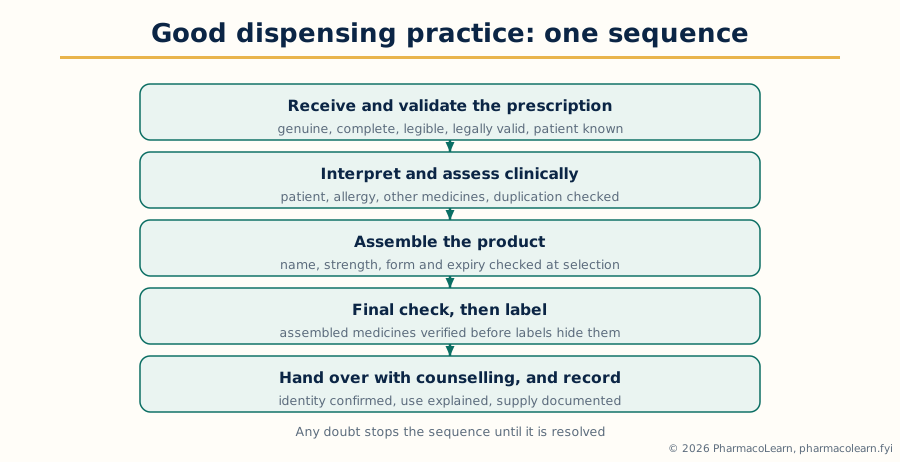 Figure: Good dispensing practice as one sequence. The clinical check stands before assembly, and the final check before labelling.
3.13 Software and databases used in community pharmacies
Computer systems now carry much of the community pharmacy's record keeping, and the syllabus names both the software and the databases. Pharmacy management software handles the operational core: stock and inventory with batch and expiry tracking and reorder alerts; purchase entry and supplier records; billing that applies the schedule and tax rules of each sale; prescription and patient records, including the regular patient's medicine history, which is the data behind refill reminders and interaction awareness; accounts and reports that feed Section 3.11; and controlled medicine registers in electronic form where permitted. Its value is accuracy at speed: expiry alerts prevent the sale of dated stock, stock visibility prevents both stock outs and over ordering, and a regular patient's history is available at the counter in seconds. Drug information databases are the second family: the references the pharmacist consults for interactions, contraindications, use in pregnancy and lactation, adverse reactions and product information, together with price and product directories and the professional and regulatory databases used for reporting and reference.
3.14 Entrepreneurship in community pharmacy
Entrepreneurship in community pharmacy is the creation and development of a pharmacy business as a professional enterprise: the pharmacist as founder, owner and innovator, not only as employee. The entrepreneurial sequence begins with the opportunity: an unserved or underserved locality, a speciality niche such as chronic care support, mother and child health, diabetes supplies and support, or a service gap the existing pharmacies leave open. A business plan converts the opportunity into commitments: the model of pharmacy, the site and premises under Sections 3.8 and 3.9, the stock and equipment investment, staffing, projected turnover and costs, the licences and registrations required, and the break even logic that states when the business sustains itself. Finance follows the plan: own capital, loans and supplier credit, each with its cost and its conditions, arranged so that the young pharmacy is not strangled by its opening stock bill. Launch and growth are professional as much as commercial: prescriber and community relationships built on reliability, services added as competence and demand justify them under Units 4 and 5, records and systems installed from the first day, and reputation guarded as the business's principal asset.
Unit 4: Prescription, Minor Ailments, OTC Medicines, Counselling, Adherence and ADR Monitoring
4.1 The prescription: legal requirements
The prescription is the written, or otherwise validly issued, order of an authorised prescriber directing the supply and use of medicines for a named patient, and it is simultaneously a clinical instruction, a legal document and a record. Its legal requirements begin with the prescriber: a registered medical practitioner or other practitioner authorised within their own field, prescribing within the law that governs the medicines concerned. The prescription must identify the patient, by name and ordinarily age and address or identifying particulars; identify the prescriber, by name, qualification, registration and address, with signature; carry its date, since validity, record keeping and the age of the therapy all run from it; and state the medicines with the particulars the dispensing pharmacist needs, name, preferably in generic form as good practice and several institutional and regulatory directions require, strength, dosage form, quantity and directions for use.
4.2 Interpretation of prescriptions and prescription related problems
Interpretation is the pharmacist's reading of the prescription as a whole: not only what each line says, but whether the whole order makes sense for this patient. The reading confirms the patient, the prescriber and the date; reads each medicine, its strength, form, quantity and directions; translates abbreviations and Latin directions accurately, with suspicion toward any abbreviation that can be read two ways; and then judges the order clinically, the assessment step of Section 3.12. Prescription related problems, the standard catalogue of what this reading finds, divide into problems of form and problems of substance. Problems of form: illegible or incomplete writing, missing strength, form, quantity or directions, an unsigned or undated prescription, an ambiguous abbreviation or a name that could be one of two look alike medicines. Problems of substance: a dose or quantity outside the usual range for the patient as known, duplication of a medicine or class across lines or across prescribers, an interaction with the patient's other medicines, a contraindicated medicine given the patient's allergy, age, pregnancy or condition, an inappropriate form for the patient, or a duration that does not fit the condition.
Handling a prescription related problem
  Problem found at validation or assessment:
  form, legibility, completeness or clinical safety
        |
        v
  Do not guess and do not dispense around it:
  check the pharmacy's own record of the patient
        |
        v
  Contact the prescriber, state the problem plainly,
  agree the corrected order, record the change
        |
        v
  Dispense against the corrected order, counsel the
  patient on anything that has changed for them
        |
        v
  File the record: the problem, the resolution and
  the supply are all traceable afterwards
4.3 Responding to symptoms of minor ailments: the assessment method
Responding to symptoms is the structured service by which the community pharmacist deals with a patient who presents a symptom rather than a prescription. A minor ailment is a self limiting condition that can be recognised and managed without medical diagnosis, with self care and, where appropriate, a permitted over the counter medicine. The pharmacist's method protects the boundary of that definition. It begins with a focused history: who the patient is, since age and pregnancy change everything; what the symptom is, where, how severe, how long present and how it has changed; what accompanies it, the associated symptoms that separate the minor from the serious; what has already been tried and with what effect; and the background, other conditions, regular medicines, allergies and previous similar episodes. Standard question frameworks exist to keep this history complete under counter pressure, and the habit they build matters more than their letters: duration, associated features and patient risk factors are never skipped. The history leads to one of three conclusions.
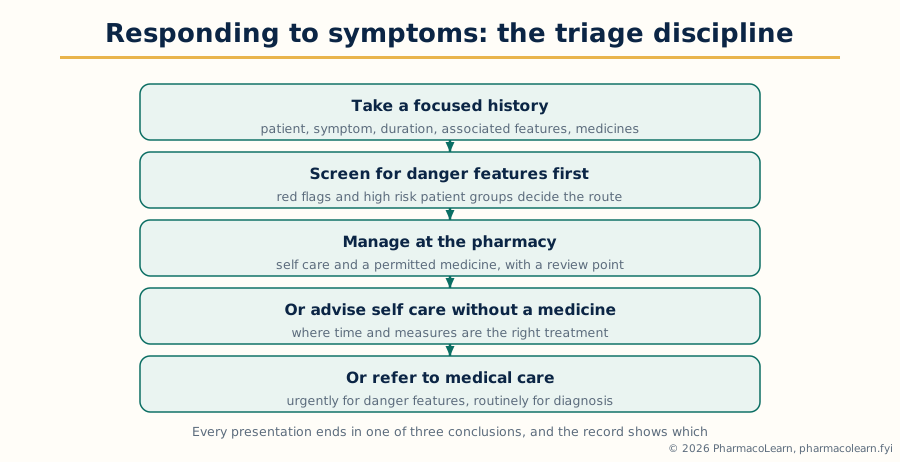 Figure: The triage discipline. Every presentation ends in management with a review point, self care, or referral, and danger features decide first.
4.4 Responding to headache
Headache is among the commonest counter presentations, and most headaches are the primary headaches, tension type headache and migraine, or accompany minor illness. The pharmacist's history establishes the pattern: the site and character of the pain, its onset and duration, its frequency and previous identical episodes, triggers and relieving factors, associated features such as visual disturbance, nausea or sensitivity to light and sound, fever or neck symptoms, recent head injury, medicines being taken, including very frequent use of pain relieving medicines, which itself becomes a cause of chronic daily headache, and the patient's age and background conditions. Danger features convert the case into a referral, urgently where they suggest an emergency: a sudden, explosive worst ever headache; headache with fever, neck stiffness, rash or altered consciousness; headache after head injury or with weakness, speech or vision loss; a new pattern of headache in later life; headache that is worst on waking, worsening progressively, or changed in character from the patient's usual; and headache in pregnancy with visual symptoms or raised blood pressure features.
4.5 Responding to pyrexia
Pyrexia, fever, is a raised body temperature, a symptom and a defence response rather than a disease, and the pharmacist's task is to judge its context. The history covers: the measured temperature and how it was measured, since the number and the method both matter; the duration of the fever; the accompanying symptoms that point to a source, cough and breathlessness, urinary symptoms, sore throat and ear pain, vomiting and diarrhoea, rash, localised pain; travel, contacts and season, which raise or lower particular possibilities; the patient's age, with fever in a young infant treated as a referral matter in itself; background conditions and medicines, including immune suppression; and what has been taken for it already. Referral is required where fever is high or prolonged, where danger features accompany it, breathlessness, rash that does not fade under pressure, confusion, dehydration, severe pain or a stiff neck, where the patient is very young, pregnant, elderly or chronically unwell, or where fever returns after settling.
4.6 Responding to menstrual pains
Menstrual pain, dysmenorrhoea, divides into primary dysmenorrhoea, the cramping pain of menstruation without pelvic disease, driven by prostaglandin release in the uterus, typically beginning with or just before bleeding in younger patients with regular cycles, and secondary dysmenorrhoea, pain caused by pelvic conditions such as endometriosis or fibroids, which tends to begin later, last longer and change in character. The pharmacist's history establishes: the timing of pain against the cycle and the bleeding; its severity and effect on daily life; its history over time, a stable pattern since adolescence against a new or changing pattern in later years; associated features, pain at other times, abnormal bleeding, discharge or fever, pain with intercourse, fertility history; contraception in use; and other conditions and medicines, especially any that bear on the medicine classes used for pain. Referral is indicated by the secondary pattern and its signs: new or worsening pain, pain outside menstruation, abnormal bleeding, fever or discharge, suspected pregnancy, or pain unrelieved by appropriate self care over successive cycles.
4.7 Responding to food and drug allergy
Allergy presentations at the counter divide by speed, and speed decides everything. The emergency form is anaphylaxis: a rapid reaction with breathing difficulty, wheeze or stridor, swelling of the lips, tongue or throat, widespread urticaria with dizziness, faintness or collapse, following a food, a medicine, a sting or another trigger. This is not managed at the counter beyond immediate emergency action: emergency services are called at once, the patient is not left alone or sent away, and where the patient carries an adrenaline auto injector for their own use, its use is supported without delay. The pharmacist who recognises anaphylaxis and acts in the first minutes has done the most important thing this section teaches. The minor forms, by contrast, are everyday pharmacy work: urticaria and itching, mild skin reactions, hay fever type symptoms after a food or in season, and the patient's report that a food or medicine does not suit them. The history distinguishes true allergy from intolerance, which is not immune mediated and is managed differently: what was taken or eaten and when, what happened and how soon, how it was treated and how it ended, and whether the same exposure has caused the same reaction before.
4.8 OTC medication and the rational use of over the counter medicines
Over the counter medicines are those the law permits to be supplied without a prescription. Their freedom from prescription is a statement about their established safety in self care when used as directed, not a statement that they are harmless, and rational use is the discipline that keeps the two ideas together. Rational OTC use means: a genuine indication, matched to the assessed symptom under Section 4.3, not to the patient's first request alone; the right product, chosen by its active ingredients and the patient's conditions, other medicines, age and allergies, with combination products examined ingredient by ingredient so that the same substance is not taken twice from two boxes; the right use, in the manner and for the duration the label and the pharmacist direct, since OTC status does not extend to unlimited duration; the right person, with special care in pregnancy, in children, in older patients and in chronic disease, where a permitted medicine for the general public may be the wrong medicine for this patient; and the right stopping point, the review and referral rules of the ailment sections, observed even when the patient asks to continue.
4.9 Medication counselling and the use of patient information leaflets
Medication counselling in the community setting is the pharmacist's structured explanation of a medicine to the patient at supply, and it converts a correctly dispensed product into a correctly used one. Its content, adapted to the patient and the medicine, covers: what the medicine is for, in the patient's own terms; how and when to take it, with food relationships and spacing from other medicines and foods that matter; how much and for how long, including what completing or not completing the course means for that medicine; how to use the form or device, inhalers, drops, patches and measures demonstrated, not merely described; what effects to expect and when; what adverse effects are common and minor, and which are warnings that need medical help; storage, and keeping medicines from children; and what to do about a missed dose for that medicine. The method matters as much as the content: counsel in a space that allows privacy, at the patient's pace and language, check understanding by inviting the patient to say back the key points, and invite questions before closing. Patient information leaflets, the printed inserts supplied with medicines and the pharmacy's own prepared leaflets, are counselling's written partner.
4.10 Medication adherence: definition, factors and strategies
Medication adherence is the extent to which a patient's medicine taking behaviour corresponds with the agreed recommendations of the prescriber: taking the medicine, at the right dose and interval, for the intended duration. It is distinguished from mere compliance by its emphasis on agreement: the regimen is one the patient has understood and accepted, not only been handed. Non adherence is correspondingly divided into unintentional, where the patient means to take the medicine and fails through forgetfulness, confusion, cost, access or regimen complexity, and intentional, where the patient decides not to take it, from disbelief in its need, fear of its effects, feeling well or feeling worse, or distrust. The factors influencing adherence behaviour are conventionally grouped: patient factors, understanding, beliefs, memory, dexterity and eyesight, and the burden of illness itself; medicine factors, number of medicines and doses per day, duration, adverse effects and cost; condition factors, chronic and symptomless conditions such as raised blood pressure being the hardest to sustain; prescriber and system factors, quality of explanation, follow up and continuity; and social and economic factors, family support, work patterns and the price of each refill.
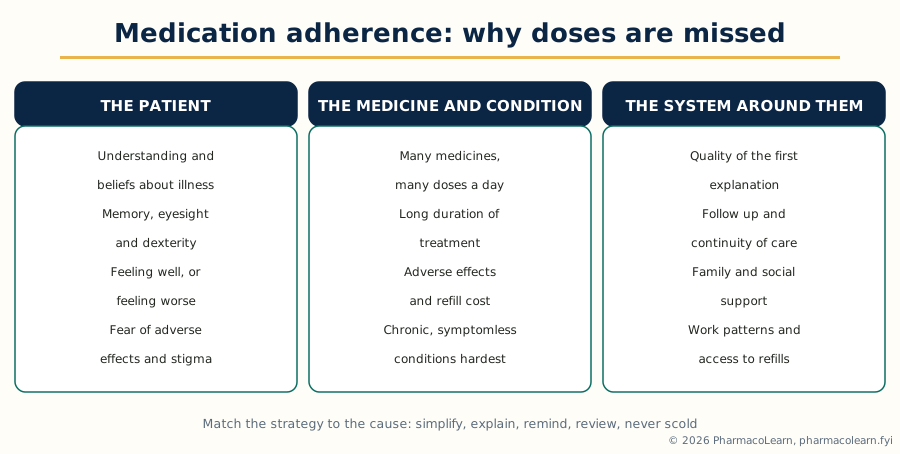 Figure: Why doses are missed. Adherence fails for grouped, findable reasons, and each group has its own remedies.
4.11 Patient referrals to the doctor
Referral is the pharmacist's formal recognition that a patient's need exceeds pharmacy management, and its quality is judged by its timing, its destination and its information. Referral is immediate and urgent where danger features are present, the red flags of Sections 4.4 to 4.7 and their equivalents in any presentation: the patient is directed to emergency or urgent medical care at once, with the reason stated plainly. Referral is routine where the picture needs diagnosis rather than emergency: symptoms that persist beyond the stated review point, recur repeatedly, change in character, arise in a patient group the pharmacist does not manage, or suggest a condition behind the symptom, together with suspected adverse reactions of significance under Section 4.12 and prescription problems the prescriber must resolve.
4.12 ADR monitoring in community pharmacies
Adverse drug reaction monitoring in the community pharmacy extends pharmacovigilance to the place where most medicines are actually used. The community pharmacist is positioned to detect reactions that hospitals never see: reactions to over the counter medicines and combinations, reactions emerging weeks into chronic therapy, reactions in patients lost to other follow up, and the interaction effects of medicines from several prescribers meeting in one patient. Detection begins with the habit of asking: at refills and counter visits, a direct question about how the medicine is suiting the patient surfaces reactions that patients do not volunteer, because they attribute them to their illness or expect to endure them. When a possible reaction is found, the pharmacist documents the essentials: the patient, the suspect medicine and any others taken, the reaction and its timing against starting, changing or stopping medicines, its severity and course, and what action followed. Causality is judged cautiously at the counter, temporal relationship, known reaction profile, alternative causes, and improvement on withdrawal where that has occurred, without overstating what one case can prove.
Unit 5: Health Promotion, National Health Programs, Home Medicines Review and Research
5.1 Health promotion: definition and activities
Health promotion is the process of enabling people to increase control over, and to improve, their health: not only the treatment of disease but the building of the conditions and habits that keep disease from arising. In community pharmacy practice it is the organised use of the pharmacy's accessibility and trust for prevention, and it converts the pharmacist from a supplier who waits for prescriptions into a health worker the neighbourhood consults while it is still well. Health promotion activities in the pharmacy take standard forms. Information and education: accurate, plain language teaching on risk factors and healthy living, delivered in conversation, in leaflets and displays, and in talks to schools, workplaces and community groups. Risk factor work: helping individual patients identify and change the behaviours that drive the common chronic diseases, smoking, harmful alcohol use, unhealthy diet, inactivity, and supporting medicine taking that prevents events in patients already at risk. Screening and early detection, the subject of Section 5.3, which finds risk and early disease and routes both into care. Immunisation support: promoting uptake, answering vaccine concerns with evidence, and participating in delivery where the regulations authorise it.
5.2 Family planning services in community pharmacy
Family planning is the means by which individuals and couples decide the number and spacing of their children, and the community pharmacist supports it as supplier, adviser and referrer. As supplier, the pharmacy stocks and supplies contraceptive products: barrier methods available over the counter, supplied freely and without embarrassment, and hormonal and other prescription methods supplied against prescription, with the same accuracy and record standards as any medicine. As adviser, the pharmacist explains the methods the pharmacy supplies: how each is used correctly, since failure of barrier and oral methods is more often a failure of use than of the method; what to do when use goes wrong, a missed pill or a failed barrier, with honest direction to timely medical or pharmacy services where the response is time limited; the interactions and medical cautions that make a method unsuitable for a particular patient, which are prescriber questions the pharmacist flags rather than settles; and the distinction between contraception and protection against sexually transmitted infections, which only barrier methods provide, a counselling point of particular importance for younger patients.
5.3 Health screening services
Health screening services in the community pharmacy are the structured measurement of health indicators in people without symptoms, to detect risk factors and early disease and to refer what is found into medical care. The standard pharmacy screening set includes: blood pressure measurement, the highest value service of the group, since raised blood pressure is common, symptomless and dangerous, and is regularly discovered at the pharmacy counter; blood glucose testing, as a pointer toward diabetes and its control in known patients; body weight, height and body mass index, and waist measurement where offered, as the entry to weight and lifestyle advice; and, in pharmacies equipped and authorised for them, further point of care tests under their own protocols. A screening service is defined by its discipline, not by its device. The measurement follows a written procedure: correct technique, a rested and correctly positioned patient for blood pressure, calibrated and maintained equipment, and repeat measurement where the first reading demands it. Results are interpreted against stated reference ranges by category, not improvised: the patient is told the result, what it means and what it does not mean, since a screening result is a pointer and never a diagnosis.
A pharmacy screening encounter, end to end
  Person attends or is offered screening, consent
  and relevant background recorded
        |
        v
  Measurement taken by the written procedure:
  correct technique, calibrated equipment,
  repeated where the procedure requires
        |
        v
  Result read against the service's stated ranges:
  reassuring, refer routinely, or refer urgently
        |
        v
  Result explained honestly: a pointer toward care,
  never a diagnosis at the counter
        |
        v
  Referral made and documented, record kept,
  service totals audited over time
5.4 First aid in community pharmacy practice
First aid is the immediate care given to a person who is injured or suddenly unwell, before professional medical help takes over, and the community pharmacy is a recognised first aid point in its neighbourhood: people come to the pharmacy with injuries because it is open, near and staffed by a health professional. The pharmacist's first aid role has three parts. Readiness: a stocked and in date first aid provision in the pharmacy, staff who know where it is and what they are competent to do, and the emergency numbers and referral routes displayed where staff can reach them at once.
5.5 Prevention of communicable and non communicable diseases
Prevention in community pharmacy divides by the two great families of disease. For communicable diseases, prevention rests on interrupting transmission and building immunity, and the pharmacist's contributions are: hygiene education, hand washing, safe water and food handling, and respiratory etiquette, taught at the counter and in campaigns; immunisation promotion, correcting misconceptions, reminding due patients where records allow, and supplying and, where authorised, supporting vaccination services; safe practice supplies and advice, including sterile injecting equipment policies where lawful schemes exist and the safe disposal of sharps; early recognition and referral of the infectious presentations of Unit 4, with the programme routes for malaria and tuberculosis of Section 5.8 followed exactly; and outbreak cooperation, where the pharmacy relays official guidance, counters rumour with the health authority's current advice, and maintains supply of the genuinely needed items without fuelling panic buying.
5.6 Smoking cessation services
Smoking cessation is the most developed single health promotion service in community pharmacy, because tobacco is the largest preventable cause of disease in the pharmacist's patient population and because quitting usually takes several supported attempts. The service follows a behavioural structure. Ask and record: smoking status is asked about and noted for regular patients, so the service has a population, not only volunteers. Advise: the smoker is told, personally and plainly, that stopping is the most effective step available for their health, linked where possible to their own conditions and medicines. Assess readiness: the willing are helped now; the unwilling are left with a respectful open door and information, since pressure without readiness wastes the attempt. Assist: a quit plan is built with the patient, a quit date set, triggers and routines examined, family and social support enlisted, follow up appointments at the pharmacy arranged, and pharmacotherapy discussed: nicotine replacement therapy in its several forms, supplied over the counter with instruction in correct use, since under use and early abandonment are its commonest failure modes, and the prescription cessation medicines, whose patients the pharmacist supports and monitors in cooperation with the prescriber.
5.7 Child and mother care services
Child and mother care is the community pharmacy's service to women in pregnancy and after delivery, and to infants and children, a population in whom medicines questions are constant and the cost of wrong answers is high. For mothers, the pharmacy's work includes: supplying the supplements and medicines of pregnancy and the postnatal period against prescription and advice, with vigilance for the medicines that pregnancy forbids, which the pharmacist checks on every supply to a woman of childbearing age where the medicine demands it; supporting breastfeeding with accurate medicines information, since most medicines questions in lactation end in reassurance based on evidence, and wrong advice costs a baby its feeding; family planning continuity under Section 5.2; and recognising and referring the danger presentations of pregnancy and the postnatal period, bleeding, severe headache and visual symptoms, reduced fetal movement as reported by the mother, fever, and the signs of postnatal depression, which the pharmacist who knows the family may be well placed to notice and route into care.
5.8 National health programs: the community pharmacist in malaria and TB control
National health programs convert national disease priorities into organised local action, and the syllabus names the community pharmacist's role in two of them, malaria and tuberculosis control, as the worked examples of a general duty: the pharmacist supports the program's strategy in the pharmacy's own place, refers into its services, and never runs a private parallel system that undermines it. In malaria control, the pharmacist's roles are: recognising the febrile patient who may have malaria and referring for testing under the program rather than supplying symptomatic treatment alone, since fever in an endemic setting is a test first presentation; supporting the correct and complete use of antimalarial treatment where it is dispensed, with adherence counselling of the kind in Section 4.10, because partial treatment breeds both relapse and resistance; promoting prevention, the use of insecticide treated nets and the other vector measures the program teaches, and stocking them where the program's channels allow; and recording and reporting as the program requires, since case data from every provider feed the surveillance on which control depends.
5.9 Home Medicines Review: definition, objectives, guidelines, method and outcomes
Home Medicines Review is a structured, comprehensive review of a patient's medicines, conducted in the patient's home, in which a pharmacist examines everything the patient actually takes and how they take it, and reports to the patient's doctor so that the regimen can be optimised. Its definition contains its method: home, because the truth about medicine taking lives there, in the cupboard with the duplicates, the expired items, the borrowed medicines and the aids or their absence; review, because the product is an assessment and recommendations, not a supply. Its objectives are: to maximise the benefit of the patient's medicines by identifying and resolving drug related problems; to detect the problems that consulting room and counter cannot see, duplication across prescribers, hoarding and sharing, wrong storage, confusion between similar packs, non adherence with its reasons under Section 4.10, and adverse effects accepted as age; to improve the patient's own understanding and organisation of their medicines; and to strengthen the working link between the patient's doctor, community pharmacist and the reviewing pharmacist.
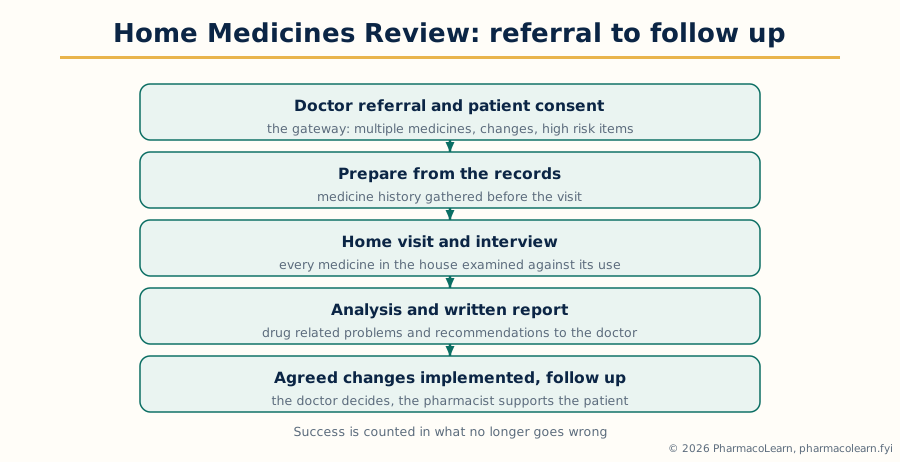 Figure: Home Medicines Review. The home visit finds what the counter cannot see, and the doctor decides on the reviewer's report.
5.10 Research in community pharmacy practice
Research in community pharmacy practice is the systematic study of what community pharmacists do, what it achieves and how it can improve, and it closes the syllabus because every other topic in this unit claims benefits that only research can verify. Its subjects follow the work of the whole subject: practice research on how services are actually delivered, dispensing accuracy, counselling quality, screening yield and referral completion; outcome research on whether pharmacy interventions change what matters, adherence, control of pressure and glucose, quit rates, adverse events detected; patient research on experience, understanding and behaviour; and workforce and business research on the models of Sections 3.10 and 3.14. Its methods are those suited to a practice setting: audits, the simplest form, in which the pharmacy measures itself against a standard and re measures after a change; surveys and interviews of patients and staff; observational studies of records and refill data; and, where partnerships with academic institutions allow, controlled studies of new services.
Frequently Asked Questions
Q: What is a hospital formulary and who maintains it? A: The hospital formulary is the continuously revised list of medicines approved for use in the hospital, together with the information needed to use them well. It is maintained by the Pharmacy and Therapeutics Committee, which decides additions, deletions and restrictions on evidence, with the pharmacy department doing the working preparation, publication and stock alignment. The formulary system behind the list evaluates, selects, monitors and reviews medicines continuously, concentrates purchasing, supports therapeutic guidelines and guarantees availability and quality for the medicines that matter most.
Q: How do the individual prescription, floor stock and unit dose distribution systems differ? A: In the individual prescription system, medicines are dispensed for a named patient against that patient's order, labelled for that patient. In the floor stock system, a stock of common medicines is held on the ward and administered from it, which is fast but gives the pharmacist no sight of the individual order. In the unit dose system, each dose for each patient is separately packaged and labelled ready to administer, against a pharmacist verified order. Modern practice combines them: pharmacy verified supply for most medicines, with limited floor stock for emergency and commonly used items.
Q: What are ABC and VED analysis in inventory control? A: ABC analysis classifies stock items by annual consumption value: the few class A items carry most of the value and receive tight control, class B moderate control, and the many low value class C items simple bulk control. VED analysis classifies by criticality: vital items whose absence endangers life or stops a service, essential items whose absence degrades care, and desirable items whose absence is an inconvenience. Combined into a matrix, they ensure a cheap vital item is protected for availability while a costly desirable item is controlled for value.
Q: What is the Pharmacy and Therapeutics Committee and what does it do? A: The Pharmacy and Therapeutics Committee is the standing advisory committee of the medical staff and administration that runs the hospital drug policy. Composed of senior physicians, the chief pharmacist, who commonly serves as member secretary, nursing leadership and administration, it approves medicines for the formulary on efficacy, safety, quality and cost, approves therapeutic guidelines, reviews drug utilisation and medication safety including adverse reactions and errors, and communicates its decisions to all prescribers.
Q: What is an intravenous admixture service and why is it centralised in the pharmacy? A: An intravenous admixture service prepares medicines added to intravenous fluids centrally in the pharmacy, by trained staff in a controlled clean environment, against pharmacist verified orders, with standardised compatibility and stability references, labelling and traceability records. Centralisation replaces improvised ward preparation under interruption with aseptic technique, checked calculations and products whose every component and batch can be traced, which is why it is one of the clearest safety advances in hospital pharmacy. Total parenteral nutrition, the most complex admixture, is prepared within the same service.
Q: What are the steps of good dispensing practice in a community pharmacy? A: Good dispensing practice is one unbroken sequence: receive and validate the prescription; interpret and assess it clinically for the patient, their allergies, other medicines and duplication; assemble the product with checks on name, strength, form and expiry; perform a final check against the prescription before labelling; label with the patient name, medicine, clear directions, date and warnings; and hand over with counselling, recording the supply. Any doubt stops the sequence until it is resolved, because most dispensing errors are born in skipped steps.
Q: How should a community pharmacist respond to a patient presenting a minor ailment? A: By a focused history first: who the patient is, the symptom and its duration and severity, associated symptoms, what has been tried, other conditions, regular medicines and allergies. The history leads to one of three conclusions: manage at the pharmacy with self care and a permitted medicine where indicated, with a stated review point; advise self care without a medicine where time and measures are the right treatment; or refer, at once where danger features are present and routinely where diagnosis is needed. Recurrent presentations are themselves a reason to refer.
Q: What is medication adherence and how can a pharmacist improve it? A: Medication adherence is the extent to which a patient's medicine taking corresponds with the agreed recommendations: the right medicine, dose, interval and duration. It fails unintentionally through forgetfulness, confusion, cost and complexity, and intentionally through disbelief, fear of effects or feeling well. The pharmacist improves it by matching strategies to the cause: simplifying regimens with the prescriber, explaining purpose at every supply, reminders, packaging aids and refill synchronisation, honest review of adverse effects fed back to the prescriber, and a non judgemental tone that finds out what is actually happening.
Q: What is Home Medicines Review? A: Home Medicines Review is a structured, comprehensive review of a patient's medicines conducted in the patient's home, usually on the doctor's referral and with the patient's consent. The reviewing pharmacist examines everything the patient actually takes, prescription, over the counter and complementary medicines, identifies drug related problems such as duplication, hoarding, wrong storage, non adherence and adverse effects, and reports recommendations to the doctor, who decides the changes. Agreed changes are then implemented with the patient and followed up.
Q: What is the community pharmacist's role in malaria and tuberculosis control programs? A: The pharmacist supports the national program's strategy rather than running a parallel system. In malaria control: referring the febrile patient for testing instead of supplying symptomatic treatment alone, supporting complete and correct use of antimalarial treatment, promoting preventive measures such as insecticide treated nets, and recording and reporting as the program requires. In tuberculosis control: recognising the persistent cough and referring for the program's free diagnosis, supporting patients through treatment with adherence encouragement and adverse effect awareness, countering stigma, and never selling anti tuberculosis medicines casually outside the program system.
Complete MPP103T notes, all 5 units in one PDF, free to keep.
Other M.Pharm subjects: MPH101T · MPC101T · MPL101T · MPH102T · MPH103T · MPH104T · MPL102T · MPL103T · MPL104T · MPC102T · MPC103T · MPC104T · MPH201T · MPH202T · MPH203T · MPH204T · MPC201T · MPC202T · MPC203T · MPC204T · MPL201T · MPL202T · MPL203T · MPL204T · MRA101T · MRA102T · MRA103T · MRA104T · MRM301T · MPG101T · MPG102T · MPG103T · MPG201T · MPG202T · MPG203T · MPG104T · MPG204T · MRA201T · MRA202T · MRA203T · MRA204T · MPP101T · MPP102T · MPP103T · MPP104T · MPP201T · MPP202T · M.Pharm