
BP206T — Environmental Sciences
3 credits · 30 hours course content · 75 marks (25 internal + 50 end-semester, 2 hr paper, non-university). Notes follow the PCI B.Pharm Semester 2 syllabus, unit by unit.
Note: PCI Table-II lists 3 hrs/week for this subject.
Units in this subject
- Unit 1 — Multidisciplinary Environmental Studies and Natural Resources
- Unit 2 — Ecosystems
- Unit 3 — Environmental Pollution
Download BP206T PDF Notes
Free PDFs for this subject, one per unit:
The PCI course content gives three units. Table II lists 3 hours per week, no tutorial and 3 credits.
Unit I: Multidisciplinary Environmental Studies and Natural Resources
Environmental studies combines natural science, social science, economics, public health, law and ethics. It examines relationships among organisms, physical surroundings and human activity. Environmental problems often involve trade-offs among food, housing, energy, transport, industry and conservation.
Forest and water resources
Forests provide habitat, soil protection, carbon storage, material resources and cultural value. Deforestation can cause habitat loss, erosion, altered water flow and reduced biodiversity. Conservation includes protection, restoration, sustainable use and participation of local communities.
Water resources include surface water, groundwater, glaciers, wetlands and oceans. Demand comes from drinking, agriculture, industry and sanitation. Overuse can lower groundwater, while pollution can make water unsafe. Conservation includes reducing waste, protecting catchments, reusing suitable water and preventing contamination.
Mineral, food and energy resources
Minerals are non-renewable on a human time scale. Mining can disturb land, generate waste and affect water quality. Food resources depend on soil, water, biodiversity, farming systems and distribution. Unsustainable practices can reduce soil fertility and increase erosion.
Renewable energy is replenished naturally, although its availability is variable. Non-renewable fuels are finite and produce environmental impacts through extraction and combustion. Energy conservation reduces demand regardless of the energy source.
Land resources and individual responsibility
Land supports settlements, agriculture, forests and industry. Land degradation includes erosion, salinisation, contamination and loss of organic matter. Individuals can reduce waste, use resources carefully, protect vegetation, avoid littering and support evidence-based conservation.
Unit I: Frequently asked questions
Q: Why is environmental studies multidisciplinary?
A: Environmental problems involve ecological, technological, social, economic, legal and ethical factors, so no single discipline is sufficient.
Q: What is the difference between renewable and non-renewable resources?
A: Renewable resources can be replenished on a human time scale, while non-renewable resources are finite or replenish too slowly for current use.
Q: How can individuals conserve resources?
A: They can reduce consumption, prevent waste, protect water and soil, conserve energy and support responsible community action.
Unit I: Key takeaways
- Environmental studies links natural and human systems.
- Forests, water, minerals, food, energy and land are interconnected resources.
- Resource use can create pollution, erosion, habitat loss and scarcity.
- Conservation combines prevention, efficient use, restoration and social participation.
- Individual behaviour contributes to resource protection.
Unit I: Practical correlation
Practical correlation: pharmaceutical waste segregation. A pharmacy or laboratory can conserve resources by ordering appropriately, separating recyclable and hazardous waste and preventing chemicals from entering drains.
Unit II: Ecosystems
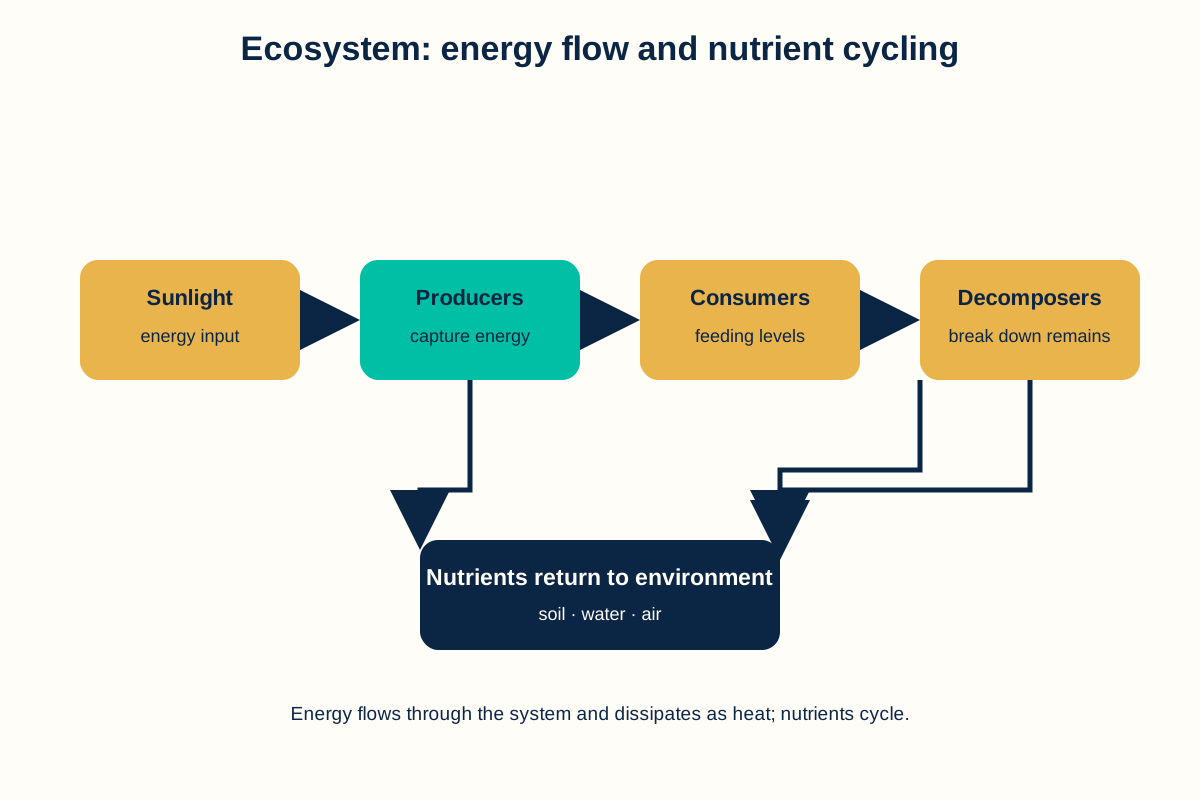
An ecosystem contains living organisms and the physical environment interacting as a system. Producers capture energy, consumers obtain energy by feeding and decomposers return nutrients to the environment.
Structure and function
Abiotic factors include light, temperature, water, soil, minerals and atmospheric gases. Biotic components include producers, consumers and decomposers. Food chains show one route of energy transfer, while food webs show interconnected feeding relationships.
Energy flows through an ecosystem and is lost as heat at each transfer. Nutrients cycle through air, water, soil and organisms. Ecological pyramids may represent number, biomass or energy.
Forest, grassland and desert ecosystems
Forest ecosystems contain layered vegetation, diverse habitats and complex nutrient cycling. Grasslands are dominated by grasses and support grazing food webs. Desert ecosystems have low rainfall, strong temperature variation and organisms adapted to conserve water.
Aquatic ecosystems
Ponds and lakes are standing-water systems. Streams and rivers are flowing-water systems. Oceans cover large saline regions, while estuaries are transition zones where fresh and marine waters mix. Aquatic systems differ in light penetration, oxygen, salinity, flow and nutrient availability.
Unit II: Frequently asked questions
Q: What are the main components of an ecosystem?
A: The main components are abiotic factors and biotic organisms, including producers, consumers and decomposers.
Q: How does energy move through an ecosystem?
A: Energy enters mainly through producers, passes through feeding relationships and is progressively lost as heat.
Q: What is an estuary?
A: It is a transition zone where freshwater and marine water mix, creating changing salinity and nutrient conditions.
Unit II: Key takeaways
- Ecosystems combine living organisms with physical surroundings.
- Producers, consumers and decomposers support energy flow and nutrient cycling.
- Energy decreases at successive trophic levels.
- Forest, grassland and desert ecosystems differ in climate and adaptations.
- Aquatic systems differ in flow, salinity, light, oxygen and nutrients.
Unit II: Practical correlation
Practical correlation: wastewater discharge. A laboratory discharge can alter oxygen demand, nutrient levels or toxicity in an aquatic ecosystem. Preventing discharge is preferable to relying only on dilution.
Unit III: Environmental Pollution
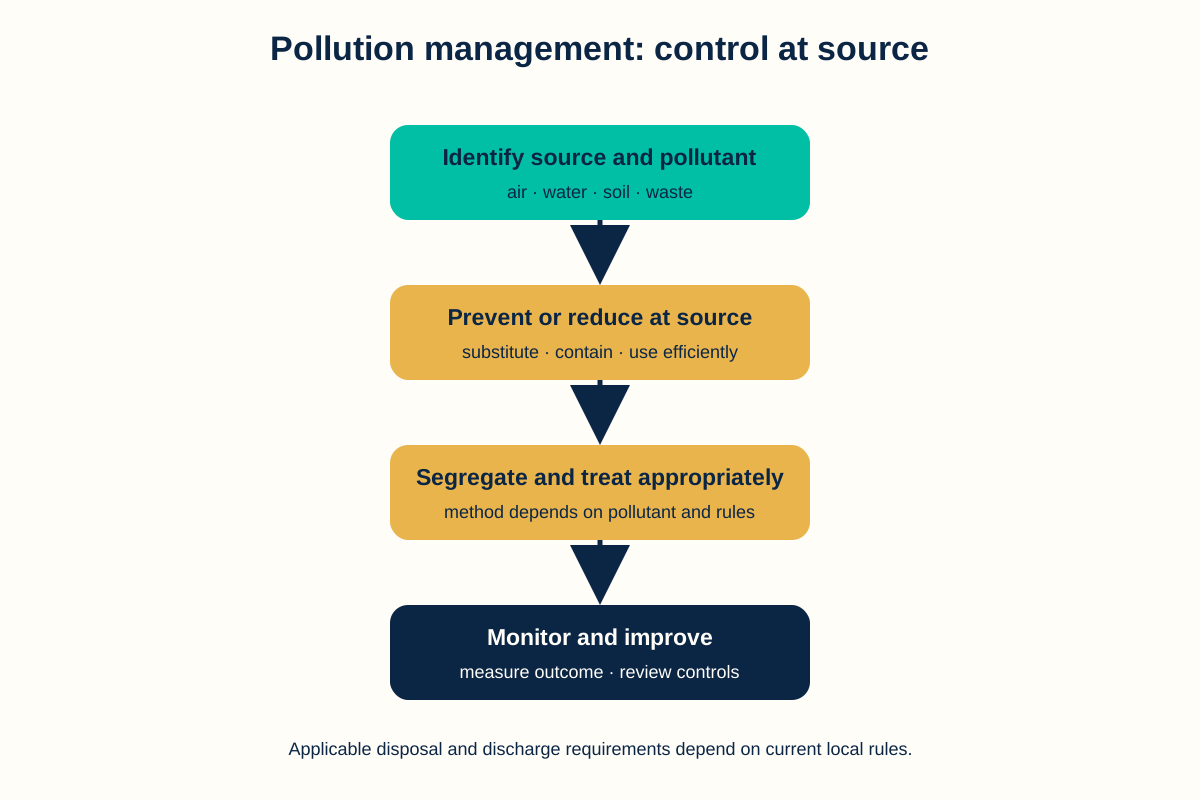
Pollution is the introduction of substances or energy into the environment at levels that cause or may cause harmful effects. The effect depends on concentration, duration, route, persistence, susceptibility and interactions with other stressors.
Air pollution
Air pollutants include particulate matter and gases such as sulfur oxides, nitrogen oxides, carbon monoxide and ozone. Sources include combustion, transport, industry, dust and biomass burning. Effects can include respiratory irritation, cardiovascular stress, reduced visibility, acid deposition and climate effects.
Control measures include cleaner fuels, emission control equipment, dust suppression, efficient combustion, public transport and monitoring. Indoor air quality also depends on ventilation, combustion sources, mould and particulate control.
Water pollution
Water pollution may arise from sewage, industrial effluent, agricultural runoff, oil, metals, pathogens and persistent chemicals. High organic load can reduce dissolved oxygen as microorganisms decompose waste. Nutrient enrichment can cause algal growth and oxygen depletion.
Control measures include source reduction, treatment, safe sanitation, monitoring and protection of catchments. Potable water requires treatment appropriate to the contaminants present.
Soil pollution and waste
Soil can be contaminated by pesticides, metals, petroleum products, industrial waste and improper disposal of medicines or laboratory chemicals. Contamination can affect soil organisms, crops, groundwater and human health.
Waste management follows prevention, reduction, reuse, recycling, recovery and safe disposal where appropriate. Hazardous waste requires identification, segregation, labelled containment, trained handling and authorised treatment.
Unit III: Frequently asked questions
Q: What is eutrophication?
A: Eutrophication is nutrient enrichment of water that can promote excessive algal growth and later reduce oxygen during decomposition.
Q: Why is particulate matter important in air pollution?
A: Small particles can remain airborne and enter the respiratory tract, where they may cause irritation and other health effects.
Q: What is the first priority in waste management?
A: Preventing or reducing waste at the source is preferred before reuse, recycling, recovery or disposal.
Unit III: Key takeaways
- Pollution effects depend on dose, time, route and susceptibility.
- Air pollution includes particles and gases from natural and human sources.
- Water pollution can reduce dissolved oxygen and transmit pathogens.
- Soil contamination can move through crops, groundwater and food webs.
- Safe waste management starts with prevention and correct segregation.
Unit III: Practical correlation
Practical correlation: biomedical and laboratory waste. Waste from healthcare and laboratories must be segregated at the point of generation and handled according to current authorised rules.
Sources
- Pharmacy Council of India. Bachelor of Pharmacy Course Regulations and Syllabus, BP206T Environmental Sciences and Table II. https://www.pci.nic.in/pdf/Syllabus_B_Pharm.pdf
- United Nations Environment Programme. Environmental assessment and pollution resources. https://www.unep.org/
- World Health Organization. Environmental health resources. https://www.who.int/health-topics/environmental-health
Complete BP206T notes, all 3 units in one PDF, free to keep.
Other Semester 2 subjects: BP201T · BP202T · BP203T · BP204T · BP205T · BP206T · Semester 2 Hub · MCQ Bank