
BP202T — Pharmaceutical Organic Chemistry I
3 hrs/week · 4 credits · 45 hours · 100 marks (25 internal + 75 end-semester, 3 hr paper). Notes follow the PCI B.Pharm Semester 2 syllabus, unit by unit.
Units in this subject
- Unit 1 — Classification, Nomenclature and Isomerism
- Unit 2 — Alkanes, Alkenes and Conjugated Dienes
- Unit 3 — Alkyl Halides
- Unit 4 — Alcohols and Carbonyl Compounds
- Unit 5 — Carboxylic Acids and Aliphatic Amines
Download BP202T PDF Notes
Free PDFs for this subject, one per unit:
Unit I: Classification, Nomenclature and Isomerism
Organic compounds are classified by carbon skeleton and functional group. Open-chain compounds may be straight-chain or branched. Carbocyclic compounds contain rings made of carbon atoms. Aromatic compounds have special cyclic conjugation. Functional groups determine characteristic reactions.
Nomenclature
IUPAC naming selects a parent chain or ring, identifies the principal functional group, numbers the structure to give the lowest possible locant and lists substituents alphabetically. Common names remain important in pharmacy, but the systematic name should be used when precision is needed.
Structural isomerism
Chain isomers differ in carbon skeleton. Position isomers differ in the position of a substituent or functional group. Functional isomers have the same molecular formula but different functional groups. Metamerism can occur when different alkyl groups surround a polyvalent atom. Tautomerism is a dynamic equilibrium between constitutional forms, commonly involving proton transfer and double-bond movement.
Stereoisomerism and representations
Stereoisomers have the same atom-to-atom connectivity but differ in spatial arrangement. Geometrical isomerism can arise when rotation is restricted, as in a double bond or a ring. In a double-bond pair, the higher-priority substituents on the same side are described as Z, and those on opposite sides as E. Cis and trans are useful for simpler cases where the comparison is unambiguous.
An asymmetric carbon is attached to four different substituents and can give non-superimposable mirror-image forms. These are enantiomers. Other stereoisomers that are not mirror images are diastereomers. A racemic mixture contains equal amounts of two enantiomers and has no net optical rotation in an ideal measurement. A compound with stereogenic centres can still be optically inactive if internal symmetry makes it meso.
Worked naming approach
For a simple branched alcohol, first choose the longest chain that contains the carbon bearing the hydroxyl group. Number from the end that gives the hydroxyl group the lowest locant, then identify and alphabetise substituents. For example, a four-carbon chain with the hydroxyl group on carbon two and a methyl substituent on carbon three is named 3-methylbutan-2-ol. This example illustrates parent selection, principal group numbering and substituent placement.
For a molecule containing more than one functional group, the group with higher naming priority is expressed by the suffix and the other group may be named as a prefix. The applicable priority sequence should be checked against the current IUPAC recommendations when less common groups occur.
Isomerism worked examples
Consider compounds with molecular formula C2H6O. One has an oxygen between two carbon groups, while the other has a hydroxyl group attached to a carbon chain. They have the same formula but different functional groups, so they are functional isomers. In contrast, two butane arrangements with a continuous chain versus a branched chain are chain isomers. These examples show why a molecular formula alone does not identify a compound.
Unit I: Frequently asked questions
Q: What is a functional group?
A: It is an atom or group of atoms that gives an organic compound characteristic chemical behaviour.
Q: What is chain isomerism?
A: It is structural isomerism caused by different arrangements of the carbon skeleton.
Q: What is the first step in IUPAC naming?
A: Select the parent chain or ring containing the principal functional group and then number it according to the naming rules.
Unit I: Key takeaways
- Classification depends on carbon skeleton and functional group.
- IUPAC naming uses a parent structure, locants and substituent names.
- Chain, position and functional isomerism are structural forms of isomerism.
- Tautomeric forms interconvert through proton and double-bond movement.
- Common names should not replace precise systematic identification.
Unit I: Practical correlation
Practical correlation: identity checking. A compound label, systematic name, molecular formula and analytical result should agree before a material is accepted.
Unit II: Alkanes, Alkenes and Conjugated Dienes
Alkanes
Alkanes contain carbon-carbon single bonds and have tetrahedral carbon atoms described as sp3 hybridised. Their main reactions are substitution and combustion. Free-radical halogenation proceeds through initiation, propagation and termination. Selectivity and product distribution depend on radical stability and reaction conditions.
In chlorination under light or heat, initiation breaks a chlorine-chlorine bond homolytically and produces chlorine radicals. During propagation, a chlorine radical abstracts hydrogen from an alkane, producing hydrogen chloride and an alkyl radical. The alkyl radical then abstracts chlorine from another chlorine molecule, yielding an alkyl chloride and regenerating a chlorine radical. In termination, two radicals combine and remove radical species from the chain. This is a chain reaction because propagation regenerates the radical carrier.
For an alkane with more than one distinct type of hydrogen, substitution can yield multiple constitutional products. Product proportions depend on the number of each hydrogen type and how readily each hydrogen is abstracted. A more stable radical pathway can be favoured, but a product prediction should account for both statistical abundance and relative reactivity. Extensive halogenation can continue unless reagent ratio and reaction time are controlled.
Alkenes and addition
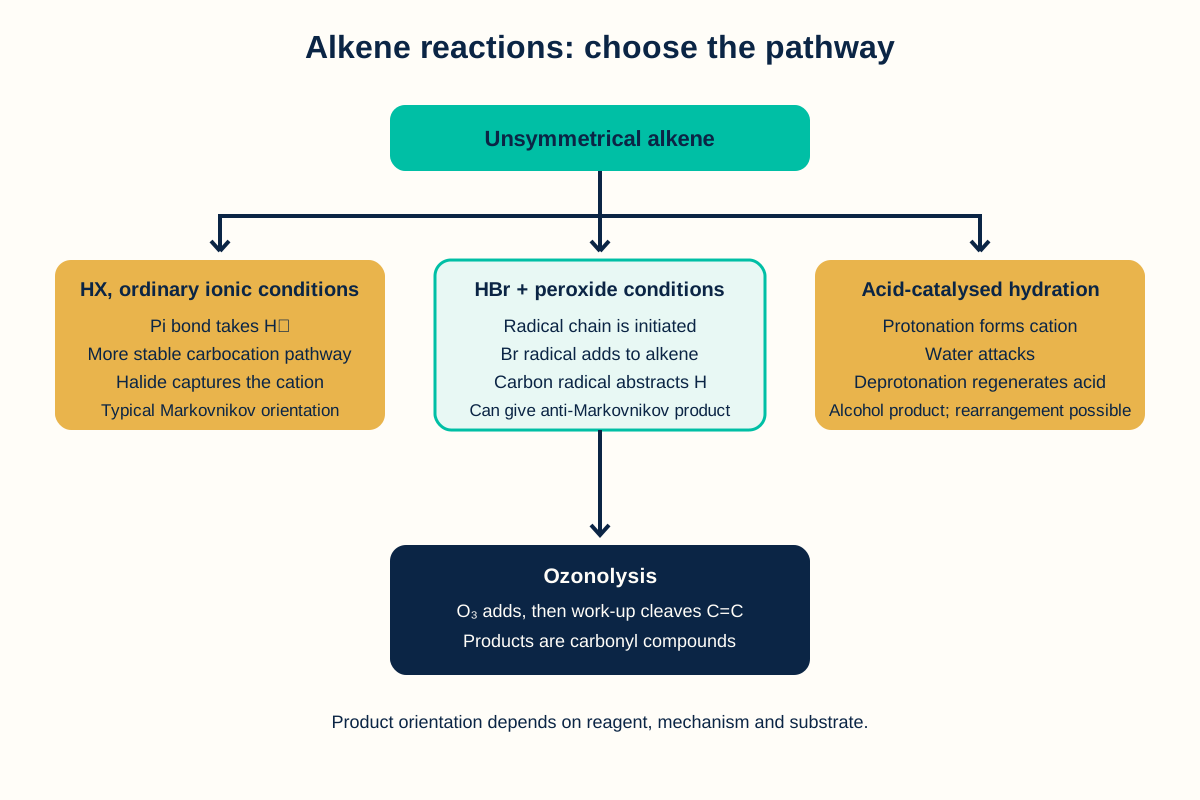
Alkenes contain a carbon-carbon double bond with sp2 hybridised carbon atoms. The pi bond is electron-rich and can undergo electrophilic addition. Markovnikov orientation places hydrogen so that the more stable carbocation intermediate is formed when the mechanism proceeds through a carbocation.
Free-radical addition can give anti-Markovnikov orientation in appropriate peroxide-mediated addition of hydrogen bromide. This rule is not general for every reagent. Ozonolysis cleaves the double bond and produces carbonyl fragments after work-up.
For acid-catalysed hydration of a simple unsymmetrical alkene, the mechanism can be followed in three stages. First, the pi bond accepts a proton, giving the more stable carbocation pathway where alternatives exist. Second, water attacks the carbocation to form a protonated alcohol. Third, another water molecule removes a proton, yielding the neutral alcohol and regenerating acid. Rearrangements may occur if a more stable carbocation can form. The product prediction therefore depends on substrate structure and conditions.
Ozonolysis is useful for inferring the position of an alkene bond. Ozone reacts with the double bond, and work-up converts the resulting intermediates into carbonyl compounds. Reductive work-up generally preserves aldehydes and ketones, while oxidative work-up can further oxidise aldehyde products. To work a product example, split the carbon-carbon double bond conceptually, replace each alkene carbon's unsatisfied valence with a carbonyl oxygen, and determine whether each fragment is an aldehyde or ketone from its attached groups. No structure drawing is needed for this reasoning.
E1 and E2 elimination
E1 elimination occurs in two steps through a carbocation. Its rate depends mainly on substrate ionisation. E2 elimination occurs in one concerted step and its rate depends on substrate and base. Carbocation rearrangement can occur in E1 pathways. Saytzeff orientation generally favours the more substituted alkene when steric and electronic factors do not override it.
In E1, the leaving group departs first to form a carbocation. A base then removes a hydrogen from a neighbouring carbon, and the electrons from that carbon-hydrogen bond form the double bond. Because carbocation formation is the slow step, a more stable carbocation usually makes ionisation easier. Polar protic solvents can stabilise ions. Rearrangement by hydride or alkyl shift is possible before elimination if it produces a more stable cation.
In E2, a base removes a beta hydrogen as the leaving group departs from the adjacent carbon. Formation of the double bond and leaving-group departure occur in one concerted event. The beta hydrogen and leaving group generally need an anti-periplanar arrangement for effective orbital overlap. A strong base and suitable substrate favour this pathway. Since no carbocation intermediate forms, a simple E2 reaction does not undergo carbocation rearrangement.
To compare substitution and elimination, inspect the substrate first, then the reagent, solvent and temperature. A strong, hindered base often favours elimination; a good nucleophile that is not strongly basic can favour substitution in suitable substrates. Heating often increases the contribution of elimination. These are qualitative trends, not substitutes for evaluating the actual substrate and conditions.
Conjugated dienes
Conjugated dienes have alternating double and single bonds. Delocalisation stabilises the system. Electrophilic addition can give products from kinetic and thermodynamic control. The Diels-Alder reaction is a concerted cycloaddition between a conjugated diene and a dienophile. Allylic rearrangement involves movement of a double bond through a resonance-stabilised allylic intermediate.
When an electrophile adds to a conjugated diene, the first step forms an allylic carbocation. Resonance distributes positive charge across the terminal positions, so a nucleophile can attack at more than one site. Lower temperature and shorter reaction time can favour the product formed faster, called the kinetic product. Higher temperature and reversible conditions can favour the more stable product, called the thermodynamic product. Which product dominates depends on the actual reaction conditions.
The Diels-Alder reaction joins a conjugated diene and an alkene or alkyne dienophile in a concerted step. The diene must adopt a suitable conformation, and electron-withdrawing substituents on a dienophile commonly increase its reactivity. The reaction creates a six-membered ring framework and can form stereogenic relationships. When analysing an example, identify the four diene atoms and the two dienophile atoms, then track which new bonds form and whether substituent relationships are retained. This is a verbal atom-mapping exercise, not a structure drawing.
Unit II: Frequently asked questions
Q: What is the difference between E1 and E2 elimination?
A: E1 is stepwise through a carbocation, while E2 is concerted and occurs in one step.
Q: What is Markovnikov orientation?
A: In a typical electrophilic addition to an unsymmetrical alkene, the product orientation follows formation of the more stable intermediate.
Q: Why are conjugated dienes more stable?
A: Their pi electrons are delocalised across the conjugated system, lowering the overall energy.
Unit II: Key takeaways
- Alkanes are saturated and commonly undergo radical substitution.
- Alkenes are unsaturated and commonly undergo electrophilic addition.
- E1 is stepwise, while E2 is concerted.
- Ozonolysis cleaves carbon-carbon double bonds into carbonyl fragments.
- Conjugation stabilises dienes and supports Diels-Alder chemistry.
Unit II: Practical correlation
Practical correlation: reaction safety. Organic reactions should be planned from substrate, reagent, solvent, temperature, mechanism and expected hazards.
Unit III: Alkyl Halides
SN1 and SN2 reactions
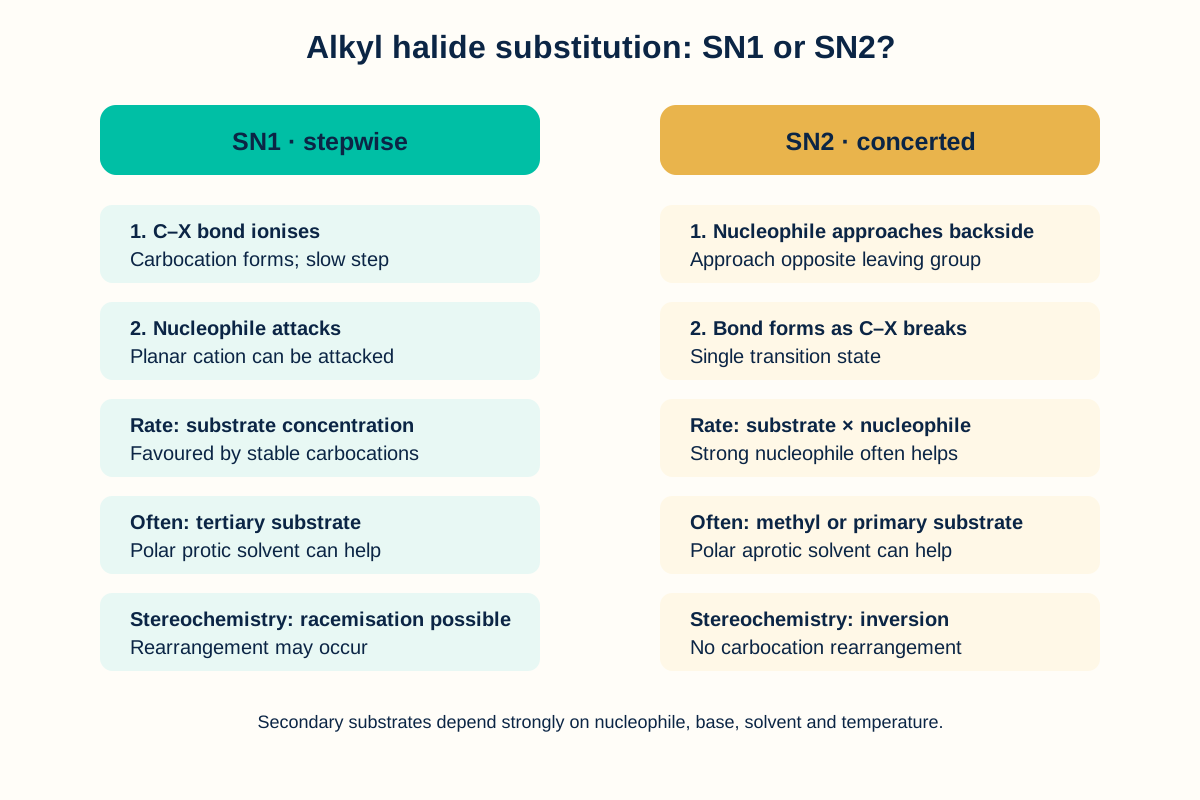
SN1 substitution has a slow ionisation step followed by nucleophile capture. It is favoured by substrates that form stable carbocations and by polar protic conditions. Because the carbocation is planar, stereochemical outcomes can include racemisation.
SN2 substitution occurs by backside attack in one concerted step. It gives inversion of configuration and is favoured by less hindered substrates, strong nucleophiles and suitable polar aprotic solvents. Steric hindrance slows SN2 reactions.
In an SN1 mechanism, the carbon-halogen bond ionises first. This produces a carbocation and a halide ion, and is usually the rate-determining step. A nucleophile then bonds to the planar carbocation. If the nucleophile is neutral, a final proton transfer may be needed to give a neutral product. The rate law is first order in the alkyl halide because nucleophile concentration is not involved in the slow ionisation step. A polar protic solvent can stabilise the ions. If the carbocation rearranges to a more stable one before capture, the product connectivity can change.
In an SN2 mechanism, the nucleophile approaches the carbon from the side opposite the leaving group. As the new bond forms, the carbon-halogen bond breaks in the same transition state. There is no isolable carbocation intermediate. The rate depends on both alkyl halide and nucleophile concentrations. Backside approach causes inversion at a stereogenic carbon. A polar aprotic solvent can keep an anionic nucleophile relatively reactive by solvating the counterion more strongly than the nucleophile.
For a practice prediction, compare two substrates with the same leaving group. A primary alkyl halide is relatively accessible to backside attack, so a strong nucleophile in a suitable polar aprotic solvent tends toward SN2. A tertiary alkyl halide is sterically crowded and can form a relatively stable carbocation, so ionisation and SN1 can be favoured in a polar protic solvent with a weak nucleophile. Secondary substrates can follow either route depending on the complete conditions. These are predictions of pathway preference, not guarantees of a single product.
Leaving groups and reaction factors
A leaving group is more effective when it can remain stable after departure. Halide leaving-group ability commonly follows iodide greater than bromide greater than chloride, while fluoride is usually poorer in ordinary substitution conditions. Nucleophile strength, solvent, substrate structure and temperature all matter. A strong base may also remove a beta hydrogen, giving elimination instead of substitution. Product analysis should therefore consider competing pathways.
Unit III: Frequently asked questions
Q: What is the stereochemical result of SN2 substitution?
A: Backside attack produces inversion of configuration at the reacting carbon.
Q: Why do tertiary substrates favour SN1 more than SN2?
A: Tertiary substrates can form relatively stable carbocations but are sterically crowded for backside attack.
Q: What is the main difference between SN1 and SN2 substitution?
A: SN1 substitution occurs in steps through a carbocation intermediate, while SN2 substitution occurs in one concerted step by backside attack.
Unit III: Key takeaways
- SN1 is stepwise and involves carbocation stability.
- SN2 is concerted and gives inversion.
- Steric hindrance strongly affects substitution pathways.
- Alkyl halide reactivity depends on substrate structure, nucleophile, solvent and mechanism.
- Compound-specific uses and tests require verified sources.
Unit III: Practical correlation
Practical correlation: qualitative analysis. A laboratory identification should compare the observed test, control result and expected reaction before a conclusion is recorded.
Unit IV: Alcohols and Carbonyl Compounds
Alcohols
Alcohols contain a hydroxyl group attached to a saturated carbon. Their properties depend on hydrogen bonding, carbon skeleton and substitution. Oxidation of primary alcohols can lead to aldehydes and then carboxylic acids, while secondary alcohols can form ketones. Tertiary alcohols resist simple oxidation because the carbon bearing the hydroxyl group lacks a hydrogen.
Qualitative tests may distinguish classes of alcohols using oxidation or substitution behaviour.
Alcohols are classified as primary, secondary or tertiary by the number of carbon groups attached to the carbon bearing the hydroxyl group. Hydrogen bonding raises boiling points compared with similar-sized compounds that cannot donate hydrogen bonds. Small alcohols mix well with water; water solubility generally falls as the nonpolar carbon chain becomes longer.
Oxidation provides a useful reactivity comparison. A primary alcohol loses hydrogen during oxidation to form an aldehyde. Further oxidation, often with an aqueous oxidising reagent, can produce a carboxylic acid. A secondary alcohol is oxidised to a ketone. A tertiary alcohol does not undergo this simple oxidation because the hydroxyl-bearing carbon has no hydrogen to remove without breaking a carbon-carbon bond. Actual reagent, solvent and work-up determine whether an aldehyde can be isolated or proceeds to acid.
Alcohols can undergo substitution to form alkyl halides under suitable conditions. In a typical acid-assisted route, the hydroxyl group is protonated so water can leave more readily. The subsequent pathway depends on substitution at carbon: a stable carbocation may support an SN1 route, while a less hindered substrate and a strong nucleophile can support SN2 displacement. Strongly acidic conditions can also cause dehydration to an alkene, so temperature and reagent choice are important.
Dehydration removes water from an alcohol. Under acid and heat, protonation converts hydroxyl into a better leaving group. Loss of water and removal of a neighbouring hydrogen then form an alkene. Depending on substrate, this can follow an E1 or E2 pathway. Rearrangements are possible when a carbocation intermediate forms. Product orientation often favours the more substituted alkene, subject to structure and conditions.
Pharmaceutical and laboratory examples
The syllabus names several halogenated compounds and alcohols for structure, properties and uses. Learn their official names, functional groups, hazards and approved uses from a verified monograph. Do not infer a use from a name.
Structure and reactivity
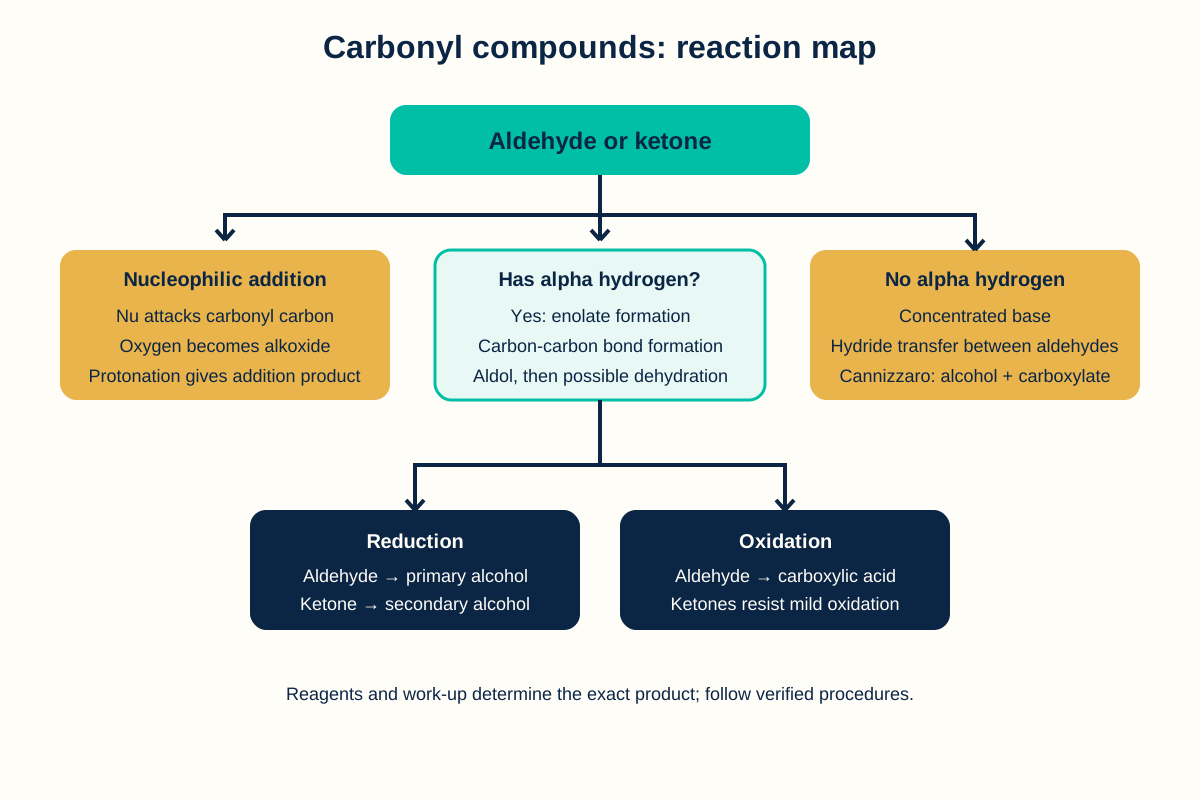
Aldehydes and ketones contain a polar carbonyl group. The carbonyl carbon is electrophilic and can undergo nucleophilic addition. Aldehydes are generally more reactive than ketones because they have less steric hindrance and fewer electron-releasing alkyl groups.
Nucleophilic addition can be described in a short sequence. A nucleophile donates an electron pair to the carbonyl carbon. The carbon-oxygen pi bond shifts toward oxygen, giving an alkoxide intermediate. Protonation of the alkoxide gives an addition product. In acid-catalysed reactions, protonation of oxygen can first increase electrophilicity, after which a weak nucleophile attacks and a proton transfer completes the process. The exact sequence depends on reagent and medium.
For a simple comparison, an aldehyde usually reacts faster than a ketone toward the same nucleophile. The aldehyde has one hydrogen and one carbon substituent at the carbonyl carbon, while a ketone has two carbon substituents. This usually means less steric crowding and less electron donation in the aldehyde. Conjugation or unusual substituents can alter the trend.
Reduction converts aldehydes to primary alcohols and ketones to secondary alcohols when an appropriate hydride donor is used, followed by protonation. Oxidation readily converts aldehydes to carboxylic acids because aldehydes have a hydrogen on the carbonyl carbon. Ketones resist ordinary mild oxidation; strong oxidative cleavage can occur under more forcing conditions. Reagent identity and work-up must be specified for a laboratory procedure.
Condensation reactions
Aldol condensation involves enolate or enol formation followed by carbon-carbon bond formation and dehydration under suitable conditions. Crossed aldol reactions use two different carbonyl compounds and can produce mixtures unless one reaction partner is controlled.
Cannizzaro reaction occurs with aldehydes that lack an alpha hydrogen under strongly basic conditions. One molecule is oxidised and another is reduced. Benzoin condensation joins aromatic aldehyde units through a cyanide or thiazolium-type catalytic pathway. Perkin condensation forms an unsaturated aromatic acid derivative from an aromatic aldehyde and an acid anhydride in the presence of base.
In an aldol reaction, a base removes an alpha hydrogen from a carbonyl compound that has one, forming an enolate. The enolate carbon attacks the carbonyl carbon of another molecule. Protonation gives a beta-hydroxy carbonyl compound, the aldol addition product. Heating or other suitable conditions can remove water to produce a conjugated carbonyl compound. In a crossed aldol reaction, two different carbonyl compounds may each form enolates and can give a mixture. Selectivity improves when one partner cannot form an enolate or when conditions control which enolate is generated.
The Cannizzaro reaction is a disproportionation of a non-enolisable aldehyde in concentrated base. Hydroxide adds to one aldehyde molecule. A hydride equivalent is then transferred to a second aldehyde molecule through a coupled step. The donor molecule becomes a carboxylate, while the acceptor becomes an alcohol after work-up. The reaction requires aldehydes without an alpha hydrogen because those with alpha hydrogens can undergo aldol chemistry instead.
Benzoin condensation is a carbon-carbon bond-forming reaction between aromatic aldehydes. A catalyst temporarily changes the reactivity of one aldehyde so it can act as a nucleophilic partner toward another aldehyde. Proton transfers and catalyst regeneration yield an alpha-hydroxy ketone. Perkin condensation combines an aromatic aldehyde with an acid anhydride in the presence of base; after condensation and work-up, an unsaturated aromatic acid derivative is obtained. Reagent scope and specific named-reaction conditions depend on substrate and are best learned from the prescribed reaction examples.
Qualitative tests
Carbonyl compounds may be investigated using tests for aldehydes, ketones or reducing behaviour.
Unit IV: Frequently asked questions
Q: How do primary and secondary alcohol oxidation products differ?
A: Primary alcohols can be oxidised to aldehydes and further to carboxylic acids, while secondary alcohols form ketones.
Q: Why are carbonyl compounds susceptible to nucleophilic addition?
A: The carbonyl bond is polar, leaving the carbonyl carbon electron-poor and open to nucleophile attack.
Q: What happens in the Cannizzaro reaction?
A: Two aldehyde molecules without alpha hydrogen undergo simultaneous oxidation and reduction under basic conditions.
Q: What is aldol condensation?
A: It is carbon-carbon bond formation involving an enolate or enol followed by dehydration to an unsaturated carbonyl compound.
Unit IV: Key takeaways
- Primary alcohols can oxidise through aldehydes to carboxylic acids, while secondary alcohols form ketones.
- The carbonyl carbon is electrophilic.
- Aldehydes usually undergo nucleophilic addition more readily than ketones.
- Aldol reactions form carbon-carbon bonds.
- Cannizzaro reactions involve oxidation and reduction of aldehydes.
- Qualitative test details must be learned with their limitations.
Unit IV: Practical correlation
Practical correlation: impurity testing. Carbonyl tests can support identity or detect a reactive group, but a single colour or precipitate is not a complete quality decision.
Unit V: Carboxylic Acids and Aliphatic Amines
Carboxylic acids
Carboxylic acids contain a carboxyl group and can donate a proton. Their acidity is influenced by resonance stabilisation of the conjugate base and by substituent effects. Electron-withdrawing groups usually increase acidity when they are positioned to influence the carboxyl group.
Carboxylic acids can form salts, esters and amides. Esterification is an equilibrium process between an acid and alcohol under suitable catalytic conditions. Amides are less basic than amines because the nitrogen lone pair is delocalised toward the carbonyl group.
The carboxylate conjugate base is stabilised because negative charge is shared across two oxygen atoms by resonance. An electron-withdrawing substituent can stabilise this anion through induction and increase acidity; an electron-donating substituent can have the opposite effect. The effect generally weakens with distance from the carboxyl group. These trends help compare acids, but solvent and molecular structure also influence measured acidity.
In esterification, the carbonyl oxygen is protonated under acid catalysis, increasing electrophilicity. The alcohol oxygen attacks the carbonyl carbon, proton transfers occur, water is eliminated, and deprotonation regenerates the catalyst. Because the reaction is reversible, removing water or using excess of one reactant can shift the equilibrium toward ester. The exact conditions depend on the substrates and safety requirements.
Aliphatic amines
Amines are derivatives of ammonia in which hydrogen atoms are replaced by carbon groups. Their basicity depends on electron donation, solvation, steric effects and resonance. Primary, secondary and tertiary amines differ in the number of carbon groups attached to nitrogen.
Qualitative amine tests use reactions such as salt formation or derivatisation.
Amines act as bases because the nitrogen lone pair can accept a proton. Alkyl groups can increase electron density by induction, but solvation and steric effects alter the observed basicity in water. Aromatic amines are generally less basic than comparable aliphatic amines because the lone pair can be delocalised into the aromatic system. Amides are still less basic because their nitrogen lone pair is strongly delocalised toward the carbonyl group.
Worked acidity and basicity comparisons
When comparing two carboxylic acids, first draw no structure but identify the substituent's electronic effect and its distance from the carboxyl group. An electron-withdrawing group close to the acid usually increases acidity by stabilising the conjugate base. When comparing amines, assess lone-pair availability, induction, resonance and solvation. In an amide, resonance with the carbonyl makes the nitrogen lone pair less available, so it is less basic than an amine. Numerical pKa comparisons require a specified solvent and reliable reference data.
Unit V: Frequently asked questions
Q: Why are electron-withdrawing groups important in carboxylic acid acidity?
A: They stabilise the negatively charged conjugate base through inductive effects and can increase acidity.
Q: Why are amides less basic than amines?
A: The amide nitrogen lone pair is delocalised toward the carbonyl group and is less available to accept a proton.
Q: What is esterification?
A: It is formation of an ester from a carboxylic acid and an alcohol under suitable conditions, usually with water as a by-product.
Unit V: Key takeaways
- Carboxylic acid acidity depends on conjugate-base stability and substituent effects.
- Acids form salts, esters and amides.
- Amines are basic because nitrogen can accept a proton.
- Amide resonance reduces nitrogen basicity.
- Specific compound uses and test observations require verified references.
Unit V: Practical correlation
Practical correlation: laboratory identification. Acid-base behaviour, solubility and a confirmatory derivative can be combined in an identification scheme.
Sources
- Pharmacy Council of India. Bachelor of Pharmacy Course Regulations and Syllabus, BP202T Pharmaceutical Organic Chemistry I. https://www.pci.nic.in/pdf/Syllabus_B_Pharm.pdf
- McMurry J. Organic Chemistry. Cengage Learning.
- Morrison RT, Boyd RN. Organic Chemistry. Pearson.
Complete BP202T notes, all 5 units in one PDF, free to keep.
Other Semester 2 subjects: BP201T · BP202T · BP203T · BP204T · BP205T · BP206T · Semester 2 Hub · MCQ Bank