
BP205T — Computer Applications in Pharmacy
2 hrs/week · 3 credits · 30 hours · 75 marks (25 internal + 50 end-semester, 2 hr paper, non-university). Notes follow the PCI B.Pharm Semester 2 syllabus, unit by unit.
Units in this subject
- Unit 1 — Number Systems and Information Systems
- Unit 2 — Web Technologies and Databases
- Unit 3 — Applications of Computers in Pharmacy
- Unit 4 — Bioinformatics
- Unit 5 — Computerised Data Analysis in Preclinical Development
Download BP205T PDF Notes
Free PDFs for this subject, one per unit:
Unit I: Number Systems and Information Systems
Number systems
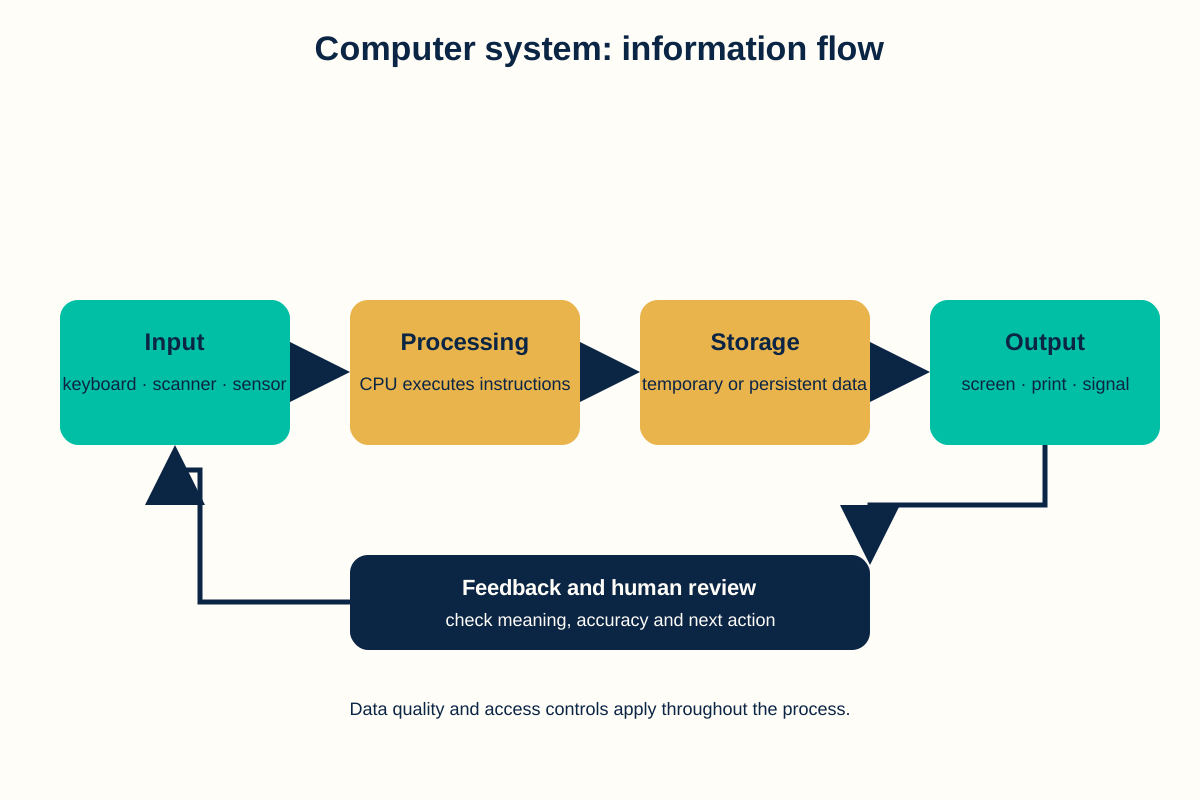
Computers represent information using bits. A bit has two possible values, commonly written as 0 and 1. A group of eight bits is a byte. Decimal uses base 10, binary uses base 2, octal uses base 8 and hexadecimal uses base 16.
To convert a binary number to decimal, multiply each bit by its positional power of two and add the results. To convert decimal to binary, repeatedly divide by two and read the remainders from bottom to top. Binary addition follows the rules 0 plus 0 equals 0, 0 plus 1 equals 1, 1 plus 0 equals 1 and 1 plus 1 equals 10.
One's complement changes every 0 to 1 and every 1 to 0. Two's complement is formed by taking the one's complement and adding one. Two's complement permits signed subtraction using binary addition. Overflow occurs when a result cannot be represented in the available number of bits.
Information systems and software
An information system combines people, procedures, hardware, software and data. Requirement analysis identifies what users need. Feasibility analysis checks whether a proposed system is technically, economically and operationally practical.
A data-flow diagram shows how data moves between processes, data stores and external entities. Input design decides how data is entered and validated. Output design decides how information is presented. A process specification describes the logic of a process in enough detail for implementation and testing.
The software life cycle includes planning, analysis, design, development, testing, implementation, maintenance and review. Documentation, access control, backups and change management help preserve data quality.
Unit I: Frequently asked questions
Q: Why are binary and hexadecimal systems used together?
A: Computers use binary internally, while hexadecimal provides a shorter human-readable representation because one hexadecimal digit represents four binary bits.
Q: What is a data-flow diagram?
A: It is a model showing how data enters a system, is processed, stored and transferred to outputs or other entities.
Q: What is feasibility analysis?
A: It is an early assessment of whether a proposed information system is practical from technical, economic and operational viewpoints.
Unit I: Key takeaways
- Binary is base 2, octal is base 8, decimal is base 10 and hexadecimal is base 16.
- One's complement inverts bits, while two's complement adds one after inversion.
- Information systems combine people, processes, technology and data.
- Data-flow diagrams show movement and processing of data.
- Software development follows a life cycle from planning to maintenance.
Unit I: Practical correlation
Practical correlation: dose conversion. A pharmacy information system may store quantities as integers, decimals or coded fields. A conversion error can change a calculated quantity, so input validation, unit labels and independent checking are essential.
Unit II: Web Technologies and Databases
HTML, XML and CSS
HTML describes the structure of a web page using elements such as headings, paragraphs, tables and links. XML stores structured data using user-defined tags and is designed to represent data rather than primarily display it. CSS controls presentation such as colour, spacing, typography and layout.
A web server receives requests and returns resources. A client is usually a browser or another application. HTTP transfers requests and responses. HTTPS adds encryption and server authentication through TLS.
Programming concepts
A program is an ordered set of instructions. Variables store values, operators perform actions, conditions select between paths and loops repeat actions. Functions divide a larger task into reusable units. Good programs validate input, handle errors, document assumptions and separate data from presentation.
Databases
A database is an organised collection of data. A relational database stores data in tables containing rows and columns. A primary key identifies a row. A foreign key links related tables. A query retrieves or changes selected records.
Database design begins with requirements and entities. Normalisation reduces unnecessary duplication and update anomalies. A transaction groups related changes so that they either complete consistently or are rolled back. Backups, permissions and audit trails support reliability.
Unit II: Frequently asked questions
Q: What is the difference between HTML and CSS?
A: HTML describes page structure and CSS describes presentation and layout.
Q: What is a primary key?
A: A primary key is a field or combination of fields that uniquely identifies a row in a table.
Q: Why is database normalisation useful?
A: It reduces repeated data and helps prevent inconsistent updates, insertions and deletions.
Unit II: Key takeaways
- HTML structures content, XML represents structured data and CSS controls presentation.
- HTTPS protects web communication through TLS.
- Relational databases organise records in related tables.
- Primary and foreign keys support identity and relationships.
- Transactions and backups protect data integrity.
Unit II: Practical correlation
Practical correlation: pharmacy drug database. A drug database should separate medicine identity, strength, dosage form, stock, supplier and transaction records instead of repeating the same information in one large table.
Unit III: Applications of Computers in Pharmacy
Drug information and pharmacokinetics
Drug information systems store searchable records and retrieve information using terms, filters and indexed fields. Pharmacokinetic software can represent dose, concentration, clearance, volume of distribution and time using mathematical models. A model is an approximation, so input assumptions and units must be recorded.
Hospital and clinical pharmacy systems
Electronic prescribing systems record medication orders and can support checks for duplication, allergies, interactions and dose range. A discharge system can produce a medication list and instructions. Barcode identification links a scanned code to a stored record, but the database and physical item must still be checked.
Patient monitoring systems collect observations such as pulse, blood pressure, temperature or laboratory values. Diagnostic systems assist interpretation of results, while a laboratory information system tracks specimens, tests, results and reports.
Mobile technology and adherence monitoring
Mobile systems can provide reminders, record patient-reported doses and transmit information to a care team. Consent, privacy, authentication, data minimisation and accessibility are required. A reminder does not prove that a dose was taken.
Unit III: Frequently asked questions
Q: What is the purpose of a pharmacy information system?
A: It stores, retrieves and processes information used for medication supply, clinical work, inventory, reporting or patient support.
Q: What is the limitation of a pharmacokinetic model?
A: It simplifies biological behaviour and depends on input data, assumptions and the selected model.
Q: Does barcode scanning replace professional checking?
A: No. Scanning reduces identification errors but does not replace checking of the patient, item, dose, route, timing and order.
Unit III: Key takeaways
- Drug information systems make structured information searchable.
- Pharmacokinetic models require correct units and stated assumptions.
- Electronic prescribing can support safety checks but cannot replace review.
- Diagnostic and patient monitoring systems depend on data quality.
- Mobile adherence tools require privacy controls and do not prove ingestion.
Unit III: Practical correlation
Practical correlation: electronic medication reconciliation. At admission and discharge, a system can compare medicines from different sources and highlight omissions or duplications.
Unit IV: Bioinformatics
Concepts and objectives
Bioinformatics applies computing, statistics and biology to biological data. It supports storage, retrieval, comparison, visualisation and interpretation of sequences and other molecular data. A database record is evidence to evaluate, not automatically a final biological conclusion.
Bioinformatics databases
Primary databases contain submitted sequence or structure data. Secondary databases add interpretation, classification or curated annotation. A search result should be checked for accession identifier, organism, version, source, method and date.
Sequence comparison uses alignment to identify similar regions. Similarity can suggest common ancestry or function, but similarity alone does not prove identical biological activity. Statistical significance and experimental confirmation remain important.
Bioinformatics in vaccine discovery
Computational workflows can compare pathogen genomes, identify conserved proteins, predict possible antigenic regions and prioritise candidates for laboratory testing. A prediction is not proof of safety, expression, immunogenicity or clinical protection.
Unit IV: Frequently asked questions
Q: What is bioinformatics?
A: It is the use of computational and statistical methods to store, analyse and interpret biological data.
Q: What is sequence alignment used for?
A: It compares biological sequences to identify matching or similar regions that may indicate relatedness or conserved function.
Q: Can a computational vaccine prediction be used directly in patients?
A: No. It identifies candidates for further laboratory, animal and clinical evaluation; it does not replace validation.
Unit IV: Key takeaways
- Bioinformatics combines biology, computing and statistics.
- Database records need identifiers, versions and source context.
- Sequence similarity can guide hypotheses but does not prove function.
- Computational vaccine discovery prioritises candidates for testing.
- Experimental and clinical validation remain necessary.
Unit IV: Practical correlation
Practical correlation: sequence record audit. Before using a database sequence in a report, record its identifier, version, organism, source and retrieval date. A missing identifier makes later verification difficult.
Unit V: Computerised Data Analysis in Preclinical Development
Chromatographic data systems
A chromatographic data system receives detector output, records the signal against time and helps identify peaks. Typical processing includes baseline handling, peak detection, integration, calibration and report generation. The analyst must review integration and document changes rather than accept every automated result.
Laboratory information management systems
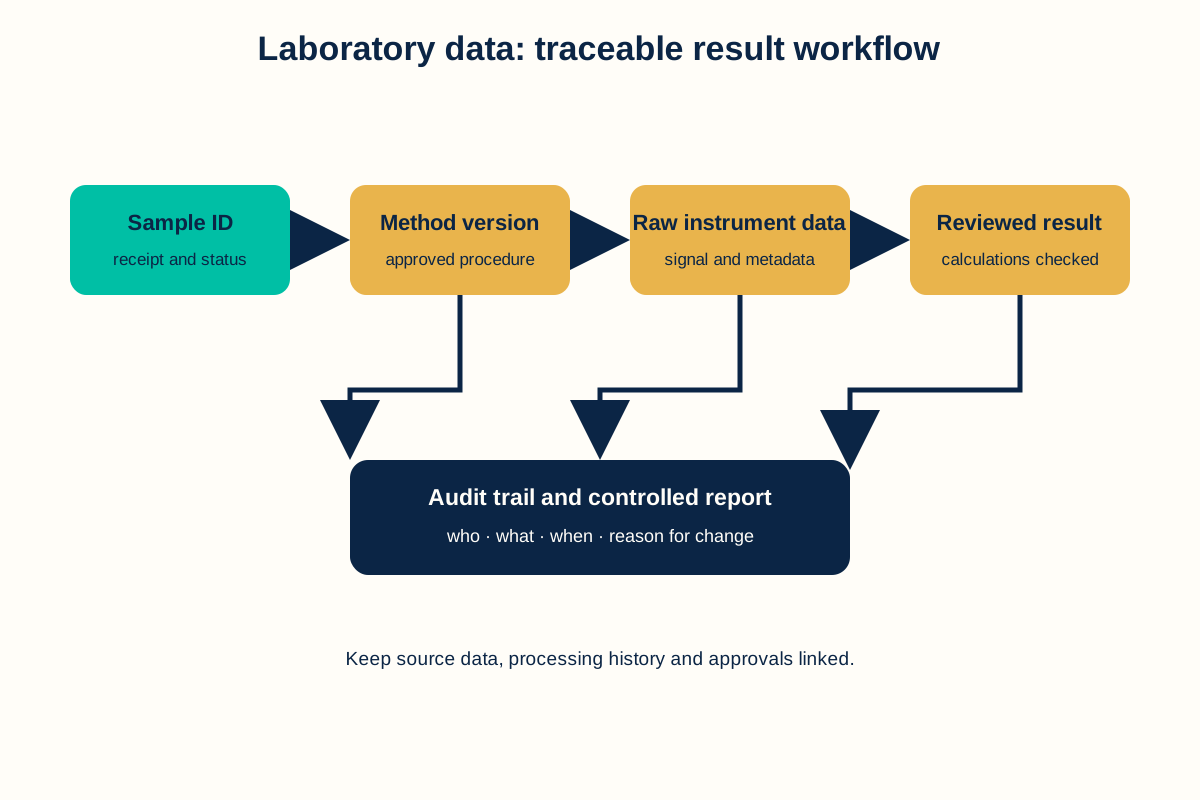
A laboratory information management system tracks samples, test requests, methods, results, instruments, users and approvals. A sample identifier links collection, storage, testing and reporting. Role-based access, audit trails, electronic signatures and backups support data integrity.
Text information management systems
A text information management system stores and retrieves documents or text records. Indexing and metadata improve retrieval. Controlled vocabulary, version control and retention rules help distinguish current procedures from obsolete copies.
Data quality and reporting
Reliable analysis requires traceability from raw data to processed result. Record instrument identity, method version, analyst, date, calculations, deviations and review status. Results should be reproducible and protected from unauthorised change.
Unit V: Frequently asked questions
Q: What does a chromatographic data system do?
A: It records detector signals and supports peak detection, integration, calibration and reporting.
Q: Why are audit trails important in a laboratory system?
A: They show who created, changed or approved data and help preserve traceability.
Q: What is the purpose of metadata in a text system?
A: Metadata describes a document, such as its title, version, owner, date and status, making retrieval and control easier.
Unit V: Key takeaways
- Chromatographic analysis converts detector signals into reviewed results.
- LIMS links samples, methods, instruments, results and approvals.
- Text systems depend on indexing, metadata and version control.
- Raw data and processing history must remain traceable.
- Automated output still requires trained review.
Unit V: Practical correlation
Practical correlation: laboratory data integrity. A preclinical result should be traceable from sample identity to raw signal, calculation, review and final report.
Sources
- Pharmacy Council of India. Bachelor of Pharmacy Course Regulations and Syllabus, BP205T Computer Applications in Pharmacy. https://www.pci.nic.in/pdf/Syllabus_B_Pharm.pdf
- World Health Organization. WHO good data and record management practices. https://www.who.int/
- U.S. National Library of Medicine. Introduction to bioinformatics resources. https://www.ncbi.nlm.nih.gov/
Complete BP205T notes, all 5 units in one PDF, free to keep.
Other Semester 2 subjects: BP201T · BP202T · BP203T · BP204T · BP205T · BP206T · Semester 2 Hub · MCQ Bank