
← Biology practicals, Year 1 Practicals
Transverse Sections of Senna, Cassia, Ephedra, and Podophyllum
1. Aim
To compare prepared transverse sections of the four PCI-named plant materials and record evidence for each assigned botanical identity. The species and organ represented by every slide must be recorded here.
2. Requirements
Four instructor-labelled or coded reference slides, compound microscope, reference atlas, notebook, lens tissue, and optional teacher-prepared fresh sections. Exact species, plant organ, stain, and magnification are specified in your college lab manual and instructor's method sheet.
3. Theory
A transverse section cuts across the long axis of an organ. The tissue arrangement seen depends strongly on whether the specimen is a leaf, petiole, stem, or rhizome. PCI names Senna, Cassia, Ephedra, and Podophyllum together but does not identify which organ or species is to be sectioned. The student must therefore check slide provenance before comparing features. Leaf epidermis, vascular-bundle pattern, supporting tissue, and storage tissue can be described where present. One microscopic character alone should not be used to certify a crude drug, especially when the specimen label is uncertain.
4. Procedure
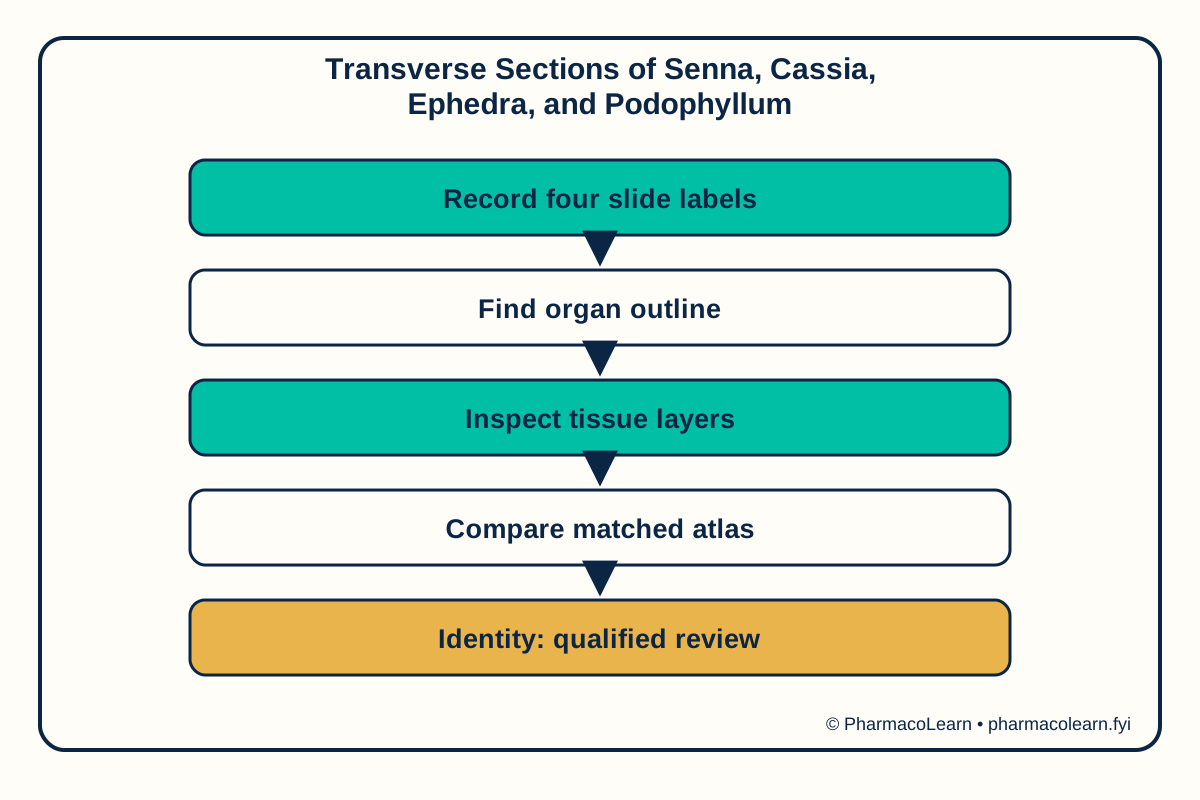
- Record the exact slide label, species if supplied, organ, preparation, and stain for each of the four materials; missing metadata must be recorded here.
- Examine each slide at low power to establish overall outline and tissue arrangement.
- Move to higher power only to inspect diagnostic features already located at low power.
- Sketch each field with labels for only observed tissues and record the objective used.
- Compare each specimen with the verified atlas for the same species and organ, documenting agreements, differences, and possible artifacts.
5. Calculation, graph, or images as appropriate
| Observation | Actual teaching record |
|---|---|
| Senna slide and organ | Record here |
| Cassia slide and organ | Record here |
| Ephedra slide and organ | Record here |
| Podophyllum slide and organ | Record here |
| Diagnostic tissue observations | Record here |
| Reference-supported conclusion | Record here |
No universal numerical count or measurement is invented. Assumed observations for practice only: an assumed Ephedra slide shows an axial stem outline and assumed vascular tissues visible at low power. This invented example does not characterize all four samples. Every actual slide identification remains Record here.
6. Result
The actual result and any identification or yield conclusion must be recorded here until the teaching method and observed record are confirmed. Safety note: Use prepared slides where possible. If fresh sections are authorized, blades, stains, and potentially toxic plant material require instructor supervision. Do not ingest or handle powdered crude drugs casually.
7. References
- Pharmacy Council of India, Pharm.D. Regulations, 2008.
- University of California Davis, Plant Anatomy Database: Stem Sections.
- Prairie View A&M University, Botany Laboratory Manual.
Back to Biology practicals, Year 1 Practicals · All Pharm D Practicals · Pharm D
Theory notes: Remedial Mathematics / Biology