
← Biology practicals, Year 1 Practicals
Study of Stem Modifications
1. Aim
To identify assigned modified stems by their structural evidence and recorded function. Species and specimen identity must be recorded here.
2. Requirements
Instructor-labelled examples or models of modified stems, hand lens, ruler if required, reference chart, notebook, and protective tools for cut surfaces. Record the supplied specimen species here; follow the instructor's method sheet for cutting.
3. Theory
A stem modification can store food, support climbing, spread vegetatively, or serve another function while retaining stem evidence such as nodes, internodes, buds, or leaf scars. The presence of a swollen storage organ alone does not prove it is a stem; roots can also swell. Observations should therefore be anchored to visible stem markers. Underground rhizomes, tubers, and aerial tendrils illustrate different modifications, but the class must identify the particular assigned specimen rather than transfer a label from a similar-looking plant.
4. Procedure
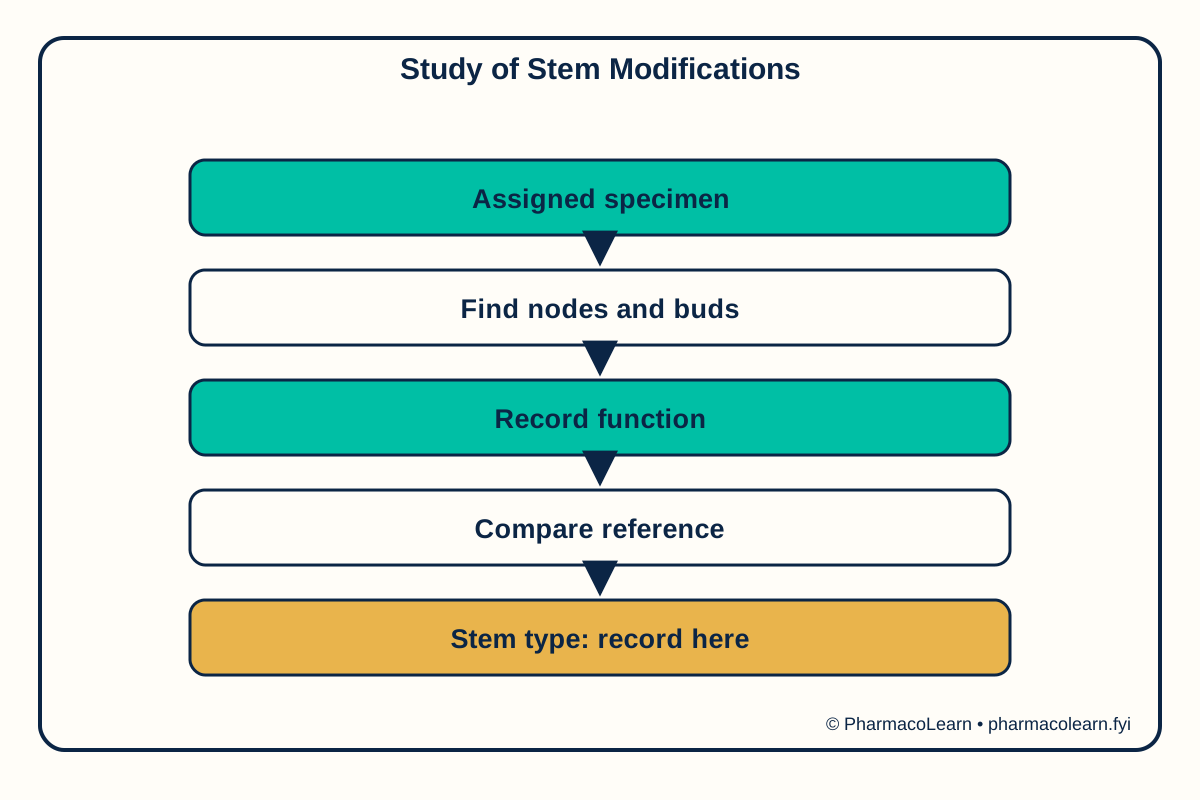
- Record the labelled specimen name or code and photograph or sketch it before handling.
- Locate nodes, internodes, buds, scars, or other stem evidence with a hand lens.
- Record orientation, storage or support structures, and any attached leaves or roots.
- Compare with a verified reference for that species and note features that distinguish it from a modified root.
- Write an evidence-based identification and note any feature not visible in the specimen.
5. Calculation, graph, or images as appropriate
| Observation | Actual teaching record |
|---|---|
| Assigned specimen | Record here |
| Visible stem markers | Record here |
| Location above or below ground | Record here |
| Apparent function | Record here |
| Reference comparison | Record here |
| Identification conclusion | Record here |
This is a morphological study, so no chemical quantity or numerical calculation is invented. Assumed observations for practice only: an assumed specimen has visible nodes and buds along a swollen axis. This invented example supports a stem interpretation only if the actual specimen and reference match. Real identification must follow your college lab manual and instructor's method sheet.
6. Result
The actual result and any identification or yield conclusion must be recorded here until the teaching method and observed record are confirmed. Safety note: Do not taste plant material. Cut only with instructor-approved tools and wash hands after handling unknown specimens.
7. References
- Pharmacy Council of India, Pharm.D. Regulations, 2008.
- Prairie View A&M University, Botany Laboratory Manual.
- University of Wisconsin Stevens Point, Botany Lab Illustrations.
Back to Biology practicals, Year 1 Practicals · All Pharm D Practicals · Pharm D
Theory notes: Remedial Mathematics / Biology