
← Biology practicals, Year 1 Practicals
Study of Root Modifications
1. Aim
To compare assigned modified roots and identify the visible characters that support a root rather than a stem origin. Specimen identity must be recorded here.
2. Requirements
Instructor-provided fresh or preserved root specimens, hand lens, reference chart, notebook, and approved cutting tools if cross sections are requested. Species, preparation method, and any stain are specified in your college lab manual and instructor's method sheet.
3. Theory
Roots can be modified for storage, support, aeration, or attachment. In contrast with a stem, a root normally lacks nodes and axillary buds. This distinction is useful but must be applied to an intact specimen because an isolated piece may conceal its origin. A swollen organ could be a storage root or a stem tuber; its attachment pattern and a verified reference settle the identification. The article treats morphology as evidence, not as proof of a medicinal identity or safe use.
4. Procedure
- Record the assigned specimen code and the part of the whole plant that was supplied.
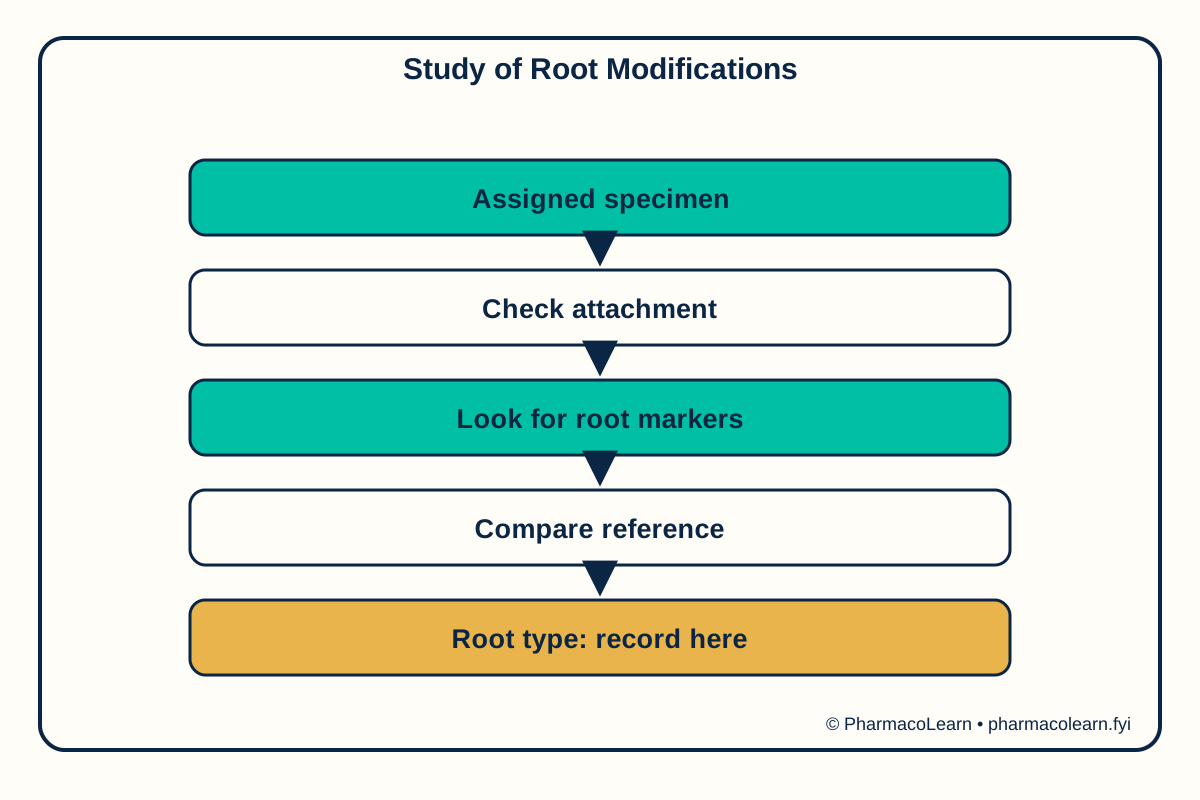
- Examine the origin and attachment of the organ, looking for lateral roots, a root cap region, and absence or presence of stem markers.
- Describe shape, branching, surface, and apparent function without guessing the species.
- Use an instructor reference or labelled whole-plant model to verify the organ type.
- Draw and label the observed characters, then state the likely modification and any uncertainty.
5. Calculation, graph, or images as appropriate
| Observation | Actual teaching record |
|---|---|
| Specimen code and whole-plant context | Record here |
| Root attachment | Record here |
| Nodes or buds present | Record here |
| Shape and branching | Record here |
| Reference comparison | Record here |
| Root modification conclusion | Record here |
No concentration or yield is involved. Assumed observations for practice only: an assumed storage organ has lateral roots and no visible nodes. This invented observation suggests a root modification, but the actual specimen identification must be recorded here.
6. Result
The actual result and any identification or yield conclusion must be recorded here until the teaching method and observed record are confirmed. Safety note: Unknown roots may irritate or be toxic. Do not taste or apply them to skin; use gloves and supervised cutting.
7. References
- Pharmacy Council of India, Pharm.D. Regulations, 2008.
- Prairie View A&M University, Botany Laboratory Manual.
- University of Wisconsin Stevens Point, Botany Lab Illustrations.
Back to Biology practicals, Year 1 Practicals · All Pharm D Practicals · Pharm D
Theory notes: Remedial Mathematics / Biology