
← Biology practicals, Year 1 Practicals
Identification of Animals
1. Aim
To identify instructor-provided animal specimens or images using visible characters and a verified zoological key. The taxonomic level and actual identifications must be recorded here.
2. Requirements
Approved museum specimens, models, or high-quality images; hand lens when useful; an instructor-approved key; notebook; and specimen labels. Any preserved material, storage fluid, handling rule, or dissection is specified in your college lab manual and instructor's method sheet.
3. Theory
Animal identification relies on a set of observable characters, not a single memorable feature. Body covering, symmetry, segmentation, limb arrangement, and other structures can narrow a specimen to a group. A key is valid only for its stated geographic and taxonomic scope. A photograph may hide important characters, while a preserved specimen may have lost colour or posture. The student should first write an observation list, then follow the key and record each decision point. A tentative group-level identification is more honest than an unsupported species name.
4. Procedure
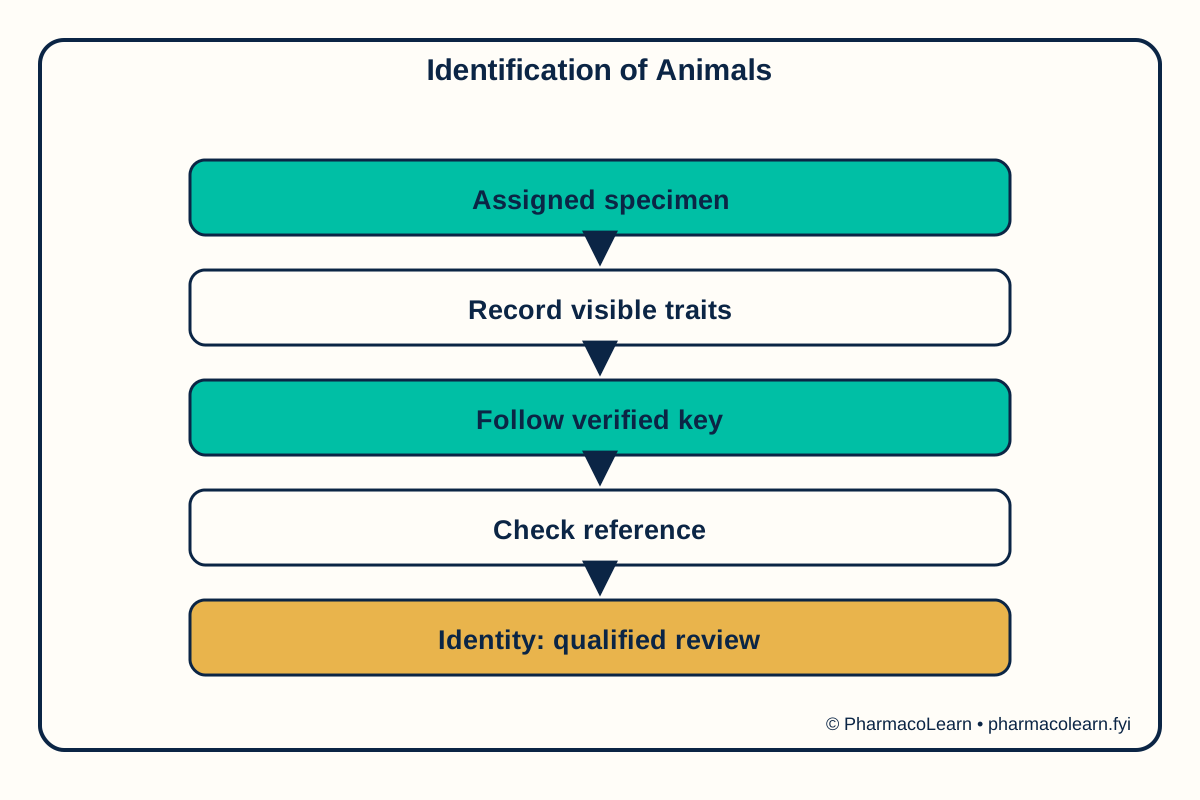
- Record the assigned specimen code and whether it is a model, image, or preserved specimen.
- Inspect external features without altering or opening the specimen.
- Write a list of positive characters and important characters that are not visible.
- Follow the approved key one decision at a time, recording the branch chosen and the evidence.
- Compare the proposed identification with a verified reference and state the supported taxonomic level.
5. Calculation, graph, or images as appropriate
| Observation | Actual teaching record |
|---|---|
| Specimen code and format | Record here |
| Observed body characters | Record here |
| Unavailable characters | Record here |
| Key decisions | Record here |
| Reference match | Record here |
| Supported identification | Record here |
No numerical count is required. Assumed observations for practice only: an assumed model has paired limbs and an assumed external backbone outline. These invented features might narrow a key, but they do not identify a real animal. The assigned specimen and final identification must be recorded here.
6. Result
Record actual observations here when the verified method and record are available. Safety note: Use images or approved preserved specimens. Do not collect live animals or handle unknown venomous animals for this class.
7. References
- Pharmacy Council of India, Pharm.D. Regulations, 2008.
- Natural History Museum of Utah, Specimen Identification.
Back to Biology practicals, Year 1 Practicals · All Pharm D Practicals · Pharm D
Theory notes: Remedial Mathematics / Biology