
Preparation of Liniment of Turpentine IP
1. Aim
To calculate and, if an authenticated formula and local controls are available, prepare a supervised teaching-lab sample of Liniment of Turpentine IP. Record emulsion formation, final volume, appearance, and separation. The applicable IP monograph and release criteria are to be recorded from the assigned current monograph or approved college method in the student record. [1, 2]
2. Requirements
The East Point College of Pharmacy manual lists soft soap, camphor, turpentine oil, and purified water. The ingredient grades, turpentine quality, exact formula, assigned batch size, final container, and storage conditions must be specified in your college lab manual and instructor's method sheet. A supervised setup may include a calibrated balance, liquid measures, mortar and pestle or suitable mixer, beakers, funnel, closable container, label, and batch sheet. Wear a laboratory coat, eye protection, and gloves appropriate for turpentine. The instructor must specify ventilation, ignition controls, spill response, and flammable waste collection. [2, 3]
3. Theory
This liniment is described by the college manual as an oil-in-water emulsion. Turpentine oil and dissolved camphor form the dispersed oil phase. Water is the continuous phase, and soft soap helps stabilize droplets at the oil-water boundary. Adding the oil phase gradually while mixing supports dispersion, but a creamy appearance does not prove stability or a particular droplet size. Separation after standing must be recorded. [2]
Turpentine is flammable and may enter the body through inhalation or skin contact. The preparation is a historical topical teaching formulation, not an oral product and not a sample for application to people during this exercise. A different university handout contains a contradictory oral direction in a label example, so the route must be established from the authenticated IP monograph and institutional method, not copied from that example. [2, 3, 4]
4. Procedure
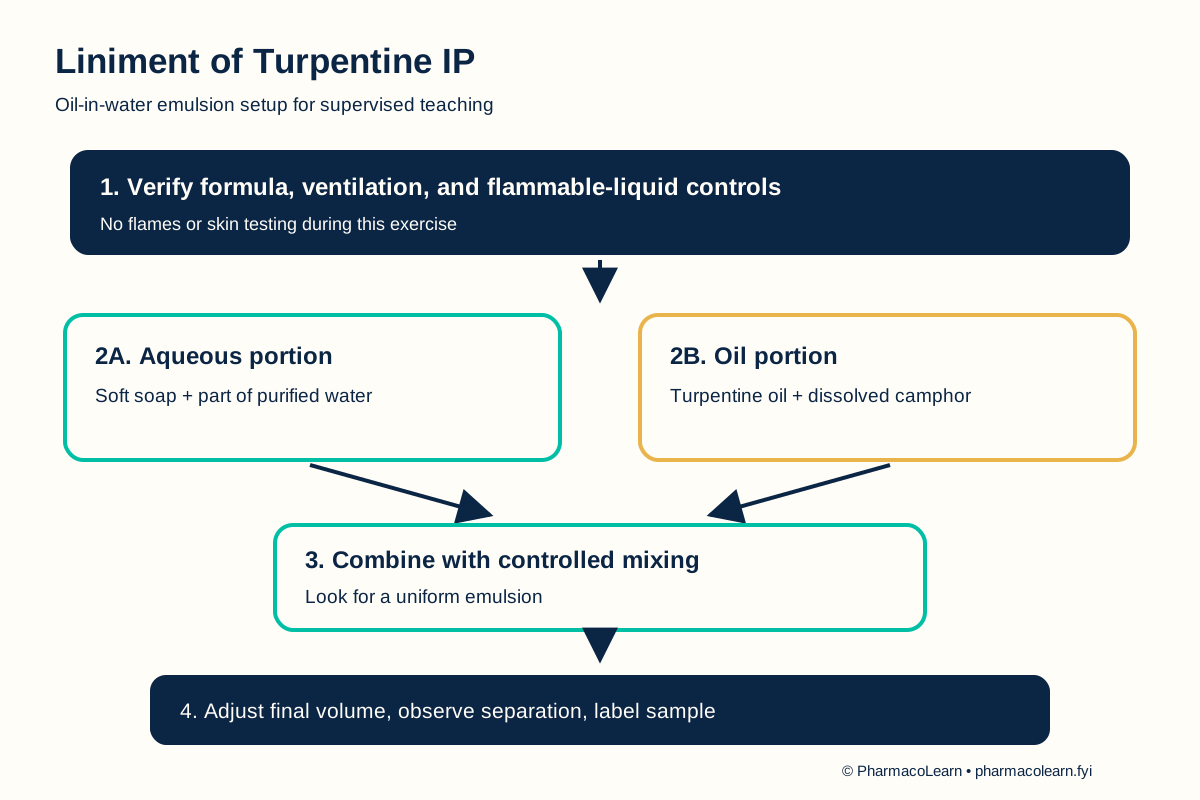
- Obtain the authenticated IP formula and edition, ingredient specifications, assigned final volume, and written flammable-liquid procedure. Record them on the batch sheet when supplied. If any essential control is unavailable, complete only the calculation and emulsion diagram review. [2, 3]
- Prepare the approved ventilated work area. Remove flames, sparks, and hot equipment. Check the protective equipment, measuring devices, labels, and waste container. The local safety check must be specified in your college lab manual and instructor's method sheet. [3]
- Calculate the amount of each ingredient from the verified master formula. Keep soap and camphor masses separate from turpentine and water volumes. Have the calculation checked before dispensing. [2]
- If wet-lab work is authorized, disperse the specified soft soap in a portion of purified water according to the written method. In a separate closed or controlled vessel, dissolve the specified camphor in the turpentine oil. Do not heat either portion. [2, 3]
- Add the oil phase to the aqueous soap phase in the verified sequence with controlled mixing until a uniform emulsion forms. The addition rate and mixing endpoint must be specified in your college lab manual and instructor's method sheet. Avoid vigorous whipping that traps air. [2]
- Transfer to the specified calibrated container and add purified water to the assigned final volume. Mix and record the actual volume. [2]
- Observe initial appearance and any separation after the instructor-specified standing interval. Record the interval and criteria here. Do not test the emulsion on skin or by tasting. [2, 3]
- Label with the verified composition, batch record, date, external-use teaching sample, flammable, and not for patient use. Follow the institution's closed-container storage and flammable-waste directions, which must be specified in your college lab manual and instructor's method sheet. [3]
5. Calculation, graph, or images as appropriate
| Record item | Historical teaching formula | Working quantity or observation |
|---|---|---|
| Soft soap | 90 g per 1000 mL finished liniment [2] | Record here |
| Camphor | 50 g per 1000 mL finished liniment [2] | Record here |
| Turpentine oil | 650 mL per 1000 mL finished liniment [2] | Record here |
| Purified water to final volume | Sufficient to target [2] | Record here |
| Initial appearance and later separation | Criteria and interval record from the assigned current monograph or approved college method | Record here |
Worked calculation for a 20 mL teaching batch: The scale factor is 20 mL ÷ 1000 mL = 0.02. Soft soap = 90 g × 0.02 = 1.8 g. Camphor = 50 g × 0.02 = 1 g. Turpentine oil = 650 mL × 0.02 = 13 mL. Purified water is added to a final volume of 20 mL, not as an extra 20 mL. These are sourced teaching quantities; current IP status, the approved batch size, actual measurements, and stability criteria must be recorded here. [2]
6. Result
State whether a supervised sample was prepared or the work remained a paper exercise. Record authenticated formula, actual ingredient amounts, final volume, initial appearance, separation observations, and deviations here. Do not claim IP compliance or suitability for human application from appearance alone. [2, 3]
7. References
- Pharmacy Council of India. Pharm.D. Regulations, 2008, Appendix A. Lists Liniment of turpentine IP after Strong solution of ammonium acetate IP.
- East Point College of Pharmacy. Pharmaceutics Practical Manual, Experiment 16: Turpentine Liniment IP. Gives the historical teaching ingredients and oil-in-water emulsion method.
- National Institute for Occupational Safety and Health. Pocket Guide to Chemical Hazards: Turpentine. Documents flammability, exposure routes, and health hazards.
- East Point College of Pharmacy. Pharmaceutics Lab Manual, Turpentine Liniment IP 66. Supports external-use framing but contains a contradictory oral direction in a label example; do not follow that direction.
Back to Pharmaceutics Practicals · All Pharm D Practicals · Pharm D
Theory notes: Pharmaceutics