
Study of Strong Solution of Ammonium Acetate IP
1. Aim
To calculate and interpret the preparation and endpoint checks for Strong Solution of Ammonium Acetate IP. Use an authenticated IP formula and an instructor-supplied record or sealed sample before any supervised wet-lab work. The edition, formula, endpoint, and local authorization must be specified in your college lab manual and instructor's method sheet. [1, 2]
2. Requirements
For the student calculation and observation exercise: authenticated formula sheet, calculator, batch record, process diagram, and supplied indicator observations or sealed sample. The East Point College of Pharmacy manual names glacial acetic acid, ammonium bicarbonate, strong ammonia solution, purified water, bromothymol blue, and thymol blue. Their exact grades, amounts, indicator method, final volume, and acceptance criteria are to be recorded from the assigned current monograph or approved college method in the student record. Wet-lab work would additionally require a trained instructor, suitable ventilation, splash protection, acid-resistant gloves, coat, and approved waste and emergency procedures. [2, 3, 4]
3. Theory
The historical preparation uses an acid and an ammonium source to form ammonium acetate in water. Addition of ammonium bicarbonate to acid can release gas and cause frothing. A separate ammonia solution may be used to adjust the endpoint, which the manual describes with indicator tests on withdrawn aliquots. Those indicator drops should never be returned to the main preparation. The final liquid is adjusted to its specified volume only after the reaction and endpoint assessment. [2]
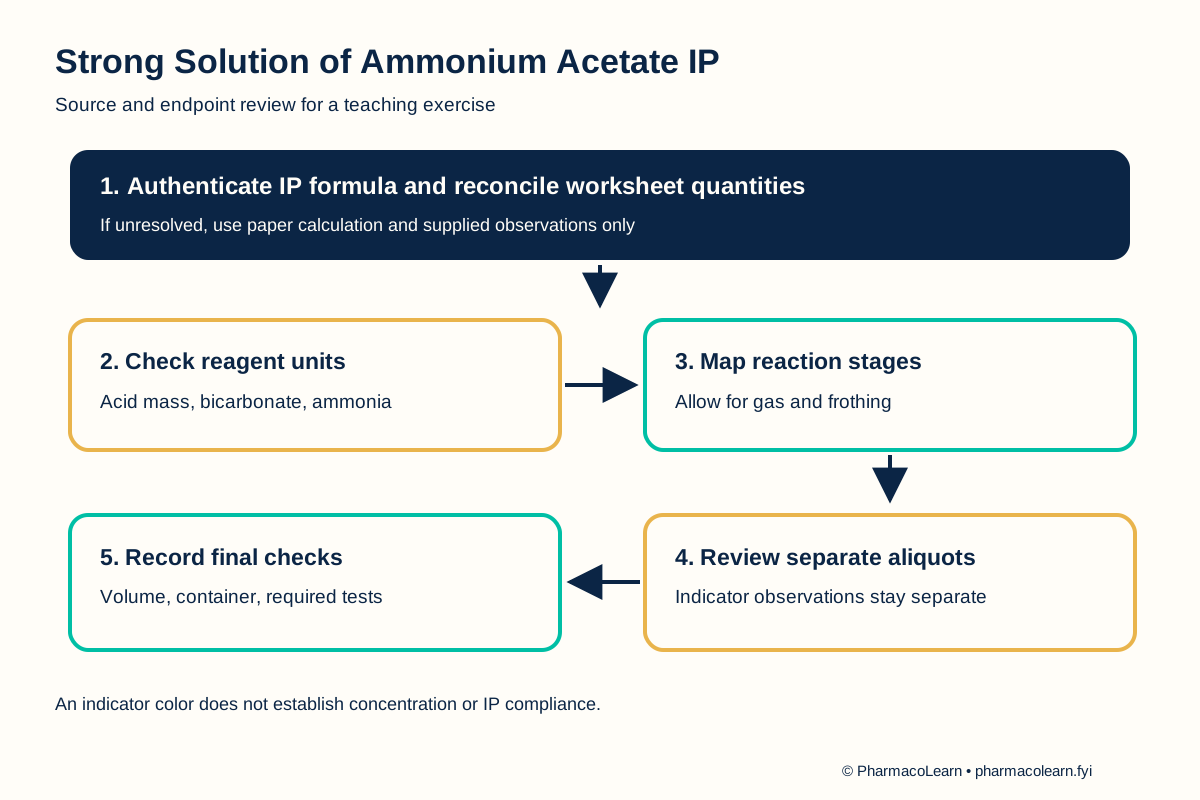
The college manual's master and working acetic-acid quantities do not scale consistently to its stated batch size. Its printed reaction explanation also needs checking against a reliable source. The instructor must reconcile the formula, reagent strengths, pH or indicator endpoint, and sequence before any preparation. Glacial acetic acid is corrosive and flammable; ammonia exposure can irritate or injure eyes and airways. A color change or clear appearance alone does not establish concentration or IP compliance. [2, 3, 4]
4. Procedure
- Obtain the authenticated IP monograph and edition, complete formula, assigned final volume, reaction and endpoint method, and written local safety controls. These must be specified in your college lab manual and instructor's method sheet. If the college manual's scale discrepancy remains unresolved, use only the paper calculation and supplied observation record. [2, 3, 4]
- List each ingredient's identity, grade, unit, and function from the verified source. Keep the indicators separate from the preparation ingredients. Record unknown grades or quantities here. [2]
- Calculate the working amounts from the authenticated master formula. Check whether mass or volume is specified for each reagent, and compare the scaled values with the manual's worksheet. Have the calculation independently checked. [2]
- On the process diagram, identify the conceptual stages: dilute acid under the written method, controlled ammonium-bicarbonate addition with space for frothing, endpoint assessment on separate aliquots, final-volume adjustment, and container checks. The actual addition rate, volumes, temperature, and endpoint must be specified in your college lab manual and instructor's method sheet. [2, 3, 4]
- Review instructor-supplied indicator observations or a sealed sample. Record the indicator identity, aliquot preparation, observed color, and stated interpretation. Do not open, smell, or taste the sample. [2, 3]
- Compare the observations with the authenticated acceptance criteria. If the indicator result is ambiguous, report it in the student record rather than adjusting a reaction from this article. [2]
- Record the final-volume and lead-free-container requirements only after confirming them in the source. The actual sample volume, packaging, storage, and disposal must be recorded here. Label all teaching material not for patient use. [2, 3]
5. Calculation, graph, or images as appropriate
| Record item | Authenticated master value or criterion | Scaled or supplied observation |
|---|---|---|
| Glacial acetic acid grade and mass | Use authenticated formula or method | Record here |
| Ammonium bicarbonate mass | Use authenticated formula or method | Record here |
| Strong ammonia solution grade and amount | Use authenticated formula or method | Record here |
| Indicator identity and endpoint color | Use authenticated formula or method | Record here |
| Purified water to final volume | Use authenticated formula or method | Record here |
| Required concentration test | Use authenticated formula or method | Record here |
Worked scaling check: If an authenticated master formula lists M grams of glacial acetic acid for V mL of finished solution, a target v mL batch needs M × v/V grams. For a batch one-fiftieth of the master volume, this is M/50. The actual M, V, v, and resulting mass must be specified in your college lab manual and instructor's method sheet. A mass cannot be converted to a volume until the specified acid grade and its verified density are known. This arithmetic does not resolve the manual's conflicting working quantity. [2]
6. Result
Report the authenticated formula status, scaling check, supplied endpoint observations, and unresolved requirements in the student record. State whether the exercise remained on paper. Do not claim IP compliance, finished strength, or patient suitability from indicator color or a sealed sample. [2, 3]
7. References
- Pharmacy Council of India. Pharm.D. Regulations, 2008, Appendix A. Lists Strong solution of ammonium acetate IP in the Pharmaceutics practical syllabus.
- East Point College of Pharmacy. Pharmaceutics Practical Manual, Experiment 15: Strong Solution of Ammonium Acetate IP. Describes the historical teaching stages and indicators; its working formula requires reconciliation.
- National Institute for Occupational Safety and Health. Pocket Guide to Chemical Hazards: Ammonia. Documents ammonia exposure and contact hazards.
- National Institute for Occupational Safety and Health. Pocket Guide to Chemical Hazards: Acetic acid. Documents glacial acetic acid burns and fire hazards.
Back to Pharmaceutics Practicals · All Pharm D Practicals · Pharm D
Theory notes: Pharmaceutics