
Preparation of Liniment of Camphor IP
1. Aim
To study the preparation of Liniment of Camphor IP as a supervised teaching exercise, calculate a scaled historical formula, and record the appearance of the finished sample. The applicable IP edition, formula, and acceptance criteria are to be recorded from the assigned current monograph or approved college method in the student record before any wet-lab preparation. [1, 2]
2. Requirements
The East Point College of Pharmacy manual lists camphor and arachis oil. A balance, dry wide mouthed glass vessel with stopper, measuring cylinder, stirrer, label, and suitable finished container are needed if the instructor authorizes preparation. The manual uses a water bath; its heating conditions and local fire controls must be specified in your college lab manual and instructor's method sheet. Wear a coat, eye protection, and suitable gloves. Confirm the oil's identity and grade, camphor grade, batch size, packaging, and any peanut or soya allergy controls before use. [2, 3, 4]
3. Theory
Camphor liniment is described in the college manual as an oily solution. Camphor is dissolved in arachis oil rather than dispersed as solid particles. Dissolution can be followed by visual inspection for remaining crystals, but a clear appearance alone cannot prove the chemical strength or IP compliance. The manual presents 200 g camphor and 800 mL arachis oil as its historical formula; it does not state that the combined mixture makes exactly 1000 mL. Mass and liquid volume must therefore be recorded separately. [2]
Camphor is a combustible solid and can be absorbed or cause harm through several exposure routes. Arachis oil is peanut oil; an official European Medicines Agency position paper advises allergy precautions for medicinal products containing it. This teaching sample must never be swallowed or applied to people. Do not use open flames. Any warming must follow an instructor-approved vessel, temperature, and ventilation procedure. [3, 4]
4. Procedure
- Obtain the authenticated IP formula and edition, specified ingredient grades, target batch quantity, acceptable appearance, and approved handling instructions. Record missing details here. If these are unavailable, complete the calculation and observation exercise on paper. [1, 2]
- Check the camphor and arachis oil labels against the approved formula. Record lot numbers, expiry dates, and any relevant allergy controls. The actual material identities and suitability must be recorded here. [2, 4]
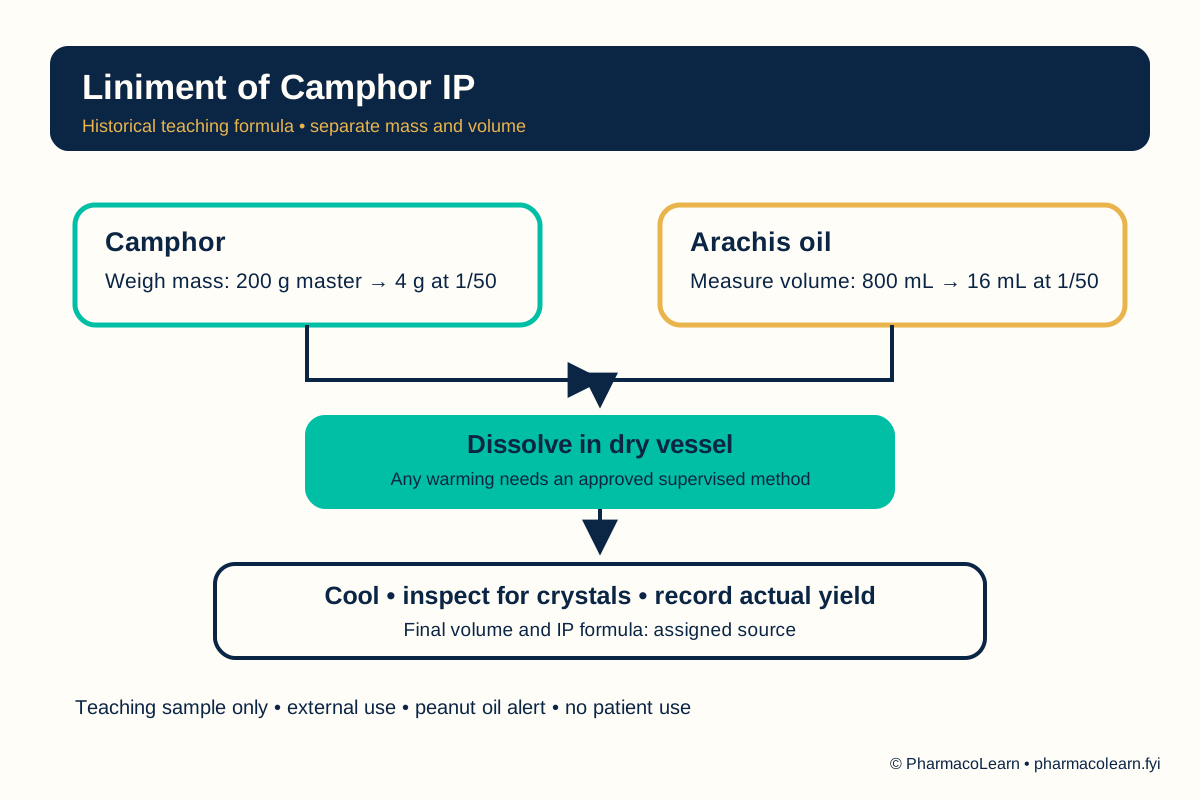
- Calculate the scaled camphor mass and oil volume separately. Have the instructor check the calculation. Do not assume the sum of 200 g and 800 mL represents a final volume. [2]
- If wet-lab work is authorized, put the weighed camphor in a dry, suitable vessel. Add the measured arachis oil according to the written institutional method and close or cover the vessel as approved. [2]
- Mix until the camphor dissolves. The college manual describes gentle water-bath warming if needed, but the permitted bath temperature, vessel closure, duration, and cooling procedure must be specified in your college lab manual and instructor's method sheet. Keep ignition sources away and do not heat without direct supervision. [2, 3]
- Let the mixture cool to the specified assessment temperature. Observe against a light background for undissolved camphor or foreign matter. Record the appearance and actual recovered amount; the release criteria are to be recorded from the assigned current monograph or approved college method in the student record. [2]
- Transfer to the approved well closed container and affix a teaching label: external-use teaching sample, contains arachis oil (peanut oil), and not for patient use. Storage and disposal conditions must be specified in your college lab manual and instructor's method sheet. [2, 4]
5. Calculation, graph, or images as appropriate
| Record item | Historical teaching formula [2] | For a one-fiftieth scale exercise | Actual observation |
|---|---|---|---|
| Camphor | 200 g | 200 ÷ 50 = 4 g | Record here |
| Arachis oil | 800 mL | 800 ÷ 50 = 16 mL | Record here |
| Finished volume or mass | Not stated as a final target | Record here | Record here |
| Appearance after cooling | Criterion record from the assigned current monograph or approved college method | Visual record only | Record here |
| Container and label | Approved method from local sheet | Teaching sample | Record here |
Worked calculation: A one-fiftieth scale of the manual's listed formula requires 200 g × 1/50 = 4 g camphor and 800 mL × 1/50 = 16 mL arachis oil. These are separate ingredient amounts, not a guarantee of 20 mL finished liniment. The actual yield and current IP formula must be specified in your college lab manual and instructor's method sheet. Do not convert the oil volume into mass using an unconfirmed density. [2]
6. Result
Report whether the work was a paper exercise or a supervised preparation. Enter the actual camphor mass, oil volume, recovered amount, appearance after cooling, and any crystals or foreign matter here until observed. Record deviations. Do not claim IP compliance or human-use suitability from this teaching exercise. [2, 3]
7. References
- Pharmacy Council of India. Pharm.D. Regulations, 2008, Appendix A. Lists Liniment of camphor IP after Liniment of turpentine IP.
- East Point College of Pharmacy. Pharmaceutics Practical Manual, Experiment 17: Camphor Liniment IP. Supplies the historical teaching formula and method; its table of contents calls the preparation BPC, while the experiment body calls it IP.
- National Institute for Occupational Safety and Health. Pocket Guide to Chemical Hazards: Camphor (synthetic). Describes combustibility and exposure hazards.
- European Medicines Agency. Position paper on the allergenic potency of herbal medicinal products containing soya or peanut protein. Gives cautionary wording for products containing arachis oil.
Back to Pharmaceutics Practicals · All Pharm D Practicals · Pharm D
Theory notes: Pharmaceutics