
Preparation of Piperazine Citrate Elixir BP
1. Aim
To calculate and document a supervised teaching-lab preparation of Piperazine Citrate Elixir BP, using an authenticated formula and locally approved ingredients. The applicable BP edition, complete formula, and authorization for any wet-lab preparation must be specified in your college lab manual and instructor's method sheet. [1, 2]
2. Requirements
The college teaching manual lists piperazine citrate, glycerol, orange oil, syrup, purified water, and chloroform spirit. The authenticated BP formula may differ, so the ingredient list, grades, quantities, target volume, and approved handling route must be specified in your college lab manual and instructor's method sheet. Use a calibrated balance, calibrated liquid measures, beakers, stirring rod, funnel, final container, label, and batch record. Wear a laboratory coat, eye protection, and appropriate gloves. If the verified formula includes chloroform spirit, the instructor must provide a written exposure-control and waste procedure before anyone handles it. [2, 3, 4]
3. Theory
An elixir is a sweetened liquid preparation in which the solvent system helps keep the active ingredient and flavoring materials distributed. The East Point College of Pharmacy manual dissolves piperazine citrate in some purified water, combines the remaining vehicle ingredients, and then adjusts to final volume. The source recipe also lists chloroform spirit. Chloroform presents a significant inhalation and skin-exposure concern, so its inclusion cannot be assumed acceptable for a current teaching or patient-use formulation. The original BP monograph was not available for direct verification. [2, 4]
The final volume is set only after all measured ingredients are combined. An appearance check may reveal undissolved material or cloudiness but cannot establish potency, preservative adequacy, stability, or BP compliance. This article supports a paper exercise if the authentic monograph and local chemical controls are unavailable. It does not give a patient dose. [2, 3]
4. Procedure
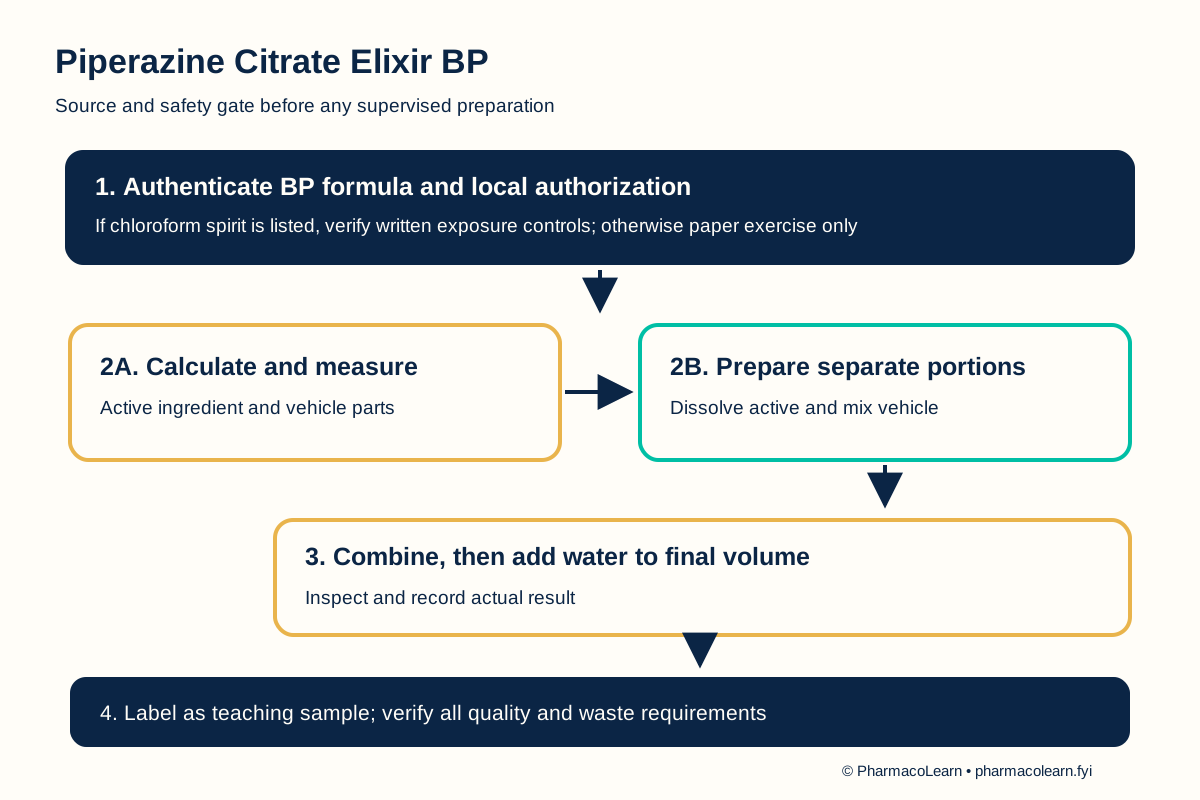
- Have the instructor authenticate the BP monograph or locally approved source formula, edition, assigned volume, and ingredient list. Confirm whether the historical chloroform-spirit component is present and whether the institution authorizes its use. These points must be specified in your college lab manual and instructor's method sheet. If unresolved, complete only the calculation and diagram review. [2, 3, 4]
- Check the work area's written safety controls, ingredient labels, balance and liquid-measure calibration, protective equipment, and waste container. The local approval and record must be recorded here. [3, 4]
- Calculate each ingredient amount from the authenticated master formula and target final volume. Have the arithmetic checked independently before measuring. The actual formula values must be specified in your college lab manual and instructor's method sheet. [2, 3]
- If wet-lab work is authorized, weigh the specified piperazine citrate and dissolve it in the amount of purified water directed by the verified formula. Record actual mass and water volume. [2]
- Measure and combine the other approved vehicle components in the prescribed order. If chloroform spirit is included, use the institution's specified exposure controls; do not heat or use an open flame. Component quantities and order must be specified in your college lab manual and instructor's method sheet. [2, 4]
- Add the piperazine solution to the approved vehicle mixture with stirring. Inspect for separation or undissolved material. Any clarification or filtration step must follow the authenticated formula and local method sheet. [2]
- Transfer to the calibrated final container, rinse with an approved vehicle portion if directed, and add purified water to the final volume. Mix and record the measured final volume. [2]
- Record appearance and any deviation without tasting. Label the container teaching sample, not for patient use, with the batch record and verified composition. Follow local storage, inventory, and chemical-waste instructions, which must be specified in your college lab manual and instructor's method sheet. [3, 4]
5. Calculation, graph, or images as appropriate
| Record item | Authenticated master formula | Calculated working quantity | Actual record |
|---|---|---|---|
| Piperazine citrate | Use authenticated formula | Record here | Record here |
| Glycerol and syrup | Use authenticated formula | Record here | Record here |
| Flavor and any permitted preservative | Use authenticated formula | Record here | Record here |
| Purified water to final volume | Use authenticated formula | Sufficient to final volume | Record here |
| Final volume and appearance | Criteria record from the assigned current monograph or approved college method | Not applicable | Record here |
Worked scaling method: If the authenticated source specifies M grams of piperazine citrate for V mL of finished elixir, an assigned v mL batch requires M × v/V grams. For a batch one-tenth of the authenticated master volume, the scaled mass is M/10. The actual M, V, v, and numerical result must be recorded here. Other components must be checked against their own units and the verified formula before scaling. Water is added to final volume, not as a separate full batch volume. [2]
6. Result
State whether the exercise remained on paper or an approved sample was prepared. Record the authenticated formula, calculated and measured ingredient amounts, final volume, appearance, and deviations here. Do not claim BP compliance or dispense a teaching sample without the appropriate monograph and quality checks. [2, 3]
7. References
- Pharmacy Council of India. Pharm.D. Regulations, 2008, Appendix A. Lists Piperizine citrate elixir BP as the first elixir practical; this article uses the standard spelling Piperazine.
- East Point College of Pharmacy. Pharmaceutics Practical Manual, Experiment 6: Piperazine Citrate Elixir. Supplies a historical teaching ingredient list and mixing sequence. Its BP attribution requires direct monograph verification.
- United States Pharmacopeia. General Chapter 795: Pharmaceutical Compounding, Nonsterile Preparations. General quality framework, not the BP formula.
- National Institute for Occupational Safety and Health. Pocket Guide to Chemical Hazards: Chloroform. Occupational exposure and hazard information for the ingredient named in the college manual.
Back to Pharmaceutics Practicals · All Pharm D Practicals · Pharm D
Theory notes: Pharmaceutics