
Physical Incompatibility: Oil and Water in an Emulsion
1. Aim
To identify physical incompatibility in an oil-and-water formulation, distinguish an expected two-phase starting system from an unstable finished emulsion, and record evidence from a sealed teaching sample or supplied observations. The PCI syllabus lists this as Physical incompatibility. The college manual illustrates it with cod liver oil emulsion. The exercise does not authorize use of a teaching sample by a patient. [1, 2]
2. Requirements
Use the PCI practical list, the East Point College of Pharmacy manual, an observation sheet, calculator, an instructor-supplied sealed emulsion or photographs, and a timer only if the instructor has specified an observation period. A transparent sample container is useful for recording layer separation without opening it. The manual names cod liver oil, acacia, chloroform, and cinnamon water. The selected sample's identity, preparation record, age, storage conditions, container integrity, and approved acceptance limits are to be recorded from the assigned current monograph or approved college method in the student record. Because the historical formula contains chloroform, this activity uses no open chloroform or preparation step. [2, 3]
3. Theory
Physical incompatibility is an undesirable change in a formulation's physical state or appearance without needing a chemical reaction to explain it. Oil and water do not form a single homogeneous liquid. An emulsion uses an emulsifier and appropriate processing to disperse one liquid as droplets in the other. This practical therefore has two questions: was an emulsion made, and does the supplied sample remain acceptably dispersed under its specified conditions? A visible oil layer may indicate separation, but appearance alone does not establish the cause or quality of an emulsion. [2]
The manual's cod liver oil example lists 30 mL of oil for a final 100 mL preparation and 7.5 g acacia. It also lists chloroform and cinnamon water. Those quantities are historical source data for recognizing the system, not a recipe to prepare here. The manual's broad description of immiscibility must not be confused with a final-product failure: two phases before emulsification are expected, whereas layer separation in a finished sample requires assessment against a defined test and time point. The source does not supply a defensible acceptance limit for the sealed sample used in this article, so that criterion is to be recorded from the assigned current monograph or approved college method in the student record. [2]
The preceding syllabus item, cod liver oil emulsion, teaches preparation. This entry concentrates on diagnosing and documenting a physical incompatibility. It does not repeat compounding instructions. If a supplied sample has separated, gentle inversion may sometimes redisperse droplets, but a visual response is not proof of acceptable droplet size, stability, preservative content, or patient suitability. The instructor's test method and conclusion must be specified in your college lab manual and instructor's method sheet. [2]
4. Procedure
- Confirm the syllabus title and the teaching sample's label. Record the sample identity, batch, preparation date, and storage record. Mark missing details Record here. [1, 2]
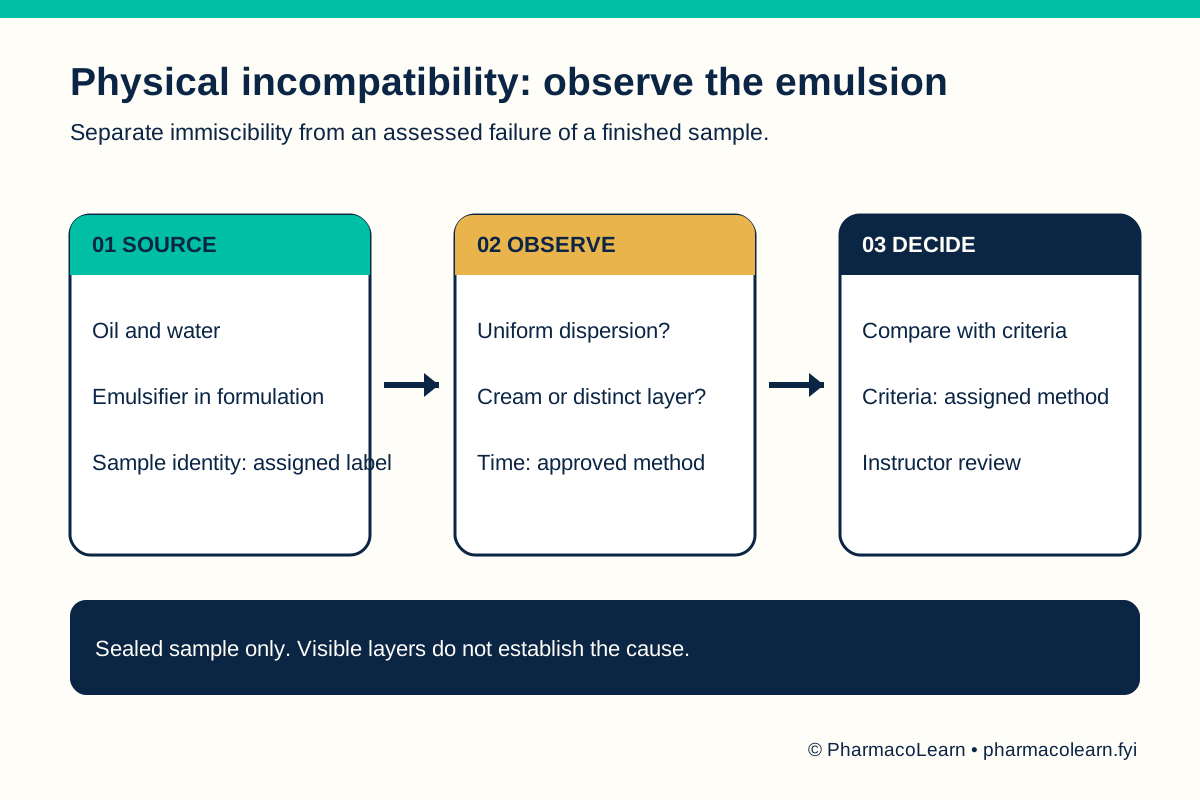
- Review the concept diagram. Identify the oil phase, aqueous phase, and emulsifier role on paper. Do not open the sample or handle chloroform. [2, 3]
- Observe the sealed sample against a plain background. Record whether it looks uniformly dispersed, shows droplets or cream at the top, or has a distinct liquid layer. Use descriptive words rather than a pass or fail claim. [2]
- If the instructor supplies before-and-after photographs, record their stated elapsed time and storage conditions. Do not invent either value; leave the student record field blank where absent. [2]
- If an approved observation plan includes inversion, record the number of inversions and the appearance afterward here until the instructor provides the method and observation. Do not shake an unlabelled container. [2]
- Compare the observations with the locally approved acceptance criteria. If no criteria are documented, record the physical finding only and label disposition Record here. [2]
- Complete the observation table and report whether the evidence suggests immiscibility before emulsification, creaming, cracking, or an unresolved appearance change. Submit the record for instructor review. [2]
5. Calculation, graph, or images as appropriate
| Item | Manual or planned value | Supplied observation | Interpretation |
|---|---|---|---|
| Oil and final preparation volume | 30 mL oil in 100 mL final volume [2] | Sample identity: Record here | Oil-volume proportion can be checked |
| Emulsifier | Acacia, 7.5 g in manual [2] | Actual sample composition Record here | Cannot infer concentration in sealed sample |
| Initial appearance | Defined test time from approved method | Record here | Describe uniformity or visible layer |
| Later appearance | Elapsed time and storage from approved method | Record here | Record any change without guessing cause |
| Redispersion test | Approved method from local sheet | Record here | Appearance alone cannot establish quality |
| Acceptance decision | Record criterion from the approved method | Record here | Instructor review required |
Worked calculation: The historical example places 30 mL of oil in a preparation made up to 100 mL. Its nominal oil-volume proportion is 30 ÷ 100 × 100 = 30% v/v. For a purely arithmetic 20 mL scale, the corresponding oil volume would be 0.30 × 20 = 6 mL. This calculation does not account for volume displacement or give a preparation instruction. It cannot be applied to the sealed sample unless its composition is confirmed. [2]
6. Result
Record the observed physical state and whether a distinct layer, cream, or other change is present. State the sample's identity and test conditions only when documented. Sample suitability and the cause of any separation are assessed by the qualified reviewer against the assigned approved method and actual record. The acceptance decision is made by that reviewer and recorded in the student record. This page decides nothing: it does not pass, fail, identify, or release any sample. No sample is prepared, opened, dispensed, or administered. [2, 3]
7. References
- Pharmacy Council of India. Pharm.D. Regulations, 2008, Appendix A. Lists Physical incompatibility in the Year 1 Pharmaceutics practical sequence.
- East Point College of Pharmacy. Pharmaceutics Practical Manual, Experiment 28: Physical Incompatibility. Uses cod liver oil emulsion to illustrate oil-water immiscibility.
- National Institute for Occupational Safety and Health. Pocket Guide to Chemical Hazards: Chloroform. Provides occupational hazard information relevant to the historical formula.
Back to Pharmaceutics Practicals · All Pharm D Practicals · Pharm D
Theory notes: Pharmaceutics