
Study of Chloral Hydrate Suppositories
1. Aim
To calculate a historical chloral hydrate suppository formula and review its moulding and quality checks using a written record. This is a paper or sealed-sample teaching exercise unless a current approved institutional protocol specifically authorizes preparation. The current formulation, ingredient controls, and acceptance criteria are to be recorded from the assigned current monograph or approved college method in the student record. [1, 2, 3]
2. Requirements
Use the PCI syllabus, East Point College of Pharmacy manual, calculator, authenticated mould-capacity and displacement data, blank observation sheet, and instructor-supplied images or sealed sample. The historical manual names chloral hydrate, cocoa butter, a suppository mould, dish, water bath, spatula, and lubricant. Actual reagent handling requires trained supervision and controls for a sedating drug; access authorization, protective equipment, ventilation, inventory, and disposal must be specified in your college lab manual and instructor's method sheet. Students should not open or use a sample. [2, 3]
3. Theory
The historical formula disperses chloral hydrate in a cocoa-butter base. The base occupies the mould volume left after the drug has displaced some of it. A displacement value expresses how much drug replaces a given mass of base; the cited manual states a value of 1.5 for chloral hydrate and a 2 g mould. It plans six cavities to obtain five intact units. These numbers support a calculation example but do not establish current compounding standards. [2]
Chloral hydrate is a central nervous system depressant. Safety sources describe serious harm from exposure and overdose. The college manual's patient directions are not appropriate for a student exercise. Appearance and unit mass alone do not prove ingredient uniformity, potency, stability, or clinical suitability. The drug and any made units must remain under institutional control. [2, 3]
4. Procedure
- Obtain the approved formula, mould calibration, verified displacement value, safety controls, and sample observation record. Record all missing items on the batch sheet and consult the approved method before proceeding. No student handling of chloral hydrate follows from this article. [1, 2, 3]
- Calculate the historical drug mass for six cavities and the theoretical base displacement. Compare the result with the manual's working table. Record the arithmetic and its assumptions. [2]
- On the diagram, identify the conceptual stages: calibrated mould, softened base, uniform drug dispersion, fill, solidification, and unit checks. The actual heating and mixing parameters must be specified in your college lab manual and instructor's method sheet. [2]
- Review a sealed instructor-supplied sample or photographs. Note visible cracks, surface defects, variation in size, or signs of separation. Do not open, handle, insert, or administer a unit. [2, 3]
- If the instructor supplies individual unit masses, calculate their range and compare it with the authenticated criterion. The measurements and limits must be specified in your college lab manual and instructor's method sheet. [2]
- Record the status of content uniformity, identity, packaging, storage, and disposal tests. Leave missing results blank in the student record; do not infer them from appearance. [2, 3]
- File the exercise as a historical formula review. Any sample remains labelled controlled teaching material, not for patient use. [2, 3]
5. Calculation, graph, or images as appropriate
| Record item | Cited manual [2] | Worked calculation or observation |
|---|---|---|
| Mould capacity with base | 2 g per cavity | Calibration Record here |
| Cavities planned | Six to obtain five | Actual units Record here |
| Chloral hydrate per cavity | 200 mg | 200 mg × 6 = 1.2 g |
| Displacement value | 1.5 | Applicability Record here |
| Base displaced | Derived | 1.2 g ÷ 1.5 = 0.8 g |
| Cocoa butter needed | 11.2 g in manual | (6 × 2 g) - 0.8 g = 11.2 g |
| Unit mass and visual quality | Criteria record from the assigned current monograph or approved college method | Record supplied result here |
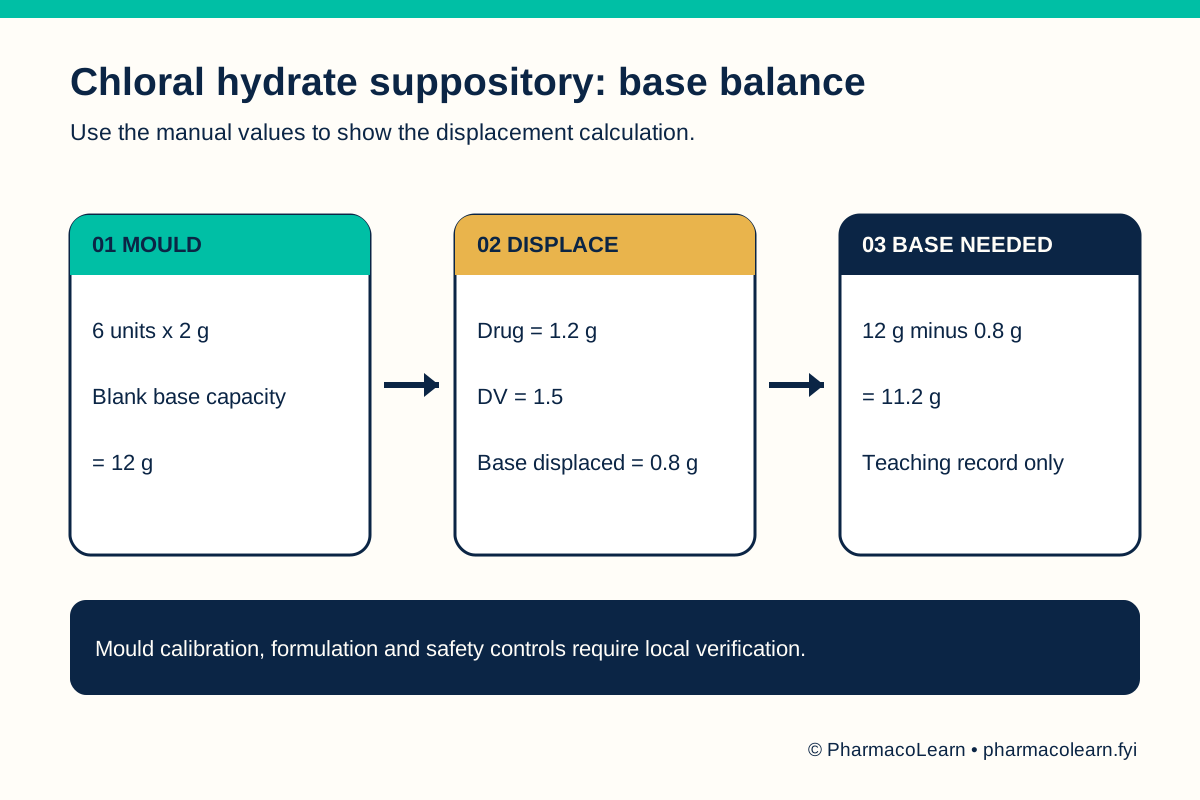
Worked calculation: Six empty 2 g cavities require 12 g of cocoa butter. The historical drug amount is 6 × 0.2 g = 1.2 g. At the manual's displacement value of 1.5, it replaces 1.2/1.5 = 0.8 g of base. The theoretical cocoa-butter amount is therefore 12 - 0.8 = 11.2 g. This is a source-based calculation, not authorization to compound or administer chloral hydrate. The actual mould calibration and current protocol must be checked against your college lab manual and instructor's method sheet. [2]
6. Result
Report the calculated historical base mass and the supplied observations. Record actual unit masses and acceptance decisions here until the instructor provides valid data. State explicitly that no student drug preparation or administration occurred. [2, 3]
7. References
- Pharmacy Council of India. Pharm.D. Regulations, 2008, Appendix A. Lists Chloral suppositories after Boric acid suppositories.
- East Point College of Pharmacy. Pharmaceutics Practical Manual, Experiment 27: Chloral Hydrate Suppositories. Gives the historical formula, 2 g mould, and displacement value.
- National Library of Medicine, PubChem. Chloral Hydrate: Safety and Hazards. Describes central nervous system depression and exposure hazards.
Back to Pharmaceutics Practicals · All Pharm D Practicals · Pharm D
Theory notes: Pharmaceutics