
Chemical Incompatibility: Oxidizer and Organic Ingredients
1. Aim
To recognize a potentially hazardous chemical incompatibility in a historical prescription example and document a safe response without preparing or mixing the substances. The PCI Year 1 Pharmaceutics list names this practical Chemical incompatibility. The college manual's example includes potassium chlorate, tannic acid, and sucrose. [1, 2]
2. Requirements
Use the PCI practical list, the college manual, a printed formula excerpt, a hazard-reference sheet, an observation table, and a calculator. No chemical reagents, balance, mortar, spatula, or physical sample are required. Confirm the source formula and intended product with the instructor. The final disposition is decided by the qualified reviewer and recorded in the student record. This page proposes no correction, decides no disposition, and stops, substitutes, or dispenses no medicine. The manual repeats potassium chlorate in its table, so the formula is not a reliable dispensing instruction. [2]
3. Theory
Chemical incompatibility means that ingredients can react in a way that changes the product or creates a hazard. Potassium chlorate is an oxidizer. The manual places it alongside organic materials, including tannic acid and sucrose. Friction, heat, or contamination may make oxidizer and combustible mixtures dangerous. This article deliberately omits ingredient amounts and any mixing, grinding, or spatulation method. Its purpose is recognition and escalation, not preparation. [2, 3, 4]
The manual presents the example as a powder and includes a proposed handling approach. A handling suggestion does not establish that the combination is safe. A proper review would need an authenticated prescription, current compatibility evidence, hazard assessment, and an approved alternative where indicated. None is supplied by the syllabus listing. Therefore the correct teaching action is to stop the preparation, document the conflict, and refer it to the supervising pharmacist or instructor. The clinical intent, the claimed correction, and any replacement formula must be specified in your college lab manual and instructor's method sheet. [1, 2, 3, 4]
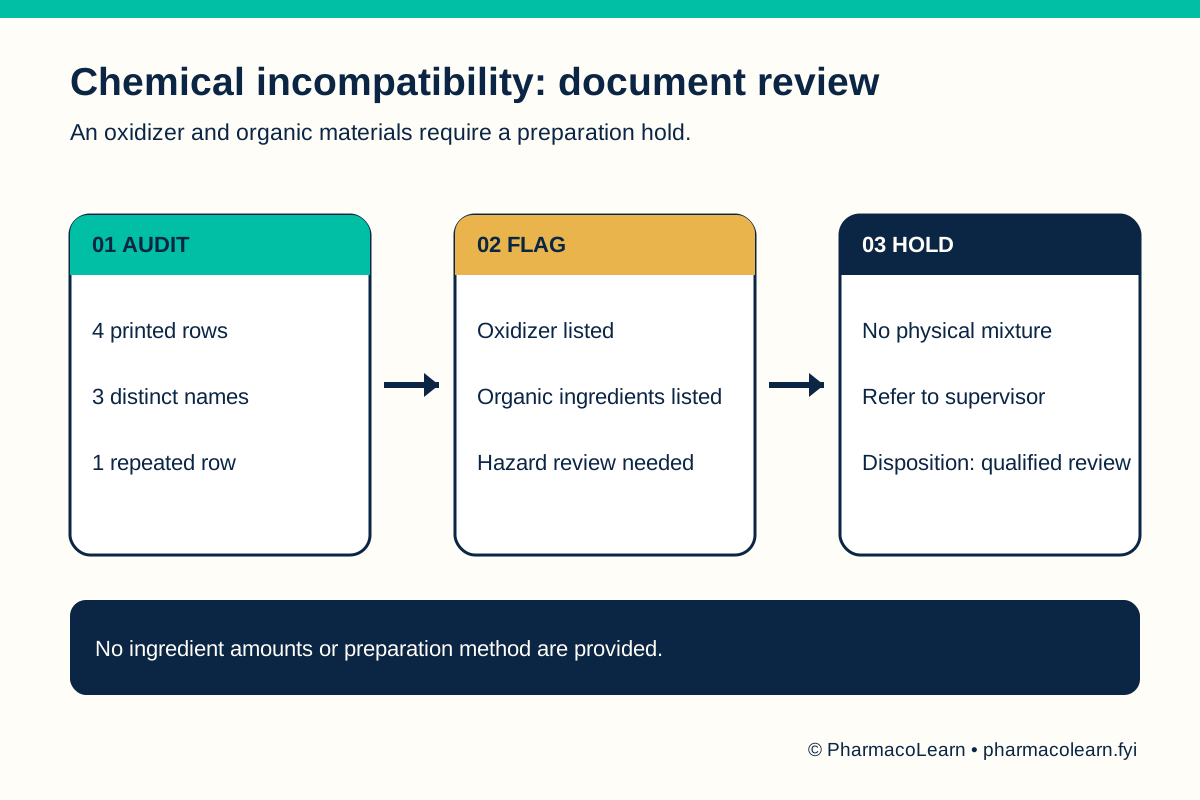
The source table has four ingredient rows but only three distinct names because potassium chlorate appears twice. That transcription issue matters independently of the hazard: a student must not decide whether the second entry was intentional. The example overlaps conceptually with the earlier Explosive powder practical, but this entry is specifically a chemical-compatibility assessment of a flawed source record. It gives no operational method for producing a reactive mixture. [2]
4. Procedure
- Read the syllabus entry and historical manual excerpt in a document-only setting. Do not obtain or open the listed chemicals. [1, 2]
- Transcribe the ingredient names only into the observation table. Flag the repeated potassium chlorate entry as a source discrepancy. Do not copy quantities into a working formula. [2]
- Identify potassium chlorate as the oxidizer and the other two listed materials as organic ingredients. Check the linked hazard sources for the incompatibility concern. [2, 3, 4]
- Record a preparation hold. Record the source's intended formula and purpose after instructor confirmation. Any proposed correction is decided by the qualified reviewer and recorded in the student record. This page proposes no correction, decides no disposition, and stops, substitutes, or dispenses no medicine. Do not trial a smaller amount or change the processing method. [2, 3, 4]
- Give the discrepancy and hazard record to the supervising instructor or pharmacist. Any decision to reject, replace, or reformulate the prescription must be documented by that person. [2, 3, 4]
- Complete the calculation below to show why duplicate ingredient rows do not equal distinct ingredients. This is a document-audit exercise only. [2]
- Record the qualified instructor's final disposition in the student record after that decision is made. This page proposes no correction, decides no disposition, and stops, substitutes, or dispenses no medicine. The exercise ends without a physical product. [2]
5. Calculation, graph, or images as appropriate
| Document check | Source finding [2] | Student record | Required action |
|---|---|---|---|
| Ingredient row count | Four rows | 4 | Check for duplication |
| Distinct ingredient names | Potassium chlorate, tannic acid, sucrose | 3 | Do not infer a corrected formula |
| Oxidizer present | Potassium chlorate | Yes | Flag incompatibility risk [3, 4] |
| Organic ingredients present | Tannic acid and sucrose | Yes | Keep document-only [3, 4] |
| Authenticated prescription and safety review | Not supplied | Record here | Refer to supervisor |
| Disposition | Not established | Record here | No physical preparation |
Worked document check: Count the four printed ingredient rows. Group rows with the same name, leaving three distinct names. The duplicate count is 4 − 3 = 1. This arithmetic detects a transcription problem; it cannot determine which row is wrong or produce a safe formula. With three distinct names there are 3 × 2 ÷ 2 = 3 possible ingredient pairs to screen in a formal compatibility review. No mass ratio or preparation amount is calculated. [2]
6. Result
The historical example requires a preparation hold because it combines an oxidizer with organic ingredients and has a duplicated source row. Record the hazard, the row discrepancy, and the referral. Record the authenticated formula from the instructor-approved source in the student record. The final disposition is decided by the qualified reviewer and recorded in the student record. This page proposes no correction, decides no disposition, and stops, substitutes, or dispenses no medicine. No mixture, sample, or medicine is produced. [2, 3, 4]
7. References
- Pharmacy Council of India. Pharm.D. Regulations, 2008, Appendix A. Lists Chemical incompatibility in the Year 1 Pharmaceutics practical sequence.
- East Point College of Pharmacy. Pharmaceutics Practical Manual, Experiment 29: Chemical Incompatibility. Supplies the historical case with a repeated ingredient row.
- National Library of Medicine, PubChem. Potassium Chlorate: Laboratory Chemical Safety Summary. Describes oxidizer hazards and incompatible materials.
- Occupational Safety and Health Administration. Hazard Classification Guidance: Oxidizing Liquids and Solids. Explains oxidizer classification and associated hazards.
Back to Pharmaceutics Practicals · All Pharm D Practicals · Pharm D
Theory notes: Pharmaceutics