
Study of Magnesium Hydroxide Mixture BP
1. Aim
To study the preparation and assessment of Magnesium Hydroxide Mixture BP as a supervised teaching exercise. Calculate ingredient amounts from a historical manual, identify the precipitation and washing stages, and record supplied observations. The applicable BP edition and safe, complete formula must be specified in your college lab manual and instructor's method sheet before any wet-lab work. [1, 2, 3]
2. Requirements
For a paper or supplied-sample exercise: authenticated BP formula, calculator, batch record, process diagram, and instructor-provided observation data. The East Point College of Pharmacy manuals list magnesium sulphate, sodium hydroxide, light magnesium oxide, water, and different chloroform-containing materials. One also includes citric acid. The correct identities, grades, quantities, water quality, and container must be specified in your college lab manual and instructor's method sheet. Any authorized preparation additionally needs a balance, measuring devices, mixing vessels, suitable filtration or decanting setup, eye and skin protection, ventilation, and approved chemical-waste controls. [2, 3, 4, 5]
3. Theory
This historical mixture is an aqueous dispersion of magnesium hydroxide. The teaching manuals describe two ways it forms: sodium hydroxide precipitates magnesium hydroxide from a magnesium sulphate solution, and magnesium oxide hydrates in water. Washing the precipitate is intended to remove soluble byproducts. A white dispersion is only a visual observation; it does not demonstrate that soluble residues are absent or that the BP specifications are met. [2, 3]
The manuals have material conflicts. The main manual lists 25 mL of chloroform spirit in a 1000 mL master formula, but its 20 mL working column says 0.05 mL; simple scaling gives 0.5 mL. The other manual lists 2.5 mL of chloroform, not chloroform spirit, and includes citric acid. The main manual mentions citric acid in its procedure but omits it from the table. These are different formulations, so no chloroform-containing step is authorized by this article. Sodium hydroxide can burn eyes and skin. Chloroform has serious inhalation and skin hazards. [2, 3, 4, 5]
4. Procedure
- Obtain the authenticated BP edition, complete formula, written institutional procedure, material safety documents, and instructor approval. Resolve whether the listed material is chloroform spirit or chloroform and whether citric acid is required. Until then, use only a paper exercise or sealed instructor-supplied sample. [1, 2, 3, 5]
- Record each reagent's identity, grade, unit, and function. Enter any missing value in the student record. Keep master-formula data separate from the conflicting working columns. [2, 3]
- Calculate the scale factor for the assigned batch and check each mass or volume. Flag the chloroform-containing item in the student record rather than selecting one manual's number. Have all calculations independently checked. [2, 3]
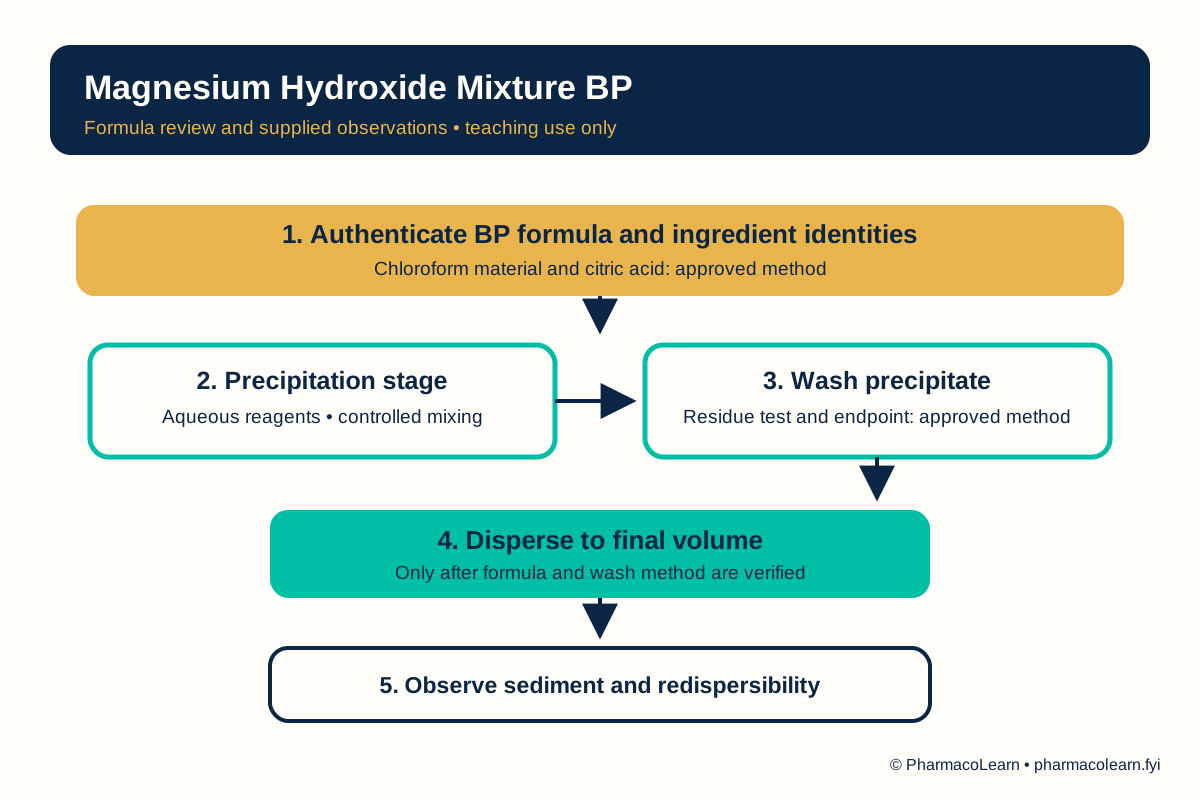
- On the diagram, trace the conceptual sequence: prepare the two aqueous portions, combine under controlled stirring, allow a precipitate to form, separate and wash it, then make the specified dispersion. The actual concentrations, addition rate, wash test, and endpoints must be specified in your college lab manual and instructor's method sheet. Do not handle sodium hydroxide without the approved lab procedure. [2, 4]
- Review instructor-provided observations of the precipitate, wash liquid, and final dispersion. Record whether a validated test for soluble sulphate or other residues was supplied; its method and criterion must be recorded here. [2, 3]
- If a sealed final sample is supplied, observe appearance and sediment after the specified interval without opening, tasting, or applying it. Record whether gentle inversion redistributes the sediment. The interval and acceptance criteria are to be recorded from the assigned current monograph or approved college method in the student record. [2]
- Complete the record with unresolved formula items, deviations, and a not for patient use designation. Container, storage, release testing, and disposal requirements are to be recorded from the assigned current monograph or approved college method in the student record. [2, 3]
5. Calculation, graph, or images as appropriate
| Record item | Main manual master amount per 1000 mL [2] | Arithmetic for 20 mL | Status or observation |
|---|---|---|---|
| Magnesium sulphate | 47.5 g | 47.5 × 0.02 = 0.95 g | Actual Record here |
| Sodium hydroxide | 15 g | 15 × 0.02 = 0.30 g | Actual Record here |
| Light magnesium oxide | 52.5 g | 52.5 × 0.02 = 1.05 g | Actual Record here |
| Chloroform-containing item | 25 mL spirit in main manual; other manual differs | 25 × 0.02 = 0.5 mL by arithmetic only | Identity and amount Record here |
| Citric acid | Mentioned in procedure, absent from main table | Record here | Record here |
| Purified water to finished volume | To 1000 mL | To 20 mL if authenticated | Actual Record here |
| Washed precipitate and final dispersion | Test and criteria record from the assigned current monograph or approved college method | Observation only | Record here |
Worked calculation: For a 20 mL target from a 1000 mL master formula, the factor is 20/1000 = 0.02. Thus 47.5 g magnesium sulphate becomes 0.95 g, 15 g sodium hydroxide becomes 0.30 g, and 52.5 g light magnesium oxide becomes 1.05 g. These calculations do not settle the conflicting chloroform material or the citric-acid omission. No chloroform quantity should be dispensed from this worksheet. [2, 3]
6. Result
State that the formula review and supplied-observation exercise was completed. Record the observed precipitate, wash test, dispersion, sediment, and redispersibility here until data are supplied. Do not claim BP compliance or patient suitability from a visual check. [2, 3]
7. References
- Pharmacy Council of India. Pharm.D. Regulations, 2008, Appendix A. Lists Magnesium Hydroxide mixture BP after Calamine lotion.
- East Point College of Pharmacy. Pharmaceutics Practical Manual, Experiment 19: Magnesium Hydroxide Mixture BP. Gives the historical formula and precipitation, hydration, and washing explanation.
- East Point College of Pharmacy. Pharmaceutics Lab Manual, Magnesium Hydroxide Mixture BP 1993. Gives a different chloroform ingredient and includes citric acid.
- National Institute for Occupational Safety and Health. Pocket Guide to Chemical Hazards: Sodium hydroxide. Documents corrosive exposure hazards.
- National Institute for Occupational Safety and Health. Pocket Guide to Chemical Hazards: Chloroform. Documents inhalation and skin exposure hazards.
Back to Pharmaceutics Practicals · All Pharm D Practicals · Pharm D
Theory notes: Pharmaceutics