
Preparation of Calamine Lotion
1. Aim
To study the preparation and observation of a calamine lotion suspension for a supervised teaching exercise. Calculate a scaled historical formula, then record the dispersion and redispersibility if a sample is made. The applicable IP edition and formula must be specified in your college lab manual and instructor's method sheet. [1, 2, 3]
2. Requirements
The East Point College of Pharmacy manual lists calamine, zinc oxide, bentonite, sodium citrate, liquefied phenol, glycerol, and a liquid vehicle. It calls the vehicle rose water in the formula table but purified water in its procedure. Another college manual also lists rose water. The correct vehicle, ingredient grades, phenol specification, final-volume method, and acceptance tests must be specified in your college lab manual and instructor's method sheet against an authenticated IP source. A balance, mortar and pestle, beakers, measuring cylinder, stirrer, transfer tools, closable container, and label are needed for an approved wet-lab exercise. Eye protection, coat, suitable gloves, and a phenol spill and waste plan are essential. [2, 3, 4]
3. Theory
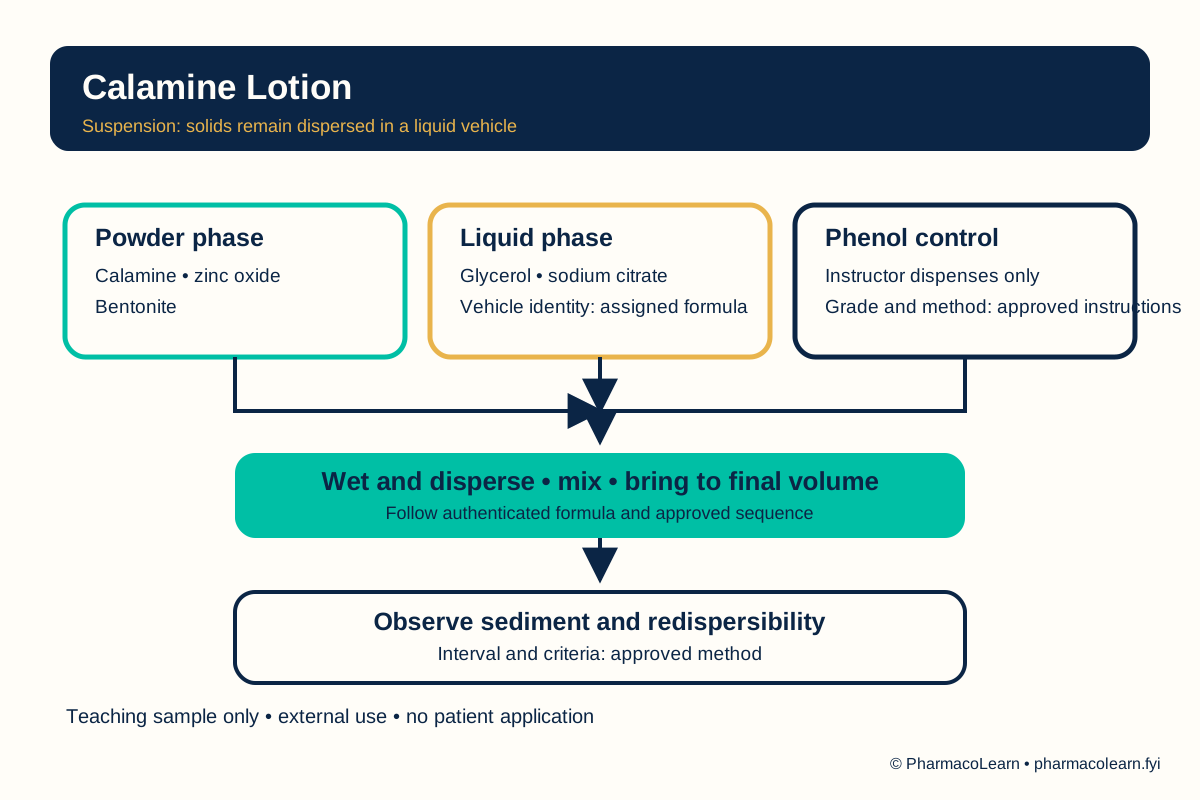
Calamine lotion is a suspension: insoluble fine solids are dispersed in a liquid vehicle. Calamine and zinc oxide are the principal solids in the historical teaching formula; bentonite helps suspend them, while glycerol helps wet the powder and gives the liquid some body. Sodium citrate is included in the manual's formula, but its exact role and quantity should be checked with the specified formulation. Standing may produce sediment. Redispersibility after gentle shaking is therefore a useful observation, although it is not a substitute for validated quality tests. [2, 3]
The college manuals disagree on the vehicle used in the procedure, and one handout prints a unit error for a working amount of liquefied phenol. These inconsistencies must be resolved before dispensing. Phenol can penetrate skin and cause serious injury, even when a small quantity is intended for a formulation. The instructor should control phenol dispensing and response to any exposure. The finished teaching sample is for observation only and must not be applied to anyone. [2, 3, 4]
4. Procedure
- Obtain the authenticated IP edition, full formula, assigned batch volume, vehicle identity, phenol grade, permitted equipment, and acceptance criteria. Record each supplied item on the batch sheet; obtain missing details from the approved method before proceeding. If unresolved, use a paper calculation and supplied observation record. [1, 2, 3]
- Check labels and record the approved quantities and lot details. Keep liquefied phenol under instructor control. The actual ingredient identities and amounts must be recorded here. [2, 4]
- Calculate each ingredient from the authenticated master formula. Keep masses in grams and liquids in millilitres. Have the scale and any unit conversions checked independently. [2, 3]
- If preparation is authorized, triturate the calamine, zinc oxide, and bentonite to a uniform fine powder according to the written method. Avoid generating airborne powder. [2]
- Wet and disperse the powder gradually with the approved glycerol and a portion of the verified liquid vehicle. Incorporate the specified sodium citrate solution as directed by the authenticated method. The order, vehicle volume, and mixing endpoint must be specified in your college lab manual and instructor's method sheet. [2, 3]
- The instructor adds or supplies the specified liquefied phenol using the local safety procedure. Mix thoroughly without splashing. If the phenol form, measure, or control is unclear, do not perform this step. [2, 4]
- Transfer the dispersion, rinse the vessel with the verified vehicle, and make up to the stated final volume. Mix and record the actual volume and immediate appearance. [2, 3]
- After the specified standing interval, record any sediment and whether it redistributes by gentle inversion. The interval and pass criteria are to be recorded from the assigned current monograph or approved college method in the student record. Label external-use teaching sample, shake before observation, contains phenol, and not for patient use. [2, 4]
5. Calculation, graph, or images as appropriate
| Ingredient or observation | Historical manual formula per 1000 mL [2] | Calculated for 20 mL | Actual record |
|---|---|---|---|
| Calamine | 150 g | 3 g | Record here |
| Zinc oxide | 50 g | 1 g | Record here |
| Bentonite | 30 g | 0.6 g | Record here |
| Sodium citrate | 5 g | 0.1 g | Record here |
| Liquefied phenol | 5 mL | 0.1 mL | Record here |
| Glycerol | 50 mL | 1 mL | Record here |
| Vehicle to finished volume | 1000 mL; identity from authenticated formula | To 20 mL; identity: Record here | Record here |
| Sediment and redispersibility | Criteria record from the assigned current monograph or approved college method | Observation only | Record here |
Worked calculation: For a 20 mL teaching batch, the scale factor is 20/1000 = 0.02. Calamine = 150 g × 0.02 = 3 g. Zinc oxide = 50 g × 0.02 = 1 g. Bentonite = 30 g × 0.02 = 0.6 g. Sodium citrate = 5 g × 0.02 = 0.1 g. Liquefied phenol = 5 mL × 0.02 = 0.1 mL. Glycerol = 50 mL × 0.02 = 1 mL. The selected vehicle is added to a final volume of 20 mL, not as an extra 20 mL. These are historical teaching quantities; the current IP formula and use of phenol must be specified in your college lab manual and instructor's method sheet. [2, 3]
6. Result
State whether the exercise remained on paper or was prepared under supervision. Record verified formula and vehicle, actual amounts, final volume, initial dispersion, sediment after the specified interval, and redispersibility here until observed. Do not report IP compliance or suitability for application from appearance alone. [2, 3]
7. References
- Pharmacy Council of India. Pharm.D. Regulations, 2008, Appendix A. Lists Calamine lotion as the first suspension practical after the liniments.
- East Point College of Pharmacy. Pharmaceutics Practical Manual, Experiment 18: Calamine Lotion IP. Supplies the historical teaching formula; its formula table and procedure disagree on the vehicle.
- East Point College of Pharmacy. Pharmaceutics Lab Manual, Calamine Lotion IP 1966. Gives a rose-water version and contains a working-formula unit error for liquefied phenol.
- National Institute for Occupational Safety and Health. Pocket Guide to Chemical Hazards: Phenol. Documents skin absorption and chemical injury risks.
Back to Pharmaceutics Practicals · All Pharm D Practicals · Pharm D
Theory notes: Pharmaceutics