
Preparation of Cod Liver Oil Emulsion
1. Aim
To study an oil-in-water cod liver oil emulsion and calculate a small historical teaching formula. Record how the primary emulsion forms and how the final dispersion behaves on standing. The applicable official formula, ingredient grades, and acceptance criteria are to be recorded from the assigned current monograph or approved college method in the student record before any supervised preparation. [1, 2]
2. Requirements
The East Point College of Pharmacy manual lists cod liver oil, acacia powder, chloroform, and cinnamon water. It uses a mortar and pestle, beakers, measuring cylinder, balance, and final container. The oil quality, acacia grade, exact cinnamon-water preparation, chloroform status, packaging, and batch volume must be specified in your college lab manual and instructor's method sheet. Any authorized wet-lab activity needs instructor supervision, eye protection, coat, suitable gloves, ventilation, and a plan for chemical waste. If the chloroform-containing formula cannot be authenticated and approved, use the diagram and supplied observation record only. [2, 3]
3. Theory
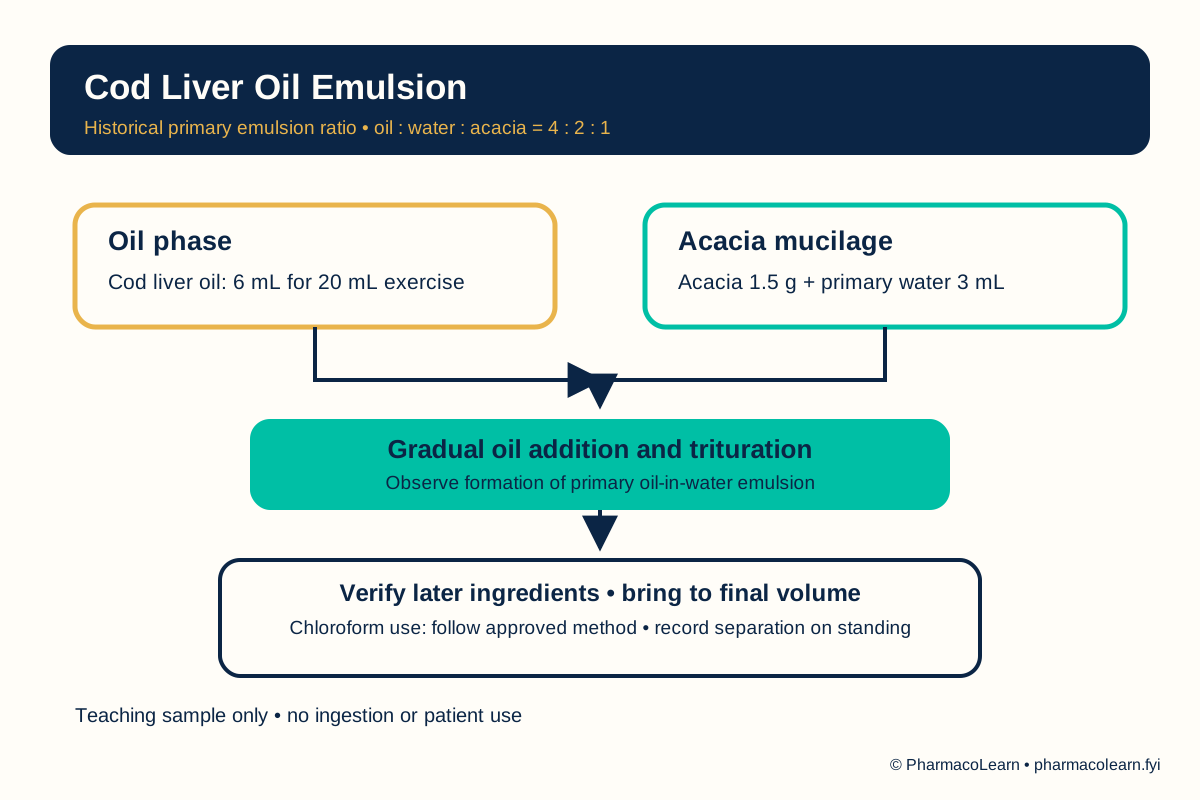
Oil and water separate unless the oil is dispersed into small droplets and the droplets are stabilized. In the college manual's historical method, acacia forms a protective layer around cod liver oil droplets, producing an oil-in-water primary emulsion. The manual describes a 4:2:1 primary-emulsion ratio of oil volume, water volume, and gum mass for this fixed oil. For its 20 mL teaching batch, that corresponds to 6 mL oil, 3 mL water for the primary emulsion, and 1.5 g acacia. Cinnamon water is later used to bring the mixture to final volume. [2]
The historical formula also lists chloroform as a preservative. Chloroform has inhalation, skin absorption, and potential carcinogenicity hazards. This article does not authorize its use or endorse it as a current excipient. The instructor must first verify whether a current accepted formula uses it and whether the institution permits it. A white, creamy appearance does not prove droplet size, microbiological quality, vitamin content, or emulsion stability. No teaching sample is to be swallowed. [2, 3]
4. Procedure
- Obtain the current accepted formula and written institutional method. Confirm the ingredients, final volume, chloroform status, safety controls, and acceptance tests. Mark missing details Record here. If any essential item is unresolved, carry out only the paper calculation and supplied-observation exercise. [1, 2, 3]
- Inspect the labelled oil and acacia containers and record grade, lot, and expiry details. Keep any chloroform-containing material under instructor control. Actual material suitability must be recorded here. [2, 3]
- Calculate the scale factor for the assigned batch. Calculate the primary-emulsion water separately from the later vehicle needed to final volume. Have the amounts checked before dispensing. [2]
- On the process diagram, identify the manual's wet-gum sequence: make acacia mucilage with the measured primary water, then add the oil gradually while triturating. The approved mixing time, speed, and endpoint must be specified in your college lab manual and instructor's method sheet. [2]
- If an authenticated and locally approved wet-lab method is available, perform the mixing steps under supervision. Observe whether a uniform primary emulsion forms. A change in appearance or sound may help the instructor judge the stage but is not a validated quality test. [2]
- Add later ingredients only as specified in the approved method. The historical chloroform amount is shown for source comparison in the table, but its actual use must be specified in your college lab manual and instructor's method sheet and must not be inferred from this article. [2, 3]
- Transfer, rinse with the approved vehicle, and make up to the stated final volume. Mix gently and record appearance, measured final volume, and any visible oil layer. [2]
- After the specified standing interval, record separation and redispersibility by gentle inversion. The interval and limits must be specified in your college lab manual and instructor's method sheet. Label teaching sample, shake before observation, and not for patient use. Storage and disposal must be specified in your college lab manual and instructor's method sheet. [2, 3]
5. Calculation, graph, or images as appropriate
| Record item | Historical manual formula per 100 mL [2] | Calculated for 20 mL | Actual record |
|---|---|---|---|
| Cod liver oil | 30 mL | 6 mL | Record here |
| Acacia powder | 7.5 g | 1.5 g | Record here |
| Water for primary emulsion | From 4:2:1 ratio | 3 mL | Record here |
| Chloroform | 0.2 mL | 0.04 mL by arithmetic only; use Record here | Record here |
| Cinnamon water to final volume | To 100 mL | To 20 mL if authenticated | Record here |
| Primary emulsion and later separation | Criteria record from the assigned current monograph or approved college method | Observation only | Record here |
Worked calculation: The scale factor is 20/100 = 0.2. Cod liver oil = 30 mL × 0.2 = 6 mL. Acacia = 7.5 g × 0.2 = 1.5 g. With the stated 4:2:1 primary ratio, water = 6 mL × 2/4 = 3 mL and acacia = 6 × 1/4 = 1.5 g. The manual's chloroform amount scales arithmetically to 0.2 mL × 0.2 = 0.04 mL, but its current appropriateness and any actual dispensing must be specified in your college lab manual and instructor's method sheet. Cinnamon water is used to bring the product to a final 20 mL, not added as an extra 20 mL. [2, 3]
6. Result
Report whether the work was a paper exercise or an approved supervised preparation. Record the primary emulsion appearance, final volume, oil separation, redispersibility, and deviations here until observed. Do not state vitamin content, shelf life, official compliance, or suitability for ingestion from this exercise. [2, 3]
7. References
- Pharmacy Council of India. Pharm.D. Regulations, 2008, Appendix A. Lists Cod liver oil emulsion as the first emulsion practical after the suspensions.
- East Point College of Pharmacy. Pharmaceutics Practical Manual, Experiment 20: Cod Liver Oil Emulsion. Supplies the historical teaching formula, wet-gum sequence, and primary-emulsion ratio.
- National Institute for Occupational Safety and Health. Pocket Guide to Chemical Hazards: Chloroform. Documents relevant chemical exposure hazards.
Back to Pharmaceutics Practicals · All Pharm D Practicals · Pharm D
Theory notes: Pharmaceutics