
Preparation of Liquid Paraffin Emulsion
1. Aim
To calculate and study the preparation of a liquid paraffin oil-in-water emulsion, then record its immediate appearance and separation on standing. The historical teaching formula and any wet-lab work require review against the institution's approved method. Formula status, ingredient grades, and acceptance criteria are to be recorded from the assigned current monograph or approved college method in the student record. [1, 2, 3]
2. Requirements
The East Point College of Pharmacy manuals list liquid paraffin, powdered Indian gum or acacia, powdered tragacanth, sodium benzoate, vanillin, glycerol, chloroform, and water. Use a balance, mortar and pestle, graduated measure, beakers, stirring rod, transfer vessel, suitable bottle, and batch record if authorized. The identity and grade of each gum, mineral oil, and preservative must be specified in your college lab manual and instructor's method sheet. The instructor must provide eye protection, coat, suitable gloves, ventilation, and a chloroform handling and waste plan. If chloroform is not approved, complete the paper calculation and supplied-observation exercise only. [2, 3, 4]
3. Theory
Liquid paraffin is a mineral oil and is immiscible with water. Mixing divides the oil into droplets, while acacia and tragacanth help keep those droplets dispersed in the water phase. The historical manual also uses glycerol, sodium benzoate, and vanillin. A creamy, uniform appearance suggests dispersion but does not establish droplet size, long-term stability, preservative effectiveness, or suitability for ingestion. Record any separate oil layer after standing rather than calling the emulsion stable on sight. [2, 3]
Both college manuals list chloroform in this old formula. Chloroform has inhalation and skin hazards and is treated by NIOSH as a potential occupational carcinogen. Its current acceptability as an ingredient must be specified in your college lab manual and instructor's method sheet; this article does not direct students to dispense it. One manual also mentions using filter paper during transfer, which could retain an emulsion and change its composition. The transfer method must be confirmed in a validated local procedure. No teaching sample should be tasted or given to a person. [2, 3, 4]
4. Procedure
- Obtain the instructor-approved formula, batch size, grades, written emulsion method, chloroform decision, transfer method, and observation criteria. Record missing items here. If any essential decision is unresolved, work from the diagram and instructor-supplied observations only. [1, 2, 3, 4]
- Check labels and record lot numbers for oil, gums, and other ingredients. Set up the approved clean work area and protective equipment. Keep chloroform under institutional control. [2, 4]
- Calculate each ingredient for the assigned volume. Keep liquid volumes and powder masses separate. Verify whether "water to final volume" means the finished emulsion volume, and have the calculation checked. [2, 3]
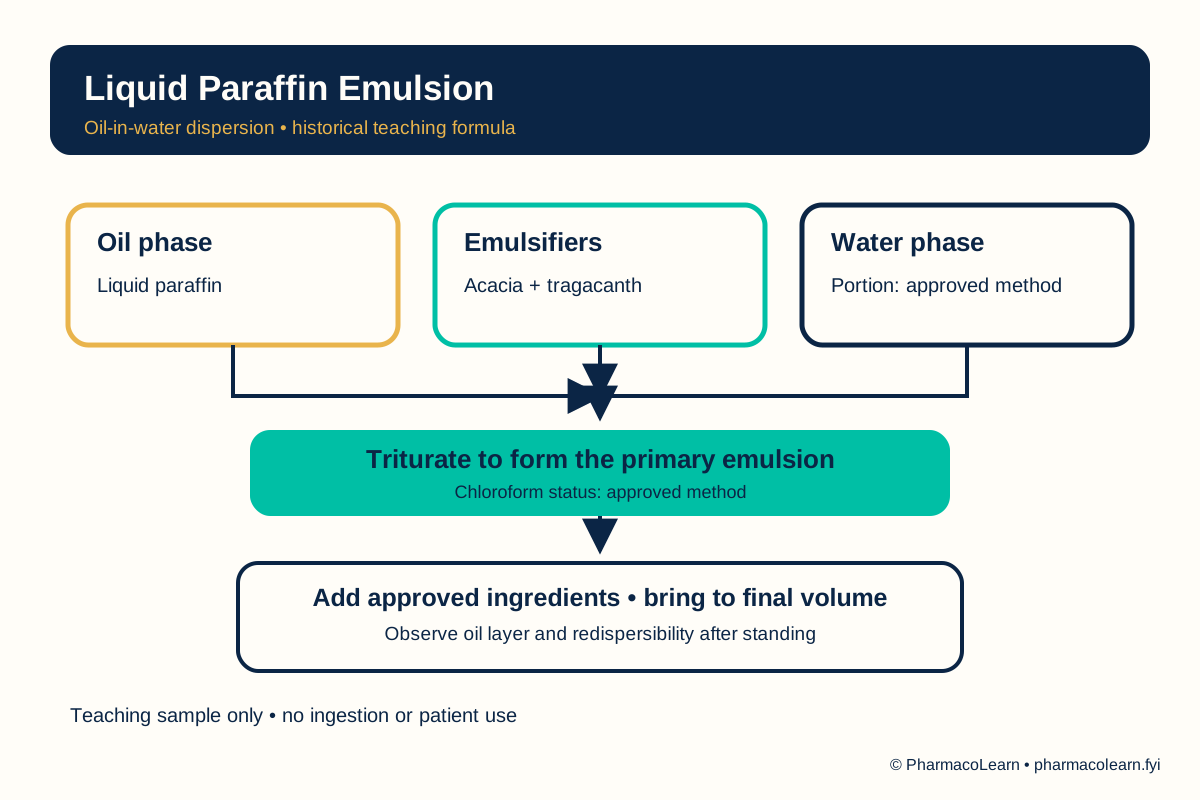
- On the process diagram, identify the oil phase, emulsifying gums, initial water addition, later dissolved additives, and final-volume step. The exact primary-emulsion water quantity and mixing endpoint must be specified in your college lab manual and instructor's method sheet from the approved method. [2, 3]
- If a complete wet-lab method is authorized, disperse the verified gums with the measured oil using the specified trituration sequence. Add the specified first water portion gradually until the primary emulsion forms. Avoid splashing and trapped air. [2, 3]
- Add sodium benzoate and glycerol in the stated dissolved form only after the instructor confirms the liquid portion and sequence. Handle vanillin and any other approved material according to the authenticated formula. Chloroform use remains your college lab manual and instructor's method sheet and is not part of this student procedure. [2, 3, 4]
- Transfer by the approved method, rinse with water as directed, and add water to the final volume. Do not filter the dispersion through paper unless that step has been validated. Record the actual recovered volume. [2]
- Observe uniformity, visible oil separation, and redispersibility after the specified standing interval. The interval and pass criteria are to be recorded from the assigned current monograph or approved college method in the student record. Label teaching sample, shake before observation, and not for patient use. Storage and disposal must be specified in your college lab manual and instructor's method sheet. [2, 4]
5. Calculation, graph, or images as appropriate
| Item | Historical manual formula per 1000 mL [2, 3] | Calculated for 20 mL | Actual or observation |
|---|---|---|---|
| Liquid paraffin | 500 mL | 10 mL | Record here |
| Indian gum or acacia | 125 g | 2.5 g | Record here |
| Tragacanth | 5 g | 0.1 g | Record here |
| Sodium benzoate | 5 g | 0.1 g | Record here |
| Vanillin | 0.5 g | 0.01 g | Record here |
| Glycerol | 125 mL | 2.5 mL | Record here |
| Chloroform | 2.5 mL | 0.05 mL by arithmetic only; use Record here | Record here |
| Water to finished volume | To 1000 mL | To 20 mL if approved | Record here |
| Appearance and later oil separation | Criteria record from the assigned current monograph or approved college method | Visual observation | Record here |
Worked calculation: The scale factor is 20 mL / 1000 mL = 0.02. Liquid paraffin = 500 mL × 0.02 = 10 mL; acacia = 125 g × 0.02 = 2.5 g; tragacanth = 5 g × 0.02 = 0.1 g. The same factor gives 0.1 g sodium benzoate, 0.01 g vanillin, and 2.5 mL glycerol. The historical 2.5 mL chloroform entry scales to 0.05 mL on paper, but actual use must be specified in your college lab manual and instructor's method sheet. Water is added to a finished volume of 20 mL, not added as an extra 20 mL. [2, 3]
6. Result
Record whether the exercise remained on paper or an approved sample was made. Report actual quantities, final volume, initial appearance, oil layer after standing, redispersibility, and deviations here until observed. Do not infer official compliance or suitability for human use from a visual result. [2, 3]
7. References
- Pharmacy Council of India. Pharm.D. Regulations, 2008, Appendix A. Lists Liquid paraffin emulsion after Cod liver oil emulsion.
- East Point College of Pharmacy. Pharmaceutics Practical Manual, Experiment 21: Liquid Paraffin Emulsion. Gives the historical formula and teaching method, including an unverified filtration step.
- East Point College of Pharmacy. Pharmaceutics Lab Manual, Liquid Paraffin Emulsion. Gives the same historical ingredient amounts and describes the role of the gums.
- National Institute for Occupational Safety and Health. Pocket Guide to Chemical Hazards: Chloroform. Documents inhalation, skin, and potential carcinogenicity hazards.
Back to Pharmaceutics Practicals · All Pharm D Practicals · Pharm D
Theory notes: Pharmaceutics