
Preparation of Eutectic Powder
1. Aim
To study how contact between selected crystalline powders can cause liquefaction and how separate premixing with a diluent may limit it. Calculate a 1 g historical teaching blend and record its appearance before and after mixing. This is a supervised laboratory demonstration only; the preparation and route of use must be specified in your college lab manual and instructor's method sheet against the approved syllabus method. [1, 2]
2. Requirements
The East Point College of Pharmacy manual lists camphor, menthol, ammonium chloride, and light magnesium carbonate. A calibrated balance, dry mortar and pestle or spatula, separate weighing papers, dry container, label, and observation record are needed. Ingredient grades, acceptable particle size, packaging material, and storage conditions must be specified in your college lab manual and instructor's method sheet. Wear a coat, eye protection, and suitable gloves, and control dust and vapours. Camphor is combustible and both camphor and menthol can irritate or harm through exposure. No tasting, smelling directly, or nasal administration is part of this exercise. [2, 3, 4]
3. Theory
Some pairs of solids form a mixture with a lower melting point than either component alone. Camphor and menthol are a common teaching example: close contact and grinding can make the blend soften or appear wet at room temperature. In the cited method, the two are first mixed separately with different powders before their mixtures are combined. This spreads the eutectic pair through other solids and reduces direct contact. It does not guarantee that the powder will remain dry under every temperature or humidity condition. [2]
The source also describes nasal use, but this article does not establish product quality, dose uniformity, microbial acceptability, or nasal safety. The blend is for observation in a teaching lab and must not be administered. A dry final appearance is a physical observation, not proof of official compliance. If liquefaction appears, record it rather than trying an unsourced correction. [1, 2]
4. Procedure
- Obtain the institution's approved formula, ingredient grades, target mass, local safety procedure, packaging method, and observation interval. Mark missing details Record here. The historical numbers below are for a calculation exercise. [1, 2]
- Prepare a clean, dry workspace away from heat and ignition sources. Check the balance and wear the required protective equipment. Avoid creating airborne camphor, menthol, or other powder. [2, 3, 4]
- Calculate the mass of each component from the cited master formula. Check that the sum equals the assigned total mass. Have the calculation independently checked. [2]
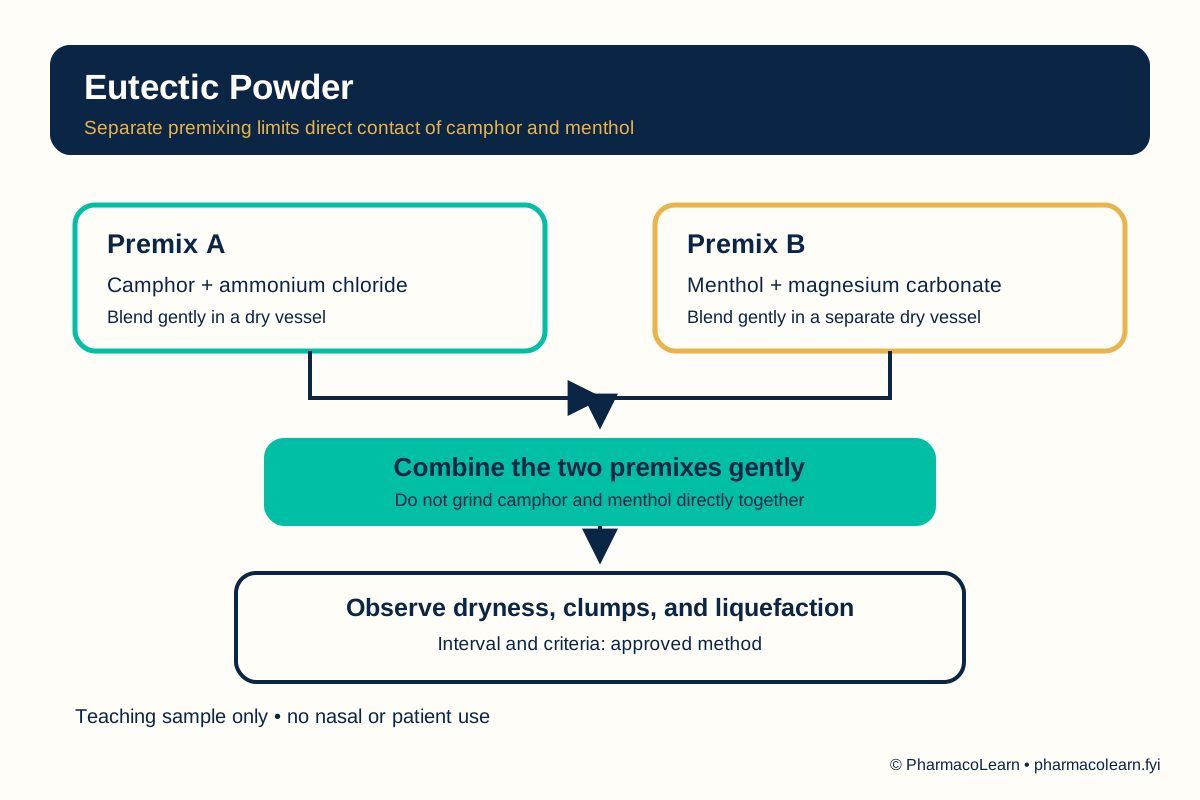
- If wet-lab work is authorized, place camphor with ammonium chloride in one dry vessel and blend gently. In a separate dry vessel, blend menthol with light magnesium carbonate. Do not grind camphor and menthol directly together. [2]
- Combine the two premixes gently using the written method. Stop and record any wet spots, clumps, or strong vapour release. Do not add an unlisted absorbent or extra powder to hide a failed observation. [2]
- Inspect the mixture immediately and again after the instructor-specified interval. Record colour, flow, clumps, dampness, and any visible liquefaction. The interval and pass criteria are to be recorded from the assigned current monograph or approved college method in the student record. [2]
- Transfer only the approved teaching quantity to a dry, labelled container. Mark laboratory sample, not for nasal use or patient use. Packaging, retention, and disposal must be specified in your college lab manual and instructor's method sheet. [2]
5. Calculation, graph, or images as appropriate
| Ingredient or observation | Historical master blend [2] | Calculated for 1 g | Actual record |
|---|---|---|---|
| Camphor | 5 g per 100 g blend | 0.05 g = 50 mg | Record here |
| Menthol | 5 g per 100 g blend | 0.05 g = 50 mg | Record here |
| Ammonium chloride | 30 g per 100 g blend | 0.30 g = 300 mg | Record here |
| Light magnesium carbonate | 60 g per 100 g blend | 0.60 g = 600 mg | Record here |
| Total | 100 g | 1.00 g | Record here |
| Appearance immediately and after standing | Criteria record from the assigned current monograph or approved college method | Observe dry or damp | Record here |
Worked calculation: The factor for a 1 g portion of a 100 g historical blend is 1/100 = 0.01. Camphor = 5 g × 0.01 = 0.05 g; menthol = 0.05 g; ammonium chloride = 30 g × 0.01 = 0.30 g; magnesium carbonate = 60 g × 0.01 = 0.60 g. Check: 0.05 + 0.05 + 0.30 + 0.60 = 1.00 g. These are sourced teaching amounts, while actual weights and current approved formulation must be specified in your college lab manual and instructor's method sheet. [2]
6. Result
State whether an approved blend was prepared or the exercise remained on paper. Record actual masses, immediate appearance, appearance after the specified interval, and any clumps or liquefaction here until observed. Do not report a clinical route, dose, or official quality from this demonstration. [2, 3, 4]
7. References
- Pharmacy Council of India. Pharm.D. Regulations, 2008, Appendix A. Lists Eutectic powder as the first powder practical after the emulsions.
- East Point College of Pharmacy. Pharmaceutics Practical Manual, Experiment 22: Eutectic Powder. Gives the historical formula and separate premixing method.
- National Institute for Occupational Safety and Health. Pocket Guide to Chemical Hazards: Camphor (synthetic). Documents combustibility and exposure hazards.
- National Library of Medicine, PubChem. Menthol: Safety and Hazards. Summarizes reported irritation and exposure hazards.
Back to Pharmaceutics Practicals · All Pharm D Practicals · Pharm D
Theory notes: Pharmaceutics