
Study of Insufflation Powder
1. Aim
To study the physical requirements of an insufflation powder and check a historical teaching formula for internal consistency. The exercise uses a formula sheet and supplied observations. No powder is administered to a person. The correct formula, particle-size specification, and approved route must be specified in your college lab manual and instructor's method sheet. [1, 2]
2. Requirements
Use the PCI practical list, East Point College of Pharmacy manual, calculator, blank batch sheet, and instructor-supplied observations or sealed demonstration sample. The manual names camphor, menthol, ammonium chloride, and light magnesium carbonate. Their grades, masses, and packaging specifications must be specified in your college lab manual and instructor's method sheet because the master and working columns disagree. If any handling demonstration is separately approved, use a dry vessel, balance, eye protection, coat, suitable gloves, dust control, and an instructor-approved containment method. Do not use an insufflator on a person. [2, 3, 4]
3. Theory
Insufflations are fine powders intended by the historical source for delivery into a body cavity. This task differs from the preceding eutectic-powder demonstration because delivery would add important requirements for particle size, dose uniformity, microbiological quality, and route-specific safety. The manual pairs camphor and menthol, which can soften or liquefy when brought into contact, and describes separate premixing with other solids. That observation does not prove the powder is suitable for nasal use. [2]
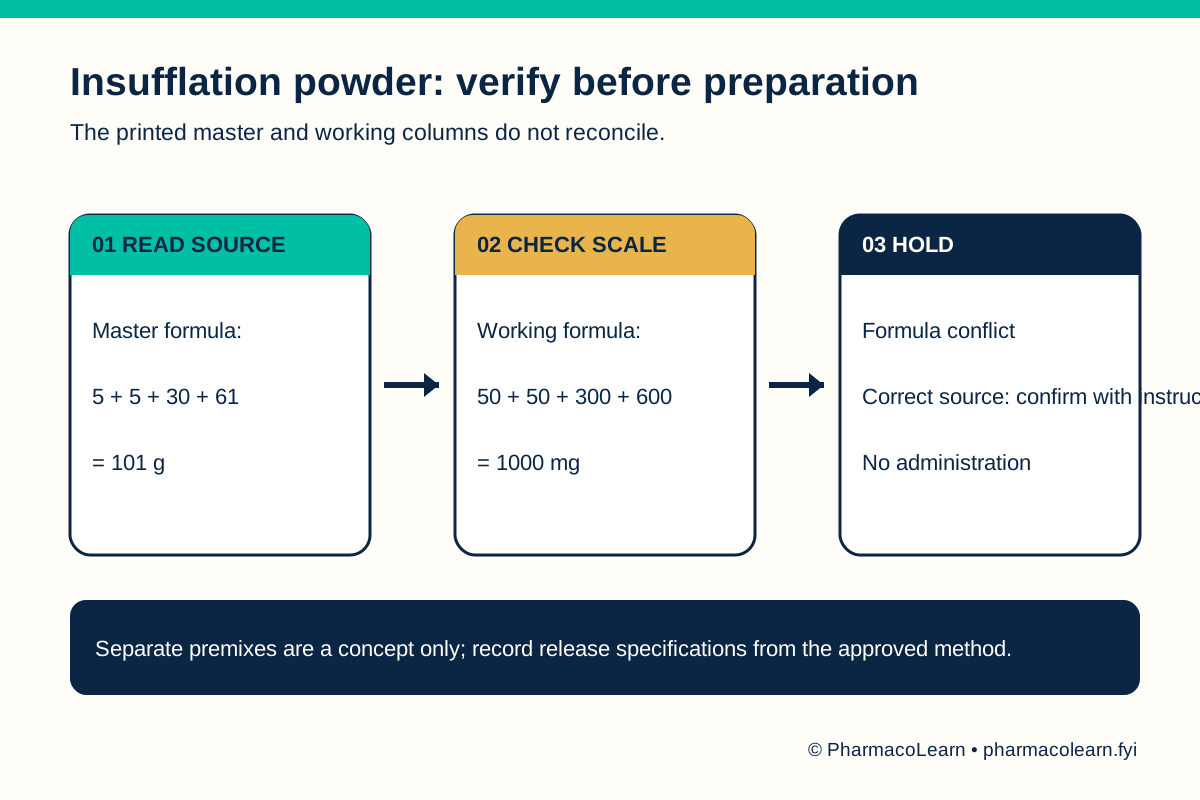
The formula must be reconciled before any preparation. The master column sums to 101 g, because it lists 5 g camphor, 5 g menthol, 30 g ammonium chloride, and 61 g light magnesium carbonate. The printed 1 g working column sums to 1000 mg and corresponds to a 100 g master with 60 g light magnesium carbonate. Neither column can be silently corrected. Camphor exposure can affect the nervous system, and menthol may irritate eyes and mucous membranes. This article therefore gives no administration directions. [2, 3, 4]
4. Procedure
- Obtain the approved syllabus method and an authenticated formula. Compare ingredient names, grades, master quantities, and working quantities. Record the magnesium-carbonate discrepancy; the product-release specifications must be recorded from the assigned current monograph or approved college method in the student record. [1, 2]
- Check the master and working sums independently. Record whether the instructor has supplied a corrected source. Do not choose 60 g or 61 g from arithmetic alone. [2]
- Review the diagram showing separate premixes as a concept. If the corrected formula and a local handling procedure are unavailable, remain with the paper exercise. [2]
- On an instructor-supplied record, note powder appearance, any visible clumps or dampness, particle-size result if available, and the stated method for checking dose uniformity. Missing observations must be recorded here. [2]
- Review the specified container and route label from the authenticated source. The historical manual's nasal direction is not permission to administer a teaching sample. [2, 3, 4]
- Record all unresolved formula and safety items, the instructor's disposition, and whether a physical sample exists. Any sample is labelled teaching material, not for patient use. [2]
5. Calculation, graph, or images as appropriate
| Formula or observation item | Master column in manual [2] | Working column in manual [2] | Verification status |
|---|---|---|---|
| Camphor | 5 g | 50 mg | Grade and actual mass Record here |
| Menthol | 5 g | 50 mg | Grade and actual mass Record here |
| Ammonium chloride | 30 g | 300 mg | Grade and actual mass Record here |
| Light magnesium carbonate | 61 g | 600 mg | Record here: columns disagree |
| Total | 101 g | 1000 mg | Correct master formula Record here |
| Particle size, moisture, and dose uniformity | Criteria record from the assigned current monograph or approved college method | Record supplied result here | Record here |
Worked consistency check: The printed master sum is 5 + 5 + 30 + 61 = 101 g. A one-hundredth scale of that master would total 1.01 g, while the printed working column totals 50 + 50 + 300 + 600 = 1000 mg = 1.00 g. The 0.01 g difference is evidence of a source conflict, not a measurement correction. The approved formula must be specified in your college lab manual and instructor's method sheet before any ingredient is dispensed. [2]
6. Result
Report the formula discrepancy, supplied observations, and missing particle-size or quality tests here until resolved. State that no administration occurred. Do not infer nasal safety, product quality, or clinical benefit from appearance alone. [2, 3, 4]
7. References
- Pharmacy Council of India. Pharm.D. Regulations, 2008, Appendix A. Lists Insufflations after Dusting powder.
- East Point College of Pharmacy. Pharmaceutics Practical Manual, Experiment 25: Insufflation. Supplies the historical ingredients and conflicting quantities.
- National Institute for Occupational Safety and Health. Pocket Guide to Chemical Hazards: Camphor (synthetic). Documents exposure hazards.
- National Library of Medicine, PubChem. Menthol: Safety and Hazards. Summarizes irritation and exposure concerns.
Back to Pharmaceutics Practicals · All Pharm D Practicals · Pharm D
Theory notes: Pharmaceutics