
Preparation of Dusting Powder
1. Aim
To calculate and study the preparation of a simple dusting powder for intact-skin teaching purposes, and to record the uniformity and flow of a supervised sample. The cited college manuals give a historical formula; the applicable current specifications, packaging, and acceptance criteria are to be recorded from the assigned current monograph or approved college method in the student record. [1, 2, 3]
2. Requirements
The East Point College of Pharmacy manuals agree on zinc oxide, starch, and purified talc in a 250:250:500 mass ratio. A calibrated balance, dry mortar and pestle or spatula, weighing papers, suitable sieve if approved, dry mixing vessel, sifter container, and batch record may be required. The ingredient grades, talc identity and sterility claim, particle-size specification, sieve choice, batch size, and container must be specified in your college lab manual and instructor's method sheet. Wear eye protection, a laboratory coat, and suitable gloves. Handle powders without raising dust; local respiratory controls must be specified in your college lab manual and instructor's method sheet from the safety assessment. [2, 3]
3. Theory
Dusting powders are finely divided mixtures intended in this historical example for external use on intact skin. Zinc oxide is the mineral component, while starch and talc contribute bulk, absorbency, and flow. Geometric dilution helps distribute a smaller component through a larger bulk: mix it first with a similar amount of another powder, then add further portions of increasing size. Visual uniformity is useful to record but cannot prove content uniformity, particle size, or microbial quality. [2, 3]
The first manual's ingredient table lists zinc oxide, starch, and talc, but its written procedure instead discusses salicylic acid and omits talc. Its procedure appears to belong to a different formula. The second manual supports the three-ingredient formula and describes blending those three materials. Use the verified three-ingredient method only after the instructor checks the source and the relevant specification. Do not add salicylic acid by following the mismatched paragraph. The distinction between a nonsterile powder for intact skin and a sterile product for wounds must be respected; no prepared teaching powder is applied to a person. [2, 3]
4. Procedure
- Obtain the approved formula, ingredient specifications, target mass, mixing and sieve method, and packaging instructions. Record unresolved details on the batch sheet and consult the approved method before proceeding. If the mismatched first-manual procedure has not been reconciled, use the second manual only as a source for discussion until the instructor approves a method. [2, 3]
- Check the identity, grade, batch number, and expiry of zinc oxide, starch, and talc. Confirm the talc specification and any claim of prior sterilization in the student record. Do not assume a teaching-lab sample is sterile. [2, 3]
- Calculate the required mass of each ingredient from the 1000 g historical master formula. Check that the masses total the target batch. Have the calculation independently checked. [2, 3]
- Prepare a dry work area and wear the required protective equipment. Avoid vigorous pouring, shaking, or sieving that generates airborne powder. The local dust-control procedure must be specified in your college lab manual and instructor's method sheet. [2, 3]
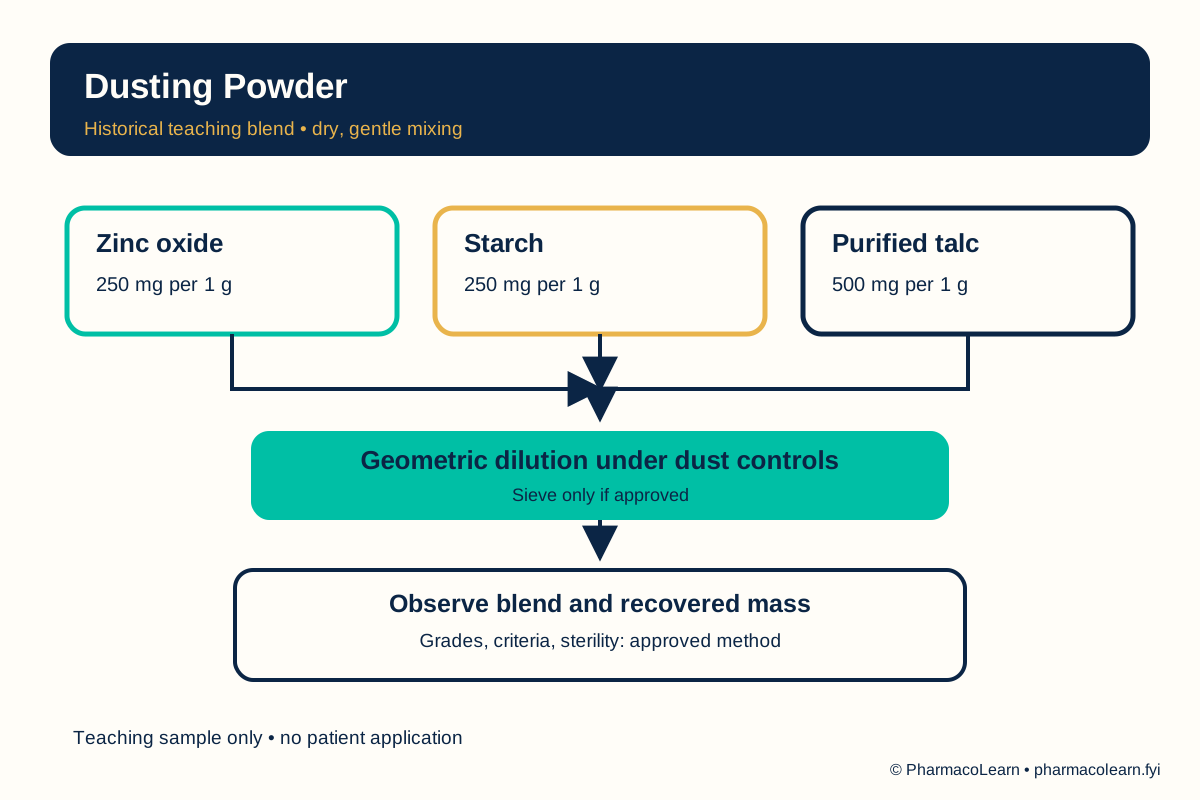
- If wet-lab mixing is approved, add the weighed zinc oxide and starch to a dry mortar or vessel and blend gently. Add the weighed talc gradually, using the instructor-approved geometric-dilution sequence. [3]
- If an approved sieve is specified, pass the blend through it with dust controls, then remix gently. The sieve size, rework limits, and pass criteria are to be recorded from the assigned current monograph or approved college method in the student record; do not copy an unrelated sieve number. [3]
- Record appearance, visible streaks or clumps, measured recovered mass, and flow into the container. A content-uniformity or particle-size test, if required, must be specified in your college lab manual and instructor's method sheet. [2, 3]
- Package in the approved dry container and label external-use teaching sample, intact skin only, not for patient use, and not sterile unless validated. Storage and disposal instructions must be specified in your college lab manual and instructor's method sheet. [2, 3]
5. Calculation, graph, or images as appropriate
| Record item | Historical master blend [2, 3] | Calculation for 1 g | Actual observation |
|---|---|---|---|
| Zinc oxide | 250 g per 1000 g | 0.25 g = 250 mg | Record here |
| Starch | 250 g per 1000 g | 0.25 g = 250 mg | Record here |
| Purified talc | 500 g per 1000 g | 0.50 g = 500 mg | Record here |
| Total theoretical mass | 1000 g | 1.00 g | Recovered mass Record here |
| Visible uniformity and flow | Criteria record from the assigned current monograph or approved college method | Observe and record | Record here |
| Talc specification and microbial status | Use authenticated formula or method | Record here | Record here |
Worked calculation: The factor for a 1 g sample from a 1000 g master blend is 1/1000 = 0.001. Zinc oxide = 250 g × 0.001 = 0.25 g; starch = 250 g × 0.001 = 0.25 g; talc = 500 g × 0.001 = 0.50 g. The theoretical total is 0.25 + 0.25 + 0.50 = 1.00 g. Enter the actual weighed and recovered masses in the student record. This arithmetic applies only to the cited teaching formula, not an authenticated modern product specification. [2, 3]
6. Result
State whether the exercise was a paper calculation or an approved supervised blend. Record actual quantities, recovered mass, appearance, visible clumps, and flow here until observed. Do not claim sterility, content uniformity, or suitability for application from a visual check. [2, 3]
7. References
- Pharmacy Council of India. Pharm.D. Regulations, 2008, Appendix A. Lists Dusting powder after Explosive powder.
- East Point College of Pharmacy. Pharmaceutics Practical Manual, Experiment 24: Dusting Powder. Gives the historical three-ingredient formula; its procedure text conflicts with that formula.
- East Point College of Pharmacy. Pharmaceutics Lab Manual, Experiment 17: Dusting Powder. Confirms the zinc oxide, starch, and talc ratio and describes their blending.
Back to Pharmaceutics Practicals · All Pharm D Practicals · Pharm D
Theory notes: Pharmaceutics